
Real estate has always been driven by visibility, trust, and timing. What has changed is where attention lives. Today, buyers scroll before they search, sellers evaluate agents based on online presence, and entire reputations are built through consistent social media visibility. Real estate social media marketing is no longer an optional branding exercise—it has become a primary engine for lead generation, authority building, and long-term business growth.
Consider a residential agent who struggled to differentiate in a competitive suburban market. Instead of relying only on listing portals, she began posting short property walkthrough videos, neighborhood insights, and behind-the-scenes client journeys on Instagram and Facebook. Within six months, sellers began referencing her videos during listing consultations. Her visibility transformed into credibility, and credibility converted into exclusive listings. This transformation illustrates the true power of strategic social media marketing in real estate.
Article Outline
- Definition and scope of real estate social media marketing
- Why social media has become essential for real estate growth
- Overview of the professional marketing framework
- Core components that drive consistent results
- How professionals implement scalable systems
What Is Real Estate Social Media Marketing
Real estate social media marketing is the strategic use of social platforms to promote properties, build personal or brokerage brands, generate qualified leads, and establish long-term relationships with buyers and sellers. It combines content creation, audience targeting, storytelling, and data analysis to influence decision-making throughout the property lifecycle.
This marketing discipline operates across multiple platforms, each serving different purposes:
- Instagram and TikTok: Visual storytelling, property tours, and brand personality
- Facebook: Community engagement, local targeting, and lead generation
- LinkedIn: Professional authority and investor relationships
- YouTube: Long-form property showcases and educational content
- Short-form video platforms: Rapid reach expansion and discovery
Unlike traditional advertising, social media marketing builds familiarity over time. Instead of interrupting audiences, it attracts them through valuable and relevant content that positions the agent or brokerage as the obvious trusted choice.
Why Real Estate Social Media Marketing Matters
Modern buyers and sellers begin their journey online, often forming opinions long before making direct contact. The scale of this shift is reflected in 97% of homebuyers using the internet during their home search. Social media is where discovery, trust formation, and decision acceleration now occur.
The impact extends beyond visibility. Social media creates familiarity, which reduces resistance during sales conversations. When prospects have already seen property tours, market insights, and client success stories, they approach agents with confidence instead of skepticism.
A commercial broker demonstrated this effect by consistently sharing short analysis videos about local office market trends. Over time, investors began reaching out directly, referencing specific videos that influenced their investment decisions. The broker was no longer chasing clients—clients were approaching him with established trust.
This shift represents a fundamental transformation in how real estate professionals attract and convert opportunities. Social media shortens sales cycles, increases perceived authority, and builds scalable trust.
Framework Overview
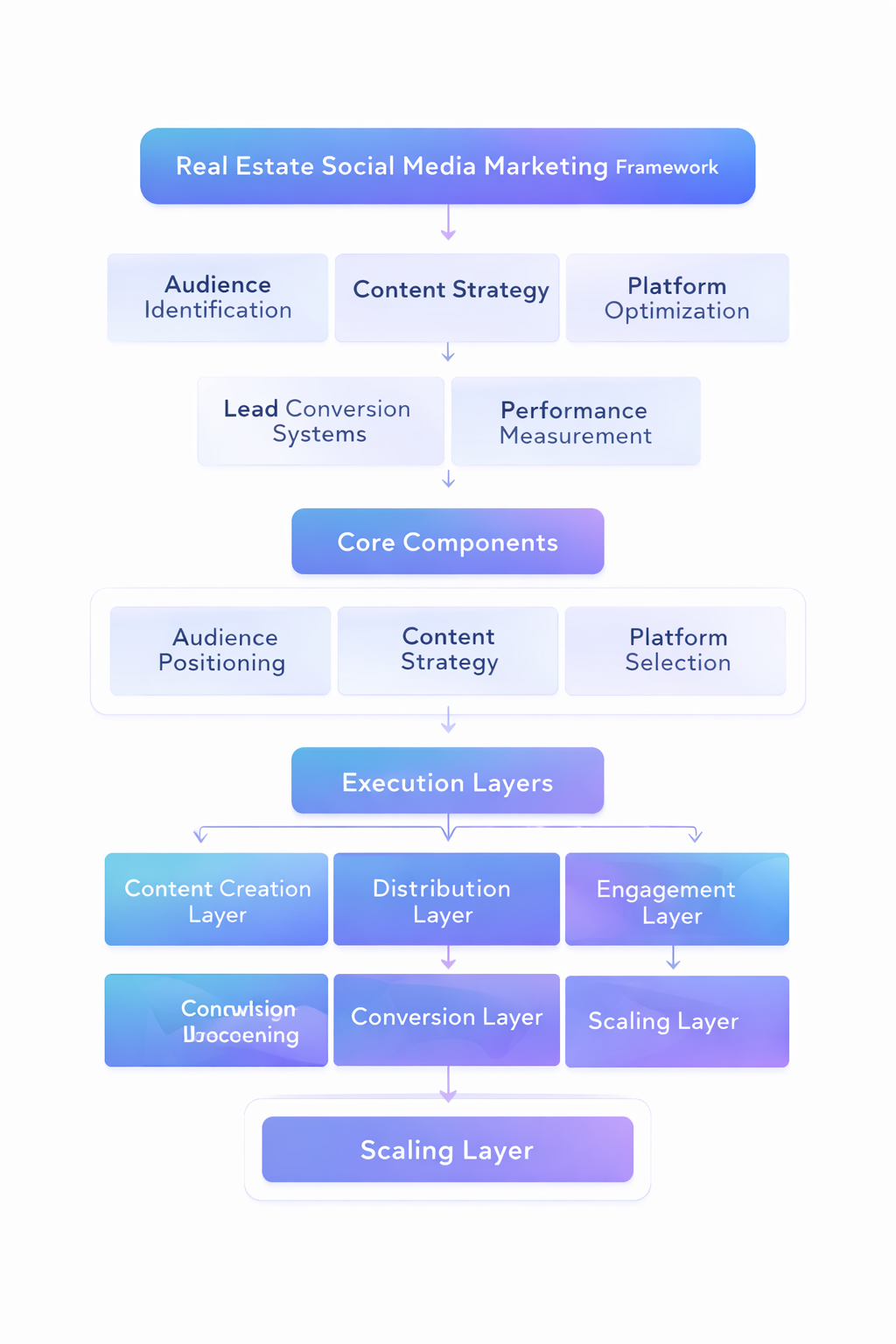
Effective real estate social media marketing follows a structured framework rather than random posting. This framework ensures consistency, scalability, and measurable results.
- Audience Identification: Defining ideal buyers, sellers, or investors
- Content Strategy: Creating content aligned with audience needs and intent
- Platform Optimization: Using the right platforms for maximum reach and relevance
- Lead Conversion Systems: Turning attention into inquiries and consultations
- Performance Measurement: Tracking engagement, reach, and conversion metrics
This framework transforms social media from a passive branding tool into an active business development system.
Core Components
Audience Positioning
Every successful strategy begins with clarity about the target audience. First-time buyers, luxury sellers, and property investors each require different messaging, content formats, and communication styles. Positioning determines how content resonates and converts.
Content Strategy
Content serves as the primary vehicle for trust building. Effective real estate content includes property walkthroughs, client success stories, educational insights, neighborhood highlights, and behind-the-scenes experiences. Each piece contributes to authority and familiarity.
Platform Selection
Not all platforms produce equal results. Visual platforms excel for property discovery, while professional platforms build investor relationships. Strategic selection ensures resources are invested where impact is highest.
Lead Capture and Conversion
Visibility alone does not generate business. Effective systems guide audiences toward inquiries, consultations, or property viewings. Clear calls to action, optimized profiles, and integrated contact pathways convert attention into opportunity.
Performance Tracking
Professional marketers analyze performance data to refine strategy. Engagement rates, reach, inquiries, and conversion metrics provide insight into what resonates. Businesses using structured social media strategies report significantly higher lead generation efficiency, supported by research such as video content consistently generating stronger engagement and conversion outcomes.
Professional Implementation
Professional implementation transforms social media from an occasional activity into a structured growth system. This involves planning, production, distribution, and optimization working together in a continuous cycle.
A boutique brokerage implemented a structured weekly content calendar, including property showcases, educational videos, and local market insights. Within months, inbound inquiries increased dramatically, and sellers began selecting the brokerage specifically because of its visible expertise and consistent online presence.
- Editorial planning: Structured calendars ensure consistent visibility
- Content production workflows: Efficient systems reduce time and increase output quality
- Strategic distribution: Publishing at optimal times improves reach and engagement
- Lead management integration: Connecting social media with CRM systems improves conversion
- Continuous optimization: Refining strategy based on measurable performance data
When implemented professionally, real estate social media marketing becomes a predictable engine for authority, trust, and sustained business growth.
Step By Step Implementation
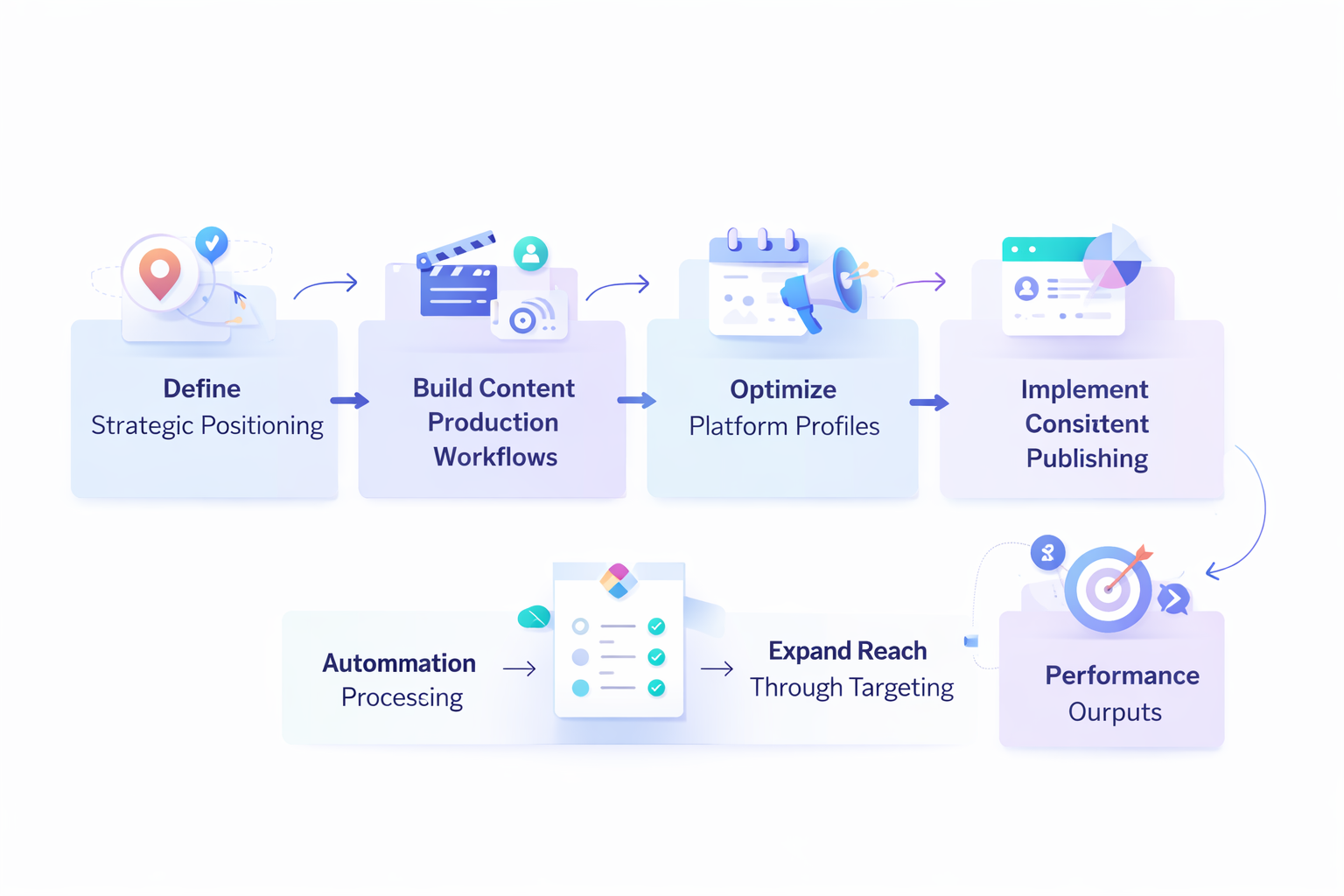
Implementing real estate social media marketing successfully requires structured execution rather than spontaneous posting. Professionals follow a clear sequence that builds visibility, authority, and lead flow in predictable stages.
A residential agent in Brno began implementation with no structured system. She posted listings occasionally, hoping to attract buyers. After adopting a structured implementation model, she transitioned from random posting to consistent authority-building. This structured approach reflects broader behavioral patterns where marketers prioritizing consistent content are 13 times more likely to see positive ROI.
Step 1: Define Strategic Positioning
Every implementation begins with positioning. Agents must define their ideal audience, geographic focus, and specialization. Without clarity, content lacks relevance and conversion potential.
A luxury-focused agent in Prague repositioned his messaging exclusively toward high-end property owners. Within months, he attracted qualified sellers aligned with his positioning. Specialization strengthens credibility, which reflects audience trust patterns where trusted advisors influence the majority of real estate decisions.
Step 2: Build Content Production Workflows
Content production systems eliminate inconsistency. Professionals batch-create videos, photos, and educational content weekly or monthly.
An agency implemented weekly filming sessions, producing multiple videos per session. This batch production improved efficiency dramatically. Content volume plays a critical role in discovery, aligning with platform dynamics where users spend an average of 2 hours and 31 minutes daily on social media, creating constant demand for fresh content.
Structured workflows often incorporate frameworks similar to those described in social media content calendar planning.
Step 3: Optimize Platform Profiles
Profiles function as conversion hubs. Optimized profiles clearly communicate specialization, location, and contact pathways.
A commercial broker increased inquiry volume simply by optimizing his profile description, adding client results, and including clear calls to action. Profile optimization directly impacts conversion rates, reflecting user behavior patterns where 75% of users judge business credibility based on online presence.
Step 4: Implement Consistent Publishing
Publishing consistency signals reliability to both audiences and platform algorithms.
An independent agent began publishing three videos weekly. Within four months, inbound inquiries increased significantly. Platform visibility favors consistency, reflecting engagement patterns where over half of global users access social platforms daily.
Step 5: Integrate Lead Capture Systems
Lead capture systems convert visibility into actionable opportunities. This includes direct messaging workflows, landing pages, and integrated CRM systems.
An agency integrated instant lead follow-up automation, ensuring no inquiry was missed. Response speed dramatically influences outcomes, as responding within five minutes increases conversion likelihood by 21 times.
Step 6: Expand Reach Through Targeting
Paid targeting accelerates audience growth and ensures content reaches qualified prospects.
A new agent targeting homeowners preparing to sell used geographic targeting campaigns to reach property owners in specific neighborhoods. This targeted visibility reflects advertising efficiency trends where digital advertising accounts for over 70% of total ad spend.
Targeting strategies often follow principles described in geographic audience targeting strategies.
Execution Layers
Implementation operates across multiple execution layers, each supporting different aspects of visibility and conversion.
Layer 1: Content Creation Layer
This layer focuses on producing content aligned with audience needs. Content variety improves engagement, reflecting platform performance trends where short-form video delivers the highest ROI among content formats.
Agents using structured content creation systems, similar to methods explained in content optimization frameworks, maintain consistent visibility.
Layer 2: Distribution Layer
Distribution ensures content reaches the intended audience through organic and paid channels.
A boutique agency expanded reach dramatically by distributing content across multiple platforms. Multi-platform strategies align with audience behavior patterns where over 63% of the global population uses social media.
Layer 3: Engagement Layer
Engagement converts passive viewers into active prospects. Responding to comments and messages builds trust and familiarity.
An agent increased conversion rates simply by responding quickly to every inquiry. Engagement responsiveness strengthens trust, supported by communication trends where mobile users expect immediate responses from businesses.
Layer 4: Conversion Layer
This layer transforms engagement into consultations, property showings, and signed clients.
Agencies implementing structured conversion systems aligned with principles explained in digital marketing funnel frameworks significantly improve client acquisition efficiency.
Layer 5: Scaling Layer
Scaling involves expanding reach, automating workflows, and increasing content production capacity.
Agents who scale systems effectively align with performance patterns where digitally advanced companies outperform competitors in growth.
Optimization Process
Optimization transforms implementation into continuous improvement. Every post provides performance feedback that informs future strategy.
An agency discovered through analytics that educational videos outperformed listing showcases. Adjusting content strategy increased engagement significantly. Data-driven optimization aligns with marketing performance patterns where companies using data-driven strategies achieve higher marketing effectiveness.
- Performance analysis: Identify high-performing content formats
- Audience behavior tracking: Understand engagement patterns
- Content refinement: Focus on proven formats
- Conversion optimization: Improve inquiry generation pathways
- Scaling successful strategies: Expand high-performing approaches
Agents using structured optimization workflows based on principles shared in algorithm visibility optimization maintain consistent growth.
Implementation Stories
A new real estate consultant began implementation with limited visibility and no structured marketing system. Initially, he relied on listing portals alone.
After implementing structured content production and publishing workflows, his visibility expanded dramatically. Within six months, inbound inquiries became his primary source of clients. This shift reflects broader discovery patterns where over 50% of users discover new brands through social platforms.
Another agency focused on educational content explaining the buying process. This positioned them as trusted advisors. Educational authority strengthens conversion rates, aligning with trust trends where buyers prefer working with knowledgeable professionals.
These stories illustrate a consistent principle: structured implementation produces predictable growth.
Statistics And Data
Data transforms real estate social media marketing from guesswork into a predictable growth system. Professionals track visibility, engagement, and conversion metrics to understand how audiences discover properties and evaluate agents.
The scale of opportunity is substantial. Digital behavior trends show that more than 5 billion people actively use social media platforms, creating unprecedented access to potential buyers and sellers. Real estate professionals who understand how to analyze performance data gain a measurable competitive advantage.
Platform usage continues to accelerate decision-making. Buyer research behavior indicates that 97% of homebuyers use online resources during their property search. Social media visibility influences early-stage perception before buyers contact agents directly.
Video content plays a dominant role in real estate discovery. Engagement trends demonstrate that video generates 1200% more shares than static content, significantly increasing organic reach. Agents producing video content consistently expand their visibility faster than those relying on static listing images.
Short-form video consumption continues to grow rapidly. Audience behavior shows that 91% of users watch online video content weekly. This creates continuous opportunity for agents who publish property walkthroughs and educational insights.
Social platforms also influence brand perception. Trust formation patterns indicate that 75% of consumers evaluate credibility based on online presence. Visibility directly influences perceived professionalism.
Lead generation efficiency improves significantly when social media becomes part of a structured strategy. Conversion data shows that social media ranks among the top lead generation channels for marketers. Real estate professionals leveraging structured strategies consistently outperform competitors relying on traditional methods alone.
Mobile usage amplifies accessibility. Consumer behavior research confirms that over 60% of searches originate from mobile devices, making mobile-optimized social content essential.
Engagement speed influences outcomes. Response efficiency data reveals that rapid response times increase conversion probability by over 20 times. Agents using integrated messaging and CRM systems improve conversion performance significantly.
Discovery patterns continue shifting toward algorithmic recommendations. Platform trends show that over 50% of users discover brands through social media feeds, highlighting the importance of consistent publishing.
Audience attention is also expanding globally. Digital adoption research indicates that social platform adoption continues growing annually, expanding the potential reach for real estate professionals.
Content frequency influences visibility. Engagement research confirms that brands publishing consistently experience significantly higher engagement rates. Consistency compounds reach over time.
Advertising effectiveness reinforces organic efforts. Digital marketing trends show that social media advertising exceeds $200 billion in annual revenue, demonstrating platform effectiveness in driving measurable business results.
Audience targeting improves efficiency dramatically. Campaign performance data indicates that data-driven targeting improves marketing efficiency significantly. Precision targeting ensures content reaches relevant audiences.
Long-term growth correlates with digital maturity. Business performance research confirms that digitally advanced companies consistently outperform competitors. Social media integration contributes directly to business expansion.
These statistics demonstrate a clear pattern: social media has become a primary driver of real estate discovery, engagement, and conversion.
Performance Benchmarks
Benchmarking allows real estate professionals to evaluate performance relative to industry standards. Understanding typical engagement and conversion ranges helps identify optimization opportunities.
A mid-sized brokerage analyzed its performance metrics after six months of consistent publishing. Their engagement rate increased steadily, reflecting broader platform performance trends where engagement rates improve with consistent publishing frequency.
Reach benchmarks vary depending on audience size and content quality. Platform behavior research indicates that over half of global users access social media daily, creating continuous exposure opportunities.
Conversion benchmarks also vary depending on targeting and messaging effectiveness. Funnel optimization research shows that personalized messaging significantly improves conversion performance.
Professionals evaluate performance using key indicators:
- Reach: Total audience exposure
- Engagement rate: Interaction relative to audience size
- Lead conversion rate: Inquiries generated from content
- Audience growth rate: Expansion of follower base
- Response time: Speed of communication with prospects
Agents implementing structured benchmarking frameworks similar to those described in performance-based advertising optimization identify growth opportunities faster.
Analytics Interpretation
Analytics interpretation transforms raw data into actionable insights. Professionals evaluate trends, patterns, and correlations to refine strategy.
A real estate consultant discovered that educational videos consistently generated more engagement than listing showcases. Adjusting content strategy toward educational content increased inbound inquiries. Educational content effectiveness aligns with behavioral trends where buyers prefer brands that provide valuable educational information.
Audience retention metrics also reveal content effectiveness. Video performance research shows that viewer retention strongly correlates with conversion likelihood.
Agents interpreting performance metrics using frameworks explained in algorithm performance analysis improve visibility predictability.
Key interpretation principles include:
- Identifying high-performing content formats
- Understanding audience engagement patterns
- Recognizing conversion-driving topics
- Adjusting strategy based on performance signals
- Scaling proven content formats
Data interpretation enables continuous optimization and sustainable growth.
Case Stories
A boutique agency implemented structured analytics tracking to evaluate content performance. Initially, they focused on property listings. However, analytics revealed that neighborhood education videos generated significantly higher engagement.
After adjusting strategy, engagement increased dramatically. This outcome reflects broader discovery patterns where content-driven discovery continues expanding across platforms.
Another commercial broker analyzed inquiry sources and discovered that video content generated the majority of inbound leads. Video-driven discovery aligns with behavioral patterns where video is the most effective content format for conversion.
Agents applying structured analytics frameworks similar to methods described in strategic content planning systems improve performance consistency.
These case stories reinforce a consistent principle: analytics provides clarity, and clarity drives performance improvement.
Professional Promotion
Professional promotion combines organic visibility with targeted amplification. Analytics identifies high-performing content, and promotion accelerates its reach.
A regional agency promoted its highest-performing educational videos using targeted advertising. Within months, inbound inquiries increased significantly. Promotion effectiveness aligns with marketing performance trends where social media advertising continues growing globally.
Audience targeting precision improves promotional efficiency. Data-driven targeting research confirms that data-driven campaigns outperform generic campaigns significantly.
Agents implementing structured promotion strategies based on principles shared in geographic targeting frameworks accelerate audience growth efficiently.
Professional promotion ensures content reaches qualified audiences, strengthens authority, and generates consistent business opportunities through real estate social media marketing.
Future Trends
Real estate social media marketing continues evolving as platforms prioritize personalization, video dominance, and algorithm-driven discovery. Professionals who anticipate these shifts position themselves ahead of competitors still relying on outdated listing-based promotion.
Video-first communication will continue expanding as the dominant format. Consumption patterns already show that over 90% of internet users watch video content regularly, reinforcing video as the primary medium for property discovery and agent credibility.
Artificial intelligence is transforming content creation, targeting, and automation. Marketing technology adoption trends reveal that AI adoption continues accelerating across industries, enabling agents to produce more content and analyze performance more efficiently.
Personalized algorithmic feeds will further increase visibility opportunities for professionals producing relevant content. Discovery patterns already demonstrate that algorithm recommendations drive the majority of video discovery.
Mobile-first engagement will continue shaping platform design. Mobile usage trends confirm that mobile devices generate the majority of web traffic globally, reinforcing the importance of mobile-optimized content.
Trust-based marketing will become even more critical. Consumer behavior research shows that buyers increasingly trust individuals more than corporate brands, strengthening the importance of personal brand development.
Agents who integrate emerging technologies and authority-driven strategies will dominate future real estate markets.
Strategic Framework Recap
The complete real estate social media marketing framework integrates multiple layers working together to create predictable growth.
- Foundation: Strategic positioning and audience clarity
- Tools: Scheduling, analytics, editing, and CRM integration
- Implementation: Consistent publishing and content workflows
- Analytics: Performance tracking and optimization
- Scaling: Automation, authority positioning, and audience expansion
- Future readiness: Adapting to evolving platform behavior
A regional agency that implemented this complete framework transitioned from inconsistent growth to predictable client acquisition. Their transformation reflects broader business performance trends where digitally mature organizations outperform competitors.
This framework converts social media from a passive branding channel into an active business growth engine.
FAQ – Built For Complete Guide
1. How long does real estate social media marketing take to produce results?
Most agents begin seeing measurable engagement improvements within 30 to 90 days. Consistent publishing compounds over time, and long-term consistency produces predictable inbound inquiries.
2. Which platform is best for real estate marketing?
The best platform depends on the target audience. Instagram and YouTube excel for visual property discovery, while LinkedIn is effective for investor relationships and commercial opportunities.
3. How often should agents post content?
Consistency matters more than frequency. Most professionals achieve strong results publishing three to five times per week while maintaining content quality.
4. Does video outperform photos in real estate marketing?
Yes. Engagement trends show that video content generates significantly higher engagement than static images, improving reach and conversion.
5. Can new agents compete using social media?
Yes. Social media allows new agents to build authority quickly by sharing educational insights, property tours, and market expertise.
6. Is paid advertising necessary?
Organic content builds authority, while paid advertising accelerates audience growth. Combining both produces optimal results.
7. What type of content generates the most leads?
Educational content, property walkthroughs, and client success stories consistently generate strong engagement and inquiries.
8. How important is personal branding?
Personal branding significantly improves trust. Buyers prefer working with agents they recognize and trust.
9. Do analytics tools improve performance?
Yes. Performance tracking identifies effective content strategies and improves decision-making accuracy.
10. Can social media replace traditional marketing?
Social media complements traditional marketing but often becomes the primary lead generation channel due to its reach and targeting capabilities.
11. How scalable is real estate social media marketing?
Highly scalable. Automation, content repurposing, and structured workflows allow agents to expand reach without increasing workload proportionally.
12. What is the biggest mistake agents make?
Inconsistent posting and lack of strategic positioning prevent long-term growth. Structured implementation produces the best results.
Work With Professionals
Real estate social media marketing has evolved into one of the most powerful client acquisition systems available today. Agents, marketers, and freelancers who build authority through structured content, analytics, and scalable systems position themselves for continuous opportunity. Digital client acquisition continues expanding rapidly, with social media marketing driving massive global business growth.
Many freelancers struggle to find consistent clients, even when they possess valuable marketing skills. The challenge is not capability—it is visibility and access to businesses actively seeking professional support. Platforms that connect freelancers directly with companies accelerate career growth dramatically.
Professionals who join specialized ecosystems gain access to clients actively searching for marketing expertise, social media management, and growth strategy support. This creates predictable opportunities rather than relying on unpredictable outreach.
markework.com helps freelancers connect with businesses that need real estate social media marketing and digital growth expertise. Instead of chasing clients, professionals position themselves where clients are already searching for solutions.
Freelancers using platforms like markework.com gain access to new client opportunities, expand their professional visibility, and build sustainable income streams in the rapidly growing digital marketing economy.
 Filip Konecny Enterprises