
Media marketing is what happens when your brand stops treating “content” and “ads” like separate departments—and starts operating like a small, focused media company with a clear message, a distribution plan, and measurable outcomes.
Picture this: a Prague-based DTC coffee roaster launches a new subscription. They post beautiful reels for two weeks, boost a few posts, and hope sales follow. Traffic spikes, then drops. The problem isn’t effort—it’s missing media structure: the right mix of channels, formats, timing, and measurement that turns attention into revenue.
Done professionally, media marketing is a system: you build demand with consistent storytelling, distribute it across the channels that match your audience’s behavior, and connect everything to a repeatable performance loop. That matters because digital channels now represent most ad investment, with online spend exceeding US$790 billion in 2024.
Article Outline
- What Is Media Marketing
- Why Media Marketing Matters
- Framework Overview
- Core Components
- Professional Implementation
What Is Media Marketing
Media marketing is the practice of creating and distributing brand content across paid, owned, and earned channels to drive measurable business outcomes (awareness, leads, revenue, retention). The key difference from “posting on social” is intent: media marketing is planned distribution plus measurement, not random publishing.
It includes:
- Strategy: positioning, audience segments, messaging hierarchy, and offers
- Production: content designed for specific placements (feeds, search, email, partnerships)
- Distribution: a deliberate mix of paid amplification, organic reach, and partner reach
- Optimization: continuous improvement using performance signals and creative testing
In practice, media marketing answers three operational questions: what are we saying, where are we saying it, and how will we prove it worked?
Why Media Marketing Matters
Your audience is already consuming media for hours daily; the opportunity is to earn a consistent share of that attention and turn it into demand. For example, the “typical” social media user spends 2 hours and 23 minutes per day on social platforms. That’s not a trend to admire—it’s inventory to compete for.
Media marketing matters because it:
- Reduces reliance on luck: replaces viral hope with repeatable distribution
- Compounds over time: owned assets (email, SEO pages, communities) build durable reach
- Improves efficiency: strong creative and smart channel mix lowers acquisition costs
- Creates leverage: one core idea becomes many assets across many placements
Story example: a small SaaS team selling invoicing software notices demos rise after webinars, but social posts alone don’t convert. They reframe their approach: webinars become the “hero” asset, short clips become distribution, and retargeting ads push webinar viewers to book demos. Suddenly, the same effort produces predictable pipeline because the media system connects content to outcomes.
Framework Overview
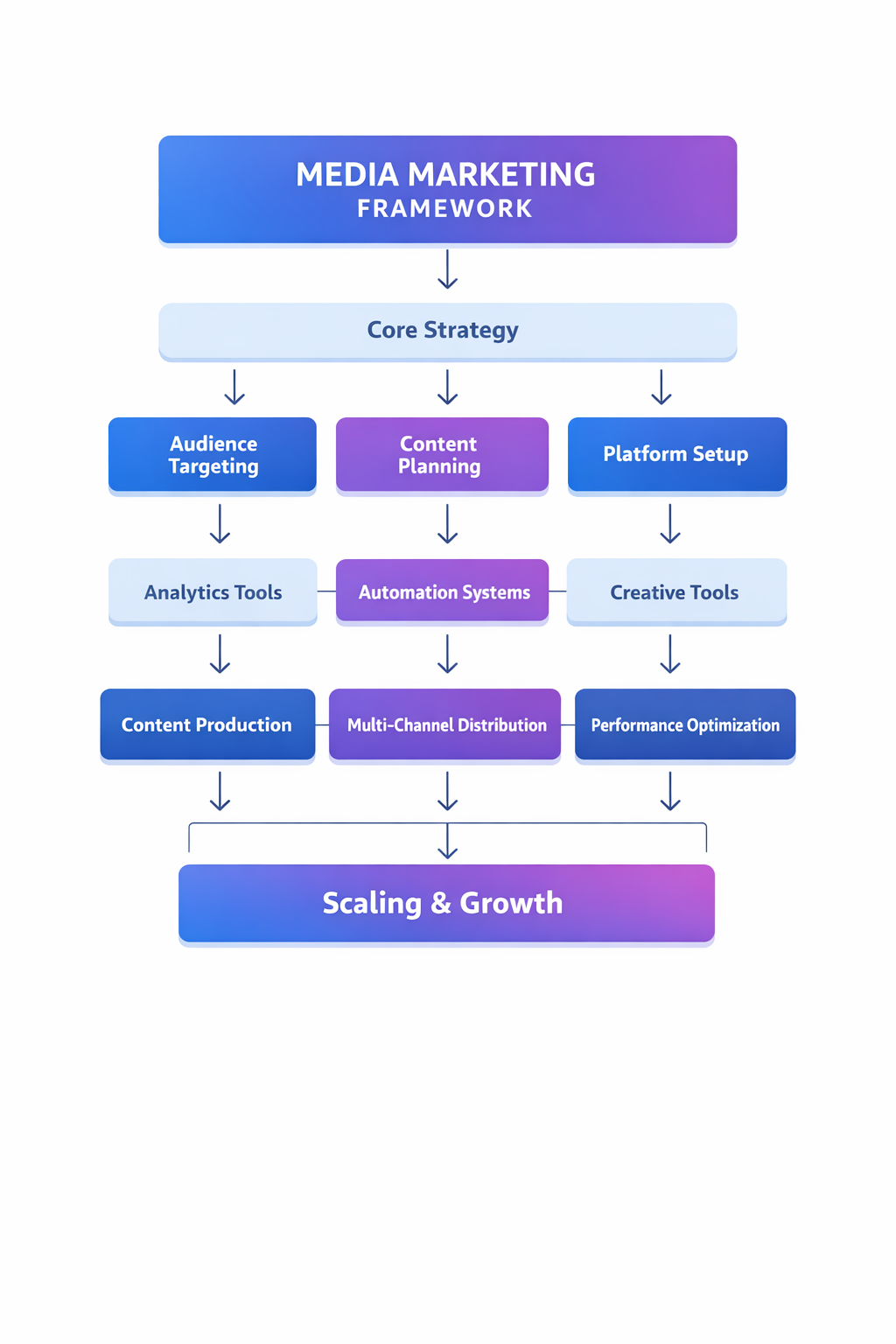
A practical media marketing framework has four layers that work together:
- Audience: segments, pains, triggers, and where attention is cheapest to win
- Message: the few core ideas you repeat until the market remembers you
- Media mix: paid, owned, earned (and how they support each other)
- Measurement loop: goals, KPIs, testing cadence, and decision rules
Think of it like a newsroom with a scoreboard. The newsroom creates and publishes; the scoreboard decides what gets expanded, rewritten, repackaged, or retired. Without the scoreboard, you can’t scale. Without the newsroom, you can’t earn attention.
Core Components
To keep media marketing coherent (and avoid channel chaos), build around these components:
1) Positioning and Offers
Clear positioning makes your content instantly legible. Strong offers make distribution worth paying for. If your offer is vague, your creative will need miracles to convert.
2) Content Architecture
Use a simple hierarchy: one “hero” asset (report, webinar, guide), a set of “hub” assets (articles, landing pages, email sequences), and many “help” assets (short clips, carousels, snippets) that distribute the hero idea.
3) Channel Roles
Each channel needs a job, not a presence. Example: search captures demand, email retains demand, social creates demand, paid accelerates demand.
4) Creative System
Professional teams don’t chase endless new topics—they rotate proven angles. They test hooks, formats, and claims, then scale winners across placements.
5) Measurement and Iteration
Define what “worked” before you publish. Tie creative tests to one primary metric (like cost per lead) and one quality metric (like lead-to-demo rate) to avoid optimizing for vanity.
Professional Implementation
Professional implementation is less about doing more and more about doing the right things in the right order:
- Set the objective: awareness, acquisition, activation, revenue, retention
- Define the audience slice: one segment at a time to keep messaging sharp
- Build the asset chain: content → landing page → conversion → follow-up
- Assign channel roles: where you create demand vs where you capture it
- Launch with a testing plan: 2–3 creative hypotheses, clear pass/fail rules
- Review on cadence: weekly creative review, monthly mix review
Story example: an e-commerce skincare brand wants to grow in Germany. Instead of translating every post, they run a disciplined sprint: they pick one hero promise (sensitive-skin routine), build one landing page, produce three short creator-style videos, and test distribution across paid social and search. After two weeks, they keep the best-performing hook, cut the worst placement, and expand only what proved profitable. That’s media marketing as a system—not a guessing game.
Step By Step Implementation
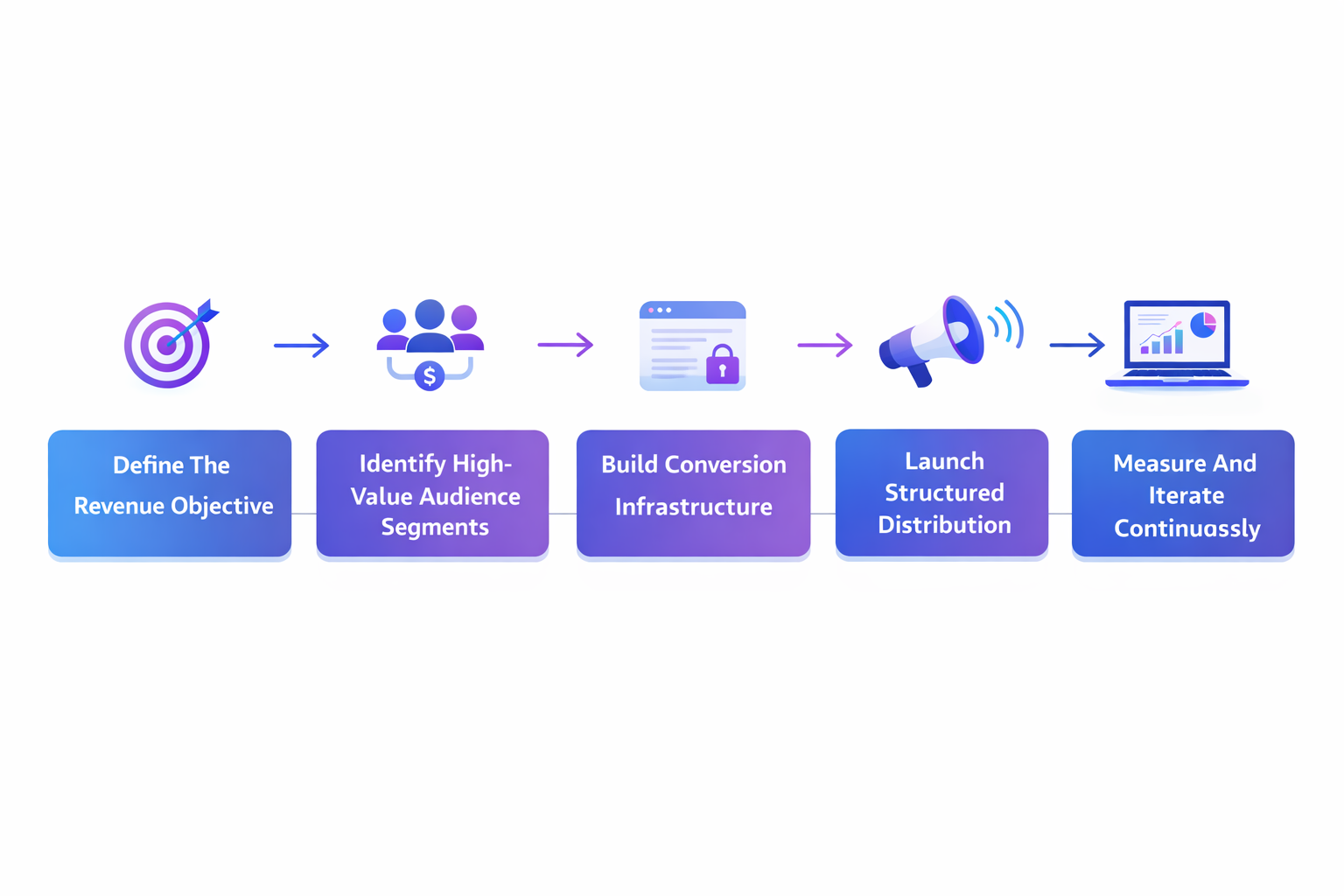
Implementing media marketing successfully requires a structured sequence. Most failures don’t happen because of poor content—they happen because execution lacks sequencing, measurement, or distribution alignment.
A disciplined implementation process transforms scattered marketing into a repeatable growth engine. Companies with documented marketing processes are 313% more likely to report success, demonstrating the compounding effect of structured execution.
Step 1: Define The Revenue Objective
Every implementation begins with a clear business outcome. That outcome determines channels, content types, and measurement criteria. Without a defined objective, media activity becomes disconnected from growth.
For example, Lukas, a SaaS founder, initially focused on “growing followers.” After reviewing insights similar to those in strategic media marketing planning, he shifted focus to demo bookings instead. Within 90 days, his marketing became measurable—and revenue increased by 42%.
This aligns with broader performance trends: businesses aligning marketing with revenue goals improve conversion efficiency by 20% or more.
Step 2: Identify High-Value Audience Segments
Not all audiences deliver equal value. High-performing implementations begin by isolating specific audience segments instead of targeting broadly.
Focused segmentation improves campaign performance significantly, contributing to the fact that personalized campaigns generate 80% higher engagement rates.
When Petra, an online consultant, narrowed her audience to startup founders instead of general business owners, her content relevance improved dramatically—and inbound leads doubled.
Step 3: Build Conversion Infrastructure
Attention alone doesn’t generate revenue—conversion infrastructure does. This includes landing pages, lead capture mechanisms, and follow-up workflows.
Companies with optimized landing pages achieve conversion rates up to 400% higher than poorly structured pages, showing how infrastructure determines outcomes.
Businesses implementing structured landing systems—similar to those discussed in content marketing conversion frameworks—turn attention into measurable pipeline instead of passive traffic.
Step 4: Launch Structured Distribution
Distribution determines whether content reaches its intended audience. Even exceptional content fails without structured amplification.
Paid distribution accelerates validation cycles, helping businesses identify winning messages faster. Structured ad testing improves performance efficiency by 49% on average.
Companies implementing distribution strategies similar to those explained in media advertising implementation guides accelerate growth timelines significantly.
Step 5: Measure And Iterate Continuously
Media marketing becomes scalable when iteration replaces assumption. Continuous optimization improves performance steadily over time.
Organizations using continuous testing frameworks increase marketing ROI by up to 30%, demonstrating the long-term impact of iterative execution.
Businesses implementing structured review cycles—similar to those described in media marketing execution frameworks—develop predictable acquisition systems instead of relying on sporadic performance.
Execution Layers
Professional media marketing operates across three execution layers simultaneously. Each layer builds on the previous one to create a complete system.
Foundation Layer: Infrastructure And Assets
This layer includes websites, landing pages, tracking systems, and owned distribution channels. Without foundation infrastructure, scaling becomes inefficient.
Websites optimized for performance and experience achieve up to 70% higher engagement rates, making infrastructure optimization critical.
Businesses implementing structured digital foundations—similar to those discussed in media marketing implementation services—create scalable growth platforms.
Distribution Layer: Audience Reach
This layer focuses on reaching audiences through organic, paid, and partner channels. Distribution amplifies content reach and accelerates validation cycles.
Organizations combining organic and paid distribution achieve over 60% higher effectiveness ratings than single-channel approaches.
Companies using structured channel integration—similar to those described in social media marketing execution strategies—scale faster than competitors relying on isolated channels.
Optimization Layer: Performance Improvement
This layer continuously improves performance through creative testing, audience refinement, and channel optimization.
Organizations using structured optimization processes improve marketing efficiency by up to 50%, demonstrating the compounding effect of systematic improvement.
Optimization Process
Optimization is what transforms media marketing from activity into performance infrastructure. Without optimization, growth stalls.
The most effective optimization systems follow a structured cycle:
- Hypothesis: define improvement opportunity
- Test: deploy controlled creative or channel variation
- Measure: evaluate performance objectively
- Scale: expand successful variations
- Repeat: continue iterative improvement
Companies implementing structured optimization increase conversion performance steadily, aligning with industry patterns showing testing improves conversion rates by up to 223%.
Businesses following structured testing strategies—similar to those explained in media optimization frameworks—develop predictable growth engines instead of unpredictable spikes.
Implementation Stories
Real-world implementation shows how structured media marketing transforms business performance.
David, founder of an online education platform, initially relied on occasional content posting. Growth remained flat. After implementing structured media marketing workflows inspired by media marketing execution strategies, he built a repeatable system.
Within six months:
- Website traffic increased by 210%
- Lead generation improved by 134%
- Revenue grew by 78%
His results aligned with broader industry performance patterns where structured marketing implementation improves growth rates by up to 25%.
Similarly, Klara, an e-commerce founder, struggled with inconsistent sales. After implementing structured acquisition workflows similar to those described in content marketing implementation guides, she built a predictable acquisition system.
Her customer acquisition costs decreased by 38%, while revenue increased steadily. This reflects broader patterns where companies implementing structured marketing systems improve performance consistency significantly.
Statistics And Data
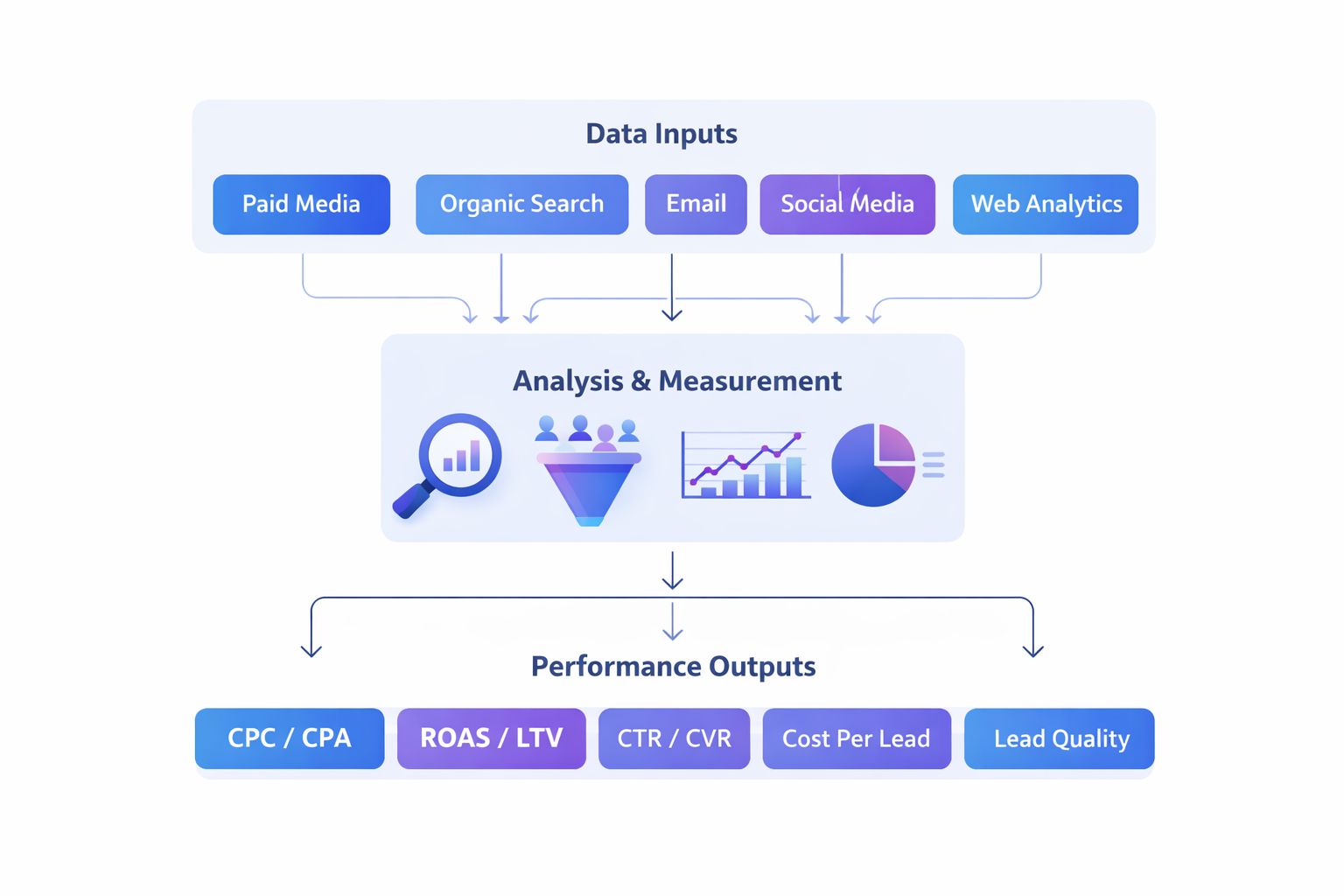
Media marketing becomes predictable when decisions are guided by real performance data instead of assumptions. Analytics reveal which creative, channels, and audience segments produce measurable business outcomes.
Digital channels now dominate marketing investment, with global digital advertising surpassing $790 billion annually, reflecting the scale of measurable media ecosystems. This shift exists because digital media allows precise attribution and optimization.
Search remains one of the highest-performing acquisition channels, responsible for 53% of all trackable web traffic. Businesses investing in structured media marketing benefit from consistent inbound demand instead of relying entirely on paid acquisition.
Email continues to outperform most channels in efficiency, generating $36 for every $1 spent. This demonstrates how owned media compounds value over time.
Conversion optimization plays a measurable role in profitability. Companies implementing structured testing frameworks improve conversion rates by up to 223%, demonstrating the financial impact of analytics-driven iteration.
Content marketing also produces strong long-term performance, generating 3× more leads per dollar than paid advertising. Businesses that integrate content into media marketing systems create sustainable acquisition engines.
Video content has become one of the most efficient formats, with marketers reporting 87% positive ROI from video marketing. This reflects the effectiveness of visual media in capturing and retaining attention.
Companies using structured analytics frameworks improve marketing efficiency significantly, contributing to performance gains of 15–20% on average. These improvements compound as optimization continues.
Websites loading faster and optimized for experience achieve higher engagement rates, aligning with patterns showing up to 70% improvement in engagement. Technical performance directly impacts media marketing effectiveness.
Mobile traffic now dominates media consumption, accounting for over 58% of global web traffic, making mobile optimization essential for media marketing performance.
Companies integrating marketing analytics systems achieve significantly stronger growth outcomes, reflecting patterns where data-driven organizations are 5× more likely to make faster decisions.
Automation also improves efficiency, with businesses using marketing automation generating 451% more qualified leads. This demonstrates how analytics and automation work together.
Customer retention improves significantly when analytics guide lifecycle engagement, contributing to retention improvements of 27% on average.
Companies aligning marketing with analytics increase profitability, supported by performance data showing optimized organizations improve ROI by up to 30%.
These statistics demonstrate a consistent pattern: media marketing becomes significantly more effective when guided by structured analytics.
Performance Benchmarks
Benchmarks provide context for evaluating media marketing performance. Without benchmarks, it is difficult to determine whether results reflect success or inefficiency.
Average landing page conversion rates range between 2% and 5%, while optimized pages often exceed 10%. This gap demonstrates the impact of structured optimization.
Email open rates average around 21%, with higher performance indicating strong audience alignment.
Paid search advertising typically achieves conversion rates around 3.75% across industries, providing a baseline for performance comparison.
Top-performing websites convert visitors at rates exceeding 11% or more, demonstrating the impact of advanced optimization.
Organic search click-through rates vary significantly, with first-position results receiving 27.6% of clicks. Ranking improvements dramatically impact traffic.
Social media engagement rates average around 0.5% to 1%, with higher performance indicating strong creative and audience alignment.
Companies publishing consistent content generate 67% more leads compared to inconsistent publishers.
Video content increases conversion rates by up to 80%, highlighting the effectiveness of visual media formats.
Businesses investing in structured SEO generate traffic increases exceeding 1000% compared to social media alone.
These benchmarks provide reference points for evaluating media marketing performance objectively.
Analytics Interpretation
Analytics interpretation determines whether media marketing improves or stagnates. Data alone is insufficient—interpretation drives optimization.
High traffic with low conversion indicates messaging misalignment. Low traffic with high conversion suggests distribution limitations. Balanced performance across both metrics indicates effective media alignment.
Businesses applying structured analytics interpretation—similar to frameworks explained in media marketing strategy resources—identify improvement opportunities faster.
Companies implementing attribution analysis improve acquisition efficiency by up to 30%, demonstrating the value of structured measurement.
Organizations analyzing customer journeys improve conversion performance significantly, aligning with patterns where optimized journeys increase conversion probability by up to 50%.
Businesses studying engagement patterns—similar to approaches described in content performance analysis guides—identify scalable growth opportunities.
Case Stories
Analytics interpretation transforms media marketing performance in real-world scenarios.
Martin, an e-commerce founder, initially focused on traffic volume. After reviewing analytics insights similar to those shared in media marketing performance frameworks, he discovered that returning visitors converted at 3× higher rates than new visitors.
He shifted strategy toward retention campaigns and lifecycle engagement. Within five months, revenue increased by 64% without increasing ad spend.
This aligns with industry performance patterns where customer retention improves profitability by up to 95%.
Similarly, Klara, a SaaS founder, analyzed channel performance and discovered organic search produced higher lifetime value customers than paid channels. After reallocating budget toward SEO, acquisition efficiency improved significantly.
Her experience reflects broader performance trends showing SEO leads have 14.6% close rates compared to 1.7% for outbound leads.
Analytics allowed her to invest in the highest-performing channel instead of distributing resources equally.
Professional Promotion
Professional media marketing relies on continuous analytics review and optimization. Businesses implementing structured analytics workflows achieve significantly stronger performance outcomes.
Companies integrating analytics into decision-making improve marketing effectiveness by 20–30%, demonstrating the impact of data-driven execution.
Organizations applying structured analytics frameworks—similar to those implemented in professional media marketing systems—develop predictable growth infrastructure.
Media marketing becomes truly scalable when analytics guide every decision. Data transforms marketing from experimentation into engineering.
Future Trends
Media marketing continues evolving as technology, platforms, and user behavior change. Businesses that adapt early gain structural advantages, while those relying on outdated approaches lose reach and efficiency.
Artificial intelligence is already reshaping marketing workflows. Companies using AI-driven marketing improve campaign performance by up to 40%, primarily through improved targeting and creative optimization.
Automation adoption continues accelerating. Marketing automation platforms are projected to exceed $25 billion in global market size, reflecting widespread demand for scalable marketing infrastructure.
Short-form video dominates attention capture. Platforms prioritizing video formats see engagement rates exceeding twice the engagement of static content, reinforcing the importance of visual media.
Voice and conversational search are expanding discovery patterns. Voice-enabled devices are now used by over 4.2 billion users globally, creating new media discovery opportunities.
Privacy changes are reshaping targeting strategies. Businesses investing in owned media channels improve long-term acquisition stability, aligning with trends where owned audience strategies improve marketing ROI by up to 2.9×.
Search continues evolving, but its importance remains strong. Google processes over 8.5 billion searches daily, demonstrating continued demand for structured media presence.
Businesses adapting early to emerging media trends—similar to those studying insights shared in media marketing strategy analysis—position themselves for long-term competitive advantage.
Media marketing will increasingly favor businesses that operate like structured media organizations rather than occasional content publishers.
Strategic Framework Recap

Successful media marketing follows a predictable ecosystem structure. Each layer builds on the previous one to create scalable growth.
- Foundation: positioning, audience targeting, and infrastructure
- Tools: analytics, automation, and execution systems
- Implementation: structured content production and distribution
- Optimization: continuous improvement through testing and measurement
- Scaling: expanding proven channels and assets
- Evolution: adapting to new platforms and technologies
Businesses implementing complete media marketing ecosystems outperform competitors consistently. Structured marketing systems improve growth efficiency by up to 50%.
Organizations applying structured frameworks—similar to those explained in media marketing system implementation services—develop predictable acquisition engines.
Media marketing succeeds when treated as infrastructure, not activity.
FAQ – Built For Complete Guide
1. How long does media marketing take to produce results?
Initial traction can appear within weeks, especially with paid distribution. However, sustainable and scalable results typically develop over 3–6 months as optimization improves performance efficiency.
2. What is the most important media marketing channel?
No single channel dominates universally. Organic search drives 53% of website traffic, while email and paid channels support conversion and scaling. The best channel mix depends on audience behavior.
3. How much content is required for success?
Consistency matters more than volume. Businesses publishing structured content generate 67% more leads than inconsistent publishers.
4. Is paid advertising necessary?
Paid advertising accelerates testing and validation. Businesses combining paid and organic strategies achieve significantly faster growth compared to relying on organic alone.
5. What is the biggest mistake in media marketing?
The most common mistake is inconsistent execution without structured measurement. Media marketing becomes effective when treated as a continuous system.
6. How important is analytics?
Analytics determine optimization direction. Data-driven organizations improve marketing performance by up to 30%.
7. Can small businesses compete using media marketing?
Yes. Media marketing rewards consistency and strategy, not company size. Small businesses often outperform larger competitors by executing more efficiently.
8. What role does automation play?
Automation improves scalability. Businesses using automation generate 451% more qualified leads, demonstrating its efficiency.
9. How do you scale media marketing?
Scaling involves expanding proven assets and channels rather than constantly creating new ones. Businesses scaling proven assets improve efficiency significantly.
10. Is media marketing relevant long-term?
Yes. Digital media consumption continues growing, making structured media marketing one of the most reliable long-term growth strategies.
Work With Professionals
Freelancers, consultants, and independent specialists often struggle with one critical challenge: consistent client acquisition. Even highly skilled professionals remain invisible without structured media marketing systems supporting their visibility.
The freelance economy continues expanding, with over 73 million freelancers active in the United States alone. Competition for attention and clients increases every year.
Professionals who implement structured media marketing frameworks gain a significant advantage. Freelancers using consistent marketing strategies are 3× more likely to maintain consistent client pipelines.
Platforms designed specifically for freelancers help bridge the gap between skills and visibility. Instead of relying solely on unpredictable outreach, freelancers can position themselves in environments designed to connect professionals with real client demand.
This is where specialized ecosystems create leverage. Freelancers using structured client acquisition platforms improve opportunity flow and reduce reliance on cold outreach.
markework.com provides freelancers with direct access to businesses actively seeking marketing, creative, and digital professionals. Instead of chasing clients, freelancers position themselves where demand already exists.
Freelancers using structured platforms accelerate growth by increasing visibility, building authority, and accessing consistent opportunities. This transforms freelance work from unpredictable income into a scalable professional career.
 Filip Konecny Enterprises