

Social Media ROI: How to Measure, Prove, and Scale Marketing Impact
Social media used to be treated as a branding channel where businesses posted content, counted likes, and hoped the attention eventually turned into customers. That era is over. Today, executives expect clear evidence that every marketing investment contributes to measurable growth.
The challenge is that social platforms influence the customer journey in ways that are not always obvious. Someone might discover a brand through a video, read reviews weeks later, and only then make a purchase. Without a structured approach to measuring social media ROI, the real value of those interactions remains hidden.
This is exactly why social media ROI has become one of the most important metrics in modern marketing. Organizations want to understand not just how many people see their content, but how those interactions translate into revenue, customer loyalty, and long-term brand equity.
The stakes are high. Digital marketing budgets continue to shift toward social platforms as performance improves and audiences spend more time there. Data compiled in recent marketing research shows that social media advertising now represents roughly three out of every ten dollars spent on digital ads, demonstrating how central these platforms have become in modern marketing strategies. When that level of investment is involved, measuring the return is no longer optional.
This guide explains how social media ROI works, why it matters, and how professional marketing teams build systems that reliably connect social activity to real business outcomes.
Article Outline
- What Is Social Media ROI
- Why Social Media ROI Matters
- Framework Overview
- Core Components of Social Media ROI
- Professional Implementation
What Is Social Media ROI

Social media ROI represents the measurable return a business receives from the time, budget, and resources invested in social media marketing activities. In simple terms, it answers a straightforward question: how much value did your social media efforts generate compared to what they cost?
The concept comes from the broader idea of return on investment used in finance and marketing. A typical marketing ROI calculation compares revenue generated by a campaign with the money spent to run it. A commonly used formula expresses ROI as the percentage difference between value generated and total investment divided by that investment.
In social media marketing, the calculation follows the same logic. Many organizations use a version of the formula explained in detailed marketing measurement guides: ((earnings from social media – total costs) ÷ costs) × 100. This produces a percentage that represents the efficiency of the investment.
What makes social media ROI unique is the range of outcomes it includes. Revenue from direct purchases is only part of the story. Social media can also generate leads, influence product discovery, reduce customer support costs, and strengthen relationships with existing customers. Each of these outcomes contributes value that must be included when measuring ROI.
This broader view reflects how modern customer journeys work. People rarely discover a brand and purchase instantly. Instead, they encounter multiple touchpoints across platforms before making a decision. Social media often serves as the discovery and engagement layer within that process.
Because of this role, measuring social media ROI requires more than tracking likes or impressions. It requires connecting those interactions to real business outcomes such as conversions, sales, retention, and customer lifetime value.
Why Social Media ROI Matters
For marketing teams, proving social media ROI is often the difference between being viewed as a cost center and being recognized as a strategic driver of growth. When the financial impact of social media is clearly measured, executives gain confidence that these channels deserve continued investment.
Industry research consistently shows that social media has become one of the most effective channels in the modern marketing mix. Data compiled in the HubSpot State of Marketing research shows that a significant share of marketers rank Facebook and Instagram among the channels delivering the highest ROI in their campaigns. These results reflect the ability of social platforms to reach large audiences while offering precise targeting capabilities.
The growing influence of social media is also visible in audience behavior. Recent global usage research summarized in marketing trend reports shows that platforms such as TikTok, LinkedIn, and Instagram continue to grow rapidly, with audience growth rates exceeding ten percent annually in several cases. This constant expansion means brands cannot afford to ignore social channels when building their customer acquisition strategies.
When organizations fail to measure ROI, they operate without a reliable understanding of which content formats, campaigns, or platforms are actually producing results. Budgets may be spent on tactics that generate attention but not revenue.
On the other hand, companies that rigorously track social media ROI gain clear strategic advantages. They can identify the platforms that produce the highest conversion rates, understand which content types influence purchasing decisions, and allocate resources to the campaigns that drive the greatest impact.
In practice, this means social media stops being treated as a standalone activity and becomes an integrated part of the broader growth strategy.
Framework Overview
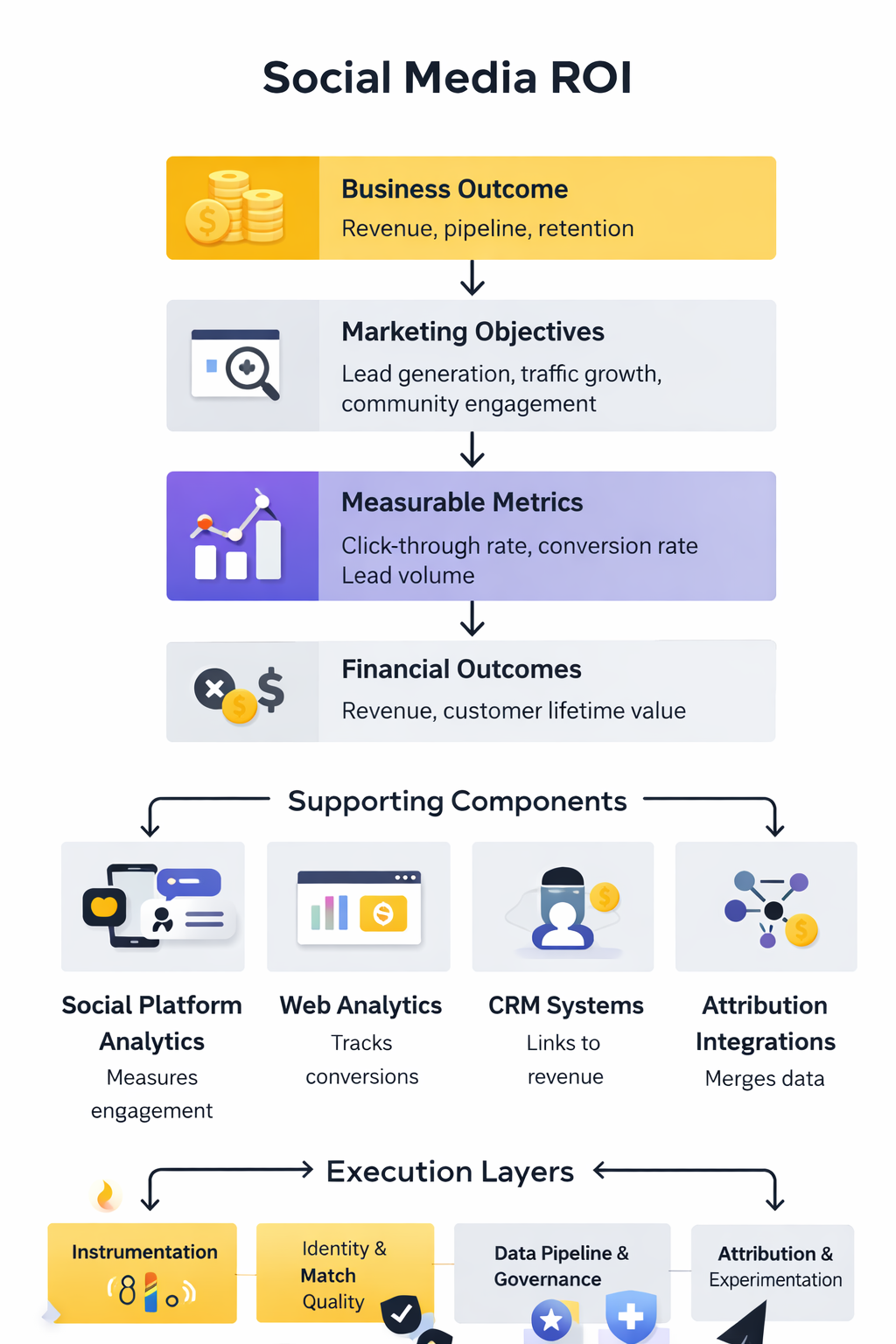
Measuring social media ROI consistently requires a structured framework. Without one, marketers often focus on surface-level metrics such as follower counts or engagement rates that do not necessarily reflect real business impact.
A robust framework typically connects four layers of measurement: business goals, marketing objectives, measurable metrics, and financial outcomes. Each layer builds on the previous one to ensure that social media activity directly contributes to organizational priorities.
The process usually begins by defining the business outcome that matters most. This might be revenue growth, customer acquisition, brand awareness, or retention. Once the business objective is clear, marketers translate it into specific social media goals such as lead generation, traffic growth, or community engagement.
From there, measurable metrics are assigned to each goal. These may include click-through rates, conversion rates, lead volume, or average order value from social traffic. The final step connects these metrics to financial outcomes by assigning monetary value to each measurable action.
This framework transforms social media analytics from a reporting exercise into a strategic system for decision-making. Instead of asking whether a post performed well, marketing teams can evaluate whether their social efforts contributed to revenue growth and long-term customer relationships.
Core Components of Social Media ROI
To calculate social media ROI accurately, organizations must account for both the value generated by social activity and the total investment required to produce it. Each side of this equation includes several components that need to be measured carefully.
The first component is revenue attribution. This involves identifying how many purchases, leads, or subscriptions originated from social media interactions. Modern analytics tools can track these journeys through referral links, conversion tracking, and attribution modeling.
The second component is engagement value. Social media often influences purchasing decisions long before the final transaction occurs. Engagement metrics such as comments, shares, and video views indicate growing interest in a brand and can contribute to later conversions.
The third component involves customer acquisition costs. Every social campaign requires investment in content production, advertising budgets, analytics tools, and staff time. These costs must be included when calculating ROI to ensure the final percentage accurately reflects the true investment.
Finally, long-term value should be considered. Customers acquired through social channels may continue purchasing over time, generating recurring revenue. When this lifetime value is included in the analysis, the return from social media campaigns often becomes significantly higher than initial calculations suggest.
Professional Implementation
In professional marketing environments, measuring social media ROI is not handled manually through spreadsheets. Instead, organizations build integrated analytics systems that combine data from advertising platforms, web analytics tools, and customer relationship management systems.
This integration allows marketers to trace the full customer journey from the first social interaction to the final purchase. For example, a potential customer might first encounter a brand through a short video, later click a link to visit the company website, and eventually convert after receiving a promotional email. Advanced attribution models help connect these events into a single measurable journey.
Another critical element of professional implementation is experimentation. High-performing marketing teams constantly test different content formats, audience segments, and messaging strategies to identify which combinations generate the strongest ROI. By systematically comparing results across campaigns, they refine their strategies over time.
Organizations that approach social media ROI this way transform social platforms into reliable revenue channels. Instead of guessing what works, they rely on measurable data to guide every decision, from content creation to advertising investment.
In the next part of this guide, we will explore the specific metrics marketers use to track social media ROI and how those metrics reveal the real performance of social campaigns.
Step-by-Step Implementation
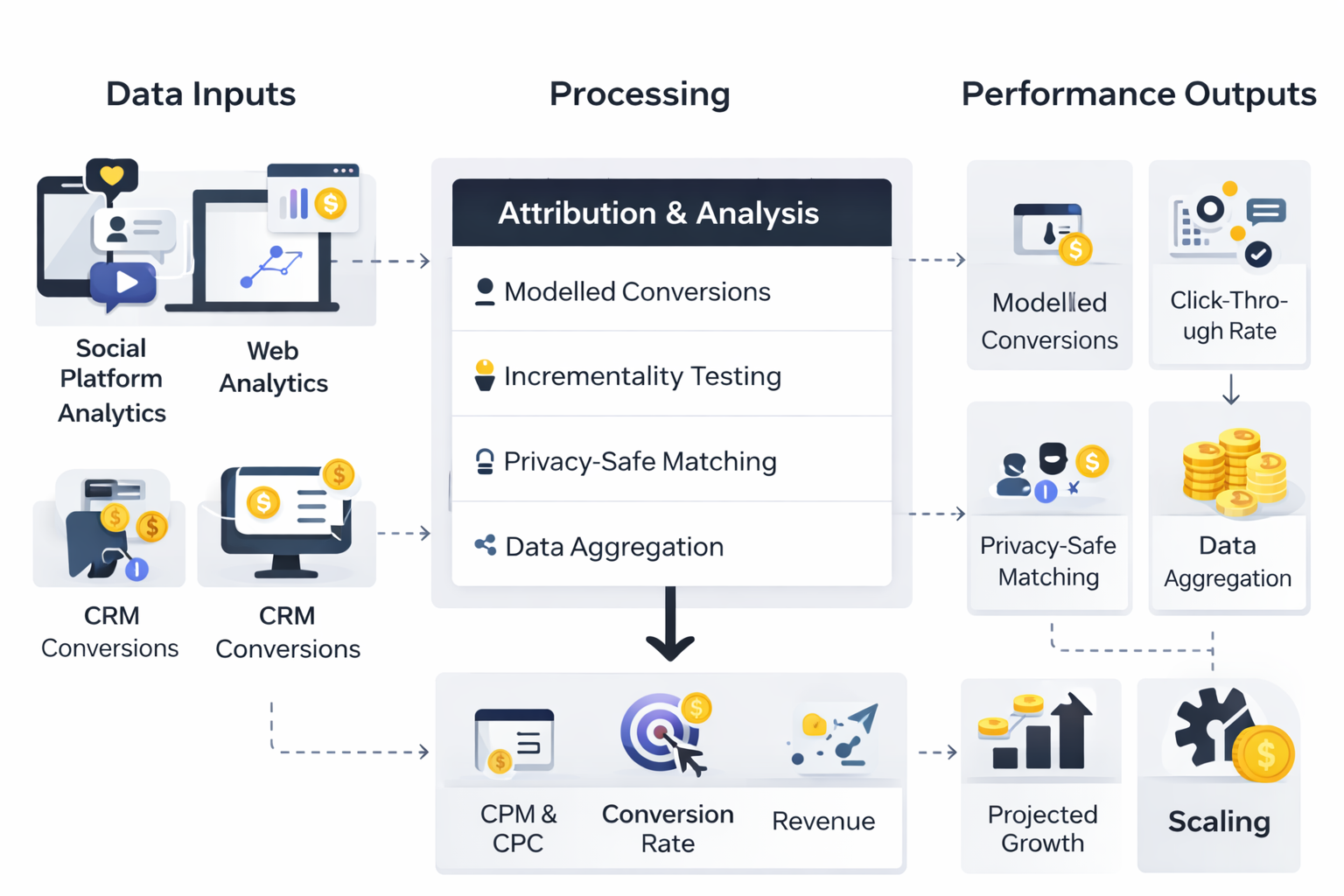
If you want social media ROI to be more than a retrospective guess, implementation has to start with discipline. Not “we’ll track everything,” but “we’ll track the few things that actually matter, and we’ll track them consistently across every platform.” When it’s done well, your reporting stops being a weekly ritual and becomes a system you can trust to guide spending decisions.
Here’s the cleanest way to roll it out without getting lost in tools, dashboards, or debates about attribution models.
Step 1: Define the business outcome you’re proving
Every social media ROI system should start with a single sentence that a finance leader would accept. For ecommerce that’s usually contribution margin or revenue. For B2B it’s qualified pipeline or closed revenue. For subscription products it’s trials that convert and churn-adjusted lifetime value.
Once you choose the outcome, lock it in as the primary KPI for this measurement cycle. This prevents the common failure mode where social reporting drifts into whichever metric looks best that month.
Step 2: Map the customer actions that predict revenue
Revenue is often too slow to optimize on day-to-day, so you need a short list of “value signals” that reliably lead to it. For ecommerce that might be view content, add to cart, begin checkout, purchase. For B2B it could be demo request, booked meeting, qualified lead, opportunity created.
This is where you decide what counts as a conversion and what’s just noise. If it can’t be tied back to revenue through CRM or transaction data, it doesn’t belong in the ROI equation.
Step 3: Standardize tracking names, UTM rules, and event taxonomy
Messy naming kills social media ROI faster than weak creative. Before you touch any platform settings, create a simple naming system everyone follows: campaign, ad set, creative, and landing page. Then define one UTM convention that’s non-negotiable.
When UTMs and event names are consistent, your data becomes comparable across time and across channels. That’s what makes optimization possible instead of anecdotal.
Step 4: Implement platform pixels and server-side events
Browser-only tracking is fragile. Between privacy changes, cookie limits, and ad blockers, relying on client-side pixels alone will quietly undercount conversions and distort your social media ROI.
That’s why modern implementations pair a pixel with server-side event sharing. Meta’s documentation explains how the Conversions API creates a direct connection between your marketing data and Meta’s systems, and TikTok’s guidance shows how the Events API connects web, app, and offline data. For B2B, LinkedIn supports conversion tracking through the Insight Tag conversion setup, and also provides broader integration guidance through its conversion tracking documentation.
The point isn’t to chase perfect tracking. The point is to reduce blind spots enough that platform optimization and your internal reporting are measuring the same reality.
Step 5: Connect web analytics to revenue systems
Social media ROI becomes credible when your conversion events are reconciled with what the business actually recognizes as value: paid invoices, completed transactions, retained subscribers, or verified pipeline.
That usually means integrating your analytics layer with a CRM or ecommerce backend. If you’re B2B, push lead and opportunity stages back into your reporting so you can separate “social drove leads” from “social drove revenue.” If you’re ecommerce, make sure refunds and cancellations can be reflected in reporting, otherwise ROI will look better than reality.
Step 6: Choose an attribution policy and make it explicit
Attribution isn’t a single truth; it’s a decision rule. Your job is to pick the rule you’ll use consistently so the organization can make decisions without arguing over the model every week.
For most teams, the practical baseline is to report two views side by side: a conservative view (like last click) and a fuller view (like data-driven or position-based). Google’s documentation on attribution models is useful here because it lays out why different models assign credit differently, especially when customers touch multiple channels.
Step 7: Build a decision dashboard, not a vanity dashboard
A good social media ROI dashboard answers three questions quickly: what did we spend, what measurable value did we create, and what should we do next. If your dashboard can’t clearly support budget decisions, it’s probably a reporting artifact instead of an operating tool.
Most teams do best with a single executive view and a deeper operator view. The executive view shows spend, conversion value, and ROI by platform and campaign. The operator view includes creative performance, audience breakdowns, and funnel drop-offs.
Execution Layers
When teams say they “can’t measure social media ROI,” it’s rarely because they lack tools. It’s usually because one of the execution layers is missing or unreliable. Treat your implementation like a stack, because every layer depends on the one beneath it.
Layer 1: Instrumentation
This is the layer where events are defined and collected. Pixels, tags, server-side events, and conversion rules live here. If instrumentation is weak, every number above it becomes a guess.
Meta’s developer guidance for Conversions API best practices and TikTok’s recommendation to pair Events API with the pixel are both examples of platforms pushing advertisers toward more resilient measurement setups.
Layer 2: Identity and match quality
Platforms can only optimize and attribute what they can match. That’s why server-side events typically include privacy-safe identifiers, and why setup quality checks matter. If match quality is low, you may see inflated costs, unstable learning, and reporting that undercounts outcomes.
This layer is where privacy-safe measurement becomes part of the ROI conversation. The industry is actively moving toward privacy-preserving attribution frameworks like the Attribution Data Matching Protocol, which is designed around privacy-enhancing approaches for measurement in environments where direct identifiers are limited.
Layer 3: Data pipeline and governance
This is where you keep your data clean enough to trust. Campaign naming conventions, UTM governance, deduplication rules, and event validation all sit here. If this layer is sloppy, reporting becomes a series of exceptions and manual fixes.
Standards bodies have been explicit about why governance matters. Measurement guidance like the IAB/MRC Retail Media Measurement Guidelines highlights data quality and validation as foundational for credible outcomes, especially in ecosystems where deduplication and attribution are difficult.
Layer 4: Attribution and experimentation
This is where you separate correlation from causation. Attribution models help you assign credit across touchpoints, but experiments help you understand incrementality: what happened because of the ads, not just alongside them.
Platform tools exist specifically for this. Meta supports experimentation through lift studies, and Google’s documentation explains how lift studies go beyond clicks and impressions to estimate true impact.
Layer 5: Reporting and decision-making
This top layer is where social media ROI becomes operational. It’s where you decide budgets, creative direction, audience strategy, and channel mix. If your lower layers are solid, this layer becomes simple: invest more in what produces incremental value and cut what doesn’t.
Optimization Process
Once your measurement system is stable, optimization stops being reactive. You’re no longer tweaking campaigns because performance “felt off.” You’re optimizing because you can see exactly where the funnel is leaking, which audiences are overpaying, and which creative is actually driving incremental conversions.
Start with a testable hypothesis
Every optimization should begin with a hypothesis tied to a measurable value signal. “Shorter videos will increase hook rate and improve purchase conversion rate” is testable. “We need better content” isn’t.
This habit matters because it keeps your work tied to social media ROI, not creative preferences.
Prioritize the biggest leverage points
Most accounts have a few high-leverage constraints: tracking gaps, weak landing pages, poor audience exclusions, or creative fatigue. Fix those before you chase minor tweaks in bidding or micro-targeting.
When you’re prioritizing, look for the changes that affect entire campaign classes, not just one ad set.
Run incrementality tests when the stakes are high
Attribution reports can be useful, but they can also mislead when customers touch many channels. When you’re making meaningful budget decisions, incrementality testing is the guardrail.
Google’s measurement guidance on incrementality testing and the way platforms position lift studies as “true impact” measurement (like Google’s lift study explanation) reflect where serious performance teams are headed: proving what your spend actually caused.
Close the loop with first-party data
Optimizing for surface conversions can inflate ROI on paper while hurting real profitability. When you can, optimize toward higher-quality outcomes: retained subscribers, higher-margin products, qualified opportunities, or repeat customers.
This is one reason first-party data workflows are becoming central to social media ROI. Recent product updates and integrations focus heavily on activating first-party data in privacy-safe ways, like the Meta Conversions API integration described by Databricks.
Make optimization a cadence, not a fire drill
Teams that consistently improve ROI usually work in cycles: weekly creative refreshes, biweekly audience and offer reviews, monthly attribution and incrementality checks, and quarterly measurement audits.
That rhythm prevents the two extremes that kill performance: constant random changes that reset learning, or long periods of inaction where creative decays and costs quietly rise.
Implementation Stories
It’s tempting to think social media ROI fails because the formula is complicated. In reality, it usually fails because the organization tries to measure outcomes with a system that can’t survive modern privacy and platform realities. The story below is real, but what matters most is the pattern: the pressure, the wall, the shift, and the discipline it took to rebuild measurement in a way leadership could trust.
A Real Shift Toward First-Party Measurement
The tension started quietly, then hit all at once. Paid social numbers looked fine in-platform, but the revenue team couldn’t reconcile them with internal reporting. Each week brought a new argument: marketing saw conversions, finance saw gaps, and no one could prove which version was closer to the truth.
The problem became impossible to ignore as the business scaled. More campaigns, more markets, more tools, and more stakeholders meant every inconsistency amplified into real budget risk. When leadership asked a simple question—“what are we really getting back from this spend?”—the room didn’t have a single answer.
Then the wall: browser-only tracking stopped being reliable enough to settle the debate. Conversion counts drifted, attribution paths looked incomplete, and optimizations started to feel like gambling because the feedback loop wasn’t stable. The team could feel performance slipping, but couldn’t identify whether the issue was creative, targeting, or measurement itself.
The turning point was realizing the system needed a sturdier foundation, not another dashboard. Instead of trying to “fix reporting,” the focus shifted to strengthening signal capture and matching. That meant first-party data, server-side event sharing, and a measurement design that could survive fragmented journeys.
The rebuild started with the plumbing. Platform integrations that create direct data connections became central to the strategy, including Meta’s explanation of how the Conversions API connects marketing data to Meta optimization and TikTok’s framing of the Events API as a reliable connection across web, app, and offline channels. On the analytics side, attribution policy was made explicit so leadership could interpret reports consistently, using guidance like Google’s overview of how different attribution models assign credit.
Of course, things still went wrong. Early server-side implementations tend to surface mismatched event names, duplicate conversions, missing parameters, and broken UTMs. Debugging takes patience, because the failures don’t show up as one big error—they show up as dozens of small inconsistencies that quietly distort ROI.
But the outcome is what organizations are chasing when they talk about social media ROI. Once the measurement loop becomes resilient, the conversation changes: spend can be defended, experiments can be trusted, and optimization becomes grounded in reality instead of platform-only reporting. That’s when social stops being “hard to measure” and starts behaving like a channel you can scale with confidence.
1) Documentation and ownership
Someone owns the measurement system the way someone owns finance reporting. Event definitions, naming conventions, UTM rules, and attribution policy are documented and enforced. When a campaign launches, the measurement requirements are part of the launch checklist, not an afterthought.
2) Experimentation as a standard, not a special project
When spend is meaningful, teams don’t rely purely on attributed ROAS to guide decisions. They validate performance with experiments designed to estimate incremental impact. Tools like Meta’s lift studies framework and Google’s explanation of what lift studies measure exist for a reason: attribution reports can be directional, but experiments can be decisive.
3) A realistic view of scale and audience behavior
The reason social media ROI matters so much is that social is now massive, and it shapes discovery whether you want it to or not. The latest global usage reporting shows social media user identities around the world at 5.66 billion as of October 2025, which helps explain why social touchpoints appear in so many customer journeys even when the final click happens elsewhere.
When that’s the environment, the goal isn’t perfect attribution. The goal is consistent, decision-grade measurement that makes it obvious what’s working, what isn’t, and what to do next. That’s what a real social media ROI system gives you.
Statistics And Data

If you want social media ROI to be more than a vibe, you need a handful of numbers that explain what’s happening in the market and what’s happening inside your own funnel. The trap is grabbing flashy charts without understanding what they’re measuring. The goal is smaller: build a “signal stack” that tells you whether your social is creating demand, capturing demand, or just generating noise.
At the macro level, marketing budgets keep drifting toward environments where audiences actually spend time. Global advertisers spent close to US$1.1 trillion on ads in 2024, and forecasts still point to continued growth into 2025 and 2026, with one widely cited projection putting 2025 global ad revenue around $1.14 trillion. That matters because social platforms are auction markets: when budgets flood in, the “cost of being seen” rises, and ROI becomes less about posting more and more about measuring what truly moves revenue.
On the audience side, the ceiling keeps lifting. Kepios’ tracking shows there were 5.66 billion social media user identities worldwide as of late 2025, which is why even niche brands can now build a measurable pipeline if they’re disciplined about tracking. What’s changed isn’t just reach; it’s the speed at which cultural moments form, spread, and convert into intent.
And if you’re trying to understand where organic opportunity may be expanding (or shrinking), platform-level growth signals can help you avoid wishful thinking. Emplifi’s 2025 benchmarks report summarizes 2024 data showing TikTok leading median monthly follower growth at 21%, while Instagram sits notably lower in the same comparison. That doesn’t mean “TikTok is best” for every business; it means that if you’re chasing attention without an attribution plan, you’ll likely confuse momentum with ROI.
Performance Benchmarks
Benchmarks are only useful when they answer a specific question. You’re not trying to “beat the average.” You’re trying to learn whether your results are being held back by the market (auction pressure), your execution (creative and targeting), or your measurement (tracking gaps that hide real value).
One practical way to use benchmarks is to treat them as context for diagnosing which lever to pull next. Tinuiti’s Q4 2024 benchmark analysis shows paid social pricing and demand shifting by platform: Meta spend grew 15% year over year in Q4 2024 with impression growth slower than spend growth, while CPM rose modestly overall. Inside that, Instagram saw faster momentum, with spend up 20% year over year in Q4 2024 alongside stronger CPM increases, which is a useful reminder that “it’s getting more expensive” can be true even when performance is improving.
Benchmarks also help you evaluate placement strategy without guessing. Emplifi’s paid benchmarks highlight Reels as a major budget focus in 2024, noting median ad spend per account in Q4 2024 of $763 on Facebook Reels versus $317 on Instagram Reels. Read that the right way: it’s not “Facebook Reels is better,” it’s “advertisers are allocating differently,” which should push you to validate your own audience response instead of copying a trend.
Finally, don’t ignore creator-led performance benchmarks if you sell in categories where trust matters. U.S. creator-economy ad spend has been projected to reach $37 billion in 2025, and that budget shift is a big reason why many brands now treat creators as a measurable distribution channel rather than a “nice-to-have.” When creators are part of your mix, your benchmark needs to expand beyond CPM and CTR and include assisted conversions, branded search lift, and repeat purchase.
Analytics Interpretation
A dashboard doesn’t “tell the truth.” It tells a story based on what you decided to track. If your social media ROI reporting feels inconsistent, it’s usually because your dashboard mixes signals that belong to different time horizons and then asks you to judge them as if they all mean the same thing.
Start by separating leading indicators from lagging indicators. Leading indicators include reach quality (who you’re hitting), attention (how long they stayed), and intent signals (profile visits, saves, clicks to high-intent pages). Lagging indicators include pipeline progression, revenue, retention, and repeat purchase. When you blend them into one line chart, you’ll panic on weeks where revenue lags even though intent is compounding, or you’ll celebrate short-term ROAS spikes that are just retargeting harvesting demand you didn’t create.
Next, interpret your numbers as relationships, not isolated facts. If CPM rises while conversions stay stable, your creative may be strong enough to absorb auction pressure. If CPM is stable but conversion rate drops, your post-click experience or audience match is likely the bottleneck. And if everything looks “fine” but revenue doesn’t move, that’s when you stop optimizing ads and start validating incrementality with holdouts, geo tests, or lift studies so you can separate true impact from correlation.
Finally, build one habit that makes your analysis more human: every metric needs a “why it moved” note. Tinuiti’s Q4 2024 write-up points out that pricing growth on Meta was strongest in December due to seasonal pressure and calendar shifts around Cyber Monday and Thanksgiving timing, which is exactly the kind of context that keeps your team from making reactive changes that damage long-term ROI.
Case Stories
Start at a point of high drama. A car fire turned into a live stress test in front of the entire internet. A TikTok showed a burned-out vehicle, and the one detail people couldn’t stop replaying was the Stanley tumbler sitting there with ice still inside. The clip was spreading so fast that the brand had a choice: respond like a corporation, or respond like a person.
Backstory. Stanley wasn’t a new brand trying to “hack” social media; it was a century-old product company that had quietly become culturally relevant through creators and community-driven demand. The brand’s growth story had already been tied to social momentum, with widespread attention around the Quencher and demand spikes covered in mainstream business media. By early 2024, the scale of that demand was being framed in headlines like a reported rise to $750 million in annual sales, which only raised the stakes when a viral moment put the brand’s reputation on the line.
Wall. Viral attention is not the same as social media ROI, and plenty of brands learn that the hard way. You can get millions of views and still end up with a week of vanity metrics that die without turning into revenue or long-term trust. Worse, the wrong response can make a brand look opportunistic, and once that narrative takes hold, your paid media gets more expensive because people scroll past you with skepticism. The wall was simple: could Stanley convert a chaotic moment into measurable goodwill without looking like it planned the whole thing?
Epiphany. The winning move wasn’t a complicated campaign; it was speed, empathy, and letting the platform format do the work. Instead of issuing a polished press statement, the brand responded in the native language of TikTok. A case write-up tied to the moment describes how the team dropped its planned content, responded quickly, and turned the reply into something viewers felt was authentic to the brand voice and promise. The intent was clear: don’t just show durability; show humanity.
Journey they went on to reach the goal. The response became a story arc people wanted to share: a brand leader duets the original video, acknowledges the situation, and makes a tangible commitment. Industry coverage captured how the brand offered to replace the vehicle, turning a product moment into a trust moment that people could retell in one sentence. The campaign mechanics were almost boring in the best way: listen, respond, do the right thing publicly, and let the community distribute it. That’s a social media ROI blueprint because it creates a compounding asset—belief—that makes future paid and organic work perform better.
Final conflict. Even when you do the right thing, the internet tests you. People demand proof, question motives, and wait to see whether the brand follows through or quietly disappears after the headlines. The moment can also backfire if logistics drag, if messaging shifts, or if the brand tries to squeeze the narrative into an ad. That’s why social ROI measurement needs a second layer beyond views: you track sentiment, branded search, referral traffic, and downstream conversion over the weeks that follow, not just the day the video spikes.
Dream outcome. The follow-through became part of the story, not an afterthought. The moment has been referenced as an example of social responsiveness in marketing and PR coverage, and it was also documented as award-worthy work with a clear strategy-and-execution summary that emphasizes immediate action and a human response. When you treat that kind of moment as measurable demand creation, you stop asking “did social work?” and start asking “how do we make social reliably create trust we can convert?” That’s the shift that turns social media ROI from a monthly report into a repeatable operating system.
The campaign write-up and the business coverage around the Stanley surge are useful reads side-by-side, because one shows the execution choices and the other shows why those choices mattered commercially.
Professional Promotion
If you’re serious about social media ROI, there’s a point where “doing your best” stops being the constraint. The constraint becomes the system: clean data, consistent experimentation, and the discipline to measure what your work is actually changing in the business.
The best professional operators treat measurement like product quality control. They build tracking that survives platform changes, they validate incrementality when attribution gets fuzzy, and they keep the team focused on a small set of decisions the numbers can confidently support. That’s also why the best ROI wins often look boring from the outside: fewer last-minute pivots, fewer emotional budget swings, and more steady compounding.
If you want your social media ROI to improve without increasing spend, the most leveraged move is usually upgrading how you interpret performance and how quickly you turn insights into better creative, better offers, and cleaner funnels. The market will keep getting noisier. Your edge is being the brand that can still prove what’s working, even when everyone else is guessing.
Advanced Strategies
Once you can measure social media ROI with enough confidence to make budget decisions, the game changes. You stop asking “did this campaign work?” and start asking “what’s the fastest path to more incremental revenue without breaking trust, margins, or measurement?” At that stage, the highest leverage strategies are rarely tactical hacks—they’re structural advantages.
Triangulate measurement instead of betting your business on one model. Platform attribution is fast, but it’s not designed to be a neutral judge. Marketing mix modeling is strategic, but it’s often slow. Incrementality testing is causally strong, but it can’t be run on every idea every week—so mature teams combine them into a single decision system, a pattern described as “triangulation” in recent research on post-cookie measurement. A 2025 study in the Journal of Digital & Social Media Marketing outlines why triangulating MMM, attribution, and incrementality helps reduce the weaknesses of any single method.
Make incrementality a budget gate, not a side project. When spend becomes meaningful, the question becomes “what did this cause?” rather than “what did this get credit for?” That’s why many teams treat lift tests as the final arbiter before scaling, using randomized test/control designs that isolate incremental conversions, described in Meta’s own overview of conversion lift testing and reinforced by standards-driven thinking in the IAB/MRC measurement guidelines, which emphasize methodological rigor and transparency when claiming incremental outcomes.
Optimize for value, not volume. If your reporting rewards “more conversions,” the system will find cheap conversions—even when they’re low-quality. Advanced social media ROI programs tie optimization to downstream value signals: margin bands, predicted LTV cohorts, qualified lead definitions, and retention. That shift is easier to sustain when your customer and marketing data are connected, a theme echoed in enterprise marketing guidance that stresses the importance of connected data foundations for decision-making. Gartner’s digital marketing strategy guidance frames this as a core requirement as marketing shifts toward owned channels and first-party data.
Build creative as a measurable system, not an art contest. At scale, creative is the biggest lever, but it needs an operating cadence: testing, iteration, and controlled refresh so performance doesn’t decay. The practical rule is simple: treat every creative concept like a hypothesis, and treat production like a pipeline. When you do that, you can grow social media ROI without constantly increasing spend—because you’re increasing the efficiency of each impression.
Scaling Framework
Scaling social media ROI is rarely about turning the budget dial up. It’s about scaling what’s already working without losing measurement clarity, audience fit, or creative freshness. A strong scaling framework prevents the most common failure mode: performance that looks great at small spend and collapses when you try to grow.
Phase 1: Prove signal quality. Before you scale, make sure your tracking is stable enough that “wins” are real. If your conversion event is noisy, duplicated, or biased toward retargeting, you’ll scale the wrong thing. This is exactly why lift designs and matched-market rigor matter in modern measurement discussions, including the IAB/MRC emphasis on validation and transparency in outcomes measurement. The IAB/MRC explainer highlights disclosure of methodology, assumptions, and limitations as part of credible incrementality measurement.
Phase 2: Identify the scalable unit. Don’t scale “a campaign.” Scale a repeatable unit: a creative concept family, a proven offer, a landing page flow, or a targeting logic that reliably finds new buyers. When you know what the unit is, you can scale horizontally (more variations) and vertically (more spend) without guessing.
Phase 3: Expand thoughtfully. Expansion should follow a sequence: broaden audience, expand placements, add new creative angles, then introduce new objectives or funnel stages. This keeps learning stable while you increase reach. If you jump to everything at once, you’ll lose the ability to explain performance—then social media ROI becomes a debate again.
Phase 4: Lock a measurement cadence. Scaling requires a rhythm that matches decision speed: weekly creative and funnel reviews, monthly incrementality checks for major spend buckets, and quarterly measurement audits. This is how you keep ROI from drifting while the business grows.
Growth Optimization
Growth optimization is where social media ROI becomes compounding. Instead of squeezing short-term efficiency out of the same audience, you create new demand, capture it cleanly, and keep customers long enough that acquisition costs make sense.
Use “incrementality wedges” to find real growth. A wedge is a controlled test that answers one question at a time: new audience vs. existing, prospecting vs. retargeting, creators vs. brand ads, broad vs. constrained targeting. When you run wedges consistently, you learn what actually creates new customers rather than recycling people who were going to buy anyway. Practical incrementality guidance for marketers often starts here, outlining methods like holdouts and geo tests as the foundation for causal answers. Northbeam’s 2024 guide lays out the logic of measuring what would have happened without the ads.
Engineer the funnel for “cheap learning.” At scale, the real cost isn’t CPM—it’s wasted learning cycles. The fastest teams reduce friction: fewer landing page variants at once, clearer value propositions, and offers that match the intent of the creative. When your funnel is predictable, you can test more creative without breaking conversion rates, which keeps ROI stable while you expand reach.
Build creator distribution with measurable guardrails. Creator-led growth can scale quickly, but it needs measurement rules that protect ROI: trackable links, controlled whitelisting, consistent offer logic, and post-purchase surveys that confirm influence. This becomes more important as creator marketing budgets expand, which mainstream business reporting has framed as a major shift in ad allocation. Business Insider’s reporting on creator-economy ad spend projections is one example of how significant the shift has become.
Design for privacy reality, not nostalgia. Measurement volatility is part of the ecosystem now, which is why resilient strategies lean into first-party data and privacy-preserving methods. Google’s Privacy Sandbox documentation on the Attribution Reporting API shows where browser-based measurement is heading, while reputable reporting on Google’s evolving cookie approach underscores why marketers can’t assume yesterday’s tracking rules will remain stable. Reuters’ coverage of Google’s 2025 decision on third-party cookie prompts captures the uncertainty that makes resilient measurement a competitive advantage.
Scaling Stories
Start at a point of high drama. The agency’s monthly client calls had turned into interrogations. Spend was rising, dashboards looked “good,” but client finance teams wanted one answer: what was truly incremental, and what was just getting credit? The worst part was the uncertainty—cut too aggressively and you risked killing real growth; scale too confidently and you risked scaling noise.
Backstory. First Media is built around performance and scale, operating a large digital content footprint and running serious budgets across Meta platforms. That kind of scale creates pressure because small tracking errors become large financial disagreements. Their work with Meta’s Marketing Science team became public through a documented success story that describes a structured approach using multiple lift studies across clients. Meta’s success story on First Media lays out the premise: rigorous experimentation to understand impact.
Wall. The wall wasn’t “getting more conversions.” It was proving that conversions were caused by ads rather than harvested by retargeting or credited through imperfect attribution. Platform reporting alone wasn’t enough to settle the argument because it couldn’t answer the counterfactual: what would have happened without the spend? That’s the exact gap incrementality testing is designed to fill, using randomized test/control groups to isolate causal lift. Meta’s conversion lift overview describes that causal structure in plain terms.
Epiphany. The turning point was treating measurement like a product, not a report. Instead of debating attribution models endlessly, the team decided that major scaling decisions would require experimental evidence—especially for prospecting and for any creative approach that looked “too good to be true.” This aligns with broader measurement thinking that argues for combining methods rather than trusting a single lens, including recent work describing triangulation across MMM, attribution, and incrementality. The 2025 triangulation paper explains why this combination helps avoid misleading conclusions.
Journey they went on to reach the goal. They built a repeatable test program: define a decision, design a holdout structure, run long enough to reach confidence, then translate results into budget rules. Over time, tests stopped being “special studies” and became the operating cadence for scaling. This approach mirrors the measurement discipline emphasized by industry standards that call for transparency, validation, and methodological rigor when claiming incremental outcomes. The IAB/MRC guidelines repeatedly stress those principles in outcomes measurement.
Final conflict. The hardest part wasn’t running tests—it was living with answers that forced uncomfortable change. Some tactics that looked efficient in-platform weren’t as incremental as expected, which meant reallocating budgets and rebuilding creative plans. There were also operational frictions: aligning clients, timelines, and test designs while campaigns still had to deliver results week to week. That’s why “measurement as a cadence” matters; otherwise, teams revert to the comfort of vanity certainty.
Dream outcome. Over time, conversations changed from “prove it” to “where do we scale next?” because the team could point to a consistent decision framework rather than a single fragile metric. That’s what scaling social media ROI looks like at a professional level: not one viral win, but a repeatable way to invest more confidently. When measurement becomes decision-grade, you don’t just grow revenue—you grow trust, which makes every future optimization easier.
Future Trends
Social media ROI is heading into a new era where measurement is less about “perfect tracking” and more about building decision-grade certainty from imperfect signals. The biggest shift is that platforms, browsers, and regulators are steadily tightening what can be observed at the individual level, while marketers are being pushed toward privacy-preserving methods that still let them prove impact.
Privacy-preserving attribution will keep replacing legacy tracking. Browsers are moving toward APIs designed to measure outcomes without cross-site identifiers, and the direction is clear in Google’s overview of the Attribution Reporting API. For marketers, this means attribution windows, conversion modeling, and aggregate reporting will play a larger role in how ROI is calculated and defended.
Incrementality will become the “budget permission slip” for scaling. As attribution gets noisier, the question becomes “what did the spend actually cause?” Lift tests and holdouts are the most straightforward way to answer that, and Meta’s explanation of conversion lift testing shows why experimentation is increasingly positioned as the most credible proof of impact for major spend decisions.
MMM and triangulation will become normal, not niche. Teams that want stable answers will combine multiple lenses rather than arguing over a single model. The measurement trend is summed up well in Funnel’s discussion of marketing measurement trends, including the rise of triangulation and the renewed focus on modeling, experimentation, and connected data foundations.
Clean-room-style measurement will fade into the background and become infrastructure. A few years ago, “data clean rooms” were a headline topic; now they’re increasingly treated as plumbing that supports privacy-safe joining, analysis, and activation. That perspective is captured in AdExchanger’s 2026 commentary on how clean rooms became less of a buzzword and more of a default capability, while Google’s own documentation on Ads Data Hub shows how large platforms are formalizing privacy-safe analysis at scale.
Creator-led distribution will keep absorbing budgets, which changes how ROI is proved. If creators are part of your mix, your social media ROI system has to connect influence to downstream outcomes rather than just counting views. The IAB’s 2025 Creator Economy Ad Spend & Strategy Report projects U.S. creator ad spend reaching $37B in 2025, which helps explain why more brands are building repeatable creator programs with trackable links, whitelisting, and post-purchase influence measurement.
AI will compress the creative cycle and raise the bar for measurement. AI tools are making it easier to generate variants, remix formats, and adapt messaging for multiple audiences. The upside is faster iteration; the downside is that without clean measurement, teams can scale the wrong creative faster than ever. The winners will be the teams that pair creative velocity with rigorous experimentation and stable attribution policy.
Strategic Framework Recap

If you strip the tools and trends away, social media ROI still comes down to a few non-negotiables that hold up across industries.
- Start with a business outcome: revenue, qualified pipeline, retained subscribers, or margin-based contribution.
- Define the value signals that predict it: the events that reliably move you toward the outcome (not the metrics that simply look good).
- Standardize tracking: naming, UTMs, event taxonomy, and deduplication so your numbers are comparable over time.
- Connect systems: social platforms, web analytics, and CRM or transaction data need to speak the same language.
- Choose an attribution policy: make it explicit so leadership can interpret results consistently.
- Validate incrementality when it matters: use lift tests and holdouts to prove what spend actually caused, not just what it received credit for.
- Operate a cadence: creative iteration, funnel reviews, and measurement audits should be a rhythm, not a panic response.
That’s the ecosystem: signal capture, value mapping, attribution policy, experimentation, and decision-making. When those pieces fit together, social media ROI stops being a debate and becomes a reliable way to scale.
FAQ – Built For The Complete Guide
1) What is social media ROI in plain English?
Social media ROI is the value your business gets back from social media compared to what you invested. The “value” can be revenue, qualified leads, retained customers, or cost savings, as long as you can connect it to business results.
2) How do you calculate social media ROI?
A common formula compares value generated to cost: (value − cost) ÷ cost. The hard part isn’t the math—it’s defining what counts as value and making sure you can track it consistently across platforms and your revenue systems.
3) What costs should be included in a social media ROI calculation?
Include ad spend, creator/production costs, agency or freelancer fees, tools, and the internal time required to plan, publish, manage community, and report. ROI often looks artificially high when teams ignore labor and production.
4) What metrics matter most for social media ROI?
The best metrics depend on your business model, but the strongest ROI systems track a small chain: qualified traffic, conversion rate, value per conversion, and downstream quality (repeat purchase, retention, or sales acceptance). Engagement metrics are useful when they help predict those outcomes.
5) Why don’t platform results match Google Analytics or CRM data?
Platforms and analytics tools use different attribution rules, tracking methods, and identity matching. Privacy controls, browser limits, and modelled conversions can also create discrepancies. The solution is to set a clear attribution policy, improve tracking resilience, and validate big decisions with incrementality tests.
6) What is incrementality, and why does it matter for social media ROI?
Incrementality is the value that happened because of your social activity, not just alongside it. It matters because attribution can over-credit retargeting or last-touch channels. Lift tests and holdouts help you prove true impact, which is why experimentation is emphasized in conversion lift measurement.
7) Should I use marketing mix modeling (MMM) or attribution?
Most mature teams use both for different decisions. Attribution is useful for faster, campaign-level feedback, while MMM helps with bigger budget allocation questions across channels. Many teams now combine methods through triangulation, discussed in measurement trend analysis like Funnel’s marketing measurement overview.
8) How do you measure ROI for organic social?
Use the same logic as paid: define value signals, track link clicks and conversions with consistent UTMs, and connect outcomes to CRM or purchase data. Organic ROI is often “assisted,” so it’s helpful to track branded search lift, return visits, and conversion paths rather than expecting last-click purchases.
9) How long does it take to see meaningful ROI from social?
For direct-response offers, you can often see signal within days or weeks. For higher-consideration products, ROI shows up through a mix of pipeline growth, repeat exposure, and assisted conversions over longer cycles. Your measurement window should match your buying cycle, not your reporting cadence.
10) What is a “good” social media ROI?
“Good” depends on margins, cash flow, and payback expectations. A low-margin ecommerce brand may need higher ROI than a high-LTV subscription business. The most useful benchmark is your own break-even point and the incremental lift you can prove when scaling.
11) How do creators fit into social media ROI measurement?
Creators can act like a distribution channel, but ROI needs guardrails: trackable links, consistent offers, whitelisting controls, and post-purchase “how did you hear about us?” signals. As creator budgets grow, the need for measurement discipline becomes more important, reflected in IAB’s 2025 creator economy report.
12) What tools are essential for measuring social media ROI?
At minimum: platform conversion tracking, web analytics, and a CRM or transaction system that stores real business outcomes. For privacy-safe analysis at scale, environments like Ads Data Hub can support aggregated reporting and joins with first-party data.
Work With Professionals
If you’ve made it this far, you already know the uncomfortable truth: social media ROI isn’t hard because you’re missing one trick. It’s hard because it takes consistency—clean tracking, clear attribution policy, and the confidence to run experiments that sometimes tell you to stop doing what “looks good.” Most teams don’t fail at ROI because they lack effort. They fail because they’re doing it alone, with limited time, and with clients or leadership demanding certainty.
That’s also why the best freelancers win more work when they can speak the language of outcomes. When you can walk into a call and explain how you’ll prove incremental impact, you stop being “a marketer” and become a growth partner clients trust with budget.
MARKEWORK.com is built for that kind of momentum. It’s a focused marketplace where marketing specialists connect directly with companies—no intermediaries, and no project fees or commissions. The platform is designed around speed and clarity: strong profiles, clear listings, and direct communication so you can negotiate scope and pay without a middle layer, reinforced on the Why Us page.
If you’re a freelancer who wants more serious clients, the most practical move is to put yourself where modern marketing teams are actively looking. MARKEWORK.com positions that pipeline around access to thousands of job listings, with straightforward monthly plans and the freedom to handle contracts and payments directly, spelled out in the site’s platform FAQ.
 Filip Konecny Enterprises