
Social media marketing 101 is not about chasing trends or posting randomly and hoping something works. It is about understanding how digital attention flows, how platforms distribute content, and how businesses turn visibility into measurable revenue.
Over the past decade, social platforms have evolved from communication tools into complex advertising ecosystems. Brands are no longer competing only with direct competitors; they are competing with creators, publishers, and friends in the same feed. That shift changes everything about how marketing must be approached.
This guide walks through the essential foundations. If you understand what social media marketing really is, why it matters strategically, and how the core framework operates, you will build campaigns that scale instead of guessing your way through algorithms.
Article Outline
- What Social Media Marketing 101 Really Means
- Why Social Media Marketing Matters for Modern Businesses
- Social Media Marketing Framework Overview
- Core Components of Social Media Marketing
- Professional Implementation in Competitive Markets
What Social Media Marketing 101 Really Means

At its core, social media marketing 101 is the structured use of social platforms to attract attention, build trust, and convert audiences into customers. It combines content strategy, paid promotion, audience psychology, analytics, and brand positioning into one integrated system.
It is not limited to posting on platforms like Facebook, Instagram, LinkedIn, TikTok, or YouTube. Those are distribution channels. The real work happens behind the scenes: defining the right audience, clarifying messaging, designing conversion paths, and measuring performance accurately.
When businesses approach social media marketing strategically, each post, advertisement, and campaign serves a defined objective. Some efforts build awareness. Others generate leads. Others nurture trust. Together, they form a pipeline that supports long-term growth rather than short bursts of engagement.
Understanding this distinction is critical. Social media activity without a marketing framework creates noise. Social media marketing built on clear objectives creates predictable results.
Why Social Media Marketing Matters for Modern Businesses
Consumer behavior has fundamentally shifted. Purchasing decisions are no longer made only on websites or in physical stores. They are influenced by content seen in feeds, reviews shared in communities, and conversations happening in comment sections.
Social platforms now function as discovery engines. People explore brands, compare options, and evaluate credibility before ever speaking to a sales representative. If a company does not actively manage its presence, the narrative about that brand will still exist — just without strategic direction.
For startups, social media offers cost-efficient access to targeted audiences. For established brands, it strengthens positioning and customer loyalty. For service providers and freelancers, it becomes a portfolio, networking tool, and lead generation channel combined into one.
Most importantly, social media marketing provides measurable feedback. Engagement rates, click behavior, watch time, and conversion data reveal how audiences respond in real time. That feedback loop allows marketers to refine messaging continuously instead of relying on guesswork.
In competitive industries, the brands that win are rarely the loudest. They are the ones that communicate clearly, consistently, and strategically across platforms.
Social Media Marketing Framework Overview
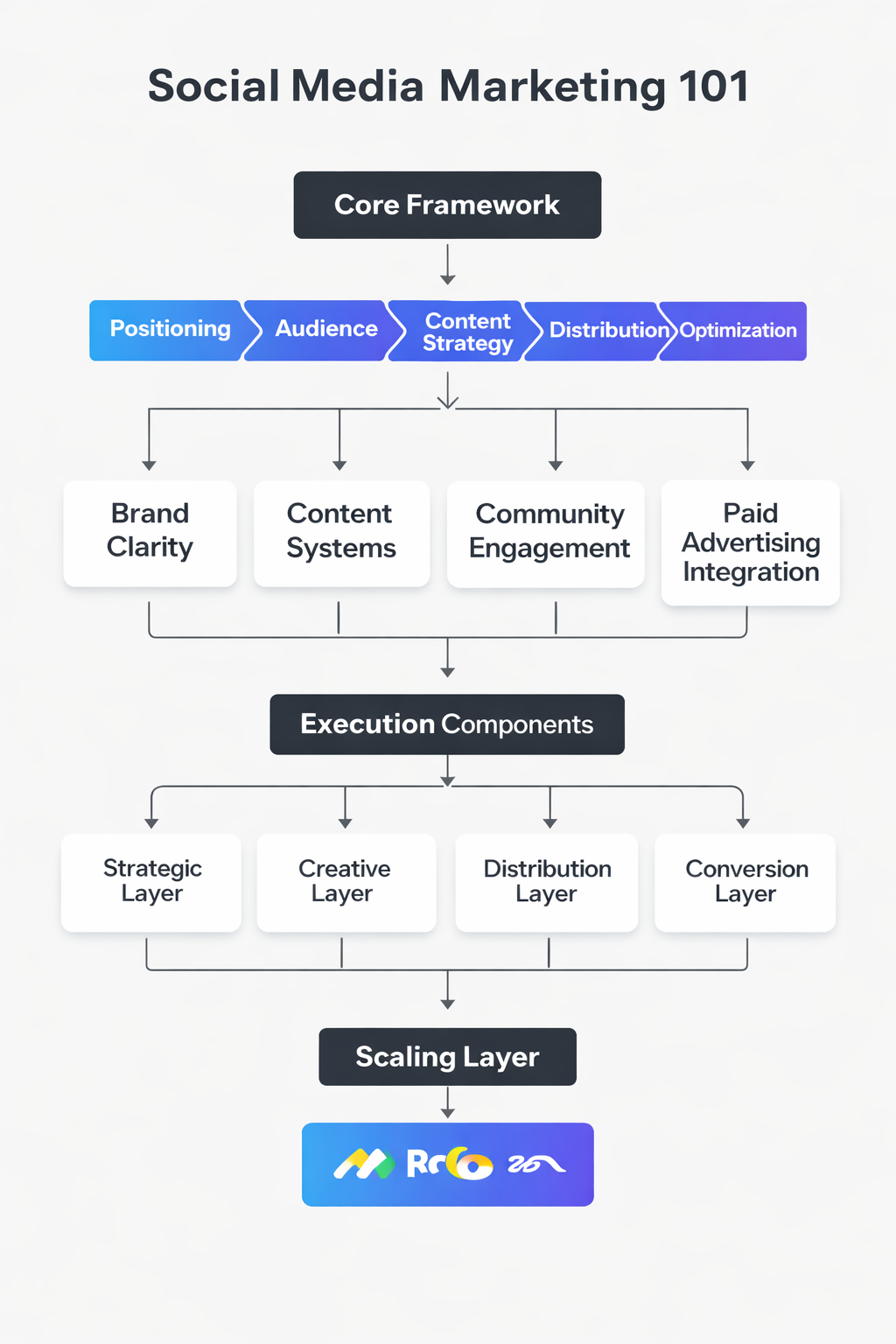
A strong social media marketing 101 framework can be broken into five interconnected stages: positioning, audience definition, content strategy, distribution, and optimization.
1. Positioning
Before publishing anything, a brand must answer a simple question: why should anyone care? Clear positioning defines the promise, the tone of voice, and the value offered to a specific audience. Without it, content feels generic and easily replaceable.
2. Audience Definition
Effective marketing begins with precision. Instead of targeting broad demographics, professionals identify pain points, motivations, objections, and buying triggers. The more specific the audience profile, the stronger the messaging resonance.
3. Content Strategy
Content must align with different stages of awareness. Some posts educate. Others demonstrate authority. Others handle objections or highlight results. A structured mix ensures the audience progresses naturally toward trust and action.
4. Distribution
Organic reach alone is rarely sufficient in competitive markets. Paid amplification, retargeting, collaborations, and cross-platform repurposing ensure that strong content actually reaches the intended audience.
5. Optimization
Data transforms marketing from art into science. Performance metrics guide creative adjustments, budget allocation, and messaging improvements. The framework is cyclical, not linear. Each campaign produces insights that inform the next.
Core Components of Social Media Marketing
While every brand’s strategy differs, successful social media marketing consistently includes several foundational components working together.
Brand Clarity
Clear messaging reduces confusion and increases trust. Profiles, bios, and visual identity should immediately communicate what the business does and who it serves. Consistency across platforms reinforces recognition.
Content Systems
Publishing sporadically creates unstable results. Professional marketers build content systems: recurring themes, content pillars, and repeatable production workflows. This ensures reliability and reduces creative burnout.
Community Engagement
Social media is interactive by design. Responding to comments, participating in discussions, and acknowledging feedback strengthens relationships. Engagement is not an afterthought; it is part of the growth engine.
Paid Advertising Integration
Organic content builds credibility, while paid campaigns accelerate reach. When aligned correctly, advertising amplifies proven content instead of gambling on untested ideas.
Analytics and Feedback Loops
Data analysis connects effort to outcome. Instead of focusing on vanity metrics, experienced marketers prioritize indicators that reflect real progress toward business goals, such as qualified leads, conversion quality, and customer acquisition efficiency.
Each component supports the others. Remove one, and the system weakens. Align them, and performance compounds over time.
Professional Implementation in Competitive Markets
Understanding social media marketing 101 conceptually is only the beginning. Execution determines results. Professional implementation requires structure, discipline, and ongoing refinement.
First, clear objectives must be defined before campaigns launch. Whether the goal is brand awareness, lead generation, or direct sales, strategy flows from that decision. Without measurable objectives, evaluation becomes subjective.
Second, resources must match ambition. High-level execution often involves creative direction, copywriting, graphic design, video production, campaign management, and analytics interpretation. Even small teams benefit from clearly assigned responsibilities.
Third, consistency must be protected. Many businesses start strong and then fade due to time pressure or shifting priorities. Sustainable growth comes from steady execution rather than short bursts of activity.
Finally, adaptability is essential. Platform algorithms change. Audience preferences evolve. Competitive landscapes shift. The businesses that treat social media marketing as an evolving system rather than a static tactic are the ones that maintain long-term relevance.
This foundation sets the stage for deeper exploration. In the next part, we will examine how to select the right platforms strategically and align them with specific business models and audience behavior patterns.
Step By Step Implementation of Social Media Marketing 101

Understanding theory is useful, but social media marketing 101 only delivers results when translated into structured execution. Implementation should never feel chaotic. It should follow a deliberate sequence that aligns positioning, audience targeting, content production, and performance tracking.
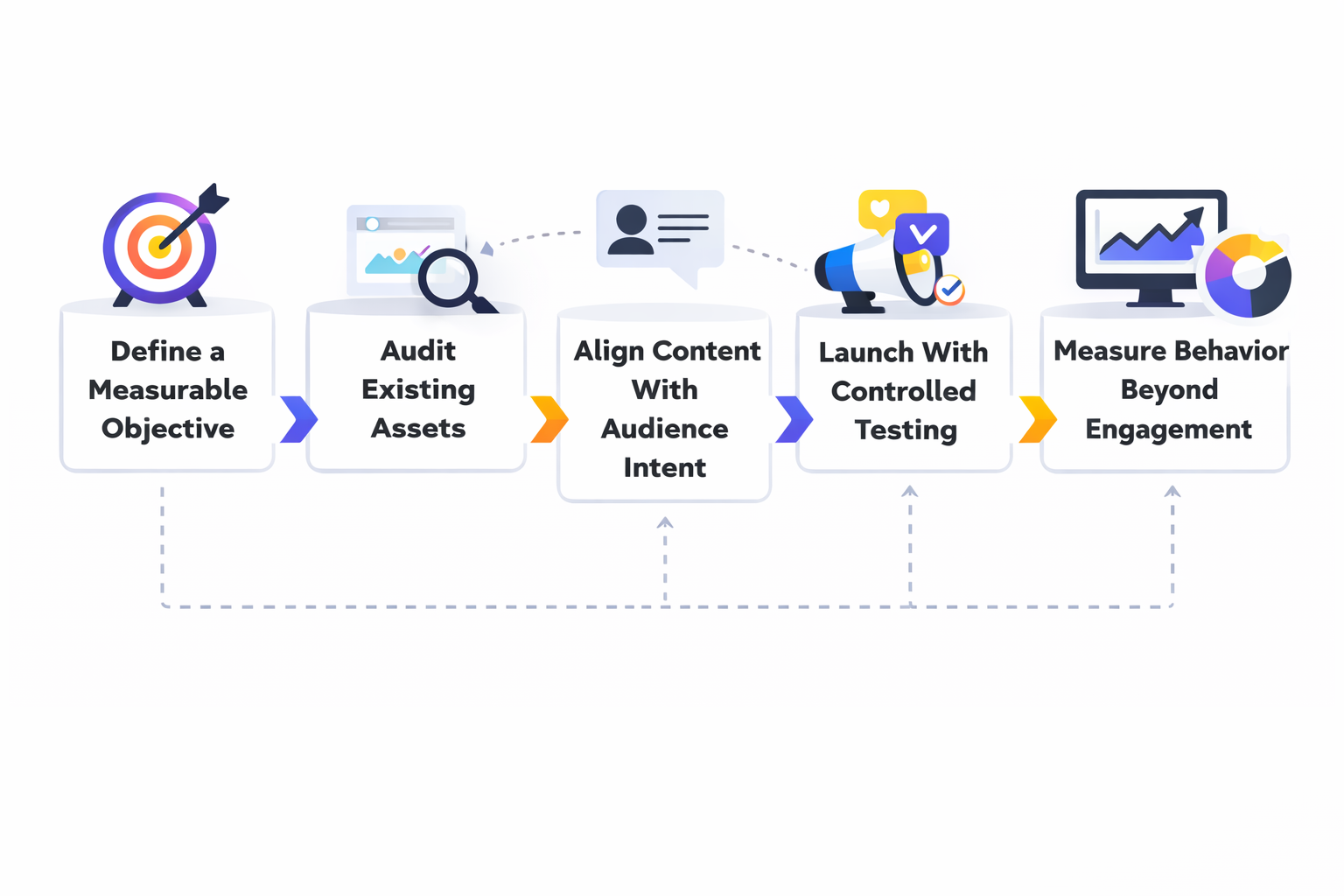
Step 1: Define a Measurable Objective
Every campaign begins with a decision. Is the goal to generate qualified leads, increase product sales, improve brand recall, or nurture an existing audience? Clear objectives determine content tone, targeting depth, and budget allocation. Without this clarity, performance data becomes impossible to interpret.
Step 2: Audit Existing Assets
Before launching new campaigns, review what already exists. Profiles, past content, landing pages, and analytics data often reveal missed opportunities. Identifying strengths and weaknesses early prevents repeating ineffective tactics.
Step 3: Align Content With Audience Intent
Different audience segments respond to different messaging layers. Educational content builds awareness. Authority-driven content builds credibility. Conversion-focused content addresses objections and motivates action. A balanced content plan ensures steady progression rather than abrupt sales pressure.
Step 4: Launch With Controlled Testing
Professional marketers rarely launch large campaigns immediately. Instead, they test variations in creative formats, headlines, calls to action, and targeting parameters. Controlled testing protects budgets and reveals performance patterns before scaling.
Step 5: Measure Behavior Beyond Engagement
Engagement metrics alone can be misleading. Effective social media marketing 101 implementation tracks deeper signals such as time on page, conversion rate, and customer acquisition cost. These metrics connect visibility to tangible business outcomes.
Following this sequence creates structure. It transforms marketing from reactive posting into a controlled growth system.
Execution Layers That Drive Sustainable Results
Implementation operates across multiple layers. Ignoring one often weakens the entire system.
Strategic Layer
This layer defines positioning, competitive differentiation, and value proposition. It ensures messaging is not generic. Without strategic clarity, even high-quality content struggles to stand out in saturated feeds.
Creative Layer
Visuals, storytelling, and tone influence attention. Short-form video, carousel posts, and educational threads each serve different psychological triggers. The creative layer translates strategy into formats that resonate within specific platforms.
Distribution Layer
Organic reach builds trust, but paid amplification increases precision. Retargeting campaigns reconnect with interested users, while lookalike audiences expand reach to similar profiles. This layer ensures strong content does not remain unseen.
Conversion Layer
Landing pages, lead forms, and follow-up systems determine whether attention turns into revenue. Weak conversion infrastructure undermines even the most successful campaigns.
When these layers operate in harmony, social media marketing becomes predictable rather than experimental.
The Optimization Process in Social Media Marketing 101
Optimization is not a one-time adjustment. It is a continuous loop of analysis, refinement, and scaling.
High-performing teams analyze patterns instead of isolated data points. For example, if video completion rates increase but conversions decline, the issue may lie in message alignment rather than creative quality. Optimization requires interpretation, not just reporting.
Professional marketers typically follow a three-phase cycle:
- Diagnosis: Identify where performance deviates from expectations.
- Hypothesis: Define a specific change to test, such as adjusting audience segmentation or refining call-to-action language.
- Validation: Run controlled experiments and compare results before scaling.
This structured approach prevents emotional decision-making. Instead of reacting impulsively to short-term fluctuations, marketers rely on data trends over meaningful time frames.
Over time, incremental improvements compound. A modest improvement in click-through quality, combined with better conversion flow and clearer messaging, can dramatically improve overall campaign efficiency without increasing budget.
Real Implementation Stories
In April 2023, SKIMS generated intense anticipation around its collaboration with the NBA. The announcement dominated social feeds within hours. Conversations spiked across platforms. Media coverage accelerated visibility beyond paid advertising.
SKIMS had already built a strong digital presence through consistent influencer partnerships and direct-to-consumer storytelling. Its marketing engine relied heavily on social channels to shape brand perception. The collaboration announcement became a stress test for its execution capacity.
The wall emerged immediately: viral attention can overwhelm infrastructure. Surges in traffic risk slow loading speeds, inventory misalignment, and negative customer experience. Visibility without operational readiness can damage credibility.
The epiphany behind SKIMS’ approach was preparation. The brand synchronized product launches with controlled messaging waves and coordinated press releases, detailed in coverage by Business of Fashion. Social posts, influencer content, and media announcements were timed strategically to maintain narrative control rather than letting speculation dominate.
The journey required cross-functional coordination. Marketing teams aligned with supply chain operations, customer support, and e-commerce optimization. Paid campaigns amplified organic momentum only after initial traction validated audience demand.
Challenges followed. High-profile collaborations attract scrutiny and polarized opinions. Public conversations required careful community management to maintain tone and brand integrity.
The outcome demonstrated disciplined implementation. The collaboration strengthened SKIMS’ positioning beyond fashion into performance and sports culture, reinforcing brand authority rather than diluting it. The campaign illustrated how social media marketing 101 principles — clarity, timing, integration, and optimization — function at scale.
Professional Implementation in Competitive Environments
Executing social media marketing 101 at a professional level requires long-term discipline. Campaigns must align with quarterly objectives, not daily moods. Creative production must follow repeatable systems. Reporting must translate data into strategic decisions.
Professional teams document processes. They maintain testing calendars. They track experiments. They separate creative performance from audience performance to avoid misdiagnosing problems.
Most importantly, they protect strategic consistency. Trends may shift weekly, but positioning should not. Brands that constantly reinvent their identity to chase attention often erode trust. Sustainable implementation balances adaptability with clarity.
In the next part, we will examine how analytics and performance measurement transform social media marketing from visibility-driven activity into a data-backed growth engine.
Statistics and Data
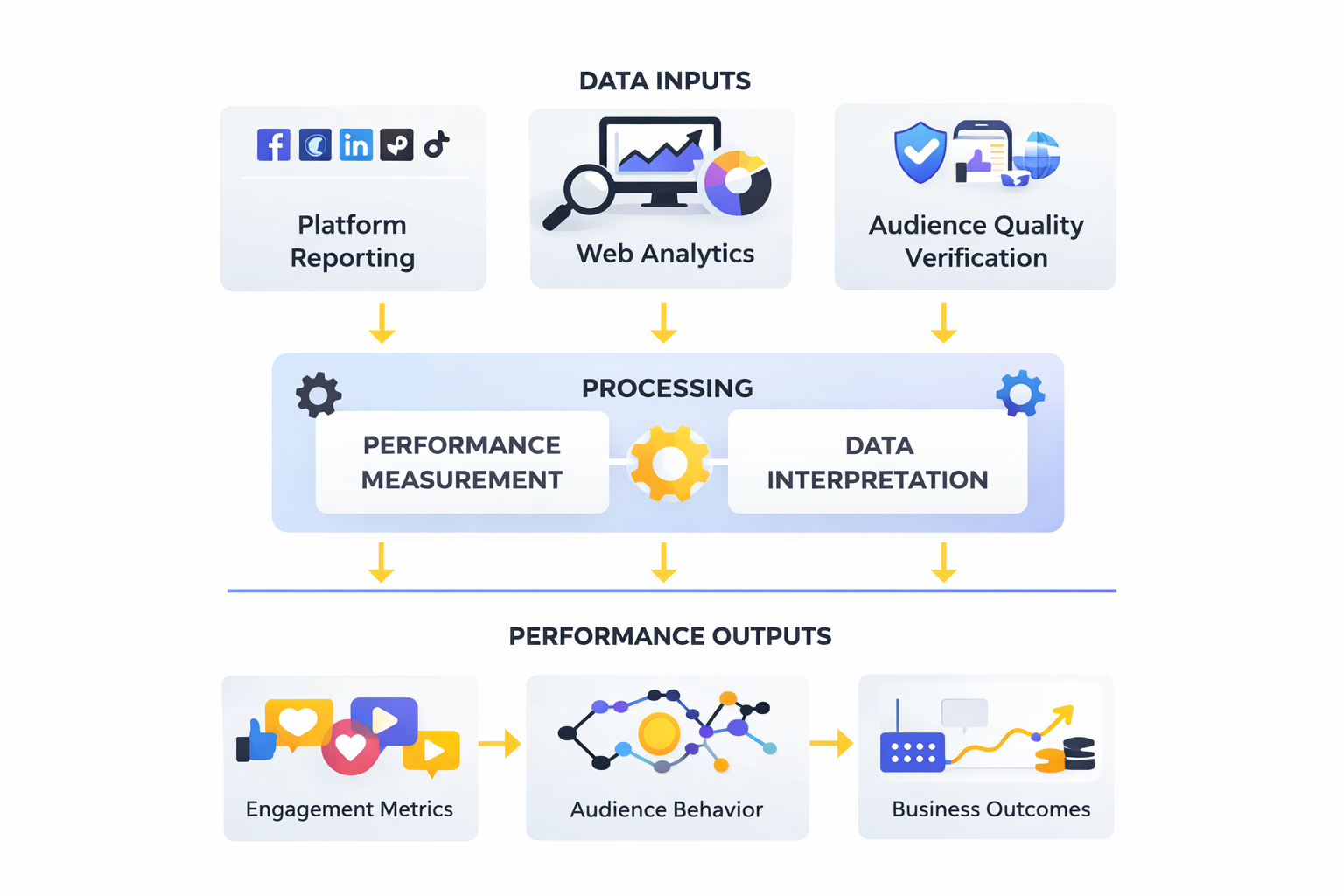
Social media marketing 101 becomes much easier to execute when you treat it like a measurement problem, not a posting problem. Data clarifies what is actually happening: where attention comes from, what content earns trust, and which messages create action.
The scale is already massive, which is why even small efficiency gains can change outcomes quickly. The global audience now includes 5.24 billion active social media user identities, and overall digital behavior continues to shift as people spend more time online and discover brands through feeds and short-form video. Average daily time online for adult internet users sits at 6 hours and 38 minutes, which keeps social at the center of discovery, research, and impulse decisions.
On the business side, the money follows attention. Global social ad investment has been projected to reach $247.3 billion in 2024, and the biggest platforms keep expanding their advertising engines. Meta reported full-year 2025 revenue of $200.97 billion, with advertising representing the overwhelming majority of that total.
Those numbers matter for one reason: competition. More brands are fighting for the same finite attention, and the only reliable way to win in that environment is to use measurement to build a repeatable advantage.
Performance Benchmarks
Benchmarks are not targets; they are context. In social media marketing 101, they help you answer one practical question: is a result genuinely weak, or is it normal for the platform, format, and industry?
Organic performance varies wildly across networks, even before you factor in creative quality. Industry benchmark reporting can help you calibrate expectations across post types and platform behaviors, especially when it breaks down results by network and vertical. The Emplifi Social Media Benchmarks Report 2025 consolidates performance patterns across brands and industries using large-scale dataset analysis, while channel and industry breakdowns from reports like Sprout Social’s benchmarks by industry provide another reference point for what “typical” engagement can look like in different sectors.
Paid benchmarks deserve even more nuance because performance depends on targeting, creative fatigue, seasonality, and attribution setup. A holiday period can inflate CPMs and shift results without any change in creative quality, which is why peak-season analysis (like Skai’s Cyber Five 2024 insights) is useful for understanding how pricing and inventory pressure can distort short-term outcomes.
When you use benchmarks well, you stop overreacting. You can see whether the issue is creative resonance, offer strength, audience definition, landing page friction, or simply normal platform variance.
Analytics Interpretation
Numbers do not “tell the truth” on their own. They tell a story, and the story changes depending on where in the funnel you are measuring. In social media marketing 101, the biggest leap in skill is moving from tracking metrics to interpreting cause and effect.
Start With Intent, Not Vanity
If your goal is lead generation, a spike in likes can be meaningless if form completion rates stay flat. If your goal is brand building, immediate conversion can be the wrong KPI. This is why modern teams pair platform reporting with business outcomes, and often connect social traffic to onsite behavior through systems like Google Analytics 4.
Separate Creative Performance From Audience Performance
When results drop, many teams blame the platform. A better first step is to isolate what changed. If watch time drops while targeting stays stable, creative likely needs a reset. If watch time is steady but conversions fall, your offer, landing page, or follow-up may be the bottleneck.
Use Lift and Testing to Avoid False Confidence
Platform dashboards can over-credit campaigns because attribution windows and cross-device behavior complicate reality. That is why incrementality approaches and controlled experiments matter, especially in paid social. Frameworks and testing methodologies are increasingly discussed across marketing research and industry practice, including scholarship on how AI and measurement are reshaping marketing decision-making, such as recent academic research on AI-powered marketing.
Protect Measurement From Garbage Data
Even strong analytics can be undermined if traffic quality is polluted. Brand safety and ad fraud have become a real operational risk in large-scale ecosystems, which is why modern teams often build verification steps into their reporting processes. This becomes especially important when investigations show how scam advertising can persist inside major ad systems, as highlighted in recent reporting by Reuters’ investigation into Meta ad fraud and follow-up coverage of internal tactics around scam ad enforcement.
Interpretation is where professionals pull away from amateurs. Anyone can read a dashboard. Fewer people can connect the dashboard to the real business constraint that needs to be fixed.
Case Stories
In late 2025, Best Buy faced a familiar retail nightmare: shoppers were browsing online, price-checking in-store, and switching devices constantly. Attribution looked messy and inconsistent. The marketing team could see sales happening, but tying those sales back to social spending felt like trying to measure wind.
The backstory matters. Best Buy has long been a hybrid business where stores are a major advantage, but also a measurement challenge. Social ads might spark demand on a phone, influence a store visit days later, and still get credited to some other channel. That gap makes it easy to underinvest in campaigns that actually drive real-world revenue.
The wall showed up in reporting. Online-only attribution struggled to capture the store halo effect. Teams could optimize for e-commerce ROAS, but that approach risked starving the campaigns that helped people decide to buy in person. The marketing system was getting “smarter” at optimizing the wrong outcome.
The epiphany was treating omnichannel impact as the core KPI rather than an afterthought. Instead of asking, “Did this ad drive an online checkout right now?” the campaign strategy moved toward measuring incremental value across both digital and in-store behavior. That shift aligned with how modern retail actually works.
The journey became an execution project, not a creative experiment. Best Buy partnered with an omnichannel measurement approach around Meta’s Omnichannel Ads, and the work focused on bridging online signals with offline outcomes. The case study published by Ovative describes how the strategy used incrementality testing to quantify true omnichannel returns, while Meta’s product framing for this approach is outlined through its omnichannel ads case study collection.
Then the final conflict hit: proving causality is hard even when the strategy is right. Retail data is noisy, campaigns overlap, and in-store outcomes have many drivers. The team had to rely on lift testing rather than comfort metrics, and that requires patience because results are not instant or perfectly clean.
The dream outcome was clarity. The work reported an incremental omnichannel ROAS of 8.8x, turning the conversation from “Should we keep funding this?” into “How do we scale this responsibly without breaking operational capacity?” That is what strong analytics does in social media marketing 101: it transforms debate into decisions.
Professional Promotion
Promotion is where social media marketing 101 stops being content publishing and becomes growth engineering. Organic distribution builds trust, but professional promotion ensures the right people actually see the message, repeatedly, in the moments when they are most likely to act.
Promote What Already Earns Attention
Boosting random posts is expensive entertainment. A more reliable approach is to promote content that has already proven it can hold attention organically. When a post consistently earns saves, shares, watch time, or meaningful comments, paid amplification turns that signal into scale.
Build Promotion Around Intent Stages
Pros rarely run a single “sales ad” and call it a strategy. They build a sequence: top-of-funnel creative that earns attention, mid-funnel assets that clarify value, and retargeting that handles objections. This is why paid social performs best when it is connected to conversion infrastructure and follow-up systems, not isolated inside platform dashboards.
Use Budget as a Learning Tool
Budget is not only spending; it is measurement. Small controlled budgets help identify which hooks, formats, and audiences create the strongest downstream behavior. Scaling happens after clarity, not before it.
Protect Brand and Performance
Professional promotion includes verification and guardrails. That can mean audience exclusions, placement controls, creative review systems, and routine checks for traffic quality. When major platforms face scrutiny around scam advertising and enforcement challenges, teams that treat promotion as a disciplined system gain a real advantage in both efficiency and brand safety, reflected in ongoing investigations like recent Reuters reporting on scam ads and compliance pressure.
In the next part, the focus expands from analytics into the wider ecosystem: how platforms, creators, communities, and paid distribution interact, and how to design a system that stays resilient even as algorithms and consumer behavior keep shifting.
Future Trends
Social media marketing 101 continues to evolve as platforms, technology, and consumer behavior shift simultaneously. The next phase will not be defined by a single new network, but by deeper integration between artificial intelligence, commerce, and owned data ecosystems.
AI-Augmented Creative Production
Artificial intelligence is increasingly embedded into advertising platforms, influencing targeting, budget allocation, and creative optimization. Rather than replacing marketers, AI tools accelerate testing cycles and surface patterns humans might miss. The competitive advantage will belong to teams that combine creative intuition with algorithmic precision.
Short-Form Video Dominance
Short-form video continues to shape platform design and user expectations. TikTok’s influence has extended across Instagram Reels and YouTube Shorts, reinforcing a feed environment built around fast consumption and high engagement density. Brands that communicate clearly within the first few seconds of content gain disproportionate reach.
Commerce Integration Inside Platforms
Social commerce is becoming increasingly frictionless. Native checkout systems reduce drop-off between discovery and purchase, compressing the traditional funnel. This shift requires marketers to think about conversion earlier in the content journey rather than relying solely on external landing pages.
First-Party Data and Community Ownership
Privacy changes and attribution limitations continue to reshape measurement. Brands that invest in email capture, membership ecosystems, and community-based engagement reduce dependency on platform volatility.
The future of social media marketing 101 is not about chasing novelty. It is about building adaptable systems that can absorb platform shifts without losing strategic clarity.
Strategic Framework Recap
Across all six parts of this guide, one principle remains constant: structure creates sustainability.
The ecosystem begins with positioning and audience clarity. It expands through content systems and controlled promotion. It stabilizes through analytics interpretation and disciplined optimization. Finally, it scales through structured experimentation and cross-functional alignment.
When these layers operate together, social media marketing 101 becomes more than a tactic. It becomes an integrated growth engine that aligns creative storytelling with measurable business impact.
The visual ecosystem above represents that interconnected structure: strategy at the core, surrounded by content, distribution, analytics, and continuous improvement. Remove one element, and performance weakens. Strengthen each layer intentionally, and the system compounds over time.
FAQ – Built For Social Media Marketing 101 Complete Guide
1. How long does it take to see results from social media marketing?
Early engagement signals can appear within days, especially with paid promotion. However, sustainable results often require consistent execution over several months. Trust, brand recognition, and audience familiarity compound gradually.
2. Is organic reach enough to grow a business?
Organic reach builds credibility and community, but competitive markets often require paid amplification to scale efficiently. The strongest systems combine both.
3. How much budget should beginners allocate?
Budget depends on objectives and industry competition. Instead of focusing on a fixed number, start with controlled testing budgets that generate learning without excessive risk. Increase investment only after validating performance stability.
4. Which platform is best for beginners?
The best platform depends on where your audience already spends attention. B2B professionals often prioritize LinkedIn, while visually driven brands may find stronger traction on Instagram or TikTok.
5. How often should content be published?
Consistency matters more than frequency. A sustainable schedule that maintains quality is better than aggressive posting followed by burnout.
6. What metrics matter most?
Metrics must align with objectives. For lead generation, focus on qualified conversions and cost efficiency. For brand awareness, track reach, watch time, and audience growth quality.
7. Can small businesses compete with large brands?
Yes. Smaller brands often move faster and communicate more authentically. Strategic positioning and niche focus frequently outperform large budgets without clarity.
8. Should every post include a call to action?
Not always. Some content builds awareness and trust without immediate conversion pressure. A balanced mix supports long-term engagement.
9. How important is video in social media marketing 101?
Video has become central to platform algorithms and user behavior. Short-form video, in particular, offers high engagement potential when executed strategically.
10. What is the biggest mistake beginners make?
Many beginners focus on surface metrics or chase trends without clear positioning. Without strategic clarity, even high engagement rarely translates into sustainable growth.
11. How do you know when to scale campaigns?
Scale only when performance metrics remain stable across multiple testing cycles. Sudden budget increases without validation can destabilize otherwise profitable campaigns.
12. Is social media marketing a viable freelance career?
Absolutely. As more businesses depend on digital channels, demand for skilled marketers continues to grow. Structured expertise in social media marketing 101 provides a strong foundation for independent professionals.
Work With Professionals
The digital economy has shifted. Businesses everywhere are investing in social channels because attention has moved there. At the same time, thousands of companies struggle to find skilled marketers who can execute strategically instead of guessing.
If you have built real capability in social media marketing 101 — if you understand positioning, analytics, scaling, and disciplined execution — there is growing demand for your expertise.
Platforms like MarkeWork are connecting marketing freelancers directly with companies actively searching for remote specialists. More than 10,000 remote marketing contracts are available from businesses looking for professionals who can manage campaigns, scale growth, and interpret performance data with confidence.
Unlike traditional freelance marketplaces that charge heavy commissions, this model allows marketers to keep 100% of what they earn. No project fees. No percentage cuts. Just direct collaboration between companies and skilled professionals.
If you want to turn your understanding of social media marketing into consistent freelance income, the opportunity is already there. Businesses are hiring. Remote work is normalized. The only question is whether you position yourself where those opportunities are visible.
 Filip Konecny Enterprises