

Businesses once relied on billboards, television spots, and print ads to reach mass audiences. Those channels still exist, but attention has shifted dramatically toward digital platforms where people spend hours every day scrolling, watching, commenting, and discovering new brands. With more than 5.66 billion social media user identities worldwide, social networks now represent one of the largest advertising environments ever created.
This shift has transformed how companies allocate their marketing budgets. Global advertising expenditure surpassed $1.1 trillion in 2024, with digital channels responsible for most of the growth. Within that ecosystem, paid campaigns across platforms such as Meta, LinkedIn, TikTok, and YouTube have become central to how brands generate awareness, leads, and sales.
What makes social media ads marketing especially powerful is not just scale but precision. Instead of broadcasting a message to everyone, advertisers can define exactly who sees an ad based on behavior, interests, demographics, and professional attributes. That combination of scale and targeting has reshaped modern marketing strategy, enabling both global enterprises and independent creators to compete for the same audience attention.
Understanding how this ecosystem works requires more than simply learning how to launch ads. Effective campaigns rely on a structured framework that integrates audience insights, creative development, data analytics, and long-term optimization. The sections below break down the foundations that professionals use to build successful social media advertising strategies.
Article Outline
- What Social Media Ads Marketing Is
- Why Social Media Ads Marketing Matters
- Framework Overview
- Core Components
- Professional Implementation
What Social Media Ads Marketing Is

Social media ads marketing refers to the use of paid promotional campaigns across social platforms to reach targeted audiences and achieve specific business objectives. These campaigns appear directly inside social feeds, stories, video streams, and messaging environments where users already spend their time.
Unlike traditional advertising channels that distribute the same message to broad audiences, social advertising platforms operate on a sophisticated targeting model. Advertisers can define who should see a campaign based on variables such as interests, browsing behavior, purchasing patterns, geographic location, or even job roles within organizations.
This targeting capability exists because social networks collect large volumes of behavioral data from user interactions. Every follow, like, search, or piece of content consumed provides signals about what users care about. Advertising systems translate those signals into audience segments that marketers can reach with remarkable precision.
The mechanics of a typical campaign involve several interconnected components. Advertisers define campaign objectives such as brand awareness, website traffic, or conversions. They then select audience segments, choose ad placements across different formats, and design creative assets such as videos, images, or interactive experiences.
Once a campaign launches, platform algorithms optimize delivery by learning which users are most likely to engage with the advertisement. As the system collects performance data, it automatically adjusts distribution to maximize outcomes such as clicks, purchases, or leads. This continuous optimization is one of the reasons social media advertising has become a dominant channel in modern marketing.
Why Social Media Ads Marketing Matters
The importance of social media ads marketing becomes clear when examining how consumer attention has shifted over the last decade. Social platforms have evolved from simple communication tools into primary discovery engines where people find products, services, and new brands.
Today, the majority of internet users interact with multiple social platforms every day. Research compiled in the Digital 2025 Global Overview Report shows that social networks reach billions of active users worldwide, creating a scale that few media channels in history have achieved.
This massive reach translates directly into marketing opportunity. Businesses can introduce new products to global audiences almost instantly, often at costs that are significantly lower than traditional media campaigns. At the same time, advanced targeting ensures that ads appear to people who are more likely to care about the offer.
Another reason social media advertising has become so influential is the shift in how people research purchases. Many consumers now evaluate products by watching reviews, reading comments, and exploring brand content directly within social apps. Paid campaigns place brands inside that discovery process, allowing them to appear exactly when potential customers are exploring solutions.
Financial investment in the channel reflects this strategic importance. Estimates indicate that companies spent around $219.8 billion on social media advertising in 2024, with projections continuing to rise as more commerce activity moves online. For many industries, social advertising has become the primary growth engine for acquiring new customers.
Beyond revenue generation, social media ads also influence brand perception and long-term visibility. Effective campaigns can introduce a brand story, build emotional connection, and establish trust through repeated exposure across multiple formats. Over time, these interactions accumulate into a recognizable brand presence that extends well beyond a single advertisement.
Framework Overview
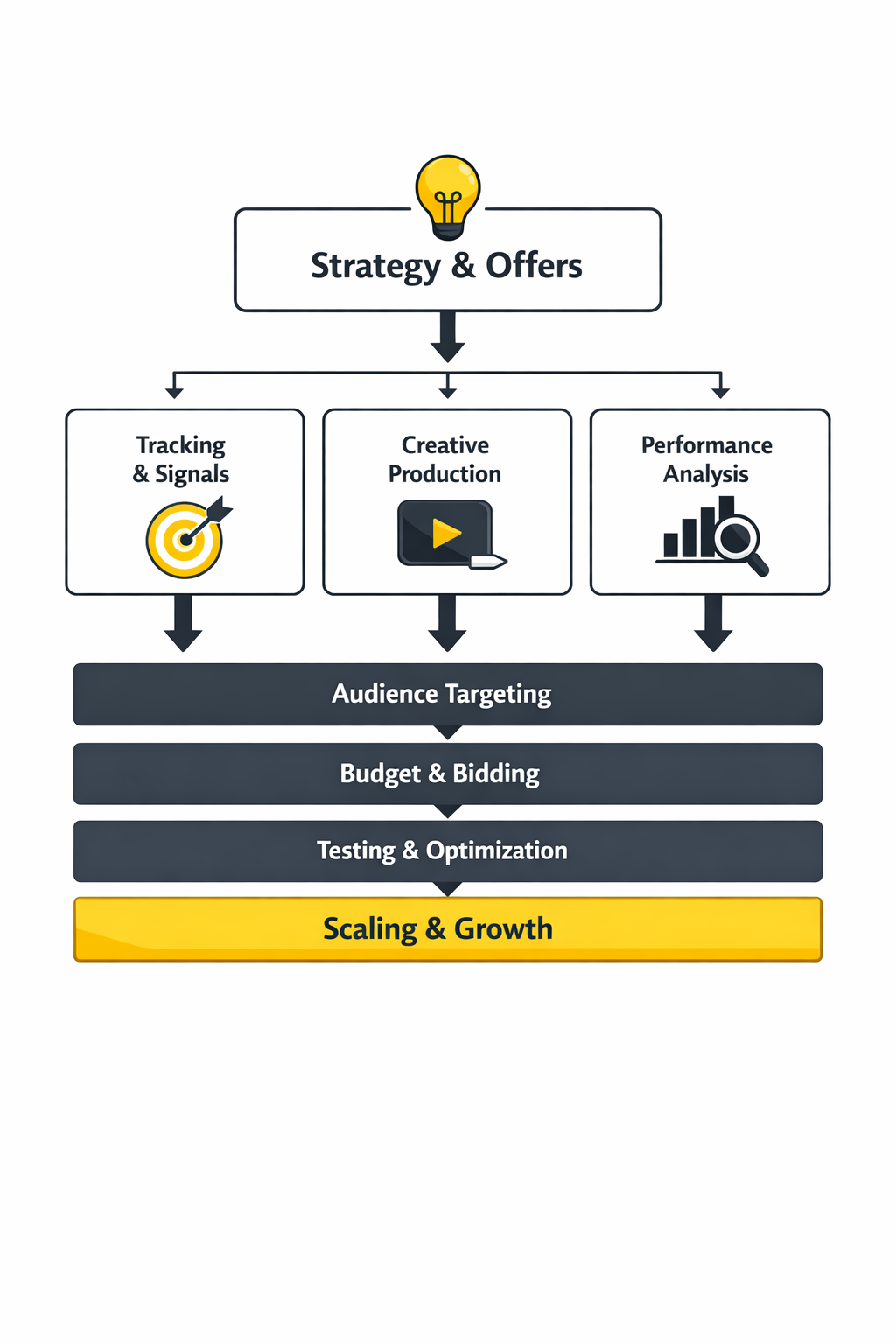
Running successful social media advertising campaigns requires more than launching ads and hoping they perform well. Experienced marketers rely on structured frameworks that guide decision-making from the earliest planning stages to ongoing optimization.
A typical framework begins with defining clear business objectives. These objectives shape every other decision in the campaign. A brand focused on awareness may prioritize video impressions and reach, while an ecommerce company may focus on conversion-driven campaigns designed to generate purchases.
Once objectives are defined, marketers move into audience analysis. This step involves identifying the groups of people most likely to respond positively to the message. Platforms such as Meta and LinkedIn provide detailed targeting capabilities, allowing campaigns to reach audiences based on interests, job roles, company size, or behavioral patterns.
The next stage focuses on creative strategy. Social platforms are highly visual environments, which means the effectiveness of an advertisement often depends on storytelling, design, and emotional resonance. Ads that interrupt scrolling with compelling visuals or relatable messages tend to capture attention and generate engagement.
After campaigns go live, analytics and optimization become the central focus. Marketers monitor performance metrics such as engagement rates, conversion costs, and return on ad spend. Insights from these metrics guide adjustments in targeting, creative elements, and budget allocation to improve results over time.
This structured framework ensures that advertising campaigns evolve continuously rather than remaining static. In a digital ecosystem where user behavior changes quickly, the ability to adapt strategy based on real-time data is often the difference between mediocre performance and exceptional growth.
Core Components
Every successful social media ads marketing strategy relies on several core components that work together to produce measurable outcomes. These components form the operational backbone of advertising campaigns across all major platforms.
The first component is audience intelligence. Marketers must understand who their customers are, what problems they are trying to solve, and how they behave online. Social platforms provide tools that reveal demographic insights, interest clusters, and behavioral signals, enabling campaigns to reach audiences with high relevance.
The second component is creative development. Effective ads are not simply product announcements; they are stories designed to capture attention in crowded feeds. Video storytelling, compelling visuals, and concise messaging all play crucial roles in stopping users mid-scroll and encouraging them to engage.
Another essential element is platform selection. Different social networks serve different audiences and purposes. Professional networking platforms excel at business-to-business targeting, while visually driven platforms often perform better for lifestyle brands and ecommerce businesses. Strategic selection of platforms ensures that advertising budgets reach the most responsive audiences.
Campaign structure is also critical. Advertising platforms organize campaigns into hierarchies that include objectives, audience segments, placements, and creative variations. Proper structure allows marketers to test different combinations efficiently and identify which variables produce the strongest results.
Finally, measurement and attribution connect advertising activity to real business outcomes. By tracking conversions, engagement patterns, and revenue impact, marketers can determine which campaigns truly contribute to growth. This feedback loop enables continuous improvement and smarter allocation of advertising budgets.
Professional Implementation
Implementing social media ads marketing at a professional level requires both technical knowledge and strategic thinking. While modern advertising platforms are designed to be accessible, consistently profitable campaigns depend on disciplined processes and data-driven decision making.
The first step professionals take is building a robust data foundation. This often involves installing tracking pixels, integrating analytics platforms, and ensuring that conversion events are recorded accurately. Without reliable data, it becomes nearly impossible to measure campaign performance or optimize effectively.
Next comes structured testing. Experienced marketers rarely rely on a single ad concept. Instead, they launch multiple variations of creative assets, targeting parameters, and bidding strategies. By analyzing which combinations perform best, they gradually refine campaigns into highly efficient acquisition systems.
Budget management is another crucial aspect of professional implementation. Advertising platforms allow budgets to be distributed dynamically across campaigns and audience segments. Skilled marketers monitor these allocations closely, increasing investment in high-performing segments while reducing spend on underperforming areas.
Finally, professional teams integrate social advertising into a broader marketing ecosystem. Campaign insights often influence content strategy, email marketing, product messaging, and even product development decisions. When these channels work together, social media advertising becomes not just a promotional tool but a central driver of business growth.
This integration between data, creativity, and strategic planning is what ultimately separates casual advertising efforts from truly effective social media marketing operations.
Tools Supporting The Framework
A solid social media ads marketing framework only works if the tools underneath it can carry the weight. Strategy decides what you want to learn and what you want to prove. Tools decide whether you can actually see the truth, move fast enough to act on it, and keep improving without burning hours on manual work.
The tricky part is that “more tools” rarely means “better outcomes.” Modern ad platforms already do a lot inside their own walls, from targeting to optimization to basic reporting. The moment you introduce more software, you’re usually buying one of three things: cleaner data, faster operations, or clearer decisions.
If you remember just one principle, make it this: pick tools that reduce uncertainty. When tracking is fuzzy, you need measurement and data plumbing. When production is the bottleneck, you need creative workflow and automation. When decision-making is slow, you need analytics that connects platform signals to real business outcomes.
That’s why the tool discussion belongs inside the framework, not next to it. A professional setup isn’t a random pile of subscriptions. It’s a system that makes the same campaign decisions easier, faster, and more reliable every week.
Tool Categories
Most teams end up with the same tool categories, even if they use different brands. Once you see the categories clearly, choosing becomes simpler because you’re comparing jobs-to-be-done, not feature lists.
Native Platform Tools
This is the foundation layer: the systems where ads are created, delivered, and optimized. Meta Ads Manager, TikTok Ads Manager, and LinkedIn Campaign Manager are not optional if you’re buying media on those networks; they’re the control rooms.
Meta’s own description of Ads Manager as an all-in-one tool for creating, managing, and tracking ads captures why native tools remain central even when you use third-party software. They are the source of truth for campaign structure, budgets, and delivery diagnostics.
TikTok documents the same hierarchy in its explanation of how campaigns, ad groups, and ads are structured, which matters because tooling choices should map to that structure. If your team can’t name what lives at each level and why, tools won’t save you.
LinkedIn positions Campaign Manager as the place where you create, optimize, and measure. In practice, this is where you diagnose delivery issues first, before blaming creative, attribution, or audiences.
Measurement And Tracking
Measurement tools exist because the browser is no longer a reliable witness. Ad blockers, privacy settings, and platform changes can blur what happened between an impression and a purchase. That’s why server-side and first-party measurement has become a default conversation, not an advanced one.
Meta explains that Conversions API creates a direct connection between marketing data and Meta’s ad optimization systems. TikTok mirrors the concept with its explanation that the Events API provides a reliable connection between TikTok and an advertiser’s marketing data across web, app, and offline.
Google’s overview of server-side tagging frames the tradeoff clearly: you move measurement from the browser to a server environment to gain more control and stability. On top of that, LinkedIn’s Insight Tag remains a practical baseline for conversion tracking and retargeting when LinkedIn is part of the mix.
Analytics And Attribution
If measurement is about collecting signals, analytics is about making those signals usable. This usually starts with event design. Google’s GA4 documentation on setting up recommended and custom events is a reminder that you don’t get clarity by “installing analytics.” You get clarity by defining what matters, naming it consistently, and wiring it end-to-end.
Attribution tools enter the picture when last-click reporting starts creating arguments inside the team. Some businesses can live inside platform dashboards. Others need independent views that combine Meta, TikTok, LinkedIn, email, and onsite behavior into one narrative. The right choice depends on how complex your customer journey is and how much money you’re allocating across channels.
Data Integration And Automation
Once you run more than one platform seriously, the real pain becomes workflow. Exporting CSVs, joining reports, and trying to reconcile discrepancies is where marketing time goes to die.
Tools in this category solve the “glue” problem: moving data between ad platforms, analytics, CRMs, and dashboards. Sometimes that’s a dedicated connector. Sometimes it’s a warehouse-first approach. Either way, the goal is the same: stop asking humans to do what systems should do.
Creative Production And Iteration
Creative production tools matter because social platforms reward volume and learning speed. If you can’t produce variations, you can’t test narratives. If you can’t test narratives, you end up “optimizing” the wrong idea for months.
TikTok’s Creative Center is useful here because it turns trend discovery into a practical input for ad concepts, not just organic content. For competitor and category intelligence, Meta’s Ad Library and LinkedIn’s Ad Library support a healthier creative process: you can study what’s actually running, then decide how to differentiate instead of guessing.
Tool Comparison
Comparing tools for social media ads marketing gets easier if you judge them by the same five criteria. The brand names change. The criteria don’t.
1) Signal Quality
Will the tool help you capture cleaner conversion and audience signals, especially when browsers fail? If you’re dealing with inconsistent tracking, server-side options like Google Tag Manager server-side, plus platform integrations like Meta Conversions API and TikTok Events API, tend to produce more reliable inputs for optimization than relying on browser-only tags.
2) Decision Speed
Does it reduce the time between “we noticed something” and “we acted on it”? Native tools are usually fastest for delivery diagnostics. Analytics tools are faster for cross-channel questions. Data connectors are faster for recurring reporting. If a tool makes you wait for exports or forces manual reconciliation, it slows your loop down even if it looks impressive in demos.
3) Operational Load
How much maintenance does the tool require? Server-side setups can be powerful, but they add infrastructure decisions and debugging responsibilities. Google’s manual setup guide for server-side Tag Manager hints at the reality: this is a real technical system, not a checkbox. If your team can’t support that load, choose a simpler approach and spend your effort on creative and offer testing instead.
4) Attribution Trust
Will the outputs be trusted inside your business? If finance, leadership, and marketing disagree about performance, you don’t have a tooling problem; you have a trust problem. Tools should help you create a shared scoreboard and clear definitions, starting with event and conversion design and extending to reporting consistency.
When the market itself is investing heavily in digital measurement, the stakes rise. The WPP Media “This Year Next Year” forecast points to global advertising revenue hitting $1.14 trillion in 2025, while the Digital 2025 global advertising trends report highlights roughly $1.1 trillion spent in 2024. In an environment that large, attribution arguments get expensive fast.
5) Compliance And Risk
Tools should help you operate cleanly, not create hidden liabilities. If you’re advertising in regulated environments, or in regions with stricter data rules, choose vendors and implementations that support first-party measurement, clear consent logic, and transparent reporting pathways. Even in less regulated contexts, the safest long-term approach is to keep your measurement durable and your data handling intentional.
Real Tool Stack Stories
Tool stacks feel abstract until you see what happens when a real organization hits a wall and has to rebuild the way it measures and optimizes. The stories below are grounded in published case studies and show how tools become leverage when they’re tied to a clear objective.
DSB: When A Measurement Gap Threatened Performance Marketing
The numbers stopped making sense, and it didn’t feel like a normal dip. Campaigns that had been stable began to wobble, while teams stared at dashboards that refused to agree with each other. The uncomfortable fear wasn’t “we’re spending too much,” it was “we don’t actually know what’s working anymore.”
DSB, Denmark’s national rail operator, wasn’t running ads for fun; it was using performance marketing to drive conversions in a competitive travel market. A change in tracking reliability can quickly turn smart bidding into guesswork, especially when customer journeys span devices and sessions. When the data inputs degrade, optimization can quietly drift even if the creative looks fine.
The wall came when the team realized that small fixes weren’t restoring confidence. Browser-based tracking had gaps, and the reporting story felt incomplete in a way that affected decision-making. Stakeholders wanted answers that couldn’t be defended with the existing setup. At that point, “we’ll monitor it” stopped being a strategy.
The shift started with an acceptance that first-party signals had to play a bigger role. The team implemented Meta’s Conversions API to create a more direct data connection into optimization. They also leaned into first-party enrichment so the system could learn from stronger inputs. It wasn’t about adding complexity; it was about replacing missing data with data they could stand behind.
From there, the work became methodical rather than frantic. They tightened their event definitions, ensured the pipeline was stable, and treated measurement as an ongoing system instead of a one-time install. They used the same campaign structure they already understood, but now fed by better signals. Over time, optimization stopped feeling mysterious and started feeling controllable again.
Then came the part nobody advertises: implementation friction. Data plumbing tends to reveal edge cases, and every edge case shows up at the worst possible time. Teams can lose momentum when a setup requires coordination across marketing, analytics, and engineering. That’s where professional discipline matters most, because “almost working” is still not trustworthy.
The outcome is captured in DSB’s published success story: implementing Conversions API and enriching it with more first-party data contributed to an 18% increase in conversions. More importantly, it gave the team a foundation they could keep improving rather than a fragile system they had to babysit. That’s the real win of a tool stack: not a single lift, but a return to confident decisions.
HubSpot: Matching The Platform To The Pipeline
Lead quality looked fine on paper, but the pipeline told a different story. Sales teams were getting names, not momentum, and marketing felt the pressure that always follows: “We’re doing the work, why isn’t it converting?” When that tension builds, it becomes easy to chase volume instead of fixing fit.
HubSpot built its growth engine on education, free resources, and content that attracts marketers before they’re ready to buy. That means paid acquisition has to do more than generate clicks; it has to find the right professionals and move them toward intent. When you sell into a crowded B2B space, “more leads” can be a trap if the targeting and offer don’t align.
The wall showed up as a targeting challenge, not a creative one. Many advertising environments can reach lots of people, but not all of them deliver the professional concentration HubSpot needed. The team needed a channel where the audience context itself did some of the filtering. Without that, optimization just created faster ways to acquire the wrong attention.
The breakthrough came from leaning into LinkedIn’s audience environment and building campaigns designed around specific offers. In LinkedIn’s published case study, HubSpot’s head of paid marketing describes the need to find venues with the right mix of marketing professionals who respond well to free marketing materials. The team created campaign-specific messaging that matched the intent of each offer rather than running generic brand copy.
Execution required more than launching ads; it required pipeline thinking. That meant tightening the connection between ad clicks and what happened next, so lead handling and follow-up weren’t left to chance. Tools like the LinkedIn Insight Tag support measurement and retargeting, while LinkedIn’s own guidance on campaign setup and budgeting reflects how the platform expects advertisers to structure for outcomes. The stack becomes valuable when it keeps the message consistent from ad to landing page to nurture.
Then came the hard part: sustaining relevance at scale. Even strong channels can decay if audiences get saturated or offers stop feeling fresh. Teams often discover that their biggest enemy isn’t competition; it’s creative fatigue and internal impatience. The only way through is to keep iterating while protecting the integrity of the pipeline.
The published case study explains the core challenge and approach, and it anchors the story in how LinkedIn’s environment fit HubSpot’s goals: the HubSpot LinkedIn Ads case study. The deeper lesson is that a “tool stack” is not just tracking code and dashboards. It’s the alignment between platform choice, targeting capabilities, offer design, and the systems that turn interest into revenue.
Start With A Minimum Stack That Covers The Full Loop
A practical baseline usually includes: (1) a native platform tool for each network you buy, (2) a tagging and measurement layer, and (3) an analytics layer that reflects your business outcomes. You can do a lot with Meta Ads Manager, TikTok Ads Manager, and LinkedIn Campaign Manager plus disciplined tracking. The complexity starts when your team needs cross-platform truth and a shared scoreboard.
Use official guidance as your setup backbone. Google’s GA4 event documentation on recommended and custom events helps keep naming and tracking consistent. Then layer in platform measurement like Meta Conversions API, TikTok Events API setup, and the LinkedIn Insight Tag when those platforms matter to your funnel.
Document Events Like A Product Team, Not Like A Marketer
Every event should have a single meaning, a single owner, and a single source of truth. If “Lead” means three different things across Meta, LinkedIn, and GA4, your optimization will be chaotic and your reporting will become political. Clean tools start with clean definitions.
Even if you’re not technical, behave like you are: keep an event schema, maintain version history, and insist on consistent naming across platforms. When something breaks, you should be able to identify what changed without guessing. Tools are only “smart” when your structure is.
Operationalize Testing So Tools Don’t Become Noise
Tools create options, and options can create distraction. Professionals keep testing narrow: one hypothesis, one key metric, one clear decision. Native platforms are excellent for controlled experiments at the ad set level, while analytics helps you validate whether those changes mattered downstream.
Where possible, treat creative discovery as a system. Use resources like TikTok’s Creative Center for trend signals, then validate with structured A/B testing rather than trend-chasing. For competitive and category context, Meta’s Ad Library and LinkedIn’s Ad Library can inspire hypotheses, but your own data still decides what you keep.
Build A Reporting Rhythm That Drives Action
Professional reporting is not a weekly PDF; it’s a decision routine. Pick a cadence where the team reviews what changed, why it changed, and what will be changed next. If a dashboard doesn’t lead to a decision, it’s entertainment, not operations.
Keep a short list of metrics tied to business reality. The IAB/PwC Internet Advertising Revenue Report for 2024 highlights the scale of social advertising revenues in the U.S., which is a useful reminder that competition inside social feeds isn’t slowing down. In that environment, the teams that win are the ones who learn faster, not the ones who report more.
Step By Step Implementation
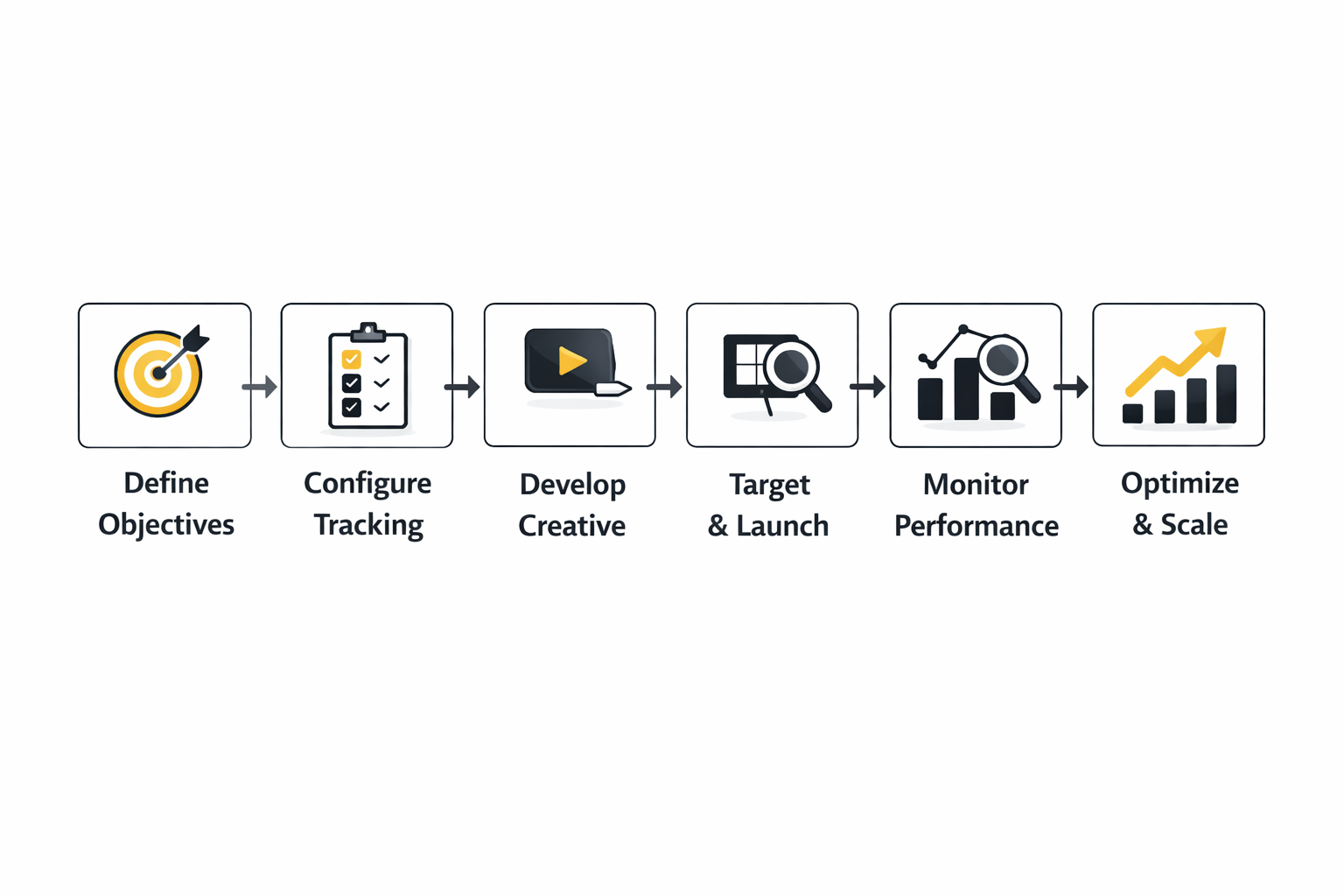
When social media ads marketing works, it rarely feels “lucky.” It feels like a system: clean tracking, a clear objective, a strong offer, creative that earns attention, and a feedback loop that turns results into better results. This step-by-step flow is designed to help you build that system without skipping the boring parts that quietly decide whether campaigns scale or stall.
The biggest implementation mistake is jumping straight to ads and treating measurement like an afterthought. Most teams do it because it feels productive. Then the first performance dip hits, everyone argues about attribution, and you realize you never built the foundation that makes optimization possible.
Step 1: Choose One Outcome That Matters
Pick a single primary outcome for the first build: a purchase, a qualified lead, a booked call, an application, or a trial start. That outcome should map cleanly to how the business actually makes money. When the outcome is fuzzy, the platform learns the wrong behavior and you end up “optimizing” toward cheap clicks that never turn into revenue.
If you’re unsure which outcome to start with, look at your sales process and ask where momentum becomes real. For ecommerce, that’s usually purchase or add-to-cart with enough volume. For services, it’s often a booked call or a form submit that sales will genuinely follow up on.
Step 2: Set Up Tracking Before You Touch Creative
Install platform tags and analytics events first, then verify they fire correctly. Meta’s official guidance for setting up and installing the Meta Pixel is a good baseline for browser-side tracking. TikTok’s walkthrough on setting up and verifying a TikTok web data connection covers the same essentials, including partner and manual options.
For B2B or higher-consideration funnels, LinkedIn’s documentation on Insight Tag conversion tracking is useful because it frames conversion tracking as confidence-building for ROI measurement, not just a technical checklist.
Step 3: Add Server-Side Signals Where They Actually Help
If your tracking is fragile or your conversion volume is valuable, server-side integrations can stabilize the data you send back to platforms. Meta explains how Conversions API creates a more direct connection between your marketing data and Meta, which can improve optimization inputs when browser data is incomplete. TikTok’s documentation describes the Events API as a server-to-server path for sharing events more reliably across web, app, and offline touchpoints.
Don’t add complexity just to feel advanced. Add it when you need the reliability, when you can support the implementation, and when it directly improves your ability to learn and optimize.
Step 4: Define A Simple Campaign Structure You Can Read
A structure is “good” when someone else can look at the account and instantly understand what’s being tested. TikTok’s explanation of the campaign, ad group, and ad hierarchy is worth revisiting because it prevents a common mistake: mixing too many variables inside the same ad group and pretending the results are clear.
Start with one campaign per objective, a small number of audience approaches, and a handful of creative variations. The goal isn’t to cover every possibility. The goal is to learn what works and why.
Step 5: Build Creative Variations That Test One Idea At A Time
In social feeds, creative is your targeting. You’re not only choosing who sees the ad; you’re choosing who feels like the ad is “for them.” Use a small set of creative themes and test variations in hook, proof, and call-to-action rather than changing everything at once.
If you need inspiration without guessing, use transparency and trend tools as inputs. Meta’s Ad Library shows what brands are running publicly. TikTok’s Creative Center can help you understand what formats and angles are resonating in your category right now.
Step 6: Launch, Validate Data, Then Let The Platform Learn
After launch, validate that events are flowing into the platform and that your primary conversion is being recorded consistently. Then resist the urge to “fix” things every hour. Most platforms need time to learn which users are likely to convert.
Think of the first week as calibration. Your job is to make sure the system is measuring the right outcome and the creative is giving the algorithm enough signals to work with.
Execution Layers
Execution gets easier when you separate what you’re doing into layers. Each layer has its own job, and mixing layers is how teams end up with messy accounts and unclear decisions.
Layer 1: Foundation
This layer includes tracking, consent, and event definitions. If the foundation is weak, everything above it becomes speculation. Google’s guidance on Consent Mode and Analytics support notes on verifying and updating consent settings matter here, especially for advertisers working with EEA traffic where consent signals affect measurement and modeling.
Foundation is also where you decide what “conversion” means. Google’s documentation on recommended events and the developer guide for setting up GA4 events helps keep this consistent across tools, which is the quiet difference between clean reporting and endless debate.
Layer 2: Campaign Architecture
This is how you organize campaigns so learning is readable. A good architecture limits confusion by keeping objectives separate, labeling audiences clearly, and isolating tests. When architecture is sloppy, teams see “results” that are really just mixed variables and accidental overlap.
Native tools are best here because they expose delivery diagnostics. Meta’s Ads Manager, LinkedIn’s Campaign Manager, and TikTok’s Ads Manager hierarchy guidance help you keep tests structured enough that the data can teach you something.
Layer 3: Creative System
A creative system is not “make more ads.” It’s a repeatable way to generate angles, produce variations, and retire what’s fatiguing. Research across advertising and consumer response continues to highlight that too much repetition can create diminishing returns, and recent modeling work on ad fatigue explores how excessive exposure can reduce effectiveness over time, even when budgets increase. This 2024 study on advertising policy and ad fatigue is a reminder that “more spend” is not the same as “more impact” when audiences are saturated.
Operationally, that means you plan for creative refreshes, not just for budget increases. When you can refresh fast, you can keep learning without watching performance decay.
Layer 4: Landing Experience And Offer
Social media ads marketing often gets blamed for problems caused by the landing page. If the offer is unclear, the page loads slowly, or the next step feels risky, the best targeting in the world won’t save it. Keep the click path simple and make the first promise match what the ad actually said.
This layer is where trust is built. The more expensive the decision, the more proof and clarity you need.
Layer 5: Analytics And Decisions
Analytics exists to help you make decisions, not to collect screenshots. Build a single view of performance that connects spend to outcomes you care about. The IAB and PwC’s report shows U.S. social media ad revenue reached $88.8 billion in 2024, which is a useful reality check: competition in social feeds is intense, so decision speed becomes a real advantage.
If your reporting takes days and your decisions take weeks, your competitors will out-learn you even with worse creative.
Optimization Process
Optimization is not “tweak things until the numbers look better.” It’s a disciplined loop: diagnose, hypothesize, test, and scale what proves itself. The loop stays the same whether you’re spending €50/day or €50,000/day.
Diagnose: Identify The Real Constraint
Start by identifying what is actually limiting performance. Is it reach, click-through, conversion rate on the site, lead quality, or creative fatigue? Each constraint points to a different fix, and guessing wastes both time and budget.
When you diagnose, use the layer model. If conversions are low but clicks are high, the constraint is rarely targeting. It’s usually offer clarity, landing friction, or misaligned creative expectations.
Hypothesize: Make One Clear Bet
A good hypothesis is specific and falsifiable. “We think a stronger proof hook will increase conversion rate because visitors currently don’t trust the claim” is a hypothesis. “We’ll try new creative” is not.
Keep the hypothesis tied to a single lever: creative, audience, placement, landing page, or measurement. That way, the result teaches you something even if it fails.
Test: Isolate Variables And Let Learning Accumulate
Change one thing at a time when you can. If you change audience, creative, and landing page simultaneously, you’ll never know what caused the lift. Use platform experimentation tools when they make sense, and keep budgets stable long enough to see a signal.
If you’re improving data quality through server-side connections, measure the impact in a way you can defend. TikTok has published internal analysis suggesting their web Events API can drive incremental event capture and performance improvements versus pixel-only setups in specific contexts, which is highlighted in a TikTok playbook referencing a Web Events API incremental performance benefit analysis. Use that kind of insight as motivation, then validate the impact in your own account with your own funnel.
Scale: Increase What’s Proven, Not What’s Exciting
Scaling is where many teams get emotional. A new ad wins, people get excited, budgets spike, and performance collapses because the system didn’t have room to learn or the audience saturates. Scale in steps, monitor frequency and creative fatigue, and keep a pipeline of fresh variations ready.
If you’re in Europe, note that social media is still growing fast enough that competition is intensifying. IAB Europe cites 23.9% social media advertising growth in 2024 in its AdEx commentary, which means more brands are competing for the same attention. Your edge becomes your learning speed and creative resilience.
Implementation Stories
Implementation becomes real when you see what happens under pressure: when measurement gets shaky, when a campaign is on the line, and when the team has to rebuild the system quickly enough to keep results alive. The stories below are based on published case studies and are written as narratives, because that’s how these moments actually feel inside a business.
Target: The Test That Had To Work Before The Season Was Over
The clock was already ticking when the results started looking unusually fragile. Budgets were committed, internal expectations were set, and the season doesn’t wait for perfect data. If the campaign underperformed, there wouldn’t be time to “learn later.”
Target was operating in a world where omnichannel behavior is normal: customers browse online, purchase in-store, and move between devices without thinking about it. That reality makes measurement and creative coordination harder, not easier. When outcomes matter quickly, vague attribution stories create real risk.
The wall was uncertainty: what message and setup actually drove stronger results without wasting spend. It’s easy to convince yourself a campaign is working because you want it to. It’s harder to prove it in a way that everyone trusts, especially when different teams watch different dashboards.
The shift came through controlled experimentation inside the platform. Meta’s success story describes an A/B split test run from October 13 to November 2, 2024 in Meta Ads Manager, focused on learning what worked better. Instead of guessing, the team used the test to turn a high-stakes question into a measurable comparison.
Once the test design was locked, the journey became operational. Creative and setup choices were treated as variables, not opinions. The team focused on a clean read of performance so they could act quickly, not just report outcomes.
Then friction showed up in the form it usually does: complexity and coordination. Testing is clean in theory, but in reality there are stakeholders who want answers early, teams who want to tweak mid-flight, and pressure to “do something” whenever the graph wiggles. Holding the test steady long enough to learn is a discipline problem, not a platform feature.
The payoff was a result that could be acted on with confidence, not just celebrated. Meta’s published summary notes that the omnichannel ads approach helped increase return on ad spend in the test period, captured in the Target case study. The deeper win was the implementation lesson: when you can run clean experiments, you don’t just improve performance, you improve how fast the organization can make decisions.
Listen Out: Turning Attention Into Ticket Sales Without Guesswork
The pressure wasn’t subtle: tickets had to move, and the window to build momentum was small. A festival can’t “ship later.” Either the hype builds and sales follow, or the launch feels quiet and the economics get ugly.
Listen Out had a product that people already cared about, but attention is never guaranteed in social feeds. Competing events, infinite entertainment, and fast-scrolling behavior make it easy to miss even strong offers. When timing is tight, you don’t get unlimited creative cycles to figure it out.
The wall was converting interest into measurable purchase behavior. Views and engagement don’t pay vendors. The team needed a setup that optimized toward the actions that matter, not the ones that look good in a report.
The epiphany came from treating tracking and conversion events as part of the campaign strategy, not as background plumbing. TikTok’s published case study emphasizes results tied to purchase behavior and “Complete Payment” events, which implies a measurement approach aligned with the business outcome. That’s the difference between “content that people like” and “ads that sell.”
The journey combined targeting, creative, and conversion optimization into a single operating loop. The campaign used TikTok as a channel for scale, but it kept the objective anchored in paid outcomes. TikTok’s own data-connection guidance for advertisers reinforces why these setups matter when it explains how the TikTok Pixel measures performance and supports optimization.
Then the campaign hit the part everyone forgets: volatility. Ticketing demand can spike and dip, creative can fatigue quickly, and audiences can saturate faster than expected. When that happens, teams are tempted to chase novelty instead of staying disciplined with what the data is actually saying.
The dream outcome is documented in TikTok’s published results for the campaign, including an 87x return on ad spend and a 22.3% conversion rate on “Complete Payment” events. Whether your own numbers look like that or not, the implementation takeaway is universal: when measurement and optimization are aligned with the real business event, performance marketing stops being a guessing game and starts being a system.
Build Operating Standards That Make Quality Automatic
Create a checklist for launches: tracking verified, conversion event confirmed, naming conventions applied, creative variants uploaded, and budget rules clear. This sounds basic until you realize how many “mystery performance problems” are actually missing standards.
Use official documentation as your baseline, not as a last resort. Meta’s Conversions API overview, TikTok’s Events API documentation, and LinkedIn’s Insight Tag overview help keep your implementation aligned with how platforms actually ingest and use signals.
Protect A Creative Pipeline Like It’s A Revenue Pipeline
Creative fatigue is not a moral failure; it’s the natural outcome of repetition. You avoid it by planning for it. Keep a backlog of concepts, refresh proven themes with new hooks, and maintain a cadence that matches your spend level.
Even academic work on repetition and ad response keeps pointing toward the same truth: variation matters. Recent research into variation and repetition strategies for ad memory shows why creative refresh is not just about “looking different,” but about maintaining effectiveness over time. This 2025 study on ad variation-repetition and memory recall is a useful reminder that repetition without thoughtful variation can change how messages land.
Keep One Trustworthy Scoreboard Everyone Uses
When teams fight about results, they usually have multiple scoreboards with different definitions. Pick one primary reporting view, define your conversion events clearly, and make sure finance and leadership understand what the numbers represent.
Consistency becomes more important as the market grows. With major industry reporting highlighting the scale and growth of social and digital advertising, such as the IAB/PwC 2024 Internet Ad Revenue Report, the competitive cost of confusion rises. Clear measurement and fast decisions are not “nice to have” anymore.
Statistics And Data
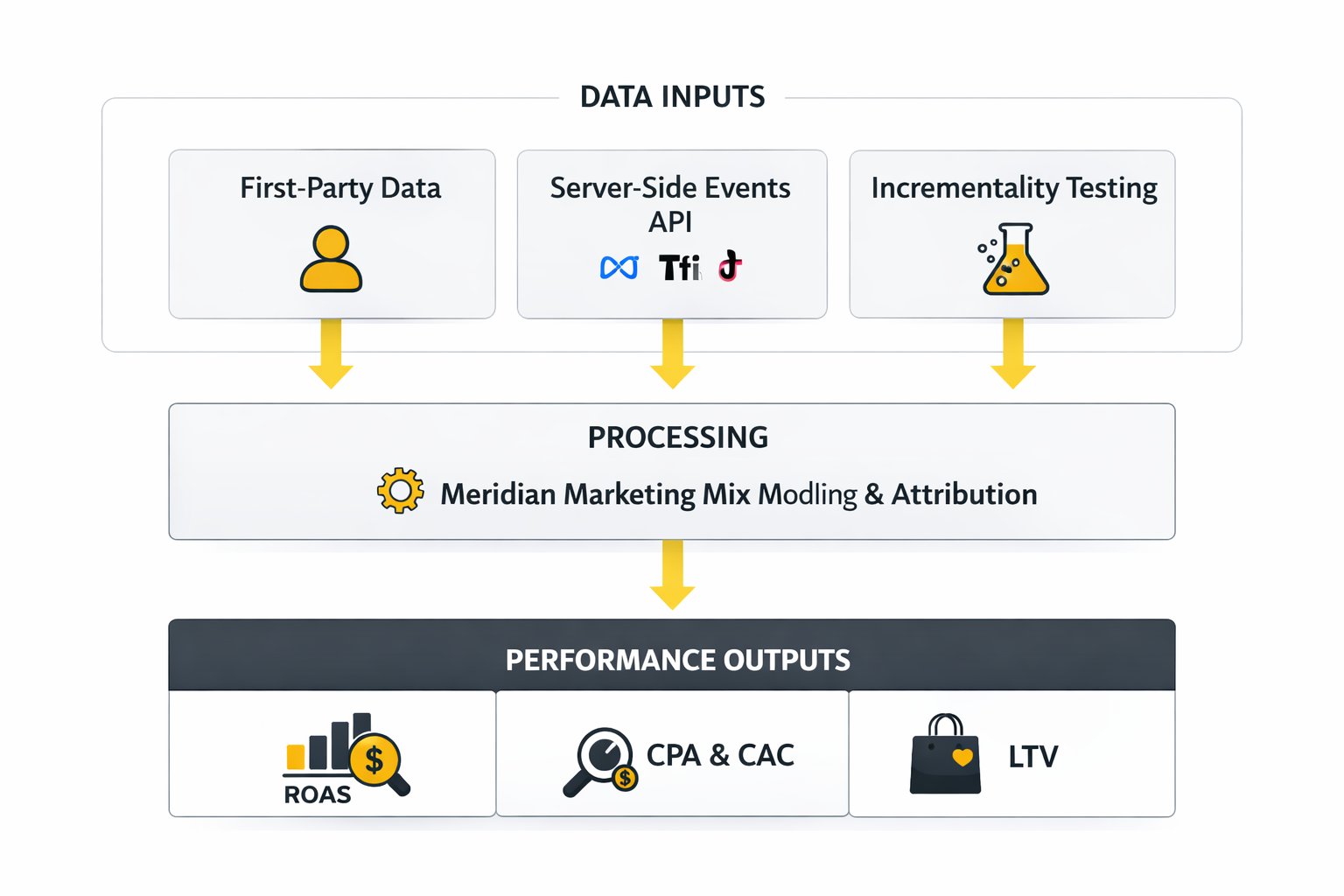
Analytics is the part of social media ads marketing that turns opinions into decisions. Without it, you’re basically arguing over screenshots and gut feelings. With it, you can explain what happened, why it happened, and what you’re going to do next with a straight face.
The scale is also worth keeping in mind, because it explains why competition feels so intense inside social feeds. Global ad investment reached close to US$1.1 trillion in 2024, with digital channels taking 72.7% of worldwide ad spend. That’s not a niche channel anymore; it’s where the money lives.
Within that shift, social platforms had a particularly strong year. The same dataset highlights that marketers spent close to a quarter of a trillion US dollars on social media ads in 2024, and that this was about 15% higher than 2023. When budgets rise like that, the bar for measurement rises too, because nobody wants to keep funding a channel they can’t defend.
In the United States, the industry benchmark report on revenue shows social media advertising revenues totaling $88.8 billion in 2024. That’s a useful reminder that “paid social” isn’t just a performance tactic; it’s a major pillar of the advertising economy.
And while spend grows, efficiency still moves around quarter to quarter. One snapshot that matters for planning is that average social media CPMs in Q4 2024 were reported at US$5.69 per thousand impressions, slightly lower year over year in that holiday quarter. Trends like that can change how aggressively you test new creative or how quickly you scale budgets, especially in competitive periods.
Performance Benchmarks
Benchmarks are only helpful when you treat them as context, not as a grade. A “good” CPM in one account can be a “bad” CPM in another if the audiences, placements, creative formats, or conversion goals are different. The smarter approach is to benchmark the motion: what’s getting more expensive, what’s getting cheaper, and what’s changing in how platforms distribute inventory.
For example, Tinuiti’s Q4 2024 benchmark report (based on anonymized advertiser data under management) shows Meta spend for Facebook and Instagram growing 15% year over year in Q4 2024, and it also highlights that Advantage+ shopping campaigns increased their share of retail and ecommerce spend from 27% in Q4 2023 to 34% in Q4 2024. That’s not just a stat; it’s a signal that automation-heavy campaign types are becoming more central in how serious advertisers buy Meta inventory.
Another benchmark worth watching is where impressions are coming from, because it changes creative requirements. The same report notes that Reels inventory continued to grow, and it includes a snapshot showing Facebook Reels dynamics with year-over-year changes in spend, impressions, and CPM. In practical terms, if more delivery shifts into short-form video placements, you either adapt your creative system or you slowly lose efficiency.
On the macro side, it helps to understand what “normal” ad pressure looks like. Digital ad investment exceeded US$790 billion in 2024, and social alone represented a meaningful chunk of that. When you’re operating in a market that large, you should expect benchmarks to drift over time as platforms, inventory, and advertiser behavior evolve.
Analytics Interpretation
Numbers don’t speak for themselves. They tell the truth only when you interpret them inside the right chain of cause and effect: what the platform delivered, what users experienced, what the site did with that traffic, and what the business did with the resulting leads or customers.
Start With Questions, Not Metrics
Before you open a dashboard, decide what you’re trying to learn. Are you testing a new audience? A new offer? A creative angle? A new objective? If you don’t define the question, you’ll end up scrolling until you find a number that makes you feel better.
A clean interpretation habit is to write the question in plain language and force your analytics to answer it. That keeps your reporting honest and your optimization focused.
Map Metrics To The Funnel Layers
Top-of-funnel signals (reach, video views, engagement) are about attention and message resonance. Mid-funnel signals (click-through rate, landing page view rate, content downloads) are about intent and clarity. Bottom-funnel signals (conversion rate, cost per acquisition, qualified lead rate) are about trust, offer strength, and friction.
What matters is how the metrics relate. If clicks rise but conversions fall, don’t blame targeting first. The more likely explanation is misalignment between what the ad promised and what the landing experience delivered.
Watch For Creative Fatigue Before It Shows Up As Panic
Most performance “mysteries” are just fatigue arriving quietly. Frequency climbs, CTR softens, conversion rate slips, and the account starts to feel like it needs constant tweaks. That’s usually not an audience problem; it’s a creative system problem.
This is also why the market-level context matters. When global social ad spend grows by around 15% year over year, more advertisers are competing for attention inside the same feeds. Your analytics should be built to spot fatigue early, so your creative pipeline can respond before efficiency collapses.
Use Benchmarks As Guardrails, Not Targets
Benchmarks are useful when they help you notice something unusual. If your CPM spikes far above what’s typical for your own account history, it may signal auction pressure, audience saturation, or a placement shift. If your CPL is “better than average” but lead quality is weak, the benchmark is distracting you from the business outcome that matters.
The real benchmark is consistency: does performance hold when you scale, and can you explain why it holds? That’s what turns a campaign win into a repeatable growth system.
Case Stories
Real analytics stories tend to begin the same way: pressure, uncertainty, and a moment where the old setup stops working. What changes the outcome is not a magical tactic; it’s the combination of measurement, creative discipline, and a willingness to invest across the funnel even when it feels slower in the short term.
Jasper: A Rebrand That Needed Proof, Not Applause
The launch was live, eyes were on the brand, and the expectations were sharp. A rebrand can’t just look good; it has to move pipeline, or it becomes an expensive slide deck. The pressure wasn’t coming from comments in social feeds, it was coming from the revenue question that follows every big marketing moment.
Jasper entered that moment in June 2025 with a major repositioning and a clear internal goal: turn the rebrand into measurable long-term growth. The team wasn’t trying to “get attention” in the abstract; they needed marketing decision-makers to understand what changed and why it mattered. And they needed to prove that the new story could produce outcomes, not just buzz. The published LinkedIn case study explains the June 2025 context and the objective.
The wall arrived fast: most of Jasper’s LinkedIn investment had historically leaned heavily on lead-generation campaigns, and that approach alone wasn’t designed to carry a rebrand. Lead gen can harvest demand, but it doesn’t always create it, especially when you’re asking the market to see you differently. If the team stayed stuck in a bottom-funnel-only mindset, the rebrand risked becoming invisible to the exact people who needed to understand it. That’s a brutal place to be, because the campaign can look “efficient” while the business goal fails.
The epiphany was to stop treating brand and performance as competing priorities and start treating them as compounding forces. Jasper shifted to a full-funnel strategy and structured investment intentionally across awareness, consideration, and lead generation. The plan wasn’t vague; the published breakdown shows a split of 40% awareness, 30% consideration, and 30% lead generation. That decision changed what success looked like, because now the team could measure momentum at every stage, not just at the form fill.
The journey became a layered execution system instead of a single campaign type. Jasper used multiple ad formats, including video and CTV for reach, Thought Leader Ads to build credibility, and Document Ads to convert engaged audiences into qualified leads. The case study describes how leadership messaging and educational assets were used to build trust before asking for the next step. That’s what full-funnel looks like in real life: you earn attention, then you earn belief, then you ask for action. The solution section outlines the format mix and funnel logic.
Then came the conflict that hits almost every serious analytics program: aligning stakeholders around the right scoreboard. Full-funnel work often produces early signals that are easy to dismiss if people only respect last-click leads. It takes discipline to keep the strategy steady long enough for the compounding effect to show up in pipeline. It also takes strong interpretation, because the team must explain why impressions and consideration activity matter when the goal is revenue.
The outcome is documented clearly in the results snapshot: 6.3M impressions, a 226% increase in qualified leads, a 40% decrease in cost per lead, and a 14% increase in demo requests. Those numbers are powerful, but the deeper win is that the analytics story is coherent. The funnel investment, the creative system, and the reporting logic all point in the same direction, which is exactly what makes performance scalable instead of fragile.
Professional Promotion
If you’re running social media ads marketing as a freelancer or as the “ads person” inside a team, analytics is also how you promote yourself professionally without sounding like hype. Most marketers can say they ran ads. Far fewer can show a trustworthy measurement system, a testing narrative, and decision-making maturity.
Build A Proof Portfolio, Not A Vanity Portfolio
A strong portfolio isn’t a collage of logos and screenshots. It’s two or three short case write-ups where the reader can see the objective, the constraint, the hypothesis, the test, and the outcome. When you can point to credible benchmarks and market context like the scale of social ad investment in 2024, your work feels grounded in reality, not bragging.
Keep the focus on what you changed and why it worked. The goal is to sound like someone who operates a system, not someone who got lucky.
Sell Your Process In Plain Language
Clients and stakeholders don’t pay for platform buttons. They pay for reduced uncertainty, faster learning, and results they can trust. Explaining your reporting rhythm, how you interpret funnel signals, and how you avoid creative fatigue will often win more confidence than quoting a random CTR.
When you can reference stable industry data points, like U.S. social media advertising revenue in 2024, it also signals that you understand the market context your client is competing in.
Make The Next Step Obvious
Professional promotion works best when it feels helpful, not pushy. Show how you diagnose constraints, how you decide what to test, and how you report outcomes in a way leadership can act on. Then offer a simple next step: an account audit, a tracking review, or a creative testing plan tied to one business objective.
When your promotion is anchored in measurement and clarity, it doesn’t feel like selling. It feels like relief.
Future Trends
The next phase of social media ads marketing will feel less like “media buying” and more like operating an ecosystem: creative production, commerce, privacy-safe measurement, and AI-led optimization all moving together. Platforms are pushing harder into automation, which changes what advertisers control, and it also raises the value of the things machines can’t invent for you: differentiated offers, real customer insight, and creative that earns attention.
One obvious shift is that creators are no longer a “nice add-on” for paid social. U.S. creator ad spend was $29.5B in 2024 and projected to reach $37B in 2025, which is the kind of momentum that forces every serious advertiser to build a creator pipeline, not just run occasional influencer posts.
Another acceleration is commerce inside social environments. TikTok’s newsroom highlights that NielsenIQ named TikTok Shop the fastest-growing online retailer in 2024, and the broader story is that discovery and purchase are compressing into the same experience. If your ads still behave like “traffic only,” you’ll miss the value created when product education, social proof, and checkout happen closer together.
Measurement is also moving into a new “privacy-first realism.” Google confirmed it would not launch a new standalone third-party cookie prompt and would keep the current cookie approach in Chrome, which Reuters covered in April 2025. The practical takeaway is that you can’t build your business on perfect browser tracking anymore, so first-party data, server-to-server events, and incrementality testing become more valuable.
Finally, AI is no longer just a creative assistant; it’s reshaping the economics of advertising services and platform operations. Recent reporting on WPP’s restructuring emphasizes the company’s push to simplify and invest in AI capabilities, including Reuters coverage in February 2026 and the Financial Times summary. When the largest holding groups reorganize around AI, it signals where the industry is heading: faster production, more automation, and a higher premium on strategy and differentiation.
Strategic Framework Recap

A complete social media ads marketing system is easier to run when you treat it like an ecosystem with a few non-negotiable pillars. When one pillar is weak, everything else gets blamed, even if it isn’t the real cause.
First, build signal you can trust. That means clean event definitions, consistent conversion logic, and durable data connections where they matter. Meta’s overview of Conversions API and TikTok’s documentation for the Events API reflect the direction platforms want advertisers to go: more reliable server-to-server signals, not just browser pixels.
Second, treat creative like the engine, not the decoration. As platforms automate more of the targeting, creative increasingly acts as the “input language” that tells delivery systems who should see your ad. That’s why serious teams build creative throughput and refresh rhythms instead of relying on a few winners for too long.
Third, scale with measurement maturity. Attribution will always be imperfect, so advanced teams add causal proof where possible. TikTok explains why incrementality matters via Conversion Lift Studies, and Google’s open approach to modeling via Meridian MMM reflects how modern budget decisions are increasingly made.
Finally, make decisions fast enough to matter. When markets grow and competition intensifies, slow learning becomes expensive. WPP Media’s “This Year Next Year” forecast expects global ad revenue to reach $1.14T in 2025, and that scale doesn’t reward hesitation. It rewards disciplined systems that learn quickly and compound.
FAQ – Built For The Social Media Ads Marketing Complete Guide
What budget do I need to start social media ads marketing?
You can start small, but the real requirement is consistency long enough to learn. A modest daily budget can work if your conversion event is realistic, your tracking is correct, and you have multiple creative variations to test. If your product has a long sales cycle, budget needs rise because learning takes longer.
Which platform should I start with: Meta, TikTok, or LinkedIn?
Start with where your buyers already spend attention and where your offer naturally fits the content format. Meta tends to be versatile for many categories, TikTok can be powerful for discovery-led creative and commerce, and LinkedIn is often strongest when targeting by role and company context. Platform choice is less about hype and more about match quality.
How long does it take to see results from paid social campaigns?
Most accounts need a launch period to calibrate tracking and stabilize delivery, then a testing period to find repeatable winners. If you change variables too quickly, you delay learning. The best way to shorten the timeline is to launch with multiple creative angles and a clean measurement setup from day one.
What metrics matter most in social media ads marketing?
The metrics that matter are the ones that map to how the business makes money. For ecommerce, that’s usually purchase efficiency and contribution margin. For service businesses, it’s qualified lead rate and cost per booked call. Vanity metrics can be useful for diagnosing attention, but they should not be the scoreboard.
Why do platform results not match GA4 or my backend sales numbers?
Different systems use different attribution windows, identity matching, and modeling methods. Browser restrictions and consent settings also reduce determinism. This is why platforms emphasize server-side event connections like Meta Conversions API and TikTok Events API to improve signal quality and matching.
Do I really need server-side tracking in 2026?
Not always, but it becomes more valuable when you rely heavily on paid acquisition, when conversion volume is meaningful, or when browser-side tracking is unstable. Server-side events can make reporting more dependable and give optimization systems more complete signals, especially when cookies and browser restrictions reduce what pixels can capture.
How do I avoid creative fatigue when scaling spend?
Assume fatigue will happen and build a refresh rhythm that matches your spend. Keep a pipeline of variations: new hooks, new proof points, new formats, and new creator faces when appropriate. Market momentum toward creators makes this even more important, given the growth cited in IAB’s creator economy reporting.
What is incrementality, and why does it matter?
Incrementality asks whether ads caused additional conversions beyond what would have happened anyway. It matters because attribution can over-credit campaigns, especially when you scale. Experiment-based approaches like TikTok’s Conversion Lift Study are designed to answer that causal question more directly.
How do I succeed when platforms keep pushing automation?
Automation rewards advertisers who provide strong inputs: clean conversion signals, steady budgets, and high-quality creative variety. Your advantage comes from what you control: offer strategy, creative direction, landing experience, and measurement integrity. Meta’s positioning of Advantage+ reflects this direction, where AI and automation are central to campaign execution.
Is social commerce a trend or a permanent shift?
It’s becoming structural, especially on platforms that blend entertainment and shopping. TikTok’s statement that NielsenIQ named TikTok Shop the fastest-growing online retailer in 2024 reflects how quickly consumer behavior can move when discovery and checkout live in the same place.
Work With Professionals
If you’ve made it this far, you already know the truth most people avoid: social media ads marketing doesn’t break because someone missed a “growth hack.” It breaks because the system isn’t built to learn fast, measure cleanly, and refresh creative before performance decays.
That’s also why freelancers who can operate the full system are in a strong position. Companies want outcomes, but they also want speed: someone who can set up reliable tracking, run disciplined tests, interpret results without drama, and keep campaigns improving week after week.
Markework is built for that kind of work. It’s a marketing marketplace where you can build a profile, browse opportunities across performance and growth roles, and connect directly with companies without a middle layer. The platform emphasizes no project fees and direct communication, so you keep control of your client relationships and how you price your work.
If you’re serious about landing better remote contracts, a clean profile plus a clear “system offer” is the fastest way to stand out: a tracking review, a creative testing plan, a scaling audit, or a full-funnel rebuild. When your offer feels like relief, clients move faster.
Build your presence, pick a specialty you can prove, and start conversations with teams that already need what you do.
markework.com Filip Konecny Enterprises