

For most companies today, social media is no longer an optional marketing channel. It has become a primary way customers discover brands, evaluate credibility, and decide where to spend their money. Modern consumers often encounter a business for the first time through a post, video, or recommendation shared on a social platform before they ever visit the company’s website.
This shift in behavior has changed how businesses approach marketing. Research examining global social media adoption shows that about 65.7% of the world’s population actively uses social media, and the average user interacts with nearly seven different platforms every month. That means the simple act of posting on social media for business now places companies inside the daily digital habits of billions of potential customers.
The opportunity is enormous, but so is the challenge. Platforms reward meaningful interaction, authenticity, and consistent value. Random or inconsistent posting rarely generates results, which is why successful organizations treat social media publishing as a structured business activity rather than casual content sharing.
Understanding how posting on social media for business actually works—from the strategic goals behind each post to the frameworks used by experienced marketing teams—creates the difference between accounts that simply exist and accounts that actively drive growth.
Article Outline
- What Posting on Social Media for Business Really Means
- Why Posting on Social Media for Business Matters
- Framework Overview for Posting on Social Media for Business
- Core Components of Posting on Social Media for Business
- Professional Implementation of Social Media Posting
What Posting on Social Media for Business Really Means

Posting on social media for business refers to the strategic publishing of content on digital platforms with the goal of strengthening relationships with customers, increasing brand visibility, and ultimately generating revenue. Unlike personal social media use, business publishing follows defined objectives and measurable outcomes.
Each post serves a purpose. Some posts introduce a brand to new audiences. Others educate potential customers about products or industry topics. Many posts exist simply to maintain engagement with existing followers so that the brand remains visible and relevant within constantly changing platform algorithms.
The scale of this opportunity explains why businesses across industries have integrated social media publishing into their core marketing strategy. Studies analyzing business adoption rates show that roughly 92% of companies now use social media for marketing, while nearly 69% of marketers report that their social activity directly contributes to lead generation.
At its best, posting on social media for business creates a continuous conversation between companies and their audiences. Instead of communicating only through advertising campaigns or website visits, brands can appear in the everyday digital environment where people already spend time reading, watching, and interacting.
This shift transforms marketing from a series of isolated campaigns into an ongoing narrative. Businesses that understand this narrative approach use social media posts not simply to promote products but to build long-term trust, credibility, and familiarity with their audiences.
Why Posting on Social Media for Business Matters
The importance of consistent social media publishing comes from how people discover and evaluate brands today. Online discovery rarely begins with a search engine or direct website visit. Instead, it often starts with a piece of content appearing in a social feed, recommended by algorithms or shared by friends.
Research on consumer behavior indicates that around 58% of people discover new businesses through social media platforms. For many companies, especially smaller ones without large advertising budgets, this discovery channel represents the most accessible path to reaching new audiences.
Social media also plays an increasingly direct role in purchasing decisions. Studies examining social commerce trends show that social platforms are evolving into transactional environments, with the global social commerce market projected to exceed $2 trillion in value as integrated shopping features become more common across platforms.
Beyond immediate sales, consistent posting on social media for business builds long-term brand visibility. When audiences encounter a company repeatedly in their feeds—through educational posts, entertaining content, or helpful advice—the brand gradually becomes familiar. Familiarity often translates into trust, and trust strongly influences purchasing decisions.
Businesses also use social platforms as customer service channels, feedback systems, and community spaces. Social posts can spark conversations, highlight customer stories, and reveal how audiences actually interact with a brand in real time. These insights often guide product development, messaging strategies, and broader marketing initiatives.
Framework Overview for Posting on Social Media for Business
Successful organizations rarely post randomly. Instead, they rely on structured frameworks that guide what type of content they publish, when they publish it, and how each post contributes to broader marketing goals.
A typical framework for posting on social media for business begins with audience understanding. Companies first identify who they want to reach, what problems those people face, and how their products or expertise can provide value. Without this foundation, social media content tends to feel generic and fails to generate meaningful engagement.
The second layer of the framework focuses on content categories. Businesses typically divide their posts into several categories, such as educational insights, behind-the-scenes content, community interaction, and product-focused messaging. This balance prevents feeds from becoming overly promotional while still supporting commercial objectives.
Consistency forms the third layer of the framework. Research examining social media strategies across industries has shown that consistent publishing schedules significantly improve audience engagement and long-term visibility. Even simple posting routines create predictable interaction patterns that platform algorithms often reward with greater reach.
Finally, a professional framework integrates measurement. Businesses analyze engagement data, audience growth, and conversion signals to understand which posts resonate most effectively. Over time, these insights shape future content strategies and refine how organizations approach posting on social media for business.
Core Components of Posting on Social Media for Business
Although every company adapts its social media strategy to fit its audience and industry, most successful social media programs share several core components that guide how content is created and published.
The first component is value-driven content. Posts that educate, entertain, or solve problems tend to outperform purely promotional messages. When audiences receive genuine value from a company’s content, they become more likely to follow the account, engage with future posts, and eventually explore the products or services being offered.
The second component is storytelling. Rather than presenting isolated facts or product features, strong social media posts often tell short narratives that reveal the people, challenges, and ideas behind a business. This storytelling approach humanizes organizations and helps audiences form emotional connections with brands.
Community interaction represents another essential component. Responding to comments, asking questions, and encouraging discussion turns social media pages into active communities rather than passive broadcasting channels. These interactions also signal to platform algorithms that the content is meaningful to users.
Visual communication also plays a major role. Studies analyzing social media engagement patterns show that visual content—including images and video—generates dramatically higher sharing and interaction rates compared with text-only posts. As platforms increasingly prioritize visual formats, businesses adapt by integrating stronger visual storytelling into their publishing strategies.
Professional Implementation of Social Media Posting
Implementing a professional system for posting on social media for business requires more than creativity. It involves planning, coordination, and consistent evaluation of performance. Marketing teams often build structured workflows that guide the process from idea generation to publishing and analysis.
Content calendars represent one of the most widely used tools in professional social media management. These calendars map upcoming posts across weeks or months, ensuring that different types of content remain balanced and aligned with business priorities such as product launches, campaigns, or seasonal events.
Professional teams also adapt their content for each platform rather than publishing identical posts everywhere. Research analyzing multi-platform strategies has found that companies maintaining a diversified presence across several social platforms can increase total web sales by roughly 2–5% through overlapping audience exposure. Repeated exposure across multiple networks reinforces brand recognition and strengthens purchase intent.
Analytics completes the implementation cycle. By studying engagement patterns, reach metrics, and audience responses, businesses refine their publishing strategies over time. This continuous improvement process gradually transforms social media accounts into reliable growth channels that consistently attract attention, build credibility, and generate opportunities for the business.
HTMLStep By Step Implementation
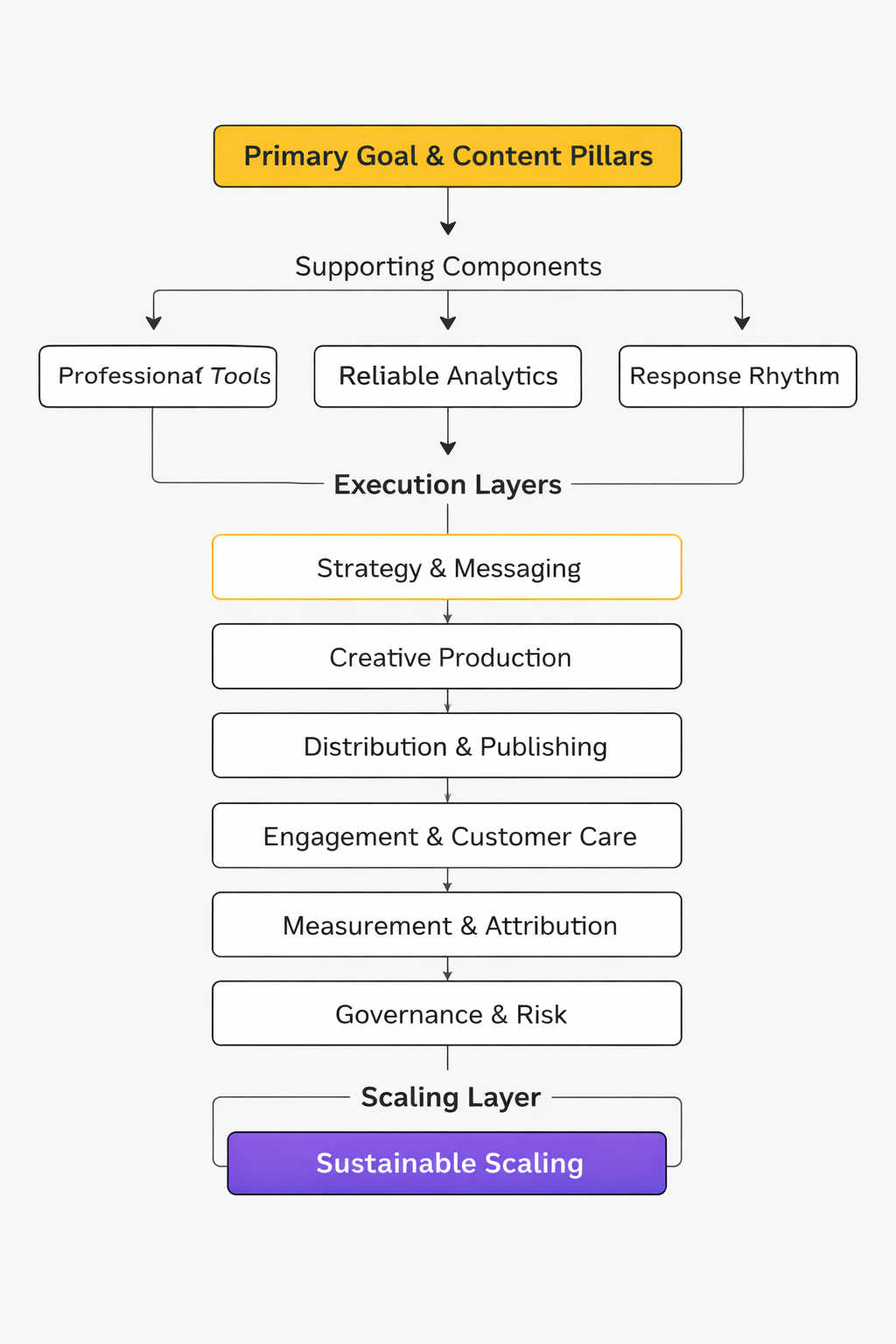
The easiest way to lose momentum with posting on social media for business is to treat it like a creative burst instead of a repeatable operating system. Implementation works best when you set a simple sequence your team can follow every week, even when things get busy. The steps below are designed to feel realistic in the real world, not perfect in a spreadsheet.
Step 1: Define One Primary Goal for the Next 30 Days
Pick one outcome to optimize for: qualified leads, product trials, local visits, customer retention, or brand trust. One goal forces clarity in what you post and what you measure, and it stops your calendar from turning into random “we should post something” decisions. If you want a simple test, ask: “If this improves, would the business actually feel it?”
Step 2: Choose Two Content Pillars You Can Sustain
Content pillars are the themes you can reliably talk about without scrambling. For example: customer education and behind-the-scenes proof, or product use-cases and community stories. Two pillars is enough to keep your feed consistent without repeating yourself, and it makes ideation faster because you’re never starting from zero.
Step 3: Build a Two-Week Batch, Not a Three-Month Fantasy Plan
Start small and prove consistency before you scale volume. A two-week batch is long enough to reduce daily stress, but short enough to adapt quickly when the platform shifts or your audience signals something new. Teams often discover that batching unlocks better quality because you stop creating under deadline pressure and start creating with intention.
Step 4: Create a Simple Approval Line
Approvals only work when they are predictable. Decide who reviews for brand voice, who checks accuracy, and who has final publish authority—and write it down. Even a lightweight approval system reduces the risk of a single careless post becoming a permanent screenshot.
Step 5: Schedule Natively First, Then Upgrade Only When You Feel the Pain
If you’re publishing mainly inside one ecosystem, native scheduling tools can be a strong baseline. Meta explains how to schedule Facebook and Instagram content through Meta Business Suite, LinkedIn documents scheduled publishing, and TikTok provides a guide to its Video Scheduler. Start with native scheduling, then move to a broader stack when you need approvals, cross-platform coordination, or deeper reporting.
Step 6: Build a Response Routine That Matches Customer Expectations
Posting on social media for business isn’t finished when you hit publish—because customers reply in real time. Consumer research in the Sprout Social Index response-time analysis highlights how strongly people value timely replies, and broader customer experience trend reporting from Zendesk shows expectations rising across channels. A simple routine—two inbox checks daily for small teams, more for high-volume brands—prevents your content from creating conversations you never show up for.
Step 7: Measure One Post, One Insight, Then Improve the Next Batch
Don’t drown in dashboards. For each post, capture one insight you can use: the strongest hook line, the best format, the best time window, the best CTA, or the best comment trigger. This is how implementation becomes compounding growth instead of endless guessing.
Execution Layers
Teams that get consistent results from posting on social media for business usually separate execution into layers. That matters because when something breaks—quality drops, deadlines slip, engagement falls—you can identify which layer failed and fix it without tearing everything down.
Layer 1: Strategy and Messaging
This layer answers “what do we stand for?” and “what do we want people to believe after seeing us for 30 days?” It includes your primary goal, your audience promise, and the two content pillars you can sustain. Without this layer, your feed becomes a collection of disconnected posts that never build momentum.
Layer 2: Creative Production
This layer is where ideas become assets: scripts, captions, designs, edits, and templates. The goal is not to maximize polish—it’s to maximize clarity and repeatability. The best production systems make it easy to create “good enough to ship” content consistently without burning out the team.
Layer 3: Distribution and Publishing
Distribution is where many teams quietly fail. Great content can underperform if the scheduling is inconsistent, the formats don’t match the platform, or the cadence disappears for weeks. Native scheduling documentation from Meta, LinkedIn, and TikTok makes one thing obvious: the platforms want you to publish regularly, and they keep making it easier—so the operational barrier is rarely the tool, it’s the discipline.
Layer 4: Engagement and Customer Care
This layer includes comment replies, DM triage, community prompts, and escalation rules when issues appear. The 2025 edition of the Sprout Social Index frames social as a two-way relationship channel, not a broadcast channel. When engagement is treated as optional, your posting can accidentally train customers that you don’t listen.
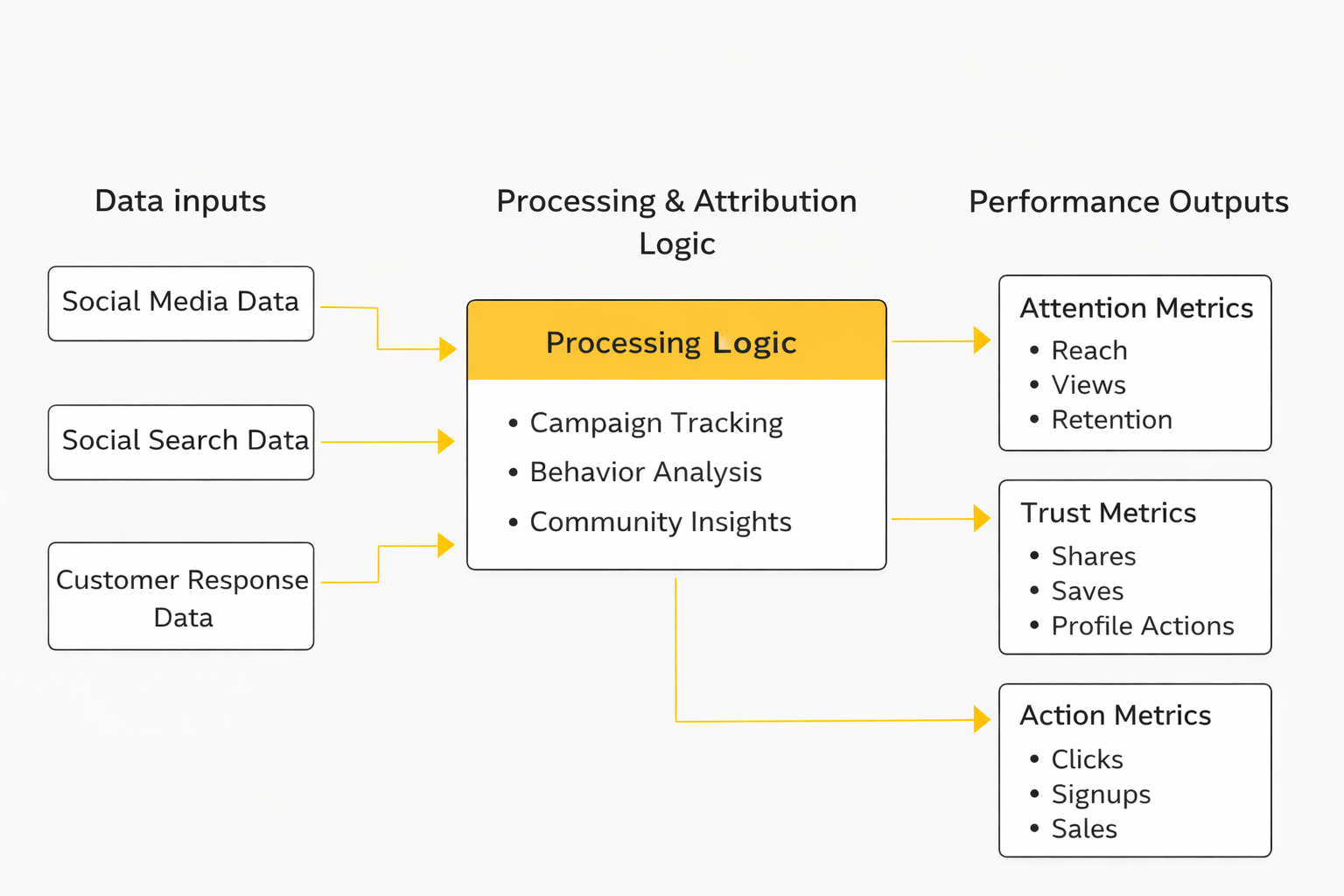
Layer 5: Measurement and Attribution
This layer connects content activity to business reality. On-platform analytics shows what performed inside the feed, but attribution tells you whether your social effort drove traffic, leads, or purchases. Google’s documentation on campaign URL parameters is a practical foundation here, because consistent tagging turns “social seems helpful” into measurable patterns you can act on.
Layer 6: Governance and Risk
Governance is where you prevent preventable mistakes: unclear approvals, inconsistent brand voice, and unauthorized posting. The bigger your team—or the higher the stakes—the more this layer matters. It’s also what keeps implementation stable when staff changes or when the calendar gets crowded.
Optimization Process
Optimization is not “chasing hacks.” It’s a calm loop that turns every week of posting on social media for business into better judgment about what your audience actually responds to. When optimization is done right, it feels less like pressure and more like learning.
The Weekly Loop That Actually Holds Up
- Review: pick the top three posts and identify why they worked (hook, format, topic, timing, comments).
- Diagnose: pick the bottom three posts and identify what failed (unclear value, weak opening, mismatched platform format, no reason to engage).
- Decide: choose one thing to double down on and one thing to stop doing next week.
- Design: create a small test that fits your normal workflow (one new hook style, one new CTA, one new format).
- Deploy: publish as usual, then track results in a simple log.
What to Test First When You’re Early
If your posting is inconsistent today, the best “optimization” is consistency—because you can’t learn from noise. Once you’re publishing reliably, test the parts that change outcomes quickly: opening lines, video intros, caption structure, and calls to action. Then move into deeper tests like content pillar balance and series formats.
Avoid Fake Precision and Focus on Repeatable Wins
A single viral post can trick you into copying the wrong thing. Instead, look for repeatable wins: topics that consistently pull comments, formats that consistently hold attention, and CTAs that consistently produce clicks. If you want one clean discipline that improves reporting fast, consistent link tagging based on Google’s UTM guidance makes your optimization decisions far more grounded.
Implementation Stories
Implementation becomes real when you see what happens under pressure: deadlines, attention spikes, unexpected backlash, and the scramble to keep publishing without losing control. The story below is a real example of what disciplined implementation can look like when the internet suddenly pays attention.
Duolingo’s “Dead Duo” Moment: How a Social System Handles Sudden Scale
The first post hit and the internet didn’t just react—it piled on. Brands joined in, celebrities replied, and the conversation started moving faster than a typical marketing team can approve anything. In a matter of hours, the campaign stopped being “a funny post” and became a live cultural moment, visible in the public timeline coverage from Axios.
Then the pressure arrived: once millions of people are watching, every next post is a test. If you go silent, you lose the moment. If you post the wrong thing, you create a screenshot people will throw back at you for years.
This is the reality of posting on social media for business when attention spikes—your system is either ready, or it isn’t.
The backstory is that Duolingo didn’t build its social presence overnight. It spent years training its audience to expect character-driven storytelling and fast reactions, a strategy profiled in a deeper breakdown by Adweek. That long-term positioning matters because it creates permission: followers don’t feel confused when the brand gets weird—they feel invited. It also means the team isn’t improvising from scratch when the platform shifts; they’re operating inside an established voice.
The company’s social leadership also pushed a “show, don’t explain” style of content, where the community participates in the lore instead of being marketed at. When that style is consistent, it becomes an engine—people share because it feels like culture, not an ad.
And that’s the foundation that makes implementation resilient: you don’t need to invent a new personality every month.
The wall showed up immediately once the campaign caught fire. Attention is not automatically useful attention; it can turn into chaos, operational overload, and reputational risk. The team had to decide whether to treat the moment like a one-off joke or commit to a narrative that could last weeks.
That decision is difficult because it requires cross-team coordination—social, product, and marketing—without slowing down. The Fast Company inside story describes how the team quickly expanded the narrative and coordinated beyond social, rather than letting the moment burn out after a few posts, in its campaign breakdown.
If your implementation isn’t designed for speed, you can’t take advantage of moments like this—you can only watch them happen.
The epiphany was recognizing that the campaign wasn’t just performing well—it was creating momentum that could be extended. The team saw the engagement signals and decided to build the narrative out instead of trying to “wrap it up” safely. That shift turned posting into a coordinated story arc rather than a single viral spike.
It’s the same logic any business can apply at a smaller scale: when a format or storyline works, you don’t repeat the exact post—you build the next chapter. That’s how you convert attention into familiarity and familiarity into trust.
In implementation terms, the epiphany is simple: treat your best-performing ideas like series, not like accidents.
The journey was operational as much as it was creative. Duolingo’s campaign became a social-led narrative described in the company’s own Q1 2025 shareholder letter, which framed the campaign as a “whodunit” story that ran across channels. That same letter states the narrative generated 1.7 billion organic impressions, which matters because it shows what happens when a social system is ready to scale a story, not just publish posts.
The team didn’t rely on a single platform moment; it extended the storyline through multiple touchpoints, which is what strong implementation looks like under real pressure. When your posting on social media for business is built as a system, you can shift gears quickly and still stay on brand.
And because the narrative was structured, it gave the audience a reason to keep returning, not just a reason to laugh once.
The final conflict was managing the human cost of that scale. High-velocity social work can create burnout fast, especially when the internet expects constant novelty and instant replies. The Wall Street Journal interview with Duolingo’s social leader captured the intensity behind the scenes, including how difficult it can be to manage expectations and mental load while operating at that level, in their discussion of virality and pressure.
That pressure is the hidden risk for any team: if your system depends on heroics, it will eventually break. The moment you rely on “one person always being on,” you’re not implementing a strategy—you’re borrowing energy from the future.
A professional implementation protects the team with roles, rotations, and clear boundaries, even while the brand stays responsive.
The dream outcome is not just a big number—it’s sustainable momentum. When a brand can turn a spike into a structured narrative, keep publishing consistently, and still protect the team, that’s what real implementation looks like. It’s also proof that posting on social media for business can be engineered: voice, process, coordination, and measurement working together.
For most businesses, the lesson isn’t “go viral.” The lesson is “build a system that can handle success when it shows up,” because success is often louder and messier than failure.
And when your system is ready, every strong post becomes the beginning of something—not the end.
Professional Implementation
Professional implementation is where posting on social media for business becomes predictable, measurable, and sustainable. It’s less about motivation and more about structure—so you can publish consistently without the calendar owning your life.
Write the SOP Your Team Will Actually Use
Your SOP should fit on one page and answer five questions: what gets posted, who creates it, who approves it, how it gets scheduled, and how results get reviewed. If it’s longer than your team will read, it will be ignored. The goal is clarity, not bureaucracy.
Make the Calendar the Boss, Not the Mood
A real calendar creates calm because it turns “what should we post today?” into “what’s next on the plan?” You can run this with native schedulers like Meta Business Suite or LinkedIn scheduling when you’re small, then expand into broader tools when collaboration demands it. The key is one source of truth that everyone trusts.
Adopt a Pre-Publish QA That Prevents Public Mistakes
Your QA doesn’t need to be complicated. Check the link, check the tags, check the visuals, check the first two lines of the caption, check subtitles for video, and check that the post matches the platform format. That one minute of discipline is often the difference between confident publishing and apologizing later.
Standardize Attribution So Social Earns Trust Internally
If leadership can’t see impact, social gets treated like a hobby. Consistent tagging using Google’s campaign URL structure makes it far easier to connect posts to traffic, leads, and purchases. Once that is in place, your weekly review turns into decision-making instead of opinion.
Define an Engagement Rhythm and Stick to It
A publishing system without a response system is incomplete. If you want a reality check on expectations, the Sprout Social response-time research and broader expectation trends in Zendesk’s CX reporting show how quickly “no reply” becomes a negative brand experience. Pick a rhythm your team can sustain, assign ownership, and treat it as part of the work—not an afterthought.
HTMLStatistics And Data

Analytics is where posting on social media for business stops being a “vibe” and turns into a controllable system. The point isn’t to worship numbers. The point is to reduce guesswork so you can repeat what works, cut what doesn’t, and explain results in plain business language.
It also helps to remember how massive the environment is. The 2025 global digital reports tracked 5.24 billion social media user identities, equaling 63.9% of the world’s population. That scale is why measurement matters: when you publish into a feed that big, tiny improvements compound quickly.
The other reason data matters is speed. Customer expectations keep tightening, and response time is part of performance now, not a “nice to have.” Consumer research summarized by Sprout shows that most people want brands to respond within 24 hours or sooner. If your posting sparks questions and your inbox goes quiet, the analytics you should care about isn’t reach—it’s the trust you’re losing.
Performance Benchmarks
Benchmarks are not goals. They’re guardrails. When you compare your account to a credible benchmark, you’re trying to answer one simple question: “Are we underperforming because the strategy is weak, or because the platform reality is different than we assumed?”
Engagement Rate Benchmarks (Use Them Carefully)
Engagement rates vary wildly depending on how they’re calculated (by followers, by reach, by impressions, by video views). That’s why you want benchmarks that clearly define the method and the time window, and you want to compare apples to apples.
If you want a broad directional baseline, Socialinsider’s 2026 benchmarking research lists typical brand engagement rates by platform, including TikTok engagement around 3.70%, Instagram around 0.48%, and Facebook around 0.15% (with the underlying note that each platform behaves differently). Use those numbers to calibrate expectations, not to panic if your Instagram doesn’t “look like TikTok.”
Benchmarks Change Because Platforms Change
A healthy benchmarking habit includes tracking whether the platform itself is rising or falling. Rival IQ’s 2025 benchmarking analysis highlights broad declines across major platforms, including year-over-year engagement drops across Facebook, Instagram, TikTok, and X. That matters because it prevents a common management mistake: blaming the team for a macro-level platform shift.
Response Time Is a Performance Metric
When your content is working, it creates inbound volume. That volume is a gift if you can keep up—and a liability if you can’t. Sprout’s research on expectations makes it clear that people increasingly want replies within 24 hours or sooner, which means your “benchmark” is not only engagement rate, it’s operational readiness.
Analytics Interpretation
Good interpretation feels like a conversation: “Here’s what people did, here’s why it probably happened, and here’s what we should change next.” Bad interpretation feels like dumping a dashboard into a meeting and hoping it speaks for itself.
Start With Intent Before You Look at Results
Every post should have a primary job. Was it supposed to drive site traffic, spark comments, or build credibility? When you define intent first, the metrics become obvious. If the post’s job was traffic, clicks and landing page behavior matter. If the post’s job was conversation, comments and shares matter more than likes.
Group Metrics Into Three Buckets
- Attention: reach, views, watch time, and hook retention. This tells you whether people noticed you.
- Trust: saves, shares, meaningful comments, and profile actions. This tells you whether people believed you were worth keeping.
- Action: clicks, signups, purchases, calls, bookings, or inquiries. This tells you whether the post moved the business forward.
Attribution Is a Habit, Not a Tool
If you want social to earn budget, you need to connect posts to outcomes. The simplest foundation is consistent campaign tagging, which Google explains through its documentation on campaign URL parameters and how they appear in Analytics. Once your naming is consistent, patterns emerge quickly: which content themes drive higher-quality clicks, which CTAs convert, and which platforms produce customers instead of just attention.
Avoid the “Vanity Metric Trap” With One Question
Any time a metric spikes, ask: “What did this change for the customer?” If a post got views but didn’t increase saves, clicks, or meaningful replies, it may have been entertainment without impact. If a post got fewer likes but generated high-intent DMs, it may be quietly doing its job extremely well.
Case Stories
A real performance story isn’t “we posted and it worked.” It’s what happens when pressure hits and the team has to use measurement to make decisions, not just report outcomes.
Chili’s: When “Value” Became a Social Narrative, Not Just a Price Point
The moment the internet started complaining about fast-food prices, the conversation moved faster than most brands can approve posts. People weren’t debating menu items; they were venting about feeling tricked and squeezed. In that kind of climate, posting on social media for business isn’t about cleverness—it’s about whether your brand can enter a live cultural argument without looking desperate.
Chili’s jumped in with confident, meme-ready value framing and let social carry the emotion, a dynamic described in The Wall Street Journal’s reporting on its value push and the way marketing helped the brand surge during the “fast-food price rage” era in its coverage of the strategy. The pressure was immediate: once you plant your flag as “the value alternative,” every customer experience has to back it up. If the food disappoints or service lags, the comments don’t just complain—they invalidate the entire narrative.
The backstory is that Chili’s didn’t treat value as a one-off promotion. Brinker’s filings describe how the company increased investment across channels including television, streaming, digital video and social media as part of an updated strategy, then continued campaigns highlighting value offerings. That matters because it shows a systems approach: the message wasn’t improvised by social alone, it was supported by broader planning and budget decisions. When social is aligned with operations and product, it becomes believable instead of performative.
It also explains why their social tone could be bold. A brand can only joke about value if the offer is real and the execution is consistent. Without that foundation, “funny social” turns into “brand getting ratioed.”
Then came the wall: attention is easy to attract; sustaining trust is harder. Once social posts started pulling in younger diners and value-hunters, the business had to handle higher traffic without breaking the guest experience. Marketing Dive’s breakdown of the chain’s record performance highlighted how the value story wasn’t just creative—it had to be supported by execution and operational readiness to keep the momentum from collapsing under its own success in its reporting on the results.
That’s the hidden challenge behind high-performing social: once your posts work, your operations get tested. If the back-end can’t keep up, your own content becomes the amplifier of disappointment. The wall isn’t “getting reach.” The wall is “not breaking when reach turns into real people walking through the door.”
The epiphany was realizing that the social narrative didn’t need to chase every trend to stay relevant. It needed a repeatable series: value comparisons, craveable food visuals, and a consistent voice that made the brand feel like it was on the customer’s side. Brinker’s communications to investors even call out that Chili’s advertising and social media campaigns continued to drive new guests and increased frequency, reinforcing that social wasn’t just noise—it was part of a broader growth engine.
Once the team treats that as a repeatable engine, the analytics conversation changes. You stop asking “what should we post?” and start asking “what series are we running next, and what signals prove it’s working?” That’s a different level of maturity in posting on social media for business.
The journey was about tightening the loop between content and measurable outcomes. The brand kept leaning into social-first creative and value-led messaging, then used performance results to justify continuing the push and refining the offer. Public reporting and investor communications show a pattern: marketing drove traffic, traffic drove results, and results supported continued investment in the approach across fiscal periods. That feedback loop is the real lesson—your social system works best when it earns the right to keep going.
It’s also where practical analytics matters: if you can’t connect content to business impact, you can’t defend the strategy when leadership asks for cuts. If you can, social becomes a lever rather than a cost center.
The final conflict was that success attracts imitation and skepticism. Once a brand becomes known for a value narrative, competitors respond, and customers raise expectations. Every slip—pricing confusion, inconsistent portions, slow service—becomes shareable content that can flip the narrative overnight. That’s why governance and operational coordination are part of analytics now: you’re not only tracking performance, you’re tracking risk.
And when the conversation is this public, your response cadence matters too. If the comments shift from jokes to complaints, the team needs to pivot fast and respond like a real business, not a meme account. That’s where the “response within 24 hours” expectation becomes a performance requirement, not a customer service dream.
The dream outcome is sustainable demand without burnout. When a brand builds a repeatable content series, ties it to an offer people genuinely care about, and measures performance in a way leadership trusts, social stops being a gamble. Chili’s story shows what posting on social media for business can look like when it becomes a disciplined narrative with operational support, not a random content calendar.
The bigger takeaway is simple: performance isn’t just “better posts.” It’s a system where messaging, operations, and measurement support each other. When they do, your social presence becomes a durable advantage instead of a fragile streak.
Professional Promotion
Professional promotion is how you turn your best organic content into predictable outcomes without turning your feed into an ad catalog. The goal is to amplify what already works, not to “buy” performance for content that doesn’t resonate.
Promote Proven Posts, Not Unproven Ideas
Start by identifying posts that already show strong trust signals—saves, shares, high-quality comments, profile visits, or inbound inquiries. Those signals tell you the message is landing. Promoting those posts is usually more efficient than spending to “force” attention onto something the audience didn’t naturally respond to.
Boosting vs. Campaigns: Pick the Right Tool for the Job
- Boosting: good for quickly extending reach on content that already performs well, especially when the goal is attention or engagement.
- Campaigns: better when you need targeting precision, controlled budgets, and measurable outcomes like leads, purchases, or bookings.
If you want promotion to be measurable, treat it like a campaign—clean naming, consistent link tagging, and a clear success metric. Google’s documentation on campaign URL parameters is a practical baseline for keeping attribution clean across paid and organic.
Use Paid as a Fast Learning Loop
Paid promotion isn’t only about results—it’s also about learning faster. By testing variations of hooks, thumbnails, and captions, you can identify what changes attention and what changes intent. Then you bring those learnings back into organic posting so your next batch is stronger even before you spend.
Build Guardrails So Promotion Doesn’t Break Trust
The fastest way to damage trust is to promote content that feels misleading, overly aggressive, or out of sync with your normal voice. If your organic presence feels human and your promoted content feels like a different company, audiences notice immediately. Keep promotion aligned with the same promise your day-to-day posting makes, and treat speed of response as part of performance—because when a promoted post scales attention, it also scales expectations for replies within 24 hours or sooner.
HTMLAdvanced Strategies
Once the basics of posting on social media for business are stable, the fastest gains usually come from changing how you package ideas, not from posting more. Advanced strategy is mostly about three things: building repeatable formats, borrowing distribution from people (creators and employees), and creating feedback loops that make your next batch smarter than your last.
One of the most reliable upgrades is shifting from “one-off posts” to social-first series. Hootsuite’s recent trend research calls out the rise of micro-drama and social-first series as a major attention pattern, which aligns with what platforms reward: viewers returning because they recognize the format and want the next chapter.
Build a Series Engine (Not a Calendar)
A series engine means you publish in formats your audience learns to expect. Think weekly “myth vs. reality,” “behind the decision,” “customer teardown,” or “3 mistakes we keep seeing.” This makes ideation easier, improves consistency, and reduces creative fatigue because you’re refining a proven container instead of inventing a new one every time.
If you want a simple rule: any post that performs well should become a template, not a memory. That’s how posting on social media for business turns into compounding growth instead of random spikes.
Treat Social Like Search (Because Your Customers Do)
More people now use social platforms to research products, compare options, and validate brands before they buy. That’s why your captions, on-screen text, and post titles should be written so a real person could find them later. TikTok’s own positioning around search-led behavior and intent-based formats shows how much the platform is leaning into discovery through search surfaces, including its rollout of Search Ads Campaign.
The practical move is simple: write like you’re answering a question. Use specific phrases your customer would type, then support them with proof (demos, comparisons, FAQs, customer stories). You’re not “keyword stuffing.” You’re making your expertise searchable.
Shift Creator Work From “Influence” to “Distribution + Creative”
Creator partnerships scale best when they are not treated as rented trust for a single post. The modern win is co-creation: creators help shape the angle and the format, then they distribute it in a voice their audience already understands. Industry research shows how mainstream this has become: IAB’s reporting projects U.S. creator ad spend reaching $37B in 2025, while CreatorIQ’s annual report notes that many “Industry Leaders” see creator marketing delivering more than 3x ROI.
A practical way to manage risk is to start with a small “creator bench” that you work with repeatedly. Repetition builds shared language, better briefs, and consistent performance without constantly onboarding new people.
Use Employee Advocacy Without Making It Cringe
Employee advocacy works when employees share what they genuinely do, believe, or learn—not when they’re forced into corporate scripts. Trend research keeps pointing to employee presence as a trust lever, including Hootsuite’s emphasis on employee involvement extending reach while boosting authenticity. For many businesses, this is the safest way to scale distribution because it’s rooted in real experience.
Make it easy: give employees a menu of optional content prompts, simple visual templates, and a “do’s and don’ts” guide. Then let their voice stay human.
Scaling Framework
Scaling posting on social media for business isn’t about doubling your output. It’s about reducing the cost of consistency. The framework below is how high-performing teams scale without becoming chaotic.
Layer 1: Repeatable Formats
You scale by turning wins into systems: series templates, hook formulas, visual layouts, and recurring segments. When formats repeat, your team spends less energy deciding “how to say it” and more energy deciding “what to say.”
Layer 2: Modular Production
Modular production means one idea becomes multiple assets: long video becomes short clips, a Q&A becomes multiple posts, a customer call becomes a case snippet. This is where volume increases without doubling workload, and it’s one of the most reliable ways to scale without burning out.
Layer 3: Distribution Multipliers
Distribution multipliers are the “non-algorithm” ways content spreads: creators, employees, partners, newsletters, communities, and even PR coverage when a story is genuinely newsworthy. This is where creator marketing becomes more than a trend: IAB’s research shows creator spend rising fast, including 26% year-over-year growth to $37B in 2025, which signals how many brands are now buying distribution intentionally.
Layer 4: Measurement and Guardrails
Scaling without guardrails increases the chance of public mistakes. Guardrails include approvals, brand voice rules, claim verification, and clear escalation paths when controversy hits. At the same time, measurement keeps scaling honest: the bigger you get, the more you need clean tracking, consistent naming, and proof that growth is not just “louder,” but more valuable.
Growth Optimization
Growth optimization is where you stop treating social like art and start treating it like a learning machine. The goal is not to “beat the algorithm.” The goal is to design a workflow where every week produces insights that make next week stronger.
Build a Pattern Library (Your Real Competitive Advantage)
A pattern library is a simple document where you store repeatable winners: hook styles, content angles, series formats, and CTAs that consistently perform. Hootsuite’s trend research highlights creative pattern analytics and rapid experimentation as a growing advantage; your pattern library is how that becomes practical in a real business.
When a post works, capture what made it work: the first line, the structure, the “proof moment,” the comment trigger, the visual rhythm. Then reuse the structure with a new idea. That’s how posting on social media for business becomes predictable.
Run “One Variable” Experiments
Most teams “test” too many changes at once and learn nothing. Instead, change one variable per batch: hook style, video length, CTA type, or series topic. Keep everything else stable so the result teaches you something real.
Use Creative-First Metrics, Not Just Platform Vanity
If you only track likes, you’ll optimize for content that feels good, not content that moves customers. Start tracking whether people stay, save, share, and return. On video, retention patterns tell you where attention drops, which is often a better creative coach than any comment thread.
Platform guidance also makes it clear that experimentation is expected. Meta’s own recommendations for Reels encourage creators and brands to try different approaches and iterate, which matches what growth teams do: they run steady experiments, then scale the winners.
Make Community a Signal, Not an Afterthought
Social is increasingly a relationship channel, not a broadcasting channel. The Sprout Social Index is built on large-scale consumer and marketer surveying and emphasizes how social is becoming central to brand experience and commerce behavior, as reflected in its 2025 edition. If your optimization ignores replies, DMs, and conversation quality, you’ll miss the most valuable signal: trust.
Scaling Stories
Scaling becomes real when the internet puts your brand under a microscope. The story below is a real example of what it looks like when attention spikes, backlash hits, and a company has to rely on a system—rather than heroics—to keep momentum.
American Eagle’s Viral Denim Campaign: Scaling Through Heat, Not Comfort
The campaign exploded, and it didn’t explode quietly. It spread across feeds with praise, mockery, and backlash all at once, which meant every next post carried risk. The brand wasn’t just “getting attention”—it was being judged in public, in real time, by people who wanted to argue about the message as much as the product.
Then the numbers started landing like a second wave of pressure. Management described the campaign as driving major acquisition, and public coverage reported more than 700,000 new customers and 40 billion impressions. Once attention hits that scale, silence becomes a strategy choice, not a scheduling mistake.
The backstory is that American Eagle had been working to sharpen its brand identity with Gen Z while consumer spending remained uncertain. The company leaned into celebrity-led storytelling to reset relevance, tying campaigns to product moments that could travel on social. When the Sydney Sweeney denim work hit, it was designed to be culturally visible—not just “another seasonal ad”—and that visibility created both upside and risk.
The momentum wasn’t isolated to one celebrity moment, either. Coverage referenced the brand stacking campaigns, including collaborations designed to broaden reach, which helped the story continue rather than peak and fade. That’s a classic scaling move in posting on social media for business: you create a narrative runway instead of relying on one post to carry the quarter.
Then came the wall they couldn’t brute-force. Backlash doesn’t just threaten PR; it threatens operational focus. Teams get pulled into reactive meetings, approvals slow down, and the calendar freezes because everyone fears making it worse. Meanwhile, the audience keeps talking, and the algorithm keeps moving, which means the cost of hesitation rises by the hour.
Public reporting captured that tension: the campaign drew criticism, but the business impact was still being framed as meaningful in coverage from outlets like WWD and Yahoo Finance. This is the wall: you must stay coherent while two realities exist at once—controversy and commercial performance.
The epiphany was that “stopping” wasn’t automatically safer than continuing. If the story is already everywhere, going quiet can look like guilt, confusion, or weakness—especially for a youth brand that’s supposed to feel culturally present. The leadership posture leaned toward staying steady, letting the work speak through results, and refusing to treat every wave of outrage as a reason to abandon the narrative.
That posture was later discussed in industry coverage about the brand’s response approach, including the idea that leadership didn’t follow a traditional crisis playbook, covered by Adweek. Whether you agree with the approach or not, it highlights a scaling truth: you need a decision framework before the heat arrives, not during it.
The journey was operational as much as it was creative. The team had to keep publishing, keep the voice consistent, and keep the internal reporting clear enough that leadership could see what was actually happening. On the business side, company communications and investor-facing updates framed the period as a moment of momentum, with leadership commentary appearing across public channels including the company’s own investor materials and related coverage.
This is where posting on social media for business becomes a real system: content, response, governance, and measurement all moving together so the organization can act instead of panic.
The final conflict was the hidden cost of scale: attention creates work. More comments mean more moderation decisions. More DMs mean more customer care pressure. More coverage means more internal stakeholders wanting control, which can strangle speed if you don’t have clear approvals and escalation rules.
And because the campaign was culturally loud, every misstep risked becoming a screenshot. That’s why the difference between “we post” and “we run social professionally” shows up most clearly during moments like this—when your system has to protect both the brand and the team.
The dream outcome is not just impressions. The dream outcome is turning a volatile moment into sustained momentum without burning out the people running it. Public coverage tied the campaign to meaningful customer acquisition and broad reach, repeatedly referencing the 700,000+ customer increase and 40 billion impressions also echoed by WWD. That’s what scaling looks like in the wild: not comfort, not perfection—just a system that can keep moving while the internet argues.
For most businesses, the lesson isn’t “copy the campaign.” The lesson is “build the operating system that can handle success and controversy at the same time.”
Amplify Winners, Then Build Lookalikes of the Winner
Start with content that already earns trust (saves, shares, strong comments, qualified DMs). Promote that, then create two or three variations that keep the same structure but improve the hook or proof moment. This prevents the common scaling mistake: spending money to promote content your audience didn’t even like organically.
Use Paid to Make Creator Work Measurable
Creator partnerships scale faster when you can measure what’s working and put paid behind it. The macro environment supports this shift: IAB’s latest work projects creator ad spend hitting $37B in 2025, while CreatorIQ’s report highlights how mature programs increasingly tie creator work to performance and ROI in its 2025–2026 findings.
The practical move is to whitelist top-performing creator assets (with permission) and amplify them to audiences that resemble the creator’s engaged viewers. This often scales better than trying to make brand-made ads feel like creator content from day one.
Capture Intent With Search-Led Formats
If your product category has high “how do I choose?” behavior, search-led placements can capture intent that organic content might miss. TikTok’s rollout and explanation of Search Ads Campaign reflects how platforms are expanding beyond passive scrolling and into active discovery behavior.
Protect Trust With Promotion Guardrails
Scaling promotion increases attention, and attention increases scrutiny. Set guardrails: what claims require verification, what topics require review, what comments trigger escalation, and who owns response coverage when promoted posts spike inbound volume. This is how promotion supports growth without creating reputational debt.
Future Trends
The future of posting on social media for business is less about “what time should I post?” and more about “how do I stay trusted and discoverable in a feed that’s getting noisier every month?” The biggest changes aren’t cosmetic. They’re structural: AI will reshape how content is created and recommended, social platforms will keep absorbing commerce, and audiences will get pickier about what feels real.
The scale will keep rising, which is why the cost of sloppy strategy rises too. The Digital 2026 report tracks 700+ pages of global usage data and highlights that social media users have reached “supermajority” status, which means your customers aren’t “on social” as a niche behavior. It’s the default environment where discovery, evaluation, and conversation happen.
At the same time, attention is fragmenting. Hootsuite’s 2026 trend research frames the year as an era of culture and attention shifts, where social-first series and “micro-drama” keep people returning, while fast response cycles (“fastvertising”) punish teams that can’t move quickly without breaking governance. The pressure is clear: you can’t just be consistent; you need to be consistent with a point of view that feels human.
The trust problem will also intensify as low-quality mass content spreads. A growing amount of coverage now points to feeds being flooded with “AI slop,” which increases the value of recognizable voices, lived experience, and proof-based storytelling. When everyone can generate content instantly, the competitive edge shifts to brands that can show receipts, tell the truth clearly, and build communities that actually want to hear from them.
Finally, social will keep behaving more like search. TikTok’s rollout of Search Ads Campaign is a signal that platforms are actively investing in intent-led discovery, not just passive scrolling. That means posting on social media for business will increasingly reward content that answers real questions, solves real problems, and stays findable weeks after it’s published.
Strategic Framework Recap

If you want posting on social media for business to feel predictable instead of exhausting, you need a framework that holds up when life gets busy. The framework you’ve built across this guide can be boiled down into a few simple operating truths.
First, strategy comes before volume. A clear goal and two sustainable content pillars beat an ambitious calendar you can’t keep. Second, consistency comes from systems, not motivation: batching, a lightweight approval line, and a single source of truth for scheduling. Third, content performs when it earns trust, and trust is created through value, proof, and responsiveness—something consumer expectation research reinforces when it shows people increasingly want brands to respond within 24 hours or sooner.
Fourth, measurement is not vanity. It’s the feedback loop that turns effort into improvement. Clean tracking practices matter because they connect posts to outcomes; Google’s documentation on campaign URL parameters is a practical foundation for linking social activity to business results. And finally, scaling is not “posting more.” Scaling is repeatable formats, modular production, distribution multipliers (creators, employees, partners), and guardrails that keep your brand safe when attention spikes.
FAQ – Built for the Complete Guide
What should I post first if my business account is basically empty?
Start with three posts that establish trust fast: who you help, what problem you solve, and what proof you have. A simple “here’s what we do,” a practical tip your ideal customer can use today, and one real example (a before/after, a result, a behind-the-scenes process) is a strong foundation. The goal is to make a first-time visitor think, “Okay, these people are real, and they know what they’re doing.”
How often should I post on social media for business to see results?
The best frequency is the one you can sustain without quality dropping. Consistency builds learning, and learning builds growth. If you can only publish three times a week but you do it every week for three months, you’ll outperform a team that posts daily for two weeks and then disappears.
Which platform should I focus on if I can’t do everything?
Choose the platform where your customers already behave the way you need them to behave. If you need discovery, short-form video ecosystems can be powerful. If you need professional credibility, LinkedIn can be the right home. If you need local reach, Meta’s ecosystem often matters. The best platform is the one that matches your customer’s buying journey, not the one that’s trending this week.
Do I need paid ads, or can organic posting be enough?
Organic can absolutely be enough in the early stages if your offer is clear and your content is useful. Paid becomes valuable when you want to scale proven messages, accelerate learning, or reach audiences beyond your current distribution. The cleanest approach is to promote posts that already perform organically instead of trying to buy attention for content that didn’t resonate.
How do I measure success without getting lost in dashboards?
Measure based on the job of the post. If the post is for attention, watch reach and retention. If it’s for trust, watch saves, shares, and meaningful replies. If it’s for business action, track clicks, inquiries, trials, and conversions. When you want to connect social to outcomes cleanly, consistent link tagging based on Google’s UTM guidance helps you see what actually drives results.
What if I don’t have time to create content constantly?
Stop thinking in daily creation and start thinking in batching. One focused content session can produce a week or two of posts when you work from templates and series. The real win is repeatable formats: the same structure with a new idea each time. That’s how posting on social media for business becomes sustainable.
Should my business jump on trends?
Only if the trend matches your audience and your brand voice. Speed matters, but so does judgment. Trend research and consumer behavior reporting show reaction cycles are shrinking and many people expect brands to move within 24–48 hours to feel relevant. If you can’t move fast with quality control, you’re better off building your own series that you can run consistently.
How fast should I respond to comments and DMs?
As fast as you can without sounding robotic. People increasingly treat social as customer care, and expectation research shows most consumers want brands to respond within 24 hours or sooner. Even if you can’t reply instantly, a consistent rhythm (twice daily inbox checks, for example) protects trust.
How do I promote my offer without sounding salesy?
Lead with help, then earn the right to ask. Teach something useful, show proof, share a clear opinion, then offer the next step. The fastest way to lose trust is to post like every follower owes you a purchase. The fastest way to build trust is to make your content valuable even to people who never buy.
What content works best right now?
Formats change, but human behavior doesn’t. Content tends to win when it’s easy to understand quickly, feels like it was made by a real person, and gives the viewer a reason to return. Hootsuite’s 2026 trend research calls out social-first series and “micro-drama” as a major attention pattern in its Social Media Trends 2026 snapshot, which is another way of saying: build repeatable formats people recognize and want more of.
What are the biggest mistakes businesses make with social posting?
The big three are: posting without a goal, posting inconsistently, and ignoring the conversation after publishing. A close fourth is confusing activity with progress—publishing a lot while never measuring what’s changing. The fix is simple: a small framework, a repeatable calendar, and a weekly review loop that produces one clear improvement for the next batch.
Work With Professionals
If you’ve made it this far, you already know the hard part about posting on social media for business: the strategy isn’t complicated, but execution is relentless. You can have great ideas and still lose weeks to bottlenecks, inconsistent publishing, and the quiet stress of “we should be doing more.”
That’s exactly why a lot of marketing freelancers end up wanting a simpler path: fewer gatekeepers, faster conversations, and more chances to land real work without paying a cut of their income. Markework is built like a focused marketing marketplace where you can create a profile, browse roles, and message directly—without project fees or commissions, as spelled out on its pricing page and Why Us overview.
If you’re trying to grow your client pipeline, what matters most is steady opportunity and low friction. Markework’s marketplace is structured around direct communication and “no middleman” positioning on the homepage, and it openly shows a large active inventory (for example, it displays 1007 active listings on the work feed view). That kind of depth matters because it gives you more shots on goal, which is how most freelancers actually win.
You can start small, get visible, and keep your earnings intact. Markework emphasizes no commissions and no project fees for both sides, while keeping the workflow simple: build a profile, browse listings, apply, then negotiate directly, as described in its step-by-step marketplace flow.
If you’re serious about turning your social skills into a steady stream of better clients, set up your profile, pick a plan that matches your pace, and start applying to roles that fit your strengths.
markework.com Filip Konecny Enterprises