

Scroll through any social platform today and you will see brands competing for attention in a space that never stops moving. Billions of people spend time on social networks daily, turning these platforms into one of the most powerful advertising environments in modern marketing. Recent global research shows that more than 5.41 billion people actively use social media worldwide, and users typically engage with nearly seven platforms every month. For businesses, that scale represents an opportunity that simply did not exist a decade ago.
At the same time, paid social advertising has become increasingly complex. Ad auctions shift constantly, algorithms evolve weekly, and audience behavior changes as quickly as new formats appear. Brands now compete not only on creative ideas but also on data, analytics, and strategic execution.
This environment is exactly why many companies rely on a specialized paid social advertising agency. Instead of experimenting blindly with budgets and campaigns, organizations partner with professionals who understand how to design scalable advertising systems that generate measurable growth.
Article Outline
- What a Paid Social Advertising Agency Actually Does
- Why a Paid Social Advertising Agency Matters for Modern Businesses
- Framework Overview of Paid Social Advertising Agency Strategy
- Core Components of a High-Performing Paid Social Advertising Agency
- Professional Implementation in Real Campaign Environments
What a Paid Social Advertising Agency Actually Does
A paid social advertising agency is a specialized marketing partner responsible for planning, launching, optimizing, and scaling advertising campaigns across social platforms such as Meta, TikTok, LinkedIn, Pinterest, and others. Instead of treating social media as a purely creative or community-driven channel, these agencies approach it as a performance marketing system built on data, testing, and conversion optimization.
In practical terms, their work combines multiple disciplines that rarely exist inside a single in-house team. Media buying specialists manage bidding strategies and budgets. Data analysts evaluate campaign performance and attribution models. Creative strategists design advertising concepts that capture attention in crowded feeds. Together, these professionals turn social platforms into measurable revenue channels.
The need for this expertise has grown as social media advertising has expanded into a massive global market. Industry analysis shows the social media advertising sector reaching roughly $375 billion in value in 2025 with projections toward $472 billion by 2031. That level of investment means companies cannot afford guesswork when allocating budgets across campaigns.
A strong paid social advertising agency therefore does far more than run ads. It develops a full performance ecosystem that includes audience research, funnel design, creative testing frameworks, and performance analytics. Every campaign becomes part of a larger system designed to attract, nurture, and convert potential customers.
This systematic approach matters because social platforms operate on algorithms that reward relevance and engagement. Campaigns that are strategically structured around audience signals, creative experimentation, and performance data gain an advantage in ad auctions and achieve better efficiency over time.
Why a Paid Social Advertising Agency Matters for Modern Businesses
Businesses once viewed social media primarily as a branding tool. That perception has changed dramatically as digital advertising has become the dominant channel in global marketing budgets. Forecasts from the advertising industry show global ad spending surpassing $772 billion in 2024, with digital formats responsible for much of that growth.
Within that digital ecosystem, social media platforms play a particularly influential role. Research into consumer behavior shows that 58% of consumers discover new brands directly through social media, which means advertising on these platforms can influence purchasing decisions long before a customer searches for a product.
This shift has fundamentally changed the role of marketing teams. Instead of simply promoting content, organizations must design highly targeted advertising systems that guide users through the entire customer journey—from awareness to purchase.
Managing that journey internally can be extremely challenging. Modern advertising platforms provide advanced capabilities such as behavioral targeting, lookalike audience modeling, retargeting based on site activity, and real-time campaign optimization. When used correctly, these features allow marketers to reach the exact users most likely to convert rather than broadcasting messages to broad audiences.
However, these same capabilities also increase complexity. Campaign structures may include dozens of audience segments, multiple creative variations, and layered conversion tracking systems. Without specialized knowledge, companies often struggle to interpret performance signals or scale successful campaigns.
A paid social advertising agency brings a structured methodology to this environment. Experienced teams analyze platform data, identify profitable audience segments, and refine campaign structures continuously. Instead of relying on assumptions, every decision—from targeting to creative strategy—is guided by measurable performance signals.
Framework Overview of Paid Social Advertising Agency Strategy
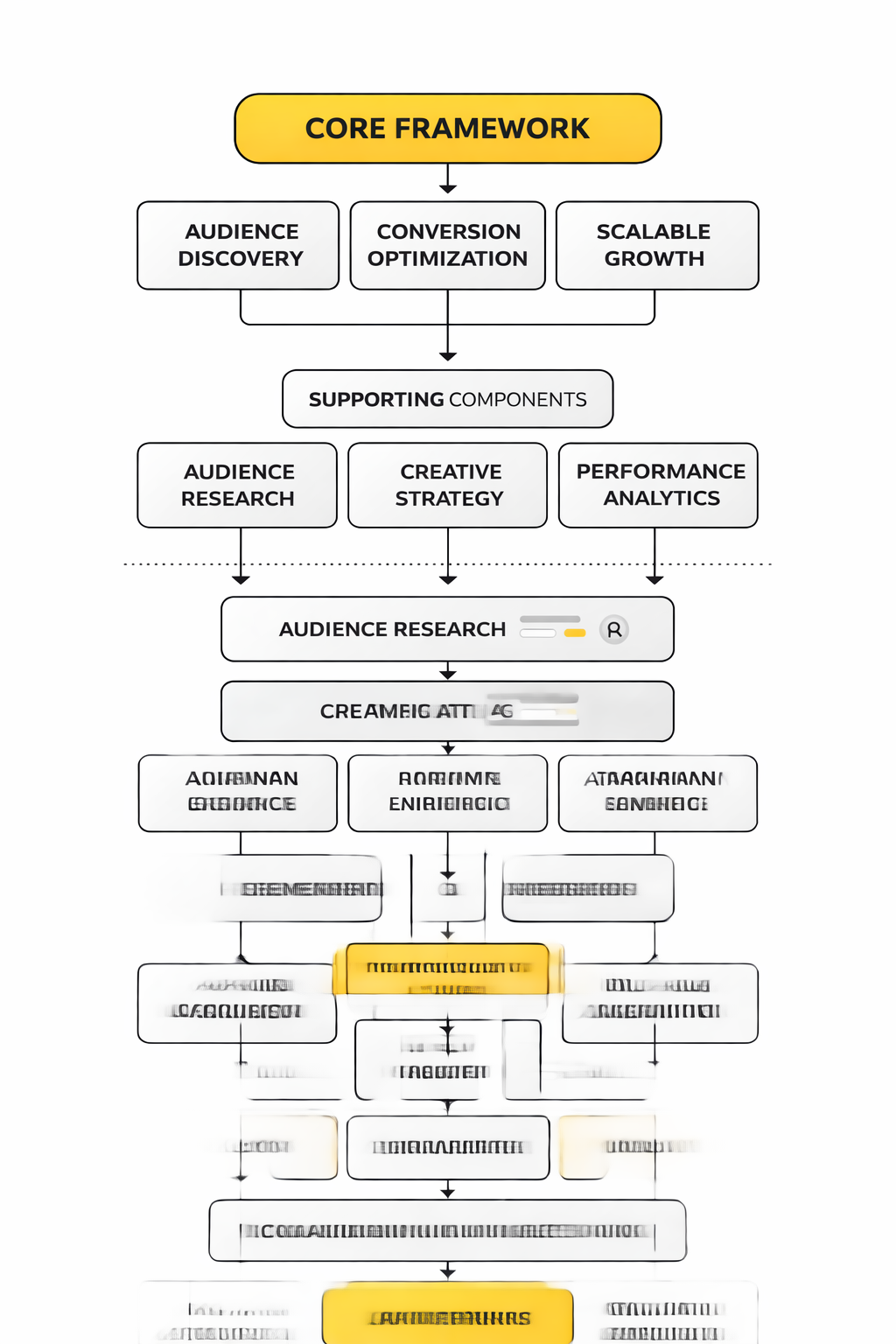
Successful paid social advertising rarely comes from isolated campaigns. Agencies typically rely on structured frameworks that guide how audiences are targeted, how creatives are tested, and how budgets are allocated across different stages of the customer journey.
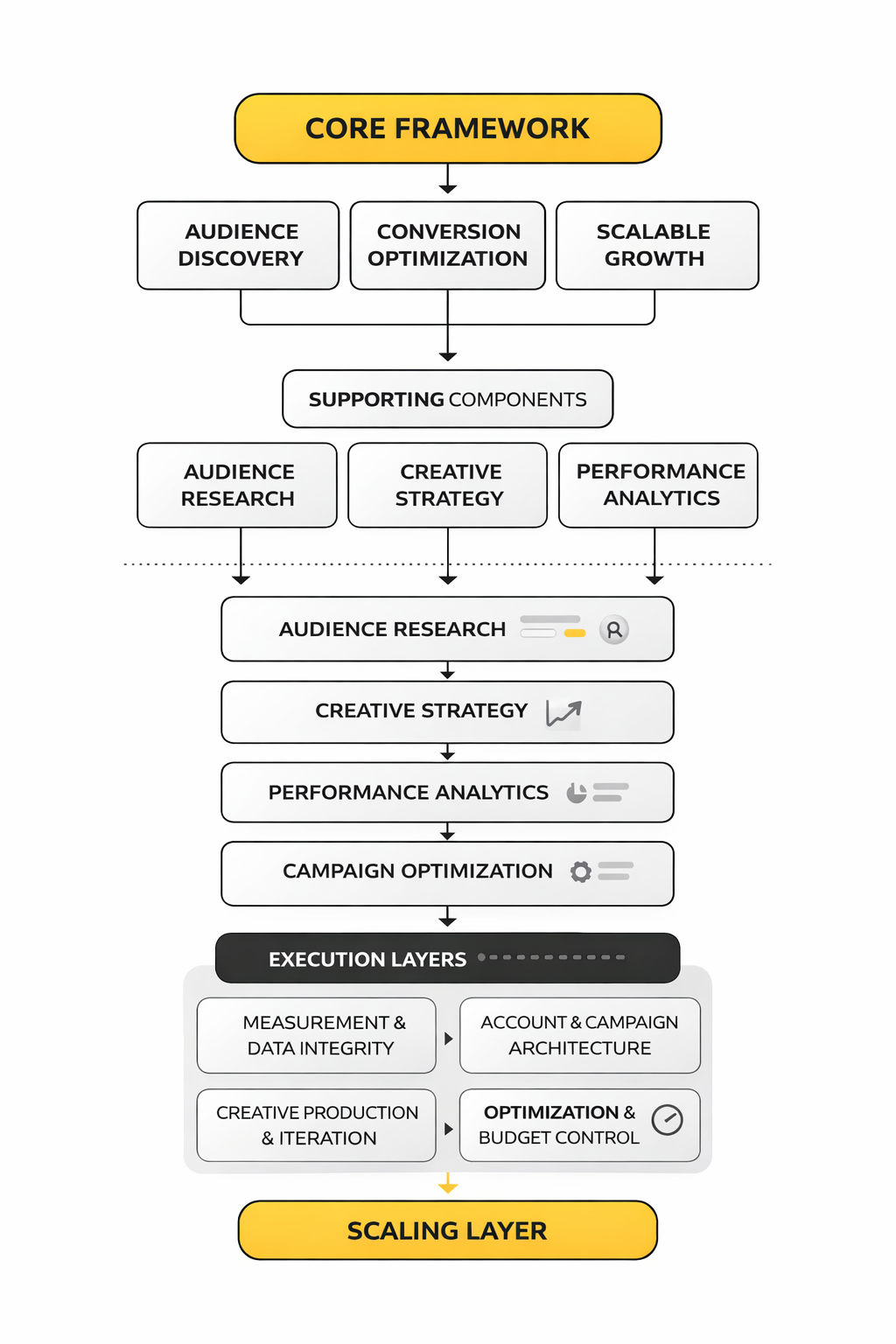
One widely used framework divides advertising efforts into three interconnected layers: audience discovery, conversion optimization, and scalable growth. Each layer builds on the insights generated by the previous stage.
The first layer focuses on discovering which audiences respond to a brand’s message. Campaigns often test multiple demographic groups, interest clusters, and behavioral segments to identify early signals of engagement. Social platforms make this process possible by analyzing user activity patterns and allowing advertisers to reach individuals with highly specific interests.
Once promising audiences are identified, agencies shift their focus to conversion optimization. This stage refines messaging, creative formats, and landing experiences to improve measurable outcomes such as purchases, leads, or subscriptions. Many agencies run rapid A/B testing cycles across different ad creatives and headlines to determine which combinations produce the strongest response.
The final layer involves scaling successful campaigns. Budgets increase gradually while maintaining performance thresholds such as return on ad spend or cost per acquisition. Because social advertising operates on auction systems, scaling must be carefully managed to prevent sudden increases in costs.
This framework allows agencies to turn advertising into a learning system. Every campaign generates insights that inform the next iteration, gradually improving efficiency and predictability.
Core Components of a High-Performing Paid Social Advertising Agency
A high-performing paid social advertising agency typically operates as a multidisciplinary team where several capabilities intersect. While different agencies may structure their operations differently, the most effective ones share a consistent set of core components.
The first component is advanced audience research. Social platforms collect enormous volumes of behavioral data, allowing advertisers to identify patterns in how users interact with content, products, and brands. Skilled analysts translate this data into actionable audience segments that campaigns can target precisely.
The second component is creative strategy. Social media advertising operates in fast-scrolling environments where users make decisions about engagement within seconds. Agencies therefore design creative formats specifically for social feeds, using short video, carousel visuals, and compelling hooks to capture attention quickly.
The third component involves performance analytics. Campaign data flows through multiple tracking systems including platform dashboards, website analytics, and conversion attribution tools. Agencies interpret this information to determine which campaigns are generating meaningful results rather than superficial engagement.
Finally, campaign optimization ensures that strategies evolve as performance data emerges. Advertising platforms constantly adjust how ads are delivered, which means campaigns require regular monitoring and strategic adjustments. Agencies analyze performance signals such as cost efficiency, audience fatigue, and engagement patterns to refine campaigns over time.
When these components operate together, advertising transforms from a series of isolated campaigns into a cohesive growth engine.
Professional Implementation in Real Campaign Environments
Understanding strategy frameworks is important, but the real value of a paid social advertising agency becomes visible during campaign execution. Implementation involves translating strategic insights into practical advertising systems that operate across multiple platforms simultaneously.
This process usually begins with campaign architecture. Agencies design account structures that separate campaigns by audience intent, marketing funnel stage, or product category. Such structures allow analysts to evaluate performance clearly and allocate budgets where they generate the highest impact.
Next comes creative deployment. Agencies launch multiple creative variations simultaneously, allowing platform algorithms to identify the combinations of visuals, messaging, and calls-to-action that resonate most strongly with specific audiences.
Continuous monitoring then becomes essential. Advertising platforms process millions of data signals in real time, meaning campaign performance can shift quickly. Agencies therefore review performance metrics regularly and adjust bidding strategies, targeting parameters, and creative rotation schedules accordingly.
Over time, these adjustments transform campaigns into optimized advertising systems capable of scaling efficiently. Rather than relying on unpredictable viral success, businesses build predictable acquisition channels powered by data, experimentation, and ongoing refinement.
Step-by-Step Implementation

When a paid social advertising agency takes over an account, the first win is rarely “better ads.” It’s building an implementation that makes performance measurable, repeatable, and safe to scale. Without that foundation, every “optimization” is basically a guess dressed up as a dashboard.
Here’s a practical sequence that agencies use when they want to move fast without breaking tracking, wasting budget, or learning the wrong lessons.
- Step 1: Define the business outcome and the decision metric. Pick the metric that will actually decide budget allocation (profit, CAC, pipeline, LTV/CAC), then pick the operational metric that will guide week-to-week decisions (CPA, cost per qualified lead, ROAS with a defined attribution window).
- Step 2: Audit measurement and close the tracking gaps. Align events, deduplication, and match quality, then implement server-side signals so performance doesn’t collapse when browser data disappears; Meta’s own Conversions API best practices are a solid checklist for what “good” looks like in production.
- Step 3: Create a campaign architecture that matches the funnel. Separate discovery from retargeting, separate prospecting by intent level, and keep testing environments isolated from scaling environments so learnings don’t get diluted.
- Step 4: Build a creative pipeline before you spend aggressively. Social platforms reward relevance and freshness; agencies set up a cadence for new angles, hooks, and formats so campaigns don’t stall the moment the first winners fatigue.
- Step 5: Launch with controlled experiments. Start with tight hypotheses, limited variables, and clean comparisons. Where possible, validate with incrementality testing using tools like Meta Conversion Lift or TikTok Conversion Lift Study, because it’s the difference between “credited” conversions and truly caused conversions.
- Step 6: Scale slowly, then scale confidently. Increase budgets in a way that preserves signal quality, keeps creative refresh ahead of spend, and avoids turning a stable CPA into a panic spiral.
- Step 7: Put governance around the system. Naming conventions, change logs, QA checklists, and reporting definitions prevent the classic agency problem: great work that becomes impossible to explain six weeks later.
Execution Layers
Execution is where a paid social advertising agency earns its keep, because “running ads” is really five different jobs happening at the same time. If you blend them together, it becomes hard to diagnose what’s working, what’s broken, and what’s simply noisy data.
Layer 1: Measurement and Data Integrity
This layer is non-negotiable. If conversion signals are incomplete, duplicated, or misattributed, the platform’s optimization engine learns the wrong behavior. That’s why mature teams combine browser-based tracking with server-side event sending and keep QA routines in place as sites, checkout flows, and cookies evolve.
Layer 2: Account and Campaign Architecture
Architecture is the difference between “we’re spending money” and “we’re running a system.” A clean structure makes it obvious where performance is coming from, which audiences are overheating, which creatives are carrying the account, and where budget should expand next.
Layer 3: Creative Production and Iteration
Creative isn’t the decoration. It’s the delivery mechanism for positioning, offer clarity, and emotional pull, and it often becomes the biggest lever for scale once targeting options tighten. Agencies that win treat creative as a testing program, not a one-time project.
Layer 4: Optimization and Budget Control
This is where teams manage learning phases, bidding, placements, and pacing. It’s also where discipline matters: optimization should follow a plan, not a reflex. When changes pile up randomly, the account becomes impossible to read.
Layer 5: Insights and Business Feedback Loops
The final layer connects media performance to what the business actually cares about: product margins, sales cycle length, onboarding capacity, and customer quality. If the ads are “winning” but the business can’t fulfill or close, the system has to adapt.
Optimization Process
A solid optimization process feels calm. There’s a rhythm to it. Everyone knows what gets checked daily, what gets reviewed weekly, and which changes require an experiment instead of a quick tweak.
Most high-performing teams organize optimization around three loops: a daily control loop, a weekly improvement loop, and a monthly truth loop.
Daily Control Loop
- Pacing and budget protection: ensure spend is on track and no campaigns are bleeding due to broken tracking or accidental edits.
- Signal health: monitor event drops and match quality issues, because platform learning depends on stable conversion inputs.
- Creative fatigue checks: watch frequency and declining engagement patterns so winners get refreshed before performance falls off a cliff.
Weekly Improvement Loop
- Hypothesis-driven tests: one clear variable per test (new offer angle, new hook style, new landing page section), with a defined pass/fail rule.
- Creative rollouts: ship new variants consistently, then promote proven winners into scaling campaigns.
- Audience refinement: adjust targeting only when it’s the bottleneck, not because it feels like “something must be done.”
Monthly Truth Loop
This is where a paid social advertising agency stops trusting the platform UI as the only source of reality. Incrementality testing and cross-channel measurement exist because attribution is messy, especially in a privacy-first world where signal loss is real and reporting can over-credit what it can easily track.
That’s why many teams validate performance with experiments and privacy-safe measurement approaches, including standards work like the IAB Tech Lab’s ADMaP protocol, alongside platform tools such as Meta Conversion Lift and TikTok’s Conversion Lift Study.
Implementation Stories
Most public “case studies” are short because brands don’t want to reveal playbooks. That’s fine, but it means you need to read them like an operator. Instead of obsessing over the headline number, look for the implementation choices: what they measured, what they changed, and how they proved impact.
For example, TikTok’s published lift work for Domino’s in Spain explicitly frames the problem as proving incrementality, not just generating clicks. The case study calls out a Conversion Lift Study setup tied to searches, web, and app outcomes, and it reports measurable lifts across conversion rate on brand-related searches, app installs, and completed payments. That matters because it shows a measurement-first implementation where the campaign design and the proof mechanism are part of the same plan.
On the B2B side, LinkedIn’s Accelerate rollout shows what implementation looks like when automation is introduced responsibly. The Calendly example is presented with clear outcome metrics in LinkedIn’s own materials, including a case study PDF describing a 3X Lead Form Completion rate improvement and a 66% cheaper cost per lead, and the launch was covered publicly as part of LinkedIn’s broader automation push in industry reporting like Digiday’s coverage of the Accelerate tool. What’s useful here is not the tool name; it’s the implementation principle: run controlled comparisons, measure the quality signal (not just volume), and scale only after the efficiency change holds.
These aren’t “magic platform moments.” They’re examples of teams treating measurement, structure, and experimentation as the core product of modern paid social execution.
Professional Implementation
In 2024, US social media advertising revenue reached roughly $88.8B, shown in the IAB/PwC full-year 2024 report, reinforced by the IAB’s release page, and echoed in industry reporting that cites the same dataset such as Search Engine Land’s breakdown. That level of spend is exactly why professional implementation has shifted from “media buying” to “systems engineering.”
A paid social advertising agency that performs at a high level is usually doing three things at once: protecting data integrity so algorithms can learn, building campaign structures that create readable signals, and running a creative and experimentation machine that keeps results from decaying over time.
If you want a simple litmus test, look for this: do they treat measurement as a first-class deliverable? Teams that start with lift testing, server-side signals, and clear decision metrics build a foundation you can scale on. Teams that start with random creative changes and dashboard screenshots usually leave you with the same result six months later: spend goes up, confidence goes down, and nobody can explain what actually caused growth.
Statistics And Data
Analytics is where a paid social advertising agency turns “we think this is working” into “we can prove what’s working.” That matters because the money flowing through social ad auctions is huge, and mistakes compound fast when budgets scale.
In the US alone, the digital ad market hit about $259B in 2024, and the same IAB/PwC dataset breaks out social media as roughly $88.7B in 2024. You’ll see the same headline total reported in multiple outlets because it’s one underlying report, including industry trade coverage and mainstream finance coverage.
At the platform level, pricing pressure is also real. Meta’s own investor releases show the “average price per ad” rising year over year in 2024, including Q3 2024 and Q4 and full-year 2024. When prices move like that, the difference between good and great measurement is often the difference between scaling profitably and scaling confusion.
This is why modern teams obsess over data quality, not just dashboards. Tinuiti’s advertiser dataset, for example, shows how spend, impressions, and CPM can move in different directions across quarters, such as Q3 2024 on Meta where impressions grew while CPM dipped, and Q4 2024 where CPM growth returned as holiday demand tightened auctions. Those shifts are normal, but they’re also why “one number” never tells the full story.
Performance Benchmarks
Benchmarks are helpful when they’re used as guardrails, not as goals. A paid social advertising agency uses them to spot anomalies quickly, sanity-check performance, and set expectations about what changes when you scale.
The most useful benchmarks are directional trends rather than “average CPC” screenshots. Tinuiti’s Q4 2024 benchmark report highlights year-over-year movement in spend, impressions, and CPM across paid social platforms, including Meta and Instagram, with details in the paid social section of the Q4 2024 report. Skai’s quarterly trend reporting provides another large view of market movement, with paid social pricing and performance trends summarized in reports like Q2 2024 and Q4 2024.
When you need an account-level “is this healthy?” benchmark, it’s usually smarter to compare your results against your own trailing periods, then contextualize with market trends. For example, if CPM rises across the market while your conversion rate holds steady, it can still be a great month. But if CPM rises, conversion rate drops, and frequency climbs, that’s often creative fatigue or a mismatch between the ad promise and the landing page experience.
The benchmark that matters most is the one tied to business reality: contribution margin, payback period, and customer quality. Platform metrics can look fantastic while the business quietly loses money on returns, churn, or low-quality leads. That’s why agencies that perform well treat “benchmarks” as a hierarchy, where finance wins arguments over vanity metrics.
Analytics Interpretation
Interpreting paid social analytics is less about collecting more numbers and more about asking better questions. A paid social advertising agency typically starts by separating leading indicators from lagging indicators, then choosing which ones deserve decisions.
Leading indicators help you detect problems early: creative fatigue, audience saturation, and landing page friction show up there first. Lagging indicators confirm whether the system actually worked: revenue, qualified pipeline, retention, and profitability. If you optimize only on lagging indicators, you react too late; if you optimize only on leading indicators, you can end up “winning” engagement while losing the business outcome.
Then there’s attribution, which is where teams get trapped. Last-click reporting is convenient, but it often fails to answer the question that matters: did the ads cause incremental conversions, or did they just happen to be present in the journey?
That’s why incrementality experiments are becoming part of normal operations. Meta documents how lift studies isolate impact through test and control groups in its lift study guide and explains the concept in its Conversion Lift overview. TikTok makes the same point in its Conversion Lift Study explainer and operational guidance in the TikTok Business Help Center.
In practice, the agency’s job is to translate analytics into a decision narrative that the business can act on. That narrative should say what changed, why it likely changed, how confident the team is, and what will be tested next. If a report can’t answer those questions, it’s not analytics yet; it’s just data.
Case Stories
On August 16, 2024, a major retailer looked at its paid social performance and saw something unsettling. The dashboard looked “fine,” but revenue volatility made it feel like the ground could shift at any moment. The team needed certainty, because the next budget decision would affect everything from inventory planning to quarterly targets.
That retailer was Zalando, and by that point it had become one of Europe’s best-known fashion platforms, with a marketing engine that depends on precision. Social advertising was not a side channel; it was a central lever for demand. When that lever becomes unpredictable, leadership doesn’t ask for prettier charts, it asks what is actually true.
The wall showed up in the exact place it always does: attribution confidence. Ads were being credited for conversions, but the team couldn’t confidently separate “caused by ads” from “would have happened anyway.” Without that separation, the budget conversation turns into opinions, and opinions turn into risk.
The epiphany was simple and brutal: if the question is causality, you need an experiment, not another report. So Zalando moved beyond conventional attribution and ran a structured lift experiment designed to isolate incremental impact. Meta’s public write-up on the work notes that Zalando used a multi-cell Meta Conversion Lift test for campaigns running August 1–16, 2024, with results published in the Zalando success story.
The journey started with measurement discipline rather than creative fireworks. A paid social advertising agency running this kind of work typically ensures tracking is stable, defines the success metric clearly, and locks down variables so the test is interpretable. In Zalando’s case, the lift framework provided a controlled comparison that could stand up in a budget meeting without hand-waving, and the write-up highlights an incremental return figure that leadership can understand.
Then the final conflict hit, because experiments are rarely convenient. Lift studies take planning, clean segmentation, and patience while the test runs, which feels uncomfortable when teams are used to daily tweaks. It also forces a reality check: if a campaign isn’t incremental, scaling it is not “growth,” it’s just spending louder.
The dream outcome was clarity that could survive scrutiny. The public results in Meta’s write-up include a reported 2.4X incremental return on ad spend revealed by the lift test, which is the kind of number that changes how teams scale and how finance trusts marketing. More importantly, it turns analytics from a rearview mirror into a steering wheel.
Professional Promotion
Professional promotion in paid social isn’t about hyping results; it’s about earning trust with reporting that holds up when someone tries to break it. A paid social advertising agency that communicates well makes performance understandable to non-marketers while still being honest about uncertainty, seasonality, and attribution limits.
The best reporting has three layers. There’s an executive layer that ties spend to outcomes and explains what changed. There’s an operator layer that shows which levers drove the change, supported by platform and third-party trend context like Tinuiti’s quarterly paid social benchmarks and Skai’s quarterly trends. And there’s a measurement layer that validates causality with experiments such as Meta lift studies or TikTok lift studies.
When those layers are in place, promotion becomes a natural byproduct of professionalism. Stakeholders stop asking “is this real?” and start asking “how fast can we scale what we know works?” That shift is what separates agencies that merely manage ads from agencies that build confidence.
Future Trends
The next chapter of paid social won’t feel like “better targeting.” It will feel like better systems: more automation in buying, more automation in creative production, and more rigorous proof around what is truly incremental. When a paid social advertising agency adapts to these shifts early, scaling becomes steadier and less dependent on lucky streaks.
AI-Driven Buying Becomes the Default
Meta, TikTok, and LinkedIn are all pushing advertisers toward automated campaign types because the platforms can test combinations faster than humans can manage manually. The trade-off is control: you gain speed and scale, but you have to be stronger on measurement and creative direction to avoid drifting into “black box” spend.
You can see this trend in how platforms and media analysts describe the market direction: AI adoption is accelerating across advertising as brands look for efficiency and resilience in uncertain conditions, highlighted in Reuters coverage of WPP Media’s outlook.
AI Creative Expands, but Authenticity Still Wins
AI-assisted creative tools are already reshaping ad production, especially for short-form video. The risk is obvious: flooding feeds with synthetic content that looks “optimized” but feels empty. The opportunity is equally obvious: faster iteration, more variations, and more room for humans to focus on the story, the offer, and the proof.
TikTok’s push into AI-generated ad formats shows how quickly this is moving, including the platform’s expansion of Symphony features covered in The Verge’s reporting. A paid social advertising agency that uses AI well treats it as a production multiplier, not a replacement for customer insight.
Incrementality and Modeled Measurement Become Non-Negotiable
Attribution is getting harder, and the cost of believing the wrong dashboard story gets higher as budgets grow. That’s why lift testing and experimental measurement are becoming standard operating practice, not “advanced” practice.
Meta’s documentation frames lift studies as a structured way to measure business impact in its Conversion Lift measurement guide, and TikTok positions lift as a practical solution for proving causality in its Conversion Lift Study overview. As these methods become more common, the agencies that stand out will be the ones that can explain results with confidence instead of relying on platform-reported attribution alone.
Creator-Led Media Keeps Taking Share
Creator platforms are pulling attention (and ad dollars) away from traditional formats, which changes how brands scale. Winning looks less like “perfect branding” and more like “consistent creator-native performance creatives that can be refreshed endlessly.”
Forecasts and reporting around creator-driven ad revenue highlight the magnitude of this shift, including The Guardian’s coverage and Business Insider’s reporting based on WPP Media’s outlook.
Strategic Framework Recap
If you zoom out, a paid social advertising agency that performs consistently is doing the same few things extremely well, over and over.
- Start with measurement you can trust. Tracking integrity, event strategy, and lift thinking create a foundation that doesn’t crumble when platforms change.
- Build a clean execution system. Campaign architecture, naming conventions, and stable testing environments keep the account readable and scalable.
- Run a creative machine. Continuous creative iteration prevents fatigue and gives algorithms the variety they need to find new pockets of performance.
- Optimize with discipline. Changes are driven by hypotheses and evidence, not anxiety or weekly reinvention.
- Scale with truth tests. Incrementality and business-level outcomes (not just platform UI metrics) determine where budget expands next.
When these pieces connect, paid social becomes less like gambling and more like operations. That’s the real promise of working with professionals: not “magic,” but a system that keeps learning.
FAQ – Built for This Complete Guide
1) What does a paid social advertising agency actually handle day to day?
A strong agency manages the full cycle: campaign architecture, creative testing, audience strategy, budget pacing, and analytics reporting. The best ones also run structured experiments to validate incrementality, using methods described in tools like Meta lift studies.
2) How do I know if my results are real or just “attribution luck”?
If performance depends entirely on platform-reported ROAS, you’re vulnerable to over-crediting. Lift studies and controlled experiments reduce that risk by isolating causal impact, explained in TikTok’s Conversion Lift Study overview.
3) How quickly should an agency make changes after launching campaigns?
Daily changes usually create noise and break learning. Most accounts benefit from a calm rhythm: daily pacing checks, weekly structured tests, and monthly measurement reviews that validate what actually moved the business outcome.
4) Is creative more important than targeting now?
In many categories, yes. As platforms push automation, creative becomes the main lever you truly control. The winning agencies treat creative like a system with a steady cadence, not a one-off deliverable.
5) Should we run ads on every platform?
No. Start where your audience already behaves like buyers, then expand once you can prove profitability. Scaling to more channels makes sense when your measurement and creative throughput can support it.
6) What’s a realistic way to set KPIs for paid social?
Start with the business outcome (margin, CAC, payback period, pipeline) and work backward into operational metrics (CPA, cost per qualified lead). Benchmarks help, but your own historical performance is usually the most honest baseline.
7) Why do costs sometimes rise even when campaigns are “working”?
Auctions change with seasonality, competition, and demand spikes. That’s why large benchmark datasets matter for context, such as the paid social trends in Tinuiti’s quarterly benchmark reporting.
8) What’s the difference between scaling and just spending more?
Scaling means increasing spend while keeping confidence in efficiency and causality. Spending more without protecting measurement and creative freshness often inflates vanity metrics while profitability quietly worsens.
9) What should I ask before hiring a paid social advertising agency?
Ask how they validate incrementality, how they structure testing, what their creative cadence looks like, and how they connect platform performance to business outcomes. If they can’t explain a measurement method beyond “the dashboard says,” that’s a red flag.
10) What are the most common reasons paid social stalls after early wins?
Creative fatigue, weak landing page alignment, unreliable tracking, and over-reliance on retargeting are the usual suspects. The fix is rarely a “targeting hack”; it’s usually a tighter system.
11) Do automated campaign types replace agency expertise?
No. Automation can speed up delivery and testing, but it doesn’t replace strategy, offer clarity, or business context. If anything, automation increases the value of agencies that can run clean experiments and produce consistent creative variety.
12) How should we report paid social to leadership?
Keep it simple: what changed, why it changed, how confident you are, and what you’ll test next. When the industry is moving fast, decision-makers also care about market context like overall digital ad growth, summarized in the IAB Internet Advertising Revenue Report overview.
Work With Professionals
If you’re building a career in performance marketing, there’s a brutal reality you’ve probably felt: skill isn’t the bottleneck. Opportunities are. You can know how to structure a campaign, write hooks, run lift tests, and still waste months chasing the wrong leads in the wrong places.
Markework was built for a simpler outcome: get you in front of companies that actively want marketing operators, without the usual friction. The platform positions itself as a marketing marketplace for hiring and finding work, with direct communication and no middleman and no project fees. You build a profile, browse roles, and connect directly with teams that are already looking for paid social, performance, lifecycle, content, and analytics talent.
That changes how your week feels. Instead of sending cold messages into the void, you focus on pitching the work you actually do well: building reliable measurement, shipping creative tests, and scaling what’s proven. You spend less time negotiating platform rules and more time negotiating outcomes with real decision-makers.
If you want a cleaner path to your next remote paid social contract, start where the marketplace is designed around speed, clarity, and keeping control in your hands.
 Filip Konecny Enterprises