

Walk through any town today and you will notice something fascinating: local businesses no longer compete only on the street where they are located. They compete on the screens in people’s pockets. The restaurant around the corner, the local gym, the dentist two blocks away, and the boutique coffee shop down the street are all fighting for attention in the same digital feeds.
This shift has fundamentally changed how communities discover and choose businesses. Research summarized by recent social media marketing statistics shows that 58% of consumers discover new businesses through social media, making it one of the most powerful discovery channels available today. At the same time, more than five billion people worldwide now use social platforms, which means local companies suddenly have access to audiences far beyond traditional advertising methods.
For small and mid-sized businesses, this creates both opportunity and pressure. Social platforms make it possible to build strong relationships with nearby customers, highlight community involvement, and respond to feedback in real time. Yet the same platforms can also feel overwhelming if there is no clear strategy guiding what to publish, how to target local audiences, or how to turn engagement into actual revenue.
This guide explores how local social media marketing works, why it matters for businesses that depend on nearby customers, and how a structured framework can transform scattered posting into a system that consistently attracts attention, builds trust, and drives measurable business growth.
Article Outline
- What Local Social Media Marketing Is
- Why Local Social Media Marketing Matters
- Framework Overview
- Core Components
- Professional Implementation
What Local Social Media Marketing Is

Local social media marketing refers to the practice of using social platforms to attract, engage, and convert customers within a specific geographic area. Instead of broadcasting messages to a broad global audience, businesses focus their content, promotions, and community engagement on people who live or work nearby.
The strategy revolves around a simple idea: most local businesses depend heavily on customers who are physically close enough to visit or use their services. A neighborhood bakery, for example, benefits far more from reaching residents within a few kilometers than from reaching thousands of viewers across another country.
Social platforms provide extremely precise targeting tools that make this possible. Businesses can create posts or advertisements that reach users based on location, interests, and behavior. In practice, that means a local fitness studio can show promotions specifically to people living within a short driving distance who already follow health and wellness topics.
This approach works particularly well because social media blends marketing with everyday interaction. Instead of feeling like traditional advertising, a local company’s content often appears alongside posts from friends, community pages, or local events. That environment naturally encourages engagement, discussion, and recommendations between neighbors.
The widespread adoption of these platforms has accelerated the importance of this approach. Studies summarized in global social media usage reports estimate that 93% of internet users actively use social media each month. For local businesses, this means their customers are already spending time on these platforms daily, making social media one of the most direct ways to remain visible within the community.
Why Local Social Media Marketing Matters
Local businesses historically relied on a limited set of marketing channels: print advertising, billboards, flyers, word-of-mouth recommendations, and occasionally local radio or television. While these channels still exist, they lack the precision and interaction that digital platforms provide.
Social media changes the equation by allowing businesses to communicate directly with customers in real time. Comments, messages, and reactions provide immediate feedback about what customers care about and how they perceive the brand. This creates a two-way relationship that traditional advertising rarely achieved.
The scale of adoption among small businesses also highlights its importance. Data collected across multiple industry reports shows that around 96% of small businesses now include social media in their marketing strategies. When nearly every competitor is active on these platforms, ignoring them effectively means disappearing from the places where customers are already paying attention.
Another reason local social media marketing matters is its influence on purchasing decisions. Consumers increasingly research businesses online before visiting a store, booking a service, or choosing a restaurant. Social media profiles often act as a real-time window into what a business is like today rather than what it looked like months ago on a static website.
Photos of daily activity, customer reviews, community events, and behind-the-scenes content help potential customers build trust before they ever step through the door. This trust is critical for local businesses because relationships and reputation within the community often determine long-term success.
Social platforms also make it easier for satisfied customers to amplify a brand’s visibility. When people share a positive experience or tag a local business in a post, that recommendation spreads organically through their social networks. In many cases, these personal endorsements carry more weight than traditional advertising because they come from someone the audience already trusts.
Framework Overview
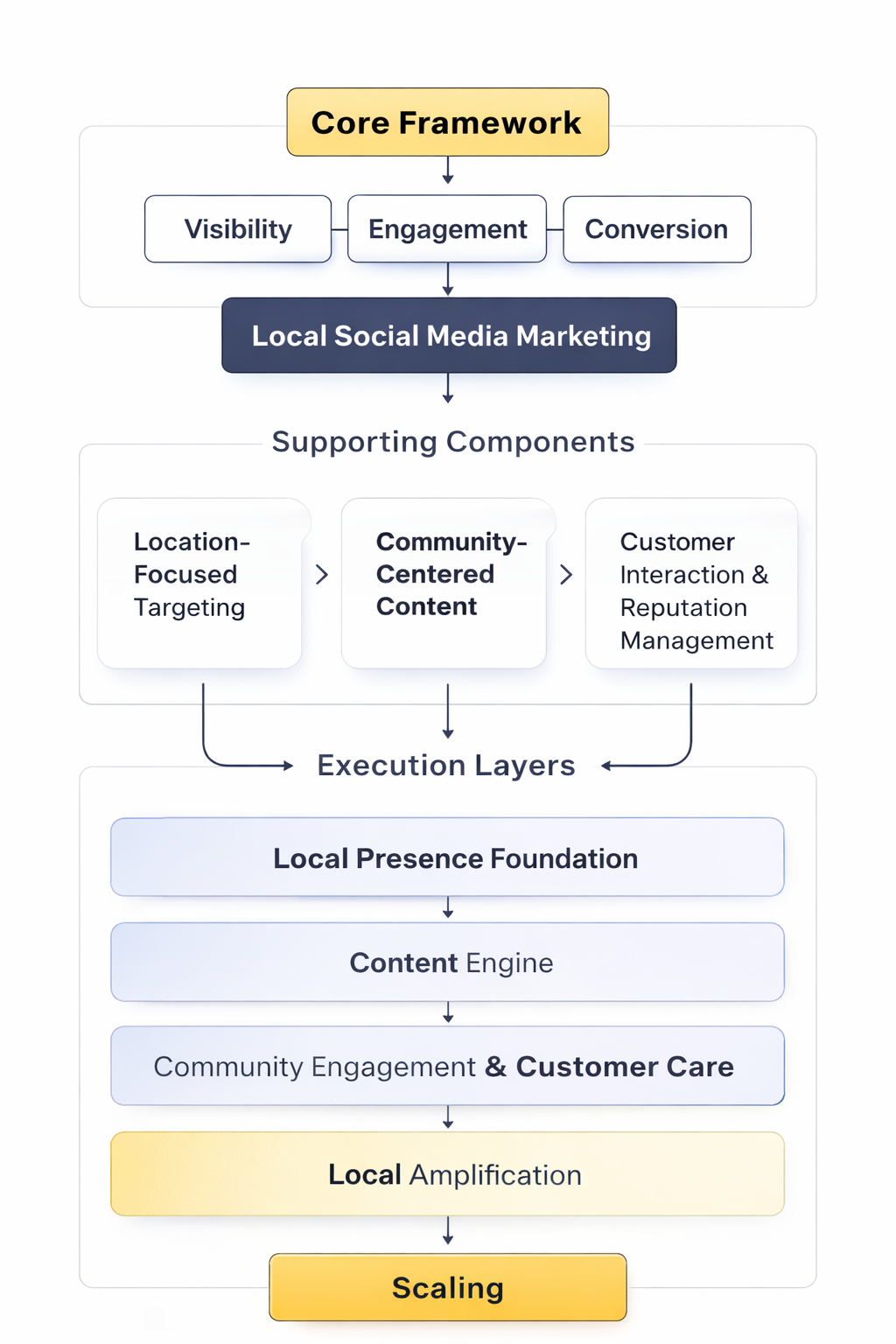
Successful local social media marketing rarely happens by accident. Businesses that consistently attract attention online usually follow a structured framework that guides how they create content, interact with customers, and measure performance.
At its core, this framework combines three essential goals: visibility, engagement, and conversion. Visibility ensures that local audiences actually see the business in their social feeds. Engagement turns passive viewers into active participants through comments, reactions, and discussions. Conversion then transforms that attention into real-world actions such as store visits, bookings, or purchases.
Without structure, many businesses fall into a pattern of random posting. They publish occasional photos or announcements but rarely see meaningful results because their efforts lack consistency and strategic focus. A clear framework helps businesses understand why each type of content exists and how it contributes to broader marketing objectives.
Another important element of the framework is community integration. Local businesses thrive when they become part of the local conversation. Social media enables companies to highlight partnerships with nearby organizations, support community events, or celebrate local achievements. These interactions strengthen brand identity and position the business as a familiar presence within the neighborhood.
Finally, modern social media frameworks emphasize data-driven decision making. Platforms now provide extensive analytics tools that reveal which posts generate engagement, which audiences respond best to promotions, and how content influences traffic and sales. By reviewing this information regularly, businesses can refine their approach and focus on the tactics that produce the strongest results.
Core Components
Although every business has unique goals, effective local social media marketing typically includes several key components working together as part of a unified strategy.
Location-Focused Targeting
Geographic targeting is the foundation of any local strategy. Social platforms allow businesses to display posts or advertisements specifically to people within defined geographic boundaries. This ensures that marketing budgets and content efforts focus on individuals who are realistically able to become customers.
For instance, a local service provider might target users within a 10–20 kilometer radius, while a restaurant could focus on audiences within a short driving distance. Precise targeting dramatically improves efficiency because it eliminates wasted exposure to people who are unlikely to visit.
Community-Centered Content
Local audiences tend to respond strongly to content that reflects their own community. Posts highlighting neighborhood events, local partnerships, or stories about employees and customers help humanize the brand. This type of content also reinforces the idea that the business is deeply connected to the local environment rather than simply operating within it.
Authentic community content often performs well because it resonates emotionally with viewers who share the same geographic and cultural context.
Customer Interaction and Reputation Management
Social media allows businesses to interact with customers publicly and privately. Responding quickly to comments, answering questions, and addressing concerns demonstrates attentiveness and professionalism. Over time, these interactions contribute to a positive reputation that influences how potential customers perceive the brand.
Because many consumers evaluate businesses by reading reviews and responses online, active engagement can significantly impact purchasing decisions.
Performance Analytics
The final core component involves monitoring performance data. Social platforms track metrics such as reach, engagement, clicks, and conversions. When businesses analyze these metrics regularly, they gain valuable insights into which types of content resonate most strongly with their audience.
These insights allow marketers to adjust their strategies, allocate budgets more effectively, and refine messaging so that future campaigns deliver stronger results.
Professional Implementation
While many businesses start social media marketing informally, achieving consistent results usually requires a more professional approach. Implementation involves planning content calendars, defining audience segments, and integrating social platforms with broader marketing initiatives such as email campaigns, websites, and local search optimization.
Professional implementation also involves maintaining a consistent brand voice and visual identity across all platforms. When customers encounter the same tone, style, and messaging repeatedly, they begin to recognize the brand more easily and develop familiarity with it.
Another important element is strategic experimentation. Social media environments evolve quickly as new features, content formats, and algorithms appear. Businesses that test different types of posts, videos, and promotions are better positioned to identify opportunities before competitors fully adopt them.
Finally, professional implementation focuses on long-term relationship building rather than short-term promotional bursts. Research summarized in recent engagement studies shows that customers who interact with brands on social platforms before purchasing often generate 20–40% higher lifetime value. This highlights the importance of nurturing community relationships over time rather than treating social media solely as an advertising channel.
When businesses approach local social media marketing strategically, the result is not simply a collection of posts but a dynamic ecosystem that continuously strengthens visibility, reputation, and customer loyalty within the communities they serve.
Step-by-Step Implementation

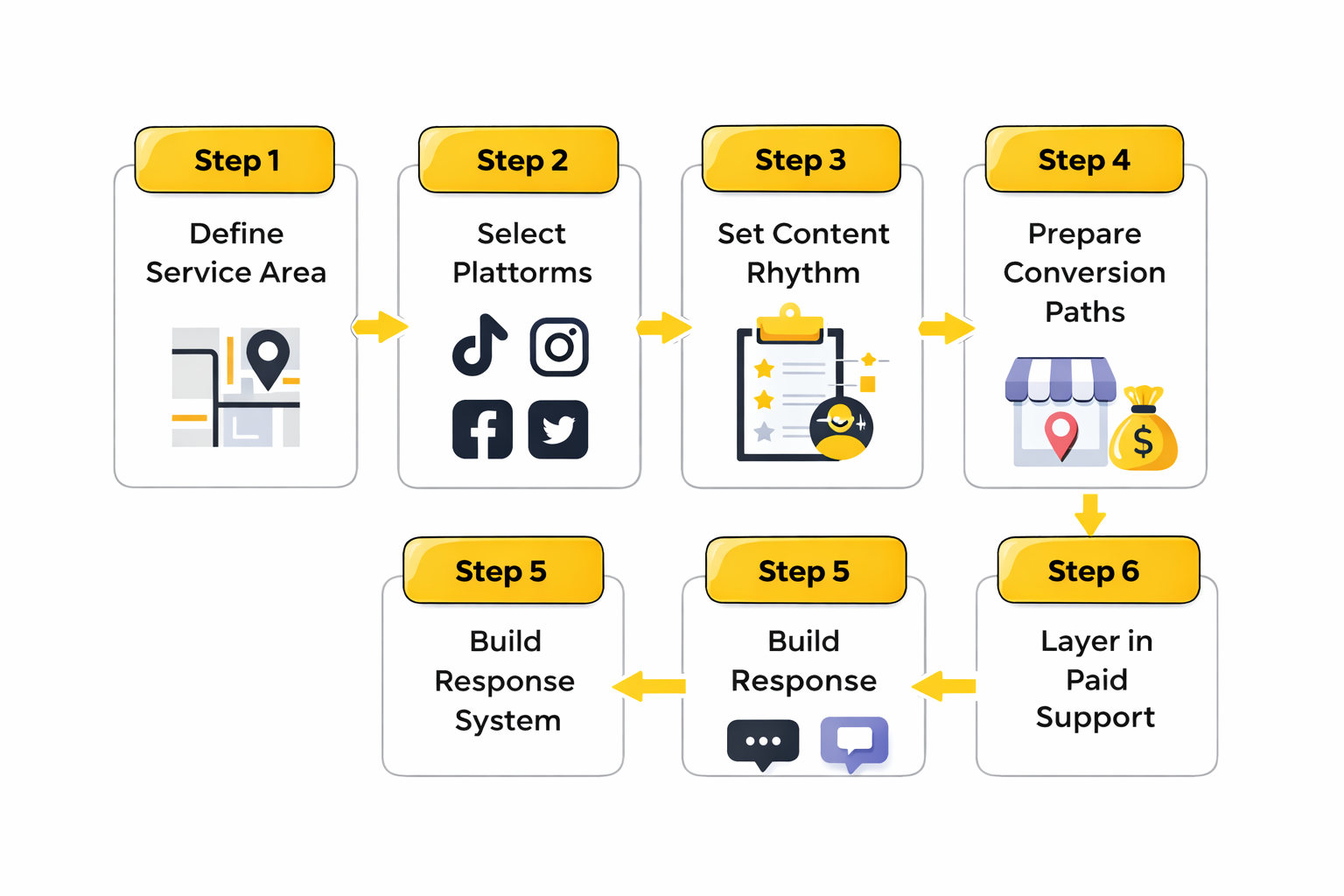
A local social media marketing plan only becomes “real” when it turns into repeatable actions that your team can execute every week without burning out. The goal of implementation is not to post more. It is to build a simple operating system that keeps you visible to nearby customers, responsive when they reach out, and easy to choose when they are ready to buy.
Step 1: Define the local boundary you actually serve
Start with geography, not platforms. Draw the true service area based on how far customers will travel for you on an average day, then define a secondary radius for higher-intent offers like seasonal promos, appointments, or limited drops. This keeps your content and paid distribution honest, because “everyone in the city” is rarely your real buyer pool.
Step 2: Choose platforms based on how locals research businesses
Pick platforms where local intent shows up naturally. People are not only looking for entertainment; they are actively researching. BrightLocal’s 2024 research found that 34% of consumers use Instagram and 23% use TikTok as alternative local business review platforms, which means these feeds function like discovery and trust channels, not just social spaces. Those local research behaviors should shape your platform priorities.
Step 3: Build a weekly content rhythm that matches real customer decisions
Instead of brainstorming from scratch every day, create a weekly rhythm that maps to how customers decide. A practical structure is: one “proof” post (results, outcomes, reviews), one “human” post (people, behind-the-scenes, community), one “offer” post (clear next step), and one “moment” post (timely update, event, or local relevance). The rhythm keeps the page active without turning into random posting.
Step 4: Set up local conversion paths before you scale attention
Visibility without a next step is wasted momentum. Make sure your profiles have consistent location details, click-to-call or booking links, and a pinned post that explains exactly what to do next. If you are a restaurant or venue, it’s worth aligning social updates with search visibility too: Google’s “What’s Happening” feature lets restaurants highlight deals and events on their Business Profile and can be updated through linked social accounts. Google’s guidance for restaurants and coverage of the rollout show how social posts can directly reinforce local discovery in Search.
Step 5: Build a response system that matches customer expectations
Local social media marketing is also customer service in public. People message businesses because they are close to buying, and silence feels like rejection. Sprout Social’s Index data shows 73% of consumers expect a response within 24 hours or sooner, which makes response speed a competitive advantage when your competitors are slow. This response-time expectation is the reason you should implement an inbox routine and a simple escalation path for tricky questions.
Step 6: Add paid support only after your organic engine is stable
Once you can publish consistently and respond quickly, paid distribution becomes a multiplier instead of a crutch. Start with small, local campaigns that boost your best-performing posts to nearby audiences, then layer in offers that drive store visits, calls, or bookings. The practical rule is simple: amplify what already resonates locally, rather than trying to “force” interest with spend.
Execution Layers
Implementation becomes dramatically easier when you treat local social media marketing as layered execution. Each layer supports the next, and skipping a layer usually creates the “why are we posting but nothing happens?” problem.
Layer 1: Local presence foundation
This layer is your credibility baseline. Profiles must be consistent, location details must be accurate, and highlights or pinned posts should answer the questions locals ask first: where you are, when you are open, what you do, and how to buy. This is also where you align social with local search surfaces that reward fresh updates, including Google Business Profile features that elevate timely content for restaurants and bars. Recent expansion notes show how these features are evolving, making operational consistency even more valuable.
Layer 2: Content engine
Your content engine is the set of repeatable formats you can produce without creative exhaustion. For local businesses, the strongest formats are usually straightforward: customer outcomes, product or service demos, quick staff-led explainers, local collaborations, and short updates tied to the neighborhood’s real calendar. The engine matters because it removes daily decision fatigue and ensures steady output.
Layer 3: Community engagement and customer care
This is where trust is built. Replying to comments, handling questions in DMs, acknowledging tagged stories, and responding to feedback publicly all signal reliability. When response speed meets customer expectations, your social presence becomes a living reputation system rather than a poster wall. The consumer response-time findings are a practical reason to treat engagement as a scheduled responsibility, not an afterthought.
Layer 4: Local amplification
Amplification includes paid boosts, local creator partnerships, and community pages that can extend reach beyond your current followers. This layer works best when it supports proven content, because your ad spend is then reinforcing messages your audience already finds credible. Local amplification should feel like a helpful spotlight, not a loud interruption.
Layer 5: Measurement and iteration
The final layer ties everything back to business outcomes: calls, bookings, walk-ins, and repeat customers. Social platform metrics are useful, but the layer becomes powerful when you connect them to real actions. This is also where you decide what to keep, what to cut, and what to refine so that the system improves over time instead of staying stuck.
Optimization Process
Optimization in local social media marketing is not about chasing viral trends. It is about making small improvements that compound: better hooks, clearer offers, tighter local targeting, and faster responses. The easiest way to do this without turning your marketing into chaos is to run an ongoing loop that is simple enough to sustain.
1) Decide what “better” means for the next 30 days
Pick one priority outcome that fits your business reality: more bookings, more calls, more in-store visits, or higher repeat purchase frequency. When everything is a goal, nothing is measurable. Keep the focus narrow for a month, then rotate.
2) Use local intent signals to shape what you test
Local audiences behave differently from broad audiences because they are closer to a transaction. Research shows people now use social platforms as research surfaces for businesses, including review-like discovery on Instagram and TikTok. These local research patterns suggest that tests should often focus on trust-building formats: proof, clarity, and responsiveness, not just aesthetics.
3) Run clean experiments instead of random changes
Change one major variable at a time. If you are testing a new offer, keep the format similar. If you are testing format, keep the offer similar. This is how you learn what is actually driving results, instead of guessing based on noisy data.
4) Treat responsiveness as a growth lever, not just a courtesy
Fast replies increase the chance that an interested local customer chooses you before they move on. Since most consumers expect responses within 24 hours, improving response time is often one of the highest-return optimizations you can make, especially in service categories where people are comparing options quickly.
5) Refresh creative with community context
When performance dips, local relevance is often the fix. Rotate in new neighborhood angles: seasonal moments, local events, partnerships, and staff stories that feel grounded in the community. This keeps your content from becoming generic, which is a common reason local pages stop growing.
Implementation Stories
The first sign of trouble was not subtle. Younger customers were talking about a menu item everywhere, but the business did not control the story. The conversation was happening without them, and it was either going to become a wave they rode or a wave they missed.
Inside the company, the pressure was intense. Operational teams needed predictable traffic, not random surges. Marketing needed to move faster than the old approval process allowed, because social trends do not wait for meetings.
That wall became obvious when the viral moment started driving demand. People arrived expecting a specific experience, but the brand’s content and on-the-ground execution were not yet synchronized. If the business could not connect social interest to consistent in-store delivery, the hype would turn into disappointment.
The breakthrough came when leadership treated social as a performance channel, not just branding. They aligned creative, offers, and operations around what customers were already asking for, then built a repeatable cadence: content that matched the trend, promotions that made the offer easy to choose, and a clearer local funnel into stores.
The journey was not “one viral post.” It was repeated execution. The team leaned into value messaging, made the offer easier to understand, and supported it with coordinated marketing pushes that matched customer demand patterns.
Then the final conflict hit: success created its own complications. A surge in demand tests kitchen speed, staffing, and inventory, and social can amplify complaints just as easily as praise. The company had to maintain consistency under pressure while staying responsive to what customers were saying publicly.
The outcome was a real business lift that turned a social moment into measurable performance. Restaurant Business reported that sales of the viral Triple Dipper appetizer were up 70% year over year, contributing to strong growth. The reporting on that sales impact, paired with coverage of how marketing supported traffic and comparable sales, shows what implementation looks like when social content, offers, and operations are executed as one system.
Statistics and Data
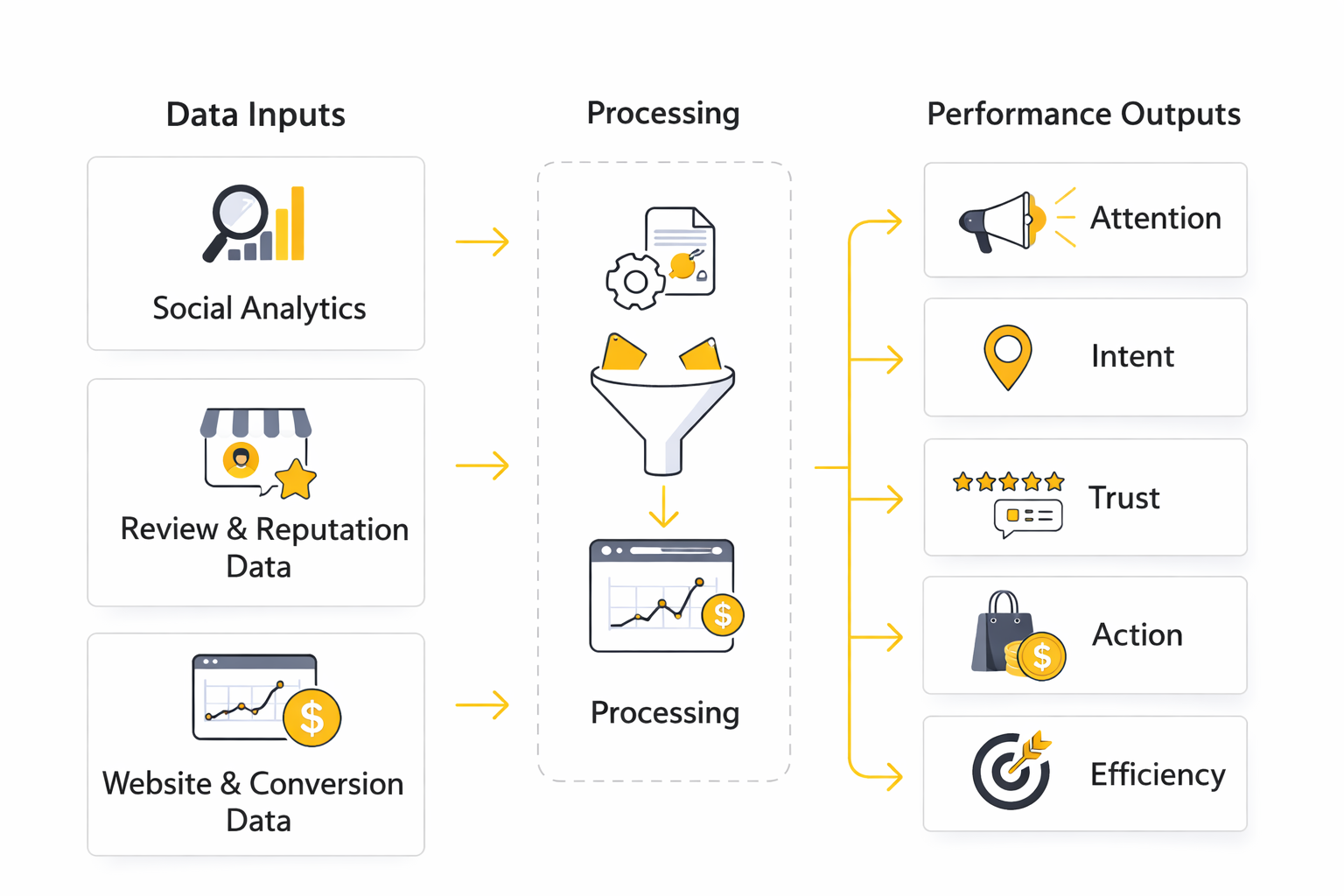
If you’re serious about local social media marketing, you can’t treat analytics like a scoreboard you check once a month. It’s closer to a navigation system: it tells you where attention is coming from, what persuades people to take the next step, and which locations are quietly leaking demand.
That matters more than ever because discovery is getting messier. People bounce between social feeds, map results, reviews, and DMs without thinking of them as separate “channels.” You can see this shift in broader consumer research: social media use for product research rising across markets is one more signal that “I saw it on my phone” has become a normal starting point, not a lucky accident.
The practical takeaway for local operators is simple: you need a small set of metrics that connect social activity to local outcomes. Not vanity numbers. Not a dozen dashboards. Just the minimum signal required to decide what to do next for each location and each offer.
Performance Benchmarks
Benchmarks are useful when they stop you from overreacting. If one location’s reach drops, you don’t want panic. You want context: is the platform down overall, did your content mix change, or did that specific location lose momentum?
Start with platform-level “reality checks,” then zoom into local differences. For example, Skai’s Q1 2025 index shows paid social CPM and CTR levels that help you sanity-check paid delivery before you blame creative: paid social CPM around $4.37 and CTR around 0.64% in Q1 2025. Those numbers won’t match every vertical, but they’re a useful baseline for spotting when your campaigns are unusually expensive or unusually ignored.
For organic content benchmarks, pay attention to how format affects engagement. Emplifi’s 2025 social media benchmarks report (built on 2024 data) highlights how short-form video continues to dominate behavior and engagement patterns across platforms: Instagram Reels’ reach engagement rates staying ahead of TikTok averages in their dataset. If your local social media marketing is still mostly static posts, you’re starting each week at a disadvantage.
To keep benchmarks from becoming noise, group them into five buckets that map to the local journey:
- Attention: reach, impressions, 3-second video views, and frequency (especially for store-launch and event pushes).
- Intent: profile visits, tap-to-call, direction requests, link clicks, and saves.
- Trust: review volume and rating trends, plus how often staff respond to reviews and messages.
- Action: purchases, bookings, lead submissions, offer redemptions, and in-store events tracked by POS or CRM.
- Efficiency: CPM/CPC/CPA, plus incremental lift where you can measure it.
One more benchmark that’s easy to overlook: category competition. If your local area is saturated, the “good” numbers won’t look as good, and that’s not your fault. It’s a signal to change the angle (offer, audience, or creative), not to bully the team into posting more.
Analytics Interpretation
Most local teams misread data in the same way: they look at a metric, decide it’s “good” or “bad,” and move on. Real interpretation is slower and more useful. You’re asking: what changed, why did it change, and what decision should we make because of it?
Here’s a clean interpretation workflow that works well in local social media marketing without turning you into a full-time analyst:
- Step 1: Separate reach problems from persuasion problems. If reach collapses, you’re dealing with distribution (budget, targeting, posting cadence, format). If reach is stable but clicks and actions drop, you’re dealing with message/offer friction.
- Step 2: Compare locations like-for-like. Compare similar stores (same category, similar population density, similar seasonality). Don’t compare a downtown flagship to a suburban strip-mall location and expect the same curve.
- Step 3: Look for “intent spikes,” not just totals. A single Reel that drives a surge in direction requests is more valuable than ten posts that slowly add likes. Skai’s discussion of social’s shifting role toward discovery and shopping behavior is a helpful lens here: the report frames paid social as bridging engagement and commerce.
- Step 4: Track trust as a leading indicator. Review and reputation signals often move before sales do. BrightLocal’s ongoing review research shows how strongly reviews influence local decision-making: their Local Consumer Review Survey highlights how review behaviors keep shifting. If your reviews dip or responses slow, expect performance to soften later.
- Step 5: Turn insights into one action per week. “Improve content” is not an action. “Record 6 short clips of staff answering the top 6 customer questions and post as Reels across all locations” is an action.
The “secret” interpretation skill is resisting false certainty. When performance changes, you usually have two or three plausible reasons. Your job is to run the smallest test that reveals which reason is most likely—then scale what works.
Case Stories
Local social media marketing can look abstract until you see what happens when demand shows up faster than a business can handle. Easy Street Burgers in Los Angeles lived that lesson in public, and the numbers weren’t vague “marketing wins.” They were operational pressure.
Start at the point of high drama. The line didn’t just get longer—it became a problem. People were waiting so long that the wait itself turned into part of the story, the kind of thing customers post about while they’re standing outside. When your product becomes a queue, you either translate attention into a system or you burn out on your own success. Bon Appétit’s reporting on restaurants impacted by Keith Lee describes the intensity in a way that sounds like a business being stress-tested, not a brand “going viral.”
Backstory. Easy Street didn’t begin as a polished chain with unlimited staff and processes. It started small, with the kind of lean setup that’s normal for local food businesses trying to survive and grow. That background matters because when attention hits suddenly, small teams don’t have slack—every extra order is extra strain. The context is captured in coverage of the brand’s trajectory and visibility surge after social moments. Eater’s look at LA restaurant TikTok places Easy Street inside a broader ecosystem where one creator can reshape local demand.
The wall. The business couldn’t “post more” to solve the problem. The bottleneck wasn’t awareness anymore; it was capacity, consistency, and keeping the experience good under pressure. Rapid spikes can also invite the wrong kind of partnership offers—paid promos, creators who don’t deliver, and distractions that take attention away from what customers actually want. Even in Eater’s reporting, you can see the tension between opportunity and risk in how restaurants navigate influencer dynamics. That same piece covers pitfalls as well as upside.
The epiphany. The breakthrough wasn’t “let’s chase virality again.” It was realizing the only sustainable move is to measure and manage the journey from content to in-person experience. When your Instagram following jumps and the line goes from busy to overwhelming, your metrics need to include staffing, throughput, and customer satisfaction—not just views. Bon Appétit reports specific operational shifts—like staffing changes and sustained demand—because those are the real outcomes that matter to local businesses. The Easy Street section includes concrete signals of scale pressure.
The journey they went on. The team had to adapt quickly: more hiring, more process, and a clearer sense of what to prioritize when attention is intense. They also had to keep the brand voice and the product quality intact while the audience expanded beyond the neighborhood. This is where analytics becomes practical: track which posts drive “direction intent,” which posts drive “menu curiosity,” and which posts trigger surges you can’t fulfill. The broader “Keith Lee effect” coverage makes clear that local demand spikes are real, measurable, and operationally disruptive. Square’s reporting on a small business after going viral reinforces the same pattern from another operator’s perspective.
The final conflict. The hardest part comes after the initial spike—when the internet moves on but your new customers still expect the same excitement. You’re now managing a bigger audience with the same standards, and any dip in experience becomes a review problem fast. That’s why trust metrics (reviews, responses, complaint themes) have to sit next to reach metrics in local social media marketing. The story isn’t “viral solved everything,” it’s “viral created a new set of problems.” Restaurant Business’s breakdown of the snowball effect captures how these moments ripple beyond a single post.
The dream outcome. When it works, the win is bigger than likes: sustained demand, stronger brand memory, and a local reputation that extends beyond the immediate neighborhood. Easy Street’s growth signals show what “local” looks like now—local businesses can become citywide destinations when the content and experience reinforce each other. Even mainstream coverage around the creator collaboration moments shows how these stories keep building instead of disappearing overnight. Forbes’s reporting on what happens after a restaurant goes viral frames the longer tail: the operational and business transformation, not just the spike.
Professional Promotion
The most professional thing you can do in local social media marketing is make your promotion measurable before you launch it. If you’re promoting an event, a seasonal offer, or a new location, decide in advance what “success” means and how you’ll see it in your data.
Here’s a clean, analytics-first promotion setup that keeps teams aligned:
- Pick one primary conversion per campaign. Calls, bookings, direction requests, lead forms, or coupon redemptions. One campaign, one main job.
- Define a “leading indicator” you can watch daily. For many local campaigns, profile visits and direction taps move earlier than sales.
- Use a simple naming system by location. If you can’t break down results per location, you can’t improve location performance.
- Plan for platform shifts. Skai’s data shows platform mix and adoption changes, including TikTok’s rising advertiser footprint in their index: TikTok adoption rising among Skai advertisers and share-of-wallet expanding. Build promotions so you can move budget without rebuilding everything.
- Protect reputation while you scale. If a promo works, volume follows. Make sure staffing, inventory, and response workflows can absorb attention, or your reviews will tell the story you didn’t intend.
When promotion is run professionally, analytics doesn’t just prove that you grew. It tells you where you grew, why you grew, and what to repeat the next time you need a predictable local win.
Advanced Strategies
Once the basics of local social media marketing are stable, the fastest growth usually comes from doing fewer things better, not doing everything at once. Advanced strategy is about building an advantage your competitors can’t copy in a weekend: a community flywheel, a content system that scales across locations, and measurement that ties attention to real outcomes.
Turn customers into a local content engine
Most local teams still treat user-generated content as “nice when it happens.” Advanced teams treat it like inventory. They set up simple prompts that make sharing natural: a photo spot in-store, a staff script that invites tags, and a post-purchase message that asks for one specific action (share, review, or DM a question).
This matters because the creator ecosystem isn’t a side show anymore. The creator ad market continues to accelerate, with IAB’s 2025 creator advertising report and reporting on the same projection pointing to U.S. creator-related ad spending reaching roughly $37B in 2025. Local businesses don’t need celebrity deals to benefit from this shift, but they do need a repeatable way to collect, permission, and publish community content.
Build “micro-local” content clusters instead of generic posting
Advanced local social media marketing doesn’t speak to “everyone nearby.” It speaks to small groups with shared context: commuters, parents, lunchtime office workers, weekend hikers, university students, or event-goers. Your content becomes a set of clusters that rotate through the week, each with its own format and call-to-action.
This reduces creative burnout because the team isn’t inventing new ideas daily. They’re rotating proven angles that match how locals actually live and buy.
Design offers like a ladder, not a single coupon
Coupons work, but advanced teams don’t lead with discounting unless they have to. They ladder offers from low-friction to high-commitment: a “try us” starter offer, a value bundle, and a loyalty nudge that keeps the relationship alive. That ladder lets you segment messaging without becoming spammy.
Use platform features that connect discovery to action
When you run location-based campaigns, the goal is not “traffic” in the abstract. It’s calls, direction taps, and visits. Meta supports this directly through its store-focused objectives and measurement options, including the store traffic objective and standard conversion infrastructure like the Meta Pixel setup workflow.
On Google’s side, local discovery and footfall are increasingly connected to a single ecosystem, with guidance on tactics like promoting locations across Search and Maps and using store-oriented campaign setups. Google’s own overview of driving store visits and in-store sales is a useful reference point when you’re building promotions designed to convert nearby intent into real-world action.
Stop chasing trends and start borrowing patterns
Trend-chasing is exhausting and often off-brand. A better advanced move is pattern-borrowing: identify the structure that works (hook, payoff, proof, invitation), then rebuild it with your local context. This is where short-form video becomes a consistent advantage rather than a constant scramble, because you’re producing repeatable formats instead of “random inspiration.”
For a strategic lens on why short-form video is becoming a performance and commerce format, TikTok’s What’s Next 2025 trend report and analysis of short-form video in commerce advertising both map the same direction: the scroll is increasingly tied to buying behavior, not just entertainment.
Scaling Framework
Scaling local social media marketing isn’t simply adding more posts or more budget. It’s building a framework that keeps quality consistent as complexity rises, especially when you add locations, staff, creators, and multiple local audiences.
1) Governance: one brand, many local voices
Scaling begins with clear boundaries. Define what must be consistent across every location (brand voice, visual system, claims you can make, response standards), then define what must be flexible locally (events, community partnerships, local staff personalities, neighborhood language). When local teams don’t know where the guardrails are, they either freeze or go rogue.
2) Content supply chain: capture, edit, publish, repurpose
High-performing multi-location teams treat content like operations. They create a capture routine (short clips from staff, customer moments, product prep), an edit routine (batch editing once or twice per week), and a publishing routine (scheduled plus real-time slots). That supply chain is how you scale output without sacrificing authenticity.
3) Distribution: local-first targeting with a national safety net
Distribution scales best when it’s layered. Local budgets push proven content to nearby audiences, while brand-level spend supports major launches, seasonal pushes, and retargeting pools that benefit every location. Google’s product guidance around driving store visits across its ecosystem is a helpful model for this layered approach. The store-visit playbook framing naturally aligns with “local-first” distribution.
4) Measurement: one dashboard, location-level truth
Scaling collapses when reporting can’t answer a basic question: which locations are winning and why? Your measurement system needs a consistent naming convention, consistent goals, and at least one outcome metric tied to real behavior (calls, bookings, direction taps, redemptions). If every location reports differently, you can’t compare, learn, or improve.
Growth Optimization
Optimization is where scaling becomes profitable. The goal is not to “improve everything.” It’s to find the smallest changes that produce the biggest compounding gains across all locations.
Optimize for responsiveness as a growth lever
For local businesses, response time isn’t just customer care. It’s conversion. People message and comment when they’re close to buying, and the fastest brand often wins. Sprout Social’s customer care research highlights that nearly three-quarters of consumers expect a response within 24 hours or sooner, which is a practical benchmark for building team schedules and inbox coverage.
Run structured experiments by location type
Instead of testing everything everywhere, group locations by similarity: high-footfall urban sites, suburban sites, tourist-heavy sites, and appointment-driven service areas. Test a single variable within a group (hook style, offer framing, creator format, audience radius), then roll winners out broadly.
Fix friction before you increase spend
When growth stalls, the fix is often not “more budget.” It’s fewer obstacles. Tighten your profile-to-action path: booking links that work, pinned posts that explain next steps, highlights that answer common questions, and creative that makes the offer instantly clear.
Scale what your audience already proves it wants
Advanced teams don’t “brainstorm” what people might like. They look for signals: saves, shares, replies, direction taps, and repeat questions in DMs. Then they produce more of the thing the market already voted for. This is also where short-form video patterns become a measurable flywheel, supported by broader platform research and commerce-focused trend analysis. The short-form commerce trend is a useful lens when deciding which formats to operationalize across locations.
Scaling Stories
The pressure hit before the brand was ready. A fast-growing chicken chain was showing up everywhere on TikTok, and the attention wasn’t controlled by a polished campaign. It was raw, chaotic, and relentless, the kind of momentum that can either build a category leader or expose every weakness in your system.
Inside the business, the challenge wasn’t “how do we go viral?” The challenge was how to scale local demand without breaking store operations, consistency, and customer trust. The brand had to turn unpredictable attention into something repeatable, location by location, day after day.
Start at the point of high drama. The hype was loud enough that it created a new baseline expectation for every opening and every location. When customers walk in because they saw dozens of videos, they expect the same moment they watched on their phones. That kind of expectation turns social performance into an operational problem immediately. Reporting on Dave’s Hot Chicken’s social momentum captures how central organic hype has been to the brand’s story.
Backstory. Dave’s Hot Chicken began as a small operation, then expanded rapidly into a national chain with aggressive growth goals. Social didn’t work like a traditional brand channel for them; it was more like a public mirror reflecting customer reactions in real time. That dynamic matters because a fast-growing brand can’t rely on slow, top-down content cycles when the internet is moving daily. Restaurant Business’s look at Dave’s TikTok dependence sets the stage for why the brand had to think differently about content and control.
The wall. The brand faced a hard constraint: attention was arriving whether they planned for it or not. A typical “brand content” approach would have required more production, more approvals, and more internal resources, which can slow a team down exactly when speed matters most. There was also the risk that if the platform shifted or the algorithm cooled, the growth engine could stall. The same reporting describes the question of what happens after TikTok, which is the wall every hype-driven brand eventually hits.
The epiphany. The unlock wasn’t making everything more polished. It was leaning into what was already working: letting customers and creators generate the story, then curating and amplifying it with consistency. That approach flips the normal model, because the “creative department” becomes the community, and the brand becomes the editor. The article’s description of Dave’s sharing user-generated clips points directly at this shift in thinking.
The journey they went on. The next step was operationalizing the model so it could scale across locations: consistent reposting guidelines, stronger brand oversight without suffocating authenticity, and tighter coordination between marketing and store operations. The brand also began preparing for a more mature growth phase, including leadership changes meant to broaden the marketing remit beyond pure organic momentum. Marketing Dive’s coverage of the brand’s next-stage marketing focus shows how the company framed that evolution.
The final conflict. Scaling a community-driven content engine creates new risks: inconsistent store experiences, local inventory and staffing strain, and reputational blowback when expectations outpace reality. At the same time, relying too heavily on one platform can make the business vulnerable to shifts in distribution. That’s why scaling local social media marketing requires both a content engine and a diversification plan across platforms and conversion paths. The “life after TikTok” question is the conflict expressed in business terms.
The dream outcome. When the system works, the brand doesn’t just get views. It gets predictable traffic, stronger openings, and a community that markets the product every day without needing a massive production budget. The brand’s growth story has been tied to that compounding visibility, with the hype translating into real business scale and valuation narratives. The Forbes reporting on the billion-dollar deal context shows what that kind of outcome looks like when social momentum becomes a durable business asset.
Build promotions around local intent signals
For many local campaigns, “store interest” is visible before sales show up. Calls, direction taps, saves, and messages are often the first sign the creative is working. This is where platform objectives and measurement infrastructure matter, including tools built to connect digital exposure to physical behavior. Meta’s documentation around the store traffic objective is a practical starting point for location-driven promotions.
Plan for operational reality before you scale budget
If the promotion works, volume follows. Make sure the location can fulfill what you’re promising: staff coverage, inventory, booking capacity, and response coverage in DMs. For customer communication standards, consumer expectations around response time are a useful benchmark for staffing the inbox during promotional bursts.
Use a scalable creative system, not one-off hero ads
The most sustainable promotional model is modular: one strong hook, three versions of proof, two offer angles, and location-specific overlays or scripts. That gives you variations without reinventing the campaign for every store. It also makes it easier to move budget between platforms as behavior shifts, supported by platform-level trend research. TikTok’s trend research is a reminder that audience behavior and formats change quickly, so your system needs flexibility built in.
When professional promotion is built this way, scaling stops feeling like gambling. Your local social media marketing becomes a disciplined growth machine: controlled experiments, repeatable creative patterns, and predictable conversion paths that work across locations.
Future Trends
Local social media marketing is moving into a new era where “content” is only one piece of the puzzle. The bigger shift is that social platforms are becoming discovery engines, customer service channels, and shopping layers at the same time. If you build your strategy around that reality, you will feel momentum. If you keep treating social as a place to post announcements, you will feel invisible.
One trend that keeps strengthening is social-first local discovery. Younger audiences are increasingly using social platforms to find nearby businesses, and the numbers are no longer subtle. Hootsuite’s 2026 statistics roundup highlights that 67% of people aged 18–24 use Instagram to discover local businesses, and 62% use TikTok. Those local discovery stats explain why local brands that show up in short-form video and searchable profiles often win mindshare before someone ever opens a map app.
Another trend is that “search behavior” is blending with entertainment. People aren’t only asking Google where to go; they are watching creators, scanning comments, and making decisions based on what feels real. That shift is already visible in category-specific reporting, including restaurant discovery where younger diners are increasingly influenced by social reviews and short-form videos. Coverage of how Gen Z discovers restaurants shows how quickly decision-making is moving toward social feeds.
AI is also changing how local teams operate. The practical win is not “AI writes captions.” The win is AI helping small teams maintain consistency: turning one shoot into multiple edits, generating variants for different neighborhoods, summarizing comments into themes, and spotting patterns in performance data. At the same time, the broader digital landscape is being reshaped by AI and platform evolution, as described in DataReportal’s Digital 2025 overview.
Finally, creators are becoming a mainstream distribution layer, even for local businesses. When creators and customers drive the story, local brands can scale attention without scaling production costs. The creator economy’s gravity is reflected in IAB’s creator advertising report, which projects U.S. creator-related ad spend reaching $37B in 2025. For local social media marketing, this supports a simple strategy: build a steady pipeline of community-led content and treat it as an asset, not a bonus.
Strategic Framework Recap
The easiest way to keep local social media marketing from becoming chaotic is to treat it like an ecosystem. Every part supports the others, and when one part is missing, performance usually feels unpredictable.
Here is the full framework in one clean flow:
- Local clarity: define your true service radius, the neighborhoods that matter most, and the type of customer you want more of.
- Platform choices: show up where locals actually discover businesses and make decisions, especially as social discovery continues to grow. The recent discovery behavior data is a useful reminder that platform choice is not a preference; it is a strategy decision.
- Content engine: build repeatable formats that make your business feel familiar and trustworthy, not “posted at.”
- Engagement and care: respond quickly, consistently, and like a real human. Social is not only marketing; it is public customer experience.
- Local amplification: use paid boosts and creator partnerships to scale what already resonates, instead of trying to force interest with spend.
- Measurement loop: track signals that matter locally (profile visits, direction taps, calls, bookings, redemptions), then run small tests that compound over time.
When the ecosystem is working, you stop guessing. You know what to post, you know what to measure, and you know what to improve next.
FAQ Built for This Complete Guide
1) What is local social media marketing in plain terms?
It is using social platforms to attract and convert customers in a specific geographic area. The strategy focuses on nearby intent: people who can realistically visit, book, or buy from you.
2) Which platforms matter most for local businesses right now?
The best platforms are the ones your customers already use to discover businesses locally. Social-first discovery is especially strong with younger audiences, as shown in recent local discovery statistics. In practice, many local categories see strong results from Instagram and TikTok, with Facebook still valuable for community groups and local events in many markets.
3) How often should a local business post?
Post often enough to stay familiar, not so often that quality drops. A realistic target for many businesses is 3–5 high-quality posts per week plus consistent story updates and replies. Consistency beats intensity because it builds long-term trust.
4) Should local businesses prioritize organic content or paid ads?
Organic content builds trust and familiarity; paid ads scale proven messages. A strong approach is to build a stable organic rhythm first, then put budget behind the posts and offers that already earn saves, shares, replies, and real intent actions.
5) What metrics matter most for local social media marketing?
Start with intent metrics that map to local action: profile visits, calls, direction taps, booking clicks, and messages. Add one outcome metric you can measure reliably, like bookings, lead submissions, or redemptions. Use reach and engagement as diagnostics, not as the goal.
6) How do reviews connect to social performance?
Reviews and social reinforce each other because both shape trust at the moment of decision. When your service is strong, people post and review. When your responses are thoughtful, your reputation becomes a visible advantage. This is why local brands that treat social as customer care often outperform brands that only broadcast promotions.
7) Is short-form video really necessary for local businesses?
It is not mandatory, but it is increasingly a competitive advantage because it matches how people discover and evaluate businesses in feeds. Short, clear videos that show the experience (food, service, results, atmosphere) often reduce uncertainty and move people closer to action.
8) How do I avoid sounding generic while still using the keyword naturally?
Use “local social media marketing” when it fits the sentence, then focus on specifics: neighborhoods, local events, staff, customer questions, and real offers. People trust details because details feel real.
9) What is the biggest mistake businesses make when trying to scale?
Scaling volume before fixing friction. If your profile is unclear, your booking link is broken, or your response time is slow, more reach just creates more missed opportunities. Fix the conversion path first, then scale distribution.
10) How can a small team handle content, comments, and DMs without burning out?
Batch production, reuse formats, and schedule engagement windows. Treat replies like a daily responsibility, not an “if we have time” task. Many teams also build a library of approved answers for recurring questions so responses stay fast and consistent.
11) How do local businesses use creators without wasting money?
Start small and local. Choose creators whose audience matches your geography and category, then agree on clear deliverables: content you can reuse, posting dates, and a call-to-action that drives measurable intent. The creator economy’s scale is clear in IAB’s creator advertising report, but the local advantage comes from fit and authenticity, not celebrity reach.
12) How do I keep up with changing algorithms?
Don’t chase every change. Build a system that survives change: strong hooks, clear offers, community-driven proof, and fast customer care. If the platform shifts, your fundamentals still work because they are based on human behavior, not hacks.
Work With Professionals
If you’re a marketing freelancer, you already know the uncomfortable truth: skill isn’t always the bottleneck. The bottleneck is pipeline. You can be excellent at local social media marketing and still spend too many weeks chasing leads, negotiating through middle layers, or paying platform fees that make good work feel like a bad deal.
That’s why marketplaces built specifically for marketing talent are becoming a serious advantage. Markework is built around a straightforward idea: make it easier for companies and marketers to find each other, talk directly, and move faster—without commissions or project fees. The platform’s positioning is clear about direct communication and the absence of middleman fees.
When you’re ready to turn your expertise into consistent paid work, the workflow is simple. You build a profile that shows your skills, rates, and proof. You browse active roles and projects that match your strengths. Then you apply, message, and close work directly with the company—without someone taking a cut of your earnings. The “Why Us” page emphasizes direct communication and no project fees, and the pricing model confirms the subscription approach rather than commissions.
Most importantly, there is real volume to work with. Markework’s listings page shows 1,000+ active listings available behind the account wall, which means you’re not joining an empty marketplace and hoping it grows. The active listings view displays the current inventory and makes the opportunity feel immediate.
If you want a cleaner path to your next clients—one where you keep control, keep your pricing, and keep your earnings—start here:
 Filip Konecny Enterprises