

Walk into almost any dental clinic today and you will notice that the competition is no longer limited to the practice across the street. Patients are comparing dentists online, scrolling through Instagram before-and-after transformations, reading reviews on Facebook, and watching short educational videos about oral health before they ever pick up the phone.
This shift in behavior has quietly reshaped how dental practices grow. Clinics that once relied primarily on word-of-mouth referrals now compete in a digital landscape where online reputation, visibility, and patient trust are built through consistent communication on social platforms.
Research exploring the relationship between patients and dental clinics shows that social platforms increasingly influence treatment choices and how people evaluate providers before booking an appointment. Studies examining patient decision-making have demonstrated that social media can directly affect how people choose dental services and learn about treatment options, especially aesthetic procedures and preventative care. One large survey of dental patients found that a substantial portion had interacted with a clinic’s social media presence before seeking care. :contentReference[oaicite:0]{index=0}
For dental practices, this means that social media is no longer simply a place to share occasional updates. It has become a communication channel where education, trust building, reputation management, and patient acquisition happen simultaneously.
When executed strategically, dental social media marketing can strengthen patient relationships, reduce anxiety around treatments by educating audiences, and help practices stand out in crowded local markets. Clinics that actively engage online often build stronger loyalty and referrals compared to practices with little digital presence. :contentReference[oaicite:1]{index=1}
This guide explores how dental social media marketing works, why it matters for modern practices, and how a structured framework can turn social platforms into a consistent source of patient growth.
Article Outline
- What Dental Social Media Marketing Is
- Why Dental Social Media Marketing Matters
- Dental Social Media Marketing Framework Overview
- Core Components of Dental Social Media Marketing
- Professional Implementation of Dental Social Media Marketing
- Content Strategy for Dental Social Media
- Choosing the Right Social Platforms
- Paid Advertising Strategies
- Analytics and Performance Tracking
- Building a Long-Term Social Media Ecosystem
- Frequently Asked Questions
What Dental Social Media Marketing Is
Dental social media marketing refers to the strategic use of social platforms such as Instagram, Facebook, TikTok, and YouTube to attract new patients, strengthen relationships with existing ones, and position a dental clinic as a trusted authority in oral health.
At its core, this form of marketing blends healthcare communication with digital storytelling. Instead of traditional advertisements, dental clinics share educational posts, short videos explaining procedures, patient testimonials, and behind-the-scenes glimpses of daily practice life.
This approach serves several purposes simultaneously. It helps potential patients understand treatments they may feel anxious about, allows dentists to demonstrate expertise in a transparent way, and gives clinics a recognizable brand personality.
Modern dental practices increasingly use social media to communicate complex procedures in an accessible format. Educational videos explaining orthodontic treatments, whitening procedures, or implant recovery often generate high engagement because they answer questions patients were already searching for online.
Social platforms also allow clinics to humanize their brand. A short video introducing staff members, a time-lapse of a smile transformation, or a post celebrating a patient milestone can transform what might otherwise feel like a clinical environment into something approachable and welcoming.
Over time, these interactions create familiarity. By the time someone needs dental treatment, they may already feel like they know the dentist and the practice — a powerful psychological advantage that traditional advertising rarely achieves.
Why Dental Social Media Marketing Matters
Dental care decisions are rarely impulsive. Most patients research extensively before choosing a provider, especially for treatments such as orthodontics, cosmetic dentistry, or dental implants.
During this research phase, social media often acts as a trust filter. Potential patients evaluate how active a clinic is, what type of cases it showcases, and how it communicates with its audience.
Studies examining dental patient behavior show that a large portion of potential patients consider a clinic’s social media presence when deciding whether a practice appears trustworthy or credible. In fact, research into dental marketing behavior indicates that around 41% of consumers say social media influences their decision when choosing a dental provider. :contentReference[oaicite:2]{index=2}
This influence extends beyond visibility. Social media also helps address one of the biggest barriers to dental care: anxiety. Educational posts, patient testimonials, and behind-the-scenes videos help people understand what to expect during treatment, which reduces fear and builds confidence before they even schedule a consultation. :contentReference[oaicite:3]{index=3}
For dental practices, the impact goes further than patient acquisition. Social media strengthens long-term relationships with existing patients. When clinics share oral health tips, appointment reminders, or seasonal advice, they remain present in patients’ daily lives.
These small interactions gradually build loyalty. Instead of a purely transactional relationship based on appointments, patients begin to view the clinic as a trusted source of health guidance.
Over time, this dynamic creates something extremely valuable: a community around the practice. Loyal patients recommend the clinic to friends, share posts, and often become informal ambassadors for the brand.
Dental Social Media Marketing Framework Overview
Effective dental social media marketing rarely happens by accident. The practices that consistently attract new patients through social platforms usually follow a structured framework that aligns marketing activities with patient behavior.
A typical framework begins with visibility. The clinic must first appear where potential patients spend time online. Platforms like Instagram, Facebook, and TikTok are particularly effective because they allow dental professionals to demonstrate results visually.
The second layer of the framework focuses on education. Many people delay dental treatment simply because they do not fully understand procedures or outcomes. Content that explains treatments in clear, approachable language helps patients make informed decisions.
Next comes credibility. Trust is built when clinics show authentic patient results, share testimonials, and consistently communicate professional expertise.
Finally, engagement converts attention into appointments. Responding to comments, answering questions in messages, and encouraging consultations transforms passive followers into active patients.
This progression—from visibility to trust to engagement—mirrors the natural decision-making journey most patients follow when evaluating a dental clinic.
Core Components of Dental Social Media Marketing
Successful dental social media marketing strategies typically combine several core components that work together to build authority and patient relationships.
Educational Content
Educational posts form the foundation of most successful dental accounts. These may include explanations of procedures, oral hygiene tips, or myth-busting posts about common dental misconceptions.
When people search for answers to questions about tooth sensitivity, whitening, or braces, educational content helps position the dentist as a trusted source of guidance.
Visual Case Studies
Before-and-after transformations are among the most powerful formats in dental marketing because they clearly demonstrate treatment outcomes. Visual case studies allow patients to see real results rather than simply reading descriptions.
This transparency helps potential patients visualize their own outcomes and builds confidence in the clinic’s expertise.
Community Engagement
Social media is inherently interactive. Practices that treat it as a one-way broadcasting channel often struggle to generate results.
Responding to comments, answering patient questions, and acknowledging feedback creates a sense of dialogue rather than marketing.
Brand Personality
People connect with people, not just businesses. Clinics that show their team members, celebrate milestones, and share authentic moments from the practice create a more relatable brand.
These human elements can make the difference between a clinic that feels corporate and one that feels welcoming.
Professional Implementation of Dental Social Media Marketing
While many clinics start social media accounts with enthusiasm, maintaining consistency and strategic direction can become challenging over time.
Professional implementation focuses on turning social media into a predictable growth system rather than an occasional marketing activity.
This process usually begins with clearly defined objectives. Some clinics focus on attracting cosmetic dentistry patients, while others prioritize increasing preventative care appointments or building long-term brand awareness.
Once objectives are clear, the next step is content planning. A structured content calendar ensures that posts remain balanced across educational material, patient stories, and community engagement.
Professional strategies also incorporate compliance considerations. Dental marketing must respect patient privacy regulations and ethical guidelines, which means obtaining proper consent before sharing patient stories or images.
Finally, consistent measurement is essential. Monitoring engagement rates, appointment inquiries, and patient feedback helps clinics understand which types of content resonate most strongly with their audience.
When these elements work together—strategy, content planning, compliance, and analytics—dental social media marketing evolves from a time-consuming obligation into a powerful driver of patient trust and practice growth.
Step-by-Step Implementation
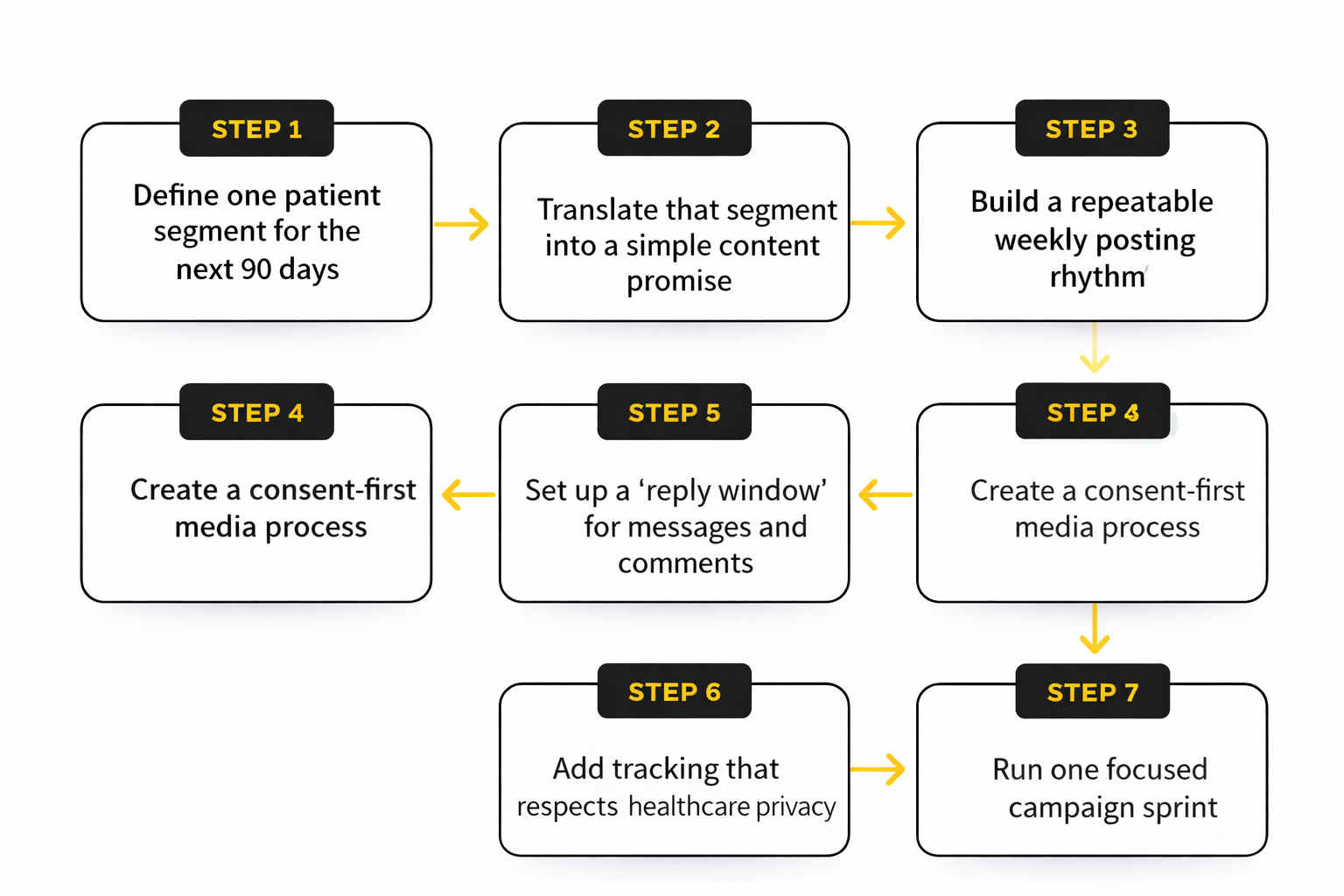
A strong dental social media marketing strategy is much easier to execute when it is treated like an operational system, not a creative hobby. The goal is to make “showing up” predictable, even on weeks when the clinic is slammed, phones are ringing nonstop, and the schedule is packed.
That discipline matters because social platforms are where patients already spend attention at scale. The latest global digital research shows 5.66 billion social media user identities, which means your next patient is almost certainly scrolling somewhere right now.
Here is a practical implementation sequence that keeps the work realistic for a dental team while still producing consistent output.
Step 1: Define one patient segment for the next 90 days
Pick a single “who” to build momentum fast: whitening inquiries, Invisalign consults, anxious patients who need gentle care, parents looking for pediatric dentistry, or implant candidates. When you choose one segment, content gets clearer because you are solving one set of questions instead of trying to speak to everyone at once.
Step 2: Translate that segment into a simple content promise
Write one sentence your social media will reliably deliver. For example: “Every week we will make dental care feel less confusing by showing what happens before, during, and after treatment.” This keeps posts from drifting into random updates that look nice but do not lead to appointments.
Step 3: Build a repeatable weekly posting rhythm
Consistency beats intensity. A sustainable rhythm might be three short educational posts, one trust-builder (testimonial, team story, community moment), and one “how to book” prompt that removes friction. If you can only do three posts, keep two educational and one trust-builder, then rotate the booking prompt into captions and Stories.
Step 4: Create a consent-first media process
Before you collect photos or videos, lock in your consent workflow and staff rules. The ADA’s guidance on social media policies for dentists emphasizes written patient consent before sharing anything identifiable, including testimonials, images, and radiographs.
Step 5: Set up a “reply window” for messages and comments
Social media works like a conversation, not a billboard. People who message a clinic often have high intent and are deciding between options in real time. Social research shows 73% of consumers expect a response within 24 hours or sooner, so set a daily response window your team can actually maintain.
Step 6: Add tracking that respects healthcare privacy
If you run ads or track conversions, treat privacy and compliance as part of implementation, not an afterthought. HHS provides guidance on online tracking technologies for HIPAA covered entities, which is worth reviewing before you install pixels or analytics tools on pages tied to patient intent.
Step 7: Run one focused campaign sprint
Pick one offer that fits your segment, like a whitening consult week, a clear aligner open house, or a “meet the dentist” Q&A series. Run it for two to four weeks, then evaluate what generated messages, calls, and booked consults. The point of the first sprint is not perfection; it is building a baseline you can improve.
Execution Layers
Implementation gets easier when you think in layers. Each layer has a different job, and when they work together, your dental social media marketing stops feeling like random posting and starts behaving like a patient acquisition engine.
Layer 1: Foundation
This is brand clarity and compliance. It includes your visual style, your tone, your consent workflow, and the topics you will never post about. It is also where you decide how you handle clinical questions in public and how you move sensitive conversations into private channels.
Layer 2: Content Production
This is your weekly pipeline. The highest-performing clinics usually keep production simple: one filming session, one editing session, one scheduling session. Tools and templates help, but the real unlock is deciding that content will be produced like any other recurring clinic task.
Layer 3: Distribution and Community
This layer is where reach turns into trust. It includes publishing, replying to messages, handling comments with empathy, and creating small moments of connection that make people feel safe choosing your clinic. When that community layer is missing, clinics often get views but fewer bookings.
Layer 4: Conversion
Conversion is how you make booking feel effortless. It is clear calls-to-action, a simple link flow, pinned posts that explain next steps, and quick replies that guide people toward a consult. If you are running ads, it is also where you ensure your targeting and copy align with platform rules like Meta’s Health and Wellness advertising policy.
Layer 5: Measurement
This is where you stop guessing. Track what topics drive DMs, what content formats lead to consult requests, and what questions keep showing up. Measurement is not just numbers; it is learning what your future patients are trying to understand before they trust you with their mouth.
Optimization Process
Optimization in dental social media marketing should feel like clinical refinement: you observe, you adjust, you test again. The mistake many clinics make is changing everything at once, then having no idea what actually improved results.
Optimize the message before you optimize the platform
If people are not responding, start with clarity. Is the content solving a real patient fear or question, or is it mostly an announcement? Educational clarity usually creates stronger engagement than promotional language, especially for services that trigger anxiety.
Optimize the “first three seconds” of your videos
Short-form video is often the easiest way to communicate trust quickly. If your videos are not holding attention, rework the opening: lead with the outcome, the misconception, or the patient concern. Then deliver the explanation in plain language, like you are speaking to someone in the chair.
Optimize responsiveness like it is part of the patient experience
If your account is growing, message volume tends to rise too, and delayed replies can quietly kill conversions. People who message are often ready to book, and when they do not hear back fast, they move on. That is why clinics build a daily reply habit around the reality that most consumers expect responses within a day.
Optimize paid campaigns with controlled experiments
If you run ads, test one variable at a time: creative, audience, offer, or landing flow. Avoid layering changes because you will not know what caused the shift. A good experiment is small, controlled, and tied to a clear “what success looks like” definition.
Optimize compliance and privacy continuously
Healthcare marketing is not a “set it and forget it” environment. Policies evolve, platforms change, and tracking expectations shift. Review your tracking setup against HHS guidance on online tracking so your optimization does not accidentally introduce risk.
Implementation Stories
The most useful implementation stories are the ones that show the messy middle. Not the highlight reel, but the real sequence of decisions that turned uncertainty into a repeatable system.
Teeth Talk Dental Clinic: turning cost chaos into a controlled system
The numbers started swinging so wildly that the team could not plan the month. One week the campaign looked stable, and the next week the cost to acquire a lead jumped without warning. The stress was not just financial; it was operational, because unpredictable demand makes a clinic schedule harder to manage.
Teeth Talk Dental Clinic operates in a competitive market, and it was already investing in digital acquisition. The problem was not effort, it was volatility: auction bid fluctuations were creating spikes in Cost Per Action. Over time, that unpredictability boxed the clinic into smaller, cautious campaigns when it wanted to scale.
That was the wall they could not push through. Without stable lead costs, every attempt to grow felt like gambling with budget. Even when performance was good, it did not feel repeatable, which made planning harder than it should have been. The clinic needed predictability more than it needed a single lucky week.
The breakthrough came from reframing the goal. Instead of chasing maximum volume, the clinic prioritized controlled acquisition with a defined cost target. That shift made automation attractive, not as a shiny feature, but as a stabilizing mechanism. The strategy became “keep cost within guardrails, then scale responsibly.”
The clinic implemented Smart+ Cost Cap on TikTok to manage bids in real time against a target CPA. Then it activated Messaging Ads so high-intent prospects could ask questions without leaving the app. That combination turned the campaign into a smoother experience: the algorithm stabilized costs while messaging reduced drop-off during the decision moment.
Then the final conflict showed up, the kind clinics often underestimate: the human workload of success. When messaging became a conversion path, response speed suddenly mattered, and the team had to handle conversations fast enough to keep momentum. It forced an internal adjustment, because growth on social platforms often comes bundled with more DMs, more questions, and more scheduling coordination.
The dream outcome was not just better metrics; it was controllable growth. The reported results showed a 20% decrease in CPA, 50% lower CPM, and a 14.7% uplift in conversion rate. More importantly, the clinic moved from “hope it works this week” to a system that could be budgeted and scaled with confidence.
Professional Implementation Workflow
Professional implementation is where dental social media marketing stops depending on individual motivation. It becomes a workflow the practice can sustain, delegate, and improve even when staffing changes or the calendar gets chaotic.
- Assign roles clearly: one person owns approvals, one person owns publishing, one person owns replies, and one person owns reporting. In a small clinic, one person may do multiple roles, but the roles should still be defined.
- Batch creation: film and capture images in one short weekly block, then edit and schedule in a second block. This avoids the daily scramble that leads to inconsistent posting.
- Standardize consent: use a consistent written consent process aligned with the ADA’s guidance on patient authorization for testimonials and photos.
- Use a response protocol: create a set of approved reply templates for common questions, and ensure your team can reply within a predictable window that matches consumer expectations for responsiveness on social platforms.
- Protect privacy in measurement: before installing tracking or launching retargeting, review the practical implications of HIPAA guidance on online tracking technologies and involve compliant vendors where needed.
- Run monthly review meetings: review the top posts, the top questions patients asked, the number of consult inquiries, and the number of bookings attributed to social. Then make one improvement decision for the next month, not ten.
When you build dental social media marketing around a workflow like this, the results get easier to repeat. The clinic gains visibility without constantly “starting over,” the team stays compliant, and patients experience the practice as responsive, trustworthy, and organized before they ever arrive.
Statistics and Data

When dental social media marketing feels “random,” it usually means the clinic is measuring the wrong things, or measuring the right things without context. Data fixes that, but only if you use sources that reflect how people actually behave on today’s platforms, not what used to work a few years ago.
The baseline reality is simple: social media is no longer niche. The latest global digital research shows 5.66 billion social media user identities, and that scale is why even a local dental practice can build meaningful reach without a national budget.
On the behavior side, dentistry benefits from a very specific pattern: people use visual proof to reduce uncertainty. Research into dental photography shared through social platforms found that images and case visuals can influence how patients select providers and treatment types, which is exactly why “before-and-after plus explanation” posts tend to outperform generic announcements.
One more data point matters more than most clinics expect: responsiveness. Social messages are often the moment a patient is deciding, and nearly 75% of customers want brands to respond within 24 hours or less. In dental social media marketing, that expectation turns DMs into a real conversion channel, not just “engagement.”
If you want to sanity-check your reporting inputs, these are reliable, frequently updated sources used throughout this section.
- DataReportal Digital 2026 Global Overview
- Pew Research Center: Americans’ Social Media Use (2024)
- Pew Research Center: Americans’ Social Media Use (2025)
- Pew Research Center: Social Media Fact Sheet
- BrightLocal: Local Consumer Review Survey (2024)
- BrightLocal: Local Consumer Review Survey (2026 edition)
- Sprout Social: Response time expectations (Index insights)
- Sprout Social: Healthcare Content Benchmarks Report
- Hootsuite: Average engagement rates by industry (Q4 2024 & Q1 2025)
- Socialinsider: Instagram benchmarks (2026 update)
- Emplifi: Social Media Benchmarks Report (2025 PDF)
- TikTok for Business: Teeth Talk Dental Clinic case study
- WhatsApp Business: Be@me success story
- Meta: Create ads that click to WhatsApp (Help Center)
- Meta: Health and Wellness ad policy
- HHS: HIPAA guidance on online tracking technologies
- ADA: Social media policies for dentists
- BMC Oral Health (2025): Dental photography on social media and provider choice
- JMIR Formative Research (2025): Social media use in dental practice
- Study (2025): Social media influence on orthodontist choice
- JADA (2024): Quality of orthodontic information on social platforms
- Health Communication (2024): Assessing #dentist content on TikTok
- Cureus (2025 PDF): Umbrella review on social media for oral health promotion
- BMC Medical Ethics (2025): Aesthetic dentistry marketing and ethics
- BMC Medical Ethics (2025 PDF): Aesthetic dentistry and ethics
- JCMC (2025 PDF): Social media as a source of dental treatment information
- Hootsuite: Healthcare social media benchmarks (2025 research)
- Socialinsider: TikTok benchmarks (2025)
- CallRail (2025): Healthcare marketing statistics with cited sources
- DataReportal: Global social media user identities page
Performance Benchmarks
Benchmarks are not targets. They are guardrails that stop a clinic from celebrating weak performance or panicking over healthy fluctuations. In dental social media marketing, the most useful benchmarks are the ones tied to trust-building behaviors: saves, shares, profile taps, and message starts.
Organic engagement varies wildly by platform and format, so you need a source that breaks it down by industry. Recent cross-industry benchmarking shows healthcare, pharma, and biotech averages like ~3.7% Instagram engagement and ~2.7% Instagram Reels engagement, which is helpful context if your clinic is trying to judge whether a “quiet” week is actually fine.
Format benchmarks matter because many clinics unintentionally compare apples to oranges. On Instagram, carousels often remain more resilient for engagement, which aligns with the reality that dental audiences like step-by-step explanations and visual proof they can swipe through.
Collaboration is another practical benchmark for modern dental social media marketing because it expands trust through association. Social reporting has tracked collaborative content growth, including a shift where collab-style posts increased from 1.7% in Q1 2023 to 4.1% by Q4 2024, reflecting how brands increasingly borrow reach through partners and creators.
For paid performance, avoid generic “industry CTR” claims unless you can map them to your campaign objective. A dental lead campaign is not comparable to a traffic campaign. Use objective-aligned benchmark collections like WordStream’s breakdown by campaign objective, then compare your clinic only to lead-focused numbers, not broad averages.
Analytics Interpretation
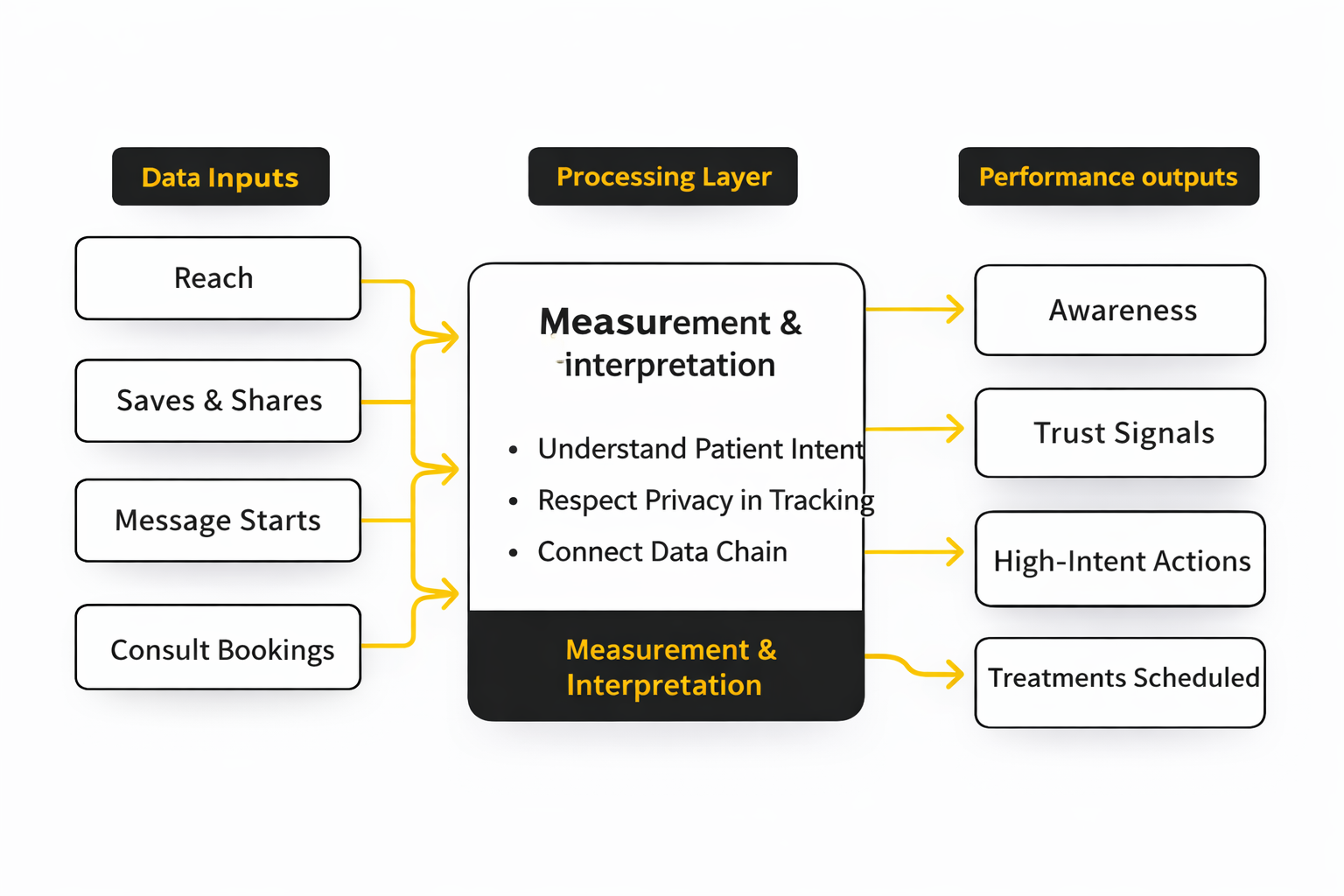
Data becomes useful when it answers patient-intent questions, not when it generates a prettier dashboard. In dental social media marketing, interpretation is about connecting platform signals to real-world behavior: “Does this content make someone feel confident enough to message us, book, and show up?”
Reach is awareness, not trust
Reach tells you how many people saw your content, but dentistry is a high-trust decision. A spike in reach without saves, shares, or messages is often just entertainment. If a Reel gets views but no DMs, the hook may be strong while the next step is unclear or emotionally unsafe.
Saves and shares are “future patient” signals
In dentistry, saves often indicate “I’m not ready yet, but I’m considering this.” Shares often mean “this answered a question someone I know is asking.” Educational posts that reduce anxiety commonly drive these behaviors, which matches clinical research showing that visual dental information on social platforms can influence provider selection.
Message starts are the closest thing to a consultation request
If you track only likes, you will miss the most valuable action. People message when they want clarity on price, suitability, pain, timing, or availability. That is why responsiveness matters so much, especially when nearly three-quarters of customers want a response within 24 hours.
Appointment bookings are the only metric that pays the rent
Marketing “wins” are not real until the schedule fills. If you run click-to-message ads, connect the chain: ad click, message start, qualified conversation, booked consult, attended consult, accepted treatment. Messaging flows are increasingly common because platforms explicitly support them, including Meta’s ads that click to WhatsApp.
Privacy and ethics are part of interpretation
In healthcare, measurement cannot ignore risk. Before you install tracking or optimize retargeting, review HHS guidance on online tracking technologies and align your patient content workflow with ADA guidance on dental social media policies. If analytics pushes you toward sensationalism or questionable targeting, the interpretation is already wrong.
Case Stories
Numbers become actionable when you see how a real organization used them to make decisions. The story below is not a highlight reel. It is a sequence of pressure, constraints, and choices that turned messaging and analytics into a scalable system.
Be@me: the day patient inquiries became unmanageable
The messages would not stop. Hundreds of patient inquiries were coming in, day after day, and every missed reply quietly turned into a lost booking. The team could feel the demand, but the workflow could not keep up.
Be@me is a global health technology dental services provider offering aligners, whitening, and general dentistry across multiple regions. They already used WhatsApp to communicate with patients, but their process was manual and dependent on staff availability. As volume grew, that manual approach became the bottleneck, not the marketing.
The wall was operational, not creative. Even when paid and organic traffic generated interest, the team had to manually track and reply to inquiries, and the workload scaled faster than headcount. Booking appointments should have been the easiest part of the journey, but it became the friction point.
The epiphany was that conversion was happening inside conversations, not on web forms. If the clinic could make those conversations faster, more consistent, and easier to route, then marketing performance would stabilize. Instead of “more ads,” the need was a better patient communication system.
They partnered with SleekFlow to redesign the WhatsApp experience and move to the WhatsApp Business Platform for automation and scalability. They also built a paid acquisition path using ads that click to WhatsApp with Advantage+ placements, sending patients directly into an automated chat where they could get FAQs answered, redeem promotions, schedule virtual consults, and book appointments. The clinic also added WhatsApp entry points to its Facebook page and website so organic interest flowed into the same system.
Then the final conflict showed up in a new form: success created more conversations, and the team had to maintain quality while scaling. Automation solved speed, but the clinic still had to protect the patient experience and ensure the handoff to humans was smooth for complex questions. Messaging systems are only “efficient” if they remain empathetic and clinically appropriate.
The dream outcome was measurable and operational. Over a full year of measurement (May 1, 2023 to April 30, 2024), the new approach delivered a 6X increase in appointment bookings, a 38% reduction in cost per lead, and a 4X increase in patient conversations. More importantly, the clinic turned dental social media marketing into a predictable pipeline rather than a daily scramble.
If you want a second example focused specifically on stabilizing paid lead costs, Teeth Talk Dental Clinic’s TikTok case study is a clean illustration of how controlled CPA targets and messaging can reduce volatility when auctions become unpredictable.
Professional Promotion
Promotion in dental social media marketing should feel like guidance, not pressure. The goal is to make the patient’s decision easier by reducing uncertainty, showing proof, and offering a clear next step that respects privacy and clinical ethics.
Promote outcomes, not hype
Patients respond to clarity: what changes, how long it takes, what it feels like, and what happens next. This is where carousels, short videos, and educational posts often outperform glossy ads, especially when visuals are used responsibly and with consent, aligned with ADA social media policy guidance.
Use messaging as the conversion bridge
Many dental services require reassurance before booking. Click-to-message formats reduce friction because the patient can ask the one question that is blocking them. Meta supports this directly through ads that click to WhatsApp, but the real advantage comes from your internal workflow: a fast response window, triage templates, and a clear booking handoff.
Keep targeting and claims compliant
Healthcare promotion has constraints that general marketers do not face. If you run paid campaigns, build your creative and targeting around platform policies such as Meta’s Health and Wellness standards, and make sure your measurement setup aligns with HHS guidance on online tracking technologies.
Let analytics decide what gets budget
A professional promotion plan is a simple loop: test one offer, measure the chain from message starts to bookings, then scale what works. If a post drives saves but not consults, it may be awareness content, not conversion content. If a campaign drives DMs but your team replies too slowly, the fix is operational, not creative.
When you treat dental social media marketing as a measurable patient journey—attention, trust, conversation, booking—you stop guessing. You start investing in the content and promotions that patients actually use to choose a clinic.
Future Trends
Dental social media marketing is moving toward a world where trust signals matter more than raw reach. Platforms are becoming noisier, patients are more skeptical, and local competition is more visible than ever. The practices that win will be the ones that pair great clinical work with clear communication, fast follow-up, and strong ethical guardrails.
AI search and the “zero-click” local decision
More patient decisions are being made inside search and map experiences before someone ever lands on a website. That puts pressure on your Google Business Profile, your review velocity, and the way patients talk about you online. Local research shows 71% of consumers use Google to find local business reviews, and a growing share now use social platforms like Instagram and TikTok for local review discovery too.
Messaging-first care journeys
Patients increasingly prefer asking one question in a message rather than filling a form and waiting. Click-to-message paths keep becoming more “native” inside ad products, including ads that click to WhatsApp. For dental practices, the operational implication is huge: response speed becomes part of marketing, not just front-desk etiquette.
Short-form video becomes the default proof format
Dental services are visual, and short videos compress trust-building into seconds. The shift is not just “make Reels,” it is “make proof easy to understand.” A simple, calm walkthrough of a treatment process often reduces anxiety more effectively than a polished brand ad.
Authenticity, verification, and deepfake risk
As AI-generated content spreads, audiences are learning to doubt what they see. Healthcare faces a specific threat: deepfakes and impersonations that misuse real clinicians’ likenesses. Recent reporting highlighted how AI deepfakes of real doctors have been used to spread health misinformation, which means your practice will increasingly need clear authenticity signals and a consistent voice patients can recognize.
Review integrity gets stricter
Dental social media marketing relies on social proof, but review manipulation is becoming riskier. The FTC’s guidance on endorsements, influencers, and reviews and its Consumer Reviews and Testimonials Rule are pushing brands toward cleaner, more transparent review practices. The safest long-term play is simple: earn reviews honestly, never gate them, and disclose relationships clearly when you collaborate.
Strategic Framework Recap

If you want dental social media marketing to produce consistent bookings without draining your team, the strategy has to feel like an ecosystem, not a posting schedule. Each part supports the next, and the whole system gets stronger as it runs.
- Visibility: show up in the places patients already scroll and search, with content that is easy to understand and easy to trust.
- Education: reduce fear and confusion with clear explanations, realistic expectations, and calm step-by-step guidance.
- Credibility: build proof ethically through consent-first visuals, patient stories, and transparent communication aligned with ADA social media policy guidance for dentists.
- Engagement: treat comments and DMs like the first conversation in the patient journey, not “extra work,” while respecting privacy boundaries.
- Conversion: make booking feel effortless with simple next steps, messaging-first pathways, and fast response habits.
- Measurement: track what leads to consults and treatment acceptance, and keep privacy in view by understanding HHS guidance on online tracking technologies when using analytics and retargeting.
When these pieces work together, dental social media marketing stops being a weekly scramble. It becomes a patient acquisition and retention system you can improve month after month.
FAQ – Built for the Dental Social Media Marketing Complete Guide
1) What should a dental clinic post most often?
Prioritize content that reduces uncertainty: procedure walk-throughs, “what to expect” explanations, preventative care tips, and consent-based patient transformations. The goal is to answer real patient questions in the same calm tone you would use chairside.
2) How often should we post for dental social media marketing to work?
Post as often as you can sustain without burnout. Three strong posts every week with reliable replies usually beats daily posting that collapses after two weeks. Consistency is the compounding advantage.
3) Which platforms matter most for a local dental practice?
Start where your patients already are: Instagram and Facebook tend to be strong for local trust and community, while TikTok can be powerful for education and reach. Reviews and local discovery matter too, and BrightLocal’s local research shows how heavily consumers rely on Google reviews when choosing local providers.
4) Can we post before-and-after photos?
Yes, but only with clear, written patient consent and a consistent internal process. The ADA’s guidance on social media policies for dentists is a practical reference point for building a consent-first workflow.
5) Is it safe to use tracking pixels and analytics on our website?
It depends on how your site is set up and what data is collected or shared. Review the considerations in HHS guidance on online tracking technologies before implementing pixels on pages tied to appointment intent.
6) How should we answer pricing questions in DMs?
Give a helpful range when appropriate, explain what drives cost (case complexity, materials, number of visits), and offer a clear next step like a consult. Avoid diagnosing or committing to final pricing in public threads.
7) Should we run ads or focus on organic first?
Build a basic organic foundation first so your clinic looks credible when someone checks your profile. Then use ads to accelerate the best-performing offers. Messaging-first ads can be effective, including click-to-WhatsApp formats, as long as your team can respond quickly.
8) What metrics matter most for dental social media marketing?
Track message starts, consultation requests, bookings, and show rates. Engagement (saves, shares) is useful, but only as a leading indicator of trust. If you are not connecting content to booked consults, you are measuring popularity, not growth.
9) What is the safest way to get more reviews without breaking rules?
Ask every patient consistently, make it easy, and never pressure or incentivize in ways that distort authenticity. Review integrity is increasingly regulated, and the FTC’s resources on endorsements and reviews are worth understanding before running any review campaign.
10) How do we promote services without sounding pushy?
Lead with education, show proof responsibly, and frame booking as a helpful next step. Patients want clarity more than hype, especially for procedures that trigger anxiety.
11) Do dentists need to be on camera for this to work?
It helps, but it is not mandatory. Team faces build trust faster, yet you can also succeed with voice-over explanations, animations, and simple “hands-only” demonstrations. The key is consistency and clarity.
12) How should we handle negative comments or complaints publicly?
Respond calmly, acknowledge the concern, and move the conversation into private channels. Avoid discussing patient details publicly. The goal is to protect privacy while showing the audience you are respectful and responsive.
Work With Professionals
If you are building dental social media marketing for clients as a freelancer, you already know the hardest part is not running campaigns. It is keeping a stable pipeline of good-fit businesses who actually value your work and pay on time.
That is why marketplaces designed specifically for marketing work can be a shortcut. MARKEWORK positions itself as a marketing marketplace to hire talent or land your next gig, built around direct communication instead of middleman friction.
Here is what makes it feel different when you are trying to grow a freelance career without losing weeks to back-and-forth and platform fees. The platform highlights no commissions and no project fees, which means you negotiate directly and keep what you earn. It also emphasizes direct communication and faster matching, so you can move from application to conversation without extra gates.
And if you are tired of hunting for one-off gigs, the promise that matters is momentum. MARKEWORK’s plans include access to thousands of job listings, which is exactly what you want when your goal is a steady stream of remote contracts you can choose from, not a single lucky win.
If you are ready to stop relying on unpredictable referrals and start building a consistent client pipeline, explore the marketplace here:
 Filip Konecny Enterprises