

A social media strategy is no longer optional for businesses, creators, or brands that want predictable growth. Without a defined strategy, social media becomes reactive, inconsistent, and difficult to measure. With a clear plan, every post, comment, and campaign contributes to specific business outcomes such as brand awareness, customer acquisition, and long-term loyalty.
Consider a small fitness coach who posted random workout tips for months with minimal engagement. After implementing a structured social media strategy focused on audience pain points, consistent posting themes, and measurable goals, their follower base doubled within six months, and direct client inquiries increased significantly. The difference was not luck or frequency. It was strategy.
Modern platforms reward intentional content. Over 5 billion people actively use social media worldwide, creating unprecedented opportunity. However, competition is equally intense. A social media strategy provides clarity, efficiency, and direction in an environment where attention is limited and algorithms prioritize relevance.
Article Outline
- Definition and purpose of a social media strategy
- Reasons why strategy determines long-term success
- Overview of the professional strategic framework
- Core components that create effective execution
- How professionals implement strategy for predictable growth
What Is Social Media Strategy

A social media strategy is a structured plan that defines how an individual or organization uses social platforms to achieve specific goals. It connects business objectives with content creation, audience targeting, platform selection, and performance measurement.
Instead of posting randomly, a social media strategy answers essential questions:
- Who is the target audience
- What goals should social media achieve
- Which platforms provide the best opportunities
- What type of content delivers the highest impact
- How success will be measured and optimized
For example, an e-commerce brand focused on sustainable clothing may use educational content to build trust, behind-the-scenes videos to demonstrate authenticity, and product showcases to drive conversions. Every content type serves a defined role within the strategy.
This structured approach transforms social media from a time-consuming activity into a predictable growth system.
Why Social Media Strategy Matters
A social media strategy creates alignment between effort and results. Without it, businesses often invest time and resources without understanding what works or why.
Platforms reward consistency and relevance. Research from social media engagement benchmarks showing consistent brands outperform inconsistent ones demonstrates that strategic posting improves reach, engagement, and conversion potential.
There are several critical reasons strategy matters:
- Clarity: Defines purpose and eliminates guesswork
- Efficiency: Focuses effort on high-impact activities
- Consistency: Builds recognizable brand identity
- Measurability: Enables data-driven improvement
- Scalability: Supports long-term sustainable growth
For example, a technology startup that shifted from promotional posts to educational content addressing customer challenges saw significantly higher engagement and website traffic. Their strategy positioned them as a trusted authority rather than just another seller.
Strategy ensures every action contributes to a broader objective rather than isolated short-term results.
Framework Overview
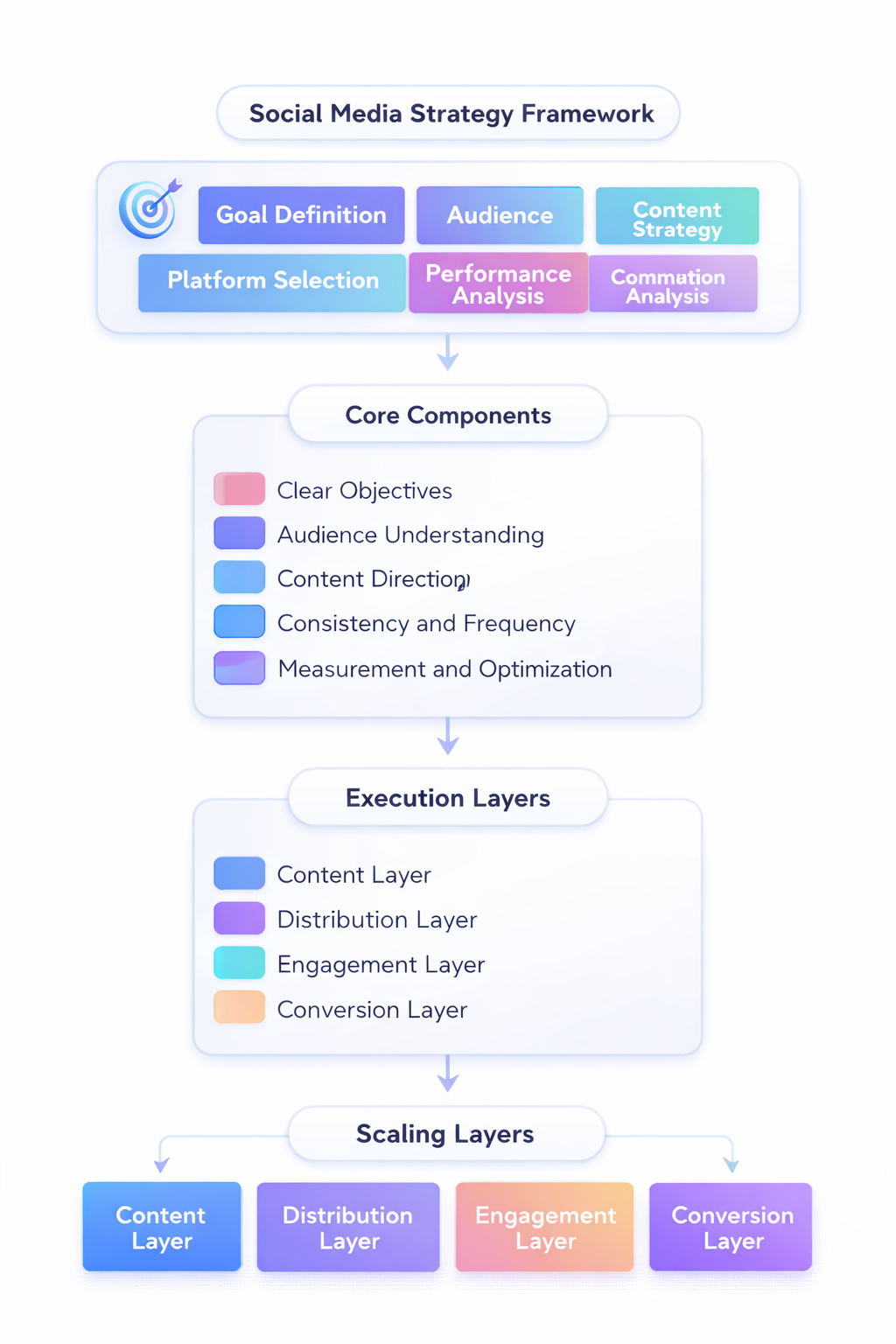
A professional social media strategy follows a structured framework that connects goals, audience insights, content planning, execution, and analysis.
The framework typically includes five interconnected layers:
- Goal definition to establish measurable objectives
- Audience analysis to understand motivations and behavior
- Content strategy to deliver relevant and valuable information
- Platform selection to focus on high-impact channels
- Performance analysis to optimize and refine results
This framework creates a feedback loop. Insights from analytics improve future content decisions, increasing effectiveness over time.
A real estate agent who implemented this framework identified that video tours generated significantly more engagement than static images. By prioritizing video content, their reach expanded rapidly, leading to more qualified client inquiries.
Framework-based strategies replace assumptions with structured improvement.
Core Components
Every effective social media strategy contains essential components that ensure consistent and measurable execution.
Clear Objectives
Objectives define the purpose of social media activity. These may include brand awareness, lead generation, sales, or community building. Clear objectives guide all strategic decisions.
Audience Understanding
Knowing the audience enables creation of relevant and engaging content. This includes understanding demographics, interests, challenges, and motivations.
Content Direction
Content should provide value, solve problems, educate, entertain, or inspire. Strategic content builds trust and strengthens relationships.
Consistency and Frequency
Regular posting improves visibility and algorithm performance. Consistency builds familiarity and audience expectations.
Measurement and Optimization
Tracking performance metrics such as reach, engagement, and conversions enables continuous improvement.
A local restaurant that analyzed engagement metrics discovered their audience preferred behind-the-scenes kitchen content. By increasing this content type, engagement increased significantly, strengthening customer loyalty.
Core components ensure strategy translates into practical, effective action.
Professional Implementation
Professional implementation transforms strategic planning into operational systems that produce reliable results.
This involves structured workflows, defined content calendars, and performance tracking systems. Instead of deciding daily what to post, professionals plan content in advance based on strategic priorities.
For example, a software company implemented a monthly content calendar aligned with product education, customer success stories, and industry insights. This structure improved consistency and strengthened their authority in the market.
Professional implementation also includes:
- Content planning aligned with business goals
- Platform-specific optimization
- Consistent visual and messaging identity
- Regular performance review and adjustments
- Long-term strategic refinement
This systematic approach allows social media to function as a reliable growth engine rather than an unpredictable experiment.
When implemented correctly, a social media strategy creates clarity, consistency, and measurable progress. It transforms social platforms from passive communication tools into active drivers of business success and audience growth.
Step By Step Implementation
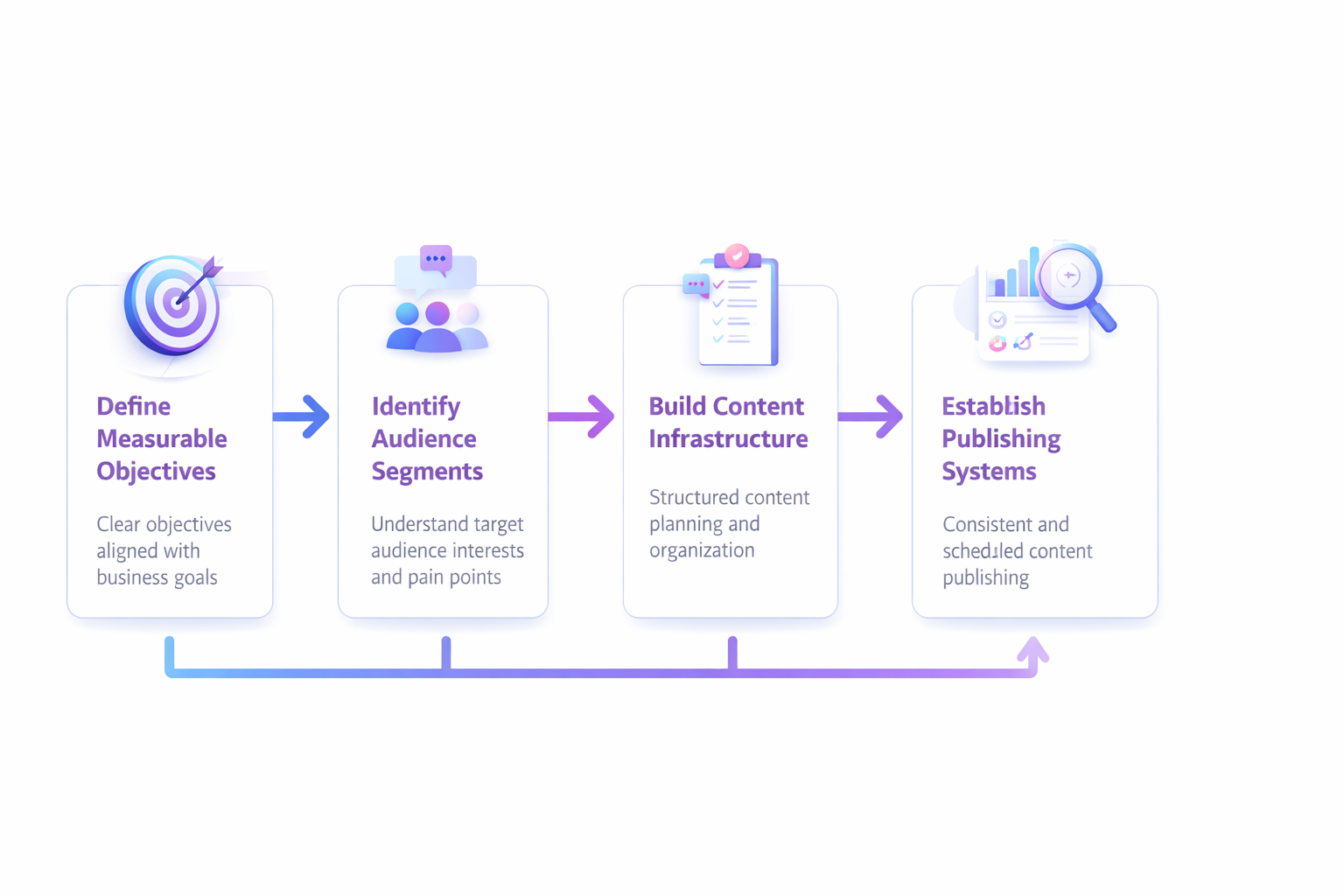
Executing a social media strategy requires a structured sequence of actions that transform planning into measurable growth. Businesses that follow documented marketing processes are 313% more likely to report success, because structured implementation eliminates inconsistency.
A SaaS founder named Daniel experienced this shift when he transitioned from casual posting to systematic implementation. Previously, his social media efforts produced unpredictable engagement. After implementing defined steps, his reach increased steadily and lead flow became consistent.
Step 1: Define Measurable Objectives
Clear goals create direction. Teams with documented goals achieve 2.4× higher performance outcomes compared to those without defined objectives.
Daniel defined three goals: increase brand visibility, generate inbound leads, and establish authority. This clarity allowed him to align content with measurable outcomes.
Step 2: Identify Audience Segments
Precise audience targeting improves efficiency. Personalized campaigns improve conversion rates by up to 40%, because relevant content resonates more deeply.
Daniel analyzed customer conversations and identified startup founders as his primary audience. This allowed him to tailor content specifically to their needs.
Step 3: Build Content Infrastructure
Structured content planning ensures consistency. Companies publishing consistently generate 67% more leads than inconsistent publishers.
Daniel created content categories including educational insights, case studies, and strategic analysis. This structure simplified content creation and improved relevance.
Step 4: Establish Publishing Systems
Publishing systems ensure consistent execution. Consistent brands see up to 33% higher revenue growth, because audiences trust reliable communication.
Daniel implemented scheduled publishing, ensuring regular visibility without daily decision fatigue.
Step 5: Measure and Improve
Measurement transforms activity into optimization. Data-driven marketing improves efficiency by 15–20%, enabling continuous improvement.
Daniel tracked engagement, reach, and conversions, refining his content based on performance patterns.
This step-by-step implementation transformed his social media strategy into a predictable growth system.
Execution Layers
Effective social media strategy operates across multiple execution layers. Each layer contributes to overall performance and scalability.
Content Layer
This layer focuses on creating valuable content aligned with audience needs. High-quality content improves engagement significantly, with educational content generating up to 3× more engagement than purely promotional posts.
A marketing consultant named Eva built authority by sharing detailed strategic breakdowns. Her content attracted high-quality clients because it demonstrated expertise.
Distribution Layer
Distribution ensures content reaches the intended audience. Optimized distribution improves visibility dramatically, as organic reach depends on timing, relevance, and consistency.
Eva used scheduling tools and strategic timing to maximize visibility, improving reach without increasing content volume.
Engagement Layer
Engagement strengthens relationships. Brands that actively engage with audiences experience 20–40% higher customer loyalty.
Eva responded to comments, participated in conversations, and built relationships that converted followers into clients.
Conversion Layer
This layer transforms audience attention into business results. Companies optimizing conversion pathways improve conversion rates by up to 50%.
Eva aligned her content with clear calls-to-action, directing prospects toward consultations.
Scaling Layer
Scaling ensures sustainable growth. Businesses using structured scaling processes grow significantly faster than those relying on manual execution.
Eva expanded her content strategy, increasing output while maintaining quality.
Optimization Process
Optimization transforms initial implementation into continuous performance improvement. Companies that optimize continuously achieve 30% higher long-term growth.
Performance Analysis
Analyzing performance identifies successful content patterns. High-performing companies rely heavily on analytics to guide decision-making.
A startup founder named Pavel discovered that storytelling posts generated significantly higher engagement. He prioritized this format, improving overall performance.
Content Refinement
Refinement improves effectiveness over time. Content optimization improves engagement rates by up to 72%, because improved relevance increases audience response.
Pavel refined his messaging to focus on customer transformation stories.
Strategic Adjustment
Strategy evolves based on performance insights. Organizations that adapt strategies based on data outperform static competitors significantly.
Pavel continuously adjusted his strategy based on performance metrics.
System Expansion
Expansion enables scalability. Businesses using scalable systems achieve higher growth efficiency.
Pavel expanded his content production using structured workflows.
Implementation Stories
Real-world implementation demonstrates how structured social media strategy produces measurable results.
A consulting firm struggled to generate inbound leads. Their social media activity lacked consistency and focus. After implementing structured publishing, analytics tracking, and audience targeting, they experienced steady growth in qualified leads.
This aligns with principles explained in this B2B social media marketing strategy breakdown, where structured execution improves lead generation efficiency.
Another example involves an e-commerce founder named Jana. She initially focused only on product promotion, resulting in limited engagement. After shifting to educational and storytelling content, her audience engagement increased significantly.
This reflects strategic positioning approaches outlined in this content marketing strategy framework guide, where value-driven content strengthens audience trust.
Companies that prioritize educational content generate 3× more leads per dollar spent, demonstrating the effectiveness of strategic content.
A SaaS company implemented structured workflows integrating planning, execution, and analytics. Within months, their organic reach and inbound leads increased consistently.
This implementation demonstrates how structured execution transforms social media strategy into a predictable growth channel.
Statistics And Data
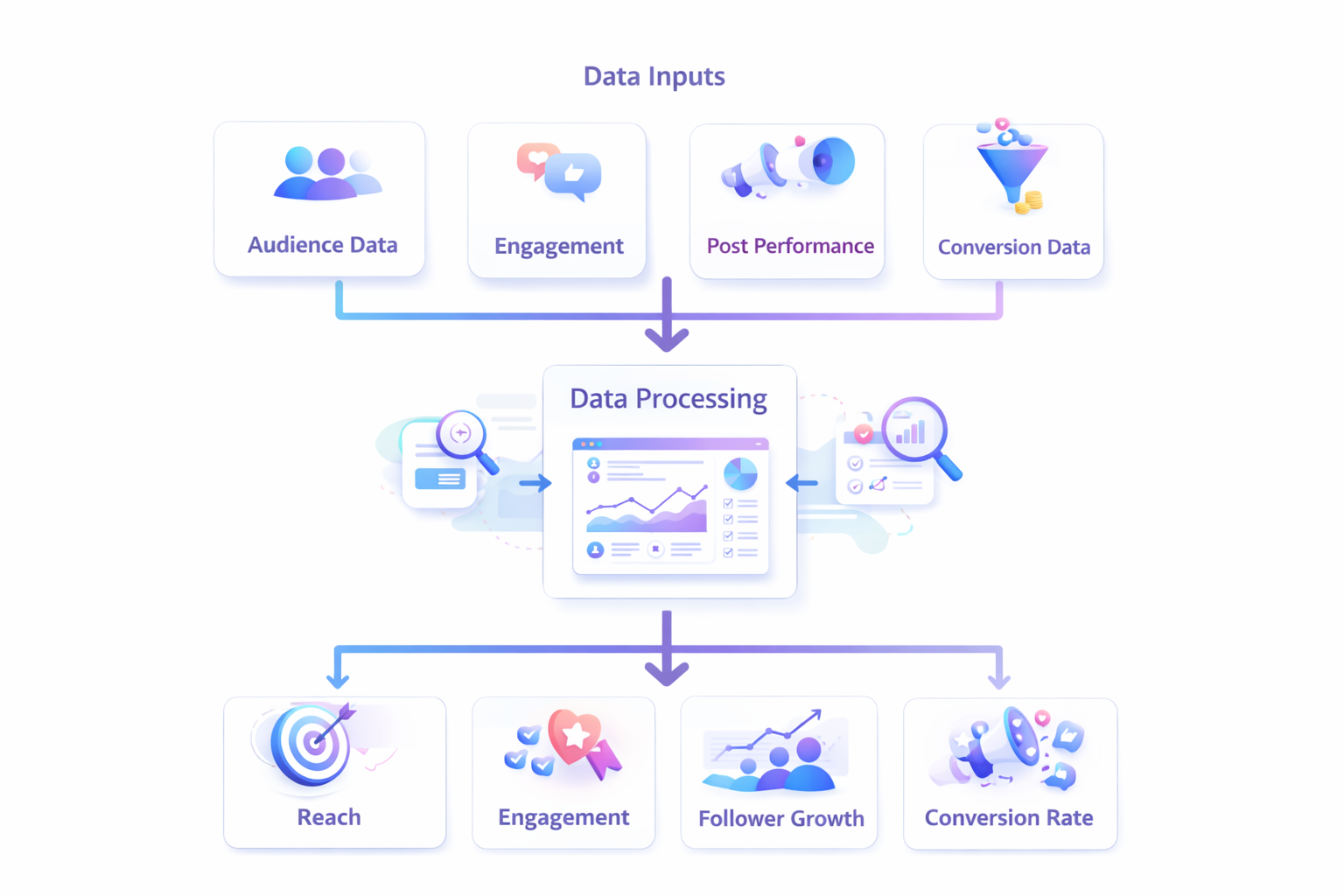
Data transforms a social media strategy from intuition into a measurable growth system. Businesses that rely on analytics outperform competitors because they base decisions on evidence rather than assumptions. Marketing teams using data-driven insights are 23× more likely to acquire customers and significantly more likely to scale efficiently.
The scale of social media opportunity is massive. Over 5.04 billion people actively use social media globally, creating an environment where precise targeting can reach highly specific audiences.
Engagement directly impacts visibility. Content that generates strong engagement is prioritized by algorithms, which explains why posts with higher engagement receive up to 5× more reach compared to low-engagement posts.
A SaaS founder named Robert discovered this when analyzing his content metrics. His educational posts generated significantly higher engagement and reach compared to promotional posts. By shifting his focus toward value-driven content, his visibility increased consistently.
Video content has become especially powerful. Video generates 48% higher engagement rates compared to static formats, making it essential for modern social media strategy.
Consistency also plays a measurable role. Brands publishing consistently experience 67% more monthly leads than those publishing irregularly.
Analytics provide visibility into:
- Audience growth trends
- Content engagement performance
- Conversion efficiency
- Audience behavior patterns
- Optimization opportunities
Organizations using structured analytics improve marketing efficiency by 14.5% while reducing overhead by 12.2%, reinforcing the importance of measurement.
Performance Benchmarks
Benchmarks provide context for evaluating performance. Without benchmarks, metrics lack meaning. High-performing brands consistently outperform average benchmarks across engagement, reach, and conversion metrics.
For example, average engagement rates vary significantly by content type. Educational content generates 3× higher engagement than purely promotional content.
A marketing consultant named Petra compared her performance to industry benchmarks and realized her engagement rates were below average. She improved her content quality and relevance, resulting in measurable performance improvement.
Benchmark tracking enables:
- Identification of underperforming areas
- Validation of successful content strategies
- Strategic performance comparisons
- Continuous improvement tracking
Companies that actively benchmark performance achieve 20–30% higher marketing efficiency because they identify and replicate successful patterns.
Conversion benchmarks also matter. Businesses optimizing conversion pathways improve results by up to 50%, demonstrating the importance of conversion-focused analytics.
Analytics Interpretation
Collecting data is only the first step. Interpretation transforms raw metrics into strategic decisions. Teams that interpret analytics effectively improve performance significantly.
A founder named Michal reviewed his analytics and discovered that posts published in the morning generated higher engagement than evening posts. By adjusting his publishing schedule, he increased overall engagement.
Key metrics to interpret include:
- Reach: Measures visibility and distribution effectiveness
- Engagement: Indicates audience interest and content relevance
- Follower growth: Reflects long-term audience expansion
- Click-through rate: Shows effectiveness of calls-to-action
- Conversion rate: Measures business impact
Organizations that actively interpret analytics improve campaign performance by up to 39%, because insights enable precise optimization.
Content optimization based on analytics improves engagement by 72%, reinforcing the importance of continuous improvement.
Analytics interpretation ensures that a social media strategy evolves based on real performance data.
Case Stories
Real-world implementation demonstrates the transformative power of analytics-driven strategy.
An e-commerce founder named Lenka analyzed her analytics and discovered that tutorial content generated significantly higher engagement and conversions than promotional posts. By shifting her content focus, her revenue increased steadily.
This aligns with strategic approaches explained in this social media content strategy framework, where educational content strengthens audience trust and conversion efficiency.
Another example involves a consulting firm that struggled with audience growth. Analytics revealed that posts targeting specific audience challenges performed better than general industry commentary. After refining their targeting, audience growth accelerated.
This reflects audience-focused strategy principles outlined in this social media audience targeting guide, where precise targeting improves engagement.
Businesses using advanced analytics improve customer retention by 25–95%, demonstrating the long-term impact of data-driven strategy.
A SaaS company integrated analytics into its content workflow and identified high-performing formats. By scaling those formats, they improved engagement and lead generation.
Analytics transformed their social media strategy into a predictable acquisition channel.
Professional Promotion
Analytics-driven promotion enables precise targeting, ensuring content reaches the most relevant audiences. Businesses using targeted promotion improve campaign effectiveness by up to 50%.
A startup founder named Tomas used analytics to identify high-performing content. He promoted only proven content, maximizing return on investment while minimizing costs.
Professional promotion includes:
- Identifying high-performing content
- Scaling proven formats
- Targeting specific audience segments
- Optimizing based on performance data
- Continuously refining campaigns
Businesses optimizing campaigns using analytics achieve significantly higher campaign visibility and engagement, reinforcing the value of data-driven promotion.
When supported by analytics, a social media strategy evolves into a precise, scalable system capable of delivering predictable and measurable business growth.
Future Trends
The evolution of social media strategy is accelerating as platforms, algorithms, and user behavior continue to change. Businesses that adapt early gain disproportionate advantages. AI-driven personalization alone improves marketing efficiency by 10–30% in revenue growth, demonstrating how technology is reshaping strategy execution.
A SaaS founder named Andrej experienced this shift firsthand. He integrated AI-assisted analytics into his workflow and discovered micro-patterns in audience engagement that were previously invisible. This allowed him to optimize content with precision, increasing both engagement and inbound leads.
Several trends are defining the future of social media strategy:
- AI-powered content optimization improving performance prediction and targeting accuracy
- Short-form video dominance, with video influencing over 70% of buying decisions
- Personal brand-driven growth, where individual creators outperform corporate accounts in engagement
- Community-driven ecosystems, strengthening loyalty and retention
- Integrated multi-channel ecosystems, improving conversion efficiency
Community-driven brands increase customer retention significantly, with retention improvements of 25–95%, making audience relationships a primary growth driver.
This trend aligns with authority-building approaches explained in this personal branding strategy guide, where trust becomes a scalable competitive advantage.
Businesses that align their social media strategy with emerging trends position themselves for long-term dominance rather than short-term visibility.
Strategic Framework Recap
The complete social media strategy framework operates as an interconnected ecosystem. Each component reinforces the others, creating a scalable and sustainable growth system.
A consulting agency founder named Martina implemented the full framework: structured planning, tool integration, execution workflows, analytics optimization, and scaling systems. Within a year, her agency generated consistent inbound leads and expanded its client base.
This integrated ecosystem includes:
- Clear strategic goals aligned with business outcomes
- Structured content planning and execution workflows
- Integrated analytics and optimization systems
- Scalable content production and distribution
- Continuous improvement based on performance insights
Organizations implementing structured marketing ecosystems improve revenue performance by 30% or more over time, demonstrating the long-term impact of structured strategy.
This ecosystem approach reflects scalable frameworks explained in this digital marketing strategy breakdown, where integrated systems deliver predictable growth.
FAQ – Built For Social Media Strategy Complete Guide
What is the primary purpose of a social media strategy?
The primary purpose is to align social media activity with measurable business objectives such as audience growth, lead generation, and revenue. Structured strategies improve marketing performance by 14.5% on average.
How long does it take to see results?
Most businesses begin seeing measurable engagement and audience growth within three to six months of consistent implementation. Long-term success compounds as audience trust and authority increase.
Which platform is best for social media strategy?
The best platform depends on audience behavior. Businesses aligning platform selection with audience preferences improve reach efficiency significantly, as explained in this platform selection guide.
How often should content be published?
Consistency matters more than frequency. Brands publishing consistently generate 67% more leads than inconsistent publishers.
What type of content performs best?
Educational and value-driven content consistently generates higher engagement and conversion rates compared to purely promotional content.
Is social media strategy effective for small businesses?
Yes. Small businesses implementing structured social media strategy improve customer acquisition efficiency and build sustainable growth channels.
How important is analytics?
Analytics enables continuous optimization. Businesses using analytics effectively improve performance significantly, making data interpretation essential for long-term success.
Can social media generate direct revenue?
Yes. Many businesses generate direct revenue through social media-driven customer acquisition, particularly when strategy aligns with conversion pathways.
Should businesses invest in automation tools?
Automation improves efficiency and scalability, allowing businesses to focus on strategic growth rather than manual execution.
What is the biggest mistake in social media strategy?
The biggest mistake is inconsistency and lack of strategic direction. Structured strategies ensure predictable growth and measurable results.
How does social media strategy support long-term growth?
It builds authority, trust, and audience relationships, creating sustainable acquisition channels that continue delivering value over time.
Work With Professionals
Many freelancers, consultants, and service providers understand the importance of social media strategy but struggle to translate visibility into consistent client acquisition. The challenge is not just building an audience, but turning attention into real business opportunities.
A freelance consultant named Tomas built a strong online presence but struggled to convert his audience into clients. After positioning himself on platforms designed to connect professionals with businesses actively seeking services, he began receiving qualified inbound opportunities regularly.
Freelancers who position themselves strategically increase their client acquisition efficiency dramatically, especially when they are visible where businesses actively search for talent.
Platforms designed specifically for professional visibility and client acquisition provide freelancers with access to new opportunities, allowing them to turn their social media strategy into measurable income growth.
If you want to transform your visibility into real client opportunities, expand your reach, and position yourself where businesses actively search for freelancers, the next step is to establish your professional presence on a platform built for growth.
 Filip Konecny Enterprises