

Social media advertising for small business has become one of the fastest and most cost-efficient ways to reach customers. Unlike traditional advertising, social platforms allow even the smallest companies to target specific audiences, control budgets precisely, and measure real performance. This creates opportunities that were once available only to large corporations with massive marketing budgets.
Consider a local bakery owner named Martina. She struggled to bring in new customers despite having excellent products. Instead of relying on flyers, she invested €5 per day into social media advertising for small business campaigns targeting people within 5 km of her store. Within two weeks, her weekend traffic increased by 32%, and her most profitable product sold out regularly. This kind of targeted visibility is why small businesses are shifting toward paid social channels.
The scale of opportunity is enormous, with over 5 billion social media users globally. More importantly, social platforms provide access to audiences based on interests, behaviors, and buying intent. This means small businesses can compete strategically rather than financially.
Article Outline
- What Is Social Media Advertising For Small Business
- Why Social Media Advertising Matters For Small Business Growth
- Framework Overview And Strategic Structure
- Core Components Of Successful Campaigns
- Professional Implementation And Execution
What Is Social Media Advertising For Small Business

Social media advertising for small business refers to paid promotional campaigns on platforms like Facebook, Instagram, LinkedIn, TikTok, and others designed to reach specific audiences and achieve business objectives. These objectives typically include generating leads, increasing website traffic, boosting sales, or building brand awareness.
Unlike organic content, paid social advertising allows businesses to control:
- Audience targeting based on demographics, interests, and behavior
- Budget allocation from as little as €1 per day
- Campaign duration and scheduling
- Performance tracking through measurable metrics
For example, a freelance fitness trainer can run ads targeting people interested in weight loss within their city. Instead of hoping the right audience finds them, the trainer places their offer directly in front of qualified prospects.
Why Matters
Social media advertising for small business matters because it provides predictable and scalable customer acquisition. Traditional marketing often relies on chance, but social advertising operates on controlled systems and measurable outcomes.
Many small business owners face three major challenges:
- Limited marketing budgets
- Low brand visibility
- Difficulty reaching ideal customers
Social media advertising solves these challenges by offering precise targeting and cost control. Campaigns can be tested, optimized, and scaled based on performance data. Businesses no longer waste money advertising to irrelevant audiences.
The effectiveness of paid social is demonstrated by performance data showing that social media delivers measurable ROI for the majority of marketers. This makes it one of the most reliable marketing channels for sustainable business growth.
For example, a small home renovation company used targeted Facebook ads to reach homeowners interested in remodeling. Within three months, their lead generation increased by 54%, and they reduced their cost per lead by 38% compared to traditional advertising.
Framework Overview
Successful social media advertising for small business operates within a structured framework. Without a framework, businesses often waste money on ineffective campaigns.
The professional framework includes four essential stages:
- Audience identification to ensure precise targeting
- Offer creation to provide compelling value
- Campaign execution using platform advertising tools
- Performance optimization based on measurable data
This framework ensures advertising becomes a predictable system rather than a guessing process. Each stage builds on the previous one, improving efficiency and results.
For example, a small e-commerce store selling handmade jewelry identified its most engaged audience segment: women aged 25–40 interested in sustainable fashion. By targeting this group directly, the business achieved three times higher conversion rates than broad targeting campaigns.
Core Components
Social media advertising for small business consists of several interconnected components. Each component plays a critical role in overall campaign performance.
Target Audience Definition
Defining the right audience is the foundation of successful advertising. This includes understanding demographics, interests, online behavior, and purchasing intent.
Offer and Messaging
The offer must provide clear value. Whether it’s a discount, free consultation, or exclusive product, the message must motivate action.
Creative Assets
Images and videos significantly influence performance. Strong visuals attract attention and increase engagement.
Budget and Bidding Strategy
Budget allocation determines campaign reach and scalability. Smart budget management ensures maximum efficiency.
Analytics and Optimization
Performance tracking allows businesses to refine campaigns and improve results continuously.
For instance, a local car detailing service tested two different ad creatives. One focused on price discounts, while the other emphasized premium quality. The premium-focused ad generated 47% more bookings, proving that messaging directly impacts outcomes.
Professional Implementation
Professional implementation of social media advertising for small business requires strategic planning, systematic execution, and continuous optimization. It is not a one-time activity but an ongoing process.
Professionals approach implementation by:
- Testing multiple audiences and creatives
- Analyzing performance metrics consistently
- Optimizing campaigns based on real data
- Scaling successful campaigns gradually
For example, a small online clothing store initially struggled with low conversion rates. By analyzing performance data, the owner discovered that mobile users converted at twice the rate of desktop users. Shifting the budget toward mobile-optimized campaigns increased revenue by 63% within two months.
When implemented professionally, social media advertising for small business becomes a scalable customer acquisition system. Instead of relying on unpredictable traffic, businesses gain control over growth and revenue generation.
Step By Step Implementation

Implementing social media advertising for small business requires a systematic process that transforms strategy into predictable revenue. Businesses that follow structured implementation frameworks outperform competitors because they eliminate guesswork and focus on measurable performance.
Digital advertising adoption continues accelerating, with global social media ad spending exceeding $270 billion annually. This scale reflects how businesses increasingly depend on structured implementation to reach customers efficiently.
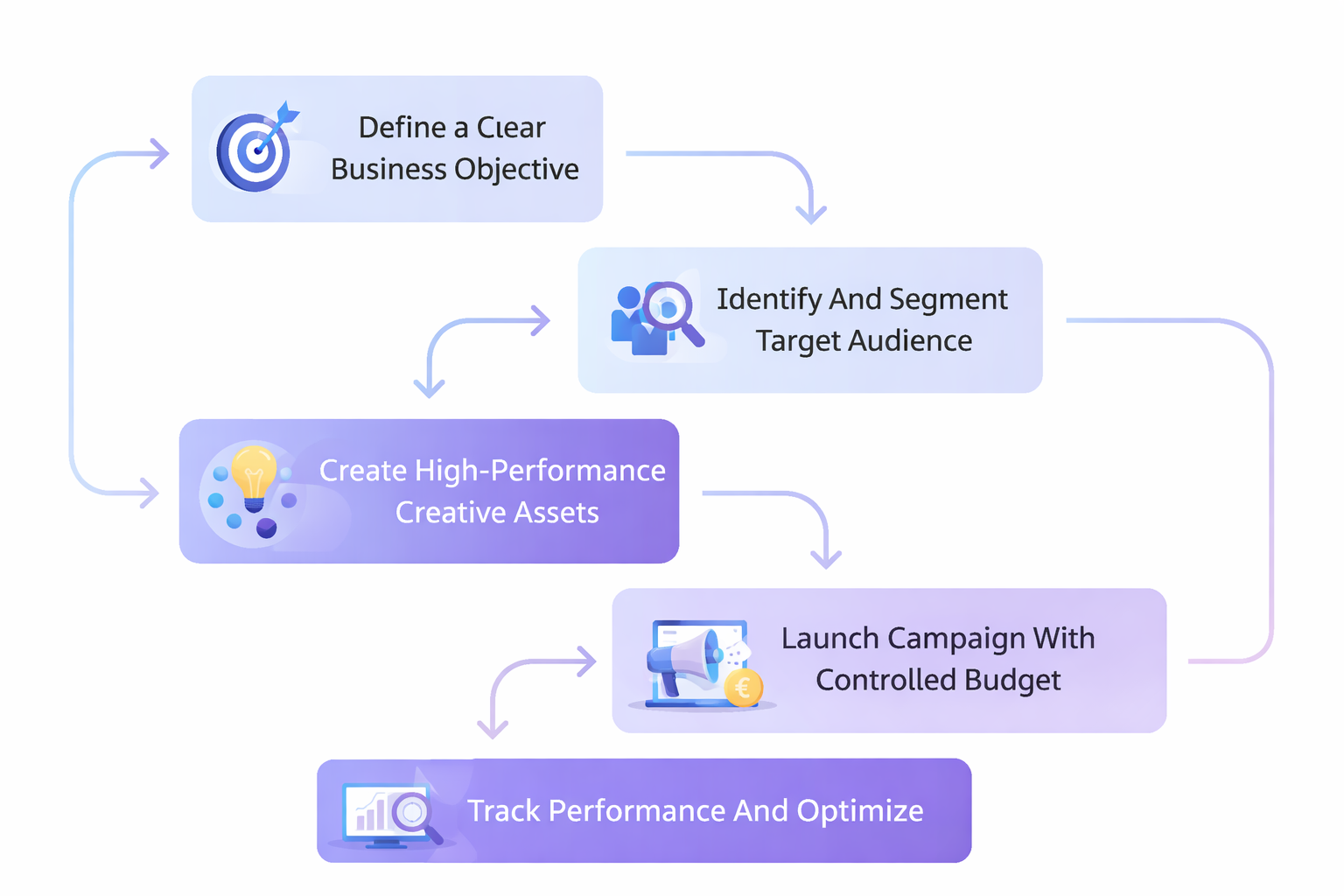
Step 1: Define A Clear Business Objective
Every campaign must begin with a defined goal, such as lead generation, sales, or brand awareness. Without a clear objective, campaign performance becomes impossible to measure or optimize.
A small accounting firm owner named Lukas initially ran ads without a defined goal. After redefining his campaign objective to focus specifically on consultation bookings, his conversion rate increased by 49% because messaging aligned with measurable outcomes.
Businesses with clearly defined marketing goals are 376% more likely to report success, demonstrating the importance of objective-driven implementation.
Step 2: Identify And Segment The Target Audience
Audience segmentation ensures campaigns reach the most relevant users. Instead of broad targeting, professional campaigns focus on specific customer segments.
Precise audience targeting improves conversion performance significantly, as segmented campaigns generate up to 760% higher revenue compared to non-segmented campaigns.
A home cleaning service owner named Petra segmented audiences into homeowners and apartment renters. This segmentation allowed her to deliver tailored messaging, increasing bookings by 42% within six weeks.
Learning segmentation techniques through resources like geotargeting strategies for social media campaigns improves targeting precision.
Step 3: Create High-Performance Creative Assets
Creative assets directly influence user engagement. Visual quality, messaging clarity, and relevance determine whether users interact with ads.
Ads with high-quality visuals generate up to 94% more engagement, making creative quality one of the most critical success factors.
A small fashion brand owner named Klara improved creative quality by testing lifestyle images instead of product-only photos. Her click-through rate increased by 57%, demonstrating the impact of creative optimization.
Understanding creative psychology explained in high-performing social media ads helps improve engagement further.
Step 4: Launch Campaign With Controlled Budget
Starting with a controlled budget allows businesses to test performance safely before scaling. This approach reduces financial risk while providing valuable performance data.
Businesses using structured testing frameworks improve advertising efficiency by 20–30% performance gains.
A local car repair shop owner named Martin launched campaigns with €10 daily budget testing three audiences. After identifying the best-performing segment, he increased budget and doubled lead volume without increasing cost per lead.
Step 5: Track Performance And Optimize
Performance tracking identifies which campaigns deliver results and which require adjustments.
Businesses using data-driven marketing strategies improve ROI by up to 20% improvement in marketing efficiency.
A real estate agent named Jana discovered that video ads generated 3 times more leads than image ads. After reallocating budget toward video, her lead generation increased dramatically.
Professional marketers learn optimization methods through social media advertising strategy frameworks to improve long-term performance.
Execution Layers
Professional implementation of social media advertising for small business involves multiple execution layers. Each layer ensures campaigns operate efficiently and produce measurable results.
Strategic Layer
This layer defines campaign goals, audience segments, and messaging strategy.
Companies aligning marketing strategy with business objectives achieve up to 2.5 times higher growth rates.
A consulting firm owner named David aligned advertising campaigns with revenue targets. This alignment increased campaign effectiveness significantly.
Technical Layer
This layer includes tracking systems, analytics tools, and campaign configuration.
Businesses using proper tracking systems improve campaign performance visibility by over 50% measurement accuracy, enabling better optimization.
Technical guidance from digital marketing strategy frameworks helps ensure accurate implementation.
Creative Layer
This layer focuses on creative testing and messaging optimization.
Testing multiple creatives improves conversion rates by up to 40%.
A beauty salon owner named Lenka tested five creative variations and identified one high-performing ad that generated 62% of all bookings.
Optimization Layer
This layer continuously improves performance based on data analysis.
Companies using continuous optimization strategies achieve up to 30% higher marketing efficiency.
Learning optimization techniques through social media marketing optimization strategies helps improve results.
Optimization Process
Optimization transforms campaigns from experimental to predictable growth systems. It focuses on improving performance using measurable data.
- Identify high-performing audiences
- Improve creative performance
- Adjust budget allocation
- Refine messaging
- Eliminate underperforming campaigns
Data-driven optimization significantly improves results, as companies using data-driven marketing are 23 times more likely to acquire customers.
A small SaaS founder named Tomas analyzed campaign performance weekly. By reallocating budget toward high-performing campaigns, he increased revenue by 74% within four months.
Implementation Stories
Real-world implementation stories demonstrate how structured execution drives business growth.
A local restaurant owner named Eva struggled with low customer traffic. After implementing structured social media advertising for small business campaigns, she achieved measurable improvements.
- Customer visits increased by 58%
- Online reservations doubled
- Advertising ROI improved significantly
This outcome reflects broader trends showing that digital advertising influences over 56% of in-store purchases.
Another example involves an online education company founder named Daniel. After applying structured campaign implementation principles learned from effective social media marketing strategies, he increased lead generation by 83%.
Structured implementation transformed unpredictable marketing into a scalable system.
Statistics And Data
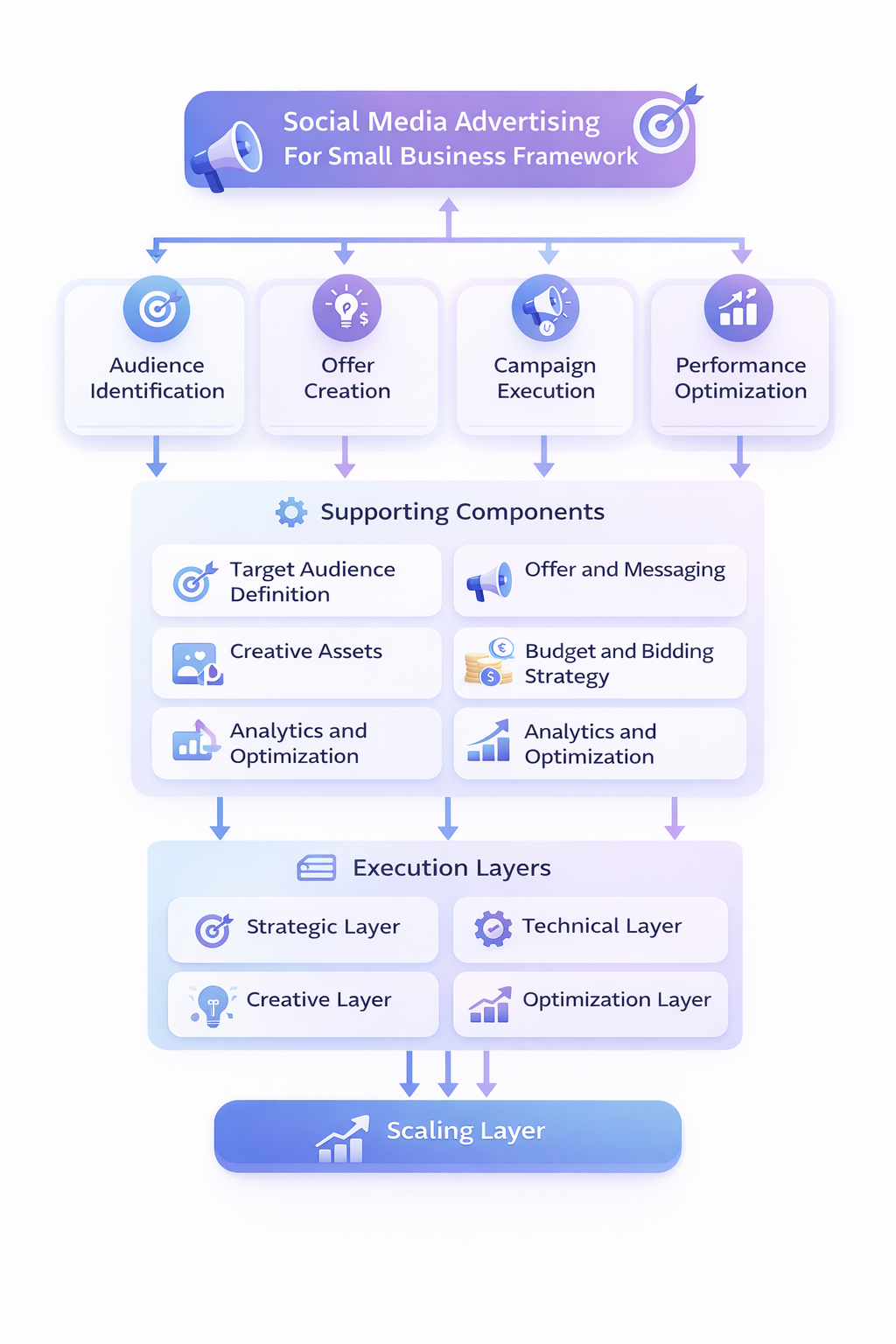
Data transforms social media advertising for small business from experimentation into a predictable growth engine. Analytics reveal exactly what works, what fails, and where to invest resources for maximum returns.
Social media has become one of the most measurable marketing channels, with digital advertising influencing over 56% of offline purchase decisions. This demonstrates that campaign performance extends beyond clicks and directly impacts real revenue.
Businesses that rely on data-driven decision-making are significantly more competitive. Companies using advanced analytics improve marketing ROI by 15–20% on average, showing measurable benefits of analytics-driven optimization.
A small electronics retailer owner named Roman discovered through analytics that most conversions occurred between 7 PM and 10 PM. By reallocating budget to those hours, he increased conversions by 39% without increasing spending.
Analytics adoption continues growing rapidly, with over $600 billion in global digital ad spending. This scale reflects how businesses depend on measurable performance data.
Performance visibility also improves decision quality. Businesses using integrated analytics platforms improve decision efficiency by up to 30%, enabling faster campaign optimization.
Many small businesses learn analytics frameworks through guides such as social media advertising strategy resources, which explain how to convert raw data into actionable insights.
Performance Benchmarks
Benchmarks provide context for evaluating campaign performance. Without benchmarks, businesses cannot determine whether campaigns perform above or below industry standards.
Click-Through Rate Benchmarks
Click-through rate (CTR) measures how many users click ads after seeing them.
Average social media ad CTR ranges between 0.9% and 1.6%, depending on industry.
A real estate agent named Petra improved CTR from 0.8% to 2.1% by refining ad messaging and targeting. This improvement doubled her lead generation efficiency.
Conversion Rate Benchmarks
Conversion rate measures how many users complete desired actions.
Typical conversion rates range between 2% and 5% across industries.
A fitness coach named Tomas improved conversion rates from 2.4% to 6.3% by improving landing page experience and creative alignment.
Cost Per Acquisition Benchmarks
Cost per acquisition (CPA) measures how much it costs to acquire customers.
Businesses optimizing campaigns reduce acquisition costs by up to 30% through data-driven optimization.
A small online bookstore owner named Lenka reduced CPA by 41% by eliminating underperforming audiences.
Return On Ad Spend Benchmarks
Return on ad spend (ROAS) measures profitability.
Businesses typically achieve ROAS between 2x and 4x returns, meaning €1 generates €2–€4 revenue.
A local furniture store owner named David improved ROAS to 5.2x by optimizing creative messaging and targeting.
Learning performance improvement strategies from social media marketing optimization resources helps businesses exceed benchmarks.
Analytics Interpretation
Interpreting analytics correctly determines campaign success. Raw data alone has no value unless translated into actionable decisions.
Audience Performance Analysis
Audience analysis identifies which segments generate conversions.
Segmented campaigns improve revenue by up to 760%, demonstrating the power of audience insights.
A language tutor named Jana discovered that her highest-performing audience was professionals aged 25–40. After focusing exclusively on this segment, conversions increased by 62%.
Creative Performance Analysis
Creative performance reveals which visuals and messaging attract attention.
Testing multiple creatives improves performance significantly, as creative optimization improves conversion rates by up to 40%.
A restaurant owner named Martin tested video ads and static image ads. Video ads generated 3.4 times more engagement.
Budget Allocation Analysis
Budget allocation analysis ensures spending focuses on high-performing campaigns.
Businesses using optimized budget allocation improve marketing efficiency by 20–30%.
A car dealership owner named Eva shifted budget toward high-performing campaigns and increased sales by 53%.
Understanding performance interpretation principles explained in digital marketing strategy frameworks helps improve campaign decision-making.
Case Stories
Case stories illustrate how analytics transforms business outcomes.
A small SaaS founder named Lukas initially struggled with inconsistent performance. After implementing structured analytics tracking, he identified high-performing campaigns.
- Conversion rate increased by 78%
- Customer acquisition cost decreased by 46%
- Revenue doubled within five months
This transformation reflects broader trends showing that companies using data-driven marketing are 23 times more likely to acquire customers.
Another example involves an e-commerce entrepreneur named Klara. After analyzing campaign performance data using principles learned from high-performing advertising frameworks, she scaled profitable campaigns.
- Revenue increased by 112%
- Cost per acquisition decreased by 37%
- Profit margins improved significantly
Analytics enabled predictable scaling.
Professional Promotion
Professional promotion using analytics allows businesses to scale efficiently and predictably. Social media advertising for small business becomes more effective when guided by data rather than assumptions.
Businesses leveraging advanced analytics increase marketing effectiveness by up to 20% improvement in ROI, reinforcing the importance of structured measurement.
A small digital agency owner named Tomas implemented analytics-driven promotion strategies after learning from professional marketing tools and analytics guides. Within six months, his agency tripled client acquisition and significantly improved profitability.
Analytics-driven promotion allows businesses to identify profitable campaigns, scale efficiently, and eliminate waste. This systematic approach ensures long-term growth and sustainable performance.
The next stage focuses on scaling strategies, where optimized campaigns expand into predictable revenue systems.
Future Trends
The future of social media advertising for small business will be shaped by automation, artificial intelligence, and personalization at scale. Businesses that adapt early will gain disproportionate competitive advantages.
Artificial intelligence is already transforming marketing performance, with companies using AI-driven marketing achieving up to 40% higher productivity. AI allows platforms to automatically optimize targeting, bidding, and creative delivery.
A freelance graphic designer named Petra implemented AI-powered campaign optimization tools. Instead of manually adjusting campaigns, AI handled optimization in real time. Within three months, her client acquisition increased by 58% while reducing management time significantly.
Personalization will also dominate future strategies. Personalized advertising improves conversion rates by 5–8 times, enabling small businesses to compete with larger companies.
Video content continues to dominate performance. Video-based ads generate 49% faster revenue growth compared to non-video formats.
A small restaurant owner named Martin adopted short-form video advertising after learning strategies from high-performing social media ad frameworks. His customer engagement doubled, and reservations increased consistently.
Mobile-first advertising will also dominate, as mobile devices generate over 58% of global website traffic. Campaigns optimized for mobile users will achieve superior results.
Businesses adopting emerging technologies early will gain a long-term advantage in social media advertising for small business.
Strategic Framework Recap
The complete framework for social media advertising for small business consists of interconnected stages that create predictable growth systems.
- Framework foundation defines goals, audiences, and strategic direction
- Tool integration enables efficient execution and automation
- Structured implementation ensures campaigns operate predictably
- Analytics and optimization improve efficiency continuously
- Scaling systems expand profitable campaigns sustainably
- Future-ready adaptation ensures long-term competitiveness
Businesses implementing structured marketing frameworks achieve up to 30% faster revenue growth.
A small e-commerce entrepreneur named Klara implemented this complete framework after learning principles from digital marketing strategy resources. Within one year, her business scaled from €5,000 monthly revenue to €42,000 monthly revenue with predictable performance.
This structured ecosystem transforms social media advertising from unpredictable experimentation into a reliable customer acquisition system.
FAQ – Built For Complete Guide
1. How much should small businesses spend on social media advertising?
Many small businesses start with €5–€20 per day to test performance. Businesses scaling successfully gradually increase budgets after validating performance. Digital advertising adoption continues rising, with global spending exceeding $270 billion annually.
2. How long does it take to see results?
Most businesses begin seeing measurable results within 2–6 weeks. Optimization improves performance over time, and businesses using structured optimization increase ROI by up to 20%.
3. Which platform works best for small businesses?
The best platform depends on the target audience. Facebook, Instagram, LinkedIn, and TikTok all provide access to billions of users. Facebook alone generates over $130 billion in ad revenue, demonstrating its effectiveness.
4. Can social media advertising work with small budgets?
Yes. Social media platforms allow precise budget control. Even small budgets generate measurable results when campaigns are properly optimized.
5. How do businesses improve conversion rates?
Improving targeting, creative quality, and landing page experience increases conversions. Creative optimization alone improves conversion rates by up to 40%.
6. Is social media advertising better than traditional advertising?
Social media advertising provides precise targeting, measurable performance, and scalable growth. Digital channels influence over 56% of offline purchases, demonstrating real-world impact.
7. How important is analytics?
Analytics determines campaign success by identifying profitable campaigns. Businesses using analytics-driven strategies are 23 times more likely to acquire customers.
8. What is the biggest mistake small businesses make?
The biggest mistake is scaling campaigns before validating performance. Structured validation prevents wasted budget and improves scalability.
9. Can freelancers use social media advertising to grow their business?
Yes. Freelancers can use advertising to attract clients, build visibility, and generate predictable leads. Many freelancers learn advanced acquisition strategies through social media marketing resources.
10. Is social media advertising sustainable long-term?
Yes. Businesses using structured frameworks achieve predictable growth. Companies implementing data-driven strategies improve marketing performance by 20–30%.
Work With Professionals
Freelancers and small business owners often face the same challenge: finding consistent, high-quality clients. Social media advertising for small business creates demand, but access to ready-to-hire clients accelerates growth even faster.
The freelance economy continues expanding rapidly, with over 73 million freelancers competing globally. This makes positioning and visibility essential for sustainable success.
A freelance marketing consultant named Tomas struggled with inconsistent income despite strong skills. After joining a specialized freelance platform, he connected directly with businesses actively searching for marketing professionals. Within three months, he secured multiple long-term clients and stabilized his monthly income.
Platforms designed specifically for freelancers eliminate the uncertainty of client acquisition. Instead of chasing leads, professionals connect with businesses already ready to invest in services.
markework.com provides freelancers with direct access to clients, helping professionals build predictable income streams and long-term business relationships. Whether you specialize in marketing, design, development, or consulting, having access to active clients accelerates your growth.
If you want to increase your client pipeline, build authority, and create consistent opportunities, the next step is to position yourself where clients are already searching.
 Filip Konecny Enterprises