

Search behavior has changed dramatically in the last few years. People no longer rely exclusively on traditional search engines when researching products, services, or brands. A growing share of discovery now happens directly on platforms like TikTok, YouTube, Instagram, and LinkedIn. In fact, around 78% of internet users report using social media platforms to research brands or products, and nearly a quarter of users say social platforms function as their primary search tool. :contentReference[oaicite:0]{index=0}
At the same time, organic search still plays a dominant role in digital traffic. Across industries, roughly one-third of all website traffic comes from organic search, and organizations that invest seriously in search optimization report dramatically stronger marketing performance. :contentReference[oaicite:1]{index=1} The reality is that search engines and social platforms are no longer separate ecosystems competing for attention—they are interconnected discovery channels that amplify each other.
This is where the discipline of SEO and social media marketing becomes essential. When executed strategically, these two channels reinforce one another: social content fuels visibility and engagement, while search optimization ensures that demand generated on social platforms translates into sustainable website traffic and long-term brand authority.
Article Outline
- What SEO and Social Media Marketing Really Mean
- Why SEO and Social Media Marketing Matter Today
- A Practical Framework for Combining Search and Social
- Core Components of an Integrated Strategy
- How Professionals Implement the Strategy
What SEO and Social Media Marketing Really Mean
At its core, SEO and social media marketing describe a unified approach to digital visibility that combines two powerful mechanisms of online discovery. Search engine optimization focuses on helping websites appear prominently in search results when people look for information, products, or solutions. Social media marketing focuses on distributing content, building communities, and creating conversations around a brand across social platforms.
For years these disciplines were treated as separate marketing channels. SEO teams focused on technical optimization, keyword research, and backlinks. Social media teams focused on engagement metrics, content calendars, and audience growth. But user behavior has blurred the boundaries between the two.
Modern discovery journeys frequently begin on social platforms, continue through search engines, and often return to social channels for validation. A person might see a product review on TikTok, search for comparisons on Google, and then look at Instagram posts or YouTube reviews before making a purchase decision. When organizations treat search and social as isolated tactics, they miss the opportunity to guide that full journey.
SEO and social media marketing therefore represent a strategic integration rather than two separate tasks. Social content introduces audiences to ideas and brands. Search optimization captures that interest once people begin actively researching. Together, they create a feedback loop that steadily expands visibility.
Even though engagement metrics like likes or shares are not used directly as ranking factors in Google’s algorithm, social activity still influences search performance indirectly by driving traffic, encouraging backlinks, and increasing brand searches. Industry analyses consistently show that social signals help amplify visibility and attract natural links, which remain one of the strongest signals in search ranking systems. :contentReference[oaicite:2]{index=2}
Why SEO and Social Media Marketing Matter Today
The importance of integrating search and social channels has grown as the digital ecosystem becomes more fragmented. Users now interact with brands across dozens of platforms before making decisions. Visibility therefore depends less on dominating a single channel and more on appearing consistently across many touchpoints.
Social platforms increasingly function as discovery engines in their own right. Video platforms, short-form content feeds, and recommendation algorithms continuously surface content to users who were not actively searching for it. This form of passive discovery introduces brands to new audiences who may later perform traditional searches to learn more.
Search engines, meanwhile, increasingly reward signals that indicate real-world credibility. When content spreads widely on social platforms, it often attracts mentions, links, and citations from blogs, news outlets, and industry publications. These signals help search algorithms determine which sources deserve prominent placement in results pages.
Research exploring the relationship between social activity and search performance consistently highlights this indirect connection. Content that gains strong engagement on social media tends to generate more website visits and external links, which strengthens its ability to rank in search results. :contentReference[oaicite:3]{index=3}
Another reason this integration matters is the rapid transformation of how people find information online. As AI search interfaces, recommendation algorithms, and social discovery tools evolve, visibility will increasingly depend on distributing content across multiple platforms rather than relying on one traffic source.
Organizations that understand this shift build resilient marketing systems. Instead of relying solely on rankings or social reach, they create a network of content assets that continuously reinforce each other. A well-structured blog post supports search visibility, while clips from the same content can circulate on social platforms and drive new audiences back to the website.
A Practical Framework for Combining Search and Social
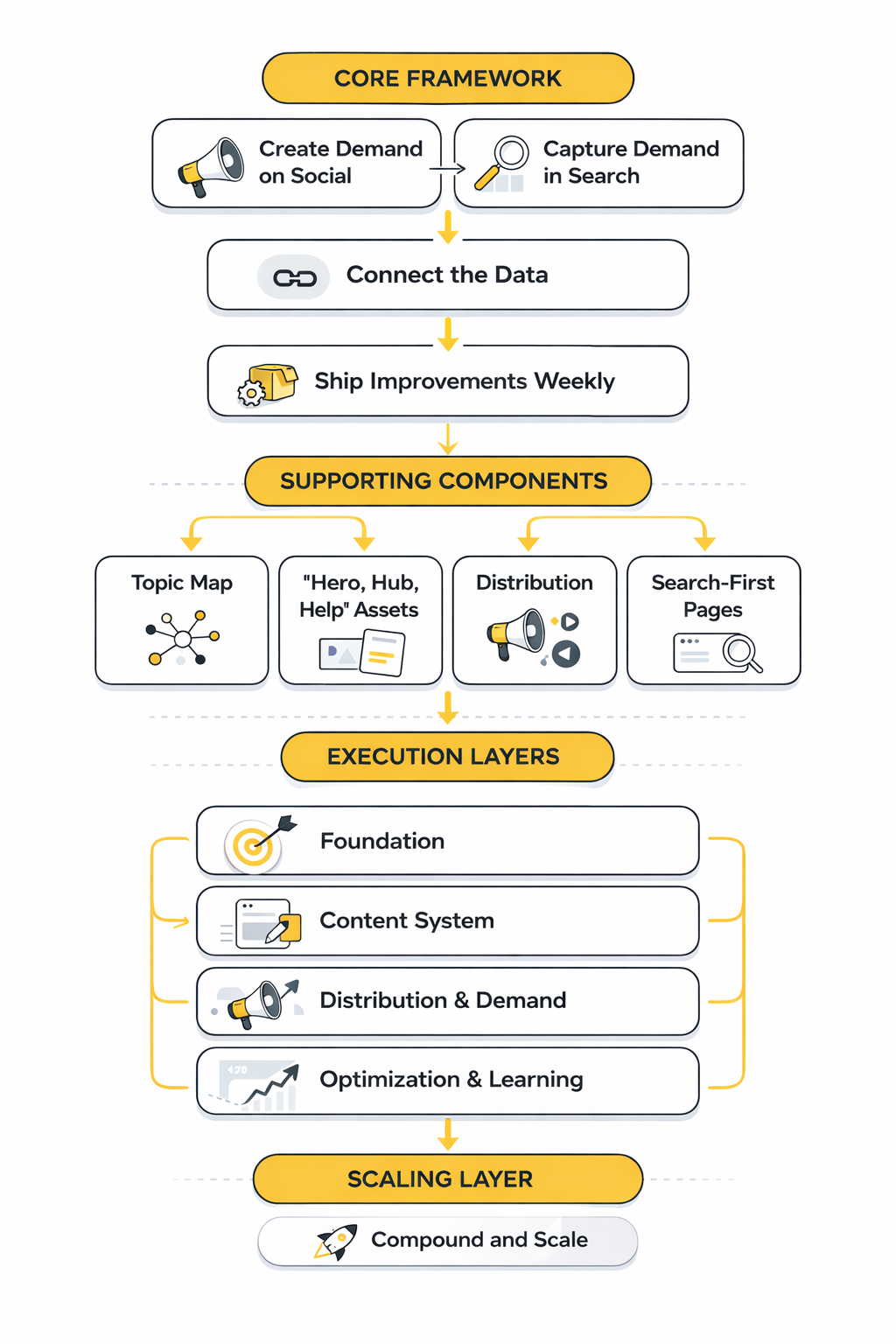
Integrating SEO and social media marketing requires a structured framework rather than ad-hoc posting or isolated keyword optimization. Effective strategies typically revolve around three interconnected layers: discovery, authority, and amplification.
The discovery layer focuses on helping new audiences encounter content. Social platforms play a dominant role here because their algorithms continuously surface posts to people who have never interacted with the brand before. Short-form videos, educational posts, and thought-leadership content introduce ideas and solutions that spark curiosity.
Once curiosity appears, search becomes the next stage of the journey. People start researching the topic they discovered on social media. This is where SEO becomes critical. High-quality pages optimized for search queries ensure that the brand appears when audiences begin actively looking for deeper information.
Authority forms the second layer of the framework. When audiences repeatedly encounter valuable content—both on social platforms and through search results—the brand gradually becomes recognized as a trusted source. This trust leads to shares, mentions, citations, and backlinks, all of which strengthen visibility across the digital ecosystem.
The third layer is amplification. Content that performs well on social media can attract thousands or even millions of views in a short period of time. When that attention leads people to link to or reference the original website content, it reinforces the search visibility of those pages. Over time, the cycle repeats and compounds.
This framework reveals why modern digital marketing strategies rarely treat SEO and social media as independent activities. Each channel strengthens the other, and organizations that coordinate them effectively create a self-reinforcing visibility engine.
Core Components of an Integrated Strategy
While the exact tactics vary by industry, most successful SEO and social media marketing systems share several foundational components. These elements ensure that content travels smoothly between platforms and that every channel contributes to long-term visibility.
Unified Content Strategy
The foundation of any integrated approach is a coherent content strategy. Instead of creating separate material for social media and search, organizations develop cornerstone topics that can be expanded into multiple formats. A single research article, for instance, might become a blog post optimized for search, a series of LinkedIn posts, short-form educational videos, and infographic summaries.
This approach ensures that every piece of content contributes to a broader narrative rather than existing in isolation. Social platforms introduce the topic, while search-optimized pages provide the depth and authority that audiences look for when researching further.
Search-Driven Topic Research
Keyword and topic research remains central to understanding audience intent. When marketers analyze the questions people search for online, they uncover the underlying problems and interests that drive curiosity. These insights guide both blog content and social media discussions.
The advantage of this approach is that it aligns social conversations with real demand. Instead of posting randomly, organizations create content around topics that people are already searching for, increasing the likelihood that social engagement will translate into website visits.
Platform-Specific Distribution
Each social platform has its own culture, content formats, and discovery algorithms. Effective strategies adapt core ideas to fit each environment. A long-form article may transform into a short educational thread on LinkedIn, a quick explainer video on TikTok, or a visual carousel on Instagram.
Although the format changes, the central message remains consistent. This consistency helps audiences recognize the brand across multiple platforms and strengthens the connection between social engagement and search visibility.
Authority Signals and Link Development
Search engines rely heavily on signals of credibility when ranking content. One of the most important signals remains backlinks—links from other websites referencing a page as a trusted resource.
Social media plays a powerful role in generating these signals because it dramatically increases the probability that journalists, bloggers, and industry professionals will encounter the content. When these individuals reference or cite a piece of content, the resulting links strengthen its search performance.
How Professionals Implement the Strategy
Professional marketers rarely treat SEO and social media marketing as isolated responsibilities. Instead, they build collaborative workflows where content creators, search specialists, and social strategists work together from the beginning of a campaign.
The process usually starts with research. Analysts examine search demand, audience questions, and emerging trends across social platforms. These insights help determine which topics deserve deeper content investment and which formats are most likely to resonate with audiences.
Once topics are identified, content teams create authoritative resources designed to perform well in search results. These resources might include in-depth guides, research articles, tutorials, or data-driven analyses. Because search algorithms prioritize useful and comprehensive information, this type of content forms the foundation of long-term visibility.
Social teams then transform that foundational content into multiple shareable formats. Short videos, graphics, commentary posts, and discussion threads distribute the core ideas across social platforms. Each piece of social content links back to the main resource, gradually directing new audiences toward the website.
Over time, this coordinated process produces compounding results. Social platforms expand reach and attract attention, while search optimization captures the growing demand created by that exposure. The combined effect is a marketing system that steadily increases brand visibility, authority, and organic traffic.
Step-by-Step Implementation
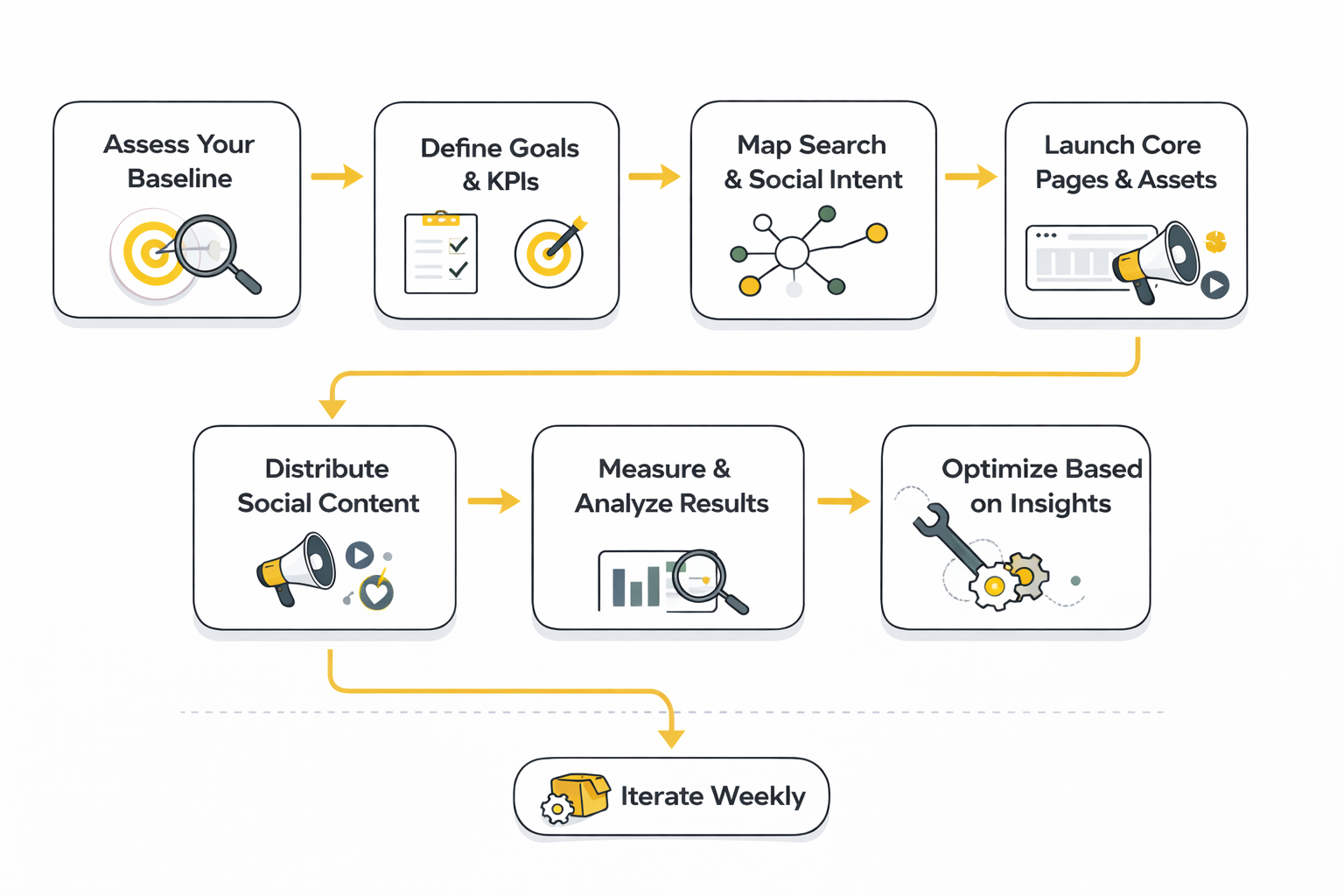
If you want SEO and social media marketing to feel like one system instead of two separate calendars, implementation has to be staged. The goal is simple: create demand on social, capture that demand in search, and then use the performance data from both to decide what you ship next. That loop is getting easier to run because Google is now experimenting with showing social-channel performance inside Search Console Insights, which is a pretty loud signal that discovery doesn’t live only on websites anymore when you’re measuring what content actually reaches people.
Step 1: Set a baseline you can trust
Start by making measurement boring and reliable. Verify Google Search Console, connect GA4, and make sure your key actions are captured as events so you can tell the difference between “traffic happened” and “business happened” when GA4 recommended events cover your core outcomes. Then standardize URL tagging across every social link so performance comparisons don’t turn into guesswork when UTMs are what makes attribution readable.
Step 2: Build a topic map that works in both search and social
Pick 3–5 topic pillars that match what your audience wants to learn, buy, or solve, then break each pillar into clusters of specific questions. This is where SEO and social media marketing stops being random posting and becomes intentional demand creation. Your social content should tease and test angles; your website content should own the deeper answer so you’re ready when curiosity turns into research.
Step 3: Produce “hero,” “hub,” and “help” assets in one pipeline
One of the fastest ways to scale without turning your team into a content factory is to ship in layers. Create one “hero” asset (a guide, resource page, or research-driven post), build “hub” content that supports it (supporting posts, FAQs, comparisons), and then publish “help” content on social (short clips, carousels, threads) that pulls people into the deeper piece. When this is done well, you’re not repurposing to fill space; you’re repurposing to move people through a journey.
Step 4: Distribute like a publisher, not a scheduler
Scheduling is not distribution. Distribution means you deliberately choose the platform-native format that best carries the idea, then you repeat the message with variation until the audience actually absorbs it. Social discovery is increasingly a shopping and research behavior, with McKinsey reporting that social media use for product research rose to 32% on average across markets in 2025 when consumers are actively hunting for proof, not just entertainment.
Step 5: Capture demand with search-first pages that deserve to rank
Once social starts pushing people into “tell me more” mode, they search. Your job is to have pages that match that intent with clarity, depth, and a clean path to the next step. Keep a close eye on Search Console performance trends, but interpret the data like directional signals; Google notes that Search Console stores top rows and not all data rows, so the report is designed to show what’s most important, not everything that exists when you’re prioritizing what to fix first.
Step 6: Run a weekly feedback loop and ship improvements
Every week, pick one search opportunity (a page slipping, a rising query group, a new intent pattern) and one social opportunity (a format or theme outperforming). Update one core page, publish two or three supporting social pieces, and tag everything so reporting stays clean. When you do this for 12 weeks without breaking rhythm, SEO and social media marketing starts compounding instead of resetting.
Execution Layers
Implementation gets easier when you separate “what must exist” from “what can be optimized later.” These layers help you build a stable engine first, then add sophistication without breaking the system.
Layer 1: Foundation
This layer is tracking, technical health, and basic publishing consistency. It’s also where you define your conversion events and ensure the essentials are captured in GA4 so you can measure outcomes, not vibes when event setup is the difference between insight and noise. Without this layer, “optimization” is mostly storytelling.
Layer 2: Content system
Here you build a repeatable pipeline: research, brief, draft, publish, repurpose, distribute, measure. The point is to create fewer, better core assets and then turn them into multiple platform-native expressions. In practice, this is how you keep quality high while still showing up often enough to matter.
Layer 3: Distribution and demand
This is where social earns its keep. You use social platforms to manufacture familiarity, test positioning, and spark curiosity, then you funnel that attention to pages built to satisfy deeper intent. Social search behavior is now mainstream; eMarketer’s March 2025 survey found 66.6% of US consumers have used social search which is why your content needs to be findable beyond Google.
Layer 4: Optimization and learning
Optimization is not “change everything.” It’s controlled iteration based on what the data consistently suggests: which topics pull qualified traffic, which formats drive meaningful clicks, and where people stall on the site. This is also the layer where you connect search and social reporting into one narrative, because teams ship faster when they agree on what the numbers mean.
Optimization Process
The cleanest optimization process for SEO and social media marketing looks like a cycle: diagnose, decide, ship, validate, and document. You’re not hunting hacks; you’re building a learning machine that gets smarter every week.
Diagnose: Find the constraint
Start with search visibility and intent fit. In Search Console, look for pages that are trending down, pages with high impressions but low clicks, and query patterns that suggest your page isn’t answering the question people actually have when Insights highlights “trending up” and “trending down” pages worth attention. Then validate with GA4: are people engaging, scrolling, clicking, and converting, or are they bouncing because the page doesn’t match the promise?
Decide: Choose one lever per sprint
Pick one primary lever so the result is interpretable. Maybe the lever is better intent alignment (rewrite the intro and headings), better internal linking (route people to the right next step), or better social packaging (a hook and format shift that drives higher-quality clicks). This is also where consistent UTM tagging becomes non-negotiable, because it lets you see which posts actually drove the sessions you’re optimizing for instead of attributing everything to “social” as a vague blob.
Ship: Update the page and launch the distribution set
When you update a page, treat it like a product release. Refresh the content, improve the structure, and add proof elements that reduce uncertainty. Then launch a small “distribution set” on social: multiple posts, multiple angles, platform-native formatting, and a clear reason to click back to the page.
Validate: Confirm the change worked
Validation is where most teams get sloppy. Give the change enough time to show movement, then check whether search performance improved and whether on-site behavior got healthier. If you’re measuring conversions or key actions, make sure the relevant events are implemented and marked appropriately in GA4 so you’re not optimizing for empty traffic when recommended events and key actions make results comparable over time.
Document: Turn results into reusable rules
Finally, write down what worked so you can repeat it. The difference between amateurs and professionals in SEO and social media marketing is that professionals don’t “get lucky” repeatedly; they standardize what they learned into templates, briefs, and checklists. Over a year, that documentation becomes an unfair advantage.
Implementation Stories
Real implementation is messy, emotional, and full of moments where the plan looks like it’s failing. The stories below are built from published reporting and case coverage, so the details you’re reading are grounded in real events rather than invented examples.
The Ordinary’s Visibility Slump and the Pivot That Kept the Brand Sticky
The warning signs didn’t arrive quietly; they hit like a cold splash of water. One of The Ordinary’s best-performing TikToks in the 2025 Vogue Business Beauty Index cycle pulled 4.8 million views and 574,000 engagements, and yet it still underscored a bigger problem: overall engagement and views were declining across the tracked platforms when the hype engine starts sputtering. It’s the kind of moment that makes a marketing team feel like they’re running faster while moving backward.
The backstory is that The Ordinary had been a standout in beauty marketing, known for a direct, value-forward voice and products that travel through word-of-mouth. That identity helped it rank high in prior Vogue Business Beauty Index editions, where purpose and customer trust were part of its performance story when authenticity is more than a slogan. But the wider category evolved, and the same lo-fi, meme-coded tactics that once felt fresh became easier for everyone to imitate.
The wall came when the platform behavior changed faster than the content machine did. Vogue Business reported that The Ordinary’s total engagement and views fell across the tracked social platforms, with TikTok called out as a key driver of the decline when the channel that once delivered the biggest spikes stops cooperating. Even their comparison point was brutal: a top TikTok post from 2024 generated 28.8 million views and 1.3 million engagements, making the newer “best performer” feel like a smaller win in a shrinking arena when your own history becomes the benchmark that haunts you.
The epiphany wasn’t “post more.” It was that visibility without trust is fragile, and trust without a clear narrative is invisible. Vogue Business highlighted that, despite the engagement decline, The Ordinary remained strong in how consumers rated the brand’s values and purpose, ranking highly on that dimension when purpose becomes the stable asset you can build on. That’s the moment SEO and social media marketing starts to align: social content can carry narrative, and search content can anchor it.
The journey looked like rebuilding the ecosystem around what people actually needed from the brand: clarity, usefulness, and reasons to believe. The team could take what resonated—product education, value framing, real explanations—and translate it into website pages that answer high-intent questions with confidence. Then social becomes the distribution and community layer again, pointing people to deeper resources instead of chasing trends for their own sake.
The final conflict is that the internet punishes slow pivots. When your competitors copy your tone and your audience gets numb to the same meme rhythms, every “normal” post feels like a waste of a day. And when the social channel is shaky, it’s tempting to over-correct by stuffing the website with keyword pages that read like they were written for robots, which quietly kills conversion and brand feel.
The dream outcome is a system where a brand’s story and usefulness travel together. Social content signals what the brand stands for and what it’s currently focused on, while search content becomes the durable library people return to when they’re ready to act. That’s what modern SEO and social media marketing is supposed to do: keep attention, capture intent, and make sure visibility doesn’t disappear the moment a platform shifts.
MAC Cosmetics Used Reddit Community Energy to Reignite Demand
It started with a very public test of relevance: a brand stepping into a forum culture that can smell marketing from a mile away. MAC Cosmetics ran its first Reddit interactive ad in January, built around a thread asking users what product MAC should bring back, and the response created immediate momentum when the community decides to play along. Then the attention escalated into something bigger than a campaign asset: an “ask me anything” featuring MAC’s global director of makeup artistry that racked up over six million views and 14,000 shares when the conversation becomes the content.
The backstory is that Reddit has positioned itself as a place people trust for unfiltered product validation. The same Vogue reporting described Reddit’s value as real user experiences and “human-led discussions,” and it highlighted that a significant share of users use the platform to validate purchases when trust is the currency. For a beauty brand, that environment is both an opportunity and a threat: show up wrong, and you get roasted; show up right, and you get something you can’t buy elsewhere—credibility.
The wall was that “credibility” can’t be forced through glossy creative. Redditors don’t respond to polished scripts the way they respond to genuine questions and meaningful answers, and brand content that feels like an interruption gets ignored or mocked. The risk is also strategic: if a brand gets the engagement but doesn’t capture demand elsewhere, the whole moment evaporates once the thread drops off the front page.
The epiphany was realizing the thread itself was a demand discovery engine. Instead of guessing what people wanted, MAC could watch thousands of comments, see which products and problems people cared about, and translate that into content that answers real questions. That’s the bridge to SEO and social media marketing: the community reveals the language, and search content turns that language into durable pages that rank and convert.
The journey is where implementation matters. A team can take the most repeated product names, concerns, and phrases from the Reddit conversation and build or refresh site pages that directly address them: product detail updates, FAQ sections, comparison pages, and educational guides. Then social distribution becomes smarter too, because you’re not pushing generic messaging—you’re amplifying what you already know the audience asked for.
The final conflict is that community-led demand can overload a marketing system that isn’t ready. If the website pages aren’t updated, the traffic hits dead ends, and the brand wastes the trust it just earned. If measurement is sloppy, leadership sees “views” and assumes success, while the team can’t prove whether the moment created downstream search growth, email signups, or sales.
The dream outcome is a loop where communities create signal and your owned content captures it. Reddit sparks high-intent conversation, social content extends it, and search content preserves it so the next person can find it three months later. When SEO and social media marketing work together like this, the brand stops chasing attention and starts collecting it.
Professional Implementation
Professionals treat implementation like operating a system, not “doing marketing.” The system has owners, checklists, and a rhythm that survives vacations, launches, and platform chaos. If your implementation depends on one heroic person being “on” every day, it isn’t implementation yet.
The weekly rhythm professionals stick to
- Monday: review Search Console for trend shifts and prioritize one page update based on what’s moving using performance patterns that indicate opportunity.
- Tuesday: update the page, improve internal links, refine the first-screen clarity, and align the content with the query intent you’re seeing.
- Wednesday: produce the “distribution set” for social (multiple hooks, multiple formats) and tag links so attribution is readable in GA4 when UTMs keep reporting honest.
- Thursday: community engagement and feedback capture (comments, DMs, community threads), then translate repeated questions into content improvements.
- Friday: measurement review in GA4 focused on outcomes, using event tracking that reflects your real business goals when events are what turn activity into insight.
Governance that keeps the system scalable
Pros standardize the boring details: naming conventions, UTM rules, what counts as a conversion, what counts as a qualified click, and where each metric is sourced. They also plan for tool constraints and interpret data with context; for example, Search Console is designed around showing the most important rows rather than every possible query and URL combination so prioritization beats obsession. With that governance in place, SEO and social media marketing becomes an engine the team can run every week, not a performance they have to “feel inspired” to deliver.
What’s changed recently for professionals
The line between search and social measurement is thinning. Google’s new experiment to surface social-channel performance inside Search Console Insights reinforces what practitioners have known for years: your “search footprint” includes your social presence, not just your site when search reporting starts acknowledging multi-platform discovery. Professionals are building their workflows around that reality now, so they can see which content truly travels and where the next round of demand is coming from.
Statistics and Data

The fastest way to improve SEO and social media marketing is to stop arguing about tactics and start agreeing on numbers. Not vanity numbers—decision numbers. How much demand exists, how efficiently you capture it, and where the journey leaks once people arrive.
A useful starting point is understanding how much of a typical site’s traffic is still driven by organic search. Conductor’s analysis across seven industries for 2024 found organic search produced 33% of overall website traffic, reinforcing why SEO remains the backbone channel even as discovery fragments across platforms. The same benchmark is reinforced in Conductor’s dedicated 2024 industry benchmark report, which describes its dataset and the same average share across 800+ domains, and it’s also echoed in industry coverage of that benchmark when marketers compare performance against peers.
At the same time, social has become a larger piece of the research phase of buying. McKinsey’s 2025 consumer trends report highlights that social media use for product research increased to 32% on average across markets, up from 27% in 2023. That shift matters because it changes what “top of funnel” looks like: demand is often created in feeds, then verified in search, then validated again through communities and creators.
And then there’s the uncomfortable reality: search clicks are getting harder to win in some query types. Search Engine Land’s January 2026 data recap summarized the direction of travel, including a reported -35% CTR impact when AI Overviews are present (alongside prevalence estimates). Separate analysis reported that on informational queries featuring AI Overviews, organic CTR fell 61% since mid-2024, and broader publisher-focused coverage has described cases where clickthroughs dropped dramatically when AI summaries appear in studies cited by news organizations. Whether you love or hate that shift, it changes what “good performance” looks like: fewer clicks can still be a win if the clicks that remain convert.
That’s why professionals are increasingly watching quality signals—engagement, pipeline, revenue—rather than treating impressions and clicks as the finish line. Similarweb’s 2025 ecommerce report, for example, claimed traffic referred by ChatGPT converted at 11.4% versus 5.3% for organic search. The takeaway isn’t “SEO is dead.” It’s that intent quality varies by source, and SEO and social media marketing need measurement tight enough to spot when “less traffic” is actually “better traffic.”
Performance Benchmarks
Benchmarks are only useful when they’re treated like weather reports: context for planning, not a scorecard for self-worth. In SEO and social media marketing, benchmarks help you answer three practical questions: are you getting attention, are you earning clicks, and are those clicks turning into outcomes?
Organic CTR by position changes by industry and device
If you’re trying to forecast the impact of ranking changes, CTR benchmarks are the bridge between “we moved up” and “we gained traffic.” Advanced Web Ranking publishes industry-and-device CTR snapshots; its Q1 2024 report illustrates how even the top position can vary widely by industry (for example, mobile top-position CTR expectations differed dramatically across sectors) in its quarterly breakdown. The point isn’t to memorize a single number; it’s to stop assuming position #1 means the same thing everywhere.
Engagement benchmarks belong to formats, not platforms
Most teams benchmark “Instagram” or “TikTok” and miss the real lever: format. What wins on social shifts as formats saturate and audience behavior evolves. Social Insider’s 2026 Instagram benchmarks, for example, summarize that carousel engagement resilience remained strong while overall engagement tightened in 2025 based on its dataset and year-over-year analysis. In practice, this means your benchmark should be “carousels vs. reels vs. static,” not “Instagram vs. TikTok.”
Industry benchmarks are a sanity check for your content mix
When leadership asks “are we doing well?”, the most honest answer usually starts with “compared to whom?” Rival IQ’s 2025 benchmark report describes an analysis of millions of posts and billions of engagements across major networks to give industry baselines. Hootsuite’s 2025 industry engagement overview similarly breaks out engagement rates by sector and platform so teams can see what ‘normal’ looks like. These references won’t tell you what to post tomorrow, but they will tell you whether your current results are wildly out of band.
Outcome benchmarks beat traffic benchmarks when clicks get squeezed
When search click behavior changes—AI summaries, zero-click patterns, heavier SERP features—outcome benchmarks keep teams grounded. Similarweb’s ecommerce report is a good example of why: it frames performance as conversion rate by source, not just sessions which forces a higher standard than “we got views”. In a world where some queries yield fewer clicks, the teams that keep winning are the ones that can prove the clicks they do earn are valuable.
Analytics Interpretation
Analytics interpretation is where SEO and social media marketing either becomes a growth engine or turns into a weekly blame game. The rule professionals follow is simple: every metric has a “why it exists,” a “how it lies,” and a “what you do next.”
Don’t force different tools to match perfectly
Search Console and GA4 answer different questions, so they will never reconcile cleanly. Google explains that Search Console data can differ from other tools for multiple reasons, including how it processes, anonymizes, and aggregates data in its explanation of discrepancies. Treat Search Console as your “search visibility truth” and GA4 as your “on-site behavior truth,” then connect them through trends and cohorts rather than expecting identical totals.
Search Console is designed to show the most important data, not all data
If you’ve ever wondered why you can’t find a specific long-tail query, it’s not necessarily because it didn’t happen. Google’s Performance report documentation notes that Search Console stores top data rows and not all data rows, which means you should optimize for patterns (query groups, page themes, intent shifts) instead of obsessing over every single phrase.
When clicks drop, check whether intent quality rose
AI summaries and richer SERPs can reduce clicks, but that doesn’t automatically mean performance is worse. If the people who still click are further along in the decision, conversion rates can hold steady or improve. This is exactly why source-level quality benchmarks (like Similarweb’s conversion-rate framing) are useful when the old “more clicks = better” logic breaks down.
Use social data to predict what will grow in search next
Social is often the earliest signal that a topic is heating up. If a theme repeatedly performs on social—saves, shares, meaningful comments, profile visits—it’s usually telling you something about audience curiosity and language. That language becomes fuel for your SEO: headings, FAQs, examples, and internal links that match how people naturally talk about the problem.
Google’s decision to experiment with showing social channels in Search Console reinforces that this connection is becoming more measurable. The official Search Central announcement describes how Search Console can surface search performance for associated social channels inside the product as part of a unified view, which makes it easier to run one visibility narrative across platforms instead of juggling disconnected dashboards.
Case Stories
Numbers matter, but stories are where teams actually change behavior. These are real, documented situations where measurement and channel interaction shaped outcomes—told in a way that reflects what implementation feels like when stakes are high.
Publishers Watched Search Traffic Leak Away and Had to Rebuild the Measurement Model
The drop didn’t feel like a gradual trend. It felt like waking up and realizing the floor had moved while you were sleeping. Publishers saw search click opportunities shrink as AI summaries and richer results reduced the need to click, and industry reporting described sharp declines tied to AI-driven experiences in search when studies showed steep clickthrough losses. Teams that had lived and died by SEO suddenly had a terrifying question: what happens if rankings stay, but clicks disappear?
The backstory is that many publishers built their entire growth system around a reliable equation: publish fast, rank well, earn clicks, monetize attention. For years, that machine worked well enough that it became institutional belief. But as the SERP evolved, the machine started producing a different output—impressions without the same click volume. Search Engine Land summarized this shift with reported CTR impacts and prevalence estimates for AI Overviews that made the change difficult to ignore.
The wall came when leadership demanded an explanation that dashboards couldn’t provide. A traffic chart going down is simple; the reason it’s going down is not. When Search Console shows “top rows” and aggregates visibility, and GA4 shows behavior after the click, teams can’t just point to one tool and declare causation. Google explicitly warns that Search Console data can differ from other tools for multiple reasons which means interpretation requires more than a screenshot.
The epiphany was realizing they were measuring the wrong success condition. If clicks are squeezed, then “more impressions” might still be valuable if it strengthens direct brand demand, subscriptions, app installs, and repeat users. That meant redefining KPIs from raw sessions to outcomes like loyal audience growth and conversion behavior. It also meant separating performance by query type—informational queries with AI summaries behave differently than navigational and branded intent, which is consistent with industry reporting that informational CTR fell sharply in AI Overview contexts over the period since mid-2024.
The journey was unglamorous: rebuilding dashboards, cleaning attribution, creating cohorts, and forcing every team to agree on definitions. Search Console became the radar for visibility shifts; GA4 became the truth for what visitors did next. Teams started measuring the quality of the remaining clicks—depth, return frequency, and subscription starts—because that’s where survivability lived. The work also pushed publishers to diversify traffic sources, treating social and community as demand builders rather than “nice-to-have distribution.”
The final conflict was psychological as much as technical. Newsrooms and marketing teams are wired to chase volume, and it’s brutal to tell creative teams “we may get fewer clicks even if we’re doing this well.” It’s also brutal to explain to executives that the tools will not line up perfectly and that the answer is a model, not a single number. Google’s own documentation that Search Console stores top rows rather than all rows became part of the education process, because the team needed permission to think in patterns instead of absolutes.
The dream outcome wasn’t “traffic went back to normal.” It was that the organization stopped being blind. With a better measurement model, teams could identify what content still earned clicks, what content generated brand demand, and what content converted loyal users. That’s the deeper promise of SEO and social media marketing done professionally: even when platforms change, your decision-making stays stable.
Google Made It Official: Social Channels Started Showing Up in Search Console
For years, teams informally treated social as the spark and SEO as the library. Then Google made the connection feel very real. Search Console began experimenting with surfacing social channel performance alongside website search performance, a move that signaled the “website-only” era of measurement is ending in Google’s official product announcement. For marketers, that’s not a novelty—it’s a change in how visibility can be managed.
The backstory is that modern discovery often starts away from the website. People encounter ideas in feeds, then search later when they’re ready to act. But teams have historically tracked those moments in separate tools with separate owners, which makes it easy to over-credit one channel and under-invest in the other. When measurement is fragmented, strategy becomes fragmented too.
The wall is that measurement shapes behavior. If leadership only sees search dashboards, teams optimize for rankings and forget packaging. If leadership only sees social dashboards, teams optimize for engagement and forget capture. The result is a leaky bucket: demand is created but not captured, or capture pages exist but nobody ever discovers them.
The epiphany is that unified reporting forces unified strategy. If the same Insights view can show what content is performing across your site and social channels, it becomes easier to plan content as one ecosystem. That’s especially important in a period where click behavior is shifting and teams need to understand where attention is moving, not just where it used to be.
The journey, in practice, is connecting the operational dots: consistent UTMs, clean event tracking, a shared taxonomy for content themes, and weekly reviews where SEO and social teams sit in the same meeting and talk about the same goals. When that’s in place, the organization can use social to test angles quickly, then invest in the best angles with search-first pages that deserve to rank.
The final conflict is that tools don’t fix alignment by themselves. Even with unified views, teams can still argue about what to prioritize unless they agree on outcomes and responsibilities. And when the data is messy—because different platforms attribute differently—the temptation is to retreat into the comfort of “our dashboard is right.” Google’s own note that Search Console and other tools can differ is a reminder that interpretation requires judgment.
The dream outcome is a calmer workflow: fewer debates, faster iteration, and smarter content investment. Social becomes your early-warning radar for what people care about; SEO becomes your durable capture system. And analytics becomes the glue that keeps SEO and social media marketing working as one machine, even when platforms change.
Professional Promotion
There’s a difference between “promoting content” and being professionally promotable as a marketer. Great SEO and social media marketing work often dies in silence because nobody packaged the results in a way that decision-makers can trust, repeat, and fund.
Build a monthly reporting pack that tells one story
Professionals don’t dump charts. They build a narrative: what changed, why it changed, what we did, and what we’ll do next. They explain why Search Console totals won’t match GA4 totals and point to Google’s own explanation of discrepancies so leadership doesn’t mistake natural differences for “bad tracking”. Then they focus the conversation on outcomes: leads, signups, purchases, pipeline—whatever the business actually values.
Turn one insight into one action, every week
If your reporting doesn’t change what you do, it’s entertainment. A professional habit is to surface one search insight (a slipping page, a rising query pattern, a CTR shift) and one social insight (a format win, a theme that earns saves/shares) and turn them into a planned action for the next sprint. Over time, that cadence becomes a personal brand: you’re the marketer who turns data into momentum.
Use external benchmarks to protect your credibility
When you present results, compare them to something external so your claims don’t sound like self-congratulation. Organic share benchmarks like Conductor’s 33% average across industries help leadership understand channel expectations, while engagement benchmarks from sources that publish their methodology (like Rival IQ’s 2025 benchmark overview based on millions of posts) keep social performance discussions grounded. Professionals don’t use benchmarks to excuse mediocre work; they use them to set realistic goals and defend smart investments.
Talk about platform shifts without sounding dramatic
Executives don’t want panic, but they do want clarity. Professionals calmly explain that search click behavior is changing for some query types, show credible coverage of the shift (like reported CTR impacts when AI Overviews appear in current industry reporting), and then outline the plan: improve content quality, strengthen brand demand, diversify distribution, and measure outcomes more tightly. That tone—clear, grounded, and action-oriented—is what makes your work promotable in the real world.
Future Trends
The next wave of SEO and social media marketing is being shaped by a simple reality: discovery is no longer linear. People see a clip, search a phrase, ask an AI tool, check a community thread, and only then decide whether to trust your site enough to convert. The winners will be the teams that design their content ecosystem for that messy path instead of trying to force everyone into a single funnel.
One of the clearest signals of where this is heading is Google’s move to connect website search performance with social channels inside Search Console Insights, positioning multi-surface visibility as one measurement story instead of a bunch of disconnected dashboards in Google’s official announcement of the experiment. That shift nudges marketers toward a healthier workflow: treat social as demand creation and brand reinforcement, and treat SEO as the capture layer that turns curiosity into action.
At the same time, the social landscape is getting noisier. Hootsuite’s Social Trends 2026 frames the competitive environment as faster-moving and increasingly shaped by AI content, which raises the bar for originality, trust, and community-building when brands are trying to stay visible without becoming background noise. A separate signal is the rise of “AI slop,” where low-quality, mass-produced content floods feeds and trains audiences to ignore anything that feels generic as recent reporting describes.
Search is evolving in parallel. SEO teams are now preparing for a world where AI-driven surfaces influence what people see, how they click, and how brands are cited. Search Engine Land’s 2026 outlook highlights themes like agentic behavior, deeper AI ad integration, and the idea that strong teams increasingly “ship tools” and systems rather than just tasks in its 2026 predictions roundup. The practical takeaway is that future-proof SEO and social media marketing will feel more like product thinking: create reusable assets, instrument everything, and iterate fast.
Strategic Framework Recap
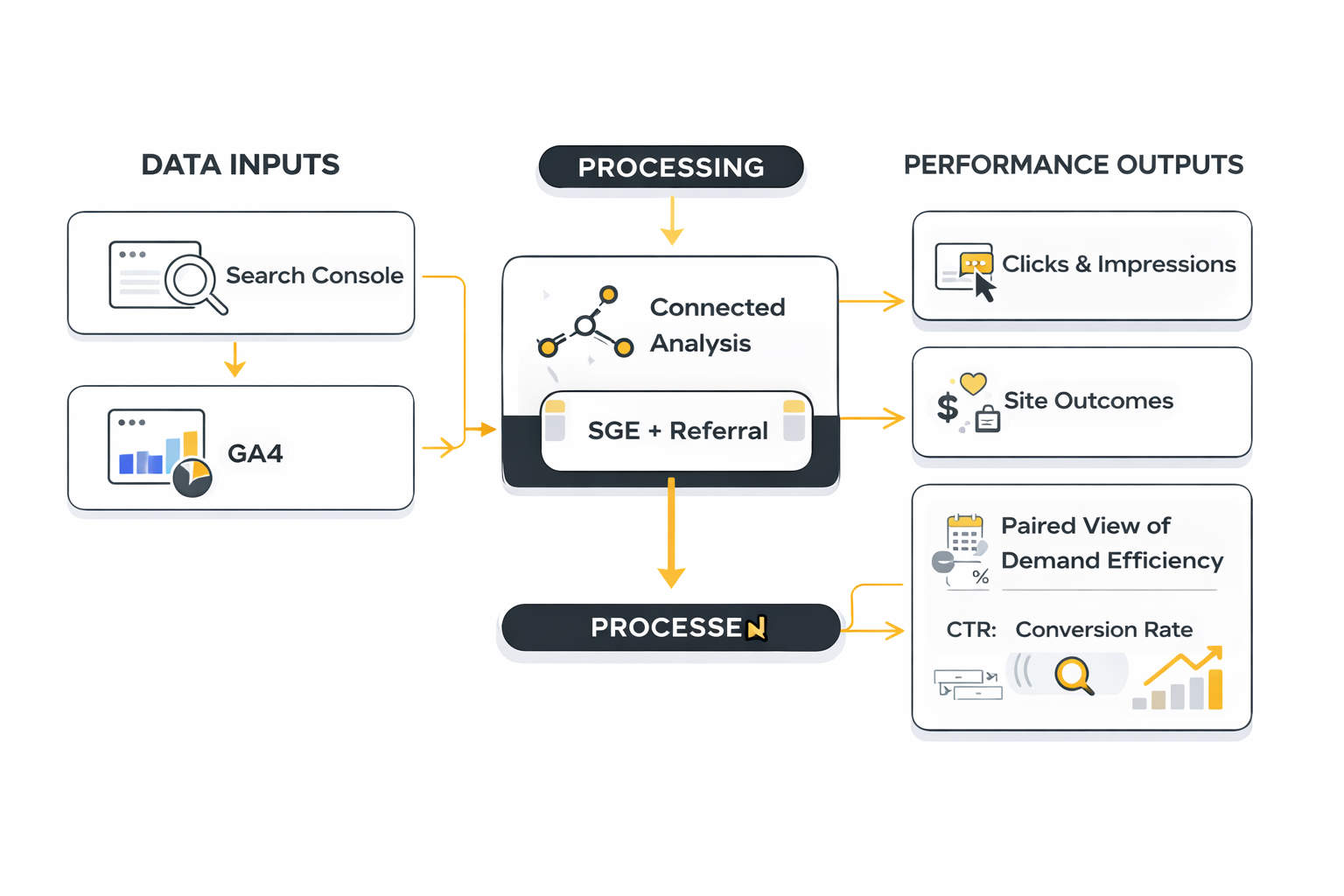
If you strip this entire guide down to the essentials, the strategic framework is a loop you can run every week without burning out.
- Create demand on social: publish platform-native content that earns attention, saves, shares, and meaningful clicks because it addresses a real problem in a human voice.
- Capture demand in search: build and maintain pages that deserve to rank by matching intent, answering objections, and making the next step obvious.
- Connect the data: interpret search visibility and on-site outcomes together, not as competing truths, because each tool answers a different question as Google explains when discussing Search Console data differences.
- Ship improvements weekly: update what’s slipping, double down on what’s rising, and keep a simple experimentation discipline so learning compounds.
- Build an ecosystem, not a campaign: social sparks curiosity, SEO anchors the durable library, and both reinforce brand memory so discovery keeps getting easier over time.
The reason this framework holds up is that it matches how people actually behave now. Social platforms and search engines are converging in discovery patterns, and even Google is testing product experiences that unify these performance views inside Search Console to reflect that reality.
FAQ – Built for the SEO and Social Media Marketing Complete Guide
1) Does social media directly improve Google rankings?
Social engagement itself isn’t a direct ranking factor you can “turn up,” but social can indirectly improve SEO by increasing exposure, earning mentions, and driving the kinds of links and brand searches that strengthen visibility over time. The most reliable way to treat it is simple: social expands reach, and SEO captures the resulting demand.
2) What’s the best way to connect social posts to SEO performance?
Use clean UTM tagging for every meaningful link you share on social so you can see which posts drove which sessions and outcomes in GA4 based on Google’s UTM guidance. Then compare those landing pages with Search Console performance to see whether increased attention is followed by rising impressions and clicks for related queries.
3) Why don’t Search Console and GA4 numbers match?
They measure different things and apply different processing and aggregation rules. Search Console focuses on Google Search performance, while GA4 focuses on on-site behavior after the click, and Google documents multiple reasons for discrepancies in its explanation of Search Console data differences.
4) Should I prioritize short-form video or long-form SEO content?
Both, but in different roles. Short-form video is an efficient demand generator and angle-testing tool, while long-form SEO pages are the durable capture and conversion layer. The best approach is to build one strong “core page” for a topic and then ship multiple short-form variations that route attention back to it.
5) How do I choose topics that work for both SEO and social?
Start with customer problems, then validate with search behavior (queries, comparison intent, FAQs) and social behavior (replies, saves, repeated questions). Topics that consistently pull engagement and repeat questions are often the same topics people later research more deeply in search.
6) What’s one mistake that kills SEO and social media marketing alignment?
Treating each channel like it has its own isolated success metric. If social is only judged by engagement and SEO is only judged by rankings, you’ll build a leaky bucket. Align both channels to shared outcomes like qualified traffic, leads, and revenue.
7) How often should I update existing SEO pages?
Update whenever performance signals show an opportunity: slipping clicks, rising impressions with low CTR, or changes in what audiences ask on social. Search Console is designed to surface the most important rows and trends rather than every possible detail as documented for the Performance report, so focus on patterns and meaningful shifts.
8) What metrics matter most when social traffic is lower but “feels better”?
Look at quality signals: engagement time, scroll depth proxies, key actions, lead quality, and conversion rate. In a shifting SERP environment, fewer clicks can still be a win if the remaining visits convert and return.
9) How do I keep my content from blending into AI-generated noise?
Anchor your content in lived expertise, real customer language, and credible sources. Generic content is increasingly easy to ignore, and recent reporting describes how mass-produced “AI slop” can flood feeds with low-value material that trains audiences to scroll past anything that feels empty.
10) What’s the most future-proof way to measure cross-platform visibility?
Build a unified measurement mindset even if your tools are separate. Use Search Console for search visibility, GA4 for outcomes, and consistent tagging for attribution. Watch the direction of the ecosystem too: Google is already testing a unified view that includes social channels inside Search Console Insights as a signal of where measurement is heading.
11) Do I need a paid tool stack to succeed?
Not at the start. You can do a lot with Search Console, GA4, and disciplined workflows. Paid tools help most when they remove bottlenecks: faster research, better competitive context, and smoother reporting. If your basics aren’t stable, paid tools mostly make you faster at being inconsistent.
12) If I’m a freelancer, what’s the easiest way to sell this to clients?
Sell a system, not a pile of deliverables. Clients don’t just want posts or blog articles; they want a predictable loop that produces results: research, publish, distribute, measure, optimize. When you can explain that loop clearly, you feel safer to hire.
Work With Professionals
If you’re a marketing freelancer, you already know the painful part isn’t doing great work. The painful part is keeping your pipeline alive while you’re busy delivering. And when your client calendar gets quiet, even strong skills can start to feel invisible.
That’s why marketplaces built specifically for marketing talent can change the game. Markework positions itself as a marketing marketplace where you can build a profile, browse listings, and connect directly with companies, with no middleman and no project fees. The platform also emphasizes direct communication and predictable costs through simple monthly plans instead of commissions, which means your earnings don’t get shaved down every time you land work.
If you want to turn your SEO and social media marketing skills into consistent income, the play is simple: present yourself like a specialist, not “a marketer.” Pick the lanes you can deliver confidently—SEO & content, paid social, lifecycle, analytics—and craft a profile that makes the outcome obvious. Markework highlights role categories like Performance Marketing, Paid Social, Paid Search, SEO & Content, and more so you can position yourself where demand already exists.
Then lean into what clients actually want: speed and clarity. Show how you run an integrated system that creates demand on social and captures it in search, and back it up with a simple weekly plan. When you can describe your workflow in plain language, clients feel the relief of “finally, someone who has a process.”
If you’re ready to build a pipeline you don’t have to beg for every month, start by creating your profile, applying to roles that fit your specialty, and using the platform’s direct messaging to move faster from conversation to contract as Markework’s flow describes for marketers.
markework.com Filip Konecny Enterprises