

Here is the part many coaches learn later than they should: visibility is helpful, but direct access is what actually builds a business. A social post can start interest. Email is where that interest gets shaped into trust, clarity, and action over time.
That is a big reason email still deserves serious attention. Recent data from HubSpot shows email was the top ROI channel for B2C brands, Litmus reports many marketing leaders are seeing returns between 10:1 and 36:1, and Mailchimp says paid users attributed about 30X ROI to connected campaigns. Those results will not appear automatically for every coach, of course, but they do make one point very clear: email is not a side tactic anymore. It is one of the strongest business assets a coach can build.
Email marketing for coaches matters even more because coaching is rarely an impulse purchase. People join lists while they are curious, unsure, cautious, or simply not ready yet. Your email system gives you a way to stay useful during that waiting period, so when the moment comes to book a call, join a group program, or buy a course, you are already the trusted option.
Article Outline
- Part 1: Why Email Marketing for Coaches Matters
- Part 2: Framework Overview
- Part 3: Core Components
- Part 4: Professional Implementation
- Part 5: Analytics and Optimization
- Part 6: Ecosystem and Long-Term Growth
Why Email Marketing for Coaches Matters

Coaches do not just sell information. They sell confidence, momentum, accountability, perspective, and a new way forward. That kind of decision usually takes more than one touchpoint, which is why a channel built around permission and consistency fits the coaching business so well.
That is also why email marketing for coaches should never be reduced to sending random updates when you remember. A better way to think about it is simple: social content helps people discover you, while email helps them understand you. Kajabi makes a similar point in its coaching marketing guidance, noting that social feeds are crowded while email gives coaches a more direct way to build relationships and promote services. When someone is considering paying for transformation instead of free tips, that direct line matters.
The benchmark picture is strong, but it also shows why coaches need nuance. Mailchimp currently places education and training at 35.64% average opens and 3.02% average clicks, HubSpot cites a 42.35% cross-industry average open rate for 2025, and MailerLite’s 2025 coaching benchmark shows 48.07% opens and 1.42% clicks. That spread is exactly why smart coaches do not obsess over one screenshot from the dashboard. They look at email as a pipeline tool and judge performance by replies, clicks to booking pages, applications started, calls booked, and revenue generated.
There is another reason not to worship open rates. Google says it does not track open rates and cannot verify third-party open-rate accuracy, GetResponse notes that Apple Mail Privacy Protection made opens less reliable, and MailerLite now treats click rate as the more accurate engagement signal. So yes, opens still matter directionally, but for coaches the deeper win is whether an email moves someone one step closer to the right offer.
When email marketing for coaches is done well, it also solves a problem that social media never fully fixes: timing. Some subscribers are ready right now. Some need six weeks. Some need six months. Email gives you a way to serve all three groups without starting from zero every time you post.
Framework Overview
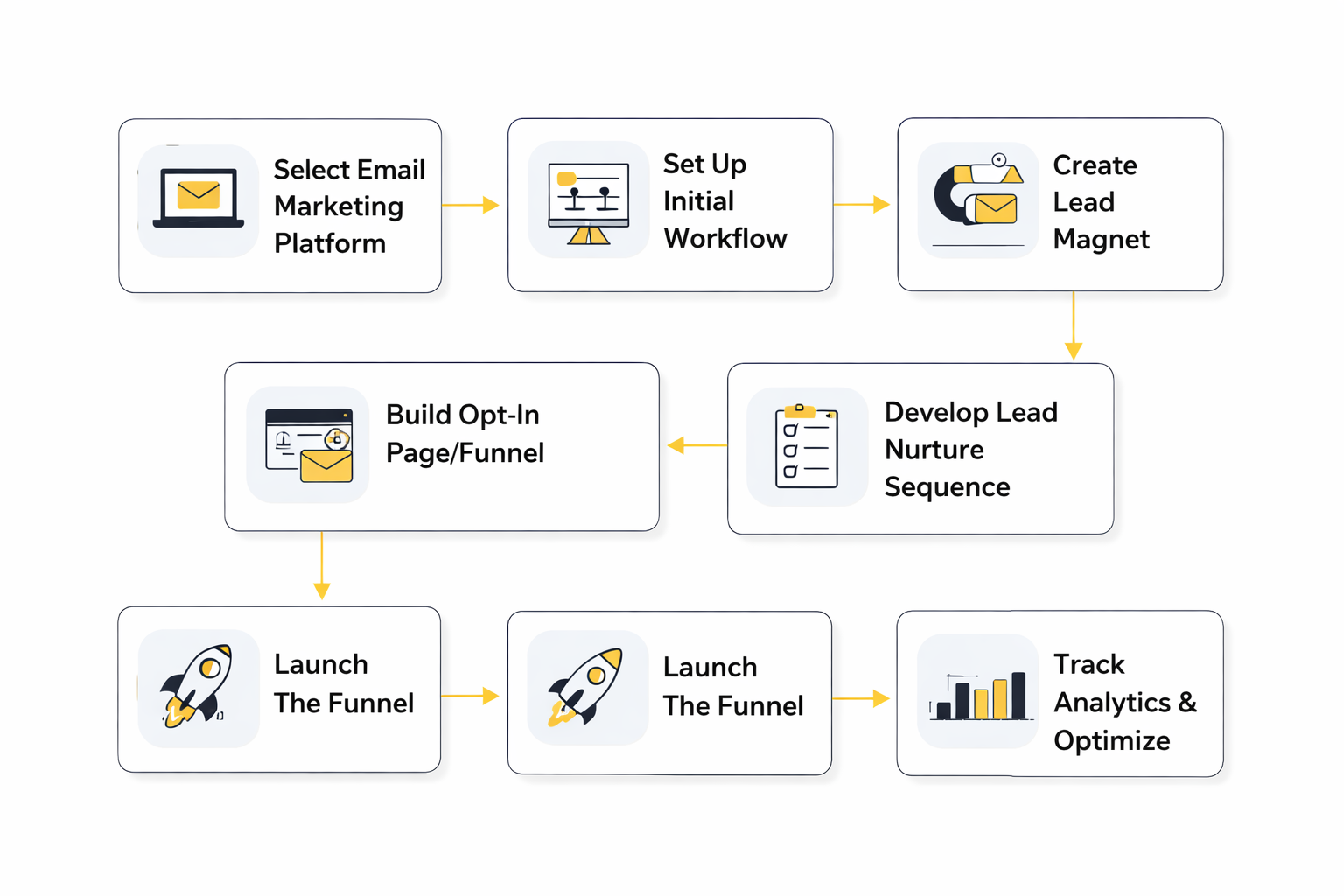
The cleanest framework for email marketing for coaches has six connected stages: attract, welcome, segment, nurture, convert, and retain. Each stage does a different job, and when one is missing, the whole system starts to feel weak. Coaches often think they have an email problem when they actually have a message problem, a segmentation problem, or an offer problem.
The first stage is attraction. You need an entry point strong enough to make the right person trade attention for access. HubSpot defines a lead magnet as a resource exchanged for contact information, but for coaches the stronger standard is even tighter than that. It should solve one urgent problem for one clear kind of person, because broad freebies usually create broad lists that are hard to convert later.
The second and third stages are welcome and segmentation. This is where you confirm the promise, deliver the resource, explain what you do, and learn what kind of subscriber just joined. If you skip segmentation, every message after that becomes weaker because you are forced to speak to everyone at once. If you segment early, your copy immediately gets sharper because the right people start receiving the right message.
The fourth stage is nurture. This is where most of the trust gets built. Good nurture emails do not flood the reader with endless teaching just to prove how smart you are. They help the reader see the problem more clearly, understand why past attempts have stalled, and recognize why your method is different.
The fifth stage is conversion. This is where many coaches suddenly get awkward and either become too passive or far too aggressive. Strong conversion emails feel natural because they connect the offer to a real point of friction the subscriber is already experiencing. They do not force urgency from nowhere. They clarify what happens next, who it is for, and why now is the right moment to move.
The sixth stage is retention. This is where email marketing for coaches becomes a real business system instead of a launch habit. Past clients need follow-up, referral prompts, renewal invitations, light-touch offers, and continued trust-building. When retention is built in, your list stops being a revolving door and starts becoming a long-term asset.
Core Components of an Effective Email System for Coaches
Lead Capture That Fits the Offer
Your lead capture process sets the tone for everything that follows. If the free resource attracts people who will never buy coaching, the list may grow while the business stays flat. That is why the strongest lead magnets for coaches are usually focused assets such as a diagnostic checklist, a short workshop, a template, a private audio training, or a mini email course built around one painful bottleneck.
The goal is not to collect as many email addresses as possible. The goal is to attract subscribers whose next logical step could become your paid offer. When the lead magnet and the offer are connected, the emails that follow feel natural instead of forced.
Welcome and Segmentation
The welcome sequence is where curiosity either deepens or fades. Someone has just signed up, which means attention is at its highest. That is your moment to deliver the promised resource fast, explain what they can expect from your emails, and invite one small action that helps you understand who they are.
This is where segmentation stops being a technical feature and becomes a sales advantage. A beginner should not receive the same emails as a warm lead ready for a consultation. A past client should not receive the same sequence as someone who just discovered you yesterday. The more accurately you divide the list by need, readiness, or interest, the less you have to rely on pushy copy later.
Nurture and Offer Architecture
Nurture is not about dumping more content into the inbox. It is about building belief. A strong coaching nurture sequence usually teaches something useful, reframes an unhelpful assumption, shows what your method looks like in real life, and makes the next step feel both safe and worthwhile.
This is also where email marketing for coaches becomes far more powerful than a basic newsletter. One segment may need education. Another may need proof. Another may need help understanding why doing nothing is already costing them something. When nurture is mapped to buying readiness, the offer starts to feel like the logical next move instead of an interruption.
Deliverability and List Quality
A list is only valuable if your emails actually make it to the inbox and land with the right people. The rules here are not optional anymore. Google requires one-click unsubscribe for marketing and subscribed mail when a sender exceeds 5,000 messages a day, Yahoo says bulk senders should keep spam complaints below 0.3%, and both Validity’s 2025 deliverability benchmark and Mailgun’s guidance recommend aiming closer to 0.1% if you want to stay safely ahead of reputation problems.
That matters for coaches because reputation is not just a technical issue. It is trust. If your opt-ins are vague, your promise is misleading, or your list is full of cold subscribers who no longer care, performance drops fast. Clean permission, relevant messaging, and regular list hygiene protect both deliverability and sales.
Professional Implementation
The biggest mistake many coaches make is building too much too early. You do not need a giant maze of automations to start. You need one clear promise, one focused entry point, one welcome sequence, one ongoing nurture rhythm, and one obvious path to the offer.
A practical version of email marketing for coaches can be surprisingly simple. Create one lead magnet tied to a real pain point. Build one landing page around that problem. Send a welcome sequence that delivers the resource, frames the issue, introduces your method, and points the subscriber toward the next step. Then keep showing up with useful emails that make progress feel both visible and achievable.
Choose the Right Stack for the Way You Sell
If you mainly need email delivery, segmentation, and straightforward automation, it makes sense to keep the stack lean. Brevo and Moosend are sensible places to start when you want a clean email system without overcomplicating the build. Simplicity is usually an advantage in the early stages, especially when your real bottleneck is messaging rather than software.
If your sales process depends on webinar registrations, application pages, workshops, or more structured conversion paths, a funnel-first setup may fit better. In that case, ClickFunnels or Systeme.io can make the path from opt-in to booking or checkout easier to manage. The right tool is the one that supports how you actually sell, not the one with the longest feature list.
Build the Minimum Viable Funnel
A professional system does not need to be complicated to be effective. In many cases, one strong CTA, one focused landing page, one thank-you page, one delivery email, and one welcome sequence are enough to create a real pipeline. HubSpot’s lead magnet framework still captures the structure well: CTA, landing page, thank-you page, and follow-up email.
The most important part is that every step feels connected. The promise on the page should match the promise in the email. The welcome sequence should match the offer. The offer should match the exact kind of subscriber the lead magnet attracted. When that alignment is present, even a simple funnel can perform like a serious asset.
Protect Deliverability From Day One
Before you obsess over templates, protect the foundation. Google’s bulk-sender update, Google’s sender guidelines, and Yahoo’s best practices all point in the same direction: authenticate your domain, make unsubscribing easy, and keep complaints low. That work may feel technical, but it is part of professional marketing now.
A coach’s email system should feel as trustworthy as the coaching itself. Clear permission, accurate expectations, relevant emails, and a clean sender setup all signal professionalism long before someone books a call. That is the standard worth building toward, because once the system is solid, optimization becomes much easier and much more profitable.
 Filip Konecny Enterprises