

Effective email campaigns are not built by blasting a list and hoping something sticks. They are built when a business knows exactly who it is speaking to, what action it wants, and why that message deserves space in a crowded inbox. That sounds basic, but the inbox has become a much tougher place to win.
There is still a big reward for getting it right. Litmus continues to show strong email ROI, yet Validity’s latest deliverability benchmark shows that plenty of legitimate marketing messages never make it to the inbox at all. Add Apple’s privacy protections, Google’s sender requirements, and the heavier shift toward first-party data, and you can see why effective email campaigns now have to be treated like a real operating system rather than a side task.
Article Outline
This article is structured as a six-part buildout so you can move from strategy to execution without losing the thread. The page jumps below are there to help you get straight to the section you need and come back to the rest when you are ready. That matters because strong email performance rarely comes from a single trick; it comes from a system that holds together from consent to conversion.
- Part 1: Why Effective Email Campaigns Matter
- Part 2: Framework Overview
- Part 3: Core Components
- Part 4: Professional Implementation
- Part 5: Analytics and Optimization
- Part 6: Campaign Ecosystem and FAQs
Why Effective Email Campaigns Matter

Email still matters because it does something very few channels can do at the same level: it creates direct, repeatable contact with people who already gave you permission to show up. That is why the channel keeps pulling budget attention, with 35% of marketing leaders reporting returns between $10 and $36 for every $1 spent on email and another 30% reporting $36 to $50. Those numbers are impressive, but the deeper reason email keeps winning is simpler: it gives you an owned line of communication instead of making you rent attention from an algorithm every single day.
The strategic value is getting even stronger as privacy rules and signal loss reshape marketing. IAB found that 71% of brands, agencies, and publishers are increasing their first-party datasets, and Litmus found that 30% of brands planned to increase email marketing spend as teams leaned harder into channels built on zero-party and first-party data. In other words, email is no longer just a conversion channel. It is becoming a core part of how brands build durable audience intelligence and keep customer relationships alive when other tracking signals get weaker.
The hard truth is that none of that matters if your campaign never reaches the inbox. Validity’s 2025 benchmark shows that one in six legitimate marketing emails fails to reach the inbox, while Google and Yahoo now put authentication, complaint rates, and unsubscribe mechanics right in the middle of campaign performance. That is why effective email campaigns are not really about writing a clever subject line and hitting send. They are about earning deliverability first, then earning attention, then earning action.
Measurement has changed too. Apple Mail Privacy Protection limits the old visibility marketers used to have into opens and remote content activity, and bot activity can inflate both open and click metrics. So the modern question is not whether a dashboard looks busy. The real question is whether the campaign moved the right audience toward revenue, retention, trust, or some other clearly defined commercial outcome.
Framework Overview
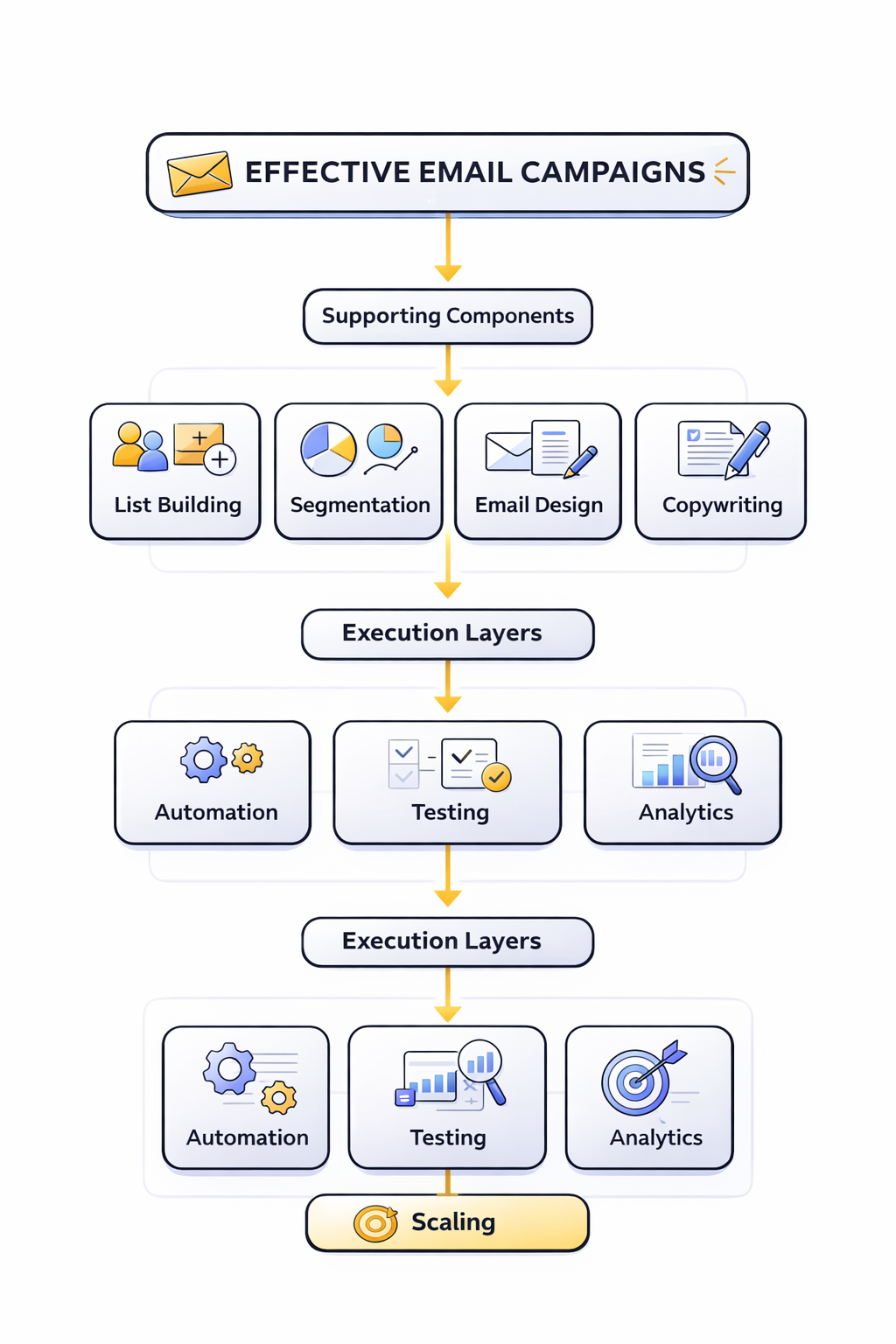
The cleanest way to understand effective email campaigns is to see them as a chain. One link is the business objective, another is the audience definition, another is the offer, another is the message structure, another is the delivery setup, and the final link is the measurement plan. When one of those links is weak, the entire campaign underperforms even if the design looks polished.
A strong framework starts with a single goal. You are either trying to acquire, activate, convert, retain, expand, or win back attention from a specific group of people, and the rest of the campaign has to line up behind that choice. Once the goal is locked, you build the message around a promise that matters to that audience, deliver it with a structure that is easy to scan, and send it through an infrastructure that protects inbox placement instead of risking it.
This framework lasts because it is grounded in how the market is actually moving. McKinsey’s recent work on personalization points to growing demand for tailored digital experiences, while Litmus shows how marketers are pushing personalization across more stages of the customer journey. That means the winning campaign is rarely the loudest email in the inbox. It is the one that feels timely, relevant, and easy to act on because the underlying system was built with intention.
Core Components
Once the framework is clear, the campaign itself comes down to a handful of core components that decide whether it feels useful or disposable. This is where a lot of teams get sloppy because they focus on the visible layer, which is the copy and design, while neglecting the invisible layer, which is audience quality, segmentation logic, rendering reliability, and post-send learning. Effective email campaigns need both layers working together or they break under pressure.
- Permission and list quality: The campaign has to start with people who actually asked to hear from you. ICO guidance on electronic mail marketing makes specific consent the default for marketing to individuals in many cases, while the FTC requires accurate sender information, truthful subject lines, and a working opt-out.
- Audience logic: Good segmentation reflects behavior, lifecycle stage, or customer value instead of broad guesswork. That matters more now because personalization is being pushed across more of the customer journey, and the quality of the data behind that personalization often decides whether the email feels helpful or creepy.
- Offer and value proposition: Every campaign needs a clear reason to exist from the subscriber’s perspective. If the email does not save time, reduce friction, teach something useful, create urgency, or make the next step easier, it will feel like inbox tax no matter how pretty it looks.
- Message hierarchy: Strong campaigns guide the eye fast. The subject line, preview text, opening promise, supporting proof, and primary call to action all have to work together so the reader can understand the value without digging for it.
- Rendering and client behavior: Design choices need to respect the environments where people actually read email. Current Litmus client-share data shows that almost 90% of opens report as Apple or Gmail, which is a huge reminder to test the big clients first, but never assume Outlook or other edge cases will forgive sloppy code.
- Accessibility and clarity: Campaigns should be readable, predictable, and easy to use for everyone. WCAG guidance and W3C’s image-alt recommendations are not extra credit here; they make the message easier to consume on mobile, with assistive technology, and under real-world attention constraints.
Benchmarks help keep these components honest, but they should never replace judgment. Mailchimp’s current all-user averages sit at 35.63% opens and 2.62% clicks, yet those numbers are best treated as directional because privacy protections and non-human interactions can distort raw engagement. The better way to use benchmarks is to spot whether a campaign is structurally healthy, then connect that read to the outcomes that matter most to the business.
Professional Implementation
Professional implementation is the moment email stops being a creative hobby and starts becoming a repeatable commercial process. A serious campaign workflow begins with one objective, one clearly defined segment, one primary action, and one agreed definition of success. From there, the build process should move through content review, rendering checks, link validation, authentication checks, and a post-send readout that looks past vanity metrics.
This is also where smart teams stop improvising compliance and infrastructure. Google requires SPF or DKIM for all senders and SPF, DKIM, and DMARC for bulk senders, while both Google and Yahoo expect one-click unsubscribe for bulk marketing messages, a standard formalized in RFC 8058. When those technical basics are handled well, creative work gets a real chance to perform instead of fighting avoidable inbox problems from the start.
Operational maturity also means picking tools that support the framework instead of distorting it. Businesses that want a practical all-in-one workflow often compare options such as Brevo and Moosend for segmentation and automation, while teams with heavier outbound or scaling needs may look at options like ScaledMail. The point is not to chase software for its own sake. The point is to use a system that keeps your data clean, your sends consistent, and your reporting clear enough to improve the next campaign instead of guessing at it.
The payoff for this professional approach is not just better-looking email. It is faster execution, fewer preventable mistakes, cleaner data, more reliable inbox placement, and a much clearer read on what is actually driving results. That is the difference between sending more email and running effective email campaigns on purpose.
Statistics And Data

This is where a lot of marketers fool themselves. A dashboard can look busy, colorful, and “healthy” while the campaign underneath it is quietly underperforming. If you want effective email campaigns, you have to stop worshipping every number and start focusing on the handful of metrics that actually tell you whether people saw the message, cared about it, and moved because of it.
The reason this matters so much now is simple. Privacy protections, image caching, stricter sender rules, and changing mailbox filters have made old-school email reporting much less reliable than it used to be. So the goal is not to collect more data for the sake of it; the goal is to read the right data well enough to make better decisions before the next campaign goes out.
Inbox Placement Is The Real Starting Line
The first number that deserves your attention is not open rate. It is inbox placement, because a message can show up as delivered and still fail where it counts by landing in spam, getting filtered away, or never earning real visibility with the subscriber. That is why recent deliverability guidance from Google, Yahoo, and benchmark analysis from Validity all point in the same direction: inbox access is now a performance issue, not just a technical housekeeping task.
This is also why complaint rate has become such a serious signal. Google says bulk senders with a user-reported spam rate above 0.3% lose mitigation eligibility, while Yahoo tells senders to keep spam rates below 0.3% and support one-click unsubscribe for marketing mail. When mailbox providers draw the line that clearly, effective email campaigns need to treat complaints as an early warning siren, not a metric you glance at once a month and forget.
Open Rates Need Context Now
Open rate still has value, but it no longer deserves to sit on the throne by itself. Apple says Mail Privacy Protection prevents senders from seeing whether a recipient opened an email and hides IP-based location data, while Litmus reports that more than half of email opens now happen on devices with Apple Mail Privacy Protection activated. That is a huge reason marketers can see open rates rise while actual buying behavior, qualified clicks, or replies stay flat.
The current client mix makes that distortion even more important. Litmus’ February 2026 client-share data put Apple at 45.51% and Gmail at 23.54%, with almost 90% of reported opens coming from Apple or Gmail, which means privacy-impacted opens and cached-image behavior are deeply baked into the numbers most teams look at first. So yes, keep an eye on opens, but do not let them make decisions that should really be driven by clicks, conversions, and downstream revenue.
Clicks, Complaints, And Unsubscribes Tell A Better Story
If you want a cleaner read on the health of your email program, clicks and post-click behavior tell a far better story. That is exactly why published averages are more useful as a range than as a rigid rule: Mailchimp’s all-user average sits at 35.63% opens and 2.62% clicks, GetResponse reports 39.64% opens and 3.25% click-through rate, and Brevo’s 2025 benchmark lands at 31.22% opens and 3.64% click-through rate. Those numbers are not identical, and that is the point: open rates move around more than most marketers realize, while click performance usually clusters much closer together and gives you a better sense of whether the message truly connected.
Complaint and unsubscribe behavior matter for the same reason. If clicks hold steady but complaints or unsubscribes spike, your targeting, frequency, or message promise is drifting off course. Effective email campaigns do not just chase interaction; they protect trust at the same time, because the fastest way to wreck future performance is to squeeze this campaign a little too hard.
Benchmark Ranges Only Work With Context
This is where many marketers make a costly mistake. They compare a welcome sequence, a discount blast, a webinar reminder, a reactivation flow, and a post-purchase email against one universal benchmark as if those messages all serve the same job. They do not, and that is why benchmark data should be used as a reference point, not as a substitute for judgment.
The smarter move is to compare campaigns in layers. First, compare each campaign against its own historical baseline. Then compare it against the right outside range for your type of program, your audience quality, and your sending environment. That gives you a much more honest view of whether your effective email campaigns are getting stronger or whether you are simply staring at vanity movement in the wrong report.
The Dashboard That Actually Helps You Win
A useful dashboard answers five questions in order: did the email reach the inbox, did the right people engage, did negative signals rise, did the campaign create business action, and was the outcome strong enough to justify repeating that approach. If your reporting cannot answer those questions quickly, it is probably too bloated or focused on the wrong layer of the funnel. The best dashboards are not the ones with the most widgets; they are the ones that make it painfully obvious what needs to be fixed next.
If you want a cleaner way to track that without building a messy stack, platforms such as Brevo and Moosend can simplify campaign reporting, automation visibility, and list behavior in one place. That is the real purpose of statistics and data in email marketing. They are not there to make you feel smart. They are there to help you run effective email campaigns with fewer blind spots and a lot more control.
Campaign Ecosystem And FAQs

By the time you reach this point, the big picture should be clear. Effective email campaigns are not isolated blasts that live and die on one subject line. They work best as an ecosystem made up of list growth, welcome flows, nurture sequences, promotional sends, transactional messages, reactivation campaigns, and measurement that tells you what is actually moving the business forward.
That ecosystem matters even more now because the rules around email have tightened while the value of owned attention has gone up. IAB found that 71% of brands, agencies, and publishers are increasing their first-party datasets, while Google’s sender requirements and Yahoo’s bulk-sender rules keep pushing marketers toward healthier list practices, stronger authentication, and lower complaint rates. So if you want effective email campaigns that hold up over time, you have to build the whole machine, not just one flashy campaign.
FAQ For This Complete Guide
What makes effective email campaigns effective today?
What works now is not raw volume. Effective email campaigns work when the message is relevant, the audience actually wanted it, the infrastructure is set up correctly, and the business knows what action it wants from the subscriber. That is exactly why first-party data keeps gaining importance and why Google and Yahoo now put list quality, authentication, complaint control, and unsubscribe mechanics right in the middle of performance.
Should I still track open rates?
Yes, but you should stop treating them like the final answer. Apple’s Mail Privacy Protection and Apple’s own user guidance make it clear that senders can no longer rely on opens as a clean signal of real human attention, and Mailchimp also warns that bot activity can falsely inflate open and click metrics. So open rate can still help you spot trends, but the stronger read usually comes from clicks, conversions, replies, revenue, and downstream customer behavior.
What spam complaint rate is dangerous?
You should treat complaint rate like a live risk signal, not a technical footnote. Google tells senders to keep spam rates below 0.10% and avoid ever reaching 0.30%, and Google’s FAQ says bulk senders lose mitigation eligibility when user-reported spam rate goes above 0.3%. Yahoo uses the same 0.3% ceiling, which means complaint control is now one of the clearest lines between stable inbox placement and performance trouble.
Do I really need SPF, DKIM, and DMARC?
Yes, if you want to send seriously. Google requires SPF or DKIM for all senders and requires SPF, DKIM, and DMARC for bulk senders, while DMARC.org explains that DMARC builds on SPF and DKIM so receivers can validate alignment and handle failures more safely. In plain English, authentication is no longer a nice extra for effective email campaigns. It is part of the price of admission.
What is one-click unsubscribe and why does it matter?
One-click unsubscribe gives subscribers a fast, standardized way to opt out without digging through a complicated settings page. Google requires one-click unsubscribe for marketing and subscribed messages from senders that send more than 5,000 messages per day, Yahoo says one-click unsubscribe is required for promotional and marketing messages, and RFC 8058 defines the standard that supports that one-click behavior. This matters because when people cannot leave easily, they often do the next worst thing for your reputation and hit spam instead.
Are bought email lists ever worth it?
For most brands, no. They create consent problems, drag down engagement, raise complaint risk, and usually flood the program with people who never wanted the message in the first place. ICO guidance on direct marketing using electronic mail is built around lawful marketing practice, and once you combine that with Google’s spam-rate expectations and Yahoo’s bulk-sender requirements, the case for buying lists gets very weak very quickly.
How often should I send email campaigns?
There is no magic number, and that is exactly why so many brands get this wrong. The right frequency depends on what subscribers were promised, how often you genuinely have something useful to say, and whether engagement stays healthy after repeated sends. Litmus notes that many marketing teams send weekly or several times per week, but the smarter rule is to let audience expectation and complaint pressure decide your cadence instead of copying someone else’s schedule.
Does segmentation really matter that much?
Yes, because relevance is the whole game now. Litmus shows that marketers are using personalization across more of the customer journey, and McKinsey points to growing demand for tailored online interactions. When you combine that with the broader shift toward richer first-party data, it becomes obvious that segmentation is not a luxury feature for effective email campaigns. It is how you avoid sending the right message to the wrong person at the wrong time.
Which metrics actually matter most?
The metrics that matter most are the ones that show whether the campaign reached the inbox, earned real engagement, and produced a business result. Validity’s latest deliverability benchmark is a strong reminder that inbox placement still decides whether the campaign even gets a chance, while Litmus argues that the best email metrics are the ones tied to business goals. So instead of obsessing over one dashboard tile, watch inbox placement, complaint rate, clicks, conversions, unsubscribe behavior, and revenue or pipeline impact together.
How do I know if bots are distorting my results?
You usually notice it when engagement suddenly looks unreal. A strange spike in opens, suspiciously fast clicks, or link activity with no matching on-site behavior often points to security scanning or automated filtering rather than genuine subscriber interest. Mailchimp explicitly warns that bot activity can falsely inflate open and click metrics, and its open-tracking guidance also notes that spam filters can create artificially high open numbers, which is why effective email campaigns should always be judged against conversion behavior and not just email-platform reports.
Should I separate promotional and transactional email?
Yes, because they do different jobs and they are not held to exactly the same expectations. Yahoo’s FAQ says one-click unsubscribe is required for promotional and marketing messages, not transactional ones, while Google specifically applies one-click requirements to marketing and subscribed messages. Keeping these streams separate makes compliance cleaner, reporting clearer, and subscriber trust easier to protect.
How much testing should I do before I send?
You should test more than most teams think, especially if the campaign matters financially. Litmus’ February 2026 client-share data shows Apple and Gmail dominating reported opens, with Outlook still holding meaningful share, so even a clean-looking email can break, misrender, or weaken the call to action across the clients your audience actually uses. For effective email campaigns, testing is not about perfectionism. It is about avoiding preventable damage before the send goes live.
When should I bring in professionals?
You should bring in help when email starts affecting real money and real risk. If your list is growing fast, your automation is getting complex, your complaint rate is rising, or your team keeps shipping campaigns without enough strategy, testing, or reporting discipline, a specialist can save you from much bigger losses later. The best professionals do not just make emails look nicer. They improve deliverability, sharpen the message, connect the campaign to revenue, and build a system your team can actually sustain.
Work With Professionals
There comes a point where doing everything yourself starts costing more than getting expert help. That point usually arrives when your email program touches sales targets, customer retention, lifecycle automation, or brand reputation in a serious way. When that happens, the smartest move is often to work with people who already know how to fix inbox problems, tighten segmentation, improve offers, and build workflows that do not collapse the moment volume increases.
If you are still building your stack, it can make sense to start with tools that simplify campaign management and automation, such as Brevo, Moosend, Systeme.io, or ClickFunnels. Teams that need heavier outbound support or sending infrastructure may also explore options like ScaledMail. But software alone will not turn weak strategy into strong results, and that is where experienced operators still make the biggest difference.
If you want to grow faster, avoid expensive mistakes, and build effective email campaigns that actually hold up over time, working with professionals is often the shortest path. It helps you move from guessing to knowing, from sending to learning, and from isolated campaigns to a real email system. And if you are the marketer who wants to be the one building those systems for brands, there is a big opportunity waiting for you too.
Explore 10K+ Remote Marketing Contracts on MarkeWork.com
Most marketers spend too much time chasing clients, competing on crowded platforms, and losing a percentage of every project to middlemen.
MarkeWork gives you a better way. Browse thousands of remote marketing contracts and connect directly with companies desperate to hire skilled marketers like you without platform commissions and without unnecessary gatekeepers.
If you’re serious about finding better opportunities and keeping 100% of what you earn, you can explore available contracts and create your profile for free at MarkeWork.com.
 Filip Konecny Enterprises