
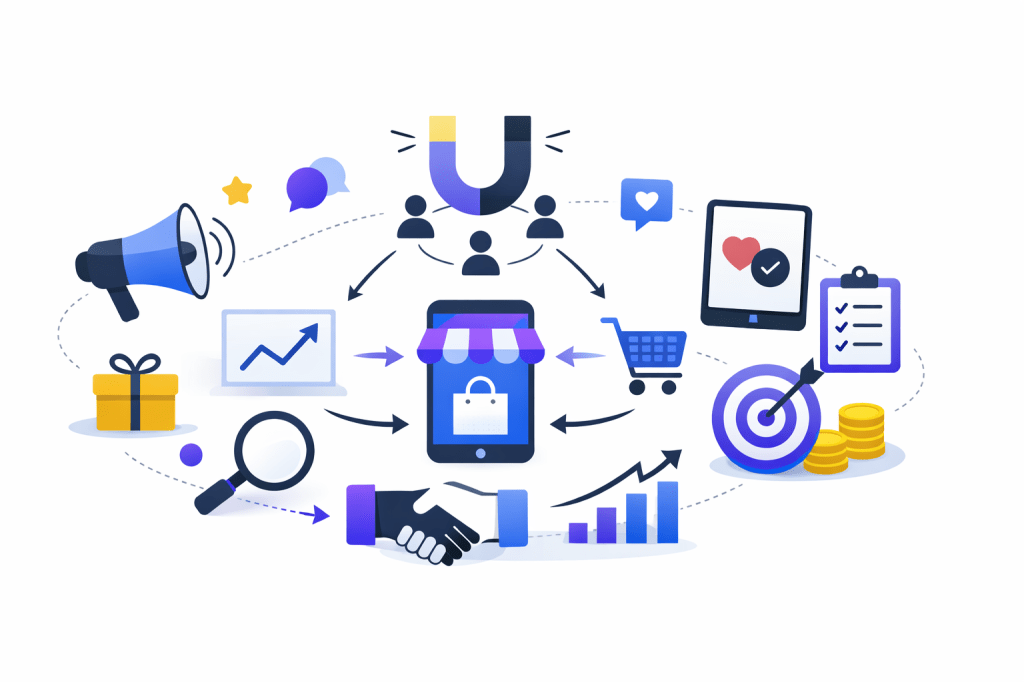
The BTL Marketing Channels That Still Earn Attention
BTL marketing stops being vague the moment you choose a channel that lets people do something real. The product can be handled, tested, compared, scanned, saved, or bought. That is why the strongest below-the-line programs usually live close to the moment of decision rather than floating at the level of broad awareness.
Experiential and Live Activations
Experiential BTL marketing works when the brand needs more than a glance. EventTrack 2025 is framed around spending, investment, strategy, measurement, dwell time, and purchase intent, while Freeman’s 2025 Trust Report says live events are having a stronger effect on how audiences think and feel about brands. That is a useful reminder that live experiences are not side projects. In the right category, they are decision-shaping environments.
The real lesson is not “make it bigger.” It is “make it usable.” Freeman’s 2025 commercial trends report shows that hands-on experiences improve how attendees judge the structure and usefulness of an event, while CEIR research highlighted by IAEE says 96% of exhibitors use attendee engagement tactics to influence their exhibiting goals. Good experiential work therefore needs a clear job: demonstration, consultation, trial, appointment-setting, or first-party data capture.
Product Sampling and Trial Campaigns
Sampling is one of the purest forms of BTL marketing because it attacks hesitation directly. If the barrier is taste, feel, scent, texture, fit, or confidence, the fastest route is often trial instead of persuasion. The channel becomes much more valuable once it is measured, which is exactly why platforms like Sampl now frame modern sampling around reviews, opt-ins, and purchase signals rather than just distribution volume.
The best recent programs also show that sampling works harder when it is targeted and followed up. SoPost’s Mikado case study and its San Pellegrino launch work both combine audience targeting, branded claim experiences, review collection, and post-trial nudges instead of treating the sample as the finish line. That is the mindset shift that separates old-school giveaway culture from modern BTL marketing: trial should create evidence, not just temporary foot traffic.
Direct Mail and Door Drop Campaigns
Direct mail still matters because attention is scarce and physical media slows people down. JICMAIL reports that the average direct mail piece is viewed for 108 seconds, while Australia Post says 81% of consumers open and read mail immediately and 74% give it full attention. In other words, BTL marketing through the mailbox still earns a kind of focus that many digital placements struggle to hold.
It also works best when it is connected to digital follow-up instead of competing with it. Lob’s 2025 consumer research found 81% of consumers take some action after receiving direct mail and 41% are more likely to engage when mail and digital touchpoints arrive together, while JICMAIL’s Q2 2025 data shows mail-driven website visits reaching a five-year high. That is why strong mail programs use QR codes, offer codes, dedicated landing pages, and response channels that make the offline touchpoint easy to track.
There is another reason marketers keep coming back to this channel. Lob’s 2025 state-of-market survey says 79% of executives view direct mail as their best-performing channel and 82% planned to increase direct mail investment in 2025, a finding echoed by USPS Delivers. For BTL marketing teams, that makes direct mail less of a nostalgia play and more of a selective weapon for acquisition, reactivation, and local promotion.
Retail and In-Store Activation
Retail activation is where BTL marketing collides with the shopping mission in real time. Shelf displays, endcaps, temporary installations, digital screens, floor graphics, demo stations, and tactical signage all matter because they influence what people notice when they are already close to purchase. The reason this still matters is simple: NRF’s 2025 consumer outlook highlights a surge in in-store shopping led by Gen Z, while McKinsey’s State of the Consumer 2025 shows how promotion sensitivity, local preference, and cross-channel shopping behavior are reshaping decisions on the path to purchase.
That shift is pushing retail media deeper into the store itself. IAB Europe’s 2025 retail media report says buyers are prioritizing transparency, performance, and measurement, and notes that in-store digital screens are drawing more interest even if budgets remain cautious. At the same time, IAB and IAB Europe’s in-store standards show just how seriously the industry is now treating store zones, ad formats, and measurement rules. The practical takeaway is that retail BTL marketing should not be designed as decoration. It should be planned as a measurable intervention at the exact point where choice is made.
Trade Shows and Field Marketing
Trade shows are still one of the clearest BTL marketing plays for complex or high-consideration purchases, but only if the team stops obsessing over raw lead counts. Freeman’s 2025 report literally frames the issue as quality conversations outweighing the quantity of leads. That is a healthier way to think about show performance, because a short scan with no buying context is rarely the outcome that actually moves revenue.
The wider exhibition market still matters enough to deserve disciplined planning. IAEE’s 2025 announcement on the CEIR Index Dashboard describes B2B exhibitions as an enduring driver of in-person commerce, and CEIR’s 2025 update makes the same point from the exhibitor side: engagement tactics matter when they are tied to concrete goals. In practice, that means field teams should be briefed around demo depth, meeting quality, pipeline stage movement, and follow-up speed, not just booth traffic.
How to Choose the Right BTL Marketing Mix
BTL marketing gets expensive when brands use the wrong channel for the wrong problem. The fix is not more activity. The fix is a better match between the friction in the buying journey and the channel that can remove it.
Match the Channel to the Friction
If people do not believe the product, use live demonstration or hands-on trial. If they know the category but keep delaying action, direct mail with a real offer can bring them back into motion, which is one reason Lob found mail especially strong for re-engagement. If the decision is happening at the shelf, retail activation and in-store media deserve the budget. And if the sale is complex, field marketing and trade shows should be built around the conversation quality that Freeman and CEIR keep pointing back to.
Build Measurement Before Launch
One of the oldest mistakes in BTL marketing is treating offline activity as hard to measure and then accepting fuzzy reporting. That excuse is getting weaker every year. Sampling platforms now track reviews, opt-ins, and purchase signals, postal operators recommend promo codes and response channels that make ROI visible, retail media bodies are publishing measurement standards for in-store formats, and Lob’s 2025 report links stronger results to better data quality and attribution discipline. Before a campaign goes live, the team should know what counts as response, what counts as conversion, and how offline behavior will be matched back to revenue.
Let Offline and Digital Work Together
The strongest BTL marketing programs do not isolate physical touchpoints from the rest of the funnel. They use the physical moment to create intent, then let digital channels capture, nurture, and close. Lob’s consumer data, JICMAIL’s 2025 performance data, and recent sampling programs like San Pellegrino’s all point the same way: offline channels are often at their best when they trigger an online action, a repeat visit, a review, or a purchase path that can continue after the first interaction. That is where BTL marketing feels modern, not because it abandons physical media, but because it connects physical attention to measurable next steps.
Once that mix is clear, the next challenge is execution: budget allocation, staffing, timelines, vendors, and reporting discipline. That is where BTL marketing stops being a good idea on paper and starts becoming a repeatable growth system.

FAQ for a Complete BTL Marketing Guide
This final section is here to clear up the questions people usually have right before they commit to a real BTL marketing strategy. And that matters, because the channel mix has become much more measurable and much more valuable than many businesses still assume. You can see that in how 74% of Fortune 1000 marketers planned to increase experiential budgets in 2025, how Freeman says live events are having a stronger effect on brand perception, and how Lob found 81% of consumers take some action after receiving direct mail.
What is BTL marketing, really?
BTL marketing is a more direct, targeted way of reaching people through channels that create an action you can actually observe. That can mean a product sample, a trade show conversation, a direct mail offer, an in-store activation, or a live brand experience that moves someone closer to purchase. The reason it still matters is simple: live events continue to strengthen trust, direct mail continues to trigger response, and retail media keeps growing along the path to purchase.
Is BTL marketing still effective today?
Yes, and the latest data makes that hard to ignore. Lob reports that 62% of consumers have converted after direct mail, JICMAIL says 9.2% of mail pieces in Q2 2025 prompted a website visit, and EventTrack 2025 shows marketers are increasing investment in experiential programs. That does not mean every campaign works. It means the channel still works when the offer, audience, and execution are aligned.
Which channels count as BTL marketing?
The core BTL marketing channels are experiential events, trade shows, sampling, direct mail, door drops, field marketing, in-store promotions, and retail activations. You could also include highly targeted local sponsorships and appointment-driven activations when the goal is direct response rather than mass exposure. Recent industry reporting keeps pointing to the same set of channels, especially experiential and trade shows in EventTrack, direct mail in Lob’s 2025 consumer research, and in-store and retail media formats in IAB Europe’s 2025 study.
How is BTL marketing different from ATL marketing?
ATL marketing is built for broad reach, while BTL marketing is built for targeted interaction. One is usually trying to influence the market at scale, while the other is trying to generate a measurable action from a narrower audience. That distinction becomes more obvious when you look at reports centered on dwell time, purchase intent, and event interaction, mail attention and response behavior, and retail media metrics tied to commerce outcomes.
Is BTL marketing a good fit for small businesses?
It can be a very smart fit for small businesses because targeted activity usually wastes less budget than broad awareness campaigns. A local service brand can use direct mail around a tight radius, a product-based business can run sampling in one neighborhood or one retailer, and a B2B company can focus on a small number of trade shows that attract real buyers. The logic behind that focus is supported by recent evidence that relevance drives direct-mail action and that engagement tactics shape exhibition outcomes.
How do you measure ROI in BTL marketing?
You measure BTL marketing by designing the campaign around trackable actions before launch, not by trying to guess after the fact. That means unique landing pages, QR codes, coupon codes, appointment bookings, retailer redemption data, qualified leads, event meetings, sample claims, and post-campaign sales matching. That approach lines up with where the industry is heading, because IAB Europe highlights measurement as a central retail media issue, CEIR ties attendee engagement to exhibitor goals, and Lob shows mail often triggers digital follow-up that can be tracked.
Does direct mail still work, or is it outdated?
Direct mail still works when the list is tight, the offer is relevant, and the follow-up path is easy. Lob found that 84% of consumers read direct mail the same day they receive it, JICMAIL says the average direct mail piece gets 108 seconds of attention over 28 days, and USPS Delivers cites 79% of marketing executives calling direct mail their best-performing channel. That is not the profile of a dead channel. It is the profile of a channel that punishes lazy targeting and rewards relevance.
Are live events and trade shows still worth the investment?
They are worth it when the team has a real plan for engagement, lead quality, and follow-up. Freeman’s 2025 Trust Report says live events are increasing their effect on how audiences think and feel about brands, while EventTrack 2025 shows rising marketer commitment to experiential spending. On the exhibition side, CEIR reports that 96% of exhibitors use attendee engagement tactics to influence their goals, which is a strong signal that passive booth presence is not enough anymore.
Is product sampling still one of the best BTL marketing tactics?
It can be, especially when the biggest barrier is uncertainty around the product itself. Sampling removes friction in a way that pure messaging cannot, and modern programs work best when they connect the sample to opt-ins, reviews, and follow-up offers instead of treating the giveaway as the finish line. That is why platforms built around sampling now emphasize controlled consumer journeys, while SoPost points to evidence that 73% of consumers are more likely to buy a full-sized product after receiving a sample.
Can BTL marketing work together with digital marketing?
It should. Some of the best recent evidence around BTL marketing points to physical channels triggering digital behavior rather than competing with it. Lob says 76% of consumers who engage with direct mail use a digital channel to do so, 41% are more likely to engage when mail and digital touchpoints arrive together, and JICMAIL’s 2025 results show mail-driven website visits hitting a five-year high. That is exactly why QR codes, retargeting, email nurture, and retailer media should be planned from day one.
What budget should you start with for BTL marketing?
Start with the smallest budget that still lets you test the full system properly. In practice, that usually means enough money to reach one clearly defined audience, one strong offer, one response mechanism, and one follow-up sequence rather than scattering budget across too many tactics. That mindset fits the way the market is evolving, because reports from EventTrack, IAB Europe, and CEIR all put more weight on measurement quality and commercial outcomes than on activity for activity’s sake.
What are the biggest mistakes brands make with BTL marketing?
The biggest mistake is treating BTL marketing like a one-off stunt instead of a structured revenue move. Brands get in trouble when they skip targeting, launch without a response mechanism, focus on vanity metrics, or fail to follow up fast enough after the first interaction. You can hear that concern directly in CEIR’s warning about insufficient engagement support on the show floor and in Lob’s 2025 finding that irrelevance is the top reason mail gets thrown out.
Should you hire professionals to run your BTL marketing campaigns?
If the campaign involves logistics, venue coordination, retailer execution, fulfillment, compliance, or multi-touch measurement, getting help is usually the smarter move. BTL marketing looks simple from the outside, but strong execution depends on planning details that most teams only notice after something breaks. That is also why recent industry reporting keeps circling back to operational maturity, whether it is measurement sophistication in retail media, measurement and investment planning in experiential, or engagement design in exhibitions.
Work With Professionals
At some point, strategy stops being the problem. Execution becomes the problem. And that is where a lot of BTL marketing campaigns quietly fall apart, not because the idea was bad, but because the targeting, follow-up, timing, measurement, staffing, or logistics were not handled tightly enough.
If you want BTL marketing to work, you need people who understand how direct response actually happens in the real world. You need people who can build the offer, coordinate the moving parts, track what matters, and keep pushing until the campaign turns into leads, sales, meetings, or repeat customers. That kind of work is much closer to operations than inspiration, which is exactly why serious brands do not leave it to chance.
Explore 10K+ Remote Marketing Contracts on MarkeWork.com
Most marketers spend too much time chasing clients, competing on crowded platforms, and losing a percentage of every project to middlemen.
MarkeWork gives you a better way. Browse thousands of remote marketing contracts and connect directly with companies desperate to hire skilled marketers like you without platform commissions and without unnecessary gatekeepers.
If you’re serious about finding better opportunities and keeping 100% of what you earn, you can explore available contracts and create your profile for free at MarkeWork.com.
 Filip Konecny Enterprises