
Choosing a seo agency for ecommerce is not a branding exercise. It is a revenue decision, because your products can now appear through free listings across Google surfaces, and those opportunities depend on far more than writing a few optimized headlines. The right partner helps you build a store that search engines can understand, shoppers can trust, and your team can scale without creating technical chaos.
The pressure is even higher now because search behavior is changing fast. Bain’s research on AI-written results and zero-click behavior shows why organic visibility is harder to convert into visits than it used to be, while Adobe’s retail data shows that shoppers are already using generative AI for product discovery and research. That is why a serious ecommerce SEO agency has to think like a merchandiser, a technical lead, and a growth operator all at once.
Article Outline
- Part 1: Why an Ecommerce SEO Agency Matters
- Part 2: Framework Overview
- Part 3: Core Components
- Part 4: Professional Implementation
- Part 5: Analytics and Decision-Making
- Part 6: Ecosystem and Long-Term Growth
Why an Ecommerce SEO Agency Matters
Google is very direct about this: hiring an SEO can improve your site and save time, and it specifically points to a redesign or a new launch as one of the smartest moments to bring that help in. That matters even more in ecommerce, where a bad category template, weak internal linking, or sloppy variant handling can quietly hurt thousands of URLs at once. By the time traffic drops show up in a dashboard, the real problem is often already baked into the store.
Ecommerce SEO is also a systems problem, not a blog-post problem. Google’s ecommerce guidance keeps returning to structure, URL design, pagination, and faceted navigation because those details determine whether your products can actually be crawled, indexed, and interpreted correctly. A generic agency that only talks about keywords will miss the real levers that control visibility on a large catalog.
The merchant layer raises the stakes again. Google’s product markup documentation, merchant listing guidance, and Merchant Center product data requirements all show the same thing: price, availability, shipping, and return details are not side notes. They are part of how search engines understand products and how shoppers judge risk before they click.
Content still matters, but only when it is built for people who are actually trying to buy. Google’s guidance on helpful, reliable, people-first content and its SEO starter guide make that standard very clear. A strong seo agency for ecommerce does not stuff keywords into thin pages; it builds buying confidence, removes friction, and makes the next step obvious.
Framework Overview
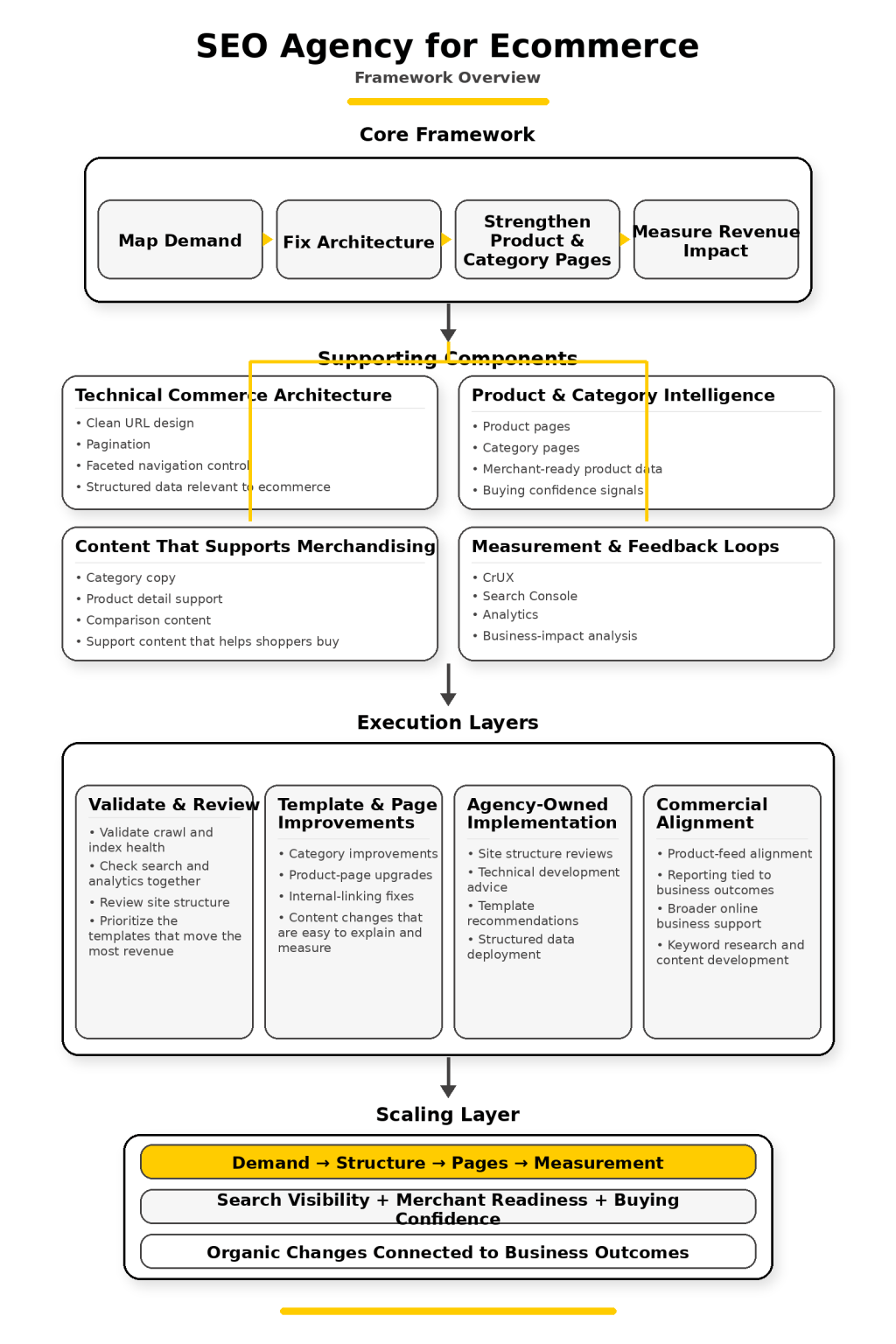
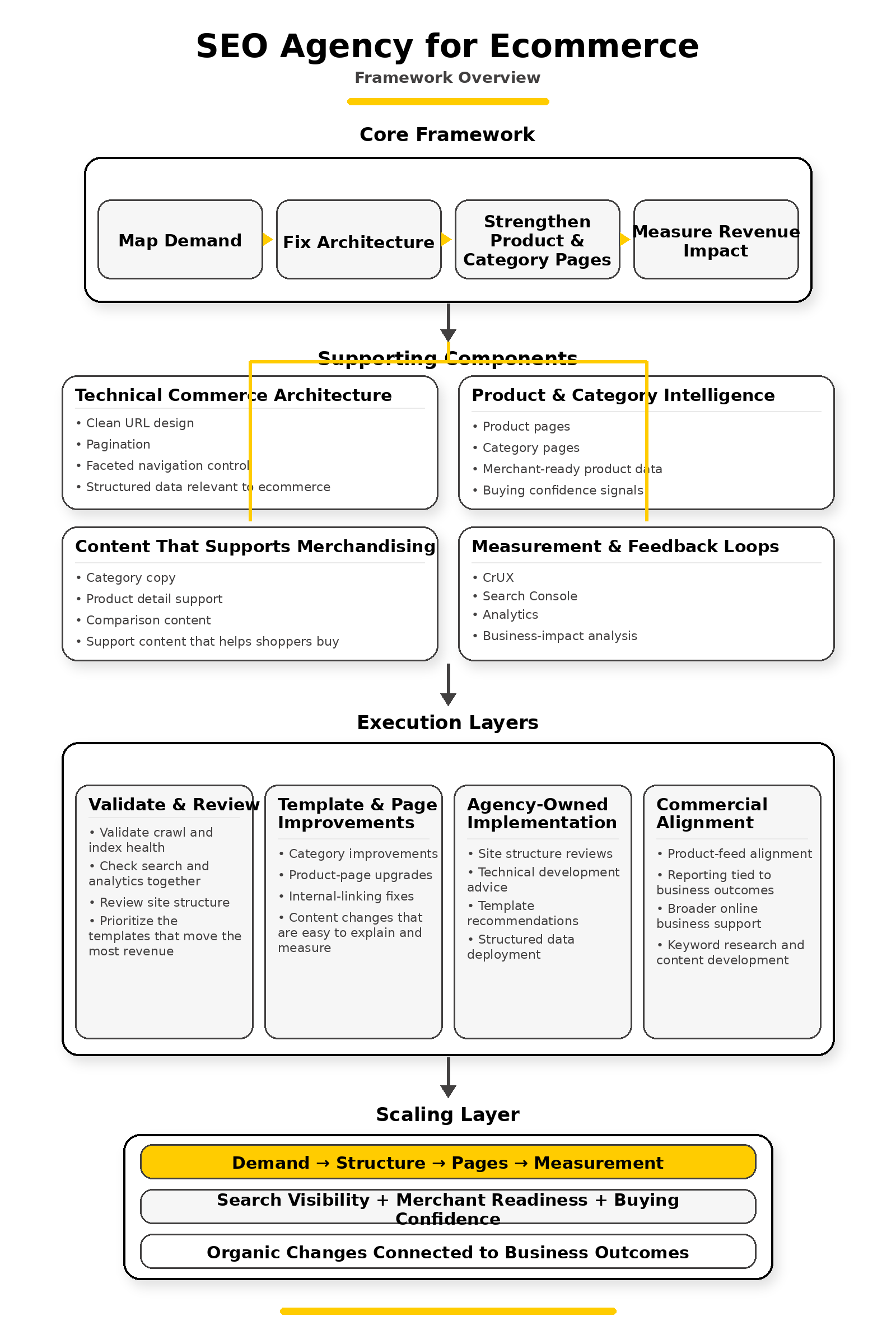
The framework I would want from any seo agency for ecommerce is simple to say and hard to execute: map demand, fix architecture, strengthen product and category pages, and measure what those changes do to revenue. That sequence lines up with Google’s guidance on people-first content, crawlable links, and combined Search Console and Analytics analysis. In other words, the real framework is not trendy at all; it is disciplined.
Demand mapping comes first because ecommerce intent is messy. Google’s starter guide says you should think about the terms readers actually use, and Baymard’s search research plus its updated product-finding work show how easily users get lost when search, navigation, and filtering are weak. A real agency turns that mess into a page-type strategy instead of a giant spreadsheet of disconnected keywords.
Then comes structure and machine-readable clarity. Google wants logical URL patterns, working pagination, disciplined handling of faceted URLs, and structured data relevant to ecommerce. That is the bridge between a page that merely exists and a page that can actually compete.
The last piece is measurement, because ecommerce SEO without measurement turns into storytelling very quickly. CrUX reflects how real users experience your site, web.dev’s business-impact material shows why performance work can affect commercial outcomes, and Search Console gives you the visibility to see what is being crawled, indexed, clicked, and ignored. That is where SEO stops being a marketing checkbox and starts acting like an operating system for growth.
Core Components
Technical Commerce Architecture
The first core component is architecture, because bad architecture makes every other SEO win smaller than it should be. Google’s documentation on ecommerce URLs, pagination, JavaScript SEO, and crawlable URL structure shows exactly why product variants, filters, and infinite combinations can spiral into waste. A good ecommerce SEO agency protects crawl budget, keeps internal paths clean, and makes sure important pages are reachable through links that search engines can actually follow.
Product And Category Intelligence
The second component is merchandising intelligence on product and category pages. Product structured data, merchant listings, and accurate Merchant Center data help Google understand what you sell, while Baymard’s navigation research and product page research show how much shoppers depend on clear hierarchy, filters, attributes, and decision support. This is where a serious agency earns its keep, because the page has to satisfy both the machine and the buyer at the same time.
Content That Supports Merchandising
The third component is content, but not the fluffy kind that exists only to rank for a phrase. Google’s people-first content guidance and starter guide push the same idea: content should be useful, well organized, original, and written for the person in front of the page. For ecommerce, that usually means sharper category copy, stronger product detail pages, better comparison content, clearer policy pages, and support content that helps a shopper move from uncertainty to purchase.
Measurement And Feedback Loops
The fourth component is feedback, because ecommerce SEO improves when the team learns quickly. Search Console and Google Analytics together, traffic-drop debugging workflows, and query-level analysis give an agency a way to see what happened after every change instead of guessing. That loop is what separates a partner that iterates intelligently from one that sends the same monthly report forever.
Professional Implementation
What A Strong Agency Owns
A strong ecommerce SEO agency does not disappear into theory. Google’s own page on choosing an SEO describes useful services such as site structure reviews, technical development advice, content development, keyword research, and broader online business support, and that is a good baseline to start from. In ecommerce, that baseline should expand into template recommendations, structured data deployment, internal linking improvements, product-feed alignment, and reporting that connects organic changes to business outcomes.
What The First 90 Days Should Look Like
The first stretch of work should feel focused, not chaotic. A good partner usually begins by validating crawl and index health in Search Console, checking search and analytics data together, reviewing site structure, and prioritizing the templates that can move the most revenue the fastest. From there, the work should narrow into category improvements, product-page upgrades, internal-linking fixes, and content changes that are easy to explain and easy to measure.
Red Flags Before You Sign
The warning signs are usually obvious once you know what to look for. Google cautions against agencies that cannot explain what they are doing, rely on deceptive tactics, or lean on junk practices like link schemes and misleading promises. If an agency cannot tell you why a page is being changed, how success will be measured, or whether its work follows people-first principles, that is not sophistication; that is risk.
A capable agency also understands where SEO hands traffic to the rest of your system. Some brands pair their SEO work with tools such as ClickFunnels, Systeme.io, Brevo, and Buffer when they want tighter control over landing paths, follow-up, and distribution. Those tools do not replace SEO, but they can strengthen the commercial system your SEO is feeding.
Begin With Commercial Intent Mapping
A serious framework begins with demand, but not the lazy version of demand where every keyword becomes a future blog post. Google’s SEO starter guidance still points back to understanding the language people use, while Baymard’s ecommerce search research and its 2024 product-finding update based on 219 test sessions and more than 160 guidelines show how often shoppers struggle to find the right products when stores do not match navigation and search behavior to real buying intent. So the first job of an ecommerce SEO agency is to turn search demand into a page map, not a content calendar full of disconnected ideas.
That usually means separating informational intent from category intent, filtering intent, comparison intent, and product-detail intent before any writing starts. Some phrases belong on collection pages, some need faceted experiences, some deserve buying guides, and some should never become standalone URLs at all. When an agency gets this right, the store starts feeling easier to shop because the SEO strategy and the merchandising logic are finally pointing in the same direction.

Secure Crawl And Index Paths
Once the page map is clear, the framework has to make sure Google can reach and understand those pages efficiently. Google’s guidance on ecommerce URL structure, its documentation on pagination and incremental loading, and its advice on helping Google understand site structure through internal links all point in the same direction: architecture matters more than most teams realize. A store can have great products and still underperform because filters create junk URLs, pagination hides inventory, or important pages are buried too deep in the site.
This is the part many brands skip because it is less exciting than publishing content. But it is also the part that decides whether later work scales cleanly or keeps running into invisible walls. A smart seo agency for ecommerce will usually treat crawl paths, canonical logic, navigation depth, indexable template rules, and internal linking as the foundation that every other organic win sits on.
Strengthen Category And Product Templates
After architecture comes template quality, because ecommerce SEO wins are usually built on repeatable page types rather than one-off hero pages. Google’s product structured data documentation explains how richer search experiences can reflect details such as price, availability, shipping, and return information, while merchant listing guidance shows how purchase-ready pages can carry stronger commercial signals. That means your product pages and category pages need to do more than mention the keyword; they need to answer buying questions, clarify differences, reduce hesitation, and present the product data cleanly enough for both shoppers and search systems to understand it.
Baymard’s recent work on product lists and filtering and its 2025 navigation benchmark make the commercial side of that issue hard to ignore, because weak filtering, vague labels, and poor category structures still create friction on a huge share of ecommerce sites. The framework should therefore treat page templates as revenue assets. When a category page is clearer, more specific, and easier to refine, SEO improves because the user experience improves first.
Align Search Signals With Merchant Data
The next layer is alignment between the storefront and the data Google reads about the storefront. Google explains that product structured data and Merchant Center feeds can improve its understanding of pricing, discounts, and shipping, and Merchant Center requirements make it clear that accuracy is not optional when you want product visibility across Google surfaces. In practice, that means the framework has to account for feed health, variant clarity, policy markup, and consistency between what the page says and what the feed says.
This is where many agencies quietly fall apart because they know editorial SEO but not ecommerce operations. A good framework makes the SEO team talk to the merch team, the dev team, and whoever owns feeds and product data. That is how you avoid the classic situation where a page ranks, a shopper clicks, and the trust signals break down because the details on the site and the details in Google do not match cleanly enough.
Build An Execution Loop The Team Can Repeat
The final step in the framework is repetition with feedback, because ecommerce stores do not stay still. Google’s workflow for combining Search Console and Analytics, its guide for debugging traffic drops, and its bubble-chart analysis approach all support the same habit: measure performance by page type, by query behavior, and by commercial outcome instead of staring only at total traffic. That is the only way to know whether the agency is growing non-branded visibility, improving category coverage, and turning more qualified searchers into buyers.
This is also the stage where the framework connects with the rest of your growth stack. Some brands support their SEO landing paths and lifecycle follow-up with tools such as ClickFunnels, Brevo, Fillout, or Buffer so traffic can move into better funnels, cleaner lead capture, stronger retention, and more consistent distribution. Those tools are not the framework by themselves, but they become far more useful when the SEO agency has already built a system that sends the right visitors to the right pages at the right moment.
Core Components That Actually Move Ecommerce SEO
If you hire a seo agency for ecommerce, this is where the conversation needs to get real. Not “we’ll optimize some keywords,” and not “we’ll publish more content.” The work that changes organic revenue usually comes down to a handful of components that affect how your store is discovered, how your products are interpreted, and how easily shoppers can move from curiosity to checkout.
Google’s own ecommerce documentation keeps pushing the same idea from different angles: site structure matters, product data matters, and the relationship between your pages matters. That is why the core components are not random tactics. They are the parts of the store that either make the whole machine easier to scale or quietly hold it back month after month.
Category Architecture That Guides Both Google And Shoppers
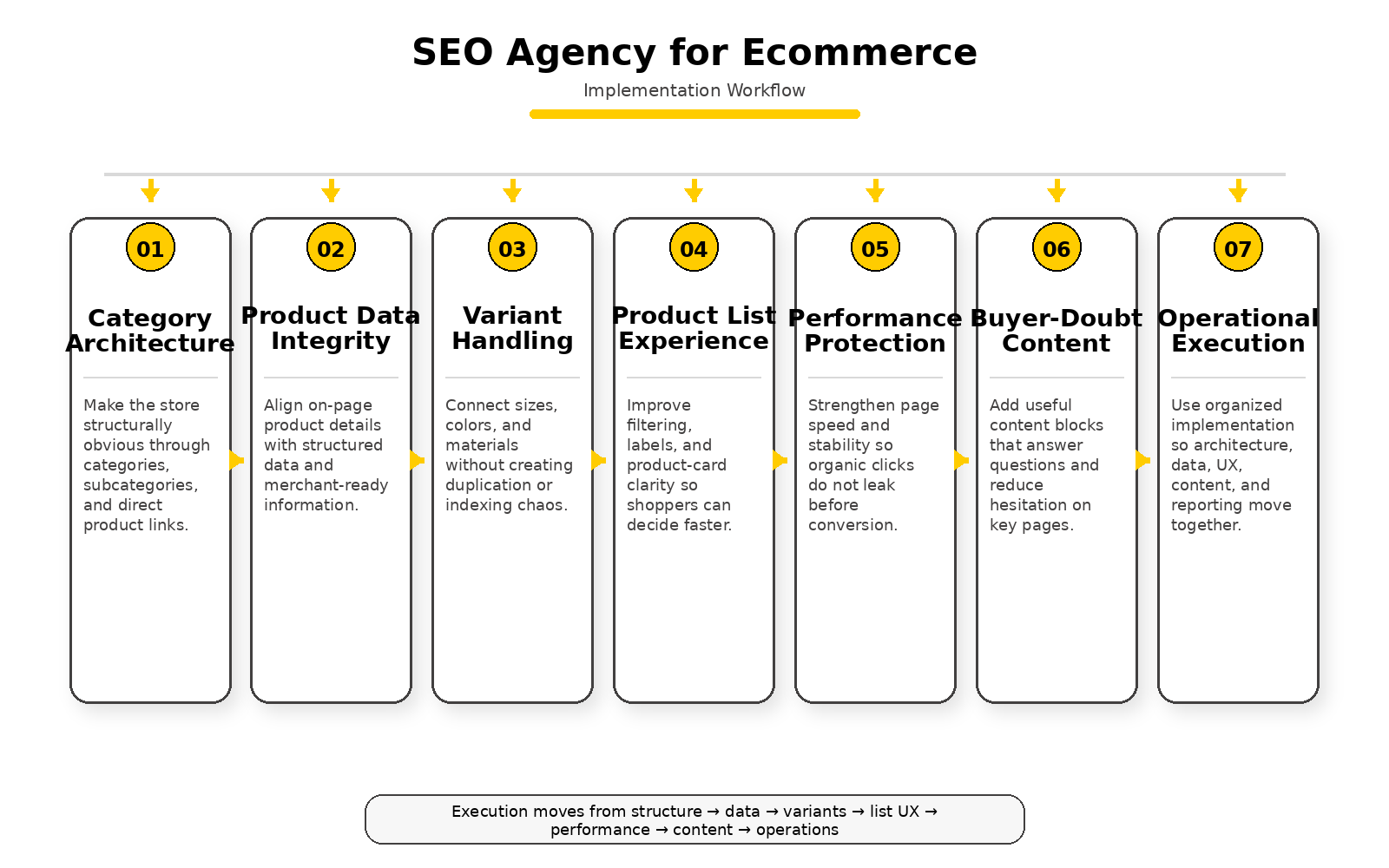
A strong ecommerce SEO setup starts with category architecture because categories do more than organize products. Google explains that it understands an ecommerce site by analyzing the relationships between pages and the links that connect them, which means your menus, subcategories, and collection pages send strong signals about what matters most. When an agency gets this right, category pages stop being thin placeholders and start acting like strategic landing pages that collect demand, pass authority, and make the catalog easier to browse.
This is also where weak stores begin to lose ground. Google warns that if category pages do not link directly to products, some products may remain hard to discover through crawling alone, especially when they are only reachable through an internal search box or a fragile interface pattern. So one of the most important core components is simple, but not easy: make the store structurally obvious, and make your most important pages reachable through normal links instead of hoping search engines will figure it out from clever technology.
Product Data That Matches Reality
The next component is product data integrity, and this is where a lot of ecommerce SEO work either becomes powerful or falls apart. Google recommends giving Search rich product data through structured data on the page, and it goes even further by saying that combining structured data with a Merchant Center feed helps Google understand and verify product information more effectively. That matters because ecommerce search visibility is no longer just about a title tag; it is about whether the product details on your site are clear, current, and consistent enough to be trusted.
Merchant Center’s product data requirements make the commercial risk even clearer. Inaccurate or missing information can create issues that prevent products from showing properly across Google. A capable seo agency for ecommerce treats this as a core component, not a side task, because pricing, availability, shipping details, and identifiers are part of how search systems understand what you sell and part of how buyers decide whether to click.
Variant Handling That Does Not Create Indexing Chaos
Variant logic is one of those details that sounds technical until it starts costing you visibility. Google’s product variant documentation explains how stores can use ProductGroup markup to connect related versions of the same product, such as sizes, colors, and materials, so Google can understand them as part of one parent relationship instead of as a messy collection of disconnected pages. That is a big deal for categories like apparel, beauty, furniture, and electronics, where variant sprawl can quietly create duplication, weak pages, and confusing signals.
This is one of the clearest places where a generic SEO provider usually feels out of depth. A real ecommerce agency knows when a store should keep variants on one page, when separate URLs make sense, and how to mark those relationships up without turning the catalog into an indexation mess. It is not glamorous work, but it is exactly the kind of work that protects product visibility at scale.
Product List Experience That Helps People Decide
Product list pages do not always get enough respect in SEO conversations, even though they are often the page type that carries the most commercial intent. Baymard’s latest benchmark on product lists and filtering shows that weak list design still causes major friction on a large share of ecommerce sites, while its broader product-finding research update shows just how many usability problems still appear when stores make filtering, comparison, and navigation harder than they should be. That should tell you something important: category and list pages are not just containers for products; they are decision-making environments.
A good ecommerce SEO agency treats those environments as part of organic growth, not just UX cleanup. Better filtering, clearer labels, stronger product-card information, and smarter category copy help users narrow choices faster, and that usually makes the page more useful for search at the same time. When the list page answers intent better, rankings have a stronger page to work with and conversions have a smoother path to follow.
Performance That Protects Conversion
Speed work belongs in the core components because performance is not just a developer concern. web.dev’s collection of Core Web Vitals case studies was built precisely to show that performance improvements can influence business outcomes, not only technical scores. That theme shows up again in real ecommerce case studies such as Ray-Ban’s published work on faster future navigations and Rakuten 24’s documentation of stronger business results after Core Web Vitals work.
The practical lesson is straightforward. A seo agency for ecommerce should care deeply about how category pages, product pages, search results, and mobile templates perform under real shopping conditions, because slower experiences make every other channel work harder. SEO can earn the click, but speed and stability often decide whether that click turns into revenue or disappears halfway through the buying journey.
Content Blocks That Remove Buyer Doubt
Content is still one of the core components, but it needs to be the kind that reduces uncertainty rather than inflates word count. Google’s people-first content guidance keeps bringing the focus back to usefulness, originality, and satisfying the visitor, which fits ecommerce perfectly. Buyers do not need category pages filled with empty adjectives. They need fit details, material explanations, comparison guidance, shipping clarity, sizing help, compatibility information, and honest answers to the questions that stop them from ordering.
That is why the best ecommerce agencies build content into the page templates themselves. They look for the moments where a shopper hesitates, then strengthen the page with information that helps the person move forward. When content is built that way, it supports rankings because it supports decisions, and that is a much healthier long-term strategy than trying to force a keyword into every paragraph.
The Operational Layer Behind The SEO Work
The final core component is operational discipline, because even great SEO ideas die when nobody can implement them cleanly. Many brands support their ecommerce workflow with tools such as Copper for relationship management, Cal.com for faster coordination, Firecrawl for structured web data collection, and Chatbase when they want AI support around product discovery or customer questions. Those tools are not a substitute for SEO, but they can make implementation far more organized once the agency knows what actually needs to change.
That is really the point of this whole section. The core components are not flashy, but they are the things that make ecommerce SEO work in the real world: cleaner architecture, stronger product data, better variants, smarter list pages, faster templates, and content that genuinely helps people buy. When an agency can improve those pieces consistently, it stops feeling like a vendor and starts feeling like a growth partner.
Statistics And Data That Guide Professional Implementation
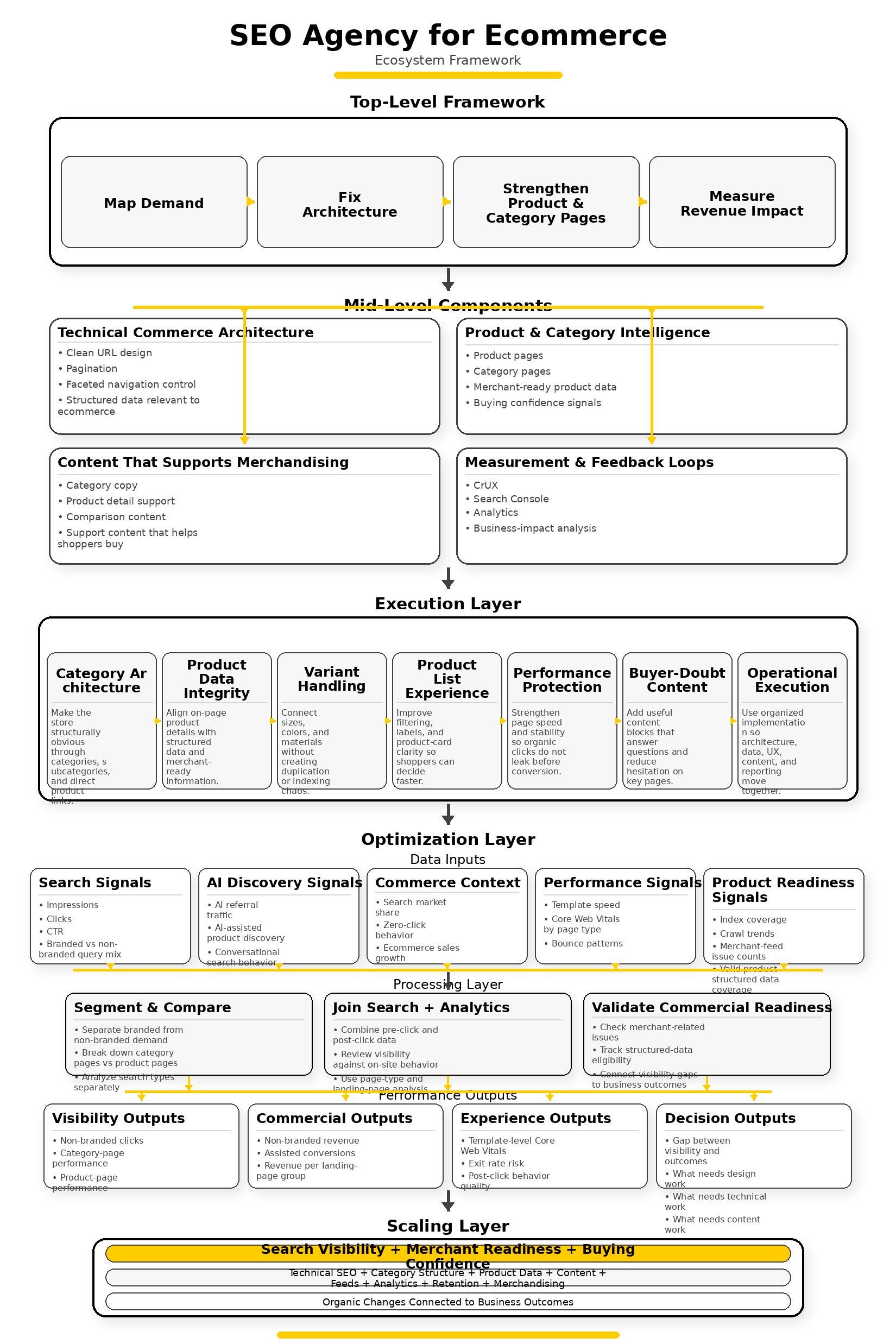
This is the point where a seo agency for ecommerce has to prove it is working from evidence instead of opinion. Strategy always sounds smart in a kickoff call, but numbers are what tell you whether the agency understands how discovery is changing, whether your product pages are earning qualified attention, and whether technical work is actually pushing revenue in the right direction. The strongest agencies do not hide behind vague traffic charts. They show which numbers matter, why those numbers matter, and what they are going to change next because of them.
That matters even more now because ecommerce search is going through two shifts at the same time. Search engines still dominate discovery, but click behavior is getting more fragmented and more compressed, especially when AI summaries answer part of the journey before the shopper ever reaches your site. So the right data set has to cover both the old reality of search demand and the newer reality of AI-assisted discovery, merchant data, and post-click performance.
Search Is Still Big, But Clicks Are Harder To Win
The first number that keeps this whole conversation grounded is simple: Statcounter’s worldwide data for February 2026 still puts Google at 90.01% of search market share. That means organic search is still too important for ecommerce brands to treat casually, and it explains why a serious agency still spends so much time on Google-facing fundamentals like architecture, product data, and category intent. But dominance does not mean easy clicks anymore, because Bain’s February 2025 research, echoed again in its follow-up analysis and the matching PRNewswire release, found that 80% of consumers rely on AI-written results for at least 40% of their searches, about 60% of searches on traditional engines now end without the user moving to another site, and organic web traffic can fall by 15% to 25% as a result.
That is exactly why raw rankings no longer tell the full story. A good ecommerce SEO agency should still care about visibility, but it also needs to watch impression share, click-through patterns, branded versus non-branded query mix, and whether product pages are earning traffic from the queries that actually signal buying intent. If the agency is bragging about positions while clicks and revenue are drifting the wrong way, it is measuring the wrong fight.
AI Shopping Behavior Is Now A Real Data Source
A lot of teams still talk about AI shopping behavior like it is hypothetical, but the data stopped being hypothetical a while ago. Adobe reported in March 2025, and Forbes, MarTech, and Search Engine Land all covered the same findings, that traffic from generative AI sources to U.S. retail websites had jumped 1,200% by February 2025 compared with July 2024. Adobe’s later August 2025 update, supported by eMarketer, Forbes, and Retail Brew, pushed the story further with a 4,700% year-over-year surge in July 2025.
The consumer side moved with it. In the March 2025 Adobe survey, 39% of U.S. consumers said they had already used generative AI for online shopping and 53% said they planned to do so that year, a set of numbers repeated by eMarketer, Yahoo Finance, and Search Engine Land. For an ecommerce SEO agency, that means AI referral traffic, AI-assisted product discovery, and the language people use in conversational search should now be part of monthly reporting instead of a side note somebody mentions on LinkedIn.
Ecommerce Keeps Growing Faster Than Total Retail
The macro backdrop also matters, because it tells you whether this channel deserves aggressive investment or defensive maintenance. The U.S. Census Bureau’s March 2026 release shows that total U.S. ecommerce sales for 2025 reached $1.2337 trillion, up 5.4% year over year, and accounted for 16.4% of total retail sales. The same underlying series appears in FRED, while Digital Commerce 360 and PYMNTS both highlighted how online retail kept outpacing the broader market.
That matters because it changes what “good enough” looks like. If ecommerce as a whole is still expanding faster than total retail, then an agency should not frame flat organic revenue as a win unless there is a very clear reason for it. In a growing market, a great SEO partner should be able to show how the store is capturing more of the demand that is already moving online instead of merely holding its place.
Performance Data Still Deserves A Seat At The Table
Performance numbers still belong in the same conversation as SEO numbers because the click is only the beginning of the commercial journey. Google’s own documentation says Core Web Vitals measure real-world loading performance, interactivity, and visual stability, and web.dev’s business-impact collection exists because these technical shifts can show up in commercial results. One of the freshest ecommerce examples is Ray-Ban’s January 2025 case study, where faster future navigations through prerendering were tied to a doubling of conversion rate and a 13% reduction in exit rate.
This is one of the easiest ways to spot whether a seo agency for ecommerce really understands the whole buying path. If their reporting stops at impressions and clicks, they are only measuring how well the store is invited into the conversation. If they also track template speed, Core Web Vitals by page type, bounce patterns, assisted conversions, and revenue per landing-page group, they are measuring whether the store is actually winning after the click arrives.
The Metrics An Agency Should Report Every Month
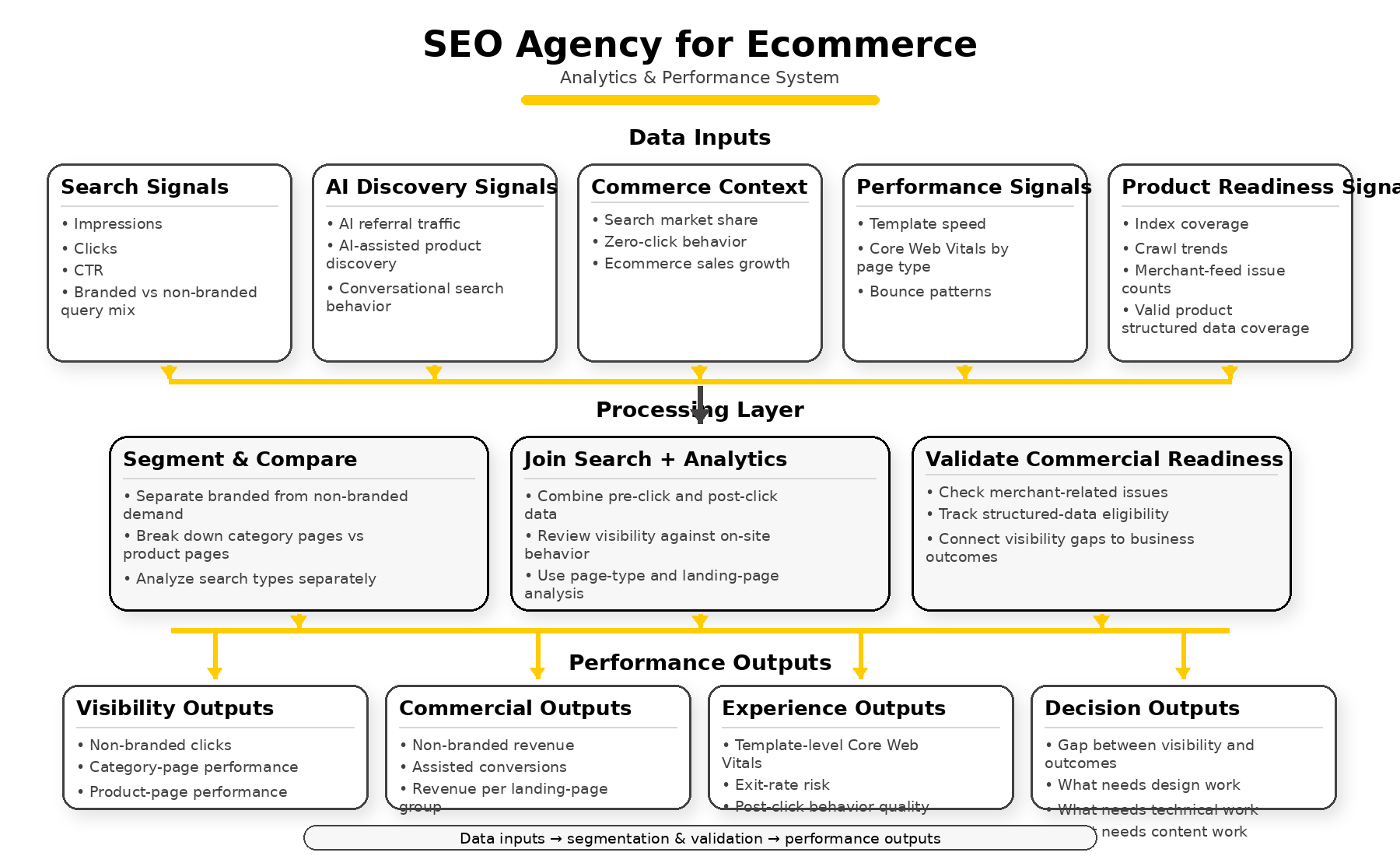
Monthly reporting should be practical enough that you can decide where to invest next without guessing. At a minimum, an ecommerce SEO agency should show non-branded clicks, non-branded revenue, category-page performance, product-page performance, index coverage, crawl trends, merchant-feed issue counts, valid product structured data coverage, Core Web Vitals by template, AI referral traffic, and the gap between visibility and actual commercial outcomes. When that data is presented clearly, you can see whether the problem is discovery, merchandising, speed, trust, or conversion friction instead of hearing the same generic “SEO takes time” explanation every month.
Some brands also tighten that reporting loop with tools that connect traffic to the rest of the revenue system. It is common to pair organic landing paths with ClickFunnels for offer and funnel measurement, Brevo for post-click lifecycle tracking, Copper for sales visibility, and Dub for cleaner link attribution when campaigns branch across channels. Those tools will not fix weak SEO by themselves, but they do make it much easier to prove whether the agency’s work is creating business value beyond a prettier report.
Ecosystem And Long-Term Growth

The long game with a seo agency for ecommerce is not just getting more pages indexed or picking up a few better rankings. It is building an ecosystem where technical SEO, category structure, product data, content, feeds, analytics, retention, and merchandising all strengthen each other instead of pulling in different directions. When that happens, SEO stops feeling like an isolated marketing service and starts acting like a growth layer that improves the whole store.
That kind of ecosystem matters more now because ecommerce discovery is spreading across more surfaces than before. Google’s documentation on where ecommerce data can appear makes it clear that products can surface across Search, the Shopping tab, Images, Maps, Lens, and more. At the same time, Adobe’s January 2026 analysis of 1 trillion U.S. retail visits showed retail AI-driven traffic up 693% year over year during the 2025 holiday season, which is another reminder that product discovery is moving through more channels, more formats, and more machine-assisted experiences.
That is why the right ecommerce SEO partner thinks beyond rankings. The agency should understand how your store is discovered, how your product data is interpreted, how your pages help people decide, and how your post-click systems turn discovery into revenue and repeat business. If those parts are disconnected, growth stays fragile. If those parts are connected, the store becomes much harder to outcompete.
FAQ For This Complete Guide
What Does An Ecommerce SEO Agency Actually Do?
A good ecommerce SEO agency does much more than optimize a few keywords. It usually works on site structure, category strategy, product page quality, structured data, Merchant Center alignment, internal linking, technical SEO, and reporting that ties search performance back to revenue. Google’s own guidance on hiring an SEO and its ecommerce-specific documentation make that broader role pretty clear.
Is Ecommerce SEO Still Worth It In The AI Era?
Yes, but the job has changed. Google still holds about 90.01% of worldwide search market share as of February 2026, so search visibility is still incredibly valuable, but Bain’s research on zero-click and AI-assisted search behavior shows why brands need to care about visibility, click-through patterns, and on-site performance together. In other words, SEO still matters a lot, but it now has to work inside a more complex discovery environment.
How Do I Know If An Agency Understands Ecommerce?
You can usually tell by the questions it asks. A real ecommerce-focused agency will ask about your catalog structure, product variants, filters, feeds, Merchant Center, category hierarchy, platform limitations, margin priorities, and how revenue flows by page type. If the conversation stays stuck on blog content and backlinks, that is usually a sign the agency is applying a generic SEO model to a much more specialized business.
Should I Hire A General SEO Agency Or A Specialist?
For most stores, a specialist is the safer bet because ecommerce has structural problems that do not show up on simpler sites. Google has entire sections dedicated to ecommerce URL structure, pagination, and faceted navigation, which tells you how different the work really is. A specialist is more likely to see the technical and merchandising issues that directly affect catalog growth.
How Long Does Ecommerce SEO Take To Show Results?
There is no honest fixed timeline because results depend on the size of the catalog, the technical condition of the store, the level of competition, and how quickly changes can be implemented. Some wins appear relatively early when crawl issues, template weaknesses, or product data problems are fixed, while broader category growth takes longer. The best agency will not sell you a fantasy calendar; it will show you what it is prioritizing first and why those tasks should produce the earliest meaningful gains.
What Metrics Should I Watch Every Month?
You should watch non-branded clicks, non-branded revenue, category-page performance, product-page performance, indexed page health, merchant-feed issues, structured-data validation, and Core Web Vitals by template. Google’s branded queries filter in Search Console makes it easier to separate existing brand demand from real discovery growth, and its guidance on using Search Console with Google Analytics helps connect pre-click and post-click performance. Those are the metrics that tell you whether SEO is driving actual business progress instead of surface-level movement.
Does Structured Data Really Matter For Ecommerce?
Yes, because it helps search systems understand your products more clearly. Google’s documentation on product structured data, product variants, and merchant listing markup shows how this information can support richer product understanding and eligibility for enhanced experiences. It is not magic by itself, but it is a core part of a healthy ecommerce SEO setup.
How Important Is Merchant Center For Organic Growth?
It is more important than many brands realize. Google’s Merchant Center product data specification makes it clear that product information needs to be accurate and complete, while Google’s guidance on sharing product data explains how feeds and structured data together improve Google’s understanding of products, pricing, discounts, and shipping. If an agency ignores the feed layer, it is ignoring part of how ecommerce discovery now works.
Can A Good Agency Help With Category Pages More Than Blog Content?
Absolutely, and in many stores that is where the biggest gains live. Category pages often sit much closer to purchase intent than informational blog posts, and they also play a huge role in internal linking, discoverability, and product finding. Baymard’s product-finding research update and its work on product lists and filtering show why better category experiences can improve both usability and commercial performance.
Does Site Speed Really Affect Ecommerce Results?
Yes, because speed affects what happens after the click. Google treats Core Web Vitals as real-world measures of loading, interactivity, and visual stability, and web.dev’s business-impact case studies show why performance improvements can influence outcomes beyond technical scores. One of the clearest recent examples is Ray-Ban’s 2025 case study, where faster future navigations were tied to a doubled conversion rate and lower exit rate.
What Are The Biggest Red Flags When Choosing An Agency?
Be careful with agencies that promise guaranteed rankings, avoid specific explanations, or cannot tell you how their work connects to business results. Google’s advice on choosing an SEO specifically warns against deceptive tactics and unclear practices, and that warning becomes even more important in ecommerce where a bad decision can affect thousands of URLs at once. If the agency cannot explain what it is changing, why it matters, and how success will be measured, that is a serious problem.
Should My Agency Care About AI Referral Traffic Now?
Yes, because it is no longer a fringe signal. Adobe’s March 2025 retail study showed AI-driven traffic to U.S. retail websites up 1,200% from July 2024 to February 2025, and Adobe’s August 2025 update showed that the surge kept accelerating. A strong ecommerce SEO agency should now be watching how AI-assisted discovery affects product research, landing-page behavior, and content opportunities.
What Should Happen In The First 90 Days?
The first 90 days should feel focused and diagnostic, not chaotic. A capable agency will usually audit crawl and index health, review site structure, analyze category and product templates, validate structured data, check feed quality, and prioritize the changes most likely to unlock revenue first. By the end of that period, you should have a clear roadmap, early implementation wins, and a reporting model that makes the next decisions easier instead of murkier.
Can Tools Strengthen The Work An Agency Is Doing?
Yes, as long as the tools support the strategy instead of replacing it. Some brands use ClickFunnels for stronger landing-path testing, Systeme.io for simpler funnel and automation workflows, Brevo for lifecycle follow-up, ScaledMail for email infrastructure, and Chatbase or Comp AI when AI support or process layers make the system more efficient. Those tools can help, but they only create real leverage when the underlying SEO strategy is already solid.
Work With Professionals
If you made it this far, you probably already know this is not the kind of project you want handled by someone guessing their way through a checklist. A strong seo agency for ecommerce should understand your catalog, your data, your page templates, your reporting, and the way search now overlaps with merchant experiences, AI discovery, and post-click conversion. That level of help is not just about getting more traffic. It is about building a store that is easier to find, easier to trust, and easier to grow.
That is also why the best partner usually feels less like a vendor and more like part of your operating system. The right agency helps your team focus on the changes that matter, avoid expensive distractions, and keep improving the parts of the store that compound over time. When that happens, SEO becomes one of the strongest long-term assets in the business instead of one more channel to babysit.
If you also want to strengthen the rest of the growth ecosystem around that SEO work, tools like Cal.com, Firecrawl, Fillout, Copper, BetterPic, Wispr Flow, Moosend, Flick, Guideless, Dub, iMallin, and PLR Funnels can support different parts of execution once the strategy is clear. But the order matters. First get the direction right, then use tools to make the system faster, cleaner, and more profitable.
Explore 10K+ Remote Marketing Contracts on MarkeWork.com
Most marketers spend too much time chasing clients, competing on crowded platforms, and losing a percentage of every project to middlemen.
MarkeWork gives you a better way. Browse thousands of remote marketing contracts and connect directly with companies desperate to hire skilled marketers like you without platform commissions and without unnecessary gatekeepers.
If you’re serious about finding better opportunities and keeping 100% of what you earn, you can explore available contracts and create your profile for free at MarkeWork.com.
 Filip Konecny Enterprises