
Online marketing on TikTok is not about gambling on one viral clip and hoping the algorithm saves the quarter. It is about building a repeatable system on a platform that TikTok says reaches more than 170 million Americans and 7.5 million U.S. businesses, while DataReportal’s 2025 analysis of TikTok’s ad tools estimated global ad reach at 1.59 billion. That is why TikTok has moved out of the “nice to test” category and into the core digital mix for brands that care about attention, discovery, and revenue.
The audience story is also much broader than the old stereotype that TikTok is only for kids. Pew reports that 68% of U.S. teens use TikTok and 63% of adults under 30 use it, while its 2024 teen study found about six in ten teens visit TikTok daily and its 2025 adult usage report found roughly half of 18-to-29-year-olds go on TikTok every day. When a platform sits that close to people’s daily habits, it stops being just another app and starts shaping the way online demand is created.
The bigger shift is that TikTok now behaves like entertainment, search, and commerce at the same time. Adobe found that 49% of consumers used TikTok as a search engine in 2026, up from 41% in its 2024 study, and YouGov found that 30% of U.S. TikTok users bought from TikTok Shop in the previous 12 months. That is exactly why serious brands need a framework for TikTok marketing instead of a pile of disconnected posting tips.
Article Outline
This guide is organized as a six-part system because winning on TikTok is not about one tactic. A brand can post every day and still go nowhere if it never connects audience insight, creative development, creator collaboration, paid distribution, conversion design, and measurement. The structure below is designed to move from first principles to execution in the right order.
If you are building from scratch, read the sections in sequence because each one depends on the last. If you already have a TikTok presence, use the page jumps to move directly to the part that matches your biggest bottleneck. Either way, the goal is the same: turn TikTok from a content experiment into a disciplined growth channel.
- Part 1: Why TikTok Matters for Online Marketing
- Part 2: Framework Overview
- Part 3: Core Components of a TikTok Marketing Engine
- Part 4: Professional Implementation on TikTok
- Part 5: Analytics and Optimization
- Part 6: Ecosystem Shifts and FAQ
Part 1 establishes the operating logic behind online marketing on TikTok, while the later parts will go deeper into performance analysis, ecosystem changes, and the questions businesses usually ask once they start investing real budget. That matters because TikTok rewards teams that think in systems, not teams that improvise forever.
Why TikTok Matters for Online Marketing
The first reason TikTok matters is simple: scale. A platform with more than 170 million American users and well over a billion people reachable through advertising tools worldwide is no longer a side bet. Even if a business does not sell directly inside TikTok, the platform now influences how people discover products, compare options, and form brand impressions before they ever hit a landing page.
The second reason is format. The broader market has been moving hard toward short-form video for a while, and TikTok sits right at the center of that change. HubSpot’s 2025 marketing research says short-form video remains the top-performing content format marketers are using, while IAB projects U.S. digital video ad spend will reach $72 billion in 2025. In other words, learning TikTok well is not just about learning one platform; it is about learning how modern digital attention works.
The third reason is behavior. TikTok is not merely where people scroll for entertainment after work. Adobe’s search study and WARC’s research with TikTok on the future of search both point to the same underlying reality: people now use social video platforms to explore, learn, evaluate, and narrow options before they buy. That makes TikTok strategically different from a channel that only delivers top-of-funnel awareness.
The fourth reason is commerce. TikTok is pushing closer to the point of transaction, not farther away from it. Alongside YouGov’s finding that 30% of U.S. TikTok users bought from TikTok Shop in the last year, TikTok says 83% of shoppers discovered a new product on TikTok Shop and 70% discovered a new brand there. When discovery and checkout begin to live inside the same environment, the job of marketing changes from “drive traffic somehow” to “design the entire journey more intelligently.”
There is also a cultural reason this matters. Pew found that 43% of adults under 30 regularly get news on TikTok, which tells you the platform is no longer just a place for dances, memes, or random trends. It is one of the environments where younger audiences decide what feels relevant, credible, useful, and worth sharing. That gives brands opportunity, but it also raises the bar because people can smell recycled marketing language on TikTok almost instantly.
Framework Overview
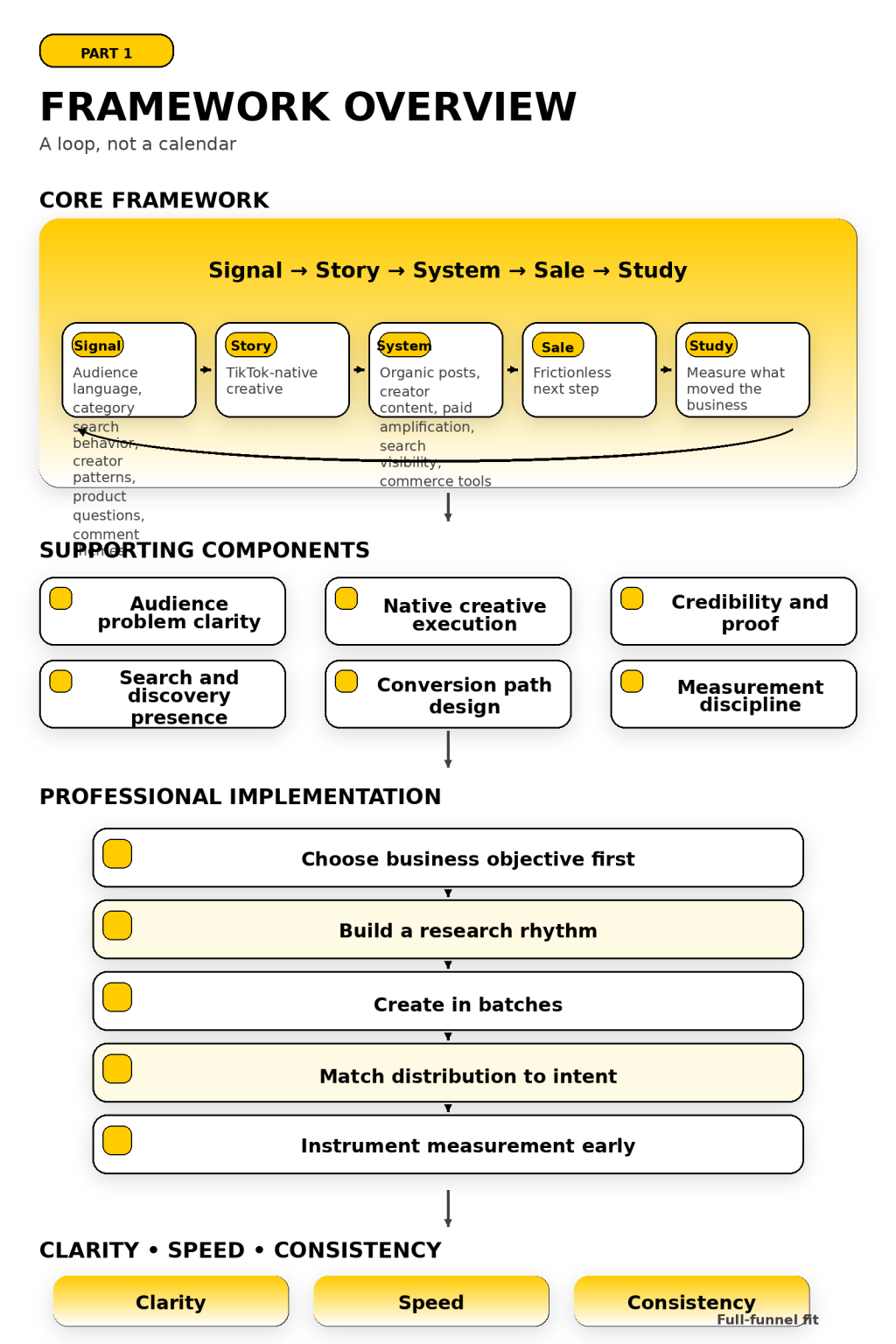
The cleanest way to think about online marketing on TikTok is as a loop, not a calendar. You start by listening to what the market is already asking, then you turn those signals into native creative, distribute that creative through the right mix of organic and paid channels, move interested viewers into a clear next step, and feed performance data back into the next round of content. That loop is the foundation because TikTok compresses discovery, persuasion, and action into one fast-moving environment.
The old playbook treated TikTok like an awareness channel where brands posted trendy videos and hoped for reach. That approach is outdated. TikTok’s own Search Ads Campaign documentation and its research with WARC both point toward a more layered model where search intent, creator trust, community signals, and conversion paths all matter at the same time.
- Signal: Start with audience language, category search behavior, creator patterns, product questions, and comment themes so your marketing begins with real curiosity instead of assumptions.
- Story: Build TikTok-native creative that earns attention quickly, sounds human, and gives people a reason to keep watching instead of skipping.
- System: Combine organic posts, creator content, paid amplification, search visibility, and commerce tools rather than relying on one format to do every job.
- Sale: Give viewers a frictionless next step, whether that means TikTok Shop, a lead form, a product page, a booking flow, or a landing page built to match the promise of the video.
- Study: Measure what actually moved the business so the next creative batch improves instead of repeating the same mistakes with more budget behind it.
This framework is also more aligned with how the platform itself is evolving. TikTok’s creative tools, commerce products, measurement solutions, and recent business product updates all move in the same direction: tighter connections between creative, distribution, shopping, and proof of impact. That is a strong clue about how professionals should structure their work.
What this means in plain English is that TikTok marketing works best when it is treated as a business system, not a content hobby. The brands that struggle usually have activity without architecture. The brands that win usually know what role each piece of content plays, what audience signal it answers, and what business action it is supposed to create.
Core Components of a TikTok Marketing Engine
Strong TikTok marketing looks casual on the surface, but the best-performing systems are rarely random. A 2024 study in the Journal of Business Research that analyzed 2,578 TikTok videos found that trustworthiness, expertise, attractiveness, authenticity, and brand heritage all shape purchase behavior. That is a helpful reminder that people do not convert because a video merely exists; they convert because the content feels credible, useful, and emotionally believable.
In practice, those academic findings need to be turned into working parts that a marketing team can actually manage. The point is not to obsess over theory for its own sake. The point is to build a TikTok engine where every major variable has a job and every job can be improved over time.
- Audience problem clarity: Every strong TikTok campaign starts with a specific frustration, aspiration, or question that viewers recognize immediately.
- Native creative execution: The videos need to feel like they belong on TikTok instead of looking like repurposed ads from another channel.
- Credibility and proof: Viewers need a reason to believe the brand, the product, or the advice, whether that proof comes from expertise, demonstrations, testimonials, or creator validation.
- Search and discovery presence: Your brand needs to show up not only in the For You feed but also when people actively explore the category through social search behavior.
- Conversion path design: Interest has to lead somewhere logical, with as little friction as possible between curiosity and action.
- Measurement discipline: The team needs a reliable way to separate vanity metrics from meaningful outcomes so creative decisions get smarter over time.
Authenticity deserves special attention because it is where many brands get this wrong. Research on sponsored user-generated content on TikTok shows that once creator content feels too obviously staged or over-controlled, perceived authenticity can drop and engagement can fall with it. That does not mean brands should fake being messy or unpolished; it means they need content that sounds like a real person making a real point inside the language of the platform.
Search is another core component now, not a bonus feature. The WARC and TikTok future-of-search study shows that search behavior is diversifying, especially among younger users, and TikTok’s own Search Ads documentation makes it clear that the platform wants brands to think in keywords, search terms, and user intent alongside creative storytelling. That matters because a business that only optimizes for passive scrolling misses people who are actively trying to solve a problem.
Conversion design is the last component that ties the engine together. For some brands, the right destination will be TikTok Shop and related commerce tools. For others, it will be a strong landing page, a lead form, an app install flow, or a booking page, but the principle stays the same: the next step must feel like a natural continuation of the video, not a jarring switch into generic sales copy.
Professional Implementation on TikTok
Professional implementation starts before the first script is written. The teams that get real results from TikTok do not begin with “What should we post today?” They begin with “What outcome are we trying to create, what audience behavior are we targeting, and what evidence will tell us whether this worked?”
- Choose the business objective first: Decide whether the real goal is awareness, qualified traffic, leads, app installs, direct sales, or repeat purchases before you touch the creative brief.
- Build a research rhythm: Use TikTok search behavior, comments, creator content, reviews, FAQs, and customer language to identify what people actually care about right now.
- Create in batches: Produce multiple angles, hooks, openings, offers, and creator variations at once so testing is built into the process instead of added later.
- Match distribution to intent: Use the right mix of organic content, paid placements, creator collaborations, search campaigns, and commerce tools based on what the campaign is supposed to do.
- Instrument measurement early: Tracking, attribution, lift, and conversion setup should be in place before scale begins, not after the budget is already spent.
This is where many businesses lose time and money. They pour effort into polished creative before they understand what the market responds to, or they isolate TikTok inside the social media team even though search, paid media, ecommerce, creator partnerships, and analytics all affect the result. TikTok’s measurement guidance is useful here because it keeps pulling marketers back toward incrementality, lift, and business outcomes instead of empty view counts.
A modern implementation stack on TikTok usually includes an official brand profile, a research process for trending questions and category language, a creator sourcing workflow, a creative testing system, clear paid media rules, and a conversion destination that matches the promise of the video. The platform’s recent business-facing tools such as TikTok One, Smart+, Market Scope, and related product updates all point toward the same operational truth: the future belongs to teams that connect creative, media, commerce, and measurement instead of treating them as separate worlds. That is the professional mindset you need before you worry about advanced tactics.
The good news is that professional implementation does not require a giant brand budget. It requires clarity, speed, and consistency. When a team understands how TikTok fits the full funnel, even simple content becomes more strategic because every post, creator brief, and ad variation is serving a defined purpose.
Start With Audience Signals, Not Content Ideas
A lot of brands open TikTok, look at a few trends, and immediately ask what they should film. That feels productive, but it is backward. A strong TikTok framework starts with what people are already trying to learn, solve, compare, or buy, which is exactly why the platform’s search behavior matters so much now.
Adobe’s 2026 research on TikTok as a search engine found that people turn to TikTok for its short video format, storytelling, and interactive feel, while TikTok’s 2025 Search Ads analysis with WARC describes search intent on the platform as unfolding across inspiration, discovery, consideration, and purchase instead of one simple keyword moment. That matters because your content framework should follow those layers of intent rather than forcing every video to behave like a direct-response ad.
The practical takeaway is that content ideation should begin with audience language. Look at category searches, repeated questions in comments, creator conversations, product objections, comparison terms, and the emotional words people use when they describe their problem. When you do that well, your TikTok strategy stops feeling like guesswork and starts feeling like market research in public.
Build Native Creative Around Trust, Not Just Reach
Once you know what the audience is looking for, the next job is turning that insight into videos that feel natural on TikTok. This is where a lot of businesses go wrong because they think “native” means sloppy, unplanned, or trend-chasing. It does not. It means the content speaks the language of the platform while still carrying a clear business purpose.
That emphasis on trust is not just a creative opinion. Recent research in the Journal of Retailing and Consumer Services shows that influencer credibility on TikTok affects trust, purchase intentions, loyalty, and recommendation behavior, while 2024 research in Psychology & Marketing found that sponsored user-generated content can lose engagement when it feels less authentic than non-sponsored content. That is a big clue for marketers: the framework has to protect credibility, not just output volume.
In real execution, this means every creative batch needs a clear point of view. One video may exist to answer a question, another to demonstrate a product, another to show a result, and another to remove risk or skepticism. When each video has a job, TikTok marketing becomes much easier to scale because you are no longer throwing random content at the feed and hoping one of the clips magically carries the whole business.

Connect Organic, Paid, and Creator Layers
A professional TikTok framework does not ask organic content to do everything on its own. Organic posts help a brand learn the language of the platform, spot early traction, build a recognizable presence, and create assets worth amplifying. But the moment a business wants more predictable reach or more controlled growth, that organic layer needs support from paid distribution and creator partnerships.
TikTok has been building more of this connection directly into its business stack. TikTok One brings creator, partner, and production workflows into one place, while TikTok’s January 2026 guidance on the Custom Identity phase-out makes it clear that brands are expected to operate from verified profiles and use native formats like Spark Ads to keep advertising closer to the actual platform experience. That shift matters because it pushes businesses toward one connected identity instead of one brand voice for organic content and another for ads.
This is also where online marketing on TikTok starts to feel more mature. Organic content teaches you what resonates. Creator content expands trust and range. Paid media lets you put fuel behind the messages that are already showing signs of life. When those three layers work together, the framework becomes much stronger than any single channel tactic on its own.
Design The Conversion Path Before You Scale
One of the fastest ways to waste TikTok attention is to earn curiosity and then send people into a weak next step. A framework only works when the promise of the video matches the destination that follows it. If the content is discovery-led, the next action might be a product page, a lead form, a newsletter signup, a demo request, or a TikTok Shop listing, but it has to feel like the natural continuation of the same conversation.
The commerce signals behind this are getting harder to ignore. EMARKETER said TikTok Shop accounted for nearly one-fifth of U.S. social commerce in 2025, YouGov found that 30% of U.S. adult TikTok users bought something from TikTok Shop in the previous 12 months, and TikTok reported in June 2025 that 83% of shoppers discovered a new product on TikTok Shop and 70% discovered a new brand there. Even if a company does not plan to sell directly inside TikTok, those signals show how tightly discovery and shopping are now connected on the platform.
That is why conversion design belongs inside the framework, not after it. Before you spend serious budget, decide where each content pillar is supposed to lead. When that decision is clear, creative gets sharper, calls to action stop feeling awkward, and it becomes much easier to tell whether the campaign actually moved the business.
Measure The Whole Loop, Not Just The Last Click
The final piece of the framework is measurement, and this is where a lot of otherwise smart TikTok campaigns get misread. If you only look at the last click, you will almost always undervalue content that created interest earlier in the journey. That is especially dangerous on TikTok because the platform often shapes discovery, trust, and intent before the final conversion happens somewhere else.
TikTok’s 2025 measurement work with WARC argues that fragmented customer journeys make older funnel-based attribution models less reliable, and the same study notes that 93% of people search on video platforms before purchase. TikTok’s newer tools follow that same logic, with Market Scope now comparing TikTok Shop and website funnels side by side and Smart+ app tools linking automation to ROAS and CPA targets. The direction is obvious: the platform wants marketers to evaluate full-funnel effects, not just the easiest number to grab in a dashboard.
So the framework should end where it began: with a loop. Study what themes earned attention, what formats held interest, what creators built trust, what landing paths converted, and where the drop-offs happened. Then feed those lessons back into the next content cycle, because that is how online marketing on TikTok becomes a repeatable growth channel instead of an endless series of disconnected experiments.
What This Means Before You Move On
If you have been trying to make TikTok work by posting more often, this section should make the real issue clearer. Frequency can help, but only when it sits inside a framework that connects audience research, native creative, distribution, conversion, and measurement. Without that structure, more activity usually just creates more noise.
The good news is that you do not need a huge team to use this framework well. You need a clear objective, a disciplined way to read audience signals, creative that feels believable, and a system for learning from results instead of guessing your way forward. In the next part, we will break this framework into the specific components that make a TikTok marketing engine actually work.
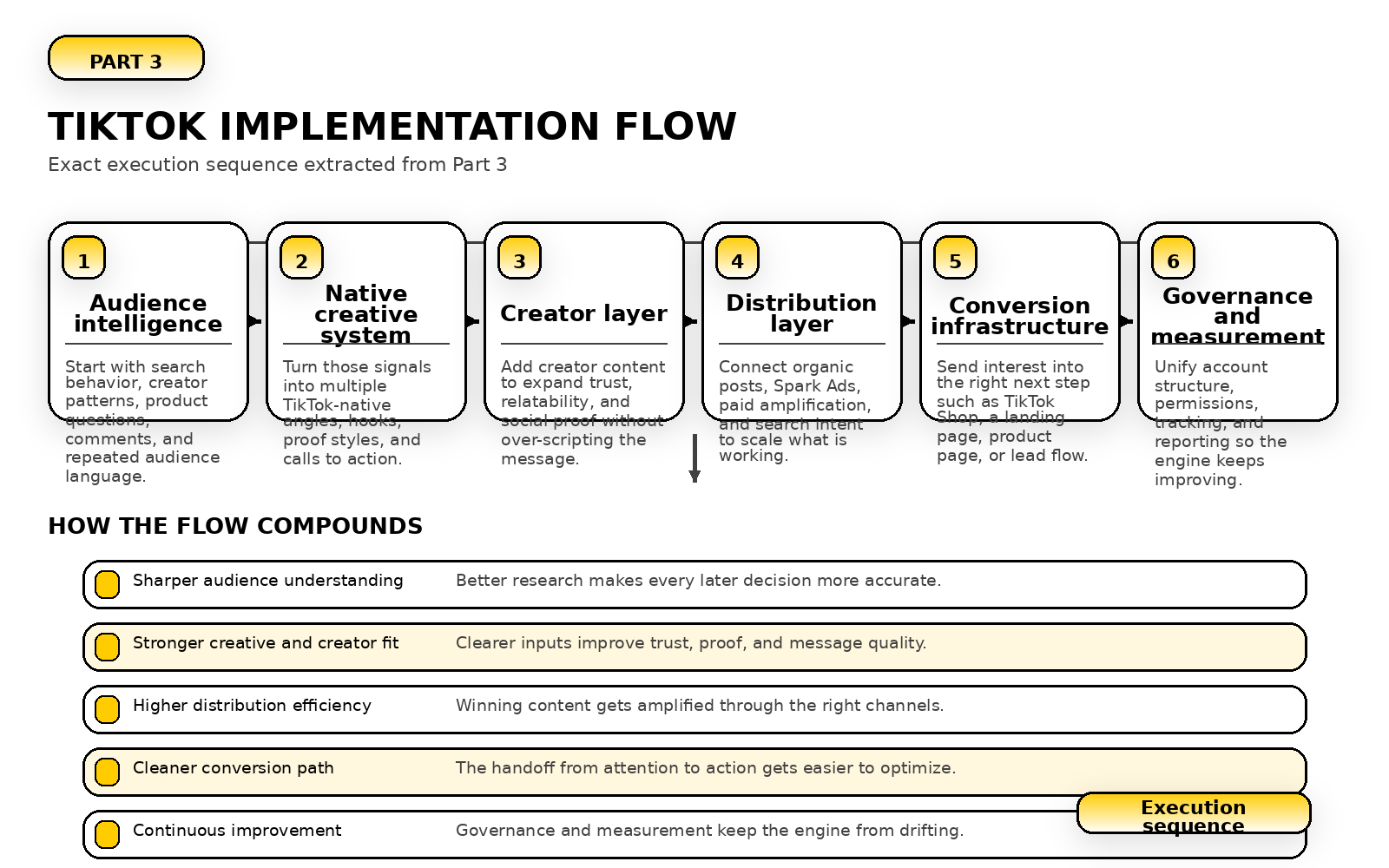
Audience Intelligence Comes First
The first core component is audience intelligence, because without it you are basically creating content in the dark. Online marketing on TikTok moves fast, and that means your audience is constantly telling you what they care about through search behavior, comments, creators they follow, products they compare, and questions they repeat. If you are not listening closely, you will keep publishing content that sounds fine in a meeting and flat in the feed.
This is not just a theory anymore. Adobe’s January 2026 survey of U.S. consumers and business owners found that nearly one in two consumers use TikTok as a search engine, and the same study showed that many business owners still struggle to turn TikTok engagement into sales. That gap matters because it tells you the job is not simply “get views.” The job is to understand what people are trying to solve, then build content and offers that meet them at the right moment.
TikTok itself is leaning harder into this insight layer. Its 2026 trend report says tools like TikTok One Insight Spotlight and TikTok Market Scope help brands track audience sentiment and market movement in real time. That is exactly the mindset you need here: stop guessing what people might care about and start reading the signals they are already giving you.
Your Creative System Has To Produce Native Content Fast
The second component is the creative system itself. Not one nice-looking video. Not one campaign concept everyone falls in love with. A system. If online marketing on TikTok is going to produce real business results, your team needs a way to create multiple angles, multiple hooks, multiple proof styles, and multiple calls to action without turning every video into a giant production.
That matters because the platform rewards creative variety and punishes sameness. A 2024 Journal of Business Research study that analyzed 2,578 TikTok short-form video ads found that trustworthiness, expertise, and attractiveness were positively related to consumer purchase behavior, while authenticity also mattered in more nuanced ways. In plain English, people do not buy because a brand showed up on TikTok. They buy when the content feels believable, informed, and worth paying attention to.
This is why the strongest TikTok teams work from content pillars instead of random ideas. They build videos that demonstrate the product, answer objections, respond to search intent, show transformation, explain why something matters, or give the audience a reason to care right now. TikTok One was launched in January 2026 partly to help marketers create more content, spend less, and scale faster, which tells you exactly where the platform thinks this is going: more variations, faster learning, and less dependence on one “perfect” ad.
The Creator Layer Expands Trust Faster Than Brand-Only Content
The third component is the creator layer, and this is where a lot of brands finally start to feel momentum. A business can say great things about itself, but on TikTok people often trust a person before they trust a polished brand message. That does not mean every creator campaign will work. It means creators are one of the fastest ways to add voice, relatability, and social proof to a marketing system that would otherwise feel too controlled.
The research behind that is strong. A 2024 study in the Journal of Retailing and Consumer Services examined influencer credibility on TikTok and linked trust in influencers to purchase intentions, loyalty, and recommendation behavior. At the same time, 2024 research published in Psychology & Marketing found that sponsored creator content can lose engagement when it feels less authentic, which is a good warning against over-scripting everything until it sounds like standard ad copy.
That is why the creator component has to be managed carefully. TikTok’s 2025 Creator Advantage guidance positions TikTok One’s Creator Marketplace as the official collaboration layer where brands can match with creators, add anchor links, and track unified organic and paid reporting. The practical lesson is simple: creators should not sit off to the side as a one-off experiment. They should be built directly into the engine as a repeatable source of trusted creative.
Distribution Has To Capture Discovery And Intent
The fourth component is distribution, because even great creative needs the right delivery system behind it. On TikTok, distribution is not just about boosting posts. It is about deciding when content should stay organic, when it should be amplified, when creator content should be turned into Spark Ads, and when search intent is strong enough to justify a dedicated search campaign.
This matters more than ever because TikTok is no longer only a passive discovery feed. TikTok’s September 2025 Search Ads Campaign research describes a search environment where people arrive with real questions and where dedicated search activations produced stronger purchase lift than comparable initiatives without search. The same report explains why this matters operationally: marketers can work with keyword targeting, match types, negative keywords, and search term reports instead of treating TikTok as if it has no search logic at all.
TikTok is also building tighter connections between organic content and paid delivery. Its January 2026 help documentation on paid and organic optimization for brand ads explains that the system connects paid and organic results in delivery and can automatically add destination links to selected organic posts when they are amplified through Spark Ads. That should tell you how to think about distribution as a core component: not as an afterthought, but as the bridge between content that earns attention and campaigns that turn that attention into business impact.
Conversion Infrastructure Turns Interest Into Revenue
The fifth component is conversion infrastructure, and this is where plenty of TikTok strategies quietly fall apart. A video can earn comments, saves, profile visits, and product curiosity, but if the next step is weak, all of that momentum disappears. That is why online marketing on TikTok needs a destination strategy just as much as it needs a content strategy.
There is a major commerce signal here. EMARKETER’s December 2025 forecast described TikTok Shop as a major force in U.S. social commerce, and TikTok’s June 2025 research with GlobalData shows how central discovery is to that behavior, with shoppers using the platform to find products, brands, and live shopping experiences before they buy. That does not mean every business should sell inside TikTok Shop. It does mean the handoff from content to transaction has to be designed with much more care than most brands give it.
For some businesses, the right conversion infrastructure will be TikTok Shop. For others, it will be a landing page, product page, demo booking flow, lead form, or app install funnel. The key is that each destination has to match the promise of the content that sent the person there. If the video feels personal and useful but the next page feels generic and disconnected, the engine breaks right at the moment it was supposed to produce value.
Governance And Measurement Keep The Engine From Drifting
The final component is governance and measurement. This sounds less exciting than creators or content, but it is one of the reasons serious TikTok programs separate themselves from casual brand activity. If nobody owns permissions, account structure, measurement logic, asset approvals, and reporting standards, the channel slowly turns into chaos.
TikTok’s own product changes make that even clearer. Its January 2026 Custom Identity transition notice says the platform is phasing out ads run without an official linked account, which means verified profiles and a more unified public presence are becoming standard. On top of that, TikTok Market Scope now describes itself as a full-funnel analytics platform that unifies first-party signals, content interactions, creator activity, and advanced modeling, showing that TikTok expects brands to measure how people move across the ecosystem instead of staring at isolated metrics.
This is why governance belongs in the core engine. You need a clean brand presence, clear account permissions, consistent naming, a shared asset library, and reporting that connects awareness, engagement, creator output, traffic, and sales. When those foundations are in place, TikTok stops feeling like a wild platform that is impossible to manage and starts feeling like a channel you can scale intelligently.
Why These Components Matter Together
Each component is powerful on its own, but the real advantage comes when they work together. Audience intelligence makes the creative sharper. Better creative makes creator partnerships easier to scale. Strong creator content improves distribution performance. Smart distribution makes the conversion path more efficient. Governance and measurement help you keep improving instead of repeating the same mistakes with more budget.
That is the difference between being active on TikTok and being effective on TikTok. The businesses that win with online marketing on TikTok are not usually the ones with the most random output. They are the ones that build an engine, keep tuning the parts, and refuse to treat the platform like a place where strategy goes to die.
Now that the components are clear, the next step is execution. In the next section, we will move from structure to professional implementation so you can see how these components get turned into a working process inside a real marketing operation.
Statistics and Data

Statistics only help if they change what you do next. That is especially true with online marketing on TikTok, because the platform moves too fast for vanity reporting to be useful for long. If you are looking at numbers without asking what they mean for creative, search behavior, commerce, and attribution, you are collecting dashboards instead of building an advantage.
The smartest way to read TikTok data is to separate it into four buckets. First, you need scale data so you understand whether the audience is large enough and active enough to matter. Then you need intent data, commerce data, and measurement data, because those are the numbers that tell you whether TikTok is just generating attention or actually helping move people toward a sale.
The Scale Numbers Tell You Whether TikTok Deserves Serious Investment
The case for taking TikTok seriously is no longer built on hype. TikTok’s newsroom says the platform has a global community of over 1 billion users, while an Oxford Economics report published through TikTok in March 2025 estimated that 7.5 million U.S. businesses on TikTok employ more than 28 million workers. On the advertising side, DataReportal’s 2025 analysis of TikTok’s own ad tools showed that TikTok ads reached 1.59 billion users in January 2025.
But this is where a good marketer slows down and reads carefully. DataReportal also makes it clear that ad reach is not the same thing as total active users, which matters because sloppy reporting can turn one impressive number into a bad strategy. The lesson is simple: use these scale numbers to justify attention and budget, but do not confuse potential reach with guaranteed relevance.
Daily Usage Data Explains Why Attention On TikTok Feels Different
The real strength of online marketing on TikTok is not just that a lot of people have the app. It is that many people use it with real frequency. Pew’s 2025 U.S. adult social media report found that 24% of American adults use TikTok daily, and that roughly half of adults ages 18 to 29 go on TikTok at least once a day. For younger audiences, the behavior is even more intense, with Pew’s 2024 teen study showing that about six in ten teens visit TikTok daily and 16% say they are on it almost constantly.
Those numbers matter because frequency changes what marketing can do. A platform people check occasionally can help with awareness, but a platform people return to every day can shape habits, preferences, and purchasing decisions over time. That is why TikTok content often works best when it is treated as an ongoing system of trust-building rather than a one-off campaign trying to force a sale on first contact.
Search Data Shows That TikTok Is Not Just A Feed Anymore
This is one of the most important shifts in the whole platform. TikTok’s own 2026 business positioning says that billions of searches happen on TikTok every day, up more than 40% year over year, and that one in four users begin searching within 30 seconds of opening the app. That means online marketing on TikTok now lives in a world where entertainment and intent are colliding in real time.
The performance data around search backs that up. TikTok’s 2025 search research with WARC says that campaigns that included a dedicated Search Ads Campaign component drove 2.0x higher purchase lift than initiatives without search, while one in five TikTok search users reported making a direct purchase after finding information through TikTok search. That is a huge clue for marketers: if your TikTok strategy ignores search behavior, you are probably missing people who are already halfway to a buying decision.
Commerce Data Shows How Fast Discovery Turns Into Buying
Commerce is where a lot of old assumptions about TikTok break down. TikTok Shop’s June 2025 update said that U.S. TikTok Shop sales were up 120% year over year, while 83% of shoppers said they discovered a new product on TikTok Shop and 70% discovered a new brand. The same update said that brands and creators hosted more than 8 million hours of LIVE shopping sessions in the U.S. during 2024.
Independent survey data points in the same direction. YouGov reported in May 2025 that 30% of U.S. adult TikTok users had bought something from TikTok Shop in the previous 12 months. That does not mean every brand should rush into TikTok Shop, but it absolutely means marketers need to stop pretending TikTok is only a top-of-funnel channel.
Attribution Data Is Where Most Brands Quietly Undervalue TikTok
This is the uncomfortable part, and it is where a lot of reporting goes wrong. TikTok’s October 2024 performance and measurement release says that 79% of purchases driven by TikTok are not attributed to TikTok and that simple click-and-buy measurement undervalues TikTok conversions by 73%. If you only trust last-click reporting, TikTok will almost always look weaker than it really is.
That is why incrementality matters so much here. The same TikTok release says that advertisers saw an average conversion lift of at least 25% when comparing exposed users with people who were not exposed on TikTok, and TikTok’s 2025 measurement work with WARC highlights how Careem’s incremental testing produced a 15.4% lift in first orders. The real message is not that every campaign will hit those numbers. The real message is that TikTok often creates value earlier in the journey than old attribution models are built to see.
The Best Data Setup Connects Content, Search, And Sales
Good reporting on TikTok is not just about reading results after the fact. It is about setting up the right data infrastructure before scale begins. TikTok’s Q1 2026 product preview says TikTok Market Scope is a full-funnel analytics platform, and its January 2026 Market Scope update explains that brands can now view TikTok Shop and website funnels side by side. That is a major improvement because it lets marketers see whether TikTok is driving in-app purchases, off-platform conversions, or both.
The tracking layer matters just as much. TikTok’s Events API documentation says the tool creates a reliable connection across web, app, and offline channels such as stores and CRMs, while TikTok’s web data connection guidance recommends using Pixel plus Events API together to maximize the events sent and improve performance and measurement. That is the kind of boring setup work that does not look exciting in a strategy deck, but it is often the difference between guessing and actually knowing what TikTok is doing for the business.
The Metrics That Matter Most In Weekly Decision-Making
When you review TikTok performance every week, the goal is not to drown in numbers. It is to find the few numbers that reveal whether your system is getting stronger. On most accounts, that means watching metrics in layers instead of staring at one headline result.
- Attention metrics: hold rate, six-second view-through rate, average watch time, and completion patterns tell you whether the opening and structure are strong enough to earn attention.
- Intent metrics: search term patterns, profile visits, product page visits, add-to-cart behavior, and lead quality tell you whether curiosity is moving toward action.
- Commerce metrics: conversion rate, cost per acquisition, return on ad spend, average order value, and repeat purchase signals tell you whether the offer and destination are doing their job.
- Incrementality metrics: lift studies, geo tests, and broader media mix analysis tell you whether TikTok is creating value that standard attribution is failing to capture.
And this is the part people skip way too often: one week of data is rarely the full story. TikTok is a channel where creative fatigue, trend shifts, search behavior, and creator performance can change fast, so the job is not to panic over one number. The job is to keep connecting statistics to decisions until your online marketing on TikTok becomes sharper, simpler, and a lot more profitable.
Analytics and Optimization
This is where online marketing on TikTok either starts compounding or starts wasting money. A lot of brands get through the hard part of making content, running ads, and finding a few creators, but then they stall because they do not have a reliable optimization process. They react to whatever number looks scary that day instead of building a system that tells them what to improve next.
Good optimization on TikTok is not about staring at one dashboard and hoping a winning ad appears. It is about reading signals from creative performance, search behavior, audience movement, conversion tracking, and full-funnel outcomes, then making the next round of decisions with more clarity than the last one. When that process is in place, your TikTok marketing gets stronger even when individual videos rise and fall.
Start By Measuring What TikTok Actually Influences
The first step is to stop measuring TikTok like a narrow last-click channel. TikTok Market Scope now describes itself as a full-funnel analytics platform, and that matters because online marketing on TikTok often shapes discovery, consideration, and intent before the final conversion happens somewhere else. If your measurement setup only rewards the last interaction, TikTok will usually look weaker than it really is.
The cleaner setup is to connect more than one signal source. TikTok’s web data connection guidance recommends using TikTok Pixel and Events API together because that helps maximize the events sent and improves performance and measurement, while Events API is designed to connect web, app, and offline data such as store or CRM activity. That is not glamorous work, but it gives you a much better shot at seeing what TikTok is really doing for the business.
Build A Weekly Testing Rhythm Instead Of Chasing One Winner
One of the biggest optimization mistakes on TikTok is treating one decent ad like a final answer. The platform changes too quickly for that mindset. What worked last month can flatten out fast, which is why your process has to be built around testing angles, openings, creators, editing styles, and offers on a steady rhythm.
TikTok’s ad testing guide recommends developing multiple ad versions with TikTok-specific variables like short versus longer videos, editing styles, trending sounds, and text overlays. It also says to keep the audience consistent when testing creatives so you can isolate what the creative itself is doing. That is a huge point, because a lot of marketers think they are running a clean test when they are really changing too many variables at once.
The same logic shows up in TikTok’s creative best practices for performance ads, which suggest three to five different creatives per ad group and three to five diversified ad groups per campaign. That is not a random recommendation. It exists because TikTok optimization works better when the system has enough variation to learn from and enough contrast between creatives to find what really moves performance.
Refresh Creative Before Fatigue Starts Draining Results
Creative fatigue is one of those problems that looks small in the beginning and expensive in the end. A campaign often feels stable right before it starts slipping, which is why teams that wait too long to refresh usually spend extra budget just to maintain weaker results. TikTok is very direct about this in its own documentation: the platform works better when you have a steady supply of new creative ready to go.
TikTok’s performance creative guidance says to check ad performance regularly and refresh ad group creatives when delivery shows a consistently declining trend or daily new users are low. It also recommends adding new creatives into an existing ad group instead of creating a new ad group just to refresh, which is a useful operational detail because it helps extend the life of a learning structure that is already working.
This is where a creative library becomes a real asset instead of a nice idea. If your team has hooks, proof clips, creator takes, testimonials, product demos, voiceovers, and alternative openings ready to rotate, optimization becomes much easier. If every refresh requires starting from zero, fatigue will almost always outrun your production speed.
Use Search And Organic Signals To Improve Messaging
One of the smartest things you can do in online marketing on TikTok is treat search and organic behavior like creative feedback. Comments, search terms, profile visits, product questions, and recurring objections are telling you how the market interprets your message. That is valuable because it shows you not just what people watched, but what they cared enough to investigate.
TikTok’s 2025 research on Search Ads Campaigns makes the broader case that search is now part of how purchase intent develops on the platform. That means optimization is not only about improving the video itself. It is also about refining your captions, your opening lines, your on-screen text, your creator briefs, and your product framing so the message aligns with what people are actively trying to find.
This is also where a unified brand presence starts helping more than people realize. TikTok’s 2026 shift toward a verified F.I.R.S.T. presence is built around unifying paid and organic activity, and that matters because optimization gets much stronger when your ad insights, profile activity, Spark Ads, and creator assets are all feeding the same system instead of living in separate silos.
Optimize The Funnel, Not Just The Ad Unit
A lot of campaigns get judged too early because the marketer only asks whether the ad performed well. That is not the full question. A strong TikTok ad can still look weak if the landing page is generic, the product page is slow, the lead form asks for too much too soon, or the offer does not match the promise of the video. When that happens, the creative gets blamed for a funnel problem.
TikTok’s full-funnel marketing guidance is helpful here because it frames the channel around awareness, consideration, intent, purchase, and loyalty rather than one single conversion moment. It also points out that people on TikTok do not always start at the top of the funnel, which is exactly why your optimization process needs to account for where the user actually is. Some viewers need education, some need proof, and some are already close to buying but need a cleaner path.
That is why the best optimization reviews look beyond CTR or CPA. They ask where drop-off is happening, what the user expected after watching the video, and whether the next step feels like a continuation of the same conversation. Once you start looking at TikTok that way, it becomes much easier to fix the real bottleneck instead of endlessly editing ads that were never the core problem.
Let Automation Help, But Do Not Hand It The Whole Strategy
Automation is getting much better inside TikTok, but it still works best when it is pointed at a clear strategy. TikTok’s updated Smart+ experience now lets advertisers choose between full automation, partial automation, and manual control in one flow. That is useful because it reflects the real world: some parts of optimization benefit from machine speed, while other parts still need human judgment.
The same theme shows up in TikTok’s January 2026 Smart+ product update, which introduced creative features like auto-selection of existing ads and eligible creator content. That can be powerful when you already have a good asset pool and reliable conversion data. But automation cannot decide your positioning, write a sharp point of view, or understand why a creator’s tone suddenly feels wrong for the audience. That part is still your job.
The best use of automation is to reduce mechanical work so the team can focus on better questions. Which message deserves another round of testing? Which creator angle is building trust fastest? Which part of the funnel is suppressing conversion? Those are the decisions that keep improving results, and they still require a human brain.
The Weekly Review Questions That Actually Improve Results
If you want your TikTok optimization process to keep paying off, the easiest move is to review performance the same way every single week. Not because rigid process is exciting, but because it stops you from making emotional decisions based on one bad day or one lucky spike. Consistency in analysis usually leads to much better consistency in performance.
- Which openings held attention best? This tells you whether the first seconds are doing their job or losing the audience before the story begins.
- Which proof angles created the strongest intent? Product demos, testimonials, creator explanations, before-and-after framing, and objection handling will not all work the same way.
- Which search themes and comments keep repeating? Those patterns often reveal the next set of videos, captions, and offers you should test.
- Where is the funnel leaking? If view quality is strong but conversion is weak, the problem may be the destination rather than the ad.
- Which assets are getting tired? Once fatigue shows up, refresh early instead of trying to squeeze one more week out of a creative that is already fading.
That is how analytics becomes useful instead of overwhelming. You are not trying to admire the data. You are using it to decide what to make, what to stop, what to scale, and what to fix. When online marketing on TikTok is managed that way, optimization stops feeling reactive and starts feeling like a real competitive edge.
TikTok’s Expanding Ecosystem in 2026

By this point, the biggest thing to understand about online marketing on TikTok is that the platform is no longer just a place to publish short videos and hope one of them takes off. TikTok has been building a much broader business ecosystem around search, creator collaboration, measurement, verified brand presence, and automated performance tools. You can see that clearly in TikTok’s Q1 2026 product preview, which highlights registered business accounts, partner workflows, richer audience insight tools, and lower-funnel performance updates in one connected stack.
That matters because the platform is pushing marketers toward a more professional operating model. Verified Business Accounts are tied to trust-building features like lead generation, destination links, app download links, multi-user login, and link-in-bio access, while TikTok One pulls creator discovery, partner production, Spark Ads activation, and unified reporting into one place. On the analytics side, TikTok Market Scope is positioned as a full-funnel platform that combines first-party signals, content interactions, creator activity, and modeling so brands can see how people move through the ecosystem.
The practical takeaway is simple: online marketing on TikTok keeps getting more powerful, but it is also getting less forgiving of sloppy execution. Smart+ is giving advertisers more automation across targeting, creative, placements, and budget, while TikTok’s full-funnel guidance makes it clear that people do not always enter at awareness and move in a straight line. The brands that win from here will be the ones that stay flexible, listen hard, and treat TikTok like a real growth system instead of a side project.
FAQ for This Complete Guide
Is TikTok still worth it for businesses in 2026?
Yes, but only if you approach it like a system instead of a random content habit. TikTok’s current business messaging centers on the idea that discovery, search, and action now happen much closer together on the platform, which is a strong signal that the opportunity is still very real. The catch is that online marketing on TikTok works best when content, creators, conversion paths, and measurement are connected.
Do I need paid ads to succeed with online marketing on TikTok?
No, but paid ads can help you scale what is already proving itself organically. Organic content teaches you what language the audience responds to, while paid media gives you more reach, more control, and faster learning once you find traction. The smartest path is usually to let organic content reveal the message, then use paid distribution to expand the winners instead of trying to force performance with untested ideas.
Should I use TikTok Shop or send people to my website?
That depends on the business model, the product, and how much friction your customers will tolerate before they buy. YouGov’s 2025 survey shows that plenty of TikTok users are already comfortable buying through TikTok Shop, but that does not automatically make it the right answer for every brand. If your website does a better job of educating, qualifying, or upselling, keeping that path may still make more sense than moving the transaction fully in-app.
How often should I post on TikTok?
There is no universal posting number that magically works for every account. What matters more is whether you can publish consistently enough to learn from the market, test multiple angles, and refresh creative before the account goes stale. A sustainable rhythm with strong feedback loops will almost always outperform a burst of activity followed by silence.
Do follower counts still matter on TikTok?
They matter, but not in the old way many marketers still think about them. TikTok can distribute content far beyond your follower base, which means a strong video can reach new people without a huge account behind it. Followers still help with familiarity and repeat exposure, but they are not the only engine of growth on this platform.
Can B2B companies win with online marketing on TikTok?
Yes, especially when they stop trying to sound like a white paper in video form. B2B brands tend to work best on TikTok when they teach, clarify, demonstrate, or react to real problems in language that feels human and specific. If your audience has questions, frustrations, or blind spots, TikTok can absolutely be a useful place to meet them.
Do I need creators, or can I build the channel with brand-only content?
You can do both, but creators often help you build trust faster than brand-only content can. TikTok One exists for a reason: the platform knows creator content, paid amplification, and brand storytelling are now deeply connected. If your internal team can speak in a natural voice and produce good content, start there, but do not ignore creators as the channel matures.
How do I know what to measure on TikTok?
Start by measuring what stage of the customer journey the campaign is supposed to influence. TikTok’s own funnel guidance lays out awareness, consideration, intent, purchase, and loyalty as distinct stages, which is useful because not every piece of content should be judged by last-click revenue. If you match your metrics to the actual job of the campaign, your decisions get much clearer.
What TikTok tools matter most for serious marketers right now?
The short list is pretty clear: a verified business presence, TikTok One for creator and production workflows, Market Scope for audience and funnel insight, and Smart+ for automation where it makes sense. Business verification helps unlock commercial features, Market Scope helps you understand movement across the ecosystem, and Smart+ gives you more flexible automation than earlier versions did. The right mix depends on your size and goals, but those are the core pieces worth watching.
How important is search inside TikTok now?
It is very important, and it is becoming more important over time. TikTok says billions of searches happen on the platform every day, which tells you that people are not only scrolling passively anymore. That changes how you should write hooks, frame product education, choose keywords in captions, and think about the kinds of questions your content should answer.
Should I let TikTok automation handle everything?
No, and this is where a lot of marketers get lazy. The upgraded Smart+ flow is useful because it now supports full automation, partial automation, or fully manual setups, which is a much better balance than forcing one rigid approach. Let automation help with repetitive optimization, but keep strategy, positioning, messaging, and creative judgment under human control.
How long does it usually take to see results from TikTok marketing?
That depends on what you mean by results. You can learn useful things about messaging and audience response within days, but meaningful business results usually take longer because creative testing, creator fit, landing-page alignment, and attribution all need time to settle. TikTok rewards consistency and fast learning, not panic after a few posts.
What is the biggest mistake businesses make with online marketing on TikTok?
The biggest mistake is trying to look polished before trying to be useful. On TikTok, people respond to clarity, relevance, proof, personality, and timing far more than they respond to sterile brand content that could have been made for any platform. If your videos do not feel like they belong in the culture and language of TikTok, the market will tell you very quickly.
Work With Professionals
There comes a point where trying to do everything yourself starts costing more than it saves. That usually happens when the brand has enough proof that TikTok can work, but not enough time, structure, or internal expertise to keep creative, creators, media, search behavior, and analytics moving together. At that stage, working with professionals is not about outsourcing your brain; it is about adding the systems and execution capacity that let the channel grow without falling apart.
The right professionals can help you tighten your offer, build a healthier testing rhythm, clean up attribution, source stronger creators, and stop wasting budget on content that was never positioned to win. They can also help you avoid one of the most common problems in online marketing on TikTok: having activity everywhere and clarity nowhere. When a skilled team is involved, the channel usually gets simpler, sharper, and much easier to scale.
If you are serious about turning TikTok into a reliable source of growth, it is worth getting people involved who understand the platform at a professional level. The platform is evolving too quickly for guesswork to stay cheap forever. The sooner your strategy, creative, and measurement start working together, the sooner TikTok can become a real business asset instead of a constant experiment.
Explore 10K+ Remote Marketing Contracts on MarkeWork.com
Most marketers spend too much time chasing clients, competing on crowded platforms, and losing a percentage of every project to middlemen.
MarkeWork gives you a better way. Browse thousands of remote marketing contracts and connect directly with companies desperate to hire skilled marketers like you without platform commissions and without unnecessary gatekeepers.
If you’re serious about finding better opportunities and keeping 100% of what you earn, you can explore available contracts and create your profile for free at MarkeWork.com.
 Filip Konecny Enterprises