
Instagram is not a side channel anymore. Recent platform analysis put Instagram’s advertising reach at 1.74 billion users in January 2025, and more than six in ten of the platform’s active adult users use Instagram to research brands and products, which means the app now sits much closer to the buying journey than many businesses still realize.
That is exactly why instagram marketing agencies matter more now than they did a few years ago. When digital channels already account for 61.1% of total marketing spend while marketing budgets remain flat at 7.7% of company revenue, brands do not have much room for weak creative, aimless posting, or influencer campaigns that look busy but never move revenue.
This first part gives you the foundation before the article moves deeper into measurement, optimization, and the wider agency ecosystem. The goal is to help you judge instagram marketing agencies with a clear head, so you can separate teams that simply publish content from teams that can build a system for growth, credibility, and conversion.
Article Outline
This article is structured in six parts so you can jump to the section you need now and come back to the rest when you are ready. The sequence is intentional, because hiring the right agency starts with strategy, then moves into execution, measurement, and only after that into broader ecosystem decisions and FAQs.
- Part 1: Why Instagram Marketing Agencies Matter
- Part 2: Instagram Marketing Agency Framework Overview
- Part 3: Core Components of a Strong Instagram Marketing Agency
- Part 4: Professional Implementation for Instagram Growth
- Part 5: Measurement, Reporting, and Optimization
- Part 6: Instagram Marketing Agency Ecosystem and FAQ
In this part, we are focusing on the first layer of the decision: why these agencies matter, how to think about the work they should own, what capabilities actually count, and what professional implementation should look like once you move forward. That foundation is what keeps a polished proposal from hiding weak strategy or vague accountability.
Why Instagram Marketing Agencies Matter
Instagram sits at the intersection of attention, discovery, and trust. A later 2025 DataReportal snapshot kept Instagram at roughly 62.8% of active users using the platform for brand research, which is a strong signal that people are not just scrolling for entertainment there; they are comparing options, checking legitimacy, and deciding who feels credible enough to buy from.
That creates real opportunity, but it also creates real complexity. Instagram now spreads brand activity across multiple surfaces such as Reels, Stories, DMs, Explore, and other discovery-oriented features, while 29% of B2C marketers planned to increase investment in YouTube, TikTok, and Instagram video in 2025, so the brands that win are rarely the ones posting at random or treating the platform like a simple photo feed.
The risk side matters just as much as the growth side. The FTC’s current influencer guidance makes clear that material relationships must be disclosed clearly, and the FTC’s reviews and testimonials rule that took effect on October 21, 2024 sharpened the legal risk around deceptive testimonials and fake reviews, so a capable agency is not just there to make the feed look better; it is there to help protect the brand while scaling attention.
Instagram Marketing Agency Framework Overview
The cleanest way to evaluate instagram marketing agencies is to ask four questions in order. Can the agency define the business goal with precision, can it translate that goal into content people actually want to watch, can it distribute that content through paid and partnership channels intelligently, and can it prove what is working without hiding behind vanity metrics?
This matters because Instagram rewards relevance more than noise. Sprout Social’s 2025 research found that 93% of consumers think it is important for brands to keep up with online culture, but that does not mean chasing every trend; it means understanding what your market cares about and showing up in a way that feels timely, believable, and useful.
The best framework also leaves room for the kind of content the platform is rewarding right now. HubSpot’s 2025 Social Trends research found that 76% of marketers say authentic, low-production video outperforms highly produced video, which is one more reason strong instagram marketing agencies tend to build editorial systems and feedback loops instead of overinvesting in polished assets that look expensive but do not feel native to the feed.
Core Components of a Strong Instagram Marketing Agency
The first core component is strategic clarity. A serious agency should be able to explain who the content is for, what problem the brand solves, which offer deserves attention first, and how Instagram will support the larger customer journey rather than operate as an isolated content machine.
The second core component is creative and creator execution. HubSpot’s 2025 survey of more than 1,100 global marketers found that smaller influencers with fewer than 100,000 followers were outperforming larger creators for many brands, which means strong instagram marketing agencies should know when to lean into niche creators, user-generated content, founder-led media, and partnership ads instead of defaulting to the biggest name they can afford.
The third core component is operational discipline. A good agency should have a point of view on cadence, testing, approvals, asset organization, paid amplification, and reporting rhythm, and it should be able to explain where platform-native workflows end and where tools such as Buffer or Flick can support planning, publishing, and refinement without becoming a substitute for strategy.
The fourth core component is governance. Between creator disclosures, testimonial rules, ad standards, permissions, and brand safety, professional instagram marketing agencies need to understand Meta’s advertising standards for branded content and keep those standards aligned with FTC endorsement expectations so growth does not come with unnecessary legal or reputational risk.
Professional Implementation for Instagram Growth
Professional implementation starts long before the first post goes live. The agency should begin with a proper audit of your account structure, creative history, audience signals, paid media setup, creator relationships, approval process, and baseline business metrics, because without that groundwork, even a talented team ends up guessing.
It should also be obvious how the team will work once the engagement starts. The strongest operators usually define ownership across strategy, creative, paid, community, and analytics from day one, and they can explain whether their capabilities align with the kind of expertise expected from Meta Business Partners instead of hiding behind broad claims about being “full service.”
Finally, professional implementation should produce a repeatable system, not just a burst of activity. Whether the agency is building an organic engine, running partnership ads, or scaling creator-led campaigns, it should leave you with better reporting discipline, clearer testing logic, stronger compliance habits, and a content operation that your internal team can actually understand and sustain.
A framework is what stops this whole process from becoming expensive guesswork. Too many businesses talk to instagram marketing agencies, hear a polished pitch, see a few pretty mockups, and assume that means the strategy is solid. It does not. A real framework helps you test whether the agency understands how Instagram actually drives discovery, trust, response, and sales before you hand over budget or access.
Start With the Business Outcome
The first question is not what the grid should look like. The first question is what the business needs Instagram to do over the next six to twelve months. If an agency cannot connect content, paid promotion, creator activity, and reporting to a clear commercial outcome, then it is not really building a strategy. It is just creating motion.
This is where strong instagram marketing agencies separate themselves from weak ones. They know the difference between using Instagram to generate demand, support product research, move people into DMs, lift branded search, warm up remarketing audiences, or drive direct purchases. That distinction matters because the same content system will not work equally well for a premium service brand, a fast-moving ecommerce company, and a founder-led personal brand.
The best teams also understand that Instagram now plays a bigger role in brand discovery than many companies still admit. Digital behavior research from 2025 shows that social platforms are deeply tied to how people learn about brands, and Instagram remains the leading social platform for brand research in that data set. So before anything else, the framework needs to answer one simple question: what exact kind of business movement should this account create?
Match the Instagram Surface to the Job
One of the biggest mistakes brands make is treating Instagram like a single channel. It is not. Instagram’s own ranking explanation and its overview of Search and Explore make it clear that Feed, Stories, Reels, Explore, and Search do not all work the same way, which means each surface has a different job inside the framework.
That changes how you evaluate instagram marketing agencies. If an agency talks about “posting consistently” without explaining where discovery is supposed to happen, where trust is supposed to build, and where conversion signals should appear, it is still thinking in an outdated social media model. A better team will tell you which content belongs in Reels for reach, which content belongs in Stories for relationship-building, which posts deserve paid amplification, and which assets should exist mainly to help qualified prospects validate the brand.
This is also why the framework should feel specific, not decorative. The right agency should be able to explain why certain ideas belong in a short-form format, why others need a carousel or a proof-heavy caption, and why some creative should never be left as organic-only content if the goal is speed. Once those roles are clear, the whole system becomes easier to judge.
Define the Role of Creators Early
Creator work should never be bolted onto the plan as an afterthought. If creators are part of the strategy, the framework should define whether they are being used for trust transfer, product demonstration, audience access, creative testing, or paid amplification through partnership workflows. Otherwise, brands end up paying for content that looks exciting in a recap deck but never becomes a meaningful growth asset.
Instagram for Business positions creator collaboration and creator marketplace discovery as a practical way for brands to find relevant partners, while Meta’s partnership ad materials explain how brands can extend creator content beyond the original post. That matters because smart instagram marketing agencies do not just ask, “Which creator can we hire?” They ask, “What job is this creator supposed to do, and what rights, approvals, and usage paths do we need before the campaign starts?”
That one shift in thinking saves a lot of waste. It keeps creator relationships tied to business logic instead of vanity, and it gives the brand a cleaner path to reuse high-performing content in paid environments where it can keep compounding value.

Build a Content System, Not Just a Calendar
A content calendar is useful, but it is not the framework. The framework is the logic behind the calendar: what themes deserve repetition, what objections need to be answered, what proof points should show up regularly, what creative angles need testing, and what audience reactions should trigger adaptation. Without that layer, brands end up posting because the schedule says to post, not because the message deserves attention.
This is where a lot of instagram marketing agencies still get exposed. They may be good at filling slots, but weaker at building a system that can evolve as audience behavior changes. HubSpot’s 2025 social trends work and Sprout’s 2025 research on authenticity, originality, and customer expectations both point in the same practical direction: brands need content that feels native, timely, and human, not forced trend participation for its own sake.
So the framework should ask better questions than “How often will you post?” It should ask how the agency develops ideas, how quickly it can respond to signal changes, how it balances planned content with opportunistic content, and how it keeps the brand recognizable while still adapting to the way people actually use Instagram now.
Set the Measurement Rules Before Launch
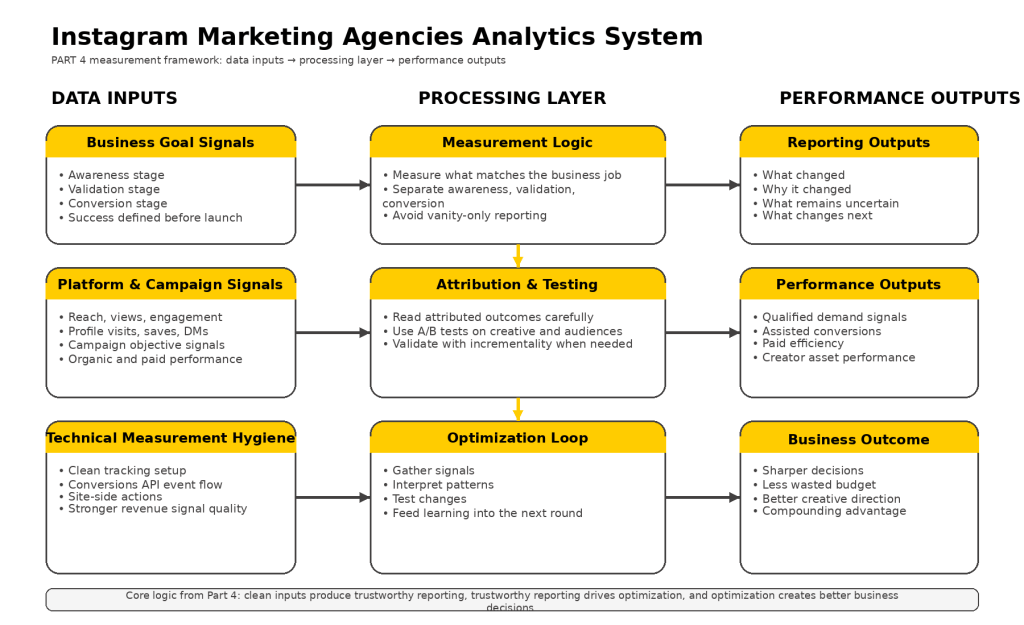
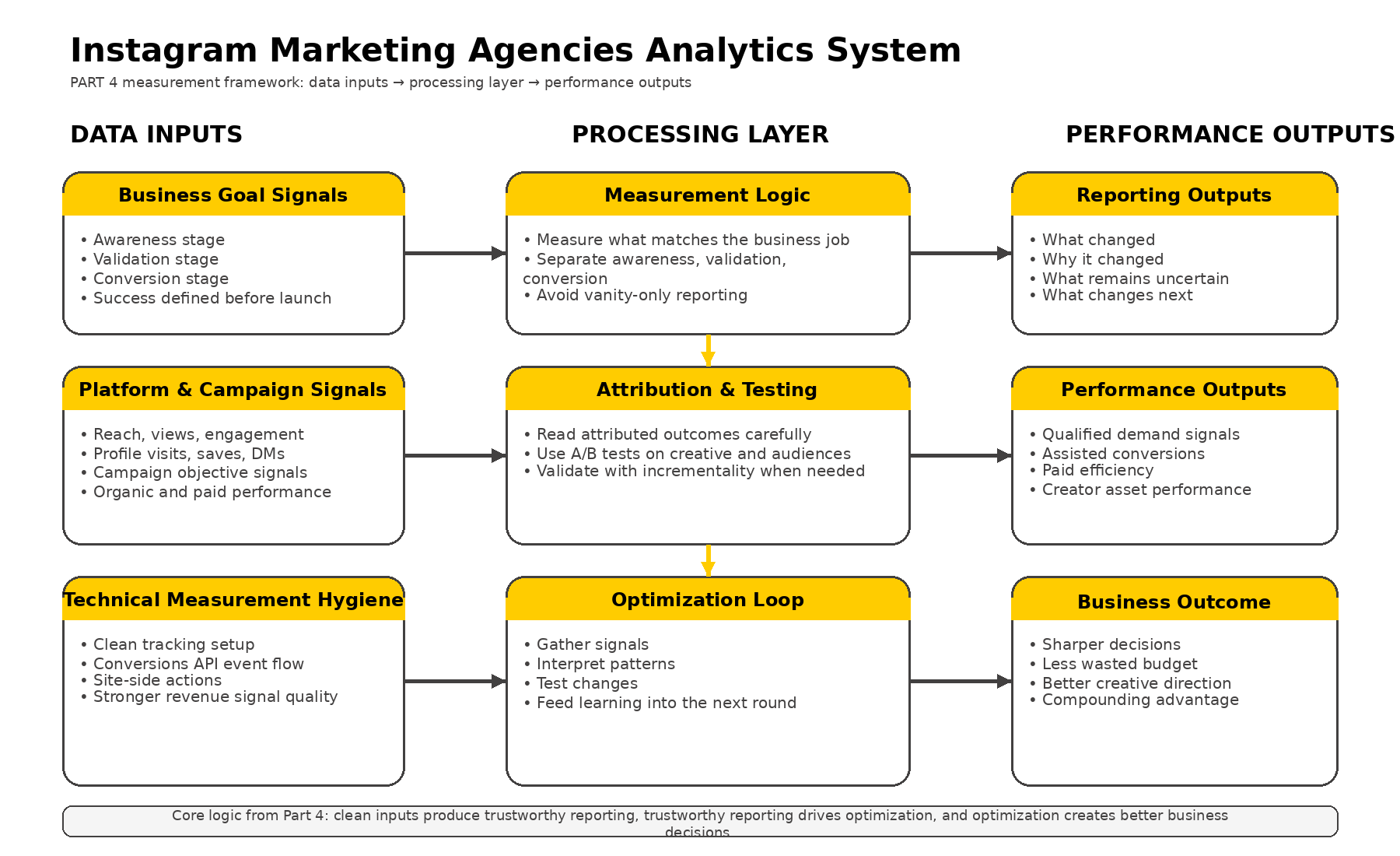
If reporting is discussed at the end of the sales call, that is a warning sign. In a strong framework, measurement is defined before production starts, because what you choose to measure changes the kind of work the agency will prioritize. Teams that are judged only on reach often chase reach. Teams that are judged on qualified response, assisted conversions, saves, retention signals, and efficient paid lift work very differently.
Instagram itself gives businesses more structure than many brands use. Professional accounts unlock the Professional Dashboard, while Meta’s guidance on Ads Manager and delivery best practices makes it clear that performance improves when creative, objective, audience, and optimization choices are aligned from the start. That is why the framework should define what success looks like at the account level, the campaign level, and the offer level before any launch happens.
It also protects you from vanity reporting. A capable agency should be comfortable showing what happened, why it happened, what changed, and what it plans to test next. If the reporting language stays fuzzy, the strategy probably is too.
Make Compliance Part of the Framework
Compliance is not the glamorous part of Instagram strategy, but it is one of the parts that can hurt you fastest when it is ignored. The framework should account for creator disclosures, testimonial usage, permissions, review practices, and ad approvals before campaigns scale. That is especially important when branded content and creator-led campaigns start blending into paid media.
The FTC’s guidance on endorsements, influencers, and reviews makes the standard very clear: material relationships and marketing claims cannot be handled casually. Professional instagram marketing agencies know this, and the better ones build simple approval rules around it so the creative team can move quickly without putting the brand in a stupid position later.
That may sound basic, but it is one of the easiest places to tell whether an agency really operates like a partner. Teams that think about disclosure, usage rights, and proof standards early are usually the same teams that think more clearly about strategy as a whole.
Use the Framework to Compare Agencies Fast
Once you have this framework in front of you, agency selection becomes much easier. You are no longer asking which team has the nicest portfolio. You are asking which team understands the business outcome, the Instagram surface mix, the role of creators, the content system, the reporting structure, and the compliance layer with the most clarity.
That is the real value of a good framework overview. It gives you a filter that cuts through vague promises and lets you hear whether an agency is thinking like an operator or just talking like one. And that matters, because with instagram marketing agencies, the difference between the two is usually what separates expensive activity from actual growth.
Audience and Offer Intelligence
A capable agency starts by understanding the people you are trying to reach and the offer you are asking them to trust. That sounds obvious, but this is the part many teams rush past because it is easier to talk about content calendars than it is to dig into buying friction, trust gaps, message-market fit, and what a prospect needs to believe before they respond. If an agency cannot explain what your audience is searching for, what they doubt, and what kind of proof they need, it is not ready to build a serious Instagram strategy.
This matters even more now because Instagram is part of how people research and validate brands, not just how they discover them. HubSpot’s 2025 social media research shows that 89% of marketers see on-platform search optimization as important to their strategy, which means a strong agency should think about content in terms of intent, discoverability, and relevance, not just reach. Good instagram marketing agencies know that audience intelligence is what tells them which angles deserve attention and which messages will fall flat no matter how good the editing looks.
Platform-Native Creative Strategy
Instagram does not reward generic content nearly as often as people think. A strong agency needs creative strategists who understand that Feed, Stories, Reels, Explore, and Search all play different roles in how people encounter and judge a brand. Instagram’s own ranking explanation and its overview of Search and Explore make that very clear, which is why smart agencies build formats around user behavior instead of forcing one style of content into every placement.
Creative strength also means understanding what people actually want from brands now. Sprout Social’s 2026 research found that educational posts were the top content type consumers wanted from brands, at 40%, with community-focused content next at 27%. That is a big clue. The agencies worth paying are not just asking how to make content look sharper; they are asking how to make it more useful, more human, and more worth stopping for.
Creator and Partnership Capability
Creator work is one of the clearest separating lines between average agencies and strong ones. On paper, almost every agency says it can handle influencers. In practice, the real question is whether the team knows how to identify the right kind of creator, structure the brief properly, secure the right usage permissions, and turn creator content into an asset that can keep working after the first post goes live.
That matters because size is no longer the whole story. HubSpot’s 2025 Social Media Marketing Report says marketers are seeing more success with influencers who have fewer than 100,000 followers, and Instagram’s creator marketplace update highlights that one of the most powerful uses of the marketplace is partnership ads. Strong instagram marketing agencies understand that creator selection is not about chasing the biggest audience in the room. It is about finding the best fit for trust, relevance, creative chemistry, and paid amplification.
Paid Media Integration
One of the biggest signs that an agency understands Instagram well is how it connects organic and paid work. Weak teams keep them separate. The content people publish, the paid team spends, and nobody really builds a loop between the two. Strong agencies do the opposite. They use organic signals to spot promising hooks, proof points, and audience reactions, then they scale those learnings through structured media buying instead of guessing which asset deserves budget.
That approach matters because social commerce is no longer fringe behavior. HubSpot’s 2025 research found that 69% of marketers believe more shopping will happen directly on social than on brand sites or marketplaces, and more than 40% of Gen Z and millennials reported buying a product directly on social in the previous three months. An agency that cannot connect creative, targeting, retargeting, and offer testing inside Ads Manager is going to leave a lot of value on the table, especially once a brand needs more than organic reach to grow.
Community Management and DM Operations
This is the component that gets overlooked all the time, and it should not. Instagram is not only a publishing platform. It is also a response environment, a customer experience channel, and in many cases the first place people go when they want to test whether a brand is actually paying attention. If an agency treats community management like a junior add-on, it is missing one of the places where trust is won or lost fastest.
The business case for this is not subtle anymore. Sprout Social’s 2025 business impact research says 73% of social users agree that if a brand does not respond to them on social, they will buy from a competitor, and its 2026 interaction analysis reinforces that people expect real, two-way interaction rather than passive broadcasting. That is why strong instagram marketing agencies build reply systems, escalation paths, DM workflows, and brand voice guidelines that make the account feel alive instead of abandoned.
Measurement Readiness and Governance
Even before you get into full analytics, one of the core components of a serious agency is simple measurement discipline. A good team knows what it is trying to influence, what signals matter at each stage, and what data should change the next decision. It also understands that tracking comments, saves, profile visits, DMs, assisted conversions, creator content performance, and paid lift tells a far more useful story than dumping top-line reach into a monthly slideshow.
Governance matters just as much. The FTC’s guidance for endorsements, influencers, and reviews and the Consumer Reviews and Testimonials Rule that took effect on October 21, 2024 mean agencies cannot be casual about creator disclosures, testimonial claims, or how social proof is used in campaigns. Add Meta’s advertising standards to that picture and you can see why the best instagram marketing agencies document approvals, claims, permissions, and usage rights before they start pushing harder on spend.
Operational Depth and Role Clarity
Finally, a strong agency has to function like a real operating team, not a pitch deck with a few freelancers behind it. Someone needs to own strategy. Someone needs to own creative direction. Someone needs to manage paid performance, someone needs to handle creator coordination, and someone needs to stay close to comments, DMs, approvals, and reporting. If all of that responsibility seems to collapse into one vague account manager, that is usually a bad sign.
You can often feel this difference in the first serious conversation. Real operators can explain how the work moves, where bottlenecks usually appear, what gets tested first, and how insights get fed back into the next round of content. That kind of clarity matters because Instagram’s professional account tools and Professional Dashboard can support the work, but tools do not replace operating discipline. The agencies that get the best results are almost always the ones with both creative instinct and process maturity working together.
Statistics and Data

Data should make your agency decision clearer, not more confusing. A lot of instagram marketing agencies throw numbers around because they know dashboards sound impressive, but the only statistics that matter are the ones that explain opportunity, buyer behavior, creative direction, and the kind of operational discipline a brand will actually need. That is why this section focuses on the numbers that change how you evaluate an agency, not the numbers that just make a proposal look busy.
The easiest mistake to make is to treat every metric as equally important. It is not. Some numbers tell you how big the opportunity is, some tell you how people use Instagram during the buying journey, and some tell you where agencies usually waste time, budget, or creative energy. When you look at the data in that order, it becomes much easier to see what strong instagram marketing agencies should be optimizing for.
Instagram Reach Data Shows the Scale of the Opportunity
DataReportal’s 2025 Instagram analysis shows that Instagram ads reached 1.74 billion users in January 2025. That is not a small, niche audience you can treat casually. It is one of the clearest signs that when brands hire instagram marketing agencies, they are not hiring for an experimental side project anymore; they are hiring for a channel with massive global commercial relevance.
The growth rate matters too. The same DataReportal analysis shows Instagram’s ad reach grew by 90.8 million users, or 5.5%, between January 2024 and January 2025, while its broader platform ranking notes that Instagram’s reported reach grew more than 5% over the year. That matters because it tells you the platform is still expanding meaningfully, which means agencies should be approaching Instagram as an active growth environment, not a mature channel that only needs maintenance.
The smart takeaway is not “post more because the audience is huge.” The smart takeaway is that scale increases competition, and competition raises the standard for creative, targeting, and reporting. That is exactly where weak agencies start to crack.
Brand Research Data Explains Why Strategy Matters
One of the most useful numbers in this entire conversation is not about impressions or engagement. DataReportal reports that 62.3% of Instagram’s active adult users use the platform to research brands and products. That means people are not just seeing content there. They are actively using Instagram to decide who looks credible, who feels relevant, and who deserves closer attention.
That single number changes how you should judge instagram marketing agencies. If prospects are using Instagram for brand research, then content has to do more than entertain. It has to answer questions, remove doubt, show proof, and make the next step feel safe.
The same report also notes that half of all adult social users now visit social platforms to learn more about brands and see the content those brands publish. In other words, the agency is not just managing a feed. It is shaping a public research layer for your business.
Shopping Data Changes How You Measure Results
Commerce behavior is another area where the numbers force a more serious standard. HubSpot’s 2025 Social Trends report says 69% of marketers believe more shopping will happen directly on social than on brand websites or third-party marketplaces. That tells you a lot about where agency strategy needs to go, especially for brands selling products people can discover, compare, and buy quickly.
The consumer side of that shift is already visible. The same report says 25% of consumers bought products directly from social media in the previous three months, and HubSpot also reports that more than 40% of Gen Z and millennials bought a product directly on social in the previous three months. Once you understand that, it becomes obvious why strong instagram marketing agencies do not stop at reach or engagement reporting.
They should be tracking signals much closer to revenue. Product views, DM intent, add-to-cart behavior, assisted conversions, creator asset performance, and paid amplification results all matter more when social platforms are increasingly part of the checkout path instead of just the awareness layer.
Community and Response Data Proves Care Is Commercial Work
A lot of brands still treat comments and DMs as soft work that can wait. The data says otherwise. Sprout Social’s 2025 research says 73% of consumers will buy from a competitor if a brand does not respond on social, which turns responsiveness from a courtesy into a revenue issue.
That has major implications for how you evaluate instagram marketing agencies. If an agency has no clear system for handling replies, routing sales questions, escalating customer issues, or keeping the brand voice consistent under pressure, then it is leaving a visible commercial gap in the strategy. The account may look polished on the surface while quietly losing trust underneath.
There is also a bigger behavioral shift happening here. Sprout Social’s 2026 research shows that consumers most want educational content from brands at 40%, with community-focused content next at 27%. That tells you people are looking for value and connection, not just volume, and the agencies that understand that are far more likely to build durable results.
Search and Creator Data Should Shape the Brief
Another number that deserves much more attention is search behavior inside social platforms. HubSpot reports that 89% of social media marketers say optimizing content for on-platform search is important to their overall strategy. That means agencies should be thinking carefully about how profiles, captions, topical relevance, creator associations, and content themes help a brand become easier to find and easier to trust.
Creator strategy should also be guided by actual performance data instead of assumptions. HubSpot’s 2025 Social Media Marketing Report says marketers are seeing more success with influencers who have fewer than 100,000 followers than with larger creators. That is important because it pushes brands away from lazy follower-count thinking and toward fit, credibility, and conversion quality.
There is a creative lesson here too. HubSpot’s 2025 Social Trends report says 76% of marketers believe authentic, low-production video outperforms highly produced video. So when instagram marketing agencies present a plan, the right question is not whether the work looks expensive. The right question is whether the creative feels native enough, useful enough, and believable enough to earn action.
How to Use the Data When Comparing Agencies
All of these numbers point in the same direction. Instagram is large, still growing, heavily involved in brand research, increasingly connected to direct shopping, sensitive to community quality, and influenced by native creative more than overproduced content. That means the agencies worth hiring should be able to explain how they will turn those realities into strategy, not just mention the data and move on.
In practice, that means asking harder questions. How will the agency build content for research behavior, not just passive scrolling? How will it connect creator work to paid distribution and direct response? How will it handle DMs, comments, search visibility, and social commerce signals without hiding behind vanity metrics?
When you use statistics this way, the conversation changes fast. You stop being impressed by presentation, and you start looking for evidence that the agency understands what the platform is actually doing right now. That is the point where the best instagram marketing agencies begin to stand out.
Instagram Marketing Agency Ecosystem and FAQ

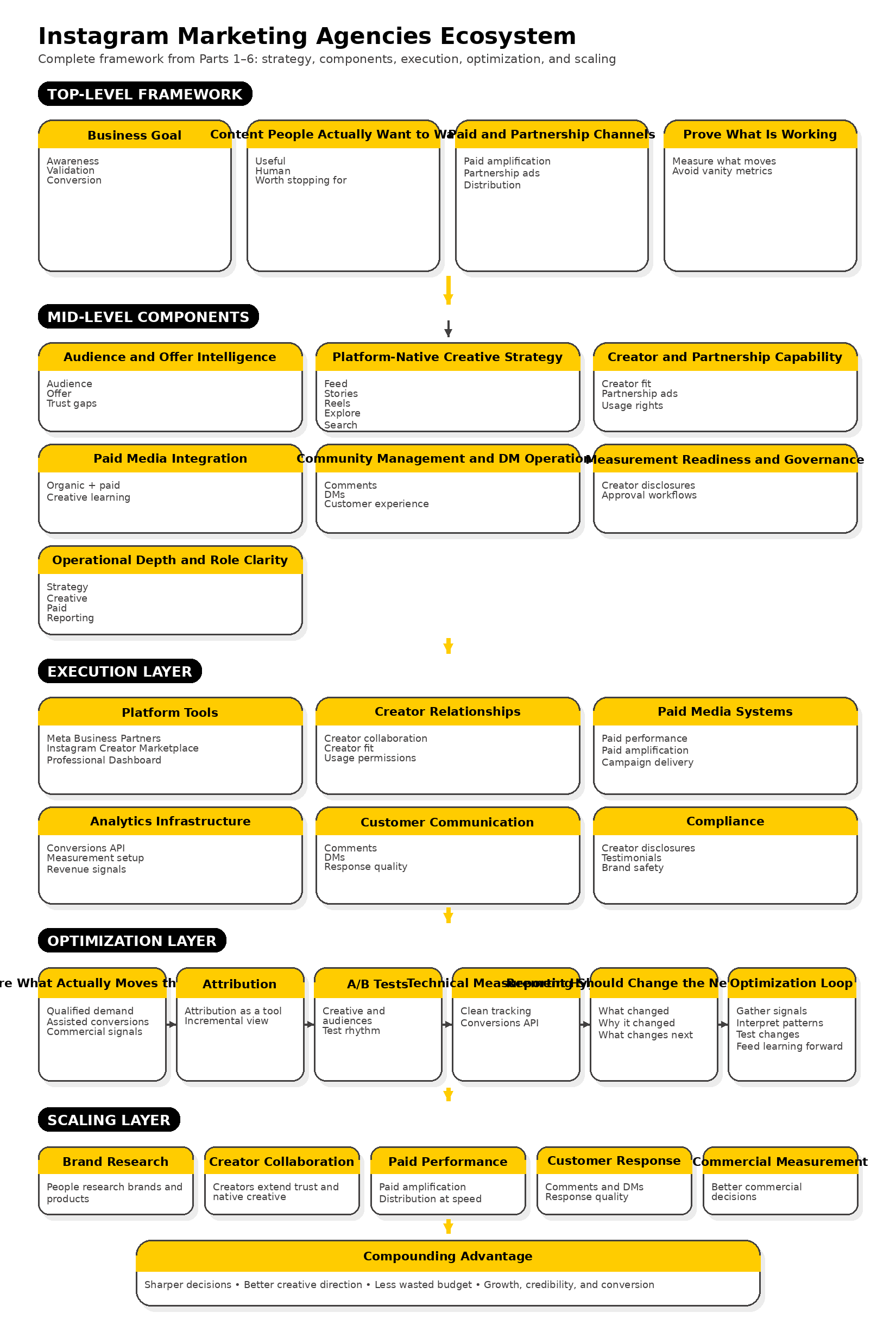
By the time you get to this point, one thing should be obvious: instagram marketing agencies do not operate in a vacuum. The strongest ones sit inside a bigger ecosystem that includes platform tools, creator relationships, paid media systems, analytics infrastructure, customer communication, and compliance. If an agency only talks about content production, it is leaving out the exact moving parts that usually decide whether the work turns into revenue or just turns into activity.
That broader ecosystem matters because Instagram now touches more than awareness. DataReportal’s 2025 social research shows that 62.3% of Instagram’s active adult users use the platform to research brands and products, which means the platform is helping people discover, compare, and validate businesses long before many conversions show up in a dashboard. Once you understand that, it becomes much easier to see why serious instagram marketing agencies care about creator fit, message clarity, response quality, paid amplification, and clean measurement all at the same time.
The platform itself supports that more connected way of working. Meta Business Partners, Instagram Creator Marketplace, the Professional Dashboard, and Meta’s Conversions API resources all point in the same direction: the brands that win are not managing isolated posts. They are building systems that make content, creators, media, and measurement work together.
FAQ for the Complete Guide
What Do Instagram Marketing Agencies Actually Do?
The good ones do far more than post content. Strong instagram marketing agencies usually handle strategy, creative planning, production oversight, creator coordination, paid amplification, community workflows, reporting, and optimization. The difference is not whether they can “manage Instagram.” The difference is whether they can turn Instagram into a system that supports brand research, trust, demand, and conversion.
When Should a Business Hire an Instagram Marketing Agency?
You should start seriously looking when Instagram has become strategically important but your team cannot give it the time, skill depth, or testing discipline it needs. That often happens when the brand is posting inconsistently, creator campaigns feel random, paid and organic are disconnected, or reporting is too vague to support decision-making. With marketing budgets still flat at 7.7% of company revenue in Gartner’s 2025 CMO Spend Survey, the right hire is usually the one that helps your team make better use of limited resources, not the one that simply promises more output.
Should I Hire a Specialist or a Full-Service Agency?
That depends on what is broken. If Instagram is the core engine for your brand, a specialist often brings sharper platform instincts, faster testing, and better creator and content judgment. If Instagram is just one part of a larger digital operation that includes search, email, landing pages, and CRM work, a broader team can make sense if it truly understands how Instagram fits into the bigger funnel.
What Should Stay In-House Versus Go to the Agency?
The brand should usually keep control of positioning, approvals, customer insight, and any sensitive commercial decisions. The agency should usually own the operating rhythm: translating strategy into content systems, managing testing, coordinating creators, structuring paid media, and turning performance data into next steps. The healthiest setup is not “we hand everything over.” It is “we know exactly who owns what and why.”
How Long Does It Take to See Results?
That depends on what kind of result you mean. Paid campaigns can generate signals quickly, but trust, creative learning, creator partnerships, and repeatable organic momentum usually take longer because they depend on accumulated insight rather than one launch. A serious agency should be willing to define early signals, mid-stage proof, and longer-term business outcomes separately so you are not judging every kind of progress by the same clock.
What Metrics Should I Ask an Agency to Report?
Ask for metrics that reflect the actual job Instagram is supposed to do. That can include profile visits, saves, qualified DMs, landing-page actions, creator asset performance, assisted conversions, paid efficiency, and message-level learnings rather than only impressions and engagement. Instagram’s Professional Dashboard and Meta’s business tools make those signals easier to organize, but the real value comes from how well the agency interprets them.
Do I Need Paid Ads If I Hire an Instagram Agency?
Not always, but many brands move faster when paid and organic work together. Organic content helps the team learn what people respond to, while paid distribution helps promising ideas reach more of the right people without waiting for the algorithm to do all the work. The key question is not whether ads are mandatory. It is whether the agency knows when paid support would accelerate the outcome you actually care about.
How Important Are Creators and Influencers?
They matter when they are tied to a clear job. Instagram Creator Marketplace exists because brands increasingly need a better way to find creators, manage partnership ads, and connect organic influence to paid performance. The real opportunity is not just access to an audience. It is access to trust, native creative, and assets that can keep working after the original partnership goes live.
What Should I Ask About Compliance?
Ask how the agency handles creator disclosures, testimonial claims, permissions, approval workflows, and proof standards. The FTC’s guidance on endorsements, influencers, and reviews is clear that material relationships and marketing claims cannot be handled casually, and the FTC’s reviews and testimonials rule that took effect on October 21, 2024 raised the stakes around deceptive review practices. If an agency gets awkward when compliance comes up, that tells you a lot.
Is Meta Business Partner Status Required?
No, but it is still a useful signal. Meta describes Business Partners as trusted experts with technical skills that help businesses grow on Facebook, Instagram, Messenger, and WhatsApp, so the status can tell you the team has invested in platform capability. It is not a substitute for strategic thinking, but it is a reasonable credibility marker when you are comparing agencies that otherwise sound similar.
Can an Agency Help With DMs and Customer Experience?
Yes, and in many cases it should. Instagram is not only a publishing channel; it is also where prospects ask questions, existing customers check responsiveness, and hesitant buyers look for reassurance. Agencies that ignore DMs and comment handling are ignoring part of the brand experience that can directly influence whether people trust the business enough to move forward.
How Do I Spot a Weak Agency Fast?
Look for vague promises, generic dashboards, and an obsession with output over outcomes. If the team cannot explain who it is trying to influence, what kind of content belongs on which Instagram surface, how creators fit into the plan, how measurement will work, and what it will optimize first, then it probably does not have a real operating model. Weak instagram marketing agencies often sound confident right up until you ask them to be specific.
Can Small Businesses Benefit From Instagram Marketing Agencies?
Yes, but the fit has to be right. Small businesses benefit most when the agency understands resource constraints, focuses on a tight offer, and builds a system that can produce clear learning instead of expensive complexity. The goal is not to imitate enterprise brands. The goal is to create focused momentum around the audience, message, and offer that matter most right now.
Work With Professionals
At the end of the day, hiring instagram marketing agencies is really about buying leverage. You are buying a faster path to clearer positioning, better creative decisions, stronger execution, and a reporting system that helps the next move get smarter. If the agency cannot deliver that kind of leverage, it is not worth the relationship no matter how polished the proposal looks.
The best teams also know when Instagram should connect to a wider operating stack. That can mean organizing publishing and approvals through Buffer, connecting lead nurture and customer communication through Brevo, or tightening client intake and discovery with tools like Fillout and Cal.com. The exact stack matters less than the principle: professionals build systems that reduce friction and keep the work moving.
So if you are serious about growth, do not settle for an agency that just keeps the feed alive. Work with people who understand how Instagram fits into brand research, creator collaboration, paid performance, customer response, and commercial measurement. That is where real momentum starts, and that is where the best instagram marketing agencies separate themselves from everybody else.
Explore 10K+ Remote Marketing Contracts on MarkeWork.com
Most marketers spend too much time chasing clients, competing on crowded platforms, and losing a percentage of every project to middlemen.
MarkeWork gives you a better way. Browse thousands of remote marketing contracts and connect directly with companies desperate to hire skilled marketers like you — without platform commissions and without unnecessary gatekeepers.
If you’re serious about finding better opportunities and keeping 100% of what you earn, you can explore available contracts and create your profile for free at MarkeWork.com.
 Filip Konecny Enterprises