
When you search for a Facebook marketing company near me, you are usually not looking for abstract brand awareness. You are looking for booked calls, qualified leads, store visits, messages, and sales from people close enough to buy. That changes everything, because local Facebook marketing only works when ads, landing pages, reviews, Google visibility, and follow-up all move together.
That is also why the cheapest offer is rarely the safest one. A company can show you polished ad screenshots and still miss the local fundamentals that decide whether a campaign turns into revenue. The goal of this guide is to help you spot that difference before you hand over your budget.
Facebook is still too large to ignore for local customer acquisition. Meta reported 3.58 billion daily active people in December 2025, with ad impressions up 18% year over year in Q4, while Pew found that 71% of U.S. adults use Facebook. That combination is exactly why the right local partner can still create serious leverage for a neighborhood business, a service-area brand, or a multi-location company.
Article Outline
This article is built in six parts so you can jump straight to what you need. The first half explains why local Facebook marketing matters and what a strong operating framework looks like. The later sections will move into analytics, partner evaluation, and the questions that separate a real operator from a smooth salesperson.
- Why a Local Facebook Marketing Company Matters
- Framework Overview
- Core Components
- Professional Implementation
- Performance and Analytics
- How to Choose the Right Local Partner
Why a Local Facebook Marketing Company Matters
A local campaign does not live inside Facebook alone. It lives in the real path a buyer takes from seeing an ad, to checking your reviews, to comparing nearby options, to deciding whether your business feels trustworthy enough to contact. That path matters more than ever because 97% of consumers read reviews for local businesses, the average person checks six review sites, and Google, Facebook, and AI tools like ChatGPT are now common sources of local recommendations.
That means the company you hire is not just buying impressions. It is shaping the full first impression your local market gets when people move from curiosity to consideration. If the ads look sharp but the reviews are stale, the business hours are wrong, or the landing page sends people into a dead end, the campaign can appear active while still underperforming where it counts.
Google makes the local side of this brutally clear. Google says local results are mainly based on relevance, distance, and popularity, and businesses with complete and accurate information are more likely to show up in local search results. A smart Facebook marketing company near you understands that weak business data, thin reviews, or inconsistent location details can quietly kill paid social performance even when the ads themselves look fine.
This is where local context becomes an advantage instead of a buzzword. A team that understands your service radius, seasonality, margins, neighborhoods, and real buyer objections can write better offers, exclude wasted geography, and send leads to the right location or rep. When that local context is missing, businesses often end up paying for attention instead of paying for outcomes.
Framework Overview

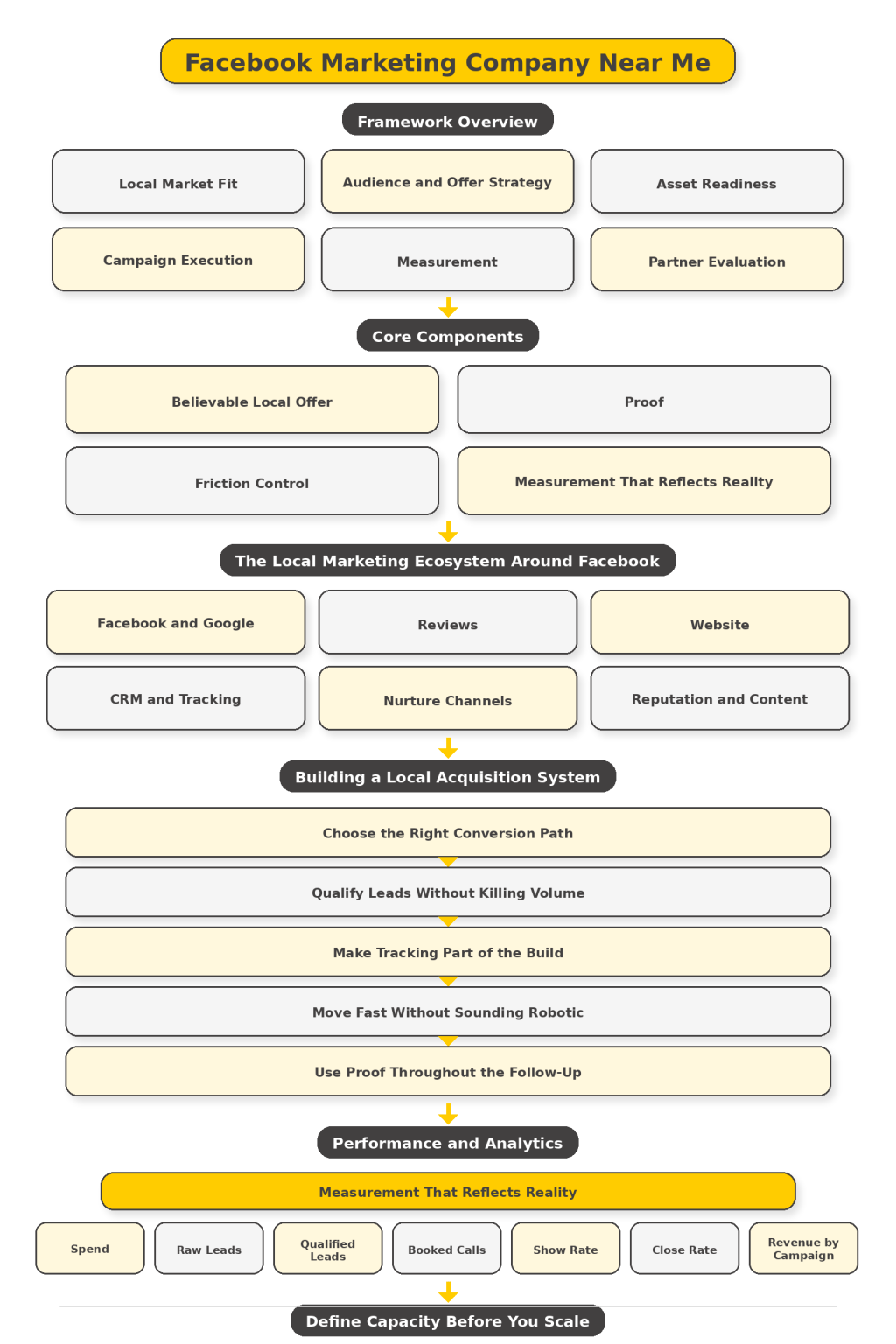
A Facebook marketing company near me search becomes much easier when you stop judging firms by presentation and start judging them by framework. The framework in this guide has six parts: local market fit, audience and offer strategy, asset readiness, campaign execution, measurement, and partner evaluation. If a company is weak in even one of those areas, your reported results can look a lot better than your actual business results.
The first layer is market fit. The company should understand who you want to reach, where those people are, what problem they want solved right now, and what proof they need before they trust you. If an agency rushes straight into targeting settings without getting clear on your offer, your price point, and your sales process, the campaign usually turns into expensive noise.
The second layer is asset readiness. Meta gives businesses multiple ways to capture intent through lead ads, click-to-message ads, and website conversion campaigns, but each path needs different creative, response speed, and tracking discipline. The right choice depends on whether your business wins through phone calls, booked appointments, messages, walk-ins, or a longer sales cycle that needs nurturing after the first click.
The third layer is credibility and transparency. Google states that there is no way to request or pay for a better local ranking, so any agency that promises guaranteed map placement should set off alarms immediately. Strong firms explain what they are testing, what they can influence, and what they cannot, and they make credibility easier to verify through public signals like the Meta Business Partners program and the Google Partners directory.
Core Components
The first core component is a believable local offer. Discounts can work, but the real job of the offer is to answer one urgent question fast: why should someone near you stop scrolling and act now instead of calling the competitor they already know. A good company will pressure-test that answer before it spends real money, because mediocre offers do not become strong offers just because the targeting is tighter.
The second core component is proof. Reviews, replies, testimonials, before-and-after visuals, and recognizable local signals all matter because buyers are trying to reduce risk before they contact you. That is exactly why BrightLocal found that 80% of consumers are more likely to use a business that responds to every review; people are not only reading what customers say, they are watching how the business behaves in public.
The third core component is friction control. A prospect who clicks from Facebook needs a fast, obvious next step, whether that is a short form, a click-to-call action, a message thread, or an appointment request. If the page is slow, the form asks for too much, or the business never responds quickly, the media budget leaks out long before your sales team gets a real chance to win the customer.
The fourth core component is measurement that reflects reality rather than vanity. Meta built the Conversions API to create a direct connection between marketing data and ad optimization systems, and serious agencies think in that direction even when the setup is simpler. They care about which campaigns produced qualified calls, showed up appointments, closed jobs, and repeat customers, not just which ad produced the cheapest click.
Professional Implementation
Professional implementation starts before the first campaign launches. A real operator checks your business profile, reviews, offer pages, creative library, lead routing, and follow-up process before scaling spend, because there is no point buying traffic for a system that is not ready to convert it. That discipline matters even more in local markets, where weak public information can damage both search visibility and ad performance at the same time.
Once the foundation is clean, the company should match the campaign type to buyer behavior instead of forcing every client into the same template. High-intent service businesses may do well with lead ads or click-to-message campaigns, while businesses with strong websites and stronger in-house sales teams may be better off driving visitors to dedicated landing pages. What you want to hear in a strategy call is not a canned pitch, but a clear explanation of why one path fits your margin, sales cycle, and operational capacity better than the others.
You should also ask how leads are captured and nurtured after the click. Some firms prefer a structured handoff into tools like ClickFunnels, Systeme.io, or Brevo, while others plug directly into the CRM or booking workflow you already use. There is no single perfect stack, but there is one non-negotiable rule: nobody should be paying for Facebook traffic if the business cannot see, contact, and qualify those leads fast.
The best companies also think beyond ads alone. They know that organic posting, review management, and message consistency all strengthen paid performance, which is why some teams pair ad execution with steady publishing workflows in tools like Buffer. When that wider system is in place, a Facebook marketing company near you stops acting like a vendor who buys clicks and starts acting like a growth partner who understands how local buyers actually make decisions.
Performance and Analytics
Measure What Turns Into Revenue
The fastest way to waste money with a Facebook marketing company near me is to let reporting stop at impressions, click-through rate, and cost per lead. Those numbers can be useful, but local businesses often close deals over the phone, in person, or after a sales conversation that happens days after the click, which is exactly why Google keeps expanding offline conversion imports, enhanced conversions for leads, and store visit conversions, while Meta keeps pushing the Conversions API as a direct connection between your data and its optimization systems. If your agency cannot show how ad spend turns into qualified calls, booked appointments, and closed revenue, it is optimizing for the easiest numbers to report instead of the numbers that actually grow the business.
That is where a lot of owners get trapped. The agency celebrates lower lead costs, the owner sees the inbox filling up, and then the sales team realizes half the leads were never serious in the first place. Cheap leads are not the same as profitable customers, and any company worth hiring should be honest about that from the beginning.
Fix Tracking Before Scaling
Good agencies do not treat tracking like a boring technical chore they can clean up later. Google’s own March 2025 updates around the Google tag and Tag Manager focused on more reliable measurement and better first-party data handling, which tells you exactly where the market is moving: cleaner implementation, stronger data quality, and fewer blind spots. A serious local partner should be comfortable talking about tags, call tracking, CRM handoff, lead status updates, and the small setup details that keep a report from lying to you.
The handoff after a click matters just as much as the click itself. Some businesses keep that pipeline simple with a short form in Fillout, push new contacts into a CRM like Copper, and let ready buyers book immediately through Cal.com. The exact stack is less important than the discipline behind it, because every lead should land somewhere visible, actionable, and measurable instead of disappearing into a spreadsheet nobody updates.
Reporting That Helps You Decide Fast
Monthly screenshots and vague summaries are not enough once real money is on the line. Google describes Looker Studio as a no-cost reporting tool built for customizable dashboards and multiple data connections, and that is the kind of visibility a strong local partner should be working toward, whether they use Looker Studio or another system. You should be able to open one report and see spend, raw leads, qualified leads, booked calls, show rate, close rate, revenue, and the campaigns that deserve more budget.
That kind of reporting changes the conversation in a good way. Instead of arguing over vanity metrics, you can make fast decisions about offer quality, response speed, landing page friction, and which neighborhoods or audiences are actually worth pursuing. That is when analytics stop being decorative and start becoming useful.
How to Choose the Right Local Partner
Questions That Expose a Real Operator
Choosing the right local partner is less about who promises the biggest numbers and more about who can explain the whole system without hiding behind jargon. Ask what they do before launch, what they need from your team, how they define a qualified lead, how they handle follow-up, and how they connect ad spend back to real business outcomes. You should also check whether they are visible in places that at least give you something public to verify, such as the Meta Business Partners program or the Google Partners directory, even though neither badge should replace critical thinking.
The quality of their answers tells you more than the polish of their pitch deck. Strong operators usually ask harder questions about your margins, close rate, service area, capacity, and buyer objections because they know those details shape campaign performance long before creative testing begins. Weak operators usually jump straight to audience targeting and ad spend because that sounds exciting and hides how little they understand the business underneath the ads.
Red Flags You Should Not Ignore
Be careful when a company wants full control of the media budget but shows no interest in your reviews, website, or response speed. BrightLocal’s 2026 Local Consumer Review Survey found that 47% of consumers will not use a business with fewer than 20 reviews, 54% check the website after reading positive reviews, and 93% have made a purchase after reading reviews, which means local ad performance is tied directly to trust signals outside the ad account. If an agency acts like Facebook ads exist in a vacuum, it is missing how real customers actually make decisions.
The other major red flag is anything that smells like review manipulation. The FTC’s final rule banning fake reviews and testimonials and its December 2025 warning letters make it clear that fabricated reviews, undisclosed insider endorsements, and incentives tied to positive sentiment are not harmless shortcuts. If a company hints that it can flood your profiles with suspicious praise or quietly suppress unhappy customers, walk away before that shortcut turns into a reputation problem you cannot control.
What the Right Fit Feels Like
The right fit usually sounds less glamorous and a lot more useful. They care about lead quality more than vanity metrics, they push for clean tracking before bigger spend, and they tell you when your offer, landing page, or sales follow-up needs work instead of pretending the ad account can solve every weakness by itself. When you find a Facebook marketing company near me that works like that, you are not just hiring someone to run ads; you are hiring a partner that can turn local attention into a system your business can actually trust.
Building a Local Acquisition System

A strong Facebook marketing company near me does not start by obsessing over ad settings. It starts by building a local acquisition system that can actually carry a prospect from first click to booked call, appointment request, or sale. That sounds obvious, but this is exactly where many campaigns quietly break down, because the ad account looks active while the handoff into the business is messy, slow, or impossible to measure.
The best local implementation work feels a little less glamorous than most agency sales calls. It is about matching buyer intent to the right conversion path, adding just enough friction to improve lead quality, and making sure tracking works before budget gets pushed. When those pieces are handled well, the campaign does not just generate activity; it generates outcomes the business can trust.
Choose the Right Conversion Path
Not every local buyer wants to convert the same way, which is why a good partner should choose the path that fits the moment instead of forcing every campaign into a single template. Meta’s lead ads with instant forms are built to generate and qualify leads directly on Facebook and Instagram, while ads that click to message send people straight into Messenger, Instagram, or WhatsApp conversations. For service businesses that live and die by speed, that difference matters a lot more than people think.
This is where strategy becomes practical. If the buyer already knows what they want and just needs a fast answer, a conversation-first path can make sense. If the purchase needs more detail, comparison, or scheduling, a structured form or website-based lead flow is often the smarter move because it gives the business more context before the sales follow-up even begins.
Meta also gives advertisers room to shape the next step more precisely than many businesses realize. Appointment request questions inside instant forms and instant form add-ons that push people toward higher-intent actions like booking appointments or visiting a website can turn a generic lead campaign into something far more useful for local operators with tight calendars and limited capacity.
Qualify Leads Without Killing Volume
Lead quality is usually where the conversation gets real. It is easy to brag about a low cost per lead when the form asks for almost nothing and the sales team has to sort through a pile of weak inquiries afterward. The right local partner understands that the job is not to squeeze the cheapest number out of the platform; the job is to bring in people who are actually worth contacting.
Meta’s instant forms include different form types such as more volume and higher intent, and that choice should be deliberate. Higher-intent forms add a review step before submission, which introduces a little more friction, but that friction can be healthy when a business would rather speak to fewer serious prospects than chase a larger list of names that never answer the phone. That is especially important when your staff is small and every bad lead steals attention from a real customer.
There is even more room to tighten quality when needed. Conditional logic in instant forms lets the business qualify or disqualify people based on how they answer earlier questions, and one-time password verification for phone numbers adds another layer of intent validation. A capable agency will not add friction everywhere just because it can, but it will use these tools when lead quality is clearly more valuable than raw volume.
Make Tracking Part of the Build
The tracking conversation should happen during implementation, not after the first month of spend. Google recommends Tag Manager as the first choice for deploying analytics and marketing tags when your platform allows it, because it gives businesses more flexibility as measurement needs grow. That matters for local companies because the real picture usually spans ads, forms, calls, CRM stages, and sales outcomes rather than a single website thank-you page.
Google’s own March 2025 Tag Manager release notes tied newer changes to stronger measurement reliability and better first-party data control, which tells you where serious implementation is heading. On the revenue side, enhanced conversions for leads and upgraded offline imports are designed to connect ad clicks, hashed lead data, CRM outcomes, and more accurate reporting. A local partner who understands this stack can give you a much clearer answer to the only question that really matters: which campaigns produced actual customers?
This is also why implementation should reach beyond the ad account. Some teams connect confirmation and nurture flows through Brevo, route outbound follow-up through ScaledMail, or add a qualifying website chat layer with Chatbase. The exact tools will vary, but the principle stays the same: the business has to see every lead, respond fast, and keep enough data tied together that the campaign can be improved with confidence.
Follow-Up and Operations Decide the Outcome
Most local campaigns are not won at the click. They are won in the hour after the click, when the prospect is still paying attention and deciding whether your business feels responsive, trustworthy, and easy to work with. That is why a Facebook marketing company near me should care just as much about operational readiness as ad creative.
This is the part many businesses underestimate because it happens outside Ads Manager. The prospect fills out a form, checks your reviews, maybe visits your website, maybe sends a message, and then waits to see what kind of business is on the other side. If the response is slow, generic, or confusing, the entire campaign loses force long before the sales team has a fair chance to close the deal.
Move Fast Without Sounding Robotic
Speed matters, but speed without judgment can still hurt you. BrightLocal’s 2026 review research found that 89% of consumers expect business owners to respond to reviews, 19% expect a same-day response, and 81% expect a response within a week. That data is about reviews, not lead forms, but the lesson carries over perfectly into local lead generation: people now expect businesses to act like they are awake and paying attention.
The quality of the reply matters too. The same BrightLocal research found that 50% of consumers are less likely to choose a business when replies feel generic or templated. A smart local partner will absolutely use automation where it helps, but it will build that automation so the first response feels clear, human, and connected to what the prospect actually asked for.
That is the balance you want. An immediate acknowledgment, a short explanation of what happens next, and a real handoff to a person who can help usually beats a longer, overproduced sequence that sounds like it came from a machine. Fast follow-up is powerful, but trust is what makes the speed worth anything.
Use Proof Throughout the Follow-Up
A local buyer almost never makes a decision based on one touchpoint alone. They see the ad, visit the site, glance at your reviews, compare you to nearby options, and look for one clear reason to believe that you are the safer choice. That means the follow-up should reinforce proof rather than assume the prospect is already sold.
Google’s local ranking guidance makes it clear that complete and accurate business information helps local visibility, and BrightLocal’s 2026 survey shows how deeply reviews influence the buying process. A good implementation plan uses that reality instead of ignoring it. Review snippets, service-area clarity, recognizable local cues, and a clean explanation of what happens next can all reduce hesitation once the lead is in motion.
This is why the best local follow-up feels consistent everywhere the prospect looks. The ad promise, the landing page headline, the review profile, the confirmation email, and the first sales message should all sound like they belong to the same business. When those signals drift apart, response rates usually drift down with them.
Protect Capacity Before You Scale
One of the easiest ways to make a campaign feel worse than it really is is to generate more demand than the business can handle well. A local clinic with limited booking slots, a home service company with only a few crews, or a law office with a packed intake schedule can damage its own results by scaling too quickly. The issue is not always lead generation; it is often that the business created demand faster than it created capacity.
The right partner watches that operational reality closely. If the sales team is drowning, appointments are being delayed, or no one is updating lead status in the CRM, spending more money can actually make performance look weaker because the business is dropping opportunities it already paid to create. Good implementation is not just about demand generation. It is also about pacing demand so the business can serve it well.
That is where simple systems matter more than flashy promises. Clear scheduling rules, visible pipelines, and agreed response windows do more for long-term growth than a dramatic one-week spike that the team cannot absorb. Local advertising scales best when operations scale with it.
What a Good First 30 Days Looks Like
The first month tells you a lot about whether an agency is operating like a professional partner or just buying time. You do not need miracles in the first 30 days, but you do need signs that the company is making smart decisions, cleaning up weak points, and building an account that can improve instead of drift. That is what separates disciplined implementation from random activity.
You should expect the early phase to feel methodical. The best teams do not rush straight to scale because they know the early job is to reduce uncertainty, gather clean signals, and protect the budget while the system gets stronger. That may sound slower, but it is usually the fastest route to a campaign that actually lasts.
Week One: Clean the Foundation
The first week should be about getting the basics right. That means checking the landing page, verifying form logic, confirming tracking, aligning offers, reviewing reviews, and making sure the business profile is complete enough that people are not running into conflicting information after the click. It also means understanding the competitive landscape before the first serious budget decisions get made.
This is one reason Meta’s Ad Library is more useful than many businesses realize. Meta describes it as a hub built for ad transparency, and that makes it a practical research tool for seeing how competitors and other advertisers in your market are positioning offers, creative angles, and calls to action. A thoughtful agency uses that visibility to sharpen your angle, not to copy someone else’s campaign line for line.
If an agency skips this stage, the problems usually show up later as wasted spend. Bad forms, muddy offers, weak proof, and broken tracking are much cheaper to fix before traffic arrives than after the campaign has already started spending every day.
Weeks Two and Three: Test the Message
Once the foundation is stable, the next job is to test what actually moves local buyers. That includes offer framing, headline language, creative formats, service-area emphasis, trust signals, and the level of qualification built into the form or message flow. The point is not to create dozens of chaotic variants. The point is to learn which message attracts the right kind of person in your market.
This is where platform features should be used with intention. Meta’s lead ad best practices recommend keeping instant forms simple and aligned to the goal, and the platform also encourages advertisers to connect CRM data back to Meta to help optimize lead ads. That combination matters because strong creative gets people in the door, but stronger data helps the system learn which prospects are actually worth chasing.
A smart agency will also pay attention to what the sales team is hearing in real conversations. The best copy is often hiding inside intake calls, chat transcripts, objections, and the phrases customers keep using when they explain what they need. Good operators mine that language and feed it back into the campaign fast.
Week Four: Cut Waste and Expand Carefully
By the fourth week, you should start seeing which combinations deserve more investment and which ones need to be cut. This is usually the moment where weak targeting, weak follow-up, or weak offer design becomes obvious enough that the business can stop guessing. What matters here is not whether every test won. What matters is whether the account is getting clearer, tighter, and more profitable with each decision.
That is also the point where the wrong agency often reveals itself. Instead of making clear cuts, it hides behind broad platform language and asks for more spend before the fundamentals are settled. The better agency does the opposite. It shows you what it learned, explains what changed, and scales the parts of the system that have already earned the right to grow.
That is what real implementation looks like. It is not magical, and it is not instant, but when a Facebook marketing company near me operates this way, you can feel the difference quickly because the campaign begins to behave like a business system instead of a pile of ads.
Statistics and Data

When someone types facebook marketing company near me into Google, they are usually trying to answer one hard question fast: is Facebook still strong enough to justify real money for a local business? The data says yes, but it also says that reach alone is not what separates winners from underperformers. What matters is whether that reach is connected to trust, measurement, and a buying path that makes sense for your market.
That is why this section matters. You do not need a hundred disconnected benchmarks. You need a small group of numbers that tells you whether Facebook still has the audience, whether local buyers still rely on public proof, and whether your reporting system is strong enough to tell the truth once the campaign is live.
Facebook Reach Still Matters
The scale question is easier to answer than the execution question. Meta reported 3.58 billion daily active people across its family of apps in December 2025, and the same filing showed that ad impressions rose 18% year over year in the fourth quarter of 2025. That matters because a local business does not need global scale to win, but it absolutely benefits from operating on a platform where attention is still abundant.
The audience is not just large in theory. Pew’s 2025 social media study found that 71% of U.S. adults use Facebook, which keeps it in the group of platforms that still matter for broad adult reach. So the real issue is no longer whether Facebook is big enough. The real issue is whether the company you hire knows how to turn that audience into qualified local demand instead of empty traffic.
Local Buyers Check More Than the Ad
This is where things get more interesting, because the ad is rarely the whole decision. BrightLocal’s 2026 Local Consumer Review Survey found that 97% of consumers read reviews for local businesses, the average person checks six review sites, and 93% have made a purchase after reading reviews. That tells you something important right away: a Facebook campaign can generate attention, but reviews and public trust signals still help decide where that attention goes next.
The same research shows just how unforgiving local buyers can be when the proof is thin. 47% of consumers say they would not use a business with fewer than 20 reviews, while 54% visit the business website after reading positive reviews. That is why a smart Facebook marketing company near me should care about your review profile, website clarity, and business information just as much as it cares about creative testing inside Ads Manager.
Google’s own local ranking guidance supports that broader picture. Google says local results are mainly shaped by relevance, distance, and prominence, and businesses with complete and accurate information are more likely to appear in local search results. In other words, local Facebook performance is rarely just a Facebook problem. It is often a visibility-and-trust problem spread across multiple surfaces.
Measurement Is Now a Data Quality Game
The next set of numbers is less exciting on the surface, but it is where serious advertisers separate themselves from everyone else. Meta’s Conversions API documentation is built around the idea that direct data connections help businesses send more reliable conversion information back to the platform. On the Google side, enhanced conversions for leads are positioned as an upgraded offline import method that offers greater durability and more accurate reporting. That is not a cosmetic shift. It is a signal that paid social and paid search both depend more heavily on clean first-party data than they did a few years ago.
This matters because local businesses often close revenue outside the browser. The lead might call, text, show up at the store, or get booked by a salesperson two days later, which means the platform can only optimize well if that outcome gets connected back to the original click. Tools can help with that once the fundamentals are in place, whether a business uses Copper to keep lead stages organized, Brevo to handle follow-up, or Fillout to clean up intake. But the bigger point is simple: cleaner data usually creates better optimization, and better optimization usually leads to less wasted spend.
Lead Quality Beats Cheap Volume
One of the most misleading numbers in local advertising is cost per lead with no context attached to it. Meta’s instant form options explicitly separate form types built for more volume from those designed for higher intent, which is a quiet reminder that the platform itself understands the tradeoff. You can make the form easier and get more names, or you can add a review step and some qualification so the business speaks to fewer people who are more likely to buy.
That is exactly why the best local agencies talk about lead quality early. A $12 lead that never answers the phone is not automatically better than a $40 lead that books, shows up, and turns into revenue. When you look at the numbers through that lens, the smartest question is no longer “How cheap can this get?” but “Which version of this campaign produces the most sales-ready demand?”
The Data That Should Drive the Decision
If you are evaluating a Facebook marketing company near me, there are really only a few numbers that deserve center stage. Audience scale tells you the platform still matters. Review and trust data tell you buyers are checking far more than the ad. Measurement guidance from Meta and Google tells you data quality now plays a bigger role in optimization than ever. And local ranking guidance from Google tells you that accurate business information still influences how discoverable and trustworthy you look once people start investigating.
That leads to a much better way to judge performance. Instead of getting hypnotized by vanity metrics, look for reporting that shows spend, lead volume, qualified lead rate, speed to contact, appointment rate, close rate, and revenue by campaign. Once that is in place, the numbers stop being decoration and start becoming the thing that tells you whether the company is actually helping your business grow.
Review Integrity Is Now a Legal Issue
There is one final data point local businesses should not brush off, and that is the legal pressure around deceptive reviews. The FTC’s final rule announced in August 2024 banned the sale or purchase of fake reviews and testimonials, and the agency sent warning letters to 10 companies in December 2025 over possible violations of that rule. That changes the math for any agency tempted to use shady shortcuts to make a weak local brand look stronger than it really is.
So yes, reputation has always mattered, but now it carries clearer enforcement risk too. A trustworthy partner should help you earn better reviews through stronger customer experience and cleaner follow-up, not through manufactured praise that creates short-term lift and long-term problems. That is the kind of data point that should influence hiring decisions immediately, because it tells you not just what works, but what kind of risk comes with working the wrong way.

FAQ for This Complete Guide
How much should I budget for a Facebook marketing company near me?
The honest answer depends on your market, margins, sales cycle, and how strong your follow-up system is before the first campaign even launches. What matters most is not just the ad budget, but whether the business can turn that spend into qualified calls, booked appointments, and closed revenue instead of collecting cheap leads that go nowhere. A smart partner will usually frame the budget conversation around capacity, expected lead quality, and the real economics of the business rather than pushing a random monthly number from the start.
Should I hire a local agency or can a remote team do just as well?
A remote team can absolutely do strong work if it understands your market, your service area, your buyer objections, and the operational limits inside the business. Still, local knowledge can be a real advantage when the offer, geography, seasonality, and neighborhood-level context shape how people buy. The better question is not where the agency sits, but whether it understands the local reality well enough to make sharp decisions without guessing.
What is the first question I should ask an agency before hiring them?
Ask how they connect Facebook activity to actual revenue inside a local business. That question gets past the performance theater quickly, because a serious company will talk about lead quality, tracking, CRM stages, follow-up speed, and reporting that shows what happened after the click. A weaker company will usually fall back on impressions, clicks, and broad promises because it has not built a system strong enough to prove real outcomes.
Does a Meta Business Partner badge really matter?
It matters, but not in the way some agencies make it sound. Meta’s Business Partners program gives you a public signal that a company has gone through Meta’s partner framework, but it does not guarantee that the firm understands your margins, your sales process, or your local market. Treat it as a credibility signal you can verify, not as a shortcut that replaces hard questions about strategy and execution.
Do I need a landing page, or can Facebook lead forms work on their own?
Both can work, and the better choice depends on how your buyers prefer to take the next step. Meta’s instant forms are designed to keep people inside the platform and can work well when speed and convenience matter, while a landing page often gives you more room to explain the offer, show proof, and pre-qualify the lead before your team gets involved. The right Facebook marketing company near you should explain why one path fits your business model better instead of pretending one setup works for everyone.
How fast should my business respond to new leads?
As fast as the business can respond well, consistently, and without sounding robotic. BrightLocal’s 2026 research found that 89% of consumers expect businesses to respond to reviews, 19% expect a same-day response, and 81% expect a reply within a week, which tells you how high responsiveness expectations have become in local buying generally. The exact timing for lead follow-up will vary by business, but the larger lesson is clear: people notice very quickly when a company feels slow, inattentive, or hard to reach.
Do reviews really matter that much if I am paying for traffic anyway?
Yes, because paid traffic often turns into a trust check before it turns into a sale. BrightLocal found that 97% of consumers read reviews for local businesses, 93% have made a purchase after reading reviews, and 54% visit the business website after seeing positive reviews. That means a paid campaign can do its job and still lose the customer if the public proof around the business feels weak, neglected, or inconsistent.
Who should own the ad account, pixel, forms, and data?
Your business should own the critical assets or at least have full admin-level access to them. That includes the ad account, the Meta pixel or broader tracking setup, the CRM connection, and any forms or landing pages tied directly to lead generation. A trustworthy partner should make your business easier to operate, not make it dependent on a setup you cannot see or control.
How long does it usually take to see results?
You can often see early signals quickly, but useful results and reliable patterns usually take longer than most sales calls suggest. The first phase should focus on getting the offer, tracking, follow-up, and qualification right so the business learns from clean data instead of reacting emotionally to the first week of activity. The best agencies do not promise instant perfection; they build a system that gets more accurate and more profitable as the feedback loop gets stronger.
Should an agency guarantee results or rankings?
You should be very cautious when an agency guarantees something it does not fully control. Google explicitly says there is no way to request or pay for a better local ranking, and the same logic applies more broadly to many performance claims that depend on offer quality, market conditions, competition, and sales execution inside the business. Confidence is good, but certainty in the wrong places is usually a red flag.
Is it ever worth using fake reviews or artificial reputation tactics to help campaigns convert?
No, and that is becoming even more dangerous than many businesses realize. The FTC’s final rule announced in August 2024 banned fake reviews and testimonials, and the agency sent warning letters in December 2025 over possible violations of that rule. A real partner should help you earn stronger proof through better customer experience and better follow-up, not through shortcuts that create legal and reputational risk.
What tools usually help a local Facebook campaign perform better after the click?
The best tools are the ones that remove friction and make the lead visible, reachable, and measurable. For some businesses that means using Brevo for follow-up, Cal.com for fast scheduling, Fillout for cleaner intake, or Chatbase to qualify inquiries before a salesperson jumps in. The real goal is not to collect more software, but to build a cleaner path from interest to action so fewer good leads die for avoidable reasons.
How do I know whether the leads are actually good?
You judge lead quality by what happens after your team starts working them. Are the right people contacting you, answering the phone, showing up, fitting your ideal service profile, and turning into profitable work often enough to justify the spend? Once you view performance through that lens, reporting becomes much more useful because you stop asking whether the campaign is producing names and start asking whether it is producing customers.
Work With Professionals
If there is one big takeaway from this guide, it is that hiring a Facebook marketing company near me should never be reduced to who promises the biggest numbers the fastest. The right partner understands local demand, review behavior, business operations, measurement, follow-up, and the practical things that decide whether paid attention becomes revenue. That broader view is what protects you from wasting budget on activity that looks impressive but does not actually move the business forward.
The best professionals also make the process easier to trust. They explain what they are testing, they show you how leads are handled after the click, they push for cleaner reporting, and they tell you when the bottleneck is outside the ad account. That kind of honesty is valuable because it keeps the relationship grounded in what the business really needs instead of what sounds good on a sales call.
So if you are serious about growth, do not just look for a vendor who can launch ads. Look for a team that can help you build a local acquisition system that works when real buyers check your reviews, compare your site, ask questions, and decide whether your business feels like the safest choice. That is where professional help makes the biggest difference.
Explore 10K+ Remote Marketing Contracts on MarkeWork.com
Most marketers spend too much time chasing clients, competing on crowded platforms, and losing a percentage of every project to middlemen.
MarkeWork gives you a better way. Browse thousands of remote marketing contracts and connect directly with companies desperate to hire skilled marketers like you without platform commissions and without unnecessary gatekeepers.
If you’re serious about finding better opportunities and keeping 100% of what you earn, you can explore available contracts and create your profile for free at MarkeWork.com.
 Filip Konecny Enterprises