
Most people build a digital marketing list the wrong way. They collect platforms, tactics, and tools until the whole thing starts to look impressive on paper, but none of it is clearly tied to audience intent, revenue goals, or retention. That is how teams end up publishing constantly, spending steadily, and still feeling unsure about what is actually moving the business forward.
A smarter digital marketing list works more like an operating system than a checklist. It tells you which channels deserve attention, what each channel is supposed to do, which assets support it, and how success will be measured before more time or money gets poured into the machine. That matters even more in a market where U.S. internet advertising revenue reached a record $259 billion in 2024 and global ad spend moved past the $1 trillion mark, because growth gets expensive fast when your channel mix is unclear.
The goal of this article is not to hand you a random list of marketing ideas. It is to help you build a digital marketing list that is strategic, lean, and useful in the real world. The six-part structure below starts with why the list matters, moves into the framework behind it, and then expands into implementation, measurement, and ecosystem design so the whole article builds toward a system you can actually use.
Article Outline
- Why a Digital Marketing List Matters
- Framework Overview for a Digital Marketing List
- Core Components of a Digital Marketing List
- Professional Implementation of a Digital Marketing List
- Measurement and Optimization for Your Digital Marketing List
- Building a Connected Digital Marketing Ecosystem
Why a Digital Marketing List Matters
A digital marketing list matters because modern growth is no longer driven by one channel doing all the heavy lifting. Search, social, email, paid media, creator partnerships, landing pages, and analytics all influence the same customer journey, so weak planning in one area usually spills into the others. When the list is documented properly, decisions stop being emotional and start becoming strategic.
That shift is badly needed right now. Salesforce’s latest global marketing study, built from nearly 4,500 marketing leaders, shows that 83% of marketers recognize the move toward personalized, two-way messaging, yet only one in four are satisfied with how they use data to power those moments. In plain English, marketers know the audience expects relevance, but many teams still do not have a clean system for deciding which channel, message, and offer should show up at the right moment.
A strong digital marketing list closes that gap because it forces clarity before execution. It helps you define the audience, assign a real job to every channel, and connect creative work to business outcomes rather than vanity metrics. Google’s current guidance for search in AI-driven experiences still points marketers back to unique, satisfying content, clean page experience, and measuring the full value of visits instead of obsessing over raw clicks, which is another way of saying that the list has to serve the user first if you want performance to last.
Framework Overview
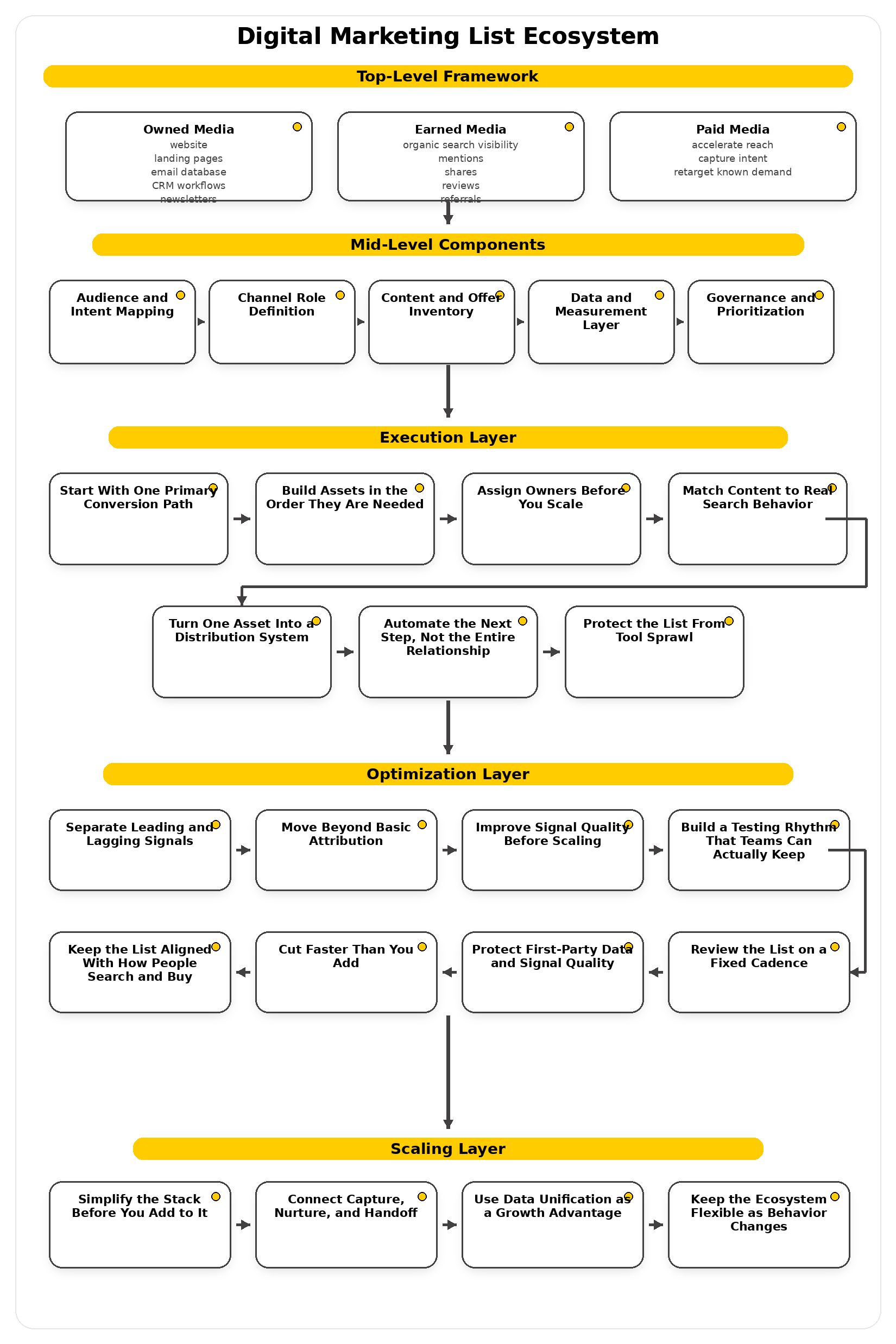
The cleanest way to organize a digital marketing list is to sort channels into owned, earned, and paid media, then assign each one a specific commercial role. Owned media includes assets you control directly, such as your website, landing pages, email database, CRM workflows, and newsletters. Earned media includes discovery and trust signals such as organic search visibility, mentions, shares, reviews, and referrals, while paid media covers the channels you use to accelerate reach, capture intent, or retarget known demand.
Once those buckets are clear, the next move is to map every channel to a stage of the buyer journey. Some channels are built to create awareness, some are designed to deepen consideration, some exist to convert high-intent visitors, and some are there to improve retention and lifetime value. That sounds simple, but it instantly removes one of the biggest problems in marketing: expecting a single platform to create attention, educate the buyer, close the sale, and retain the customer all by itself.
The framework also needs a measurement layer from day one. Google explains that Conversion Lift is designed to measure the causal impact of ads, and its newer measurement guidance says advertisers who adopted tag gateway for advertisers saw an 11% uplift in signals. That matters because the best digital marketing list is not just a channel map; it is a working model that connects audience, channel role, creative asset, tracking quality, and business outcome inside one decision-making system.
Core Components
The framework becomes useful only when it is broken into components that a team can actually manage. These are the building blocks that keep a digital marketing list from turning into a vague strategy document full of nice intentions and no operational detail. When these components are clearly defined, execution gets faster, reporting gets cleaner, and weak channels become much easier to identify.
Audience and Intent Mapping
Every digital marketing list should start with the people you want to reach and the reasons they are already looking for help, answers, or alternatives. That means identifying segments, understanding what they care about at different stages, and matching that intent to the language and formats they actually respond to. Skip this step, and the rest of the list becomes a collection of channels searching for a customer instead of a customer-centered system.
Channel Role Definition
Every channel needs one primary job before it gets budget, content, or attention. Search content might capture demand, social might create familiarity, email might nurture and reactivate, and paid media might validate messages quickly or scale what is already working. That level of clarity matters even more now that IAB says creator ad spend is projected to reach $37 billion in 2025 and that creators now rank among the top three “must buy” channels for brands, because creators should be treated as a deliberate channel choice, not a trendy add-on.
Content and Offer Inventory
A channel without a relevant asset is just empty capacity. Your digital marketing list should show which articles, videos, newsletters, lead magnets, landing pages, demos, consultations, product pages, and retention assets support each stage of the journey. HubSpot’s current marketing research makes the point clearly by framing AI as the baseline rather than the differentiator, which means the real edge comes from how useful, specific, and human your content and offers feel once they reach the market.
Data and Measurement Layer
This is the component that turns a digital marketing list into a management tool instead of a brainstorming file. It should define which metrics matter, where the source of truth lives, how traffic and conversions are tagged, and how assisted influence is interpreted across the funnel. Without that layer, teams end up arguing over dashboards when they should be improving the customer journey itself.
Governance and Prioritization
A serious digital marketing list also needs ownership, review cadence, and rules for what gets cut. Someone has to decide which channels stay core, which ones are in test mode, which ones need new assets, and which ones should be retired before they drain more time. Governance sounds boring until you realize it is often the difference between a strategy that compounds and a strategy that quietly turns into clutter.
Professional Implementation
Professional implementation starts with a ruthless audit. List every live channel, every major asset, every automation, every audience segment, and every reporting view you currently rely on, then remove anything that has no clear role or no visible business value. Many teams think they need more marketing ideas when what they really need is a cleaner system and the discipline to stop doing work that no longer earns its place.
Once the audit is done, move into prioritization instead of expansion. Choose the few channels that match audience behavior, internal capacity, and commercial goals, then build the minimum set of assets required to support them well. If execution needs better infrastructure, this is where many teams put the list into motion with an email automation platform, a social scheduling workflow, or a simple funnel builder so the strategy does not stay trapped inside a document.
After that, implementation becomes a rhythm rather than a one-time project. Review the list regularly, test one meaningful variable at a time, and keep tightening the connection between message, channel, and measurement. When Google describes incrementality testing as the way to understand conversions directly driven by the presence of the ad, it is pointing to the standard serious marketers follow: keep what proves it changed the outcome, and rebuild what does not.
Measurement and Optimization for Your Digital Marketing List
A digital marketing list only becomes valuable when it tells you what is working, what is stalling, and what deserves more investment. Plenty of teams can describe their channels, but far fewer can explain which touchpoints actually create movement in the customer journey and which ones are just consuming budget. That is why measurement is not a reporting exercise at the end of the month; it is the discipline that keeps the whole system honest while the market is changing underneath you.
The hardest part is that not every useful signal looks impressive at first glance. A search visit that does not convert on the same session can still shape a later sale, a newsletter click can reopen a deal that looked dead, and a branded search spike can reveal growing trust long before revenue dashboards catch up. Once you start looking at a digital marketing list through that lens, optimization stops being about chasing pretty numbers and starts being about understanding how demand is created, captured, and converted over time.
Separate Leading and Lagging Signals
One of the smartest ways to manage a digital marketing list is to split your metrics into leading indicators and lagging indicators. Leading indicators tell you whether attention, engagement, and intent are improving right now, while lagging indicators show whether that movement is turning into pipeline, revenue, renewals, or stronger lifetime value. If you mix those two layers together, you can end up killing a channel too early or celebrating a channel that looks busy but does not truly help the business.
That is where cleaner reporting matters. Google now lets teams use the branded queries filter in Search Console to separate brand-driven demand from non-branded discovery, which makes it much easier to see whether your content engine is expanding reach or simply harvesting people who already know your name. That distinction is incredibly useful when you are reviewing a digital marketing list, because brand demand usually reflects trust that has already been built, while non-branded growth tells you whether the market is still finding you for fresh reasons.
Move Beyond Basic Attribution
Attribution still has a role, but it should not be treated like the final word. It can show you which touchpoints appeared in the journey, yet it often struggles to answer the question that matters most: would that conversion have happened anyway if the campaign, message, or channel had never existed in the first place? When marketers confuse visibility with causality, budgets drift toward channels that look busy in dashboards but are not actually creating much lift.
Google’s own measurement guidance pushes marketers toward that more serious standard. Conversion Lift is built to measure the causal impact of ads, and Google’s broader guidance on proving business value explains why incrementality testing matters when you want to isolate the lift a marketing activity truly creates. In other words, a good digital marketing list should not only ask which channels are present in the funnel, but which ones are actually changing the outcome.
Improve Signal Quality Before Scaling
Optimization gets expensive when the underlying data is weak. Teams often try to solve a performance problem with more creative, more spend, or more channels when the real issue is broken tagging, fragmented identities, or incomplete conversion capture. It is difficult to make wise decisions from a digital marketing list if the signals feeding that list are inconsistent from one platform to the next.
Google has been unusually direct about this. Its current measurement documentation says advertisers who configured tag gateway for advertisers saw an 11% uplift in signals, and its analytics guidance keeps emphasizing that Google Analytics 4 can measure engagement across both app and website in one place. That combination matters because cleaner first-party measurement gives you a truer view of how channels support one another, which is exactly what a digital marketing list is supposed to clarify.
Build a Testing Rhythm That Teams Can Actually Keep
The best optimization systems are boring in the best possible way. They run on a steady rhythm of reviewing signals, forming a hypothesis, changing one meaningful variable, and then checking whether the result held up over a reasonable period of time. That kind of consistency may not feel flashy, but it protects you from one of the most common marketing mistakes: changing five things at once and learning nothing from the outcome.
A healthy testing rhythm also keeps your digital marketing list aligned with how people now search and evaluate options. Google says queries in AI-powered search experiences are becoming longer and more complex, which means marketers need to test not just channels, but also message depth, landing page structure, and content formats that answer more nuanced questions. When optimization is handled this way, the list becomes a living system that learns instead of a static document that ages badly.

Building a Connected Digital Marketing Ecosystem
A digital marketing list gets much more powerful when it is supported by a connected ecosystem instead of a pile of disconnected tools. In practical terms, that means your audience capture, automation, CRM, content workflows, analytics, and handoff points should work together well enough that the customer experience feels coherent from first touch to follow-up. If the ecosystem is fragmented, the strategy may look sharp in a planning document while the real-world execution feels clumsy, delayed, and hard to measure.
This is where a lot of teams quietly lose momentum. A campaign launches, leads come in, and then someone discovers the form does not pass enough context into the CRM, the email workflow fires too late, or the sales team receives a lead with no clue which asset or promise drove the conversion. None of those problems show up in a neat channel list, but all of them can sabotage the performance of that list in the real world.
Simplify the Stack Before You Add to It
Before you add another tool to your digital marketing list, it is worth asking whether the current stack is already too complicated to use well. Gartner’s latest survey says martech utilization has dropped to 49%, while its 2025 spend data shows marketing budgets remain flat at 7.7% of company revenue. Those two facts belong together, because they paint a very clear picture: most teams do not have unlimited room for experimentation, so unused software is not a harmless inconvenience anymore.
The market itself is not getting simpler either. Chiefmartec’s latest landscape tracks 15,384 marketing technology solutions, which makes tool accumulation feel easy and tool discipline feel rare. A strong digital marketing list should therefore reduce complexity wherever possible, because the easier the stack is to understand, the easier it becomes to move fast, measure accurately, and improve without drowning in admin.
Connect Capture, Nurture, and Handoff
A connected ecosystem does not need to be giant, but it does need to be intentional. If someone discovers you through search, clicks through to a landing page, fills out a form, receives an email sequence, books a call, and then gets handed into a CRM, each step should pass context forward instead of forcing the next system to start from zero. That is how your digital marketing list stops being a set of channels and starts acting like a real customer journey.
For many businesses, a lean setup is better than an overengineered one. A practical stack might start with a form layer that captures clean data, an email automation system that handles nurture, a CRM that keeps the relationship visible, and a booking workflow that makes the next step frictionless. The point is not that every business needs those exact tools; it is that every serious digital marketing list needs a clear handoff structure so momentum is not lost between interest and action.
Use Data Unification as a Growth Advantage
Disconnected data makes even strong campaigns feel weaker than they really are. Salesforce’s current marketing research shows that only one in four marketers are satisfied with how they use data to power personalized moments, and its broader marketing statistics page says only 31% are fully satisfied with their data unification ability. That is a huge clue for anyone building a digital marketing list, because better performance often comes from cleaner connection between systems rather than from shouting louder in the market.
When your data is unified well enough to show who the customer is, what they engaged with, and where they are in the journey, content and automation become much more relevant. That matters even more now that Salesforce reports 78% of marketers need more personalized content than they can currently produce. A connected ecosystem helps close that gap because it gives your team context, and context is what makes personalization feel helpful instead of random.
Keep the Ecosystem Flexible as Behavior Changes
The final piece is flexibility. Search behavior is shifting, Google says people are asking longer, more specific follow-up questions in AI search experiences, and the content that performs best is still the content that feels genuinely useful, original, and easy to navigate. That means a digital marketing list cannot be frozen around last year’s assumptions about how discovery works.
The same is true across the broader channel mix. IAB’s latest creator research shows creator ad spend is projected to reach $37 billion in 2025 and that brands increasingly treat creators as a distinct channel rather than a side tactic, which is another reminder that ecosystems evolve whether teams are ready or not. The healthiest digital marketing list is the one supported by an ecosystem that can add, remove, or reweight channels without breaking measurement, handoffs, or the customer experience in the process.
Turning Your Digital Marketing List Into an Execution Plan
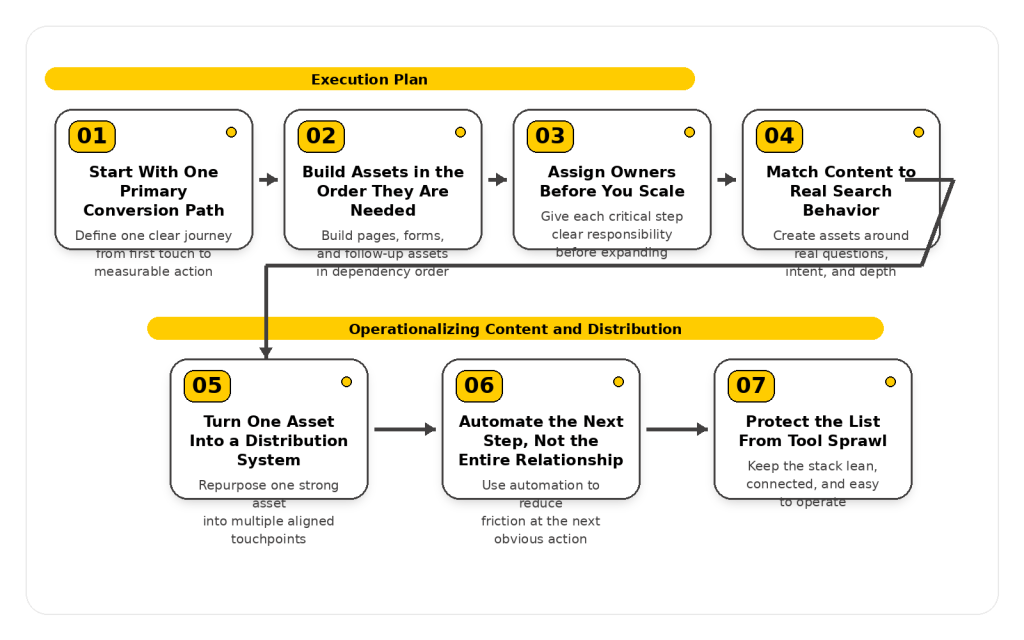
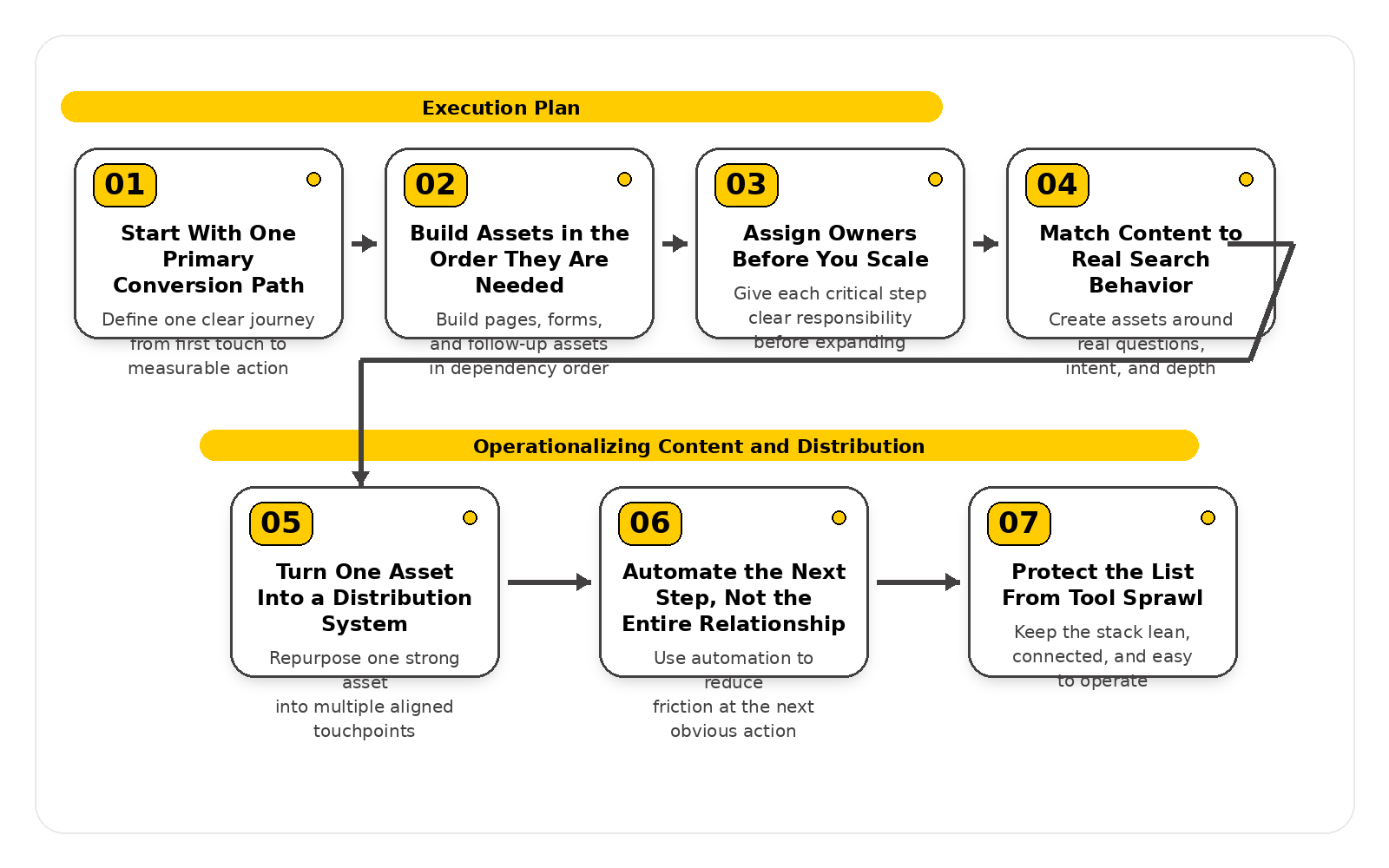
A digital marketing list starts paying off when it stops living as a strategy document and starts showing up in daily execution. That means deciding what gets built first, what depends on something else being ready, and which activities are important enough to earn time from the team this quarter. It sounds obvious, but this is exactly where a lot of businesses get stuck, because they try to launch everything at once and end up with too many moving parts and not enough momentum.
The smarter move is to turn your digital marketing list into a sequence. You build the core conversion path first, then the assets that feed it, then the automation that keeps it moving, and only after that do you add more channels or experiments. That kind of discipline matters even more when marketing budgets are sitting at 7.7% of company revenue, because flat budgets punish scattered execution much faster than they punish slow ambition.
Start With One Primary Conversion Path
The fastest way to make a digital marketing list useful is to decide what one successful journey looks like from beginning to end. Maybe that journey is search traffic into a lead magnet, email nurture into a booked call, or paid traffic into a product page and retargeting sequence. Whatever the model is, it should be simple enough that everyone on the team can explain it without opening three dashboards and six tabs.
This is where many marketers overcomplicate the build. They create content, social posts, ads, landing pages, forms, automations, and sales follow-up at the same time without deciding which path is supposed to carry the most weight first. Google’s own lead generation guidance for GA4 points marketers toward recommended events that measure the full lead funnel, including offline activity, which is a strong reminder that the list works best when the core path is measurable before it is expanded.
Build Assets in the Order They Are Needed
Once the main conversion path is clear, the next move is to build the supporting assets in dependency order. The landing page or product page has to make sense before you spend serious effort on traffic, the form has to capture the right context before automation starts firing, and the follow-up sequence has to be ready before you ask the market to respond. That order keeps a digital marketing list from becoming a pile of half-finished ideas that never quite connect.
This is also why a lean stack often beats a glamorous one. HubSpot’s current state of marketing report says AI is now the baseline rather than the differentiator, which means the edge is no longer having more tools that can generate things quickly. The edge is having a system where each asset supports the next step cleanly, whether you build that with a funnel builder, a focused landing-page workflow, or a form layer that keeps the data usable from the start.
Assign Owners Before You Scale
A digital marketing list becomes much easier to maintain when every important part of it belongs to someone. One person should own the main conversion path, one person should own reporting hygiene, one person should own content production, and one person should own handoff quality if sales or client success enters the picture. Ownership does not mean working alone; it means there is no confusion about who notices when something breaks, drifts, or underperforms.
This step matters because execution usually fails in the gaps between functions rather than inside them. A campaign can attract the right audience, the landing page can convert, and the lead can still go cold because nobody was clearly responsible for the transition into the next stage. When a digital marketing list has visible ownership, problems surface earlier and improvement becomes part of the operating rhythm instead of a rescue mission.
Operationalizing Content and Distribution
Once the execution plan exists, the next challenge is keeping it moving week after week without burning out the team or flooding the market with forgettable material. That is where content operations and distribution workflows come in. A good digital marketing list does not just tell you what channels you use; it tells you what kind of content each channel needs, how often it should appear, and what action it is supposed to create.
The biggest trap here is volume without structure. HubSpot reports that 83% of marketers say AI has raised expectations for them to produce more content than ever before, but more output does not automatically lead to more growth. If the content is not tied to audience questions, offer strategy, and a real next step, the list gets busier without getting better.
Match Content to Real Search Behavior
Content planning gets stronger when it follows how people actually search rather than how marketers wish they searched. Google explains that in newer AI search experiences, users are asking longer, more specific questions and often adding follow-up questions that go deeper, which means a digital marketing list should include assets that answer layered intent instead of repeating shallow keyword variations. That changes the job of content from filling a calendar to solving a problem clearly enough that the next action feels natural.
This is one reason a digital marketing list should include content formats, not just channels. You may need comparison pages, practical guides, calculators, demos, email sequences, or short social cutdowns built from a stronger core asset. If the content map is done well, distribution becomes more consistent because each piece already knows where it belongs and what it is helping the reader do next.
Turn One Asset Into a Distribution System
A strong digital marketing list gets easier to execute when one serious asset can be turned into multiple touchpoints without losing its meaning. A research-backed article can feed your newsletter, short-form social, retargeting copy, sales follow-up, and even lead nurturing if the message stays aligned. That approach gives the team leverage, which is exactly what you want when the market keeps demanding more output and the budget does not magically expand to match.
This is where workflow tools can genuinely help rather than just add noise. A scheduling setup through Buffer, a niche social support layer like Flick, or an assisted writing workflow such as Wispr Flow can make distribution more reliable if the core message is already strong. What matters is not the number of tools in the stack, but whether they help your digital marketing list move faster without diluting the quality of the message.
Automate the Next Step, Not the Entire Relationship
Automation is most useful when it removes friction from the next obvious action. A welcome sequence, a follow-up reminder, a qualification form, or a booking confirmation can all strengthen a digital marketing list because they protect momentum at the exact point where people are most likely to drop off. Problems usually begin when marketers try to automate the whole relationship instead of using automation to support a human-centered journey.
That distinction matters even more now that Salesforce says 78% of marketers need more personalized content than they are currently able to produce. Automation can help close that gap, but only if the data flowing into it is clean and the journey itself still feels relevant. In practice, that might mean a simple email automation setup, a newsletter workflow, or a booking flow that keeps response time fast without making the experience feel robotic.
Protect the List From Tool Sprawl
The final implementation challenge is resisting the urge to keep adding software every time a process feels slightly inconvenient. Chiefmartec’s latest landscape now tracks 15,384 martech solutions, which sounds exciting until you remember how quickly too many platforms can fragment reporting, ownership, and execution. A digital marketing list should reduce complexity, not mirror it.
That is why the best implementation plans usually look simpler than expected. You need enough infrastructure to capture intent, move people to the next step, and keep reporting clean, but not so much that your team spends half its energy maintaining the machinery. When the list stays lean, you can adapt faster when platform rules change, like Google’s shift away from Enhanced CPC for Search and Display campaigns in 2025, because your strategy is built on clear outcomes rather than on one fragile tactic.
Statistics and Data

A digital marketing list gets a lot more valuable when it is grounded in current market data instead of guesswork. The numbers do not replace strategy, but they do show where attention is rising, where budgets are tightening, and where weak measurement is quietly distorting decisions. That matters because it is very easy to keep adding channels to a digital marketing list when the real problem is that the economics, tools, or tracking behind those channels are working against you.
The smartest way to read the data is not as a pile of random percentages. It is to ask what the numbers reveal about your next move. Some statistics tell you where the market is heading, some tell you where marketers are under pressure, and some tell you why a digital marketing list must be simpler and more measurable than it used to be.
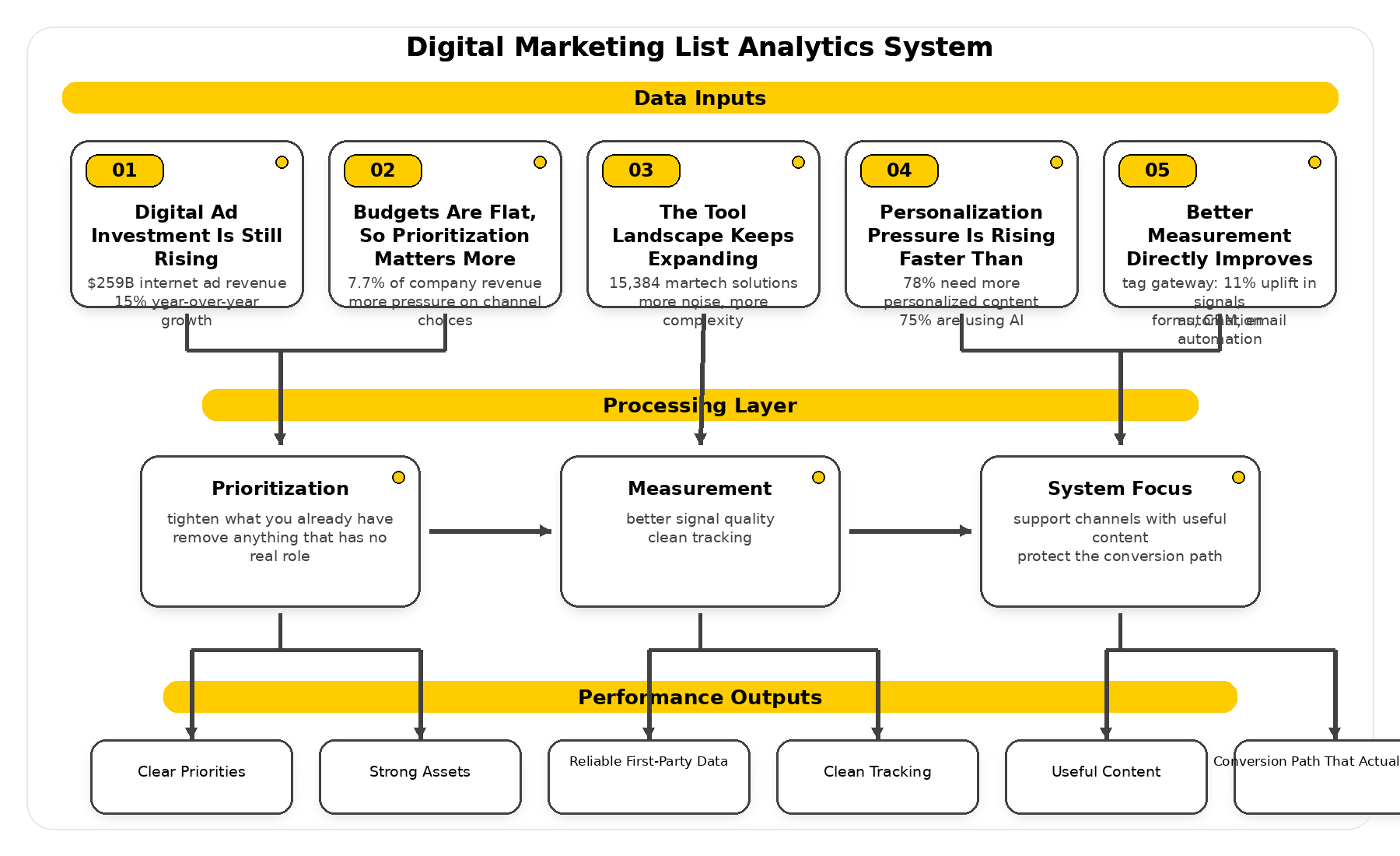
Digital Ad Investment Is Still Rising
The market is still expanding fast, which means digital visibility is more valuable but also more competitive. The IAB and PwC report put 2024 internet ad revenue at $259 billion, and the same figure was highlighted by ANA and Marketing Brew. When a digital marketing list is built in that kind of environment, you cannot afford to treat channel selection casually, because the cost of competing without a clear role for each channel adds up quickly.
The growth rate matters too, not just the headline number. The same IAB/PwC findings showed 15% year-over-year growth, a point repeated in Yahoo Finance coverage and ANA’s write-up. In practical terms, that means a digital marketing list should not just ask where you can show up, but where you can show up with enough message quality, tracking, and follow-through to justify the cost.
Budgets Are Flat, So Prioritization Matters More
Even though digital media keeps growing, marketing teams are not suddenly swimming in extra money. Gartner’s 2025 CMO Spend Survey said budgets remained flat at 7.7% of company revenue, and that same figure was echoed by Campaign and Demand Gen Report. That is exactly why a digital marketing list has to be selective rather than ambitious in every direction at once.
Flat budgets change how you should evaluate channels. A channel can be interesting, trendy, and full of potential, but if it pulls time away from the parts of your digital marketing list that already produce measurable movement, it is not helping your growth. The more financial pressure there is on the system, the more every channel needs a clearly defined job.
The Tool Landscape Keeps Expanding
The number of available platforms is still exploding, and that creates a strange problem for marketers: more options, but not necessarily better decisions. Chiefmartec counted 15,384 martech solutions in 2025, and the same total was discussed by MarTech.org and CMSWire. A digital marketing list built without discipline can easily turn into a reflection of that chaos instead of a protection against it.
This is why simplicity has become a competitive advantage. When there are thousands of tools competing for attention, the businesses that win are often the ones that choose a cleaner stack, connect it properly, and then get better at execution instead of endlessly swapping software. A digital marketing list should help you reduce unnecessary complexity, not justify more of it.
Personalization Pressure Is Rising Faster Than Capacity
The data around personalization is one of the clearest signals in the market right now. Salesforce found that 78% of marketers need more personalized content than they are currently able to produce, and the same gap was highlighted by eMarketer and CX Today. That tells you something important about a digital marketing list: it should not be stuffed with channels that all demand constant custom output unless your process can actually support that level of personalization.
The pressure is even more interesting when you pair it with AI adoption. The same Salesforce release said 75% of marketers are using AI to help close that gap, and that number was reinforced in MarTech.org’s coverage and industry reporting on the study. In other words, a modern digital marketing list needs to be realistic about production capacity, because using more tools does not automatically solve the bottleneck if the system itself is still too fragmented.
Better Measurement Directly Improves Signal Quality
One of the most useful statistics in the current measurement landscape is not about reach at all. It is about signal quality. Google says advertisers who configured tag gateway for advertisers saw an 11% uplift in signals, and the same improvement was described in Cloudflare’s product announcement and Search Engine Land’s reporting. For a digital marketing list, that is a powerful reminder that better tracking can improve decision-making without adding a single new channel.
This is where many teams leave money on the table. They keep asking which platform to try next while their existing measurement setup is still dropping useful data. If your current system cannot capture and pass clean signals well enough, tightening the stack with a better form workflow, a more connected CRM setup, and a reliable email automation layer will often strengthen your digital marketing list more than another experimental channel.
What These Numbers Mean for Your Digital Marketing List
Put all of these numbers together and the direction becomes clear. The market is still growing, budgets are not expanding at the same pace, the tool ecosystem is getting noisier, personalization demands are rising, and measurement quality has a direct effect on performance. A digital marketing list that tries to do everything will struggle under that pressure, while a digital marketing list built around clear priorities, strong assets, and reliable first-party data has a much better chance of compounding.
That is why the best next step is usually not to add more. It is to tighten what you already have, remove anything that has no real role, and make sure the channels left on your digital marketing list are supported by clean tracking, useful content, and a conversion path that actually works. When the data is read that way, it stops feeling like trivia and starts acting like strategy.
Common Mistakes That Weaken a Digital Marketing List
A digital marketing list can look impressive and still underperform badly. That usually happens when the list keeps growing, but nobody stops to ask whether each channel has a real job, whether the supporting assets are strong enough, or whether the team can still manage the whole thing without creating confusion. The danger is not that marketers care too much about growth. The danger is that they build a bigger machine than they can operate cleanly.
This matters more now because the market keeps getting more expensive and more crowded at the same time. Internet ad revenue reached $259 billion in 2024, while marketing budgets stayed flat at 7.7% of company revenue in 2025. When those two realities collide, a sloppy digital marketing list becomes expensive much faster than it used to.
Treating Every Channel Like a Priority
One of the fastest ways to weaken a digital marketing list is to treat every channel as equally important. Teams do this all the time because it feels safer to stay present everywhere than to make a tough choice about what really deserves focus. In reality, that habit spreads resources too thin, makes execution inconsistent, and usually leaves the strongest channels underbuilt while weaker channels keep receiving attention they have not earned.
The fix is not to become narrow-minded. It is to become deliberate. A digital marketing list gets stronger when each channel is assigned a specific commercial role, a clear content requirement, and a threshold for what success needs to look like before more time or spend is committed.
Letting Software Decide the Strategy
Another common mistake is letting tools shape the marketing plan instead of supporting it. This usually starts innocently enough. A team buys a platform for social scheduling, then another for forms, then another for analytics, then another for automation, and before long the digital marketing list begins to reflect whatever the stack makes easy instead of what the audience actually needs.
That is not a small problem anymore. Chiefmartec tracked 15,384 martech solutions in 2025, and Gartner’s 2025 Marketing Technology Survey says martech utilization has dropped to 49%. Those two numbers belong together because they show the trap clearly: the market offers endless tools, but many teams are not fully using the tools they already bought. A digital marketing list should help you simplify that environment, not surrender to it.
Confusing Activity With Progress
There is also a more subtle problem that quietly drains momentum: confusing visible activity with meaningful progress. A team can publish content, launch campaigns, post on social, send newsletters, and still have no clean answer to whether those actions are actually improving discovery, conversions, or retention. When that happens, the digital marketing list becomes a calendar of tasks rather than a system for growth.
This is why measurement cannot be treated like an afterthought. Google now gives marketers a branded queries filter in Search Console, which makes it easier to separate branded demand from broader discovery. That kind of visibility helps a digital marketing list stay honest, because it becomes easier to tell whether growth is coming from fresh audience interest or simply from people who already knew your name.
How to Keep a Digital Marketing List Working Over Time
The real test of a digital marketing list is not whether it looks sharp when it is first created. The real test is whether it still helps the team make better decisions three months later, six months later, and after the market shifts again. A list that stays useful has to be reviewed, challenged, and updated before weak assumptions turn into expensive habits.
This is especially important now because customer expectations are still rising. Salesforce’s 2026 marketing research says 79% of marketers need more personalized content than they are currently able to produce, and the same study highlights how data quality and fragmented systems keep many teams from delivering that experience consistently. A digital marketing list that is not maintained will struggle even more, because every extra channel adds pressure to an already stretched production and data environment.
Review the List on a Fixed Cadence
The easiest way to keep a digital marketing list useful is to review it on a schedule instead of waiting for performance to collapse. Monthly reviews are usually enough for most teams, while faster-moving environments may need a weekly look at core signals and a deeper monthly decision session. What matters is not the exact timing. What matters is that the review exists, has an owner, and forces the team to look at channel role, asset quality, signal quality, and next-step priorities in one place.
That rhythm prevents drift. Without it, outdated tactics linger, weak assets stay live for too long, and the list slowly fills with channels that no longer deserve the same weight they had when conditions were different. A digital marketing list should be treated like operating infrastructure, not like a static strategy document that gets admired once and then ignored.
Protect First-Party Data and Signal Quality
A digital marketing list becomes much more resilient when it is supported by strong first-party data and cleaner measurement signals. That does not sound glamorous, but it matters because every channel decision gets weaker when the underlying data is partial, delayed, or fragmented across tools that do not talk to each other properly. Teams often think they have a traffic or creative problem when they really have a signal problem.
Google’s current guidance makes that pretty hard to ignore. Advertisers who configured tag gateway for advertisers saw an 11% uplift in signals, which is a practical reminder that improving data capture can strengthen a digital marketing list without adding any new acquisition channel at all. The same idea shows up in Salesforce’s latest findings, where only 26% of marketers say they are completely satisfied with their data unification. When the data layer is weak, personalization gets harder, attribution gets messier, and optimization starts leaning on guesswork.
Cut Faster Than You Add
Most businesses do not need a longer digital marketing list. They need a tighter one. The strongest systems usually improve because someone had the discipline to remove a channel, retire a format, simplify a workflow, or stop sending energy into a tactic that looked interesting but never proved it could contribute. That is one of the hardest habits in marketing, because adding feels like progress and cutting feels risky, even when the opposite is true.
In practice, this means every channel should keep earning its place. If it does not support awareness, demand capture, conversion, or retention in a way the team can explain and measure, it probably should not stay on the list in its current form. A digital marketing list gets stronger when it becomes more focused over time, not when it turns into a museum of every tactic the team has ever tried.
Keep the List Aligned With How People Search and Buy
The final discipline is staying close to real customer behavior instead of clinging to outdated channel assumptions. Google’s guidance on succeeding in AI search still comes back to the same core idea: create unique, satisfying content that helps people asking longer and more specific questions. That should shape a digital marketing list far more than generic best-practice checklists, because the channels that matter are the ones that help you answer genuine demand clearly and move the customer to the next step.
When you maintain the list that way, it becomes easier to adapt without panicking every time the market changes. You are no longer asking whether you should be everywhere. You are asking whether each part of your digital marketing list still reflects how your audience discovers, evaluates, and trusts what you offer. That is the question that keeps the system healthy, and it is also what sets up the final part of the article, where everything gets pulled together into practical answers and next steps.
FAQ for Your Complete Digital Marketing List Guide

By this point, you have seen how a digital marketing list works as a framework, an execution plan, a measurement system, and a way to keep the whole marketing machine from turning into chaos. The questions below are here to make the guide more practical. If you are serious about building a digital marketing list that actually helps you grow, these are the decisions you will run into sooner rather than later.
What Is a Digital Marketing List, Really?
A digital marketing list is not just a list of channels you have heard marketers talk about online. It is a structured view of the channels, assets, workflows, and measurement points that help your business attract attention, earn trust, convert interest, and retain customers. When it is built properly, it becomes a decision-making tool instead of a random inventory of tactics.
That is why the best digital marketing list always connects channels to a job. Search content may capture demand, email may nurture it, paid media may accelerate it, and CRM follow-up may help close it. The list becomes powerful when every part of it has a purpose and a place in the customer journey.
How Many Channels Should a Digital Marketing List Include?
There is no perfect number, and that is exactly the point. A digital marketing list should include only the channels your team can support with real consistency, useful assets, and clean measurement. For most businesses, fewer strong channels outperform a bloated setup filled with half-maintained campaigns and weak follow-up.
This matters even more in a market where marketing budgets have stayed flat at 7.7% of company revenue. When budgets are not expanding, every extra channel has to earn its place. A smaller digital marketing list that is run well will usually beat a larger one that spreads the team too thin.
Which Channels Should Come First?
The first channels in a digital marketing list should be the ones closest to audience intent and revenue clarity. That usually means a website or landing page that can actually convert, some form of demand capture such as search or targeted outreach, and a follow-up system that prevents interest from dying after the first click. Without those basics, adding more channels usually just creates more leakage.
In other words, start with the path that can produce a result you can explain. Once that path works, then you can widen the list with more content distribution, paid acceleration, creator partnerships, or retention assets. That order matters because growth becomes a lot easier to scale when the foundation is already doing its job.
Is SEO Enough on Its Own?
SEO can be a powerful part of a digital marketing list, but it rarely works best alone. Search is excellent at capturing intent, especially when somebody is already looking for an answer, a tool, or a provider. What it does not always do by itself is nurture uncertainty, reactivate cold leads, or create the kind of repeated exposure that helps people trust a brand faster.
That is why a digital marketing list built around SEO usually gets stronger when email, retargeting, and strong conversion assets are added around it. Google’s own guidance around succeeding in newer AI search experiences still points back to unique, satisfying content that truly helps people. That matters, but it also means search should connect to a larger system rather than carry the entire business alone.
Should Every Business Use Paid Ads?
No, but every business should understand where paid distribution fits inside a digital marketing list. Paid ads are useful when you need faster testing, faster reach, or a way to scale something that already converts reasonably well. They are much less useful when the message is still unclear, the landing page is weak, or the handoff after conversion is messy.
This is one reason so many teams burn money. They use paid traffic to solve a positioning or systems problem, and that almost never works for long. A digital marketing list should treat paid media as an amplifier, not as a substitute for clarity.
What Metrics Matter Most?
The best metrics in a digital marketing list are the ones that help you make a decision, not the ones that just make a dashboard look busy. You need a mix of leading indicators such as qualified traffic, engagement quality, and conversion rate, and lagging indicators such as revenue, retention, repeat purchases, or pipeline contribution. Looking at only one layer usually gives you an incomplete picture.
It also helps to separate brand-driven demand from broader discovery. Google now offers a branded queries filter in Search Console, which makes it easier to understand whether your digital marketing list is expanding awareness or mostly serving people who already knew your brand. That distinction can change how you judge content, SEO, and paid performance.
How Often Should a Digital Marketing List Be Reviewed?
Most teams should review their digital marketing list every month, with lighter weekly check-ins on the signals that matter most. That gives you enough time to spot trends without overreacting to every short-term fluctuation. A deeper monthly review is usually where the real improvement happens, because that is where channel role, asset quality, and measurement health can be looked at together.
What matters most is consistency. If the list is only revisited when performance collapses, the team usually ends up making rushed decisions from frustration instead of making clean decisions from evidence. A digital marketing list works best when it is maintained before it becomes urgent.
How Does AI Change a Digital Marketing List?
AI changes execution speed far more than it changes strategy. It can help you draft, repurpose, summarize, personalize, and automate parts of the workflow faster, which is useful when the list includes multiple channels and content requirements. What it does not do is decide which channels deserve focus, what your audience actually cares about, or how trust should be built over time.
That is why AI should strengthen a digital marketing list, not dictate it. Salesforce’s latest marketing research shows 79% of marketers say they need more personalized content than they are able to produce, and 80% are turning to AI to help close that gap. The opportunity is real, but the list still needs human priorities behind it or the output becomes faster without becoming better.
Can a Small Business Build a Strong Digital Marketing List Without a Huge Team?
Yes, and in many cases a small team has an advantage because it is forced to stay focused. A lean digital marketing list built around a clear offer, strong messaging, a clean website, email follow-up, and one or two well-managed traffic channels can outperform a much larger setup that is full of complexity and unclear ownership. Smaller teams often win when they keep the system simple enough to execute well.
The key is choosing tools that reduce friction instead of adding more of it. A lightweight form workflow, a focused email automation setup, a simple funnel builder, or a scheduling tool such as Buffer can help a small business operate a digital marketing list without drowning in admin.
When Should You Cut a Channel From Your Digital Marketing List?
You should cut or downgrade a channel when it no longer has a clear job, when the supporting assets are too weak to justify more effort, or when the team cannot explain how that channel contributes to growth. Cutting a channel does not always mean abandoning it forever. Sometimes it simply means moving it out of the core list until the strategy, assets, or capacity improve enough to support it properly.
This kind of discipline matters because the market keeps offering more tools and more places to show up. Chiefmartec’s 2025 landscape tracked 15,384 martech solutions, which is exactly why a digital marketing list must protect focus instead of mirroring every trend. The channel you remove may improve the performance of the channels that remain.
What Is the Biggest Mistake People Make With a Digital Marketing List?
The biggest mistake is confusing completeness with usefulness. A long digital marketing list can feel strategic because it looks comprehensive, but it often hides the truth that no one has clearly prioritized what matters most. That creates a dangerous illusion of progress while the actual customer journey remains fragmented.
A better digital marketing list is usually shorter, sharper, and more connected to how people really buy. It tells you where demand comes from, what happens next, who owns each step, and how success will be measured. If it cannot do those things, it is not really helping the business.
What Should a Digital Marketing List Look Like Six Months From Now?
Six months from now, your digital marketing list should be cleaner than it is today, not longer. The channels that truly help should be better defined, the weak ones should either be fixed or removed, and the reporting should make it easier to see where growth is coming from. If the list is doing its job, your team should feel less confused, not more overwhelmed.
It should also be supported by better systems. With internet advertising revenue reaching $259 billion in 2024, competition is not getting easier. A digital marketing list that becomes more disciplined over time is far more likely to compound than one that keeps expanding without stronger measurement and execution behind it.
Do You Need Professional Help to Build a Digital Marketing List?
Not everyone needs an outside expert on day one, but a lot of businesses benefit from experienced help once the list becomes tied to revenue, hiring, or serious growth targets. An expert can usually spot channel overlap, wasted spend, broken handoffs, and weak measurement much faster than a team that has been living inside the same system for too long. That outside perspective becomes especially valuable when the list looks active on the surface but still is not producing the right outcomes.
The right help should make the list simpler, sharper, and more measurable. If outside support adds more jargon, more tools, and more confusion, it is probably moving in the wrong direction. A strong digital marketing list should feel easier to run after professional input, not harder.
Work With Professionals
If you have made it this far, you already know that a digital marketing list is not something you throw together in ten minutes and forget about. It is the system that decides where your attention goes, how your audience moves through the journey, and whether your marketing can actually compound instead of restarting from zero every month. That is why serious businesses eventually stop looking for random tactics and start looking for people who can build clean systems.
The upside is huge when you get this right. Instead of chasing disconnected channels, you build a marketing engine that can attract, nurture, convert, and retain customers with a lot more clarity. And if you are the marketer doing that work, the demand for your skill set is only going to become more valuable as more companies realize that scattered execution is costing them real money.
Explore 10K+ Remote Marketing Contracts on MarkeWork.com
Most marketers spend too much time chasing clients, competing on crowded platforms, and losing a percentage of every project to middlemen.
MarkeWork gives you a better way. Browse thousands of remote marketing contracts and connect directly with companies desperate to hire skilled marketers like you — without platform commissions and without unnecessary gatekeepers.
If you’re serious about finding better opportunities and keeping 100% of what you earn, you can explore available contracts and create your profile for free at MarkeWork.com.
 Filip Konecny Enterprises