
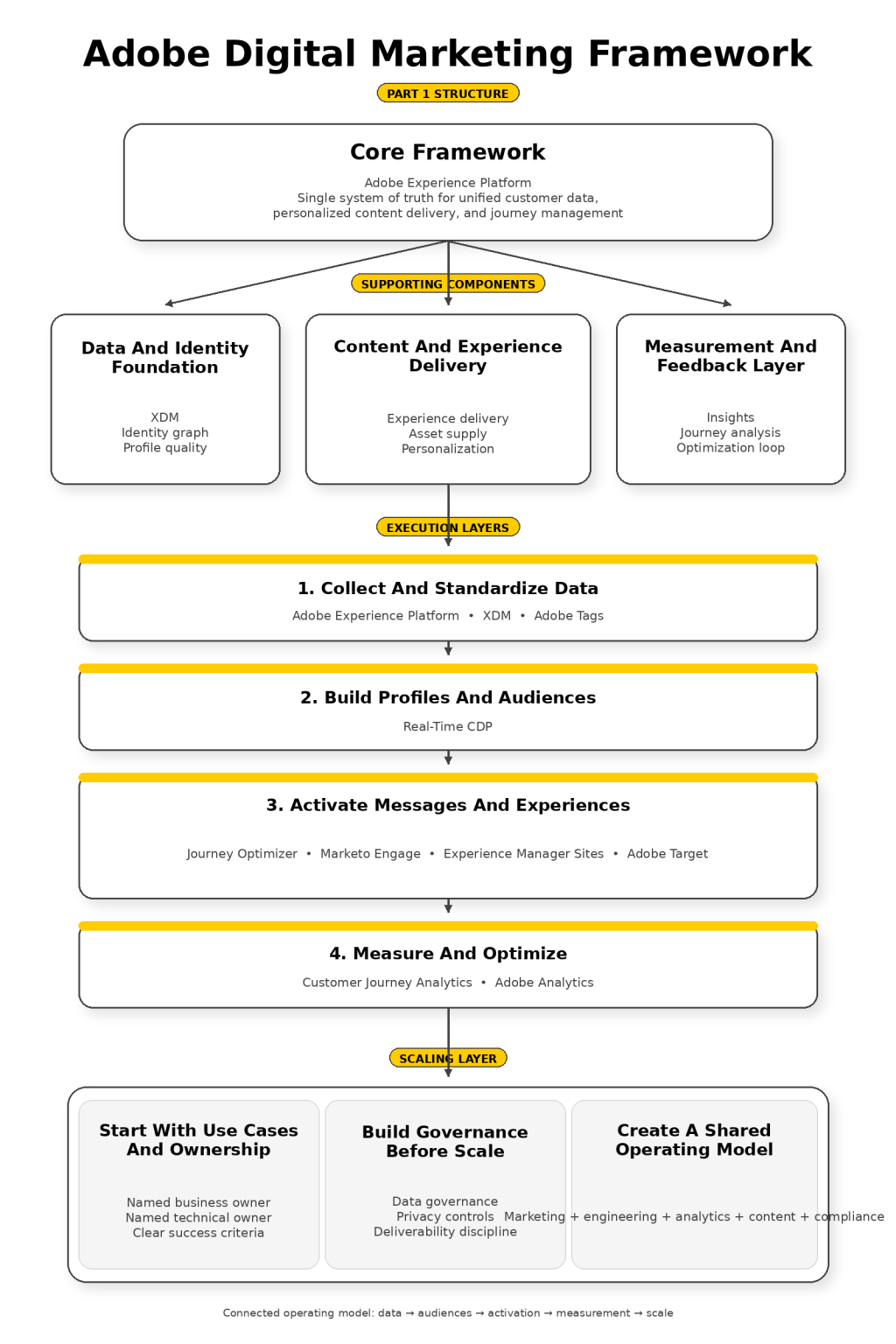
Adobe digital marketing matters most when a company has already learned the hard way that disconnected tools create disconnected customer experiences. When digital channels absorb 61.1% of total marketing spend and marketing budgets remain stuck at 7.7% of company revenue, the real problem is rarely a lack of tactics. The real problem is that data, content, activation, and measurement are still living in separate systems that do not talk to each other well enough.
That is why Adobe keeps positioning its platform less like a single product and more like an orchestration engine. In its latest annual report, Adobe said its Digital Experience business reached $5.86 billion in fiscal 2025 and described that business as a set of solutions for actionable data, personalized content delivery, and customer journey management connected through Adobe Experience Platform. That framing tells you exactly how Adobe digital marketing is supposed to work: not as a pile of features, but as a connected operating model.
The timing also helps explain why so many enterprise teams keep revisiting Adobe. Salesforce found that 83% of marketers recognize the shift toward personalized, two-way messaging, yet only one in four are satisfied with how they use data to power those moments, while McKinsey reports that 72% of organizations are using AI and 65% are regularly using generative AI. Adobe digital marketing sits right in the middle of that pressure: better data, faster content creation, tighter audience activation, and much more scrutiny around whether all of it is actually working.
Article Outline
- Part 1: Why Adobe Digital Marketing Matters
- Part 2: Adobe Digital Marketing Framework Overview
- Part 3: Core Components Of Adobe Digital Marketing
- Part 4: Professional Implementation Of Adobe Digital Marketing
- Part 5: Measurement, Attribution, And Optimization In Adobe Digital Marketing
- Part 6: Future Trends, Challenges, And FAQ
Why Adobe Digital Marketing Matters
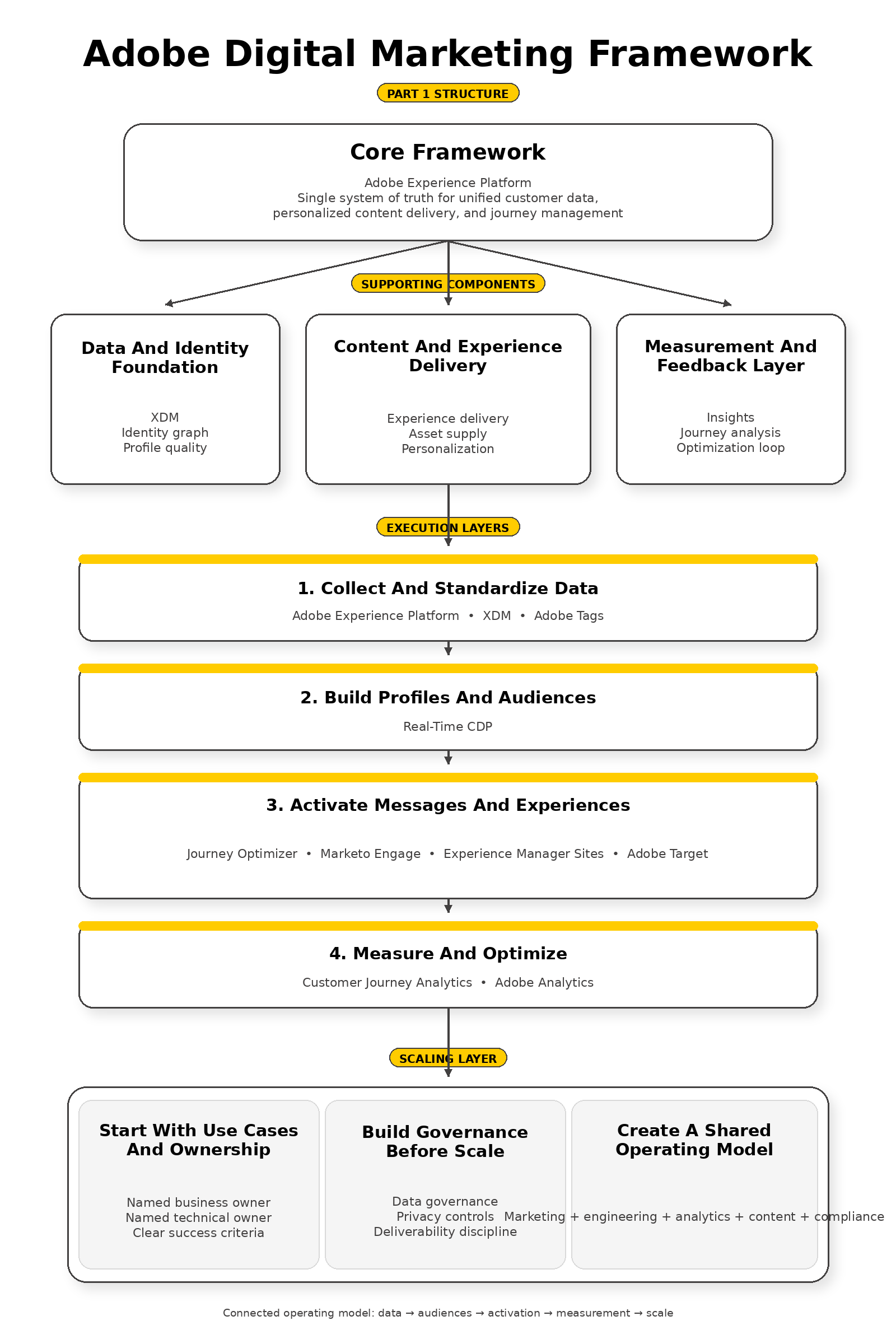
What makes Adobe digital marketing important is not the logo on the invoice. It is the fact that enterprise marketing has become a coordination problem before it becomes a creative problem. Teams need to unify behavioral data, CRM records, commerce signals, content assets, campaign logic, and reporting into one usable flow, and Adobe’s platform language reflects that reality by promising a single system of truth for unifying, analyzing, and activating customer data rather than another isolated dashboard.
That matters even more because the rules around data are changing while AI adoption is accelerating. Google now tells brands to test what breaks when third-party cookies are blocked by user choice and move toward privacy-preserving solutions, while the IAB says AI is reshaping media planning, audience work, optimization, and measurement even as companies struggle with setup complexity, fragmented capabilities, and rising privacy and transparency concerns. In other words, modern digital marketing needs more than automation. It needs structure, governance, and a platform that can handle identity and decisioning without falling apart when conditions change.
Adobe digital marketing becomes most useful when a business has outgrown channel-by-channel execution. A team can survive for a while with separate tools for web analytics, email, content management, experimentation, and audience building, but the operating cost rises fast once multiple regions, business units, brands, or product lines are involved. At that point, the real bottleneck is not publishing more campaigns but getting the entire system to recognize the same customer, act on the same context, and learn from the same results.
Adobe Digital Marketing Framework Overview
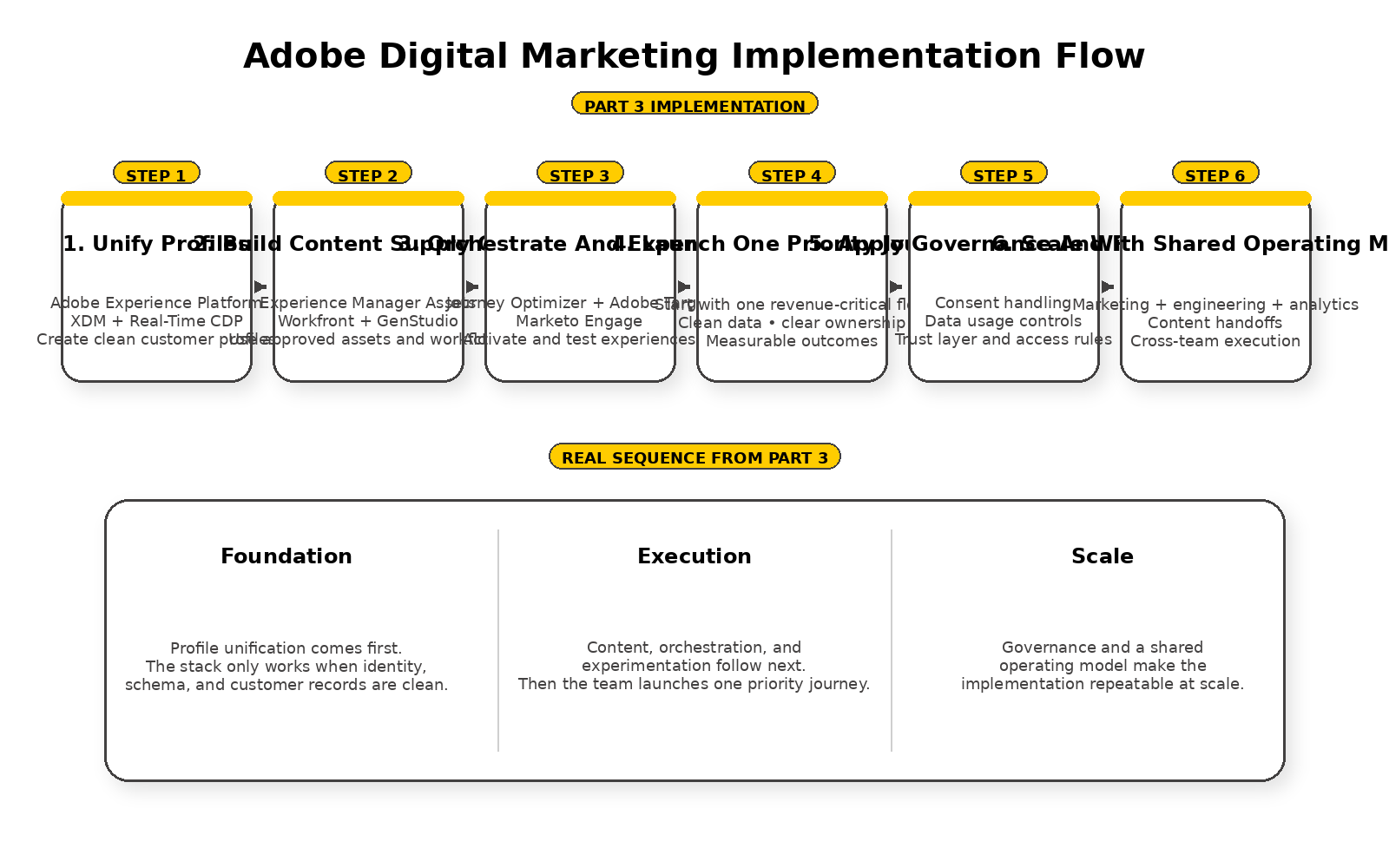
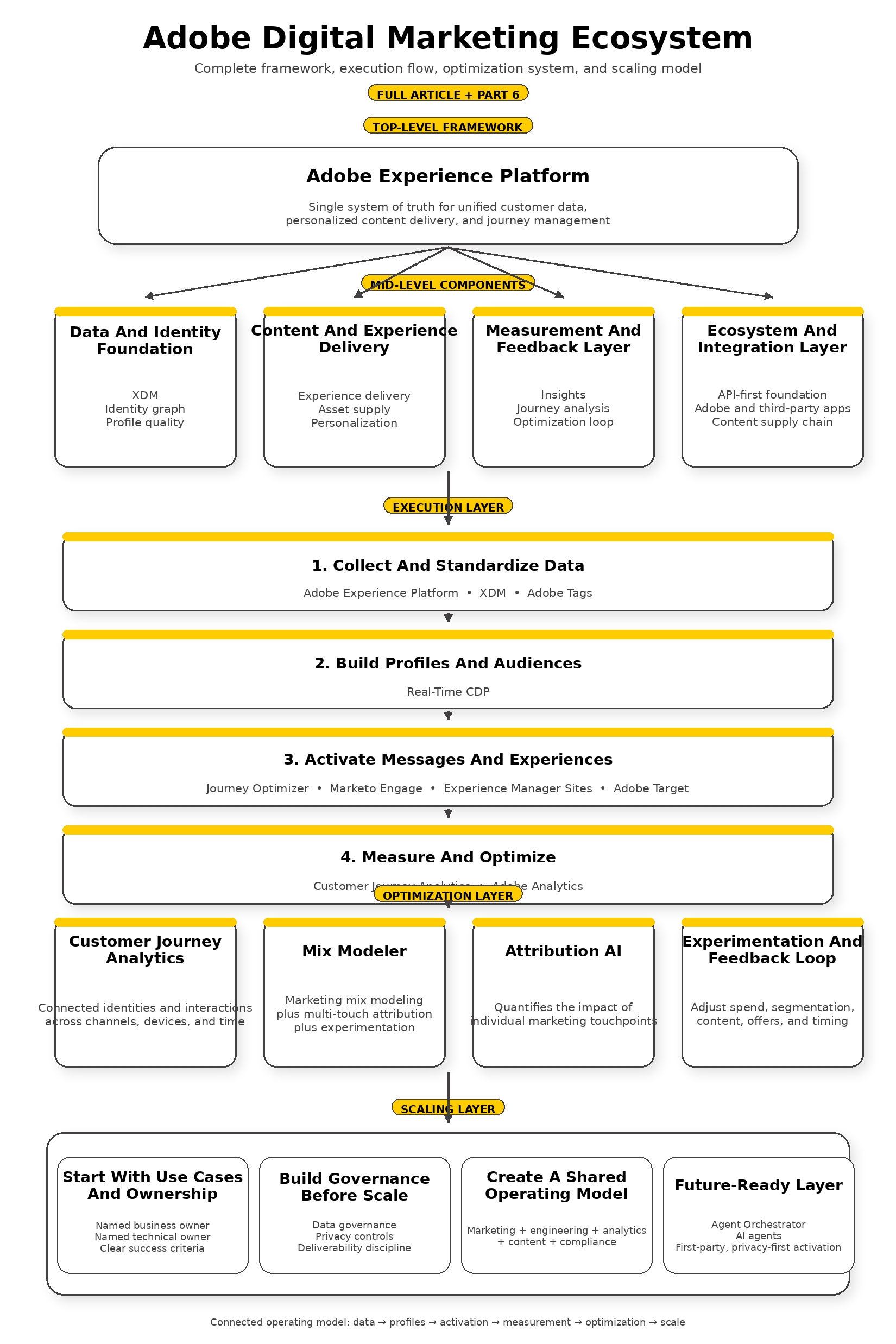
The simplest way to understand the Adobe framework is to see it as a loop instead of a funnel. You collect and standardize data with Adobe Experience Platform, the Experience Data Model, and Adobe Tags; you build profiles and audiences in Real-Time CDP; you activate messages and experiences through Journey Optimizer, Marketo Engage, Experience Manager Sites, and Adobe Target; then you read the outcome in Customer Journey Analytics and Adobe Analytics.
The reason that loop works is that Adobe designed these products to share context rather than just sit in the same procurement bundle. Real-Time CDP says it can harmonize customer and account data across online, offline, and pseudonymous sources into unified real-time profiles. Journey Optimizer is built to merge cross-channel data into profiles ready for activation, while Customer Journey Analytics is designed to connect identities and interactions across channels, devices, and time.
Content also sits inside the same framework, which is why Adobe digital marketing is not just a data conversation. Experience Manager Sites gives enterprise teams a cloud CMS for digital experiences, Experience Manager Assets handles asset organization and activation at scale, and GenStudio for Performance Marketing adds a generative AI layer that can produce on-brand variations faster while staying connected to approved assets and workflows. Once you see that full loop, Adobe digital marketing stops looking like a collection of modules and starts looking like a system for producing, delivering, and improving customer experience continuously.
Core Components Of Adobe Digital Marketing
Data And Identity Foundation
The first core component is the data model underneath everything else. Adobe’s own documentation describes XDM as the core framework for standardizing customer experience data for downstream Adobe services, and its modeling guidance starts with business use cases, source systems, and a clean entity design before anyone gets excited about dashboards or journeys. That order is important because bad schemas create bad audiences, weak measurement, and unreliable personalization no matter how polished the front-end tools look.
Identity is the second half of the foundation, and it is where many implementations quietly succeed or fail. Adobe’s identity graph linking rules exist to help architects build quality identity graphs and avoid graph collapse, which happens when two people get merged into one profile by mistake. If your Adobe environment cannot reliably distinguish between a person, a household, an account, a buyer, a lead, and a device, every downstream decision becomes harder to trust.
Content And Experience Delivery
Once the data foundation is stable, Adobe digital marketing moves into delivery. Experience Manager Sites handles the web experience, Experience Manager Assets manages the content supply behind that experience, Journey Optimizer runs cross-channel lifecycle messaging, and Marketo Engage remains central for many B2B programs that need pipeline visibility and tighter sales alignment. The practical value here is straightforward: the same audience logic can inform the message, the destination, the content variant, and the timing of delivery.
Adobe Target adds the experimentation and personalization layer that keeps the whole machine honest. Adobe describes it as a way to optimize essential digital interactions for conversions, retention, and revenue, which is exactly what mature teams need once content velocity starts rising. AI can generate more options now, but experimentation is still what separates useful personalization from expensive guesswork.
Measurement And Feedback Layer
The third core component is measurement, even if the deeper attribution discussion belongs later in the article. Adobe positions Adobe Analytics as a cross-channel source of truth for behavioral data and Customer Journey Analytics as a way to analyze connected identities and interactions across channels, devices, and time. That matters because serious digital marketing performance is no longer about reporting one website metric or one email click rate in isolation.
What teams really need is a feedback loop that tells them whether audience definitions, content choices, and journey logic are improving the customer experience or simply creating more noise. Adobe digital marketing becomes much more persuasive when insight flows back into the system quickly enough to change the next message, the next page, the next segment, and the next budget decision. Without that loop, even a sophisticated stack becomes a very expensive publishing engine.
Professional Implementation Of Adobe Digital Marketing
Start With Use Cases And Ownership
Professional implementation starts with restraint. Adobe’s own data-modeling guidance says teams should begin with business use cases, identify the right data sources, and map a high-level ERD before building schemas, which is the opposite of the common enterprise temptation to switch on every module at once. The healthiest Adobe programs usually start with a small number of high-value flows that force the organization to prove its data quality, ownership model, and activation logic early.
That kind of focus also clarifies accountability. A welcome journey, a returning-customer web experience, or a B2B nurture sequence tied to sales feedback can expose broken identity stitching, weak content operations, and inconsistent measurement faster than a giant transformation deck ever will. Adobe digital marketing works best when every early use case has a named business owner, a technical owner, and a clear definition of success.
Build Governance Before Scale
The next step is governance, and this is where many implementations either become enterprise-grade or quietly become unmanageable. Adobe’s governance framework covers cataloging, lineage, usage labels, policies, and control of data use for marketing actions, while Journey Optimizer’s operational guidance goes deep on suppression lists, sender reputation, IP warmup, live reporting, and DMARC. None of that sounds glamorous, but it is exactly what keeps personalization from turning into compliance risk or deliverability damage.
This is also where Adobe digital marketing stops being a marketing-only project. Legal, privacy, IT, security, analytics, and content operations all need a say in how audiences are defined, what data can be activated, how messages are authenticated, and how experiments are approved. The brands that skip this stage often end up with a stack that is technically live but politically fragile.
Create A Shared Operating Model
The final requirement is organizational, not technical. The IAB’s latest industry research shows that companies still face setup complexity, fragmented tech capabilities, and persistent ethical and privacy concerns as AI moves deeper into marketing workflows, and its recommendations push teams toward phased roadmaps, better data readiness, stronger governance, and broader internal training. Adobe digital marketing performs best when marketing, engineering, analytics, content, and compliance teams share one language for audiences, experiments, approvals, and release cycles.
That is why experienced operators do not treat Adobe as a website rebuild or an email migration. They treat it as a customer experience operating model that happens to be enabled by software. Once that mindset is in place, the stack becomes far easier to evaluate, because every product can be judged by one question: does it help the organization understand customers better and respond to them more intelligently at scale?
Measurement, Attribution, And Optimization In Adobe Digital Marketing
Why Serious Teams Move Beyond Last-Click
The more money a company pushes into digital, the less forgiving weak measurement becomes. With digital channels now taking 61.1% of total marketing spend while marketing budgets remain flat at 7.7% of company revenue, there is far less room for lazy reporting than there used to be. That is exactly where Adobe digital marketing becomes more interesting, because the conversation shifts from “which campaign got the last click” to “which combination of channels, messages, and moments actually changed the outcome.”
That shift is not theoretical anymore. Salesforce found that only 26% of marketers are completely satisfied with their data unification, which tells you why so many teams still struggle to connect spend, behavior, and business results. Adobe digital marketing tries to close that gap by making measurement part of the operating system rather than a report someone checks after the quarter is already over.
Once you look at it that way, last-click attribution starts to feel dangerously small for modern customer journeys. People move between devices, channels, time windows, and intent levels long before they buy, renew, or engage in a meaningful way. If measurement ignores that complexity, optimization gets pushed toward whatever is easiest to count instead of what is genuinely moving the business.
How Adobe Handles Modern Measurement
Adobe has been unusually direct about the fact that no single measurement method is enough on its own. In Adobe’s own explanation of its measurement philosophy inside Mix Modeler, the company says marketing mix modeling, multi-touch attribution, and experimentation each have strengths and weaknesses, and that the real advantage comes from layering them together instead of pretending one method can answer every question. That is a much more realistic way to think about Adobe digital marketing than treating attribution like a magic scoreboard.
Adobe Mix Modeler is built for that layered approach. Adobe describes it as a tool that measures campaigns and optimizes planning across paid, earned, and owned media, while its technical breakdown explains that the product joins aggregate-level marketing mix modeling with event-level multi-touch attribution and experimentation inputs. That matters because marketing leaders do not just need to know what happened at the individual click level; they also need a credible view of how channel mix, baseline demand, seasonality, and external factors influence performance over time.
Adobe also gives teams a more detailed journey lens through Customer Journey Analytics, which is designed to connect identities and interactions across channels, devices, and time. On the attribution side, Attribution AI is meant to quantify the impact of individual marketing touchpoints across customer journeys at a granular level. Put those pieces together and Adobe digital marketing starts to feel less like a dashboard stack and more like a disciplined measurement environment where strategic planning and tactical optimization can actually inform each other.
Optimization Becomes A Living System
This is where a lot of teams finally see the point. Measurement is not there to produce prettier slide decks; it is there to change what happens next. Adobe highlighted that its own marketing organization increased its contribution to subscription growth by 75% after moving beyond last-touch attribution, aligning executives, marketing, finance, agencies, and a more future-proof measurement model around a clearer view of impact.
The practical lesson is simple, even if the execution is not. When Adobe digital marketing is working well, audience data, budget planning, journey orchestration, and performance insights all keep feeding each other. Instead of waiting for quarterly postmortems, teams can use measurement to adjust spend, update segmentation, revise content, and test stronger offers while the opportunity is still alive.
That same feedback loop matters in execution-heavy environments too. Adobe’s customer story on Auckland International Airport says the team cut the time needed to create and send an email by about 40% and boosted transactions by 5x using AI in Journey Optimizer. The point is not that every brand will get the same result. The point is that measurement becomes much more valuable when it lives close enough to content and activation to influence the next move immediately.
If you want another perspective on building a cleaner growth system around strategy, execution, and measurement, this banner leads to Markework.

Future Trends, Strategic Challenges, And FAQ
Where Adobe Digital Marketing Is Heading
The future of Adobe digital marketing is clearly moving toward AI-assisted orchestration instead of isolated automation. Adobe used Summit 2025 to introduce an AI platform that connects first-party data, CX language models, and agent orchestration inside Adobe Experience Platform, and it followed that with general availability for AI agents designed to support customer experience orchestration. That is a meaningful direction of travel, because enterprise marketers are no longer asking only for dashboards and workflow automation; they want systems that help them interpret signals, recommend actions, and remove operational drag.
Adobe’s Experience Platform Agent Orchestrator makes that direction even clearer. Adobe says these agents can operate autonomously or semi-autonomously, remain grounded in customer experience data and content, and work inside a trust layer that includes data access controls, consent handling, and usage governance. In plain English, Adobe digital marketing is heading toward a world where analysis, journey building, content production, and optimization feel much more conversational and much less manual.
That broader market trend is easy to see outside Adobe as well. McKinsey’s latest global AI survey says revenue increases from AI are reported most often in marketing and sales, while the IAB’s 2025 State of Data research shows the industry racing to apply AI across planning, activation, analytics, and optimization even as governance and privacy remain major pressure points. Adobe is building directly into that reality rather than pretending the old martech model is enough.
The Hard Parts Most Teams Underestimate
The first hard part is privacy-safe signal loss, because the market is not going back to the old era of effortless cross-site tracking. Google’s own documentation now tells companies to test how their experiences behave when third-party cookies are blocked by user choice, and WebKit continues to describe privacy protections such as Intelligent Tracking Prevention and active removal of tracking data as a core part of its philosophy. Adobe digital marketing still works in that environment, but it works best when a company has already accepted that first-party data quality, consent discipline, and modeled measurement are strategic necessities rather than compliance chores.
The second hard part is activation discipline. Adobe’s launch of Real-Time CDP Collaboration matters because it is built around consent-driven first-party data and designed to help brands and publishers discover, activate, and measure audiences without relying on third-party cookies. That is a strong sign of where the ecosystem is going, but it also means teams need better audience logic, stronger data contracts, and cleaner collaboration workflows than they needed in the old spray-and-pray ad stack.
The third hard part is operational trust. Adobe’s own Journey Optimizer deliverability guidance makes DMARC setup part of keeping legitimate email from being rejected or sent to spam, which is a reminder that Adobe digital marketing can fail for very practical reasons long before the strategy fails. Great personalization means very little if your identity logic is shaky, your governance is loose, your content approvals are messy, or your messages never make it to the inbox in the first place.
Frequently Asked Questions About Adobe Digital Marketing
Is Adobe Digital Marketing Only For Large Enterprises?
Adobe digital marketing is most naturally suited to organizations with serious complexity, not just organizations with big logos. The platform starts making much more sense when a business has multiple brands, regions, channels, teams, or data sources that need to work from one customer view and one operating model. Smaller companies can absolutely use Adobe products, but the biggest return usually appears when fragmentation has already become expensive enough that a connected system creates immediate operational relief.
What Is The Difference Between Adobe Analytics And Customer Journey Analytics?
Adobe Analytics remains the classic behavioral analytics product many teams know for digital reporting, while Customer Journey Analytics is built to connect identities and interactions across channels, devices, and time inside Adobe Experience Platform. The practical difference is that Customer Journey Analytics is designed for a broader journey view instead of a narrower web-and-app reporting lens. For brands trying to understand how data from commerce, CRM, service, media, and digital experience connect, that broader lens is often the more strategic one.
Does Adobe Still Make Sense In A Privacy-First World?
Yes, but only if the business treats privacy as part of the architecture instead of a legal box to check later. Adobe is clearly steering toward first-party data, consent-aware collaboration, and governed activation through products like Real-Time CDP Collaboration and through the trust and governance language surrounding Agent Orchestrator. In other words, Adobe digital marketing can fit a privacy-first future very well, but it rewards disciplined operators far more than teams that hope technology alone will clean up messy data and weak governance.
Is Adobe Too Complex To Implement Well?
Adobe can absolutely become too complex when companies buy faster than they define use cases, owners, and success criteria. The safer path is the one Adobe itself keeps pushing in its implementation guidance and Summit education: begin with high-value use cases, establish governance early, and scale only after the first workflows are producing trustworthy results. Complexity is not the enemy on its own. Unmanaged complexity is.
Profile Unification Inside Adobe Digital Marketing
The first thing to understand about Adobe digital marketing is that the visible campaign layer is only as good as the customer profile underneath it. Adobe Experience Platform is built around one shared system for collecting, standardizing, and activating customer data, while Adobe Real-Time CDP is designed to harmonize customer and account data from multiple sources into profiles and audiences that can be activated in real time. That sounds technical, but it has a very practical consequence: when identity logic is clean, marketing stops guessing and starts reacting to what a customer is actually doing right now. The reason serious teams care so much about schema design is that XDM gives customer data a common structure, which makes it far easier for different Adobe applications to work from the same interpretation of the customer instead of fighting over conflicting records.
That is also why Adobe digital marketing tends to feel either incredibly powerful or frustratingly messy depending on how the data foundation was built. If web behavior, CRM activity, commerce events, and service interactions are modeled inconsistently, every audience and every decision downstream becomes weaker. When the profile layer is handled well, though, the whole stack becomes much more responsive, because segmentation, personalization, analytics, and journey orchestration are all pulling from the same source of truth instead of separate databases that disagree with each other.
Content Supply Chain Inside Adobe Digital Marketing
A lot of marketers talk about personalization as if it is mainly a data problem, but Adobe digital marketing makes it obvious that content operations are just as important. Adobe Experience Manager Assets now positions itself as an agentic DAM that helps teams organize, govern, and activate content across channels, and Adobe Workfront connects the planning and approval side of that work so content does not get stuck in endless review cycles. In other words, the stack is not only trying to decide what message should go out. It is also trying to make sure the right approved asset is available when the message needs to go live.
That becomes even more important when content volume starts rising fast. Adobe GenStudio for Performance Marketing is built to generate on-brand variations faster, and Adobe says it connects directly with Experience Manager Assets so marketers can assemble campaigns using approved assets instead of starting from scratch every time. The practical lesson is simple: if your content library is chaotic, your personalization strategy will feel slow no matter how advanced your data stack looks on paper. Adobe digital marketing works best when creative operations are treated as part of the revenue engine rather than a separate studio process off to the side.
Orchestration And Experimentation Inside Adobe Digital Marketing
Once data and content are in good shape, Adobe digital marketing moves into activation. Adobe Journey Optimizer is built around unified profiles, real-time signals, and cross-channel orchestration, which makes it useful for brands that need to react to behavior while the customer is still moving through the journey. Adobe Target adds the testing and personalization layer for digital experiences, and Marketo Engage remains central for companies that need stronger B2B lead nurturing, buying-group engagement, and revenue visibility. Each product does something different, but together they answer one very important question: how do you turn customer context into the next best experience without slowing the team down?
Real-world Adobe deployments make that clearer than any product diagram can. Telefónica Germany describes Real-Time CDP and Journey Optimizer as the core of its customer experience ecosystem, using them to connect interactions across touchpoints so customers can move more smoothly from one stage to the next. AAA Northeast pairs Journey Optimizer with Adobe Target so its team can both orchestrate more relevant communications and test digital experiences in real time. That is the kind of setup that makes Adobe digital marketing feel alive, because the system is not only sending messages but learning which content, offers, and experiences deserve more attention.
Roll Out Adobe Digital Marketing With One Priority Journey
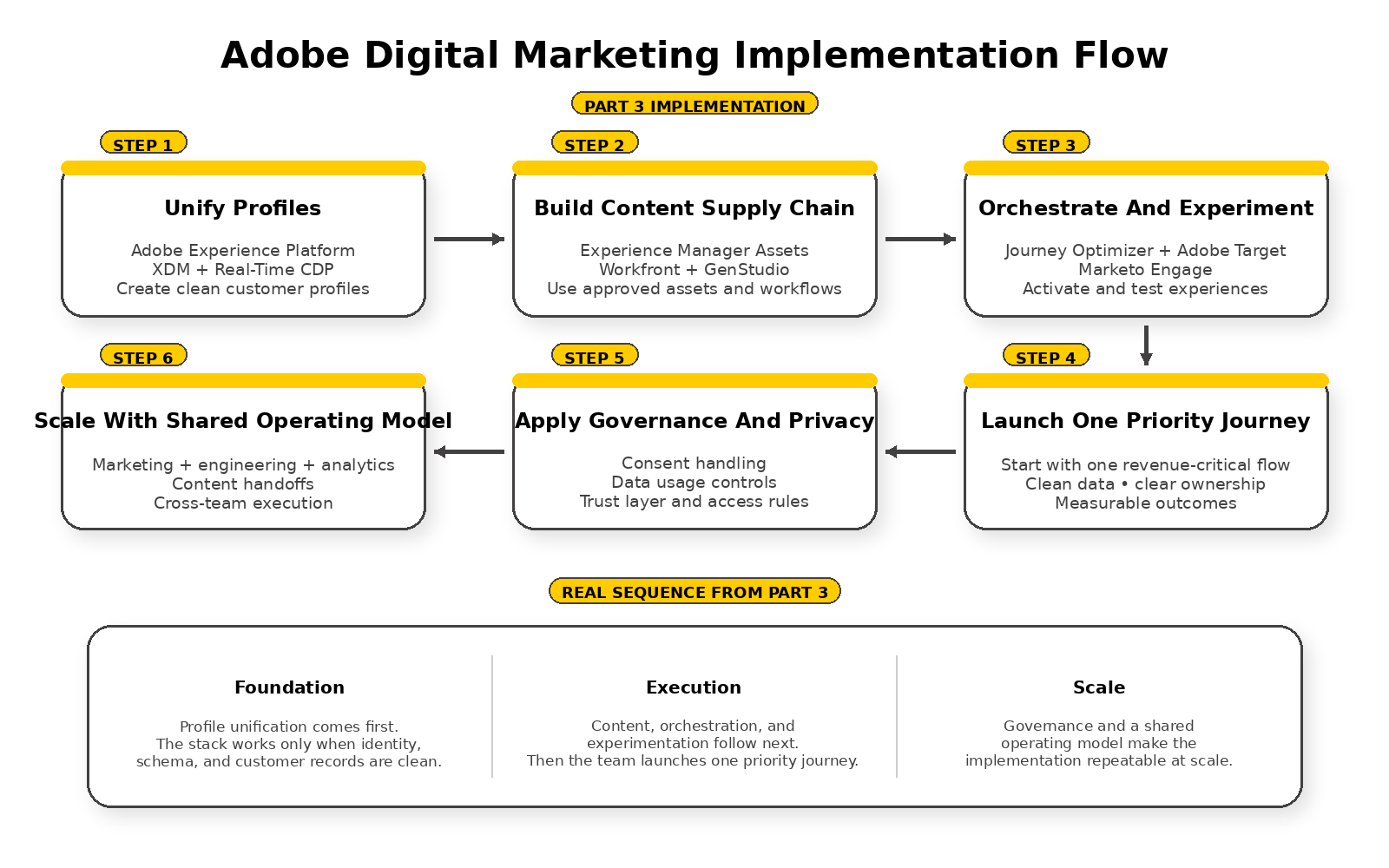
The smartest way to implement Adobe digital marketing is usually much narrower than teams expect at the beginning. Instead of trying to rebuild every channel at once, it is usually better to pick one revenue-critical journey and make that journey work end to end with clean data, approved content, clear ownership, and measurable outcomes. Adobe’s own journey setup guidance shows why this matters: Journey Optimizer relies on an XDM schema and a usable event structure, which means the platform can only react intelligently if the implementation team has already decided what events matter and how those events should be represented.
That first journey acts like a stress test for the whole operating model. It exposes where identity is weak, where content approvals drag, where data arrives too late, and where analytics still cannot explain the business outcome clearly enough. Adobe digital marketing gets much easier to scale after that first journey is working, because the team is no longer debating abstract architecture in a conference room. They are solving real problems inside a real customer flow that leadership actually cares about.
Governance And Privacy For Adobe Digital Marketing
Implementation also gets more serious the moment privacy, permissions, and AI oversight enter the room. Adobe consistently frames Real-Time CDP around governance and privacy-conscious personalization, and Agent Orchestrator is wrapped in a trust layer with data access controls, consent handling, and data-usage management. Adobe also says customer prompts, customer data, metadata, and outputs are not used to train the underlying LLMs for Experience Platform Agents, which is exactly the kind of detail legal and security teams want nailed down before broader AI-enabled workflows are approved.
This is the part companies tend to underestimate because it does not look flashy in a product demo. But Adobe digital marketing can only scale comfortably when governance rules are built into the implementation from the beginning rather than patched on later. The teams that do this well are not just protecting themselves from risk. They are creating the trust needed to move faster with audience activation, experimentation, and AI-assisted workflow design.
Create An Operating Model That Keeps Adobe Digital Marketing Moving
At some point, every Adobe deployment becomes an organizational challenge rather than a software challenge. Marketing needs analytics to validate decisions, analytics needs engineering to keep data reliable, engineering needs clear business priorities, and creative teams need an approval process that does not collapse under campaign volume. Workfront matters here for a reason, because Adobe treats work management as part of the content supply chain instead of an unrelated admin tool. That is a smart move, because most personalization programs do not fail from a lack of ideas. They fail when too many teams are waiting on each other and nobody owns the handoff.
You can see the payoff of that alignment in customer stories where Adobe is used as an operating system rather than a collection of disconnected products. Real Madrid describes its Adobe-powered transformation as a way to build a genuine dialogue with fans, while Coca-Cola presents Journey Optimizer, Real-Time CDP, and Customer Journey Analytics as part of a more centralized personalization model. That is the real implementation lesson. Adobe digital marketing does not become powerful just because the licenses are active. It becomes powerful when the organization agrees on how data, content, testing, and decision-making are supposed to move together.
Statistics And Data
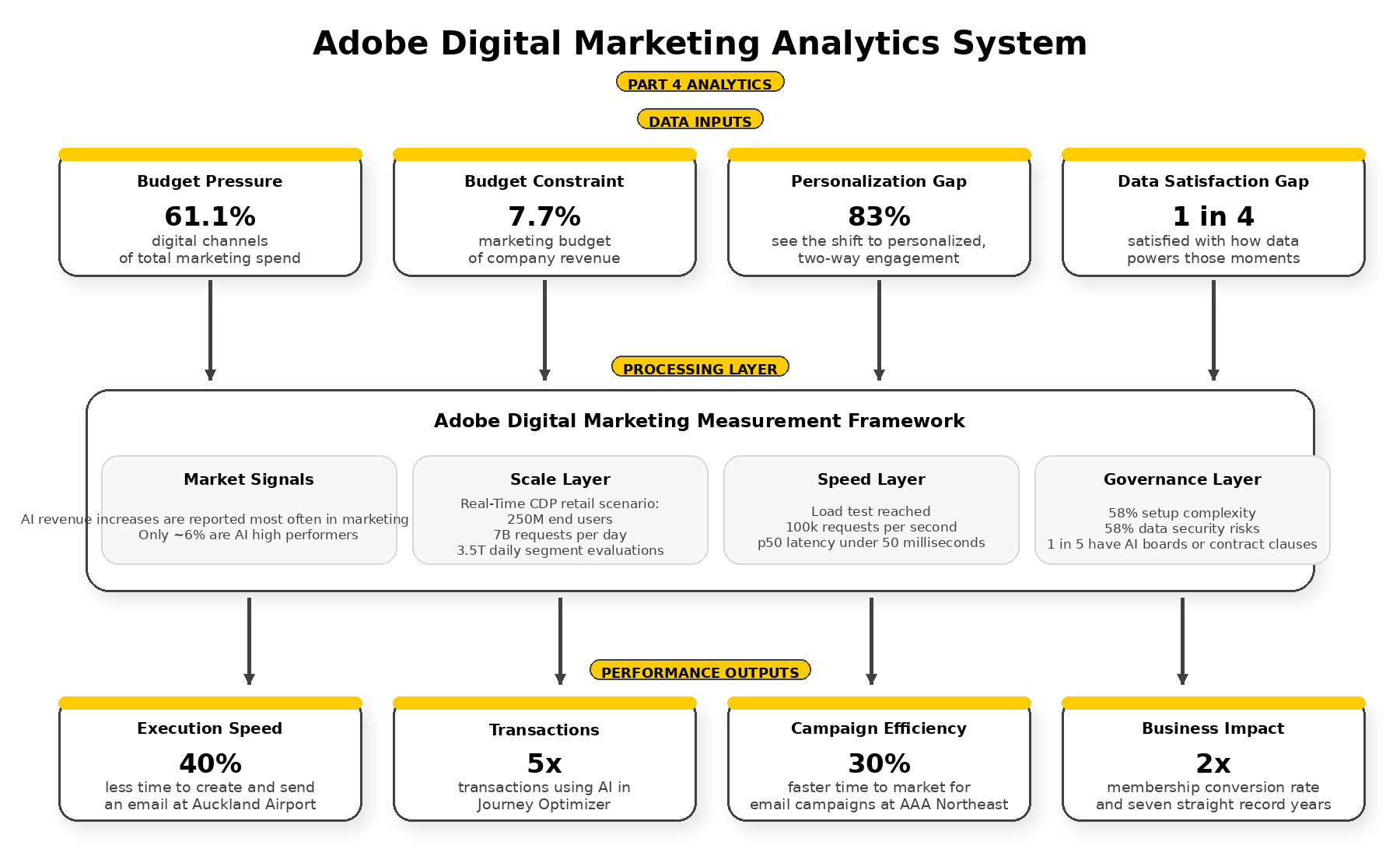
The first numbers that define Adobe digital marketing are budget numbers, and they are impossible to ignore. Digital channels now account for 61.1% of total marketing spend, while marketing budgets remain flat at 7.7% of overall company revenue. That is a pressure-cooker environment for modern marketing teams, because more of the budget is being pushed into measurable digital channels without giving teams more room to waste money, tolerate messy data, or wait weeks for clean reporting.
The Personalization Gap Is Still Mostly A Data Gap
The next set of numbers explains why so many teams still feel like they are working hard without fully connecting the dots. In Salesforce’s survey of 4,500 marketing leaders worldwide, 83% said the market has shifted toward personalized, two-way engagement, yet only one in four were satisfied with how they use data to power those moments. That gap is exactly where Adobe digital marketing tries to earn its keep. The whole point of the stack is to turn scattered behavior, profile, commerce, and campaign data into something the business can actually use before the opportunity disappears.
AI Is Raising The Stakes Even Higher
AI makes the situation even more intense, because it amplifies both the upside and the mess. McKinsey’s 2025 global AI survey says revenue increases from AI are reported most often in marketing and sales, but the same research also says only about 6% of respondents qualify as AI high performers. That is a very useful reality check. Adobe digital marketing does not become powerful just because AI features are available inside the platform; it becomes powerful when the data foundation, governance model, and workflow design are strong enough to turn AI into a repeatable advantage instead of a shiny new layer of confusion.
Adobe’s Own Business Numbers Show The Scale Of The Market
Adobe’s own financials make it clear that this is not some side category inside the company. In Adobe’s fiscal 2025 annual report, the Digital Experience segment generated $5.86 billion in revenue, including $5.41 billion in subscription revenue. Those numbers do not automatically prove that every Adobe implementation is excellent, but they do show that enterprise demand for unified data, content orchestration, analytics, and customer journey management is large enough to be a major business on its own. When Adobe followed that with its March 2025 launch of an AI platform built around Experience Platform Agent Orchestrator, it was obvious that the company sees the next chapter of Adobe digital marketing as AI-assisted execution layered on top of an already enormous enterprise base.
Customer Performance Data Tells The More Interesting Story
The most persuasive Adobe digital marketing data is not Adobe’s revenue. It is what happens when customers actually use the stack well. Auckland Airport said AI inside Journey Optimizer reduced the time needed to push out an email by about 40% and boosted transactions by 5x, while AAA Northeast said it cut time to market for email campaigns by 30%, doubled membership conversion rate, and produced seven consecutive years of record membership growth without additional marketing spend. Those are not random vanity metrics. They show Adobe digital marketing creating value in the places that matter most: speed, conversion efficiency, and the ability to personalize at scale without making execution slower.
Scale And Speed Metrics Reveal What Adobe Is Built To Handle
Adobe has also started publishing more detailed engineering numbers, and those numbers help explain why the platform keeps attracting large organizations. In a February 2026 engineering write-up on Real-Time CDP, Adobe described a retail scenario involving 250 million end users, peak traffic of 80,000 requests per second, 7 billion requests per day, and 3.5 trillion daily segment evaluations. The same article says a load test reached 100,000 requests per second with p50 latency under 50 milliseconds. Those are not normal marketing operations numbers. They are the kind of numbers that make Adobe digital marketing relevant for brands that need identity, segmentation, and personalization to keep working even when traffic spikes and the cost of delay becomes very real.
Privacy And Governance Data May Matter Most Of All
The most overlooked Adobe digital marketing statistics may be the governance ones, because they explain why so many AI ambitions still stall in the real world. The IAB’s 2025 State of Data report says the two most-cited future AI challenges both landed at 58%: complexity of setup and maintenance, and data security risks; it also says at most only 49% of agencies, brands, and publishers are using or planning to use any given one of 18 key solutions to overcome AI-adoption challenges, and only one in five have put AI boards or contract clauses in place. Put that beside Google’s note that cookies can be blocked by browser design, enterprise policy, or user choice and WebKit’s explanation that Intelligent Tracking Prevention actively blocks and removes website data, and the direction becomes obvious. Adobe digital marketing is moving toward a governed first-party system because the old tracking-heavy model is becoming harder to trust, harder to scale, and harder to defend.
What These Numbers Actually Mean For Strategy
When you put these data points together, the picture gets very clear very fast. Adobe digital marketing makes the most sense when a company is dealing with digital-heavy budget allocation, a visible data-to-personalization gap, rising governance pressure, and a genuine need to act on customer signals in real time. That is why the strongest Adobe programs are not judged only by traffic, opens, or impressions. They are judged by how quickly the business can move from data to action, how reliably teams can measure incremental impact, and how confidently leadership can scale personalization without losing trust in the numbers behind it.
Building An Adobe Digital Marketing Ecosystem That Scales
There comes a point where Adobe digital marketing stops being a conversation about individual products and starts becoming a conversation about system design. That point usually arrives when a business realizes the real problem is not a missing feature but a broken flow between planning, content creation, customer data, activation, analytics, and governance. Adobe itself makes that direction clear on Adobe Experience Platform, where it describes the platform as an API-first foundation for integrating Adobe and third-party applications, not just a place to store customer data.
That distinction matters because large marketing organizations rarely fail from a lack of tools. They fail when too many tools are doing similar jobs badly, or when valuable data gets trapped before it can improve content, targeting, or measurement. Adobe digital marketing becomes far more compelling when it is treated as the connective tissue across the business instead of a bundle of separate licenses that happen to sit in the same procurement contract.
Why The Ecosystem Matters More Than Another Feature Demo
The ecosystem matters because customer experience is now assembled across many moving parts, and those parts do not naturally cooperate on their own. Adobe’s own partner ecosystem page says its third-party service packages, apps, and integrations are meant to extend the value of Adobe applications, while the company’s Summit 2025 announcement called out strategic partnerships with Acxiom, Amazon Web Services, Genesys, IBM, Microsoft, RainFocus, SAP, ServiceNow, and Workday so AI agents can work together more effectively. That is a strong signal that Adobe digital marketing is no longer being sold as a closed garden. It is being sold as an orchestration layer that has to live comfortably inside a larger enterprise stack.
That is also why companies that already have serious operational complexity tend to get the most from Adobe. If a business needs content to move across web, email, paid media, commerce, service, and analytics without losing brand control or customer context, ecosystem quality matters more than one more shiny campaign feature. Adobe digital marketing pays off best when it reduces friction between systems that were already essential, not when it tries to replace every other tool in the company overnight.
Integrations Are Where Adobe Digital Marketing Either Compounds Or Clogs
The integration layer is where the whole promise either compounds or falls apart. On the Experience Manager Assets integrations page, Adobe describes the DAM as an open, flexible, and extensible platform that connects to third-party systems through APIs and SDKs for asset discovery, storage, work management, delivery, and custom development. That sounds like infrastructure language, and that is exactly the point. Adobe digital marketing only scales cleanly when content, approvals, metadata, and delivery do not need manual workarounds every time a team launches in a new channel.
Adobe’s own Workfront and Experience Manager Assets integration guidance shows why this is so practical. The integration can connect work and digital asset management, create linked folders automatically, sync metadata, and support several Experience Manager repositories in one Workfront environment or the reverse. That may not sound glamorous, but it is the kind of plumbing that determines whether Adobe digital marketing feels fast and strategic or slow and bureaucratic once multiple teams start touching the same campaigns.
The Content Supply Chain Is The Hidden Growth Engine
One of the smartest things Adobe has done is stop talking about content as a side issue and start talking about it as a supply chain. On its Content Supply Chain solution page, Adobe frames GenStudio as an integrated solution that automates and accelerates planning, creation, activation, and analytics so teams can scale personalized experiences with more consistency and less wasted motion. That framing fits reality much better than the old idea that marketing teams simply need “more content.” Usually they do not need more content first. They need a better system for producing, governing, reusing, and learning from the content they already create.
That is where Adobe digital marketing starts to feel like an operating model rather than a martech stack. Experience Manager Assets now emphasizes asset usage data, top downloads, cross-channel performance visibility, and agentic insights, which means the content system is no longer just a library. It becomes a feedback loop. When teams can see what is actually being reused, what performs, and what is getting lost, Adobe digital marketing gets better because content decisions become less subjective and much more commercial.
What Strong Adobe Digital Marketing Looks Like In The Wild
The strongest Adobe programs all seem to arrive at the same destination: fewer silos, faster execution, and better decisions made from fresher customer context. Signify describes using Real-Time CDP and Journey Optimizer to create a single view of millions of global customers, reduce cross-market campaign deployment from months to days, and increase email open rates by 20%. Brightline describes a connected Adobe environment that helped push booking time on its app 70% faster, triple monthly ridership from 80,000 to 260,000 trips, and keep the experience running with 99.999% uptime. Those examples matter because they show Adobe digital marketing doing what it is supposed to do: connecting experience, operations, and measurable business performance instead of treating them like separate conversations.
You can see the same pattern on the content side. Red Hat says Workfront, Experience Manager Assets, Adobe Express, Creative Cloud, and Firefly helped turn fragmented workflows into a connected content supply chain, while Lumen says Adobe GenStudio for Performance Marketing helped it cut social campaign time to market by 3X and reduce the time needed to produce Meta ad variations by 65%. None of that happens because one team suddenly got more talented. It happens because Adobe digital marketing works much better when the ecosystem reduces handoff friction and keeps approved content, planning context, and performance feedback moving together.
How To Keep The Ecosystem From Turning Into An Expensive Mess
The big risk is assuming the ecosystem will organize itself once the software is live. It will not. Adobe’s Agent Orchestrator documentation is helpful here because it keeps stressing governed enterprise data, built-in access controls, consent and data-usage management, and a framework where Adobe and third-party agents can be coordinated with human oversight. That is a useful reminder that Adobe digital marketing needs strong architecture and operating discipline long before it needs more experimentation around AI.
A healthier Adobe environment usually has a few visible signs. Teams know which system is the source of truth for audience data, which system owns approved assets, how approvals move, how metadata is maintained, and how performance gets fed back into the next campaign or experience. When those rules are clear, Adobe digital marketing becomes a serious growth engine. When they are vague, even a premium stack starts behaving like a pile of expensive shortcuts that never quite connect.
FAQ – Built For Complete Guide
What Is Adobe Digital Marketing In Practice?
In practice, Adobe digital marketing is a connected way to manage customer data, content, personalization, journey orchestration, and measurement inside one broader ecosystem. The reason companies invest in it is simple: when web experiences, email, paid media, analytics, and customer profiles are disconnected, performance usually suffers long before anyone notices it in a board meeting. Adobe’s own Experience Platform and Real-Time CDP pages make it clear that the goal is to unify customer context so teams can act on it faster and far more consistently.
Who Should Use Adobe Digital Marketing?
Adobe digital marketing makes the most sense for businesses that have already outgrown scattered tools and disconnected teams. If a company has multiple brands, regions, business units, channels, or customer databases, the value of a coordinated system rises quickly because every inconsistency becomes more expensive. That is one reason Adobe’s Digital Experience business grew to $5.86 billion in fiscal 2025, which shows just how large the enterprise demand is for this kind of connected operating model.
Is Adobe Digital Marketing Only For Enterprise Brands?
Not strictly, but enterprise complexity is where the platform usually makes the strongest case for itself. A smaller company can still use Adobe products, but the biggest payoff usually appears when teams need shared governance, high-volume personalization, cleaner identity resolution, and stronger cross-channel measurement. The simpler the business model and channel mix, the more carefully a team should compare Adobe digital marketing against lighter-weight alternatives before committing to the full ecosystem.
What Products Are Most Important In Adobe Digital Marketing?
The answer depends on the use case, but the usual center of gravity is Adobe Experience Platform, Real-Time CDP, Journey Optimizer, Customer Journey Analytics, Experience Manager, and in many organizations Marketo Engage or Adobe Target. The pattern is easy to see once you step back: one part of the stack organizes data, another activates journeys and experiences, and another explains whether any of it is actually working. Adobe digital marketing feels powerful when those pieces are chosen around a real operating model instead of being bought simply because they share the same vendor logo.
How Is Adobe Digital Marketing Different From Using Separate Tools?
Separate tools can absolutely work for a while, especially when the company is small and the channel mix is simple. The problem shows up when marketing, analytics, content, CRM, commerce, and service all create their own versions of the customer and nobody is fully sure which version is right. Adobe digital marketing is different because it is designed to reduce that fragmentation, and the market pressure for doing that is real when digital channels already represent 61.1% of total marketing spend.
Does Adobe Digital Marketing Still Make Sense After Cookie Loss?
Yes, but the reason has changed. The old model of leaning heavily on third-party signals is becoming less dependable as browsers, platforms, and users keep tightening privacy controls, which is why Google now says brands should prepare for cookies being blocked by user choice, enterprise policy, or browser behavior. Adobe digital marketing makes more strategic sense in that environment when it is built around first-party data, consent-aware activation, and tools like Real-Time CDP Collaboration, which Adobe launched to help advertisers and publishers work in a more privacy-first landscape.
How Does Adobe Digital Marketing Handle Personalization?
Adobe handles personalization by combining customer profiles, audience logic, content assets, and journey orchestration instead of treating each one as a separate project. That matters because the market still has a huge execution gap: in Salesforce’s latest marketing research, 83% of marketers recognized the shift toward personalized, two-way engagement, yet only one in four were satisfied with how they use data to power those moments. Adobe digital marketing tries to close that gap by keeping the data and content closer to the decision point, which makes personalization feel less like a campaign add-on and more like a system.
What Is The Role Of AI In Adobe Digital Marketing?
AI is increasingly becoming the acceleration layer on top of the Adobe stack rather than a disconnected novelty feature. Adobe’s Summit 2025 announcements introduced Experience Platform Agent Orchestrator as a way to coordinate Adobe and third-party agents across workflows, while GenStudio for Performance Marketing is built to generate and adapt on-brand campaign assets more quickly. The opportunity is real, but it only becomes useful when the underlying data, governance, and approval processes are already strong enough to support faster execution.
Is Adobe Digital Marketing Hard To Implement?
It can be, and pretending otherwise is one of the fastest ways to create an expensive mess. Adobe digital marketing usually becomes difficult when teams buy multiple products before they define their use cases, data model, ownership rules, and workflow handoffs clearly enough. The more honest starting point is to launch one high-value journey first, prove that the data and content flow can support it, and then expand only after the operating model is holding up under real pressure.
What Mistakes Do Companies Make With Adobe Digital Marketing?
The most common mistake is treating Adobe like a software installation project instead of a business operating model. Another mistake is underestimating the content supply chain, because personalization sounds exciting until teams realize they do not have the approved assets, metadata discipline, or workflow speed to support it. A third mistake is weak governance, which matters even more now that the IAB’s latest data says 58% cite setup complexity and 58% cite data security risks as top future AI challenges.
How Does Adobe Digital Marketing Handle Measurement?
Adobe’s measurement story is much stronger when it moves beyond simple last-click reporting. With Customer Journey Analytics, Adobe Analytics, and Mix Modeler, the company is clearly pushing toward a broader view that combines journey analysis, attribution, and planning. That matters because serious marketing decisions are rarely about one touchpoint alone; they are about understanding how channels, content, timing, and investment work together to create incremental impact.
Can Adobe Digital Marketing Support Both B2B And B2C?
Yes, and that is one reason the platform keeps showing up in complex organizations. B2C teams often lean harder on real-time profiles, cross-channel journeys, and large-scale personalization, while B2B teams may rely more on Marketo Engage, buying-group orchestration, and deeper coordination with sales. Adobe digital marketing is broad enough to support both, but the smartest implementations still choose one business problem first instead of trying to solve every customer motion at once.
How Long Does It Take To See Results From Adobe Digital Marketing?
That depends far more on implementation discipline than on the software alone. Businesses that start with one priority journey, clean data inputs, defined owners, and clear success metrics usually find useful wins much faster than businesses that begin with a giant transformation roadmap and unclear accountability. Adobe’s own customer stories show that when teams do get the fundamentals right, the gains can be meaningful, including about 40% less time to create and send an email at Auckland Airport and 30% faster time to market for email campaigns at AAA Northeast.
Do You Need Governance For Adobe Digital Marketing?
You absolutely do, and this is one of the least glamorous but most important parts of the entire stack. Adobe’s own Agent Orchestrator materials emphasize consent, data-usage management, access controls, and enterprise trust layers, while Journey Optimizer documentation highlights operational basics like DMARC because even strong strategy falls apart when authentication and deliverability are weak. Adobe digital marketing moves much more confidently when governance is treated as a growth enabler instead of a bureaucratic afterthought.
Work With Professionals
Adobe digital marketing can do incredible things, but only when strategy, implementation, content operations, analytics, and governance are all moving in the same direction. That is why companies that get the best results usually work with people who understand both the platform and the business reality behind it. Tools matter, but operators matter more, especially when budgets are tight, expectations are high, and nobody wants to waste six months building the wrong system.
If you are serious about putting Adobe digital marketing to work, the smartest move is to work with professionals who can connect architecture, activation, measurement, and commercial outcomes without turning the project into a never-ending rebuild. The right people help you avoid bloated implementations, weak data models, and content bottlenecks that quietly kill performance. They also help you focus on the journeys and decisions that can create momentum the fastest instead of drowning the team in unnecessary complexity.
Explore 10K+ Remote Marketing Contracts on MarkeWork.com
Most marketers spend too much time chasing clients, competing on crowded platforms, and losing a percentage of every project to middlemen.
MarkeWork gives you a better way. Browse thousands of remote marketing contracts and connect directly with companies desperate to hire skilled marketers like you — without platform commissions and without unnecessary gatekeepers.
If you’re serious about finding better opportunities and keeping 100% of what you earn, you can explore available contracts and create your profile for free at MarkeWork.com.
 Filip Konecny Enterprises