

Choosing among the top ecommerce agencies is harder than it used to be because the market is larger, faster, and much less forgiving. Global ecommerce sales are forecast to reach $6.42 trillion in 2025 and $6.88 trillion in 2026, while U.S. retail ecommerce generated an estimated $1.2337 trillion in 2025 and accounted for 16.4% of total retail sales. When the opportunity gets this big, the agency you hire affects far more than your storefront design.
The economics are tighter too, which is exactly why the wrong partner becomes expensive in a hurry. A 2025 benchmark from Contentsquare reported that brands spent 13.2% more on digital ad spend, saw the cost of an online visit rise 9%, and still watched conversion rates fall 6.1%. At the same time, retail returns are projected to total $890 billion in 2024, with 16.9% of annual sales expected to come back, so weak acquisition, weak merchandising, and weak post-purchase systems all hit margin at once.
That is why this article is not going to throw a random agency list at you and pretend that counts as strategy. It is going to show you how to judge the top ecommerce agencies by platform depth, growth systems, reporting discipline, and operational fit, because modern consumer journeys now move across streaming, scrolling, searching, and shopping instead of following a neat linear funnel. If you want to hire well, that is the standard that matters.
Article Outline
This article is built as a six-part guide so you can move from big-picture strategy to confident agency selection without getting lost. The first half focuses on why the top ecommerce agencies matter and how to evaluate them before the sales pitch pulls you in. The second half moves into analytics, ecosystem fit, and the final questions that separate a smart hire from an expensive mistake.
- Part 1: Why Top Ecommerce Agencies Matter More Than Ever
- Part 2: A Practical Framework for Evaluating Top Ecommerce Agencies
- Part 3: The Core Components That Separate Top Ecommerce Agencies From the Rest
- Part 4: What Professional Implementation Looks Like in the Real World
- Part 5: Analytics, Reporting, and Ecosystem Fit
- Part 6: How to Choose the Right Agency and FAQ
Why Top Ecommerce Agencies Matter More Than Ever

The pool of brands competing online keeps getting deeper, and that changes what good agency work actually looks like. OECD analysis showed ecommerce adoption among retail SMEs nearly doubled from 23% to 43% between 2013 and 2023, which helps explain why a store can no longer win with a decent theme and a few ads. The top ecommerce agencies matter because they help brands build a real commercial edge when more sellers have access to the same platforms, channels, and basic automation tools.
They matter even more because the buyer journey is now messy by default. Mobile now drives the majority of ecommerce traffic, and 46% of online orders in the first quarter of 2025 came from repeat customers, which means growth is not just about generating a click and hoping for the best. A serious agency has to connect acquisition, site experience, retention, merchandising, and customer lifecycle work so the brand does not pay heavily to earn a first order and then lose the profit on the second.
That shift changes what the word top should mean. The best ecommerce agencies are not the ones with the flashiest pitch decks or the loudest awards page; they are the ones that can reduce friction, protect margin, and improve the whole customer journey when traffic is more expensive and conversion is harder to earn. Once you look at agencies through that lens, the difference between hype and operating quality becomes a lot easier to spot.
A Practical Framework for Evaluating Top Ecommerce Agencies
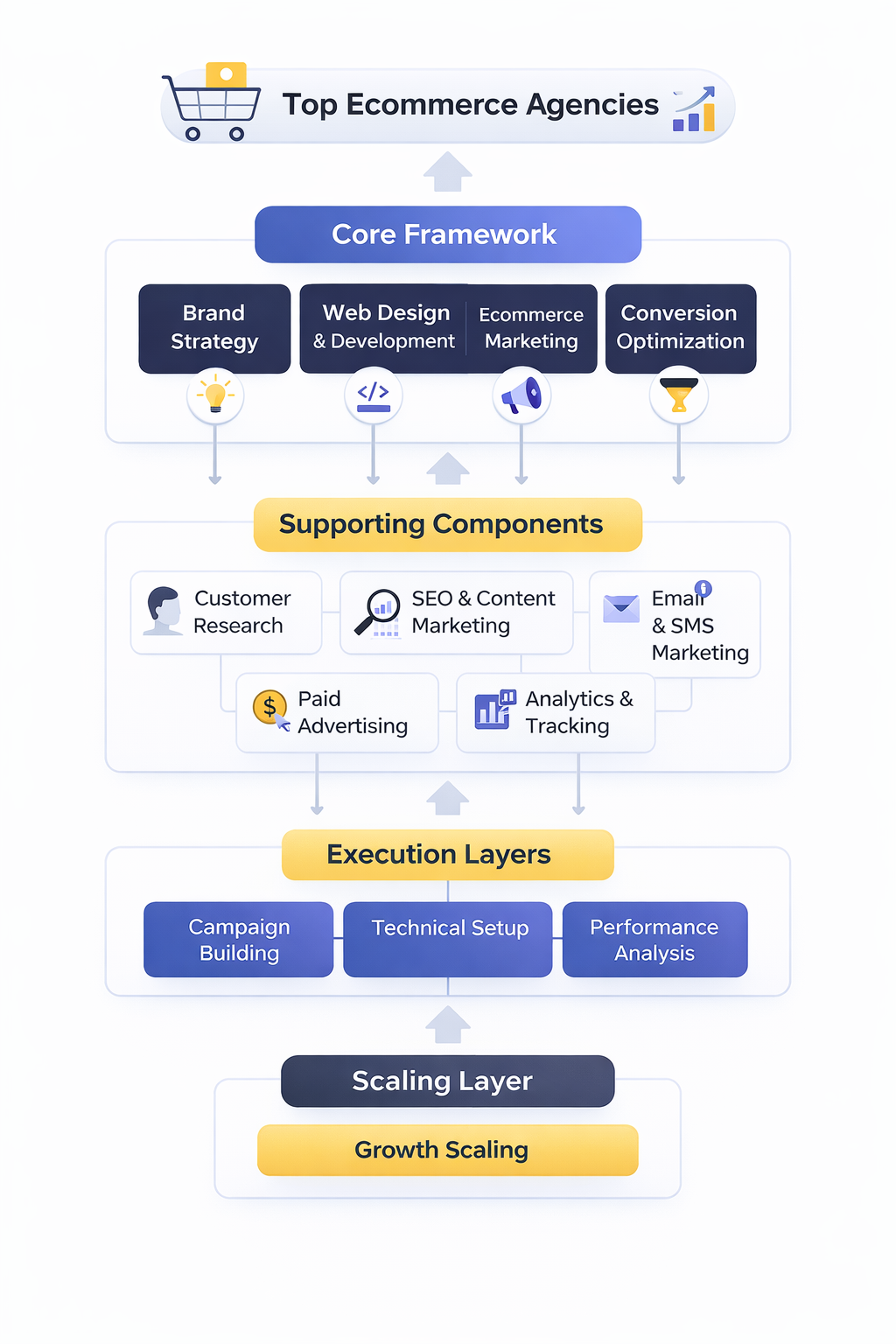
The fastest way to waste money is to hire from a generic roundup that never explains why a firm is a fit for your business model, catalog complexity, or growth stage. A stronger framework starts with five filters: platform fit, service depth, evidence of results, commercial alignment, and operational compatibility. If an agency looks impressive on social media but fails on even one of those filters, the relationship usually gets expensive very quickly.
- Platform fit: The agency should be fluent in the commerce stack you actually use or plan to adopt.
- Service depth: Strategy, design, development, paid media, CRM, CRO, and analytics should connect instead of sitting in isolated silos.
- Evidence of results: Look for measurable case studies, migration outcomes, retention work, and clear commercial impact rather than vague growth language.
- Commercial alignment: Pricing, scope, and incentives should match your margins, seasonality, and internal capacity.
- Operational compatibility: Reporting cadence, project management style, and decision-making speed need to fit your team in the real world.
Official partner ecosystems are one of the smartest places to pressure-test those filters. The Shopify Partner Directory lists more than 30 service categories, BigCommerce says the agencies in its directory are vetted for expertise, performance, and customer success, Adobe emphasizes specialization and proven customer success in its solution partner network, and Salesforce frames its consulting program around expertise and customer value. None of that guarantees greatness, but it gives you a far better starting point than a list built around whoever wrote the smoothest copy.
The rest of this guide expands each layer of that framework so you can see how the top ecommerce agencies think, what they own, and where weak firms usually crack under pressure. The goal is not to make every agency look the same. The goal is to give you a reliable way to tell the difference between a polished vendor and a true growth partner before the contract gets signed.
The Core Components That Separate Top Ecommerce Agencies From the Rest
Once the framework is clear, the next question is what the top ecommerce agencies actually need to do well. The answer is much broader than design and media buying because profitable ecommerce now depends on how well a brand connects data, creative, merchandising, and customer experience across channels. Adobe’s 2025 retail trends research found that 51% of retailers were prioritizing data-driven offers across channels, 45% were prioritizing real-time site and app personalization, and 43% were investing in automated content assembly, which shows how quickly the role has moved beyond simple storefront maintenance.
- Commercial strategy: Top ecommerce agencies begin with offer clarity, customer segmentation, pricing logic, and margin awareness so growth does not destroy profitability.
- Experience design and development: They improve navigation, collection structure, product pages, checkout flow, and performance so the store can convert the traffic it already earns.
- Acquisition and demand generation: They connect search, paid social, creators, email capture, and landing-page logic instead of treating each channel like a separate universe.
- Retention and lifecycle marketing: They build post-purchase flows, loyalty logic, repeat-purchase sequences, and win-back systems because the second order is where efficiency often starts to show up.
- Measurement and experimentation: They define KPIs, test systematically, and separate signal from noise so decisions are driven by economics instead of opinions.
Trust belongs in that list too, not as a nice extra but as part of performance itself. Adobe found that 87% of consumers expect retailers to handle personal data responsibly and securely, while only 46% believe brands are doing that well, so the top ecommerce agencies have to balance personalization with restraint. Better targeting is useless if it damages trust, pollutes reporting, or makes the customer experience feel invasive.
That is also why shallow full-service claims deserve real scrutiny. Adobe’s 2026 digital trends report says fewer than half of organizations believe their data quality is adequate for AI, and only 39% say they have a shared customer data platform capable of supporting agentic AI. An agency that cannot work across analytics, operations, and activation will usually hit a wall the moment the brief becomes more ambitious.
What Professional Implementation Looks Like in the Real World
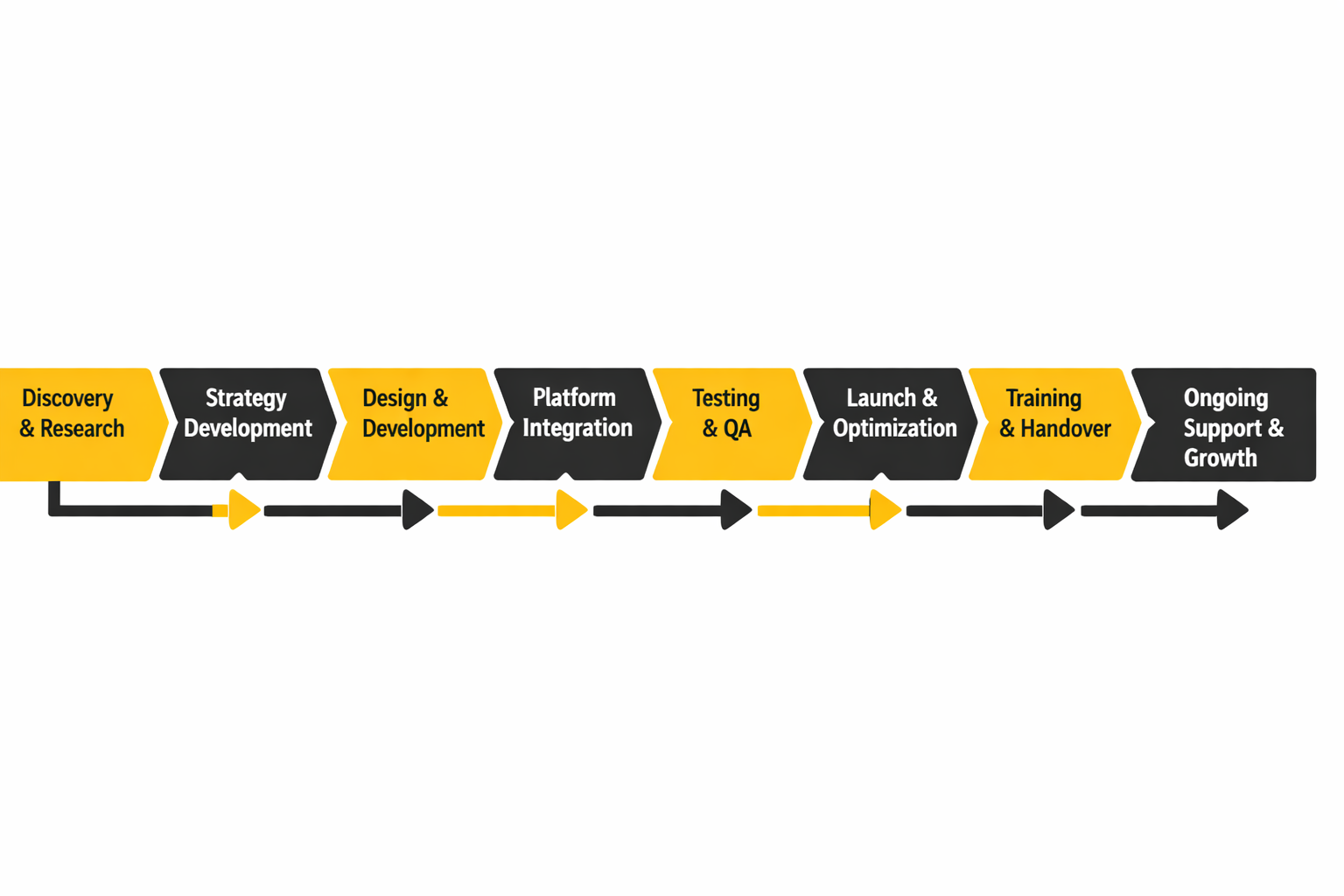
Professional implementation is where average agencies usually get exposed. They can sell the dream in a proposal, but once the project starts they struggle to align positioning, site changes, campaign launches, feed management, reporting, and lifecycle work into one operating rhythm. The top ecommerce agencies work differently: they start with a serious audit, set a measurement baseline, prioritize quick wins, and turn the rest of the work into a sequenced roadmap instead of a pile of disconnected tasks.
That discipline matters because execution pressure is real. Adobe found that 43% of retailers feel pressure to deliver more content across multiple channels while 47% are under pressure to improve engagement and conversion at the same time, and only 44% of organizations say they have a measurement framework for generative AI. A capable agency brings order to that chaos by defining who owns the brief, how tests are approved, which metrics matter, and when a change should roll out across the wider stack.
For brands that are not ready to hire a full-service partner yet, the smartest move is often to clean up the obvious gaps first. A lean stack built around ClickFunnels, Systeme.io, Brevo, or Fillout can tighten landing pages, follow-up flows, customer communication, and form handling before you pay agency rates for avoidable cleanup work. That kind of preparation makes agency conversations better, scopes cleaner, and performance expectations far more realistic.
Great implementation is not magic. It is a disciplined system that turns strategy into deadlines, assets, tests, integrations, and feedback loops without losing sight of margin, customer experience, or internal capacity. That is the standard this guide will keep using as we move deeper into analytics, ecosystem fit, and final agency selection.
The framework only becomes useful when you can apply it under real commercial pressure. That is where a lot of agency shortlists fall apart, because they look impressive on paper but never force the hard questions about platform depth, checkout friction, customer retention, international expansion, and reporting discipline. If you want to evaluate the top ecommerce agencies like an operator instead of a hopeful buyer, you need a scorecard that matches the way modern commerce actually works.
The good news is that this does not need to get complicated. It needs to get honest. A strong framework helps you separate agencies that can genuinely improve revenue systems from agencies that are really just selling creative polish, media management, or development hours dressed up as growth strategy.

How to Score Top Ecommerce Agencies Step by Step
A practical scorecard for the top ecommerce agencies starts with six areas: business-model fit, platform and technical depth, channel integration, proof of results, commercial alignment, and operating fit. Miss one of those areas and the relationship usually gets awkward fast, because the agency will either oversell what it can do or quietly avoid the work that actually moves profit. Hit all six and you are much more likely to hire a partner that can make smart decisions when the easy wins run out.
- Business-model fit: Does the agency understand how your store really makes money?
- Platform depth: Can it work inside your actual stack without slowing everything down?
- Channel integration: Can it connect acquisition, merchandising, retention, and operations?
- Proof: Does it show controlled, believable evidence instead of vanity metrics?
- Commercial alignment: Do the pricing model and scope make sense for your margins?
- Operating fit: Can your team actually work with these people every week?
This is also the point where some brands realize they do not need one of the top ecommerce agencies yet. If your biggest problems are basic landing-page clarity, weak email capture, and poor follow-up, a lighter setup built around ClickFunnels, Brevo, or Fillout may fix the bottleneck before you commit to a full agency retainer. That is not a step backward. It is often the most financially responsible way to get your store ready for a more sophisticated partner.
Start With Business-Model Fit
The first filter is brutally simple: does the agency understand the kind of commerce business you actually run. A subscription-heavy brand, a catalog-led DTC store, a B2B hybrid seller, and a marketplace business can all look similar from the outside, but they break in very different places once growth starts to accelerate. Stripe’s 2025 annual letter makes that point clearly by describing the rise of global-by-default businesses, while Stripe’s ecommerce payments guide and its payment localization guidance show how quickly pricing, payment methods, currencies, and compliance become part of the growth conversation.
That is why you should ask agencies what kind of revenue model they are strongest in before you ask how many clients they have. If they mostly build beautiful stores for straightforward one-country brands, that may still be useful, but it is not the same as knowing how to manage cross-border payments, tax obligations, or local currency presentation. Global compliance and 2026 tax changes are not side issues once a brand grows past a simple domestic setup, so an agency that treats them like afterthoughts is telling you something important.
The top ecommerce agencies do not just ask what platform you use. They ask how you acquire customers, how often they reorder, where margin gets squeezed, what returns do to profitability, and which markets you plan to enter next. That line of questioning usually tells you more about their quality than their pitch deck ever will.
Test Platform and Technical Depth
Once business-model fit is clear, move straight into platform depth. The easiest way to get burned is to hire an agency that knows how to sell around a platform but not how to build inside it. The strongest firms can explain exactly how they handle theme architecture, app sprawl, search and collection logic, checkout customization limits, ERP or CRM integrations, analytics instrumentation, and migration risk before the project even starts.
Official ecosystems help here because they create a baseline for seriousness. Shopify’s Partner Directory lets brands filter by specific service categories rather than treating every provider like a generalist, BigCommerce says agencies in its directory are vetted for expertise, performance, and customer success, Adobe positions its solution partners around specialized expertise and customer success, and Salesforce now frames its consulting partner program around expertise-driven delivery and customer value. None of those ecosystems guarantee a perfect hire, but they do make it harder for an unproven firm to hide behind vague claims.
You also want to know who will actually do the work. Ask whether the senior strategist who sold the engagement will stay involved once the contract is signed. Ask who owns the technical architecture, who reviews QA, who handles integrations, and how often senior people get involved when something breaks. Those questions sound basic, but they are exactly where weak agencies start getting slippery.
- Who leads technical discovery?
- Who approves architecture and QA?
- Which integrations has the team implemented more than once?
- What part of the work is handled in-house and what part is subcontracted?
Check Channel and Lifecycle Integration
A lot of agencies still act as if growth lives in separate rooms. Paid media lives in one room, ecommerce design in another, email in another, and customer support somewhere far away from all of them. That is not how people buy anymore. Google found that 64% of U.S. holiday shoppers blended scrolling, streaming, searching, and shopping, and Google’s work on the new decision-making process makes the same point from another angle: the customer journey is fluid, nonlinear, and shaped by intent shifts that happen in real time.
The agency you hire has to be able to work inside that reality. That means paid acquisition should connect to landing-page clarity, merchandising, product discovery, checkout usability, email capture, lifecycle messaging, and post-purchase experience. If those pieces are split across departments that barely talk to each other, you will feel it in the numbers long before you see it in a status meeting.
This is where practical UX research becomes extremely valuable. Baymard still places average cart abandonment at 70.19%, while its 2025 checkout research argues that large ecommerce sites can unlock meaningful conversion gains by fixing avoidable checkout barriers. A top ecommerce agency does not look at those findings and think only about forms or buttons. It sees a chain reaction that starts with ad intent, continues through navigation and product-page confidence, and ends with whether the customer finishes the order without frustration.
- Acquisition: traffic quality, landing-page match, creative-to-offer consistency
- On-site experience: navigation, search, product pages, collection logic, mobile usability
- Checkout: friction, payment options, address handling, trust signals, speed
- Lifecycle: email, SMS, repeat-purchase flows, win-back campaigns, loyalty
- Post-purchase: returns, support, delivery communication, review collection
Demand Proof That Goes Beyond Vanity Metrics
This is where you stop being impressed by screenshots. The top ecommerce agencies should be able to show what changed, why it changed, over what time period it changed, and what trade-offs came with that improvement. If the proof sounds like “we scaled spend,” “we refreshed the brand,” or “engagement improved,” keep pushing until you get to revenue quality, margin quality, retention impact, or operational lift.
One good standard is to look for evidence built around testing, not storytelling. Stripe’s March 2026 analysis of 1.5 million subscription checkout sessions is useful here not because every ecommerce agency needs to run localized subscription pricing, but because it shows what credible proof looks like: a clear intervention, a large sample, a holdback group, and outcomes that included a 4.7% average conversion lift, a 1.9% authorization lift, and a 5.4% increase in LTV per session. That is the level of specificity you want agencies to respect.
Case studies do not all need to look like lab reports, but they should still answer the questions that matter. What was the baseline. What was broken. What changed. What got better. What got harder. If an agency cannot stay concrete when talking about its best work, it is usually because the results are not as durable as the branding around them.
Pressure-Test Commercial Alignment
Good agencies can still be bad hires when the commercial model is wrong. A fixed retainer can work beautifully for a brand that needs ongoing experimentation across multiple channels, but it can become dead weight for a business that really needs a focused migration, a checkout rebuild, or a retention reset. You are not only buying talent here. You are buying a structure for decisions, priorities, and accountability.
This is why top-line growth numbers are never enough on their own. Retailers expect 15.8% of annual sales to be returned in 2025, and free returns remain a major purchase factor for 76% of consumers, so an agency that celebrates more orders while ignoring returns pressure, discount dependence, and support load may be making your revenue line look healthier than your profit line really is. The right commercial conversation asks what kind of growth you want, what kind of volatility you can handle, and which metrics deserve priority when they inevitably start competing with one another.
It also helps to ask what happens when scope friction arrives, because it always does. If new creative is needed, who pays for it. If tracking is broken, who owns the fix. If email and retention become more important than paid media mid-engagement, can the team reallocate without turning every adjustment into a miniature contract negotiation. The best agencies answer those questions calmly because they have run into them before and built for them.
Evaluate Operating Fit Before You Sign
The final filter is the one people often underestimate because it sounds soft. It is not soft at all. Operating fit decides whether strategy turns into execution or dies in project-management purgatory. A brilliant agency that cannot communicate with your team, cannot document decisions, or cannot move at your pace will feel average within a month.
This matters even more now because the underlying systems are getting more complex, not less. Adobe reported in 2026 that only 39% of organizations have a shared customer data platform capable of supporting agentic AI and fewer than half say their data quality is adequate for AI. In other words, most brands are still operating with messy data, disconnected tooling, and imperfect visibility, so an agency that needs ideal conditions to perform is going to stall the first time reality shows up.
You want a team that can work with imperfect inputs without becoming sloppy. That means clear agendas, clean weekly updates, honest prioritization, documented test plans, and fast escalation when blockers appear. The top ecommerce agencies rarely win because they are the most dramatic. They win because they make hard work feel organized.
What a Winning Framework Should Leave You With
By the time you finish this part of the process, your shortlist should feel smaller and stronger. You should know which agencies truly understand your business model, which ones can handle your stack, which ones think across the full customer journey, which ones can prove impact, and which ones fit the way your team actually operates. That is the kind of clarity that protects you from expensive enthusiasm.
And that is exactly why the next part matters. Once the framework is in place, you can look deeper at the components that separate the top ecommerce agencies from the firms that only look convincing during the pitch.
Commercial Strategy Has to Come Before Creative
The top ecommerce agencies start with the economics of the business because everything else depends on that foundation. They want to know which products drive margin, which bundles increase average order value without hurting conversion, which customers reorder, which offers are too reliant on discounts, and where returns quietly destroy profit after the sale. If an agency jumps straight to aesthetics without dealing with those questions, it is already solving the wrong problem.
This is also where strategy becomes more than branding language. Google’s 2025 work on streaming, scrolling, searching, and shopping shows how messy consumer journeys have become, which means a strong commercial strategy has to hold together across discovery, evaluation, checkout, and repeat purchase. The best agencies understand that an offer is not just a headline on a landing page; it is the logic that connects product, pricing, merchandising, and customer intent into something people feel confident buying.
Conversion Experience Has to Be a Revenue System
A lot of agencies still talk about design as if it were mostly visual. The top ecommerce agencies do not make that mistake. They treat the store like a revenue system where navigation, search, collection structure, product-page clarity, mobile speed, checkout friction, payment options, and trust signals all have to work together or the whole machine leaks money.
The numbers make that impossible to ignore. Baymard’s checkout research shows that 70.19% of carts are still abandoned, and the same research explains that checkout usability alone can be the reason users walk away after they have already shown real purchase intent. That is why top ecommerce agencies spend so much time on practical details like form friction, guest checkout logic, shipping transparency, and payment flow instead of treating conversion rate optimization like a button-color exercise.
They also understand that international and subscription businesses need more than a generic checkout clean-up. Stripe’s March 2026 test across 1.5 million subscription checkout sessions found that localized pricing lifted conversion by 4.7%, authorization by 1.9%, and LTV per session by 5.4%. You do not need to run a subscription brand to learn from that. The lesson is that the closer a checkout feels to the buyer’s expectations, the easier it becomes to turn intent into revenue.
Retention and Lifecycle Have to Be Owned
One of the clearest differences between average firms and the top ecommerce agencies is what happens after the first purchase. Weak agencies treat retention like an add-on. Strong agencies build it into the commercial model because they know a brand cannot keep paying more for traffic while acting as if the second order will somehow take care of itself.
Salesforce reported that purchases from repeat shoppers were up 6% year over year in Q1 2025, which is a strong reminder that customer loyalty is not a soft metric sitting off to the side. It is one of the cleanest ways to make growth more efficient. The agencies worth hiring create post-purchase flows, replenishment timing, win-back campaigns, VIP logic, and customer education that increase the odds of another order without making the brand feel robotic.
The same pattern shows up in retailer priorities. Adobe’s 2025 retail research found that 51% of retailers were prioritizing personalized offers across channels, 45% were prioritizing real-time personalization of site and app content, and 41% were focusing on product recommendations that support cross-sell and upsell. That is not just a technology trend. It is evidence that lifecycle marketing, on-site relevance, and retention strategy are now part of the same job.
Data and Measurement Cannot Be an Afterthought
The top ecommerce agencies do not wait until month three to ask whether the numbers can be trusted. They know measurement problems can poison everything else, because once attribution is fuzzy and event tracking is unstable, even smart teams start arguing from opinion instead of evidence. That is why high-quality agencies define the KPIs, instrumentation, and reporting rules before they scale tests or spend.
The urgency here is real. Adobe found that 41% of retailers say fragmented data is stopping them from delivering real-time personalization, while 35% say it is causing inconsistent experiences across channels. The same report shows that 43% of retail organizations are prioritizing advanced segmentation, 42% predictive modeling, 42% data unification across sources, and 43% faster real-time data processing. In plain English, the market has already moved past basic analytics hygiene, and agencies that cannot work across data, activation, and decision-making are going to slow a brand down.
This is also why the best firms talk comfortably about measurement limits. They know what can be inferred, what can be tested directly, what needs longer observation windows, and where blended judgment still matters. That kind of honesty usually sounds less exciting in a sales call, but it becomes incredibly valuable once the work begins.
Implementation Needs Process, Not Chaos
Even a smart strategy falls apart when the agency cannot translate it into a clean operating rhythm. The top ecommerce agencies are strong here because they build a sequence for the work: audit first, baseline second, priority roadmap third, then testing, deployment, reporting, and iteration on a weekly cadence. That structure is not glamorous, but it is usually the thing that keeps good ideas from dying in Slack threads and half-finished tickets.
Adobe found that 43% of retailers feel pressure to produce more content across multiple channels, while 47% are under pressure to improve engagement and conversion at the same time. That is exactly the kind of environment where average agencies become chaotic. The good ones create a process for approvals, creative testing, asset reuse, deployment timing, and feedback loops so the team can move fast without turning the brand into a mess.
For smaller brands, implementation discipline sometimes starts with simplifying the stack before a large agency engagement even makes sense. A lean setup using Systeme.io, Brevo, or Moosend can clean up email automation, lead capture, and basic funnel logic before a brand pays premium fees for someone else to untangle avoidable clutter. That kind of cleanup is not flashy, but it often makes every later agency decision much smarter.
Post-Purchase Operations Protect Margin
This is the component too many buyers overlook because it sits outside the glamorous part of ecommerce. The top ecommerce agencies know better. They understand that shipping communication, returns policy, support handoff, review collection, and fraud controls shape profitability just as much as media buying or design changes do, especially when a brand starts scaling fast.
NRF’s 2025 Retail Returns Landscape reports that 19.3% of online sales are expected to be returned in 2025, and 82% of consumers say free returns matter when they shop online. Those two facts create tension immediately. Customers want low-friction post-purchase experiences, while brands still need to protect margin. The agencies that really understand ecommerce build policies, messaging, and operational handoffs that respect both sides instead of pretending the trade-off does not exist.
That is one more reason the best agencies think in systems. They know the sale is not the finish line. It is the moment the rest of the brand experience starts proving whether the growth was actually healthy.
Why These Components Change How You Hire
Once you understand these core components, the top ecommerce agencies become much easier to evaluate. You stop getting distracted by surface-level promises and start asking harder questions about revenue mechanics, lifecycle ownership, data quality, implementation discipline, and operational follow-through. That shift changes everything because it forces the conversation back to what the agency must actually do inside the business.
And that leads naturally into the next part of the article. Once the core components are clear, the real question becomes what professional implementation looks like when those components have to work together under deadline, budget pressure, and the realities of an actual ecommerce team.
What Professional Implementation Looks Like With Top Ecommerce Agencies
The top ecommerce agencies do not prove themselves in the proposal. They prove themselves in the first few weeks after kickoff, when strategy has to turn into priorities, ownership, reporting rules, creative workflows, and shipping decisions that hold up under pressure. That is where a polished sales story either becomes a real operating system or falls apart into missed deadlines, vague updates, and activity that looks busy without clearly moving revenue.
Professional implementation starts with discipline. The best teams establish a baseline, define which metrics actually matter, document the technical and content constraints, and decide how fast the brand can test changes without breaking the customer experience. That sounds simple, but it is exactly the kind of rigor most brands need when digital ad spend has risen 13.2%, the cost of an online visit has climbed 9%, and conversion rates have still fallen 6.1%.
Kickoff Should Produce a Commercial Baseline
The first sign that you are dealing with one of the top ecommerce agencies is that kickoff does not begin with aesthetics. It begins with the numbers that define commercial reality: traffic quality, conversion by device, add-to-cart rate, checkout completion, average order value, repeat purchase rate, return rate, support burden, and margin pressure by product or channel. Without that baseline, the agency has no honest way to decide what deserves priority and no credible way to prove later that its work changed anything meaningful.
This is more important than ever because the context around those numbers is getting harder to ignore. Shopify highlights that smartphones accounted for roughly 78% of retail site visits worldwide in Q3 2025 and generated about 70% of online shopping orders, while NRF reports that 19.3% of online sales are expected to be returned in 2025. A serious implementation plan cannot treat those realities as background noise, because a mobile-heavy store with high returns needs a very different roadmap from a desktop-heavy catalog with stronger post-purchase economics.
Delivery Cadence Has to Protect Speed and Quality
Once the baseline is clear, the work needs a cadence that protects both speed and judgment. The top ecommerce agencies usually run a tight rhythm: one stream for priorities, one for production, one for QA, and one for reporting back to the client in plain English. That structure keeps creative, development, lifecycle, and media work moving together instead of letting each function disappear into its own backlog.
That kind of cadence matters because most retail teams are already under pressure before the agency even arrives. Adobe found that 43% of retailers feel pressure to deliver more content across multiple channels, while 47% feel pressure to improve engagement and conversion at the same time. If the agency cannot organize testing, approvals, and deployment around those pressures, implementation turns into chaos fast.
For smaller brands, that sometimes means simplifying the stack before expanding it. A cleaner operating flow built around Brevo, Fillout, or ClickFunnels can make lead capture, follow-up, and offer testing far easier to manage before a brand piles on extra complexity. The best agencies are usually honest about that because they care more about clean execution than selling unnecessary layers of tooling.
Senior Oversight Should Show Up in the Hard Calls
The strongest implementation models also make senior oversight visible when the hard decisions arrive. That means senior people step in when attribution looks weak, when the checkout needs trade-offs between speed and flexibility, when retention is underperforming despite healthy acquisition, or when a major campaign should be delayed because the site is not ready. It is easy to promise strategic guidance in a sales call. It is much harder to show up with clear judgment when the answer is inconvenient.
The need for that judgment is obvious in the data. Adobe’s 2026 report shows that only 44% of organizations say their data quality and accessibility are adequate for AI, only 39% have a shared customer data platform capable of supporting agentic AI, and only 44% have implemented a measurement framework for generative AI. In other words, most brands are still operating with imperfect foundations, which is exactly why top ecommerce agencies earn their keep by helping teams make sensible decisions before those weak foundations start distorting every report and experiment.
Statistics and Data Top Ecommerce Agencies Actually Use
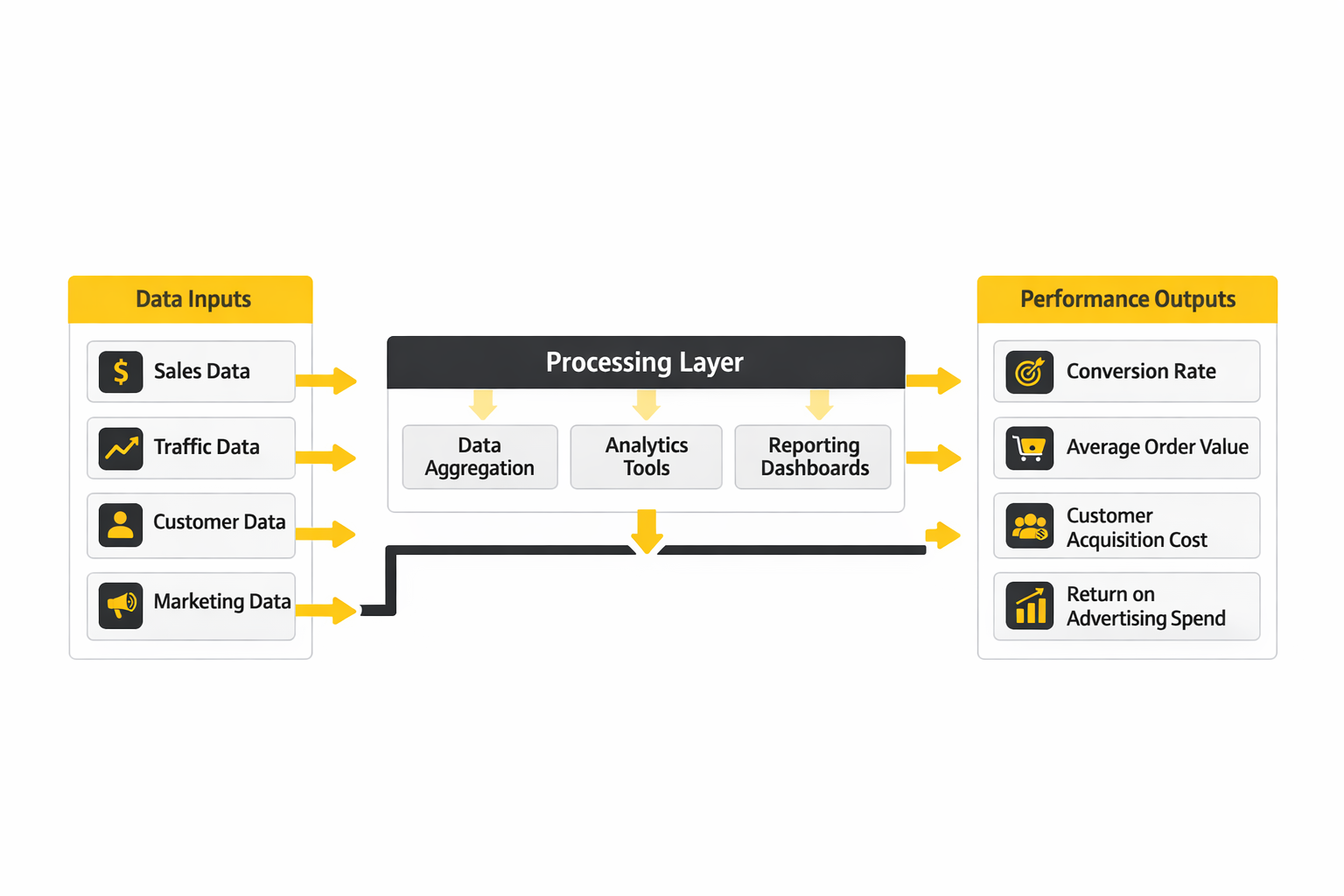
When implementation gets serious, reporting has to get better too. The top ecommerce agencies do not drown clients in dashboards full of decorative charts and vanity metrics. They build reporting around the handful of numbers that tell you whether acquisition is efficient, the site is converting, customers are coming back, and post-purchase friction is quietly eating the margin you thought you were gaining.
That is also why raw traffic is rarely the headline metric in a mature engagement. Traffic matters, of course, but it only matters in context. The real question is whether better traffic, better merchandising, better checkout flow, and better lifecycle work are combining into healthier economics over time.
The Numbers That Deserve a Permanent Place on the Dashboard
- Conversion rate by device and channel
- Add-to-cart rate and product-page conversion rate
- Checkout completion rate
- Average order value and gross margin after discounts
- Customer acquisition cost and cost per visit
- Repeat purchase rate and cohort revenue
- Return rate, refund value, and post-purchase support volume
- Page speed, bounce rate, and frustration signals on key templates
Those metrics belong together because they explain one another. Contentsquare found that 40% of online visits in 2024 were affected by user frustration, and slow-loading content caused 53% of users to leave after viewing just one page. If an agency reports media spend in one deck, UX issues in another, and retention performance somewhere else, it becomes much harder to see the real chain of cause and effect.
How the Best Agencies Read the Data Instead of Just Reporting It
Reading the data properly means knowing where to look for the real leak. A lower conversion rate does not automatically mean the traffic got worse. It might mean the mobile experience is underperforming, the product pages are not resolving hesitation, the checkout is creating friction, or returns are rising because the wrong customers are being acquired through the wrong promises.
This is where the top ecommerce agencies usually separate themselves from average vendors. Baymard’s research shows that 65% of sites still have checkout performance rated mediocre or worse, that the average site has 32 unique improvements available, and that better checkout UX can drive a 35% increase in conversion for a typical large-scale ecommerce site. Good agencies do not just quote those numbers and move on. They use them to investigate exactly where a brand is losing intent and which fixes are likely to create the biggest commercial lift first.
That mindset changes the reporting conversation. Instead of saying that performance is “mixed,” the agency can say the product pages are doing their job, mobile cart progression is weak, shipping clarity is hurting checkout completion, and repeat purchase behavior is healthy enough that improving first-order friction is worth immediate investment. That is the difference between a dashboard and a decision-making tool.
What Clean Reporting Feels Like to the Client
Clean reporting feels surprisingly calm. The client knows what was tested, what changed, what held back the numbers, what still looks uncertain, and what the next decision should be. There is no need for theatrical language when the logic is solid and the numbers are tied to the way the business actually makes money.
That clarity becomes even more valuable when new technologies enter the mix. Adobe found that 50% of retail executives report better decision-making from AI insights, 48% report gains in content ideation and production, and 65% of organizations with proven AI ROI tied those projects directly to core business objectives from the start. The lesson is not that every brand needs an AI-heavy strategy tomorrow. The lesson is that reporting gets stronger when every initiative begins with a business goal, a measurement plan, and a clear definition of what success should look like before the work begins.
That is the standard worth holding. The top ecommerce agencies do not just implement ideas and hope the numbers cooperate. They create a reporting environment where the numbers become useful enough to guide the next wave of implementation, which is exactly what separates expensive activity from real progress.
The next part of the article moves from reporting discipline into ecosystem fit, because even great implementation can stall when the agency, platform, apps, data flow, and internal team are not built to support one another.
Analytics, Reporting, and Ecosystem Fit
By this point, the big lesson should be clear: even the top ecommerce agencies cannot do their best work inside a broken ecosystem. A store can have strong creative, a capable media team, and a beautiful front end, yet still underperform because the data is fragmented, the apps do not communicate cleanly, or the internal team is not structured to make fast, sensible decisions. That is why ecosystem fit deserves its own section instead of getting treated like a technical footnote.
The pressure behind this is real. Adobe’s 2025 retail report shows that 75% of consumers value a consistent experience across website, app, email, social media, and in-store touchpoints, yet only 41% of brands are seen as delivering that consistency. When expectations are that high, the agency you hire has to fit not just your storefront, but the entire commercial system around it.
Ecosystem Fit Starts With the Stack You Already Have
The top ecommerce agencies do not walk into an account assuming the answer is a brand-new stack. They start by understanding what is already in place: your platform, checkout constraints, ERP, CRM, email system, product information setup, subscriptions, reviews, search, analytics, support tools, and any marketplace or retail media connections that influence the buying journey. That first map matters because the same recommendation can be brilliant in one ecosystem and destructive in another.
Shopify’s 2025 guide to building an ecommerce tech stack puts it plainly: the difference between a good stack and a bad one is whether the parts actually work together. That is exactly the mindset you want from an agency. If a firm keeps suggesting new tools before it understands how orders, customer data, content, and reporting already move through the business, it is probably solving for presentation, not operational quality.
This is where business model and stack model collide. A DTC brand with a simple catalog and strong repeat purchase behavior may need cleaner lifecycle automation more than another app. A B2B or international seller may need an agency that can handle complex integrations, regional experiences, procurement realities, or multiple catalogs without turning the stack into a maintenance problem. The best agencies understand that ecosystem fit is less about how many tools they know and more about how well they can simplify the system that already exists.
Data Flow Is Where Good Agency Work Either Scales or Stalls
A lot of brands discover this too late. The agency launches campaigns, refreshes landing pages, improves offers, and still cannot get clear answers out of the reporting because data is duplicated, customer identities are fragmented, and important events are not flowing properly across systems. At that point, the issue is no longer channel execution. It is ecosystem design.
Adobe’s 2026 Digital Trends report shows how serious that problem still is: only 44% of organizations say their data quality and accessibility are adequate for AI, only 39% have a shared customer data platform capable of supporting agentic AI, and only 44% have implemented a measurement framework for generative AI. Those numbers matter even if you are not chasing the latest AI trend, because they reveal how many organizations still struggle with the basics of unified data, clean measurement, and cross-functional visibility.
Adobe’s 2025 retail findings make the same point from the commerce side: 41% of retailers say fragmented data is preventing real-time personalization, while 35% say it is causing inconsistent experiences across channels. That is exactly why the top ecommerce agencies obsess over tracking plans, event naming, customer identity, feed quality, and reporting logic. They know you cannot scale what you cannot trust.
Partner Ecosystems Are Useful, but They Are Not a Shortcut
Official partner ecosystems are still one of the smartest places to start your search. Shopify’s agency selection guide points brands to its partner directory for agencies with deep platform knowledge and a successful track record, while BigCommerce says every agency in its directory has been vetted for expertise, performance, and customer success. That is valuable because it gives you a more credible first filter than a random “top agency” roundup built around whoever wrote the slickest copy.
But directories are only a starting point. They tell you an agency is serious enough to be visible inside an ecosystem. They do not tell you whether that agency is the right fit for your margin structure, internal speed, governance style, or growth priorities. That is why the best hiring process uses partner directories as a shortlist tool, then moves quickly into deeper questions about integrations, category experience, reporting discipline, and team structure.
This matters even more if your business is moving across channels and regions. BigCommerce positions its platform around powering buying experiences across brands, regions, and channels from a single scalable foundation, and Salesforce frames its consulting ecosystem around expertise and customer value. Those ecosystems can be extremely helpful, but only if the agency can explain how it will make your specific version of complexity feel simpler, not heavier.
Privacy, Trust, and Governance Are Part of Ecosystem Fit Too
One mistake brands make is treating privacy, trust, and AI disclosure as legal problems that sit somewhere outside agency work. The top ecommerce agencies do not think that way. They know the moment an agency touches personalization, automation, customer messaging, or service workflows, it is already part of the trust layer of the business.
Salesforce’s 2024 State of the AI Connected Customer found that 71% of customers are increasingly protective of their personal information, only 42% trust businesses to use AI ethically, and 61% say it is even more important for companies to be trustworthy as AI use expands. Adobe’s 2025 retail research adds another layer: 87% of consumers expect retailers to handle personal data responsibly and securely, but only 46% believe brands are doing that well. That gap is not abstract. It affects the way customers respond to personalization, support, post-purchase communication, and the brand as a whole.
So when you evaluate ecosystem fit, ask the unglamorous questions. Who owns consent logic. Who signs off on AI-assisted messaging. How are customer segments governed. Where does support escalation go when automation gets something wrong. Those questions do not make an agency presentation more exciting, but they absolutely make the relationship safer and smarter.
Internal Team Fit Is the Hidden Part of the Ecosystem
Ecosystem fit is not just software. It is people, cadence, and decision rights. An agency can be excellent on paper and still fail because the client team is set up in a way that creates bottlenecks nobody addresses early enough.
Shopify’s guidance for hiring an ecommerce agency recommends asking who will be working on the account, what the workflow looks like, what the onboarding process involves, what will be expected from the client team, and how results will be reported. Those are not filler questions. They are really questions about whether your internal ecosystem can absorb the agency’s way of working without creating constant friction.
If your ecommerce manager needs approvals from finance, brand, legal, and operations before a change can ship, that should shape the agency’s project design from day one. If your internal team is lean and needs outside help with execution, the agency needs deeper production capability. If your team is strong in creative but weak in data, the agency needs to compensate there instead of duplicating what you already do well. The top ecommerce agencies are usually the ones that recognize this quickly and adapt instead of trying to force every client into the same model.
How to Spot a Misaligned Ecommerce Ecosystem Early
You can usually see ecosystem misalignment before the results get ugly. The signs are not subtle once you know what to look for. Reporting depends on manual exports, app recommendations pile up faster than business cases, product data keeps breaking downstream workflows, nobody can explain which source of truth to trust, and the agency spends more time navigating internal confusion than improving performance.
- The agency recommends major tools before auditing the current stack.
- Reporting lives in separate systems that do not reconcile cleanly.
- There is no clear owner for product data, customer data, or feed quality.
- Creative, CRM, paid media, and development operate on different timelines.
- Privacy, consent, and AI disclosure questions have no obvious decision-maker.
- The internal team cannot approve or ship changes at the pace the agency assumes.
When those warning signs show up, the answer is not always to fire the agency. Sometimes the answer is to simplify the ecosystem before asking more of it. That can mean consolidating tools, tightening data governance, or using a lighter operational layer with tools like Copper or Brevo where that makes the workflow cleaner. The real goal is not to collect more software. It is to create a system the agency and the business can both operate with confidence.
Why Ecosystem Fit Is the Last Big Filter Before You Hire
By the time you reach this stage, you should be looking at the top ecommerce agencies through a much sharper lens. You are not just asking whether they can design, build, or buy media. You are asking whether they can work inside your platform, protect data quality, respect customer trust, collaborate with your team, and make the entire commercial system easier to run.
That is the last big filter before you make a decision, and it is a powerful one because it exposes whether an agency can perform in the real world instead of just in a pitch. The final part of this guide brings everything together and shows you how to choose the right partner with confidence, avoid the most common hiring mistakes, and answer the final questions that usually come up right before signing.
How to Choose the Right Top Ecommerce Agency and Make the Right Final Call
At the end of the day, choosing among the top ecommerce agencies is not really about finding the most famous name. It is about finding the team that can understand your revenue model, work inside your ecosystem, communicate clearly with your people, and improve the customer journey without creating fresh chaos somewhere else. That is the standard worth holding because acquisition costs are rising while conversion pressure is getting worse, which means the margin for a weak agency hire is much smaller than it used to be.
The smartest final decision is usually a simple one. Pick the agency that can explain your business back to you with real clarity, show believable proof, ask better questions than your other options, and make the work feel more organized before the contract is even signed. If a team cannot do that in the sales process, it is very unlikely to do it once the invoices start.
This is also where confidence matters. You do not need perfect certainty before you hire, but you do need enough evidence to believe the agency can improve the system instead of just adding more movement inside it. That is especially true now that 75% of consumers value consistent experiences across channels while only a minority of brands are seen as delivering them well.
A Final Checklist for Choosing Top Ecommerce Agencies
- Business fit: The agency understands how your brand really makes money, where margin gets squeezed, and what kind of customers are worth keeping.
- Platform fit: The team has clear experience inside your platform, not just generic ecommerce language around it.
- Operational fit: Their workflow, meeting cadence, escalation path, and reporting style match the way your team actually works.
- Commercial fit: Scope, pricing model, and expected pace of testing make sense for your current stage, not for some fantasy version of the business.
- Proof: The case studies are specific enough to trust and do not rely on vague claims about reach, engagement, or “brand lift.”
- Trust fit: The agency treats data quality, privacy, consent, and customer experience as part of performance instead of side issues for legal or IT.
If an agency clears those six tests, you are usually looking at a serious contender. If it stumbles on several of them, do not talk yourself into the hire because the deck looked polished or the founder sounded confident. That is how expensive relationships begin.
FAQ for the Complete Guide
What really separates the top ecommerce agencies from average ones?
The top ecommerce agencies do not just execute tasks faster. They understand how acquisition, merchandising, UX, lifecycle marketing, post-purchase operations, and reporting connect into one commercial system. That matters because connected customer experiences depend on integrated communication, customer data, service, and inventory management, so a team that only improves one layer often leaves the real bottleneck untouched.
Should I hire a specialist agency or a full-service ecommerce agency?
That depends on what is actually broken. If you already have strong internal creative and development, a specialist in paid media, CRO, or lifecycle marketing may be the better move. If the business needs coordinated work across site experience, acquisition, retention, and data, one of the top ecommerce agencies with broader capabilities can create more alignment and reduce handoff problems.
How do I know whether an agency understands my platform well enough?
Ask them to talk through real implementation details instead of broad strategy language. A credible agency should be able to explain how it handles themes, integrations, app sprawl, tracking, QA, and platform-specific constraints without sounding vague. Official ecosystems can help too, which is why Shopify points brands to its partner directory when looking for agencies with platform knowledge and a successful track record and BigCommerce says agencies in its directory are vetted for expertise, performance, and customer success.
What should I ask before signing with one of the top ecommerce agencies?
Ask who will actually work on the account, how onboarding works, what the reporting looks like, what the agency needs from your internal team, and how it handles scope changes when priorities shift. Those questions are practical, but they reveal a lot about how the relationship will feel after kickoff. Shopify’s agency hiring guidance specifically recommends asking about workflow, onboarding, reporting, and account ownership for exactly that reason.
How long should I expect before I see meaningful results?
It depends on the starting point and the type of work. Basic fixes around offer clarity, email capture, checkout friction, or lifecycle automation can show movement relatively quickly, while deeper architecture, migration, internationalization, or data cleanup usually take longer. The important thing is not whether the agency promises instant wins, but whether it can show a staged plan with early signals, medium-term changes, and a believable path to larger gains.
How do top ecommerce agencies usually price their work?
Most serious agencies use some mix of project fees, monthly retainers, performance-linked arrangements, or hybrid models. The right structure depends on whether you need a defined build, an ongoing growth partner, or a team that can flex across strategy and execution each month. Be careful with anything that sounds cheap but leaves strategy, QA, analytics, or senior oversight outside the scope, because that often makes the relationship more expensive later.
Can a smaller brand still benefit from working with a strong ecommerce agency?
Yes, but only if the timing is right. A smaller brand with clear demand, decent product-market fit, and a willingness to implement changes can get a lot out of the right agency, especially if the main issues are conversion, retention, or channel coordination. If the fundamentals are still messy, a lighter setup with tools like Brevo, Fillout, or Systeme.io may be the smarter first step before paying for a heavier engagement.
Which metrics matter most when evaluating agency performance?
The answer should never be just traffic or ad spend. The top ecommerce agencies should care about conversion rate by device and channel, checkout completion, average order value, repeat purchase behavior, return rate, support burden, and the margin quality behind the revenue. That is especially important when 19.3% of online sales are expected to be returned in 2025 and global cart abandonment still sits around 70.19%, because growth looks very different once post-purchase economics enter the picture.
Is partner-directory status enough proof that an agency is excellent?
No, but it is a useful filter. A directory listing inside a serious platform ecosystem tells you the agency has at least crossed a credibility threshold, which is better than relying on generic rankings or paid list placements. It still does not tell you whether the team is right for your category, internal speed, governance style, or specific commercial goals, so you still need to test fit carefully.
When should I avoid a custom or headless build?
You should be cautious when the brand has not yet earned the complexity. A headless or heavily customized architecture can be powerful, but it also creates more moving parts, more governance needs, and more maintenance risk if the business is not ready for that level of operational maturity. Shopify’s 2025 guide to headless versus traditional commerce makes it clear that architecture should be chosen around business needs, not around trend-chasing.
How important are trust, privacy, and AI governance in an agency decision?
They are far more important than many buyers realize. The moment an agency touches segmentation, personalization, service workflows, or automated messaging, it is already part of your trust layer. That is why Salesforce found 71% of customers are increasingly protective of their personal information and only 42% trust businesses to use AI ethically, while Adobe found 87% of consumers expect responsible data handling but only 46% believe brands are doing it well.
What is the clearest sign that an agency relationship is not working?
The clearest sign is not always a dramatic revenue drop. More often, it is persistent confusion: unclear reporting, weak accountability, shifting priorities, endless activity without a strong narrative, and a growing sense that nobody can explain what is actually driving performance. When that happens while brands are already paying more for traffic and dealing with lower conversion rates, the cost of staying in the wrong relationship rises very quickly.
Work With Professionals
If you have made it this far, you already know the real game. Choosing among the top ecommerce agencies is not about finding the loudest name or the flashiest website. It is about finding professionals who can help you grow without making the business harder to run.
That is why the best next step is usually simple: be ruthless about fit, be honest about your bottlenecks, and work with people who can actually move the numbers that matter. When you hire from that mindset, you stop chasing agency hype and start building a business that is stronger month after month.
Explore 10K+ Remote Marketing Contracts on MarkeWork.com
Most marketers spend too much time chasing clients, competing on crowded platforms, and losing a percentage of every project to middlemen.
MarkeWork gives you a better way. Browse thousands of remote marketing contracts and connect directly with companies desperate to hire skilled marketers like you — without platform commissions and without unnecessary gatekeepers.
If you’re serious about finding better opportunities and keeping 100% of what you earn, you can explore available contracts and create your profile for free at MarkeWork.com.
 Filip Konecny Enterprises