

Freelance digital marketing jobs from home sound like one opportunity, but they are really a collection of remote-friendly service businesses. SEO, paid search, paid social, email marketing, content strategy, lead generation, lifecycle automation, reporting, and conversion support all fit under the same umbrella, which is why so many people feel interested in the space and overwhelmed by it at the same time. The opportunity becomes much clearer when you stop thinking about “working online” in general terms and start looking at the specific services companies already pay for.
The timing still makes sense, but the market is not casual anymore. LinkedIn found that 58% of people worldwide planned to look for a new job in 2025 while half said the search had become harder, and LinkedIn’s remote work research showed U.S. remote-only applicants were down just 3.7 percentage points from peak while remote jobs were down 11.2 points. That gap is exactly why freelancing deserves serious attention: instead of waiting for one employer to offer full remote flexibility, you can build a portfolio of clients who care more about results than your location.
Article Outline
- Part 1: Why Freelance Digital Marketing Jobs From Home Matter
- Part 2: Framework Overview
- Part 3: Core Components
- Part 4: Professional Implementation
- Part 5: Analytics and Optimization
- Part 6: Ecosystem Growth and FAQ
Why Freelance Digital Marketing Jobs From Home Matter

This market matters because businesses are still putting serious money into digital channels. The U.S. digital advertising market reached $258.6 billion in 2024, Europe’s digital advertising market climbed to €118.9 billion in 2024, and WARC expects global ad spend to reach $1.17 trillion in 2025, with social platforms set to take 40.6% of the market. When budgets keep flowing into digital channels at that scale, companies keep needing people who can attract traffic, improve conversion paths, manage campaigns, build funnels, and explain performance clearly.
The employment data backs that up. The U.S. Bureau of Labor Statistics projects about 36,400 openings a year for advertising, promotions, and marketing managers, while market research analysts and marketing specialists are projected to see about 87,200 openings a year. On the independent talent side, Upwork reported that 49% of full-time workers rely on freelancers for critical gaps and 48% of CEOs planned to increase freelance hiring, and its November 2025 hiring report found that over 40% of SMBs planned to hire digital marketing freelancers in the next three months.
The home-based angle matters because the work itself already lives online. DataReportal counted 5.24 billion active social media user identities at the start of 2025, and Meta says ad impressions across its family of apps rose 12% for the full year 2025. If the research, creative testing, ad management, email deployment, reporting, and client communication all happen inside connected tools, a strong home setup is not a compromise at all; it can be the most efficient way to deliver the work.
That said, home-based freelancing is not automatically easier just because it is flexible. Gallup’s 2025 workplace data shows 31% engagement among exclusively remote employees, but also 45% reporting a lot of stress the previous day. So the real advantage is not comfort for its own sake. The real advantage is building a focused remote business model around services clients already buy, outcomes clients already understand, and systems that keep your work from turning chaotic.
Framework Overview
The simplest way to evaluate freelance digital marketing jobs from home is to run each service idea through four filters. Demand asks whether companies already spend money on the work. Remote deliverability asks whether you can do it at a high level without needing to be on-site. Measurable impact asks whether the client can connect your work to traffic, leads, bookings, sales, retention, or revenue. Repeatability asks whether the work can become a process instead of a new emergency every week.
That framework immediately eliminates weak positioning. Saying you do “a little bit of everything” feels flexible, but it usually creates fuzzy offers, weak proof, and constant price pressure. Upwork’s 2025 skills research highlighted a shift toward deeper expertise over generalist positioning, and its 2026 market view says businesses are still hiring people at scale for concrete outcomes like boosting SEO and generating leads. The market is telling you very clearly that specificity beats vagueness.
Once you use those four filters, the field becomes far less confusing. SEO fits because it is measurable and recurring. Paid search and paid social fit because campaign setup, audience testing, creative iteration, landing page feedback, and reporting are fully remote-friendly. Email marketing, lifecycle automation, content repurposing, analytics support, CRO work, and lead generation fit for the same reason: they are tied to real business outcomes and can be delivered without a physical office.
This framework also keeps you from chasing platforms instead of business problems. Clients do not actually want “more random marketing activity.” They want lower acquisition costs, better quality leads, stronger conversion rates, more booked calls, cleaner reporting, or higher customer value. When your service is tied to a business problem instead of a trendy channel, your work becomes easier to sell and much easier to defend.
Core Components
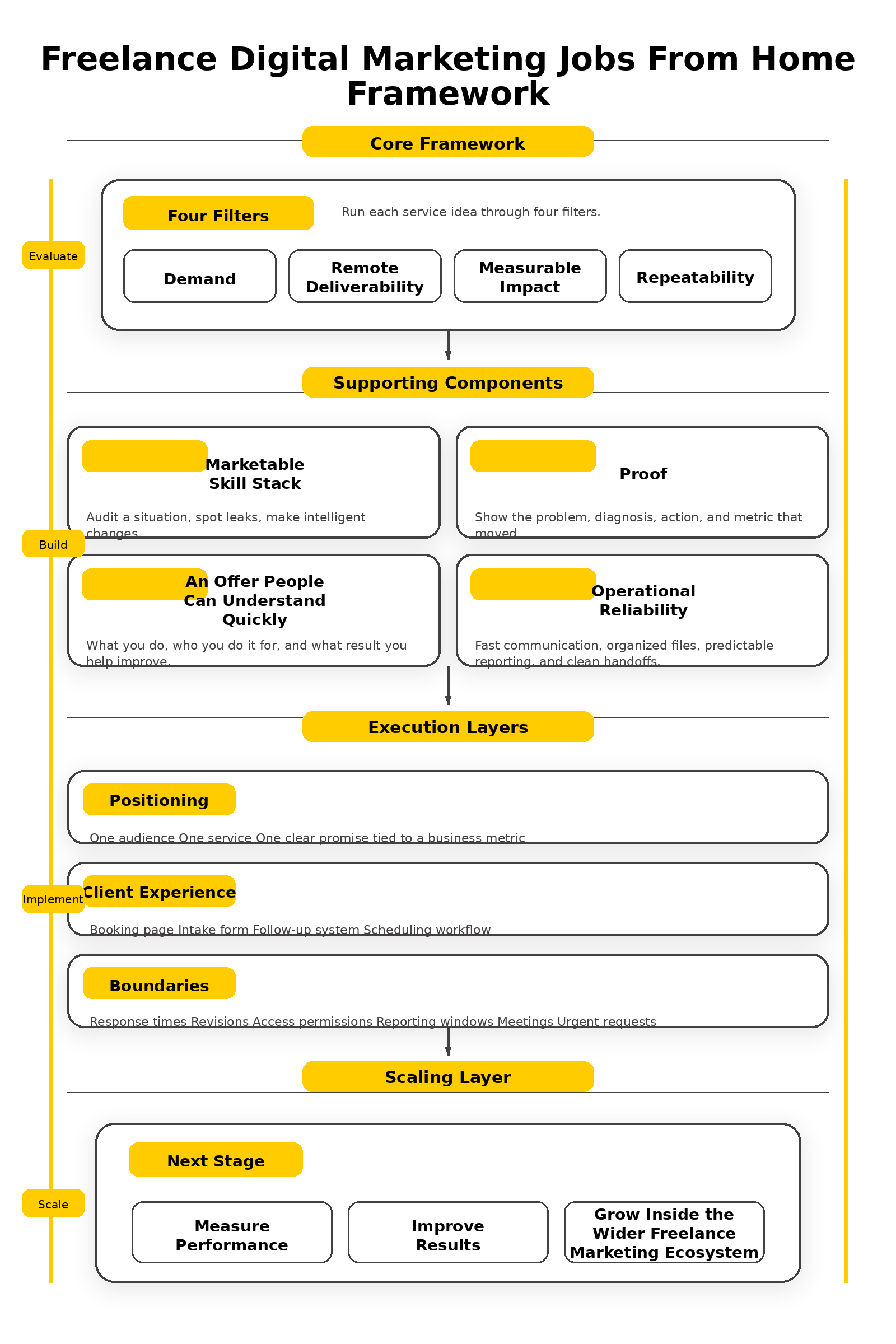
Once you pick a lane, four core components determine whether you can turn that choice into a real income stream. The first is a marketable skill stack. You do not need every certification or every tool, but you do need enough hands-on ability to audit a situation, spot obvious leaks, make intelligent changes, and explain why those changes matter.
The second component is proof. Proof can come from your own project, a previous role, volunteer work, a controlled side project, or freelance client work, but it has to show thinking and not just design polish. A freelancer who can explain the problem, the diagnosis, the action, and the metric that moved will usually outperform someone who only says they are creative, hardworking, or passionate about marketing.
The third component is an offer people can understand quickly. Instead of selling your time in the abstract, define what you do, who you do it for, and what result you help improve. “I help local service businesses increase qualified leads through paid search and landing page improvements” is far stronger than “I do digital marketing from home for anyone who needs help.”
The fourth component is operational reliability. Clients need fast communication, organized files, secure access, predictable reporting, and clean handoffs. This is the part many beginners overlook when they picture freelance digital marketing jobs from home, yet it is often the exact reason one freelancer gets repeat work while another stays stuck chasing first projects forever.
Professional Implementation
Implementation is where this path stops being an idea and starts becoming a business. Start with one audience, one service, and one clear promise tied to a business metric. That structure makes it much easier to build a focused portfolio, send outreach that sounds relevant, and speak like a specialist instead of someone hoping a prospect will figure out where you fit.
The next step is making the buying process feel easy. A simple booking page through Cal.com, a short intake form in Fillout, a follow-up system inside Brevo, and a scheduling workflow in Buffer are enough to create a professional client experience before you build a giant stack. Clients do not need you to own every app on the market. They need to feel that you can take a messy problem and move it through a calm, organized process.
Professional implementation also means setting boundaries before the work gets busy. Decide how you handle response times, revisions, access permissions, reporting windows, meetings, and urgent requests before a client asks. Home-based freelancing becomes much more stable when your calendar, communication standards, and delivery steps are clear enough that clients know exactly what working with you will feel like.
The biggest shift is mental. Freelance digital marketing jobs from home are not won by hiding behind a laptop and waiting to be discovered. They are won by building visible proof, making specific offers, and showing that you can connect marketing activity to business outcomes. That foundation matters because the next stage is not just getting work; it is learning how to measure performance, improve results, and grow inside the wider freelance marketing ecosystem.
Analytics and Optimization
Getting freelance digital marketing jobs from home is one thing. Keeping those clients month after month is something else entirely, and that is where analytics starts to matter a LOT. In a market where more than one in five U.S. job seekers were still exclusively applying to remote roles by the end of 2024, the freelancers who stay booked are usually the ones who can explain performance clearly instead of just saying they have been “working on marketing.”
That is why this section matters so much. Businesses do not keep paying for activity they cannot understand, especially when budgets are being watched closely and channels change fast. If you want freelance digital marketing jobs from home to become a stable business instead of a temporary hustle, you need a reporting rhythm that makes your work easy to trust.
Measure What Actually Moves the Business
A lot of freelancers make reporting harder than it needs to be. They throw thirty metrics into a slide deck, send it over, and hope the client feels impressed. The smarter move is to focus on a few numbers that explain whether the business is getting more attention, more qualified action, and better efficiency from the work.
The logic here is simple, and it is exactly how serious marketing teams think. The U.S. Bureau of Labor Statistics describes market research analysts as the people who measure the effectiveness of marketing strategies and turn findings into reports, which is basically the discipline a strong freelancer brings into every client account. You are not just posting, writing, or launching ads. You are helping a business understand whether its marketing is producing something useful.
- Visibility: impressions, reach, rankings, or qualified traffic
- Action: booked calls, form submissions, purchases, or replies
- Efficiency: cost per lead, cost per acquisition, or conversion rate
- Business impact: revenue, pipeline value, repeat purchases, or retention
Once you narrow the scoreboard, your work becomes easier to explain and much easier to improve. That matters because clients rarely fire freelancers for telling the truth about numbers. They fire freelancers when they cannot tell what those numbers mean.
Build a Home-Based Reporting Stack That Stays Simple
One of the biggest advantages of freelance digital marketing jobs from home is that the whole delivery system can live online. Your meetings, lead capture, campaign management, notes, files, reports, and follow-ups can all run without a physical office if the structure is clean. The problem is that too many freelancers keep everything scattered across inboxes, screenshots, half-finished spreadsheets, and vague memory.
You do not need a giant tool stack to look professional. You need a clear flow from inquiry to call to proposal to delivery to reporting, and that is where simple systems start paying for themselves. If your work leans toward lead generation, landing pages, or funnel support, tools like Systeme.io or ClickFunnels can make the client journey easier to track from first click to booked call, while Copper can help you keep deal stages and follow-ups from slipping through the cracks.
The key is not collecting software for the sake of it. The key is making sure every important action leaves a trail you can revisit later when a client asks what happened, where a lead came from, or why results improved. When that trail is clean, working from home stops feeling chaotic and starts feeling efficient.
Turn Reporting Into Decision-Making
This is where a freelancer either starts looking premium or starts looking replaceable. Sending a dashboard link is not the same thing as leading a client. Real value shows up when you can look at the numbers, explain what changed, identify what is leaking, and recommend the next move with confidence.
That gap is still a huge issue across the marketing world. Salesforce’s tenth State of Marketing report, built on insights from nearly 4,500 marketers, says 83% of marketers recognize the shift toward personalized, two-way messaging, yet only one in four are satisfied with how they use data to power those moments. That tells you something important: data is everywhere, but useful interpretation is still rare, and that gives a sharp freelancer room to stand out.
So every reporting cycle should answer three basic questions. What is working better than expected? What is underperforming and why? What is the next change worth testing before the next report goes out? Once you build that habit, clients stop seeing you as someone who completes tasks and start seeing you as someone who helps them make decisions.
Use Optimization to Defend Your Value
Optimization is not just about squeezing more performance out of a campaign. It is also how you protect your time, your margins, and your reputation. When a client asks for random changes every week, clear analytics give you a calm way to bring the conversation back to what is actually improving leads, sales, and customer quality.
This matters because specialization is getting more valuable, not less. Upwork’s 2026 skills research says businesses are still hiring people at scale for work like boosting SEO and generating leads, and its September 2025 hiring data showed digital marketing demand up 9% overall, with SEO and SEM up 8% and 7% among SMBs, while 53% of businesses expected to hire freelance digital marketers within three months. In other words, companies are not looking for vague help. They are looking for people who can improve a channel, explain the outcome, and keep making it better.
That is the real job. When you can show that a landing page change improved conversion rate, that a search campaign started bringing better leads, or that an email sequence reactivated buyers who had gone quiet, pricing conversations become much easier. You stop defending your hours and start defending your results, which is exactly where freelance digital marketing jobs from home become much more sustainable.
Once your analytics are solid, the next step is bigger than reporting. It is about building your place in the wider remote marketing ecosystem so you are not relying on luck, one-off projects, or job boards alone to keep the pipeline full.
Professional Implementation in Real Client Work

This is the point where freelance digital marketing jobs from home stop being an idea and start acting like a business. Plenty of people know the buzzwords, watch tutorials, and tell themselves they are ready, but implementation is where the market immediately separates the serious operators from everyone else. That matters even more now because Upwork found that 49% of businesses were turning to freelancers to solve critical skill gaps and 48% of CEOs planned to increase freelance hiring, which means demand still exists, but buyers are looking for clear proof and sharp positioning rather than vague enthusiasm.
The good news is that you do not need a giant team or a fancy office to compete. You need an offer that makes sense, a process that feels easy to buy, and a delivery system that helps clients feel calm the moment they start working with you. When those three pieces are in place, working from home no longer feels like a limitation. It starts feeling like an advantage because you can stay focused on high-value work instead of wasting energy on office theater.
Pick an Offer That Looks Hirable
The biggest implementation mistake beginners make is trying to sound available for everything. They offer social media, SEO, email, funnels, branding, content, paid ads, analytics, websites, and lead generation all at once, and then wonder why prospects do not know what to do with them. A buyer rarely feels relief when a freelancer says, “I can do anything.” They feel relief when a freelancer says, “I fix this specific problem for this type of business.”
That is exactly why specialization keeps becoming more valuable. Upwork’s September 2025 hiring data showed digital marketing contracts rising 9% overall, with SEO and SEM up 8% and 7% among SMBs, while 53% of businesses said they expected to hire freelance digital marketers in the next three months. The market is telling you, very clearly, that freelance digital marketing jobs from home get easier to win when your work connects to a channel and a result instead of a vague promise to “help with marketing.”
A strong offer usually has three parts. It names the buyer, the channel, and the business outcome you help improve. So instead of calling yourself a general digital marketer, you might position yourself as someone who helps service businesses improve local search visibility, or someone who helps coaches and consultants turn warm traffic into booked calls through email and landing page optimization, or someone who helps ecommerce brands recover more revenue through lifecycle automation.
- Buyer: local service businesses, ecommerce brands, coaches, SaaS companies, agencies, or creators
- Channel: SEO, paid search, email marketing, paid social, conversion optimization, or reporting
- Outcome: more qualified leads, stronger conversion rates, lower acquisition costs, higher repeat purchases, or cleaner reporting
Once you define that clearly, your messaging gets easier, your portfolio gets easier to organize, and your outreach stops sounding like it was copied from a freelancer template. That is when prospects start to picture where you fit inside their business. And that picture is what gets calls booked.
Build a Client Journey That Feels Easy
Clients do not just buy marketing skill. They buy certainty. If your inquiry process feels messy, your calendar is hard to access, your questions are vague, and your next steps are unclear, the prospect starts assuming the actual project will feel the same way. That is why implementation for freelance digital marketing jobs from home needs to focus just as much on the buyer experience as the technical work.
A clean system can stay simple. A booking page with Cal.com, an intake form through Fillout, a lightweight CRM flow in Copper, and follow-up emails through Brevo are more than enough to make you look organized from the start. The point is not to collect tools for the sake of it. The point is to make the path from first message to signed client feel smooth enough that nobody has to guess what happens next.
This matters because modern buyers are dealing with higher expectations on every side. Adobe’s 2025 customer engagement research found that 78% of customers want consistent brand experiences, and Salesforce found that 83% of marketers recognize the move toward personalized, two-way messaging while only one in four are satisfied with how they use data to power it. If businesses are struggling to deliver a smooth experience to their own customers, they are absolutely going to notice whether a freelancer makes their own buying experience feel easy or confusing.
So map the journey out in plain English. How does a lead find you? How do they book? What do they see before the call? What happens after the call if the fit is strong? What do they receive in week one after they say yes? When you can answer those questions clearly, you stop looking like a person searching for work and start looking like a business that knows how to onboard clients properly.
Deliver Remotely Without Looking Chaotic
One of the best things about freelance digital marketing jobs from home is that almost everything important can be delivered asynchronously. Research, audits, ad changes, keyword mapping, content briefs, email sequences, CRM cleanup, reporting, and experiment planning can all happen without nonstop meetings. But that only works when your delivery system is tight enough that clients never feel lost.
This is where many freelancers quietly hurt themselves. They keep files in random folders, approval requests in old emails, research in private notes, and task updates in their own head. Then the client asks a simple question about what changed last week, what is waiting on approval, or what happens next, and the answer takes far too long because the operation is built on memory instead of process.
You do not need a massive operations manual, but you do need a consistent rhythm. Set a review day, define where assets live, decide how approvals happen, and create one place where the client can always see priorities and status. If you create landing pages or funnels, platforms like ClickFunnels or Systeme.io can help you keep the path from visitor to lead more visible, and if you need cleaner research and site extraction while auditing opportunities, Firecrawl can make that workflow faster.
Remote delivery also gets stronger when communication is thoughtful instead of constant. A short weekly update that explains what was done, what was learned, what is blocked, and what comes next is usually more valuable than three scattered messages a day. Clients want to feel informed, not interrupted, and the freelancer who understands that tends to keep trust much longer.
Use AI and Automation With Human Judgment
AI can make freelance digital marketing jobs from home more profitable, but only if it sits inside a smart process. The market is moving toward speed, but buyers are still paying for judgment, prioritization, and quality control. That is why AI should reduce friction around research, transcription, drafting, summarizing, and repetitive admin while leaving core strategic decisions in human hands.
The demand data keeps pointing in that direction. Upwork reported that 58% of businesses planned to prioritize AI proficiency when hiring freelancers, but the same report also framed rising demand around human oversight, quality assurance, and better outputs rather than blind automation. In other words, businesses do not just want someone who can press the AI button. They want someone who can use AI without flooding their company with sloppy work.
That creates a real opportunity for freelancers who build a sensible operating layer around the tools. You might use Wispr Flow to speed up dictation and idea capture, Comp AI to support compliance-related workflows, Chatbase when a client needs a better website assistant experience, or Dub when you want cleaner link tracking and attribution. The value still comes from deciding what should be automated, what should be reviewed, and what should never be handed off to a tool without human eyes on it.
That balance matters because AI can easily create the illusion of productivity. A freelancer can produce more drafts, more summaries, more ideas, and more variations than ever before, yet still fail to create business value if none of that work sharpens the offer, improves the funnel, or increases the quality of leads. Implementation only becomes powerful when speed and judgment are working together.
Price Like a Business, Not a Busy Person
The final piece of implementation is pricing, and this is where many talented freelancers quietly undercut themselves. They spend so much time trying to look affordable that they forget the client is not buying motion. The client is buying clarity, execution, and a better business result than they were getting before.
That is another reason specialized work keeps pulling ahead. Upwork’s 2025 skills data highlighted a broader shift toward deep expertise over generalist roles, while the U.S. Bureau of Labor Statistics still projects 87,200 openings a year for market research analysts and marketing specialists. Businesses keep signaling that they are willing to pay for people who can diagnose problems, improve performance, and explain what happened in language leaders understand.
So price around the structure of the engagement rather than raw busyness. An audit can be a fixed-fee project. Ongoing email or SEO support can be a monthly retainer. Funnel work can be packaged around deliverables, milestones, and testing windows. Once your pricing reflects the actual value of the work instead of the number of hours you looked occupied, freelance digital marketing jobs from home start becoming far more sustainable.
That is the real shift. You are no longer trying to prove that you are “working hard.” You are building a service business that helps clients move from confusion to clarity, from scattered effort to organized execution, and from hope to measurable progress. And once that system is in place, the next step is learning how to track that progress properly so you can improve results, keep clients longer, and grow with confidence.
Statistics and Data
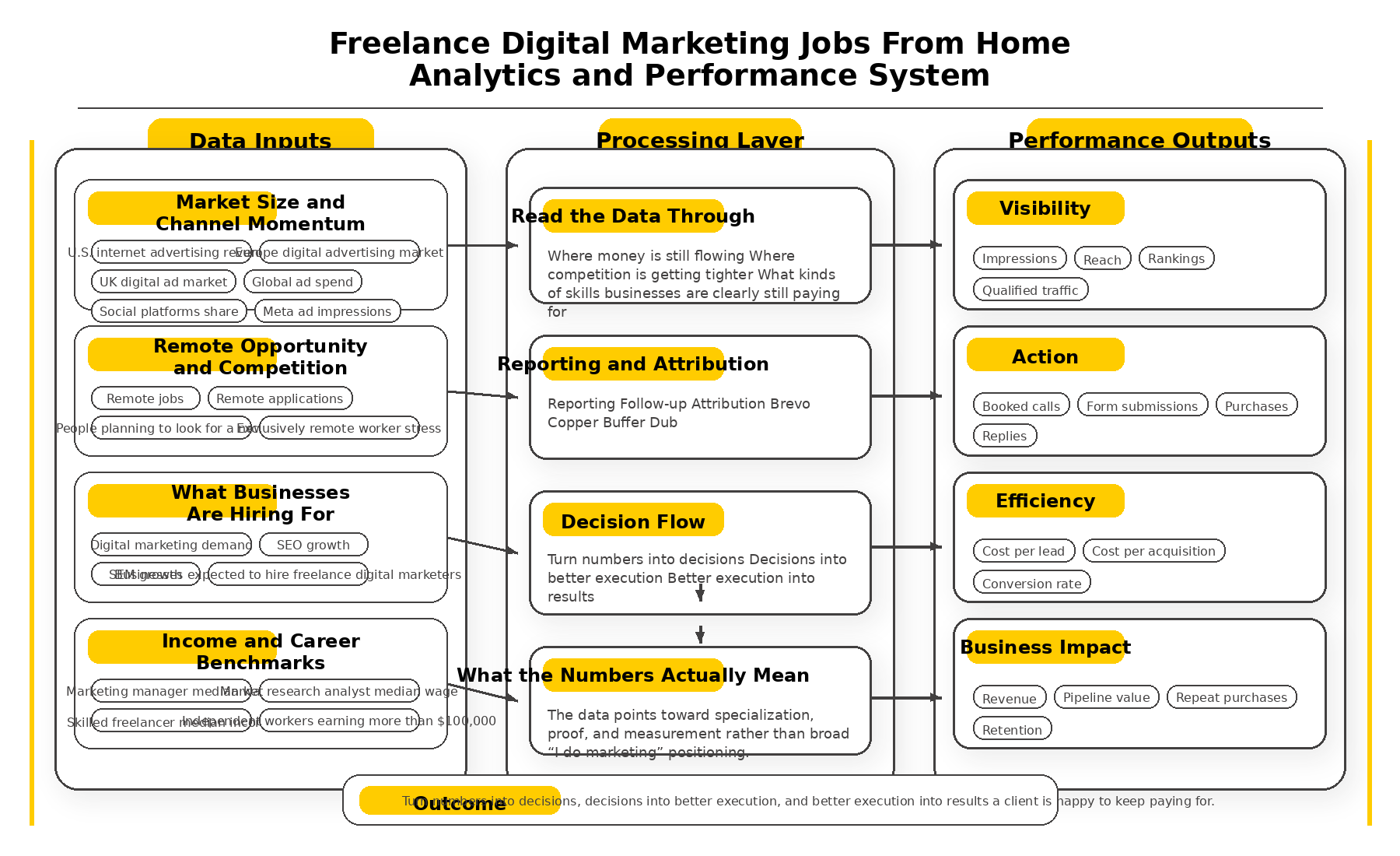
Numbers can either make you sharper or make you panic. For anyone thinking seriously about freelance digital marketing jobs from home, the point of looking at the data is not to get lost in reports. The point is to see where money is still flowing, where competition is getting tighter, and what kinds of skills businesses are clearly still paying for through freelance marketplaces, job platforms, and the broader independent workforce.
The first takeaway is simple: this is not a tiny corner of the economy. The IAB and PwC put U.S. internet advertising revenue at $259 billion in 2024, IAB Europe said Europe’s digital advertising market reached €118.9 billion in 2024, and IAB UK said the UK digital ad market hit £40.5 billion in 2025. When markets at that size keep growing, freelance digital marketing jobs from home start making a lot more sense because you are positioning yourself inside a business function companies already fund aggressively.
Market Size and Channel Momentum
The money behind digital marketing is still expanding, and that matters because freelancers live downstream from budget decisions. WARC projected global ad spend would reach $1.17 trillion in 2025, with social platforms taking 40.6% of the market. That is a huge signal because it means businesses still need people who can run paid traffic, improve creative, build landing pages, optimize lead flows, and explain performance in language a client can actually understand.
The channel-level data tells the same story. Meta said ad impressions across its Family of Apps increased 12% for the full year 2025, while Alphabet said Google Search & other revenue grew 17% year over year in Q4 2025. Add in the fact that DataReportal counted 5.24 billion active social media user identities at the start of 2025, and it becomes pretty obvious why freelance digital marketing jobs from home keep showing up across SEO, paid media, content, email, analytics, and conversion work.
Remote Opportunity and Competition
The remote angle is real, but the competition is real too. LinkedIn’s mid-market enterprise economy report showed remote jobs were just 8.3% of postings but attracted nearly 43% of applications, and LinkedIn’s 2025 Work Change Report said 58% of people worldwide planned to look for a new job while half said job search had become harder. That is exactly why freelance digital marketing jobs from home cannot be treated like easy internet money, because flexible work still pulls huge demand from people who want freedom, location flexibility, and more control over how they earn.
There is another layer to this that does not get talked about enough. Gallup’s 2025 workplace data showed that 45% of exclusively remote employees experienced a lot of stress the previous day, and Gallup also found that fully remote workers were less likely to be thriving in life overall than hybrid and on-site remote-capable workers. So yes, freelance digital marketing jobs from home can give you autonomy, but the data also says you need structure, boundaries, and a sane client load if you want that freedom to stay healthy.
What Businesses Are Hiring For
The hiring data keeps pointing toward specialist work, not vague generalism. Upwork’s September 2025 hiring report said digital marketing demand rose 9% overall, while SEO and SEM rose 8% and 7% among SMBs, and 53% of businesses expected to hire freelance digital marketers in the next three months. That tells you something important right away: clients are not just looking for “help with marketing.” They are hiring around concrete problems and channels.
The broader freelancer data reinforces that shift. Upwork said 49% of businesses were turning to freelancers to solve critical skill gaps, 48% of CEOs planned to increase freelance hiring, and its 2026 skills report said demand stayed strong even in marketing categories often assumed to be vulnerable to automation. That is a huge advantage for anyone building freelance digital marketing jobs from home around real business outcomes like lead generation, SEO improvements, paid search efficiency, lifecycle email, or conversion optimization.
Income and Career Benchmarks
Income data needs to be read carefully, because employee salaries are not the same thing as freelance pricing. Still, the benchmarks matter because they show what the market thinks these capabilities are worth. The U.S. Bureau of Labor Statistics put the median annual wage for marketing managers at $161,030 in May 2024, while market research analysts had a median annual wage of $76,950, along with about 87,200 projected openings per year. That does not mean a freelancer should charge like a salaried manager on day one, but it does show that analytical and growth-oriented marketing skills sit inside a serious value category.
The independent workforce data makes the case even stronger. Upwork said more than 1 in 4 U.S. skilled knowledge workers now freelance or work independently, with $1.5 trillion in collective earnings in 2024, and full-time freelancers in that skilled group reporting a median income of $85,000 versus $80,000 for full-time employees. On top of that, MBO Partners said a record 5.6 million independent workers earned more than $100,000 in 2025, which is a strong reminder that freelance digital marketing jobs from home can absolutely become a serious income path when the skill, offer, and positioning are strong enough.
What the Numbers Actually Mean
If you step back from all of this data, the pattern is pretty clear. The budgets are there, the channels are active, the independent workforce is growing, and businesses are still paying specialists to close execution gaps. The catch is that freelance digital marketing jobs from home reward precision a lot more than they reward enthusiasm, which is why the data consistently points toward specialization, proof, and measurement rather than broad “I do marketing” positioning.
That is also where tools and systems start becoming practical instead of optional. When you are turning campaign performance into something a client can actually follow, a cleaner workflow through Brevo, Copper, Buffer, and Dub can make reporting, follow-up, and attribution far easier to manage from home. And that matters because the data does not really reward the busiest freelancer. It rewards the one who can turn numbers into decisions, decisions into better execution, and better execution into results a client is happy to keep paying for.
Ecosystem Growth and FAQ
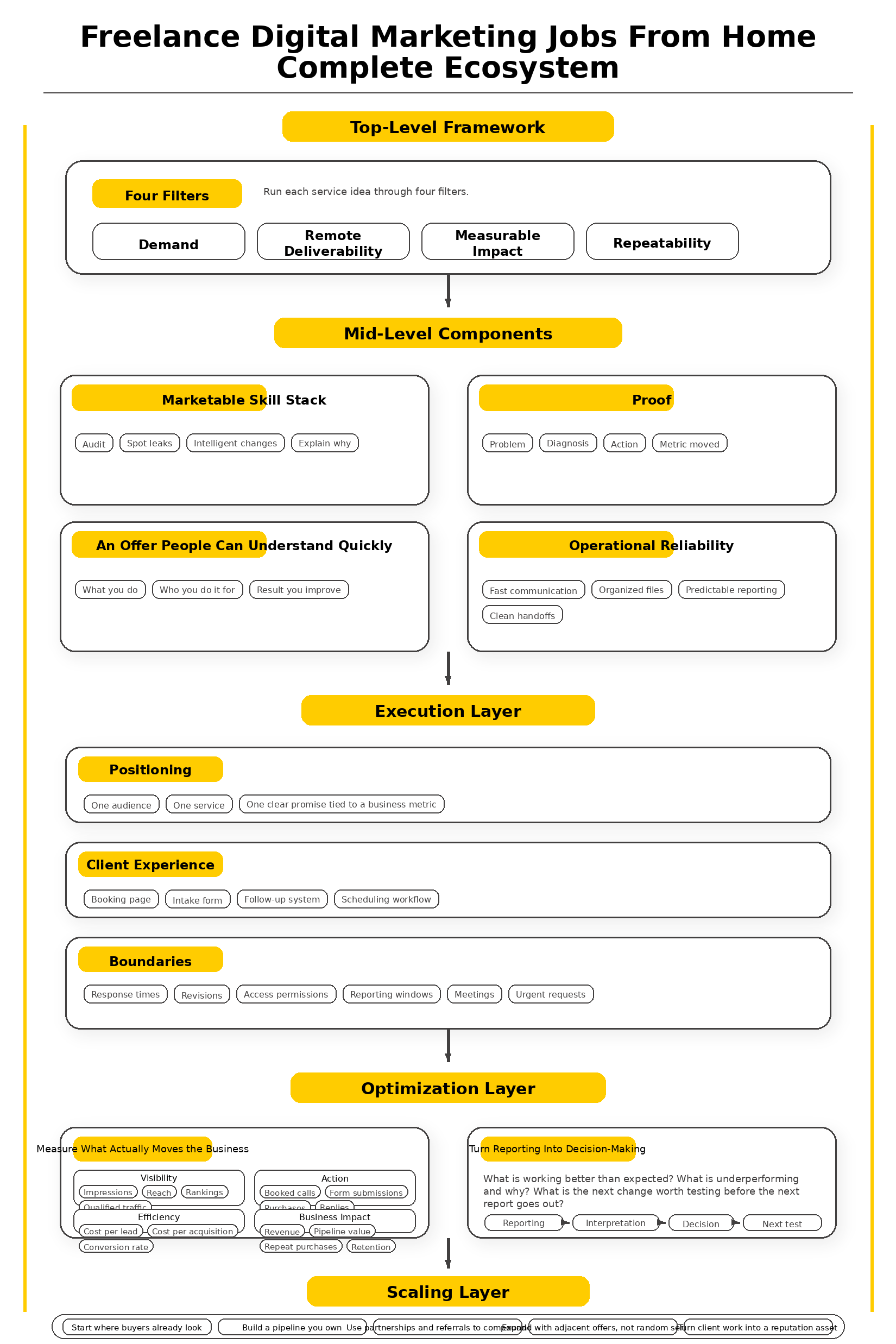
If you have made it this far, you can probably feel the real shape of the opportunity now. Freelance digital marketing jobs from home are not just random online gigs anymore; they sit inside an industry where U.S. internet advertising revenue reached $258.6 billion in 2024, Europe’s digital advertising market reached €118.9 billion in 2024, and global ad spend was forecast to hit $1.17 trillion in 2025. That matters because it means companies are still spending heavily on channels that freelancers can manage from anywhere with a laptop, strong process, and real skill.
The challenge is that flexibility attracts a crowd. LinkedIn’s remote work data showed remote roles still attracting far more demand than supply in 2025, while Upwork said 53% of businesses expected to hire freelance digital marketers in the next three months. So the opportunity is absolutely there, but the people who win are the ones who stop thinking like applicants and start thinking like operators.
FAQ for This Complete Guide
Are freelance digital marketing jobs from home still worth pursuing?
Yes, but only if you treat them like a real business instead of easy internet money. The demand side is still strong, with digital marketing contracts on Upwork rising 9% in September 2025 and 53% of businesses saying they expected to hire freelance digital marketers in the next three months. The reason it feels harder is that remote work is still incredibly attractive, so you need sharper positioning than you did a few years ago.
Which digital marketing services are easiest to start with from home?
The easiest services to start with are usually the ones that are clearly measurable and do not require a huge team around you. SEO support, email marketing, content repurposing, paid search management, reporting, and landing page optimization all fit well because they are tied to traffic, leads, and conversion instead of vague brand activity. That matches what buyers are already spending on, especially when SEO and SEM both showed growth among SMBs on Upwork in late 2025.
Do I need a marketing degree to get started?
No, and the market is moving further in that direction. Upwork reported that 74% of executives say degrees are irrelevant when hiring freelancers, because buyers care more about proof, judgment, and results than classroom credentials. A degree can help if you already have one, but it is not what convinces a client to trust you with their funnel, campaign, or revenue path.
Can beginners really get clients without previous agency experience?
Yes, but beginners usually need to win with clarity and proof instead of pedigree. If you can show a focused skill, a clean process, and a small but believable body of work, you can compete far better than someone with a vague résumé and no visible thinking. That is even more true in a market where executives say they are prioritizing proven expertise over formal credentials.
How much can someone realistically earn doing freelance digital marketing jobs from home?
The honest answer is that income ranges wildly based on specialization, positioning, and how well you sell. Still, the ceiling is very real: Upwork said full-time skilled freelancers reported a median income of $85,000 in 2024 compared with $80,000 for full-time employees, while MBO Partners said a record 5.6 million independent workers earned more than $100,000 in 2025. That does not mean you start there, but it absolutely means this can become serious income when your offer solves an expensive problem.
Is Upwork the best place to find your first clients?
It can be one of the best starting points, but it should not become your entire business model forever. Marketplaces are useful because they let you test positioning fast, learn what buyers ask for, and build the first layer of proof, and MBO says 42% of independents rely on online platforms as their primary way to find work. The smarter long-term move is to use them for traction while also building an audience, referral flow, and pipeline you actually own.
Should I specialize or offer everything?
You should specialize much earlier than most people think. Buyers are not looking for a freelancer who says yes to every possible task; they are looking for someone who can fix a specific leak in traffic, lead flow, messaging, or conversion. That is one reason Upwork’s skills research keeps pointing toward deeper expertise instead of broad generalism.
What do clients actually care about when hiring a freelancer?
Clients usually care about three things more than anything else: whether you understand their problem, whether your process feels organized, and whether they can trust you to communicate clearly. The pressure on businesses to deliver stronger customer experiences is obvious in Adobe’s finding that 78% of customers want consistent brand experiences and in Salesforce’s finding that 83% of marketers recognize the demand for personalized, two-way messaging. A freelancer who brings that same clarity to the client experience is instantly more hireable.
What tools do I actually need at the beginning?
You need fewer tools than most people think, but you do need a system. A booking page with Cal.com, an intake form through Fillout, follow-up through Brevo, contact management in Copper, and content scheduling through Buffer are enough to make you look organized without drowning in software. Once the basics are clean, tools stop being a distraction and start becoming leverage.
How important is AI for freelance marketers now?
AI matters a LOT, but not in the lazy way people talk about it. Upwork reported that 58% of businesses said they would prioritize AI proficiency when hiring freelancers, but that same report also showed demand rising for human oversight and quality control. So the opportunity is not in pressing a button faster than everyone else; it is in using AI to move faster while still producing work a client can trust.
Can I do this part-time while I keep a job?
Yes, and that is actually one of the safest ways to start. It gives you time to sharpen an offer, build proof, and test your client process before your income depends on it every single month. A lot of independent work starts that way, and MBO’s 2025 data shows that side gigs and independent income streams are now a normal part of working life for a large share of professionals.
How do I get my first client if I have no testimonials yet?
You replace testimonials with specificity. Show a focused offer, publish useful thinking, build a small portfolio from controlled projects, and make your outreach about the prospect’s business instead of your own desperation to get hired. When you do that well, clients can still see your judgment even if you do not yet have a long page full of reviews.
How competitive is remote work in this space?
It is competitive enough that weak positioning gets ignored very quickly. LinkedIn’s research showed that demand for remote work stayed stubbornly high even as the share of remote jobs fell, which means flexibility alone is not a differentiator anymore. To stand out, you need proof, a niche, and messaging that sounds like you understand a buyer’s problem better than the next freelancer does.
What makes clients stay with a freelancer long term?
Retention usually comes from clarity, not charm. Clients stay when they understand what you are doing, why it matters, what changed, and what happens next, which is why reporting and communication matter so much more than most freelancers expect. When you combine strong delivery with clean systems, the relationship starts feeling safe, and safe freelancers get renewed.
How do I avoid burnout while working from home?
You avoid burnout by building structure before the workload gets messy. That matters because Gallup found that 45% of exclusively remote workers experienced a lot of stress the previous day, which is a reminder that flexibility without boundaries can turn into constant pressure fast. Set office hours, define response windows, keep a sane client load, and do not let “working from home” become code for “working all the time.”
Is freelance digital marketing a real long-term career or just a temporary trend?
It is a real career path, but only when it is built on business fundamentals. The independent workforce keeps maturing, with more than one in four U.S. skilled knowledge workers freelancing or working independently in 2024 and a record number of independent professionals clearing six figures in 2025. The people who last are not the ones chasing random gigs forever; they are the ones building repeatable offers, durable reputations, and a client experience that keeps compounding over time.
Work With Professionals
If you want freelance digital marketing jobs from home to grow faster, the smartest move is to stop trying to do every single part alone. Strong operators build around clean systems, sharp presentation, and reliable workflows, which is why tools like BetterPic for professional headshots, Wispr Flow for faster idea capture, Chatbase for website assistant experiences, and Guideless for guided customer journeys can strengthen the way you show up and the way you deliver.
The same goes for building offers that are easier to sell. If your work leans toward funnels, lead capture, or productized marketing systems, ClickFunnels, Systeme.io, PLR Funnels, and iMallin can help you turn scattered service work into something more structured and easier for clients to buy. The point is not to hide behind software. The point is to build an ecosystem where your skill has a better chance to look premium, perform well, and scale cleanly.
Explore 10K+ Remote Marketing Contracts on MarkeWork.com
Most marketers spend too much time chasing clients, competing on crowded platforms, and losing a percentage of every project to middlemen.
MarkeWork gives you a better way. Browse thousands of remote marketing contracts and connect directly with companies desperate to hire skilled marketers like you — without platform commissions and without unnecessary gatekeepers.
If you’re serious about finding better opportunities and keeping 100% of what you earn, you can explore available contracts and create your profile for free at MarkeWork.com.
 Filip Konecny Enterprises