

Most companies do not start looking for b2b content marketing agencies because they suddenly want more articles. They start looking when the pipeline feels slower, buyer conversations feel later, and the content already in market is not doing enough heavy lifting before sales gets involved. In Gartner’s latest sales survey, 61% of B2B buyers said they prefer an overall rep-free buying experience, and 73% said they actively avoid suppliers that send irrelevant outreach.
That completely changes what content has to do. It is no longer enough for content to chase traffic, look polished, or fill a calendar. 6sense found that the winning vendor is already on the day-one shortlist 95% of the time, which means your content often shapes the sale before your sales team even gets a real shot.
That is why b2b content marketing agencies matter more now than they did a few years ago. The best ones are not content factories; they are operating partners that help you clarify positioning, build trust with multiple stakeholders, create a repeatable production system, and connect content to revenue. This first part gives you the foundation for judging agencies the right way, before we move into agency types, evaluation criteria, pricing, governance, and final selection in the next parts.
Article Outline
- Part 1: Why B2B Content Marketing Agencies Matter
- Part 2: Agency Types And Engagement Models
- Part 3: Evaluation Criteria And Selection Process
- Part 4: Pricing, Scope, And Red Flags
- Part 5: Integration Workflows And Governance
- Part 6: Choosing The Right Partner And FAQs
Why B2B Content Marketing Agencies Matter

The biggest reason b2b content marketing agencies matter is simple: buyers are doing more of the journey on their own, and they are doing it across more channels than most in-house teams can manage consistently. 6sense shows that average B2B buying cycles still stretch to 10.1 months and that first contact now happens around 61% of the way through the journey, while McKinsey’s B2B Pulse research shows buyers use an average of ten interaction methods across the buying process. If your brand sounds sharp on the website but vague in nurture emails, weak on LinkedIn, and disconnected from sales follow-up, buyers feel the inconsistency long before your team sees it in attribution.
There is also a political side to B2B buying that many companies underestimate. The obvious buyer is rarely the only buyer, and 55% of hidden decision-makers say they use thought leadership as part of vendor vetting, while 95% say strong thought leadership makes them more receptive to sales and marketing outreach. That means content is not just attracting attention; it is reducing perceived risk, building internal consensus, and helping unfamiliar vendors feel safer than they would through product pages alone.
The third reason is operational. Content Marketing Institute found that 45% of B2B marketers still do not have a scalable model for content creation, 43% struggle to differentiate their content from competitors, and 46% expect their content marketing budget to increase. That combination tells you exactly what the market is wrestling with: leadership still believes in content, but many teams do not yet have the process, talent mix, or distribution muscle to turn budget into business results.
This is where the right agency becomes valuable. A strong partner brings structure to research, editorial planning, subject-matter expert extraction, distribution, optimization, and measurement. A weak partner just adds more assets to a messy system and leaves you wondering why production went up while pipeline stayed flat.
Framework Overview
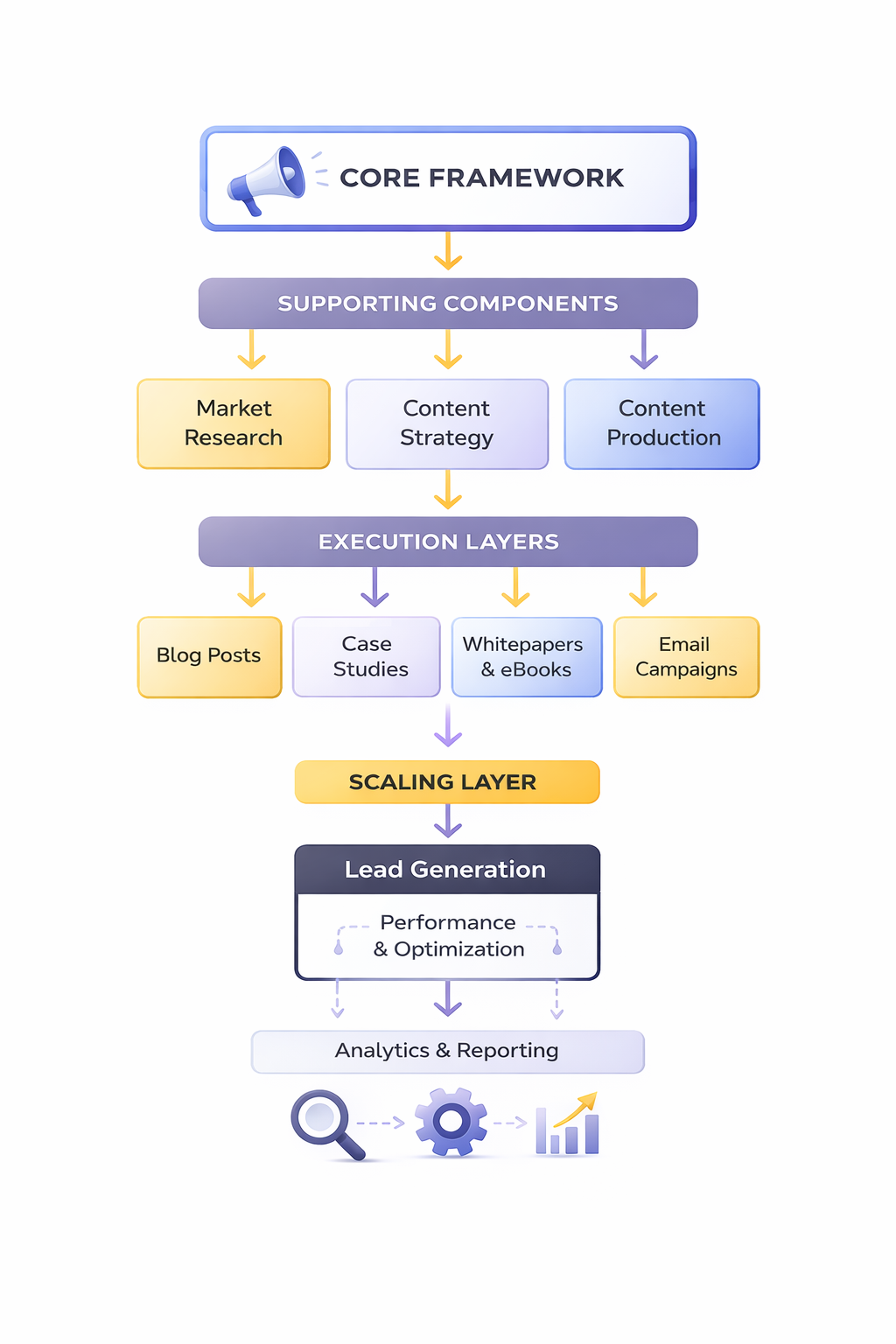
Lens 1: Audience fit. The first job is to determine whether an agency truly understands your market, your category pressure, your sales motion, and the people who actually influence a deal. That matters because 82% of the most successful B2B content teams say understanding their audience is the main reason they perform well. If an agency cannot speak naturally to your buying committee, it will produce content that sounds competent but never feels indispensable.
Lens 2: Content system quality. You are not only buying writing or design; you are buying a repeatable way to turn expertise into trust. The agency should be able to show how it gathers insight, challenges weak positioning, captures real subject-matter expertise, and creates content that follows Google’s people-first guidance for helpful and reliable content instead of recycling surface-level opinions. In B2B, content that feels generic is not neutral; it actively makes the vendor feel replaceable.
Lens 3: Distribution strength. Content without a distribution plan is just an expensive draft. CMI found that 61% of B2B marketers expect to increase investment in video and 52% expect to increase investment in thought leadership, while LinkedIn’s 2025 B2B benchmark says 78% of B2B marketers already use video. A serious agency needs to think in programs, not just assets, because buyers move between search, social, email, sales enablement, and dark-funnel conversations without caring which team owns which channel.
Lens 4: Measurement and governance. The last test is whether the agency can prove impact in a way your leadership team will actually respect. Salesforce’s tenth State of Marketing report found that 83% of marketers recognize the shift toward personalized, two-way messaging, yet only one in four are satisfied with how they use data to power it. If an agency cannot connect content decisions to engagement quality, pipeline movement, sales usage, and buying-group progression, you are not buying strategy; you are buying activity.
Core Components
Audience intelligence and message architecture. Great b2b content marketing agencies begin by mapping buyers, hidden stakeholders, objections, questions, and proof requirements. They know that the content challenge is not simply attracting a lead; it is helping the entire buying group feel confident enough to move forward. That is why 73% of hidden decision-makers say thought leadership is one of the best ways to judge the caliber of thinking a company can deliver, and why an agency that only writes top-of-funnel posts will almost always underperform.
Expert-led content production. Strong agencies do not rely on generic internet summaries. They build editorial processes that extract real expertise from founders, operators, consultants, product leaders, sales teams, and customers, then shape that knowledge into useful assets that actually help buyers make sense of a problem. That approach matters because 86% of hidden decision-makers say they prefer ideas that challenge assumptions instead of merely validating what they already think.
Format and channel range. The agency should be able to recommend the right mix of articles, landing pages, research pieces, case studies, founder-led posts, sales enablement assets, webinars, and video based on buying-stage intent. That mix matters because B2B teams still use short articles, videos, case studies, long-form articles, visual content, and white papers at meaningful scale, and LinkedIn reports that 82% of B2B decision-makers say content directly influences their decisions. A good agency knows when a category needs more search capture, when it needs stronger executive perspective, and when it needs better conversion content closer to the deal.
Measurement tied to commercial outcomes. Content is doing its job when it improves awareness, lead quality, progression, and trust across the journey. CMI found that 87% of B2B marketers saw content help with brand awareness and 74% saw it help generate demand and leads, but the stronger signal is that 53% of top performers say they measure and demonstrate content performance effectively. The right agency will treat reporting as part of strategy, not as a last-minute dashboard export.
Professional Implementation
Implementation starts with an audit, not a content calendar. Before a strong agency writes anything, it should review your existing assets, search visibility, sales materials, nurture flows, CRM stages, conversion points, and message consistency. That matters because 69% of B2B buyers say they encounter inconsistencies between what a supplier’s website says and what sellers tell them. If that mismatch stays in place, better content alone will not fix the deeper trust problem.
Then the agency needs a production operating model. That means a clear editorial thesis, a subject-matter expert interview rhythm, approval rules, repurposing logic, publishing cadence, and agreed definitions for what success looks like in each stage of the funnel. The need for that structure is obvious when Adobe reports that B2B buyers now engage in around 14 meaningful touchpoints before a decision. Without process, teams usually default to random acts of content and then wonder why nothing compounds.
Execution also needs the right stack. In practice, many agencies pair strategy with tools for funnels, email, scheduling, social publishing, forms, chat, and link tracking. Depending on the program, that can mean building conversion paths in ClickFunnels or Systeme.io, running lifecycle email through Brevo or Moosend, managing publishing with Buffer or Flick, collecting higher-intent responses with Fillout, routing meetings through Cal.com, and strengthening conversational capture or campaign attribution with Chatbase and Dub. The exact tools matter less than the fact that the agency can connect them into one coherent workflow.
Finally, implementation must stay close to revenue teams. The best agency relationships create a working loop between marketing, sales, product, and leadership so content keeps getting sharper as objections, deal friction, and buying behavior evolve. That is where professional implementation separates itself from outsourced production. The agency is not there to fill space; it is there to make sure your expertise shows up in the market with enough clarity, consistency, and momentum to influence the deal before the deal becomes visible.
Agency Types And Engagement Models
This is where a lot of companies get tripped up. They search for b2b content marketing agencies as if all of them sell the same thing, then they wonder why the relationship feels off three months later. One agency is really a strategy shop with senior operators, another is an SEO production machine, another is closer to a fractional content department, and another is basically a demand generation partner that happens to use content as the connective tissue.
The easiest way to think about it is this: you are not only hiring for output, you are hiring for the kind of problem you need solved. That distinction matters even more now that 67% of B2B buyers say they prefer a rep-free experience, because the pressure on content is no longer limited to traffic generation. Content has to educate, reassure, differentiate, and move buyers forward before a salesperson ever gets the chance to clean things up.

Strategy-Led Boutique Agencies
A strategy-led boutique is usually the right fit when the real issue is not volume but clarity. Maybe your team has content, but it does not sound like it comes from one company. Maybe sales is telling one story, the website is telling another, and leadership is frustrated because the market still does not seem to understand what makes you different.
This type of partner normally starts with audience research, positioning work, message architecture, editorial themes, and a realistic publishing plan. It is a smart choice when the internal team is capable of execution but needs sharper direction, especially because 43% of B2B marketers still say they struggle to differentiate their content from competitors. The tradeoff is that a boutique strategy firm can be incredibly valuable up front, but it may not be the best option if you also need a high-volume production engine every single week.
SEO-Led Content Agencies
An SEO-led agency makes the most sense when your category has meaningful search demand and buyers are already educating themselves before they ever talk to sales. In that situation, you need a partner that understands search intent, topic clusters, commercial pages, refresh workflows, internal linking, and how to move a visitor from early research into a real evaluation process. That work matters because 61% of B2B marketers say SEM and PPC deliver the best results among paid channels for content marketing, which tells you search behavior still sits close to the money.
But this is also the category where companies most often hire the wrong agency. If the shop is obsessed with keyword coverage and blind to expertise, the output may rank for a while and still do nothing for trust or conversions. That is why the better SEO-focused b2b content marketing agencies build around Google’s guidance on helpful, reliable, people-first content instead of treating articles like disposable search inventory.
Thought Leadership And Executive Content Partners
This model is ideal when the company already has expertise, but that expertise is stuck inside founders, executives, consultants, product leaders, or subject-matter experts who do not have time to turn it into consistent market-facing content. A thought leadership partner extracts insight, sharpens the point of view, and turns it into articles, LinkedIn posts, executive briefs, interviews, webinars, and increasingly video. It is a very different discipline from ordinary blog production because the goal is not simply to publish, but to make senior buyers feel that your company understands the stakes better than everyone else.
The timing for this kind of agency is strong. Edelman and LinkedIn describe thought leadership as a strategic tool for building trust, driving alignment, and opening doors where ads and traditional sales methods fall short, and the same report notes that more than 40% of B2B deals stall because of internal misalignment within buying groups. When that is the backdrop, an agency that can turn executive expertise into persuasive content is not just polishing the brand; it is helping deals move.
This model gets even stronger when it includes video and creator-style distribution. LinkedIn reports that 78% of B2B marketers now use video and that 55% already work with influencers or creators, which is why many executive-content partners now combine ghostwriting with clip production, repurposing, and social scheduling through tools like Buffer or Flick.
Full-Service Demand Generation Content Partners
If your problem is broader than content alone, a full-service demand generation partner may be the right fit. This is the model for companies that want one team helping with strategy, production, landing pages, email, paid amplification, webinar support, lead capture, nurture flow, and reporting. In other words, content is still central, but it is not treated like a separate department that throws finished assets over the wall.
This model is increasingly relevant because buying journeys are becoming more personalized and more account-aware. Adobe’s 2025 B2B journeys research highlights the pressure to deliver personalized, real-time engagement across buying groups and accounts, and that pressure usually exposes every gap between content, automation, and sales handoff. The upside of a full-service partner is obvious: fewer handoff points, faster iteration, and a better chance of turning content into actual pipeline movement.
The caution is that you need real operational discipline. A big-scope partner can become expensive fast if nobody defines ownership, approvals, reporting cadence, and what happens after a lead converts. The strongest agencies in this category usually connect content workflows to tools like Brevo, Moosend, Fillout, Cal.com, Copper, or a funnel layer built in ClickFunnels or Systeme.io, because the content itself is only half the job.
Specialist Industry Agencies
Some b2b content marketing agencies win because they know your industry cold. That can be a huge advantage in markets where the product is technical, the buying cycle is political, or the compliance burden is heavy. If you sell into manufacturing, cybersecurity, fintech, healthcare, or enterprise software, industry fluency can save months of onboarding and dramatically reduce the amount of editing your internal experts have to do.
The real benefit is not just vocabulary. It is the ability to ask better questions, recognize weak claims, understand what buyers actually worry about, and create content that feels native to the category instead of translated into it. The risk, though, is that some specialist agencies end up writing the same article for five competitors in slightly different clothes, so you still need to test whether their work sounds like your company or just like the sector average.
Fractional Content Teams And Outsourced Editorial Desks
This model is often the most practical one for mid-market companies that know content matters but do not want to build a full in-house department yet. A fractional content team usually acts like an external managing editor, strategist, writer pool, and production desk all at once. It gives you continuity without forcing you to hire a head of content, multiple writers, a designer, and an operations manager before you are ready.
You can see why this model keeps gaining traction. 45% of B2B marketers still say they do not have a scalable content creation model, while only 27% expect their content team to grow in 2025. When headcount stays tight and expectations keep rising, outsourcing the editorial operating layer becomes a very rational move.
The key question here is ownership. Some fractional teams are excellent because they behave like an embedded function and work inside your process. Others stay forever in vendor mode, which means the moment you pause the retainer, the system disappears with them.
Retainer, Project, And Hybrid Engagements
Once you understand agency types, the next decision is how you want the relationship structured. This matters just as much as the service mix because the wrong engagement model can make a good agency feel disappointing. A smart company does not only ask, “Who should we hire?” It also asks, “What kind of working rhythm will actually help us win?”
Project-Based Engagements
A project-based scope works best when the need is clearly defined. That could mean a website messaging overhaul, a content audit, a pillar-page buildout, a case-study package, or a launch campaign around a new offer. This model is attractive because it creates clean boundaries, clearer deliverables, and less long-term commitment.
The problem is that content rarely creates compounding results through one-off effort alone. If the project ends right when insights start to accumulate, the company is often left with a strong set of assets and no system for keeping the momentum going. Project work is useful, but it usually solves a contained problem rather than building a durable engine.
Monthly Retainers
A monthly retainer is usually the better fit when the company wants consistency, iteration, and shared accountability over time. It gives the agency room to learn the product, refine the voice, respond to sales feedback, and improve performance instead of trying to get everything right on day one. That is especially important when 46% of B2B marketers expect their content marketing budget to increase and 61% expect to increase investment in video while 52% plan to invest more in thought leadership, because those priorities reward continuity far more than isolated campaigns.
Retainers do need discipline. If the scope is vague, the agency starts drifting into busywork and the client starts feeling like nothing important is happening. The best retainers are structured around outcomes, recurring workflows, strategic reviews, and a publishing system that gets smarter over time.
Pilot And Sprint Models
A pilot or sprint is a good middle path when the company wants to reduce risk before committing to a larger engagement. Instead of signing a big annual scope, you test the agency on one audience segment, one channel, or one conversion path and see how they think, communicate, and execute under pressure. That approach is especially sensible right now because 54% of B2B teams still take an ad hoc approach to AI and only 19% say AI is integrated into daily workflows, which means many agencies are still figuring out their own production standards in real time.
A good pilot does not exist to get cheap work out of an agency. It exists to expose how they handle research, interviews, revisions, strategic pushback, and reporting. By the end of a real sprint, you should know whether they can think like a partner or only execute like a freelancer with better branding.
Performance-Linked Scopes
Some companies are tempted by performance-linked deals, and sometimes that instinct is understandable. Leadership wants accountability, finance wants cleaner math, and nobody loves paying a monthly fee for content if the connection to revenue feels fuzzy. The issue is that content performance depends on too many shared variables for a pure pay-for-results model to be fair in most B2B settings.
If the offer is weak, the sales follow-up is inconsistent, the CRM is messy, or the traffic mix is poor, the agency can still produce strong work and get blamed for a system it does not control. A better version of accountability is a hybrid arrangement where the base scope covers strategy and production, then performance bonuses are attached to milestones the agency can genuinely influence, such as qualified traffic growth, content-assisted demos, sales adoption, or improved conversion rates on pages they own.
What To Take Away From Part 2
The most important thing to remember is that b2b content marketing agencies are not interchangeable. A brilliant thought leadership partner can still be the wrong fit for a search-led pipeline goal, and a strong SEO agency can still disappoint if the real issue is muddy positioning or poor sales alignment. When you get the type of agency and the type of engagement model aligned with the actual problem, the relationship gets dramatically easier to manage and far more likely to pay off.
Evaluation Criteria And Selection Process

By this point, you already know that b2b content marketing agencies are not all built the same. Now comes the part that really matters: figuring out which one can help your company grow and which one just knows how to sound smart in a pitch. That decision has gotten more important, not less, because 67% of B2B buyers now say they prefer a rep-free experience, and 45% used AI during a recent purchase. In plain English, your content partner is no longer supporting the buying process from the sidelines. In many cases, they are shaping the buying process before your team ever gets in the room.
That is why the evaluation process has to go deeper than portfolio screenshots and a few nice-sounding case studies. You need to know whether an agency understands your market, whether it can capture real expertise instead of summarizing the internet, whether its workflow can scale without turning robotic, and whether it knows how to connect content to revenue. The agencies that deserve serious consideration are the ones that can do all four.
How To Score An Agency Before The Call
A lot can be learned before the first meeting even happens. Look at the agency’s site, but do not stop at the design. Read how they explain their process, how specific they are about outcomes, whether their writing actually teaches anything useful, and whether their expertise feels deep or generic.
This is the first filter because weak agencies often reveal themselves early. They say they do strategy, but their own content has no original point of view. They say they understand B2B buying, but they only talk about traffic, impressions, and posting frequency. That should make you pause, especially when 55% of hidden decision-makers say they use thought leadership as part of vendor vetting and 73% say a company’s thought leadership is one of the best ways to judge the caliber of thinking it is likely to deliver to clients. If their own content does not build trust, it is hard to believe they will build it for you.
Industry Understanding And Strategic Fit
The first serious criterion is whether the agency actually understands the environment you sell into. That does not mean they have memorized industry jargon. It means they understand what your buyers are worried about, what stalls deals, what internal politics shape the sale, and what kind of proof is needed for people to feel safe choosing you.
This matters because the bar is higher than “seems competent.” In Edelman and LinkedIn’s 2025 research, 85% of hidden decision-makers said that being a leading expert in an area relevant to the product or service matters in a final vendor choice. The same study found that 76% care about strategic fit, 74% care about understanding trends affecting their industry, and 68% care about whether a vendor understands their business’s challenges and needs. In other words, buyers are not just judging whether an agency can publish content. They are judging whether that content can make the company behind it feel credible, relevant, and strategically useful.
When you talk to b2b content marketing agencies, listen closely to the questions they ask. If the agency jumps straight into channels and deliverables without asking about your sales cycle, buying group, product complexity, expansion goals, and competitive pressure, that is a bad sign. A serious partner wants to understand the commercial terrain first, because that terrain decides what content needs to do.
Proof Quality Over Pretty Portfolios
A polished portfolio is nice, but it is not proof. What you want is evidence that the agency can solve problems that look like yours. That can include credible case studies, strong client references, a clear explanation of what changed after the work launched, and signs that the agency knows how to improve not just aesthetics but positioning, conversion paths, and sales usefulness.
This is where many selection processes go sideways. Companies fall in love with samples that look impressive while missing the more important question: did the work actually help the client make money, win trust, or enter more buying conversations? That question matters even more because LinkedIn’s B2B Institute reports that 81% of B2B buyers say the brand ultimately purchased was already known by everyone or almost everyone in the buyer group at the start of the process. Great content is not just decoration. It is part of how a company becomes known, remembered, and safer to buy from.
Reference calls are where you can separate style from substance. Ask former or current clients what the agency was like once the honeymoon phase ended. Ask whether deadlines held, whether the strategic thinking improved over time, whether the team pushed back intelligently, and whether content started influencing sales conversations instead of just filling the content calendar.
Editorial Process And Subject-Matter Extraction
The strongest b2b content marketing agencies do not just “write well.” They run a disciplined process for finding insight, pressure-testing claims, interviewing experts, shaping arguments, and producing assets that sound like the client at their best. That process is one of the clearest signs that you are dealing with a real partner rather than a content vendor wearing a strategy costume.
This is also the moment to ask how the agency handles search and AI. Google has made its standard clear in its guidance on creating helpful, reliable, people-first content: the goal is material created to benefit people, not content built primarily to manipulate rankings. That should influence how you judge the agency. If their workflow depends on thin briefs, superficial keyword coverage, and machine-generated first drafts with minimal expert review, the output may be fast, but it will almost never feel authoritative.
The caution is even stronger when you look at how B2B teams themselves are handling AI. Content Marketing Institute found that 54% of B2B marketers still take an ad hoc approach to AI, only 19% say AI is integrated into daily workflows, and just 4% report a high level of trust in generative AI outputs. So when an agency tells you its process is “AI-powered,” do not get dazzled. Ask who owns accuracy, who interviews experts, who approves claims, and how they keep the work from sounding like everyone else.
Distribution, Conversion, And Operational Readiness
Another key criterion is whether the agency understands that content only creates leverage when it moves through a system. A good article is helpful, but a content program becomes powerful when it connects to landing pages, email sequences, demo requests, CRM stages, retargeting, and sales follow-up. If an agency talks only about publishing and never about what happens next, it is showing you the ceiling of its thinking.
That ceiling matters because the market is demanding more relevance than most teams can currently produce. Salesforce reports that 78% of marketers need more personalized content than they can currently produce, while Adobe’s 2025 B2B journeys research highlights the push toward personalized, real-time engagement across buying groups and accounts. The practical implication is simple: an agency needs more than writers. It needs workflow discipline, repurposing logic, conversion thinking, and enough operational maturity to keep content aligned with the rest of the revenue engine.
This is also a smart place to test the agency’s implementation instincts. If they say they can support lead capture and nurture, ask how they would connect content to forms in Fillout, meeting handoff through Cal.com, email sequences in Brevo or Moosend, and account visibility inside Copper. You are not testing whether they use your exact stack. You are testing whether they understand that content has to travel through a commercial system, not just sit on a website hoping for miracles.
Measurement, Governance, And AI Standards
The reporting conversation should happen before you sign anything. If you wait until month three to ask how success will be measured, you are already behind. A serious agency should be able to explain what it will track, why those signals matter, how often it will review results, and how it separates noise from meaningful progress.
You also want to know whether the agency has governance standards for quality control, approvals, and AI use. That is not a bureaucratic detail. It is part of protecting your brand voice, your credibility, and your legal comfort level. The same CMI research shows that 45% of B2B marketers still lack a scalable model for content creation, which is one reason so many teams end up producing more while learning very little. The agencies worth hiring are the ones that have already solved for process, not the ones trying to invent it on your retainer.
There is also a more human side to measurement. Ask how the agency gathers qualitative feedback from sales, customer success, leadership, and subject-matter experts. The best programs improve because the team keeps learning where buyers hesitate, which objections repeat, what language closes the gap, and what assets sales actually uses in live deals.
A Selection Process That Actually Works
The cleanest selection process is usually the simplest one. Start with a short internal brief that explains your business model, audience, sales cycle, offer, current content situation, core challenge, and what success would look like in the next 6 to 12 months. Then shortlist only a few agencies that genuinely match the problem instead of taking calls with everyone who showed up in search.
- Step 1: Send the same brief to every shortlisted agency so you can compare thinking, not just chemistry.
- Step 2: Ask each agency to explain its diagnosis before it recommends deliverables.
- Step 3: Meet the people who would actually do the work, not only the founder or sales lead.
- Step 4: Review one or two case studies in depth and ask what was hard, what changed midstream, and what failed before things improved.
- Step 5: Check references and ask how the agency behaved when priorities shifted, approvals slowed down, or performance was unclear.
- Step 6: Score each agency on strategic fit, proof quality, process quality, communication, operational readiness, and measurement maturity.
If you do that well, the right choice usually becomes much more obvious. The best b2b content marketing agencies do not only make you feel excited. They make you feel clearer. They help you see the path, the workload, the tradeoffs, and the reason their approach should work for your business specifically, which is exactly what a real partner should do before the contract is ever signed.
Pricing, Scope, And Red Flags
This is the point where a lot of companies make an expensive mistake. They compare b2b content marketing agencies by monthly fee, assume the cheapest proposal is the most efficient, and only realize later that they were comparing completely different levels of work. One agency priced a writing package, another priced a strategic content system, and another quietly assumed it would also be fixing positioning, distribution, reporting, and sales enablement along the way.
That is why price never tells the full story by itself. A low fee can look attractive right up until your internal team is doing all the brief writing, all the subject-matter extraction, all the editing, and all the distribution work anyway. A higher fee can look expensive right up until you realize it includes senior strategy, stronger processes, and a real operating system that saves your team from chaos.
Statistics And Data

The numbers around content investment already tell you why pricing has become more layered. Forty-six percent of B2B marketers expected their content marketing budget to increase in 2025, while 41% expected it to stay the same, and 61% expected more spending on video while 52% expected more spending on thought leadership. That is not the profile of a market trying to buy random blog posts as cheaply as possible. It is the profile of a market asking content to do more jobs at once.
The operational pressure is just as revealing. Content Marketing Institute found that 45% of B2B marketers still lack a scalable model for content creation, only 27% expected their content team to grow in 2025, and 54% said their teams take an ad hoc approach to AI while only 19% said AI is integrated into daily workflows. In other words, many companies want bigger outcomes without building a much bigger in-house machine, which is exactly why b2b content marketing agencies keep getting pulled into broader roles.
Buyer behavior makes that even more obvious. Gartner found that 67% of B2B buyers prefer a rep-free experience and 45% used AI during a recent purchase, while McKinsey reports that B2B customers now use an average of ten interaction channels during the buying journey. Add in the fact that 6sense says buying groups average more than ten members on a $250,000 deal, evaluate 5.1 vendors on average, and still choose from the day-one shortlist 95% of the time, and it becomes clear that content is now part of a much larger commercial system than a simple editorial calendar.
The AI data matters too, especially when agencies use automation as a selling point. Only 4% of B2B marketers say they have a high level of trust in generative AI outputs, yet Salesforce reports that 75% of marketers have adopted AI, 78% need more personalized content than they can currently produce, 69% still struggle to respond to customers quickly, and 84% admit they are running generic campaigns. That is a huge clue for pricing decisions: if an agency is selling “AI efficiency” without showing how it protects quality, speed alone is not a real advantage.
What The Numbers Mean For Agency Pricing
When you put those numbers together, agency pricing starts to make more sense. Companies are not only paying for words on a page anymore. They are paying for research, subject-matter interviews, channel adaptation, workflow management, revisions, editorial judgment, analytics, and increasingly the ability to support self-directed buyers who may never want a traditional sales conversation early in the journey.
That is why the cheapest proposal is often missing the most important work. If an agency is expected to help you win in a market where buyers use ten channels, where shortlist positioning forms early in the journey as 6sense’s buyer research makes clear, and where trust matters before live seller contact, the scope has to go far beyond content drafting. Price goes up because the work is broader, more strategic, and more operationally demanding.
That does not mean every expensive agency is worth it. It means you should expect real cost differences when one proposal includes message architecture, editorial planning, distribution support, conversion assets, and reporting, while another proposal includes only a fixed number of articles per month. Those are not substitute offers, even if they both use the word “content.”
What Usually Expands Scope
Scope expands fast when the company needs more than publishing. A program usually becomes more expensive when the agency is also responsible for audience research, website messaging, pillar pages, case studies, founder-led content, sales enablement materials, email nurture, video scripting, social repurposing, or performance reviews with leadership. Each of those layers adds meetings, decisions, dependencies, and specialized labor.
Technology can expand scope too, especially when the agency is expected to build a working system instead of a pile of assets. If the proposal includes landing pages in ClickFunnels or Systeme.io, nurture sequences in Brevo or Moosend, social scheduling in Buffer or Flick, form capture in Fillout, routing through Cal.com, CRM visibility in Copper, or attribution tracking through Dub, you are paying for implementation and coordination as much as content creation.
That is not a bad thing. In fact, it is often what makes the engagement finally useful. The mistake is pretending that this kind of scope should cost the same as a lightweight writing package, because it simply does not demand the same level of work.
Cheap Scope Warning Signs
The first red flag is suspiciously high volume at a suspiciously low fee. If the offer promises a large number of highly specialized assets every month without enough time for interviews, review, or strategic planning, something is being skipped. Usually it is the thing that makes the content valuable in the first place: real thinking.
The second red flag is vague language around research and originality. If the agency cannot clearly explain how it gathers insight, verifies claims, and keeps work aligned with Google’s people-first content guidance, the low fee may simply reflect a template-driven system built for speed. That risk becomes more obvious when only 17% of B2B marketers rate AI-generated content quality as excellent or very good, and only 4% report a high level of trust in AI outputs.
The third red flag is reporting theater. If an agency talks a lot about dashboards but cannot tell you how content will influence qualified traffic, sales usage, form completion quality, pipeline movement, or buyer progression, the package may be cheaper because the agency never planned to own outcomes in the first place. Pretty reports are easy. Useful decision-making is harder.
Expensive Scope Warning Signs
Price can also be wrong on the other end. Some agencies charge premium retainers for what is really a vague promise of “strategy,” then disappear into slow meetings, abstract recommendations, and a light production schedule that never justifies the fee. Expensive does not automatically mean senior, and senior does not automatically mean effective.
Watch for proposals that sound impressive but avoid operational specifics. If the agency cannot tell you how many interviews are included, how research is done, who reviews drafts, how many revision rounds exist, what gets measured, and what decisions the monthly review is supposed to drive, the high fee may be covering ambiguity rather than value. In that case, you are buying confidence, not clarity.
Another warning sign is when an agency positions every request as out of scope without helping you define a smarter system. Content programs always evolve. A premium partner should not say yes to everything for free, but it should help you understand what belongs in the base scope, what deserves a separate sprint, and what can be simplified before it turns into a budget leak.
How To Compare Proposals Fairly
The cleanest way to compare b2b content marketing agencies is to break every proposal into the same categories. Look at strategic depth, number of deliverables, seniority of the team, amount of subject-matter expert access, revision structure, distribution support, reporting quality, technology support, and ownership of implementation. When you do that, pricing starts making a lot more sense because you can finally see what is actually being bought.
- Strategy: Does the agency include positioning, audience research, content themes, and journey mapping, or does it begin at production?
- Production: How many assets are included, how complex are they, and who is responsible for briefs, interviews, editing, and approvals?
- Distribution: Does the agency stop at publishing, or does it help with repurposing, social, email, paid amplification, and sales handoff?
- Measurement: Are you getting vanity metrics, or are you getting reporting tied to commercial questions your team actually cares about?
- Operations: Who owns workflows, deadlines, tools, and cross-functional coordination when the plan touches marketing, sales, and leadership?
If you compare proposals this way, cheap offers become easier to diagnose and expensive offers become easier to challenge. That is the real goal here. You are not trying to find the lowest number on the page. You are trying to find the scope that gives your company the best chance to create useful content, distribute it well, and turn it into real commercial momentum without creating a second full-time job for your internal team.
Integration Workflows And Governance
Hiring one of the better b2b content marketing agencies is only half the battle. The other half is what happens after the contract is signed, because that is where momentum is either built or quietly destroyed. You can have a smart strategy and still get mediocre results if the workflow is messy, approvals are slow, feedback is vague, and nobody knows who owns what from brief to publication to sales follow-up.
This matters more than ever because the buying journey is getting harder to control through one channel or one team. McKinsey reports that B2B customers now use an average of ten channels during the buying journey, while Gartner found that 69% of B2B buyers see inconsistencies between what a supplier’s website says and what sellers tell them. If content, sales, operations, and leadership are not working from the same playbook, the market feels that disconnect long before your team sees it in a report.
Onboarding And A Single Source Of Truth
The first month with an agency should not feel glamorous. It should feel organized. The best b2b content marketing agencies begin by building a shared source of truth that includes positioning, buyer profiles, approved claims, product context, sales objections, case studies, competitors, compliance notes, tone guidance, and a clear view of what content already exists.
This step matters because once the work starts moving, confusion compounds fast. If the agency is hearing one story from the founder, another from sales, and a third from the website, your output will look polished on the surface and fragmented underneath. That fragmentation becomes expensive in a market where buyers already report inconsistent information from websites and sellers, because content is supposed to reduce friction, not create more of it.
A strong onboarding process usually ends with documented priorities and clear ownership. Who approves strategy. Who can sign off on product claims. Who provides subject-matter expertise. Who gives final editorial approval. Those decisions sound small, but they are the difference between a content engine and a weekly pileup.
Editorial Workflow And Approval Lanes
Once the foundation is set, the workflow has to be simple enough to move and disciplined enough to protect quality. In practice, that usually means an editorial calendar, clear brief templates, interview windows for subject-matter experts, draft deadlines, revision rounds, and an approval lane that does not involve six people rewriting the same paragraph from six different angles. If you skip that structure, the agency does not become a growth partner. It becomes a traffic jam.
This is one reason operational maturity matters so much. Content Marketing Institute found that 45% of B2B marketers still do not have a scalable content creation model, which explains why so many companies produce content inconsistently even when they believe in it. The agency should be helping you solve that problem, not inherit it and make it worse.
The best workflow is usually boring in the best possible way. It tells everyone what happens before an idea gets approved, how research is gathered, when experts are interviewed, how revisions are handled, and what counts as final signoff. That kind of clarity keeps the content moving without turning every asset into a committee project.
Distribution And Revenue Handoffs
Content is rarely the bottleneck by itself. The real bottleneck is what happens after the content is published. If the article goes live but nobody repurposes it, links it from commercial pages, uses it in email, hands it to sales, or turns it into assets for nurture and conversion, then the program looks active without becoming effective.
That is why integration with revenue workflows matters so much. Adobe’s 2025 B2B journeys research highlights the push toward personalized, real-time engagement across buying groups and accounts, while Salesforce reports that 78% of marketers need more personalized content than they can currently produce. In plain English, the market is asking content to move through more touchpoints, faster, and with more relevance than most internal teams can manage on their own.
So the agency needs to understand handoffs, not just publishing. A strong partner knows how an article can lead into a lead magnet, how that lead magnet feeds a nurture sequence, how that sequence routes to a meeting link, and how sales can reuse the same core insight during live conversations. This is where the relationship stops feeling like outsourced writing and starts feeling like a real commercial system.
Governance Rules That Prevent Drift
Governance sounds dry, but this is one of the biggest reasons agency relationships either stay sharp or slowly decay. Good governance means the team agrees on voice standards, evidence standards, fact-checking rules, AI rules, update cycles, escalation paths, and what happens when priorities change. Without those rules, quality becomes subjective and every month starts from scratch.
This is especially important now because AI is speeding up production while trust is still lagging behind. CMI found that 54% of B2B marketers still take an ad hoc approach to AI, only 19% say AI is integrated into daily workflows, and only 4% report a high level of trust in generative AI outputs. That means agencies need explicit governance around where AI can help, where human review is mandatory, and who owns the final accuracy of every claim with your company’s name on it.
A healthy governance model also protects the brand from message drift. Over time, even good teams can start slipping into generic phrases, unsupported assertions, or softer positioning just because the workflow got rushed. The fix is not more meetings. The fix is a tighter standard for what gets approved and why.
Tool Stack And Operational Fit
The right tool stack should support the workflow, not dominate it. Some b2b content marketing agencies overcomplicate this part and turn a simple publishing and nurture system into a maze of dashboards, disconnected automations, and extra admin. The better approach is to use only the tools that help content move cleanly from creation to capture to follow-up.
Depending on the program, that may mean drafting briefs and notes faster with Wispr Flow, building lead capture through Fillout, routing booked calls with Cal.com, managing follow-up in Brevo or Moosend, publishing and scheduling through Buffer or Flick, tracking account context in Copper, or measuring click paths with Dub. In some setups, agencies also use Chatbase to capture and qualify conversational demand from content-driven pages.
The important thing is not whether an agency uses your favorite software. It is whether the stack matches the motion. If the workflow requires too many manual steps, your team will hate it. If it hides everything in agency-owned tools, you will struggle to keep the system when the engagement ends.
How To Keep The Relationship Healthy
The strongest agency relationships usually have a simple rhythm. There is a working meeting for production, a sharper review for performance and priorities, and a decision-maker on the client side who can actually unblock things. Everything else is noise.
This rhythm matters because content performance is rarely improved by more people touching the work. It improves when the team can learn quickly from what buyers respond to, what sales actually uses, and where the funnel is leaking. That learning loop matters even more now that 83% of marketers recognize the shift toward personalized, two-way messaging, yet only one in four are satisfied with how they use data to power those moments. The agency should not just send reports. It should help your team make better decisions from them.
At its best, governance does not slow things down. It removes drama. It makes approvals cleaner, expectations clearer, revisions faster, and accountability harder to avoid. And that is exactly what you want when you hire b2b content marketing agencies for serious growth: not more activity, but a system that keeps producing useful work without burning out your team or confusing your market.
Choosing The Right Partner And FAQs
At the end of this guide, the decision is simpler than it first looked. The best b2b content marketing agencies are the ones that can make your company clearer, more trusted, and easier to buy from before a sales conversation even starts. That matters because 67% of B2B buyers now prefer a rep-free experience, 45% used AI during a recent purchase, and buyers still choose from their day-one shortlist 95% of the time.
That means the agency you hire cannot just be good at producing assets. It has to understand how content shapes perception early, helps hidden stakeholders feel safer later, and supports revenue teams all the way through the journey. The stakes are even higher when 95% of hidden buyers say strong thought leadership makes them more receptive to sales and marketing outreach, because trust now starts building well before your team gets live access to the account.
So the right move is not to hire the agency with the prettiest portfolio or the cheapest retainer. The right move is to hire the one that understands your market, runs a disciplined process, can prove it knows how to turn expertise into trust, and is willing to plug that work into the systems that actually create pipeline. When you do that, b2b content marketing agencies stop feeling like vendors and start acting like real growth partners.
FAQ For This Complete Guide
These are the questions that usually come up right before a company makes the decision. They are worth answering clearly because a good agency fit can save months of wasted effort, while a bad one can burn budget, slow momentum, and leave your team with more work than it had before. If you want to choose well, these are the practical questions that matter most.
Do I Need An Agency Or An In-House Hire First?
If you need one person to own content every day, manage internal stakeholders, and stay deeply embedded in the business, an in-house hire can make sense. If you need strategy, production, channel knowledge, and execution across multiple disciplines without building a full department, one of the stronger b2b content marketing agencies is usually the faster move. A lot of companies pick agencies first because 45% of B2B marketers still do not have a scalable content creation model, which means the operating system often matters just as much as the headcount.
What Should I Ask On The First Call?
Ask how the agency diagnoses a content problem before recommending deliverables. Ask how it extracts expertise, how it handles approvals, what it measures, and what it believes content should change in the business beyond “more traffic.” Then listen carefully to whether the questions coming back show real commercial understanding or just a rehearsed sales script.
How Long Does It Take To See Results?
That depends on what kind of result you mean. Message clarity, stronger sales alignment, and better executive positioning can often improve quickly, while search visibility, audience trust, and pipeline influence usually take longer because buyers move across many touchpoints before deciding. That is why patience matters in B2B, especially when the average buying journey still stretches to roughly 10.1 months.
Should The Agency Specialize In My Industry?
Specialization helps when the product is technical, regulated, or sold into a politically complex buying group. It reduces ramp time, improves the quality of interviews, and makes it easier for the agency to recognize weak claims and stronger proof angles. But specialization alone is not enough, because an industry-specific agency can still produce content that sounds like every other company in the category.
Are Retainers Better Than Project Work?
Retainers are usually better when you want compounding results, steady learning, and a system that improves over time. Project scopes are better when the need is tightly defined, such as a messaging overhaul, a content audit, or a launch campaign with clear boundaries. The mistake is expecting project work to create the same long-term leverage as an ongoing program.
How Can I Tell If An Agency Is Overusing AI?
You can usually tell by the way the content feels and by the way the process is explained. If the agency cannot show who interviews experts, who verifies facts, who rewrites for voice, and who owns final accuracy, then “efficiency” may just be a polite word for thin work produced too quickly. That concern is fair because only 4% of B2B marketers report a high level of trust in generative AI outputs.
What Metrics Actually Matter?
The best metrics depend on the goal, but they should connect to buyer movement and business outcomes, not just publishing activity. That can include qualified organic traffic, conversion rate on commercial pages, content-assisted demos, sales usage of assets, buying-group engagement, and the quality of leads entering follow-up. Vanity metrics are not useless, but they should never be the main story in a B2B content program.
Can An Agency Help Sales, Not Just Marketing?
Yes, and the better agencies absolutely should. In many companies, the biggest content gap is not top-of-funnel awareness but the lack of clear materials that help sales handle objections, explain the category, and build confidence inside buying groups. That matters even more when more than 40% of B2B deals stall because of internal misalignment within the buying group.
What Formats Should An Agency Prioritize?
The right answer depends on buying-stage need, not trend-chasing. Search-driven articles, case studies, founder-led posts, landing pages, webinars, email sequences, and sales enablement materials can all work when they match real buyer questions and real commercial friction. The mix is getting broader, which is one reason 61% of B2B marketers expected increased investment in video and 52% expected increased investment in thought leadership.
Should An Agency Own Distribution Too?
In many cases, yes, or at least part of it. Content creates far more value when the agency can help repurpose it for email, social, paid amplification, sales follow-up, and conversion pages instead of just publishing it and walking away. Distribution is where the work starts influencing outcomes instead of simply existing on the website.
Can Small B2B Companies Benefit From Agencies?
Absolutely, but only if the scope matches the stage of the business. Smaller companies often benefit most from sharper positioning, a cleaner website message, a focused search plan, and a few high-leverage assets rather than a giant publishing calendar. The biggest risk for smaller teams is paying for volume before they have clarity.
What Is The Biggest Red Flag?
The biggest red flag is when the agency talks confidently about outputs but vaguely about insight, process, and business impact. If it cannot explain how it learns your market, how it keeps quality high, and how it connects content to pipeline, the relationship will probably feel good in a proposal and frustrating in execution. Great agencies make the work feel clearer, not more mysterious.
What Makes An Agency Feel Like A Real Partner?
A real partner does not just take orders and send drafts. It asks sharper questions, challenges weak assumptions, protects quality, and helps your team make better decisions about where content should go next. When that happens, the agency becomes part of the growth system instead of an outside vendor filling a calendar.
Work With Professionals
If you are serious about results, work with professionals who understand that content is not a side project. It is one of the main ways buyers form an opinion, compare vendors, build internal confidence, and decide whether your company feels worth the risk. That is exactly why the best b2b content marketing agencies combine strategy, production, distribution, and measurement instead of pretending that content can win on volume alone.
The right professionals also know how to connect content to the rest of the revenue engine. In practice, that can mean building conversion paths in ClickFunnels or Systeme.io, capturing leads through Fillout, pushing nurture through Brevo or Moosend, scheduling clean handoffs with Cal.com, and keeping account context visible in Copper. When those systems work together, content stops being a publishing exercise and starts becoming a real business asset.
That is the real takeaway from this guide. Do not hire for motion. Hire for clarity, trust, process, and the ability to make your company easier to choose in a market where buyers are doing more research on their own than ever before. When you find a team that can do that well, you are not just buying content support; you are buying momentum.
Explore 10K+ Remote Marketing Contracts on MarkeWork.com
Most marketers spend too much time chasing clients, competing on crowded platforms, and losing a percentage of every project to middlemen.
MarkeWork gives you a better way. Browse thousands of remote marketing contracts and connect directly with companies desperate to hire skilled marketers like you — without platform commissions and without unnecessary gatekeepers.
If you’re serious about finding better opportunities and keeping 100% of what you earn, you can explore available contracts and create your profile for free at MarkeWork.com.
 Filip Konecny Enterprises