
If Rebrandly feels fine but not exciting, that is usually the moment Dub starts to look interesting. You are still getting branded links and link management, but Dub pushes harder on attribution, cleaner reporting, and a much more modern product feel.
That does not automatically make it the right move for everyone. Some buyers just need reliable branded short links and do not care about deeper conversion tracking, migration speed, or whether the interface feels a generation newer.
This review is here to help you make that call fast. By the end, you should know whether Dub is the smarter buy right now, whether you should stay with Rebrandly a bit longer, or whether a cheaper tool makes more sense for your setup.
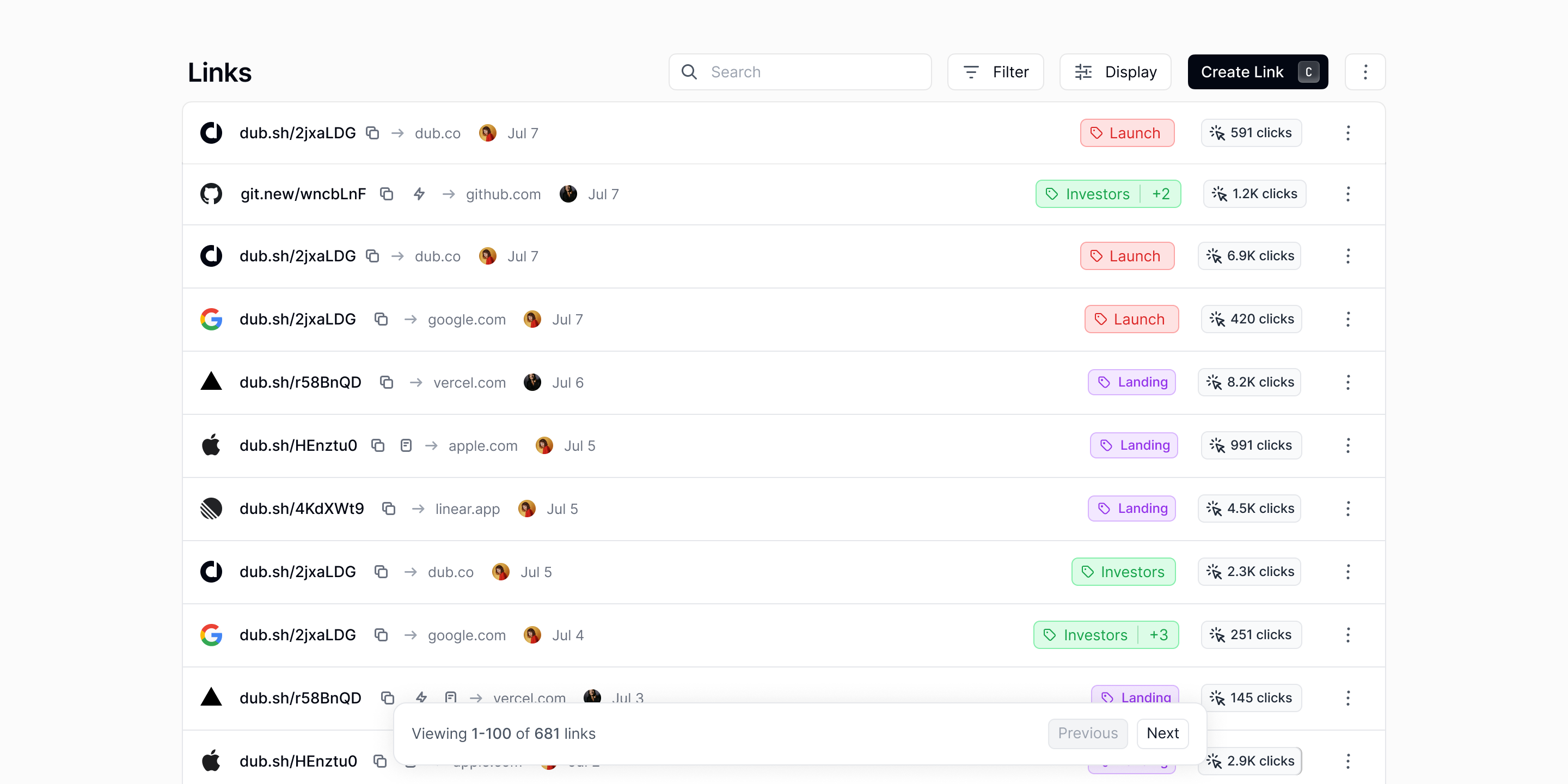
Image source: Dub vs Rebrandly comparison page
Article outline
I split this review into three simple parts so you can jump straight to the section that matters most to your decision.
- Should you switch to Dub? — a quick reality check on where Dub looks stronger, where Rebrandly still holds up, and what kind of buyer should keep reading.
- What you get with Dub — the free plan, the features that actually matter, pricing, and whether the upgrade feels justified or overpriced.
- Dub vs other options — the alternatives worth comparing, who should buy Dub now, and who should skip it.
Should you switch to Dub?
Dub looks strongest for marketers, startups, SaaS teams, and creators who want link tracking to do more than count clicks. If you care about branded links, conversion visibility, custom domains, and a dashboard that does not feel clunky, Dub immediately becomes a serious Rebrandly alternative.
That matters because switching link platforms is annoying if the payoff is tiny. You do not want to move domains, links, tracking rules, and reporting habits unless the new tool makes everyday work meaningfully easier or gives you clearer data.
Dub has a strong case on both fronts. Its official positioning is very direct: better analytics, a cleaner interface, migration support for Rebrandly users, and pricing that starts lower on the main paid tier than Rebrandly’s comparable professional option.
That lower entry point is a big part of why this comparison matters. If you are already paying for branded links, you probably do not want to keep paying more for a platform that feels older or gives you less useful reporting once campaigns start getting serious.
The catch is that “better” depends on what you actually need. If your team mainly wants branded short links, QR codes, and a familiar setup without caring much about attribution depth, Rebrandly can still be perfectly fine.
Dub becomes more compelling when link performance is tied to leads, sales, partner traffic, or campaign decisions. At that point, a platform that pushes beyond basic click stats starts to earn its price much faster.
That is also why this is not a one-size-fits-all recommendation. If you are barely creating links each month, you probably should not overcomplicate this and rush into a switch just because a newer tool looks nicer.
If you already have real campaigns running, though, waiting can cost more than the subscription difference. Messy reporting, weaker visibility, and a tool your team does not enjoy using tend to slow execution in quiet ways that add up.
Another reason Dub is getting attention is how broad its use case has become. It is not just trying to be a URL shortener with branding slapped on top; it is leaning into link attribution, deeper analytics, and partner-driven workflows in a way that feels more built for modern growth teams.
That does not mean it replaces every marketing tool you use. It means it can replace a weaker link stack, reduce reporting blind spots, and make your short-link setup feel more connected to actual outcomes instead of vanity metrics.
Buyers who usually like Dub fall into a pretty specific group. They already have traffic, already care about tracking, and already know that hacked-together workflows become expensive once the team grows.
Buyers who should slow down are the ones who still need the simplest possible solution. If you are not using custom domains seriously, not tracking campaign performance, and not building repeatable marketing systems yet, Dub may be more platform than you need today.
That balance is what the rest of this review will unpack. I am not going to pretend Dub is perfect, but for the right buyer, it looks a lot more like a smart upgrade than a shiny distraction.
What you get with Dub
Dub is not just a link shortener with branding. It is built more like a lightweight attribution and link management system, which is why it feels closer to a marketing tool than a utility.
You get branded links, custom domains, analytics, and team collaboration features right away. What stands out is how clean everything feels compared to older tools that still look like they were built years ago and barely updated.
The free plan is enough to test properly, not just poke around. You can create branded links, track clicks, and actually see whether the interface and reporting make sense for how you work.
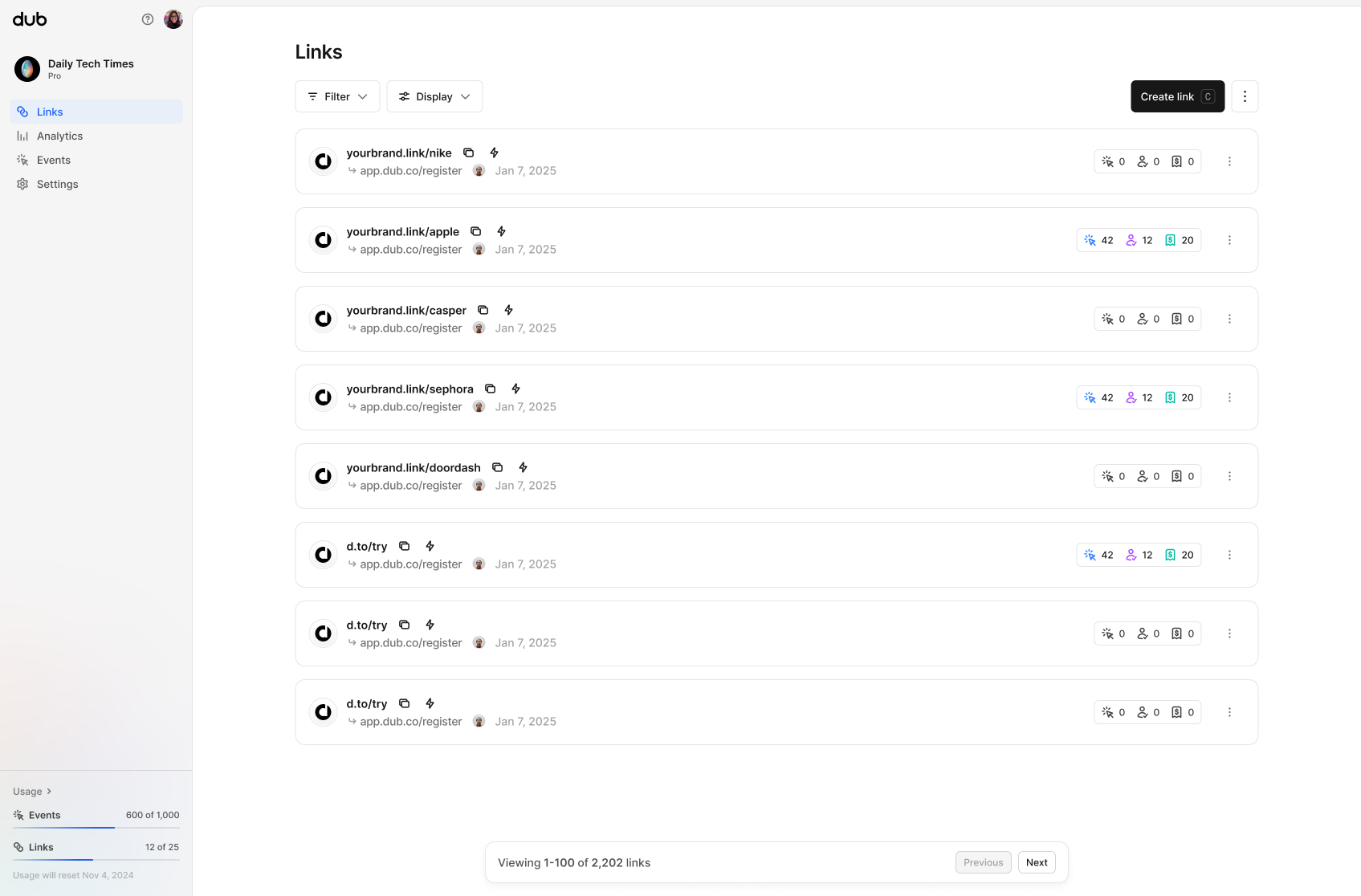
Image source: Dub homepage
The dashboard focuses heavily on clarity. You are not digging through menus just to understand which link is performing or where your traffic is coming from.
That matters more than it sounds. If reporting is annoying to use, you stop checking it, and then your links become guesswork instead of a real decision tool.
The features that actually matter
Branded links and custom domains are standard at this point. Dub does them well, but that alone is not why people switch from Rebrandly.
The real upgrade is attribution and tracking depth. You can track traffic sources, campaign performance, and link-level analytics in a way that feels built for people who actually care about outcomes, not just clicks.
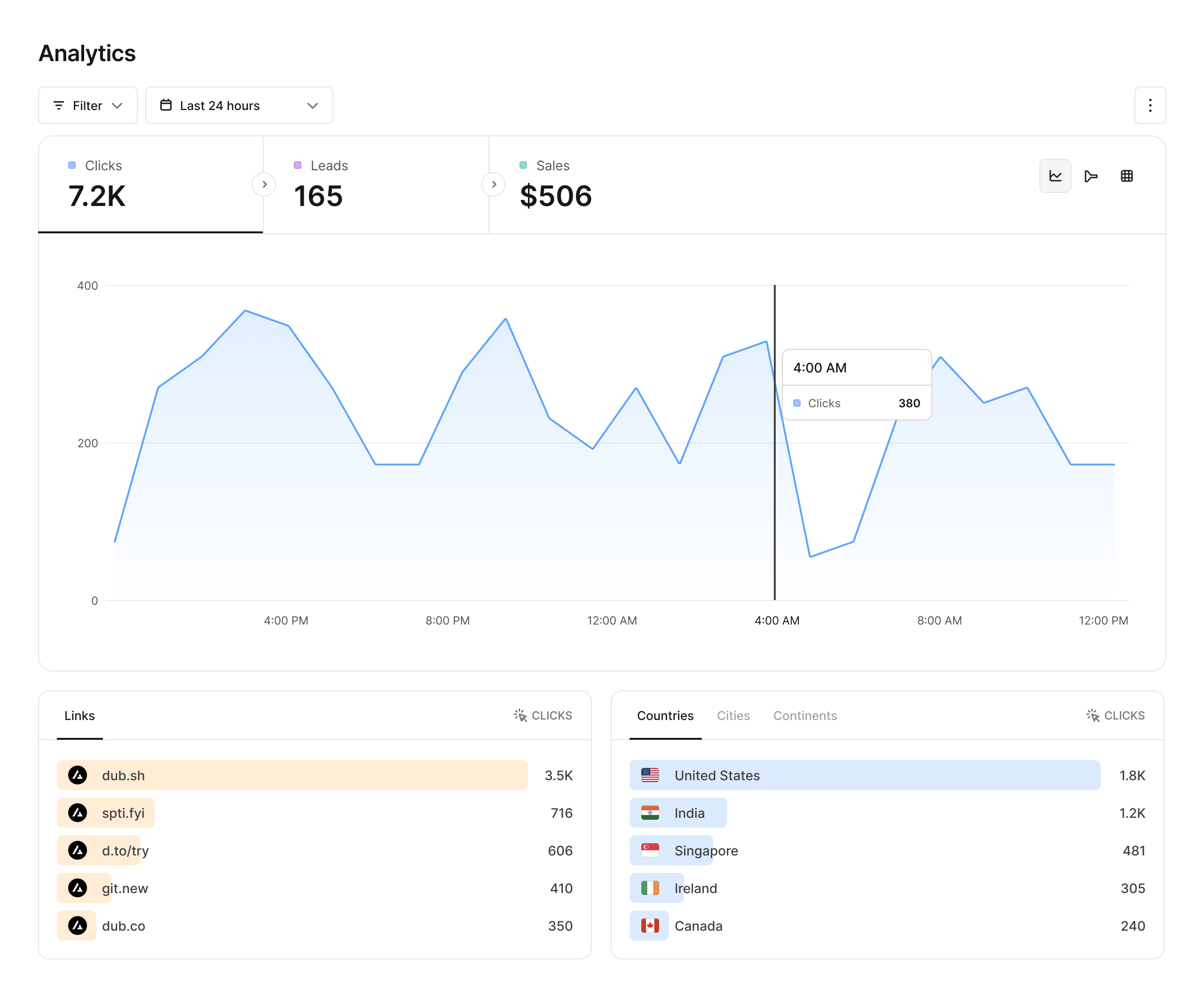
Image source: Dub analytics overview
Short links become more than just shortened URLs. They turn into trackable assets that help you understand what is working and what is wasting traffic.
Another strong point is how Dub handles teams and collaboration. You can manage links across projects without things getting messy, which becomes important once more than one person is involved.

Image source: Dub team features
Migration support also removes a big objection. If you are coming from Rebrandly, you do not have to rebuild everything manually, which is usually the main reason people avoid switching.
Where Dub is better than Rebrandly
The biggest difference is how modern the product feels. Rebrandly still works, but Dub feels like it was designed for current workflows instead of slowly patched over time.
Analytics are easier to read and more actionable. You are not just seeing numbers; you can actually connect those numbers to campaigns and decisions.
Pricing is also more aggressive on entry-level paid plans. That lowers the risk of switching because you are not paying a premium just to test whether it is better.
Where Dub is not perfect
Dub is still growing, which means some edge-case features or niche integrations may not be as mature as older platforms. If you rely on very specific workflows, you need to double-check before switching.
It can also feel like overkill if you only need basic link shortening. If your current setup works and you do not care about analytics depth, you may not see enough value to justify the move.
That is why this is not a blind upgrade recommendation. It is a strong option, but only if you are actually going to use what makes it better.
Pricing and how it compares to other tools
Dub starts free, which removes most of the risk. You can test it properly before paying anything, which already makes it easier to justify trying compared to tools that lock features immediately.
The paid plans are positioned to compete directly with tools like Rebrandly but with a stronger feature set. You are not just paying for branding, you are paying for tracking clarity and a better workflow.
Check the official Dub free trialThat comparison makes one thing clear. Dub is not trying to be the cheapest tool, and it is not trying to replace your entire marketing stack either.
It sits in the middle. More advanced than basic link shorteners, but far simpler than full all-in-one platforms.
Why you might want to switch sooner rather than later
Switching tools is always annoying, so most people delay it longer than they should. The problem is that weak tracking quietly costs you more over time than the subscription difference.
If your links are part of real campaigns, not just casual sharing, better attribution changes how you make decisions. You stop guessing and start seeing which channels actually deserve more attention.
Dub makes that shift easier because the data is clearer. You do not need to dig through complicated reports to figure out what is happening.
That is where it starts to feel worth paying for. Not because it shortens links better, but because it helps you make better decisions with the traffic you already have.
If your current setup feels messy, this is the kind of upgrade that cleans it up quickly. If your setup is simple and working fine, you can wait without losing much.
The key question is simple: are your links just links, or are they part of how you grow? If they matter, Dub is a much stronger option than sticking with something that only does the basics.
Dub vs other options (and when you should pick something else)
Dub is a strong Rebrandly alternative, but it is not the only option worth considering. Some tools go cheaper, some go broader, and some try to replace your entire marketing stack.
The right choice depends on how important link tracking actually is in your workflow. If links are tied to revenue, campaigns, or partnerships, the decision looks very different than if you just need clean URLs.
Try Dub freeDub wins when tracking matters and you want something focused. Systeme.io wins when budget is the main concern, and GoHighLevel wins when you want an entire marketing system instead of just link tracking.
Rebrandly still works if you want something simple and familiar, but it starts to feel limited once you care about performance data.
If you are already thinking about switching, that usually means your current setup is not doing enough. In that case, Dub is the most natural upgrade without jumping into something overly complex.
My honest take
Dub is one of the few tools in this space that actually feels like a real upgrade instead of a lateral move. It fixes the biggest frustration with tools like Rebrandly, which is shallow analytics and an aging interface.
It is not perfect, but the direction is clear. You are getting a product that is actively being improved and designed for modern marketing workflows.
The biggest reason to buy is simple: better decisions. If you can see what your links are actually doing, you stop wasting time guessing and start focusing on what works.
The biggest reason to skip it is also simple: you do not need it yet. If you are barely using link tracking, this will feel like overkill.
For the right buyer, though, this is absolutely worth trying. Especially if your current setup feels clunky or limited.
Common questions people still have
Is Dub hard to set up?
No. The setup is straightforward, especially if you have used any link shortener before. Custom domains take a bit of configuration, but that is normal for any tool in this category.
Is it worth switching from Rebrandly?
Yes if you care about analytics and performance tracking. If you only need branded links and everything works fine, switching is optional.
Does Dub replace other tools?
Not fully. It replaces your link shortener and improves tracking, but it does not replace full marketing platforms like CRMs or funnel builders.
Is the free plan enough?
It is enough to test properly and decide. You will need a paid plan if you want to use it seriously for campaigns or teams.
Should beginners use it?
Beginners can use it, but they do not always need it yet. If you are just starting, a simpler or cheaper tool may be fine until tracking becomes important.
Should you start now or wait?
Start now if your links are part of how you grow. Waiting usually means you keep running campaigns without clear insight into what is working.
Wait if you are still figuring out the basics and not using tracking seriously. In that case, you will not get much value yet.
If you are already comparing tools like this, you are probably closer to the first group than the second.
Explore Dub and see if it fits your setup Filip Konecny Enterprises