

A social media marketing agency website should do a lot more than sit there looking polished. It has to take the attention you earn on social platforms and turn it into trust, qualified conversations, and signed clients. If it cannot do that, it is not really supporting your marketing at all.
That matters more now because discovery is fragmented. HubSpot’s 2024 consumer research shows social media leading product discovery, GWI’s 2025 brand discovery data shows people still move across search engines, social ads, official websites, and review sites, and DataReportal’s 2025 social report shows global social usage continuing to climb. So a social media marketing agency website has to connect those touchpoints instead of acting like a disconnected brochure.
Buyers are also doing more homework before they ever reach out. 6sense’s 2025 buyer study, Gartner’s 2025 sales survey, and McKinsey’s 2024 B2B Pulse all point in the same direction: people want self-service research, but they still expect clear guidance once they get serious. That is exactly where your site has to do its best work.
Article Outline
This article is organized into six parts so you can move from strategy to execution without losing the thread.
- Why a Social Media Marketing Agency Website Matters — why the site is the bridge between social attention and real client action.
- Framework Overview — the simple structure that turns visits into trust and trust into leads.
- Core Components — the pages, proof, and conversion elements that a serious agency site needs.
- Professional Implementation — how design, copy, UX, speed, and credibility come together.
- Measurement and Optimization — how to track what is working and improve what is leaking.
- Future-Ready Ecosystem — how to keep the site aligned with platforms, buyer behavior, and search shifts.
Why a Social Media Marketing Agency Website Matters

Social posts can win the click, but the website usually wins or loses the lead. Clutch’s 2025 social commerce research found that 78% of consumers say brand posts influence buying decisions, yet only 15% complete purchases directly inside social apps while 36% go on to buy from the company’s website. That gap is the whole opportunity for agencies: attention is earned on social, but confidence is often sealed on the site.
The trust window is brutally short. Clutch’s 2025 website trust survey says 87% of consumers have left a site immediately because it did not look trustworthy, and 83% judge credibility in under 20 seconds. So if your homepage is vague, slow, or packed with clever words that say nothing, the prospect is usually gone before your best point ever lands.
That pressure gets even stronger when you sell expertise instead of a low-risk product. Reputation’s 2024 consumer survey shows online reviews now outweigh company claims for many buyers, and BrightLocal’s 2026 review research shows recency, consistency, and business responses all shape trust. A strong social media marketing agency website has to prove you are current, credible, and easy to work with before anyone asks for a proposal.
Framework Overview
The cleanest way to think about the site is this: attract, orient, prove, convert, and continue the relationship. That structure matches how discovery works now. HubSpot shows social driving discovery, GWI shows official websites still play a direct role in brand discovery and validation, and Clutch shows many people still leave social to complete the action on a company site.
Once a visitor lands, the page needs to answer four quiet questions fast: what do you do, who do you help, why should I believe you, and what should I do next. G2’s 2024 buyer data shows buyers lean heavily on external proof such as review sites, while BrightLocal’s 2026 survey and Reputation’s 2024 findings show that recent and trustworthy feedback matters. That is why the framework has to combine positioning with proof instead of treating them like separate jobs.
When that framework is right, every page earns its place. The homepage sets the promise, service pages qualify intent, case studies lower skepticism, proof sections reduce risk, and the call to action gives the right next step without forcing every visitor into the same funnel. That is the structure the rest of this article will keep building out.
Core Components

The core pieces are not complicated, but they do need to work together. A serious social media marketing agency website needs a sharp homepage, focused service pages, industry or offer-specific landing pages, case studies, testimonial or review sections, a real about page, a visible contact path, and content that proves the team understands platforms, creative, reporting, and business outcomes. When those pieces are disconnected, traffic leaks out long before trust has time to build.
Those components also have to reflect how people actually browse today. Statcounter’s current platform share shows mobile edging past desktop worldwide, and Similarweb’s 2026 traffic share view also puts mobile in the lead. So mobile-first thinking is not a nice extra for agency sites anymore, especially when so many first visits begin from a social click.
Proof deserves special attention because buyers compare faster than most agencies think. G2’s 2024 report says 31% of buyers consult review sites more often than other sources, and BrightLocal’s 2026 data says 74% only care about reviews from the last three months. That is why a high-performing social media marketing agency website needs recent testimonials, named case studies, specific outcomes, platform-level expertise, and proof that the results were actually earned.
Professional Implementation
Professional implementation is where strategy stops being theory. Google’s Search documentation explicitly recommends good Core Web Vitals for search success and better real-world experience, while Clutch’s 2025 trust data shows visitors lose confidence when a site feels slow, broken, or sloppy. Design, copy, development, SEO, analytics, and CRO have to work like one system.
Security and clarity matter just as much as visuals. Clutch found that SSL signals, clean design, and recognizable trust elements help users feel secure, while typos, broken links, hidden contact options, and clunky navigation push them away. If you are selling digital competence, your own website cannot quietly signal the opposite.
In practice, professional implementation means consistent messaging, clean hierarchy, fast-loading media, obvious navigation, transparent privacy language, a real contact path, and tracking that shows which pages actually create pipeline. It also means resisting the urge to hide the offer behind trendy motion and vague slogans. When the build is disciplined, the website stops acting like an online brochure and starts working like your best salesperson.
Measurement and Optimization
A social media marketing agency website should be measured like a sales system, not admired like a design project. Google’s own GA4 guidance makes the distinction very clear: when lead generation is the goal, tracking generate_lead tells you far more than celebrating shallow actions like scroll depth. That matters because a site can look active, bring in traffic, and still fail to create a single qualified conversation.
The first layer of measurement is intent. Search Console’s Performance report shows which queries drive impressions, clicks, and click-through rate, while GA4 funnel explorations let you map the path from first visit to form view to completed lead. When those two views are connected, you stop guessing whether the website is attracting the right people and start seeing exactly where strong opportunities are getting lost.
The second layer is experience quality. Search Console’s Core Web Vitals report uses real-world field data, and Google’s Search documentation still recommends achieving good Core Web Vitals for search success and user experience. If the page hesitates, jumps, or feels clumsy right when someone tries to book a call, that friction is not just a UX issue anymore; it is a conversion problem.
Track the Right Conversions First
This is where a lot of agencies lie to themselves without realizing it. Google explicitly contrasts a lightweight event like scroll with generate_lead and makes the point that the lead event is the stronger business signal when a form submission is what actually matters. So a social media marketing agency website should be judged by calls booked, proposals requested, and real sales conversations started, not by vanity engagement that makes a dashboard look prettier than reality.
That changes how you evaluate every important page. If a service page gets visits but never moves people deeper into the lead-generation funnel, it is not doing its job no matter how polished the copy looks. The better question is always whether the page helps the right prospect feel informed enough, confident enough, and interested enough to take the next step.
Once you start thinking that way, optimization becomes much more honest. You can test headlines, CTA language, proof sections, form length, page structure, and booking flow against lead progression instead of arguing over design preferences in the abstract. That is when measurement starts protecting the business from opinion-led decisions.
Build a Clean Measurement Stack
Clean measurement is rarely about adding more tools. It is about making the important actions readable. Google Tag Manager’s form submission trigger can track standard form sends, while custom event triggers are there for modern forms where the normal browser submit behavior has been overridden. That matters because broken tracking can make a strong website look weak, and that sends teams chasing the wrong fix.
Privacy has to be handled seriously too. Consent mode changes how Google tags behave based on user choices, and Measurement Protocol can extend GA4 with server-to-server or offline events when you need a fuller picture of what happened after the form was submitted. A strong social media marketing agency website should not only measure leads cleanly, but measure them in a way that respects consent and still reflects real business outcomes.
One more thing gets missed all the time: the reporting layer itself can hide the truth. GA4 thresholds can withhold data in reports and explorations, especially on small datasets or narrow date ranges, which means one bad read can push a team toward the wrong conclusion. Good optimization depends on stable windows, clear event definitions, and enough context to tell the difference between a real performance drop and a reporting artifact.
If you want to study a cleaner path for turning visibility into action, this is worth a look.

Future-Ready Ecosystem
The future-ready version of a social media marketing agency website is not just “SEO optimized.” It is built to be understood across search, AI-assisted discovery, review platforms, social profiles, and direct visits. Google expanded AI Overviews to more than 200 countries and territories in more than 40 languages, Google also says people are asking more complex, longer, and multimodal questions in Search, and ChatGPT search is now available to everyone in supported regions. That means your site has to work as a source of truth, not just as a page that hopes to rank.
This is where clarity starts beating cleverness. Search systems and AI systems both respond better when your site makes the basics unmistakable: who you are, what you do, who you help, how you work, and what proof supports the claim. A homepage full of vague slogans might sound impressive in a brainstorm, but it gives real buyers and machine-driven discovery systems almost nothing solid to hold onto.
The smartest move is to treat the website as the center of a broader digital reputation system. Reviews, service pages, team bios, case studies, social profiles, and booking paths should all reinforce the same story instead of competing with each other. When they do, the site becomes easier to discover, easier to trust, and much harder to confuse with every other agency making the same generic promises.
Optimize for AI-Assisted Discovery
Optimizing for AI-assisted discovery does not mean stuffing a page with robotic answer blocks. Google’s people-first content guidance still points in the right direction, because the best input for AI systems is usually the same thing that helps a serious buyer: specific, helpful, first-hand information. If you want a social media marketing agency website to show up in the right conversations, the pages need to explain real services, real process, real deliverables, and real expertise in plain language.
Structured data supports that clarity. Organization markup helps Google understand and disambiguate company details, while ProfilePage markup can support author, employee, or expert profile pages on your site. That does not guarantee a special search treatment, but it does give search systems cleaner signals about who is speaking and why the content deserves trust.
There is also a writing lesson here that too many agencies ignore. Service pages should answer the layered questions real prospects ask after they discover you through a social post, a referral, a review site, or an AI-generated summary. That means your approach, deliverables, reporting style, niche experience, platform focus, and next step should be easy to find without making people fight through fluff.
Keep Proof and Entity Signals Current
Freshness matters because trust decays fast online. BrightLocal’s 2026 agency guidance drawn from its latest consumer review research notes that 66% of consumers still seek additional information on websites, social channels, and other touchpoints before they feel confident enough to choose a business. So even when discovery starts somewhere else, the website still has to confirm the story.
That is why proof cannot be stale. BrightLocal’s 2026 survey shows how strongly positive and negative reviews influence choice, while G2’s 2024 buyer research shows review sites remain a major validation source during software and services buying. On an agency site, that translates into recent testimonials, updated case study dates, clear client context where confidentiality allows it, visible team expertise, and a consistent brand identity across your website and public profiles.
In other words, a future-ready social media marketing agency website is maintained, not merely launched. The pages should be updated when your offer changes, when platforms shift, when your team evolves, and when new proof becomes available. That ongoing upkeep is not busywork; it is how you stay believable in an environment where prospects can compare five agencies and verify every claim in minutes.
Implementation Playbook for a Social Media Marketing Agency Website
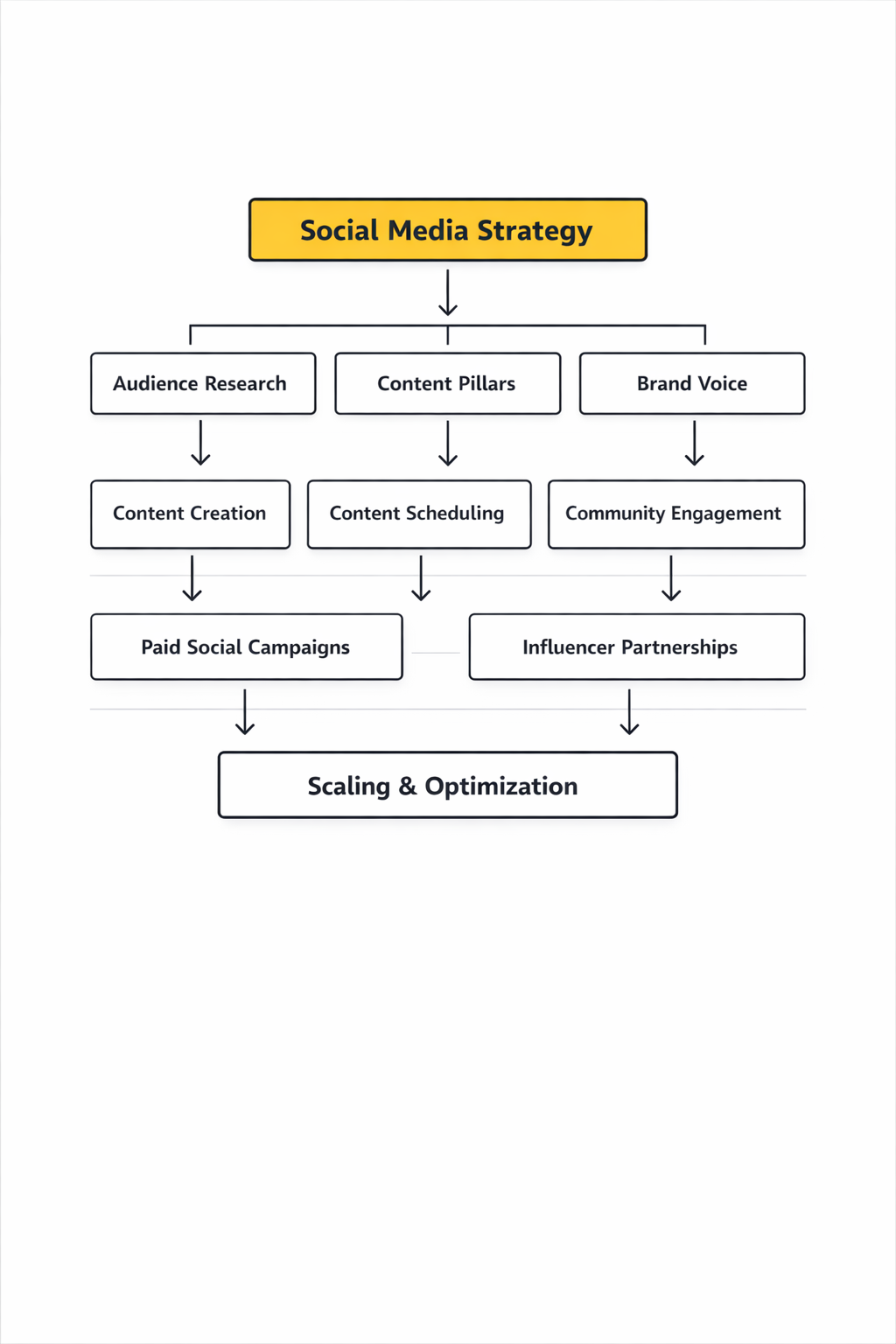
This is the point where strategy either becomes real or falls apart. A social media marketing agency website can have the right offer, the right design references, and the right ambition, but if the implementation is sloppy, visitors feel the friction immediately. And once that happens, all the clever messaging in the world will not save the lead.
The good news is that strong implementation is not mysterious. It comes down to building pages that make decisions easier, forms that feel easy to finish, and technical foundations that do not get in the way of trust. Google’s page experience guidance and its Core Web Vitals documentation both point in the same direction: the experience has to work well in the real world, not just in a mockup.
That is exactly how you should think about this part of the build. You are not creating a digital brochure for people to admire. You are creating a social media marketing agency website that should move someone from curiosity to confidence without making them work too hard to get there.
Start With Messaging, Not Decoration
The easiest mistake to make is designing first and clarifying the message later. That usually leads to vague headlines, overproduced hero sections, and pages that sound impressive without saying anything concrete. On a social media marketing agency website, that is dangerous because visitors are already comparing you with other agencies that are promising growth, leads, scale, and creative excellence in almost identical language.
The better order is simple: define the promise, define the audience, define the proof, and only then design the page around that structure. That makes it easier to write a headline that names the outcome, a subheading that explains how you get there, and a CTA that feels like the natural next move instead of a pushy demand. When the message is settled first, the design starts supporting understanding rather than distracting from it.
This also makes the rest of the website more consistent. Service pages sound aligned with the homepage, proof sections reinforce the same positioning, and the contact path feels like the continuation of one clear conversation. That kind of alignment is what makes a social media marketing agency website feel professional even before someone studies the finer details.
Map Service Pages to Real Search and Buyer Intent
Most agency sites lose people because the page structure mirrors the agency’s internal thinking instead of the buyer’s questions. Prospects are not arriving with a neat mental map of your departments. They are trying to figure out whether you can help with paid social, organic content, creator campaigns, analytics, reporting, or full-funnel strategy, and they want those answers fast.
That is why each service page should do one job clearly. It should explain who the service is for, what is included, how success is measured, what the process looks like, and what happens next if someone wants help. A social media marketing agency website becomes much easier to trust when every important page answers those questions without burying them under abstract branding language.
There is also a technical reason to keep those pages focused. Google’s JavaScript SEO basics make it clear that important content should remain understandable to Search even when modern frameworks are involved, and Google’s mobile-first indexing best practices warn against hiding critical content in ways that create crawl or parity problems. In plain English, your core service value should be visible, load reliably, and make sense on mobile without requiring visitors or crawlers to fight the page.
Reduce Friction in Lead Capture Without Killing Quality
Lead forms are where too many agency websites suddenly get greedy. After doing all the hard work to earn a click and build trust, they ask for too much, too soon, and make the final step feel heavier than it needs to be. That is a terrible trade, especially when the visitor was ready to reach out just a few seconds earlier.
Baymard’s 2024 form research makes a useful point that applies well beyond ecommerce: the number of fields often hurts usability more than the number of steps. Its refreshed checkout study was built on 4,000+ hours of research, more than 200 qualitative usability sessions, and 1,350+ medium-to-severe usability issues, which is a strong reminder that friction tends to hide in details teams stop noticing. On a social media marketing agency website, that usually means asking only for the information needed to start the conversation, then qualifying further once the relationship begins.
This is where strong implementation beats ego. A shorter form with a better thank-you flow, a clear expectation for what happens next, and a calendar option for higher-intent visitors often does more for lead quality than a bloated intake form ever will. The goal is not to make the process feel “serious.” The goal is to make the right person feel comfortable enough to take the next step.
Make Forms Clear and Accessible From the Start
Accessibility is not a side issue for agency websites. It shapes whether people can understand the page, move through it confidently, and complete the action you are asking them to take. WCAG 2.2 exists because accessible design is part of basic web quality, not a decorative extra to be added when there is time left over.
Forms deserve special attention here. W3C’s guidance on identifying input purpose explains why programmatically declaring what each field is for can make forms easier to complete, especially for people using assistive technologies or browser autofill. Its guidance on client-side validation and error text also reinforces something practical: when a form fails, the page should explain what went wrong in a way people can actually understand and fix.
This matters for conversions just as much as it matters for compliance. A social media marketing agency website that uses clear labels, sensible field types, helpful error states, and visible focus indicators simply feels easier to use. And when a site feels easier to use, it also feels easier to trust.
Build for Speed and Search Visibility at the Same Time
Performance work should never come at the expense of visibility. Teams sometimes hear “optimize the site” and start aggressively lazy-loading assets, pushing essential content behind interactions, or relying too heavily on client-side rendering without checking what Google can actually see. That can make the site feel modern in a demo while quietly weakening the very pages that should bring in qualified traffic.
Google’s lazy-loading guidance is very straightforward about the risk: lazy-loading is a valid performance technique, but it can hide content from Google when it is implemented badly. Its mobile-first indexing guidance also says not to lazy-load primary content upon user interaction, which is especially relevant for agencies that tuck important proof, service explanations, or portfolio content behind fancy effects. A social media marketing agency website should absolutely be fast, but it should never become fast by making itself harder to crawl or harder to understand.
That is why implementation needs balance. Use compression, sensible media handling, and modern loading techniques, but keep the primary message, the proof, and the core service content easy to access. When speed and clarity reinforce each other, the site feels sharper to users and stronger in search.
Connect Leads to the Systems That Actually Close Deals
A website lead is only valuable if the business can follow it through. That sounds obvious, but a surprising number of agency sites still treat the form submission as the finish line instead of the handoff point. In reality, the most important implementation work often happens after the thank-you message appears.
Google Analytics recommends lead-generation events such as generate_lead when the goal is to measure the full lead funnel, and Google Ads’ documentation for enhanced conversions for leads explains how user-provided data can improve attribution back to campaigns and support more durable reporting. That does not mean every agency needs an overly complex stack on day one. It does mean a social media marketing agency website should pass lead data cleanly into the CRM, preserve source information, and make it possible to connect revenue back to the pages and campaigns that created the opportunity.
This is where implementation stops being web design and becomes business infrastructure. If the form fires but the lead routing is messy, if attribution breaks the moment a deal closes offline, or if nobody can tell which service pages generate the best opportunities, the site is leaving money on the table. A strong build closes that gap so the website is not just collecting names, but helping the agency understand what is truly working.
Statistics and Data
If you want to build a social media marketing agency website that actually produces clients, you need to look at the numbers the right way. Not to stuff the page with random percentages. Not to sound smart. But to understand what modern buyers are doing, where they discover agencies, and what makes them trust one enough to reach out.
That is what this section is about. The data does not replace strategy, but it does stop you from building the wrong kind of site. And that matters because the wrong site can quietly waste months of content, ads, outreach, and attention without you realizing just how much opportunity is leaking out.
Discovery Starts on Social, but It Does Not End There
DataReportal counted 5.24 billion active social media user identities at the start of 2025, which tells you just how massive the attention pool really is. HubSpot’s 2024 consumer research says social media is the number one product discovery channel, and its follow-up analysis puts 26% of consumers in the camp that prefers discovering new products through social media. That is a huge reason agencies invest so heavily in content, paid campaigns, and platform-native brand building in the first place.
But the next move matters just as much as the first one. GWI’s 2025 brand discovery research shows 30% of consumers discover brands through social ads, 33% through search engines, 26% through brand or product websites, and 23% through review sites. In other words, people do not live inside one channel when they are evaluating whether a business is worth their time.
You can see the same pattern in purchase behavior. Clutch found in 2025 that only 15% of consumers complete purchases directly inside a social app, while 36% go to the company’s website and 31% head to an online marketplace. For a social media marketing agency website, that is the real lesson: social may create the click, but the website is often where confidence gets built or broken.
Trust Is Judged Fast and Harshly
If you have ever wondered whether people really notice weak design, thin copy, or shaky credibility signals, the answer is yes, and they notice faster than most agency owners think. Clutch’s 2025 website trust research says 87% of consumers have immediately left a website because it did not look trustworthy. That number alone should make any agency take its own site much more seriously.
The time window is even tighter than most teams assume. The same Clutch study says 83% judge credibility in under 20 seconds, and 55% form an opinion within 10 to 20 seconds. So when a visitor lands on your homepage from Instagram, LinkedIn, TikTok, search, or a referral, you do not have much time to explain yourself.
That is why a social media marketing agency website cannot afford vague messaging or generic design. The page has to say what you do, who you help, why you are credible, and what the next step is before the visitor’s skepticism wins. If that sounds intense, good. It is supposed to, because that is exactly how real buying behavior works online.
Mobile and Performance Are No Longer Optional Conversations
You do not need another debate about whether mobile matters. Statcounter showed mobile at 52.48% of worldwide web traffic in February 2026, Similarweb showed mobile ahead in the United States at 53.31% in February 2026, and Similarweb showed an even larger mobile lead in the United Kingdom at 66.49% in February 2026. That is not a niche behavior anymore. That is the mainstream experience.
HubSpot’s consumer research reinforces the same point from another angle. HubSpot says consumers now use mobile phones more than any other device for online shopping and for searching questions online, and 71% of Gen Z shoppers in its 2024 report say mobile is the device they use most often when shopping online. So if your agency site still treats mobile usability like a stripped-down version of the “real” desktop experience, you are building for the wrong world.
Performance has to keep up with that reality. Google’s own guidance says site owners should achieve good Core Web Vitals for success with Search and a great user experience. A social media marketing agency website that loads slowly, jumps around while rendering, or buries key proof below heavy assets is not just annoying visitors; it is sabotaging trust at the exact moment trust matters most.
Buyers Want to Research You Before They Ever Talk to You
This is one of the biggest shifts agencies still underestimate. 6sense’s 2025 Buyer Experience Report says buyers reported prior experience with an average of 3.8 of the 5 vendors on their shortlist, which means many decisions are already taking shape before your agency ever gets a reply, a form fill, or a booked call. The shortlist is often being built quietly, and the website is one of the places where you either make it onto that list or disappear from it.
Gartner reported in March 2026 that 67% of B2B buyers prefer a rep-free experience, while McKinsey’s 2024 B2B Pulse research says buyer comfort with remote and self-service spending has leaped. That does not mean people never want to talk. It means they want to understand enough on their own terms before they decide a conversation is worth having.
For a social media marketing agency website, that changes the job of every important page. Your site has to answer the questions a buyer is already asking privately: what exactly do you do, how do you work, what proof do you have, what kind of clients are you best for, and what happens if we talk. If the site cannot carry that part of the load, it is not helping your pipeline nearly as much as it should.
Reviews, Recency, and Proof Shape the Final Decision
Trust is not built only by what you say about yourself. It is built by what other people can verify about you. G2’s 2024 Buyer Behavior Report says 31% of buyers consult review sites more often than other sources, which tells you that third-party validation is not a side issue anymore. It is part of how serious buyers reduce risk.
Recent proof matters even more than old praise. BrightLocal’s 2026 Local Consumer Review Survey says 74% only care about reviews written in the last three months, 47% will not use a business with fewer than 20 reviews, and 31% will only use a business with 4.5 stars or more. That is a powerful reminder that credibility is not a static asset you earn once and keep forever.
The downside shows up just as clearly. Reputation’s 2024 survey says negative reviews sway 67% of consumers away from making a purchase, while 85% say seeing responses to negative reviews affects their decision-making. That is why a social media marketing agency website should not just display testimonials and call it a day. It should connect website proof, external reviews, case studies, and visible responsiveness into one believable reputation system.
Measure the Actions That Create Revenue, Not the Ones That Inflate Ego
One of the most useful pieces of guidance here comes straight from Google Analytics. Google’s example for key events says a lead-generation business should care more about a generate_lead event than a scroll event, because the lead event shows when someone actually completes the sign-up form rather than merely interacting with the page. That is a simple point, but it saves a lot of teams from building dashboards that look exciting and mean very little.
For a social media marketing agency website, that means the numbers that deserve your attention are the ones that show movement toward revenue. Qualified form submissions. Booked calls. Proposal requests. Sales conversations started. Those are the signals that tell you whether the site is truly converting the attention your social content earns.
Everything else should support that view, not replace it. Traffic matters because it creates opportunity. Engagement matters because it can reveal friction or relevance. But if your analytics setup can celebrate clicks, scrolls, and page views while staying vague about who actually became a lead, then your measurement stack is protecting your feelings instead of telling you the truth.
FAQ for a Complete Guide
What should a social media marketing agency website do better than a generic agency site?
A social media marketing agency website should connect attention to action. That means it should take someone who found you through Instagram, LinkedIn, TikTok, Facebook, YouTube, search, or a referral and help them understand what you do, why they should trust you, and what they should do next. If the site cannot do that clearly, it is not really supporting your marketing no matter how good it looks.
It also has to reflect how agencies are actually evaluated today. People compare offers fast, check social profiles, read reviews, scan case studies, and judge credibility in minutes, not days. So the website needs to act like the central trust hub for everything else your brand is doing.
Do I really need a website if my agency already gets clients from social media?
Yes, because social media and a website do different jobs. Social platforms are excellent for reach, conversation, and top-of-funnel attention, but your website is where you control the message, structure the proof, and guide the next step without platform limits or algorithm changes. That matters even more now that many buyers still move from social to a company website before taking action.
A website also gives you something social platforms never fully can: a stable home base. Your service pages, case studies, testimonials, contact flow, analytics stack, and search visibility all live there. That makes your website an asset, not just another channel.
What pages are absolutely essential on a social media marketing agency website?
You do not need fifty pages to look legitimate. You need the right pages doing the right jobs: a homepage, focused service pages, a proof layer with testimonials or case studies, an about page that makes the team feel real, and a contact path that is easy to use. If those pages are strong, the site already has a serious foundation.
After that, you can expand intentionally. Industry pages, landing pages, resources, team bios, and process pages can all help when they add real clarity. The mistake is building a bloated site before the core message is working.
How much proof should I show on the website?
More than most agencies do, but only if it is real. A social media marketing agency website should show enough proof that a serious prospect can understand your credibility without having to guess what you have actually done. That can include testimonials, named or anonymized case studies, process screenshots, reporting examples, platform expertise, and public reviews where appropriate.
The key is honesty. The FTC’s guidance on reviews, influencers, and endorsements is a useful reminder that testimonials and review-based marketing should be presented truthfully and without misleading omissions. Strong proof builds trust. Decorative proof just creates suspicion.
Should every service have its own page?
Usually, yes, if the services are genuinely different. A paid social service page, an organic content page, a creator marketing page, and a reporting page should not all say the same thing with a few platform names changed. When each page explains who the service is for, what is included, and how success is measured, the whole site becomes easier to navigate and easier to trust.
This also helps with search visibility and user experience at the same time. A focused page is easier for Google to understand and easier for a buyer to evaluate. That is a much better combination than one giant services page trying to cover everything badly.
How important is mobile performance for an agency website?
It is critical, not optional. Google uses the mobile version of a site’s content for indexing and ranking, which means a weak mobile experience is not just a usability problem anymore. It can affect how your site is understood and surfaced in search.
That matters even more for a social media marketing agency website because so many first visits begin from a phone. Someone taps through from a social post, ad, DM, or story, and your mobile experience becomes the real first impression. If the mobile version hides key proof, feels slow, or makes the form annoying to complete, the site is working against you.
What is the best call to action for a social media marketing agency website?
The best call to action is the one that matches buyer intent. Some visitors are ready to book a call. Others want to ask a question, request a proposal, or see whether your agency is the right fit before they commit to anything more serious. A good website gives them a clear next step without forcing everyone into the same lane.
That usually means one primary CTA and one lower-friction option. For example, you might feature a strategy call as the main action and offer a contact form or email inquiry for people who are interested but not ready to book yet. The goal is to reduce hesitation, not to pressure people into a format they do not want.
How should I measure whether the website is actually working?
Measure the actions that move the business forward. A social media marketing agency website should be tracked around qualified leads, booked calls, proposal requests, and real sales conversations instead of vanity metrics that look exciting but say very little. Google’s own GA4 guidance uses generate_lead as the stronger example for a lead-generation business, which is exactly the right mindset.
You should also watch the journey, not just the finish line. Search Console’s Performance report helps you see how people discover the site, while GA4 funnel exploration helps you see where people drop out before converting. That combination gives you much better answers than traffic numbers on their own.
Should I optimize the site for AI search and AI Overviews?
Yes, but not by turning the site into robotic answer bait. The smarter move is to make the site clearer, more specific, and more trustworthy so search systems and AI-assisted discovery tools can understand what your agency actually does. That means stronger service pages, clearer company details, real author or team identity, and more useful proof.
That matters because search is already changing. Google expanded AI Overviews to more than 200 countries and territories and more than 40 languages in 2025, and ChatGPT search became available to everyone in supported regions in February 2025. A social media marketing agency website should be built to be understood in that environment, not just to chase old ranking habits.
Does structured data matter for an agency website?
Yes, because it helps search systems understand who you are and what the page is about. Google’s Organization structured data documentation explains that it can help Google better understand your organization’s administrative details and disambiguate your business. That is useful for agencies that want clearer brand signals in search.
It is not a magic trick, and it will not fix weak content. But it is part of a cleaner technical foundation. A social media marketing agency website should make it easy for both people and search systems to understand the brand behind the page.
How important is accessibility on a social media marketing agency website?
It is a core quality issue, not a side project. WCAG 2.2 exists to make web content more accessible across a wide range of disabilities, and the practical result is simple: clearer navigation, better labels, better focus states, better forms, and a site that more people can actually use. That is good for users and good for the business.
Accessibility also overlaps with trust. When buttons are clear, forms are understandable, and the layout behaves predictably, the website feels more professional. That matters because a social media marketing agency website is being judged not only on its ideas, but on its execution.
How often should the website be updated?
More often than most agencies update theirs. You do not need a full redesign every few months, but you do need regular maintenance so the site reflects your current offer, team, proof, and platform expertise. An outdated agency site quietly sends the message that the business is not paying attention.
A good rhythm is simple. Review the homepage, service pages, proof sections, and contact flow on a recurring basis. Update testimonials, case studies, offers, and positioning when the business changes. A social media marketing agency website should evolve as the agency evolves, not stay frozen in the moment it launched.
Can a small agency have a high-converting website without a huge budget?
Absolutely. A smaller budget does not prevent you from building a strong site. What hurts smaller agencies is usually not a lack of money, but a lack of focus. They try to look bigger than they are, say too many vague things at once, or copy the structure of agencies that are selling to a completely different market.
A smaller agency often wins by being clearer. If the message is specific, the proof is real, the site is easy to use, and the CTA makes sense, the website can perform very well without expensive complexity. Strong fundamentals beat unnecessary polish almost every time.
Work With Professionals
If you want your social media marketing agency website to become a real client-acquisition asset, treat it like part of your sales system rather than a design trophy. The strongest websites are clear, fast, trustworthy, easy to use, and built around the way real buyers actually make decisions. That is the standard worth chasing.
It also helps to be honest about what this takes. You need messaging that says something specific. You need proof that feels earned. You need pages that guide people naturally from discovery to trust to action. And you need the discipline to keep improving the site after launch instead of assuming the first version is the final version.
When that is done well, the results compound. Your social content sends traffic into a better system. Your referrals land on a page that confirms what they already hoped was true. And your website starts helping you close the attention gap that so many agencies never quite solve.
Explore 10K+ Remote Marketing Contracts on MarkeWork.com
Most marketers spend too much time chasing clients, competing on crowded platforms, and losing a percentage of every project to middlemen.
MarkeWork gives you a better way. Browse thousands of remote marketing contracts and connect directly with companies desperate to hire skilled marketers like you without platform commissions and without unnecessary gatekeepers.
If you’re serious about finding better opportunities and keeping 100% of what you earn, you can explore available contracts and create your profile for free at MarkeWork.com.
 Filip Konecny Enterprises