

Ask five agencies about social media management pricing and you can get five completely different numbers. That does not mean the market is random. It usually means one quote covers strategy and approvals, another includes content production and community management, and a third quietly assumes paid support, analytics, and software overhead; that is why Sprout’s recent budgeting guide places a basic program between $500 and $5,000 per month, while Upwork shows median freelance social media manager rates in the $14 to $35 per hour range and basic setup work on its marketplace often lands around $400 to $1,200 per month.
The bigger reason pricing has become harder to fake is that social stopped being “just posting” a while ago. Eight in ten marketing leaders say budget is moving from traditional channels into social, yet only 44% say their teams are expert at measuring social’s business value. At the same time, 36% of social media users say they search for brands and products on social platforms and 24% search for local shops or businesses there, while 31% of consumers now use social media to find answers to questions.
So the smart way to think about social media management pricing is not to ask, “What is the normal monthly retainer?” The better question is, “What mix of strategy, creative labor, publishing, response time, reporting, and accountability are we really buying?” That is the point of this article, and this first part gives you the foundation before the deeper sections unpack margins, measurement, and long-term pricing decisions.
Article Outline
- Why Social Media Management Pricing Matters
- A Framework for Social Media Management Pricing
- Core Components of Social Media Management Pricing
- How Professionals Implement Social Media Management Pricing
- Analytics, Margin, and Pricing Adjustments
- Ecosystem, FAQs, and Final Recommendations
Why Social Media Management Pricing Matters

Price is not just the number at the bottom of a proposal. It is the operating system for the account. When a retainer is too low, the first things to disappear are strategy time, creative quality, response speed, and reporting discipline.
That tradeoff matters because social now sits much closer to revenue than many businesses admit. HubSpot’s recent social commerce coverage shows that 69% of marketers believe more shopping will happen directly on social media than on brand websites or marketplaces, and DataReportal notes that 38.3% of active social media users already use social platforms for work-related activities. When one channel is doing brand awareness, search, product discovery, customer care, and sales support at the same time, lazy flat-fee pricing stops making sense.
The market has noticed. A 2025 agency pricing survey highlighted by MarketingProfs found that 97% of agencies were raising prices, and 63% said cash flow was unpredictable. That is not just an agency-side headache; it is a warning to buyers that bargain retainers often hide fragile delivery models that break the moment scope expands.
A Framework for Social Media Management Pricing
The cleanest way to price social media management is to separate the work into layers instead of hiding everything inside one vague package. That gives the client a clearer quote and gives the service provider a better shot at protecting margin. It also makes comparisons easier, because you can see whether a proposal is charging for thinking, production, operations, or all three.
- Base strategy fee: This covers positioning, content direction, planning, approvals, and account leadership.
- Production fee: This covers the actual output, including captions, graphics, editing, carousels, short-form video, and publishing prep.
- Community management fee: This covers comments, direct messages, moderation, escalation rules, and expected response windows.
- Reporting and optimization fee: This covers dashboards, analysis, review calls, recommendations, and iteration.
- Tools and optional add-ons: This covers platform software, creator coordination, paid amplification, influencer support, and any rush or after-hours work.
This framework also makes room for the reality of modern content. HubSpot’s 2025 social trends research shows that 76% of marketers believe authentic, low-production videos outperform highly produced content, which means pricing should separate native phone-shot content from premium production instead of pretending both belong in the same bucket. The same research also shows that 29% of B2C marketers planned to increase investment in YouTube, TikTok, and Instagram video, so any pricing model that ignores video volume is already behind the way social is actually being bought and sold.
The goal is not to make proposals feel complicated. The goal is to make them honest. Honest pricing is easier to defend, easier to scale, and much less likely to implode after the first month of approvals, extra edits, and “quick” requests.
Core Components of Social Media Management Pricing
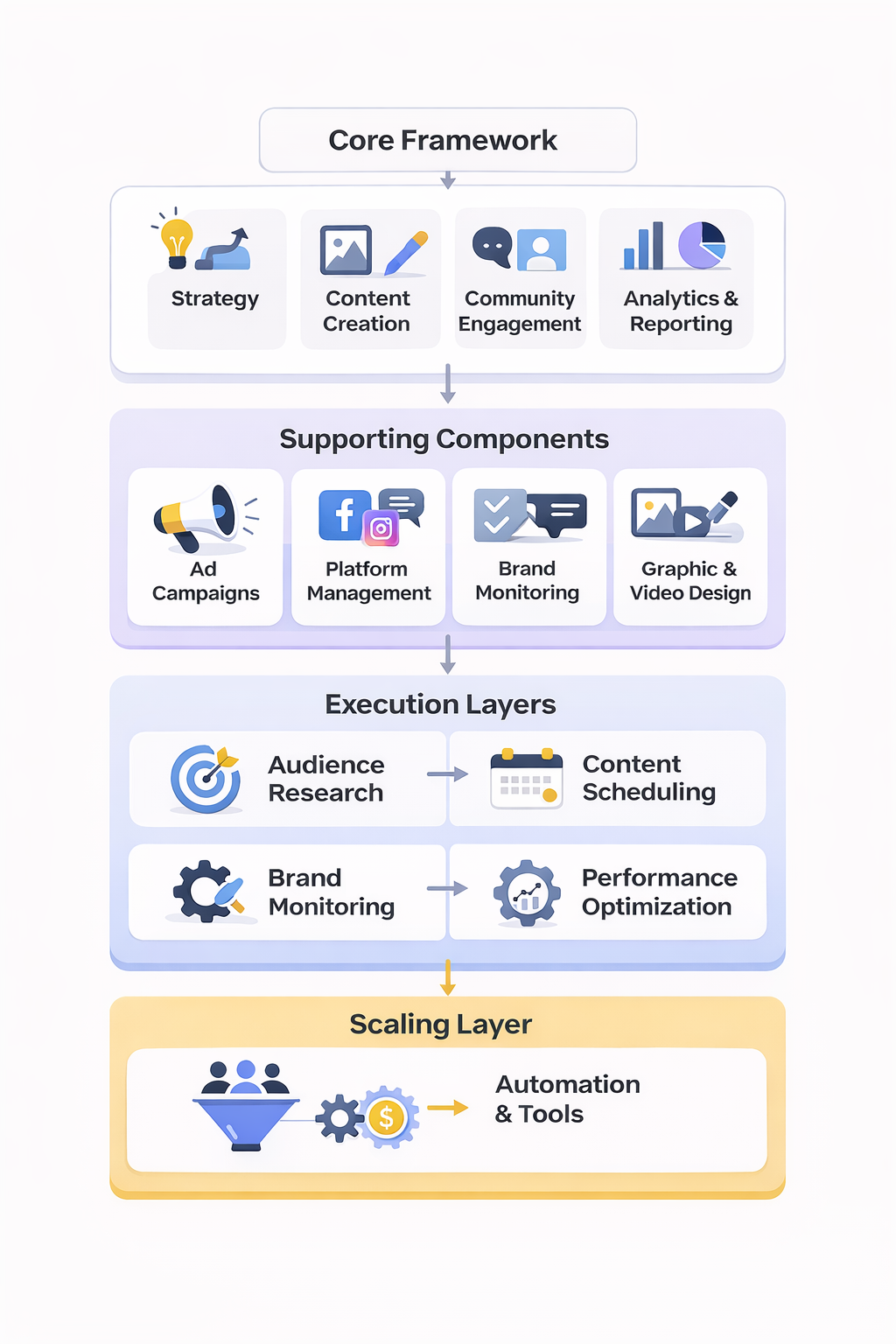
Strategy And Account Leadership
This is the thinking layer, and it is where weak retainers usually get exposed. Strategy includes audience research, platform selection, content pillars, campaign planning, approval workflows, and the judgment needed to decide what should be posted in the first place. If that thinking is not priced properly, the account starts drifting into random content that looks busy but does not move the business forward.
Content Production And Creative Volume
Content volume is where many pricing models break because not all deliverables cost the same to create. One caption-only post, one carousel, and one edited short-form video may all count as “one post” on paper, but the labor behind them is completely different, especially once scripting, revisions, hooks, subtitles, and platform formatting are added. That gap matters even more now that authentic low-production video is outperforming polished studio-style output for many marketers, because clients often want more video without realizing that more native content still means more planning, editing, approvals, and feedback loops.
Community Management And Response Time
Posts create work after publishing, not just before it. If a brand expects comment moderation, direct-message handling, escalation for complaints, lead qualification, or product-question replies, those tasks need to be priced by hours, volume, or response windows rather than hidden behind the word “engagement.” That operational layer is real, and HubSpot’s recent social commerce coverage notes that nearly half of marketers say managing social shops is a top responsibility, which tells you how quickly social content can turn into front-line customer experience work.
Reporting, Tools, And Revision Load
Reporting is where many retainers quietly lose money. Dashboards, monthly calls, tagging systems, competitor tracking, revision rounds, and internal handoffs take time, while software costs can range from free-entry and per-channel tools with volume discounts to multi-tier platforms that scale from Standard and Advanced plans to custom Enterprise pricing and premium suites such as Sprout Social, which start at $199 per month. If those costs are not visible in the pricing model, the service provider is still paying them; they are just paying them with margin instead of cash.
How Professionals Implement Social Media Management Pricing
Professionals do not usually sell one giant undefined retainer. They turn the framework into clear packages with boundaries around channels, deliverables, video count, community-management coverage, meeting cadence, turnaround expectations, and revision limits. That keeps the proposal readable for the client while protecting the service from the endless scope creep that destroys profitability.
A lean operating stack helps too. Teams that want simpler scheduling and approvals can run day-to-day publishing through Buffer, agencies that want stronger Instagram planning and caption support can add Flick, and smoother client onboarding often comes from structured intake in Fillout plus kickoff scheduling through Cal.com. None of those tools magically fix bad pricing, but they do reduce the admin drag that turns a healthy retainer into a messy one.
The real professional move is simple. Price the work people actually want, not the vague label they use for it. If the client wants strategy, content, community, reporting, and faster decisions, the quote needs to reflect each of those demands in plain language, and that is exactly what the rest of this article will build on.
Analytics, Margin, and Pricing Adjustments
This is where social media management pricing stops being theoretical and starts becoming real. A retainer can look healthy on paper and still be weak in practice if the reporting is shallow, the revision load is ignored, or the account keeps expanding without a matching price increase. That is exactly why 65% of marketing leaders want a direct connection between social campaigns and business goals, 52% want clear cost savings, and 45% want better visualizations of social data, because vague reporting makes every price feel negotiable.
The smartest teams do not wait until the client says the fee feels high. They watch the account the same way a sharp operator watches inventory, payroll, and cash flow. When the workload changes, the pricing has to change too, and that adjustment should feel logical rather than emotional.
Measure The Workload Drivers First
Before you decide whether your social media management pricing is too low, you need to measure what is actually consuming the team. The obvious items are posting volume, channel count, and meeting time, but the hidden drivers are usually the ones that wreck margin: approval delays, revision rounds, custom reporting requests, direct-message handling, and short-form video editing. That is why Sprout’s 2025 social benchmarks break inbound engagement down by day and by post, because better pricing starts with knowing whether the work is being driven by publishing volume, response volume, or both.
Reporting matters just as much as production because it shapes how clients interpret value. AgencyAnalytics found that 70% of agency leaders rate client reporting as “extremely important” for retention, which means your report is not just a recap; it is part of the product. If your team is doing strategic analysis, translating numbers into decisions, and tying those decisions to business outcomes, that work belongs inside the price instead of getting treated like an invisible bonus.
Protect Margin Before Promising More
Margin disappears fast when service businesses keep adding output without updating the math behind delivery. Labor is not cheap, and the U.S. Bureau of Labor Statistics shows that marketing managers earned a median annual wage of $161,030 in May 2024, while advertising and promotions managers earned $126,960. Even if your social team is structured differently, those figures are a useful reminder that strategy, oversight, approvals, and optimization all carry real cost.
Software adds another layer that clients often underestimate. Buffer’s pricing starts at $5 per channel per month for Essentials and $10 per channel per month for Team, while Sprout explains that its pricing is built from plan, users, profiles, and add-ons, and its 2025 budget guide notes that platform management alone can run from $500 to $5,000 per month. When you stack software, labor, meetings, creative revisions, and account leadership together, underpricing stops looking generous and starts looking careless.
If you want tighter delivery and cleaner client communication around approvals, timelines, and account notes, it also helps to keep your workflow simple. A lean setup with Buffer for publishing, Copper for account context, and Cal.com for recurring review calls can reduce admin drag before it quietly eats into your retainer.

Raise Prices When Scope Shifts
A lot of price problems come from treating the original proposal like a forever agreement. It is not. If the client adds a second platform, asks for more video, wants faster replies in comments and direct messages, or expects a more executive-level reporting package, the scope has changed and the price should follow it.
The broader agency market is already moving that way. MarketingProfs highlighted research showing that 97% of agencies are raising prices in 2025, 63% say cash flow is unpredictable, and 45% review pricing during renewals. That matters because waiting too long creates the worst kind of conversation: the team feels resentful, the client feels surprised, and the account has already spent months eroding profitability.
The cleanest approach is to define pricing triggers in advance. You can spell out that new channels, higher posting frequency, extra approval rounds, expanded reporting, campaign support, creator coordination, or after-hours community coverage all trigger a retainer review. When those rules are clear from the beginning, price adjustments feel like normal account management instead of a sudden negotiation.
Use Reporting To Justify The Retainer
The best reporting does not drown clients in dashboards. It shows what changed, why it changed, and what should happen next. That is especially important now because only 44% of marketing leaders say their teams are experts at measuring the business value of social, even though 80% are moving budget from traditional channels into social, which means there is still a huge gap between spending more and explaining that spend well.
That gap is exactly where stronger social media management pricing wins. When your monthly review connects content output to inbound engagement, response quality, lead quality, customer questions, or assisted revenue, the retainer stops looking like a cost center and starts looking like operating infrastructure. It also becomes much easier to defend strategic work, because the client can see that the account is being managed, not merely filled with posts.
In other words, price increases are easier to accept when the client can already see the logic behind them. If your reporting proves that the account is generating business value, reducing wasted effort, and guiding smarter decisions, then better pricing does not feel aggressive. It feels earned.
Statistics And Data

If you want to make sense of social media management pricing, you need to look at the numbers that actually shape the work. Not vanity numbers, not random engagement screenshots, and definitely not made-up package labels. The useful data sits in four places: what the market is already charging, why demand for social keeps climbing, what it really costs to deliver the service well, and which metrics make a higher retainer easier to defend.
Market-Rate Benchmarks
The market is already telling us that social media management pricing is wider than most buyers expect. Upwork’s current cost guide for social media managers shows a median hourly rate of $20, with typical rates landing between $14 and $35 per hour, which is useful because it reflects real buyer-and-seller activity instead of vague opinion. At the same time, Sprout’s recent budgeting guide puts basic social media management programs in a much broader monthly band of $500 to $5,000, which immediately tells you that “management” can mean very different things depending on whether the work is mostly scheduling or a full retainer with strategy, creative, reporting, and community coverage.
That spread is not a problem. It is a signal. The lower end of the range usually reflects light execution, while the higher end starts absorbing more senior thinking, more channels, more revisions, and more accountability for outcomes.
Demand-Side Numbers
Pricing gets stronger when the channel itself becomes more important to the business, and the recent data points in that direction. Sprout’s 2025 Impact of Social Media Report says eight in ten marketing leaders are reallocating budget from other channels into social, while Deloitte’s 2025 State of Social research says social budgets rose by an average of 9% from 2023 to 2024. That is not what a fading channel looks like.
The user behavior behind that budget shift is just as important. HubSpot found that 36% of social media users search for brands, products, or services on social platforms, and 24% search for local shops or businesses there, while 84% of marketers in HubSpot’s 2025 social trends research believe consumers will search for brands on social this year. Add that to DataReportal’s estimate of 5.24 billion social media user identities worldwide at the start of 2025, and it becomes easier to see why social media management pricing is under pressure to rise rather than stay frozen.
Delivery Cost Data
The reason cheap retainers break so often is that the underlying delivery stack is more expensive than it looks from the outside. Labor is the obvious part of it, and the U.S. Bureau of Labor Statistics reported median annual pay of $161,030 for marketing managers and $126,960 for advertising and promotions managers in May 2024. Even if your social team is smaller or more junior than that, those figures are a reminder that strategic oversight, creative review, approvals, and optimization all carry real cost.
Software is the second layer that quietly changes margin. Buffer’s pricing starts at $5 per channel per month on its Essentials plan, which is one reason lean teams often prefer a lighter setup such as Buffer when they want to keep overhead under control, while Sprout Social’s Standard plan starts at $199 per seat per month for teams that need broader reporting and management features. Neither of those costs includes the human time needed to build reports, review comments, edit video, or sit through client approvals, which is exactly why low-fee retainers feel profitable until the workload becomes real.
The pressure is even more obvious when scope starts drifting. Ignition’s 2025 Agency Pricing and Cash Flow Report says 57% of agencies lose between $1,000 and $5,000 per month to scope creep, while 63% say cash flow is unpredictable. That is one of the clearest data points in the whole pricing conversation because it shows how fast margin disappears when extra work is not turned into extra billing.
Reporting Metrics That Justify Pricing
The final layer is the data clients actually need to see before they stop arguing about price. Sprout’s 2025 ROI research shows that 65% of marketing leaders want direct connections between social campaigns and business goals, 52% want quantifiable cost savings, and 45% want better visualizations of social data. In other words, the market is not asking for more pretty dashboards; it is asking for clearer proof.
That proof is still harder to deliver than most teams admit. Sprout also reports that only 44% of marketing leaders consider their teams expert at measuring social’s business value, which helps explain why weak reporting often makes even good social media management pricing feel fragile. On the agency side, AgencyAnalytics found that 70% of agency leaders rate client reporting as extremely important for retention, so reporting is not an optional extra anymore. It is part of the service, part of the cost, and very often the part that makes a premium retainer believable.
Put all of those numbers together and the pattern becomes pretty clear. Social media management pricing is rising because the channel is doing more, buyer expectations are getting sharper, software and labor are not free, and weak scoping keeps draining profit from the work. That is why the smartest price conversations are no longer built around “how many posts do we get,” but around what the data says this account actually demands.
The Ecosystem Around Social Media Management Pricing
By this point, the big idea should be pretty clear: social media management pricing is never just about posting content. The price sits inside a bigger ecosystem that includes lead capture, approvals, reporting, customer care, sales follow-up, and the software stack needed to keep all of that moving without chaos. When people ignore that ecosystem, they usually end up buying a retainer that looks cheap at first and expensive later.
That is happening because social now reaches far beyond awareness. HubSpot’s 2025 consumer research shows that 36% of social media users search for brands, products, or services on social platforms, and 24% search for local shops or businesses there, while Sprout’s 2025 Impact of Social Media Marketing report says leaders increasingly want customer experience, customer care, support, and business development teams to use social insights. Once one channel starts influencing discovery, trust, support, and revenue at the same time, the pricing model has to grow up with it.
Why Social Pricing Has To Match The Whole Funnel
A lot of businesses still price social as if it ends at the post button. That is the old way of thinking, and it breaks the moment real activity starts flowing in. If the content drives comments, direct messages, product questions, consultation requests, or demo interest, then the work has already moved beyond “content management” and into a much bigger system.
That is also why stronger social media management pricing often belongs next to lead handling and customer communication rather than sitting alone in a marketing silo. HubSpot’s 2025 social shopping coverage says 85% of marketers believe building an active online community is crucial to a successful social strategy, and community work is not just creative output; it is relationship management. The moment a brand expects social to generate conversations that need real follow-up, the quote has to reflect that responsibility.
The Stack Behind A Profitable Retainer
One of the easiest ways to keep social media management pricing profitable is to stop treating operations like an afterthought. A lean stack can reduce admin drag, cut approval delays, and make reporting much easier to defend. That matters because even affordable tools add up when you multiply them across channels, clients, and team members; Buffer’s official pricing starts at $5 per month for one channel on Essentials, and that is before you layer in CRM access, form capture, email follow-up, and any premium reporting software.
This is where a practical setup starts to make a real difference. A smaller operator might handle scheduling and approvals in Buffer, route inquiries and lead qualification through Fillout, keep sales conversations organized in Copper, and push follow-up campaigns through Brevo. None of those tools replaces strategy, but they absolutely affect how much work the team can deliver without letting the retainer get buried under messy operations.
Final Recommendations Before Part Six
If you are setting your own social media management pricing, start by defining what the client is actually buying in the ecosystem around the service. That means separating strategy, production, community management, reporting, approvals, and follow-up systems instead of blending them into one fuzzy monthly number. The clearer the moving parts are, the easier it becomes to protect margin without sounding defensive.
If you are the one hiring, the smartest question is not “How many posts do I get?” but “What happens after the content goes live?” That one question usually reveals whether the quote covers surface-level execution or a real operating system for social. And that matters because 80% of marketing leaders say they are reallocating budget from other channels into social, which means weak social processes are becoming a more expensive problem, not a smaller one.
The best place to finish this part is with one simple principle: price the system, not just the content. When the system includes publishing, community, reporting, lead flow, and better decision-making, the retainer becomes easier to justify and much harder to undercut. In the final part, we can turn that into direct answers by covering the most important questions businesses and service providers still have about social media management pricing.
FAQ For The Complete Guide

What Is A Fair Monthly Price For Social Media Management?
A fair monthly price depends on what the work actually includes. Sprout’s 2025 pricing guide places a basic social media management program between $500 and $5,000 per month, while Upwork shows freelance social media managers commonly charging $14 to $35 per hour and basic setup work around $400 to $1,200 per month. The real question is not whether the number sounds high or low, but whether it covers strategy, creative work, reporting, approvals, and community management in a way that can actually be sustained.
Why Do Prices Vary So Much?
Social media management pricing varies because different providers are selling very different levels of work under the same label. One quote may cover scheduling only, while another includes strategy, short-form video, analytics, direct-message support, and higher-level reporting. That spread makes sense when 36% of social media users say they search for brands, products, or services on social platforms and 24% search for local businesses there, because the channel is doing much more than publishing posts.
Is Hourly Pricing Better Than A Retainer?
Hourly pricing is useful when the scope is still uncertain or the client only needs light support. A retainer becomes stronger when the work is ongoing and the provider is being hired not just to execute tasks, but to guide the account and keep the system running smoothly every month. In practice, many strong operators use a hybrid model, with a retainer for the core work and separate fees for projects, rush requests, or unexpected scope expansion.
Should Content Creation Be Included In Social Media Management Pricing?
It can be included, but it should never be assumed. Caption writing, design, editing, filming, and short-form video production all add labor, and that labor changes the economics of the account fast. That is one reason HubSpot’s recent social trends research found that authentic low-production video continues to outperform highly polished content for many marketers, because even “simple” social content still requires planning, revisions, and platform-specific formatting.
Should Community Management Cost Extra?
In many cases, yes. Once a brand expects comment moderation, direct-message handling, lead qualification, or customer-care triage, the service is no longer just about content publishing. That distinction matters even more now that HubSpot’s recent reporting shows marketers increasingly treat community-building and social shopping support as a core responsibility, which means response work should be scoped and priced with the same care as content creation.
How Many Platforms Should One Retainer Cover?
There is no universal rule, but one retainer should only cover as many platforms as the team can manage well without diluting strategy or response quality. Every added platform changes the workload through formatting differences, approval cycles, reporting complexity, and audience expectations. If the client wants real traction instead of scattered activity, it is usually smarter to go deeper on fewer channels before expanding.
When Should Social Media Management Pricing Go Up?
Pricing should go up when the scope changes in a meaningful way. New channels, more video, faster response times, more reporting, added approval meetings, and heavier campaign support all justify a review. The broader market is already moving this direction, with Sprout reporting that 80% of marketing leaders are reallocating budget from other channels into social, which means stronger social operations are becoming more valuable, not less.
Is Cheap Social Media Management Worth It?
Sometimes cheap support is fine for basic scheduling, but cheap retainers become risky when the business expects strategy, consistency, reporting, and real accountability. Underpriced work usually leads to weaker creative, slow response times, shallow reporting, or constant turnover behind the scenes. That is why many buyers eventually discover that the low quote was not cheaper at all; it simply delayed the real cost.
How Do I Know If The Reporting Is Good?
Good reporting should explain what changed, why it changed, and what the team plans to do next. It should connect social activity to business outcomes or at least to meaningful leading indicators, not just dump screenshots into a PDF. That standard matters because 65% of marketing leaders want direct connections between social campaigns and business goals, 52% want quantifiable cost savings, and 45% want better data visualizations, while 70% of agency leaders say client reporting is extremely important for retention.
Freelancer Or Agency: Which Is Better?
A freelancer is often the better fit when the brand wants flexibility, lower overhead, and a more direct working relationship. An agency can make more sense when the account needs broader creative resources, backup coverage, and multiple specialists working together. The best choice is not about prestige; it is about whether the delivery model matches the complexity of the work.
Do Tools Change The Price?
Absolutely. Scheduling platforms, analytics suites, CRM tools, and intake systems all add cost, and they also change how efficiently the work gets delivered. Buffer’s pricing starts at $5 per month for one channel on Essentials, while Sprout Social starts at $199 per month, so the software layer alone can look very different depending on the stack being used.
What Should Be Listed In A Proposal?
A solid proposal should clearly spell out channels, deliverables, community-management coverage, reporting cadence, revision limits, turnaround expectations, and anything that triggers additional billing. If those details are vague, the relationship usually gets harder once the work starts. Clear proposals make better clients, better delivery, and much healthier pricing conversations.
What Is The Best Way To Judge Value?
The best way to judge value is to look at whether the service helps the business make better decisions and get better outcomes over time. That includes content quality, speed of execution, reporting clarity, and how well the provider handles the messy operational details that clients usually do not see. When a team makes the whole channel easier to run and easier to trust, the price stops being a random expense and starts feeling like real infrastructure.
Work With Professionals
If you are serious about making social media management pricing work for you, do not stop at the proposal. Look at the operating system behind the proposal. The best professionals know how to combine strategy, content, workflows, reporting, and lead handling so the account does not collapse the moment things get busy.
A practical stack can make a huge difference here. Teams that want simpler scheduling and collaboration often use Buffer, brands that need stronger Instagram planning can lean on Flick, smoother onboarding can run through Fillout, recurring reviews can be booked in Cal.com, and follow-up systems often work better when they are connected through Brevo or Copper. Tools are not the whole answer, but they absolutely help good professionals deliver a cleaner service at a healthier margin.
The last thing to remember is simple. A strong provider does not just post for you. They protect consistency, improve decision-making, watch performance, and keep the moving parts from turning into chaos. That is the kind of professional support worth paying for.
Explore 10K+ Remote Marketing Contracts on MarkeWork.com
Most marketers spend too much time chasing clients, competing on crowded platforms, and losing a percentage of every project to middlemen.
MarkeWork gives you a better way. Browse thousands of remote marketing contracts and connect directly with companies desperate to hire skilled marketers like you — without platform commissions and without unnecessary gatekeepers.
If you’re serious about finding better opportunities and keeping 100% of what you earn, you can explore available contracts and create your profile for free at MarkeWork.com.
 Filip Konecny Enterprises