
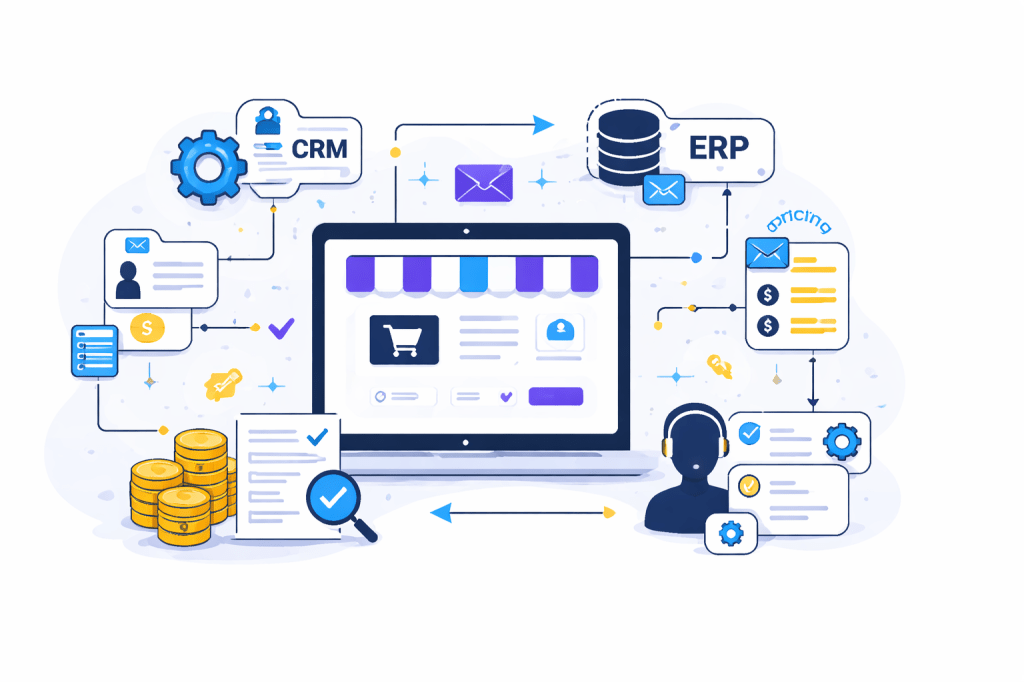
A b2b ecommerce agency should do far more than launch a polished website. In a real B2B environment, the work sits where buyer expectations, account-specific pricing, approvals, catalog logic, and operational data all meet, which is why SAP frames modern B2B e-commerce around real-time visibility, collaboration, and connected supply relationships while Salesforce highlights negotiated pricing, customized catalogs, buyer entitlements, and large-scale ordering as baseline platform requirements. When an agency understands that complexity, commerce becomes a serious revenue channel instead of a disconnected digital brochure.
The urgency is coming from buyers, not from hype. McKinsey’s 2024 B2B Pulse found that buyers now use an average of ten interaction channels and increasingly expect seamless movement across them, Gartner reported in March 2026 that 67% of B2B buyers prefer a rep-free experience, and Sana Commerce’s 2025 buyer report says 73% prefer to buy online. That is why hiring a b2b ecommerce agency is no longer a design decision alone; it is a decision about how your company will sell, serve, and scale in the next phase of B2B commerce.
Article Outline
- Part 1: Why It Matters – why the shift in buyer behavior has made specialist B2B commerce execution a strategic priority.
- Part 2: Framework Overview – the practical lens for evaluating what a serious agency should handle from strategy to operations.
- Part 3: Core Components – the systems, workflows, and buyer-facing capabilities that hold the whole program together.
- Part 4: Professional Implementation – how strong agencies move from roadmap to rollout without creating chaos inside the business.
- Part 5: Analytics and Optimization – how performance gets measured, improved, and tied back to revenue and customer retention.
- Part 6: Commerce Ecosystem – how to future-proof the platform, partnerships, and long-term operating model.
Why It Matters
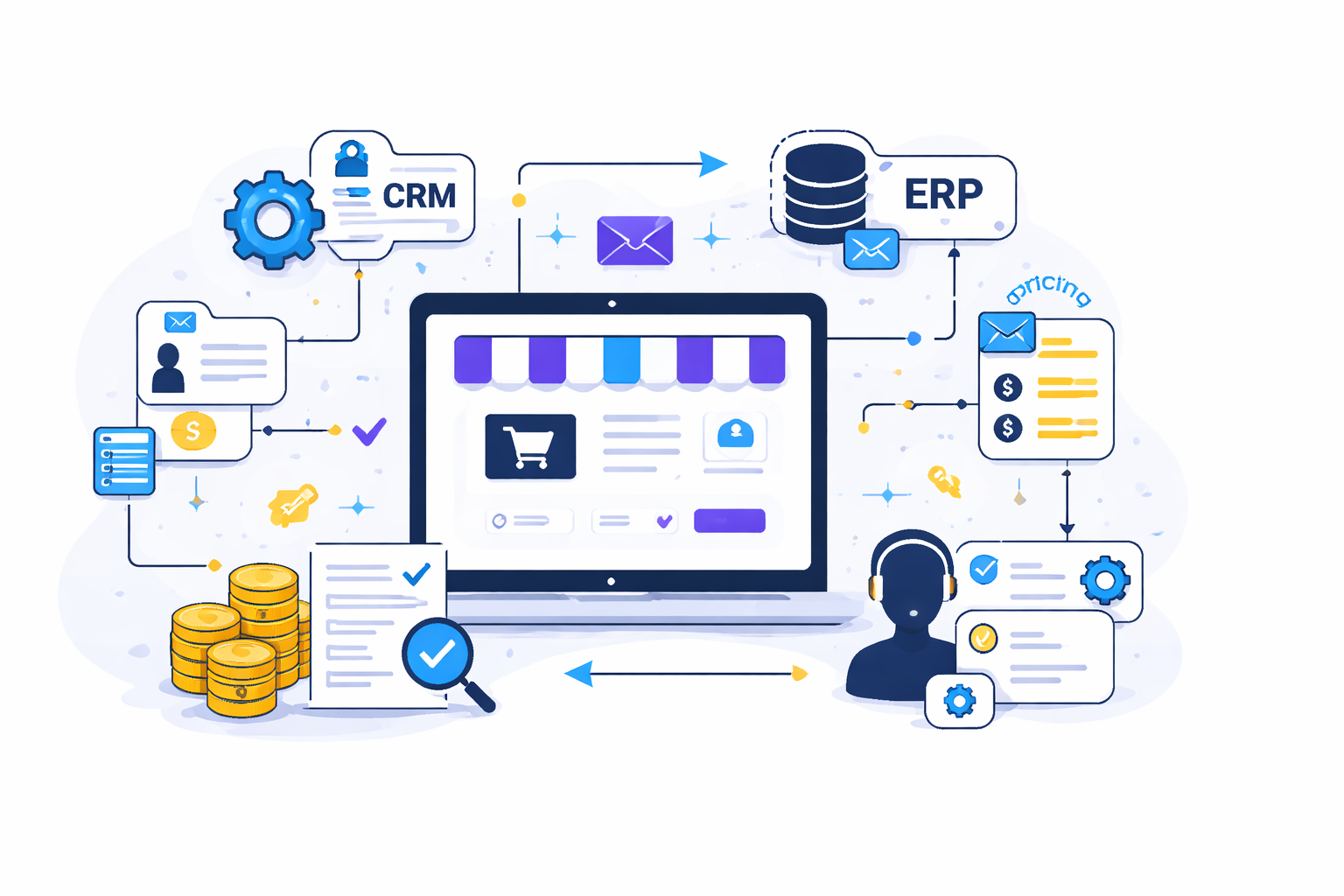
A strong b2b ecommerce agency matters because the buying journey has already changed. McKinsey shows that B2B decision makers now expect omnichannel buying and interact through ten channels on average, while Salesforce’s latest connected customer research points to rising expectations for personalized and cohesive experiences. Buyers do not separate your pricing logic, product data, reorder flows, and post-purchase service into internal departments; to them, it all feels like one brand experience.
That is exactly where weak execution gets expensive. A 2024 UK and EU buyer study found that 93% of B2B buyers use e-commerce channels for procurement and 71% make more than half of their purchases online, yet Sana Commerce found in 2025 that 85% still experience frustrations when buying online. On top of that, Shopify’s 2025 B2B study with B2B Online and Deloitte Digital reported that demand for digital B2B sales is rising faster than most companies feel prepared to handle, which means businesses that treat commerce like a side project are leaving a gap for faster competitors to exploit.
The right agency closes that gap by translating commercial ambition into an operating model buyers can actually use. Instead of obsessing over surface-level design, it should help the business connect self-service with sales assistance, align data with the storefront, and make the buying process feel easier than the old manual route. That is why the best agency relationships usually start with commercial clarity, not with mockups.
Framework Overview
The simplest way to evaluate a b2b ecommerce agency is to ask whether it can think in systems rather than pages. Adobe Commerce positions B2B commerce around multi-brand experiences, self-service portals, and scalable operations, IBM centers digital commerce on complex order fulfillment, real-time inventory, and multichannel orchestration, and Salesforce focuses on entitlements, pre-negotiated pricing, customized catalogs, and split shipments. A credible framework has to account for all of that at once, because B2B growth rarely breaks along neat departmental lines.
That makes agency selection a five-part exercise. First, can the team understand your revenue model and sales motion well enough to decide what should be self-service and what should stay sales-assisted? Second, can it design the data backbone so pricing, stock, customer accounts, and order status are trustworthy in the storefront? Third, can it shape a buyer journey that respects how procurement teams actually work instead of forcing them to navigate a site built around internal system limitations?
The final two questions are just as important. Can the agency map operational workflows such as approvals, quoting, reordering, fulfillment, and support handoffs without creating friction, and can it keep optimizing after launch instead of disappearing once the build is complete? When you look through that lens, you stop searching for a vendor that can “make a site” and start looking for a partner that can build commercial infrastructure.
Core Components

The core components of a serious B2B commerce program usually fall into six connected layers: platform architecture, data integration, account and pricing logic, buyer experience, order orchestration, and performance insight. Salesforce’s B2B commerce stack emphasizes buyer entitlements, negotiated pricing, custom catalogs, and support for complex orders, IBM focuses on order orchestration and real-time fulfillment visibility, and SAP describes B2B e-commerce as a connected operating model that streamlines procurement and improves visibility across the network. A b2b ecommerce agency has to understand how those layers reinforce each other, because failure in one layer usually shows up as friction somewhere else in the buying journey.
Real-time data is the thread that keeps those components honest. Sana’s 2025 report ties buyer frustration directly to missing or unreliable information on products, stock, delivery times, and prices, while Adobe’s ERP integration guidance explains why disconnected commerce and operational systems create unnecessary stress and inefficiency. If a buyer cannot trust availability, pricing, or order progress, the storefront may still look modern, but it will not feel dependable enough for repeat business.
That is why the strongest agencies do not treat UX, integrations, and operations as separate workstreams that barely speak to each other. They design search, product detail pages, quote requests, reordering flows, account dashboards, and support handoffs around the same source of truth. When those elements line up, digital commerce starts doing what businesses actually need it to do: reduce manual work while making it easier for customers to buy again.
Professional Implementation
Professional implementation is where the difference between a specialist and a generalist becomes obvious. Adobe’s REDARC case study shows the company working with Balance, an Adobe Platinum Partner, to connect commerce with IFS ERP and give staff and customers access to region-specific stock information and tiered pricing. OroCommerce’s Azelis case study shows Smile helping build a framework that connects ERP, CRM, PIM, and a cloud data platform while supporting expansion across 150 markets. Those are not brochure-site projects; they are multi-layer commercial transformations that require architecture, data discipline, rollout planning, and stakeholder alignment.
A true b2b ecommerce agency should be able to handle discovery, solution design, integration planning, phased rollout, and post-launch governance without pretending everything can be solved in a single sprint. The best teams know that implementation is partly technical and partly organizational, because sales, operations, finance, service, and marketing all have to trust the new model before buyers ever see the finished experience. That is also why the strongest rollouts usually happen in stages, starting with the most valuable buyer journeys and the cleanest data paths before expanding outward.
Professional execution also means designing smooth handoffs between self-service and human support instead of forcing customers to start over every time the journey changes shape. Salesforce’s 2026 B2B roadmap puts a major emphasis on configurable products, RFQ workflows, localization, and seamless transitions between buyer actions and seller assistance, because complex B2B buying still needs both autonomy and expertise. Any agency that understands this space should be comfortable building for that reality rather than forcing every deal into a simplistic checkout flow.
Account Structure And Permissions
One of the first core components is account structure, because B2B buying almost never happens through a single person clicking “buy now” in total isolation. Teams need multiple users, approval rights, location-level access, purchasing roles, and company hierarchies that reflect how the customer actually operates. Adobe makes company accounts the primary building block for supporting B2B buyers, and Salesforce emphasizes creating store experiences tailored to each buyer, which tells you this is foundational rather than optional.
That matters because access problems do not feel like technical issues to the buyer. They feel like friction, wasted time, and risk. A strong b2b ecommerce agency will map user roles, purchasing authority, and parent-child account relationships early so the buying experience matches how real companies make decisions instead of forcing everyone into a flat consumer-style model.
Pricing And Catalog Logic
Pricing is where many B2B commerce projects either become genuinely useful or instantly frustrating. Buyers often need contract pricing, customer-specific assortments, region-based availability, volume discounts, or restricted product visibility, and that means a generic catalog is not enough. Adobe’s B2B documentation explains that shared catalogs allow custom prices for different companies across one or more websites, while Salesforce highlights negotiated, account-specific pricing as one of the core differences between B2B and B2C commerce.
This component is bigger than displaying the right number on a product page. It shapes trust. If a customer sees the wrong price, the wrong product set, or terms that do not reflect the relationship they already have with the supplier, the platform stops feeling like a helpful channel and starts feeling like something they need to double-check manually. A capable b2b ecommerce agency builds pricing and catalog logic as a governed commercial layer, not as scattered overrides patched in later.
Ordering Speed And Repeat Purchases
Another core component is the ability to make repeat purchasing feel almost effortless. In B2B, many customers are not browsing for inspiration. They already know what they need, they know the SKU, and they want to complete the order without digging through layers of navigation. Adobe’s B2B feature set includes quick order for buyers who know product names or SKUs and requisition lists for frequently ordered products, which shows how seriously the platform treats speed and repeatability.
This is one of those components that has a direct effect on revenue even though it rarely gets headline attention in project pitches. The easier it is to rebuild common orders, upload long lists, reorder from past purchases, or manage saved product sets, the more naturally the platform fits into the customer’s routine. A smart b2b ecommerce agency understands that convenience is not fluff in B2B commerce; it is part of retention.
Quotes, Approvals, And Purchase Controls
Not every B2B transaction should flow straight into a standard checkout, and this is where workflow controls become one of the most important core components. Some orders need negotiation, some need internal approval, and some need a structured quote process before the buyer is ready to commit. Adobe’s B2B module includes negotiable quotes that let buyers and sellers manage quantities, discounts, and quote history until they reach agreement, and it also includes purchase order workflows designed to help companies track and control spending.
This is exactly the kind of thing a weak agency often underestimates. It assumes every improvement should reduce the journey to fewer clicks, when in reality some B2B buying journeys need more structure, not less. A good b2b ecommerce agency knows how to reduce unnecessary friction while still preserving the controls that procurement teams, finance leaders, and account managers actually need.
Real-Time Data And The Integration Layer
None of the components above work properly if the platform is pulling unreliable information from disconnected systems. The integration layer is what makes pricing accurate, stock visibility believable, account entitlements enforceable, and order status useful after the purchase is complete. Sana’s 2025 buyer report ties buyer frustration directly to missing information on products, stock levels, delivery times, and prices, and SAP frames modern B2B e-commerce around real-time visibility across connected processes and supply relationships.
This is why integration work should never be treated like a technical footnote. It is one of the core commercial components of the whole program. A b2b ecommerce agency that understands the market will spend serious time aligning ERP, CRM, PIM, tax logic, fulfillment data, and customer account data so the storefront can act with confidence instead of constantly making promises the back office cannot keep.
Post-Purchase Visibility And Service
The buying experience does not end when the order is placed, and that is another place where strong agencies separate themselves from average ones. Buyers want to see order progress, shipment details, invoice history, account activity, and support paths without being pushed back into the same manual communication loops that digital commerce was supposed to reduce. IBM’s order management positioning focuses on real-time inventory and orchestration across the order lifecycle, which reinforces the idea that commerce should extend into fulfillment visibility and service, not stop at checkout.
When this component is missing, customers feel abandoned right after the moment they expected the platform to become most useful. When it is done well, the platform becomes more than a transaction channel. A high-level b2b ecommerce agency uses post-purchase visibility to deepen trust, reduce service overhead, and make the next order easier than the last one.
Why These Components Have To Work Together
The most important thing to understand is that these are not isolated features you can mix and match without consequence. Account structure affects pricing, pricing affects approvals, approvals affect ordering workflows, workflows depend on integrations, and integrations shape the post-purchase experience. Once you see the connections, it becomes obvious why a b2b ecommerce agency has to think in systems and sequences rather than in scattered deliverables.
That is also why businesses get into trouble when they focus too heavily on the visual layer and leave the hard operational choices for later. The hard choices are the product. When the core components are designed to reinforce each other, digital commerce starts to feel reliable, fast, and commercially useful. And when that foundation is solid, the next step is implementation, because even the best blueprint means nothing if rollout is sloppy.
Statistics And Data

This is the part many companies skip, and it is exactly where a strong b2b ecommerce agency separates itself from a team that just ships pages and moves on. If the agency cannot tell you what the market is doing, what buyers are struggling with, and which numbers actually predict revenue, then it is not really leading the project. It is just reacting to it.
The reason data matters so much in B2B commerce is simple: this is not a low-stakes impulse-buy environment. Buyers are comparing suppliers, checking pricing logic, validating stock, looping in colleagues, and moving between self-service and sales support before money changes hands. So when a b2b ecommerce agency talks about performance, it needs to talk about buyer behavior and operational trust, not just traffic spikes and pretty dashboards.
The Market Signal In The Data
The market signal is not subtle anymore. Sana Commerce’s 2025 B2B Buyer Report shows that 73% of B2B buyers prefer to buy online, and the same research says 85% still run into frustrating barriers while buying online, while 75% would switch to a supplier offering a better experience. That combination should get any leadership team’s attention FAST, because it means digital demand is real, but buyer patience is thin.
The same pattern shows up from other angles too. Gartner reported in March 2026 that 67% of B2B buyers prefer a rep-free experience, while McKinsey’s 2024 B2B Pulse found that buyers now use an average of ten interaction channels during the buying journey. Then Forrester’s 2025 B2B marketing and sales predictions said more than half of large B2B purchases would be processed through digital self-serve channels. Put all of that together and the direction is obvious: buyers want more digital autonomy, but they still expect the experience to feel connected, accurate, and easy to trust.
What The Right Metrics Actually Are
That is why a smart b2b ecommerce agency cannot stop at vanity metrics. Traffic matters, of course, and conversion rate still matters, but those numbers only tell a small part of the story. Forrester wrote in early 2025 that 91% of B2B buyers face online purchasing barriers, and that finding changes what the dashboard should look like.
In practice, the agency should care about whether buyers can find the right products quickly, whether contract pricing appears correctly, whether company accounts are being activated smoothly, whether quotes become orders at a healthy rate, and whether repeat purchases are getting faster instead of slower. It should also measure how many manual touches are being eliminated inside the business, because operational drag quietly destroys margin even when top-line sales look healthy. A serious b2b ecommerce agency reads numbers in context, not in isolation.
That is also why the best reporting setups blend commercial and operational signals together. It is not enough to say revenue went up if the customer service team is drowning in avoidable tickets, or if the sales team is still fixing pricing errors by hand. Good data tells you whether the commerce experience is getting easier, more accurate, and more scalable at the same time.
Real Case Data From The Field
Real case data makes this easier to understand than theory ever could. In Adobe’s 2024 BAUHAUS case study, the company worked with Vaimo to turn its original Swedish webstore into a proper B2B e-commerce engine tied to its ERP system. The published results were not minor: online revenue increased 296%, conversion rates improved 376%, transactions rose 205%, manual processes dropped by more than 80%, and new customer registrations increased 50%. Those numbers matter because they show what happens when customer experience, back-office integration, and account management are treated like one connected system.
Adobe’s 2024 REDARC case study tells a similar story from a different angle. Working with Balance, REDARC unified disconnected sites, integrated Adobe Commerce with its IFS ERP, and improved the buying journey for both retail and trade audiences. The company reported a 100% conversion lift, a 29% increase in new trade customer accounts, and stronger productivity by eliminating manual steps tied to stock availability and special pricing. That is the kind of evidence worth paying attention to, because it ties growth directly to better data, cleaner workflows, and more reliable self-service.
How Agencies Should Use The Numbers
The point of all this data is not to fill a slide deck with impressive percentages. The point is to guide decisions. A high-level b2b ecommerce agency should use the numbers to decide which customer segments need better onboarding, which catalogs are creating friction, where buyers abandon self-service and ask for help, and which parts of the process are still being propped up by manual fixes behind the scenes.
This is where analytics becomes practical. The agency should be reviewing performance by account type, region, product family, quote pathway, and reorder behavior, because that is where real patterns show up. Salesforce’s 2026 B2B commerce roadmap highlights RFQ workflows that let buyers move from cart to sales-assisted quoting without losing context, and that kind of handoff is something worth measuring carefully. If buyers keep dropping into assisted channels at the same moment, the business needs to know whether that is healthy complexity or a broken self-service experience.
When the reporting is built properly, the numbers stop being abstract and start becoming directional. They tell the team where to invest, what to simplify, which buyers are thriving, and where revenue is being held back by friction nobody noticed before. That is the real value of data in this space, and it is exactly why a b2b ecommerce agency should be judged not only by what it launches, but by how clearly it helps the business see what happens next.
FAQ – Your B2B Ecommerce Agency Questions, Answered
By this stage, most companies are no longer asking whether digital commerce matters. They are asking how a b2b ecommerce agency fits into a buying environment where large B2B transactions are moving further into digital self-serve channels while McKinsey’s 2024 B2B Pulse research shows buyers still expect strong omnichannel access instead of a one-size-fits-all sales process.

The questions below focus on what actually creates friction in B2B commerce: company accounts, customer-specific pricing, ERP data, approvals, quotes, self-service, and long-term operations. That is exactly where a serious b2b ecommerce agency earns its keep.
What does a B2B ecommerce agency actually do?
A real b2b ecommerce agency does far more than design a prettier storefront. It maps how accounts, permissions, catalogs, pricing, payments, and checkout should work for real business buyers, which is why Shopify’s B2B features revolve around companies, payment terms, catalogs, tax settings, and contact permissions, while Adobe Commerce company accounts support subaccounts, roles, permissions, and tailored offers. It also helps scope the build properly, which matches BigCommerce’s guidance to define goals, budget, timelines, and required functionality before development starts.
When should you hire a B2B ecommerce agency?
You should bring in a b2b ecommerce agency when your business is no longer dealing with simple online ordering and starts running into complexity around pricing rules, account hierarchies, quote workflows, or ERP-connected operations. The timing matters even more now that Forrester expects more than half of large B2B purchases to be processed through digital self-serve channels and McKinsey says buyers want the ability to interact in many ways, everywhere, at any time. If your internal team is already stretched, BigCommerce’s own build guidance says agency support can save internal teams significant time while helping deliver a more polished result.
Can a B2B ecommerce agency work with an existing ERP, CRM, or CPQ stack?
Yes, and that is usually the point where a specialized b2b ecommerce agency becomes much more valuable than a generic web team. Sana Commerce’s ERP-first guidance treats live business data as central to B2B commerce, SAP’s self-service portal is positioned to work with S/4HANA, and Oracle’s B2B Commerce product tour explicitly connects commerce with CPQ for self-service configuration and quoting. If an agency cannot explain how pricing, inventory, credit terms, and approvals move between systems, it is not ready for serious B2B work.
Which platform is best for B2B ecommerce?
There is no single winner for every company, and any honest b2b ecommerce agency should tell you that immediately. Shopify B2B gives merchants native B2B capabilities inside Shopify Plus, Adobe Commerce B2B is built around company accounts, shared catalogs, quotes, quick order, and requisition lists, and BigCommerce B2B Edition centers its buyer portal and company workflows around self-service. For organizations with deeper enterprise requirements, SAP Commerce Cloud and Oracle CPQ may make more sense when configuration, contracts, and complex quoting are central to the sale.
Which features matter most in a B2B build?
The highest-value features are usually the least glamorous ones: account structure, customer-specific pricing, catalog control, approvals, quote handling, purchase orders, and repeat ordering. You can see that pattern clearly in Shopify’s B2B feature set, Adobe’s B2B feature configuration, SAP’s order-visibility and portal capabilities, and Oracle’s emphasis on product configuration and self-service quoting. A strong b2b ecommerce agency prioritizes the workflows that remove friction from the buyer’s job, not the features that only look impressive in a demo.
Do B2B buyers really want self-service?
Yes, but they do not want self-service in isolation. Forrester’s 2025 B2B marketing and sales predictions point to a major shift toward digital self-serve processing for high-value purchases, while McKinsey’s B2B Pulse research shows that buyers still value omnichannel flexibility rather than a forced digital-only experience. That is why SAP positions self-service around order visibility, invoices, and lower support costs instead of pretending every business purchase should happen without human guidance.
Can B2B and D2C run together in one environment?
In some cases, yes, and that can simplify operations if the business model truly supports it. Shopify states that merchants can run B2B and direct-to-consumer sales in one store or in a separate dedicated B2B store, and Adobe describes its B2B extension as an integrated solution that supports both B2B and B2C models. A good b2b ecommerce agency will decide this based on pricing logic, customer access, merchandising complexity, and operational risk, not based on a generic template.
How long does implementation usually take?
The honest answer is that timing depends less on theme development and more on data cleanup, scope control, approval rules, catalog logic, and back-office integration. That is why BigCommerce’s development framework starts with business goals, budget, timelines, and functionality, and why Shopify publishes a dedicated B2B setup checklist before merchants go live. A disciplined b2b ecommerce agency shortens the project by removing ambiguity early, not by pretending complex B2B requirements are simple.
How should success be measured after launch?
The smartest teams measure whether buyers are actually adopting the workflows the site was built to support. That includes whether customers are using self-service, whether quotes and approvals move faster, whether routine support inquiries go down, and whether repeat ordering gets easier, which matches the priorities behind SAP’s portal positioning and Adobe’s quick order, requisition list, and quote capabilities. A b2b ecommerce agency should tie performance back to operational efficiency and buyer behavior, not just top-line traffic.
Does the agency’s job end once the store goes live?
No, because launch is when real buyer behavior finally starts teaching you what needs to change. BigCommerce explicitly includes ongoing maintenance in B2B project planning, and Shopify Flow’s workflow examples show how B2B teams can continue automating account, catalog, payment-term, and notification processes after go-live. A serious b2b ecommerce agency should still be involved in optimization, automation, merchandising, analytics, and governance after the first launch window ends.
How do you choose the right B2B ecommerce agency?
Choose the team that can explain your commerce model in operational terms, not just creative language. They should be fluent in the kinds of workflows documented by Shopify company structures, Adobe purchase-order workflows, BigCommerce company permissions, and Oracle CPQ if complex quoting is part of your sale. The best b2b ecommerce agency will talk comfortably about data, approvals, buyer friction, change management, and post-launch accountability before it ever talks about colors and mockups.
Work With Professionals
A strong b2b ecommerce agency does not treat B2B like B2C with larger order quantities. It maps account hierarchies, price logic, approval paths, and system integrations before the build begins, which is exactly why BigCommerce tells teams to define scope and functionality early and why McKinsey’s research on B2B buying behavior keeps pointing back to omnichannel expectations.
The right partner can also connect the surrounding stack that turns traffic into revenue and revenue into repeat business. For faster funnel launches and offer testing, teams often use ClickFunnels or Systeme.io, then connect lifecycle messaging through Brevo, lead capture with Fillout, meeting routing through Cal.com, CRM handoff in Copper, and buyer qualification through Chatbase. What matters is not having the biggest stack. What matters is having professionals who can tie every tool back to buyer needs, operational reality, and measurable growth.
If you are serious about building a digital sales engine instead of another disconnected website, work with professionals who already understand complex B2B commerce. The best b2b ecommerce agency helps you protect margins, reduce buying friction, and launch a system your sales, service, and operations teams can actually use.
Explore 10K+ Remote Marketing Contracts on MarkeWork.com
Most marketers spend too much time chasing clients, competing on crowded platforms, and losing a percentage of every project to middlemen.
MarkeWork gives you a better way. Browse thousands of remote marketing contracts and connect directly with companies desperate to hire skilled marketers like you — without platform commissions and without unnecessary gatekeepers.
If you’re serious about finding better opportunities and keeping 100% of what you earn, you can explore available contracts and create your profile for free at MarkeWork.com.
 Filip Konecny Enterprises