
Most people looking up Comp AI plans are not casually browsing. They are usually trying to answer a very practical question: can this tool get them compliant faster without locking them into a bloated enterprise setup or a painful manual process.
Comp AI looks interesting because it is positioned as open-source compliance automation, supports frameworks like SOC 2, ISO 27001, HIPAA, and GDPR, and gives buyers a choice between a managed experience and a self-hosted one. That mix is not normal in this category, and it is the main reason this review is worth reading before you book a demo.
You still should not assume it is the right fit just because the pitch sounds strong. Pricing is not laid out in a simple public plan grid, the category itself gets expensive fast, and some teams will honestly be better off waiting or choosing something simpler.
My quick take before you book a demo
Comp AI looks best for startups and growing teams that already feel real pressure from security questionnaires, procurement reviews, or upcoming compliance work. If you need to move fast, want automation instead of spreadsheet chaos, and like the idea of keeping more control over your stack, this is the kind of platform that deserves a serious look.
The part that makes it more compelling than a generic “compliance tool” is the combination of 250+ integrations, continuous evidence collection, a trust center, and a bring-your-own-auditor model. That matters because the real cost of compliance is rarely just the software bill. It is the lost time, the manual screenshots, the back-and-forth with buyers, and the internal drag that hits engineering and ops when everything is held together with docs and reminders.
The catch is simple: this is not the kind of product where you glance at a cheap monthly starter plan and decide in two minutes. Comp AI clearly pushes buyers toward a demo for exact pricing, so the decision is less about grabbing a low-risk impulse subscription and more about deciding whether the platform could save enough time and effort to justify a real sales conversation.
That makes Comp AI a stronger fit for companies with an actual compliance reason to act now than for curious early-stage founders who just want to “be ready someday.” If you do not have customer pressure, audit pressure, or a near-term trust requirement, even a good platform can be overkill. If those pressures are already here, waiting often costs more than the software because your team keeps doing the work the slow way.
I also like that Comp AI is not framed as a black-box system where you must accept the vendor’s entire worldview. The official site leans hard into open source, self-hosting, and money-back protection, which makes the product feel more credible for technical buyers who hate vendor lock-in and want more visibility into what they are buying.
Quick decision snapshot
Explore Comp AIArticle outline
I split this review into three simple stages so you can jump straight to the part that matters most to you. Each section is built to help you decide whether Comp AI is worth trying now, worth revisiting later, or not the right tool for your situation.
- Start here: Is Comp AI worth it? and the quick snapshot. This part is about fit, not hype, so you can quickly see whether the platform matches the kind of company pressure you are actually dealing with.
- Then go deeper: what you get in the free trial, the good stuff, pricing and value, and why buying sooner can make sense. This is the part that answers the money question and the “does it replace enough work to justify the cost?” question.
- Finish with the decision section: alternatives, the final verdict, and the FAQ. That last section is where I compare Comp AI against the kinds of cheaper, broader, or more established options buyers usually consider before they commit.
If you are already leaning toward a demo, the next section matters most because it will show whether Comp AI looks like a serious time-saver or just another compliance subscription. If you are still unsure whether you even need a platform in this category, stick with the review in order and the answer should get a lot clearer fast.
What you get in the free trial
Comp AI does advertise a free trial, but this is not one of those products with a super-clean public pricing page that spells out every limit in neat little boxes. That is the first thing to know before you get excited about Comp AI plans. You are not really choosing between simple self-serve tiers. You are choosing between testing the product, going open-source and self-hosted, or talking to the team about a managed setup.
That sounds annoying at first, but it also tells you what kind of buyer this is built for. Comp AI is aimed at teams that already have a real compliance problem to solve, not people casually exploring software on a Sunday afternoon. If you already need SOC 2, ISO 27001, HIPAA, or GDPR help, the trial is useful because it lets you see the product logic fast instead of making you guess what the platform actually does.
The trial looks most useful for three things. You can see the main dashboard, connect the systems you actually use, and judge whether the automation feels real enough to replace a chunk of the manual evidence work that usually drags these projects out. If that clicks for you, checking the official trial and demo path makes sense. If you want a fully published feature matrix before speaking to anyone, this will probably feel too opaque.
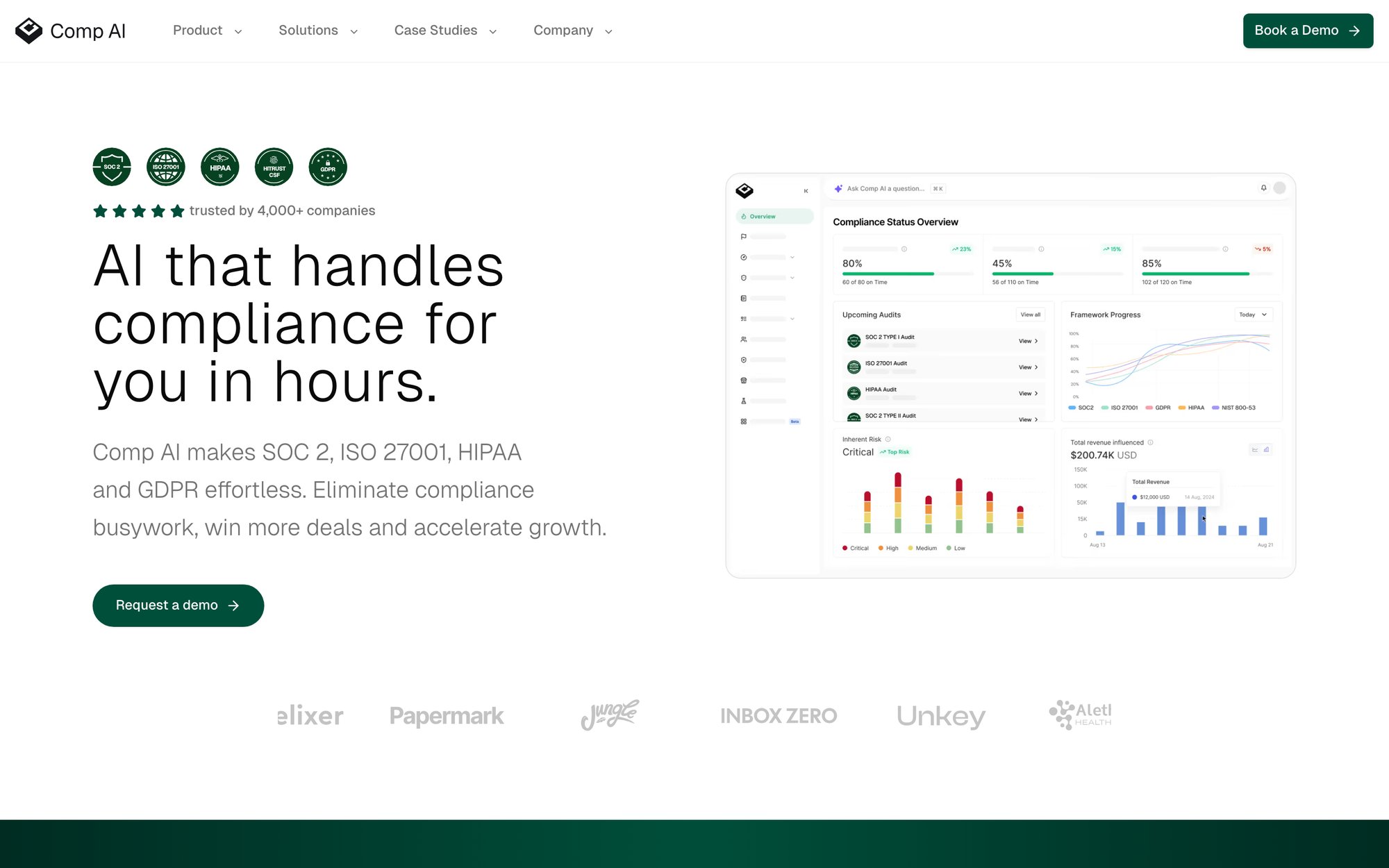
Image source: Comp AI
The bigger point is simple. You do not need a free trial to prove that compliance software exists. You need it to answer a more useful question: will this save your team enough time and pain to justify paying for it. Comp AI gives a strong first impression there because the product is built around automation, integrations, and audit readiness rather than a pile of generic GRC language.
The good stuff
Comp AI is most appealing when compliance is already blocking revenue or creating drag for your team. That is where the platform starts to feel less like “nice to have software” and more like a serious shortcut. You are not just buying a dashboard. You are buying a way to stop turning engineers, founders, and ops people into part-time evidence collectors.
The strongest part of the product is the automation layer. Comp AI connects to your stack, collects evidence continuously, maps controls across frameworks, and keeps the program moving without forcing you to build everything from scratch. That matters because manual compliance work is not hard in a clever way. It is hard in a repetitive, annoying, expensive way.
The other thing I like is that Comp AI does not sound like a locked-down black box. The product is openly positioned as open source, and there is a self-hosting route for teams that care about control, transparency, or vendor risk. That will not matter to every buyer, but for technical teams it is a real advantage over platforms that want you fully inside their world from day one.
The trust center angle is also more important than it sounds. A lot of buyers think compliance ends at passing an audit. It does not. You still get hit with questionnaires, security reviews, and customer proof requests. Comp AI pushes hard on the idea that compliance should help you close deals faster, and that is one of the better parts of the pitch because it ties the spend back to revenue instead of treating compliance like pure overhead.
Support also looks stronger than the usual “here is the help center, good luck” setup. Comp AI talks publicly about dedicated Slack support and done-for-you onboarding, which makes the higher spend easier to justify for busy teams. That is important because even the best compliance software can disappoint if you are still left to figure out scope, controls, policies, and audit prep on your own.

Image source: Comp AI
Here is the catch. Comp AI will feel like overkill if you are still pre-demand and nobody is asking you for compliance yet. It is also less attractive if you hate sales-led pricing, need a super-cheap monthly starter plan, or want a simple point tool instead of a broader compliance system. For the right buyer, though, the good stuff is very real. Speed, automation, open-source positioning, and support are exactly the things that make this category worth paying for.
Comp AI pricing: what the plans really look like
This is where buyers usually get frustrated. Comp AI plans are not presented like typical SaaS tiers with crystal-clear monthly buttons. The public picture is more like this: there is an open-source path, there is a free trial, and there is a managed option that usually leads into a demo and custom conversation.
That does not automatically make it a bad deal. In compliance software, the sticker price is rarely the whole story anyway. Audit fees, internal time, consultant hours, setup mistakes, and delays can cost more than the platform itself. Comp AI becomes easier to justify once you think in total effort, not just software subscription price.
See current Comp AI optionsThe honest answer is that Comp AI is not the cheapest possible path if you have zero urgency and plenty of internal time. The honest answer is also that cheap compliance gets expensive fast when it slows deals, eats founder time, or turns into months of scattered work. That is why the pricing can still make sense even without a pretty public plan grid.

Image source: Comp AI
Why you might want to get it now
Comp AI is easiest to recommend when you already have something valuable on the line. A bigger customer asks for proof. Procurement slows down. Security reviews start eating your week. That is the moment this kind of software stops feeling optional.
Waiting can be smart if you are still too early, have no audit pressure, and are not selling into buyers who care about compliance yet. Waiting is usually a mistake if the work is already landing on your team anyway. Then you are still paying for compliance. You are just paying with time, distraction, and slower deals instead of software.
For the right company, getting started with Comp AI is a practical move, not a speculative one. It makes the most sense when speed matters, manual work is already hurting, and you want a platform that feels closer to an automated compliance function than just another dashboard.
Comp AI alternatives: when this is the better pick and when it is not
Comp AI is not the only serious option in this category, and that is a good thing for you. A review is only useful if it helps you decide whether Comp AI plans are the smartest move for your situation or whether another route fits better.
The cleanest way to think about it is simple. Comp AI wins when you want compliance automation without feeling trapped in a closed vendor setup, and when open source, self-hosting, and bring-your-own-auditor flexibility actually matter to you. Vanta, Drata, and Secureframe make more sense when you want a more traditional vendor-led experience and you are comfortable with quote-based pricing.
Image source: Comp AI
Explore Comp AIChoose Comp AI if you want automation plus control, and if open source is more than a marketing buzzword for you. Choose the cheaper route of self-hosting or waiting if budget is your main concern and you can live with more setup work. Choose a broader vendor-led option like Vanta, Drata, or Secureframe if you want a more conventional buying process and you care less about transparency under the hood.
My honest final verdict
Comp AI is a strong buy for the right team. I would take it seriously if you already have enterprise deals on the line, need to get audit-ready faster, or are tired of treating compliance like a side project that keeps stealing time from the real business.
The biggest reason it stands out is not just feature count. It is the combination of open-source positioning, self-hosted or managed choice, 270+ integrations, and a product pitch built around getting you ready for real audits instead of just selling abstract “trust” language. That is a pretty attractive mix if your current setup feels messy or too dependent on spreadsheets, consultants, and last-minute scrambling.
The biggest limitation is still pricing clarity. Buyers usually want a clean public plan grid, and Comp AI does not make the managed route as instantly obvious as a low-friction self-serve SaaS tool. If that bothers you a lot, you will feel that friction before you ever start the trial.
I would not push this on a very early startup with no compliance pressure yet. If nobody is asking for SOC 2, ISO 27001, HIPAA, or GDPR proof, you probably do not need to spend money here today. If customers are already asking, delaying usually means you keep paying for compliance with slower deals and more internal busywork.
Image source: Comp AI
That is why my overall take leans positive. For the right buyer, Comp AI looks worth trying now, not later, because the product is built to shorten the painful part of compliance work. If you are just window-shopping, wait. If you are serious about closing bigger deals or getting audit-ready faster, Comp AI is worth a real look.
Comp AI FAQ
Is Comp AI cheaper than Vanta or Drata?
It can be, especially because Comp AI has an open-source self-hosted path while Vanta and Secureframe use quote-based pricing and Drata uses quote-based pricing with public bundle structure. The tradeoff is that Comp AI still asks you to do a little more work to understand the managed price before you buy.
Can you use Comp AI without giving up control to a vendor?
Yes, that is one of the main reasons the product is interesting. Comp AI publicly offers a self-hosted path and leans hard into open-source positioning, which makes it more attractive for technical teams that care about data control and vendor lock-in.
Does Comp AI replace your auditor?
No. Comp AI is designed to help you get ready faster, organize evidence, automate monitoring, and support the process. The official positioning is still bring your own auditor, which is actually a plus if you do not want the software vendor forcing the audit relationship.
Is Comp AI good for beginners?
Yes, if beginner means you are new to compliance but already need to get moving. No, if beginner means you are simply curious and have no real audit or customer pressure yet. Then it is probably overkill, even if the product itself is good.
How much coverage do you actually get?
Comp AI currently promotes support for multiple frameworks including SOC 2, ISO 27001, HIPAA, GDPR, PCI DSS, ISO 42001, ISO 9001, and NEN 7510, along with 270+ integrations. That breadth matters because it gives the platform more long-term value than a tool built only for a single checkbox project.
Image source: Comp AI
Comp AI plans make the most sense when you are already close to action. The platform looks strongest for teams that want to move faster, reduce manual compliance work, and avoid getting boxed into a more closed vendor model.
That is the real decision. If you need compliance soon, view the current Comp AI options and see whether the managed route or the self-hosted path matches how you want to work. If you do not need it yet, wait and keep your budget for something more urgent.
Get started with Comp AI Filip Konecny Enterprises