
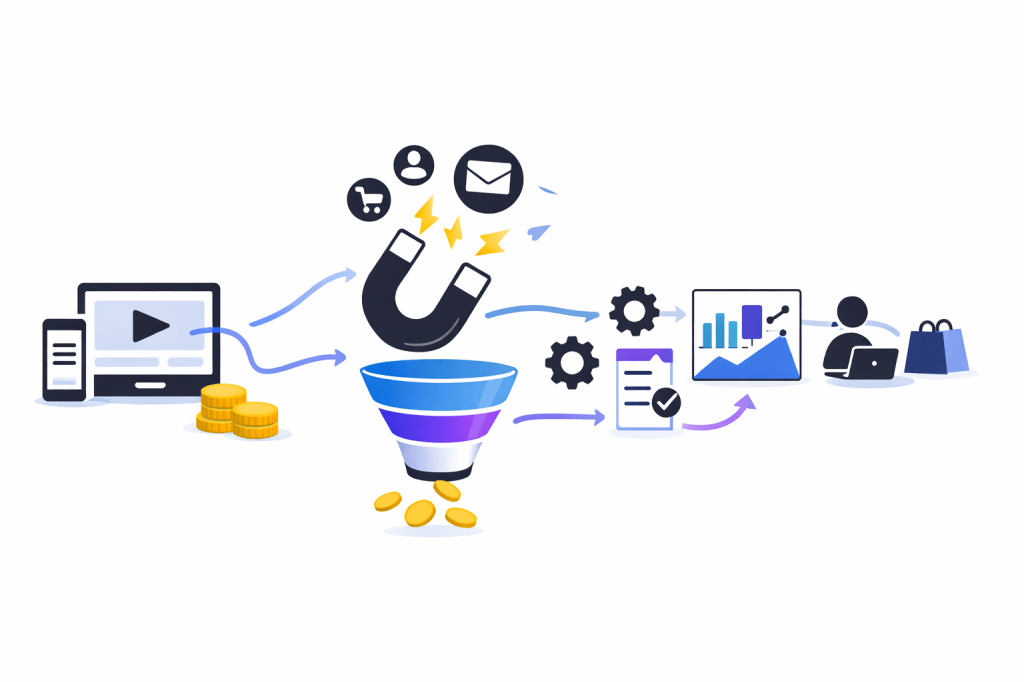
That question gets expensive fast, because ClickFunnels is not the kind of tool you casually add and forget. The current pricing page puts the entry plan well above lightweight landing-page builders, so the real issue is not whether the software is cheap. The real issue is whether it replaces enough moving parts, shortens your launch time enough, and improves follow-up enough to justify the spend.
That is why this article does not treat ClickFunnels like a simple page builder. The platform now bundles funnel building, websites, email, automations, CRM-style pipeline tools, appointments, analytics, courses, communities, and a customer center inside one ecosystem, as shown across the official product overview, site builder, CRM pages, and customer center documentation. For some businesses, that consolidation is exactly why ClickFunnels is worth it. For others, it is precisely why the platform feels oversized.
So here is the smart way to think about it. Do not ask whether ClickFunnels is “good.” Ask whether your business needs a conversion-focused system badly enough that paying more for tighter integration makes sense. If you want to test that in the real world instead of debating it forever, you can try ClickFunnels through its current promotional entry offer and compare that experience against a cheaper all-in-one like Systeme.io.
Article Outline
- Part 1: Why It Matters
- Part 1: Framework Overview
- Part 1: Core Components
- Part 1: Professional Implementation
- Part 2: Cost and Fit Analysis
- Part 3: Alternatives and Final Verdict
Why It Matters
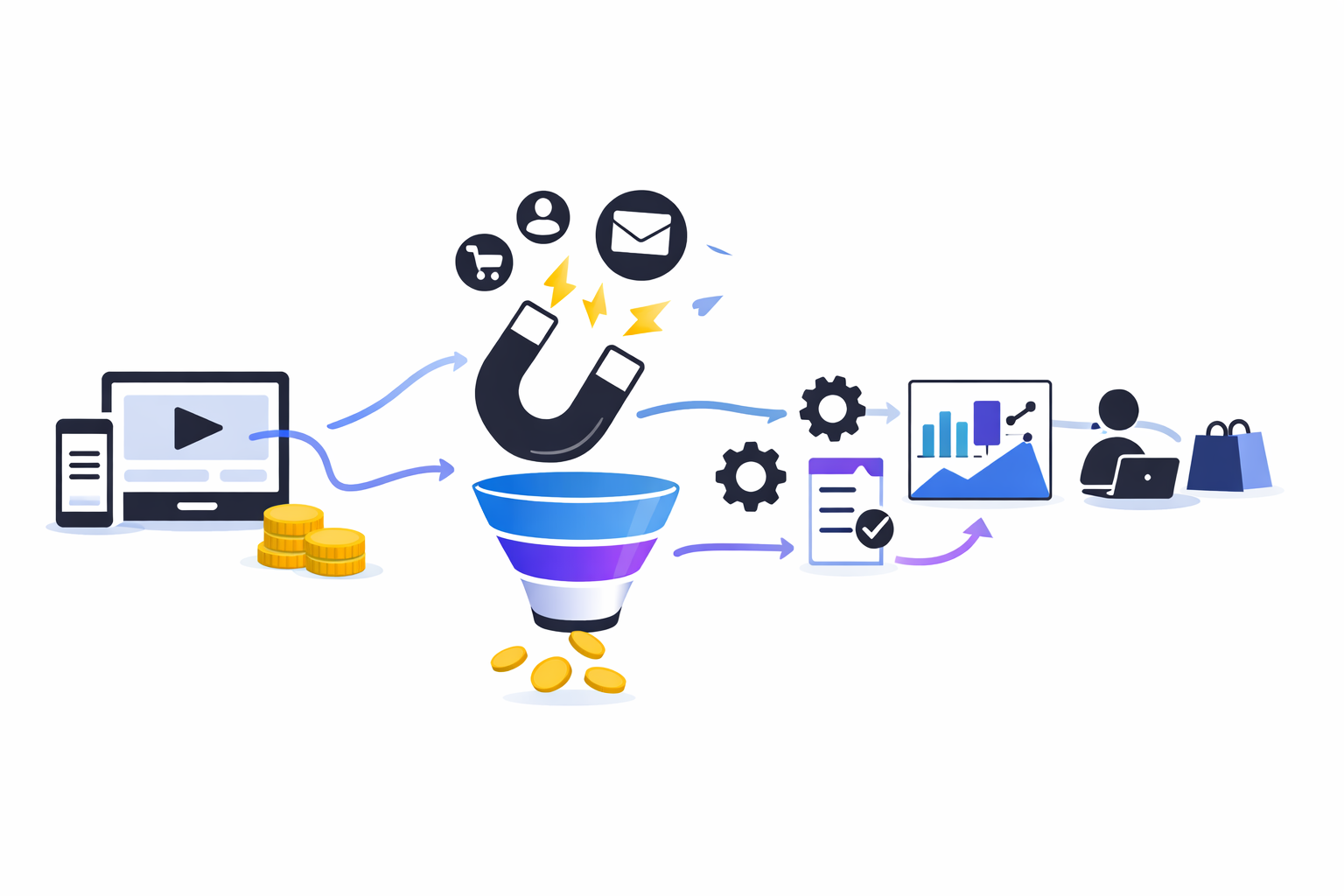
ClickFunnels matters because most businesses do not lose money from a lack of tools. They lose money because the journey from click to lead to sale is messy, slow, and broken in small ways that stack up. A visitor lands on a page, the message is unclear, the offer feels disconnected from the checkout, the email follow-up is weak, and the prospect disappears. That is exactly the kind of leak a funnel platform is supposed to fix.
The bigger reason this decision matters in 2026 is that marketing teams are under pressure to create more personalized journeys without adding even more software chaos. Salesforce’s latest State of Marketing research says 83% of marketers recognize the shift toward personalized, two-way messaging, yet only one in four are satisfied with how they use data to power those experiences. In plain English, businesses want tighter journeys, but many are still stitching them together with too many separate tools.
Email performance makes that even more important. Mailchimp’s benchmark data shows that average email click rates are still modest across industries, which means every extra layer of friction after the click matters a lot. If ClickFunnels gives you a cleaner handoff between page, offer, checkout, CRM, and follow-up, it can be worth the premium. If your current stack already does that well, the premium gets much harder to defend.
Framework Overview
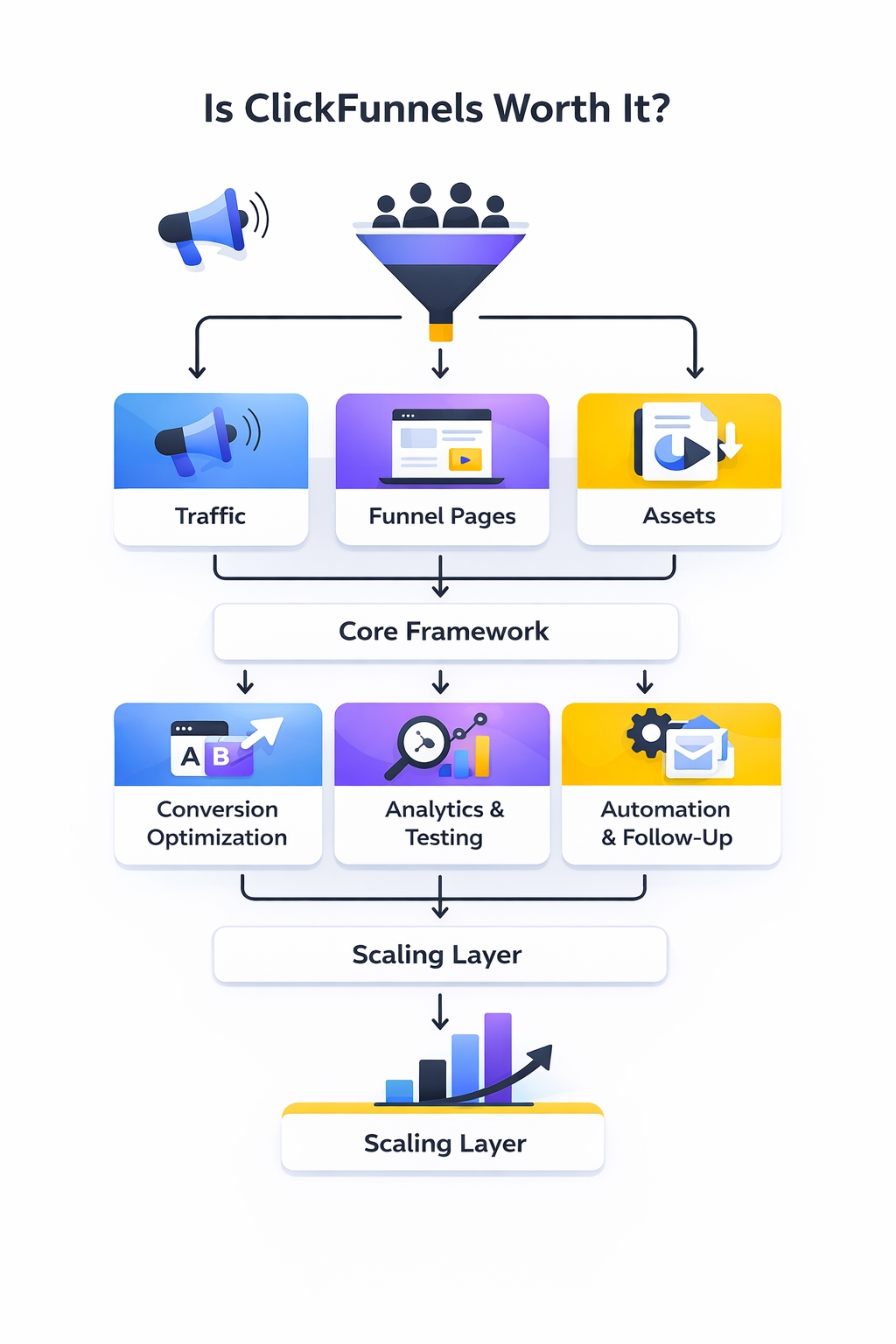
The best way to answer whether ClickFunnels is worth it is to run the platform through a simple framework: revenue fit, workflow fit, and replacement fit. Revenue fit asks whether even a modest lift in leads, average order value, or follow-up quality would cover the monthly cost. Workflow fit asks whether your team will actually use the platform consistently instead of paying for features that sit untouched. Replacement fit asks how many separate subscriptions or manual handoffs ClickFunnels can remove from your current setup.
This framework matters because ClickFunnels is not competing only with one product. It is competing with combinations of products. A business comparing it with Leadpages, Unbounce, Kajabi, Systeme.io, or even parts of Shopify is really comparing different philosophies: specialized stack versus integrated stack.
Once you look at it that way, the pricing becomes easier to interpret. The official ClickFunnels plans currently start at $97 per month on Launch, while lower-cost competitors can start much cheaper, including $37 per month for Leadpages and $17 per month for Systeme.io’s Startup plan. But lower price does not automatically mean better value. If the cheaper stack still forces you to patch together pages, automations, course delivery, scheduling, and customer management, the “savings” can disappear in labor, missed follow-up, and technical drag.
Core Components
The first core component is funnel building itself. ClickFunnels is still strongest when you need conversion-first pages, offer sequencing, upsells, and a flow that is built around action rather than browsing. That is different from a general website mindset, and it is why the platform continues to appeal to coaches, info-product sellers, service businesses, and marketers running focused campaigns.
The second core component is consolidation. The official platform pages show that ClickFunnels now includes websites, CRM and pipeline tools, email and message hub features, a customer center for post-purchase access, analytics, appointments, automations, communities, courses, and store functionality. That matters because the worth of ClickFunnels rises sharply when you use several of those components together. If you only need one nice landing page, the platform is usually overkill.
The third core component is market proof, and that story is more nuanced than the hype. Independent review platforms still show strong satisfaction, with G2 listing ClickFunnels at 4.6 out of 5 from 413 reviews and Capterra showing 4.5 out of 5 from 665 reviews, but Capterra also highlights recurring complaints around cost and technical disruptions. That combination is important because it points to the real answer: ClickFunnels tends to be worth it for businesses that use its revenue-driving features deeply, and less worth it for buyers who mainly want a simpler page builder with a lower bill.
Professional Implementation
Professional implementation starts with restraint. Do not buy ClickFunnels because it can do a lot. Buy it only if you are ready to build one complete path from traffic source to opt-in to sale to follow-up, then improve that path with data. Businesses that treat the platform like a digital junk drawer usually end up blaming the software for a strategy problem.
A more professional approach is to map one offer, one audience, one funnel objective, and one follow-up sequence before you touch the builder. The official Launch plan currently includes 10,000 contacts, 50,000 emails per month, 3 courses, 5 custom domains, 2 team members, and 1 workspace, which is enough for many lean operators to test whether the ecosystem actually simplifies execution. That makes the early decision less about scale and more about operational discipline.
It also helps to treat the first 30 to 60 days as a replacement audit. If ClickFunnels can realistically remove page-builder costs, reduce email-tool dependence, centralize follow-up, and give you better visibility through its built-in opportunities and analytics features, then the premium can make sense. If your business already runs smoothly on a cheaper combination of tools, then the smarter move may be to skip the heavier ecosystem and keep your stack lean.
Cost And Fit Analysis
Here is where the question gets real. If you are asking whether ClickFunnels is worth it, you are really asking whether the extra monthly cost turns into extra revenue, faster launches, or less operational mess. The official pricing page currently places the Launch plan at $97 per month, while Systeme.io starts at $17 per month, Leadpages starts at $37 per month when billed annually, and Unbounce starts at $74 per month when billed annually. That gap is exactly why ClickFunnels can feel either like a smart investment or a very expensive mistake.
The right way to think about that price is not in isolation. You have to compare it against what you would otherwise pay for pages, email, automations, lead routing, course delivery, customer access, and the time required to keep all of those parts talking to each other. For some businesses, ClickFunnels is worth it because it compresses the stack. For others, especially businesses with a simple lead magnet and a small email list, the cheaper path wins because the all-in-one promise solves a problem they do not really have.
And this is where people get trapped. They compare ClickFunnels with a single cheaper tool, not with the total cost of the system they actually need. If you want to test that without locking yourself into a giant commitment, you can try the current ClickFunnels promotional offer here and measure it against a lighter alternative like Systeme.io here.
Where The Math Starts Working
ClickFunnels starts to make sense when one improved funnel can pay for the software without heroics. A consultant who closes one additional client because their booking flow, email reminders, and follow-up sequence finally work together is looking at the platform very differently from a beginner with no traffic and no clear offer. In other words, the platform becomes easier to justify when the bottleneck is execution and follow-up, not idea generation.
The numbers support that logic. The Launch plan includes 10,000 contacts and 50,000 emails per month, which means the monthly price is not just buying a page builder. It is buying room to capture leads, nurture them, sell to them, and keep them inside one system. If you would otherwise pay for separate email software, page software, checkout tooling, and some kind of customer portal, the monthly bill can stop looking outrageous pretty quickly.
That is also why some businesses feel immediate relief after switching. Review patterns on G2, Capterra, and Trustpilot show a familiar split: users who value speed and consolidation tend to rate the platform highly, while users who only need a narrower tool keep circling back to the price. That split is not noise. It is the clearest possible sign that ClickFunnels is worth it only when you actually use the ecosystem instead of just renting a fraction of it.

Hidden Costs Most Buyers Miss
The biggest hidden cost is not on the invoice. It is the cost of buying a serious tool before you have serious clarity. If your offer is vague, your messaging is weak, and you have no traffic strategy, ClickFunnels will not magically rescue the business. It may actually make the situation worse by giving you more things to tweak while the real issue stays untouched.
There is also the cost of complexity. ClickFunnels can replace multiple tools, but that only helps if your team is willing to learn its workflow and commit to using it properly. Review pages on Capterra repeatedly mention strong funnel-building value, yet the same review base highlights complaints around high subscription costs and technical disruptions, which means the platform is not a friction-free purchase just because it is powerful.
And then there is opportunity cost. A creator who mainly needs email newsletters and a simple landing page may get better economics from Kit’s creator-focused pricing or Brevo’s lower-cost email and CRM model. A course-first business may find Kajabi’s structure easier to justify if the education product is the center of the company. ClickFunnels is worth it when funnel performance is the center of the business, not when you force it to win categories it was never meant to dominate.
Who Gets ROI Fastest
The businesses most likely to get paid back quickly are the ones with a clear offer, paid or organic traffic already flowing, and a reason to optimize the path from click to sale. Coaches, agencies, consultants, info-product brands, high-ticket service providers, and businesses selling through webinars or applications fit that pattern well. They do not just need a website. They need sequencing, persuasion, follow-up, and visibility across the whole buying journey.
That is important because buyer behavior is moving toward more tailored journeys, not less. HubSpot’s latest State of Marketing report frames AI and personalization as operational necessities now, not side projects, and Salesforce’s recent marketing research shows many teams still struggle to use customer data well enough to deliver those experiences consistently. An integrated funnel platform is not automatically the answer, but it does speak directly to that operational pressure.
If that sounds like your business, ClickFunnels can be worth it because it helps you move faster with fewer handoffs. If that does not sound like your business, the smarter move may be to keep things lean for now. You can always graduate into a heavier system later, but it is much harder to justify paying premium software prices while your business is still trying to figure out its basic offer-market fit.
When ClickFunnels Is Not Worth It
Let’s be blunt, because this is where people save money. ClickFunnels is usually not worth it if you are still in the “I just need something online” phase. It is also not worth it if your main need is a basic website, a simple newsletter, or a couple of landing pages without sophisticated follow-up.
It can also be the wrong buy if you already have a stable stack that works. A business running a solid website, dependable email platform, familiar CRM, and clean reporting may create more disruption than advantage by switching everything into a new ecosystem. In that case, the higher monthly price is only the visible cost. The invisible cost is retraining, migration, process change, and the risk of slowing down a system that was already producing results.
So, is ClickFunnels worth it? In Part 2, the honest answer is yes for businesses that need a revenue-focused system and will use the all-in-one structure aggressively. For beginners, minimalist creators, and brands that already have a clean stack, the better answer is often to look closely at what ClickFunnels includes before buying and compare it against a lower-cost route like Systeme.io or a more specialized stack that matches the business you actually run today.
Alternatives And Final Verdict
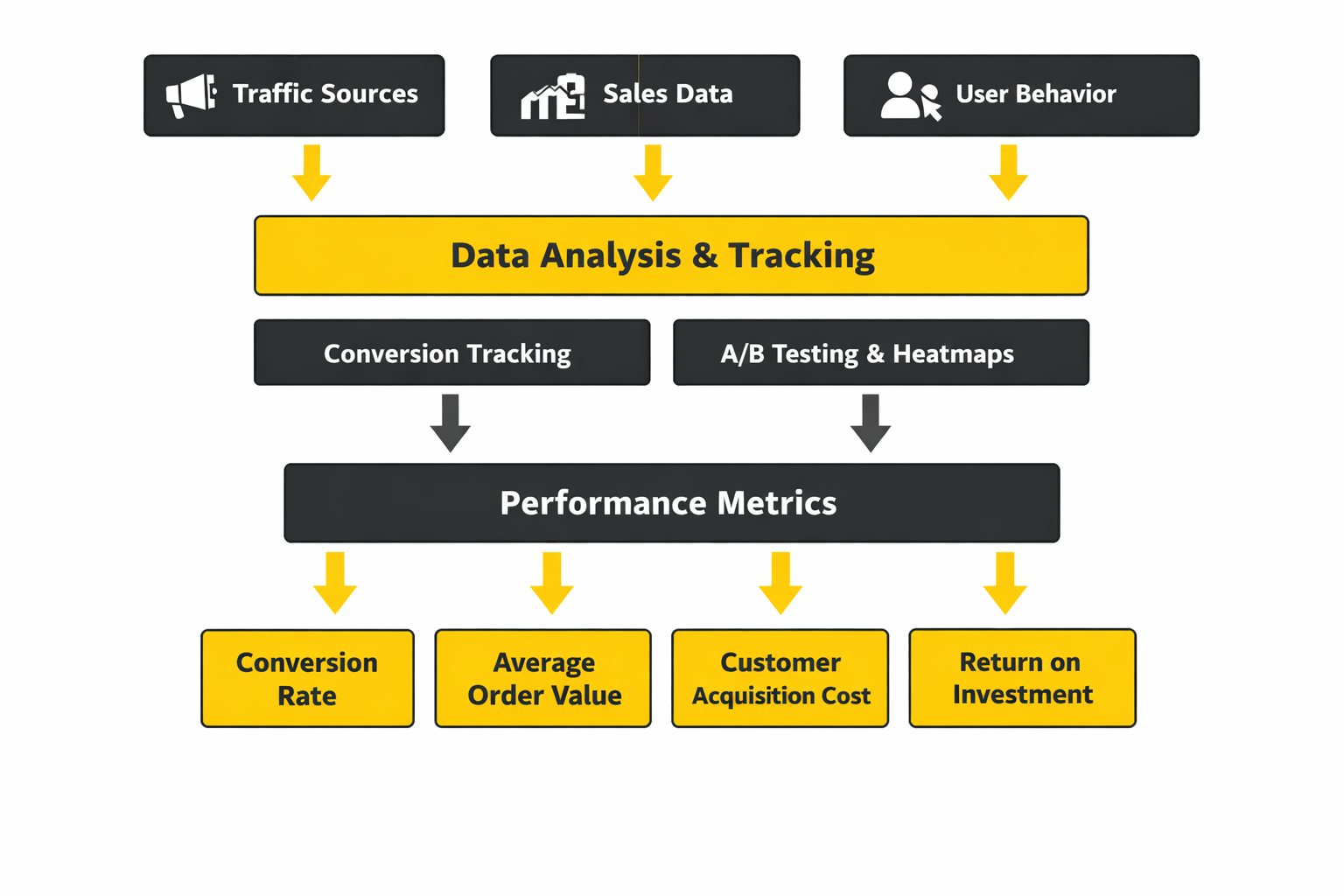
Now we get to the part that matters most, because asking whether ClickFunnels is worth it without comparing it to real alternatives is how people overspend. The platform clearly offers an integrated sales environment through its main platform, CRM tools, and Launch plan at $97 per month. But that does not automatically make it the smartest buy for every business. It just means you need to compare it against the kind of business you are actually building.
This is where a lot of creators and business owners finally get clarity. If your business depends on strong funnel sequencing, upsells, checkout flows, lead capture, and tight follow-up, ClickFunnels has a serious argument in its favor. If your needs are simpler, or if your business centers more on email newsletters, digital products, or course delivery than on aggressive funnel optimization, there are cheaper and sometimes better-fitting options sitting right in front of you.
So let’s break it down the right way. Not with hype. Not with random software worship. Let’s look at where ClickFunnels wins, where it loses, and what kind of buyer should move forward.
Best Alternatives Based On Business Model
If you are extremely budget-conscious, ClickFunnels is not the obvious first stop. Systeme.io starts at $17 per month and even offers a free plan, which makes it one of the easiest ways to get pages, email, automations, courses, and funnels running without putting pressure on cash flow right away. That is a major reason many early-stage creators find it easier to justify, and if you want to test that path directly, you can check out Systeme.io here.
If your main goal is polished landing pages and conversion-focused testing without buying a broader all-in-one ecosystem, Leadpages and Unbounce deserve serious attention. Leadpages starts lower than ClickFunnels, while Unbounce sits closer in premium territory but leans heavily into landing page optimization and experimentation rather than trying to run your entire business. That distinction matters because some businesses do not need more software. They need fewer distractions and sharper pages.
If your business is built around courses, memberships, and creator education products, Kajabi’s pricing makes more sense to compare than general landing-page builders. Kajabi is more expensive than entry-level alternatives, with the current Basic tier shown at $179 per month, but it is also positioned around expert businesses, products, and content delivery rather than pure funnel execution. That is why the right question is never just “is ClickFunnels worth it?” It is “worth it compared to what kind of business model?”
Where ClickFunnels Still Has The Edge
ClickFunnels still stands out when the center of your business is selling through a guided path. That means opt-in pages, sales pages, order bumps, upsells, appointment booking, CRM-style tracking, and post-purchase delivery all matter as part of the same revenue motion. The official product pages keep reinforcing that exact positioning through its site tools, pipeline and CRM functionality, and customer center structure.
That matters more than people think. A cheaper tool may win on raw monthly price and still lose badly in real-world execution if it forces you to duct-tape together forms, emails, checkouts, automations, and client access. ClickFunnels becomes easier to justify when your business suffers every time those handoffs break, because then the extra cost is not just buying software. It is buying fewer dropped leads, fewer manual workarounds, and faster campaign launches.
The review ecosystem reflects that tradeoff pretty clearly. G2’s review base and Capterra’s user ratings both stay strong overall, yet complaints consistently return to price and complexity. That pattern tells you something important: users who actually need ClickFunnels tend to like it. Users who just wanted “something to build pages” often realize they paid for a much bigger machine than they needed.
The Clearest Buyer’s Guide
ClickFunnels is usually worth it for businesses that already have traffic, a clear offer, and a reason to care deeply about conversion flow. That includes coaches, consultants, agencies, info-product brands, webinar sellers, and service businesses that close leads through structured journeys. Those businesses are not shopping for a homepage. They are shopping for momentum.
It is usually not worth it for total beginners with no validated offer, creators who mostly need newsletters and a few pages, or businesses that already have a stable stack they like using. In those cases, paying for ClickFunnels too early can feel exciting, but it often turns into expensive procrastination. The platform cannot solve a weak offer, unclear messaging, or a traffic problem, and too many buyers quietly expect it to.
If you are close to the line and want the simplest possible next move, do this. Review the official ClickFunnels plan details, compare them to Systeme.io’s lower-cost pricing, and then decide whether your business is really asking for a funnel ecosystem or just a simpler publishing stack. That one decision will save you a lot of wasted money.
Final Verdict On ClickFunnels
So, is ClickFunnels worth it? Yes, for the right business, and no, for the wrong one. That may sound obvious, but it is the only honest answer after looking at what the platform includes, what it costs, and what businesses are actually paying for when they subscribe.
If your revenue depends on guiding people through a deliberate buying journey and you want that journey inside one environment, ClickFunnels has a strong case. You can see what ClickFunnels includes here or test the lower-friction entry point through this current promotional offer. If your business is earlier, leaner, or simply less funnel-dependent, starting with Systeme.io may be the smarter move.
And that is really the whole game. Do not buy software because the branding is strong or the community is loud. Buy the platform that matches the stage, speed, and structure of your business right now. That is how you make sure the answer to “is ClickFunnels worth it?” ends up being yes for you instead of just yes in someone else’s sales pitch.
Statistics And Data
If you want a cleaner answer to whether ClickFunnels is worth it, you need to stop thinking in vague terms and start looking at the numbers that actually shape the decision. The current ClickFunnels Launch plan is listed at $97 per month, with 10,000 contacts, 50,000 emails per month, 1 workspace, 2 team members, 3 courses, and 5 custom domains. That matters because the software is not priced like a lightweight landing-page tool. It is priced like a revenue system that expects you to use multiple pieces of the stack.
That price becomes easier to understand when you compare it with the market around it. Systeme.io shows a free plan and a Startup plan at $17 per month, Leadpages starts at $37 per month, Unbounce shows pricing at $249 per month on the page currently available through web search, and Kajabi lists its Basic plan at $179 per month. So the real statistical takeaway is not that ClickFunnels is cheap or expensive in isolation. It sits in the middle of a category where value depends heavily on how many jobs the platform is replacing for you.
Pricing Data In Context
This is where a lot of people misread the numbers. They compare ClickFunnels with one cheaper app and call it overpriced, but that is not the most honest comparison. If your business would otherwise pay for page building, email marketing, basic CRM functions, automations, course delivery, and customer access in separate tools, then the monthly price has to be measured against the total system, not just one line item.
That is also why the entry-level alternatives matter so much. Systeme.io’s pricing page shows a dramatically lower starting point, which makes it attractive for beginners and lean creators. On the other end, Kajabi’s pricing shows that creator-focused all-in-one platforms can cost substantially more than ClickFunnels, especially when the business is built around products, memberships, and delivery rather than pure funnel flow. In other words, the raw price data does not prove whether ClickFunnels is worth it. It proves that the right comparison depends on your business model.
Review Data And User Sentiment
There is another data point that matters here, and that is how real users respond after paying for the platform. Capterra currently shows ClickFunnels at 4.5 out of 5 from 665 reviews, while its product summary also flags common complaints like high subscription costs and frequent technical disruptions. That balance is useful because it tells you this is not a universally adored tool or a universally regretted one. It is a tool that people often like when it matches the job they need done.
G2’s ClickFunnels review page shows a similarly strong overall pattern, while the visible review text still points to a familiar tension: users like the breadth of functionality, but some find advanced setup and customization more demanding than they expected. That is one of the most important pieces of data in the whole article. A platform can score well overall and still be the wrong buy for someone who only needs basic pages and simple email capture.
Marketing Performance Data That Actually Matters
When people ask whether ClickFunnels is worth it, they often focus too much on software features and not enough on the performance environment those features sit inside. That is a mistake. Mailchimp’s current benchmark data shows average click rates around 2.62% across all users, with ecommerce at 1.74%, business and finance at 2.78%, and education and training at 3.02%. Those are not giant numbers, which means every improvement in the path after the click matters a lot.
This is exactly where a funnel platform can earn its keep. If traffic is expensive or hard-won, then wasting the visit because the handoff between page, offer, and follow-up is clumsy becomes a real financial problem. That is why the math around ClickFunnels can work even when the subscription price initially feels high. A modest lift in lead capture, booking rate, average order value, or follow-up consistency can outweigh the monthly fee faster than many buyers expect.
Personalization And Data Trends
The broader market data also supports why integrated systems keep getting attention. Salesforce’s tenth State of Marketing report says 83% of marketers recognize the shift toward personalized, two-way messaging, but only one in four are satisfied with how they use data to power those moments. A related Salesforce breakdown of that report puts complete satisfaction with data unification at 26%, which is a brutally clear sign that many teams still struggle to connect the customer journey properly.
HubSpot’s 2026 State of Marketing report pushes in the same direction, framing AI and personalization not as optional add-ons but as the new baseline for competitive marketing. That does not prove that every business needs ClickFunnels specifically. What it does prove is that disconnected tools and fragmented customer data are becoming more expensive problems over time. So when people ask whether ClickFunnels is worth it, one of the strongest data-backed answers is this: integrated workflow has real economic value when personalization and follow-up are central to revenue.
What The Data Really Says About ClickFunnels
Put all of the numbers together and the conclusion gets much clearer. ClickFunnels is not the low-cost option, and the pricing data makes that obvious immediately. But the review data shows many users still feel positive about it, and the broader marketing data shows why a connected funnel and follow-up system can matter more than ever.
So what do the statistics and data really say? They say ClickFunnels is worth it when your business has enough traffic, enough offer clarity, and enough need for integrated execution that even a small performance lift has real monetary value. They also say that if your business is early, simple, or not especially funnel-driven, the numbers point just as strongly toward a lower-cost path such as Systeme.io or a narrower toolset built around the exact job you need done.
Practical Decision Checklist
By this point, the question is no longer just “is ClickFunnels worth it?” The better question is whether it is worth it for your business right now, with your traffic, your offer, your team, and your tolerance for complexity. That matters because the current Launch plan at $97 per month can be a smart buy when it replaces multiple tools and sharpens execution, but it can also become an expensive distraction when the real problem is weak positioning or inconsistent traffic.
So this part is about making the decision without guessing. Not based on hype. Not based on what the loudest person on social media says. Based on whether the platform matches the stage and structure of the business you are actually running.
Five Questions To Answer Before Buying
First, do you already have an offer that people clearly want? If the answer is no, ClickFunnels is probably not the first problem you need to solve. A more advanced funnel will not rescue an offer that nobody is excited to buy, and that is exactly how software ends up getting blamed for a strategy issue.
Second, are you already getting traffic from somewhere that matters? It could be organic content, referrals, paid ads, webinars, email, or social media. What matters is that people are already entering your world, because funnel software becomes much more valuable when there is real traffic to convert instead of just a theoretical audience.
Third, how much are broken handoffs costing you right now? If leads are slipping through the cracks because your forms, emails, pages, automations, and follow-up tools are disconnected, then an integrated platform starts looking more attractive. That logic fits the broader market direction too, because the latest Salesforce State of Marketing report says 83% of marketers recognize the shift toward personalized, two-way messaging, while only one in four are satisfied with how they use data to power it.
Fourth, will you actually use the platform deeply enough to justify it? ClickFunnels can only be worth it if you use more than a small slice of what you are paying for. If you mainly want a landing page and a basic email opt-in, the cheaper route still looks very strong through Systeme.io’s low-cost pricing or narrower tools like Leadpages.
Fifth, are you prepared to simplify the business around one funnel instead of endlessly tinkering? That is the part many people do not want to hear. The platform can help, but it still rewards clarity, focus, and a willingness to build one solid path before chasing ten different ideas.
Signs ClickFunnels Is Probably Worth It
ClickFunnels is usually worth it when you already know the business needs a guided buying journey. That often means webinars, consultation funnels, info-product sales, appointment funnels, upsells, order bumps, post-purchase delivery, and ongoing follow-up all need to work together. In that situation, the platform’s integrated structure through its site tools, CRM and pipeline tools, and customer center becomes much easier to justify.
It is also a better fit when your time is expensive. A founder or lean team that loses hours every week jumping between tools is paying a hidden tax whether they notice it or not. If ClickFunnels compresses that operational mess into one cleaner system, then the monthly cost may be lower than the true cost of staying fragmented.
You should also lean toward ClickFunnels if small improvements in conversion have meaningful financial impact. Mailchimp’s current benchmark data shows that average click rates are still relatively modest across industries, which means the path after the click matters enormously. When traffic is hard-won, improving that journey is not cosmetic. It is revenue protection.
Signs You Should Wait Or Buy Something Else
ClickFunnels is probably not worth it when your business is still trying to answer basic questions like who the offer is for, what problem it solves, or how you will get consistent traffic. In that stage, the danger is not just overspending. The danger is using software setup as a substitute for actual market learning.
You should also be cautious if the business already has a working stack that people on your team genuinely like using. Software change has a cost. Training, migration, workflow changes, and short-term disruption can eat away at the benefits of moving into a new platform, even when the new platform looks impressive on paper.
And if budget pressure is real, forcing yourself into a premium tool too early can make the business tighter than it needs to be. That is why a lot of smaller creators and early-stage operators are better served by testing with Systeme.io, or by staying focused on a lighter stack until the business earns the right to need something heavier.
The Smartest Way To Test It
If you are on the fence, the smartest move is not endless comparison shopping. It is a controlled test. Build one offer, one traffic source, one funnel objective, and one follow-up sequence, then compare that setup against what you could build with a cheaper alternative.
That is exactly why a limited trial period or promotional entry point can be useful. Instead of debating the platform in theory, you can test ClickFunnels through its current promotional offer, track how quickly you launch, and see whether the system genuinely helps you move. Then compare that experience with a lower-cost path like Systeme.io or a narrower page-focused tool if that better reflects your business model.
The key is to judge the platform by outcomes, not by feature count. Did it make launching easier? Did it clean up follow-up? Did it reduce tool chaos? Did it help revenue move faster? That is how you find out whether ClickFunnels is worth it in a way that actually means something.
Part 5 Wrap-Up
At this stage, the answer is pretty clear. ClickFunnels is worth it when you have a real offer, real traffic, and a real need for a connected sales system. It is not worth it when you mainly need simplicity, lower cost, or time to validate the business before layering on more software.
That is why the best decision is usually the one that feels a little less exciting and a lot more honest. Buy the tool that matches your current reality, not the one that makes you feel like a more advanced business owner for a few days. When you do that, the software starts serving the business instead of the business serving the software.
FAQ – Built For A Complete Guide

This final section is here to answer the questions people usually ask right before they buy, skip, or postpone the decision. And that matters, because whether ClickFunnels is worth it usually comes down to a handful of practical concerns, not some abstract software debate. Once you understand the cost, the fit, the alternatives, and the workload involved, the answer gets a lot less confusing.
Is ClickFunnels worth it for beginners?
Usually not right away, at least not for most beginners. If you are still figuring out your offer, your audience, and how you are going to get traffic, paying ClickFunnels’ current entry price can feel heavy before the business is ready to benefit from it. A lower-cost option like Systeme.io often makes more sense at that stage because it gives you room to test ideas without adding as much financial pressure.
Is ClickFunnels better than Systeme.io?
Not automatically. ClickFunnels is often stronger when the business depends on a more aggressive, conversion-focused funnel system and you want pages, CRM-style tracking, automations, and customer flow living closer together. Systeme.io is often the better value play when budget matters a lot and you want an easier starting point, especially since its pricing begins far lower than ClickFunnels’ Launch plan.
Can ClickFunnels replace other tools?
Yes, and that is one of the biggest reasons some businesses decide ClickFunnels is worth it. The platform’s official pages show tools for sites and pages, CRM and pipeline management, courses, customer access, and email-related workflow inside the same ecosystem. The catch is simple: it only becomes a great value if you really use those pieces instead of paying for a broad platform and then relying on outside tools anyway.
Is ClickFunnels just a landing page builder?
No, and that is exactly why the answer to “is ClickFunnels worth it?” is so dependent on context. A basic landing-page tool can be cheaper and easier, but ClickFunnels is positioned more like a sales system than a single-purpose page builder. If all you need is a few polished landing pages, Leadpages or Unbounce may fit the job more cleanly.
How much does ClickFunnels cost right now?
The official pricing page currently shows the Launch plan at $97 per month, with annual billing shown lower on a monthly equivalent basis. That is a serious price point compared with entry-level competitors, so the platform really needs to save time, consolidate tools, or improve conversions to earn its place in the stack. If you want to test it with less friction, you can also look at the current ClickFunnels promotional offer.
Is ClickFunnels good for coaches and consultants?
It often is, especially when the sale depends on applications, bookings, webinars, nurture sequences, and follow-up instead of a simple one-page website. Coaches and consultants usually need a guided journey more than a static online presence, and that is where ClickFunnels tends to feel more justified. If your business closes through structured conversations and conversion flow, the platform is usually easier to defend.
Is ClickFunnels good for ecommerce?
It can work for ecommerce offers, especially when the business depends on focused promotions, upsells, order bumps, and campaign funnels. But it is not automatically the best default ecommerce platform for every store. If your business is primarily catalog-driven and operationally centered on store management, broader commerce platforms may still be a more natural fit than a funnel-first system.
Does ClickFunnels help with email marketing?
Yes, and that matters more than people think. The Launch plan details include 50,000 emails per month and 10,000 contacts, which means the platform is trying to do more than collect leads. It is trying to help you follow up with them too, and that becomes valuable because current benchmark data from Mailchimp shows average click rates are still modest enough that every handoff after the click matters.
What is the biggest reason people regret buying ClickFunnels?
The biggest reason is usually not that the software is bad. It is that they bought it before the business was ready. When someone has no clear offer, weak traffic, or no real funnel strategy, ClickFunnels can turn into a very expensive way to procrastinate while pretending to build momentum.
What is the biggest reason people love ClickFunnels?
It is the sense of momentum that comes from having a conversion-focused system under one roof. People who like ClickFunnels usually like the fact that they can build pages, move leads, guide buyers, and keep follow-up closer together without stitching everything manually. That kind of operational speed is hard to appreciate until your current stack starts slowing launches down.
Should I buy ClickFunnels now or wait?
If you already have a clear offer, some traffic, and a reason to care deeply about conversion flow, it can make sense to move now. If you are still validating the basics of the business, waiting is often the smarter and more profitable choice. The goal is not to buy the most exciting platform. The goal is to buy the platform that matches the business you actually have right now.
How should I test ClickFunnels the smart way?
Keep the test simple. Build one offer, one funnel, one follow-up sequence, and one traffic path, then measure how fast you launch and how cleanly the system runs. That is a much better test than wandering through features, and if you want to run that experiment directly, you can start with ClickFunnels here or compare it side by side with Systeme.io here.
So, is ClickFunnels worth it in one sentence?
Yes, if your business needs a real funnel system and will actually use it; no, if you mainly need a simpler, cheaper tool and are still early in the game. That is the clearest answer in the whole guide. Everything else is just helping you figure out which side of that line your business is standing on.
Work With Professionals
If this guide did its job, you should now have a much better handle on whether ClickFunnels is worth it for your situation. And if you are a marketer helping businesses make these kinds of decisions every day, there is another angle worth thinking about too. The more you understand funnels, conversion paths, and software economics, the more valuable your expertise becomes in the real market.
That is why working with better clients matters so much. You do not want to spend your time fighting for scraps on crowded platforms when businesses are already out there looking for people who understand growth, systems, positioning, and performance. When you know how to think clearly about tools like ClickFunnels, you are already bringing more to the table than a lot of people competing on price alone.
Explore 10K+ Remote Marketing Contracts on MarkeWork.com
Most marketers spend too much time chasing clients, competing on crowded platforms, and losing a percentage of every project to middlemen.
MarkeWork gives you a better way. Browse thousands of remote marketing contracts and connect directly with companies desperate to hire skilled marketers like you — without platform commissions and without unnecessary gatekeepers.
If you’re serious about finding better opportunities and keeping 100% of what you earn, you can explore available contracts and create your profile for free at MarkeWork.com.
 Filip Konecny Enterprises