

A TikTok agency is no longer just a vendor that makes a few short videos and turns on ads. The serious agencies now sit at the intersection of creative development, creator partnerships, paid media, measurement, and commerce, because that is how the platform itself has evolved. When TikTok ads reached 1.59 billion users in January 2025 and the platform’s own newsroom reported that more than 200 million people across Europe use TikTok every month, the question stopped being whether brands should pay attention and became whether they have the right operating model to compete there.
That is where the idea of a specialized TikTok agency starts to make sense. TikTok’s own partner ecosystem says brands can work with companies that are rigorously evaluated for TikTok excellence, while TikTok’s newer product stack is built around connected workflows for creators, advertisers, and agencies inside TikTok One. In other words, the platform itself now assumes that strong performance comes from coordinated execution rather than random posting.
This first part maps out the strategic foundation. You will see why the model matters, what the modern framework looks like, which capabilities separate a real TikTok agency from a generic social media shop, and how professional implementation works when the goal is not vanity metrics but measurable business growth.
Article Outline
- Part 1: Why a TikTok Agency Matters
- Part 2: Framework Overview
- Part 3: Core Components of a TikTok Agency
- Part 4: Professional TikTok Agency Implementation
- Part 5: Analytics and Optimization for TikTok Agency Work
- Part 6: The TikTok Agency Ecosystem and FAQs
Why a TikTok Agency Matters

The biggest reason a TikTok agency matters is that TikTok is not a channel where creative, media buying, and audience insight can be separated for very long. The platform’s own 2025 event materials describe TikTok as a full-funnel growth environment, and they place creator collaboration, AI-supported production, and campaign orchestration inside one connected system through TikTok World 2025 and TikTok One. That tells you something important: the platform is pushing brands toward integrated execution because disconnected teams move too slowly for how fast culture shifts there.
A second reason is that the surface area is now too wide for a generalist team to master casually. TikTok’s business resources distinguish between organic business accounts, paid campaigns through Ads Manager, creative trend intelligence, creator collaboration, and commerce-focused ad products inside its marketer resources. A strong TikTok agency is valuable because it turns that complexity into one operating rhythm, so the brand is not forced to stitch together freelancers, internal approvals, creators, editors, and media buyers every single week.
The third reason is performance pressure. Creative still drives outcomes on TikTok, but it has to be tied to business objectives. TikTok’s newsroom reported that 41% of users say entertaining ads improve the platform experience, which is a reminder that the winning work does not feel like a banner ad stuffed into a video feed. The agencies that matter understand that the platform rewards relevance, speed, and native storytelling first, then uses media and measurement to scale what already fits how people behave.
Framework Overview
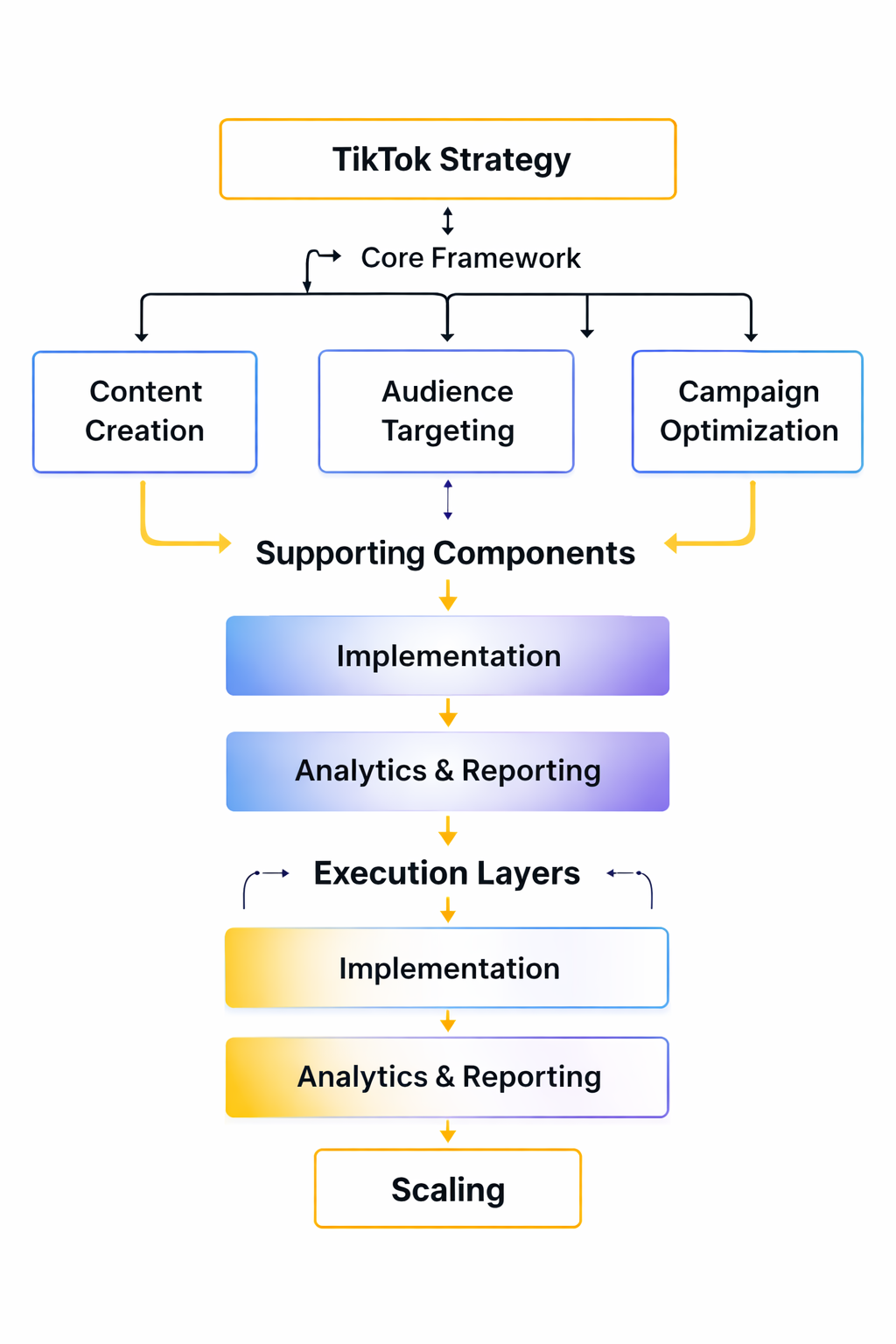
A useful way to think about a TikTok agency is as a framework with four connected layers: strategy, creative production, distribution, and feedback. Strategy decides what the brand is trying to win, whether that means awareness, qualified traffic, add-to-cart volume, lead generation, or direct sales. Creative production translates that goal into TikTok-native concepts. Distribution covers organic posting, paid amplification, creator whitelisting, Spark Ads, and testing. Feedback closes the loop through reporting, audience learning, and creative iteration.
This framework matters because TikTok no longer behaves like a pure awareness channel. TikTok describes its business offering as a place where brands can find new customers, turn visitors into buyers, and drive more sales, and TikTok One is explicitly positioned as a place where creators, advertisers, and brands collaborate. So the modern agency framework cannot stop at content ideas. It has to connect ideas to outcomes, then connect outcomes back to the next round of creative decisions.
The most practical test is whether an agency can show you how one decision affects the next. If a concept performs well organically, can they explain when it should be promoted with paid support. If a creator brief works in one audience segment, can they tell you how to adapt it for another. If conversion costs rise, can they identify whether the issue sits in the hook, the offer, the landing page, the creator match, the media structure, or the measurement setup. That is what separates a framework from a content calendar.
Core Components of a TikTok Agency
The first core component is strategic planning that is specific to TikTok rather than copied from another social platform. That means audience hypotheses, content angles, creator selection criteria, offer strategy, and a testing plan built around how TikTok users actually discover products and ideas. It also means using the platform’s own intelligence tools such as Creative Center, where agencies can review top-performing ads, trend signals, creators, songs, and regional activity before they brief the next campaign.
The second component is creative operations. TikTok’s creative stack now includes not only native production but also creator collaboration and AI-supported tooling, with TikTok Creative Center and TikTok One updates announced at TikTok World 2025 reinforcing how central creative speed has become. A real TikTok agency therefore needs scripting, UGC direction, editing, testing discipline, and the judgment to know when polished production helps and when it kills the authenticity that makes people stop scrolling.
The third component is media and optimization. TikTok’s help documentation keeps its ad best practices updated because campaign success depends on more than turning on spend. Structure, objective choice, audience settings, creative variation, landing-page continuity, and post-click experience all matter. The agencies worth hiring are the ones that treat media buying as a live learning system rather than a one-time setup.
The fourth component is proof. A TikTok agency should not ask a client to believe in creative mythology without measurement. In a Nielsen marketing mix modeling case study, the point was not merely that TikTok can work, but that advertisers need methods strong enough to isolate the platform’s contribution to sales and brand outcomes. That is why serious agencies care about event tracking, attribution logic, holdout thinking, creative-level reporting, and post-purchase data, even in the first phase of an engagement.
Professional TikTok Agency Implementation
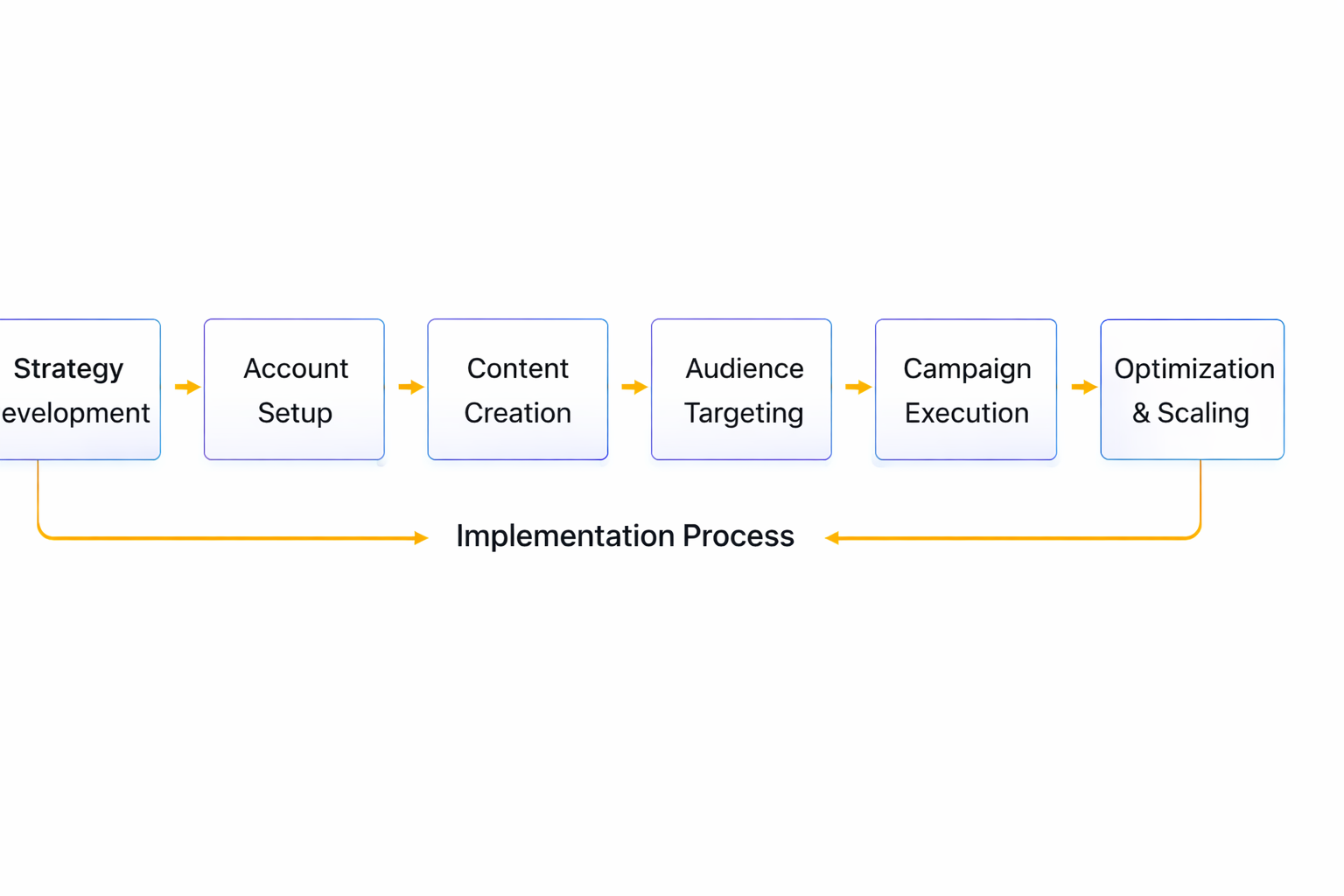
Professional implementation starts with sequencing. The best agencies do not begin by promising virality. They begin by diagnosing the offer, the audience, the content backlog, the existing ad account structure, the creator network, and the measurement environment. Only then do they build a launch plan that matches the brand’s actual stage, because a new consumer startup, a mature ecommerce brand, and a lead-gen business should not be running the same TikTok playbook.
That sequencing shows up clearly in real work. In TikTok’s official case study on e.l.f. Cosmetics and Tinuiti, the winning move was not one isolated piece of creative magic. The agency and brand built an always-engaged full-funnel strategy using a mix of ad formats and personalized targeting, and TikTok reports that the effort reduced add-to-cart acquisition costs by 56%. That is a useful example because it shows how a TikTok agency earns its keep: not by uploading random videos, but by linking creative variety, audience relevance, and funnel design into one system.
Professional implementation also requires operational honesty. TikTok changes quickly, trend cycles are short, and creative fatigue arrives faster than many brands expect. An agency that works at a high level should be comfortable telling a client when the problem is weak product-market fit, a poor landing page, delayed approvals, or a creative concept that feels like an ad before it feels like content. That kind of honesty is not a nice extra. It is what keeps TikTok from becoming an expensive experiment with no clear learning attached to it.
Start With the Business Goal, Not the Platform
This is where many weak agency engagements fall apart. A brand says it wants “more TikTok content,” the agency starts producing videos, and a few weeks later nobody can explain whether the work was supposed to generate revenue, leads, lower-funnel demand, more efficient customer acquisition, or stronger brand recall. That is a terrible foundation, because the framework becomes reactive from day one.
A strong TikTok agency begins with the commercial target. TikTok’s own agency solutions page is built around goals like boosting conversions, increasing sales, driving traffic, driving engagement, and increasing views, and that is a useful reminder that the platform already expects marketers to match format to objective. If the goal is sales, the framework should prioritize conversion-ready creative, offer clarity, landing-page continuity, and lower-funnel optimization. If the goal is brand growth, the framework should emphasize memorability, creator fit, and reach before it worries about squeezing every last click from the campaign.
This sounds simple, but it changes everything. It affects how the agency briefs creators, how it edits the first three seconds, how it allocates spend, and what it treats as success. Without that clarity, even high-performing TikTok content can become noise because the business never defined what winning was supposed to look like in the first place.
Build a Creative System Before You Scale Media
A TikTok agency should never think of content as a pile of isolated videos. It should think in terms of a creative system that keeps producing new hooks, new angles, new creator variations, and new offers without losing the core message of the brand. That is why TikTok keeps expanding tools such as Creative Center and why its 2025 business roadmap put so much emphasis on creative at scale through TikTok One.
The framework here is practical. You begin with audience insight, trend observation, comment mining, product truth, and creator language. Then you turn those inputs into batches of concepts instead of betting everything on one “hero” ad. After that, the agency tests different hooks, structures, faces, and calls to action, learns from the response, and keeps feeding those lessons back into the next wave of content.
This is also where a lot of brands underestimate the work. Native TikTok creative looks casual on the surface, but the system behind it is usually disciplined. The agencies that perform best are not winging it. They are collecting signals, turning those signals into repeatable creative patterns, and moving fast enough to stay relevant while the conversation is still happening.
Make Creators Part of the Framework, Not an Add-On
One of the clearest shifts in the platform is that creators are no longer a nice extra sitting beside the media plan. They are part of the operating system. TikTok One brings Creative Center, Creator Marketplace, and Creative Exchange into one collaboration environment, and TikTok’s own 2025 trend report argues that the old model of brands telling consumers what they need is over. Brands now have to work with creators and communities if they want content that feels culturally alive.
That changes how a good TikTok agency should work. Instead of asking creators to simply read a script, the agency should know when to hand over structure and when to hand over freedom. It should know which creators can explain, demonstrate, entertain, compare, or build trust for a specific offer. And it should know how to turn creator content into a long-term asset rather than a one-off activation that disappears as soon as the invoice is paid.
This is not theory. On TikTok’s partner guidance, the platform explains that badged partners can help brands simplify creator discovery, monitor conversations, identify trends, and know when to boost organic posts with Spark Ads. That is exactly how creator work should fit into the framework: not as decoration, but as a performance lever tied to discovery, trust, and paid amplification.
Connect Organic Performance to Paid Amplification
One of the biggest advantages a TikTok agency can offer is knowing when an organic post should stay organic and when it should be pushed harder with paid media. TikTok’s own agency materials describe Spark Ads as a way to combine the reach of paid media with the authenticity of organic content, which is a useful shorthand for how the framework should behave. The agency watches what is already earning attention naturally, then uses media to scale the pieces that have proven they belong on the platform.
That sounds obvious, but it takes judgment. Some videos attract curiosity without commercial intent. Others convert well even if they do not look spectacular in a weekly content report. A mature TikTok agency framework therefore treats organic content as a signal generator, not just a brand activity, and it uses those signals to decide what deserves budget, what deserves iteration, and what should be retired quickly.
There is a real business reason for this discipline. In TikTok’s case study on Danish agency FABO, the agency built growth around a strategy that mixed organic content with paid media, leaned on Spark Ads and full-funnel campaign design, and later reported 533% growth in clients using TikTok as part of their media mix. The point is not that every brand will copy FABO exactly. The point is that the framework works best when organic learning and paid scaling are designed together from the beginning.
Create a Measurement Loop That Keeps Improving the Work
A TikTok agency framework is incomplete if it stops at content production and media launch. The final layer has to be measurement, but not the shallow kind where an agency sends over a dashboard full of impressions and calls it strategy. The real job is to understand which creative themes move people, which creator types earn trust, which formats assist conversion, and which combinations deserve more investment.
That is why measurement partners matter so much inside the TikTok ecosystem. TikTok’s marketing partner program explicitly separates agency, creative, measurement, and marketing technology specialists, which shows how seriously the platform takes the reporting side of growth. And in Nielsen’s 2024 meta-analysis of TikTok campaigns in Southeast Asia, the point was not simply that TikTok can generate returns, but that marketing mix modeling can identify short-term sales impact, long-term brand equity effects, and synergies with other channels.
That should shape how a TikTok agency reports to clients. It should explain what changed, why it changed, what the team learned, and what will be tested next. When measurement is handled this way, the framework becomes a learning engine. When it is handled badly, the brand just gets a pile of disconnected numbers and no idea how to improve the next campaign.
Why This Framework Wins in Practice
The reason this model works is that TikTok has become too dynamic for fragmented execution. A business cannot rely on one team for content, another for creators, another for paid media, and another for reporting if those groups are not sharing information fast enough. The platform’s own 2025 updates describe a world where creative insight, creator collaboration, search behavior, AI tools, and full-funnel media solutions are increasingly connected, and the framework has to reflect that reality.
There is also a scale reason behind it. TikTok’s European newsroom reported that more than 200 million people across Europe use the platform every month, and TikTok’s February 2026 economic impact release said businesses advertising on TikTok generated €31 billion in economic value across the EU in 2025. Once a platform reaches that level of commercial importance, brands cannot afford to improvise forever. They need a system.
And that is really what a great TikTok agency sells. Not random content. Not just media buying. Not just creator outreach. It sells a framework that helps the brand keep learning, keep adapting, and keep turning attention into something valuable long after the first campaign goes live.
Strategic Planning That Starts With Market Reality
The first core component is strategic planning, and I do not mean a vague kickoff deck filled with generic language about awareness and engagement. A real TikTok agency starts by looking at the market, the offer, the customer, the category, and the actual buying journey. It needs to know why someone would stop for this product, who is most likely to care, what objections they have, and how TikTok fits into the broader revenue picture before a single creative brief gets approved.
This is what keeps the rest of the engagement from going off the rails. TikTok’s own agency-facing materials are organized around specific outcomes like increasing sales, driving traffic, boosting conversions, and growing views or engagement, which is a reminder that the platform expects a clear relationship between objective and execution. If the strategy is fuzzy, everything downstream gets weaker, because the content sounds directionless, the paid media structure becomes inefficient, and reporting turns into a pile of numbers that nobody can tie back to business goals.
That is why strong planning always feels a little demanding at the start. The agency should ask hard questions about margins, fulfillment, landing pages, content approvals, creator fit, and audience nuance. It is doing that because TikTok can expose weak positioning very quickly, and the earlier those cracks are found, the better the campaign has a chance to work.
Creative Production That Feels Native, Not Forced
The second core component is creative production, and this is where a weak TikTok agency is usually exposed. Many agencies still approach TikTok creative as if it were a polished commercial cut into a shorter format, but that is not how the platform rewards attention. The content has to feel like it belongs in the feed, which means the hook, pacing, editing style, language, framing, and emotional tone all have to match how people actually consume content there.
TikTok keeps reinforcing this reality through its own tools. Creative Center is built to help marketers study trending formats, high-performing ads, creator examples, songs, and search behavior because success on the platform is tied so closely to creative relevance. And TikTok’s 2025 business updates made it even clearer that the company sees creative as a performance driver, not a soft branding layer, with TikTok World 2025 highlighting expanded AI and creator workflows inside TikTok One.
A good TikTok agency therefore needs more than editors. It needs people who understand scripting, audience psychology, product positioning, UGC direction, testing logic, and how to produce multiple variations without diluting the message. The goal is not to make one nice video. The goal is to build a creative engine that keeps generating ideas strong enough to earn attention and specific enough to support the business objective.
Creator Collaboration That Builds Trust Faster
The third core component is creator collaboration, because TikTok is one of the clearest examples of a platform where trust often moves through people before it moves through brands. A skilled TikTok agency knows how to identify creators whose tone, audience, and style match the product, but it also knows how to structure the collaboration so the content still feels alive. That balance is everything. Over-script the creator and the post feels dead. Under-brief them and the message can drift into irrelevance.
TikTok has made creator collaboration central to its own business ecosystem. The help documentation for TikTok One describes a system that brings together Creative Center, Creator Marketplace, and Creative Exchange so brands, advertisers, and creators can work in one place. That matters because it tells you creator work is no longer an optional add-on. It is part of the operating model that the platform itself is encouraging.
You can see the value of that component in TikTok’s case study with Showa Sangyo and agency partner YRK&. The agency leaned into creator partnerships to help the brand produce content that could reach household consumers and parents more naturally, and TikTok reports the campaign generated a 283% increase in video views and a 195% increase in follower growth. Those numbers are useful, but what matters even more is the reason behind them: the agency did not try to overpower the platform with brand voice alone. It used creators to make the message feel more human and more native to how TikTok works.
Paid Media Management That Knows What to Scale
The fourth core component is paid media management, but this should never be reduced to clicking buttons inside Ads Manager. The hard part is not launching campaigns. The hard part is knowing what deserves budget, when to broaden reach, when to narrow the focus, when to let a concept breathe organically, and when to turn an organic winner into a paid asset with more aggressive distribution. That kind of judgment is where a serious TikTok agency creates leverage.
TikTok’s official partner ecosystem makes this very clear by separating expertise across agency, creative, marketing technology, and measurement partners. The platform does that because performance does not come from media setup alone. It comes from the relationship between good creative, good targeting logic, good offers, and fast feedback. If any of those pieces are weak, scale becomes expensive instead of profitable.
A strong example comes from TikTok’s case study on FABO Agency. By building campaigns that combined organic and paid execution, using formats such as Spark Ads and full-funnel media design, the agency later reported 533% growth in clients using TikTok in their media mix. That story matters because it shows what media management is supposed to do inside a TikTok agency. It is not there to rescue bad creative. It is there to identify what is already working and scale it with precision.
Measurement and Reporting That Lead to Better Decisions
The fifth core component is measurement and reporting, and this is where a lot of agency relationships either become valuable or become a waste of time. If the reporting only tells you how many impressions or clicks happened last month, it is not enough. A good TikTok agency should be able to explain which creative angles are improving performance, which creators are lifting trust, which offers are converting, and what changes the team will make next because of what the data is saying.
This is exactly why TikTok puts so much emphasis on third-party validation and measurement expertise. The official Marketing Partners program includes a dedicated measurement category, and the platform has leaned on rigorous studies such as Nielsen’s marketing mix modeling work for TikTok campaigns to show that marketers need stronger ways to isolate business impact across sales and brand outcomes. When an agency understands that level of measurement, it stops treating reporting like a client deliverable and starts using it as a creative and media decision tool.
That has a direct impact on growth. It means the team can cut weak concepts faster, keep stronger variations in rotation longer, and make smarter budget decisions with less emotion involved. The numbers become useful because they are tied to action, not because they look impressive in a slide deck.
Operational Speed and Process Discipline
The final component that often gets overlooked is operational speed. TikTok moves quickly, trends shift fast, and creative fatigue can hit long before a traditional campaign cycle would even get through approvals. So a strong TikTok agency needs process discipline behind the scenes: clear briefs, fast edits, creator coordination, approval workflows, legal checks when needed, and a cadence for launching and iterating content without dragging every decision through a two-week bottleneck.
This is one reason specialized agencies have an edge over generalist teams. In TikTok’s case study on AIDEM AGENCY, the firm is described as using TikTok-specific frameworks and data-led decision making to help brands grow with the platform. That detail matters because it shows the best agencies are not just creative shops with a TikTok offering added later. They are building their operations around the actual tempo of the platform.
And that is really the point of all these components working together. A TikTok agency becomes valuable when strategy, creative, creators, media, reporting, and execution speed are aligned tightly enough that each round of work improves the next one. When those components are missing or disconnected, the brand may still get content. It just will not get the kind of compound learning that turns TikTok into a serious growth channel.
Statistics and Data
If you are evaluating a TikTok agency seriously, this is the point where hype needs to give way to numbers. The platform is far too large, too commercial, and too measurable to judge an agency only by whether its content “looks good.” What matters is whether the data shows that TikTok can create enough attention, intent, and downstream business impact to justify a specialized partner.
The answer is yes, but only if you read the numbers the right way. A TikTok agency should know which statistics matter for scale, which ones point to buying intent, which ones prove economic value, and which ones are useful only after they are tied to creative decisions and media structure. Otherwise, it is easy to drown in impressive-looking dashboards without learning anything useful from them.
The Audience Is Large Enough to Matter
The first thing the data tells you is that TikTok is not a niche play anymore. DataReportal showed TikTok’s advertising audience at at least 1.59 billion users in January 2025, which is enormous by any serious media planning standard. In Europe, the picture is just as clear, with TikTok’s own newsroom reporting that more than 200 million people across Europe now use TikTok every month.
That matters for agency selection because it changes the job. A TikTok agency is not being hired to chase novelty on a trendy app. It is being hired to help a brand compete on a platform with enough reach to influence mainstream discovery, consideration, and purchase behavior. Once a channel reaches this level of scale, weak execution becomes expensive very quickly, which is exactly why specialization starts to matter.
Search Behavior Shows That TikTok Is Moving Down the Funnel
A second data point that changes the agency conversation is search intent. TikTok said at TikTok World 2025 that billions of searches happen on the platform every day and that search activity was up more than 40% year over year. The same announcement also said that 1 in 4 users starts searching within the first 30 seconds of opening the app, which is a strong signal that people are using TikTok to explore options, compare products, and move toward action rather than just scroll passively.
This is exactly why a good TikTok agency cannot think only in terms of entertainment metrics. Once search becomes part of the user journey, content has to answer questions, paid media has to capture intent, and reporting has to show whether those touchpoints are driving efficient action. In other words, the data pushes the agency model closer to performance marketing without removing the need for strong creative.
Economic Data Shows That Discovery Is Turning Into Revenue
The broader economic numbers also make the case for taking TikTok agency work seriously. TikTok’s February 2026 European release, based on independent research by Public First, said that businesses advertising on TikTok generated €31 billion in economic value across the EU in 2025. The same release said EU SMEs accounted for €13 billion of that total, which is especially important because it shows the platform is not working only for giant brands with massive budgets.
Those numbers do not mean every campaign will print money. What they do mean is that TikTok has already moved beyond the stage where brands can dismiss it as top-of-funnel noise. A TikTok agency is operating in an environment where discovery is producing measurable economic output, and that should raise the standard for how strategy, media buying, and attribution are handled.
Independent Measurement Matters More Than Vanity Metrics
This is where many brands make a mistake. They look at views, likes, or follower growth and assume the platform is working, when those metrics can be completely disconnected from revenue. The stronger evidence comes from studies that try to isolate actual business contribution.
In a 2024 meta-analysis by Nielsen covering ten TikTok campaigns across consumer packaged goods brands in Southeast Asia, the study found a short-term return of $1.7 for every advertising dollar spent on paid TikTok ads. Nielsen also found that TikTok delivered 2.2 times more long-term sales through brand equity than the other measured channels in that study, and when short-term and long-term effects were combined, the analysis reported a total ROAS of $2.3 per advertising dollar. Those are the kinds of numbers a competent TikTok agency should understand, because they show why media decisions cannot be separated from creative quality and long-term brand effects.
The Best Agencies Read TikTok in Context, Not in Isolation
Another smart way to read the data is to look for interaction effects instead of acting as though TikTok lives on an island. The same Nielsen analysis found 9.4% incremental sales when TikTok ads ran together with television ads for at least four weeks. That is a useful reminder that a TikTok agency should not just be optimizing one platform in a vacuum. It should understand how TikTok contributes inside a broader media mix.
This matters even more for established brands. If TikTok is helping amplify brand memory, improve search demand, or convert interest created elsewhere, then the agency’s reporting has to explain that clearly. Otherwise, the brand may underinvest in TikTok simply because the team is measuring the wrong thing or giving too much credit to the last click.
Case Study Data Reveals What Good Agency Execution Looks Like
Official case studies are useful here because they show what happens when a TikTok agency connects creative, media, and testing properly. In TikTok’s case study on Quay and its agency partner Monks, the brand ran a Conversion Lift study and TikTok reported a 417% lift in search, a 70% lift in add-to-cart activity, and a 54% lift in purchase. That is not just a nice-looking outcome. It is evidence that agencies can use controlled measurement approaches to validate whether TikTok is actually creating incremental lower-funnel movement.
The FABO agency story tells a different but equally useful data story. TikTok reports that FABO grew the number of clients using TikTok in their media mix by 533%, while one retail client achieved consistent 10x ROI on TikTok campaigns. Another client highlighted in the same case study grew from 2.47 million DKK in 2022 to 32.46 million DKK in 2023. You should not read those numbers as universal benchmarks. You should read them as proof that when a TikTok agency gets the formula right, the upside can be dramatic.
Analytics Infrastructure Has Become More Mature
One more piece of data matters if you are wondering whether TikTok measurement is still too immature for serious advertisers. It is not. Kantar said in April 2024 that its qualification as a TikTok Brand Lift measurement partner was built on more than 700 TikTok Brand Lift studies conducted with brands including Pepsi. That number matters because it shows the platform now has a much deeper measurement ecosystem than many people assume.
For a TikTok agency, this changes the standard of proof. It is no longer enough to say that the content “felt strong” or that engagement was “really good.” The better agencies are expected to tie campaign structure to conversion lift, brand lift, incrementality, or mix modeling whenever the client’s scale and budget make that possible. That is how analytics becomes a decision system instead of a reporting ritual.
What the Data Really Means for Choosing a TikTok Agency
Put all of these numbers together and the picture becomes much clearer. TikTok has the audience size to matter, the search behavior to support mid- and lower-funnel activity, the economic footprint to prove commercial relevance, and the measurement infrastructure to make agency performance easier to validate than it was a few years ago. That combination is exactly why brands should be demanding more from a TikTok agency than posting frequency and creative enthusiasm.
The right agency should be able to translate data into action. It should know when audience scale matters and when it does not, when search behavior changes creative priorities, when economic impact studies are relevant, and when a case study is actually comparable to the client’s situation. When an agency can do that, statistics stop being decoration in a pitch deck and start becoming a real competitive advantage.
Analytics and Optimization for TikTok Agency Work
This is the part where a TikTok agency either proves it knows what it is doing or gets exposed fast. It is easy to talk about trends, creators, and viral hooks, but the real test is whether the agency can look at live campaign data, understand what it means, and make smart changes before budget gets wasted. That is the difference between a team that creates activity and a team that creates momentum.
The platform itself has matured enough that there is no excuse for lazy reporting anymore. TikTok’s own measurement stack now includes a detailed reporting metrics framework inside Ads Manager, Conversion Lift tools designed to isolate incremental impact, and a broader partner ecosystem where measurement specialists sit alongside agency and creative partners. So when you hire a TikTok agency, you should expect more than screenshots from a dashboard and a few vague comments about how “engagement looked strong.”
Start With the Metrics That Match the Goal
The first rule of analytics is simple: the numbers have to match the job. If the campaign is built to drive direct sales, the agency should care far more about qualified traffic, add-to-cart behavior, checkout progression, cost per acquisition, and return on ad spend than it cares about likes. If the campaign is designed to grow awareness or shape consideration, then view quality, completion rates, brand lift, search activity, and audience retention matter more than pretending every impression should convert immediately.
TikTok reflects this directly in its own system. The platform’s official documentation on available optimization objectives shows that marketers can optimize for very different outcomes depending on whether they want traffic, conversion, value-based growth, retargeting, app actions, or broader business goals. That means a serious TikTok agency should never dump all campaigns into one reporting template. It should build a measurement structure around what the brand actually needs to accomplish.
This sounds basic, but it prevents a lot of bad decisions. Once the goal is clear, the team knows which creative signals deserve more budget, which audiences are worth deeper testing, and which metrics are merely interesting without being useful. That clarity keeps optimization grounded in business reality instead of vanity.

Read Creative Performance Like a Diagnosis
A great TikTok agency does not look at creative results and simply label a video as good or bad. It reads the performance like a diagnosis. If the hook is strong but conversion is weak, the problem may be offer clarity, creator fit, landing-page continuity, or the call to action. If click-through is low, the issue may sit in the first three seconds, the framing, the visual tension, or whether the concept feels native enough to earn attention in the feed.
This is exactly why creative and analytics have to stay connected. TikTok’s 2025 business updates emphasized how creative, search, AI tools, and performance solutions are becoming more tightly integrated, which means agencies have more ways to spot what is working and then build on it fast. The agency that wins here is the one that can explain why a concept worked, not just report that it did.
That is also why the best teams test in clusters rather than as isolated one-off videos. They compare opening hooks, creator styles, offers, pacing, comment angles, and social proof structures so the data reveals patterns instead of random outcomes. Over time, that process gives the brand something much more valuable than one successful post. It gives it a repeatable creative advantage.
Search Signals Are Now Part of Optimization
One of the most important shifts in TikTok analytics is that search behavior now needs to be treated as part of performance, not as a side note. At TikTok World 2025, the company said billions of searches happen on TikTok every day, search activity is up more than 40% year over year, and 1 in 4 users starts searching within the first 30 seconds of opening the app. That changes how a TikTok agency should think about optimization.
It means the agency has to look beyond feed metrics and ask sharper questions. Are people searching brand terms after exposure. Are they searching category phrases that show rising intent. Are creators using language that mirrors how people naturally look for solutions. Is the content helping the brand appear inside moments of curiosity rather than just moments of passive entertainment. These are the kinds of questions that become extremely valuable once search behavior becomes part of the platform’s commercial engine.
In practical terms, this pushes optimization closer to audience language and intent capture. A good TikTok agency should feed search insight back into scripts, video metadata, hooks, landing-page copy, and paid keyword strategy where relevant. That is how analytics stops being a backward-looking report and becomes part of planning the next move.
Measure Incrementality Whenever the Budget Allows It
One of the biggest mistakes brands make is assuming last-click reports tell the whole story. They do not. TikTok often influences discovery, consideration, branded search, and later conversion, which means the agency has to think in terms of incremental value instead of just platform-reported outcomes. That is why more advanced measurement methods matter so much once spend reaches a meaningful level.
TikTok has been pushing this direction openly. Its official explanation of Conversion Lift Study says the tool is designed to isolate the specific impact of TikTok advertising within a broader marketing mix, and the company’s business blog on Conversion Lift frames it as a way to understand true incremental value beyond clicks and impressions. A TikTok agency that understands incrementality will know when to recommend lift testing, when to use media mix modeling, and when simpler directional reporting is enough for the client’s stage.
This matters because it protects both sides from bad conclusions. Without incrementality, a brand may cut a campaign that is quietly generating downstream demand, or it may keep funding a campaign that looks efficient only because other channels are doing the hard work first. Better measurement makes optimization harder in the short term, but much smarter over time.
Optimization Has to Happen on a Real Cadence
Analytics only becomes valuable when it leads to action on a schedule that matches the speed of the platform. TikTok moves too fast for monthly reporting to carry the whole load. A good TikTok agency needs a rhythm for checking signal quality, spotting fatigue, refreshing creative, adjusting budgets, reviewing audience splits, and deciding what deserves another round of testing before performance slips too far.
The platform’s own updates have moved in that direction as well. TikTok’s 2025 measurement materials highlighted faster experiment design and campaign-level testing improvements, which tells you the company expects advertisers to test and iterate more actively than before. A competent TikTok agency should already be working that way. It should not need a crisis to start learning.
This is where operational discipline becomes visible. The team should know when to kill weak concepts, when to refresh the first three seconds instead of rebuilding the entire ad, when to rotate creators, and when to let a winner keep running while new variants are prepared in the background. That kind of cadence is what turns analytics into a growth system instead of a postmortem.
Know the Red Flags Before They Get Expensive
Part of optimization is catching the warning signs early. If view metrics stay healthy but landing-page views collapse, that usually points to creative-message mismatch or weak calls to action. If click-through improves but conversion efficiency worsens, the issue may be lower-intent traffic, a broken post-click experience, or targeting that is expanding too aggressively. If a creator campaign looks strong on the surface but produces shallow engagement and no downstream action, the creator may be entertaining without actually building buying confidence.
TikTok’s own Ads Best Practices keep returning to the relationship between native creative, clear messaging, user experience, and performance because the platform knows these breakdowns happen all the time. A TikTok agency worth hiring should be able to spot those patterns quickly and explain them in plain language. Not with jargon. Not with excuses. Just with clear reasoning and a clear next step.
This is also where trust gets built with clients. An agency that can name the problem honestly is much more valuable than one that hides behind averages, benchmarks, or empty optimism. Optimization gets stronger the moment everyone stops pretending the data is flattering and starts using it to make the work better.
What Good Reporting Actually Looks Like
Good reporting from a TikTok agency should feel like a decision memo, not a data dump. It should tell you what happened, why it likely happened, what the team learned, what changed since the previous period, and what the agency is going to test next. The best reports make it easy to connect creative insight, media performance, audience behavior, and commercial outcomes without making the client dig through twenty screenshots to find the point.
The reason this standard matters more now is that the ecosystem around TikTok analytics has become stronger. TikTok’s partner program continues to emphasize measurement expertise across online and offline performance understanding, and the broader market keeps expanding around it. As just one example, Ovative was named a TikTok Measurement Partner in 2025 with a focus on media mix modeling, which shows the platform is continuing to attract more serious analytical infrastructure.
So the final takeaway is simple. A TikTok agency should not just help a brand get seen. It should help the brand understand what is happening, why it is happening, and how to improve the next round fast. When analytics and optimization are handled that way, TikTok stops feeling unpredictable and starts feeling like a channel you can actually learn how to win.
The TikTok Agency Ecosystem and FAQs

By the time a brand gets serious about hiring a TikTok agency, it is usually dealing with a much bigger question than content alone. It is trying to understand how creators, paid media, measurement partners, production teams, and platform tools fit together without turning the whole thing into chaos. That is why the TikTok agency ecosystem matters so much. If you understand the ecosystem, you stop looking for a vendor and start looking for the right operating partner.
TikTok has been building that ecosystem very deliberately. TikTok One brings creators, advertisers, and brands together in one collaboration environment, while the official TikTok Marketing Partners directory separates agency, creative, measurement, and technology specialists. That structure tells you something important right away: the platform expects modern TikTok growth to be collaborative, measurable, and much more specialized than the old model of “just post more videos.”
There is also a commercial reason this ecosystem matters now more than ever. TikTok’s February 2026 EU release said that businesses advertising on TikTok generated €31 billion in economic value across the EU in 2025. Once a platform is influencing demand at that scale, the brands that win are usually the ones that understand how to assemble the right mix of creative talent, media expertise, creator relationships, and measurement discipline before competitors do.
FAQ for a Complete TikTok Agency Guide
What is a TikTok agency, really?
A TikTok agency is a specialized marketing partner that helps brands grow on TikTok through strategy, creative production, creator collaboration, paid media, and reporting. The reason the role has become more specialized is that the platform now includes a connected system of tools and partnerships, with TikTok One combining Creative Center, Creator Marketplace, and Creative Exchange. So a real TikTok agency is not just posting content. It is coordinating the parts of the platform that actually drive growth.
Do I actually need a TikTok agency?
You do not always need one, but many brands hit a point where they need expertise they cannot build quickly in-house. That usually happens when creative testing becomes inconsistent, paid spend rises, creator coordination gets messy, or leadership wants clearer proof that TikTok is producing business results. If your team can already do all of that well, you may not need an agency. If not, hiring one can be a faster path than trying to build every capability from scratch.
How is a TikTok agency different from a general social media agency?
A general social media agency may know how to manage content calendars across multiple platforms, but a strong TikTok agency is built around the tempo and behavior of TikTok specifically. That means it understands native hooks, creator-led storytelling, Spark Ads, creative testing, search behavior, and the way TikTok content can influence both discovery and conversion. The best signal that this difference matters is right in TikTok’s own ecosystem, where the platform recognizes specialized agency, creative, measurement, and tech partners separately.
What services should a TikTok agency offer?
A solid TikTok agency should cover strategy, creative planning, short-form video production, creator sourcing or management, paid campaign execution, reporting, and ongoing optimization. It should also understand when organic content should stay organic and when it should be amplified through paid tools such as Spark Ads. The most modern agencies also work comfortably inside TikTok One for advertisers, where brands can find vetted creators and partners, produce assets, and analyze performance in one place.
How does a TikTok agency usually charge?
Most TikTok agencies charge through a monthly retainer, a project fee, a percentage of ad spend, or a hybrid structure that combines management and production. There is no one perfect model because the right structure depends on whether the agency is handling media only, creative only, or a broader full-funnel engagement. What matters more than the pricing format is whether the scope is clear, whether the creative workload is realistic, and whether reporting expectations are defined from the start.
How long does it take for a TikTok agency to show results?
That depends on the business goal, the quality of the offer, and how quickly the team can test creative variations. Some campaigns show encouraging signals fast, especially when the brand already has a strong product and a clean conversion path. But compounding results usually come from repeated testing, better creator fit, and faster learning cycles, not from one lucky video. So the better question is not how fast one post can work, but how fast the agency can build a system that keeps improving.
Can a TikTok agency help small businesses, or is it mostly for big brands?
It can absolutely help smaller businesses, especially those with a strong offer and the willingness to test creative consistently. TikTok’s February 2026 EU release said that small and medium-sized businesses accounted for €13 billion of the platform’s economic value across the EU in 2025. That does not mean every small business should jump in immediately, but it does show the platform is not reserved for giant advertisers with giant budgets.
What makes a good TikTok agency stand out?
A good TikTok agency can connect creative, media, creators, and analytics without letting the work become fragmented. It can explain why something is working, not just point to a spike on a chart. It also knows how to operate at TikTok speed, which matters because trend windows close fast and creative fatigue can arrive before a traditional team has even approved the second batch of videos. The strongest agencies usually feel disciplined behind the scenes even when the content itself feels casual and natural.
Should a TikTok agency use creators in every campaign?
Not every campaign needs creators, but many benefit from them because creators often build trust and native attention faster than brand-led content alone. TikTok clearly sees this as a core part of the ecosystem, with TikTok One built to support creator, advertiser, and brand collaboration. A smart agency knows when creators are the right fit, what type of creator matches the offer, and how much scripting is too much.
How important is search on TikTok now?
It is much more important than many brands realize. TikTok said at TikTok World 2025 that billions of searches happen on the platform every day, and the same update said 1 in 4 users starts searching within the first 30 seconds of opening the app. That means a TikTok agency should think not only about feed performance, but also about how content captures curiosity, answers questions, and supports intent.
What metrics should I watch when working with a TikTok agency?
The answer depends on the goal. For ecommerce, you may care most about add-to-cart activity, checkout progression, acquisition cost, conversion rate, and return on ad spend. For awareness or consideration, view quality, completion rates, search lift, branded search behavior, and broader lift studies may matter more. What you should not do is let the agency hide behind engagement numbers that look good but do not connect to the business objective.
Can a TikTok agency prove incremental impact?
At the right budget level, yes. TikTok offers tools such as Conversion Lift Study to help isolate the specific impact of TikTok campaigns, and the platform’s partner ecosystem includes specialized measurement firms through the TikTok Marketing Partners program. That matters because the best agencies are not satisfied with last-click numbers alone. They want to understand whether TikTok is creating real incremental business value.
Can one TikTok agency handle both organic and paid well?
Yes, but not every agency does it equally well. The strongest ones use organic content as a testing ground, identify which ideas deserve amplification, and then scale those ideas through paid media rather than treating organic and paid as separate universes. That integrated model lines up closely with how TikTok itself describes the platform’s tools for brands and advertisers, especially inside TikTok One.
How do I vet a TikTok agency before signing?
Start by asking how they think, not just who they have worked with. Ask how they build creative tests, how they decide when to use creators, how they report performance, how often they refresh content, and what they do when the first campaign batch misses the mark. Then look for proof that they understand the platform’s ecosystem, whether through experience with official TikTok tools, credible case studies, or partner status that aligns with the service they claim to provide.
Is TikTok still worth investing in in 2026?
For many brands, yes, because the platform is still influencing discovery at huge scale and increasingly supports intent-driven behavior. TikTok’s EU update in February 2026 described €31 billion in economic value generated by businesses advertising on TikTok across the EU in 2025. That is not the kind of number you ignore if your audience spends time there. The smarter move is to treat the platform seriously and make sure the team running it actually knows how to win there.
Work With Professionals
If you have made it this far, the biggest takeaway should be clear. A TikTok agency is not valuable because it says the word “TikTok” in a pitch deck. It is valuable when it can bring strategy, creators, creative production, media buying, measurement, and fast iteration together in a way that helps a business keep learning and keep growing. That is what separates a real operator from a team that simply produces content and hopes for the best.
The platform itself is already organized around that idea. TikTok One is built for collaboration across creators, brands, and advertisers, and the official partner ecosystem recognizes specialized support across agency, creative, measurement, and technology categories. In other words, TikTok is telling brands exactly how to think about the channel: not as a side experiment, but as an ecosystem that rewards coordinated execution.
So if you decide to work with professionals, choose a TikTok agency that can explain its system clearly, show you how it learns, and prove it knows what to optimize when the first round of creative does not hit hard enough. That kind of partner gives you something much more valuable than a few good posts. It gives you a way to compete consistently on one of the most commercially important platforms in the market.
Explore 10K+ Remote Marketing Contracts on MarkeWork.com
Most marketers spend too much time chasing clients, competing on crowded platforms, and losing a percentage of every project to middlemen.
MarkeWork gives you a better way. Browse thousands of remote marketing contracts and connect directly with companies desperate to hire skilled marketers like you without platform commissions and without unnecessary gatekeepers.
If you’re serious about finding better opportunities and keeping 100% of what you earn, you can explore available contracts and create your profile for free at MarkeWork.com.
 Filip Konecny Enterprises