

Pay per click advertising still gives businesses one of the fastest ways to turn demand into measurable action, but it does not reward guesswork anymore. Paid search is operating inside a more complex environment where auctions factor in relevance, assets, context, landing-page experience, and increasingly AI-assisted matching rather than just the bid you enter. That shift is why smart advertisers treat PPC as a full business system instead of a traffic lever they can flip on and off.
The stakes are high because the channel is still enormous. The IAB’s 2024 revenue report showed U.S. internet ad revenue reached $258.6 billion in 2024, and paid search alone accounted for $102.9 billion, which tells you exactly where brands continue to place performance budgets. At the same time, Google now allows ads to appear around AI Overviews in 200+ markets, so advertisers are competing inside a search experience that is expanding rather than shrinking.
This first part lays down the foundation for the rest of the article. You will see how pay per click advertising works at a strategic level, why it matters to revenue-focused businesses, what framework keeps campaigns under control, which components actually move performance, and what professional implementation looks like when the goal is profitable scale rather than vanity clicks.
Article Outline
This article is organized into six connected parts so you can move straight to the section that matches your current stage.
- Part 1: Opening, article outline, why pay per click advertising matters, framework overview, core components, and professional implementation
- Part 2: Campaign setup, keyword strategy, audience targeting, match types, and account structure
- Part 3: Ad creation, offer design, landing pages, conversion paths, and message alignment
- Part 4: Bidding, budgeting, optimization cycles, search term control, and scaling decisions
- Part 5: Measurement, analytics, attribution, conversion quality, and return on investment
- Part 6: Advanced strategy, common mistakes, ecosystem decisions, and FAQ
Why Pay Per Click Advertising Matters
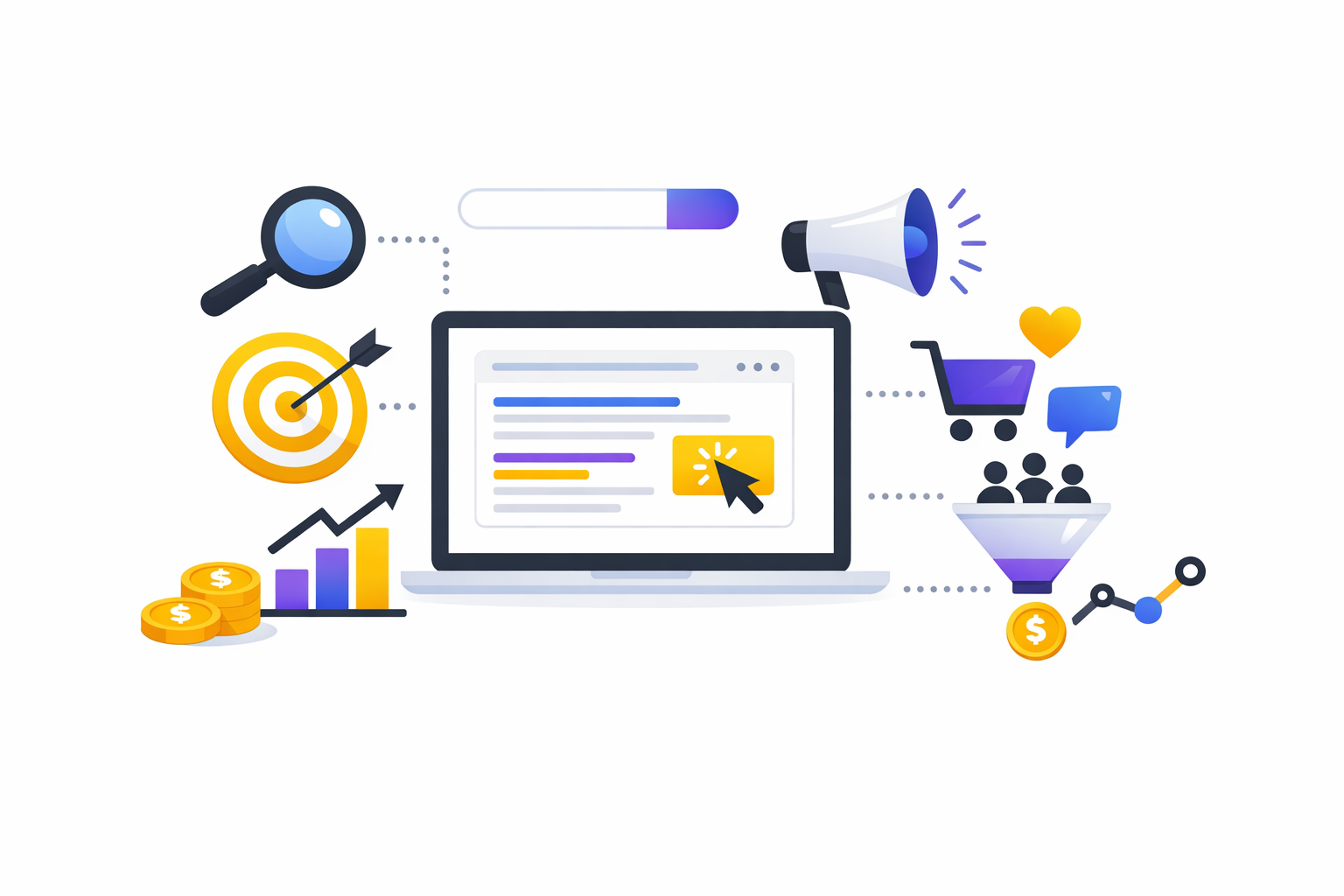
What makes pay per click advertising so important is its position in the buying journey. SEO, social content, email, and brand campaigns all matter, but PPC reaches people when intent is already forming and when the next click can lead directly to a quote request, purchase, booked demo, or phone call. That immediacy is why the channel remains central for businesses that care about pipeline now, not just awareness later.
It also matters because search behavior is getting broader and more nuanced, not simpler. Google has confirmed that ads are now eligible to show above, below, and in some cases within AI Overview experiences depending on relevance and commercial intent, which means advertisers have new chances to appear during exploratory searches that used to feel too early to monetize. In practical terms, pay per click advertising is no longer only about capturing obvious bottom-funnel keywords; it is also about showing up when a customer is comparing options, framing a problem, or narrowing a shortlist.
The business case becomes even stronger when measurement is done properly. Google’s recent measurement guidance points to research showing an average short-term profit ROI of £1.87 for every £1 invested, with higher returns when longer-term effects are included, but that upside only appears when advertisers connect spend to real business outcomes instead of celebrating cheap traffic. PPC matters because it can be accountable, fast, and scalable, but only when the account is built to learn from revenue data rather than just clicks.
There is another reason this channel deserves serious attention: it is still where competitive pressure becomes visible first. Google’s auction system weighs relevance, expected asset impact, and context alongside bids, and Google explicitly states that a more relevant ad can win a higher position at a lower price than a competitor with a bigger bid. That means pay per click advertising is one of the few channels where operational discipline, not just budget size, can create a genuine advantage.
Microsoft’s network reinforces the same point from a different angle. Its advertising platform continues to position itself as a way to reach high-intent users across Bing, Yahoo, DuckDuckGo, Microsoft properties, and partner inventory, while keeping the model simple: you only pay for clicks. For many brands, that creates a useful second engine for demand capture, especially when Google is crowded and the team needs incremental reach without abandoning search intent.
A Framework Overview
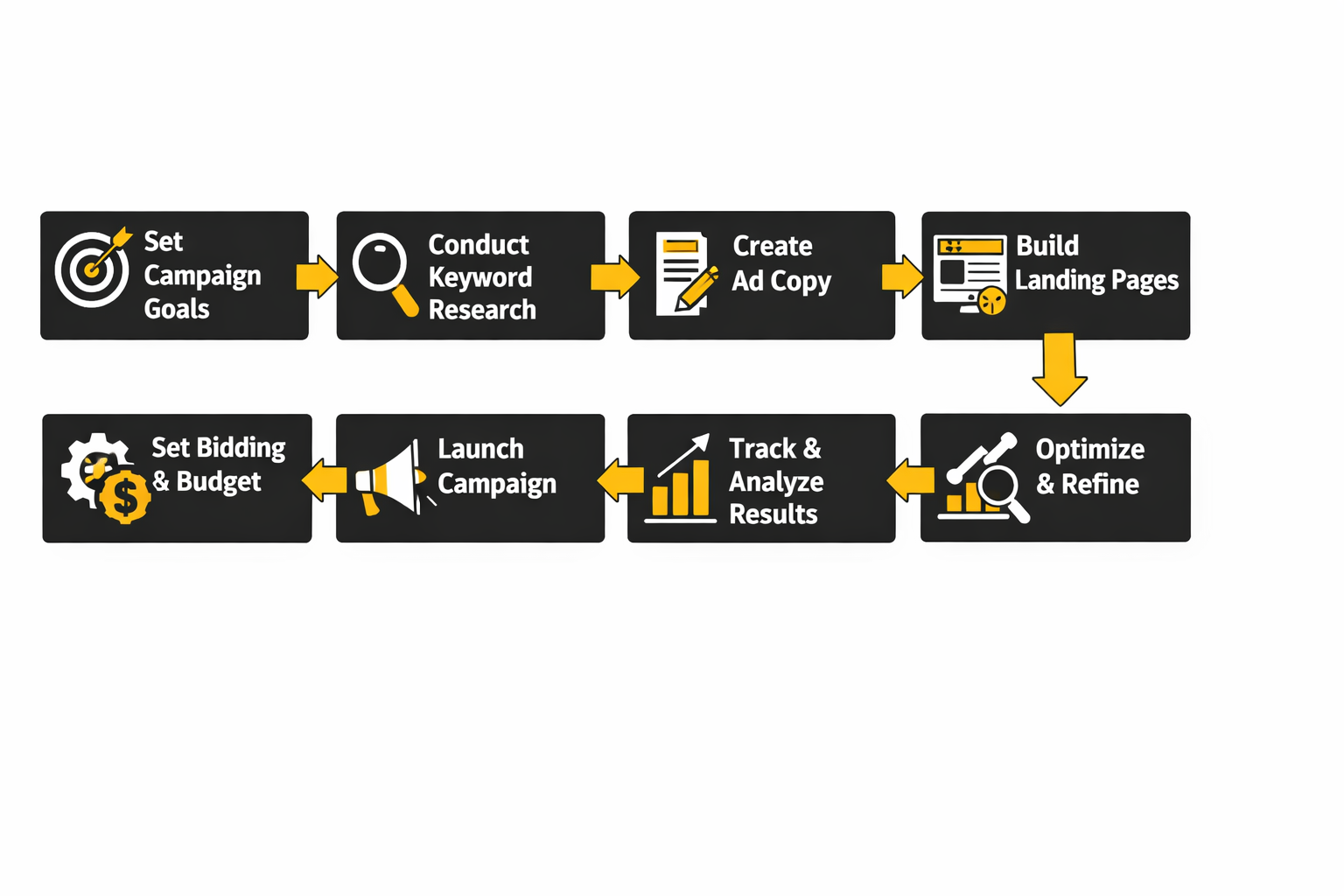
The cleanest way to understand pay per click advertising is to see it as a five-layer framework: demand capture, message matching, conversion design, measurement, and optimization. Most struggling accounts focus almost entirely on the first layer and assume keyword selection is the whole game. In reality, strong results only appear when all five layers support each other.
Demand capture is the front door. This is where campaigns decide which searches, audiences, locations, devices, and commercial moments deserve budget. It includes classic keyword strategy, but it also includes broader controls such as exclusions, audience signals, product feeds, and campaign types that now rely heavily on automation and first-party data. Google’s 2025 product updates have leaned even harder into AI-powered expansion and incrementality testing, which is another sign that modern PPC is less about manual micromanagement and more about feeding the platform clear signals it can optimize against.
Message matching is where many accounts silently lose money. A search ad has to feel like the next logical step after the query, not a generic promotion pasted across a hundred ad groups. The stronger the alignment between user intent, ad copy, assets, and landing page promise, the easier it becomes to win better visibility without simply raising bids.
Conversion design is the part too many advertisers outsource to luck. A campaign can attract exactly the right user and still fail if the page is slow, the offer is weak, the form is bloated, or the next step is unclear. This is why experienced teams treat landing pages as part of pay per click advertising, not as a separate web project. When businesses need a fast way to build cleaner post-click experiences, tools such as ClickFunnels or Systeme.io are often used to tighten the path from click to lead without waiting for a full development cycle.
Measurement is the control center. Google’s newer lead-generation guidance keeps returning to the same truth: if you do not connect downstream outcomes back into the ad platform, bidding systems will optimize for the wrong people. That is why offline conversion imports, enhanced conversions, CRM feedback loops, and sales-qualified lead tracking are no longer advanced extras. They are basic operating requirements for any business that wants profitable growth.
Optimization is the final layer, but it is not a one-time cleanup session. It is the weekly and monthly discipline of deciding what deserves more budget, what needs tighter targeting, what should be cut, and what can be expanded because the economics finally support it. The framework matters because it prevents the common mistake of solving a measurement problem with bid changes, or a landing-page problem with broader keywords, or a poor-offer problem with better ad copy.
Core Components
The first core component is campaign architecture. A good account structure makes intent visible. It separates branded from non-branded demand, isolates high-value offers, protects budget from vague traffic, and gives the team a clear way to compare search, shopping, remarketing, and automated campaign types without blending them into one unreadable dashboard. Structure is not glamorous, but it decides whether optimization will be surgical or chaotic.
The second component is targeting logic. Keywords still matter, but pay per click advertising now depends just as much on how well you guide automation with exclusions, audience data, creative inputs, product information, and conversion signals. Google’s newer AI-led search products are designed to uncover net-new relevant queries and adapt assets to user intent, which can be powerful, but only when the advertiser has done the foundational work of defining what a valuable lead or sale actually looks like.
The third component is ad quality. Google explains that ad assets, expected performance impact, and contextual relevance all influence Ad Rank, which is why weak ads often create an invisible tax on the account. If every headline looks interchangeable and every description sounds like corporate filler, the business is effectively forcing itself to pay more to compete. Better ads do not just lift click-through rate; they improve the economic efficiency of the entire campaign.
The fourth component is the landing page and offer combination. People do not click ads because they love ads. They click because the promise feels useful, timely, and credible. The page they arrive on must continue that promise immediately, prove the claim, remove friction, and make the next action obvious. For lead generation, that often means a tighter form, stronger proof, better call-to-action placement, and faster page speed. For ecommerce, it usually means cleaner product detail pages, clearer shipping and return information, and sharper merchandising around the click source.
The fifth component is data integrity. Nielsen’s 2025 Annual Marketing Report was built on responses from 1,400 global marketers, and one of the biggest themes in current performance marketing is pressure to prove what is really working across channels. Inside PPC, that pressure shows up as a simple question: are you measuring leads, qualified leads, opportunities, closed revenue, or just form fills? The more expensive the market becomes, the more dangerous shallow measurement gets.
The sixth component is platform mix. Google remains the center of gravity, but it is not the whole market. Microsoft Advertising continues to pitch its network as a way to reach active searchers across major search and publisher environments, and for some brands it can produce less contested auctions and highly attractive incremental volume. Professional teams do not force every budget into one platform out of habit; they compare economics and keep the channels that produce profit.
The seventh component is operational speed. Campaigns drift fast when search behavior changes, competitors launch promotions, or the sales team updates what counts as a good lead. A PPC program needs a routine for search term reviews, creative refreshes, negative keyword control, landing-page experiments, budget reallocation, and stakeholder feedback. Without that rhythm, even a well-built account slowly becomes an expensive snapshot of what worked three months ago.
Professional Implementation
Professional implementation starts with business math, not platform settings. Before a single campaign goes live, the team should know the target cost per acquisition, the acceptable payback window, the average order value or deal value, close rates, and the difference between a cheap lead and a profitable one. That sounds basic, but many PPC accounts are still launched with the vague objective of “getting traffic,” which is another way of saying nobody has defined success clearly enough to optimize toward it.
From there, professional implementation moves into tracking discipline. Conversion setup has to be checked at the page level, form level, CRM level, and revenue level. Google’s own lead-generation materials keep stressing the value of stronger conversion measurement because automation can only optimize around the signals it receives. If the account is fed incomplete or low-quality data, even smart bidding will scale the wrong behavior.
The next step is building campaigns that reflect how buyers actually search. That means separating urgent commercial intent from early research intent, protecting the budget with negatives, and matching landing pages to the promise of the query. It also means accepting that newer campaign types need supervision, not blind trust. AI-powered systems can expand reach and speed up testing, but they perform best when the advertiser provides quality creative, reliable conversion data, and clear business constraints.
A professional approach also brings cross-functional thinking into the process. PPC does better when the landing page team, CRM owner, sales team, and analytics lead are all connected. If a campaign is delivering leads that never close, the answer may sit in qualification rules, follow-up speed, pricing friction, or offer mismatch rather than the ad platform itself. This is why mature advertisers use pay per click advertising as an operating system tied to revenue, not as a standalone media buy.
Real-world results usually come from that level of integration. Google recently highlighted Meilleurtaux, which used Performance Max as part of a broader acquisition strategy and achieved an 8% increase in conversions, a 3% reduction in cost per lead, and an 11% improvement in conversion rate. In another current example, Google reported that Audi Polska’s Demand Gen strategy generated 2x more leads at a 55% lower cost per lead and a 40% lower cost per click than comparable social campaigns. Those are not magic tricks. They are the result of stronger audience signals, better creative alignment, and clearer optimization around business outcomes.
Microsoft’s recent customer stories point in a similar direction. Its platform highlights cases such as GLAMI reporting 130% more sessions year over year and 76% more orders for partners through Microsoft Shopping, while case studies for brands like Postbank and IKEA show how disciplined account consolidation, smarter campaign mixes, and clearer product-level organization can strengthen paid performance. The lesson is not that one platform or one campaign type is secretly perfect. The lesson is that professional implementation wins when strategy, data, creative, and conversion experience are all built to support each other.
The final layer is follow-up after the click. PPC rarely fails because someone clicked the wrong headline. It fails because the business does not answer the lead quickly enough, nurture the inquiry well enough, or turn demand into a coherent post-click journey. That is why many advertisers pair campaigns with tools for email capture, automation, and remarketing such as Brevo for lifecycle messaging or Buffer to reinforce paid campaigns with consistent organic distribution. The click is important, but what happens after the click is where profit is either protected or wasted.
Part 1 establishes the core idea that pay per click advertising is not just media buying. It is the coordination of intent, message, offer, data, and follow-up inside a system that can be measured and improved. In Part 2, the focus shifts into campaign setup and targeting so the foundation you build here can turn into a cleaner, more controllable account structure.
Campaign Setup and Targeting
If you want pay per click advertising to work, the setup phase has to be treated like strategy, not admin. This is the point where you decide what kind of demand deserves its own budget, how tightly you want to control intent, and where you are willing to let automation explore. Get this wrong and the account becomes messy fast, which usually means good searches get buried under vague traffic, reporting becomes hard to trust, and optimization turns into guesswork.
That is also why serious advertisers do not begin with keywords alone. They start with business goals, map those goals to campaign types, then decide how targeting should support the economics of the offer. Google’s current guidance on keyword matching options, negative keywords, audience signals, and search themes makes it clear that modern targeting is broader than the old model of building a few ad groups and hoping exact match does the rest.
In this part, the focus is on how to structure campaigns so pay per click advertising can stay profitable as data accumulates. That means separating intent properly, using match types with purpose, teaching the platform what to avoid, and building an account that still makes sense when it is twice the size it is today.
Campaign Architecture That Protects Budget
Good campaign architecture is about protecting clarity. When branded traffic, competitor traffic, high-intent non-brand searches, experimental campaigns, and remarketing all live in the same budget pool, the account stops telling the truth. A branded search can make the whole account look efficient, while broad prospecting quietly drains spend in the background.
That is why the cleanest setup for pay per click advertising usually starts by separating campaign intent, not just product categories. Brand campaigns need their own reporting because they answer a different question from non-brand acquisition. High-intent commercial terms deserve more direct budget control than exploratory searches, and remarketing should not be blended into cold acquisition if you want to understand what is really creating new demand.
Microsoft Advertising makes a similar case in practice through its enterprise customer stories, including the recent IKEA account consolidation example, where simplifying fragmented account structures helped the team improve visibility and streamline spend decisions. That matters because campaign structure is not just an internal preference. It shapes how quickly a team can spot waste, find winners, and reallocate money before a weak month turns into a weak quarter.
Keyword Strategy and Match Types
The smartest keyword strategy in pay per click advertising does not begin with the longest list possible. It begins with the clearest set of buying moments. Some searches are direct and transactional, some are comparison-driven, and some are still early enough that the user needs education before they will act. If you mix all of those into one targeting approach, the account will pull traffic from too many stages of intent without telling you which stage is actually making money.
Google still centers search targeting around broad match, phrase match, and exact match, but the real decision is not which one is “best.” The decision is which one fits the level of exploration or control you need in a specific campaign. Google’s official explanation of match types makes this tradeoff very clear: broad match opens reach to a wider variety of searches, while exact match gives you tighter control over the queries that can enter the auction.
That means broad match makes the most sense when conversion tracking is strong, the budget can tolerate learning, and the business wants discovery. Exact match makes more sense when the offer is narrow, margins are tight, or the team needs extremely clean search intent. Phrase match often sits in the middle, giving enough flexibility to capture close variants while still preserving some structure around the core commercial language that matters most.
Google’s rollout of AI Max for Search campaigns adds another layer to this conversation because search term matching can now expand beyond the traditional keyword list when advertisers choose to enable it. That does not make keyword strategy irrelevant. It means the strategy has shifted from manually predicting every valuable query to deciding where the platform should have room to discover and where it should be tightly fenced in.
Negative Keywords and Exclusions
One of the biggest mistakes in pay per click advertising is treating targeting as only a matter of what you want. In reality, the account gets cleaner and cheaper when you also define what you do not want. Negative keywords stop the platform from wandering into searches that sound related on the surface but have no realistic chance of producing revenue.
Google’s guidance on negative keywords is still one of the most practical rules in the entire platform: highly targeted campaigns are built by choosing what not to target. That sounds simple, but it changes everything once an account grows. Terms like “free,” “jobs,” “definition,” “template,” or unrelated product variants can quietly siphon spend unless someone is actively reviewing search behavior and blocking irrelevance before it compounds.
There is a second layer here that matters even more for modern accounts. Google’s updated materials now warn that negatives are a restrictive control and should be used deliberately, especially in more automated environments where brand exclusions or better audience guidance may solve the problem more cleanly. In other words, negative keywords are still essential, but professional advertisers use them with intent instead of building giant lists that choke off valid discovery.
At scale, exclusion work becomes a system. Shared negative lists, account-level patterns, and recurring search-term reviews are what keep pay per click advertising from drifting into low-quality traffic over time. Without that discipline, an account can look stable in the interface while steadily becoming less qualified in the real world.
Audience Targeting and Intent Layering
Audience targeting matters because not every click should carry the same value. Two people can type similar searches while arriving with very different levels of readiness. One may be comparing options for the first time, while the other already knows the category, the price range, and the kind of solution they want. Great pay per click advertising recognizes that difference and layers intent signals into the account instead of pretending every search is equally mature.
Google’s official documentation for audience signals in Performance Max shows how first-party data, past converters, site visitors, and engaged users help the system learn faster. That matters because audience signals do not lock targeting permanently. They guide the machine toward stronger starting points, which is especially useful when the business already has valuable customer data but has not been feeding that data back into the platform properly.
Search themes play a similar role in newer automated campaigns. Google explains in its help page on search themes that these phrases help keywordless targeting find relevant demand faster by describing what customers are likely to search for. That is important because it shows where the platform is headed: less obsession with manually entering every phrase, and more focus on giving the system accurate commercial direction.
For a business running pay per click advertising today, that means audience work should not be saved for retargeting only. Customer lists, past purchasers, qualified leads, high-value visitors, cart abandoners, and top-of-funnel educational audiences all have a role. The better the account reflects those layers of intent, the easier it becomes to decide where to push harder and where to stay selective.
Location, Device, and Schedule Controls
A lot of wasted spend in pay per click advertising comes from targeting controls that look harmless because they were never set thoughtfully in the first place. Location targeting is a perfect example. Many advertisers think they are showing ads only in a service area when they are actually allowing interest-based expansion that reaches people outside the territory they can realistically serve.
That is why campaign setup needs to include a very practical review of geography, device behavior, and timing. A local service business, for example, does not need broad national exposure just because search volume is bigger there. An ecommerce brand may be able to sell nationwide, but still discover that certain regions convert far better and deserve separate budgeting or localized messaging.
Device and timing decisions work the same way. A lead-generation offer that converts beautifully on desktop during working hours may struggle on mobile late at night, not because the traffic is bad, but because the buying context is different. Professional teams use these controls to sharpen the fit between the click and the likely action, rather than assuming more availability automatically means better performance.
Account Structure for Scaling
The account structure you choose at launch will either make scaling easier or turn it into a headache later. That is why pay per click advertising should be structured in a way that can survive success. If a campaign starts winning, you need to know whether the structure will let you split budgets, isolate top performers, test new pages, add new geographies, or segment by product line without rebuilding the entire thing under pressure.
A scalable account usually has naming conventions that make sense, campaign goals that are visible immediately, and asset organization that reflects the real business model. Search, shopping, remarketing, brand defense, and experimentation all need enough separation that one strong area does not hide weakness elsewhere. Once the account begins to grow, this becomes less about tidiness and more about operational speed.
There is also a human side to this. Paid search rarely lives with just one person forever. Agencies get involved, internal hires take over, finance wants cleaner reporting, leadership wants answers faster, and sales wants better lead quality. A well-structured account makes those handoffs easier because the logic is visible. A sloppy one forces every new person to guess what the original builder intended, and that is where wasted budget starts piling up.

A Practical Setup Mindset
The best mindset for campaign setup is to assume that every setting will eventually be tested by real money. That is why pay per click advertising rewards people who think in systems. They do not ask only whether a targeting option can bring clicks. They ask whether it can bring the kind of clicks that match margins, sales capacity, close rates, and the actual promise of the offer.
This is also the stage where post-click planning should start, not later. If the campaign is driving people into a weak form flow or a confusing page, even excellent targeting will disappoint. That is why many businesses pair their paid traffic setup with a cleaner conversion path using tools like ClickFunnels, Systeme.io, or Brevo when they need the lead capture and follow-up side of the system to be as intentional as the targeting itself.
Once this foundation is in place, the account becomes much easier to improve because you are no longer fixing structural confusion every week. You are optimizing a system that already knows what kind of demand it wants, what kind of traffic it should reject, and how to route the right click toward the right next step. That is the point where pay per click advertising starts to feel less chaotic and a lot more profitable.
Ad Creation and Landing Pages

This is where pay per click advertising stops being a targeting exercise and becomes a persuasion exercise. You can choose the right keywords, the right audiences, and the right bidding strategy, but if the ad feels generic or the landing page feels disconnected, the whole system breaks right after the click. That is why the best advertisers do not treat ad copy and landing pages as separate tasks. They treat them as one continuous promise.
Google’s own explanation of responsive search ads makes that pretty clear. The platform is built to test combinations of headlines and descriptions over time so it can find which messages work best for different searches. That means your job is not to write one clever line and hope it wins forever. Your job is to give the system a strong set of useful messages that reflect real buyer intent, then make sure the page after the click delivers exactly what the ad suggested it would.
Part 3 is about building that bridge. It covers how to write ads that sound relevant instead of robotic, how to use assets to make the message more useful, how to create landing pages that keep momentum alive, and how to tighten the path from search to conversion so your pay per click advertising does not lose qualified people at the moment they were finally ready to act.
Writing Ads That Sound Like the Answer
The strongest ads in pay per click advertising do not sound like advertisements first. They sound like the next logical answer to the search someone just made. When a person types a commercial query, they are not looking to admire your creativity from a distance. They are looking for a result that feels specific, credible, and immediately useful.
That is why good ad writing begins with intent, not slogans. A high-intent search needs clarity about the offer, the category, the benefit, and the next step. A comparison search may need stronger differentiation. An early-stage search may need reassurance and framing more than a hard push. When you write every ad as if the buyer is in the same mental state, you flatten the account and make it harder for the platform to match the right message to the right moment.
Google’s current guidance on responsive search ads and its newer campaign-level text assets points to the same operating principle: variety matters when it is purposeful. Different headlines should not just repeat the same claim with minor wording changes. They should express different angles of relevance, such as urgency, trust, product fit, pricing clarity, or outcome. That is how pay per click advertising starts to feel personal without becoming vague.
Using Assets to Make Ads More Useful
Assets matter because they make the ad bigger, clearer, and more helpful before anyone clicks. Google explains in its documentation on ad assets that relevant assets like sitelinks and images can improve visibility and prominence on the results page. In plain English, that means a strong ad can take up more space, answer more objections, and give searchers more reasons to choose you before they even reach the landing page.
This is one of the easiest places to lose money quietly. Businesses spend a huge amount of time picking keywords and almost no time building useful assets, which leaves their ads looking thin next to more prepared competitors. A sitelink to pricing, a callout about setup speed, a structured snippet that clarifies categories, or an image extension that supports the offer can all strengthen the pre-click experience in a way that generic copy alone cannot.
Google’s campaign-level asset reporting also matters here because it gives advertisers a cleaner view of which assets are helping performance across campaigns. That feature became available for dates on and after June 5, 2025, which is a useful reminder that ad creation in pay per click advertising is getting more measurable. You no longer have to treat assets like decorative extras. You can treat them like performance inputs and improve them the same way you improve bids or audiences.
Landing Pages That Finish the Job
A click only has value when the page after it keeps the conversation going. Google’s explanation of landing page experience focuses on relevance, usefulness, ease of navigation, and whether the page matches the expectations created by the ad. That last point matters more than many advertisers realize. A landing page does not just need to look good. It needs to feel like the exact destination the searcher thought they were choosing.
This is where a lot of pay per click advertising breaks down. The ad promises a clear solution, but the landing page opens with vague branding language, too many competing links, or a layout that forces the visitor to hunt for the next step. The momentum from the search is gone in seconds. That is not a design problem alone. It is a business problem because you already paid for the opportunity and then made the path harder than it needed to be.
Google also notes in its landing page performance guidance that improving mobile speed is one of the easiest ways to get better results, and it highlights that in retail a 1-second delay on mobile can affect mobile conversions by up to 20%. That is exactly why landing pages need to be built with urgency in mind. When someone clicks with intent, speed is not a luxury feature. It is part of the sale.
Forms, Offers, and Friction
Most landing page underperformance is not caused by one dramatic flaw. It usually comes from friction stacking up in small ways. A headline that is too broad, a form that asks for too much too early, a button that does not clarify what happens next, an offer that sounds safe instead of compelling, or a page that feels designed for everyone instead of the person who just searched. On their own, each problem may look manageable. Together, they crush conversion intent.
The smarter way to think about this inside pay per click advertising is to ask a brutally practical question: what is the minimum amount of friction required to move the right person forward without damaging lead quality? Google’s lead generation best practices emphasize mapping the full lead-to-sale path and choosing conversion actions that reflect real business value. That means your form should not be designed in isolation. It should reflect what sales actually needs, what prospects are willing to give, and what stage of the journey the click represents.
When businesses need more control over the post-click experience, many of them use dedicated funnel and landing page tools instead of forcing every paid search visitor onto a general website template. Platforms like ClickFunnels and Systeme.io are often used for that reason. They give advertisers a faster way to tighten the offer, reduce distractions, and match the page more closely to the intent that pay per click advertising is already paying to attract.
Message Match Across the Full Click Path
Message match is one of those ideas that sounds simple until you realize how often it gets ignored. If the search says one thing, the ad says another, and the landing page opens with something else entirely, trust starts leaking immediately. People do not always articulate that mismatch, but they feel it. And once they feel it, the click becomes fragile.
The better approach is to keep the thread intact from the first search term to the final call to action. The promise in the ad should show up in the headline. The headline should flow into proof. The proof should support the offer. The offer should lead naturally into the form, demo request, checkout, or booking step. That kind of continuity is what makes pay per click advertising feel less like interruption and more like assistance.
Google’s own framing of landing page experience reinforces this point by centering user expectations from the clicked ad creative. In other words, the platform is not only evaluating whether the page exists. It is evaluating whether the page deserves the click it received. That is why message match is not just a copywriting best practice. It is part of performance.
Conversion Paths and Follow-Up
The conversion path does not end when the form is submitted. In many businesses, that is where the real make-or-break moment begins. A search campaign can bring in an excellent lead, but if the response is slow, the follow-up is weak, or the nurture sequence is missing, the value created by pay per click advertising starts evaporating almost immediately.
This is why the best advertisers think beyond the page itself. They plan what happens after the click and after the form. Confirmation pages, calendar scheduling, automated email sequences, CRM routing, remarketing audiences, and sales alerts all matter because they shape whether demand turns into revenue or just another line in a dashboard. A campaign can look healthy in-platform and still disappoint the business if the next steps are sloppy.
That is where tools for capture and follow-up start earning their keep. Brevo can help with automated email follow-up and segmentation, while Cal.com can shorten the distance between interest and booked conversation when speed matters. The point is not that every business needs the same stack. The point is that pay per click advertising becomes much more powerful when the click is connected to a real conversion system instead of being left to chance.
What Good Part 3 Really Means in Practice
If you zoom out, the lesson from this part is pretty simple. Great pay per click advertising does not win by attracting clicks and hoping the rest takes care of itself. It wins by making the ad feel like the answer, making the page feel like the right destination, and making the conversion path feel easy enough for the right person to continue.
That is also why this stage deserves so much attention. The ad is where relevance becomes visible. The landing page is where trust becomes tangible. The conversion path is where business value either appears or disappears. Once those three layers start working together, optimization becomes a lot more effective because you are improving a complete system instead of trying to rescue broken handoffs.
In Part 4, the focus shifts to the money side of the engine: bidding, budgeting, optimization cycles, search term control, and the scaling decisions that determine whether pay per click advertising stays efficient as spend rises.
Bidding, Budgeting, and Optimization
This is the part of pay per click advertising where a campaign either becomes a disciplined growth system or starts leaking money in ways that are hard to spot at first. The platform can find demand, the ads can attract clicks, and the landing page can convert, but the economics still fall apart if bids are pushing too hard, budgets are set without enough room to learn, or optimization is reduced to random changes made under pressure. That is why the money side of paid search deserves just as much structure as the targeting side.
Google’s official guide to Smart Bidding makes the current reality very clear. Automated strategies now set bids at auction time and use contextual signals to pursue conversion volume or conversion value with more precision than manual bidding can usually handle at scale. That does not mean advertisers should hand over control and stop thinking. It means the job has shifted from entering bids by hand to feeding the system stronger goals, cleaner data, and tighter commercial boundaries.
In other words, pay per click advertising is no longer won by whoever clicks the most buttons inside the interface. It is won by the business that knows how much a conversion is worth, how much volatility it can tolerate, and how quickly it can tell whether higher spend is creating more profit or just more activity. Once that becomes the lens, bidding, budgeting, and optimization stop feeling like isolated platform tasks and start working like financial decisions.
Choosing a Bidding Strategy That Fits the Goal
The right bidding strategy depends on what the business is actually trying to maximize. If the goal is lead volume and the conversion data is trustworthy, strategies such as Maximize Conversions or Target CPA can make sense. If the goal is revenue or higher-value purchases, Target ROAS or Maximize Conversion Value often align better with how the business makes money. Google’s help documentation on Smart Bidding and bid strategy simulators reinforces that these systems are designed to react to auction-level signals in real time, which is exactly why they work best when the objective is defined clearly.
The mistake many advertisers make is choosing a bidding strategy because it sounds advanced rather than because it matches the commercial model. A lead-generation company with weak qualification data can struggle badly on automated bidding if the platform is optimizing for every form fill equally. An ecommerce business that knows its margins and values can often get much better results because the system has a clearer target to chase. So the question is never just “Which bid strategy is best?” The question is “Which bid strategy best reflects how this business creates value?”
That distinction matters even more now that Google continues to expand AI-powered ad delivery across search experiences and campaign types, as highlighted in its 2025 product highlights. When the platform can expand into more placements and query patterns, your bidding strategy becomes even more important because it tells the system what kind of result is worth pursuing when it finds those opportunities.
Budgeting With Room to Learn
Budgeting in pay per click advertising should never be based on hope. It should be based on how many meaningful clicks the campaign needs, how expensive those clicks tend to be, and how much data the system needs before it can make smarter decisions. A budget that is too tight does not just slow growth. It can distort the learning process so badly that good campaigns never get enough volume to prove themselves.
Google’s explanation of the budget report is useful here because it frames budget as something you actively manage in relation to projected spend and performance, not something you set once and forget. The platform is telling advertisers, in effect, that budget is part of performance management. If the campaign is capped too early in the day, strong demand goes uncaptured. If the budget is inflated without a plan, low-quality expansion becomes much more likely.
This is also where marketers get tripped up by averages. The 2025 search advertising benchmark analysis based on more than 16,000 campaigns shows just how wide the gaps can be by industry for click-through rate, cost per click, conversion rate, and cost per lead. That matters because a sensible budget in legal, SaaS, home services, or ecommerce can look completely different. Pay per click advertising gets much easier to manage when budgeting is tied to your own conversion economics and your own market reality rather than somebody else’s generic “minimum spend” rule.
Optimization Cycles That Actually Improve Performance
Optimization is where discipline beats emotion. A lot of advertisers still react to short-term noise by changing bids, budgets, and targeting too aggressively, especially after a few slow days. That usually creates more instability instead of less because the system never gets enough consistency to learn what is working. Pay per click advertising improves faster when changes are tied to patterns, not panic.
That is one reason Google keeps pushing advertisers toward better visibility tools rather than pure interface tinkering. Its documentation on search terms insights and the search terms report shows how the platform expects advertisers to study how customers are actually searching, identify performance themes, and use those findings to improve creative, landing pages, and exclusions. The goal is not to optimize for the sake of movement. The goal is to make smarter decisions based on where intent and results are lining up.
The best optimization cycles are usually built around a clear rhythm. Search behavior gets reviewed regularly. Weak queries are excluded. Strong themes get promoted into cleaner structures when needed. Ads are refreshed when the message gets stale. Budgets move toward what is closing, not just what is attracting curiosity. When that rhythm is in place, pay per click advertising becomes more stable because the account is learning in an organized way instead of being jerked around by every fluctuation on the dashboard.
Scaling Without Destroying Efficiency
Scaling sounds exciting until the numbers start bending in the wrong direction. The reason this happens so often is simple: the easiest clicks and conversions usually come first. Once you push beyond that core demand, the campaign has to work harder to find the next layer of profitable volume. That is why scaling in pay per click advertising cannot be reduced to “raise the budget and hope the machine figures it out.”
Google’s own case studies are useful because they show what healthy scaling tends to look like. In the company’s Meilleurtaux lead generation example, Performance Max contributed to an 8% increase in conversions, a 3% reduction in cost per lead, and an 11% lift in conversion rate within a year. What stands out there is not just the improvement itself. It is the fact that the gains were tied to a more mature setup around lead generation strategy, not a single tactic pulled out of context.
The same pattern shows up in Google’s Audi Polska Demand Gen case study, where the brand generated 2x more leads at a 55% lower cost per lead and a 40% lower cost per click than comparable social efforts. That does not mean every campaign will suddenly deliver those numbers. It means efficient scaling usually comes from better signal quality, stronger creative alignment, and sharper commercial intent rather than from sheer budget force.
For advertisers trying to scale their own pay per click advertising, that translates into a practical rule: expand one constraint at a time and watch what happens to lead quality, conversion rate, and downstream revenue. If spend rises but qualification falls, that is not real scale. It is just more expensive noise dressed up as growth.
Statistics and Data
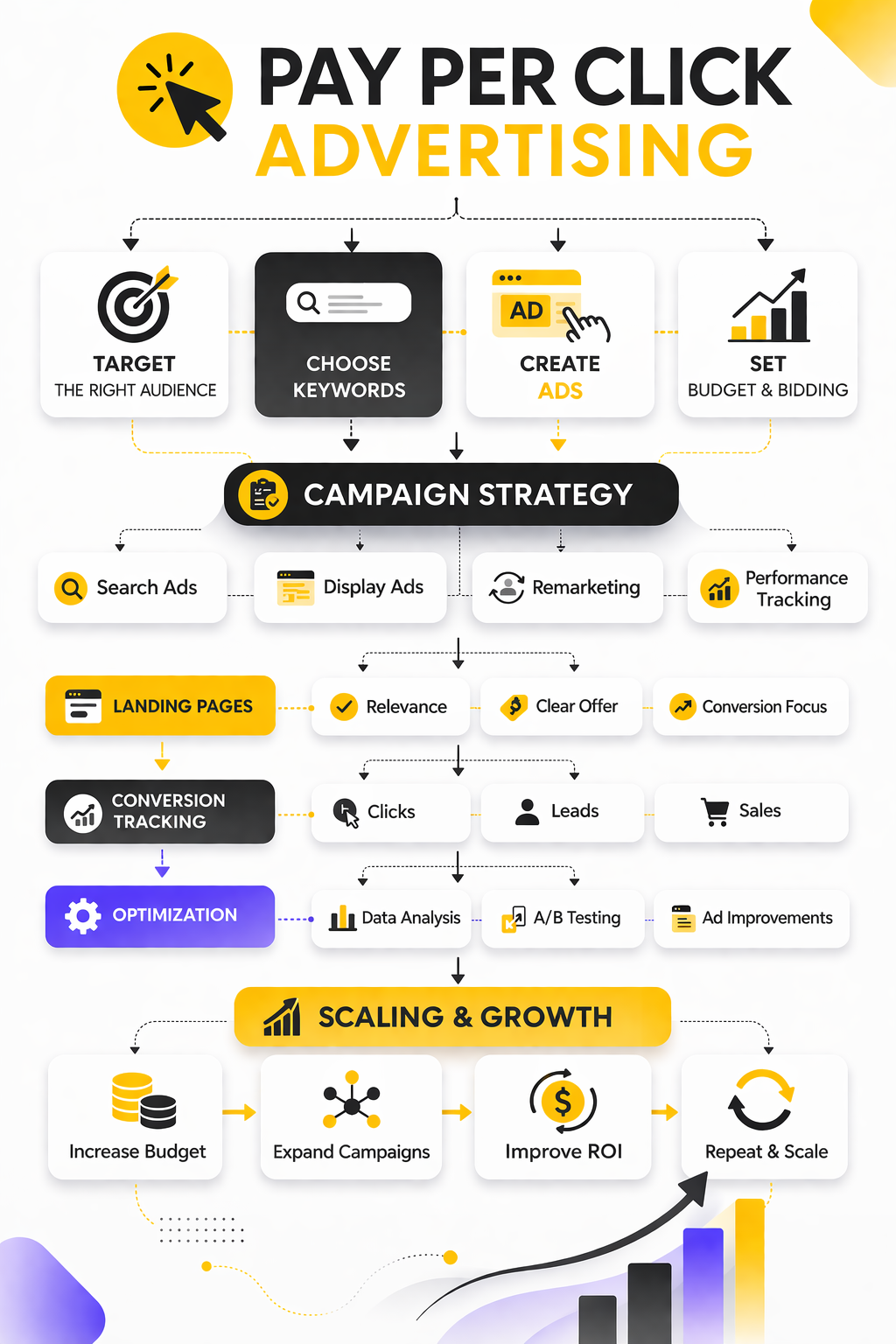
The broader market data explains why businesses keep investing so heavily in pay per click advertising even as competition gets tougher. The IAB’s Full Year 2024 Internet Advertising Revenue Report shows U.S. internet advertising revenue reached $258.6 billion in 2024, and search remained one of the largest and most commercially important parts of that mix. That matters because it confirms something every serious advertiser can already feel on the ground: search is still where a huge amount of measurable demand gets captured.
There is also a strong measurement story behind the channel. Google’s own marketing effectiveness research, summarized in its piece on unlocking hidden marketing ROI, points to an average short-term profit return of £1.87 for every £1 invested, with even stronger performance when longer-term impact is included. The important part is not the number by itself. The important part is what it suggests about how pay per click advertising should be managed. The upside becomes much more visible when measurement is tied to true business value instead of soft conversion counts.
The pressure to measure better is also showing up across the wider industry. Nielsen’s 2025 Annual Marketing Report, built from responses from 1,400 marketers globally, reflects how strongly performance teams are being pushed to prove effectiveness across channels and connect tactics to real outcomes. That matters for paid search because the old comfort zone of reporting clicks, impressions, and even raw lead counts is no longer enough for businesses that want to scale responsibly.
When you bring those numbers together, the takeaway is pretty straightforward. Pay per click advertising still commands major investment because it sits close to revenue, it can be measured more directly than many channels, and it adapts quickly when the business feeds it better data. But those same strengths create a higher standard. If the account is not built around quality signals, sensible budgets, and disciplined optimization, the channel can become very expensive very fast.
Why the Metrics Have to Connect
The biggest reporting mistake in pay per click advertising is looking at metrics one at a time and assuming they tell the whole story. A lower cost per click can look great while lead quality is deteriorating. A rising conversion rate can feel like a win while average order value is falling. A cheaper cost per lead can impress everyone in the meeting and still create less revenue because the wrong people are converting more easily than the right ones.
That is why the best teams connect metrics in layers. They look at impression share and search visibility to understand coverage, click-through rate to understand message resonance, conversion rate to understand post-click fit, cost per acquisition to understand efficiency, and revenue or qualified pipeline to understand whether the whole system is actually worth scaling. Once those metrics are connected, pay per click advertising becomes much easier to diagnose because each number has a role instead of acting like a random headline.
This is also where analytics tooling starts to matter more. If the platform is only seeing basic front-end conversions, the bidding system is optimizing a shallow version of success. When better forms, CRM feedback, and clearer value tracking are added into the loop, the account stops rewarding activity for its own sake and starts rewarding outcomes the business actually cares about.
The Real Point of Part 4
If there is one lesson to take from this part, it is that pay per click advertising does not become profitable by accident once the campaign is live. Profitability comes from choosing a bid strategy that matches the business model, setting budgets that give the system enough room to learn, optimizing on a steady rhythm, and reading statistics in relation to one another instead of in isolation.
That is the difference between running ads and managing paid growth. Anyone can launch a campaign. Far fewer people can control the economics after launch, especially once scale introduces more complexity. The advertisers who can do that are the ones who stay calm, trust the data that actually matters, and adjust with intention instead of reacting to every little spike or dip.
In Part 5, the focus shifts from platform-level performance to the measurement layer underneath it all: attribution, conversion quality, analytics, and the return on investment view that decides whether pay per click advertising is creating real business growth or just creating prettier dashboards.
Measurement, Analytics, and ROI
This is the part of pay per click advertising that separates busy accounts from profitable ones. A campaign can generate clicks, leads, and even a decent-looking dashboard while still failing the business if the tracking setup is shallow or the revenue picture is incomplete. That is why measurement is not a reporting chore at the end of the month. It is the system that tells you whether your paid traffic is actually turning into money.
The tricky part is that modern buyer journeys are rarely neat. Google Analytics explains in its documentation on attribution that credit has to be assigned across multiple ads, clicks, and interactions on the path to a meaningful action. Once you accept that reality, pay per click advertising becomes much easier to manage because you stop judging the channel by the last visible touchpoint alone and start looking at the full path to conversion.
Part 5 is about building that measurement layer properly. It covers attribution, conversion quality, enhanced tracking, offline sales feedback, and the return-on-investment view that helps you decide whether pay per click advertising deserves more budget, needs a sharper offer, or is being judged by the wrong numbers altogether.
Attribution That Reflects the Real Buyer Journey
Attribution matters because the last click rarely tells the whole story. In many accounts, a prospect sees one ad, comes back through another search, visits the site again later, and only then converts. Google Ads explains in its guide to data-driven attribution that this model uses your account’s own conversion data to understand how keywords, ads, ad groups, and campaigns contribute across the path rather than forcing all the credit onto one touchpoint.
Google Analytics adds another useful layer here. Its Attribution Models report is designed to compare how different attribution models change the value assigned to marketing channels, and its attribution settings let advertisers define how key event reporting and Google Ads optimization should assign credit. That matters because pay per click advertising can look overpriced or underpriced depending on whether you are measuring it with a model that fits your sales cycle.
For a short, simple ecommerce purchase, last-click style reporting may not distort reality too badly. For B2B, high-consideration services, or anything with a longer path, it can hide the real contribution of early and mid-funnel clicks. Once attribution is set up with more care, paid search decisions get better because the account is finally being judged in the context of how people actually buy.
Conversion Quality Matters More Than Raw Volume
One of the biggest traps in pay per click advertising is celebrating lead volume without asking what those leads turn into. If the platform is rewarded for every form submission equally, it will often find more of the easiest conversions, not more of the best conversions. That can make the dashboard look stronger right when the business is becoming less profitable.
Google has been moving more openly in this direction. Its help page on qualified leads and converted leads explains that Google Ads replaced the old imported leads goal with separate goal types for qualified and converted leads, specifically to help advertisers align optimization with better business outcomes. That is a major clue about where performance marketing is heading. The platform itself is telling advertisers that lead count alone is too blunt to guide serious decision-making.
This is why measurement has to continue after the form fill. The sales team needs to tell the ad platform which leads were useful, which opportunities progressed, and which deals actually closed. Without that feedback loop, pay per click advertising tends to optimize toward convenience rather than value, and convenience is often expensive when it is disconnected from revenue.
Enhanced Conversions and Offline Feedback Loops
Enhanced conversions matter because the measurement picture is never perfect if you rely only on front-end browser signals. Google Ads explains in its documentation on enhanced conversions that the feature improves conversion measurement accuracy and supports stronger bidding by using hashed first-party data. Google’s setup documentation also notes that the data is protected using the SHA-256 hashing process before it is used for matching.
That is useful, but it is only part of the job. Many businesses do not make money the moment someone fills in a form. They make money later, after calls, demos, proposals, approvals, or contract signatures. Google’s guidance on offline conversion imports and its updated offline conversion import guidelines exist for exactly that reason: to connect ad clicks to what happens in the real sales process after the browser session is over.
When this loop is in place, pay per click advertising gets much smarter. Instead of rewarding any lead that can complete a form, the system starts learning which campaigns and queries are actually producing calls that close, deals that move forward, and customers that create value. That is a massive difference, and it is usually one of the clearest turning points between an account that is merely active and an account that is genuinely scalable.
Assigning Value Instead of Counting Everything Equally
Not every conversion should be worth the same amount. A repeat customer is not the same as a first-time low-margin sale. A lead from a high-value geography is not always equal to a lead from a territory with lower close rates. A booked demo from an enterprise buyer should not be measured the same way as a low-intent contact form that never gets answered. Pay per click advertising becomes far more useful once the account starts reflecting those differences.
Google Ads makes this possible in a few different ways. Its documentation on conversion values explains that assigning values helps advertisers measure the total business impact of campaigns rather than simply counting how many conversions happened. Its guide to conversion value rules goes further by showing how values can be adjusted based on location, device, and audience signals, while value-based bidding best practices and conversion value best practices push advertisers toward optimizing for business impact instead of raw action volume.
This is where ROI gets much clearer. Once values are assigned with some logic behind them, pay per click advertising stops being a contest to generate the most conversions at the cheapest visible price. It becomes a system for prioritizing the kinds of conversions that actually move the business forward. That is a much healthier way to scale, and it also makes budget decisions easier because you are comparing value created, not just activity reported.
Analytics That Help You Make Decisions
Analytics should make decisions easier, not just produce more charts. The best reporting layers in pay per click advertising connect visibility, click behavior, on-site performance, lead quality, and downstream value in a way that tells a story. If the data only lives in separate dashboards that never speak to one another, the team ends up arguing about symptoms instead of fixing causes.
This is one reason broader industry measurement pressure matters so much right now. Nielsen’s 2025 Annual Marketing Report, built from 1,400 global marketers, reflects how strongly marketers are being pushed to prove effectiveness and get clearer on measurement. Google’s own thinking on unlocking hidden ROI points in the same direction by arguing that stronger measurement frameworks reveal more of marketing’s total value over time instead of focusing only on the instantly visible portion.
For pay per click advertising, that means the most useful analytics setups are usually the ones that connect ad platform data with site behavior, CRM outcomes, and revenue reporting. A platform-only view tells you how the campaigns performed inside the auction. A joined-up analytics view tells you whether those campaigns brought in people the business actually wants more of.
Building a Cleaner ROI System
If you want a cleaner ROI picture, the process usually starts with a few blunt questions. Which conversions really matter? Which of them deserve values? Which ones can be pushed back into Google Ads from the CRM? Which reports are helping you act, and which ones are just decorating meetings? Those questions matter because pay per click advertising gets better when the measurement layer becomes more honest.
This is also where operational tools can help. A better lead form built with Fillout can make first-party data capture cleaner, and a tighter follow-up flow through Brevo can make it easier to tie ad-sourced leads to later lifecycle events. The exact stack is not the point. The point is that measurement gets stronger when the path from click to customer is designed intentionally rather than patched together later.
Once that happens, ROI stops feeling mysterious. You can see where pay per click advertising is attracting the right people, where the offer is losing them, where sales follow-up is slowing them down, and where value is being created at a level that justifies more spend. That is the kind of measurement that helps a business grow, because it turns reporting into action instead of leaving it as a pile of disconnected numbers.
The Real Goal of Part 5
The real goal of this part is simple: make pay per click advertising measurable in a way that reflects reality, not just interface convenience. Attribution should match the buying journey. Conversion goals should reflect quality, not vanity. Tracking should stretch far enough to capture what happens after the lead, and values should reflect the business impact of those outcomes.
When those pieces are in place, optimization gets a lot more intelligent. The platform stops chasing whatever is easiest to count and starts chasing what is actually worth having. That is the point where paid search becomes more than a traffic channel. It becomes a revenue system you can trust enough to scale.
In Part 6, the article wraps everything together with advanced strategy, common mistakes, ecosystem decisions, and the FAQ section that answers the practical questions most businesses ask once they are serious about making pay per click advertising work.
Advanced Strategy, Common Mistakes, and Ecosystem Decisions
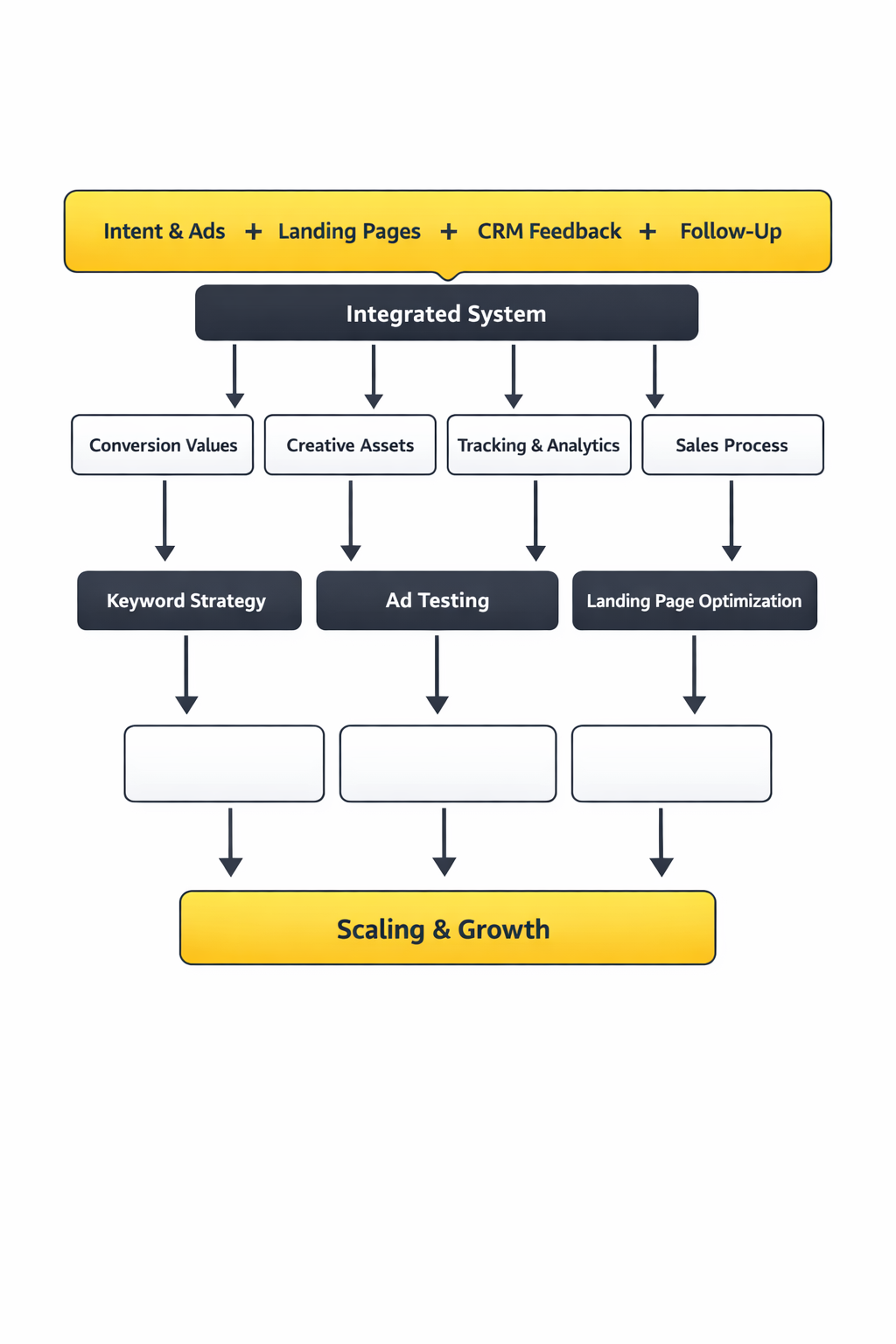
By the time a business reaches this stage, pay per click advertising is no longer about learning where the buttons are. It is about building an operating advantage. The companies that keep winning are usually the ones that connect intent, creative, landing pages, CRM feedback, and follow-up into one system instead of treating each piece like a separate task handled by a different team with different goals.
That matters even more now because Google keeps pushing search advertisers toward AI-assisted execution. Its help documentation explains that Smart Bidding uses auction-time signals to optimize for conversions or conversion value, while responsive search ads test multiple headline and description combinations to show more relevant messages. In practice, that means the competitive edge has moved away from manual micromanagement and toward better inputs, cleaner measurement, and stronger commercial judgment.
The deeper lesson is simple. Pay per click advertising gets more profitable when you stop asking how to control every tiny platform behavior and start asking how to give the platform better direction. Better conversion values, cleaner first-party data, tighter landing pages, more useful creative, and faster sales follow-up usually create more upside than endless interface tinkering ever will.
Common Mistakes That Quietly Kill Performance
The first major mistake is optimizing for the wrong outcome. A lot of advertisers still chase cheaper clicks or cheaper leads without checking whether those leads are actually turning into sales. Google’s documentation on qualified and converted leads is a strong reminder that front-end lead volume is not the same thing as business value. If the account is rewarded for easy form fills, it will often deliver more of the wrong people with impressive-looking efficiency.
The second mistake is letting the post-click experience lag behind the media strategy. Businesses often work hard on keywords and bidding, then send expensive traffic to pages that are slow, vague, or packed with friction. Google’s guidance on enhanced conversions shows how seriously the platform takes better measurement and better signal quality, but the same principle applies to landing pages too: if the user experience after the click is weak, the whole system gets weaker.
The third mistake is refusing to adapt to how search is changing. Google has already announced that new call-only ads are being removed in February 2026 in favor of responsive search ads with call assets. That is more than a product update. It is a signal that pay per click advertising is moving further toward flexible, asset-driven formats that rely on better inputs rather than rigid old setups.
Ecosystem Decisions That Shape Results
The platform account is only one part of the system. Pay per click advertising performs better when the rest of the business stack is built to support it. That includes the landing page builder, the form tool, the email follow-up system, the scheduler, the CRM, and the analytics layer that ties all of it together after the click.
This is why ecosystem decisions matter more than they first appear. A cleaner funnel built in ClickFunnels or Systeme.io, a more structured form flow through Fillout, and stronger lead nurturing with Brevo can all make the exact same media budget more productive because the business is no longer dropping qualified people into a weak post-click experience.
The best advertisers think about this like operators, not just campaign managers. They know the ad account creates the opportunity, but the surrounding ecosystem determines how much of that opportunity actually turns into revenue. Once that mindset clicks, pay per click advertising becomes much easier to scale because the rest of the business is finally helping the channel instead of quietly sabotaging it.
FAQ for a Complete Guide to Pay Per Click Advertising
What is pay per click advertising in simple terms?
Pay per click advertising is a model where you pay when someone clicks your ad rather than when the ad is merely shown. It is most commonly associated with search engines, where businesses bid to appear when people search for relevant terms. The reason it matters so much is that it lets you reach buyers while intent is already forming, which is very different from interruptive advertising that hopes attention appears later.
Is pay per click advertising still worth it in 2026?
Yes, but only if it is managed like a business system and not just a traffic source. Search remains a massive part of digital advertising, with the IAB’s Full Year 2024 report showing total U.S. internet ad revenue of $258.6 billion and search continuing to hold one of the largest shares of that spend. That tells you the channel still matters, but it also tells you competition is serious, which is why weak measurement and lazy setup get punished faster than they used to.
How much budget do you need to start?
There is no universal number because the right budget depends on your cost per click, conversion rate, sales cycle, and how quickly you need reliable learning. A low budget can work in a narrow local market with clear intent and strong conversion pages, while a more competitive industry may need much more room before the data becomes useful. The better question is not “What is the minimum?” but “What budget gives this campaign enough room to generate meaningful decisions?”
Which platform should you start with first?
For most businesses, search is the best starting point because it captures existing demand rather than trying to manufacture interest from scratch. Google is usually the default first platform because of its scale, but Microsoft Advertising can also be a strong addition once the core system is working. The right answer depends on where your buyers search, how competitive the auction is, and whether your team can support more than one platform without losing focus.
Should you use Smart Bidding or manual bidding?
In most cases, Smart Bidding deserves serious consideration because Google states that its automated bid strategies use auction-time signals to optimize for conversions or conversion value. That said, automation is not a magic fix. It works best when your conversion tracking is trustworthy and your goals reflect real business value. If the account is feeding bad signals into the system, automated bidding will simply help you scale mistakes faster.
Do keywords still matter if Google is using more AI?
Yes, but their role has changed. Keywords still help define intent and structure, but modern pay per click advertising increasingly depends on assets, audience signals, conversion values, and first-party data alongside keyword choices. The shift is not that keywords stopped mattering. The shift is that they no longer carry the whole strategy on their own.
What makes a good landing page for pay per click advertising?
A good landing page feels like the natural continuation of the search and the ad. It needs a clear headline, an offer that matches the click, strong proof, low friction, and an obvious next step. The user should not feel like they landed on a generic page that could belong to any campaign in any industry. They should feel like they arrived exactly where the ad promised they would.
How do you measure ROI correctly?
You measure ROI correctly by going beyond clicks and front-end conversions. Google Ads supports offline conversion imports, and Google also notes that enhanced conversions can improve measurement accuracy and unlock stronger bidding. That combination matters because it helps connect ad clicks to what happens after the form fill, which is where real revenue usually becomes visible.
Why do some accounts get clicks but not sales?
Usually because one of the core handoffs is broken. The targeting may be too broad, the ad may attract curiosity instead of commercial intent, the landing page may create friction, or the sales process may be too slow after the lead arrives. This is why paid traffic should never be judged only by what happens in the ad platform. The real question is whether the full system is helping the right person move forward.
How long does it take to see results?
You can start seeing signal quickly, but trustworthy conclusions usually take longer than impatient advertisers want. Early clicks and conversions may appear within days, yet profitable optimization depends on having enough data to separate luck from pattern. The timeline is shaped by budget, traffic volume, sales cycle, and whether the account is measuring real outcomes or only shallow conversion events.
Can small businesses still win with pay per click advertising?
Absolutely, but they usually win through focus rather than scale. A smaller company can often outperform a bigger competitor by narrowing the offer, tightening the targeting, improving speed of follow-up, and building a much cleaner landing page journey. In pay per click advertising, a more relevant and better-operated system can still beat a bigger budget that is being used carelessly.
What is the biggest mistake beginners make?
The biggest mistake is thinking the goal is to buy traffic cheaply. Cheap traffic is meaningless if it does not turn into qualified leads, customers, or revenue. Once beginners shift their thinking from “How do I get more clicks?” to “How do I build a profitable acquisition system?” their decisions around keywords, bids, landing pages, and tracking usually improve very quickly.
Should you manage pay per click advertising yourself or hire help?
That depends on the size of the opportunity and the cost of mistakes. If your budget is small and you are willing to learn carefully, doing it yourself can teach you a lot. If the account represents meaningful revenue or you already know weak execution is getting expensive, experienced help often pays for itself because it shortens the learning curve and prevents common structural mistakes from compounding over time.
Work With Professionals
There comes a point where trying to hold everything together alone stops being efficient. The account needs better creative, cleaner landing pages, better measurement, stronger CRM feedback, and tighter commercial strategy all at once. That is usually the moment when outside expertise becomes less of a cost and more of a shortcut to faster, cleaner growth.
If you are serious about making pay per click advertising work, the smartest move is often to work with people who understand the full system, not just the ad dashboard. You want professionals who can think through intent, offers, data quality, conversion tracking, landing page flow, and the business economics behind the clicks. That kind of help saves time, protects budget, and usually makes scaling far less painful.
And if you are the kind of marketer who wants to do this work for clients or companies at a high level, the market is still full of businesses looking for people who can actually drive results instead of just talk about tactics. That is why it makes sense to put yourself where real opportunities live.
Explore 10K+ Remote Marketing Contracts on MarkeWork.com
Most marketers spend too much time chasing clients, competing on crowded platforms, and losing a percentage of every project to middlemen.
MarkeWork gives you a better way. Browse thousands of remote marketing contracts and connect directly with companies desperate to hire skilled marketers like you without platform commissions and without unnecessary gatekeepers.
If you’re serious about finding better opportunities and keeping 100% of what you earn, you can explore available contracts and create your profile for free at MarkeWork.com.
 Filip Konecny Enterprises