

A social media agency used to be hired for posts, captions, and maybe a monthly report. That definition is far too small now. In 2025, brands are dealing with a channel that blends publishing, paid media, creator partnerships, community management, customer care, and direct commerce, all while audiences move fast and platform behavior changes even faster.
That shift is exactly why the best social media agency relationships are built around business outcomes instead of vanity activity. Digital 2025 shows just how large the opportunity has become, while Sprout Social’s 2025 consumer research and HubSpot’s latest state of marketing data make the commercial case clear: social is influencing purchases, budgets, and channel priorities in a way no serious growth team can ignore.
This first part lays the groundwork. It explains why a social media agency matters, what an effective operating framework looks like, which core components separate serious partners from content factories, and how professional implementation turns a promising strategy into repeatable performance.
Article Outline
This article is structured in six connected parts so readers can move directly to the section they need most. If you are evaluating a new social media agency, rebuilding an underperforming one, or trying to bring more rigor to an existing partnership, these page jumps will help you navigate the full framework.
- Part 1: Why a Social Media Agency Matters
- Part 2: Social Media Agency Framework Overview
- Part 3: Core Components of a Social Media Agency
- Part 4: Professional Implementation in a Social Media Agency
- Part 5: Measurement and Optimization
- Part 6: Choosing, Scaling, and Long-Term Fit
Why a Social Media Agency Matters

A social media agency matters because the work now sits at the intersection of brand, revenue, and customer experience. The old model of assigning social to a junior coordinator with a design tool and a publishing calendar breaks down when social content is expected to influence discovery, trust, conversion, retention, and support at the same time.
The scale alone makes specialization valuable. Global social usage remains enormous, and HubSpot’s current marketing research shows brands continue to put social near the center of their channel mix, with paid and organic social ranking among the most impactful marketing activities. When a channel gets that much budget attention, leadership no longer wants more output. They want better decisions.
Consumer behavior is another reason the category has become more strategic. Sprout Social reports that 76% of consumers say social has influenced their purchases in the last six months, and Salesforce’s 2025 social shopping data shows discovery and buying behavior are especially strong among younger audiences. That means social is no longer just where brands talk. It is where people evaluate, compare, ask questions, and increasingly decide.
A strong social media agency helps a company respond to that reality with focus. It translates business goals into platform-specific moves, protects the brand from reactive posting, creates an operating rhythm for testing and learning, and builds a system that can survive algorithm shifts, personnel changes, and sudden spikes in demand. The best agencies do not simply make brands look active. They make them more effective.
Social Media Agency Framework Overview
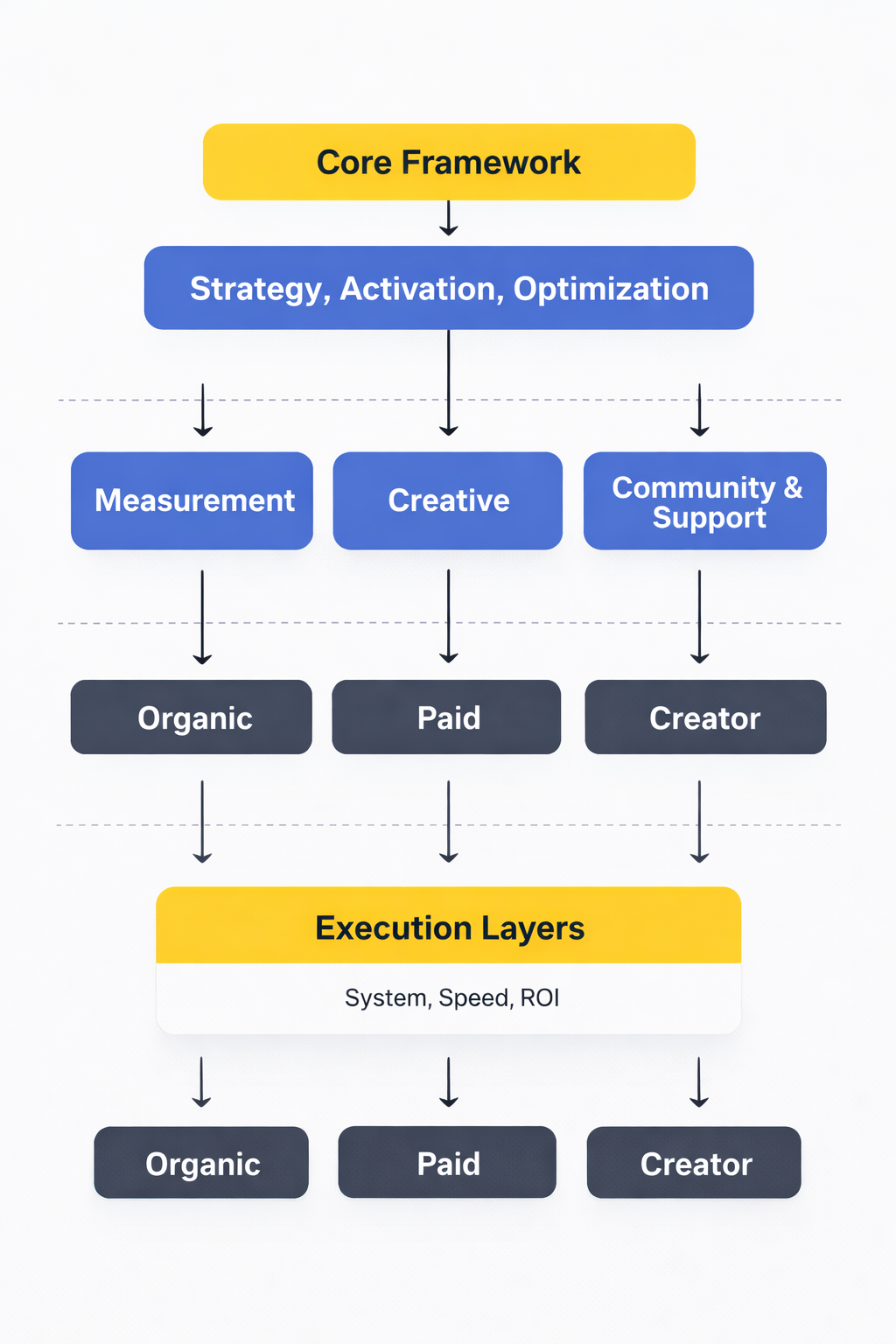
The simplest way to understand a modern social media agency is to see it as an operating system with six connected layers: business goals, audience intelligence, channel strategy, content production, distribution, and measurement. If one layer is weak, the rest can still look busy for a while, but the results eventually flatten because the system has no real center.
Business goals come first because social should answer to growth, not to content volume. Audience intelligence comes next because an agency has to know what people care about, what they distrust, what makes them save, share, click, or buy, and how those behaviors differ by platform. That is where social strategy became more complex in recent years, because audiences now expect relevance, creator fluency, and fast feedback loops rather than polished but generic brand broadcasting.
The creator layer is especially important now. Deloitte’s latest creator economy research found that three out of five consumers are more likely to engage positively with a brand when it is recommended by the right creator, and the same study shows high-ROI brands tend to manage a broader portfolio of creator relationships instead of betting everything on one face. A serious social media agency builds that into the framework from the start instead of treating creators as a side experiment.
Distribution is the point where many weaker agencies get exposed. Publishing alone is not enough. A complete framework has to decide what should earn reach organically, what deserves paid amplification, what should be handed to creators, what belongs in community threads or DMs, and what needs to be repurposed into email, landing pages, or remarketing flows. That is why the most effective agencies think more like media operators than content vendors.
Measurement closes the loop. Nielsen’s 2025 marketing findings show that only a minority of marketers measure media holistically across digital and traditional channels, which explains why so many brands still argue about social performance instead of understanding it. A reliable framework does not wait until the monthly report to define success. It decides in advance which signals matter, how they connect to revenue, and what changes will be made when performance slips.
Core Components of a Social Media Agency
The first core component is strategic diagnosis. Before a social media agency creates anything, it should be able to explain the market position of the brand, the competitive set, the audience tensions that matter, and the role social should play in the wider funnel. If an agency skips that and jumps straight into content ideas, the relationship usually turns into a cycle of subjective revisions instead of commercial progress.
The second component is creative production with platform fluency. Content does not perform because it is merely attractive. It performs because it fits the behaviors, pacing, and expectations of the environment where it appears. TikTok’s 2025 trend report emphasizes creator spread, trust, and constant brand presence, while HubSpot’s current data shows short-form video continues to outperform other media formats for ROI. A capable agency turns those signals into repeatable creative standards instead of chasing every trend with no filter.
The third component is community and care. Social now shapes brand perception through comments, replies, DMs, and response speed as much as it does through campaign creative. That matters because people judge trust through the total experience, not just through ad messaging, and Edelman’s 2025 brand trust research makes it clear that outside voices, customer experiences, and what others say about a brand shape buying decisions in powerful ways. A social media agency that ignores community management is leaving brand equity exposed in public.
The fourth component is paid media integration. Even brilliant organic content has limits, especially when a brand needs predictable lead flow, controlled audience targeting, or measurable scaling. The strongest agencies know when to use paid social to validate creative angles, extend winning messages, retarget warm audiences, and accelerate results without turning the entire strategy into expensive interruption marketing.
The fifth component is analytics that lead to action. Reporting is not the goal. Learning is the goal. A useful agency dashboard should show where reach is turning into engagement, where engagement is turning into qualified traffic, where creator content is outperforming brand content, and where spend is creating diminishing returns. If the data cannot tell a team what to stop, what to scale, and what to test next, it is decoration.
Professional Implementation
Professional implementation starts with structure, not inspiration. A social media agency needs clear ownership, publishing workflows, approval paths, creative briefs, asset libraries, response standards, and a measurement model that the client can understand without needing translation every week. This is the difference between a team that looks talented in pitch meetings and a team that can actually operate under pressure.
That operating discipline usually depends on a real stack of tools rather than improvisation. Many agencies use Buffer for scheduling and workflow visibility, Flick for social planning and research support, Brevo when social needs to connect with email and CRM activity, and Copper when lead handling and pipeline visibility matter as much as reach. On the operations side, tools like Cal.com for scheduling, Fillout for intake and campaign requests, and Dub for trackable links can make implementation cleaner and easier to audit.
Professional implementation also means building around response speed and iteration speed. A content plan created once a month is rarely enough now, because performance signals arrive daily and audience attention moves fast. Nielsen’s ROI blueprint makes the broader point well: fragmented channels demand a more unified measurement approach, and that applies inside social too. The agency that can review, decide, and adjust faster usually beats the agency that simply produces more deliverables.
Finally, implementation has to respect the reality that social is increasingly connected to sales enablement and customer support. When social content triggers demand, somebody has to capture it, qualify it, and move it forward. That is why some agencies now layer in tools such as Chatbase for conversational capture, ScaledMail for outbound follow-up systems, or Systeme.io for lightweight funnel infrastructure. A social media agency becomes far more valuable when it can connect attention to action instead of stopping at impressions.
Business Goals Come First
A social media agency should never begin with content ideas alone. It should begin with the commercial question the business is trying to solve, whether that means driving qualified leads, shortening the sales cycle, improving retention, lowering paid acquisition pressure, or building enough trust that conversion rates rise across other channels too. When that first step is skipped, social quickly turns into a stream of activity that feels busy but never quite earns a seat at the strategy table.
This matters even more now because budget pressure is real. Nielsen’s 2025 marketing research shows marketers continue to prioritize measurable digital channels, but the same body of work also makes it clear that easy-to-measure does not automatically mean effective. A serious social media agency frames every campaign around business impact first so the team knows whether reach, engagement, clicks, lead quality, assisted revenue, or retention should carry the most weight.
Audience Intelligence Before Content
Once the business goal is clear, the next move is understanding the audience at a much deeper level than age brackets and platform preferences. A social media agency needs to know what the audience is worried about, what kind of proof they trust, what makes them stop scrolling, and what they are trying to solve in the moment they open a platform. That is where strategy stops being generic and starts becoming commercially useful.
The best recent research keeps pointing in the same direction. Salesforce’s 2025 social shopping data shows that discovery on social is especially strong among Gen Z, while Sprout Social’s latest Index shows consumers expect brands to understand culture, respond quickly, and communicate like real participants rather than detached broadcasters. A social media agency that studies audience behavior this closely has a much better chance of producing content that feels native instead of forced.

Channel Role Clarity
One of the biggest mistakes a social media agency can make is treating every platform like it has the same job. It does not. Some channels are stronger for discovery, some are better for authority building, some work best for conversation, and some are built for rapid creative testing that later feeds paid campaigns or landing pages.
That is why channel role clarity matters so much. HubSpot’s latest social video research and its 2025 short-form video findings both show that short-form video continues to dominate attention and marketer investment, but that does not mean every brand should copy the same format everywhere. A smart social media agency defines what each channel is supposed to do, then builds creative and reporting standards around that role instead of forcing every platform into the same template.
Content Production as a System
Content should not be treated like a pile of disconnected deliverables. A modern social media agency needs a production system that turns strategy into repeatable formats, clear briefs, faster approvals, cleaner asset handoffs, and content variations that can be tested without rebuilding everything from scratch. That system matters because consistency is not just about posting often. It is about keeping quality, positioning, and learning intact while the pace increases.
This is where many agencies either become extremely valuable or quietly become replaceable. HubSpot’s 2025 social trends report highlights how heavily marketers are leaning into short-form video and community building, while TikTok’s 2025 trend report points to the growing importance of brand chemistry, cultural fluency, and creative responsiveness. A social media agency that treats production like a disciplined system can respond to those demands without burning out the team or watering down the message.
Distribution and Amplification Layer
Publishing content is only one part of the job. A social media agency also has to decide what deserves organic reach, what should be boosted, what should be handed to creators, and what should be repurposed into email, landing pages, retargeting, or sales enablement assets. Without that amplification layer, even strong creative can end up underperforming simply because it was never distributed with intention.
The creator piece is especially important now. Deloitte’s latest creator economy research found that three out of five consumers surveyed are likely to engage positively with a brand when the recommendation comes from the right creator. That means a social media agency needs to think like a media operator, not just a publishing team, because the growth often comes from the way content is distributed and endorsed, not only from the way it is produced.
Measurement That Improves Decisions
The final layer in the framework is measurement, but it should never arrive as an afterthought at the end of the month. A social media agency should know in advance which indicators matter for each campaign, what a healthy signal looks like at the top, middle, and bottom of the funnel, and what action will be taken if those signals move in the wrong direction. Otherwise reporting becomes a ritual instead of a decision-making tool.
That problem is more common than most brands want to admit. Nielsen’s 2025 annual report emphasizes how difficult holistic measurement still is for many marketers, while Sprout Social’s recent ROI analysis shows that social now influences spontaneous buying behavior and in-app purchasing patterns in ways brands can no longer dismiss as soft impact. A strong social media agency uses measurement to decide what to stop, what to scale, what to test again, and where the next wave of creative energy should go.
Why the Framework Has to Work as One System
This is the part many businesses miss when they hire a social media agency. They evaluate creative samples, maybe ask about reporting, and then assume performance will take care of itself once the content starts flowing. In reality, the results usually come from how well the whole system works together, because strong creative without audience insight underperforms, paid amplification without channel clarity wastes budget, and good reporting without strategic action changes nothing.
When the framework is solid, everything sharpens. The content gets more focused, the team wastes less time, the data becomes easier to trust, and the client can finally see how social supports broader growth instead of sitting off to the side as a separate marketing activity. That is the real value of a professional social media agency framework: it gives the work structure, gives the strategy teeth, and gives the business a much better shot at turning attention into revenue.
Strategic Leadership and Positioning
The first core component is strategic leadership. A social media agency needs someone who can look at the business, the offer, the competition, the customer journey, and the market mood, then make sharp decisions about what the brand should actually say and why people should care. Without that layer, content becomes reactive, and reactive content is usually just another way of saying expensive noise.
This is where positioning becomes everything. The best agencies do not try to make a brand sound like everyone else in the category. They work to identify the tension, pain point, aspiration, or point of view that gives the brand an edge, because once that is clear, content stops feeling random and starts feeling like part of a real campaign to win trust and attention.
Audience and Market Research
The second component is research that goes deeper than surface-level demographics. A social media agency should know what the audience is already seeing, what they are tired of, what kind of proof they trust, what questions keep coming up in comments and DMs, and what kind of language feels natural to them instead of sounding like brand theater. That level of understanding is what helps content land emotionally rather than just technically.
It also matters because the buying journey is no longer clean or linear. Salesforce’s 2025 social shopping findings show that discovery, product evaluation, and purchase behavior increasingly overlap on social platforms, while Deloitte’s creator economy research shows people are far more likely to engage when the message is carried by a creator they see as credible. A social media agency that ignores those shifts will keep creating content for the old funnel while the audience is already living in a new one.
Creative Direction and Messaging
Creative direction is another core component, and it is more than choosing colors, fonts, or post layouts. A social media agency needs the ability to decide what themes the brand should own, what stories are worth telling, how to create hooks that feel strong without feeling manipulative, and how to maintain a consistent voice across different formats and platforms. Good creative direction makes a brand recognizable even when the content style changes.
This is one reason the work has become harder in the last two years. HubSpot’s 2025 social trends research and TikTok’s 2025 trend analysis both point to a faster, more video-first, more culturally responsive environment. A social media agency cannot survive in that environment by relying on generic brand slogans and recycled content pillars. It needs messaging that has conviction and creative that feels alive.
Content Production and Operations
This is the part that people love to underestimate. Content production sounds simple until a social media agency has to coordinate strategy, scripts, design, editing, approvals, publishing, revisions, paid variations, and reporting for multiple campaigns at once. If the operational side is weak, even the smartest strategy gets slowed down by bottlenecks and confusion.
A professional agency builds systems that reduce friction. Tools such as Buffer can help with scheduling and workflow visibility, Flick can support planning and research, and Fillout can make client requests and intake cleaner. The point is not the tool itself. The point is that a social media agency needs a reliable machine behind the scenes, because once the work starts scaling, improvisation becomes expensive.
Community Management and Brand Trust
One of the biggest mistakes a company can make is hiring a social media agency that focuses only on publishing and ignores the audience response layer. Social is public, emotional, and fast-moving. That means comments, replies, direct messages, customer complaints, praise, confusion, and creator interactions all become part of the brand experience whether the team is ready for them or not.
This is why community management is not a side task. It is one of the core components. Edelman’s 2025 brand trust research makes the larger point clear: people pay attention to what others say, how brands behave, and whether trust is reinforced by real interactions rather than polished messaging alone. A social media agency that manages community well protects more than engagement. It protects the brand’s credibility in public.
Paid Social and Amplification
Organic content is powerful, but it is not enough on its own for every growth goal. A complete social media agency should understand how to use paid social to test angles, scale winning ideas, retarget warm audiences, and support launches without turning the brand into a nonstop stream of interruptive ads. Paid media should amplify what is already working, not rescue content that never had a real strategic point.
This matters because budgets are being watched more closely now. Nielsen’s 2025 marketing report shows marketers still prioritize digital channels, including social, but also highlights the ongoing challenge of proving value with clear measurement. A capable social media agency understands that paid social is not just about spend. It is about using distribution intelligently so the strongest ideas get the reach they deserve.
Creator and Partnership Management
Creators are no longer an optional add-on for many brands. They are often one of the fastest ways to borrow trust, reach a niche community, and make branded content feel more human. That means a modern social media agency needs to know how to source creators, evaluate fit, structure partnerships, guide messaging without suffocating authenticity, and measure whether the collaboration actually moved the needle.
This part of the work is becoming more important, not less. Deloitte Digital’s 2025 State of Social research and Deloitte’s creator economy findings both reinforce the same idea: social-first brands are leaning harder into community, creators, and conversion-driven content ecosystems. A social media agency that knows how to manage that well becomes far more valuable than one that only knows how to publish brand-owned posts.
Analytics and Decision-Making
The final core component is analytics, but not analytics for decoration. A social media agency should be able to explain what happened, why it happened, and what needs to change next. If the reporting only says that impressions were up or engagement dropped without connecting those shifts to creative, audience, offer, timing, or distribution choices, it is not really helping the client make better decisions.
That is also where stronger infrastructure starts to matter. Tools like Brevo can help connect social activity with email and lead nurture, Copper can make pipeline visibility clearer, and Dub can improve link tracking across campaigns. A social media agency becomes much more dangerous in a good way when it can tie social performance to real commercial movement instead of hiding behind platform-native numbers.
Why These Components Have to Work Together
Each of these components matters on its own, but the real power shows up when they work together. Research sharpens strategy. Strategy gives creative direction. Creative feeds content production. Production supports paid amplification and creator collaboration. Community management protects trust. Analytics turn all of it into a smarter next move.
That is why hiring a social media agency based on one visible strength is risky. Great design without positioning will not carry a weak message. Fast posting without strong operations will burn out the team. Strong reporting without strategic judgment will produce plenty of charts and very few breakthroughs. The agencies that really help businesses grow are the ones that build all of these components into one system and then keep improving that system over time.
Measurement and Optimization
This is the point where a social media agency either proves its value or gets exposed. Content can look great, meetings can sound smart, and dashboards can feel impressive, but if the work is not creating better decisions over time, the client is not really buying growth. They are buying activity dressed up as progress.
Measurement matters because social has become too important to judge by instinct. Digital 2025 shows how deeply social is woven into everyday behavior, while Sprout Social’s 2025 consumer research shows social content, ads, and creator influence are shaping purchase decisions in ways that can no longer be treated as soft impact. A serious social media agency needs a system that connects attention to action, and action to revenue.
Statistics and Data
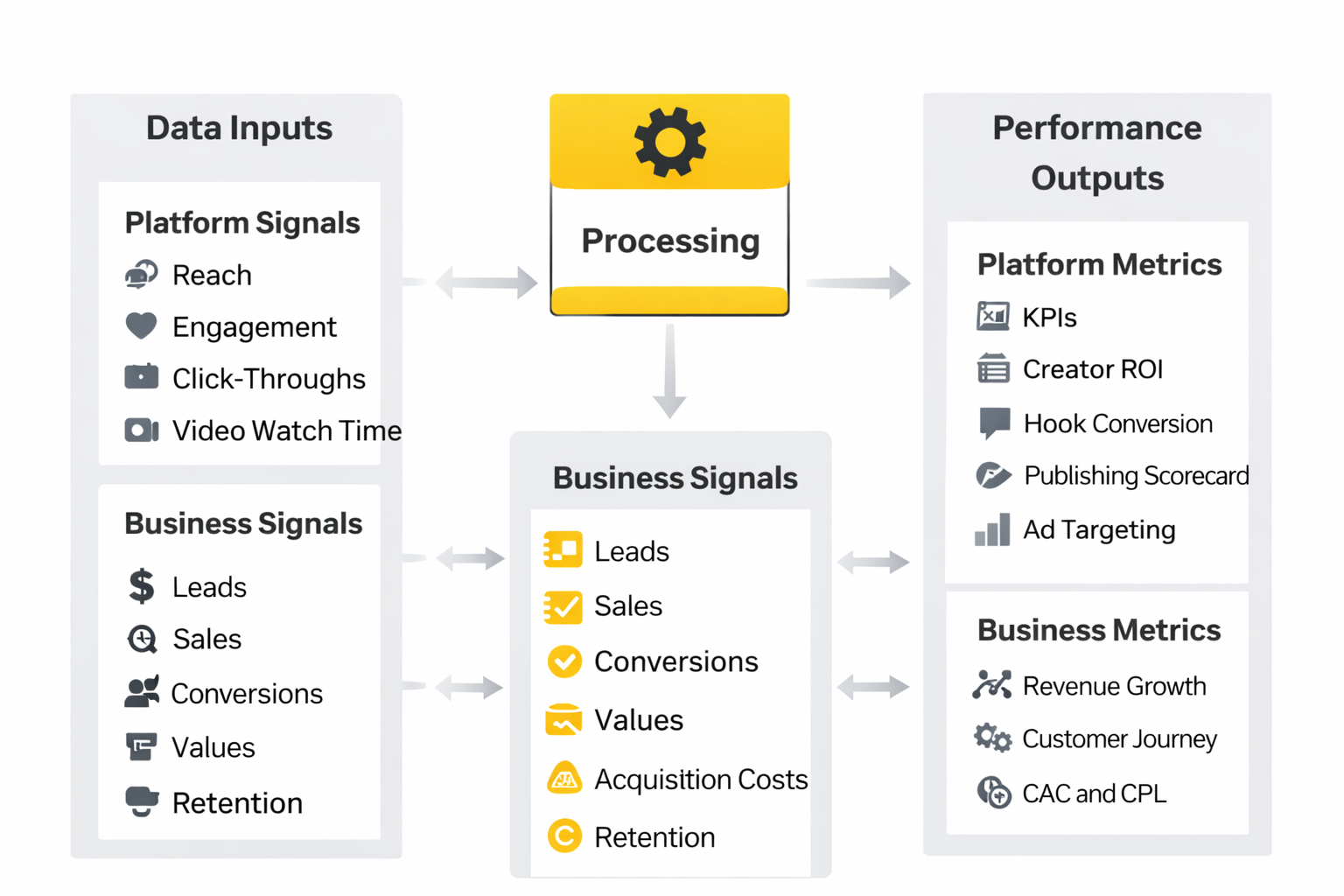
The numbers around social are big enough that lazy measurement becomes dangerous. DataReportal’s 2025 global overview puts worldwide social media user identities above five billion, which means even small inefficiencies can become expensive when campaigns scale. At the same time, Sprout Social found that 76% of surveyed consumers said social influenced a purchase in the previous six months, and Sprout’s 2025 attention analysis reinforces the same pattern by showing how tightly discovery and buying behavior are now linked on social platforms.
That is why a social media agency should not treat top-line numbers as decoration. Reach matters because without reach there is no market signal. Engagement matters because it tells you whether the message is landing with the right kind of energy. Clicks, leads, assisted conversions, view-through behavior, and retention signals matter because they reveal whether the content is creating movement or just collecting cheap reactions.
Budget decisions also make this more urgent. Nielsen’s 2025 Annual Marketing Report shows social media remains one of the leading digital channels for marketer investment, but it also makes clear that many teams still struggle with holistic measurement. That gap creates an opportunity for a good social media agency, because the agency that can turn data into clearer decisions becomes much harder to replace.
What a Social Media Agency Should Measure
The smartest measurement model starts by separating platform signals from business signals. Platform signals include things like watch time, saves, shares, comments, completion rate, follower growth, profile actions, and click-through behavior. Business signals include qualified leads, booked calls, product page visits, add-to-cart behavior, assisted conversions, customer acquisition cost, repeat purchase activity, and sometimes even support deflection when social content answers questions before they become tickets.
A social media agency should know which layer matters most in each campaign. If the goal is awareness, then the quality of reach and the cost of attention matter more than last-click revenue. If the goal is pipeline or sales, then surface engagement stops being enough and the agency needs to show how social traffic behaves after the click, how it converts compared with other channels, and whether the quality of demand is improving over time.
Vanity Metrics Versus Decision Metrics
This is where a lot of reporting goes wrong. A social media agency can make almost any month look good if it only highlights impressions, likes, and follower growth. Those numbers are not useless, but they become dangerous when they are presented without context, because they can make weak strategy look healthy for far too long.
Decision metrics are different. They help a team choose what to scale, what to cut, what to rework, and what deserves more budget. For example, high reach with low hold rate may point to a strong hook and a weak payoff. High engagement with weak downstream conversion may suggest that the content is entertaining the wrong audience. Low volume but strong assisted revenue may reveal that a smaller campaign is attracting exactly the kind of people the business wants.
How Optimization Actually Works
Optimization is not magic, and it is not just a fancy word for making small edits. A strong social media agency uses performance data to identify patterns, then tests changes that have a clear reason behind them. That could mean changing the hook, adjusting the first three seconds of a video, rewriting the call to action, shifting the audience segment, changing the offer framing, altering the creator mix, or moving budget toward the messages that are already pulling the strongest commercial response.
The key is that optimization should feel cumulative. Each campaign should leave the agency smarter than it was before. Over time, the team should know which themes create stronger watch time, which creator styles drive the best trust signals, which landing pages convert social traffic best, and which formats are more likely to bring in high-quality leads rather than cheap clicks.
Cross-Channel Proof Matters
One reason measurement gets messy is that social rarely works alone anymore. Someone sees a creator mention a product, visits later through search, joins an email list, clicks a remarketing ad, and then buys days after the original touchpoint. If a social media agency only reports what happened inside the platform, it can miss the real commercial role the channel played.
That is why connected tracking matters so much. Tools such as Dub can make campaign links easier to compare, Brevo can help tie social traffic to email nurture and conversion behavior, and Copper can make lead and pipeline movement more visible after the click. A social media agency becomes dramatically more useful when it can show not just what social did on-platform, but how social supported revenue across the wider funnel.
The Role of Creators in Performance Data
Creator performance deserves its own lens because it often behaves differently from brand-owned content. A creator may drive lower raw reach than a branded campaign, but create stronger trust, better comments, higher save rates, or better downstream conversion because the message feels more believable in that environment. If a social media agency measures creator work by the exact same standards it uses for every other asset, it can end up underinvesting in one of the most valuable growth levers available.
That would be a mistake in the current market. Deloitte’s creator economy research found that three out of five consumers surveyed are likely to engage positively with a brand when recommended by the right creator, and Deloitte Digital’s 2025 State of Social research shows major B2C brands are actively investing in creators, social commerce, and community management. A social media agency should be measuring not just creator output, but creator fit, creator trust, and creator-driven commercial lift.
Why Reporting Needs a Story
Numbers without interpretation are not that useful. A client should never finish a monthly report wondering what actually happened. A strong social media agency explains the story inside the data: what changed, why it changed, which hypotheses were supported, which assumptions failed, and where the biggest next opportunity sits.
That narrative layer matters because reporting is not there to impress anyone. It is there to sharpen execution. When the story is clear, leadership gains confidence, creative teams stop guessing, paid media gets more precise, and future campaigns start with better inputs than the last round had.
What Good Measurement Creates Over Time
When a social media agency measures the right things consistently, the compound effect is enormous. The team gets faster at spotting weak hooks, stronger at identifying audience signals, better at selecting creators, more disciplined with budget, and more honest about what deserves scaling. That is where real leverage shows up.
And that is the bigger point of this entire section. Statistics and data are not there to make social feel more scientific than it is. They are there to protect the client from drift, give the strategy teeth, and make sure the agency keeps earning trust with evidence instead of opinion. Done right, measurement turns a social media agency from a content vendor into a real growth partner.
Choosing, Scaling, and Long-Term Fit
Choosing a social media agency is not just a hiring decision. It is a growth decision, a trust decision, and in many cases a speed decision, because the right partner can help a brand move faster without losing its voice, while the wrong one can burn budget, confuse positioning, and leave the business with a pile of content that never really changed anything. That is why smart companies should look past polished proposals and ask a harder question: can this social media agency help us grow in a way we can actually sustain?
The timing matters. Sprout Social’s 2025 ROI research shows that 65% of leaders want direct connections between social campaigns and business goals, while only 30% of marketers in that same research say they can actually measure social ROI well. Add that to Nielsen’s 2025 marketing findings, which show social media remains one of the leading digital channels for planned spend, and the conclusion is obvious: if a social media agency cannot help a business connect execution to commercial results, it is not a serious growth partner.
How to Evaluate a Social Media Agency
The first thing to look for is whether the agency thinks beyond content volume. A weak social media agency talks mostly about posting frequency, follower growth, and aesthetics. A strong one talks about audience behavior, conversion pathways, testing priorities, creator fit, community management, measurement discipline, and how social supports the wider business.
That difference is not cosmetic. It tells you whether the team sees itself as a content supplier or as an operating partner. If the conversation never gets specific about business goals, internal bottlenecks, approval speed, sales alignment, or how performance will be judged, the relationship will probably drift into vague deliverables and vague expectations.
Questions Worth Asking Before You Sign
Before hiring a social media agency, a business should ask how strategy is built, how success is defined, what happens when performance drops, how creative testing works, what the reporting actually changes, and who is responsible for day-to-day decisions. These questions matter because they reveal whether the agency has a real operating system or just a sales process.
You should also ask what kind of collaboration the agency needs from your side. Some businesses assume outsourcing social means handing over the login details and waiting for results. That almost never works well. Even the best social media agency needs access to product knowledge, customer feedback, internal priorities, and enough responsiveness from the client side to keep the work sharp.
Red Flags That Should Make You Pause
There are a few warning signs that show up again and again. One is an agency that promises results too easily without digging into the market, the offer, the sales cycle, or the existing performance baseline. Another is an agency that talks about being full-service but cannot explain who is really doing strategy, who owns paid amplification, who handles community issues, and how creator relationships are vetted and managed.
A more subtle red flag is overreliance on vanity wins. If a social media agency keeps steering the conversation back to reach, likes, and follower growth without explaining what those numbers mean in context, it may be hiding weak commercial performance behind attractive platform metrics. Good partners are comfortable talking about what is working, what is not, and what needs to change next.
What Scaling Really Requires
Scaling with a social media agency is not the same as posting more often or spending more on ads. Real scaling happens when the brand develops repeatable creative patterns, faster feedback loops, better targeting decisions, stronger creator partnerships, cleaner handoffs between marketing and sales, and a measurement system that helps the team learn faster than competitors do. Without those ingredients, more spend usually just magnifies inefficiency.
The current market makes that even more important. HubSpot’s 2025 short-form video research shows short-form video continues to be the top-performing content format for marketers, while Deloitte Digital’s 2025 State of Social research shows large B2C brands are investing heavily in creators, social commerce, and community management. A social media agency that wants to help a client scale has to build for that environment, which means speed, adaptability, and operational rigor matter just as much as creativity.
The Role of Systems in Long-Term Fit
Long-term fit usually comes down to systems more than excitement. In the first month, almost any social media agency can feel promising because everything is new and the client is hopeful. The real test comes later, when deadlines tighten, priorities shift, campaigns underperform, feedback gets messy, and the team needs a process sturdy enough to keep moving without losing quality.
That is why the best agency relationships are supported by clean systems for planning, approvals, publishing, tracking, and follow-up. Tools such as Buffer can help keep publishing workflows visible, Flick can support research and planning, Fillout can organize client intake, and Cal.com can remove friction from scheduling and review cycles. The tool itself is never the whole answer, but a social media agency with no operational backbone usually creates more friction as the work grows.
Why Creator Fit and Community Fit Matter
Long-term fit is not just about internal workflow. It is also about whether the agency truly understands the kind of people the brand needs to attract and the kind of voices that audience will trust. A social media agency can produce technically good work and still miss commercially if the creator mix feels wrong, the tone feels borrowed, or the community experience feels cold.
This is where the research is moving in a clear direction. Deloitte’s creator economy findings show that three out of five consumers surveyed are more likely to engage positively with a brand when it is recommended by the right creator, and Deloitte’s social commerce research shows 72% of consumers surveyed are willing to buy directly within social platforms. A social media agency that understands creator trust and community behavior is far more likely to help a brand scale without losing authenticity along the way.
How to Know the Partnership Is Working
You usually know a social media agency is the right fit when the work starts getting sharper, not just louder. The messaging becomes clearer. The team begins to spot patterns earlier. Meetings get more focused because fewer things are being debated from scratch. The data starts leading to decisions instead of just summaries. And the business feels more confident about where social is helping rather than wondering whether all the activity is worth it.
That kind of progress is what long-term fit looks like in practice. It is not constant excitement. It is increasing clarity, better execution, cleaner communication, and more trust on both sides. When that starts happening, a social media agency stops feeling like an outside vendor and starts feeling like part of the company’s growth engine.
When to Scale and When to Reset
Not every relationship should be scaled right away. Sometimes the right move is to deepen the strategy, tighten the measurement, simplify the offer, or fix the handoff between social and sales before adding more content, more creators, or more ad spend. A good social media agency will not push growth for the sake of appearances if the foundation is still unstable.
That is another mark of long-term fit. The right partner is willing to protect the system before accelerating it. Once the fundamentals are working, scaling becomes much less risky and much more exciting, because the business is no longer guessing. It is building on something that already has proof behind it.
The Best Social Media Agency Is the One That Can Grow With You
At the end of the day, the best social media agency is not the one with the flashiest proposal or the busiest content calendar. It is the one that understands your market, tells the truth about what is required, builds systems that make execution easier, and keeps helping the business make smarter decisions as the stakes rise.
That is what businesses should really be buying. Not just content. Not just reach. Not just management. They should be buying clarity, momentum, accountability, and a partner that can still deliver when the brand gets bigger, the campaigns get harder, and the expectations get higher. That is the kind of social media agency relationship worth keeping.
FAQ for This Complete Guide
By this point, the big picture should be clear. A social media agency is not just there to fill a content calendar. The real job is to help a business turn attention into trust, trust into action, and action into measurable growth while keeping the brand consistent across a fast-moving channel environment.
Still, there are a few questions that almost always come up when people are deciding whether to hire a social media agency, replace one, or scale an existing relationship. These answers are designed to help you make that decision with a lot more clarity and a lot less guesswork.
What does a social media agency actually do?
A social media agency should do much more than write captions and schedule posts. The best teams handle strategy, audience research, content planning, creative direction, publishing, community management, creator coordination, paid amplification, reporting, and optimization. In other words, they are supposed to build and run a system, not just create isolated pieces of content.
Is hiring a social media agency worth it?
It can be extremely worth it if the business needs faster execution, stronger strategy, more consistent content, or better measurement than it can build internally right now. The case gets even stronger when 76% of surveyed consumers say social has influenced their purchases in the last six months and social media usage now reaches well over five billion user identities worldwide. When a channel has that much influence, weak execution becomes expensive.
How do I know if my business needs one?
You probably need a social media agency when your team knows social matters but cannot keep up with the strategy, production, testing, and reporting needed to make it perform. You may also need one when your internal team is stretched thin, your paid and organic efforts feel disconnected, or your social presence looks active without producing meaningful business outcomes. A good agency should remove friction and sharpen decision-making, not just add more deliverables.
Should I hire an agency or build an in-house team?
That depends on speed, budget, and how much specialized talent you need right now. An in-house team can be powerful when the company has enough scale to support strategy, design, video, community, analytics, and paid media under one roof. A social media agency is often the better move when you want access to that range of skills faster, without the cost and complexity of hiring every specialist yourself.
What results should I expect from a social media agency?
You should expect clearer strategy, more consistent execution, better creative testing, stronger reporting, and a much better understanding of what social is actually doing for the business. The exact performance outcome will depend on the offer, market, sales process, budget, and brand position, so serious agencies should be careful about making easy promises. What they should promise is a disciplined process that makes future decisions smarter and performance easier to improve over time.
How long does it take to see results?
Some signals show up quickly, especially if the agency improves hooks, content quality, publishing consistency, or paid distribution early on. Bigger gains usually take longer because audience trust, creative learning, and revenue impact tend to compound instead of appearing overnight. Any social media agency that pretends everything will transform instantly is probably selling hope instead of a real operating model.
What platforms should a social media agency focus on?
The right answer depends on where your buyers actually spend attention and how they behave there. A strong social media agency should never force every brand into the same platform mix. It should decide whether the job is awareness, community, authority, direct response, creator-led discovery, or social commerce, then choose channels that fit that role instead of chasing every platform at once.
Does a social media agency handle paid ads too?
Many do, and the stronger ones usually think about paid social as an amplification layer rather than a separate universe. That matters because content, targeting, creator partnerships, landing pages, and retargeting often work best when they are coordinated. With social media still sitting near the top of planned digital spend in Nielsen’s 2025 marketing research, it makes sense to work with a team that understands how organic and paid efforts support each other.
How does a social media agency measure success?
A professional social media agency should measure both platform signals and business signals. Platform signals include reach, watch time, shares, saves, comments, click-throughs, and follower quality. Business signals include qualified leads, booked calls, add-to-cart behavior, assisted conversions, customer acquisition costs, and retention patterns, because performance should always be judged in the context of what the business is trying to achieve.
What are the biggest red flags when choosing a social media agency?
Be careful with agencies that promise guaranteed growth without asking hard questions about your offer, sales cycle, audience, and existing data. Be careful with agencies that talk mostly about aesthetics and posting frequency but stay vague about strategy, testing, reporting, and accountability. And definitely be careful with any social media agency that keeps hiding behind vanity metrics instead of explaining how the work connects to actual business movement.
Are creators now part of the job for a social media agency?
In many industries, yes. Creators are increasingly central to how brands earn trust and attention on social, especially when audiences are tired of overly polished branded messaging. That shift is not small either, because Deloitte’s creator economy research shows three out of five consumers surveyed are likely to engage positively with a brand when the recommendation comes from the right creator, which is exactly why creator fit has become a serious strategic issue rather than a side experiment.
Can a social media agency help with tools and systems too?
It should. Execution gets much easier when the agency helps build a cleaner operating system around the work. That can include publishing workflows with Buffer, research and planning support through Flick, intake and request management with Fillout, email and CRM coordination through Brevo, and pipeline visibility through Copper. The exact stack can vary, but a social media agency that improves systems usually improves results too.
What if I already have an agency but I am not sure it is working?
Look at whether the work is getting sharper over time. You should see stronger messaging, better creative decisions, more useful reporting, clearer priorities, and a better connection between social activity and business outcomes. If the relationship keeps producing content without producing clarity, that is usually a sign the social media agency is creating motion instead of momentum.
Work With Professionals
If you have made it this far, then you already know the truth most businesses learn the hard way. Social is too important to run casually, too fast-moving to fake well, and too connected to revenue to hand over to a team that only knows how to make things look busy. The right social media agency can give you structure, sharper strategy, stronger execution, and the kind of consistency that is very hard to build when everything is being improvised.
It is also a huge opportunity for marketers who know what they are doing. Companies need people who can think strategically, adapt fast, understand audience behavior, manage creative systems, and turn performance data into better decisions. That demand is not going away. If anything, it is getting stronger as brands put more pressure on social to deliver real commercial outcomes.
If you want to work with better clients, build stronger partnerships, or find companies that already understand the value of skilled marketing talent, there is a smarter way to do it than fighting through crowded marketplaces and middlemen.
Explore 10K+ Remote Marketing Contracts on MarkeWork.com
Most marketers spend too much time chasing clients, competing on crowded platforms, and losing a percentage of every project to middlemen.
MarkeWork gives you a better way. Browse thousands of remote marketing contracts and connect directly with companies desperate to hire skilled marketers like you without platform commissions and without unnecessary gatekeepers.
If you are serious about finding better opportunities and keeping 100% of what you earn, you can explore available contracts and create your profile for free at MarkeWork.com.
 Filip Konecny Enterprises