

Social media advertising has moved far beyond boosting a post and hoping for the best. It now sits inside a crowded, high-speed environment where audience attention is fragmented, platform behavior changes fast, and creative, targeting, measurement, and automation all have to work together for campaigns to pay off.
That pressure is exactly why the topic matters so much right now. More than 5.5 billion social media user identities were active globally by mid-2025, while YouTube’s ad reach topped 2.53 billion and Facebook’s ad reach reached 2.28 billion at the start of 2025. The scale is enormous, but scale on its own does not create results. The winners are usually the brands that know where social fits in the customer journey, how each platform behaves, and how to measure lift instead of chasing vanity metrics.
That is the structure this article follows. Part 1 builds the foundation so the rest of the guide makes sense. Then the later sections move into campaign architecture, execution, analytics, ecosystem shifts, and practical questions that come up once you are spending real money and expecting real business outcomes.
Article Outline
- Part 1: Why Social Media Advertising Matters
- Part 1: Framework Overview
- Part 1: Core Components
- Part 1: Professional Implementation
- Part 5: Measurement and Optimization
- Part 6: Future Trends and FAQ
Why Social Media Advertising Matters

Social media advertising matters because it gives businesses something older channels rarely offered at the same level: speed, precision, and live feedback in the same system. A campaign can be launched, tested, refined, and expanded within days instead of waiting through the long cycles that defined traditional media buying.
It also matters because consumers do not move through a clean funnel anymore. They discover products in feeds, watch proof in short-form video, compare options through comments and creator content, click away, return later, and sometimes convert after multiple platform touches. That messy behavior makes social media advertising valuable not because it replaces every other channel, but because it influences more moments in the decision process than many teams realize.
The budget data points in the same direction. The Spring 2025 CMO Survey found that social media accounted for 11.3% of marketing budgets, and those same marketers expected that share to rise over the following year. At the industry level, IAB’s 2025 Outlook Study highlighted performance-focused investment, cross-platform measurement, and generative AI adoption as major forces shaping ad spend decisions. That combination tells a clear story: marketers are not treating social as an optional add-on anymore; they are treating it as infrastructure.
Framework Overview
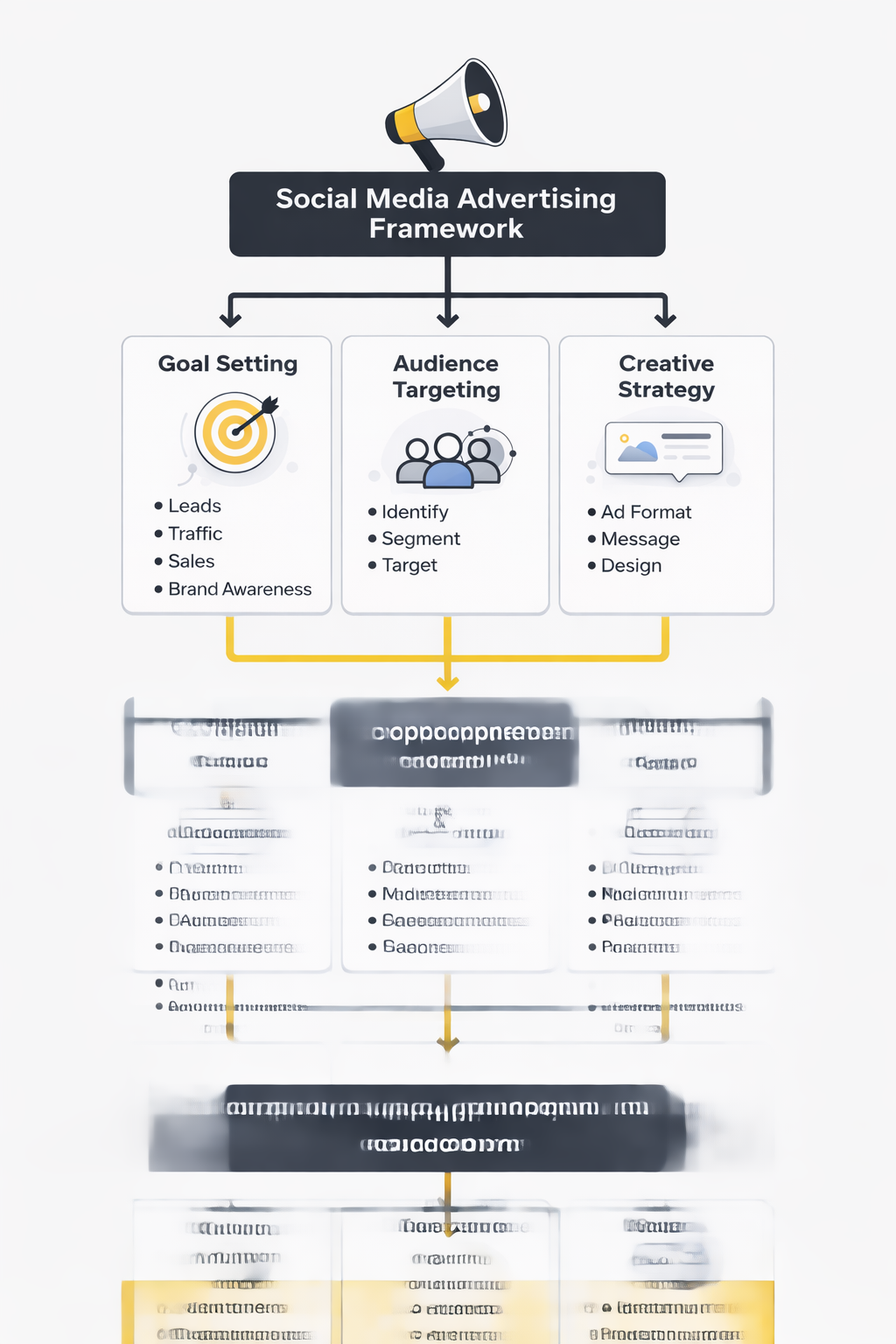
A useful social media advertising framework starts with one simple truth: platform activity is not the same thing as business progress. Before choosing creatives, audiences, or placements, the campaign needs a job. That job might be demand creation, lead generation, direct sales, app installs, retargeting, or market education, but it needs to be specific enough that the rest of the decisions are not random.
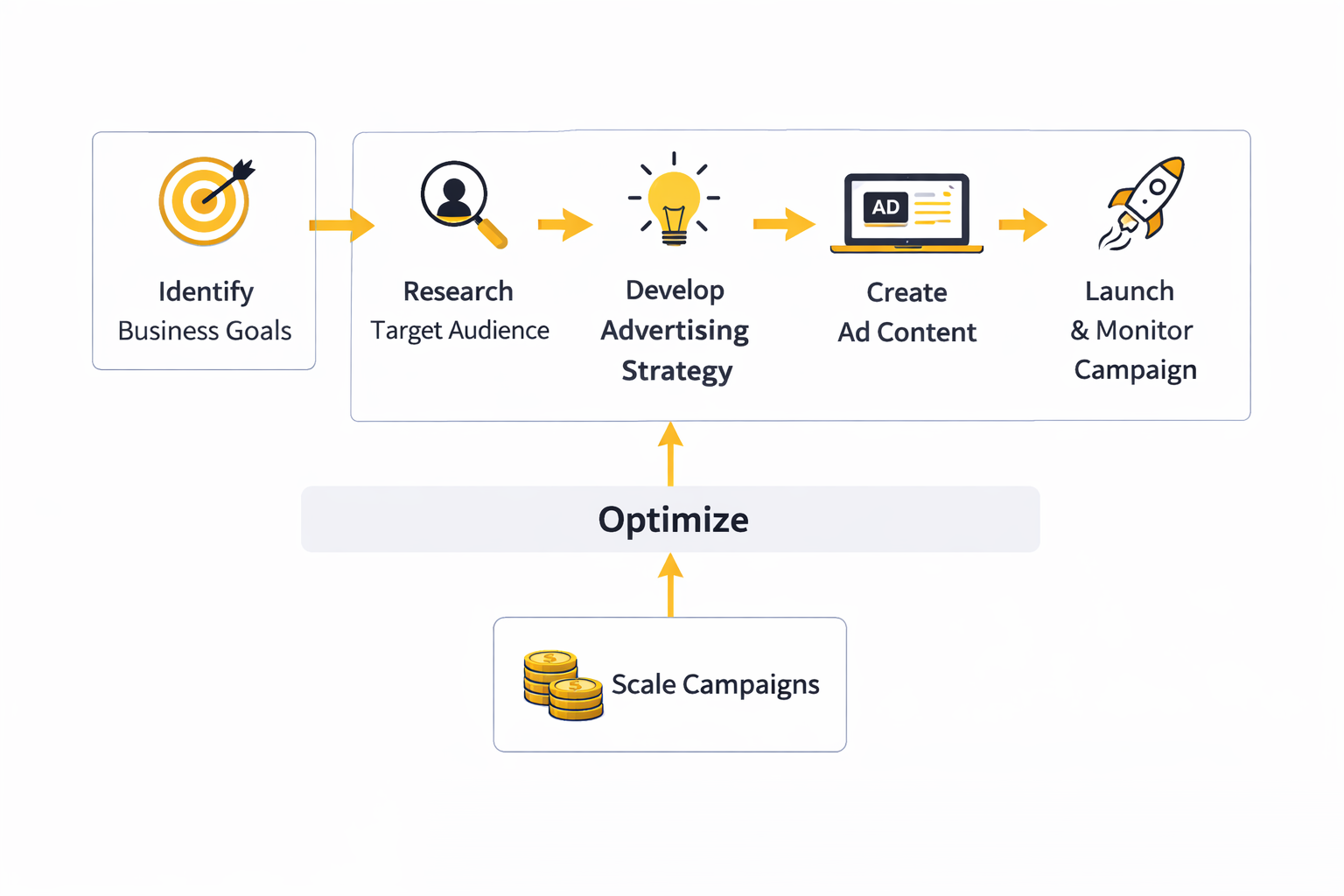
From there, the framework usually becomes easier to manage when it follows six layers. The business goal comes first, then audience definition, then offer positioning, then creative format, then distribution and budget logic, and finally measurement. When teams skip that order, they often end up arguing about click-through rate, cost per result, or platform choice without agreeing on what success is supposed to look like in the first place.
This is also where a lot of weak social media advertising breaks down. A campaign may have strong visuals but no compelling offer. It may have excellent targeting but creative that feels generic. It may generate low-cost clicks but little downstream revenue. The framework exists to prevent those disconnects by forcing every campaign element to support the same commercial objective.
Core Components
The core components of strong social media advertising are audience, creative, offer, landing experience, and measurement discipline. Audience selection determines who gets the message, but creative determines whether anyone cares. The offer translates attention into action, and the landing experience decides whether that action feels worth completing. Measurement then tells you whether the entire path is producing business value or just surface-level engagement.
Each platform puts different pressure on those components. On fast-moving video-heavy feeds, the opening seconds of a creative matter more than a polished brand statement buried later in the asset. In more intent-rich or professional environments, clarity and relevance can outperform entertainment. That is why advertisers who copy the same message everywhere often end up paying for impressions without earning meaningful response.
Measurement deserves special emphasis because it is where good campaigns are either validated or misunderstood. TikTok’s Conversion Lift Study is built around the question of whether ads created incremental business growth, not merely attributed conversions. That distinction matters across the whole discipline. The point of social media advertising is not just to show a dashboard full of activity. The point is to prove the campaign changed outcomes that would not have happened otherwise.
Professional Implementation
Professional implementation begins when a business stops treating campaign setup as the strategy itself. Building ad sets, uploading creatives, and choosing objectives are operational tasks. The strategic work happens earlier, when the team decides what audience deserves attention first, what message angle is most likely to move them, how much budget the test deserves, and what evidence will justify scaling.
The strongest operators also build around testing systems rather than one-off bets. They rotate creative deliberately, document what changed between iterations, and separate learning-stage noise from patterns that are actually stable. That mindset is even more important now because automation plays a larger role in delivery. Meta has said nearly all of its advertisers already use at least one AI-driven product in its ad portfolio, which means human judgment has shifted away from micromanaging every lever and toward better inputs, cleaner strategy, and sharper evaluation.
Professional implementation also means respecting the fact that platforms are not interchangeable. A business can absolutely run a connected multi-platform strategy, but each environment still has its own behavior, creative norms, and decision context. Social media advertising becomes far more effective when the team understands not just where people can be reached, but why they are on that platform, what mindset they bring with them, and what kind of message feels native enough to earn attention.
Choosing the Right Platforms
A lot of money gets wasted in social media advertising because businesses start with the platform they personally like instead of the platform that matches buyer behavior. That sounds harmless, but it changes everything. The people scrolling for entertainment, the people researching products, and the people making professional buying decisions do not all behave the same way, so your campaign structure should not pretend they do.
The smarter way to think about platform choice is to start with buying context. Half of adult social media users now say they visit social platforms to learn more about brands, but that does not mean they do it with the same level of intent everywhere. Some environments are better at driving discovery, some are stronger for repeat exposure, and some work best when you need to influence a buying group over a longer period of time.
That is why serious social media advertising strategy always begins with a simple question: where is this audience most receptive to this message at this stage of the decision? Once you answer that honestly, platform choice becomes much more practical. You stop chasing trends and start building campaigns where attention, intent, and creative format actually line up.
What Each Platform Is Really Doing
Each platform usually plays a different commercial role, even when the targeting tools look similar on the surface. Pew’s 2025 research shows that usage patterns still differ meaningfully across major platforms, which matters because reach without context can mislead advertisers into assuming that scale alone will solve the problem. It rarely does.
In practical terms, video-heavy platforms often win when a brand needs to create fast emotional recognition or product curiosity. Search-like social behavior matters too, because Sprout Social’s 2025 research describes social as a front-line discovery channel, especially for younger users. That means social media advertising is not only interrupting entertainment anymore; in many cases, it is answering active discovery behavior that used to belong almost entirely to traditional search.
For B2B campaigns, the role changes again. Edelman and LinkedIn’s 2025 thought leadership research found that trust-building content helps influence visible and hidden decision-makers alike, which is a reminder that social media advertising in B2B often works best when it earns credibility before it asks for conversion. If your message is too aggressive too early, you may generate activity without ever building enough confidence to move the deal forward.
Audience Targeting Without Guesswork
Targeting works best when it is built on behavior, problem awareness, and message fit rather than on a pile of demographic filters that look sophisticated in the ad manager. Plenty of campaigns feel precise because the setup is detailed, but the message is still too broad for the people seeing it. When that happens, the audience definition is not really helping; it is just making the campaign look more organized than it is.
One reason this matters more than ever is that users now spread their attention across more environments than they used to. DataReportal shows that the world’s social audiences use an average of 6.83 platforms per month, which means your prospects are not living in one neat channel. Good social media advertising recognizes that fragmentation and adapts the message to the role each platform plays instead of forcing the exact same creative on every audience segment.
The strongest targeting approach is usually a layered one. Start with the people most likely to care now, build custom and lookalike audiences where it makes sense, and then let creative do the qualifying work that targeting alone cannot do. That is how you avoid the trap of trying to solve a messaging problem with audience settings.
Creative Strategy That Actually Wins Attention
Creative is where social media advertising either comes alive or dies in silence. You can have the right offer, the right budget, and the right audience, but if the creative does not earn attention in the first seconds, none of the rest gets a fair chance. That is why the best advertisers do not treat creative as decoration after the real strategy is done. Creative is the strategy the audience actually experiences.
That shift has become even more important as platform algorithms do more of the distribution work. Meta has tied its AI-driven advertising systems to large-scale commercial impact in the United States, and that points to a clear reality for advertisers: machine delivery gets stronger when the inputs are stronger. In plain English, the system can help you find response more efficiently, but it still needs creative that gives people a reason to stop, watch, click, or remember.
The best social media advertising creative usually feels less like a polished interruption and more like a native piece of communication built for the environment it appears in. That does not mean every brand should look casual or rough on purpose. It means the ad should respect how people consume content on that platform and meet them in a format they are already willing to engage with.
Why Creator-Led Thinking Matters
One of the biggest shifts in social media advertising is that brands no longer compete only with other brands. They compete with creators, communities, reactions, commentary, and endless streams of content that feel more human than most traditional ads. If your campaign looks like it was built in isolation from the way people actually use the platform, it starts at a disadvantage before the first impression is served.
That is exactly why creator-led thinking has become so valuable. TikTok’s 2025 trend report emphasizes that a wider pool of creators can build stronger relevance across niches, while YouTube’s 2025 creator guidance encourages brands to extend effective sponsored content through partnership ads and paid reporting. The takeaway is not that every campaign needs an influencer attached to it. The takeaway is that social media advertising performs better when it understands how trusted voices, familiar formats, and community language shape response.
That creator-led mindset also improves internal decision-making. Teams become less obsessed with making every ad look expensive and more focused on whether it feels believable, useful, and platform-native. In many cases, that is the difference between content people skip out of habit and content they watch because it feels like it belongs in their feed.
Offers and Landing Pages That Finish the Job
Even great creative cannot rescue a weak offer. If the promise is vague, the next step feels confusing, or the landing page breaks the momentum the ad created, the campaign stalls right where it should have started producing results. This is where a lot of social media advertising underperforms without the team realizing why, because the ad gets blamed for a conversion problem that actually begins after the click.
The offer has to match the audience’s level of readiness. Cold traffic usually needs clarity, relevance, and a reason to care now. Warmer audiences can handle stronger calls to action because the campaign is no longer starting from zero trust. When businesses understand that difference, their social media advertising stops sounding desperate and starts sounding timely.
The landing experience needs the same discipline. Message match, fast load time, visual continuity, and one obvious next step matter far more than clever wording that makes people work to understand what happens next. If you want campaigns to scale, do not just ask whether the ad got the click. Ask whether the full journey made it easy for the right person to say yes.
Execution Blueprint for Social Media Advertising
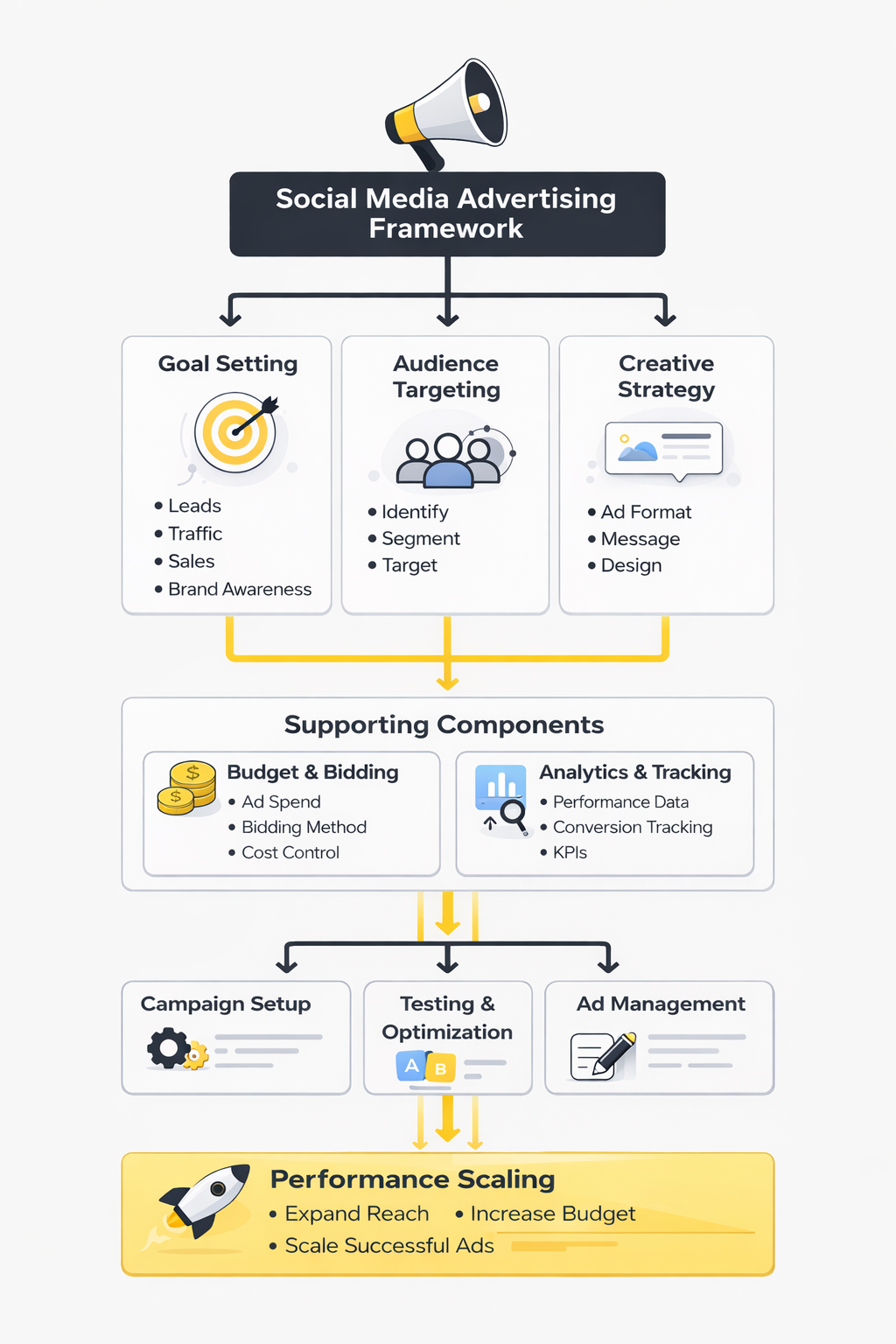
Once the strategy is clear, social media advertising becomes an execution game. This is the point where a lot of businesses get exposed, because ideas sound smart in meetings, but campaigns only earn their keep when the audience definition, offer, creative, landing page, tracking, and budget logic all work together under real market pressure. If one of those pieces is weak, the platform will still spend your money, but it will not magically fix the weak link for you.
The cleanest way to implement a campaign is to build it in layers. Start with the business goal, map the audience segment you care about first, choose the campaign objective that fits that goal, and then build creative variations around one strong angle instead of five unrelated messages. That structure matters even more now because IAB’s 2025 State of Data report shows AI is increasingly being used for audience segmentation, media mix decisions, testing, and campaign forecasting, which means messy inputs can now scale confusion faster instead of improving performance.
This is why disciplined implementation beats frantic activity. When you know exactly what the campaign is supposed to do, every later decision gets easier. You know what to test, what to ignore, and what kind of performance would actually justify turning the budget up.
How to Structure Campaigns Without Creating a Mess
A strong campaign structure should make decision-making easier, not harder. Too many ad accounts are built like junk drawers, with cold audiences mixed with remarketing, broad creative mixed with niche offers, and naming conventions so inconsistent that nobody can tell what is actually working. Social media advertising gets much more manageable when campaigns are organized by objective, audience temperature, and offer stage.
That usually means separating campaigns for awareness, consideration, conversion, and retention instead of trying to force one campaign to do everything. The reason is simple: people at different stages need different messages. A person seeing your brand for the first time does not need the same creative or call to action as someone who has already visited your pricing page twice in the past week.
Platform tools now support that kind of maturity much better than they used to. Google’s guidance for YouTube partnership ads explains that creator content can be extended across the funnel with standard reporting and lift measurement, which is useful because it reinforces a larger point: implementation is not just about launching ads, but about designing each asset to play a role in a sequence instead of throwing everything into one bucket and hoping the algorithm sorts it out.
Budget, Testing, and Scaling Decisions
Social media advertising usually breaks down when people try to scale before they have learned enough. They get one decent result, panic that the opportunity will disappear, and pour budget into a setup that has not yet proved it can survive more volume. Then performance softens, costs rise, and the platform gets blamed for a problem that started with impatience.
The better approach is to treat early spend as tuition. Budget the first phase to buy signal, not ego. That means testing enough creative variation to learn something meaningful, giving the campaign enough room to stabilize, and being honest about whether the performance is strong because the system found real demand or because one narrow audience segment happened to respond for a moment.
This is where incrementality thinking becomes a real advantage. TikTok’s Conversion Lift Study is designed to answer whether ads actually produced incremental growth, which is a far more useful question than simply asking how many conversions were attributed inside a dashboard. If you scale based only on attributed activity, social media advertising can look healthier than it really is. If you scale based on true incremental impact, the budget has a much better chance of compounding instead of leaking.
Why Creative Testing Needs a Rhythm
The strongest advertisers do not test creative randomly. They test with rhythm. One round may focus on hooks, another on offer framing, another on proof, another on format, and another on audience-message alignment. That rhythm matters because it allows you to understand why a campaign improved instead of stumbling into better results without knowing what changed.
It also protects you from the false confidence that comes from one lucky ad. Social media advertising is affected by timing, competition, seasonality, platform dynamics, and plain randomness, so a single strong result is not the same thing as a repeatable system. You need multiple rounds of evidence before you can say the message is truly durable.
That is one reason automated systems are changing the operator’s job. Meta has linked its newer AI-driven ad tools to a 22% improvement in return on ad spend in a U.S. impact study. Whether a business sees that exact gain or not, the bigger lesson is clear: when distribution becomes more automated, creative testing becomes even more important, because the human edge shifts toward stronger inputs, sharper experimentation, and clearer interpretation.
A Real Social Media Advertising Story Under Pressure
Opill had a serious problem the moment it entered the market. Becoming the first FDA-approved over-the-counter birth control pill was a major milestone, but that kind of breakthrough does not automatically create understanding. The pressure was immediate, because awareness had to grow fast enough for the product to matter, and the message had to land in a category where confusion, hesitation, and misinformation could easily slow adoption.
The backstory made the stakes even higher. Snap’s Opill case story explains that the product reached the market after nearly a decade of research and collaboration, which meant the launch carried far more weight than a typical consumer packaged goods campaign. This was not a brand trying to refresh a flavor or promote a seasonal offer. It was a product trying to change access in a sensitive category while speaking clearly to a younger audience that needed both relevance and trust.
Then the wall showed up. Breaking through with health-related messaging is difficult on any platform, and it becomes even harder when the audience has to understand what is new, what is different, and why it matters right now. A weak campaign could have generated impressions without education. An overly clinical campaign could have sounded cold. An overly aggressive one could have lost credibility before the message had a chance to settle.
The epiphany was not flashy, but it was smart. Instead of treating social media advertising like a volume game, the campaign was built to connect message, audience, and format. Snap says the brand used Commercials and Tile-less Story Ads to reach women aged 18 to 24, pairing the distribution choice with creative that highlighted the product’s accessibility and over-the-counter status in a way that was direct enough to inform without losing attention.
The journey from there was about disciplined execution. The campaign did not rely on one format doing all the work. It used non-skippable video to make the message stick and broader story placement to expand reach, giving the brand a better chance to educate and repeat the value proposition across touchpoints. That is exactly how good social media advertising behaves in the real world: not as one dramatic impression, but as a sequence that helps the audience understand, remember, and act.
There was still a final conflict, though, because results in this kind of campaign have to prove more than surface-level engagement. Awareness is only valuable if it moves meaningfully, and category education has to be strong enough to beat market noise. The campaign had to show it was not just being seen, but actually changing perception.
The dream outcome was strong enough to make the story worth studying. Snap reports that Opill generated a 13-point lift in brand awareness, a 12-point lift in ad awareness, and an 11-point lift in message awareness, with Commercials driving a 24% increase in brand awareness in the campaign. The reason this story matters is not just the numbers. It shows what happens when social media advertising is implemented with message discipline, platform fit, and a clear understanding of what the audience actually needs to hear.
Governance, Trust, and Long-Term Control
The more social media advertising scales, the more governance matters. That includes brand safety, creative transparency, measurement standards, privacy-aware tracking, and internal rules for how automation is used. A campaign can perform well in the short run and still create long-term risk if the business has no control over how assets are produced, labeled, tested, or interpreted.
This is especially important now because creative workflows are changing fast. Meta’s 2025 update on generative AI transparency explains how it labels ads created or significantly edited with its generative AI features. That matters because social media advertising is entering a phase where speed is easier to buy than trust. If brands move too quickly without clear standards, they can end up scaling content that feels cheap, confusing, or out of step with what the audience expects from them.
The practical lesson is simple. Use automation, but do not surrender judgment. Build faster, but keep editorial standards high. The businesses that win with social media advertising over the long run will not be the ones that generate the most assets. They will be the ones that keep message quality, measurement quality, and audience trust intact while moving faster than everyone else.
Statistics and Data
If you want to understand where social media advertising is heading, the numbers make one thing obvious fast: this is not a side channel anymore. DataReportal’s 2025 global analysis puts active social media user identities at 5.24 billion, which means the audience base is still enormous even after years of mainstream adoption. That kind of scale changes the conversation, because the challenge is no longer whether people are on social platforms, but whether your campaigns are precise enough to reach the right people in the right context.
Reach data reinforces that point. YouTube’s social advertising audience now exceeds 2.53 billion, while Facebook’s stands at 2.28 billion. On the adult side, Instagram’s reported reach of 1.67 billion edges TikTok’s 1.59 billion, which is a useful reminder that social media advertising decisions should be built on campaign fit, not platform mythology.
What the Reach Numbers Really Mean
Big audience numbers are impressive, but they only become useful when you connect them to behavior. Half of adult social users now visit social platforms to learn more about brands, which tells you that people are not just there to kill time anymore. They are actively researching, comparing, checking credibility, and deciding whether something feels worth a click, a follow, or a purchase.
That research behavior gets even more interesting when you look closer. Instagram leads brand research, with 62.3% of its active adult users using the platform to research brands and products, while Facebook follows at 52.5% and TikTok at 51.5%. So when people say social media advertising is only about attention, they are missing the bigger story. A large share of that attention is now tied to active commercial curiosity.
There is another layer here that matters just as much. GWI’s latest data shows the average social user now uses 6.83 platforms per month, which means your audience is rarely sitting still in one place. Good advertisers understand that social media advertising has become a multi-touch environment, so they stop asking which platform wins in general and start asking which platform plays the best role in the sequence.
Ad Spend Trends in Social Media Advertising
The spending data is just as revealing. IAB’s 2025 Outlook Study shows overall U.S. ad spend is projected to grow 7.3% in 2025, but social media is projected to grow 11.9%. That gap matters because it shows buyers still expect social to outperform the broader market even in a year without the unusual event-driven surge that boosted 2024.
The share data makes the picture even clearer. IAB’s channel mix projection shows social media rising to 17.2% of ad spend in 2025, up from 14.2% in 2024. That is not a minor budget adjustment. It suggests that marketers continue to see social media advertising as one of the few places where addressability, scale, and measurable response can still work together at the same time.
That does not mean every social budget is automatically well spent. It means the market is still betting that the channel deserves more money. Whether that money produces profit depends on creative quality, offer strength, measurement discipline, and whether the campaign is built for incrementality instead of vanity metrics.
Platform Performance Benchmarks
Performance benchmarks help explain where that money is likely to flow. Emplifi’s 2025 benchmark report found TikTok had median monthly follower growth of 21%, while Instagram came in at 6% and X showed decline. That does not automatically mean TikTok should get every dollar, but it does show why brands chasing expansion and younger attention keep taking it seriously.
Instagram, meanwhile, still has major strength where many businesses care most: consistent reach and strong short-form video behavior. Emplifi reports that Reels accounted for 38% of brand posts by the end of 2024, slightly ahead of image posts at 37%. Even more importantly, Reels posted a 2.2% reach engagement rate, ahead of TikTok’s 1.7% average in the same analysis, which helps explain why Instagram remains such a central part of serious social media advertising plans.
The real lesson is not that one platform is universally better. It is that each platform rewards a different type of strategic thinking. TikTok is still a growth engine, Instagram remains incredibly powerful for broad engagement and brand research, and Facebook still holds major commercial value thanks to scale, mature ad infrastructure, and its role in discovery for older and broader audiences.
What Effectiveness Data Says About Strategy
One of the most useful recent findings is that social media advertising does not work the same way for every brand maturity stage. DISQO’s 2025 social effectiveness benchmarks show new brands overperform in aided awareness at 312.18, while emerging brands stand out in consideration at 123.91. Then the balance shifts again, with established brands leading in category e-commerce at 130.43.
That is a huge deal, because it means a campaign can be working exactly as it should even if it is not driving the same downstream action another brand would expect. A younger brand may be winning by creating recognition. A scaling brand may be winning by pushing consideration. A mature brand may be winning by defending purchase intent and commerce activity while also fighting off competitor curiosity.
This is why social media advertising needs better interpretation, not just more reporting. The benchmark that matters depends on the stage of the business, the category pressure, and the job the campaign was hired to do. Once you understand that, the data stops feeling random and starts becoming a strategy tool.
The Most Important Takeaway From the Data
The biggest takeaway is that social media advertising is getting more competitive, but also more measurable and more strategically valuable. People still spend an average of 2 hours and 21 minutes a day on social platforms, and 38.3% of active social users now say they use social for work-related activities. That tells you social is no longer just a leisure environment. It is woven into research, work, buying, discovery, and everyday decision-making.
So here is the bottom line. The data does not say that every business should spend more on social media advertising without thinking. It says the opportunity is very real, the audiences are massive, the commercial intent is stronger than many people realize, and the brands that understand the numbers well enough to act on them intelligently are the ones most likely to pull away from the pack.
Measurement and Optimization in Social Media Advertising
If you are serious about social media advertising, measurement cannot be treated like a report you glance at after the money is already gone. It has to function as a decision system. That means knowing which numbers are useful for diagnosing creative, which numbers help you judge audience quality, and which numbers tell you whether the campaign actually created business value instead of simply collecting credit for conversions that may have happened anyway.
This is where many advertisers get into trouble. They see a dashboard full of attributed conversions, assume the campaign is healthy, and scale too early. Then the cracks show up. Sales quality weakens, blended acquisition costs drift upward, and nobody can explain why the in-platform numbers looked strong while the broader business picture felt less convincing.
The real job of measurement in social media advertising is to reduce that confusion. Good reporting should help you understand what happened, why it happened, and what to do next. If it does not do all three, it is probably giving you activity data without giving you decision clarity.
Attribution Is Useful, but It Is Not the Whole Truth
Attribution still matters because it helps you see the path people took before they converted. You need that visibility. You need to know which campaigns were involved, which creatives earned action, and which audience segments appear to move faster than others. But attribution has limits, especially in social media advertising, where people discover brands in one place, compare them elsewhere, and often convert after a series of touches that no single platform can fully explain on its own.
That is why incrementality has become so important. TikTok’s Conversion Lift Study is built to answer whether ads drove incremental growth, and Meta’s conversion lift tools are designed to estimate incremental conversions that would not have happened without ad exposure. That is a very different question from simple attribution credit, and it is a much more useful one when you are deciding whether a campaign deserves more budget.
The difference is practical, not academic. Attribution tells you what the platform can connect. Incrementality tells you what the campaign likely caused. Social media advertising gets much easier to manage once you stop acting like those two ideas are interchangeable.
Why Marketing Mix Modeling Is Back in the Spotlight
As privacy changes, cross-platform fragmentation, and longer buying journeys make simple attribution less reliable, marketers are leaning harder on broader measurement methods. That is one reason marketing mix modeling is getting renewed attention. Google launched Meridian as an open-source marketing mix modeling framework in 2025, describing it as a response to modern measurement challenges and a more privacy-durable way to estimate media impact.
That matters because social media advertising does not exist in a vacuum. It interacts with search, email, retail media, direct traffic, creator activity, PR, and offline demand drivers. When a business looks only at channel-level dashboards, it often ends up making local decisions that hurt the overall system. Marketing mix modeling helps correct that by asking a bigger question: what combination of channels is actually improving outcomes at the business level?
This does not mean every advertiser needs a full modeling team tomorrow. It means the mindset needs to change. Budget allocation in social media advertising should not be based only on whatever platform claims the most credit. It should be based on the most credible picture you can build from experiments, attribution, business results, and broader modeling.
The Optimization Rhythm That Keeps Campaigns Healthy
Optimization works best when it follows a rhythm instead of a panic cycle. Too many advertisers change targeting, budget, creative, attribution windows, and landing pages all at once, then wonder why they cannot tell what actually improved. Social media advertising becomes far more manageable when you sequence decisions and let each round of changes answer a specific question.
A strong rhythm usually starts with creative and message fit, because that is where audience response becomes visible fastest. Then it moves into offer clarity, landing page continuity, and budget pressure. Once those pieces are stable enough, broader allocation decisions become easier because you are no longer trying to scale a setup that is still fundamentally unclear.
This also protects your team from overreacting to noise. A single bad day does not always mean the campaign is broken. A single strong day does not always mean it is ready to scale. Good social media advertising optimization is less emotional than that. It is built on repeated observation, pattern recognition, and restraint.
Why Smarter Measurement Still Requires Human Judgment
AI is improving the speed and sophistication of campaign analysis, but it has not removed the need for judgment. In fact, it has made judgment more important. IAB’s 2026 State of Data report says advanced measurement is widely adopted, yet much of the buy-side still believes it underperforms on rigor, timeliness, trust, and efficiency. That is a strong warning for anyone assuming that newer tools automatically solve interpretation problems.
The same report points to another issue that matters a lot in social media advertising. Only 39% of buy-side respondents were using attribution, incrementality, and marketing mix modeling together, even though each method answers a different measurement question. That gap explains why so many teams still struggle to defend spend clearly. They are often using one lens and expecting it to do the work of three.
So yes, automation can help. Better models can help. Faster reporting can help. But none of those tools replace the need to ask whether the metric on the screen is actually connected to the business outcome you care about. That question still belongs to the operator.
What a Strong Reporting Stack Should Include
A healthy reporting stack for social media advertising should show more than platform-reported outcomes. It should include in-platform delivery and engagement data, landing page behavior, CRM or ecommerce outcomes, and some way to compare platform claims with broader business performance. Without that layered view, teams end up arguing over which dashboard is “right” instead of trying to understand what each one is actually measuring.
It also helps to separate diagnostic metrics from decision metrics. Diagnostic metrics tell you where friction might exist. They can reveal weak hooks, poor click quality, bad page continuity, or audience mismatch. Decision metrics tell you whether the campaign deserves more investment. That is where contribution to revenue, qualified pipeline, retention, or incremental lift matters far more than isolated vanity indicators.
The goal is not to create more reporting for the sake of looking sophisticated. The goal is to make social media advertising easier to improve without fooling yourself. A strong stack gives you fewer blind spots, faster learning, and much better odds that the next round of optimization actually moves the business forward.
What to Do Next With Your Social Media Advertising Data
The next move is not to chase more metrics. It is to become more honest about which ones are helping you make money and which ones are just helping you feel busy. If a number cannot influence a decision, it probably does not deserve center stage in your reporting.
Start by tightening your measurement logic. Compare platform attribution with actual business outcomes. Use lift testing where it is available. Bring broader modeling into the conversation if the budget is large enough to justify it. Then make optimization decisions one layer at a time so you can actually learn from them.
That is how social media advertising turns from a stressful guessing game into a disciplined growth system. Not by staring at more dashboards, but by building a measurement approach that tells the truth clearly enough for you to act on it.
FAQ for a Complete Guide to Social Media Advertising
What is social media advertising, really?
Social media advertising is paid distribution inside platforms where people already spend time discovering brands, products, opinions, and recommendations. The reason it matters so much now is not just scale, although DataReportal’s 2025 global review still shows billions of active social identities worldwide. It matters because social has become part of how people research brands, compare options, and move toward a buying decision, which means good campaigns can influence far more than a last-click conversion report might suggest.
Is social media advertising still worth it in 2026?
Yes, but only if you approach it like a business system instead of a button you press when sales feel slow. IAB projected social media ad spend to grow faster than the overall ad market in 2025, which tells you serious advertisers still see opportunity there. The catch is that competition is stronger, audience attention is harder to win, and weak creative or sloppy measurement gets punished much faster than it used to.
Which platform is best for social media advertising?
There is no universal winner, because platform choice depends on who you are trying to reach, what you are selling, and where that person is in the decision process. Pew’s 2025 U.S. usage data shows YouTube and Facebook still lead broad platform reach, while DataReportal’s 2025 research shows Instagram is especially strong for brand and product research behavior. The smarter question is not which platform is “best,” but which platform fits your audience, your message, and your campaign objective best right now.
How much should I spend on social media advertising?
You should spend enough to generate signal, not just enough to feel active. In the early stage, the budget’s job is to help you learn which audience-message combination deserves more money. If your budget is too small, you often end up making decisions from noise. If it is too large before you have clarity, you can scale mistakes fast and call it testing when it is really just expensive confusion.
How long does social media advertising take to work?
That depends on the campaign goal. Direct-response offers can produce useful feedback quickly, while brand education, higher-consideration purchases, and B2B buying cycles usually take longer. The important thing is not to confuse speed with success. Some campaigns generate activity fast but produce weak downstream value, while stronger campaigns sometimes need a little more time to show their real impact across the full buying journey.
What metrics matter most in social media advertising?
The most important metrics are the ones tied to actual decisions. Engagement and click data can help diagnose whether the creative is earning attention, but business decisions should lean much harder on qualified leads, revenue contribution, retention, and causal lift. IAB’s 2026 State of Data report highlights how attribution, incrementality, and marketing mix modeling each answer different measurement questions, which is a strong reminder that one dashboard rarely tells the whole story.
What is the difference between attribution and incrementality?
Attribution tries to map the path that led to a conversion. Incrementality asks whether the ad caused an outcome that would not have happened otherwise. That difference matters more than ever in social media advertising because people often discover in one place, compare in another, and convert later through a different touchpoint. TikTok’s conversion lift framework and Meta’s lift-testing tools both exist because advertisers need more than platform credit; they need a clearer view of real contribution.
Does organic social still matter if I run ads?
Yes, because paid and organic play different roles and often strengthen each other. Organic content helps build familiarity, tone, proof, and trust over time, while paid distribution gives you speed, scale, and sharper audience targeting. When both are aligned, social media advertising feels less like a cold interruption and more like an extension of a brand people already recognize.
Should I use creators in social media advertising?
In many cases, yes, because creator-led content often feels more native to the platform and more believable to the audience. Sprout Social’s 2025 research on the customer journey and YouTube’s 2025 guidance on partnership ads both point toward a world where trusted voices and familiar formats can improve relevance. That does not mean every campaign needs an influencer. It means brands should stop assuming that polished studio content always beats content that feels more human and platform-aware.
Why do some social media advertising campaigns fail even with good targeting?
Because targeting cannot rescue a weak offer, a boring message, or a confusing landing page. A campaign can look sophisticated in the ad manager and still fail in the real world if people do not understand why they should care or what they should do next. Most failures are not caused by one dramatic mistake. They usually come from a chain of smaller problems that reduce response at every step.
Can social media advertising work for B2B companies?
Absolutely, but the strategy usually has to respect longer buying cycles and more complex trust-building. B2B buyers rarely make decisions from one impression, which means social media advertising often works best when it builds recognition, credibility, and problem awareness before asking for a high-friction conversion. That is why thought leadership, category education, retargeting, and buyer-group influence matter so much in B2B campaigns.
Is social search changing how social media advertising works?
Yes, and this is one of the biggest shifts marketers need to pay attention to. Sprout Social’s 2025 research found that Gen Z now turns to social before traditional search engines for many discovery behaviors. That means social media advertising is no longer only about interrupting entertainment. In many cases, it is showing up inside active research behavior, which changes how your message should be framed.
How often should I refresh social media advertising creative?
You should refresh it whenever performance patterns and audience fatigue tell you the current assets are losing force, not because a calendar said it was time. Some messages hold up longer than expected, while others burn out fast. The key is to test creative with discipline so you know whether the problem is the hook, the format, the offer, or the audience-message match before you start replacing everything at once.
Can AI improve social media advertising results?
Yes, but only when the inputs are good. AI can help with delivery, testing speed, audience modeling, and creative assistance, but it does not remove the need for strategy. IAB’s 2026 measurement research shows the industry is using AI more aggressively across measurement and optimization, yet many marketers still do not fully trust the systems they are relying on. So the real advantage comes from combining smarter tools with stronger judgment, not from handing the whole job over to automation.
What is the biggest mistake beginners make with social media advertising?
The biggest mistake is trying to scale before they understand what is actually working. They see a few encouraging numbers, assume they have found a winner, and increase spend before the creative, offer, landing page, and measurement logic are solid enough to support that growth. Good social media advertising rewards patience early, because patience is what gives you the clarity to scale with confidence later.
Work With Professionals
There comes a point where doing everything yourself starts slowing the business down. Social media advertising can absolutely be learned, improved, and managed in-house, but serious growth usually requires stronger creative systems, cleaner measurement, sharper platform execution, and people who already know how to spot waste before it burns through the budget.
That is why working with professionals can make such a big difference. The right expert does not just launch ads for you. They help you think more clearly, test more intelligently, and build a system that keeps paying off after the first campaign ends. If you want better opportunities on the execution side of the market too, the banner below is worth a click.
Explore 10K+ Remote Marketing Contracts on MarkeWork.com
Most marketers spend too much time chasing clients, competing on crowded platforms, and losing a percentage of every project to middlemen.
MarkeWork gives you a better way. Browse thousands of remote marketing contracts and connect directly with companies desperate to hire skilled marketers like you without platform commissions and without unnecessary gatekeepers.
If you’re serious about finding better opportunities and keeping 100% of what you earn, you can explore available contracts and create your profile for free at MarkeWork.com.
 Filip Konecny Enterprises