
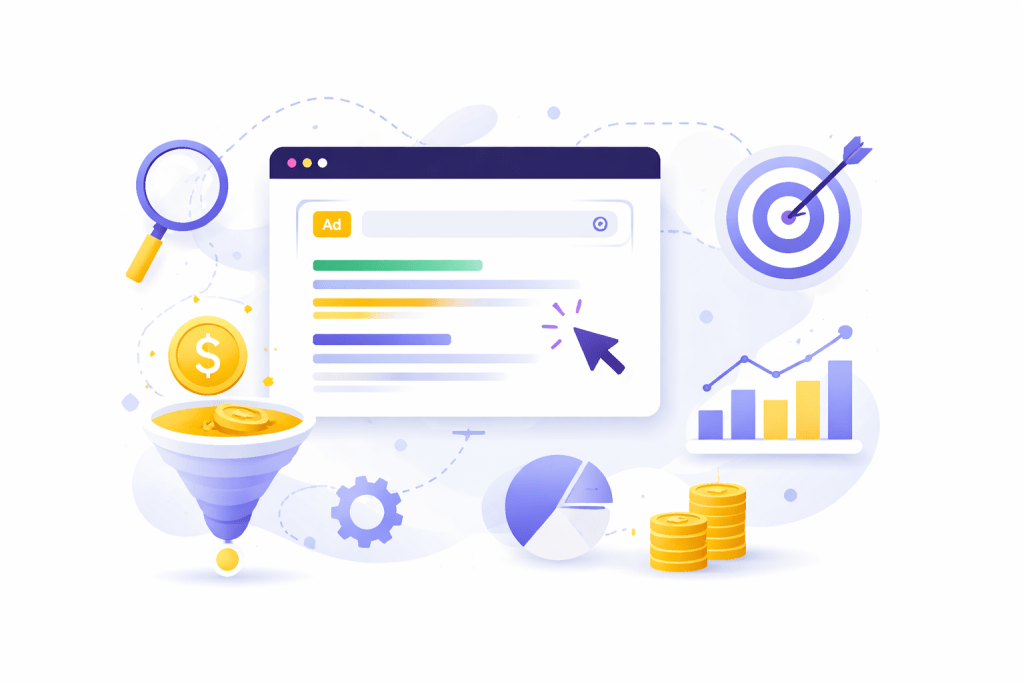
Pay per click is one of the few marketing channels that lets you step into demand exactly when someone is already looking for a solution, comparing products, or signaling clear commercial intent. Google says Search ads can appear when people search for businesses like yours and that advertisers pay only when someone clicks, which is why PPC keeps attracting brands that care about speed, control, and measurable outcomes.
That matters even more in a market where digital ad budgets are still enormous and intensely performance-driven. The latest IAB/PwC Internet Advertising Revenue Report for full-year 2024 shows how much money continues to flow into digital media, while Alphabet’s 2024 annual report and Microsoft’s 2025 annual report make it clear that search advertising remains a major commercial engine for the platforms themselves. When the platforms make that much money from search demand, it tells you something important: users still click, advertisers still buy traffic, and the economics still work when campaigns are built properly.
The mistake most businesses make is assuming pay per click is just about setting a budget and writing a few ads. In reality, it is a full operating system that connects intent, bidding, creative, landing pages, tracking, and post-click follow-up. This first part lays that foundation so the rest of the article can go deeper without losing the thread.
Article Outline
- Part 1: Why Pay Per Click Matters
- Part 2: Framework Overview
- Part 3: Core Components
- Part 4: Professional Implementation
- Part 5: Analytics and Optimization
- Part 6: Ecosystem, Trends, and FAQs
Why Pay Per Click Matters
The biggest reason pay per click matters is simple: it puts your offer in front of people who are already close to taking action. Google’s own materials explain that Search ads are built to connect advertisers with people actively searching, and Google also notes that it processes billions of searches every day. That combination of scale and intent is what makes PPC feel different from broad awareness channels that need more time to warm up.
It also matters because search behavior is still heavily concentrated on the platforms where advertisers can buy visibility. Statcounter’s February 2026 worldwide data shows Google holding roughly 89.98% of global search engine market share, while Microsoft continues to report growth in search and news advertising in its latest annual reporting. If your buyers use search to discover options, compare vendors, and validate trust, pay per click is not a side tactic; it is a front-line acquisition channel.
There is another reason serious operators keep returning to PPC even after experimenting with newer channels: accountability. Google’s conversion documentation explains that advertisers can measure what users do after clicking, from purchases to lead actions and other key events, through conversion measurement and web conversion setup. That means a campaign can be judged by business outcomes instead of guesswork, which is exactly what separates professional media buying from vanity marketing.
Framework Overview
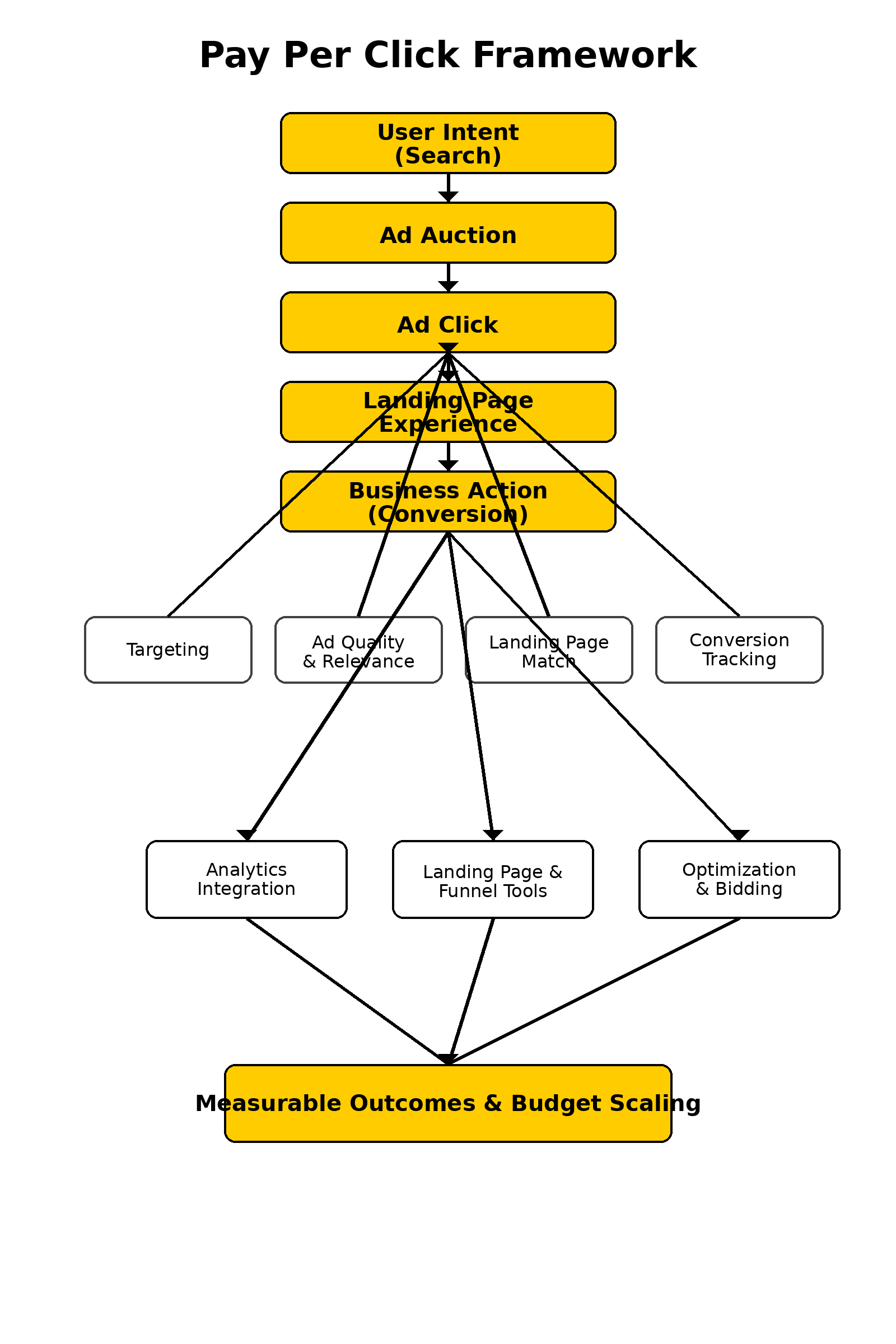
A useful way to understand pay per click is to stop seeing it as an ad and start seeing it as a chain. The chain starts with a search, audience signal, or shopping moment, then moves into an auction, then into a click, then into a landing-page experience, and finally into a measured business action. If any link in that chain is weak, the whole campaign becomes more expensive than it should be.
That is why the auction itself is only one piece of the story. Google explains that Smart Bidding uses auction-time signals such as device, location, time of day, browser, operating system, and language to set bids more precisely, while Amazon explains that its Sponsored Products campaigns let advertisers control products, keywords, bids, budgets, and measurement within a CPC model. Different platforms package the mechanics differently, but the operating logic stays the same: platform signals, advertiser inputs, and user intent interact in real time.
Once you look at PPC through that framework, a lot of common confusion disappears. You stop obsessing over clicks in isolation and start asking better questions about intent quality, message match, conversion friction, and downstream revenue. That shift is what turns pay per click from a traffic-buying habit into a disciplined growth system.
Core Components
The first core component is targeting, because the platform needs a clear instruction about who should see the ad or what query should trigger it. On Google Search, that usually means keywords and match behavior; on Amazon, it can mean keywords or automated targeting; and on other platforms it may lean more heavily on audience definitions. No matter the platform, the goal is the same: reduce wasted exposure and stay close to commercial intent.
The second core component is ad quality and relevance. Google describes Quality Score as a diagnostic tool built from expected clickthrough rate, ad relevance, and landing page experience, and Microsoft describes its own quality score in similar terms around keywords, ads, and landing pages. That is a strong reminder that pay per click is never just a bidding game, because platforms reward advertisers that create a better match between what the user wants and what the ad actually delivers.
The third core component is the post-click experience. Google’s landing-page guidance says the page should be useful, relevant, easy to navigate, and aligned with the expectations set by the ad, while its optimization guidance stresses that landing pages should closely match your ad and keywords. In practical terms, that means you do not win PPC by forcing cold traffic onto a generic homepage; you win by removing friction between the click and the conversion.
Professional Implementation
Professional implementation begins before the campaign ever goes live. A serious setup connects ad accounts, analytics, conversion tracking, and consent infrastructure from day one, because measurement gaps quietly destroy decision-making later. Google recommends linking Google Ads and Google Analytics to see the full customer cycle, and its consent documentation explains how consent mode helps communicate users’ consent choices while adapting tag behavior.
The next step is building a practical operating stack around the campaign instead of treating the ad platform as a self-contained universe. If you need to launch landing pages quickly, route leads into follow-up sequences, or test offer flow without waiting on a full development sprint, tools like ClickFunnels, Systeme.io, and Brevo can make implementation faster. That kind of speed matters in PPC because the businesses that learn fastest usually buy growth more efficiently.
Professional implementation also means accepting that the first version of a campaign is rarely the finished version. You launch with a structure that is measurable, logically segmented, and grounded in buyer intent, then you improve it through better search terms, stronger message match, cleaner landing pages, smarter bidding, and tighter reporting. That is the discipline behind profitable pay per click, and it is the standard the rest of this article will build on.
The Intent Layer Comes First
Everything starts with intent. In search-based PPC, that intent shows up when someone types a query, compares options, or looks for a solution with enough urgency to act. Google’s Search ads documentation explains that advertisers can show ads when people search for businesses like theirs and only pay when someone clicks, which is what makes search traffic so valuable in the first place.
But intent is not all equal, and that is where many beginners burn money. A person searching for broad educational information behaves very differently from someone searching a product name, pricing phrase, or service near their location. That is why Google recommends building tightly themed ad groups, choosing relevant keywords carefully, and using negative keywords and match types to stop your ads from drifting into irrelevant searches.
This is also why pay per click works so well for businesses that know their buyer deeply. If you understand the language people use when they are frustrated, ready to compare, or ready to purchase, you can structure campaigns around moments that already carry commercial energy. That is a massive advantage because you are no longer trying to manufacture demand from thin air; you are stepping into demand that already exists.
The Auction Layer Decides Visibility
Once intent is present, the platform still has to decide whether your ad deserves to show and how aggressively to price that opportunity. This is where the auction layer comes in. Google explains that with auction-time bidding, automated bidding systems can factor in signals like device, location, time of day, language, browser, and other context in real time, which means each auction is more dynamic than most advertisers realize.
That matters because pay per click is not won by budget alone. Google’s explanation of Quality Score shows that expected clickthrough rate, ad relevance, and landing page experience are core diagnostic components tied to user experience. Microsoft describes its own quality score system in a similar way, focusing on the quality of keywords, ads, and landing pages, which tells you this is not just a Google quirk but a broader paid search reality.
In plain English, the platform wants to protect its users while still making money from advertisers. That is why weak message match usually gets punished over time, even if the advertiser is willing to bid hard. The stronger your fit between keyword, ad, and destination, the more efficiently you tend to compete.
The Click Layer Is Where Messaging Gets Tested
The click itself is not the goal, but it is still a brutally honest test. It tells you whether your message was compelling enough to earn attention in a competitive environment. When Google evaluates ad relevance and expected CTR inside its Quality Score framework, it is effectively asking whether your ad looks like a credible answer to the searcher’s problem.
This is why bland copy usually underperforms even when the keyword targeting is sound. If your headline feels generic, if your offer is vague, or if the ad does not reflect the actual intent behind the search, people hesitate. And in PPC, hesitation is expensive because the platform is constantly learning which advertisers deserve visibility.
Strong messaging in pay per click is not about sounding clever. It is about sounding specific, relevant, and immediately useful. The best ads often feel like they were written by someone who truly understands what the searcher is trying to accomplish in that exact moment.
The Post-Click Layer Determines Whether the Money Was Well Spent
This is where a lot of businesses lose the plot. They spend hours on keywords and bidding, then send traffic to a page that is slow, confusing, generic, or disconnected from the promise made in the ad. Google’s landing page guidance stresses that the destination should be useful, relevant, and closely aligned with the ad and keywords, because a better landing page experience improves both user outcomes and campaign performance.
If a person clicks because they expect pricing clarity, a demo, a product comparison, or a direct answer, the page needs to deliver that fast. This is not the place to bury the offer under corporate fluff. The best pay per click landing pages reduce friction, repeat the core promise, and make the next step obvious without forcing the visitor to figure everything out on their own.
That is why professionals do not judge a campaign by ad metrics alone. They look at what happened after the click, because that is where the business result is either created or quietly destroyed. A great campaign can be made unprofitable by a weak page, while an average campaign can become far stronger when the destination experience is sharp and persuasive.
The Measurement Layer Feeds the Whole System
Without measurement, the whole framework breaks down. You may still get traffic, and you may still generate some sales or leads, but you will have a hard time understanding which queries, ads, audiences, and landing pages actually moved the business forward. Google’s documentation on conversion tracking and linking Google Ads with Google Analytics shows how the platform expects advertisers to connect media spend with real actions on site.
This becomes even more important now that privacy, consent, and data loss affect how much signal flows back into ad systems. Google’s documentation on consent mode makes it clear that measurement is no longer just a technical afterthought. It is part of whether the campaign can learn accurately enough to improve.
Once you see the measurement layer properly, you stop making decisions from emotion and start making them from evidence. That changes everything. Instead of asking whether a campaign “feels promising,” you can see whether it is actually producing qualified leads, revenue, or profitable customer acquisition.
How the Whole Framework Works in Practice
When the framework is healthy, each layer strengthens the next one. Strong intent targeting brings in the right people. The auction rewards relevance. The ad earns the click because the messaging matches what the user wants. The landing page converts because it continues the same conversation instead of resetting it. Then the tracking loop tells the platform and the advertiser what is truly working.
You can also see why random optimization rarely works. Changing bids without fixing message match is shallow. Rewriting ads without improving the landing page creates friction after the click. And chasing more traffic before your measurement is trustworthy just gives you more noise to sort through.
That is the real framework overview of pay per click. It is not a trick, not a shortcut, and not a magic dashboard setting. It is a system where every layer affects the next, and the businesses that treat it that way are the ones that usually end up pulling away from the competition.
Keywords and Targeting Define Who Gets In
The first core component is targeting, because that is what decides whether your ad even enters the right conversations. In Google Ads, keywords are the main language of search intent, and Google explains that keyword matching lets advertisers control how closely a user’s search must relate to the keyword before the ad becomes eligible to show. That may sound technical, but the business meaning is straightforward: if your targeting is sloppy, your campaign starts paying for attention that was never likely to convert.
This is why match types matter so much in pay per click. Google’s documentation on keyword match types and building effective keyword lists makes it clear that exact match gives tighter control, phrase match keeps useful flexibility, and broad match expands reach when paired with enough data and smart optimization. Each one has a place, but the real skill is knowing when you need precision and when you want discovery.
Negative keywords matter just as much, even though they get far less attention. They protect your budget from drifting into the wrong searches and force the account to stay aligned with buyer intent. That means the targeting layer is not just about getting more traffic; it is about filtering traffic so the rest of the campaign has a real chance to succeed.
Ad Creative Turns Relevance Into Action
Once your targeting is sound, the ad has to earn the click. That is where creative comes in, and in search PPC, creative is not about flashy design as much as it is about relevance, clarity, and timing. Google explains that responsive search ads allow advertisers to enter multiple headlines and descriptions so the system can test combinations and learn which messages perform best in different contexts.
That is a big deal because the ad is the bridge between the search and the offer. If the wording feels vague, generic, or disconnected from what the user actually wants, the click never comes or it comes from the wrong person. Google’s guidance on creating effective Search ads makes this point in a practical way by focusing on relevance, helpfulness, and adapting messaging to changing user behavior.
The best pay per click ads do not try to sound clever for the sake of it. They make the promise clear, reflect the user’s intent, and create enough confidence for the person to take the next step. When that happens, the click feels natural rather than forced, and that is usually where better quality traffic starts.
Landing Pages Finish What the Ad Started
A click is only valuable if the page on the other end continues the same conversation. This is where many campaigns quietly fail. The ad may be strong, the keyword may be relevant, and the budget may be healthy, but if the user lands on a page that feels confusing, slow, generic, or disconnected from the promise they just clicked on, the whole thing starts to fall apart.
Google’s guidance on optimizing ads and landing pages and its more detailed page on optimizing landing pages makes the expectation clear: the page should closely match the ad and keywords so users immediately find what they expected to see. That is more than a best practice. It is one of the core components behind better relevance, better user experience, and stronger conversion performance.
This is why smart advertisers treat the landing page as part of the ad system, not as a separate website problem. If you need a faster way to build focused pages, test different offers, and guide users into a tighter conversion path, platforms like ClickFunnels or Systeme.io can make that process much easier. The point is not which tool you use. The point is that the post-click experience has to be intentional, focused, and built to convert.
Conversion Tracking Tells You What Is Actually Working
If you cannot measure what happens after the click, you are not really managing pay per click. You are just buying visits and hoping your instincts are good enough to interpret the results. Google’s resources on conversion measurement, how website conversions are tracked, and setting up web conversions make it clear that campaign performance only becomes truly useful when business actions are being captured properly.
This is where a lot of advertisers get fooled by surface metrics. Clicks can look healthy. CTR can look exciting. Even cost per click can look reasonable. But if leads are low quality, purchases are thin, or tracking is incomplete, those numbers tell an incomplete story and can lead you into bad decisions.
Strong tracking gives the platform better learning signals and gives you better judgment. It helps you see which keywords deserve more budget, which landing pages are failing, and which campaigns look good only because they have not been held accountable to real outcomes yet.
Account Structure Keeps Everything Understandable
One of the most overlooked core components in pay per click is structure. A messy account makes it harder to see what is happening, harder to scale what works, and harder to fix what does not. Even when the individual parts are decent, poor structure can bury insight under so much noise that the account becomes difficult to trust.
A clean account structure separates intent clearly enough that reporting remains meaningful. That means campaigns and ad groups should reflect real business differences such as product type, service line, funnel stage, geography, or buyer intent rather than being thrown together for convenience. When that happens, the data starts telling a story you can actually use.
This also makes testing far more useful. You can compare themes, offers, messages, and landing page paths without constantly wondering whether your data is being distorted by a messy setup. In other words, structure is not just tidiness. It is what makes optimization possible at a professional level.
Follow-Up Systems Protect the Value of Every Click
This is the part many businesses forget until they realize how much money they have been leaving on the table. Not every valuable click converts immediately, especially in lead generation, higher-ticket offers, or longer decision cycles. That means the campaign is only one part of the revenue story, and the follow-up system has to carry its share of the weight.
If your campaign generates leads, but no email sequence, sales workflow, or CRM process exists to keep those leads moving, the value of the click drops fast. Tools like Brevo for email automation or Copper for relationship management can help tighten that handoff so leads do not go cold for avoidable reasons. That matters because a PPC campaign should not be judged only by the first action a visitor takes; it should be judged by how effectively the business captures and develops that intent afterward.
This is where serious advertisers pull ahead. They do not just buy attention. They build a system that respects the value of that attention after it arrives. And when that happens, the economics of pay per click often improve far more than people expect.
Why These Core Components Have to Work Together
The real power of pay per click does not come from any one component in isolation. Good targeting without a strong landing page still leaks money. Strong creative without clean tracking still leaves you guessing. Solid conversion tracking without a useful follow-up system still leaves revenue on the table. Everything is connected.
That is why the strongest PPC operators think in systems rather than tricks. They know the keyword has to bring in the right person, the ad has to make the right promise, the landing page has to continue that promise, and the measurement stack has to capture the outcome clearly enough for optimization to mean something. When those pieces line up, the account starts becoming easier to improve because every change is pushing on a system that already makes sense.
And that is exactly what you want. You do not want a campaign that works by accident. You want a pay per click engine that keeps getting stronger because the core components underneath it were built the right way from the beginning.
Statistics and Data
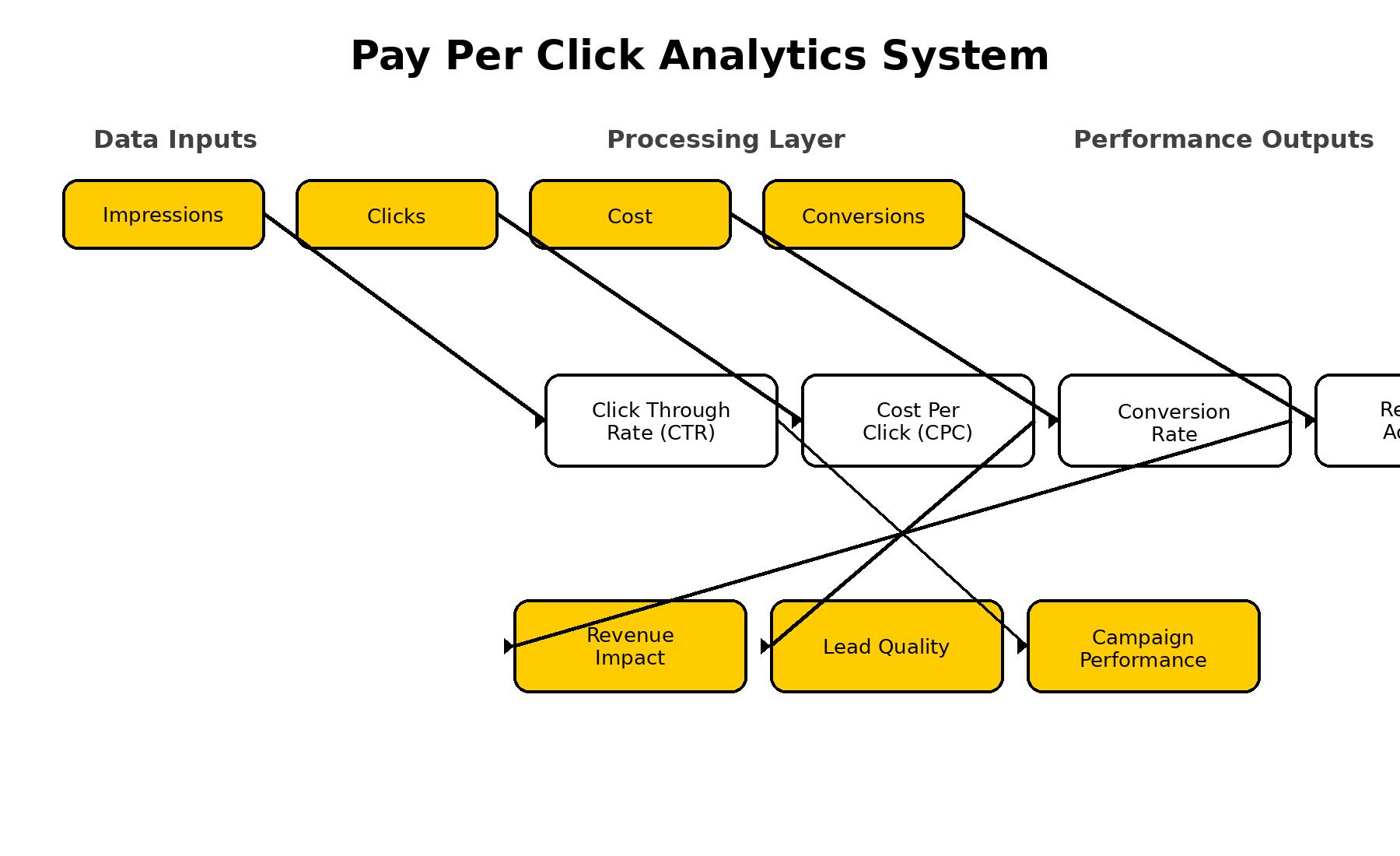
If you want to run pay per click like a professional, you have to get serious about data. Not dashboard theater. Not vanity reporting. Real data that helps you decide where money is being wasted, where intent is strong, and where the campaign deserves more trust and more budget.
This matters because PPC sits inside an enormous market where performance pressure is very real. The IAB and PwC full-year 2024 revenue figures show U.S. internet ad revenue reaching $258.6 billion in 2024, up 14.9% year over year, with search alone accounting for $102.9 billion. When that much capital is flowing through digital advertising, weak measurement stops being a minor inconvenience and starts becoming a direct competitive disadvantage.
It also matters because search demand is still heavily concentrated. Statcounter’s worldwide figures for February 2026 show Google holding 89.98% of global search engine market share, which means a huge portion of commercial intent is still being captured and priced inside one ecosystem. So if you are buying search traffic, the statistics you look at had better tell you something useful, because this is not a small sandbox anymore.
The Pay Per Click Metrics That Actually Matter
The first professional shift is understanding that not all numbers deserve equal attention. Clicks, impressions, and average CPC are useful, but they are only meaningful when they help explain business performance. Google defines average CPC as total click cost divided by total clicks, which makes it a clean efficiency metric, but it still does not tell you whether those clicks were valuable.
That is why conversion data changes everything. Google’s explanation of conversion measurement is clear that the point is to understand which keywords, ads, ad groups, and campaigns are actually driving valuable customer activity. Once you start reading PPC data through that lens, a cheap click stops looking impressive on its own and a higher click cost can actually look attractive if it produces better leads, better orders, or stronger revenue.
Professional operators also separate diagnostic metrics from outcome metrics. Diagnostic metrics tell you where friction lives. Outcome metrics tell you whether the business is actually winning. Mixing those two together is one of the fastest ways to confuse yourself and make bad optimization decisions.
Why Impression Share Reveals More Than Most Advertisers Realize
Impression share is one of the best statistics for understanding whether your campaign is even present often enough to compete. Google defines impression share as the percentage of impressions your ads received compared with the total number of impressions they were eligible to receive. That makes it one of the clearest windows into missed visibility.
This is where the data starts getting useful in a very practical way. If impression share is low, the issue may be budget, rank, or both. Google’s reporting on lost impression share breaks that down by showing when ads were not shown because of insufficient budget and when they were not shown because Ad Rank was too weak to compete.
That gives you a much better decision path than simply “raise bids and hope.” Sometimes the right move is more budget. Sometimes the right move is stronger relevance, better copy, and a tighter landing page. And sometimes the smartest move is to accept lower visibility because the queries you are missing are not profitable enough to chase aggressively.
Auction Data Helps You See the Market, Not Just Your Account
One reason PPC data becomes so valuable is that it lets you read competitive pressure without needing a separate market research project. Google’s auction insights report shows metrics like impression share, overlap rate, outranking share, position above rate, top of page rate, and absolute top of page rate. In plain language, that means you can see how often competitors show up beside you and how often they beat you in the same auctions.
This helps you avoid shallow conclusions. If leads are down, the issue may not be that your landing page suddenly broke or your ad copy became weak overnight. It may be that competition became more aggressive, budgets moved, or the auction itself changed. Data like overlap rate and outranking share help you spot that shift faster.
It also makes your bidding decisions far more grounded. Instead of reacting emotionally to a bad week, you can see whether the market got tighter, whether visibility dropped, and whether your campaign is losing because of auction pressure or because the offer itself needs work.
Conversion Delay Can Make Good Campaigns Look Worse Than They Are
One of the easiest ways to misread pay per click statistics is to judge performance too quickly. Google’s explanation of conversion lag reporting notes that conversion lag is the delay between an ad click and the eventual conversion, and that this can make CPA look inflated while ROAS looks deflated in the short term. That is a massive point, especially for lead generation and higher-consideration purchases.
In other words, the data you are seeing today may still be incomplete. If you shut campaigns down too early, you can end up killing something that was actually working but had not fully reported yet. This is one of the reasons professionals usually evaluate search performance over a more stable window instead of panicking over yesterday’s numbers.
Google reinforces that patience in its guidance for Smart Bidding Exploration measurement, where it recommends running that type of optimization for at least 6 weeks. That does not mean you ignore data for six weeks. It means you respect that performance systems need enough time to learn before you decide what is truly broken and what is merely still maturing.
Cleaner Measurement Usually Beats More Reporting
A lot of advertisers think the answer to weak data is more reports. Usually the real answer is cleaner measurement. Google’s documentation on enhanced conversions explains that the feature improves measurement accuracy and can unlock more powerful bidding by sending hashed first-party data in a privacy-safe way. That matters because better signal quality gives both you and the bidding system a more trustworthy picture of reality.
There is also a timing element here that many people overlook. Google’s enhanced conversion impact guidance notes that enhanced conversions can need up to 30 days to train before their impact begins appearing in reporting. So once again, good PPC analysis is not just about what metric you watch. It is about understanding when that metric is ready to be trusted.
This is why disciplined implementation beats frantic optimization. If your data foundation is weak, every conclusion on top of it becomes shakier than it looks. If your data foundation is strong, even simple reports become dramatically more useful because they are reflecting reality instead of distortion.
Why Analytics Linking Changes the Quality of Your Decisions
Another professional move is making sure ad platform data is not stuck in isolation. Google’s guide to connecting Google Ads to Google Analytics explains that linking the two products allows data to flow between them so advertisers can analyze more of the customer journey in one place. That sounds technical, but the business benefit is huge.
Once your ad account and analytics setup are connected properly, it becomes easier to see what happens after the click. You can spot which campaigns drive engaged sessions, which landing pages lose people fast, and where conversion flow starts breaking down. That is the difference between judging a campaign by surface metrics and judging it by the actual experience users have after they arrive.
If your PPC process depends on lead capture, form quality, and follow-up speed, tools like Fillout for cleaner form flows or Brevo for email and lifecycle follow-up can make your reporting more useful because they improve the system behind the numbers. Better data does not live only inside Google Ads. It also depends on how well the rest of your funnel is built.
The Professional Mindset Behind PPC Statistics and Data
The biggest difference between average and advanced PPC management is not access to secret metrics. It is the discipline to read statistics in context. A rise in CPC may be fine if lead quality is stronger. A drop in CTR may be acceptable if the campaign is filtering out weaker traffic. A lower ROAS today may not mean much if conversion lag says more value is still likely to report.
That is why pay per click data should be used like a decision tool, not a source of stress. You are trying to understand intent, visibility, competition, conversion behavior, and signal quality well enough to make smarter moves than the advertiser next to you. When you do that consistently, the account starts becoming easier to grow because the numbers are finally being read the way they were meant to be read.
And that is the real point of statistics and data in PPC. They are not there to make reports look sophisticated. They are there to help you protect budget, spot opportunity, and build a campaign that gets stronger because your decisions get sharper over time.
Ecosystem, Trends, and FAQs
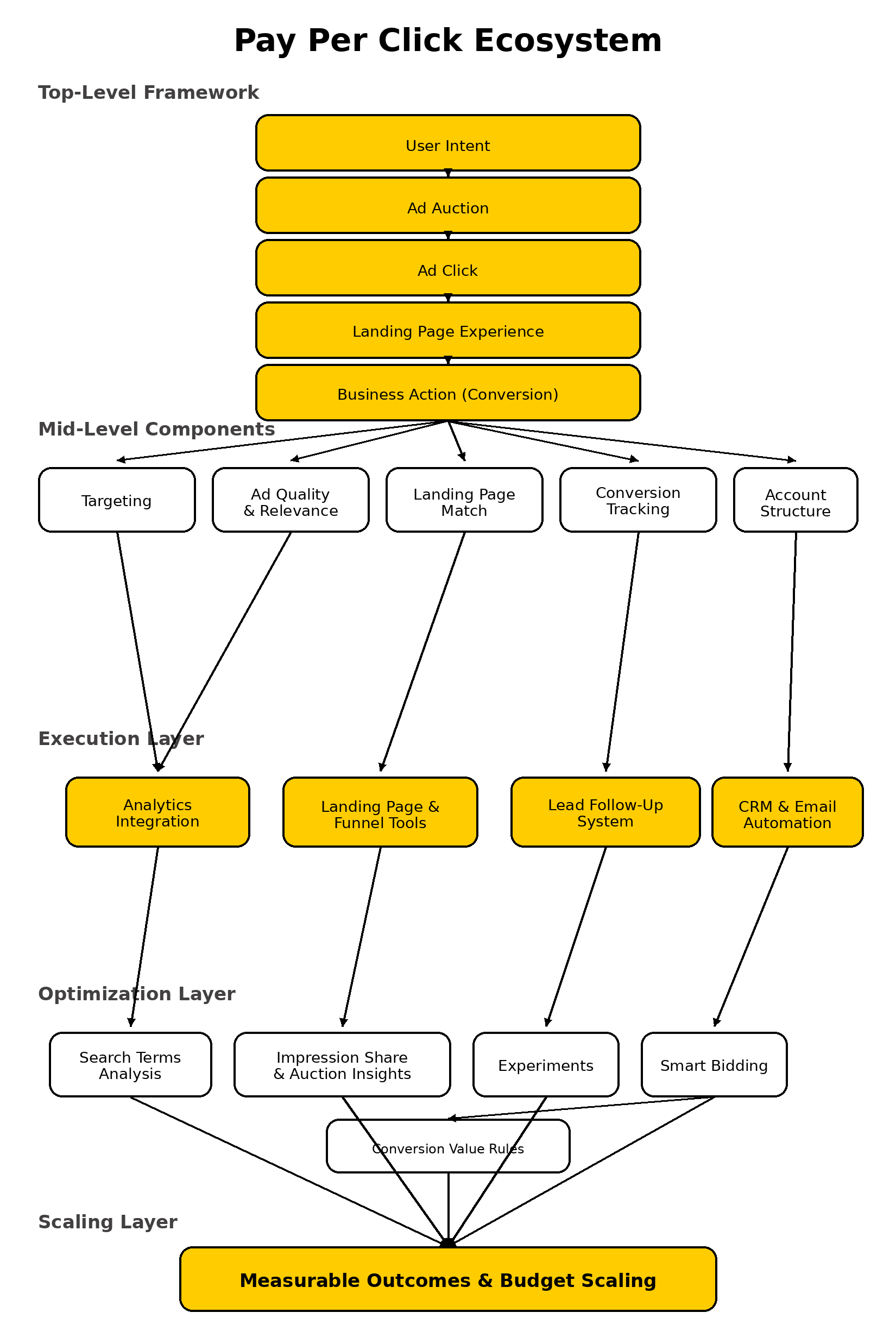
By this point, you can probably see that pay per click is no longer just about buying a few search ads and hoping for the best. It now lives inside a much bigger ecosystem that includes search engines, retail media networks, analytics platforms, landing page tools, CRM systems, privacy controls, and AI-driven bidding. That is a big reason why the latest IAB and PwC revenue report for full-year 2024 showed U.S. internet advertising revenue hitting $258.6 billion, with search still representing one of the largest segments and commerce media continuing to rise fast.
The ecosystem is getting broader because buyer journeys are getting less linear. Someone may discover a solution on Google, compare options on YouTube, get retargeted somewhere else, and then buy through a marketplace or after an email follow-up sequence. That is why the best PPC operators think beyond the ad account itself and build systems that can capture, measure, and follow through on demand wherever it shows up.
It is also why pay per click keeps rewarding people who adapt. Google keeps expanding AI-driven bidding through Smart Bidding, Amazon keeps pushing CPC-based sponsored placements through Sponsored Products, and measurement keeps getting tighter around first-party data through tools like enhanced conversions. So the question is not whether the ecosystem will keep changing. It will. The real question is whether you are building your PPC process in a way that can keep up.
FAQ for This Complete Guide
What is pay per click in simple terms?
Pay per click is a form of advertising where you pay when someone clicks your ad rather than paying simply for the ad to exist. Google explains that Search ads can appear when people search for businesses like yours and that advertisers pay only when someone clicks. The simple version is this: you are buying access to attention at the exact moment a platform thinks your offer is relevant.
Is pay per click only about Google Ads?
Not even close. Google is still dominant in search, and Statcounter’s global search market share data shows why it gets so much attention, but PPC also exists on Microsoft Ads, Amazon Ads, social platforms, marketplaces, and other ad networks. Amazon, for example, describes Sponsored Products as CPC ads that promote product listings on Amazon and select apps and websites.
How much budget do you need for pay per click?
There is no universal number because the right budget depends on your industry, keyword costs, sales cycle, and how much data the platform needs to learn. What matters more than the starting amount is whether the budget gives your campaign enough room to generate meaningful data. If the spend is too low to produce enough clicks and conversions, you may end up judging the channel before it even had a fair chance to work.
How long does pay per click take to work?
PPC can generate clicks immediately, but profitable optimization usually takes longer than people expect. Google’s guidance around conversion lag reporting makes it clear that conversions may show up after the click with a delay, and Google’s documentation for some AI-led bidding workflows says meaningful learning may require several weeks. So yes, traffic can start fast, but reliable performance judgment needs patience.
Is SEO better than pay per click?
That is the wrong fight. SEO and pay per click do different jobs. SEO is powerful for compounding visibility over time, while PPC is powerful for speed, control, testing, and capturing high-intent demand right now. The strongest businesses usually use both, because organic search builds long-term presence while paid search gives you a direct way to buy visibility when timing matters.
Why do some pay per click campaigns fail even when they get clicks?
Because clicks are not the finish line. Many campaigns fail because the targeting is too broad, the ad promises the wrong thing, the landing page is weak, or the tracking setup is incomplete. Google’s landing page guidance around optimization and message match exists for a reason: the click only has value if the visitor lands in the right experience and is given a clear next step.
What metrics matter most in pay per click?
The most important metrics are the ones tied to business outcomes, not just ad activity. Google’s documentation on conversion measurement makes that clear by focusing on the actions that matter after the click. Clicks, CTR, and CPC are useful diagnostic metrics, but they only become meaningful when you can connect them to leads, sales, revenue quality, or customer acquisition efficiency.
Should you use Smart Bidding?
In many cases, yes, but only when the account is feeding the system good signals. Google explains that Smart Bidding uses AI to optimize for conversions or conversion value in each auction. That can be powerful, but automation performs best when your conversion tracking is reliable, your campaign structure is logical, and your landing pages are not sending mixed signals back into the system.
What role does first-party data play in modern pay per click?
It plays a much bigger role than it used to. As privacy restrictions and data loss make measurement harder, platforms are leaning more heavily on advertiser-owned signals. Google says enhanced conversions can improve measurement accuracy and unlock stronger bidding by using hashed first-party data in a privacy-safe way. That means your forms, CRM, tracking setup, and consent flow are no longer side issues. They are part of PPC performance.
Is Amazon part of the pay per click ecosystem now?
Absolutely. Amazon is not just an ecommerce platform anymore. It is also a major paid media environment where brands can buy intent close to the point of purchase. Amazon’s own documentation says Sponsored Products are cost-per-click ads, and that matters because more commercial discovery is happening directly inside marketplace ecosystems instead of beginning on a traditional search engine.
Can small businesses still win with pay per click?
Yes, but not by trying to outspend giant advertisers across broad markets. Small businesses usually win by being more focused, more specific, and more disciplined with intent. When the campaign is tightly aligned to buyer language, the landing page is strong, and the follow-up system is sharp, a smaller advertiser can often compete very effectively in a well-defined slice of the market.
How do you improve a struggling pay per click campaign?
Start with diagnosis, not panic. Look at search terms, conversion tracking, landing page match, impression share, and whether the offer itself is strong enough to deserve the click. Google’s search terms report and impression share reporting are especially useful here because they help you see whether the issue is poor intent matching, weak visibility, or wasted exposure.
Do you need a landing page builder and CRM for pay per click?
You do not always need both on day one, but once you care about scale, speed, and follow-up quality, they become extremely helpful. PPC is not just about winning the click; it is about turning that click into a measurable business outcome. That is why many advertisers use tools like ClickFunnels for funnel building, Systeme.io for all-in-one execution, Brevo for follow-up automation, or Copper for relationship management.
What is the biggest pay per click mistake?
The biggest mistake is treating PPC like a switch instead of a system. People assume they can pick a few keywords, write generic ads, send traffic to a random page, and somehow the platform will do the hard part for them. It does not work that way. The real winners in pay per click are the ones who respect the full system from intent to click to conversion to follow-up.
Work With Professionals
There comes a point where doing everything yourself stops being efficient. Maybe you understand the basics of pay per click, but you do not have the time to manage search terms every week, tighten landing pages, clean up tracking, test new offers, and build stronger follow-up at the same time. That is usually the moment when working with professionals stops feeling like a luxury and starts feeling like the faster route to better results.
The right professionals do more than run ads. They help you think clearly about buyer intent, tracking quality, creative relevance, funnel structure, and what the numbers are actually saying. They can also help you move faster with the surrounding infrastructure, whether that means building pages in ClickFunnels, setting up automation inside Systeme.io, tightening forms with Fillout, or improving lead handling through Brevo.
That is really what this complete guide has been building toward. Pay per click rewards action, but it rewards smart action even more. If you are serious about growth, then do not just dabble. Build the system properly, measure it honestly, and get the right people involved when the opportunity is too big to keep treating casually.
Explore 10K+ Remote Marketing Contracts on MarkeWork.com
Most marketers spend too much time chasing clients, competing on crowded platforms, and losing a percentage of every project to middlemen.
MarkeWork gives you a better way. Browse thousands of remote marketing contracts and connect directly with companies desperate to hire skilled marketers like you without platform commissions and without unnecessary gatekeepers.
If you’re serious about finding better opportunities and keeping 100% of what you earn, you can explore available contracts and create your profile for free at MarkeWork.com.
 Filip Konecny Enterprises