
Online advertising is no longer the optional part of a marketing plan that you get around to after everything else is done. It is where brands compete for attention, where buyers compare options in real time, and where revenue is often won or lost before a sales conversation ever begins. When WARC projected global ad spend would pass $1 trillion and then keep climbing toward $1.24 trillion by 2026, it confirmed what businesses already feel every day: digital media has become the main commercial battleground.
The same pattern shows up inside the United States, where IAB and PwC reported that internet advertising reached a record $259 billion in 2024. That growth did not come from one channel doing all the work. It came from search, social, video, and commerce media all becoming more tightly connected, more measurable, and more essential to the customer journey.
And the platforms themselves make the shift impossible to ignore. Meta reported full-year 2025 revenue of $200.97 billion, with ad impressions up 12%, while Alphabet said YouTube alone surpassed $60 billion in 2025 across ads and subscriptions. Put that together with Pew Research showing that 84% of U.S. adults use YouTube and 71% use Facebook, and you can see why online advertising matters so much: the audience is there, the money is there, and the competition is absolutely there.
Article Outline
- Part 1: Why Online Advertising Matters
- Part 2: Online Advertising Framework Overview
- Part 3: Core Components of Online Advertising
- Part 4: Professional Online Advertising Implementation
- Part 5: Online Advertising Analytics and Optimization
- Part 6: The Online Advertising Ecosystem, Future Direction, and FAQ
This article is built to move in the same order that smart advertisers work in real life. First, we will get clear on why online advertising matters at the business level. Then we will walk through the framework, the moving parts inside it, and the way professionals actually implement campaigns without wasting budget.
After that, the later sections will cover measurement, optimization, and the broader ecosystem shaping the future of digital ads. That matters because online advertising is not just about buying clicks anymore. It is about building a system that connects message, media, data, and conversion into something that can keep producing results even as platforms, privacy rules, and buyer behavior keep changing.
Why Online Advertising Matters
Online advertising matters because it gives businesses something older media could rarely offer at scale: speed, targeting, and feedback in the same system. You can launch a campaign, see how different audiences respond, adjust your message, and improve performance before the week is over. That ability to learn while spending is one of the biggest reasons digital channels keep attracting more budget.
It also matters because modern buying journeys are messy. A prospect might discover a brand on social media, research it through search, watch product videos, compare reviews, and finally convert on a marketplace or direct website. Deloitte’s 2025 Digital Media Trends research describes a market where advertisers are competing for roughly six hours of daily media and entertainment time per person, which means brands are not just competing against direct rivals anymore. They are competing against everything else capable of absorbing attention.
That is exactly why channel reach still matters, but channel behavior matters even more. Pew’s 2025 social media data shows that major platforms are still enormous, yet user habits differ sharply by age, frequency, and platform purpose. So when a business says it wants to “do online advertising,” the real question is not whether digital ads work. The real question is whether the business understands where its audience is, what state of mind that audience is in, and what kind of ad fits that moment.
There is also a practical reason this topic matters so much right now: the environment has become harder, not easier. IAB’s State of Data 2024 report found that 95% of advertising and data decision-makers expected continued legislation and signal loss, which means advertisers can no longer rely on lazy targeting and weak measurement. The businesses that win in online advertising now are usually the ones that treat it like a professional operating system rather than a collection of disconnected hacks.
Online Advertising Framework Overview

A strong online advertising framework starts with one simple truth: ads do not succeed because a platform is popular. They succeed because the campaign matches the right objective to the right audience, the right offer, the right creative, and the right landing experience. When one of those pieces is weak, the whole system feels expensive, even if the media buying itself is technically fine.
The best way to think about the framework is in layers. The first layer is the business goal, because a campaign designed to generate leads should not be structured the same way as a campaign designed to build awareness or recover abandoned carts. The second layer is audience intent, because someone casually scrolling video is not thinking the same way as someone actively searching for a solution. The third layer is conversion architecture, which includes the ad, the page, the call to action, and the follow-up path after the click.
That framework is also becoming more cross-platform every year. WARC’s 2025 review of Amazon’s ad business highlighted how commerce media is moving beyond simple sponsored listings into a fuller funnel mix of search, display, and streaming inventory. In other words, online advertising is not neatly divided into “brand” on one side and “performance” on the other anymore. The modern framework has to account for discovery, persuasion, conversion, and retention as parts of the same engine.
This is why experienced advertisers stop obsessing over channels in isolation. Search can capture demand, social can shape demand, video can deepen trust, and retail media can intercept buyers close to purchase. When those roles are clearly defined, online advertising feels strategic. When they are not, brands usually end up duplicating spend, confusing audiences, and blaming platforms for problems that actually started in the campaign structure.
Core Components of Online Advertising
The core components of online advertising are simpler than people make them sound, but they still have to work together. You need a clear objective, a defined audience, compelling creative, a credible offer, and a destination that can convert attention into action. Miss one of those elements and even a well-funded campaign can produce weak results.
Creative deserves special attention because it is often treated as decoration when it should be treated as leverage. Good creative does not just look polished. It communicates relevance fast, earns the next second of attention, and makes the click feel like the natural next step. That is especially important in an environment where social platforms, creators, user-generated content, and recommendation systems are reshaping how people consume media.
Data is another core component, but not in the simplistic way many advertisers talk about it. The point is not to collect everything. The point is to collect the signals that help you make better decisions about audience quality, creative performance, conversion rates, and customer value. Nielsen’s 2025 Annual Marketing Report found that only 32% of marketers measure traditional and digital media spend holistically, which explains why so many teams still struggle to understand what is truly working across channels.
Then there is the landing environment, which many advertisers underestimate until it starts killing performance. An ad can win the click and still fail the sale if the page is slow, confusing, generic, or disconnected from the promise in the ad. That is why serious online advertising is never just media buying. It is media, message, conversion design, and measurement working as one system.
Professional Online Advertising Implementation
Professional implementation begins before a single campaign is launched. It starts with deciding what success actually means, how it will be measured, which conversion events matter most, and what level of customer value justifies the spend. Without that discipline, businesses often celebrate vanity metrics while losing money in the background.
From there, implementation becomes a process of controlled alignment. The audience definition has to match the business objective. The creative has to match the audience’s stage of awareness. The landing page has to match the promise in the ad. And the reporting has to make it obvious whether the campaign is creating profitable movement or just generating activity.
Professional advertisers also build for today’s privacy and attribution reality instead of pretending the old tracking environment still exists. IAB’s research on the privacy-by-design ecosystem shows that advertisers are adapting through first-party data, data enrichment, AI-assisted analysis, and measurement approaches that are less dependent on third-party cookies. That does not make online advertising weaker. It makes disciplined execution even more valuable, because the teams that know how to operate with cleaner strategy usually outperform the teams that were depending on platform shortcuts.
That is the real dividing line between random ad spend and professional online advertising. Professionals do not just ask, “Can we get traffic?” They ask whether the campaign fits the economics of the business, whether the conversion path is strong enough to support scale, and whether the account structure will still make sense after the first burst of easy wins is gone. That mindset is what turns advertising from an expense into an asset.
Start With the Right Goal, or the Whole Campaign Drifts
The framework for online advertising always begins with the business goal, not the platform. That sounds obvious, but this is where a lot of advertisers quietly burn money. If the goal is profitable customer acquisition, the campaign has to be structured very differently than a campaign built to expand reach, defend brand demand, or reactivate existing buyers.
That is why strong advertisers ask harder questions up front. What counts as a conversion here? How much can the business afford to pay for it? How long does it usually take for a click to turn into revenue? Once those answers are clear, the rest of the framework starts to make sense, because every choice after that has a real commercial reason behind it.
The broader market reinforces that discipline. IAB’s 2024 revenue report shows U.S. internet advertising hit a record $259 billion in 2024, up 15% year over year, which means competition is not getting lighter. In a market that large, vague objectives are expensive. Clear objectives are what keep online advertising from turning into random motion with a media budget attached to it.
Match the Channel to Buyer Intent
Once the goal is set, the next layer in the framework is intent. This is where online advertising becomes much more than choosing between Google Ads, Meta Ads, YouTube, retail media, or display. Each channel meets people in a different mental state, and that mental state changes what kind of message can actually work.
Search is powerful because it captures demand that already exists. Social is powerful because it can create desire before a buyer starts searching. Video often sits in the middle, shaping perception, building familiarity, and making the eventual click feel less risky. Deloitte’s 2025 Digital Media Trends report describes advertisers competing for an average of six hours of daily media and entertainment time per person, which is a reminder that attention does not come neatly packaged anymore. You are stepping into a chaotic environment, and your framework has to reflect that reality.
That is also why channel planning cannot be lazy. Pew Research found that 84% of U.S. adults use YouTube and 71% use Facebook in 2025, but reach alone does not tell you where a campaign belongs. What matters is whether the platform gives you the right kind of attention for the job you need done. If you miss that, online advertising starts to feel “unpredictable” when the real problem is that the campaign is speaking to the wrong mindset.
And this is exactly where a lot of businesses get stuck. They know they should be advertising online, but they do not have a clean system for turning traffic into leads and sales. That is why tools that help map funnels, offers, and conversion paths matter so much.

Build the Conversion Path Before You Scale Anything
The third layer of the framework is the path after the click. This is where online advertising stops being media buying and becomes system design. The ad creates expectation, the landing page confirms it, the offer makes the next step feel worthwhile, and the follow-up process turns initial interest into revenue. If those pieces are disconnected, scale usually makes the problem worse instead of better.
That is why experienced advertisers do not judge performance by click numbers alone. A cheap click can still be a bad click if it lands on a weak page, attracts the wrong visitor, or creates no momentum after the first interaction. The campaign has to carry the same promise from the first impression to the final action, otherwise the buyer feels friction at every stage.
The growth of commerce media makes this even more important. WARC’s 2025 and 2026 outlook says retail media is expected to reach $176.2 billion in 2025 and rise again in 2026, becoming larger than linear TV by share of global ad spend. That shift tells you something important: online advertising is increasingly happening closer to the point of purchase, which means the handoff from ad to action has to be sharp. If the journey feels clumsy, the market will punish it fast.
Create Feedback Loops That Make the Framework Smarter Over Time
The final piece of a real framework is feedback. Online advertising works best when it is designed to learn, not just to spend. That means the account structure, reporting setup, and testing rhythm should help you see which audience, message, offer, and placement combinations are moving the business forward.
This matters more now because the old era of effortless tracking is over. Nielsen’s 2025 Annual Marketing Report highlights how much pressure marketers still face when trying to measure media holistically, and that lines up with what advertisers feel in the field every day. You can no longer assume one dashboard will magically tell the whole story. You need a framework that compares platform signals with actual business outcomes.
That is the deeper point of online advertising strategy. The framework is not there to make your campaigns look organized on paper. It is there to help you make better decisions faster, spend with more confidence, and improve results without constantly starting over from scratch. When that framework is built well, every campaign teaches you something useful. When it is built badly, every campaign feels like a gamble.
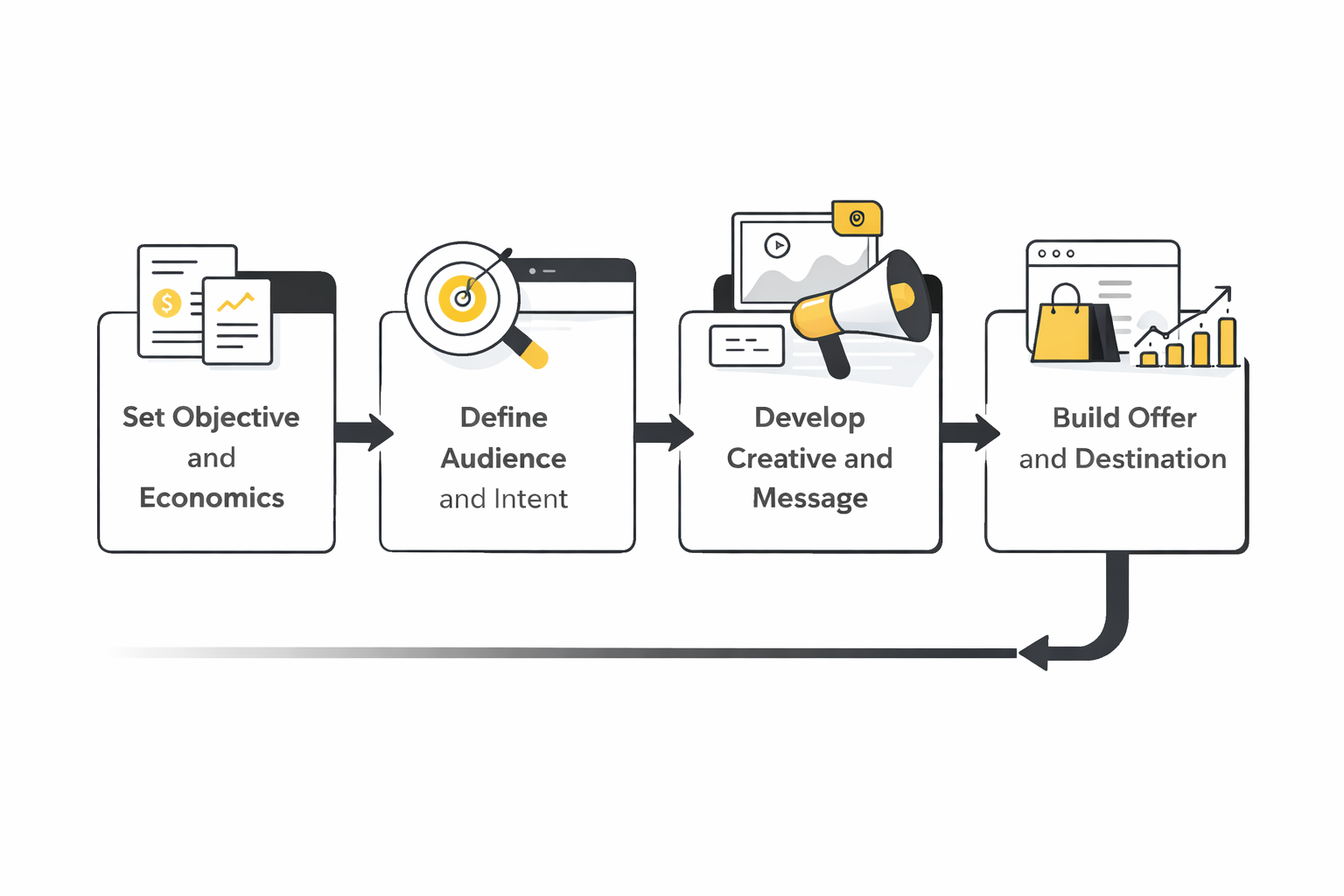
Objective and Economics Come First
The first core component in online advertising is not the ad creative, the targeting menu, or the platform dashboard. It is the economic logic behind the campaign. If a business does not know what a qualified lead is worth, what a new customer is worth, and how long it usually takes revenue to show up, then even a campaign that looks busy can quietly become a bad investment.
This is where strong advertisers separate motion from progress. They do not ask whether traffic is increasing in general. They ask whether the traffic is creating profitable behavior, whether the offer can carry the cost of acquisition, and whether the campaign is built to support the actual sales cycle instead of an imaginary one.
That discipline matters even more in a market that keeps getting more crowded. IAB’s full-year 2024 report shows U.S. internet advertising reached $259 billion in 2024, up 15% from the year before. When that much money is competing for the same attention, sloppy economics do not stay hidden for long. Online advertising rewards clarity fast, and it punishes fuzzy thinking just as fast.
Audience and Intent Shape Everything Else
The second core component is audience intent. This is where many campaigns go wrong, because advertisers often define the audience by broad demographics and stop there. But in online advertising, who the person is matters less than what they are trying to do, how aware they are of the problem, and how much urgency they feel in the moment they see the ad.
Someone typing a direct query into a search engine is in a very different state than someone casually watching short-form video. One person may want an answer right now. The other may only be open to a strong idea, a useful demonstration, or a message that makes them pay attention for the first time. That difference changes the kind of creative you need, the offer you should show, and the landing experience that makes sense.
That is why audience research cannot be reduced to platform settings alone. Pew Research found that 84% of U.S. adults use YouTube and 71% use Facebook in 2025, but those reach numbers are only the starting point. The real work is figuring out where your buyers are mentally when they show up. In online advertising, the best message in the wrong moment still loses.
Creative and Message Turn Attention Into Action
The third core component is creative, but not in the shallow sense of making something look polished. In online advertising, creative is the mechanism that earns attention, signals relevance, and gives the viewer a reason to care. It has to work quickly, because the buyer is usually deciding in seconds whether your message feels useful, interesting, credible, or easy to ignore.
This is why message quality matters so much. Strong creative shows the buyer that you understand the problem they are dealing with, that your offer belongs in their world, and that taking the next step will not feel like a waste of time. Weak creative usually fails long before anyone reaches the landing page, because it never earns enough trust or curiosity to deserve the click.
The media environment has only made this more intense. Deloitte’s 2025 Digital Media Trends research describes consumers spreading roughly six hours of daily media and entertainment time across streaming, social platforms, creators, gaming, music, podcasts, and more. That means online advertising is competing inside a fractured attention economy, not a neat media plan. Creative has to do more than fill space. It has to win a real decision in the middle of distraction.
Offer and Destination Decide Whether the Click Was Worth Buying
The fourth core component is the offer and the destination behind it. This is the part that many advertisers underestimate because it sits outside the ad platform, yet it often has more influence on profitability than a dozen small targeting tweaks. The offer has to feel specific enough to matter, and the destination has to make the promised next step feel obvious and easy.
If the ad says one thing and the landing page says something fuzzier, the campaign loses force. If the creative builds excitement and the page creates confusion, the click becomes expensive even if media costs looked reasonable on paper. Online advertising works best when there is a clean line from the first impression to the final action, with no awkward break in the story along the way.
This is one reason commerce media has become so important. IAB’s 2024 revenue report shows retail media grew to $53.7 billion in the United States in 2024, which signals how much value advertisers place on ad environments that sit closer to the point of purchase. That growth is not just about new inventory. It reflects a bigger truth about online advertising: the closer the message gets to a ready buyer, the more every mismatch in the conversion path starts to matter.
Data, Measurement, and Learning Keep the System Honest
The fifth core component is measurement. Without it, online advertising quickly becomes a performance theater where dashboards look active but nobody can clearly explain what is creating real business value. Good measurement is not about collecting every possible metric. It is about building a feedback system that helps you understand which audiences, messages, offers, and channels are genuinely producing profitable movement.
This matters because platform numbers can be directionally useful without being the whole story. You need to compare campaign data with downstream outcomes like qualified leads, closed revenue, repeat purchases, or whatever metric actually reflects success for the business. Otherwise, a campaign can look efficient in-platform while underperforming in the only place that really counts.
That challenge is still widespread. Nielsen’s 2025 Annual Marketing Report says only 32% of marketers measure traditional and digital media holistically, which helps explain why so many teams struggle to connect ad activity with business results. The advertisers who get ahead are usually the ones who treat online advertising as a learning system, not just a spending system.
Structure Is What Lets Online Advertising Scale Without Falling Apart
The final core component is structure. This is the architecture behind the account, the campaign naming, the testing logic, the reporting rhythm, and the way decisions get made after launch. Without structure, online advertising can still produce occasional wins, but those wins are hard to repeat because nobody has built a system that makes improvement predictable.
Good structure does something simple but powerful: it makes cause and effect easier to see. You can tell which creative angle is pulling its weight, which audience group is worth more, which landing page variation is reducing friction, and where budget should move next. That does not remove uncertainty, but it stops the entire program from turning into guesswork every time performance shifts.
That is what professionals are really building when they work on online advertising. They are not just launching ads. They are building a machine that can attract attention, convert it, measure it, and get smarter with every cycle. And once that machine is in place, growth stops feeling random and starts feeling earned.
Statistics and Data for Online Advertising
The Market Is Bigger Than Ever, and That Changes the Standard
If you want to understand why online advertising feels more competitive now, start with the size of the market. IAB and PwC reported that U.S. internet advertising reached $259 billion in 2024, up 15% year over year, while WARC projected global ad spend would top $1 trillion for the first time in 2024 and then continue climbing. Those numbers matter because they tell you this is not a side channel anymore. Online advertising is where major brands, fast-growing challengers, and performance-driven businesses are all fighting for the same sliver of attention.
That growth also changes how you should read your own results. A campaign that would have looked decent in a less crowded market can now underperform simply because the auction is more intense, the creative bar is higher, and buyers have more options in front of them. In other words, statistics and data are not just interesting here. They are the context that explains why execution has to be sharper than it used to be.
And the money is not spreading evenly. WARC said the global ad market is forecast to hit $1.19 trillion in 2025, with Alphabet, Amazon, and Meta absorbing most of the incremental growth through 2027. That tells you something important about online advertising right now: scale still matters, but platform concentration matters too. If you do not understand where the money is flowing, it becomes much harder to understand how pricing power and competition are shaping your campaigns.
Platform Power Shows Where Attention and Revenue Are Concentrating
The biggest platforms are not just large. They are enormous, and the numbers help explain why so many advertising strategies end up orbiting around them. Meta reported $200.97 billion in revenue for full-year 2025, with ad impressions across its Family of Apps up 12%. That is not a niche media business. That is a machine built to monetize attention at a scale very few companies on earth can match.
The same thing is happening inside the Google ecosystem. Alphabet said YouTube’s annual revenue surpassed $60 billion in 2025 across ads and subscriptions, and it also highlighted strong direct-response growth in the fourth quarter. That matters because it shows how online advertising is not just about top-of-funnel awareness anymore. Platforms that once looked easier to classify as brand channels are now deeply involved in performance-driven campaigns as well.
When you put those numbers next to Pew Research data showing 84% of U.S. adults use YouTube and 71% use Facebook in 2025, you get the bigger picture. The leading platforms have both reach and revenue power, which means they shape the rules of online advertising far more than smaller players do. That does not mean every business should use them in the same way. It means every serious advertiser has to understand the gravity they create in the market.
Retail Media Data Reveals How Close Ads Are Moving to the Point of Purchase
One of the most important changes in online advertising is how much budget is moving closer to buying environments. IAB’s full-year 2024 report said U.S. retail media revenue reached $53.7 billion, which shows just how fast commerce-driven ad inventory has become a major force. This is not a small trend sitting off to the side. It is a signal that advertisers increasingly want media placements tied to intent, product discovery, and measurable conversion behavior.
The forward-looking forecasts make the shift even clearer. EMARKETER discussed 2025 retail media spend at around $60 billion, while WARC’s 2025 outlook described Amazon, Meta, and Alphabet as the companies expected to capture most new global ad growth. Together, those signals show why online advertising is becoming more commerce-connected and more bottom-funnel-aware. Brands are not just buying attention anymore. They are trying to buy attention in places where purchase behavior is easier to influence and easier to measure.
That has practical consequences for campaign planning. When more budget moves into environments tied to shopping behavior, weak offers and weak landing experiences become much more visible. Statistics and data do not only tell you where the opportunity is. They also warn you that buyers are getting closer to the moment of decision, which raises the cost of sloppy execution.
Measurement Data Shows Why So Many Advertisers Still Struggle
Here is the part nobody wants to admit: having more data does not automatically create more clarity. Nielsen’s 2025 Annual Marketing Report found that only 32% of marketers measure traditional and digital media holistically. That means most teams are still trying to judge online advertising performance without a complete view of how channels are working together.
This creates a very common problem. Platform dashboards can make a campaign look healthy, but the business itself may see weaker lead quality, slower sales velocity, or lower downstream value than expected. When those signals are not tied together, it becomes easy to over-credit a channel that happened to win the last click and under-credit the channels that created demand earlier in the journey.
That is why statistics and data have to be interpreted inside a system, not pulled out as isolated facts. The best advertisers use campaign numbers to ask better questions. Which channels are generating intent? Which ones are converting that intent efficiently? Which signals are useful, and which ones are simply making the dashboard look busy? Online advertising becomes much more effective when measurement is designed to support judgment instead of replacing it.
Privacy Pressure Is Changing What Data Can Actually Do
The final piece of this section is the one many advertisers still underestimate. The data environment is not getting simpler. IAB’s State of Data 2024 report found that 95% of advertising and data decision-makers expected continued legislation and signal loss in 2024 and beyond, and the same research showed more than 80% said legislation and signal loss had already affected how their organizations are staffed or structured. That is a major operational shift, not a minor technical inconvenience.
This matters because online advertising used to let many teams get away with messy strategy as long as tracking was easy enough. That era is fading. Privacy rules, signal loss, and changes in platform measurement are forcing advertisers to rely more on first-party data, better creative, stronger offers, cleaner testing, and more disciplined thinking about what success actually means.
So when you look at the statistics and data around online advertising, the real takeaway is not just that the industry is huge. It is that the industry is huge, concentrated, measurable in imperfect ways, and increasingly shaped by privacy constraints. That combination is exactly why professionals who know how to read the numbers well have such a big edge now.
Online Advertising Analytics and Optimization
This is the point where online advertising either becomes a real growth system or stays an expensive guessing game. Launching campaigns is not the hard part anymore. The hard part is knowing what to improve, what to ignore, and what deserves more budget before the market changes again.
That is why analytics and optimization matter so much. Good advertisers do not just read dashboards. They use data to make sharper decisions about creative, audience quality, bidding, landing page friction, and the actual economics behind every conversion. When that process is tight, online advertising stops feeling random and starts feeling controllable.
Focus on Business Metrics Before Platform Metrics
The first rule of optimization is brutally simple: start with the numbers that matter to the business, not the numbers that make the ad account look busy. Click-through rate, impressions, video views, and cost per click can all be useful, but only if they connect to qualified leads, revenue, repeat purchases, or whatever outcome actually keeps the business healthy. If they do not connect, they are just activity wearing a suit.
This is where many advertisers get lost. A campaign can look efficient inside the platform and still produce weak customers, low close rates, or poor retention once the traffic hits the real world. Nielsen’s 2025 Annual Marketing Report found that only 32% of marketers measure digital and traditional media holistically, which helps explain why so many teams struggle to connect campaign performance with actual business impact.
So before you optimize anything in online advertising, get ruthless about the hierarchy of metrics. The platform tells you what is happening inside the auction. The business tells you whether that activity is worth paying for. If those two views are not connected, optimization becomes a loop of small improvements that never turn into meaningful growth.
Improve Creative Before You Obsess Over Tiny Targeting Tweaks
A lot of advertisers still behave as if targeting does the heavy lifting and creative just fills the slot. That is backwards. In modern online advertising, creative is often the biggest lever because it determines whether the right person notices the ad, understands the message, and feels enough relevance to take the next step.
This matters even more in a crowded market where attention is split across platforms, creators, streaming, search, and commerce environments. Meta reported that ad impressions across its Family of Apps increased 12% for full-year 2025, while Alphabet said YouTube generated more than $60 billion in 2025 across ads and subscriptions. Those numbers show how much inventory exists, but they also show how much creative competition exists. Your ad is not entering a quiet room. It is entering a fight.
That is why creative optimization should be treated like a disciplined testing program, not a one-time design task. Test different openings. Test different claims. Test different proof points, hooks, and calls to action. In online advertising, the fastest way to improve performance is often not finding a clever technical trick. It is learning how to say the right thing more clearly and more persuasively than the competition.
Fix the Post-Click Experience So Paid Traffic Does Not Leak Away
There is no point in paying for better traffic if the landing experience is weak. This is one of the most expensive problems in online advertising because it hides in plain sight. The campaign gets blamed, the platform gets blamed, and the targeting gets blamed, while the real issue is that the buyer clicked into confusion, friction, or a weak offer.
Strong optimization always looks beyond the ad itself. Does the landing page continue the promise from the ad, or does it suddenly change tone and direction? Is the next step obvious? Is the form too heavy? Is the product page doing enough to reduce doubt? These are not “website issues” that sit outside performance marketing. They are part of the advertising system itself.
That is also why the rise of commerce-driven environments matters. IAB and PwC reported that U.S. retail media revenue reached $53.7 billion in 2024, which tells you advertisers increasingly value placements closer to the buying moment. In those environments, the post-click experience has even less room to be sloppy. When intent is high, friction becomes painfully visible.
If you want to tighten the path between ad click and actual conversion, it helps to map the entire journey instead of optimizing pieces in isolation. That is one reason systems built around clearer workflows, funnels, and handoffs can make such a difference in online advertising.
Use Automation, but Do Not Surrender Judgment
Automation is now built into almost every major part of online advertising, from bidding to audience expansion to creative assembly. That can be a massive advantage when the campaign has clear signals, strong inputs, and a business model that can support the algorithm’s learning process. It becomes a problem when advertisers treat automation like a substitute for strategy.
Google’s own 2025 highlights for advertisers emphasize AI-powered campaigns, bidding that aims to maximize ROI, and the expansion of ads in AI Overviews across more surfaces. That is a big shift. It means optimization now includes understanding how to feed systems better data, better creative, and better conversion architecture rather than micromanaging every lever by hand.
But here is the catch: automation can optimize toward the wrong thing if you set the wrong target. If the conversion event is too weak, the platform can get very good at finding low-value actions. If the creative is generic, the system can scale generic messaging efficiently. In online advertising, automation multiplies whatever strategic quality you feed into it. It does not magically repair weak thinking.
Build Feedback Loops That Keep Getting Smarter
The final layer of optimization is feedback. This is where online advertising becomes compounding instead of episodic. Every campaign should teach you something useful about buyer behavior, channel fit, creative angles, landing page friction, and the true cost of growth. If you are not learning from each cycle, you are not really optimizing. You are just spending repeatedly.
This is especially important in a privacy-constrained market. IAB’s State of Data 2024 report found that 95% of data and advertising decision-makers expect continued legislation and signal loss, and more than 80% said those pressures had already affected how their organizations are structured. That means optimization cannot depend on perfect tracking anymore. It has to rely on better experimentation, better first-party data, cleaner reporting, and stronger judgment.
That is the real goal here. You are not trying to make a dashboard look prettier. You are trying to build an online advertising engine that gets wiser as it spends, sharper as it scales, and more profitable as the market gets harder. When you reach that point, optimization stops being a set of disconnected hacks and becomes a real competitive advantage.
The Online Advertising Ecosystem and Where It Is Going Next
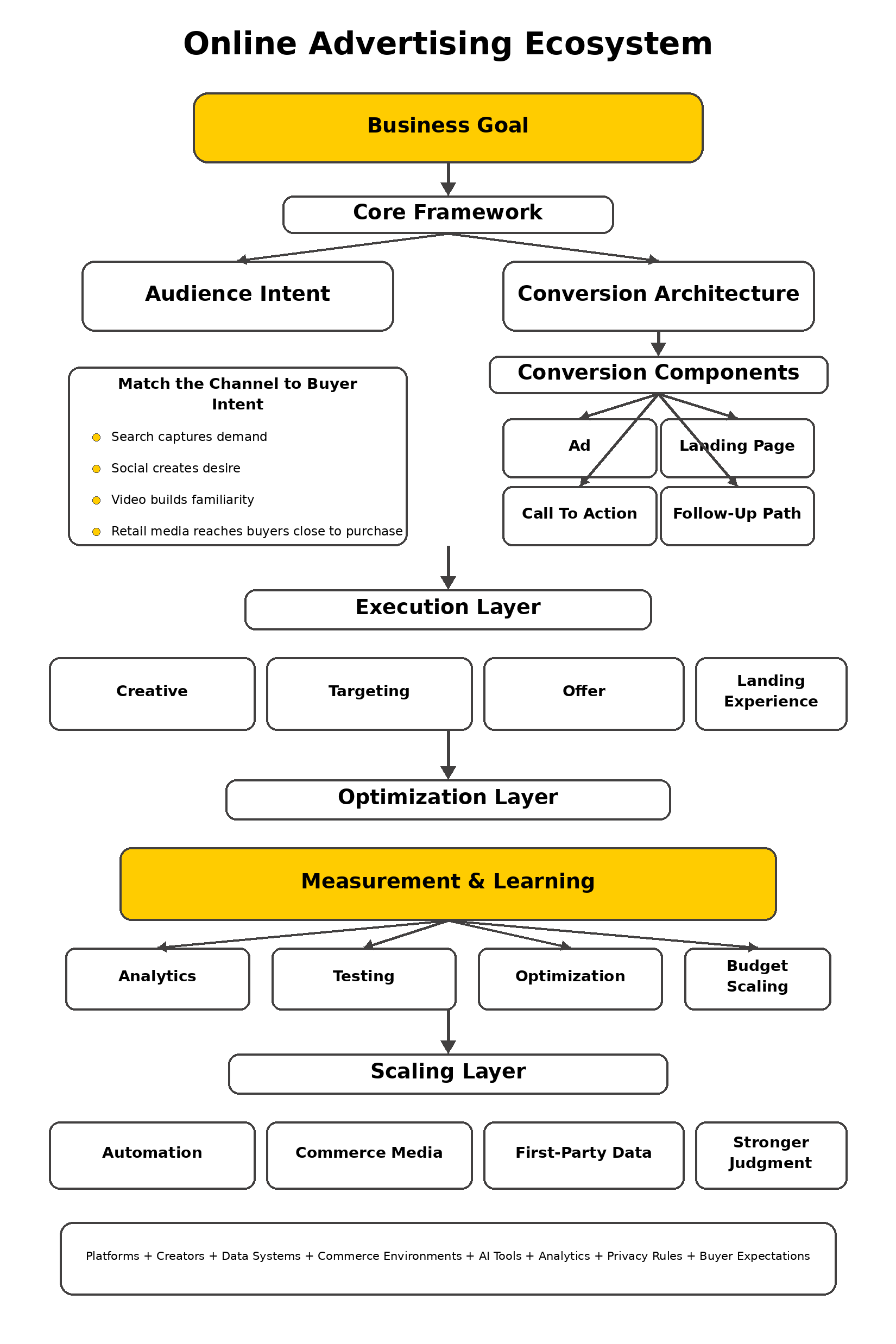
By this point, you can probably see the bigger picture. Online advertising is not just search ads, social ads, display ads, or retail media sitting in separate boxes. It is an ecosystem where platforms, creators, data systems, commerce environments, AI tools, analytics, privacy rules, and buyer expectations all keep influencing one another.
That is exactly why the market feels both full of opportunity and harder than ever at the same time. IAB and PwC showed U.S. internet advertising reached about $259 billion in 2024, while WARC projected global ad spend would reach roughly $1.19 trillion in 2025 and continue climbing in 2026. When the industry is this large, every change in platform behavior, measurement, and user attention has real consequences.
The ecosystem is also concentrating around very powerful companies. Meta reported $200.97 billion in full-year 2025 revenue with ad impressions up 12%, Alphabet said YouTube generated more than $60 billion in 2025 across ads and subscriptions, and Amazon’s ad business passed $68 billion in 2025. That does not mean smaller channels do not matter. It means the center of gravity in online advertising is increasingly shaped by a few giant systems that influence pricing, inventory, targeting, and reporting standards for everyone else.
The Next Phase Will Be More Automated, More Commercial, and More Privacy-Constrained
The future direction of online advertising is becoming easier to see. More campaigns will be shaped by automation, more inventory will sit closer to commerce and conversion, and more decisions will have to be made with imperfect measurement. That sounds intimidating, but it also creates a real edge for businesses that understand strategy instead of relying on platform shortcuts.
AI is already changing how ads are delivered and where they appear. Google’s 2025 product updates for advertisers and its guidance on ads in AI Overviews show how search advertising is evolving beyond the old model of matching a keyword to a simple results page. At the same time, retail media keeps pulling budgets closer to shopping behavior, with EMARKETER covering forecasts that Amazon’s retail media ad revenues would move past $60 billion in 2025.
But there is another force shaping all of this: privacy and signal loss. IAB’s State of Data research found that 95% of advertising and data decision-makers expected continued legislation and signal loss, and more than 80% said those changes were already affecting how their organizations are structured. So the future of online advertising is not just more technology. It is more technology combined with a stronger need for better judgment, stronger offers, cleaner first-party data, and more disciplined measurement.
FAQ: Online Advertising Questions People Actually Ask
What is online advertising in simple terms?
Online advertising is paid promotion delivered through digital channels such as search engines, social media platforms, websites, streaming environments, marketplaces, and apps. The goal is usually to reach a specific audience and move them toward an action, whether that means clicking, subscribing, buying, booking, or requesting more information. What makes online advertising powerful is that it lets you adjust targeting, creative, and budget much faster than traditional media ever could.
Why is online advertising so important for modern businesses?
It matters because buyers spend a huge part of their attention online, and businesses need to show up where decisions are being shaped. Pew Research found that 84% of U.S. adults use YouTube and 71% use Facebook in 2025, which shows how digital platforms still dominate everyday media habits. Online advertising also gives businesses speed, testing ability, and measurable feedback, which makes it one of the most practical ways to grow when it is managed well.
How much should a business spend on online advertising?
There is no universal number that works for everyone, because the right budget depends on customer value, margin, sales cycle, competition, and how strong the conversion path is after the click. A small budget can work if the business understands its economics and uses the budget to learn quickly. A big budget can fail fast if it is attached to weak messaging, weak offers, or bad measurement.
What is the best platform for online advertising?
The best platform is the one that matches the buyer’s intent and the business goal. Search tends to work well when people are actively looking for a solution. Social often works better when you need to create demand, tell a story, or put an offer in front of people before they start searching. Retail media is increasingly powerful when a buyer is already near a product decision, which is one reason U.S. retail media revenue grew to $53.7 billion in 2024 in the IAB and PwC report.
Is online advertising better than SEO?
They do different jobs, and strong businesses often use both. Online advertising gives you speed, testing, and immediate distribution as long as you keep spending. SEO usually takes longer, but it can create compounding visibility over time. The smart question is not which one is universally better. The smart question is which one solves your current growth problem faster and more profitably.
How long does it take to see results from online advertising?
You can often see early signals within days, especially around click behavior, cost patterns, and conversion flow. But meaningful results take longer, because you need time to test creative, refine targeting, and separate lucky spikes from repeatable performance. Businesses usually get into trouble when they either panic too early or wait too long without making any real improvements.
What metrics matter most in online advertising?
The most important metrics are the ones tied to business outcomes. That often means cost per qualified lead, customer acquisition cost, return on ad spend, revenue per visitor, lead-to-sale rate, or customer lifetime value. Platform metrics like impressions, clicks, and CTR can still be useful, but only when they help explain performance instead of distracting from it.
Why do so many online advertising campaigns fail?
Most campaigns do not fail because the platform is broken. They fail because the goal is unclear, the audience intent is misunderstood, the creative is weak, the offer is bland, the landing page leaks trust, or the measurement setup is too shallow to guide decisions. In other words, online advertising usually breaks at the system level, not just at the ad level.
How is AI changing online advertising?
AI is changing how ads are targeted, assembled, priced, and surfaced across digital environments. Google’s 2025 advertiser updates make it clear that automation is becoming central to campaign setup and optimization, while AI Overviews ad guidance shows how search results themselves are evolving. The key point is that AI can improve execution, but it still needs strong inputs, clear goals, and human judgment to produce strong outcomes.
How do privacy changes affect online advertising?
Privacy changes reduce the amount of clean signal advertisers can use, which makes lazy targeting and weak attribution much harder to rely on. IAB’s research on the privacy-by-design ecosystem shows the industry expects continued signal loss and organizational change because of legislation and shifting data access. In practice, that means advertisers have to depend more on first-party data, stronger creative, better testing, and tighter measurement discipline.
Can a small business still compete in online advertising?
Yes, but not by trying to outspend giant brands in a broad auction. Small businesses compete by being sharper: sharper with positioning, sharper with messaging, sharper with niche targeting, and sharper with the conversion path after the click. A focused business with strong relevance can still beat a bigger advertiser whose campaign feels generic and forgettable.
Why is retail media becoming such a big deal in online advertising?
Because it brings advertising closer to buying behavior. Instead of paying only for attention at the top of the funnel, brands can place ads in environments where people are already comparing products and moving toward a decision. That is a major reason retail media keeps attracting more budget and why Amazon’s advertising growth has become such an important part of the broader online advertising conversation.
Should a company manage online advertising in-house or hire help?
That depends on how much skill, time, and operational discipline the company can realistically commit. Some teams do well in-house when they have a clear offer, a steady testing process, and people who can handle both strategy and execution. Others grow faster by working with specialists who already know how to structure campaigns, interpret data, and avoid the expensive mistakes that come from learning everything the hard way.
Work With Professionals
At some point, every serious business runs into the same truth: online advertising looks simple from the outside, but it gets complicated fast once real money is on the line. You are dealing with creative, media buying, conversion systems, analytics, platform changes, and shifting buyer behavior all at once. That is exactly why experienced operators are so valuable.
If you want better results, the answer is not to chase random tricks or keep patching a weak system with more budget. The answer is to work with people who understand how the whole machine fits together, from strategy to creative to measurement to scale. When you do that, online advertising stops feeling chaotic and starts feeling like something you can actually build on.
Explore 10K+ Remote Marketing Contracts on MarkeWork.com
Most marketers spend too much time chasing clients, competing on crowded platforms, and losing a percentage of every project to middlemen.
MarkeWork gives you a better way. Browse thousands of remote marketing contracts and connect directly with companies desperate to hire skilled marketers like you without platform commissions and without unnecessary gatekeepers.
If you’re serious about finding better opportunities and keeping 100% of what you earn, you can explore available contracts and create your profile for free at MarkeWork.com.
 Filip Konecny Enterprises