

A strong marketing strategy gives your business something far more valuable than a pile of campaigns: it gives you direction. When teams skip strategy, they usually end up chasing channels, copying competitors, and mistaking activity for progress. That looks busy from the outside, but it rarely creates durable growth.
That problem is getting bigger, not smaller. HubSpot’s 2026 State of Marketing report found that 61% of marketers believe the profession is going through its biggest disruption in 20 years, while Gartner’s 2025 CMO Spend Survey showed budgets staying flat at 7.7% of company revenue and 59% of CMOs saying they still do not have enough budget to execute their strategy. In plain English, the pressure is rising while the margin for waste is shrinking.
That is exactly why marketing strategy matters so much right now. It helps you decide who you want to win with, what promise your brand should make, where you should show up, and how you will know the work is paying off. Get that right, and every channel becomes more useful because it is finally pulling in the same direction.
Article Outline
- Part 1: Why Marketing Strategy Matters
- Part 2: Framework Overview
- Part 3: Core Components
- Part 4: Professional Implementation
- Part 5: Measurement and Optimization
- Part 6: Final Takeaways and FAQ
Why Marketing Strategy Matters

Marketing strategy matters because it keeps your business from making random decisions under pressure. When the budget gets tighter, the algorithm changes, or a new tool starts getting hyped, strategy gives you a filter for what deserves attention and what should be ignored. Without that filter, even talented teams can end up investing in work that looks modern but does not move revenue, retention, or brand strength.
The market is also demanding more coherence from brands than ever before. Adobe’s 2025 AI and Digital Trends report found that 78% of customers want consistent brand experiences, and 61% of senior executives say personalized experiences and deeper engagement will be critical for growth. That means your message, offer, audience targeting, and customer journey cannot live in separate silos anymore. They have to connect.
There is also a financial reason this conversation has become urgent. Gartner reported in 2025 that digital channels now account for 61.1% of total marketing spend, with paid online channels taking 69% of the digital mix, yet owned and earned channels declined year over year except for email, which still held 7.4% of total digital spend. In other words, brands are spending heavily, but spending heavily is not the same thing as spending with clarity.
A real marketing strategy turns that clutter into a system. It tells you which audiences deserve disproportionate focus, what kind of demand you are trying to create, what role brand and performance should each play, and which metrics deserve executive attention. That is how marketing stops being a cost center people question and starts becoming a growth engine people trust.
Framework Overview
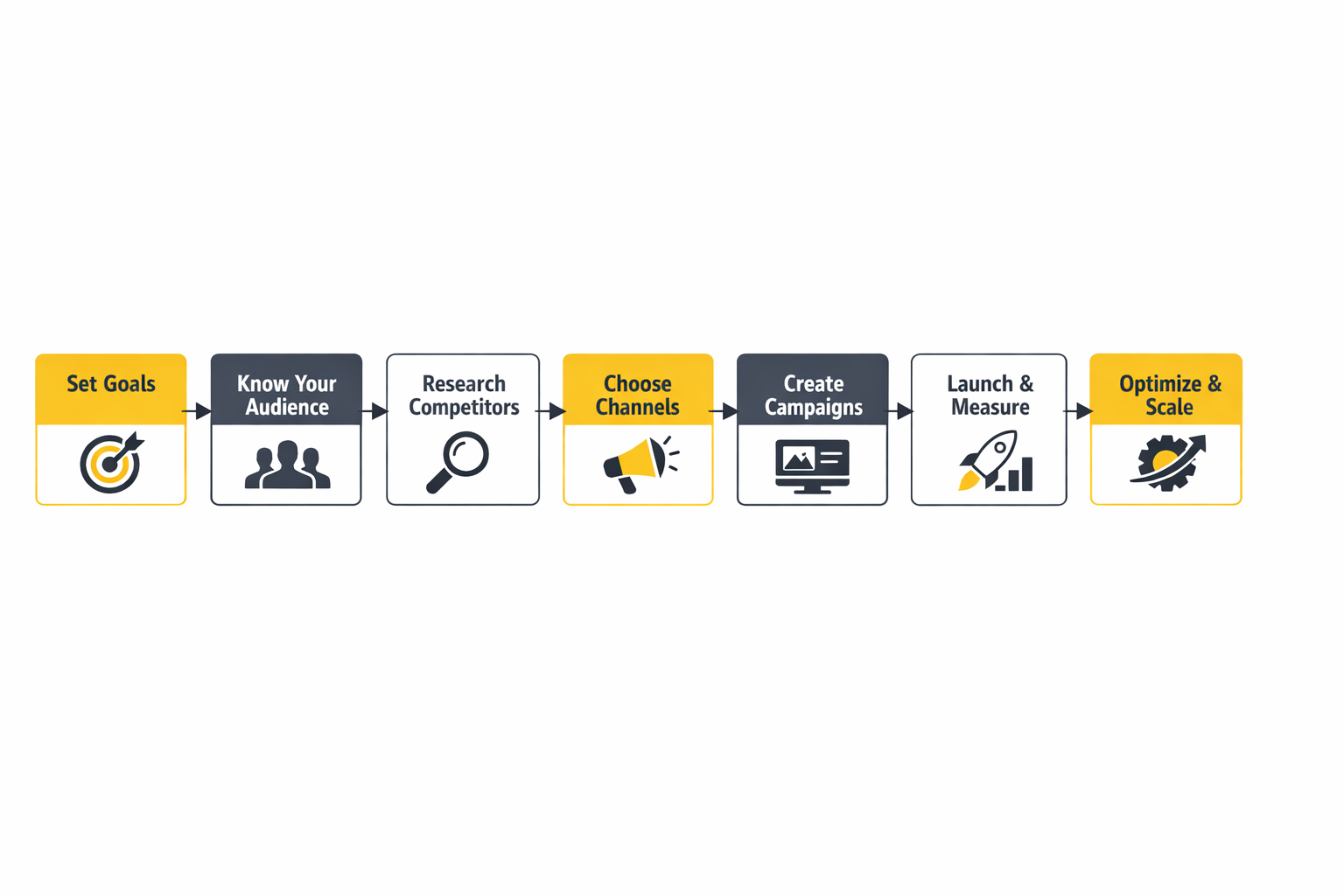
The best way to think about marketing strategy is as a sequence of decisions, not a document you create once and forget. You begin with the market and the customer, move into positioning and messaging, choose your channels and offers, and then build a measurement system that tells you whether the whole machine is creating business value. That sequence matters because bad downstream execution usually starts with fuzzy upstream thinking.
A useful modern framework is hiding in plain sight inside McKinsey’s work on personalized marketing, which points to five pillars: data, decisioning, design, distribution, and measurement. That is a smart structure because it forces you to connect insight with action. It is not enough to know your audience better; you need a decision model for what to say, creative that fits the moment, channels that can deliver it, and measurement that ties the effort back to real business outcomes.
The same logic shows up in Think with Google’s profitable growth research, which argues that effective marketing builds brands, drives revenue, strengthens loyalty, and fuels long-term growth, but only when investment, analytics, and business alignment work together. That is why a good framework is never just about promotion. It is about making sure your strategy can survive scrutiny from finance, sales, product, and leadership.
So if you have ever felt overwhelmed by the phrase marketing strategy, here is the simplest way to see it: know who you want, know what you want them to believe, know where and when to reach them, and know how you will prove the work mattered. Everything else is detail layered on top of that foundation.
Core Components
Every serious marketing strategy rests on a handful of core components. The first is audience clarity, because vague targeting produces vague results. When McKinsey noted that 65% of customers see targeted promotions as a top reason to make a purchase, the deeper lesson was not just about promotions at all; it was about relevance. People respond when the message feels meant for them.
The second component is positioning. Your strategy has to answer why someone should choose you, remember you, and trust you when alternatives are everywhere. That challenge is getting sharper as AI floods the market with content, which is why HubSpot’s 2026 report frames clear brand point of view, trust, and relevance as growth drivers rather than nice brand extras.
The third component is channel strategy, and this is where many businesses get themselves into trouble. They treat channel choice like a trend contest instead of a business decision. A stronger approach is to choose channels based on how your audience buys, how your message needs to be delivered, and how the channel fits the economics of your offer.
The fourth component is measurement. Google’s Modern Brand Measurement playbook makes a crucial point: your KPI should have a clear link to business outcomes. That one sentence saves a lot of wasted effort, because it pushes you past vanity metrics and toward signals that can defend budget, shape future decisions, and earn credibility with the rest of the company.
Professional Implementation
Professional implementation is where strategy stops sounding smart and starts being useful. This is the stage where goals become timelines, audience insights become briefs, positioning becomes creative direction, and channel plans become operating rhythms for the team. A strategy that cannot be executed by real people inside real constraints is not finished yet.
The smartest teams are also learning to implement strategy with more discipline around technology and workflows. HubSpot reported that 80% of marketers now use AI for content creation and 75% use it for media production, while Gartner found that GenAI investments are already producing time-efficiency gains for 49% of CMOs and cost-efficiency gains for 40%. The takeaway is not that AI replaces strategy. It is that strategy becomes even more important when execution gets faster, because speed without direction just helps you waste resources more efficiently.
Implementation also demands cross-functional alignment. Adobe’s 2025 report showed that 87% of organizations using AI-driven personalization have already seen boosts in customer engagement, but that kind of outcome depends on clean data, connected systems, and teams that agree on what success looks like. Marketing cannot deliver those gains alone if product, data, analytics, and leadership are pulling in different directions.
That is why the most professional version of marketing strategy is operational, not theoretical. It shows who owns what, what gets measured weekly versus quarterly, how creative and channel teams coordinate, and how customer feedback feeds back into the next round of decisions. Once you build that discipline, strategy becomes less like a presentation deck and more like a competitive advantage.
Start With the Business Goal
A real framework begins with the business goal because marketing strategy is not supposed to be a creative exercise floating in space. It has to support something concrete, whether that means entering a new market, lifting retention, increasing average order value, protecting share, or making demand more efficient. When that part is fuzzy, the rest of the strategy becomes a collection of attractive ideas that compete with each other instead of compounding.
This is where many teams get themselves in trouble. They set marketing goals that sound active, like publishing more content or increasing impressions, but those are outputs, not outcomes. A stronger framework makes you ask a harder question right away: what business result has to change, and what customer behavior would prove we are moving it?
Define the Market and Audience
Once the business goal is clear, the next step is deciding exactly who matters most. That sounds obvious, but in practice a lot of companies still write targeting that is so broad it could apply to half the market. A smarter marketing strategy narrows the field until the team can describe not just who the audience is, but what situation they are in, what they are trying to solve, and what would make them act now rather than later.
That kind of precision matters because relevance is not optional anymore. McKinsey’s 2025 work on personalized marketing explains that people increasingly expect interactions to feel tailored to them, while Adobe’s 2025 customer engagement research shows that 78% of customers want consistent brand experiences. Put those two ideas together and the lesson becomes clear: you cannot build relevance if you do not know who you are trying to matter to in the first place.
Build a Positioning Core
After audience clarity comes positioning, which is where your marketing strategy stops describing people and starts making a promise to them. This is the part that answers why your brand deserves attention, memory, and trust in a market full of alternatives. It is not just a slogan exercise either. It shapes your messaging, your offer design, your creative decisions, and even the channels that make the most sense for you.
Good positioning usually lives at the intersection of customer need, market tension, and brand truth. If it only sounds clever but does not connect to something buyers already care about, it will struggle. If it promises something the experience cannot deliver, it may win clicks but lose trust, and that is a terrible trade in a market where HubSpot’s 2026 State of Marketing report makes it clear that trust and differentiated point of view are becoming more important as AI makes content easier to produce and harder to remember.
Choose the Right Growth Levers
Now you get into the part most teams rush to first: how growth will actually happen. A solid framework forces you to choose the right levers instead of treating every lever as equally important. Some businesses need more demand creation because awareness is weak. Others have plenty of demand but leak conversions because the offer, onboarding, or sales handoff is broken. Others need a retention strategy because their acquisition economics only work when customers stay longer and buy more.
This is where discipline pays off. When you identify the true growth lever, channel selection becomes easier, budget allocation becomes smarter, and measurement becomes more honest. The framework stops you from spending six months polishing a top-of-funnel machine when the real bottleneck is lower down the path.
Turn Channels Into a System
Channels should never be picked like a popularity contest. The right channel mix depends on how your audience discovers options, how much explanation your offer needs, how quickly trust can be built, and how the economics work at each stage of the customer journey. That is why a smart marketing strategy treats channels like jobs inside a system rather than isolated buckets of activity.
You can see that logic in how large brands are restructuring modern marketing operations. Coca-Cola says it shifted from a TV-centric approach to a digital-first model, taking digital from less than 30% of total media spend in 2019 to about 65% in 2024, and it built Studio X with WPP to create a more connected marketing ecosystem. That is not just a channel tweak. It is a framework decision about speed, flexibility, data, and coordination.
A Real Example of Framework in Action
The pressure point came first. Big brands were dealing with fragmenting attention, rising demands for relevance, and a media environment that no longer rewarded the old habit of pushing the same message through a handful of giant channels. The old playbook could still produce reach, but reach alone was no longer enough to justify the spend or explain the results.
The backstory makes the stakes even clearer. Coca-Cola had already built one of the most recognizable brands on earth, which meant the problem was not basic awareness. The harder challenge was staying culturally relevant, operating at global scale, and still responding fast enough to local shifts in consumer behavior. That is exactly the kind of tension a marketing framework has to absorb without breaking.
Then came the wall. A fragmented media world makes consistency harder, not easier, and every additional market, agency relationship, and content variation increases the risk of slower execution and scattered decision-making. If the structure behind the marketing strategy is weak, scale becomes a burden instead of an advantage.
The epiphany was not mysterious at all. Rather than treat digital as just another media line item, the company reframed the operating model around a more connected system. Its investor materials explain that the business moved to a digital-first model, expanded its digital mix sharply, and created Studio X to support faster and more integrated execution across markets.
The journey after that was about building the machine, not just announcing the intent. The company kept leaning into a model centered on consumers, brands, channels, and predictive capabilities, which shows up clearly in its 2025 CAGNY presentation. That is what good framework work looks like in the real world: not one campaign, but a series of operating decisions that make better campaigns more likely.
Of course, the final conflict never disappears. Even an improved framework has to survive inflation, market volatility, changing consumer expectations, and the constant pressure to deliver short-term numbers while protecting long-term brand value. That balancing act is exactly why companies need a framework in the first place, because tactics alone cannot carry that weight.
The dream outcome is not perfection. It is resilience. When Coca-Cola reported its 2025 full-year results, the company pointed to resilience and momentum in a complex environment, which is the kind of language you hear when a strategy is doing more than generating noise. A framework will not remove uncertainty, but it gives a brand a better way to navigate it without starting from scratch every quarter.
Make the Framework Measurable
The last step is making the framework measurable enough to stay honest. If your strategy cannot tell you whether awareness, conversion, retention, or profitability is improving, then it is still unfinished. Measurement does not sit outside the framework as a reporting layer. It belongs inside it, because what you choose to measure shapes what the team will prioritize when pressure rises.
That is why the strongest frameworks connect every stage to a business signal. Google’s modern brand measurement guidance pushes teams to tie KPIs to real outcomes, not just convenient metrics, and that advice becomes even more relevant when HubSpot’s 2026 marketing statistics show that data-driven strategy and cross-team data sharing are still major obstacles for many marketers. If the framework cannot learn, it cannot improve.

So here is the big takeaway from this framework overview: your marketing strategy should help you make better decisions in the right order. Start with the business goal, narrow the audience, sharpen the position, choose the true growth levers, turn channels into a coordinated system, and measure what actually moves the business. Do that well, and strategy stops feeling abstract and starts becoming the thing that gives every campaign a much better chance to win.
Audience Definition and Segmentation
The first core component is audience definition, and this goes much deeper than writing down broad demographics. A serious marketing strategy identifies the highest-value segments, the situations they are in, the buying triggers that matter, and the frictions that make them hesitate. That is how you move from “we serve everyone” to “we know exactly whose attention is worth earning first.”
This component is becoming more important because relevance is no longer a bonus feature. Adobe’s 2026 AI and Digital Trends report found that 80% of organizations believe breakthrough customer experiences over the next few years will need to be highly personalized and anticipatory in real time, while Adobe’s 2025 customer engagement research found that 61% of senior executives see personalized experiences and deeper engagement as critical for growth. If your audience definition is weak, you cannot deliver that kind of relevance no matter how advanced your tools look on paper.
Good segmentation also protects your budget. It helps you decide which customers deserve premium attention, which ones need education before they are ready to buy, and which segments are too expensive or too distracted to pursue right now. That kind of discipline is one of the quiet reasons strong marketing strategies outperform noisy ones.
Positioning and Category Claim
The second component is positioning, which is where your strategy defines the space your brand wants to own in the customer’s mind. This is not about writing something clever and hoping it sticks. It is about making a clear claim that connects what your audience wants, what the market is missing, and what your business can genuinely deliver better than alternatives.
Positioning becomes even more valuable when content is cheap and volume is easy. HubSpot’s 2026 State of Marketing report frames brand point of view, credibility, and trust as growth levers in a market where AI is becoming standard rather than special. That means a weak position gets drowned out faster, while a strong position gives every campaign, landing page, and sales conversation more force.
This is also where many businesses make a costly mistake. They confuse what they sell with what they mean. Customers do not remember brands just because they have features; they remember brands because those features are tied to a sharper promise, a more recognizable worldview, or a more useful way of solving the problem.
Offer and Value Proposition
A marketing strategy is incomplete until it defines the offer clearly. The offer is not just the product or service itself. It is the package of value, risk reduction, urgency, proof, and next step that makes action feel logical instead of difficult.
This is where strategy has to become brutally honest. If the offer is weak, confusing, overpriced for the perceived value, or disconnected from the audience’s real pain, no amount of channel optimization will save it for long. The smartest marketers know that when campaigns underperform, the problem is often not the ad first; it is the offer sitting underneath the ad.
That is also why effective strategy work asks questions most teams try to avoid. What exactly are we asking people to do? Why would they do it now? And what makes that step feel safer, more attractive, or more profitable than doing nothing at all? When you answer those questions well, conversion starts improving for a very simple reason: the customer finally understands why this decision makes sense.
Message Architecture
Once the offer is clear, your marketing strategy needs message architecture. This is the component that organizes the story your brand tells at different moments, to different audiences, across different channels, without turning into a pile of disconnected claims. It keeps the core message stable while allowing the execution to flex.
This matters because consistency is one of the fastest ways to build trust. Adobe’s 2025 report found that 78% of customers want consistent brand experiences, and its 2026 report found that 72% of organizations believe breakthrough customer experiences will need to feel seamless across digital and physical touchpoints. If your messaging changes wildly from email to ads to sales calls to product pages, people feel that disconnect immediately even if they cannot explain it out loud.
Strong message architecture usually includes a core promise, supporting proof points, emotional themes, objections that need to be answered, and channel-specific adaptations. That sounds simple when you list it out, but getting it right is one of the biggest advantages a brand can build because it turns communication from random output into compounding memory.
Channel Mix and Role Clarity
Another core component is channel mix, but the important part is not just choosing channels. It is defining the role each channel plays. Some channels create discovery, some deepen trust, some capture demand, and some help retention or expansion, and when you do not define those roles clearly, you end up judging every channel by the wrong standard.
The pressure to get this right is increasing. Nielsen’s 2025 Annual Marketing Report found that only 32% of marketers measure traditional and digital media spend holistically, which tells you a lot about why channel decisions often feel messy inside companies. If teams cannot see the system as a whole, they naturally overvalue the channels that are easiest to track and undervalue the ones that strengthen the rest of the machine.
A better marketing strategy gives each channel a job and then measures success in a way that matches that job. That keeps upper-funnel channels from being killed too early, keeps lower-funnel channels from getting credit for demand they did not create, and helps the whole budget behave more like an investment portfolio than a set of isolated bets.
Resource Allocation and Operating Model
Even a brilliant strategy can fail if the business does not allocate resources in a way that supports it. That is why resource allocation and operating model belong inside the core components rather than somewhere off to the side. You need to know where the time, people, money, technology, and decision rights actually sit.
This sounds operational, but it is deeply strategic. Gartner’s 2025 CMO Spend Survey shows budgets flat at 7.7% of company revenue, which means many teams do not have room for sloppy execution or duplicated effort. A strong marketing strategy therefore has to decide not only what to do, but also what to stop doing, what to centralize, what to automate, and what absolutely requires human judgment.
This is one of those components people overlook because it is less exciting than creative or brand work. But in real life, resource allocation is often the difference between a strategy that scales and one that burns out the team by quarter two.
Brand and Performance Balance
One of the hardest components to get right is the balance between brand building and performance marketing. Lean too hard into performance and you can squeeze short-term gains while weakening the demand base that keeps acquisition efficient over time. Lean too hard into brand without clear commercial pathways and you can create admiration without enough revenue movement to defend the spend.
The healthiest strategies do not treat this as an either-or fight. Nielsen’s 2025 report found that 48% of North American marketers prioritize revenue growth and brand awareness equally, which reflects the reality that businesses need both immediate response and future demand. Good strategy work decides how those two goals should support each other instead of forcing them into separate camps.
This is also where leadership maturity shows up. Businesses that understand the balance are usually calmer in volatile markets because they know when to protect brand memory, when to press for conversion, and when to adjust the mix without losing the plot. That steadiness is a competitive edge all by itself.
A Real Example of Components Working Together
The tension shows up fast when you look at a company like Procter & Gamble. It competes across categories where consumer needs shift, retailers have enormous power, and rivals are highly capable. That is the kind of environment where marketing strategy cannot depend on a single campaign or one lucky product cycle because the business is too large and the market moves too quickly for that.
The backstory is important here. P&G has spent years building brands that operate at massive scale, which means its challenge is not discovering that strategy matters. The real challenge is keeping the strategy coherent while adapting in real time to volatility, retailer dynamics, consumer expectations, and operational pressure across a very broad portfolio.
The wall is exactly what you would expect. At that scale, every component can drift. Portfolio decisions can move one way, brand messaging another, investments another, and organizational behavior somewhere else entirely. When that happens, the business may still look active from the outside, but the parts stop reinforcing one another.
The epiphany is visible in P&G’s 2025 Annual Report, where the company describes an integrated growth strategy built around portfolio performance, superiority, productivity, constructive disruption, and an empowered organization. That matters because it shows the company is not treating marketing strategy as promotion alone. It is connecting brand choice, product superiority, investment capacity, innovation, and execution discipline inside one system.
The journey is what makes this example useful. Rather than pretending one component can do all the work, the company frames its advantage as the combined effect of multiple reinforcing choices. That is exactly how strong marketing strategy behaves in the real world: the audience, the offer, the message, the channel choices, and the operating model all strengthen one another until the business becomes harder to outmaneuver.
The final conflict, of course, never goes away. Big companies still face inflation, media fragmentation, retailer pressure, and changing consumer standards. But a strategy with strong components holds together better under strain because it does not rely on one fragile lever to carry the entire business.
The dream outcome is not that every quarter becomes easy. It is that the business can keep adapting without becoming incoherent. That is why this example matters so much: it shows that the core components of a marketing strategy are not academic boxes to fill in, but the real structure that allows a company to stay competitive when the market gets messy.
Why These Components Must Work Together
The biggest mistake you can make is treating these components like separate checklists. Audience, positioning, offer, messaging, channels, resources, and brand-performance balance are not independent. They shape one another constantly, which means weakness in one area eventually leaks into the rest.
You can see that interdependence in the broader research. Salesforce reports that while marketers increasingly understand the shift toward personalized engagement, many still struggle to use data well enough to deliver it, and Adobe’s 2026 report shows that many organizations still lack the measurement frameworks, shared data foundations, and alignment needed to scale modern customer experience effectively. That is another way of saying the components only work when they are connected.
So if you want your marketing strategy to perform, do not just ask whether each component exists. Ask whether the audience supports the position, whether the position strengthens the offer, whether the offer fits the channel mix, whether the message stays consistent across touchpoints, and whether the operating model gives the team a real chance to execute. That is when strategy stops being theory and starts becoming leverage.
Statistics and Data

You cannot build a serious marketing strategy on gut feeling alone anymore. The market is moving too fast, customer expectations are shifting too quickly, and leadership teams are asking harder questions about efficiency, proof, and revenue impact. That is why the numbers matter so much here: they do not replace judgment, but they do stop you from making expensive decisions based on hope.
The most useful statistics are not random percentages pulled out to sound impressive. They help you understand where the pressure is coming from, what customers expect now, where teams are underprepared, and which parts of the strategy deserve the most attention first. That is exactly how data should function inside a marketing strategy: not as decoration, but as decision support.
Budget Pressure Is Shaping Strategy
One of the clearest numbers in the market right now comes from Gartner’s 2025 CMO Spend Survey, which shows marketing budgets flat at 7.7% of overall company revenue for the second straight year. That would already be enough to make strategy more important, but the same survey makes the pressure even clearer by showing that 59% of CMOs still say they do not have enough budget to execute their strategy. In other words, the modern marketing strategy has to be selective by design because many teams no longer have the luxury of trying everything.
The AI layer makes that even more interesting. The same Gartner release says GenAI investments are already producing time-efficiency gains for 49% of CMOs, cost-efficiency gains for 40%, and more content capacity for 27%. That does not mean AI magically fixes weak strategy. It means the teams with the sharpest priorities are now in a stronger position to turn efficiency gains into actual competitive advantage.
Personalization Is No Longer Optional
The data around personalization has moved beyond hype. Adobe’s 2026 AI and Digital Trends report shows that 80% of organizations believe breakthrough customer experiences over the next few years will need to be highly personalized and anticipatory in real time, while 72% believe those experiences will need to feel seamless across digital and physical touchpoints. That tells you something important about modern marketing strategy: customers are not judging brands in isolated moments anymore. They are judging whether the whole experience feels connected.
The challenge is that many organizations still are not built to deliver that. Salesforce’s Tenth Edition State of Marketing says 83% of marketers recognize the shift toward personalized, two-way messaging, yet only one in four are satisfied with how they use data to power those moments. That gap between ambition and execution is where a lot of marketing strategies fail. They describe a modern customer experience without having the data, operating model, or measurement discipline to support it.
Attention Is Harder to Win Than Ever
A strong marketing strategy also has to respect just how little time brands have to earn attention. Adobe’s 2026 report found that half of customers say promotional emails, ads, and social media posts have only two to five seconds to capture their interest. That is not a creative trivia point. It changes how you think about message clarity, visual hierarchy, offer design, and channel fit.
The broader context makes that pressure even sharper. HubSpot’s 2026 State of Marketing report says 61% of marketers believe marketing is experiencing its biggest disruption in 20 years because of AI. So the real problem is not just that attention is short. It is that brands are now competing in an environment where more content can be produced faster than ever, which makes weak, generic, forgettable messaging even easier to ignore.
Measurement Is Still the Big Blind Spot
This is where the numbers get uncomfortable in the best possible way. Nielsen’s 2025 Annual Marketing Report found that only 32% of marketers globally say they measure their media spending holistically across both digital and traditional channels. That means most teams are still trying to optimize a system they cannot fully see, which is one of the fastest ways to misread performance and misallocate budget.
The trust issue goes even deeper inside the organization. Google’s Modern Brand Measurement Playbook notes that 83% of CEOs believe marketing can be a major driver of growth, yet half of CFOs have declined or not fully funded marketing proposals because they did not show a clear contribution to business outcomes. That is why marketing strategy needs a measurement spine. If the work cannot show its connection to revenue, retention, margin, or market share, the strategy will always be more vulnerable than it should be.
Brand and Performance Have to Work Together
A lot of teams still act as if they need to choose between brand building and performance marketing, but the data keeps pointing in the opposite direction. Nielsen’s 2025 report shows that in North America, the exact same proportion of marketers, 48%, list revenue growth and brand awareness as their first or second priorities. That is a revealing number because it captures how the strongest operators think: short-term outcomes and long-term memory are not enemies, they are partners.
The same Google playbook pushes that logic even further by highlighting benchmark evidence that a one-point gain in awareness or consideration can correspond to a one-point gain in sales and a one-point decrease in CPA. The exact effect will vary by market and category, of course, but the strategic lesson is powerful. Brand metrics matter most when they are tied to business outcomes rather than treated like soft signals that sit outside commercial performance.
Customer Experience Breakdowns Are Directly Hurting Growth
Another reason marketing strategy has to be broader than campaign planning is that customer experience failures are now feeding directly back into growth outcomes. PwC’s 2025 Customer Experience Survey found that 52% of consumers stopped using or buying from a brand because of a bad experience with its products or services, while 29% stopped because of poor customer experience online or in person. Those are not support-team problems sitting off to the side. They are strategic growth problems.
There is also a dangerous perception gap inside companies. The same PwC research shows that 70% of executives say customer expectations are evolving faster than their company can adapt. That is exactly why a modern marketing strategy cannot focus only on acquisition. It has to think all the way through the experience supply chain, because promises made in marketing get judged in product, service, checkout, onboarding, and support.
AI Readiness Is Real but Incomplete
There is no question that AI is now part of the marketing strategy conversation, but the more useful numbers show where organizations are still exposed. Adobe’s 2026 report says only 44% of organizations have implemented a measurement framework for generative AI, and only 31% have one for agentic AI. Even more telling, 47% have neither framework in place nor are unsure whether one exists. That means a lot of businesses are accelerating adoption before they can properly judge performance, risk, or return.
The infrastructure numbers tell a similar story. Adobe also reports that only 51% of organizations have cloud-based technology ready for agentic AI, compared with 89% for generative AI. So while AI is becoming central to marketing strategy, the real advantage will not go to the teams making the loudest announcements. It will go to the teams that combine AI adoption with stronger data foundations, clearer measurement, and better operational alignment.
What These Numbers Actually Mean
If you step back from the individual percentages, a very clear pattern shows up. Budgets are tight, personalization expectations are rising, attention is harder to earn, measurement is still weak in many organizations, and customer experience mistakes are expensive. That combination means a modern marketing strategy has to be more focused, more measurable, and more connected to the full customer journey than ever before.
That is the real value of statistics and data in strategy work. They are not there to impress people in a presentation. They are there to force better decisions, expose weak assumptions, and help you put your energy where it actually has a chance to pay off.
Measurement and Optimization
A marketing strategy is only as good as its ability to learn. You can have sharp positioning, strong messaging, and a smart channel mix, but if you do not know what is actually working, you are still guessing with nicer language. That is why measurement and optimization are not the boring cleanup phase at the end of the process. They are the part that protects your budget, sharpens your decisions, and helps the whole strategy get better instead of just busier.
This matters more than ever because the environment is getting harder to read. Nielsen’s 2025 Annual Marketing Report shows that only 32% of marketers say they measure media holistically across digital and traditional channels, which means most teams are still making decisions with an incomplete view of how the system performs. If you want your marketing strategy to produce consistent growth, this is the part where you stop admiring activity and start demanding proof.
Start With Business Outcomes, Not Vanity Metrics
The first rule of measurement is simple: begin with the outcome the business actually cares about. That could be revenue growth, pipeline quality, retention, average order value, expansion revenue, or market share, depending on the model. Once that outcome is clear, you can work backward into the metrics that deserve your attention.
This sounds obvious, but a lot of marketing teams still build dashboards that are full of motion and empty of meaning. They can tell you what happened to clicks, impressions, open rates, or engagement, but not whether those changes improved business performance in a meaningful way. Google’s Modern Brand Measurement Playbook makes the point clearly by showing that many CFOs still hold back on funding marketing proposals when the connection to business outcomes is weak.
Build a KPI Stack That Matches the Funnel
A strong marketing strategy does not rely on one metric to explain everything. It uses a stack of metrics that match the customer journey. That usually means tracking leading indicators that show whether attention and interest are improving, mid-funnel indicators that reveal whether the audience is progressing, and lagging indicators that prove whether the work is creating economic value.
The reason this matters is that no single number tells the whole story. If you only look at short-term conversion, you may underinvest in brand-building work that makes conversion cheaper later. If you only look at awareness, you may feel good about reach while revenue stalls. Google’s 2025 marketing strategy guidance highlights this shift toward more mature measurement, where media, brand, and business impact are considered together rather than trapped in separate reporting silos.
Use Incrementality to See What Really Caused Growth
One of the biggest problems in modern marketing is confusing correlation with causation. A campaign can appear to perform well because it was present near a sale, even if the sale would have happened anyway. That is why a serious marketing strategy needs incrementality testing, not just platform attribution.
This is becoming easier to implement, which is good news for teams that want cleaner answers. Google’s 2025 guidance on incrementality explains how advertisers are being pushed toward measurement approaches that better isolate lift and prove what marketing actually changed. That is a big deal because once you start measuring incremental impact, budget conversations become much more honest. You stop rewarding channels just for being close to the finish line and start evaluating whether they genuinely moved the customer.
Optimize for Customer Value, Not Just Cheap Acquisition
A lot of weak optimization happens because teams chase the cheapest lead instead of the most valuable customer. That usually feels efficient at first, but it can quietly damage the business if those cheaper leads convert poorly, churn faster, or never become profitable. A stronger marketing strategy optimizes for customer quality, future value, and retention potential, not just front-end cost.
You can see why this is so important in HubSpot’s 2025 CPL and CAC benchmark research, which points out that estimating acquisition cost accurately is getting harder as buying journeys become longer and more complex. That makes it even more dangerous to optimize on shallow acquisition metrics alone. When your measurement system includes value after the first conversion, your strategy becomes far more resilient because it stops overrewarding easy wins that do not compound.
Connect Marketing Performance to Customer Experience
Optimization gets much smarter when you accept that marketing performance does not end at the click or the form fill. The strategy may create interest, but the customer experience determines whether that interest turns into trust, repeat behavior, and advocacy. If that handoff is weak, marketing may look less effective than it really is because the value gets lost later in the journey.
This is why customer experience data belongs inside marketing optimization. PwC’s 2025 Customer Experience Survey found that 52% of consumers stopped using or buying from a brand because of a bad experience with its products or services, and 29% stopped because of poor customer experience online or in person. That means a modern marketing strategy cannot afford to optimize campaigns in isolation. It has to watch what happens after acquisition and learn from that too.
Make Optimization a Rhythm, Not a Panic Response
Another mistake teams make is treating optimization like an emergency measure. They wait until performance dips, leadership gets nervous, or a quarter starts going sideways, and then they scramble. That usually leads to reactive decisions, rushed creative changes, and channel cuts that solve the wrong problem.
A much better approach is to build a review rhythm into the strategy itself. Weekly reviews can focus on leading indicators and active experiments. Monthly reviews can evaluate channel roles, audience behavior, and offer performance. Quarterly reviews can step back and ask whether the strategy still fits the market, the budget, and the business goal. That kind of rhythm creates stability, and stability is one of the most underrated advantages in marketing.
A Real Business Example of Optimization Discipline
The pressure becomes very real when a global business has to grow in a market that is not making life easy. Costs rise, channels fragment, and consumers become harder to impress. In that environment, optimization is not a nice extra. It is the thing that decides whether brand investment turns into durable growth or just more expensive noise.
That is part of what makes Unilever’s 2025 full-year results so useful as a real-world reference point. The company reported that brand and marketing investment increased by 10 basis points to 16.1% of turnover, while also emphasizing execution excellence across channels, cost discipline, premiumization, and digital commerce. That combination matters because it shows optimization is not just about cutting waste. It is about investing with more precision while keeping the broader growth engine strong.
The deeper lesson is easy to miss if you only glance at the headline numbers. Unilever is not treating optimization as a narrow media exercise. It is tying investment levels, channel execution, portfolio focus, and growth priorities together, which is exactly how a mature marketing strategy should behave when the goal is profitable growth rather than surface-level efficiency.
Why AI Changes Optimization but Does Not Replace It
AI is making optimization faster, but it is not making strategic judgment less necessary. In fact, the opposite is happening. As more teams use AI to generate content, produce assets, and speed up execution, the real advantage shifts toward deciding what deserves optimization in the first place and how success should be measured.
The gaps in readiness make that clear. Adobe’s 2026 AI and Digital Trends report shows that only 44% of organizations have implemented a measurement framework for generative AI, and only 31% have one for agentic AI. So the opportunity is huge, but so is the risk of moving fast without knowing whether the outputs are improving real performance. A smart marketing strategy uses AI to accelerate testing and learning, while still holding the system accountable to business outcomes.
The Real Goal of Measurement and Optimization
The goal is not to build a prettier dashboard. It is to create a marketing strategy that gets smarter over time. That means knowing which signals to trust, which experiments to run, which channels deserve more room, which offers need work, and where customer experience is quietly destroying the value marketing created.
When measurement is tied to business outcomes, optimization becomes calmer and more effective. You stop chasing every fluctuation and start making better decisions with more confidence. And once that happens, your marketing strategy becomes something far more powerful than a plan. It becomes a system that learns, adapts, and keeps earning its place in the business.
Final Takeaways

A great marketing strategy is not a pile of tactics, and it is definitely not a random collection of content, ads, and automation tools. It is a clear set of decisions about who you want to win with, what you want to be known for, where growth will come from, and how you will prove the work is paying off. When those decisions are connected, the strategy starts creating leverage, and that is when marketing becomes far more powerful than promotion alone.
The market is making that discipline more important, not less. Gartner’s 2025 CMO Spend Survey shows budgets still flat at 7.7% of company revenue, while Adobe’s 2026 AI and Digital Trends report shows that organizations expect customer experiences to become more personalized, more seamless, and more AI-supported at the same time. That combination means weak strategy gets exposed faster because teams have less room for waste and customers have less patience for disconnected experiences.
So if you want the simplest possible takeaway, here it is: build your marketing strategy around business outcomes, audience clarity, strong positioning, a real offer, consistent messaging, smart measurement, and a willingness to keep learning. Do not overcomplicate it, but do not take shortcuts either. The brands and marketers who win are usually the ones who stay focused long enough to make the fundamentals compound.
FAQ – Complete Guide
What is a marketing strategy, really?
A marketing strategy is the plan that connects business goals to customer behavior. It defines who you want to reach, what you want them to believe, what action you want them to take, and which channels and messages should move them there. The reason it matters so much is that it stops your business from reacting randomly every time a new platform, trend, or tool shows up.
Why is marketing strategy so important for growth?
It is important because tactics without strategy waste time and money faster than most businesses realize. When budgets are tight, every decision needs to support a bigger commercial goal, and the latest Gartner data makes it clear that most teams are still being asked to do more without a meaningful budget increase. Strategy gives you the filter that helps you choose what deserves focus and what should be ignored.
What is the difference between a marketing strategy and marketing tactics?
Strategy is the logic behind the plan, while tactics are the actions you take to execute it. Your positioning, audience choice, offer structure, and measurement model belong to strategy, while emails, ads, landing pages, webinars, and posts belong to tactics. A lot of businesses get into trouble when they become excellent at tactics before they become clear about strategy.
How do I create a marketing strategy from scratch?
Start with the business goal first, because that tells you what success actually means. Then define the audience, sharpen the position, clarify the offer, choose the right channels, and decide how you will measure business impact. If you follow that order, your marketing strategy will feel far more stable because the later decisions will be built on real clarity instead of guesswork.
How often should a marketing strategy change?
The core strategy should not change every week just because performance moves around or a new tool gets attention. What should change more often is the execution, the testing plan, and the way you respond to fresh information from the market. A strong marketing strategy is stable enough to create consistency and flexible enough to adapt when the evidence says it should.
What should be included in a marketing strategy?
At minimum, it should include your business objective, target audience, positioning, value proposition, channel mix, messaging direction, budget logic, and measurement framework. Those pieces work together, which is why a missing component usually creates weakness somewhere else in the system. The best strategies also define ownership clearly so the team knows who is responsible for execution and learning.
How do you measure whether a marketing strategy is working?
You measure it by connecting marketing performance to business outcomes rather than stopping at vanity metrics. That means tracking revenue quality, pipeline contribution, retention, customer value, brand lift, or profitability depending on the business model, not just impressions or clicks. Nielsen’s 2025 marketing research is a good reminder that many teams still do not measure holistically enough, which is exactly why so many optimization decisions stay messy.
Does AI change how marketing strategy should be built?
Yes, but not in the way many people assume. AI speeds up production, experimentation, and analysis, yet it also makes clear positioning, creative quality, and trustworthy measurement even more valuable because content volume rises so quickly. Adobe’s 2026 report shows that many organizations are still missing mature AI measurement frameworks, which means strategic judgment is still a massive advantage.
What are the most common marketing strategy mistakes?
The biggest mistake is skipping audience clarity and trying to market to everyone at once. Right behind that comes weak positioning, unclear offers, inconsistent messaging, and dashboards that make a team look active without proving commercial impact. Most strategy problems are not caused by a lack of effort; they are caused by effort being spread across too many disconnected priorities.
Do small businesses really need a marketing strategy?
They may need one even more than large brands do because they have less room for waste. A small business usually cannot afford months of channel experimentation without a clear point of view, a specific audience, and a practical measurement system. A simple strategy executed consistently will beat a chaotic burst of tactics almost every time.
How long does it take for a marketing strategy to start working?
Some signals can appear quickly, especially in conversion, engagement, or lead flow, but the full effect of a marketing strategy usually takes longer because trust, memory, and customer value build over time. That is one reason smart teams look at both leading and lagging indicators instead of expecting one campaign to explain everything. The real goal is not instant proof of genius; it is steady evidence that the system is improving.
What is the best channel for a marketing strategy?
There is no universal best channel because the answer depends on how your audience buys, what your offer requires, how trust gets built in your category, and what economics you can support. The better question is what role each channel should play inside your broader strategy. Once you think that way, channel selection becomes much smarter and a lot less emotional.
Can a marketing strategy improve even without a bigger budget?
Yes, and in many businesses that is exactly what has to happen. Better focus, stronger positioning, sharper offers, improved measurement, and cleaner alignment often unlock more growth than simply increasing spend. That is why strategy matters so much in a flat-budget environment: it helps you turn discipline into an advantage.
Work With Professionals
If there is one final lesson worth holding onto, it is this: great marketing strategy is easier to understand than it is to execute. It takes consistency, sharp thinking, and the willingness to keep refining the work when the market changes. That is why serious businesses and serious marketers keep investing in better systems, better measurement, and better people instead of hunting for shortcuts.
If you want to grow faster, make better decisions, and avoid the costly chaos that comes from random marketing activity, working with people who understand strategy at a deeper level can save you an enormous amount of time. The right professionals will not just help you launch more campaigns. They will help you build a system that is actually capable of winning.
Explore 10K+ Remote Marketing Contracts on MarkeWork.com
Most marketers spend too much time chasing clients, competing on crowded platforms, and losing a percentage of every project to middlemen.
MarkeWork gives you a better way. Browse thousands of remote marketing contracts and connect directly with companies desperate to hire skilled marketers like you without platform commissions and without unnecessary gatekeepers.
If you’re serious about finding better opportunities and keeping 100% of what you earn, you can explore available contracts and create your profile for free at MarkeWork.com.
 Filip Konecny Enterprises