

A marketing plan is not just a document you create because someone on the leadership team asked for one. It is the working system that turns broad ambition into specific decisions about audience, positioning, channels, budget, timing, and measurement. The U.S. Small Business Administration explains it plainly: a marketing plan describes the actions you will take to persuade potential customers to buy your products or services, which is exactly why serious businesses use one to stay on schedule and on budget.
That matters even more now because marketing has become harder to run on instinct alone. The 2025 Gartner CMO Spend Survey found that 59% of CMOs say they do not have enough budget to execute their strategy, while Salesforce’s State of Marketing reports that 83% of marketers recognize the shift toward personalized, two-way messaging. When expectations rise and resources stay tight, a strong marketing plan stops being optional and starts becoming the difference between random activity and consistent growth.
Article Outline
- Part 1: Why a Marketing Plan Matters
- Part 2: Framework Overview
- Part 3: Core Components
- Part 4: Professional Implementation
- Part 5: Measurement and Analytics
- Part 6: Marketing Ecosystem and FAQ
Why a Marketing Plan Matters

A good marketing plan gives your business a clear line from objective to execution. Instead of chasing every channel, trend, or tactic that looks exciting this week, you decide what matters first, who you are trying to reach, what message should move them, and how success will be measured. That clarity protects your time, your budget, and your brand from the chaos that comes from reacting instead of leading.
It also forces the kind of discipline most teams say they need more of. In Content Marketing Institute’s 2025 B2B benchmarks, only 29% of marketers rated their strategy as extremely or very effective, and 42% of those with weaker results said the problem was a lack of clear goals. That is exactly what a marketing plan is supposed to fix: it gives the team a common target, makes tradeoffs visible, and keeps everyone from confusing motion with progress.
There is also a customer reason to plan more carefully now than before. McKinsey notes that 71% of consumers expect personalized interactions and 76% get frustrated when they do not get them, which means your plan cannot be built around generic messaging and hope. If you want to earn attention in a crowded market, your marketing plan has to connect audience insight, channel selection, creative direction, and measurement into one coordinated approach.
Framework Overview
The easiest way to think about a marketing plan is as a sequence of smart decisions rather than a stack of slides. You start with the business goal, define the market reality around you, choose the audience that matters most, shape an offer and message that fit that audience, decide how you will reach them, and then attach numbers, owners, deadlines, and metrics to the work. When one of those steps is missing, the plan gets weak fast because the rest of the system loses context.
That is why the strongest plans are built top-down and bottom-up at the same time. Top-down, they stay tied to revenue, pipeline, retention, market share, or another real business outcome. Bottom-up, they respect operational reality, which is especially important when marketing budgets have remained flat at 7.7% of company revenue in Gartner’s 2025 survey and teams are being pushed to produce more with the same money.
A modern framework also has to include measurement from the start rather than treating it like an afterthought. Google’s modern measurement playbook recommends combining incrementality experiments, marketing mix modeling, and attribution because no single method gives a full picture anymore. In practical terms, that means your marketing plan should tell you not only what you are going to do, but also how you will know whether it actually worked.
Core Components
The core components of a marketing plan should be simple enough to use and detailed enough to guide execution. At minimum, that means a clear objective, a sharp audience definition, a positioning statement, key messages, channel priorities, campaign themes, budget allocations, timelines, team responsibilities, and a measurement model. If one of those pieces is vague, the team usually feels the pain later through missed deadlines, inconsistent messaging, or weak reporting.
Audience understanding belongs near the top because almost everything else depends on it. CMI’s 2025 research shows that 82% of top-performing B2B marketers credit their success to understanding their audience, while many lower-performing teams say their strategies are not tied closely enough to the customer journey. That gap says a lot: the businesses that win are rarely the ones making the most noise; they are usually the ones making the most relevant moves.
Documentation matters too, even though many teams still skip it. The same CMI study found that 47% of top performers say having a documented strategy contributes to success, which is a useful reminder that clarity scales better than tribal knowledge. When your plan is written clearly, people across content, paid media, email, SEO, sales, and leadership can work from the same playbook instead of building separate versions of the truth.
Professional Implementation
Professional implementation is where a marketing plan stops being theory and starts influencing the market. This is the stage where goals become quarterly priorities, campaigns are assigned to owners, budgets are protected, reporting is standardized, and review cycles are put on the calendar before launch. Without that operating discipline, even a smart strategy can collapse into last-minute execution and scattered activity.
The best implementation approach is not to do more things. It is to make better decisions about sequence, ownership, and accountability. That idea shows up across current research: McKinsey highlights marketing strategy, performance, tech-enabled marketing, and the operating model as four connected maturity areas, while Deloitte’s 2025 CMO Survey points to proving marketing’s value as a top challenge. In other words, execution is not just about shipping campaigns; it is about building a system that makes performance visible and repeatable.
That is also why implementation should include regular review points from day one. You want to know which channels are earning attention, which messages are moving prospects, which assets are helping sales, and where the plan needs adjustment before a quarter disappears. A professional marketing plan is never rigid, but it is always deliberate, and that balance is what allows a company to adapt without losing direction.
Start With the Business Goal
A strong marketing plan starts with the business goal, not the marketing channel. That sounds obvious, but a lot of teams still begin with, “We should post more,” “We should run ads,” or “We should launch email campaigns,” before they have defined what success needs to look like. The framework breaks that habit by forcing the first question to be simple: what outcome are we trying to create for the business over the next quarter or year?
The U.S. Small Business Administration recommends defining marketing and sales goals for the next year, including outcomes like growing market share, increasing sales, or expanding your subscriber base. That advice is more practical than it looks because once the goal is clear, the rest of the marketing plan becomes easier to evaluate. If a tactic does not move the chosen objective, it probably should not make the final plan.
This is where many businesses either gain momentum or lose it completely. When the goal is vague, every tactic sounds useful and the plan gets bloated fast. When the goal is specific, the framework becomes a filter, and that is exactly what a marketing plan is supposed to be.
Ground the Plan in Market Reality
Once the goal is clear, the next step is to get honest about the market you are stepping into. You need to know who already owns attention, what customers care about, what problems remain unsolved, and where your offer actually has room to win. Without that step, even a beautifully written marketing plan can turn into an expensive way to say the wrong thing to the wrong people.
The SBA’s guidance on market research and competitive analysis makes this practical by pointing businesses toward trend data, demographics, household income, and direct customer research. That matters because the framework should not be built on guesses or internal opinions alone. A real marketing plan needs outside evidence, otherwise you are not planning a market strategy at all; you are just documenting your assumptions.
This is also the moment when positioning starts to take shape. You begin to see where competitors are overspending, where they sound the same, and where customers still feel friction. A good framework turns that insight into strategic leverage, which is one of the reasons disciplined planning consistently beats frantic execution.
Define the Audience and Message
After the market is clear, the framework has to narrow its focus to the people who matter most. A marketing plan gets stronger when it stops talking to “everyone” and starts speaking directly to a specific audience with a specific problem, desire, or trigger. That is the difference between generic promotion and communication that actually lands.
Customer expectations are not getting easier here. McKinsey reports that 71% of consumers expect personalized interactions and 76% get frustrated when they do not get them, which tells you something important about the framework itself: audience definition and message development cannot be treated as side notes. They belong near the center of the marketing plan because relevance is now one of the biggest drivers of attention, trust, and conversion.
This is where your message strategy should become brutally clear. What problem are you solving, why should this audience care now, and what makes your offer worth choosing over the alternatives? If your marketing plan cannot answer those questions in simple language, the issue is not the channel. The issue is that the framework has not gone deep enough yet.
Turn Strategy Into Channel Choices
Only after the goal, market, audience, and message are clear should the framework move into channel selection. That order matters because channels are not strategy by themselves. They are simply delivery systems, and the right ones depend entirely on who you need to reach, how they make decisions, and what kind of buying journey you are trying to influence.
That is one reason channel planning has become so demanding. Salesforce’s research on modern marketing teams shows that marketers are operating in a world shaped by AI, data, and personalization, which means the old “be everywhere” mindset is even more dangerous now. A better framework asks a harder question: which channels deserve focus because they match the audience, support the message, and have a realistic path to measurable return?
When that question is answered honestly, the marketing plan gets sharper fast. Some teams realize they need fewer channels and better creative. Others realize they do not have a traffic problem at all; they have a conversion problem, a follow-up problem, or a measurement problem. That is exactly why framework matters so much: it reveals where the real work actually is.
Build Measurement In Before Launch
The final step in the framework is measurement, but it should not be treated like an afterthought. A marketing plan needs to define what will be measured, how often it will be reviewed, what signals matter early, and what outcomes matter later. If that structure is missing, teams usually end up either celebrating vanity metrics or panicking before enough evidence exists to make a smart decision.
Google’s modern measurement playbook recommends using attribution, marketing mix modeling, and incrementality together, and its performance marketing guidance explains that a solid strategy is supported by that combined measurement framework. That is important because no single dashboard can tell the whole truth anymore. A modern marketing plan has to connect daily optimization with broader business impact, otherwise reporting becomes noise instead of guidance.
The pressure to prove that impact is only growing. Deloitte’s 2025 CMO Survey and The CMO Survey both show a world where marketing leaders are expected to demonstrate value more clearly while budgets remain constrained. So the framework is not complete until it answers one last question: when the quarter is over, will this marketing plan make it obvious what worked, what failed, and what needs to happen next?
That is the real overview of a marketing plan framework. It is not complicated because marketers love complexity. It is structured because businesses need a repeatable way to move from ambition to action without wasting time, money, or momentum. And once that framework is in place, the next step is to break it down into the specific components that make the whole plan executable in the real world.
Target Market and Customer Insight
The first core component is a precise understanding of the market and the customer inside it. If your marketing plan is fuzzy here, everything that follows gets weaker, because messaging, channel choices, creative direction, and budget allocation all depend on knowing who you are trying to move. This is also where a lot of businesses quietly sabotage themselves by describing the audience too broadly and then wondering why nothing they publish seems to land.
The SBA’s section on market research and competitive analysis points businesses toward demographic data, consumer statistics, economic indicators, and competitive context for a reason. Good planning starts with evidence, not with instinct alone. You want to understand the size of the opportunity, the shape of demand, the customer frustrations that already exist, and the alternatives buyers are comparing you against.
This is also one of the clearest differences between average teams and stronger ones. In Content Marketing Institute’s 2025 B2B research, top-performing marketers consistently tie success to understanding their audience better, which is exactly what a strong marketing plan should force you to do. Before you write a single campaign brief, the customer should already feel real on the page.
Competitive Advantage and Positioning
Once the audience is clear, the plan needs a sharp explanation of why your business deserves attention in the first place. This is the positioning layer of a marketing plan, and it matters because customers rarely buy simply because a product exists. They buy because the offer feels more relevant, more trustworthy, more desirable, more convenient, or more valuable than the alternatives in front of them.
The SBA frames this as competitive advantage, and that wording is helpful because it forces honesty. Your edge might come from pricing, product quality, service, speed, specialization, expertise, convenience, or a better customer experience. But whatever it is, the plan should name it clearly enough that a marketer, salesperson, founder, or agency partner can repeat it without reinventing the message every time.
This is where a lot of weak marketing plans drift into empty adjectives. “High quality,” “innovative,” and “customer-centric” do not mean much unless they are tied to something concrete. Strong positioning tells the market why this business matters now, for this specific audience, in this specific context, and that level of clarity changes everything downstream.
Goals and Success Metrics
A marketing plan also needs goals that are specific enough to guide action and strict enough to prevent distraction. Without that, teams start treating every campaign, piece of content, and new channel as equally important, which is one of the fastest ways to waste time. Goals create pressure in a good way because they force prioritization.
The SBA recommends defining marketing and sales goals for the next year, including practical outcomes like increasing email subscribers, growing market share, or increasing sales by a set percentage. That works because it connects marketing activity to business impact. A proper marketing plan should make it clear whether the objective is awareness, lead generation, customer acquisition, retention, expansion, or some combination that reflects the real economics of the business.
The measurement side cannot be vague either. Google’s current work on modern measurement and marketing mix modeling makes the case for clearer KPI selection and better budget decisions, and that matters because metrics influence behavior. If your team is measured on clicks alone, they will chase clicks. If the marketing plan is built around qualified pipeline, revenue efficiency, retention, or contribution to growth, the work usually gets smarter fast.
Channel Strategy and Action Plan
This is the part of the marketing plan most people think about first, but it should only come after the earlier components are already solid. Channel strategy is not just a list of places where the brand shows up. It is a deliberate choice about where your audience can be reached most effectively, what kind of content or campaign each channel should carry, and how those channels work together rather than competing with each other.
The SBA’s marketing action plan guidance points businesses toward channels, pricing strategy, promotions, and post-sale support, which is useful because it reminds you that action planning is broader than advertising. A serious marketing plan should define campaign themes, publishing or launch cadence, ownership, dependencies, and what each channel is supposed to accomplish. Otherwise, the plan turns into a random activity calendar instead of an operating system.
That is especially important now because the execution environment is getting more complex, not less. Salesforce’s latest State of Marketing report shows marketers working in an environment shaped by AI, data, and rising expectations for personalized engagement, so the action plan has to be disciplined enough to keep the team focused. More channels do not automatically create more growth. Better alignment between audience, message, offer, and channel usually does.
Budget, Resourcing, and Constraints
A marketing plan that ignores constraints is not a plan. It is wishful thinking. Budget and resourcing deserve to be treated as core components because they determine what the team can actually execute, how quickly they can do it, and where tradeoffs will have to be made when priorities collide.
The SBA explicitly recommends including a complete breakdown of marketing costs, and that advice matters because hidden assumptions destroy plans later. You want to know what is being spent on media, software, creative production, contractors, events, tools, internal labor, testing, and post-launch support. When those numbers are visible early, you can make strategic decisions before the quarter starts instead of making panicked cuts halfway through execution.
The need for that discipline is easy to see in current market research. Gartner’s 2025 CMO Spend Survey reports that marketing budgets remain flat at 7.7% of company revenue, which is exactly why budgeting cannot be treated like a formality. When resources are limited, the components inside a marketing plan have to protect focus, not create more noise.
Review Cycle and Optimization
The last core component is the review process, because no marketing plan survives contact with the market unchanged. Customer behavior shifts, competitors react, creative underperforms, timing changes, budgets tighten, and sometimes a campaign that looked great on paper simply does not convert the way you expected. The plan needs a built-in rhythm for review so that adjustment feels normal instead of reactive.
The SBA advises businesses to measure ROI and update the plan regularly, and that idea is more powerful than it sounds. Review cycles create accountability. They force teams to compare cost to outcome, separate useful signals from vanity metrics, and decide whether to scale, fix, pause, or replace a tactic before too much time disappears.
This is also where a marketing plan starts becoming a real management tool. The Spring 2025 CMO Survey reflects a world where marketing leaders are under constant pressure to show value more clearly, so optimization cannot be left to chance. A modern marketing plan should not just tell the team what to launch. It should also tell them when to stop, when to adapt, and what evidence is strong enough to justify the next move.
When all of these components are present, the marketing plan feels less like a document and more like a system. It gives direction without making the team rigid, and it creates enough structure that better decisions can happen faster. That is the real power of a well-built plan: it turns scattered effort into coordinated momentum, which is exactly what professional implementation depends on next.
Statistics and Data
A marketing plan gets much stronger when it is built on real numbers instead of optimism. That does not mean stuffing the document with random percentages just to make it look impressive. It means using current data to understand the pressure marketers are under, the gaps they still need to fix, and the systems that are becoming necessary if they want their plan to survive in the real world.
And this is where a lot of businesses get tripped up. They collect statistics, but they do not translate them into decisions. A better approach is to let the numbers shape the plan itself, which means budget data should influence priorities, audience data should influence messaging, and measurement data should influence how success gets judged after launch.
Budget Reality Shapes the Plan
One of the clearest numbers marketers need to face right now is budget pressure. Gartner’s 2025 CMO Spend Survey shows that marketing budgets remained flat at 7.7% of company revenue, and the same 2025 findings show that 59% of CMOs say they do not have enough budget to execute their strategy. That combination matters because it changes what a responsible marketing plan should look like.
When budgets are tight, planning has to become more selective. You cannot build a serious marketing plan around ten major priorities when the resources only support three. The statistics push you toward focus, sequencing, and a more disciplined decision about what deserves budget now versus what should wait until the current plan proves it can produce results.
The Data Activation Gap Is Still Real
Another number that matters is not about how much data marketers have. It is about how well they are actually using it. Salesforce’s latest State of Marketing report, based on 4,500 marketing leaders worldwide, says 83% of marketers recognize the shift toward personalized, two-way messaging, yet only one in four are fully satisfied with how they use data to power those moments.
That gap says a lot about why so many marketing plans underperform. The strategy may sound smart in the room, but once it hits the market, the team often lacks the data structure, segmentation, automation, or reporting clarity needed to deliver on the promise. A marketing plan should therefore include not just campaign ideas, but also the practical data capability required to make personalization, timing, and follow-up work the way leadership expects.
Strategy Quality Still Separates Top Performers
There is also strong evidence that better planning still creates a performance gap. In Content Marketing Institute’s 2025 B2B benchmarks, only 29% of marketers said their content marketing strategy was extremely or very effective. The same research points to familiar differences between stronger teams and weaker ones, including clearer goals, better audience understanding, and stronger documentation.
That matters because it shows a marketing plan is not just administrative paperwork. It is one of the mechanisms that separates organized growth from scattered activity. When only a minority of marketers describe their strategy as highly effective, the advantage goes to the businesses willing to think harder, document more clearly, and connect execution back to a real operating system.
Documented Strategy and Audience Clarity Matter
The same 2025 CMI research shows that 47% of top-performing B2B marketers say a documented strategy contributes to their success, while 82% of those top performers say their success comes from knowing their audience. Those are not decorative statistics. They point directly to two components every strong marketing plan needs: written clarity and genuine customer understanding.
If the plan only lives in someone’s head, it is hard to align creative, paid media, email, SEO, sales enablement, and leadership reporting. If the audience section is vague, the whole plan starts sounding generic no matter how polished the writing looks. These numbers make the case for being more deliberate, not more complicated.
Measurement Is Getting More Sophisticated
The data around measurement also shows that old reporting habits are no longer enough. Google’s modern measurement playbook argues for combining attribution, incrementality, and marketing mix modeling rather than relying on one method alone, and Google’s 2025 rollout of Meridian reflects how seriously large platforms now take cross-channel, budget-level measurement.
That should change how a marketing plan is written. Instead of treating reporting as a final slide with a few KPIs, the plan should define what each measurement method is supposed to answer. Attribution can help with directional channel performance, experiments can test lift, and broader modeling can inform budget allocation over time. The statistics and data are useful only when they make decisions easier, and that is exactly how they should function inside a modern marketing plan.
Pressure to Prove Value Keeps Rising
There is one more trend the numbers make impossible to ignore: marketing leaders are under rising pressure to prove value more clearly. The 34th edition of The CMO Survey describes a market where marketing influence may be growing, but so is pressure to demonstrate ROI, and Deloitte’s 2025 overview of The CMO Survey highlights the same environment of scrutiny around profitability, automation, and leadership expectations.
That is why the statistics in a marketing plan should never be there just to impress. They should clarify what the business is up against and what kind of proof will be required after launch. When the numbers are chosen well, they give the plan credibility before execution starts and accountability after the work goes live.
So the real role of statistics and data is not to make a marketing plan look smarter. It is to make the decisions inside the plan harder to argue with. And when the right numbers are tied directly to goals, priorities, budget choices, and measurement design, the plan becomes much more than a set of ideas. It becomes a practical blueprint for action in a market that is getting less forgiving by the quarter.
Marketing Plan Ecosystem

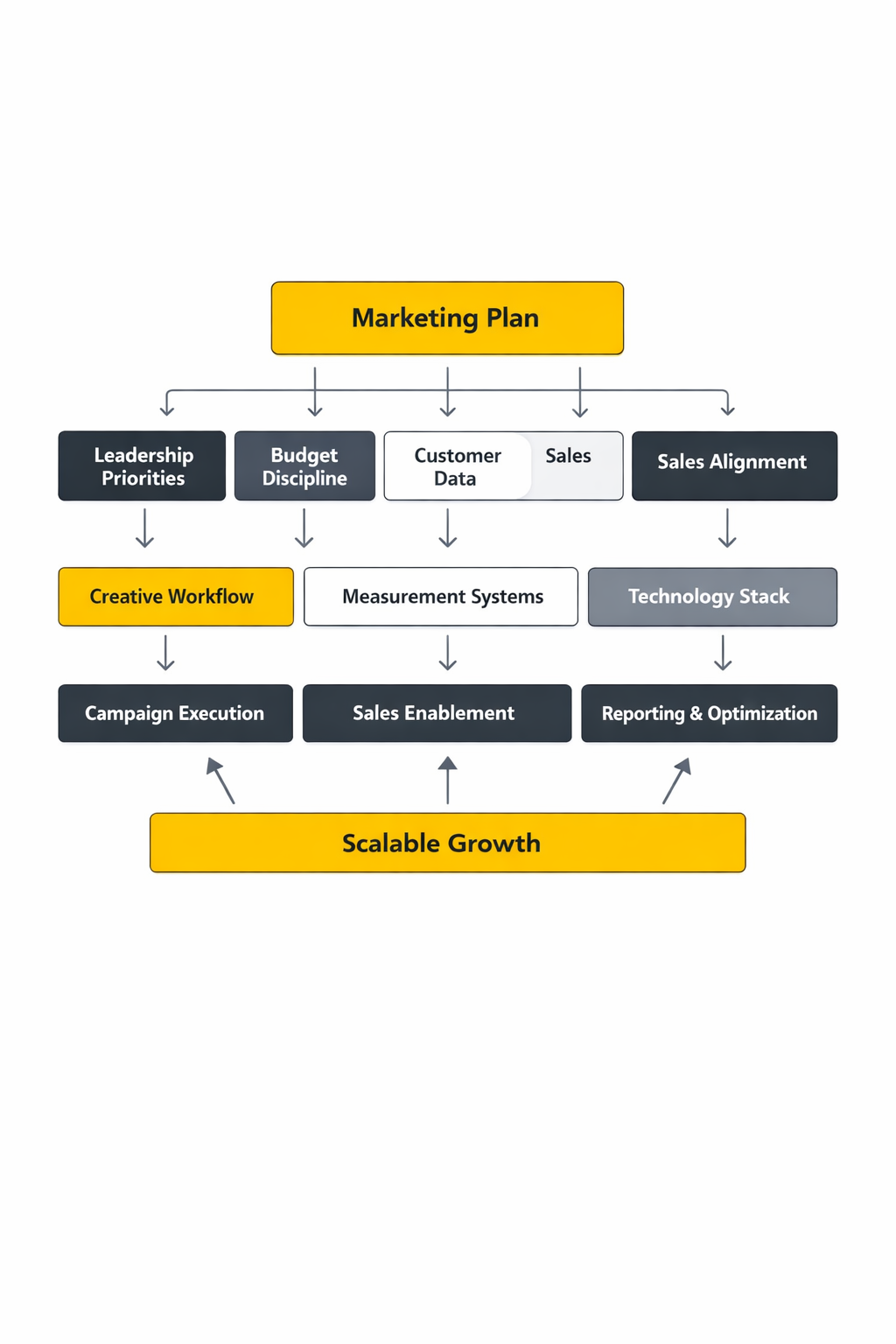
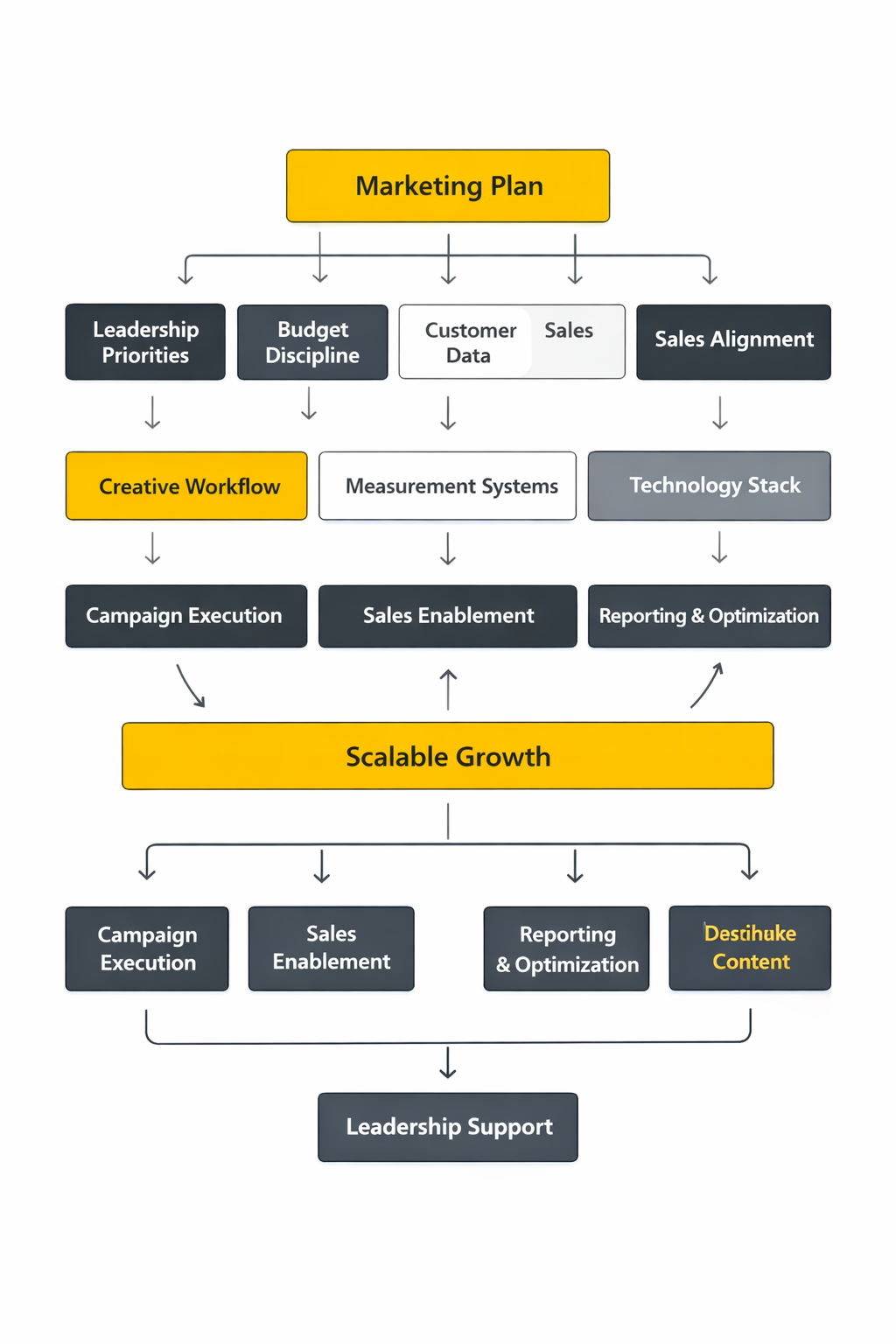
A marketing plan does not operate in isolation, and that is exactly why so many plans fall apart after the kickoff meeting. The document may look sharp, the goals may sound ambitious, and the campaign ideas may feel exciting, but none of that matters if the rest of the business is not set up to support execution. A real marketing plan lives inside an ecosystem made up of leadership priorities, budget discipline, customer data, sales alignment, creative workflows, measurement systems, and the technology stack that keeps everything moving.
This is where strategy either becomes operational or stays theoretical. The U.S. Small Business Administration’s guidance on marketing and sales makes it clear that a practical plan needs goals, action steps, budget, and ongoing measurement, which is another way of saying the plan has to connect to the wider business system. And that wider system matters even more now because marketing budgets remained flat at 7.7% of company revenue in Gartner’s 2025 CMO Spend Survey, while Salesforce’s latest State of Marketing report, built on insights from nearly 4,500 marketers worldwide, shows teams trying to deliver more personalization, better data use, and stronger performance under tighter conditions.
That is why the ecosystem around a marketing plan matters so much. Leadership has to support the priorities inside it. Sales has to be ready to follow up on the demand it creates. Data has to be clean enough to guide decisions. Creative and channel teams have to understand the same message, the same audience, and the same end goal. When those parts work together, the marketing plan becomes a growth engine. When they do not, even a smart strategy gets buried under friction, delays, and mixed signals.
FAQ: Built for a Complete Guide
What is a marketing plan, really?
A marketing plan is the working blueprint that shows how a business will attract attention, generate demand, and turn interest into revenue over a defined period. It is not just a list of channels or a pile of campaign ideas. The SBA describes it as the actions you will take to persuade consumers to buy your products or services, and that is a useful definition because it keeps the plan tied to outcomes instead of activity.
Why does a business need a marketing plan?
Because without one, marketing usually turns into a stream of disconnected tasks that feel busy but do not build momentum. A solid plan forces clarity around goals, audience, budget, message, and measurement before money starts moving. That discipline matters in a market where budgets are stuck at 7.7% of company revenue and teams are expected to produce more with less room for waste.
What should a marketing plan include?
At minimum, it should include business goals, target audience, market context, competitive positioning, messaging, channel choices, action steps, budget, and measurement. The SBA’s marketing and sales framework also emphasizes sales methods, goals, action plans, costs, and ROI tracking, which is helpful because it keeps the plan grounded in execution. If those pieces are missing, the plan usually feels polished on the surface but weak when the team tries to use it in real life.
How is a marketing plan different from a marketing strategy?
A strategy explains the big idea behind how the business will win attention and demand in the market. A marketing plan turns that direction into concrete action, which means it adds timelines, owners, campaigns, budget decisions, and KPIs. You can think of strategy as the theory and the plan as the operating document that makes the theory usable.
How long should a marketing plan be?
It should be as long as necessary to create clarity and no longer. A small business may only need a few pages if the audience, offer, and channel mix are straightforward, while a larger company may need a more detailed planning document tied to regions, products, or business units. The real test is not page count. It is whether the team can use the plan to make better decisions quickly.
How often should a marketing plan be updated?
Most businesses should review the plan continuously and formally revise it at least quarterly. The SBA recommends measuring ROI and adjusting the plan regularly, and that advice matters because market conditions, customer behavior, and performance data change faster than many teams expect. A marketing plan should provide direction, but it should never become so rigid that it ignores evidence from the market.
Should a small business have a marketing plan?
Absolutely, and in many cases a small business needs one even more than a large company because mistakes are more expensive when resources are tight. A smaller team often has less budget, less time, and less margin for scattered execution, which makes planning one of the cheapest ways to create focus. The SBA’s marketing plan template exists for exactly that reason: to help businesses turn broad ambition into a practical roadmap.
What metrics should a marketing plan track?
The answer depends on the business goal, which is precisely why the metrics must be chosen after the objective is clear. Awareness goals may rely more on reach, branded search, or share of voice, while acquisition goals may prioritize qualified leads, conversion rate, customer acquisition cost, or pipeline contribution. Google’s modern measurement guidance is useful here because it explains why marketers increasingly need attribution, incrementality, and marketing mix modeling together instead of expecting one method to answer everything.
How much budget should go into a marketing plan?
There is no universal number that fits every business, industry, or growth stage, which is why budget should follow the goal, the opportunity size, and the economics of the business. Still, it helps to know the broader climate: Gartner’s 2025 data shows budgets holding at 7.7% of company revenue. That does not tell you what your business should spend, but it does show why focus, sequencing, and measurement matter so much inside a marketing plan.
How important is audience research in a marketing plan?
It is one of the most important parts because every serious decision in the plan depends on it. Audience research shapes positioning, messaging, channel selection, creative direction, and even how success should be measured. That importance shows up in current performance data too, with Content Marketing Institute’s 2025 B2B research highlighting audience understanding as one of the clearest differences between top-performing marketers and the rest of the field.
Does a marketing plan need personalization built into it?
Yes, because customer expectations have moved far beyond generic messaging. McKinsey notes that 71% of consumers expect personalized interactions and 76% get frustrated when they do not get them, which means relevance is no longer optional. A modern marketing plan should therefore define not just who the audience is, but how different segments will be addressed, what data will support that approach, and where personalization will actually influence results.
Can a marketing plan work without good data?
It can function at a basic level, but it will usually underperform because decisions get made with too much guesswork. That problem is still common. Salesforce’s latest State of Marketing report shows that marketers see personalization and data as essential, yet many are still not fully satisfied with how effectively they use their data. A marketing plan becomes much stronger when the data layer is clean enough to guide segmentation, reporting, optimization, and follow-up.
Who should own a marketing plan inside a company?
Usually one person or one team should be clearly accountable for maintaining the plan, but the plan itself should never belong to marketing alone in practice. Leadership, sales, operations, product, and customer-facing teams often influence whether the plan succeeds. Ownership needs to be clear, but alignment needs to be broader, because marketing performance is affected by far more than campaign execution.
Is a documented marketing plan really worth it?
Yes, because documentation creates shared understanding, and shared understanding makes execution faster and cleaner. It is much easier to align creative work, paid media, content production, reporting, and sales support when people are not relying on memory or guesswork. That is one reason CMI’s 2025 research shows documented strategy contributing to success for many top-performing marketers.
What is the biggest mistake businesses make with a marketing plan?
The biggest mistake is treating it like a one-time document instead of a decision system. Teams build the plan, present it, approve it, and then ignore it until the next planning cycle, which defeats the whole purpose. A good marketing plan should guide what gets funded, what gets measured, what gets adjusted, and what gets cut when reality does not match the original assumptions.
Work With Professionals
If you have made it this far, then you already know a marketing plan is not something you throw together in an hour and hope for the best. It takes research, discipline, judgment, and the willingness to measure what is really happening instead of what you wish were happening. And if you want the plan to drive serious growth, working with people who understand positioning, demand generation, analytics, content, paid media, lifecycle marketing, and sales alignment can save you a lot of expensive trial and error.
That matters even more in a market where expectations are climbing fast. The 34th edition of The CMO Survey describes a landscape where marketing leaders are facing growing pressure to prove ROI while influence, AI use, and performance expectations continue to rise. In other words, the businesses that win are often the ones that stop improvising, bring in real expertise, and build a marketing plan that can actually survive contact with the market.
So yes, learn the principles, understand the framework, and get clear on your goals. But do not be afraid to work with professionals who can help you tighten the message, sharpen the funnel, clean up the measurement, and turn a good plan into real-world performance. That is often the move that separates a business that keeps “trying marketing” from one that finally starts making it work.
Explore 10K+ Remote Marketing Contracts on MarkeWork.com
Most marketers spend too much time chasing clients, competing on crowded platforms, and losing a percentage of every project to middlemen.
MarkeWork gives you a better way. Browse thousands of remote marketing contracts and connect directly with companies desperate to hire skilled marketers like you without platform commissions and without unnecessary gatekeepers.
If you’re serious about finding better opportunities and keeping 100% of what you earn, you can explore available contracts and create your profile for free at MarkeWork.com.
 Filip Konecny Enterprises