

Marketing companies matter more now because the stakes are higher than they were even a few years ago. WARC’s late-2024 global outlook showed advertising spend pushing past the trillion-dollar mark, while Gartner’s 2024 CMO survey showed marketing leaders working with tighter budget share at the same time. That combination changes the conversation from “Should we hire outside help?” to “Which kind of partner can help us grow without wasting time, budget, and momentum?”
The best marketing companies do not simply run ads or post content. They help businesses make smarter decisions about positioning, channels, measurement, creative direction, customer journeys, and the technology stack that connects all of it. In practice, that means the right partner should make your marketing simpler, more accountable, and easier to scale rather than more confusing.
This first part lays the groundwork. You will see why marketing companies still play such a central role, how to think about the modern agency framework, which core components separate strong partners from weak ones, and what professional implementation actually looks like when a business wants results instead of activity.
Article Outline
- Part 1: Why Marketing Companies Matter
- Part 2: Framework Overview
- Part 3: Core Components
- Part 4: Professional Implementation
- Part 5: Performance Analytics
- Part 6: Marketing Ecosystem Trends
Why Marketing Companies Matter

Marketing companies matter because most businesses no longer compete on a single channel. A company can have a strong product and still lose because its offer is unclear, its creative is weak, its website leaks conversions, or its measurement system cannot tell leadership what is actually working. That is exactly why outside specialists remain relevant even as in-house teams have grown.
The pressure is financial as well as strategic. Gartner found average marketing budgets fell to 7.7% of company revenue in 2024, which means every retained agency, consultant, or specialist has to justify their place. At the same time, PwC’s CMO Pulse findings show leaders are being pushed to prove ROI while balancing cost pressure, personalization, and new technology adoption. In that environment, strong marketing companies become leverage, while weak ones become overhead.
There is also a capability gap that many internal teams cannot close on their own. McKinsey’s work on the marketing operating model points to maturity gaps in performance, ecosystem development, real-time data use, and AI strategy. A capable partner can fill those gaps faster than a company can hire and coordinate five separate specialists. That is the real value: not outsourced busywork, but concentrated expertise applied to growth problems that touch strategy, execution, and measurement at the same time.
Framework Overview
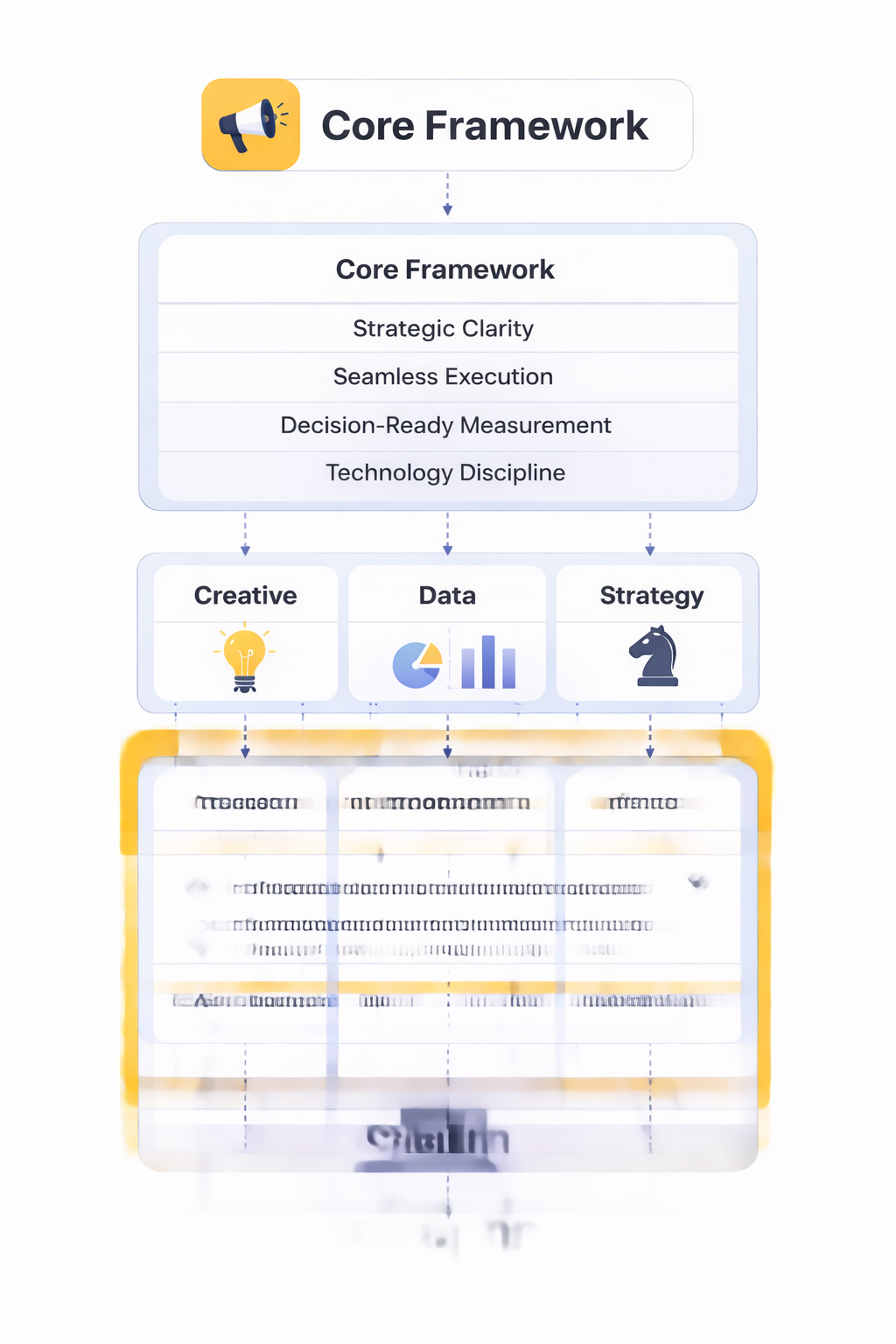
The easiest way to understand marketing companies is to stop grouping them into one giant category. Some firms are built for brand strategy, some for paid acquisition, some for SEO and content, some for lifecycle marketing, and some for full-funnel execution across multiple channels. When businesses hire the wrong type of company, disappointment usually follows even if the agency is competent, because the mismatch starts at the business model level.
A practical framework starts with four questions. First, does the company primarily shape strategy or execute tasks? Second, is it built around one channel or a full system? Third, does it optimize for short-term demand, long-term brand equity, or both? Fourth, can it measure outcomes in a way leadership can trust? These questions bring clarity quickly because they force decision-makers to compare service design, not just portfolios and promises.
This distinction matters more now because the operating environment is changing fast. IAB’s 2025 State of Data companion guide describes a market shaped by privacy constraints, signal loss, AI-powered planning, predictive analytics, and cross-channel measurement demands. In other words, the modern framework for evaluating marketing companies has to include data fluency and measurement discipline, not just creative quality or channel experience.
Core Components
The strongest marketing companies tend to share the same core components even when they specialize in different areas. They begin with strategic clarity, which means they can explain the audience, the offer, the message, the channel logic, and the business objective in plain language. If a team jumps straight into deliverables without tightening those foundations, the relationship usually turns into a stream of disconnected tactics.
The next component is channel competence paired with operational discipline. recent agency-client research summarized by MarketingCharts found that brands commonly outsource social media marketing, SEO and content, email marketing and automation, technology work, and strategy. The same research also showed that brands leave when results are weak, delivery is slow, or the value no longer feels justified. That tells you something important: execution matters, but reliability matters too.
The final component is measurement that connects marketing activity to business outcomes. Google’s work on hidden marketing ROI argues that narrow measurement can understate true impact, especially when long-term effects are ignored. Good marketing companies understand that a dashboard is not enough on its own. They need to know which metrics signal progress, which ones are vanity metrics, and how to communicate performance in a way that helps a business make better next-step decisions.
Professional Implementation
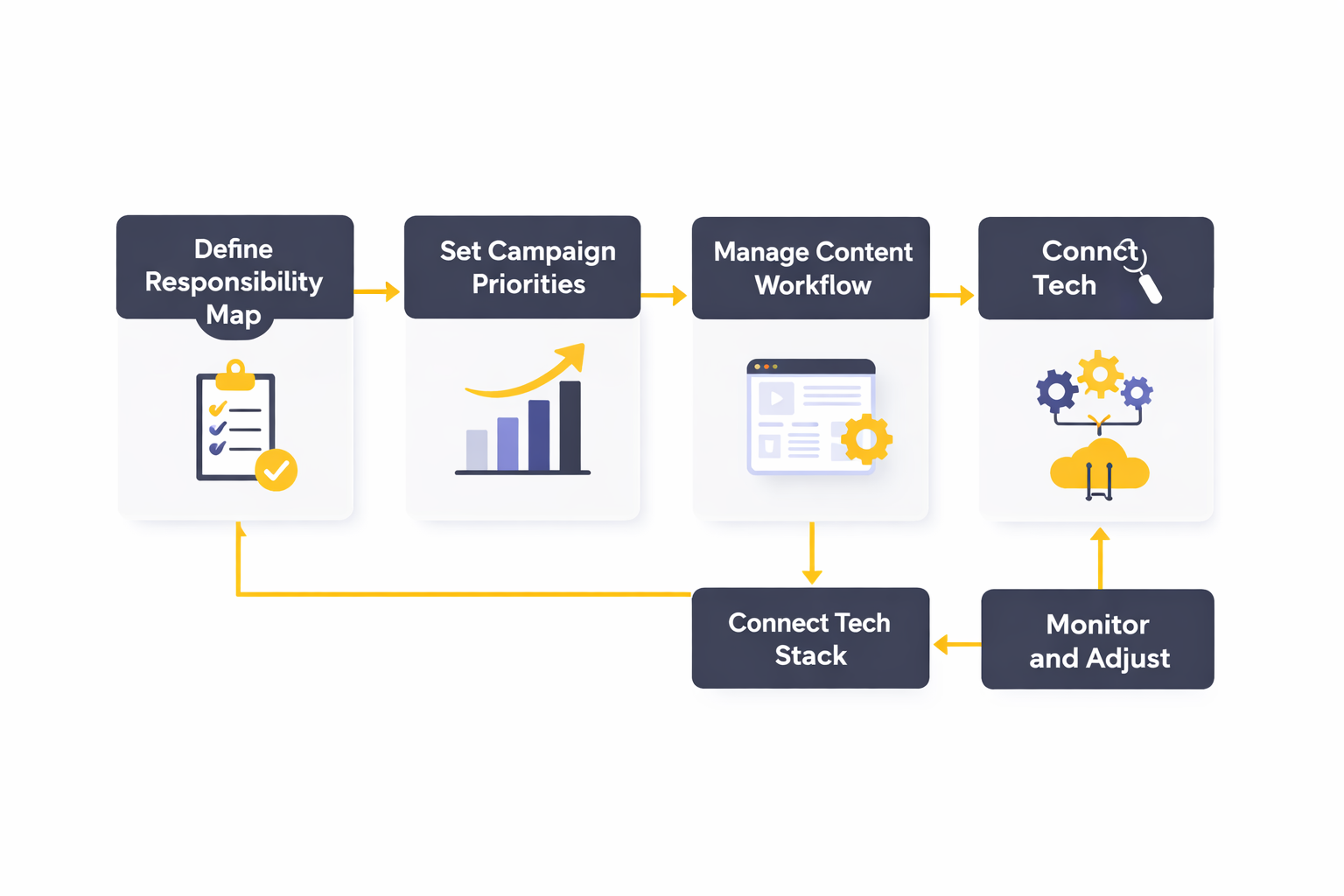
Professional implementation starts before the first campaign launches. A serious marketing company will define scope, success metrics, channel responsibilities, approval workflows, reporting cadence, and the technology stack before creative production or media buying begins. That early structure can feel less exciting than campaign ideas, but it is usually the difference between a clean engagement and months of avoidable friction.
It also helps to think in systems instead of isolated tools. A business might use Buffer to manage publishing, Brevo for lifecycle email, Systeme.io or ClickFunnels for funnel pages, Fillout for lead capture, Chatbase for site-side AI support, and Copper to keep pipeline visibility connected to marketing activity. The point is not to collect software for the sake of it. The point is to make sure strategy, execution, capture, nurturing, and sales follow-up form one connected system.
Implementation also requires realism about time horizon. Google’s modern measurement playbook and IPA effectiveness research both reinforce a simple truth: businesses need both short-term activation and longer-term brand-building logic. The marketing companies that create lasting value are the ones that can handle that balance without pretending every problem can be solved by one ad account, one viral post, or one reporting snapshot.
Defining the Right Type of Marketing Company
The first step is to stop treating all marketing companies as if they do the same job. Some firms are built to create strategic direction, sharpen positioning, and clarify the brand story. Others are built for execution inside one channel such as paid search, SEO, email, social media, or conversion-focused funnel design.
A third category sits in the middle and acts more like a growth partner than a traditional agency. These companies connect strategy, creative, media buying, analytics, and systems implementation so the work functions as one engine instead of several disconnected tasks. That distinction matters because McKinsey found only 27% of consumer and retail marketing leaders say they have a mature operating model, which means many businesses do not just need more output from marketing companies; they need outside help filling structural capability gaps.
Once you understand the type of company you are looking at, a lot of confusion disappears. A specialist agency can be excellent and still be the wrong choice if your real issue is brand clarity, broken measurement, or weak offer architecture. In the same way, a full-service partner can look impressive and still underperform if you only needed one highly technical skill delivered with speed and precision.
Matching Marketing Companies to Business Stage
The second step is to match marketing companies to the stage your business is actually in. Early-stage brands usually need message clarity, audience validation, channel focus, and a simple system for capturing and following up with demand. More established companies often need integration across multiple channels, tighter measurement, stronger customer segmentation, and better coordination between brand and performance work.
This is where a lot of expensive mistakes happen. A business in the early growth phase sometimes hires a large agency that is optimized for enterprise complexity, then wonders why progress feels slow and expensive. On the other side, a company with real scale sometimes hires a lightweight boutique team that can produce content and launch campaigns but cannot support governance, testing rigor, stakeholder communication, or cross-channel attribution.
The framework becomes more useful when you ask practical questions instead of abstract ones. Does this company know how to solve the problem we have at our current stage, with our current team, budget, and sales model? If the answer is vague, then the fit is weak no matter how attractive the proposal looks.

Evaluating Capabilities Beyond Channel Skills
A smart framework also looks beyond channel skill and asks whether marketing companies can operate inside the realities of the modern market. IAB’s 2025 guidance for brands and agencies makes it clear that AI, privacy-first data strategy, cross-channel effectiveness, and measurement accuracy are now part of the job. So if a company only talks about creative ideas or campaign tactics, that is no longer enough.
The strongest marketing companies can explain how they use data without becoming dependent on fragile tracking assumptions. They can show how strategy connects to execution, how reporting connects to decision-making, and how technology supports the process instead of turning it into a mess of dashboards no one trusts. McKinsey’s recent work on personalization describes a framework built on data, decisioning, design, distribution, and measurement, and that is a useful lens here because it reveals whether a potential partner understands marketing as a system rather than a list of tactics.
You should also pay attention to operational maturity. Google and Clear M&C Saatchi’s 2024–2025 research shows marketers increasingly want agencies to help solve AI implementation and privacy challenges, not just produce deliverables faster. That means the real test is whether a company can help you navigate change while still moving the business forward in a way leadership can measure.
Choosing Between In-House, Outsourced, and Hybrid Models
The final piece of the framework is deciding whether the work should live in-house, outside the company, or in a hybrid structure. Some capabilities are best owned internally because they are deeply tied to product knowledge, leadership priorities, or day-to-day communication with customers. Other capabilities make more sense to outsource because they require specialist expertise, expensive tools, or repeatable execution that would be slower and costlier to build from scratch.
That hybrid reality is becoming normal across business functions. Deloitte’s 2024 global outsourcing survey points to a broader shift in how organizations source skills, talent, and capabilities, especially as AI changes the economics of work. Marketing companies fit directly into that pattern because businesses are no longer choosing between “all internal” and “all agency.” They are building blended models where internal teams own brand and decision-making while outside partners bring speed, specialist skill, and additional capacity.
When you use that lens, the decision becomes much clearer. The question is not whether marketing companies are good or bad for growth. The question is which responsibilities they should own, which ones your team should keep, and how those roles will connect without confusion, duplication, or gaps in accountability.
How to Use This Framework in Real Decisions
In practice, this framework works best when you use it as a filter before you review proposals, pricing, or portfolios. Start by defining the business stage, the real growth constraint, the capabilities already in-house, and the outcomes that matter most over the next 6 to 12 months. Then evaluate marketing companies based on fit, not on surface-level excitement.
This approach protects you from two common traps. The first is hiring a partner because their case studies look impressive even though the clients, channels, and goals have little to do with your business. The second is choosing the cheapest option because the deliverables sound similar, even though the deeper strategy, measurement discipline, and implementation quality are nowhere close.
Once that filter is in place, the rest of the decision gets easier. You can see which marketing companies are built for your stage, which ones understand modern operating complexity, and which ones are likely to become a real extension of your growth system rather than another vendor you have to manage around.
Strategic Clarity Comes First
The first core component is strategic clarity. Good marketing companies can explain who the customer is, what problem the offer solves, why the message should matter now, and which channels deserve attention first. If they cannot do that in plain language, then everything that follows is at risk of becoming expensive noise.
This matters because modern marketing is more fragmented than ever. Salesforce’s latest State of Marketing research highlights how marketers are trying to balance AI, data, personalization, and customer trust all at once, which means a weak strategic foundation gets exposed very quickly. When a company does not know its positioning or its growth priority, even talented specialists can end up optimizing the wrong thing.
That is why strong partners slow the process down just enough at the beginning. They pressure-test the offer, the audience, the buying journey, and the competitive angle before they start producing deliverables. It is not glamorous work, but it is usually the piece that separates marketing companies that drive real momentum from those that just stay busy.
Execution That Connects Creative and Channels
The second core component is execution, but not execution in the shallow sense of just launching campaigns and filling calendars. The best marketing companies understand that creative and channel strategy have to work together. A weak message pushed through a strong media plan still underperforms, and a great creative idea without the right distribution plan rarely scales the way people hope it will.
This is where the market has been shifting fast. IAB’s 2025 State of Data report describes AI moving deeper into segmentation, planning, buying, optimization, and analysis across the media workflow. That changes what execution quality means. It is no longer enough for marketing companies to know one ad platform or one content format; they also need to understand how automation, data inputs, human oversight, and creative judgment work together.
In practice, that means the strongest teams are disciplined about the basics. They know how to build offers people care about, how to adapt messaging to the platform instead of copying and pasting it everywhere, and how to keep campaigns aligned with the real business objective. When that discipline is missing, companies often mistake movement for progress, and that gets expensive fast.
Measurement That Guides Decisions
The third core component is measurement that actually helps a business make decisions. Plenty of marketing companies can send dashboards. Far fewer can explain which metrics deserve attention, which ones are distractions, and how performance should influence the next round of creative, budget allocation, and channel strategy.
That is especially important in a privacy-first environment. Google’s modern measurement playbook makes the case that effective measurement now depends on clear success definitions, quality data, and a framework that uses more than one method rather than relying on a single attribution view. In other words, good marketing companies do not just tell you what happened. They help you understand what is likely driving results, what is uncertain, and what should happen next.
This is where trust gets built or destroyed. If reporting feels disconnected from revenue reality, leadership starts doubting the work even when parts of it may be performing well. But when a partner can translate data into decisions with honesty and context, the whole relationship becomes more useful because the business can act with more confidence.
Technology and Operations Discipline
The fourth core component is technology and operational discipline. Marketing companies now work in an environment where systems matter almost as much as ideas, because campaigns, content, lead capture, sales follow-up, personalization, and reporting all rely on the stack behind the scenes. If the systems are messy, even strong strategy ends up slowing down or leaking value.
The scale of that reality is hard to ignore. Chiefmartec’s 2025 marketing technology landscape shows just how large and complex the martech ecosystem has become, while IBM’s 2024 State of Salesforce research found that although 97% of surveyed Salesforce customers collect diverse data, only 24% are using it to transform customer experiences. That gap matters because it shows a common problem: companies often have tools, but they do not yet have the operating model to turn those tools into better outcomes.
Strong marketing companies help close that gap. They think through workflows, handoffs, naming conventions, data hygiene, campaign setup, and reporting architecture before problems get large. They also know when to keep things simple, which is a skill on its own, because too much complexity can quietly destroy speed and focus.
Human Judgment and Collaboration
The fifth core component is human judgment. AI can help marketing companies speed up research, drafting, segmentation, testing, and analysis, but that does not remove the need for people who understand customers, brand risk, commercial priorities, and the emotional texture of persuasion. In fact, the more automation enters the process, the more valuable thoughtful human oversight becomes.
You can see that shift in how the industry is talking about performance and trust. HubSpot’s 2026 State of Marketing report frames AI as baseline infrastructure rather than a differentiator and emphasizes that human-led marketing still wins trust and revenue. Salesforce’s global marketing research points in a similar direction by showing how AI ambition now sits alongside concerns around data, security, and trust. The message is clear: businesses still need marketing companies that can think, challenge assumptions, and exercise judgment instead of simply generating more output faster.
That is why collaboration matters so much. The best partners do not disappear into a black box and return with slides full of vague optimism. They communicate clearly, surface issues early, and help internal teams make smarter decisions with them rather than around them.
Why These Core Components Separate the Best
When you put these components together, the pattern becomes obvious. The best marketing companies build around clarity, execution quality, decision-ready measurement, operational discipline, and human judgment. They do not rely on one flashy strength to compensate for structural weakness everywhere else.
This is also why businesses should be careful when evaluating proposals that sound broad but feel thin. A partner may promise strategy, creative, paid media, content, analytics, automation, and AI support all at once, yet still lack the operating discipline to make those pieces work together. the 2025 ANA and 4As client-agency tenure research is useful here because it reflects an environment where agency relationships are being judged more on sustained value and fit, not just on initial excitement.
That is the real takeaway from this section. The core components are not just a checklist. They are the practical traits that tell you whether marketing companies can become a real growth asset for the business or whether they are going to create more motion than progress.
Statistics and Data
When businesses compare marketing companies, statistics and data should not sit at the end of the conversation as a reporting afterthought. They should shape the decision from the beginning, because the numbers reveal what kind of market agencies are working in, what pressures clients are under, and which capabilities are becoming non-negotiable. Once you look at the current data, it becomes obvious that marketing companies are being hired into a much tougher environment than the one many brands were dealing with just a few years ago.
Budget Pressure Is Reshaping Expectations
The first number that matters is budget pressure. Gartner’s 2025 CMO Spend Survey showed marketing budgets holding at 7.7% of company revenue for a second straight year, while 59% of CMOs said they still do not have enough budget to fully execute their strategy. That changes how companies evaluate outside partners because they are not just looking for activity anymore. They are looking for marketing companies that can help them produce more with the same budget, simplify execution, and cut waste without cutting growth.
This is also why weak reporting creates so much damage. If leadership already feels budget pressure, vague dashboards and soft interpretations do not reassure anyone. Marketing companies need to show not only what happened, but why it happened, what that means for the business, and how the next move will improve efficiency or growth.
AI Adoption Is Now Part of the Job
The second big shift is how fast AI has moved from experiment to expectation. IAB’s 2025 State of Data report focused on more than 500 experts across brands, agencies, and publishers and described AI as increasingly embedded throughout the media campaign lifecycle, from planning and activation to optimization and analytics. That matters because clients are no longer impressed just because a marketing company mentions AI. They want to know whether it improves targeting, creative testing, workflow speed, analysis quality, and decision-making without introducing sloppiness or blind trust in automation.
The same pressure shows up in broader marketer surveys. Salesforce’s global State of Marketing research found that AI sits at the center of both marketer ambition and marketer concern, with teams trying to balance productivity gains against trust, security, and data readiness. In practical terms, that means marketing companies now need a real point of view on where AI helps, where human judgment still matters more, and how to build workflows that keep quality from collapsing under the promise of speed.
Data Quality Is Becoming a Competitive Advantage
Another pattern in the data is that access to information is not the same as being able to use it well. Salesforce’s tenth edition State of Marketing report draws on insights from nearly 4,500 marketing leaders worldwide and puts data, personalization, and AI readiness at the center of modern marketing performance. That is important because it highlights a reality most businesses feel every day: they have platforms, dashboards, forms, CRM records, ad accounts, and website data, yet still struggle to turn all of it into clear commercial decisions.
That gap is exactly where strong marketing companies can create real value. They do not just collect more numbers. They help businesses clean the data, connect it across systems, and turn it into a usable picture of what the customer journey actually looks like. When that work is done well, data stops being a pile of disconnected reports and starts becoming an advantage.
Measurement Is Moving Beyond Simple Attribution
The next thing the statistics make clear is that old-school measurement models are not enough on their own. Google’s modern measurement playbook makes the case for using multiple methods rather than trusting a single narrow attribution lens, especially as privacy changes and signal loss continue to affect visibility. That matters for marketing companies because clients increasingly need interpretation, not just exported platform data.
If an agency only reports last-click conversions or platform-reported return and ignores the rest of the journey, it can make bad decisions look smart for a while. But over time, businesses start noticing the disconnect between what dashboards say and what revenue reality feels like. The better marketing companies understand that measurement is now about building a more complete decision system, not pretending any one number tells the whole truth.
Personalization Still Has a Strong Business Case
The case for personalization also remains strong, but the numbers show that doing it well is more operational than inspirational. McKinsey’s work on the next frontier of personalized marketing argues that better data, decisioning, design, distribution, and measurement are what unlock performance, not personalization talk on its own. That is useful for evaluating marketing companies because it separates teams that understand system design from teams that only use personalization as a buzzword in proposals.
There is a simple lesson in that. When a partner says they can personalize campaigns, content, or journeys, the real question is whether they have the structure to make that believable at scale. Without that structure, personalization becomes another promise that sounds sharp in a pitch and falls apart in execution.
Why These Numbers Matter When Hiring Marketing Companies
Put these data points together and the picture becomes clear. Marketing companies are operating in a world of flat budgets, rising expectations, AI acceleration, higher measurement complexity, and stronger pressure to turn scattered data into confident decisions. That is why the best partners now look less like isolated service providers and more like operators who can connect strategy, execution, analytics, and systems.
This is also why surface-level comparisons are risky. If one company promises more posts, more ads, or more deliverables for less money, that can sound attractive until you place it next to the market realities these statistics reveal. In this environment, businesses usually get the best results from marketing companies that can explain the numbers, work responsibly inside them, and use them to guide the next move instead of just decorating reports.
Turning Strategy Into an Operating Rhythm
The best marketing companies do not treat implementation like a vague middle phase between planning and results. They turn it into an operating rhythm. That means clear priorities, deadlines, owners, review cycles, feedback loops, and a way to keep campaigns moving without constant confusion.
This sounds basic, but it is one of the biggest reasons engagements succeed or fail. McKinsey found that only 27% of consumer and retail marketing leaders say they have a mature operating model, which tells you how common the structural gap really is. Strong marketing companies close that gap by bringing process where the client has fragmentation, and by making the work easier to run week after week instead of relying on adrenaline and last-minute saves.
Once that rhythm is in place, decisions get cleaner. Meetings become shorter because they are tied to real priorities. Teams stop guessing what matters most. And the client starts to feel like the marketing engine is finally running on purpose instead of lurching from one emergency to the next.
Defining Roles Before Work Starts
Professional implementation also means being very honest about roles before execution begins. One of the fastest ways for a relationship with marketing companies to go sideways is when nobody defines who owns strategy, copy, creative approval, media buying, analytics, CRM follow-up, or landing page changes. The confusion usually does not show up on day one. It shows up after the first deadlines slip and everyone realizes they were assuming different things.
The better agencies prevent that by building a responsibility map early. They clarify what sits with the client, what sits with the agency, what requires shared decision-making, and which items can move without constant approval. That may not sound exciting, but it is exactly the kind of groundwork that protects momentum later.
It also helps companies avoid a subtle but expensive trap. Sometimes a client hires marketing companies thinking they are buying execution, when what they are really buying is coordination overhead on top of their existing chaos. Real implementation fixes that by reducing friction rather than adding another layer of it.
Building a Stack That Actually Supports Growth
A professional implementation process always touches the technology stack, because marketing work no longer lives in one place. It moves through ad platforms, analytics, forms, CRM systems, email tools, scheduling software, content workflows, and sales follow-up. If those pieces do not connect well, the business starts losing visibility, speed, and eventually revenue.
That is why the best marketing companies think like system builders as much as campaign builders. They look at how leads are captured, how contacts are tagged, how handoffs happen, how reports are built, and where data quality starts to break down. You can see why that matters in Google’s 2024–2025 research with more than 700 senior marketing leaders, which showed that agencies are now expected to help clients navigate AI disruption, shifting capabilities, and new operational demands, not just produce assets faster.
So the stack should not grow just because new tools look interesting. It should grow only when each addition makes execution cleaner, decisions sharper, or customer movement smoother. Otherwise businesses end up with a pile of software and no real operating advantage.
Why Hybrid Models Are Becoming Normal
Another important piece of professional implementation is accepting that most businesses do not need an all-or-nothing sourcing model anymore. In many cases, the strongest setup is hybrid. Internal teams stay close to brand, product, leadership, and customer knowledge, while marketing companies handle specialist execution, scale, and external perspective.
That broader shift is visible far beyond marketing. Deloitte’s 2024 Global Outsourcing Survey found that organizations are increasingly using outsourcing as a way to access specialized talent and AI-enabled capabilities, not just to cut cost. That maps directly onto how companies now use marketing partners. The question is less about whether to outsource and more about which capabilities should stay in-house and which ones create more leverage when handled by specialists.
When that model is designed well, everyone benefits. Internal teams keep clarity and control where it matters most. Marketing companies bring execution depth and outside expertise. And the business gets a system that is more flexible than either approach would be on its own.
Maintaining Quality Under Real-World Pressure
The hardest part of implementation is not launching the first version of the work. It is maintaining quality once real-world pressure kicks in. Deadlines tighten, approvals slow down, campaigns underperform, stakeholders start asking for changes, and new channels suddenly look urgent. This is the moment when weaker partners become reactive and stronger marketing companies show their value.
That value shows up in how they respond under strain. They do not panic and start changing ten variables at once. They do not hide behind vague language when numbers dip. They keep the process intact, diagnose what is actually happening, and make changes in a sequence that can be tracked and understood.
This is also why long-term fit matters more than flashy chemistry at the start. the 2025 ANA and 4As client-agency tenure findings point to an average relationship length of about seven years, more than double the 2016 figure, which signals a market that increasingly values durable, value-based partnerships. Businesses do not stay with marketing companies that only look good in the pitch. They stay with the ones that can keep quality high when the easy phase is over.
What Professional Implementation Should Feel Like
When implementation is handled well, it feels surprisingly calm. Not slow, not passive, but calm in the sense that everyone knows what is happening, why it is happening, and what comes next. Campaigns still need effort, testing, and adaptation, but they stop feeling chaotic.
That is the standard businesses should look for when evaluating marketing companies. Professional implementation should create clarity, accountability, and momentum at the same time. If a partner cannot do that, then even strong strategy and good creative will struggle to translate into consistent growth.
And that is really the heart of it. Marketing companies become valuable when they can take ideas off the whiteboard, turn them into a working system, and keep that system moving when the pressure becomes real. That is what separates a vendor from a true growth partner.
Marketing Ecosystem Trends

The ecosystem around marketing companies is changing fast, and the biggest shift is that clients no longer hire agencies just to deliver isolated tasks. They want partners who can think across strategy, creative, paid media, data, CRM, automation, and measurement without letting the whole system become bloated. That makes the modern market tougher, but it also makes great marketing companies far more valuable because they can simplify complexity instead of adding to it.
You can see that pressure in current industry research. Gartner’s 2025 CMO Spend Survey showed budgets holding at 7.7% of company revenue, while IAB’s 2025 State of Data research described AI moving deeper into planning, activation, optimization, and analysis across media campaigns. Put those two realities together and the message is clear: businesses need more output, better decisions, and cleaner systems without getting more budget to waste on confusion.
The strongest marketing companies are responding by becoming more operationally mature. Salesforce’s latest State of Marketing report shows how deeply AI, data quality, and personalization now shape the work, while the 2025 ANA and 4As tenure study shows client-agency relationships are lasting longer again when value, trust, and fit are strong. That is where the ecosystem is heading: fewer random tactics, more integrated execution, and much less patience for partners who cannot connect ideas to outcomes.
FAQ – Built For Complete Guide
What do marketing companies actually do?
Marketing companies help businesses attract attention, create demand, generate leads, improve conversion, and strengthen brand position. The better ones do not just run ads or publish content; they connect strategy, execution, measurement, and systems so growth becomes easier to manage. That matters even more now because IAB’s 2025 companion guide makes it clear that modern marketing increasingly depends on AI, data, and cross-channel coordination rather than one isolated tactic.
Are marketing companies worth it for small businesses?
They can be, but only when the fit is right. A small business usually needs focus, clear messaging, and a simple acquisition system more than it needs a giant full-service retainer. The right marketing company can shorten the learning curve and prevent wasted spend, but the wrong one can create complexity a small team does not need.
How do I choose between a specialist agency and a full-service firm?
Choose a specialist when your bottleneck is narrow and obvious, such as paid search, SEO, email automation, or conversion design. Choose a broader partner when your issue is not one channel but the way your entire growth system fits together. The decision should come from the actual constraint in the business, not from whichever pitch sounds more impressive.
How much should I expect to spend on marketing companies?
There is no universal number because pricing depends on scope, complexity, business stage, and the quality of the partner. What matters more is whether the engagement is built around outcomes, priorities, and responsibilities instead of a vague list of deliverables. In a market where marketing budgets remain under pressure, businesses usually get better results by paying for clarity and capability than by chasing the cheapest option.
Should I build an in-house team instead of hiring a marketing company?
Sometimes yes, but not always. In-house teams are strong when you need close product knowledge, fast internal communication, and daily alignment with leadership, while marketing companies are strong when you need specialist skill, outside perspective, or extra capacity. Many of the best setups are hybrid because they combine internal control with external expertise.
How long does it take for marketing companies to produce results?
That depends on the channel mix and the problem being solved. Paid acquisition and conversion improvements can move faster, while SEO, content authority, brand perception, and lifecycle optimization usually need more time to mature. A trustworthy partner will explain the likely timeline clearly instead of pretending every result should happen instantly.
What red flags should I watch for when hiring marketing companies?
Be careful with partners who promise fast results without asking hard questions about your audience, offer, margins, sales process, and data quality. Be careful with reporting that looks polished but does not help you make better decisions. Also be careful with agencies that say they do everything, yet cannot clearly explain who owns what and how the work will run week to week.
Do marketing companies need to use AI now?
They do not need to use AI for everything, but they do need a serious point of view on where it helps and where human judgment still matters more. IAB’s 2025 findings show AI moving deeper into campaign workflows, and Salesforce’s marketer research shows AI sits at the center of both opportunity and concern for marketing leaders. The real question is not whether a company uses AI, but whether it uses it in a way that improves quality, speed, and decision-making without damaging trust.
What metrics should marketing companies report on?
The answer should always connect back to the business model. For some companies that means qualified pipeline, booked calls, close rates, and revenue contribution, while for others it may mean lead quality, retention, repeat purchase behavior, or branded demand. Good marketing companies do not hide behind vanity metrics; they explain which numbers matter, why they matter, and what action the business should take next.
Can marketing companies help with branding and performance at the same time?
Yes, and the best ones understand that those two goals should not be treated like enemies. Performance work captures demand now, while brand work makes future demand easier and cheaper to capture. The real skill is knowing how to balance both based on your stage, budget, and growth goals.
Why do some agency relationships fail even when the agency looks talented?
Because talent alone is not enough. Relationships usually break when there is a mismatch in scope, business stage, communication style, speed of decision-making, or expectations around measurement and ownership. the ANA’s 2025 summary of client-agency tenure research reinforces how much trust, transparency, and fit matter when partnerships are meant to last.
What should happen in the first 30 days with a new marketing company?
The first month should create clarity, not chaos. That usually means defining goals, priorities, reporting logic, handoffs, approvals, customer segments, messaging angles, and the immediate execution plan. If the first 30 days are full of activity but leave everyone less clear on how the system works, that is usually a warning sign.
Can marketing companies replace a weak offer or a bad product?
No, and the honest ones will tell you that early. Great marketing can improve positioning, sharpen messaging, and create more effective demand generation, but it cannot permanently cover up a bad product-market fit or an offer people do not really want. In many cases, the most valuable thing a strong partner does is reveal where the real business problem is.
What is the biggest mistake businesses make when hiring marketing companies?
The biggest mistake is hiring based on surface appeal instead of operational fit. Businesses often get pulled in by case studies, polished pitch decks, or low prices without checking whether the partner is actually built for their stage, sales model, team structure, and constraints. That is why the smartest hiring process focuses on alignment, accountability, and execution discipline before anything else.
Work With Professionals
If you have made it this far, the pattern should be pretty clear. Marketing companies create the most value when they help you think better, execute better, and measure better without turning growth into a maze of disconnected tools and opinions. That is the standard worth holding, whether you are hiring your first outside partner or replacing one that never quite delivered what the pitch promised.
The opportunity in front of skilled marketers is also very real. Businesses are under pressure to grow with flatter budgets, cleaner systems, and better use of AI and data, which means people who can actually solve those problems are in demand. That is exactly why serious marketers should put themselves where serious companies are already looking.
Explore 10K+ Remote Marketing Contracts on MarkeWork.com
Most marketers spend too much time chasing clients, competing on crowded platforms, and losing a percentage of every project to middlemen.
MarkeWork gives you a better way. Browse thousands of remote marketing contracts and connect directly with companies desperate to hire skilled marketers like you without platform commissions and without unnecessary gatekeepers.
If you’re serious about finding better opportunities and keeping 100% of what you earn, you can explore available contracts and create your profile for free at MarkeWork.com.
 Filip Konecny Enterprises