

LinkedIn Marketing: A Professional Growth Framework That Compounds
LinkedIn marketing works differently from most social platforms because people do not open it to be distracted. They open it to learn, evaluate opportunities, build credibility, and make decisions that affect budgets, partnerships, hiring, and long-term growth. That changes the entire job of the marketer. Instead of chasing shallow reach, you are building commercial trust in a place where trust can turn into pipeline.
That is also why so many businesses get LinkedIn wrong. They treat it like a corporate noticeboard, post stiff updates that sound like they were approved by six people, and then wonder why nothing moves. Strong LinkedIn marketing is more strategic than that. It blends positioning, content, distribution, paid amplification, and relationship building into one system that helps the right people remember you when the buying window opens.
This first part lays the foundation. You will see why LinkedIn marketing matters now, how the framework fits together, which components actually drive outcomes, and how to implement the work professionally so it does not collapse into random posting.
Article Outline
- Part 1: Why LinkedIn Marketing Matters
- Part 2: LinkedIn Marketing Framework Overview
- Part 3: Core Components of LinkedIn Marketing
- Part 4: Professional Implementation
- Part 5: Analytics and Optimization
- Part 6: Ecosystem, Scaling, and FAQ
Why LinkedIn Marketing Matters
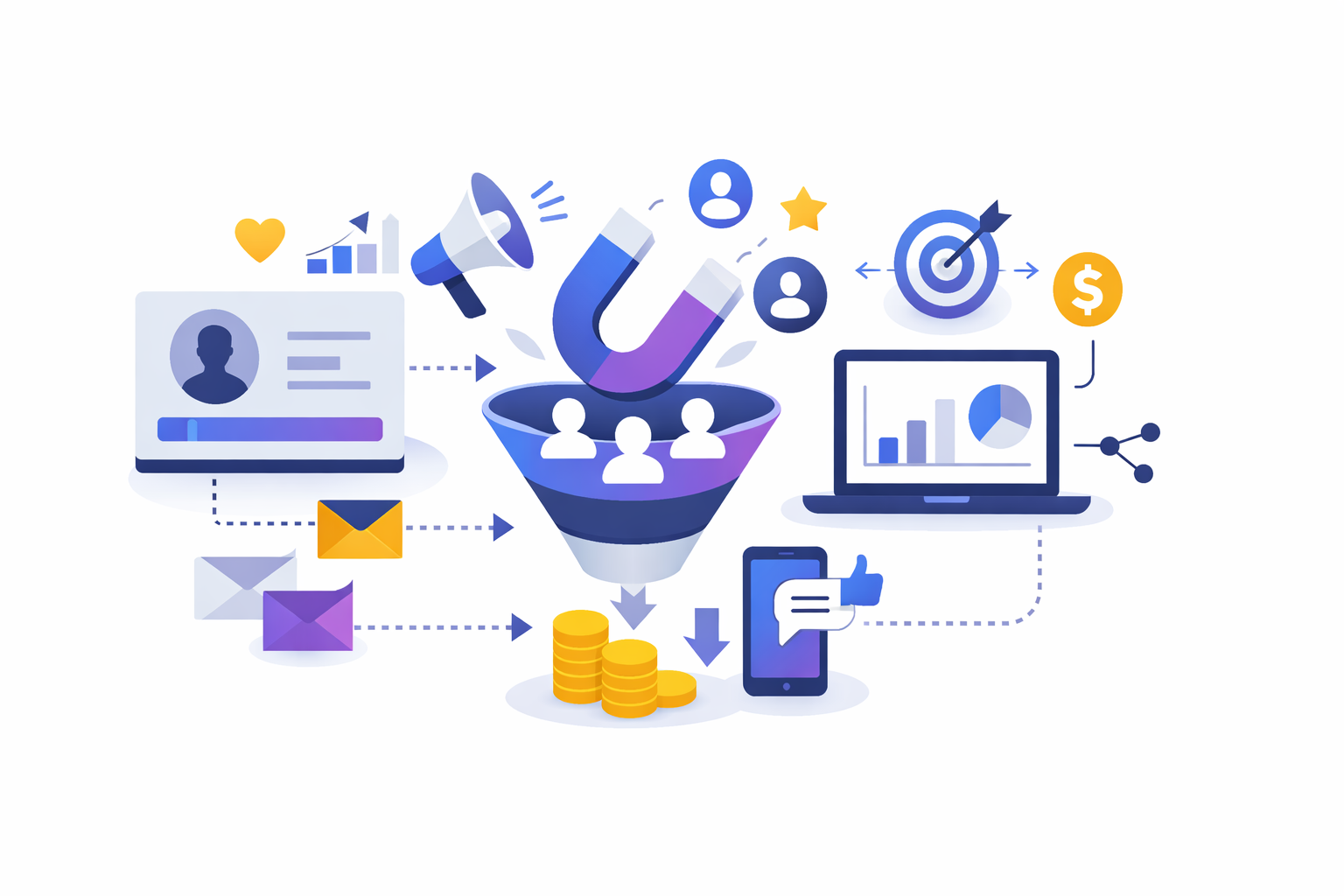
LinkedIn marketing matters because it gives you access to a professional environment where attention is closer to intent than it is on entertainment-first platforms. Eighty-five percent of B2B marketers in Content Marketing Institute’s 2025 research said LinkedIn delivers the best value of any social platform, which is an unusually strong signal in a market where marketers are under pressure to justify every channel. That kind of lead over Facebook, YouTube, Instagram, X, and TikTok does not happen by accident. It happens because the platform sits near the center of B2B discovery, reputation, and validation.
The quality of attention is what makes the difference. LinkedIn’s own positioning, echoed in recent industry roundups, keeps highlighting that four out of five members influence business decisions and the audience has roughly twice the buying power of the average web audience. Even when you are not running ads, that context matters. A strong post, a sharp founder perspective, or a useful company update can reach people who can approve spend, shortlist vendors, or bring your name into an internal conversation.
The platform is also holding its commercial momentum. Microsoft reported LinkedIn revenue grew 9% year over year in fiscal Q2 2025, with growth across Marketing Solutions, Talent Solutions, Premium Subscriptions, and Sales Solutions. That does not prove every campaign will work, but it does show the ecosystem is active, monetized, and still attracting serious business investment. In practical terms, LinkedIn marketing is not a side channel anymore. It is infrastructure.
There is another reason it matters right now: B2B buyers spend long stretches out of market, and brands that disappear between buying cycles lose the right to be remembered later. Edelman and LinkedIn’s 2024 thought leadership research framed the challenge clearly by pointing to the reality that most potential buyers are not actively shopping at any given moment. If your LinkedIn presence helps people rethink a problem, understand a shift, or feel smarter after interacting with your content, you are not just collecting impressions. You are building mental availability before demand becomes visible.
LinkedIn Marketing Framework Overview
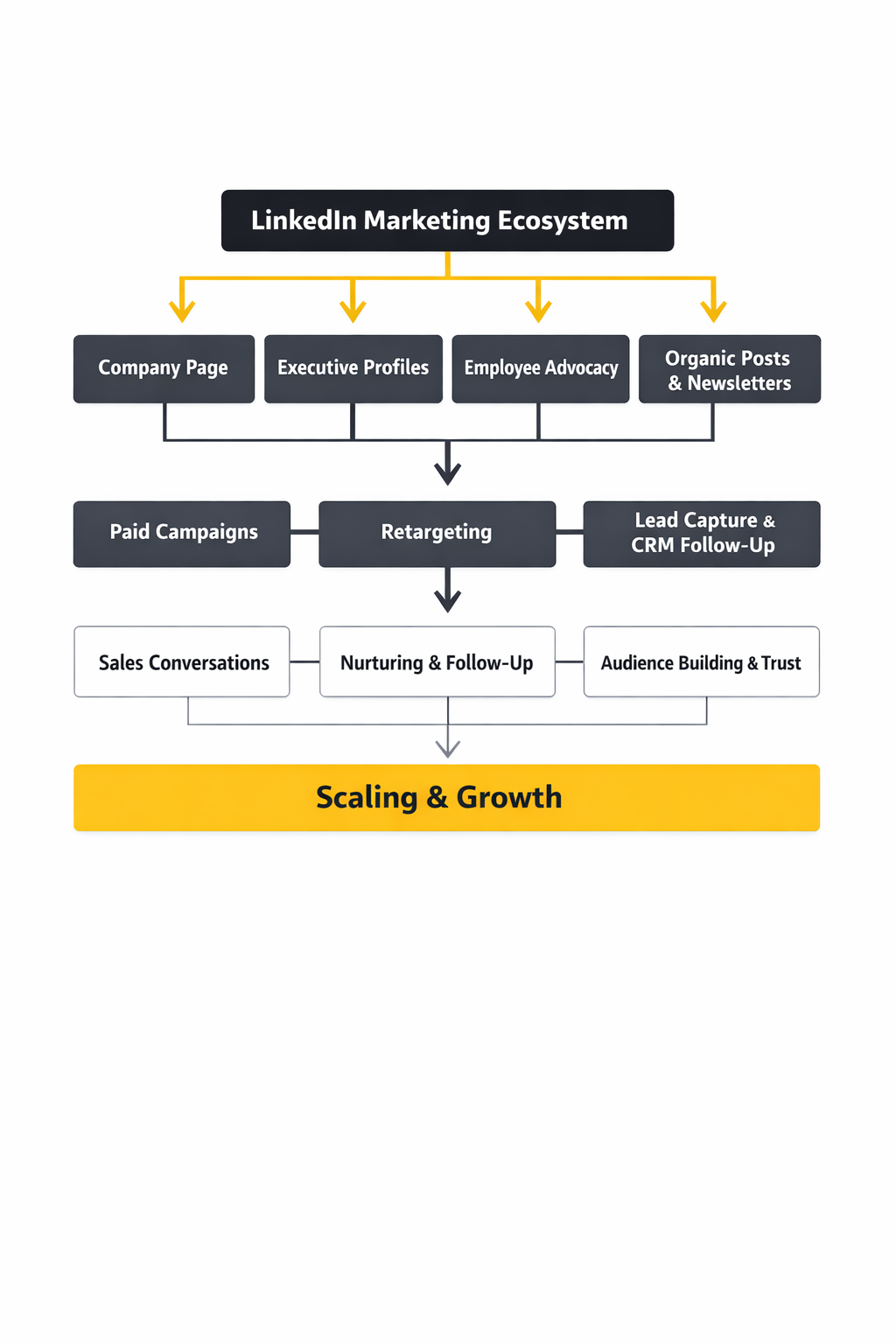
A reliable LinkedIn marketing framework starts with positioning, moves into content, then expands through distribution, conversion, and measurement. That order matters. If the positioning is weak, the content sounds generic. If the content is weak, distribution only spreads forgettable material. If distribution works but conversion paths are missing, you generate attention that never becomes revenue.
The framework should therefore answer five practical questions. Who exactly are you trying to be known for helping? What ideas do you want to own in the market? How will those ideas appear across personal profiles, company pages, newsletters, comments, direct outreach, and paid campaigns? Where should interested people go next? And which signals will tell you that awareness is turning into trust and demand?
Seen this way, LinkedIn marketing is not “posting on LinkedIn.” It is a system for shaping perception over time. That is why the strongest teams combine brand building with demand capture instead of arguing over which one matters more. The same 2025 CMI research found that 61% of B2B marketers expect increased investment in video, 52% expect increased investment in thought leadership content, and 40% expect increased investment in paid advertising. The market is already moving toward integrated programs, not isolated tactics.
On LinkedIn specifically, that integrated approach works because a single idea can travel through multiple layers of the platform. A founder can publish a point of view, the company page can reinforce it with proof, employees can extend reach through discussion, a document or video can deepen the argument, and paid promotion can place the strongest asset in front of a defined buying committee. The framework is powerful precisely because the parts can work together instead of competing for attention.
Core Components Of LinkedIn Marketing
The first core component is strategic clarity. You need a clear audience, a clear commercial goal, and a clear editorial point of view. Without those three pieces, LinkedIn marketing becomes a stream of disconnected updates that might look active on the surface but do not accumulate authority. Clarity gives the audience a reason to remember you and gives your team a filter for deciding what deserves to be published.
Audience And Positioning
Good LinkedIn marketing begins with audience design, not content calendars. You need to know which roles matter, which industries matter, which stage of awareness they are in, and which commercial tension they are trying to resolve. A finance leader, a demand generation manager, and a founder may all buy the same service eventually, but they will not respond to the same angle, proof, or level of detail.
Positioning is what turns that audience insight into relevance. Instead of saying you help companies grow, you define the problem you are unusually good at solving and the perspective that makes your approach distinct. When that positioning is strong, your posts stop sounding like generic business advice and start sounding like a market view that only your brand could deliver.
This is where many LinkedIn strategies quietly fail. Teams spend energy polishing creative while leaving the strategic center unresolved. The result is content that is professionally written but commercially vague. On a platform crowded with expertise claims, vagueness is expensive.
Content And Format Selection
The second core component is content that matches how professionals actually consume ideas on LinkedIn. Short posts can earn fast engagement, but they are rarely enough by themselves. You also need depth assets that demonstrate reasoning, credibility, and practical application. That is one reason videos were rated the most effective B2B content type in CMI’s 2025 benchmark study, ahead of case studies, white papers, and research reports. Format choice is becoming strategic, not cosmetic.
That does not mean every brand should rush into video for the sake of trend chasing. It means the content mix should reflect the buying journey. Fast-moving posts can open the conversation. Carousels, documents, and videos can explain a framework. Longer-form articles, newsletters, webinars, and gated assets can help someone move from curiosity to evaluation. Each format has a job inside the system.
The strongest LinkedIn marketing also respects tone. Audiences on the platform still expect professionalism, but they do not reward lifeless corporate language. The content that stands out is specific, useful, and human enough to sound like a person with real conviction behind the words. Professional does not mean sterile, and authority does not require sounding distant.
Distribution And Conversion Paths
The third core component is distribution. Publishing is only the starting point. You need a deliberate plan for how content moves beyond the first burst of impressions. That can include executive advocacy, employee sharing, reposting ideas in different formats, direct outreach around relevant posts, newsletter promotion, event tie-ins, and selective paid amplification when an asset proves it deserves more reach.
Distribution matters because even excellent insights can disappear if they are left to platform luck. CMI found that 84% of B2B marketers use paid channels, with 73% using social media advertising or promoted posts. That does not mean every LinkedIn strategy needs a large ad budget from day one. It means serious teams increasingly accept that quality content and thoughtful amplification belong together.
Then comes conversion design. When someone is ready for a next step, the path should feel obvious. That next step might be a newsletter subscription, a webinar registration, a demo request, a lead magnet, a consultation booking, or a direct message conversation. LinkedIn marketing becomes far more effective when the audience never has to guess what to do after they trust you.
Professional Implementation
Professional implementation is the difference between a LinkedIn presence that compounds and one that burns out after a few enthusiastic weeks. The work needs owners, workflows, editorial standards, approval boundaries, publishing rhythms, and measurement rules. Otherwise, everything depends on bursts of motivation, and the brand voice changes every time a different person touches the account.
Operating Model And Governance
Start by deciding who owns what. In some organizations, the company page carries most of the weight. In others, founder-led or executive-led content is the real growth engine, with the brand page acting as proof and reinforcement. Neither model is automatically better. What matters is choosing an operating model that fits the business, then defining how ideas are sourced, drafted, reviewed, published, and repurposed.
This governance issue is more important now because content volume is rising while confidence in AI-generated output remains limited. Only 19% of B2B marketers in CMI’s 2025 research said AI is integrated into their daily workflows, and just 4% reported a high level of trust in AI output. That is a useful reminder. AI can speed up production, but professional LinkedIn marketing still needs strong human judgment around positioning, proof, claims, and tone.
Governance also protects consistency. Your audience should feel the same underlying intelligence whether they read a founder post, a brand update, a sponsored asset, or a newsletter issue. That does not require every piece to sound identical. It requires every piece to sound like it belongs to the same strategic mind.
Cadence, Teamwork, And Execution
Execution becomes easier when the cadence is realistic. Most teams do better with a smaller number of high-conviction pieces than with a bloated schedule full of forgettable posts. A weekly rhythm that combines one flagship insight, several supporting posts, active commenting, and one clear conversion opportunity usually beats an anxious plan to publish every day without enough substance to support it.
Professional implementation also means building for reuse. One webinar can become a short video series, several text posts, a document post, a newsletter edition, a sales follow-up asset, and an ad creative test. That repurposing mindset is not just efficient. It is one of the clearest ways to make LinkedIn marketing sustainable without lowering quality.
Finally, the team needs to treat LinkedIn as a business channel, not a vanity channel. Comments from the right people matter more than weak viral reach. Saves, profile visits, qualified form fills, meeting requests, branded search lift, and sales conversations matter more than applause from people who were never potential buyers. When implementation is professional, the platform stops feeling random and starts feeling measurable.
The framework behind strong LinkedIn marketing is not complicated, but it does demand discipline. You need the right market position, the right message architecture, the right publishing system, and a clear path from attention to action. When any one of those pieces is missing, the whole thing starts to look busy without becoming valuable.
That matters even more in B2B because the buying window is usually small and the memory window is long. Research tied to the LinkedIn B2B Institute’s 95:5 rule explains why only 5% of buyers are likely to be in-market in a given quarter, which means most of your future revenue is sitting with people who are not ready to talk to sales today. A real LinkedIn marketing framework is built for that reality, not against it.
Start With Market Positioning
The first job of LinkedIn marketing is to make your business easy to understand in a crowded market. That means defining the commercial problem you solve, the audience you solve it for, and the point of view that makes your solution feel sharper than the generic promises filling most feeds. If that strategic core is fuzzy, the rest of the framework gets weaker no matter how often you post.
This is where many brands lose the game before it starts. They talk about innovation, growth, or transformation in broad language that could belong to almost any competitor. A better approach is to choose a narrower battleground and own it with enough clarity that the right buyer immediately feels, “These people get the problem I am dealing with.”
That is also why LinkedIn marketing rewards specificity. Professionals do not remember bland competence for very long, but they do remember a company that explains a painful problem in precise language and then keeps returning with useful, confident insight. Positioning gives every later post, document, video, and ad a center of gravity.
Build Trust Before Demand Appears
Once the position is clear, the next layer in the framework is trust. On LinkedIn, trust is built through repeated exposure to useful thinking, not through one clever campaign. The platform gives you room to show how you think, how you solve problems, and whether your expertise feels practical enough to matter when budgets are on the line.
That is exactly why thought leadership belongs near the center of modern LinkedIn marketing. Edelman and LinkedIn’s 2024 global study of 3,484 business executives found that 73% of decision-makers see thought leadership as a more trustworthy basis for assessing a company’s capabilities than marketing materials and product sheets. That is a major strategic clue. If buyers trust informed perspective more than polished collateral, your framework has to create space for perspective.
Trust also needs to arrive before the buyer is actively shopping. The same research shows 54% of decision-makers and C-suite leaders spend more than an hour per week consuming thought leadership. That tells you LinkedIn marketing is not just about catching people at the point of conversion. It is about shaping preference while they are still learning, comparing, and quietly deciding who feels credible.
Create A Content Engine, Not Random Posts
A lot of brands think they have a LinkedIn strategy when they really just have a posting habit. A framework is different because it connects each content format to a clear purpose. Some pieces are there to earn discovery, some to deepen authority, some to create conversation, and some to move a qualified prospect toward a next step.
That is why content mix matters so much. Content Marketing Institute’s 2025 B2B benchmark research shows that 61% of marketers expect higher investment in video, 52% expect more investment in thought leadership, and 40% expect more investment in paid advertising. The signal is clear: the market is moving toward richer formats and stronger ideas, not just more text updates.
In practice, that means your LinkedIn marketing engine should have layers. Short posts can sharpen a point of view and spark discussion. Documents, carousels, videos, webinars, newsletters, and proof-driven landing assets can then take that same idea deeper so the audience does not just notice you for a moment but starts associating you with real expertise.
Turn Organic Reach Into Qualified Conversations
Attention alone is not the goal. A proper LinkedIn marketing framework creates a bridge from content consumption to commercial action without making every post feel like a sales pitch. That bridge can be a newsletter signup, a webinar registration, a lead magnet, a consultation page, a direct message conversation, or a request to see how your approach works in practice.
The key is to understand that content changes the quality of later sales interactions. Edelman and LinkedIn found that 86% of decision-makers are more receptive to outreach from companies that consistently produce high-quality thought leadership, and 60% of people who researched a product they were not previously considering ended up buying from or working with the organization behind that thought leadership. Those numbers do not mean every insightful post closes deals on its own. They do show that the right framework warms the market in a way traditional outreach cannot do by itself.
This is where patience pays off. Great LinkedIn marketing rarely looks dramatic day to day, but it compounds because each strong interaction lowers resistance for the next one. Over time, sales conversations start warmer, objections become easier to handle, and your brand enters shortlist discussions earlier.
Align Organic And Paid Distribution
Organic reach is valuable, but it should not carry the entire system on its back. The smarter move is to let organic content prove which ideas resonate, then use paid distribution to extend the best-performing messages into carefully defined audiences. That approach gives LinkedIn marketing both authenticity and scale.
The broader market is already leaning in that direction. CMI reports that 84% of B2B marketers use paid channels, and 73% of those teams use social media advertising or promoted posts. The lesson is not that every business needs aggressive spending from day one. It is that paid amplification works best when it is attached to content that has already earned some trust organically.
That sequence also protects quality. Instead of pushing thin creative into the market and hoping the targeting saves it, you can identify the ideas that people already respond to and then back those with budget. In a strong LinkedIn marketing framework, paid media is not a substitute for relevance. It is an accelerator for relevance that already exists.
Protect Consistency With Governance
The final layer in the framework is governance, and this is the part that separates serious programs from chaotic ones. Someone has to own the messaging, someone has to own the editorial standards, and someone has to decide how insights move from internal expertise into public content. If nobody owns the system, the system falls apart the moment priorities shift.
That point matters even more now because content production is speeding up while trust in rushed output remains limited. CMI’s 2025 research shows that only 19% of B2B marketers say AI is integrated into daily workflows, which is a useful reminder that speed is not the same thing as confidence. LinkedIn marketing still rewards strong judgment, sharp editing, good sourcing, and a clear sense of what your brand should and should not say.
Governance also helps you stay human. Heike Young from Microsoft argued in CMI’s 2025 research that LinkedIn rewards content that feels more human and real, not overly formal or corporate. That is exactly the balance the best frameworks protect: professional enough to build trust, human enough to hold attention, and structured enough to turn credibility into revenue.
Profile And Page Architecture
The first core component is the foundation people land on after they notice you. That usually means a founder profile, executive profiles, employee presence, and the company page itself. If those surfaces are weak, unclear, or disconnected from your actual market position, then even strong content loses momentum because curious prospects do not immediately understand who you help, what you do, and why they should keep paying attention.
This is one of those details people underestimate because it does not feel exciting. But it is incredibly important. LinkedIn marketing works best when every visible asset supports the same commercial story, from the headline on a leader’s profile to the company page description to the pinned content that signals what your brand is known for.
That is also where trust starts to become tangible. A sharp post can earn attention, but a complete profile ecosystem converts that attention into credibility. When someone clicks through and sees alignment instead of confusion, the platform starts working like a reputation engine rather than just a content feed.
Content Pillars And Format Mix
The second core component is your content architecture. Not random topics. Not filler posts. Real pillars that reflect the problems your buyers care about, the perspective your company brings, and the proof that makes your expertise believable. This is where LinkedIn marketing becomes memorable, because repetition around a few meaningful themes is what helps the market associate your name with a specific kind of value.
The format mix matters just as much as the topic mix. Socialinsider’s 2025 LinkedIn benchmark study, based on 1 million posts published over 2024, found that multi-image posts averaged a 6.60% engagement rate, native documents averaged 5.85%, and videos averaged 5.60%, while polls generated the highest number of impressions. That does not mean you should abandon text posts. It means the strongest LinkedIn marketing strategies use format intentionally instead of treating every idea as if it belongs in the same wrapper.
There is another clue hidden in broader B2B content research. Content Marketing Institute’s 2025 benchmark study found that 92% of B2B marketers use short posts, 76% use video, and 75% use case studies or customer stories, while video was rated the most effective content type by 58% of respondents. So a healthy LinkedIn marketing mix usually includes quick perspective posts for discovery, richer assets for education, and proof assets that help buyers justify serious attention.
Thought Leadership And Market Point Of View
The third core component is thought leadership that actually has a point of view. This is where a lot of brands play it too safe. They publish agreeable, obvious content that sounds polished but leaves no impression. On LinkedIn, that is a problem, because professionals are not just scanning for information. They are looking for signal. They want to know who understands the market deeply enough to make sense of what is changing.
That is why real thought leadership is not an optional extra in LinkedIn marketing. It is one of the central mechanisms that creates preference before a deal is active. The 2025 Edelman-LinkedIn report explains that hidden buyers actively discover and evaluate thought leadership just like visible decision-makers do, which is a huge strategic insight because those people can quietly shape which vendors feel credible long before sales teams know they are involved. If your content challenges assumptions, clarifies risk, and gives buyers language they can use internally, you are doing far more than posting. You are helping your future champion make the case for you.
This is also the component that prevents your brand from sounding interchangeable. Strong LinkedIn marketing does not just describe what you sell. It interprets the market in a way that earns attention from people who are tired of generic claims. The brand that explains the problem better often wins trust before it ever gets the chance to explain the solution.
Distribution, Community, And Employee Amplification
The fourth core component is distribution, and this is where many otherwise solid strategies quietly break down. Publishing something good is only half the work. The other half is making sure that good idea moves through the network in a way that creates repeated exposure among the right people. That includes comments, employee sharing, executive participation, direct engagement with prospects, and repurposing the same idea into formats that fit different moments of attention.
This is not just a nice add-on. It is part of the operating system. CMI’s 2025 data shows that 89% of B2B marketers distribute content through organic social media, which tells you that organic reach is still a core channel for professional visibility. But reach alone is not enough. Distribution works best when your team treats comments, employee advocacy, and repurposing as part of the plan instead of leaving all amplification to chance.
That community layer matters because LinkedIn marketing compounds through interaction, not just publication. A post seen once can be forgotten. A sharp idea that appears again through comments, follow-up posts, executive takes, and peer discussion starts to feel like a market position. That is when people begin to remember you without needing to be pushed.
Paid Media And Lead Capture Infrastructure
The fifth core component is the bridge from attention to action. Organic LinkedIn marketing can create familiarity and trust, but paid media and lead capture infrastructure help you turn that trust into measurable demand. When you know which ideas resonate organically, you can put spend behind the best ones, retarget engaged audiences, and give interested buyers an easy path to take the next step.
The technical side of that system is more important than it looks. Microsoft’s LinkedIn Marketing API documentation describes the platform as one built to reach, engage, and convert professional audiences at scale, with specific infrastructure for reporting and analytics, Lead Sync, Matched Audiences, and website retargeting. That is a useful reminder that strong LinkedIn marketing is not just creative. It is operational. If your forms are disconnected, your audience segments are sloppy, or your CRM handoff is slow, interest leaks out of the system.
Paid distribution should therefore feel like a continuation of your content strategy, not a separate universe. The best-performing setup is usually simple: publish strong organic ideas, learn which messages attract the right people, then use paid campaigns to scale the winners into defined audiences with an offer that matches their stage of intent. That is how LinkedIn marketing stops being noisy and starts becoming commercially reliable.
Measurement And Strategic Discipline
The last core component is discipline. You need to know what success means, what signals matter, and what deserves to be adjusted over time. Too many teams measure LinkedIn marketing with weak vanity metrics and then either panic too early or celebrate too early. The better move is to connect platform signals to business movement, which usually means tracking not just impressions and engagement, but also profile visits, qualified leads, audience growth in the right segments, demo intent, and how content influences later pipeline.
This kind of discipline shows up clearly in high-performing teams. CMI’s 2025 research found that 82% of top-performing B2B marketers attribute success to understanding their audience, 77% to producing high-quality content, 53% to measuring and demonstrating performance effectively, and 47% to having a documented strategy. That is not glamorous advice, but it is the kind that wins. Great LinkedIn marketing is not built on random inspiration. It is built on clarity, repetition, and the willingness to keep refining a system that is already pointed at the right audience.
When all of these components are present, the platform starts to work the way most brands hope it will. Your profiles reinforce your message. Your content earns attention. Your distribution extends that attention. Your paid campaigns capture intent. And your measurement tells you where to push harder next. That is the real power of LinkedIn marketing when it is built like a system instead of handled like a side project.
Statistics And Data
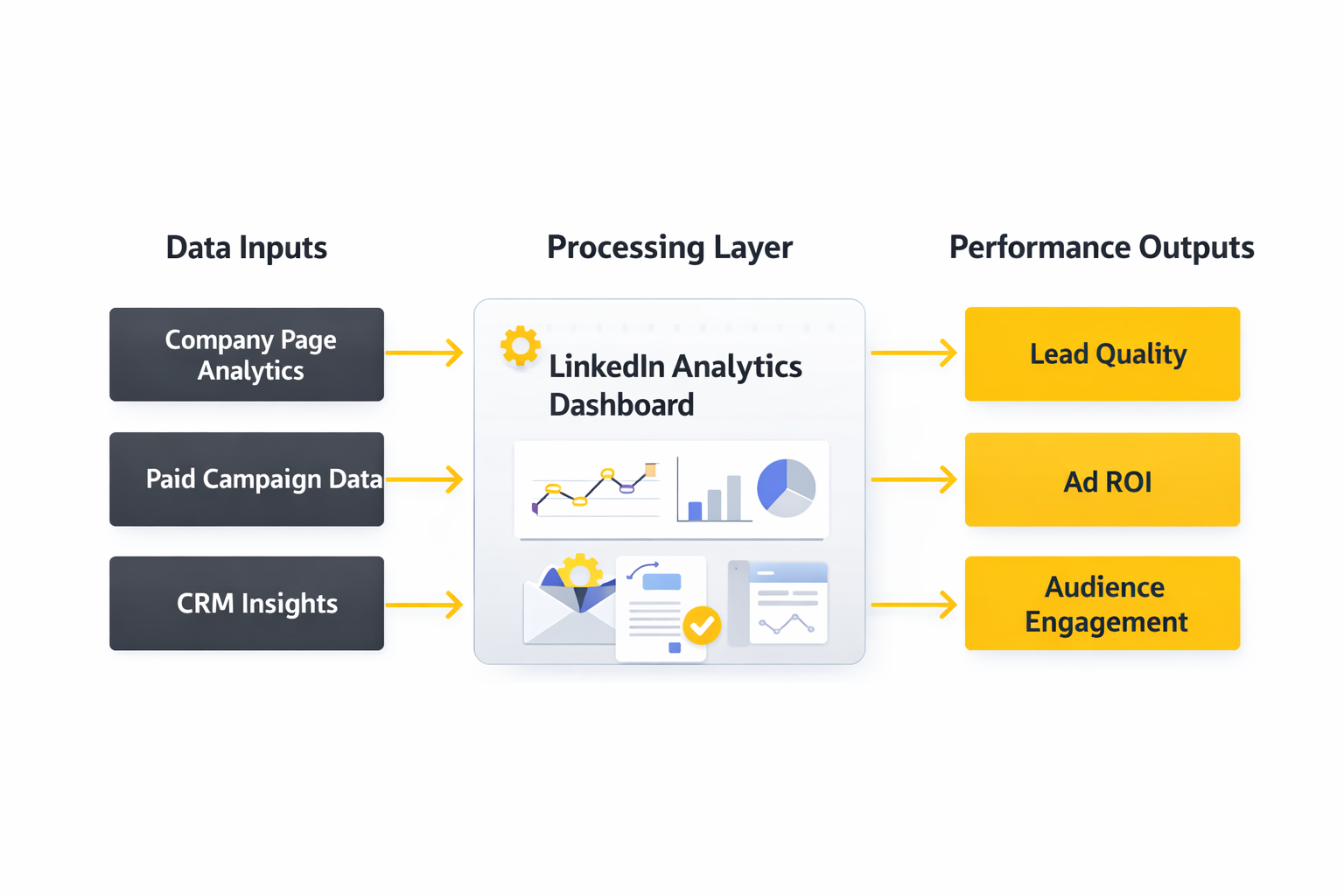
If you want to get serious about LinkedIn marketing, you have to stop treating numbers like decoration. Data is not there to make reports look impressive. It is there to tell you whether your message is reaching the right people, whether your content is building trust, and whether your effort is creating commercial momentum instead of just giving you a few nice-looking screenshots to celebrate.
The first thing worth noticing is that the platform still holds real weight inside B2B marketing. Content Marketing Institute’s 2025 benchmark research shows that 85% of B2B marketers say LinkedIn delivers the best value of any social media platform they use. That number matters because it does not just say LinkedIn is popular. It says marketers who are under pressure to defend budgets still see it as the strongest social environment for business outcomes.
The business behind the platform is still moving, too. Microsoft reported that LinkedIn revenue grew 9% year over year in fiscal Q2 2025, with growth across Marketing Solutions, Talent Solutions, Premium Subscriptions, and Sales Solutions. That does not guarantee your campaigns will work, but it does tell you the ecosystem is active, commercial, and far from stagnant.
What The Benchmark Data Really Shows
One of the biggest mistakes in LinkedIn marketing is looking for a single magic benchmark and then judging everything against it. Real performance depends on audience quality, brand strength, offer maturity, format choice, and how much trust you have already built. That said, benchmark data is still useful because it tells you what kind of behavior the platform is rewarding right now.
Socialinsider’s 2025 LinkedIn benchmark study, built on 1 million posts published over 2024, found that multi-image posts averaged a 6.60% engagement rate by impressions, native documents averaged 5.85%, videos averaged 5.60%, and polls generated the highest average impression count. That is a genuinely useful pattern. It suggests that people are still rewarding posts that either teach visually, package insight in a swipeable way, or invite lightweight participation.
At the same time, the same benchmark report notes that LinkedIn engagement declined 8.3% in the first half of 2025. That is exactly why raw engagement totals can mislead you. If the platform gets more competitive and average interaction rates soften, a post that looks weaker on the surface may still be doing a strong job relative to market conditions, especially if it is attracting the right buyers rather than broad passive attention.
How To Read LinkedIn Marketing Data Correctly
The smartest way to read LinkedIn marketing data is to separate signal from vanity. Impressions can be useful because they show distribution. Reactions can be useful because they suggest lightweight approval. But neither one means much on its own if you do not know who saw the content, whether the right people engaged, and what happened after that first interaction.
This is where platform mechanics matter. LinkedIn’s reporting documentation explains that performance metrics for campaigns, creatives, and spend are near real-time, while professional demographic reporting can lag by 12 to 24 hours and is presented as approximate to protect member privacy. That is a very practical reminder that the dashboard is useful, but not magical. If you check too early or treat demographic slices as perfectly precise, you can make bad decisions with a false sense of confidence.
So when you evaluate LinkedIn marketing, ask harder questions. Did the post increase profile visits from relevant job titles? Did the campaign reach the right company sizes or functions? Did the content create repeat exposure that later turned into demo requests, newsletter signups, booked calls, or branded search lift? Those questions take more discipline, but they lead to better decisions than obsessing over surface-level applause.
Which Numbers Actually Deserve Attention
Not every number deserves equal respect. For organic LinkedIn marketing, the metrics that usually matter most are qualified impressions, saves, comments from relevant people, profile visits, follower growth among the right audience, click-throughs to deeper assets, and downstream conversions that start with content. Those signals tell you whether you are attracting business attention, not just social attention.
For paid programs, the picture gets a little more technical. LinkedIn’s marketing platform documentation describes a system designed to reach, engage, and convert professional audiences at scale, and the data model supports campaign performance analysis, lead handling, audience targeting, and attribution-related workflows. That means your metrics should reflect the objective of the campaign itself. A thought-leadership promotion should not be judged like a bottom-funnel lead capture ad, and a retargeting campaign should not be judged like broad awareness activity.
There is also a strong case for watching format-level performance instead of only campaign-level totals. Content Marketing Institute’s 2025 research shows that video was rated the most effective B2B content type by 58% of marketers, while 92% use short articles or posts, 76% use video, and 75% use case studies or customer stories. That matters because LinkedIn marketing often improves when you stop asking, “Did content work?” and start asking, “Which format moved this audience one step closer to trust?”
What Good LinkedIn Marketing Data Looks Like
Good data usually tells a layered story, not a one-line story. First, visibility increases among the right people. Then engagement quality improves because more of the interaction comes from decision-makers, practitioners, and likely buyers rather than random spectators. After that, you start seeing stronger mid-funnel behavior such as profile visits, form fills, newsletter subscriptions, webinar attendance, or replies from prospects who already understand what you stand for.
That progression matters because modern B2B buying is messy. Edelman and LinkedIn’s 2025 thought leadership report highlights that more than 40% of B2B deals stall because of internal misalignment within buying groups. In other words, one visible champion is rarely enough. Your LinkedIn marketing data gets more valuable when it helps you see whether your message is spreading across multiple relevant stakeholders instead of landing on a single contact and dying there.
This is also why content influence should matter in your analysis. If a campaign does not produce instant conversions but it repeatedly brings high-fit people into your ecosystem, that is still valuable. The job of data is not just to confirm final revenue after the fact. It is to show whether your system is creating the conditions that make revenue more likely later.
Connecting LinkedIn Data To Revenue
The real test of LinkedIn marketing is whether the numbers connect to pipeline, not whether they look busy on a dashboard. That does not mean every post needs to create immediate revenue. It means the data should help you understand how awareness, trust, retargeting, lead capture, and sales follow-up work together over time.
LinkedIn’s Matched Audiences documentation and its website retargeting guidance make that connection easier to understand. By using the Insight Tag, advertisers can match website visitors to LinkedIn members and continue the conversation with more refined professional targeting. That means LinkedIn marketing does not have to live in a silo. It can become part of a broader system where organic content creates familiarity, paid campaigns reinforce the strongest ideas, and retargeting helps move interested people back into a meaningful buying journey.
Once you measure the channel this way, the platform starts making much more sense. A post can start the relationship. A document or video can deepen authority. A retargeting sequence can keep the brand visible. A lead form or landing page can capture intent. And the data can show you whether those steps are working together or whether one weak link is wasting the attention you worked so hard to earn.
The Smart Way To Use Statistics Without Getting Lost
The final lesson is simple: statistics are useful servants and terrible masters. They help you spot patterns, compare formats, validate shifts in audience behavior, and make better bets. But if you let them replace judgment, you end up optimizing for whatever is easiest to count rather than what actually grows the business.
That is why the best LinkedIn marketing teams use data as a decision tool, not a confidence costume. They look at platform benchmarks to understand the landscape, but they keep coming back to the same hard questions. Are we reaching the people who matter? Are we giving them a reason to trust us? And are our numbers moving in a way that makes future revenue more likely?
When you can answer yes to those questions, the data starts doing what it is supposed to do. It stops being random trivia, and it becomes proof that your LinkedIn marketing is building something that compounds.
Analytics And Optimization
Once your LinkedIn marketing system is live, the next job is not to publish more just for the sake of activity. The real job is to learn faster than the market changes. That means watching how people respond, identifying which ideas create movement with the right buyers, and then tightening the system so each month of effort performs better than the last one.
This is where a lot of brands lose momentum. They either keep repeating what feels comfortable, or they chase every small fluctuation like it is a life-or-death signal. Smart optimization sits in the middle. It respects the data, but it also understands that LinkedIn marketing is usually compounding trust over time, not producing instant miracles every single week.
Optimize For Memory, Not Just Immediate Clicks
The first shift is mental. If your entire optimization model is built around immediate lead capture, you will almost certainly misread the platform. The Ehrenberg-Bass explanation of the 95:5 rule shows why most B2B buyers are not in-market at a given moment, which means much of the value created by LinkedIn marketing comes from building memory, familiarity, and preference before the buying window opens.
That matters because the channel can look unproductive to impatient teams even when it is doing exactly what it should do. A post may not create a form fill today, but it can make your brand easier to trust when the same buyer enters the market later. Optimization, then, is not only about squeezing harder on short-term conversion points. It is also about making sure your message is memorable enough to survive the delay between attention and purchase.
That is one reason the platform still earns serious B2B attention. Microsoft’s fiscal Q2 2025 results showed LinkedIn revenue up 9% year over year, driven by growth across Marketing Solutions, Talent Solutions, Premium Subscriptions, and Sales Solutions. The ecosystem is not being funded because marketers enjoy posting updates. It is being funded because businesses keep finding commercial value in staying visible where professional decisions are shaped.
Use The Right Levers When You Optimize
Good optimization starts by knowing which levers actually move performance. Content Marketing Institute’s 2026 B2B research found that effective teams most often credited content relevance and quality at 65%, team skills and capabilities at 53%, alignment with sales at 45%, customer understanding and segmentation at 40%, measurement and reporting at 40%, and channel selection and optimization at 36%. That mix tells you something important. Better results do not usually come from one trick. They come from making the system sharper in several connected places.
So when your LinkedIn marketing underperforms, do not jump straight to blaming the algorithm. Look at the fundamentals first. Is the content actually relevant to the audience you want? Is the team good enough to turn expertise into clear, persuasive assets? Are marketing and sales aligned on what a qualified conversation looks like? Are you even distributing your strongest ideas in the channels and formats that match how your buyers pay attention?
Those questions are less exciting than chasing hacks, but they produce stronger answers. Optimization is often just disciplined honesty. You remove vague positioning, tighten the message, improve the offer, refine the audience, and keep doing that until the platform starts reflecting clearer strategic choices.
Improve Audience Quality With Better Segmentation
One of the fastest ways to improve LinkedIn marketing is to stop talking to “everyone relevant” and start segmenting more precisely. The platform performs better when your message is built for a specific slice of the market, not a broad professional crowd that shares very little besides a job title. A founder, a procurement lead, a department head, and an operator may all touch the same buying process, but they need different angles, different proof, and different reasons to care.
This becomes even more important when hidden buyers are involved. Edelman and LinkedIn’s 2025 report explains that more than 40% of B2B deals stall because of internal misalignment within buying groups. In plain English, your LinkedIn marketing can look solid with a visible champion and still fail if finance, legal, operations, or other internal stakeholders are unconvinced. Smarter segmentation helps you build content and campaigns that influence more than the loudest person in the room.
That is also where professional targeting tools start to matter. LinkedIn’s Matched Audiences documentation covers account targeting, contact targeting, and website retargeting, which makes it possible to align your organic and paid efforts around specific companies, known contacts, and people who have already shown interest. The better your segmentation becomes, the less your campaigns feel like public broadcasting and the more they feel like a guided buying journey.
Tighten The Journey Between Content And Conversion
A lot of LinkedIn marketing breaks down in the gap between interest and action. The content does its job, but the next step is unclear, badly timed, or too aggressive for the stage of awareness the buyer is actually in. That is why optimization has to look beyond posts and ads and examine the entire path into your ecosystem.
LinkedIn’s website retargeting guidance explains that the Insight Tag lets advertisers match website visitors to LinkedIn members and continue engaging them with more refined professional targeting. That matters because warm audiences behave differently from cold ones. Someone who has already read your content, visited your site, or watched a meaningful percentage of a video is telling you something. Optimization means responding to that signal with a next step that feels relevant instead of starting the conversation from zero every time.
The same principle applies to engagement retargeting. LinkedIn also supports retargeting based on interactions such as company page visits or video views, which gives you another way to build sequences around real behavior. Strong LinkedIn marketing gets much more efficient when you stop treating every audience as equally cold and start building specific follow-ups for specific levels of intent.
Align Content Testing With Business Goals
Testing matters, but only when you test the right things. A lot of teams run shallow experiments that produce neat little observations with no strategic value. They compare two headlines, declare a winner, and miss the bigger issue, which is whether the underlying message, proof, and audience fit are strong enough to deserve scale in the first place.
A better approach is to test at three levels. First, test market angle: which problem framing earns the strongest response from the right people. Second, test format: whether a short post, document, video, or executive viewpoint creates deeper engagement for that idea. Third, test conversion path: which next step best matches the maturity of the audience being targeted. That makes optimization more useful because it improves the whole LinkedIn marketing system instead of polishing a weak asset.
The broader B2B market is leaning into this kind of structured improvement. CMI’s 2026 report found that 25% of B2B marketers plan to increase paid media investment, 24% plan to increase content personalization, 21% plan to increase martech infrastructure and analytics, and 20% plan to increase social or earned media investment. That mix makes sense. Better optimization usually comes from tighter feedback loops between creative, targeting, personalization, and measurement rather than from one isolated tactic.
Keep The System Human As You Scale
The last piece of optimization is the easiest to overlook and the most damaging to lose: humanity. LinkedIn marketing can become highly systemized without becoming robotic, but only if you protect the voice, judgment, and perspective that made people pay attention in the first place. The moment the content starts sounding like it was generated to satisfy a workflow rather than help a real buyer think more clearly, the channel gets weaker.
This is one of the clearest lessons from recent B2B research. CMI’s 2026 findings emphasize that better results still come more from people and capabilities than from tools alone. In other words, optimization is not just a technical exercise. It is a strategic and editorial one. You scale what is working, but you keep enough human conviction in the system that the market continues to feel a real point of view behind the brand.
When that balance is right, LinkedIn marketing becomes a serious compounding asset. You learn which messages stick. You improve how they reach the right people. You shorten the path from curiosity to conversation. And you do it without flattening the brand into generic, forgettable business content. That is what real optimization looks like when it is done well.
LinkedIn Marketing Ecosystem And FAQ

At the highest level, LinkedIn marketing works best when you stop thinking about it as one channel and start treating it like an ecosystem. Your company page, executive profiles, employee advocacy, organic posts, newsletters, paid campaigns, retargeting, lead capture, CRM follow-up, and sales conversations all influence each other. When those pieces are disconnected, the platform feels inconsistent. When they work together, LinkedIn becomes one of the strongest places to build memory, trust, and qualified demand in B2B.
That ecosystem matters because most of your future buyers are not ready to act today. The 95:5 rule tied to Ehrenberg-Bass thinking explains why only about 5% of B2B buyers are in-market at a given time, which is exactly why LinkedIn marketing needs to do more than chase immediate clicks. It has to keep your brand visible, useful, and credible for the far larger group that will buy later.
The platform is built for that kind of long game. Content Marketing Institute’s 2025 benchmark research found that 85% of B2B marketers see LinkedIn as the social platform delivering the best value, while Microsoft reported LinkedIn revenue grew 9% year over year in fiscal Q2 2025. In other words, the ecosystem is not shrinking, and serious businesses are still investing in it because it keeps influencing real commercial decisions.
That influence is not limited to the obvious buyer, either. Edelman and LinkedIn’s 2025 thought leadership research makes the point that hidden buyers inside legal, finance, operations, and procurement can shape vendor decisions behind the scenes, and more than 40% of B2B deals stall because of internal misalignment. That is why the best LinkedIn marketing systems are built to influence groups, not just individuals.
FAQ For A Complete Guide
What Is LinkedIn Marketing?
LinkedIn marketing is the process of using LinkedIn’s professional network to build awareness, credibility, relationships, leads, and revenue. That can include organic posts, company page content, newsletters, thought leadership, employee advocacy, paid campaigns, retargeting, lead forms, and CRM-connected follow-up. It works especially well in B2B because the audience arrives with a business mindset instead of an entertainment mindset.
Why Is LinkedIn Marketing So Important For B2B?
It matters because the platform sits close to professional decision-making. The 2025 CMI benchmark study showing 85% of B2B marketers rate LinkedIn as the most valuable social platform is a strong signal that it consistently outperforms alternatives for business use. LinkedIn is where buyers research expertise, evaluate credibility, and notice who keeps showing up with useful thinking.
How Long Does LinkedIn Marketing Take To Work?
It depends on what you mean by work. If you want stronger reach, profile visits, and engagement from relevant people, you can often see movement within weeks. If you want the platform to influence larger deals, the timeline is usually longer because most B2B buyers are not in-market right now. In practice, LinkedIn marketing rewards consistency more than short bursts of effort.
Should I Focus On A Personal Profile Or A Company Page?
The strongest answer is usually both, but not in the same way. Personal profiles often create faster trust because people respond to people more naturally than to logos. Company pages still matter because LinkedIn’s official documentation describes the Company Page as the core organizational entity for organic and sponsored activity. The profile often opens the relationship, and the page helps validate the brand behind it.
What Content Works Best On LinkedIn?
The content that works best is the content that gives professionals a useful reason to stop, think, and remember you. Format still matters, though. Socialinsider’s 2025 benchmark study based on 1 million posts found that multi-image posts, native documents, and video all performed strongly for engagement, while polls generated the highest average impression count. The real lesson is not to copy a format blindly, but to choose the format that best matches the idea and the audience’s stage of awareness.
Is Organic LinkedIn Marketing Enough?
Organic content can do a lot of heavy lifting, especially when you are building authority, testing positioning, and learning which ideas resonate. But organic alone is not always enough if you need faster reach into strategic accounts or warmer retargeting around engaged visitors. CMI found that 84% of B2B marketers use paid channels and 73% use social media advertising or promoted posts, which shows how common it has become to combine organic proof with paid amplification.
How Do LinkedIn Lead Forms Work?
LinkedIn Lead Gen Forms let a member submit their information without leaving the platform, which reduces friction when interest is already there. The bigger advantage is operational. LinkedIn’s Lead Sync documentation explains that lead data captured through Lead Gen Forms can be synced into CRMs and other systems, and the official use-case guide explains that LinkedIn Lead Sync is built to move high-quality leads into marketing automation platforms, CRMs, or CDPs. That makes follow-up faster and reduces the chance that strong interest dies in a spreadsheet somewhere.
What Is The LinkedIn Insight Tag?
The Insight Tag is LinkedIn’s website tracking mechanism for advertisers. It helps connect on-site behavior with LinkedIn campaign activity so you can measure conversions and build retargeting audiences. LinkedIn’s official website retargeting documentation says the Insight Tag lets advertisers match website visitors to LinkedIn members and use that behavior for refined targeting. That is a major part of turning LinkedIn marketing into a full-funnel system rather than a content-only channel.
How Should I Measure LinkedIn Marketing?
You should measure it in layers. Start with visibility among the right audience, then engagement quality, then movement into deeper actions like profile visits, site visits, lead captures, booked calls, or pipeline influence. LinkedIn’s reporting documentation explains that campaign and creative performance metrics are near real-time, while professional demographic metrics can lag by 12 to 24 hours and are approximate for privacy reasons. That means measurement matters, but interpretation matters just as much.
Can LinkedIn Marketing Work For Small Businesses Or Consultants?
Yes, and in many cases it works especially well because smaller brands can sound more direct, more human, and more opinionated than large companies that get trapped in corporate language. A consultant with a sharp niche can often build trust quickly by consistently publishing useful perspective around a very specific problem. The key is not pretending to be bigger than you are. The key is becoming easier to remember than competitors who sound interchangeable.
How Often Should I Post On LinkedIn?
There is no single perfect posting frequency that guarantees results. What matters more is whether you can keep quality high and stay strategically consistent. One strong, specific, useful post each week will usually do more for your LinkedIn marketing than daily filler content that teaches the market nothing. The right cadence is the one you can sustain while still sounding thoughtful, credible, and genuinely helpful.
What Is The Biggest Mistake In LinkedIn Marketing?
The biggest mistake is treating the platform like a random stream of updates instead of a trust-building system. That usually leads to generic messaging, weak positioning, inconsistent publishing, and poor follow-up. Another major mistake is ignoring hidden buyers. The 2025 Edelman-LinkedIn report shows that internal misalignment stalls more than 40% of deals, which means content aimed only at one visible contact often leaves too much influence untouched.
Does Thought Leadership Really Help Conversions?
Yes, but usually in an indirect and compounding way. Good thought leadership makes outreach warmer, meetings easier, objections lighter, and your brand more defensible in a shortlist. Edelman and LinkedIn’s 2025 research shows that high-quality thought leadership influences hidden buyers and can meaningfully shape purchase preference. That is why smart LinkedIn marketing does not separate brand and demand as if they have nothing to do with each other.
Work With Professionals
If you want LinkedIn marketing to become a serious growth channel, the smartest move is often to get help from people who already understand positioning, content systems, paid distribution, retargeting, CRM follow-up, and reporting. The platform looks simple from the outside, but the difference between random activity and a real pipeline engine usually comes down to expertise, consistency, and execution quality.
That is even more true when you need LinkedIn marketing to support a broader commercial system. The strongest setups connect organic authority, executive visibility, retargeting, lead capture, and sales enablement into one coordinated motion. Once those pieces start working together, the channel becomes much more predictable and much more valuable.
Explore 10K+ Remote Marketing Contracts On MarkeWork.com
Most marketers spend too much time chasing clients, competing on crowded platforms, and losing a percentage of every project to middlemen.
MarkeWork gives you a better way. Browse thousands of remote marketing contracts and connect directly with companies desperate to hire skilled marketers like you without platform commissions and without unnecessary gatekeepers.
If you’re serious about finding better opportunities and keeping 100% of what you earn, you can explore available contracts and create your profile for free at MarkeWork.com.
 Filip Konecny Enterprises