
Google digital marketing matters because it sits at the point where intent, discovery, measurement, and conversion meet. Marketers are not dealing with a single channel here; they are working inside an ecosystem that includes Search, YouTube, Maps, Shopping, analytics, local discovery, and AI-powered campaign systems that now influence how people move from curiosity to purchase. That is exactly why the topic deserves a framework instead of a random checklist.
The scale alone explains why businesses keep investing here. Alphabet’s 2025 annual report shows Google Search & other revenue at $224.5 billion, YouTube ads at $40.4 billion, and total Google advertising revenue at $294.7 billion, which tells you this is not a side channel in modern marketing. It is one of the clearest signals of where attention, commercial intent, and advertiser demand continue to concentrate.
What makes the landscape more interesting in 2026 is that Google is no longer just a place where people type a keyword and click a blue link. Google’s own product updates around Ads in AI Overviews and other 2025 Google Ads launches, combined with research from Google and BCG on streaming, scrolling, searching, and shopping behaviors, show that customer journeys are now blended across formats and surfaces. So if you want results from Google digital marketing, you need a system that connects visibility, creative, targeting, data quality, and measurement instead of treating each tool like a separate project.
Article Outline
- Part 1: Why Google Digital Marketing Matters
- Part 2: Framework Overview
- Part 3: Core Components
- Part 4: Professional Implementation
- Part 5: Analytics And Optimization
- Part 6: Ecosystem Trends And FAQ
Why Google Digital Marketing Matters
Google digital marketing matters because it captures people at different moments of awareness, not just at the bottom of the funnel. A person may discover a brand through YouTube, compare options in Search, check credibility in Maps, review products through Merchant Center surfaces, and return later through remarketing or branded search. When marketers understand that sequence, they stop building isolated campaigns and start building momentum.
Google’s own business materials make that breadth clear. The main Google Ads overview positions Performance Max as a way to reach customers across Search, Display, YouTube, Shopping, and more from a single campaign, while Merchant Center documentation shows that eligible products can appear for free across Search, Maps, YouTube, Images, Lens, the Shopping tab, and Gemini. That combination of paid reach and free visibility is why strong operators treat Google as a connected growth environment rather than an ads dashboard.
There is also a behavior shift marketers cannot afford to ignore. The latest Google Search innovation research shows that newer search behaviors are being shaped by visual and AI-assisted discovery, and the current YouTube press data says YouTube Shorts is averaging more than 200 billion daily views. In plain English, Google digital marketing now rewards brands that can show up across text, video, product feeds, local presence, and measurement at the same time.
Framework Overview
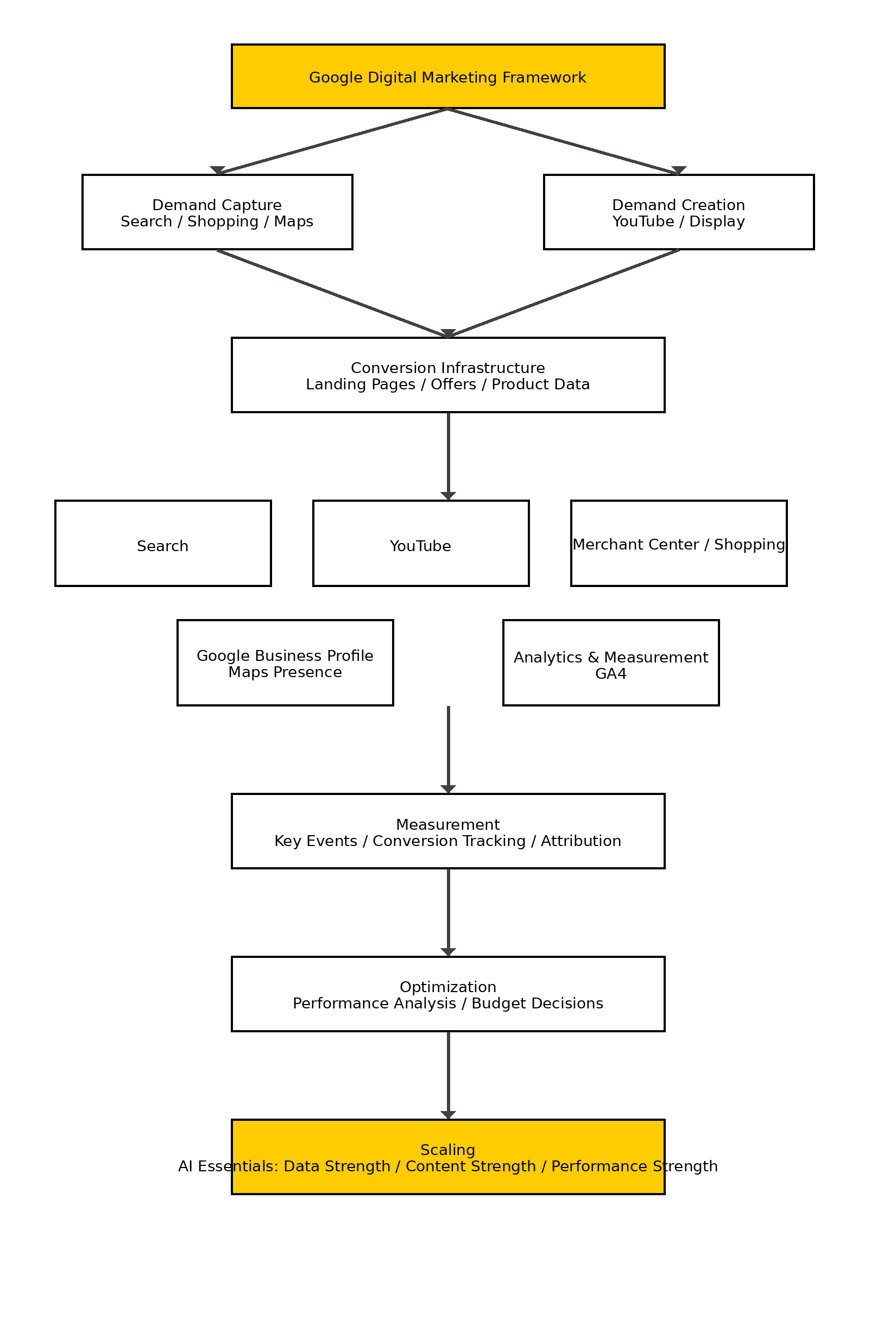
The cleanest way to think about Google digital marketing is as a five-layer framework: demand capture, demand creation, conversion infrastructure, measurement, and optimization. Demand capture covers Search, Shopping, Maps, and branded discovery when people already show intent. Demand creation covers YouTube, Display, and broader campaign types that create awareness before the prospect is ready to buy.
The next layer is conversion infrastructure, and this is where many businesses quietly lose money. Google’s current AI Essentials guidance puts data strength, content strength, performance strength, and agentic capabilities at the center of better outcomes, which is another way of saying that weak tracking, thin creative, and poor landing pages limit campaign performance no matter how much budget you spend. A polished framework makes sure the website, product feed, conversion actions, audience inputs, and messaging are all strong before scale enters the picture.
Measurement then ties the whole model together. Since Universal Analytics stopped processing standard-property data in July 2023 and Google continues to release new features in Google Analytics, businesses that still think in old reporting habits are already behind. The modern framework for Google digital marketing is not just about traffic generation; it is about building a reliable decision engine that can tell you which channels, audiences, queries, and creative assets are driving actual business value.
Core Components
The core components of Google digital marketing start with Search because intent still pays the bills. Search campaigns help brands show up when prospects are actively looking for a solution, while Google Search Console helps improve organic visibility and diagnose how a site appears in Google Search. Paid search and SEO are often discussed separately, but professionally they work best when they inform each other.
The second major component is YouTube and visual discovery. Video has become a practical performance channel as well as a branding channel, and Google’s own ecosystem increasingly connects video behavior with later search behavior, remarketing opportunities, and broader cross-surface campaigns. That makes YouTube valuable not just for storytelling, but for warming cold audiences before they become high-intent searchers.
The third component is presence across commerce and local surfaces. Google Business Profile helps businesses turn visibility on Search and Maps into calls, visits, and inquiries, while Merchant Center gives retailers a direct route into Google’s shopping-related surfaces. Add Display, audience strategies, and first-party data, and you begin to see why Google digital marketing is not one tactic at all, but a stack of interconnected assets that support each other.
Professional Implementation
Professional implementation begins with priorities, not platform excitement. Before launching anything, a serious team defines the commercial goal, the conversion event, the offer, the audience signal, and the reporting logic that will decide whether the campaign is working. That discipline sounds simple, but it is what separates businesses that are learning from the account from businesses that are just paying for activity.
From there, implementation becomes an exercise in alignment. The campaign type has to match the buying stage, the landing page has to match the promise in the ad, the tracking has to reflect real business outcomes, and the creative has to reflect how people actually discover brands today across Search, Shopping, Maps, and video. Google’s own materials on campaign selection and AI readiness keep pointing back to the same truth: stronger inputs create stronger outputs.
That is why good Google digital marketing is usually less flashy than people expect. It is not about chasing every new feature the second it appears, even though new releases in ads and analytics do matter. It is about building a stable operating system for growth so that when you do add new campaign types, AI features, or measurement upgrades, they improve a sound strategy instead of compensating for a broken one.
The Visibility Layer
The first layer is visibility, and this is where your business earns the right to be considered at all. In Google digital marketing, visibility means showing up where the prospect is already looking, whether that happens in classic Search, local discovery, product surfaces, or video-driven discovery that later leads to a branded query. It is the layer where strong positioning beats wishful thinking.
This is also the point where many businesses discover that visibility is broader than rankings or ad impressions. Search Console is built to show queries, clicks, impressions, and indexing health, while Business Profile performance reporting shows how people find and interact with a business on Search and Maps. When those signals are reviewed together instead of in isolation, you begin to understand where your brand is winning attention and where it is still invisible.
That is why the visibility layer should always be treated as a portfolio, not a single tactic. Organic search, paid search, local optimization, video presence, and product data feeds all strengthen each other when they are aligned around the same categories, same buyer questions, and same commercial intent. The businesses that dominate Google digital marketing are usually not the ones doing one thing perfectly; they are the ones showing up in multiple meaningful places at the same time.

The Persuasion Layer
Visibility alone does not produce growth. Once people find you, Google digital marketing has to persuade them that your brand is credible, relevant, and worth a click right now. That persuasion happens through ad copy, product titles, offer structure, review signals, video hooks, page experience, and the promise you make before the user ever lands on your site.
This is where weak strategy gets exposed fast. A business can show up in search results all day long, but if the message is generic, if the landing page does not continue the conversation, or if the offer feels vague, the click either never happens or it does not turn into value. Google keeps reinforcing this in its own materials, and the current AI Essentials framework is basically a reminder that better inputs, better creative, and better performance signals create better outcomes.
In real terms, the persuasion layer asks one simple question: when a prospect sees your brand inside Google’s ecosystem, do they feel pulled forward or do they keep scrolling. That is why this layer cannot be reduced to writing a few ads and hoping for the best. Strong Google digital marketing makes the next step feel obvious, natural, and low-friction.
The Conversion Layer
The third layer is conversion, and this is where attention either becomes business or quietly disappears. A lot of companies blame Google when campaigns underperform, but the real problem often sits on the other side of the click in the form of a weak offer, slow page, confusing form, poor mobile experience, or no clear path to action. Traffic is only valuable if the destination deserves it.
This is also the layer where strategic discipline matters the most. Search intent should land on pages built for that exact intent, local discovery should connect to calls or directions without friction, and shopping traffic should land on product experiences that remove doubt instead of adding more choices and more confusion. When the handoff is clean, Google digital marketing becomes easier to optimize because the system has clearer feedback on what success actually looks like.
That is one reason Google has been pushing marketers toward cleaner event-based measurement and stronger conversion setup. GA4 key event and conversion guidance reflects the broader shift toward measuring real actions across channels instead of obsessing over surface-level traffic numbers. In other words, the conversion layer is where marketing stops being about attention and starts being about economics.
The Measurement Layer
The final layer is measurement, and this is the one that decides whether your framework improves over time or drifts into guesswork. Good Google digital marketing requires a measurement system that can connect discovery, engagement, and conversion across multiple touchpoints without pretending the customer journey was simpler than it really was. If your reporting only rewards the last click, you will misread what is actually creating demand.
That is why modern measurement has become far more central to performance than it used to be. Google’s updates around more unified measurement across Ads and Analytics, together with the expanded reporting highlighted in Google Ads’ 2025 product highlights, point in the same direction: marketers need clearer visibility into how channels, formats, and conversion paths work together. The era of managing Google like a pile of disconnected reports is fading fast.
When measurement is set up correctly, the whole framework becomes more powerful. You can see which search themes are driving qualified demand, which creative assets are supporting the journey, which locations or products deserve more budget, and where friction is killing otherwise good traffic. That is the point of the framework: not to make Google digital marketing feel more complicated, but to make it more understandable, more controllable, and a lot more profitable.
Search And Intent Capture
Search remains the backbone of Google digital marketing because it lets you show up when someone is already trying to solve a problem. That is powerful for a simple reason: the person typing that query is raising their hand and telling you what they want right now. Few marketing channels give you that kind of direct signal, which is why Search still deserves serious respect even as the broader platform evolves.
But effective intent capture is about much more than bidding on a few obvious keywords. Search Console gives businesses a direct view into impressions, clicks, and the queries that are already bringing people to the site, while Google’s AI Max for Search announcement shows how Google is pushing Search campaigns toward broader AI-assisted targeting and creative flexibility. That means the real advantage now comes from understanding buyer language, organizing landing pages around commercial intent, and feeding the system clearer signals instead of trying to micromanage every tiny variable.
When businesses treat Search as a listening tool as well as an acquisition channel, their entire strategy gets sharper. They start to see which questions signal research, which queries signal urgency, and which branded searches reveal growing trust. That is where Google digital marketing stops being about traffic and starts becoming a real map of market demand.
YouTube And Demand Creation
The second core component is YouTube, and this is where many marketers still underestimate Google digital marketing. Search captures existing intent, but YouTube helps create the future searches that matter. A person sees an idea, a solution, a review, or a demonstration on video, and later that same person comes back through Google with a much clearer sense of what they want.
This is not a side note in the Google ecosystem anymore. YouTube’s current press page says Shorts is averaging more than 200 billion daily views, and that YouTube has been the number one platform in U.S. streaming watch time for nearly three years as of January 2026. Those numbers matter because they show how video is shaping awareness at massive scale, which makes YouTube one of the most important demand-creation layers inside Google digital marketing.
What makes YouTube especially useful is that it is not limited to one type of business goal. Brands can use it for product education, trust building, remarketing support, or category expansion before a prospect is ready to buy. When video is treated as part of a wider Google strategy rather than as a separate branding experiment, it strengthens the entire path from discovery to search to conversion.
Merchant Center And Shopping Surfaces
For product-driven businesses, Merchant Center is one of the most practical components in the entire stack. It connects product data to Google’s commercial surfaces and helps your inventory show up where people are already comparing options. That matters because a lot of buying decisions are shaped not by a clever slogan, but by whether the right product appears with the right information at the right moment.
The official free listings documentation makes the reach of this component very clear: eligible products can appear across Google Search, Maps, Gemini, YouTube, the Shopping tab, Images, and Lens. On top of that, Merchant Center Next continues to expand with simpler workflows, richer insights, and AI-supported tools, which tells you Google is investing heavily in making product visibility easier to manage and more central to performance. So when ecommerce brands ignore feed quality, pricing accuracy, titles, images, and availability signals, they are not just making a minor mistake; they are weakening one of the strongest parts of their Google digital marketing engine.
The deeper point here is that product data is not just administrative work. It is marketing infrastructure. Great creative can help, but if the product information is weak, incomplete, or out of sync with the site, the whole system becomes harder to trust and harder to optimize.
Local Presence And Business Profile
Local presence is another core component that businesses often underestimate until they see how much buyer action happens close to the point of decision. For many service businesses, restaurants, clinics, retailers, and regional companies, Google digital marketing is not only about website visits. It is also about calls, map actions, direction requests, review trust, and whether someone chooses your business over the other one two streets away.
Google Business Profile lets a business manage how it appears on Search and Maps at no charge, and Business Profile performance reporting is built to show how people discover a profile and what they do once they find it. That makes local presence far more measurable than many people assume. It is not just a digital directory listing; it is an active visibility and conversion asset inside the wider Google environment.
When local optimization is handled seriously, it creates an advantage that is difficult for weaker competitors to copy quickly. Accurate business information, strong reviews, complete service details, helpful imagery, and clear category alignment all improve how easily a customer can choose you. That is why local presence deserves a place among the core components of Google digital marketing instead of being treated like an afterthought.
Measurement And Conversion Architecture
The last core component is measurement, because without it the rest of the system becomes guesswork dressed up as marketing. Google digital marketing now relies heavily on AI-assisted optimization, and that means the platform performs better when the conversion setup, event logic, and business signals are clean. If you feed the system weak signals, it learns the wrong lessons and scales the wrong behavior.
Google Analytics guidance on key events explains how important actions can be marked and evaluated across channels, while its conversion documentation shows how those key events can be turned into shared conversions for campaign measurement and optimization. Google reinforces the same idea inside data strength best practices, where connected data sources and robust tagging are framed as essential to measurement accuracy and ROI resilience. Put simply, if measurement is weak, the account may look busy, but the decisions coming out of it will be less trustworthy.
This is why mature operators do not obsess only over clicks and impressions. They care about whether the tracking reflects real business outcomes, whether lead quality is visible, whether landing pages match the traffic source, and whether reporting can show what is truly driving profit. Once that architecture is in place, Google digital marketing becomes far easier to improve because you are working with reality instead of assumptions.
Statistics And Data
If you want to understand where Google digital marketing is heading, the numbers tell the story fast. They show where attention is gathering, where advertisers are still spending aggressively, and where Google is expanding the places brands can appear. That matters because strategy gets much easier when you stop guessing and start reading what the platform itself is signaling.
The revenue picture alone makes the case. Alphabet’s fiscal 2025 results show Google Search & other revenue at $224.5 billion, YouTube advertising revenue at $40.4 billion, and total Google advertising revenue at $294.7 billion. Those are not the numbers of a fading ecosystem. They are the numbers of a platform that still sits very close to the center of commercial intent on the internet.
That financial strength also explains why Google keeps shipping new advertising formats and AI-led updates at such a rapid pace. The official Google Ads highlights for 2025 make it clear that the company is leaning hard into automation, broader inventory access, and more integrated campaign experiences. When a platform of this size is still evolving that aggressively, marketers should pay attention.
Search And Advertising Scale
Search still deserves to be treated as the anchor of Google digital marketing because it reflects intent at the exact moment people are trying to solve something. That is what makes the scale of Search revenue so important. It is not just a giant number on an earnings release; it is evidence that businesses across categories still believe Google can connect them with buyers who are ready to act.
The same earnings materials also show how broad that commercial engine has become. In the 2025 Q4 earnings call, Alphabet said YouTube’s annual revenue surpassed $60 billion across ads and subscriptions, which matters because it shows how tightly brand discovery and performance marketing now live side by side inside the same ecosystem. So when you think about Google digital marketing, it makes far more sense to think in systems than in channels.
This is also why weak execution becomes expensive so quickly. If the world’s largest advertisers are still pouring money into this environment, it means competition is real, sophistication is rising, and average work gets punished. The data does not just confirm opportunity. It also raises the standard.
AI Search Behavior And New Inventory
One of the biggest changes in Google digital marketing is that search is no longer limited to a simple results page with a few ads around it. Google has been opening new ad opportunities around AI-assisted search experiences, and that changes how brands can appear during earlier, more exploratory moments. In practical terms, advertisers are being given a path into questions that used to sit further away from a direct click.
Google’s help page for ads and AI Overviews states that ads are eligible to show above, below, or within AI Overviews, and that AI Overviews are available in more than 200 markets. The Google Marketing Live 2025 roundup pushes that even further by describing ads in AI Overviews as a way to place brands directly in responses that drive stronger exploration and satisfaction. That is a major shift because it expands the number of meaningful commercial moments available inside Search itself.
For marketers, the lesson is simple. Google digital marketing is moving closer to the full decision journey, not just the last step. Businesses that prepare better content, better offers, and better measurement will be far more likely to benefit from that shift than businesses still treating Search like a narrow keyword auction from ten years ago.
Video Attention And Demand Creation Data
Video is now too large to treat as a supporting tactic. It is a core part of how Google digital marketing creates demand before a person ever performs a high-intent search. That is why the YouTube numbers matter so much: they show that discovery, entertainment, education, and commercial influence are blending together at scale.
The current YouTube press data says Shorts is averaging more than 200 billion daily views, and that YouTube has been the number one platform in U.S. streaming watch time for nearly three years as of January 2026. Those figures matter because they reveal how much attention lives inside Google’s video ecosystem before the user reaches a bottom-of-funnel moment. A brand that ignores this is not just skipping awareness. It is often skipping the stage that creates the later search demand.
That is why strong Google digital marketing should not force a false choice between Search and YouTube. Search captures demand that already exists. YouTube helps create the demand that Search can later harvest. Put together, they become far more powerful than either one running alone.
Shopping, Local, And Surface Expansion
Another statistic-heavy signal that marketers should not miss is how many places product and business information can now appear across Google. That reach is one of the clearest reasons Google digital marketing keeps getting more interesting for ecommerce brands, retailers, and location-based businesses. The old model of “run ads and hope” is being replaced by a much broader visibility layer built on feeds, profiles, and structured information.
Google’s free listings documentation says eligible products can appear on Search, Maps, Gemini, YouTube, the Shopping tab, Images, and Lens. Its local listings guidance also makes clear that nearby shoppers can discover store information and products through free local listings. When you step back and look at that range, it becomes obvious that Google digital marketing is no longer just about a website visit. It is about making sure your products, locations, and offer details are present wherever the buyer happens to look.
That expansion creates a very practical advantage for disciplined operators. If your product data is clean, your business profile is complete, and your website supports the promise being made, you can build visibility across multiple surfaces without reinventing your strategy each time. The system starts compounding instead of fragmenting.
What The Data Should Change
The most useful thing about all this data is not the data itself. It is what the numbers should push you to do differently. When Google advertising revenue is still enormous, YouTube attention is still exploding, and AI-assisted search is creating new inventory, the clear takeaway is that Google digital marketing deserves a connected strategy rather than a collection of isolated experiments.
That means you should build around intent signals, strengthen your creative and landing pages, and treat data quality like a real competitive advantage. Google’s current AI Essentials framework focuses on data strength, content strength, and performance strength for a reason. The businesses that win are usually not the ones doing something magical. They are the ones feeding the system better inputs and reading the platform’s signals faster than everyone else.
So yes, statistics matter. But only if they lead to action. In Google digital marketing, the brands that keep growing are usually the ones that let the data sharpen their decisions instead of simply decorate their reports.
Ecosystem Trends And FAQ

Google digital marketing is moving into a more connected, AI-assisted era, and that changes how smart marketers should think about the platform. Search is still powerful, but it now works alongside YouTube, product feeds, local discovery, AI Overviews, and tighter Ads-Analytics integrations that reward better data and better creative. The brands that win from here are usually the ones that stop treating Google like a single channel and start treating it like a full commercial ecosystem.
You can see that shift in the official signals Google keeps putting out. Ads in AI Overviews, free product listings across multiple Google surfaces, YouTube’s current scale and streaming dominance, and GA4’s key event and conversion structure all point in the same direction. Google digital marketing is becoming more unified, more automated, and more dependent on the quality of your inputs.
That is why the final step is not just learning the tools. It is learning how to think clearly about the whole system. Once you do that, the platform becomes far less confusing and far more useful.
FAQ For A Complete Guide
What Is Google Digital Marketing?
Google digital marketing is the practice of using Google’s ecosystem to attract attention, generate leads, drive sales, and measure business outcomes. That can include Search, Google Ads, YouTube, Merchant Center, Google Business Profile, Maps, and Google Analytics. The reason it matters so much is that these tools reach people at different moments of the buying journey instead of only at the final click.
Why Is Google Digital Marketing So Important For Businesses?
It matters because it combines intent, reach, and measurement better than most marketing ecosystems. Alphabet’s 2025 results show how large Google’s advertising engine still is, while YouTube’s current platform scale shows how much attention exists before search demand is even created. That gives businesses a way to both capture demand and create it.
Is Google Ads The Same As Google Digital Marketing?
No, and this is where many people get tripped up. Google Ads is a major piece of Google digital marketing, but it is only one piece. A full Google digital marketing strategy can also include SEO, YouTube content, product visibility through Merchant Center, local optimization through Business Profile, and measurement through GA4.
How Does SEO Fit Into Google Digital Marketing?
SEO helps your business appear in organic search results when people are looking for information, products, or services related to what you offer. It fits naturally into Google digital marketing because organic visibility often supports paid performance, branded search growth, and credibility. Google Search Console is one of the best places to understand how search demand is already finding your site.
Does YouTube Really Matter For Google Digital Marketing?
Yes, and it matters more than many businesses realize. YouTube’s official press data says Shorts is averaging more than 200 billion daily views, which shows how much early-stage attention lives inside Google’s video ecosystem. That means YouTube often helps create the future searches and brand demand that search campaigns later convert.
What Role Does GA4 Play In Google Digital Marketing?
GA4 gives you the measurement layer that helps you see which channels, campaigns, and user journeys are driving meaningful actions. Google’s current guidance on key events and conversions reflects how important event-based measurement has become for modern optimization. Without that structure, Google digital marketing quickly turns into activity without clarity.
What Is Performance Max And When Should You Use It?
Performance Max is a campaign type designed to reach people across multiple Google surfaces from one campaign. Google’s own overview describes it as a way to reach customers across Search, Display, YouTube, Shopping, Discover, Gmail, and Maps. It can be powerful when your tracking, creative assets, product data, and landing pages are already strong, but it is not a substitute for weak fundamentals.
How Important Is Merchant Center For Ecommerce Brands?
It is extremely important because it connects your product data to the places shoppers already use to compare options. Google’s free listings documentation shows eligible products can appear across Search, Maps, YouTube, Images, Lens, the Shopping tab, and Gemini. That makes Merchant Center one of the most practical infrastructure pieces in Google digital marketing for retailers and ecommerce businesses.
Is Google Business Profile Still Worth It For Local Companies?
Absolutely. For local businesses, Google digital marketing is often about calls, directions, reviews, and map visibility just as much as website traffic. Google Business Profile remains one of the most valuable free assets for improving local discovery on Search and Maps.
How Should Businesses Think About AI Overviews?
They should treat AI Overviews as a meaningful shift in how information and commercial exploration happen inside Search. Google confirms that ads can appear above, below, or within AI Overviews, which means visibility opportunities are expanding into more exploratory search experiences. That makes content quality, offer clarity, and measurement even more important.
What Metrics Actually Matter Most In Google Digital Marketing?
The most important metrics are the ones closest to business outcomes, not just attention. Clicks and impressions have value, but they are not enough on their own. The better questions are whether qualified leads increased, whether purchases increased, whether conversion paths improved, and whether your campaigns are creating profitable growth.
How Long Does Google Digital Marketing Take To Show Results?
That depends on the channel, the quality of execution, and the competitiveness of the market. Paid search can generate signals relatively quickly, while SEO, YouTube, and broader demand creation usually take longer to compound. The smartest mindset is to build quick feedback loops while also investing in assets that keep strengthening over time.
Can Small Businesses Win With Google Digital Marketing?
Yes, but they usually win by being sharper, not louder. Smaller businesses often do well when they focus on clear commercial intent, strong local presence, better landing pages, and tighter tracking instead of trying to outspend larger competitors everywhere at once. Google digital marketing rewards relevance and clarity more than most people think.
What Is The Biggest Mistake To Avoid?
The biggest mistake is treating every Google tool as a separate tactic without a unifying strategy. That leads to disconnected campaigns, weak data, confused landing pages, and reporting that cannot explain what is actually working. The better approach is to connect visibility, persuasion, conversion, and measurement into one system that gets stronger over time.
Work With Professionals
There comes a point where trying to piece everything together on your own starts costing more than it saves. Google digital marketing now touches search behavior, AI-powered campaign systems, product visibility, local discovery, analytics, and creative strategy all at once. When those moving parts are managed well, growth gets easier. When they are not, even good businesses waste money and time.
That is why working with professionals can make such a big difference. The right people do not just launch campaigns. They build the infrastructure, fix the measurement, sharpen the offer, improve the landing pages, and help your Google digital marketing strategy operate like one coordinated system instead of five disconnected tasks.
If you are serious about getting stronger results, it helps to work with people who understand both the creative side and the performance side. That combination is what turns platform activity into real commercial momentum.
Explore 10K+ Remote Marketing Contracts on MarkeWork.com
Most marketers spend too much time chasing clients, competing on crowded platforms, and losing a percentage of every project to middlemen.
MarkeWork gives you a better way. Browse thousands of remote marketing contracts and connect directly with companies desperate to hire skilled marketers like you without platform commissions and without unnecessary gatekeepers.
If you’re serious about finding better opportunities and keeping 100% of what you earn, you can explore available contracts and create your profile for free at MarkeWork.com.
 Filip Konecny Enterprises