
Free Email Marketing: How To Build A Real System Before You Spend A Dollar
Free email marketing is not about hunting for a forever-free loophole. It is about building a channel you control, learning what your audience actually responds to, and proving that your message can turn attention into action before software costs start eating into your margin.
That matters even more now because email is still one of the few channels you truly own. HubSpot’s latest marketing statistics hub points to email as the top ROI channel for B2C brands, while the DMA’s 2025 benchmarking report shows delivery rates reached 98% in 2024. In other words, the opportunity is still massive, but inboxes are crowded enough that free email marketing only works when the strategy is disciplined from day one.
The smart move is to stop thinking in terms of “cheap blasts” and start thinking in terms of a compact system. You need a clear offer, a place to collect subscribers, a simple sequence that welcomes them well, and a measurement habit that tells you whether the list is getting stronger or weaker every week.
Article Outline
- Part 1: Why Free Email Marketing Matters
- Part 1: Framework Overview
- Part 1: Core Components
- Part 1: Professional Implementation
- Part 2: Measurement And Optimization
- Part 3: Scaling Without Breaking What Works
Why Free Email Marketing Matters
Free email marketing matters because it gives small brands, solo creators, consultants, and lean ecommerce teams a way to build direct distribution without paying every time they want to reach people. A social post can disappear in hours, a paid campaign can stop the second you pause spend, but an email list keeps working as long as you keep earning attention and protecting deliverability.
It also creates an unusually clear feedback loop. When you publish a lead magnet, send a welcome email, or test a subject line, you can see whether people subscribed, opened, clicked, replied, or ignored you. That is why free email marketing is such a strong proving ground: the list shows you very quickly whether your message is relevant or just noisy.
There is another reason this topic deserves serious attention. Google’s sender guidelines FAQ and Yahoo’s sender requirements have made it crystal clear that bulk email is now held to higher standards around authentication, unwanted mail, and unsubscribes, so even a free setup has to be run like a professional system. The brands that treat free email marketing like a real asset can grow into paid tools smoothly, while the brands that treat it like a shortcut usually end up with weak engagement, low inbox placement, and a list that never becomes an engine for revenue.
Free Email Marketing Framework Overview
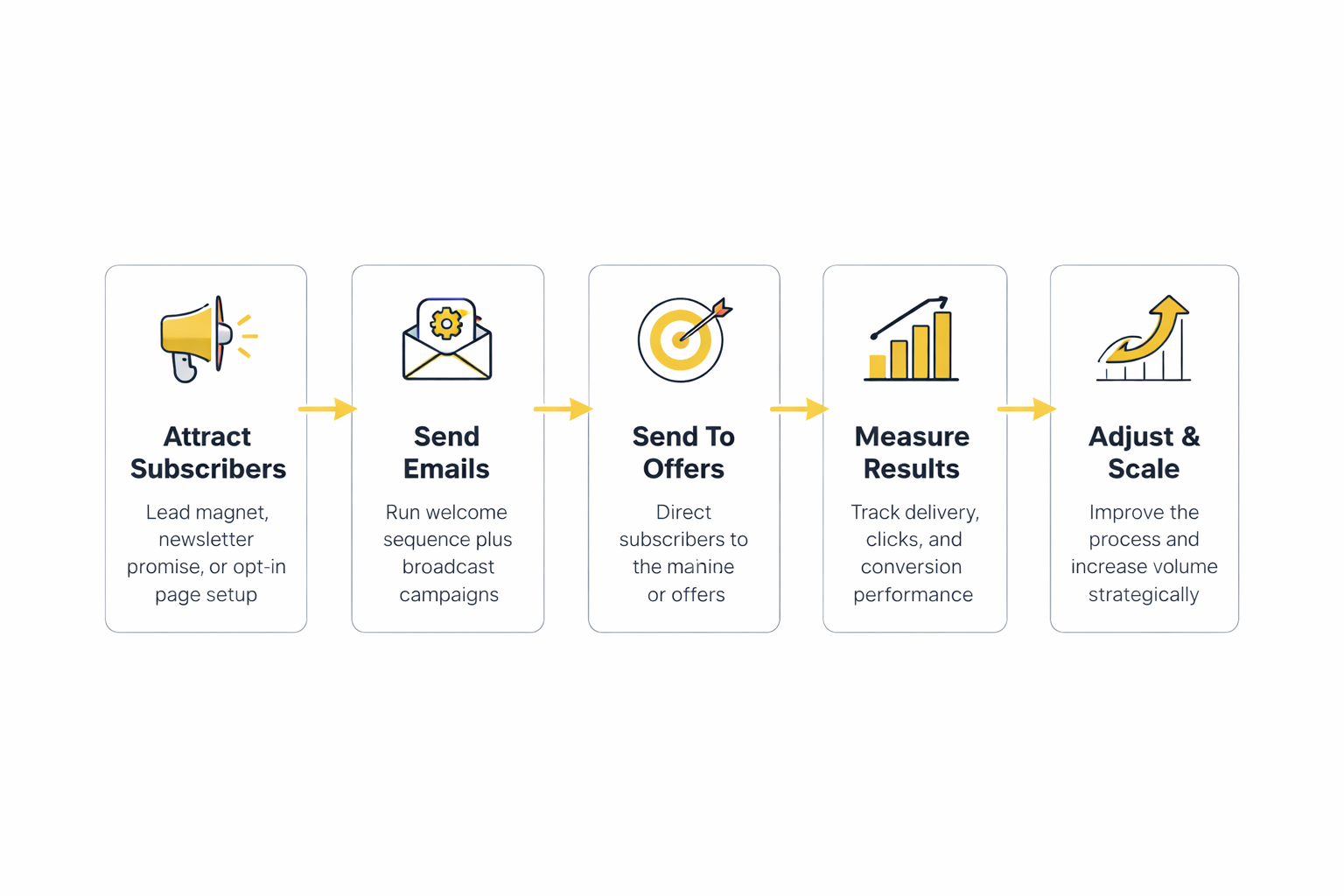
The simplest framework for free email marketing has six moving parts: audience promise, signup path, lead capture, welcome sequence, ongoing campaign rhythm, and measurement. When any one of those pieces is missing, the whole machine gets shaky. You may collect subscribers but fail to keep them engaged, or you may send polished emails to a list that was never built around a clear reason to subscribe in the first place.
Start with the promise first. People do not join lists because a business wants “more subscribers.” They join because they expect a useful outcome, whether that is better deals, sharper insights, earlier product drops, curated analysis, or a practical resource that saves them time.
Then build the path that turns that promise into a habit. A landing page or embedded form captures the email, a welcome sequence sets expectations, and a repeatable campaign cadence keeps the relationship alive. That is the framework that lets free email marketing stay strategic instead of becoming one more half-abandoned marketing channel.
Core Components
The first core component is the platform itself, and this is where many people make the wrong decision. Instead of asking which tool has the most features, ask which free plan matches your current stage. Brevo’s free plan allows up to 300 emails per day, MailerLite’s free plan offers up to 12,000 emails per month, Kit’s Newsletter plan supports up to 10,000 subscribers, and Mailchimp’s free plan is positioned for accounts with fewer than 250 contacts. None of those numbers mean anything on their own, so the real question is whether your list size, send frequency, and content model fit the limits cleanly.
The second core component is your capture layer. You need at least one focused landing page or signup form that explains what people are getting, how often they will hear from you, and why the email is worth opening. Platforms such as HubSpot’s free marketing tools, Brevo landing pages, and Kit landing pages make it easier to launch that capture layer without hiring a developer, which is exactly why free email marketing is more practical than it used to be.
The third core component is segmentation, even if your list is still tiny. Litmus highlights in its 2025 personalization analysis that marketers still struggle with collecting the right data and measuring the impact of personalization, which is a good reminder to keep segmentation simple at the start. Tag subscribers by source, interest, or intent, then send the most relevant message you can. Free email marketing becomes dramatically more effective when the right 500 people get the message instead of the wrong 5,000.
Professional Implementation
Professional implementation starts with restraint. Do not try to mimic a giant brand with ten automations, five lead magnets, and a weekly newsletter the moment your account goes live. Build one clean acquisition path, one welcome sequence, and one recurring email format that you can publish consistently without burning out.
A strong starter setup usually looks like this: one landing page, one subscriber incentive if it is genuinely useful, a three-to-five-email welcome sequence, and one weekly or biweekly campaign. If you want to move fast with tools that fit this kind of rollout, many marketers test options like Brevo, systeme.io, or Moosend because they lower the barrier to getting pages, forms, and email campaigns running in one place. The key is not the logo on the software. The key is whether the tool helps you publish reliably and collect clean engagement data.
You also need to protect deliverability from the beginning, even on a free plan. Google’s email sender guidelines and Gmail’s bulk email best practices both reinforce the same basic principle: get consent, authenticate your sending domain, and make unsubscribing easy. That may sound technical, but it is really a business discipline issue. Free email marketing works best when every email feels expected, useful, and easy to stop receiving if the fit is no longer there.
Finally, define success in a way that goes beyond vanity metrics. The DMA’s recent benchmarking work makes a strong case for looking past open rates alone, and Mailchimp’s benchmark library plus Brevo’s 2025 benchmark data are useful reminders that performance varies wildly by sector, audience, and objective. A professional free email marketing program is not trying to impress anyone with random averages. It is trying to build a list that opens, clicks, replies, and buys a little better month after month.
Measurement And Optimization
In the next part, the focus shifts to measurement. That is where free email marketing stops being a hopeful experiment and becomes a channel you can improve deliberately, because every send gives you another data point about list quality, messaging, timing, and intent.
We will look at which metrics deserve your attention first, how to interpret engagement without getting trapped by weak benchmarks, and how to know when your free setup is helping your business versus quietly wasting your time. That is the point where a list starts acting less like a side project and more like a real asset.
Scaling Without Breaking What Works
Later in the article, we will move into scaling. That section will cover how to expand your free email marketing system without piling on complexity, losing relevance, or upgrading tools before the business case is there.
The goal is simple: keep what is working, remove what is bloated, and grow from a clean foundation. That is how free email marketing turns into a durable revenue channel instead of a messy collection of disconnected campaigns.
Which Metrics Matter Most In Free Email Marketing
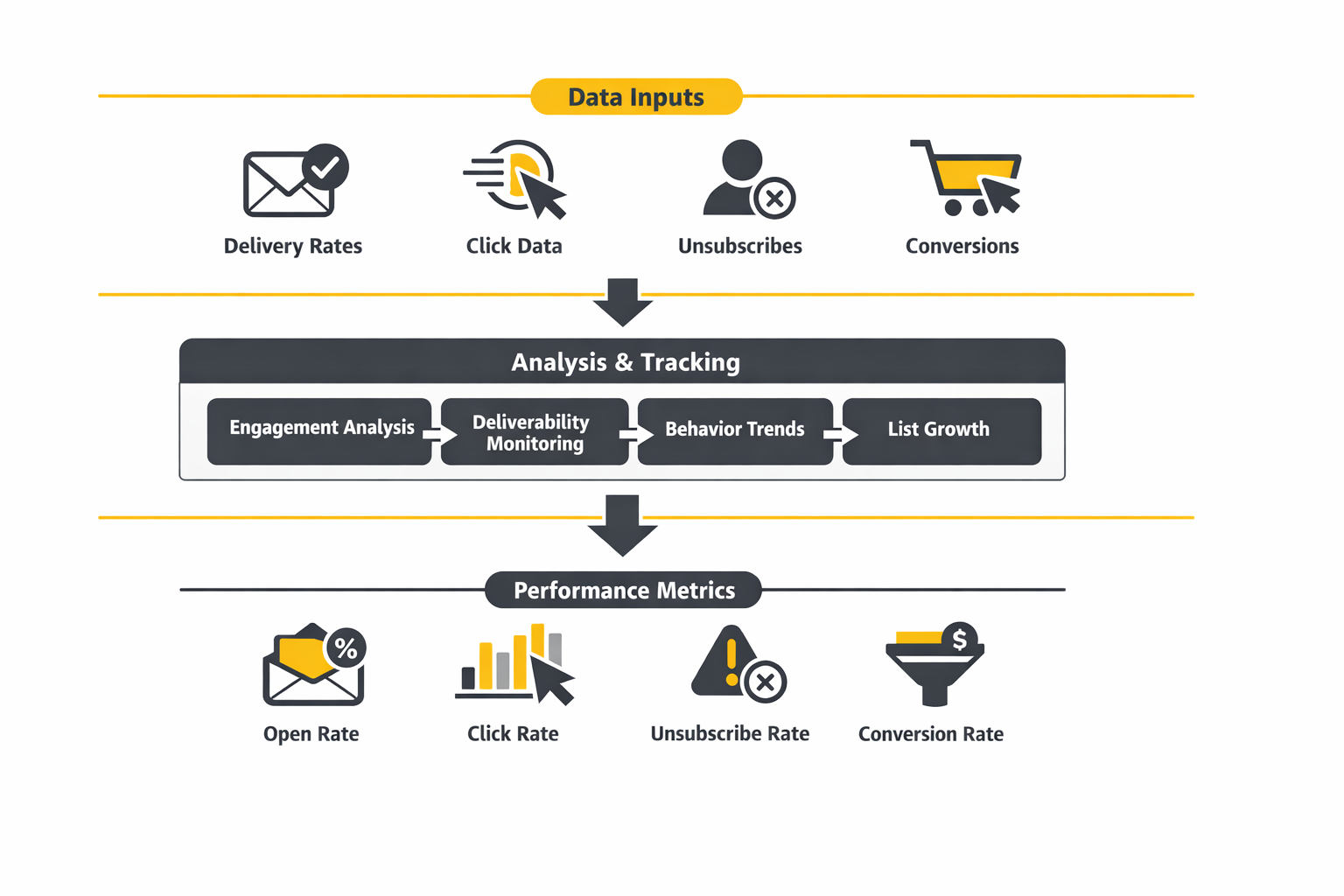
The first metric to watch is delivery, because nothing else matters if the email never reaches the inbox. The DMA’s 2025 benchmarking report shows a 98% delivery rate across the market, which sounds healthy on the surface, but that number can hide a lot of pain for smaller senders when list quality is slipping or domain setup is weak. In free email marketing, a delivery problem is usually an early warning that the list is aging badly, the acquisition source is attracting weak subscribers, or your technical setup is not as solid as it needs to be.
The second metric is clicks, because clicks reveal intent far better than opens ever could. Mailchimp’s own explanation of open and click rates points out that bot activity and Apple Mail Privacy Protection can inflate opens and even distort some engagement signals, which is why smart marketers treat opens as directional rather than definitive. If people are clicking, replying, visiting a page, or taking the next step, your message is doing real work.
The third metric is subscriber movement. That means watching unsubscribe rates, spam complaints, and list growth together rather than in isolation. Brevo’s 2025 benchmark data and Mailchimp’s industry benchmark library both make it obvious that email performance shifts sharply by sector, so the question is not whether your numbers look “average.” The real question is whether your list is becoming more engaged and more qualified over time.
How To Read Email Data Without Fooling Yourself
The easiest trap in free email marketing is celebrating vanity metrics. A high open rate can look exciting while revenue stays flat, replies stay low, and nobody remembers your brand the next day. That is why every campaign should be read as a sequence: did it get delivered, did it get opened, did it earn a click, and did that click lead to a meaningful action?
Once you start reading metrics in sequence, patterns become easier to diagnose. If opens are decent but clicks are weak, the subject line may be doing its job while the body copy or offer is falling flat. If clicks look strong but conversions collapse after the visit, the email may be working just fine and the landing page may be the real bottleneck.
This is also where benchmarks need to be handled carefully. The 2025 Validity deliverability benchmark report notes that inbox placement remains under pressure, and Litmus highlighted in its 2025 State of Email recap that marketers are still wrestling with ROI measurement, engagement, and data quality. So do not use benchmark reports as a shortcut to thinking. Use them as context, then judge your free email marketing program by business outcomes and direction of travel.
If you want a cleaner system for building forms, pages, and campaign flows while you measure what is happening, tools like Brevo and systeme.io are often tested early because they make it easier to connect list growth and campaign reporting without adding a complicated tech stack. What matters most is not having more dashboards. What matters most is being able to see the entire path from opt-in to click to conversion without getting lost.

The Right Testing Rhythm For Free Email Marketing
Testing is where free email marketing starts compounding. You do not need to test ten things at once. In fact, that usually makes the data harder to trust, because you cannot tell which change actually moved the result.
A better rhythm is to test one meaningful variable at a time. Start with the subject line if opens are soft, the call to action if clicks are weak, the send day if timing feels off, or the offer structure if people are engaging but not converting. This keeps your learning clean and gives every campaign a job beyond just “sending something to the list.”
There is also a practical reason to stay this focused. Mailchimp’s reporting guidance and custom reporting resources both reinforce the idea that email performance only becomes useful when it is reviewed consistently and compared over time. Free email marketing rewards patience, because even small lifts in click rate, reply rate, and conversion rate can create a very different business outcome after a few months of steady sends.
Deliverability Signals You Cannot Ignore
Deliverability is one of those topics people ignore until it hurts. Then suddenly the problem feels mysterious, even though the warning signs were there all along. Lower engagement, more unsubscribes, strange swings in opens, and a slow drop in conversions often show up before a sender fully realizes that inbox placement is slipping.
Google’s sender guidelines FAQ, Google’s announcement on Gmail protections, and Yahoo’s sender best practices all point in the same direction: authenticate your mail, make unsubscribing easy, and keep complaint rates under control. That is not just enterprise advice. It matters for free email marketing too, because inbox providers do not care whether you are sending from a premium account or a free plan if the behavior looks careless.
This is why list hygiene matters so much. If subscribers never engage, keeping them forever does not make your list stronger. It makes your numbers noisier, your deliverability weaker, and your understanding of the audience less accurate.
How Often You Should Review Performance
Daily checking usually creates anxiety, not insight. Unless you are sending at very high volume, a weekly review is a much better rhythm for free email marketing. It gives campaigns enough time to gather meaningful engagement while keeping the learning cycle tight enough for you to adapt quickly.
A simple weekly review can answer five questions. Did list size grow from a healthy source, did delivery remain stable, did clicks improve or decline, did unsubscribes spike on any specific message, and did the email create a business result worth repeating? If you can answer those five questions honestly every week, you are already running a much stronger program than most beginners.
Then once a month, step back and look at the bigger pattern. Brevo’s regional and industry benchmark analysis, Litmus’ State of Email reports, and Mailchimp’s campaign benchmarking explanation all support the same basic discipline: performance becomes more useful when it is tracked in context, not judged off one lucky send or one disappointing week.
When To Upgrade From Free Email Marketing Tools
You should not upgrade just because a platform nudges you to. You should upgrade when the limit is actively blocking growth. That usually happens when your send cap forces you to reduce frequency, your automation needs become more advanced than the free plan allows, or your reporting is too shallow to guide smart decisions.
The limits are very real, and they vary more than many people realize. MailerLite’s free plan is built around monthly sending volume, MailerLite’s pricing page also frames the free tier around a smaller subscriber base, Brevo’s free plan works with a daily send cap, and Kit’s pricing structure is shaped for creators growing an audience-first business. Free email marketing works best when you choose a tool whose limits match your actual model, not just the headline promise on the pricing page.
A good upgrade feels earned. Your list is responding, your emails are generating action, and the added cost clearly removes friction from a system that is already working. That is very different from paying for a bigger tool in the hope that the software will somehow rescue weak messaging or a weak offer.
What Good Progress Actually Looks Like
Good progress in free email marketing does not always look dramatic. Sometimes it looks like fewer subscribers but stronger clicks. Sometimes it looks like a cleaner list, better replies, and a smaller number of people who are much more likely to buy. Sometimes it looks like your welcome sequence quietly becoming your best-performing asset because you finally aligned the promise, the timing, and the call to action.
That is the mindset shift that matters. You are not collecting metrics so you can admire a dashboard. You are collecting them so you can make the next email better, the next signup more qualified, and the next month more profitable than the last one.
And once you reach that point, free email marketing stops feeling “free” in the cheap sense of the word. It starts feeling valuable, because you have built a system that earns attention, measures what matters, and gets stronger every time you send.
Scaling Free Email Marketing Without Breaking What Works
The biggest mistake people make with free email marketing is trying to scale by doing more of everything at once. More forms. More sequences. More offers. More campaigns. It feels ambitious in the moment, but what usually happens is that the message gets muddy, the list gets less responsive, and the entire system becomes harder to manage than it should be.
Real scaling is quieter than that. It usually looks like tightening your acquisition sources, improving the welcome flow, sending more relevant campaigns, and upgrading only when the current limits are clearly choking growth. That is how free email marketing turns into something durable instead of becoming one more marketing machine that looked exciting for a few weeks and then collapsed under its own weight.
Scale What Has Already Proven Itself
If one signup source is producing engaged subscribers and another is producing people who never click, the answer is not complicated. Push harder on the source that is already creating quality. Too many businesses try to rescue weak acquisition channels when the smarter move is to pour more effort into the path that has already shown it can attract the right kind of subscriber.
This is where free email marketing rewards honesty. You may love a certain content format, a certain lead magnet, or a certain social platform, but if the subscribers coming from that source keep ignoring your emails, the market is telling you something. HubSpot’s marketing statistics collection keeps reinforcing how important lead quality is across the funnel, and email is no exception. A bigger list means very little if the extra subscribers never become readers, replies, or customers.
So before you “scale,” ask a simple question: what has already earned the right to grow? That one question can save you months of wasted motion.
Free Email Marketing Gets Stronger With Better Segmentation
Once your list starts growing, you cannot keep talking to everyone the same way and expect the same results. The more varied the audience becomes, the more important segmentation becomes. Not because segmentation sounds sophisticated, but because relevance is what keeps inbox trust alive.
Litmus’ recent work on segmentation and personalization makes this point clearly: marketers still struggle when subscriber data is thin, fragmented, or poorly used. That matters because free email marketing often begins with a stripped-down setup, and if you never improve the way subscribers are grouped, your campaigns can start feeling generic fast.
The fix is simpler than many people expect. Segment by source, by interest, by product intent, or by where a subscriber is in the customer journey. You do not need twelve layers of complexity. You just need enough structure that people feel like your emails were sent for them, not merely to them.
When To Add Automation And When Not To
Automation can absolutely help free email marketing scale, but only when it solves a real problem. If you add automation before your message is clear, all you are doing is sending confusion faster. A weak welcome email does not become stronger because it is automated. It just becomes a more efficient way to disappoint people at scale.
The better approach is to automate only after a manual process has already shown signs of life. If your welcome series consistently gets clicks, if a re-engagement email genuinely brings people back, or if a simple post-download follow-up moves readers toward a sale, then automation makes sense. It protects what is already working.
This is one reason some businesses experiment with tools like Brevo, Moosend, or systeme.io as they grow. The point is not to collect software for the sake of it. The point is to make sure your automations, forms, and campaigns can live in a setup that stays manageable as volume increases.
Protecting Deliverability While You Grow
Growth creates risk. That is the part many people do not see coming. You add more subscribers, send more campaigns, and assume success should follow automatically, but larger volume also means more chances to hit disengaged contacts, more chances to trigger complaints, and more chances to expose technical gaps you were able to get away with when the program was smaller.
That is why the rules from Google and Yahoo matter so much. Google’s sender guidelines FAQ and Yahoo’s sender best practices both emphasize the same fundamentals: authenticate your mail, avoid unwanted messages, and make unsubscribing easy. Google’s own announcement about Gmail protections made it even clearer that bulk email now has to meet a higher standard.
So if you want free email marketing to keep working while your list grows, you need to treat list hygiene as a growth strategy, not a cleanup task. Remove dead weight. Respect inactivity. Watch for signs that engagement is slipping. The goal is not to protect the ego boost of a large subscriber count. The goal is to protect inbox placement and long-term results.
Why Bigger Lists Do Not Always Win
A lot of marketers still act like scale is mostly a volume game. Get more names. Send more messages. Hope the math takes care of the rest. But free email marketing gets more interesting when you realize that the healthiest list is not always the biggest list. Sometimes the strongest email program is the one that trimmed weak subscribers, tightened its offer, and focused on the people most likely to care.
That idea lines up with what the deliverability world keeps seeing in practice. The 2025 Validity benchmark report showed global inbox placement pressure continuing to matter, which is a powerful reminder that scale without engagement is fragile. If your audience stops opening, clicking, replying, or buying, raw list size becomes a very expensive illusion.
That is why good operators scale with selectivity. They do not just ask, “How do we add more subscribers?” They ask, “How do we add the right subscribers and keep the experience strong as we do it?” That question leads to a much better business.
How To Expand Content Without Losing Your Voice
Once free email marketing starts working, the pressure to produce more content shows up fast. Suddenly there is an urge to send more often, cover more topics, build more funnels, and talk to more segments. That can work, but only if the core voice of the brand stays intact. If the tone shifts wildly from one email to the next, trust starts to wobble.
The easiest way to prevent that is to create a few repeatable formats instead of inventing everything from scratch each week. One teaching email. One story-based email. One promotion email. One curated resource email. That gives you variety without chaos, and it keeps the brand recognizable even as volume increases.
This is also where free email marketing becomes easier to maintain when the content supports a bigger ecosystem. A newsletter can point readers to a landing page, a webinar replay, a product page, or a sales funnel, but each asset has to feel connected. If the pieces feel random, the email loses momentum before the click even happens.
Using Landing Pages And Funnels The Smart Way
As your list grows, your next bottleneck often stops being the email itself and starts being what happens after the click. If the landing page is weak, if the offer feels disconnected, or if the funnel is too long and confusing, your campaigns can look healthy in the email dashboard while business results stay stubbornly flat.
That is why scaling free email marketing usually requires at least a basic funnel mindset. You do not need a huge system, but you do need a clear next step. In some cases that might mean a clean opt-in page and a simple sales page. In other cases it might mean a lead magnet, a short nurture sequence, and a conversion page built to continue the same promise the subscriber responded to in the first place.
Some marketers test tools like ClickFunnels when they want more control over that journey, especially when the email is feeding directly into an offer. The important thing is not the brand name of the tool. The important thing is making sure the click leads somewhere strong enough to deserve the attention your email worked so hard to earn.
How To Know Your Free System Is Ready To Scale
You are ready to scale free email marketing when the basics are no longer unstable. Subscribers are joining from clear sources. The welcome sequence is doing its job. Campaigns are earning real engagement. And the performance from one month to the next is strong enough that more volume feels like an opportunity rather than a gamble.
You are probably not ready if the system still depends on random bursts of effort, weak offers, or inconsistent messaging. Scaling a shaky system does not create strength. It creates a bigger mess. That is why patience matters so much here. You are not trying to grow fast just to say you did. You are trying to grow in a way that keeps the machine reliable.
And that is the real heart of this whole section. Free email marketing scales best when you resist the temptation to act bigger than you are, focus on the assets that are already proving themselves, and build in layers that your audience can actually feel. That is how you grow without breaking the very thing that made the channel work in the first place.
Statistics And Data

If you want to understand whether free email marketing is worth your time, the numbers tell a very clear story. The audience is still enormous, engagement is still very real, and small businesses are still leaning on email when they need a channel they can actually control. What has changed is that the old lazy approach no longer works, which is exactly why the data matters so much.
The Audience For Email Is Still Massive
Email is not hanging on by habit. It is still woven into how people live and work online. DataReportal’s 2025 analysis of email behavior shows that 75% of online adults use email at least once per month, and the same report notes that people are more likely to check email than to use the internet for shopping, music, or news in a typical month.
That matters because free email marketing only works if the underlying channel still has reach. It clearly does. HubSpot’s latest marketing statistics collection also points to a world with 4.6 billion email users in 2025, which lines up with the scale marketers are seeing across both consumer and business audiences.
Free Email Marketing Benchmarks Show Healthy Engagement
One of the most useful benchmark snapshots for small and midsize senders comes from MailerLite, because it looks at millions of campaigns instead of relying on theory. Its 2025 benchmark report puts the overall median at 43.46% open rate, 2.09% click rate, 6.81% click-to-open rate, and 0.22% unsubscribe rate.
Mailchimp’s industry benchmark page shows a different but still very useful reference point, with 35.63% average open rate, 2.62% average click rate, and 0.22% unsubscription rate across all users. The exact number you should expect will vary by industry and list quality, but the bigger takeaway is simple: free email marketing does not need miracle numbers to be useful. It just needs steady engagement from the right subscribers.
Deliverability Data Has Gotten More Serious
This is where the conversation gets more interesting, because engagement benchmarks only matter if messages actually land where they are supposed to. Validity’s 2025 Email Deliverability Benchmark Report found that global performance sat at 83.5% inbox placement, with 6.7% landing in spam and 9.8% going missing.
The trend inside that same report is even more important than the headline number. Validity shows inbox placement sliding to 82.3% during Q4, while spam placement nearly doubled from 4.5% in Q1 to 8.6% in Q4. That tells you exactly why free email marketing cannot be run carelessly anymore. If your list is weak or your sending habits are sloppy, the inbox does not quietly forgive you.
Small Businesses Are Still Betting On Email
The small-business picture is especially important here, because free email marketing is often where smaller brands begin. Constant Contact’s 2025 Small Business Now findings show that 44% of SMBs say email is their most effective marketing channel, up from 23% in 2024.
That is a big jump, and it says something important. Small businesses are not turning back to email because it is trendy. They are turning to it because it gives them a more direct path to customers than channels that depend on rented attention. The same Constant Contact release also shows that only 18% of SMBs feel very confident in their marketing results, which is a powerful reminder that simply “doing marketing” is not enough. The businesses that win with free email marketing are the ones that measure, adjust, and keep the message tight.
Workflow And ROI Data Support Email Too
Litmus adds another layer to the picture by showing how deeply email is still embedded in real marketing operations. Its State of Email reports page highlights that 58% of marketing teams send emails weekly or several times per week, while 35% of companies report email ROI of 36:1 or more. Those are not vanity numbers. They point to a channel that still earns recurring effort because it still produces meaningful results.
HubSpot’s current marketing dataset strengthens that case from another angle. It shows that only 8.4% of marketers treat opens and clicks as their most important success metric, while 40% of marketers use email marketing and 22% call it one of their top ROI-driving channels. That is exactly the right mindset for free email marketing: use engagement metrics to diagnose performance, but judge the channel by business impact.
What These Numbers Really Mean
Put all of this together and the picture becomes very clear. The audience is huge, open and click performance is still strong enough to build on, and small businesses continue to trust email when they need real results. At the same time, deliverability is under more pressure than it used to be, which means free email marketing rewards professionalism faster than ever.
That is why the data does not point in two different directions. It points in one direction very clearly. Free email marketing is still one of the smartest ways to build a direct response channel when you are early, lean, or trying to prove an offer without spending heavily upfront. You just have to run it like a real system, because the numbers now punish lazy operators and reward disciplined ones.
Choosing The Right Free Email Marketing Tools And Ecosystem
Once you understand strategy, measurement, scaling, and performance data, the next big question is practical: which tools should you actually use? This is where a lot of people overcomplicate free email marketing. They assume they need the most advanced platform on the market, when in reality they need a stack that matches how they sell, how often they email, and how fast they are likely to grow.
The smartest way to choose is to stop asking which platform is “best” in the abstract. Ask which one fits your current business model without forcing awkward workarounds. Free email marketing works best when the tool feels like an extension of your process rather than a system you have to fight every time you want to send a campaign.
Choose Tools Based On Your Business Model
If you run a content-first brand, a newsletter business, or a creator-led offer, your needs are different from someone running simple funnels for digital products or lead generation. That sounds obvious, but it is where many people go wrong. They choose a platform because the homepage looks impressive, then discover a month later that the sending limits, automation rules, or landing page workflow do not really suit the way they operate.
That is why free email marketing should start with business logic, not feature envy. If your main need is sending regular content to a growing audience, you should care deeply about subscriber limits and email volume. If your main need is connecting forms, funnels, pages, and follow-up emails in one place, then the ecosystem around the email tool matters just as much as the email editor itself.
Best For Daily Sending And Simple Campaign Operations
For businesses that want a clean sending setup without paying immediately, Brevo remains one of the more practical starting points. Brevo’s official pricing page says its free plan allows 300 emails per day, while Brevo’s own plan documentation adds that the free tier includes 100,000 contacts in storage and access to core email features. That combination makes sense for businesses that care more about steady outreach than about sending large monthly bursts.
The beauty of a setup like this is that it forces some discipline. A daily cap pushes you to send intentionally instead of blasting the whole database every time you have a thought. For many free email marketing users, that is not a limitation at all. It is a surprisingly healthy guardrail.
Best For Newsletters And Audience-Building
If your business is more creator-led or newsletter-driven, the math changes. MailerLite’s official free plan page says users can send up to 12,000 emails per month without paying, which is attractive when you want predictable monthly sending room. Kit’s pricing page positions its free Newsletter plan around up to 10,000 subscribers, along with landing pages, forms, broadcasts, and basic automation for audience-first businesses.
These are not identical tools, and that is the point. MailerLite often makes more sense when you want a straightforward email platform with generous monthly sending. Kit can make more sense when free email marketing is tied closely to content, subscriber relationships, and creator-style monetization. The right choice depends on whether your system revolves around campaigns or around audience growth itself.
Best For All-In-One Funnels And Email
Some businesses do not want to glue together separate tools for pages, forms, and follow-up emails. They want one place to build the whole path from opt-in to offer. That is why a lot of people exploring free email marketing end up testing platforms with a broader business stack built in.
systeme.io is appealing in that context because its official email marketing page emphasizes free access and unlimited emails, while its broader platform overview highlights a free plan built around email contacts, funnels, and site assets in one place. That makes it especially interesting when free email marketing is not a standalone activity but part of a lean funnel-based business. If your real bottleneck is building pages and connecting follow-up logic, an all-in-one tool can remove more friction than a pure email platform.
For marketers who want to test a more premium funnel workflow, ClickFunnels is usually not the place to begin free email marketing forever, but its official pricing page does offer a free trial. That can be useful when you already know the email needs to feed a sales funnel, checkout flow, or offer sequence rather than simply a newsletter. In other words, it is less about “free forever” and more about testing whether a funnel-heavy model is worth paying for.
When HubSpot Makes Sense
HubSpot becomes more interesting when email is only one piece of a larger relationship system. Its official email marketing page positions free email marketing inside a wider CRM and marketing environment, which can be valuable if you care about contact history, pipeline visibility, and cross-team coordination from the beginning. That is a very different use case from a solo creator who simply wants to send a weekly email.
So HubSpot is usually not the first tool I would point to for someone who just wants the easiest path into free email marketing. But it can make a lot of sense if the real goal is building a broader customer system while keeping early costs under control. When that is the situation, starting inside a CRM-shaped ecosystem can save painful migrations later.
How To Build A Lean Free Email Marketing Stack
A lean stack for free email marketing usually needs only four things: a place to collect subscribers, a place to send emails, a place to direct clicks, and a simple way to measure results. That is it. You do not need a dozen integrations just to prove that your message can attract the right people and move them toward action.
One clean setup might be a landing page inside your email tool, a short welcome sequence, and a single offer page. Another might pair a form tool with an email platform and a lightweight sales page. If you are still early, the right system is the one you can actually maintain every week without losing momentum, not the one with the longest feature checklist.
That is why some people prefer using one platform for almost everything, while others are happy to keep a simpler specialist stack. Free email marketing becomes fragile when the setup is too complicated for the current stage of the business. It becomes powerful when every tool has a clear job and none of them are there for decoration.
Mistakes To Avoid When Picking Tools
The first mistake is choosing based on hype instead of constraints. If the free plan gives you the wrong sending limit, the wrong subscriber cap, or the wrong workflow for your business, it does not matter how popular the software is. The tool is still the wrong tool.
The second mistake is ignoring deliverability and compliance while tool-shopping. Google’s current sender requirements make it clear that enforcement around authentication and bulk sending has tightened, so your platform choice has to support good sending behavior rather than encourage bad habits. Free email marketing is not really “free” if the hidden cost is weak inbox placement and a list that stops responding.
The third mistake is upgrading emotionally instead of operationally. Just because a platform shows you locked features does not mean you need them yet. Upgrade when your limits are genuinely blocking growth, not when the software has done a good job making you feel behind.
The Right Mindset Before The Final Part
At this point, the goal should be clear. Free email marketing is not about squeezing every possible dollar out of a no-cost tool. It is about building a simple, reliable system that earns attention, protects deliverability, and creates enough momentum that paying for better tools later feels obvious rather than risky.
That is the perfect place to head into the final section. The next part will pull the whole article together, answer the most important remaining questions, and make it easier to decide what to do first if you want your free email marketing setup to start working in the real world.

FAQ For This Complete Guide
Is free email marketing actually worth it?
Yes, free email marketing is absolutely worth it when you use it to prove your message, build a responsive list, and learn what your audience cares about before paying for extra software. The channel is still massive, with HubSpot’s latest marketing statistics pointing to 4.6 billion email users in 2025, while DataReportal’s 2025 digital analysis shows 75% of online adults use email at least monthly. That is not a dying channel. That is a channel with enormous reach that still rewards people who know how to use it well.
The catch is that free email marketing is not a magic trick. It works when the offer is clear, the list is permission-based, and the emails are genuinely useful. If the strategy is weak, the tool being free will not save it.
What is the biggest limit of free email marketing?
The biggest limit is not usually the email editor or the templates. It is the sending cap, subscriber cap, or automation depth on the free plan you choose. Brevo’s pricing page says its free plan allows 300 emails per day, MailerLite’s free plan offers 12,000 emails per month, and Kit’s Newsletter plan is built around up to 10,000 subscribers.
That is why free email marketing works best when you pick a tool that matches your model. A creator sending a weekly newsletter has different needs from a service business sending tighter nurture sequences. The limit only becomes painful when it blocks a system that is already working.
How many subscribers do I need before email starts mattering?
You do not need thousands of subscribers before free email marketing becomes useful. In fact, a small list of the right people can be more valuable than a bloated list that never engages. What matters most is whether subscribers open, click, reply, and eventually buy.
That is also why benchmarks should be handled carefully. Mailchimp’s benchmark library and MailerLite’s 2025 benchmark report show that performance varies by industry, so the better question is not “Is my list big enough?” but “Is my list alive?” A responsive list of a few hundred people can teach you more than a dead list of ten thousand.
How often should I send emails on a free plan?
You should send as often as you can maintain quality and relevance without training people to ignore you. For some businesses that means once a week. For others it means twice a month, or a short welcome sequence followed by occasional campaigns. Consistency matters more than forcing a volume goal that your content cannot support.
This is where free email marketing can actually help you develop good habits. A tighter sending allowance forces you to think before you hit send. That is usually a good thing, because inbox providers are watching behavior more closely now than they used to.
Do open rates still matter?
They matter, but not in the old simplistic way. Opens can still help you spot trends, compare subject lines, and notice sudden drops in engagement, but they should not be treated as the final truth. Mailchimp’s explanation of open and click rates makes it clear that privacy protections and automated activity can distort engagement signals.
That is why free email marketing gets stronger when you look at opens alongside clicks, replies, conversions, unsubscribes, and list growth quality. Opens can tell you whether attention was captured. They cannot tell you by themselves whether the email truly did its job.
What metrics should I watch first?
Start with delivery, clicks, unsubscribes, and conversions. Those four tell a much better story than obsessing over vanity metrics. If delivery slips, you may have a trust or hygiene problem. If clicks are weak, the copy or offer may be off. If unsubscribes spike, the message or frequency may be wrong. If conversions are weak after decent clicks, the landing page may be the bottleneck.
This is one reason HubSpot’s current marketing data is so useful. It shows only 8.4% of marketers treat opens and clicks as their most important success metric, which is a healthy reminder that free email marketing should be judged by business outcomes, not dashboard theater.
Can free email marketing hurt deliverability?
Yes, if you run it carelessly. The fact that a tool is free does not mean inbox providers lower their standards for you. Google’s sender guidelines FAQ and Yahoo’s sender best practices both make it clear that authentication, easy unsubscribes, and low complaint behavior matter.
The risk gets even clearer when you look at Validity’s 2025 deliverability benchmark report, which found 83.5% inbox placement globally, with 6.7% landing in spam and 9.8% going missing. That means free email marketing needs to be run like a serious channel, even when the budget is tiny.
Should I use one tool or build a stack?
Start with the simplest system that gets the job done. If one tool can handle forms, pages, broadcasts, and basic automations well enough for your current stage, that is often the smartest path. Complexity feels powerful at first, but it becomes expensive in attention very quickly.
That is why some people start with a broader platform like systeme.io, while others prefer focused tools like Brevo or Moosend. Free email marketing gets easier to sustain when every tool in the stack has a clear role and none of them are just there because they looked impressive in a comparison table.
When should I upgrade from free email marketing tools?
You should upgrade when the cost removes a real bottleneck, not when the software simply makes paid features look tempting. If your subscriber growth is healthy, your campaigns are working, and the free plan is forcing you to send less often than you should or blocking the automations you now clearly need, that is a good time to move up.
A good upgrade feels earned. By that point, free email marketing has already proven the channel deserves more investment. You are not paying because you hope the tool will rescue weak strategy. You are paying because the strategy is already working and the limit is now getting in the way.
Is free email marketing good for ecommerce only?
No, not at all. It works for service businesses, coaches, consultants, creators, publishers, SaaS companies, local businesses, and personal brands. Ecommerce gets a lot of attention because product launches and promotions are easy to visualize, but the real value of free email marketing is broader than that. It creates a direct line to people who have already raised their hand and said they want to hear from you.
That is exactly why so many smaller companies still lean on email. Constant Contact’s 2025 SMB research shows 44% of small businesses now see email as their most effective marketing channel. That is not an ecommerce-only signal. That is a business-wide signal.
How do I grow a list without ads?
The best way is to give people a clear reason to subscribe and then place that reason where intent already exists. That may be a content upgrade, a newsletter promise, a useful resource, a short workshop, a waitlist, a product update stream, or a lead magnet that solves one immediate problem well. Free email marketing grows faster when the promise is specific and the signup path is friction-free.
You do not need to invent something huge. You need something relevant enough that the right people want it now. Then your welcome sequence has to confirm that they made a smart decision by joining. That is where trust begins.
What kind of business sees the best results from email?
The businesses that do best with free email marketing are not always the loudest or the biggest. They are usually the ones with a clear promise, a clean offer, and a message that stays relevant over time. Email tends to reward businesses that know exactly who they help and why the subscriber should care.
That is also why Litmus State of Email reports remain useful. They show email is still deeply embedded in how modern marketing teams operate, and they consistently point back to the same fundamentals: relevance, measurement, and consistency. Those are not glamorous answers, but they are the ones that keep working.
Can I build a real business with free email marketing?
Yes, but only if you treat it as the beginning of a system instead of a forever-cheap shortcut. Free email marketing is powerful because it lets you build distribution, test offers, and learn from real audience behavior without taking on unnecessary cost too early. That is an incredible advantage when you are starting lean.
But the long game is not staying free forever. The long game is building something good enough that paying for stronger tools later becomes the easiest decision in the world. That is when email stops feeling like a budget tactic and starts feeling like an asset you would never want to lose.
Work With Professionals
There is a point where doing everything yourself stops being efficient. Maybe your list is growing, your offers are getting sharper, and you know free email marketing is working, but you also know there is money being left on the table because the strategy, copy, automation, or deliverability side needs a more experienced hand.
That is when working with professionals can save you a ridiculous amount of time. The right person can help you clean up the acquisition path, strengthen the welcome sequence, improve campaign logic, and turn a decent email setup into a serious revenue channel. Not because they have magic powers, but because they have already walked through the problems you are just now running into.
If you want to build faster, avoid preventable mistakes, and get in front of businesses that already value marketing skill, this next step makes a lot of sense.
Explore 10K+ Remote Marketing Contracts on MarkeWork.com
Most marketers spend too much time chasing clients, competing on crowded platforms, and losing a percentage of every project to middlemen.
MarkeWork gives you a better way. Browse thousands of remote marketing contracts and connect directly with companies desperate to hire skilled marketers like you without platform commissions and without unnecessary gatekeepers.
If you’re serious about finding better opportunities and keeping 100% of what you earn, you can explore available contracts and create your profile for free at MarkeWork.com.
 Filip Konecny Enterprises