

An email blast can still move a business fast, but only when it is treated like a disciplined communication system instead of a random mass send. Inbox providers have tightened the rules, readers are less patient, and the difference between a campaign that gets opened and one that gets ignored often comes down to trust, timing, and relevance. That is why a modern email blast has to balance clear commercial intent with smart segmentation, technical compliance, and a message that earns attention.
That balance matters more now because large mailbox providers have become stricter about authentication and spam complaints. Google’s sender guidelines and Yahoo’s sender requirements pushed bulk senders to treat deliverability as a front-end strategy decision, not a back-end cleanup task. If you send a high-volume email blast without the right setup, the issue is not just lower engagement; the bigger problem is that the message may never earn a fair chance in the inbox.
At the same time, the channel is still too valuable to ignore. Recent benchmark pages from Mailchimp, Brevo, and MailerLite all show the same big truth from different datasets: email remains one of the most measurable ways to create demand, nurture leads, and drive revenue when the list is permission-based and the offer is relevant. So the real question is not whether an email blast works, but what kind of email blast deserves to work today.
Article Outline
- Part 1: Why Email Blasts Matter
- Part 1: Framework Overview
- Part 1: Core Components
- Part 1: Professional Implementation
- Part 2: Advanced Execution and Optimization
- Part 3: Analytics, Ecosystem, and FAQ
The structure of this article is built to move from the strategic foundation into execution, then into long-term performance. In this first part, the goal is to show what makes an email blast valuable, what framework keeps it controlled, which components matter most, and how professionals implement the channel without damaging their sender reputation. The later parts will build on these anchors so the page jumps stay useful as the full article expands.
Why Email Blasts Matter

The phrase email blast sometimes sounds outdated because it brings to mind one generic message fired at an entire list. In practice, though, businesses still use the term when they mean a campaign sent to a large audience within a short time window, often to announce an offer, launch a product, react to a seasonal moment, or reactivate demand. The tactic still matters because speed matters, and email remains one of the few channels where a brand can reach its own audience directly without renting attention from an algorithm.
That does not mean every email blast is a good idea. The smartest teams now treat a blast as a controlled campaign layered on top of consent, list hygiene, domain authentication, and a specific business objective. That shift is exactly why guidance from the FTC’s CAN-SPAM compliance page, the UK ICO’s rules on electronic mail marketing, and GDPR compliance guidance has become part of normal campaign planning rather than a legal footnote added at the end.
The business case is still strong, but the meaning of success has changed. It is no longer enough to brag about sending volume when recent benchmark collections from Mailchimp, Campaign Monitor, and Brevo keep reminding marketers that opens, clicks, unsubscribes, and bounces vary widely by industry, audience quality, and send strategy. A strong email blast matters because it compresses attention into a short moment, but it only pays off when that moment is earned.
Framework Overview
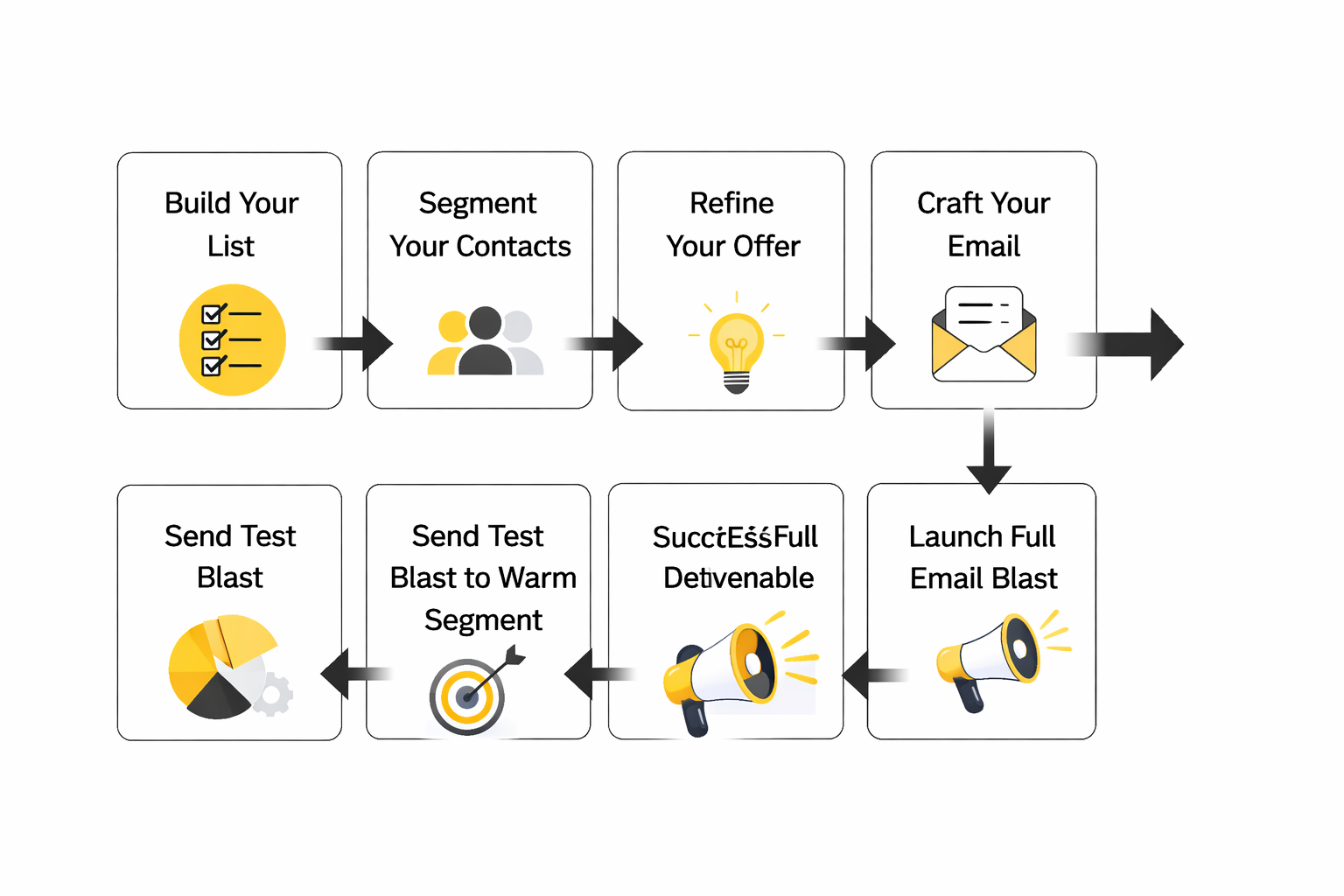
A professional email blast framework starts with one simple question: what single action should happen after the send? If the answer is fuzzy, the campaign usually becomes fuzzy too. The cleanest email blasts are built around one commercial purpose, one audience definition, one main promise, and one next step.
From there, the framework becomes much more practical. First comes audience selection, because a broad list is not the same thing as the right list. Then comes deliverability readiness, which is where Google’s bulk sender FAQ, Google’s authentication guidance, and Yahoo’s sender FAQ matter so much: if SPF, DKIM, unsubscribe handling, and spam-rate discipline are weak, even a well-written campaign can lose before the subject line gets judged.
After that, the framework moves into message construction. The offer has to be understood instantly, the body has to carry the reader toward a clear call to action, and the design has to work on the email clients people actually use. That is why email teams continue to watch usability and accessibility guidance from resources such as Litmus on accessible email and email-client behavior research compiled in recent Litmus State of Email reports. A framework is not there to make the process feel complicated; it is there to keep a high-volume send from turning into a high-volume mistake.
Core Components
The first core component is permission. An email blast sent to a weak list is a reputation problem disguised as a marketing activity. That is why the legal guidance from the FTC and the consent standards discussed by the ICO are so important: they force marketers to build on opt-in logic, suppression discipline, and an unsubscribe path people can actually use.
The second core component is authentication and trust. A modern email blast should be supported by SPF, DKIM, and DMARC because mailbox providers use those signals to judge legitimacy, and technical explainers such as Cloudflare’s overview of DMARC, DKIM, and SPF make clear why unauthenticated sending creates both spoofing risk and delivery trouble. This is not glamorous work, but it is the difference between building a sending asset and burning one.
The third core component is relevance. Benchmarks from MailerLite, Brevo, and HubSpot’s roundup of current benchmark sources show that performance moves by sector and use case, which is a polite way of saying there is no universal “good” email blast. The email has to match where the subscriber is in the relationship, what they signed up for, and what problem they want solved right now.
The fourth core component is a strong send structure. That usually means a subject line with one job, preview text that extends the idea instead of repeating it, body copy that gets to value quickly, and a call to action that does not compete with five other calls to action. A blast is supposed to create momentum, and momentum dies when the email asks the reader to think too hard.
The fifth core component is measurement. Opens still tell part of the story, but privacy changes and client-level behavior mean they are no longer enough on their own. Serious teams combine engagement metrics from tools such as Mailchimp’s benchmarks and Campaign Monitor’s metric guidance with downstream business outcomes like demo bookings, purchases, qualified leads, or revenue per recipient.
Professional Implementation
Professional implementation starts before the campaign is written. The list gets cleaned, inactive subscribers are reviewed, and the sending domain is checked for authentication and complaint risk. Teams that skip this stage often think they have a copy problem when they really have an infrastructure problem, which is exactly why sender guidance from Google, Yahoo, and industry best-practice groups like M3AAWG now sits so close to campaign planning.
Once the technical base is solid, professionals build the send around audience logic instead of vanity reach. They suppress people who recently converted, separate highly engaged subscribers from colder segments, and think hard about whether the email blast should be a full-list announcement or a controlled release to the readers most likely to care. This is also where the right platform matters, whether a team wants to use Brevo for campaign management, Moosend for automation and list workflows, or ScaledMail for cold email infrastructure in a use case where cold outreach is legally and strategically appropriate.
Then comes the part most people think of first: the message itself. A professional email blast respects the reader’s time, gets to the point fast, and avoids hiding a weak offer behind design tricks. If the campaign is promotional, it should sound confidently promotional; if it is educational, it should still have a commercial point; and if it is urgent, the urgency should be real rather than manufactured.
The last piece of implementation is post-send discipline. Professionals do not just watch opens for an hour and move on. They look at complaint rates, click patterns, unsubscribes, landing-page behavior, and whether the blast helped or hurt the health of the list, because the channel compounds in both directions: a well-run email blast makes the next campaign easier to deliver, while a sloppy one makes the next campaign harder to trust.
Advanced Execution and Optimization
The next part of this article will go deeper into segmentation logic, campaign timing, subject-line strategy, and creative decisions that increase response without pushing complaint rates higher. That section will also look at how to decide when an email blast should stay broad and when it should be broken into smaller audience groups for better relevance. This is where the difference between a decent campaign and a genuinely scalable one becomes obvious.
Analytics, Ecosystem, and FAQ
Later sections will cover measurement models, ecosystem trends, and the FAQ that most businesses have before they commit to an email blast program. That includes what to benchmark, how to interpret performance without fooling yourself, and how email fits with automation, CRM data, landing pages, and broader lifecycle marketing. By the end of the full article, the goal is to make the term email blast feel much less vague and much more usable.
Segmentation That Makes an Email Blast Feel Relevant
The fastest way to make an email blast feel lazy is to send the same message to everyone just because they technically exist on the list. Relevance is what protects both engagement and deliverability, and that is exactly why guidance from Google’s bulk email best practices and M3AAWG’s sender documents keeps circling back to active, engaged audiences instead of raw volume. Mailbox providers are telling marketers, in plain language, that healthier sending starts with sending to people who are actually likely to want the message.
In practical terms, segmentation should begin with behavior, not demographics. A recent buyer should not get the same blast as someone who has not opened in six months. A lead who clicked pricing last week is living in a totally different reality than a subscriber who only reads educational content. The point is not to build a thousand tiny segments just because your platform allows it. The point is to create meaningful groups that change the message, the offer, or the urgency in a way the reader can feel.
You can also see why this matters when you look at platform guidance around list health. Brevo’s current benchmark guidance explicitly pushes double opt-in, regular list cleaning, and tailored campaigns through segmentation, while Mailchimp’s benchmark resources and MailerLite’s 2025 benchmarks both frame campaign performance as something that depends heavily on industry, audience quality, and relevance rather than a single universal standard. That is a huge clue. If your audience is mixed, your message should not pretend it is uniform.
Timing and Frequency Without Burning the List
Marketers love hunting for the perfect send time because it feels like a shortcut. The truth is less exciting and much more useful. Timing matters, but it matters most after the audience, the offer, and the message are already right. If those pieces are weak, moving a send from Thursday afternoon to Tuesday morning will not save the campaign.
That said, timing still deserves respect. Brevo’s benchmark summary notes that Monday and Tuesday often produce stronger open and click-through performance than weekends, and that lines up with how many commercial lists behave when readers are back in work mode and paying attention again. But this is where professionals avoid turning benchmark patterns into dogma. A B2B email blast aimed at operators, founders, or sales teams may behave very differently from a DTC weekend offer tied to payday, sport, or leisure shopping behavior.
Frequency is even more dangerous than timing because it compounds. One aggressive blast might still perform. Four irrelevant blasts in two weeks can quietly train people to ignore you, unsubscribe, or complain. The stricter environment described in Google’s sender requirements makes that impossible to shrug off, because the platform explicitly tells senders to keep spam rates in Postmaster Tools below 0.3%. So frequency should never be decided by internal pressure alone. It should be decided by how much value, novelty, and urgency you can honestly deliver each time.

Subject Lines, Preview Text, and First-Screen Impact
If the opening screen of your email blast is weak, the rest of the copy does not get a fair shot. That makes the subject line and preview text one of the most strategic parts of the whole campaign, not a cosmetic detail added five minutes before launch. The subject line wins attention, the preview text reduces hesitation, and the top of the email has to confirm the reader did not make a mistake by opening.
The smartest subject lines are not clever for the sake of it. They promise one thing, they fit the audience’s level of awareness, and they match the message inside. That last point matters more than people think. If the subject line screams urgency and the email body opens with a vague paragraph about the company mission, the campaign immediately feels slippery. Trust drops fast when the first sentence does not cash the check the subject line wrote.
This is also where excessive creativity can backfire. Providers are already paying attention to authentication, complaints, and unsubscribe behavior, and readers are making fast emotional decisions inside crowded inboxes. A strong email blast usually feels clear before it feels clever. The reader should know what is happening, why it matters now, and what to do next before they have a chance to get distracted.
Testing the Parts That Actually Move Results
Testing matters, but not every test deserves your attention. Too many teams burn energy testing tiny stylistic details while ignoring the structural decisions that shape campaign performance. You do not need a testing culture that makes you feel scientific. You need a testing culture that helps you make more money, protect list health, and learn something reusable about your audience.
That is why the most valuable tests usually happen high in the funnel of attention. Subject line angle, offer framing, audience split, send timing, and CTA emphasis tend to matter more than minor design tweaks. Even Mailchimp’s guidance on open and click rates points marketers back toward testing as a way to improve what matters, while its benchmarking framework keeps reminding users that performance only becomes meaningful when you compare it against the right context.
A test should answer one clear question. Did urgency beat curiosity for this segment? Did a shorter landing-page path improve conversions? Did sending only to recent clickers improve total revenue per delivered email even if reach dropped? Once you start thinking like that, testing stops being a vanity ritual and becomes a compounding strategic advantage.
What to Test Before You Touch Design Details
Start with audience selection. A smaller, hotter audience often beats a broader, colder list because it creates stronger engagement signals and keeps the message more relevant. That may feel counterintuitive if your instinct is to maximize reach, but reach without response is exactly how a list becomes expensive dead weight.
Then test the offer and the angle. The same product can be framed as speed, savings, certainty, exclusivity, simplicity, or momentum, and different segments react to different emotional triggers. This is where a disciplined email blast starts feeling less like broadcasting and more like matching the right promise to the right moment.
Only after that should you obsess over layout, button language, or design polish. Design matters, but it does not rescue a weak promise. If people do not care about the thing you are offering, no amount of spacing and rounded buttons is going to create intent out of thin air.
How to Read Test Results Without Fooling Yourself
One of the easiest mistakes in email optimization is declaring victory too early. A version that wins on opens is not automatically the better version if it produces weaker clicks, worse downstream conversion, or a spike in unsubscribes. That is why serious teams read results in layers instead of stopping at the first number that looks flattering.
The benchmarks available from MailerLite, Brevo, and Mailchimp are helpful for orientation, but they are not your business model. The stronger habit is to compare each test against your own recent baseline, your segment quality, and the full commercial result. If a campaign gets fewer opens but more booked calls, more checkouts, or stronger revenue per click, that is not a loss. That is a clearer win.
You also need to watch the hidden costs. A short-term uplift that raises complaints or pushes more people to unsubscribe can leave you worse off in the next campaign. Optimization is not just about squeezing more from one blast. It is about building a system that keeps working after the excitement of the send is over.
Landing Page and Post-Click Optimization
An email blast does not end when someone clicks. In a lot of cases, that is the first moment the campaign becomes real. If the landing page is slow, confusing, or disconnected from the promise inside the email, the campaign leaks value immediately. Many email underperformers are not actually email problems at all. They are post-click problems wearing an email mask.
The transition from inbox to page has to feel seamless. The headline should continue the promise, the design should not create doubt, and the call to action should be painfully obvious. If your email says one thing and your landing page makes the visitor hunt for confirmation, momentum dies. That is especially true on mobile, where patience is thinner and the cost of friction is brutal.
This is also why accessibility and rendering discipline matter more than people think. Litmus’ current State of Email report hub keeps pointing marketers toward lifecycle thinking, personalization expectations, and the practical realities shaping email performance. An email blast should not be built as an isolated asset. It should be built as the first step in a complete user journey.
Making the Click Feel Like the Obvious Next Step
The click becomes easier when the reader feels oriented. That means the CTA in the email should prepare them for exactly what happens next. If they are clicking to claim an offer, show the offer immediately. If they are clicking to book a demo, show the booking path immediately. If they are clicking to read more, do not dump them onto a generic homepage and hope curiosity survives the confusion.
Consistency matters here more than persuasion tricks. The strongest email blasts keep the visual language, promise, and emotional tone aligned from subject line to landing page. That continuity reduces anxiety, and lower anxiety usually means higher conversion.
You should also remove optional friction wherever you can. Fewer form fields, clearer benefits, faster load time, and cleaner hierarchy all help the campaign finish what the email started. At that point, optimization stops being abstract. It turns into real business outcomes.
Preparing for Part 3
Now that the execution layer is in place, the next step is to look at performance with sharper eyes. Part 3 will get into analytics, the wider email ecosystem, and the metrics that tell you whether an email blast is truly healthy or just creating temporary vanity numbers. That is where inbox placement, conversion interpretation, and long-term channel strategy start to come together.
Analytics, Ecosystem, and Performance Measurement
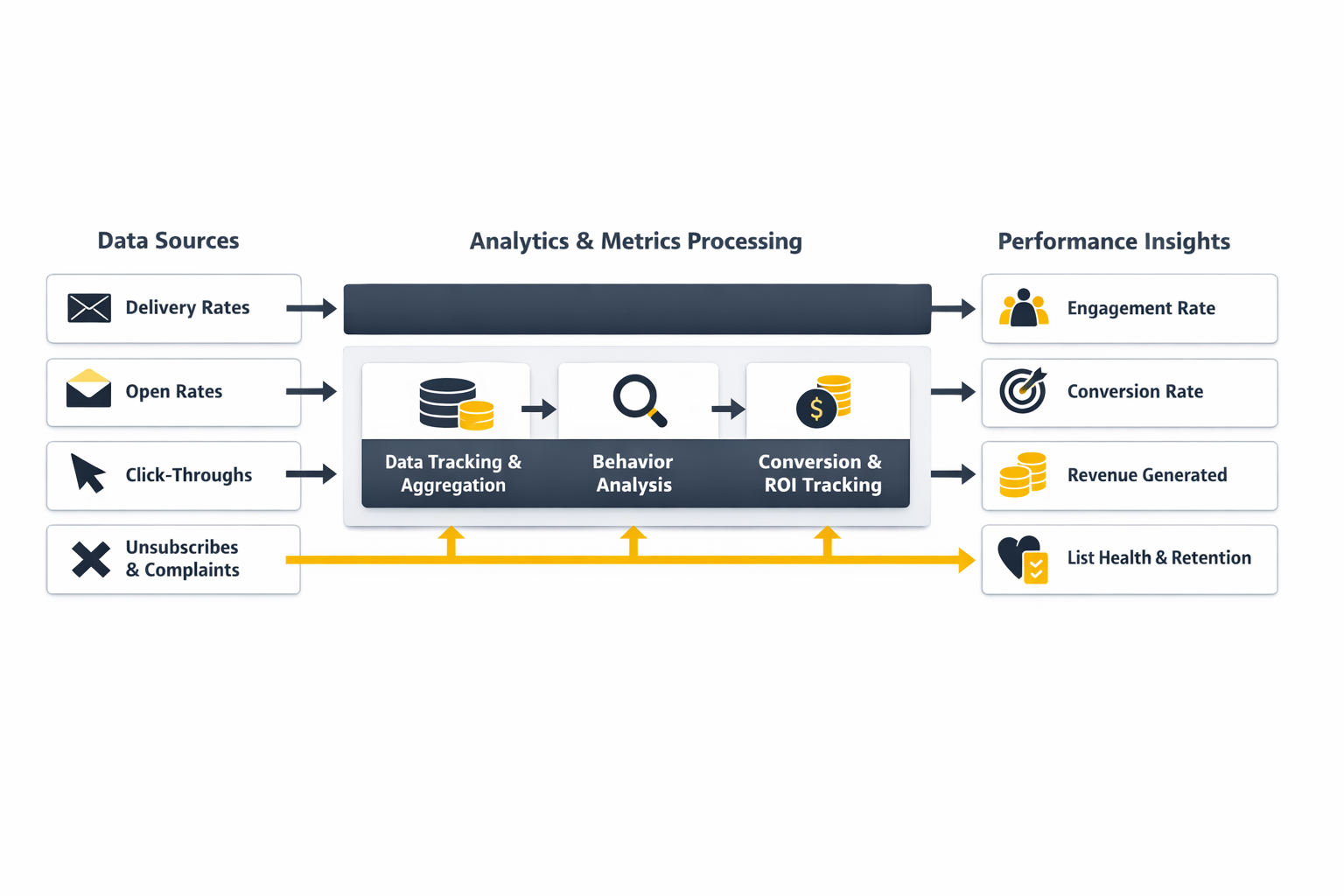
Once an email blast is live, the real work begins. This is the stage where a marketer finds out whether the campaign created real momentum or just produced a few flattering numbers that look good in a dashboard for half a day. That difference matters because email can be wildly profitable, but only when you read the results with enough discipline to separate attention from action and action from revenue.
The inbox itself has changed, and that changes how an email blast should be measured. Mailbox providers now care far more about authentication, complaints, and user signals than marketers were able to ignore a few years ago, which is why Google’s bulk sender requirements, Google’s spam-rate mitigation rules, and Yahoo’s sender standards have become part of normal campaign analysis instead of a technical side note for deliverability teams.
That shift is healthy, even if it makes lazy reporting harder. It forces businesses to treat an email blast like a system with inputs, outputs, and consequences. If the campaign gets opened but does not produce clicks, that means something. If it gets clicks but not conversions, that means something else. And if it gets short-term clicks while quietly increasing complaints or unsubscribes, that tells you even more than the visible engagement ever could.
What to Measure in an Email Blast
The first rule is simple: do not let one metric tell the whole story. Open rate still has value, but it no longer deserves the starring role by itself. Privacy protections, image loading behavior, and client-side quirks have made opens useful as directional information rather than a final verdict, which is why smart teams pair opens with clicks, unsubscribe rate, complaint signals, conversion rate, and revenue per recipient before deciding what a campaign actually accomplished.
This is also where benchmark data helps, but only when used with common sense. MailerLite’s 2025 benchmark analysis puts average open rates across industries at 43.46%, while Brevo’s current benchmark data and Mailchimp’s benchmark library show substantial variation by industry and email type. That should immediately kill the fantasy that one “good” number applies to every email blast. Different audiences behave differently, and a campaign should be judged against the reality of the business, not against a random screenshot from somebody else’s newsletter account.
So the healthier approach is to think in layers. Did the message reach the inbox? Did it earn attention? Did it produce intent? Did that intent turn into something the business actually values, such as a purchase, a booked call, a trial signup, or qualified demand? When you report an email blast this way, the campaign stops being a vanity exercise and starts becoming a decision-making tool.
Engagement Metrics That Deserve Attention
Open rate still matters because it gives you a quick read on subject line strength, brand recognition, and surface-level audience interest. But it becomes much more useful when compared against what happened next. If opens rise while clicks fall, the campaign may have created curiosity without creating desire. If opens are average but clicks and conversions are strong, the subject line may have been calm while the offer itself did the heavy lifting once people got inside.
Click-through rate deserves more respect because it signals active engagement rather than passive visibility. Yet even here, the story is incomplete without context. A high click-through rate can still hide weak commercial performance if the landing page is misaligned, the traffic is curious but unqualified, or the email promised something the page did not deliver.
Unsubscribes and complaint signals are just as important, even though marketers love pretending otherwise. A campaign that drives temporary activity while damaging list health is not a win. It is borrowed performance that often makes the next email blast harder to deliver and harder to trust.
Conversion Metrics That Actually Connect to Revenue
This is where analysis gets serious. A business should know what the blast was built to do before it looks at performance, because the primary conversion defines what counts as success. For one brand that could be direct sales. For another, it could be webinar registrations, demo requests, or lead magnet completions that enter a larger funnel.
Once that target is clear, the email blast should be measured against the economics of the outcome. Revenue per recipient, revenue per click, cost per acquisition, and lead-to-sale quality are far more useful than celebrating raw click volume with no proof of business impact. That is why benchmark material from Mailchimp’s campaign benchmarking resources matters most when it is used to frame better questions, not when it is used to chase generic averages.
The biggest advantage here is clarity. When a team knows exactly what its email blast must produce, copy improves, landing pages improve, segmentation improves, and reporting improves. The campaign becomes sharper because the definition of success becomes sharper.
Deliverability Metrics You Cannot Ignore
Deliverability used to be treated like technical housekeeping. Now it sits right in the middle of email strategy, and that is absolutely the right place for it. A brilliant email blast that gets routed to spam or throttled by mailbox providers is not a brilliant campaign. It is a wasted asset.
This is where provider rules become painfully practical. Google requires bulk senders to authenticate email, support easy unsubscription, and keep complaints under control, while Google’s mitigation FAQ makes the 0.3% user-reported spam threshold impossible to dismiss as a soft suggestion. Yahoo’s sender hub pushes the same direction with its enforcement standards for high-volume senders.
So yes, inbox placement is a performance metric. Complaint rate is a performance metric. Bounce behavior is a performance metric. And if your email blast starts degrading any of those signals, the platform is telling you something important: the campaign may be technically sent, but it is strategically unhealthy.
Why Complaint Rate Matters More Than Most Marketers Admit
Spam complaints are not just a reputation issue. They are a direct expression of mismatch between message and recipient. Sometimes that mismatch comes from poor targeting. Sometimes it comes from over-sending. Sometimes it comes from a list that was never truly healthy in the first place. Whatever the cause, complaint rate is one of the cleanest truth-tellers in the entire email blast system.
That is exactly why the current mailbox environment is so strict about it. Google’s guidance for mitigation eligibility spells out that a user-reported spam rate above 0.3% makes bulk senders ineligible for mitigation until the rate stays below that level for seven consecutive days. That is not a theoretical best practice. It is a performance boundary with consequences.
When complaint rate starts climbing, the answer is rarely to get more aggressive. The smarter move is usually the opposite. Tighten the audience, reduce unnecessary frequency, clean the list, improve expectation-setting at opt-in, and make the value of the email blast more obvious from subject line to CTA.
Authentication and Trust Signals
Authentication is not glamorous, but it changes how an email blast is interpreted before the reader ever sees it. SPF, DKIM, and DMARC help verify that the message is actually coming from the domain it claims to come from, and that makes them central to both security and deliverability. Providers are no longer treating those standards as optional polish for advanced senders.
The strategic implication is simple. Every marketer who depends on email should understand the basics of technical trust, even if someone else handles the DNS records. A business that ignores authentication is taking a core revenue channel and leaving it exposed to preventable failure.
That is also why the most professional email programs no longer separate creative work from infrastructure. The copy, the segment, the sending domain, the complaint rate, and the unsubscribe experience all work together. An email blast succeeds or fails as a complete system, not as isolated parts living in different departments.
The Wider Email Ecosystem
An email blast does not exist in a vacuum. It sits inside a broader ecosystem that includes acquisition sources, CRM data, automation logic, landing pages, sales follow-up, consent management, analytics tools, and brand trust. If any of those pieces are weak, the campaign feels weaker than it should. If they are aligned, email becomes one of the most powerful compounding assets a business can build.
This bigger picture matters even more now because email is being asked to do more than it used to. It is not just a broadcast channel anymore. It supports lifecycle marketing, first-party data strategy, retention, reactivation, and cross-channel orchestration. That broader role is reflected in the themes covered by Litmus and Oracle’s State of Email Trends report and Litmus’ wider State of Email report library, where personalization, lifecycle thinking, and operational maturity keep showing up as durable competitive advantages.
That means the real question is no longer whether to send an email blast. The better question is whether the blast is connected to everything around it well enough to do its job. When it is, one campaign can trigger more than one result at once. It can generate immediate revenue, enrich audience data, sharpen future targeting, and improve how the next campaign is built.
Where Platform Choice Starts to Matter
As the ecosystem grows, the platform matters more. Some businesses need strong automation and segmentation. Others care more about deliverability controls, CRM syncing, or the ability to manage both campaigns and transactional logic from one place. A smaller business might prefer Brevo for its broader communications stack, while another team might lean toward Moosend for automation workflows and campaign management.
The point is not to chase software for the sake of it. The point is to choose a setup that supports the kind of email blast program you actually want to run. If you need better list logic, choose for that. If you need tighter revenue attribution, choose for that. If you need infrastructure for outbound campaigns in a specific use case, evaluate a tool like ScaledMail with full awareness that cold outreach has different legal, ethical, and deliverability considerations than permission-based email marketing.
Software does not create strategy, but bad software fit can definitely slow strategy down. The stronger your ecosystem becomes, the more obvious it is that your email blast results are shaped by the system around the send as much as the send itself.
How Mature Teams Read Their Results
The most experienced teams do not panic over one campaign, and they do not celebrate one lucky spike as proof that everything is solved. They look for patterns across several sends. They compare segments against each other. They ask whether performance is improving because the message is better, because the audience is cleaner, because the offer is stronger, or because external conditions made this particular campaign easier than the last one.
That kind of patience creates better decisions. It also keeps a business from copying the wrong lesson. A strong result from one email blast might come from timing, novelty, or a temporary offer. A weaker result might actually contain the seeds of a better long-term strategy if the clicks were more qualified or the unsubscribes were lower. Mature analysis looks past the obvious number and asks what the campaign is teaching the business about its audience.
When you approach performance this way, email stops feeling unpredictable. It becomes a channel that can be refined with discipline. And once that happens, the value of every future email blast starts to climb because the business is no longer just sending messages. It is building intelligence.
Statistics and Data

Once you get serious about an email blast, statistics stop being decoration and start becoming decision tools. The numbers tell you whether your campaign is healthy, whether your audience still trusts you, and whether the business is creating attention that turns into action instead of noise that slowly damages deliverability. That is why this part matters so much: if you do not know how to read the data, you can talk yourself into almost any conclusion you want.
The tricky part is that email data can look stronger than it really is or weaker than it really is, depending on what you focus on first. A rising open rate can feel exciting until you discover the clicks are soft and the conversions are flat. A modest open rate can look disappointing until you realize the campaign is producing strong revenue per recipient and very low unsubscribe pressure. That is why the right way to analyze an email blast is to read the numbers in layers instead of chasing one headline metric.
What the Latest Email Blast Benchmarks Show
The current benchmark landscape makes one thing painfully clear: there is no universal number that magically defines a good email blast. MailerLite’s 2025 benchmark study, built from more than 3.6 million campaigns sent from 181,000 approved accounts, shows just how widely results move across industries, regions, and list types. Brevo’s 2025 benchmark, based on more than 44 billion emails, lands in the same place and reports overall averages of 31.22% for open rate, 3.64% for click-through rate, 0.4% for unsubscribe rate, 3.6% for soft bounce rate, and 0.19% for hard bounce rate.
That spread is exactly why businesses get into trouble when they copy random benchmark screenshots from social media. A strong email blast in one industry can look totally ordinary in another, and an “average” campaign can still be extremely profitable if it is built around the right audience and offer. Mailchimp’s campaign benchmarking system, which analyzes hundreds of millions of emails, reinforces this by comparing senders against peers with similar audience and industry characteristics instead of pretending all email performance belongs in one bucket.
So yes, benchmark data matters. But it matters in the way a map matters, not in the way a commandment matters. It shows you the terrain, not your exact destination.
Numbers That Actually Deserve Your Attention
If you want a clean way to think about an email blast, track the numbers in the order the customer experiences them. First comes delivery. Then comes attention. Then comes engagement. Then comes action. Then comes the aftertaste of the campaign, which shows up in unsubscribes, complaints, and list fatigue.
- Delivery metrics: inbox placement, bounce rates, authentication health, and complaint signals show whether the campaign even had a fair chance to work.
- Attention metrics: open rate is useful here, but only as directional evidence rather than the final answer.
- Engagement metrics: click-through rate and click-to-open rate reveal whether the content created real intent after the open.
- Business metrics: conversion rate, revenue per recipient, booked calls, trial starts, or qualified leads show whether the email blast helped the business in a meaningful way.
- List-health metrics: unsubscribes, spam complaints, and inactivity trends tell you what the campaign cost you on the way out.
This layered model matters because a campaign can look strong at one stage and weak at another. That does not make the data confusing. It makes it honest. The job is to understand where momentum is being created and where it is leaking away.
Open Rate Data Without Falling in Love With It
Open rate is still useful, but it should no longer run the whole conversation. Privacy changes and image-loading behavior have made opens less precise than they used to be, which means a high open rate is no longer enough to prove that an email blast truly worked. It can tell you that the subject line resonated, that the brand was recognized, or that curiosity was high. It cannot, on its own, tell you whether the campaign created value.
That is why it helps to read several benchmark sets together. MailerLite’s 2025 benchmark analysis places the overall median open rate at 43.46%, while Brevo’s 2025 benchmark page reports an overall open rate of 31.22%. Those numbers are not contradictory. They come from different datasets, different customer bases, and different methodologies. What they really tell you is that open rate can vary a lot even across reputable benchmark sources, which is exactly why no serious business should treat one benchmark as gospel.
The smarter question is this: did the email blast earn enough attention for the rest of the campaign to matter? If the answer is yes, then the next step is to inspect what happened after the open. That is where the real story begins.
Click and Click-to-Open Data That Reveals Intent
Clicks matter because they are harder to fake and more closely tied to actual interest. A reader who clicks is not just passively skimming the inbox. They are choosing to move forward. That makes click-through rate one of the most valuable signals in any email blast, especially when it is read alongside click-to-open rate.
Brevo’s current benchmark page reports an overall click-through rate of 3.64%, while MailerLite’s benchmark study tracks click rate and click-to-open rate across 46 industries and seven regions precisely because those numbers move so much by context. In other words, clicks are more meaningful than opens, but they still need interpretation. A low click rate may signal a weak offer, poor CTA hierarchy, or a mismatch between audience and message. A high click rate with low conversion can point to a post-click problem rather than an email problem.
This is where a lot of businesses finally realize the truth: an email blast is never just an email. It is the front door to a full conversion path, and clicks tell you how many people were willing to step inside.
Unsubscribe, Bounce, and Complaint Data
The least glamorous numbers in an email blast are often the most useful. Unsubscribes, complaints, and bounces tell you how much friction the campaign created. They show whether the message felt relevant, whether the list is being maintained properly, and whether the sending system is staying healthy enough to support the next campaign.
Brevo’s 2025 benchmark data reports an overall unsubscribe rate of 0.4%, a soft bounce rate of 3.6%, and a hard bounce rate of 0.19%. Those are not numbers you stare at only when something goes wrong. They are early warning signals. If unsubscribes climb, your messaging or frequency may be off. If soft bounces rise, mailbox issues or sending volume may be creating trouble. If hard bounces rise, the list almost always needs immediate cleaning.
Complaint data matters even more because it hits reputation directly. Google’s sender FAQ says senders should keep spam rates below 0.1% and prevent them from ever reaching 0.3% or higher, which means complaint pressure is not just a minor annoyance anymore. It is one of the clearest lines between a sustainable email blast program and one that is slowly training mailbox providers to distrust the brand.
Why Complaint Data Is So Important
Complaint data is brutal because it reflects real human irritation. A recipient is not clicking “report spam” because your design spacing was slightly off. They are doing it because the message felt unwanted, mistimed, misleading, or too frequent. That makes complaints one of the best truth signals in the entire email system.
Yahoo’s Complaint Feedback Loop documentation spells out the practical consequence: when recipients mark a message as spam, that directly hurts the sender’s reputation, and the feedback can be used to optimize who you target and how often you send. Yahoo’s sender best practices pushes the same point by recommending timely and relevant email to active, engaged audiences, plus prompt removal of invalid recipients and better handling of inactive subscribers.
This is why complaint data should never be treated as a deliverability team problem sitting somewhere in the background. If complaints are rising, your email blast strategy needs fixing at the audience and message level, not just at the technical level.
Cadence and Frequency Data
Frequency decisions are where a lot of email programs quietly lose money. Sending too little can leave attention on the table, but sending too much can turn a healthy list into a tired list faster than most teams expect. That is why cadence is not a creative preference. It is a data problem.
MailerLite’s 2026 cadence study analyzed more than 42,000 accounts, 1.4 million campaigns, and over 12 billion sent emails from 2025 data to study how send frequency affects engagement. That kind of dataset matters because it pushes the conversation away from generic advice and toward actual behavior patterns. The takeaway is not that every business should send at the same rhythm. The takeaway is that cadence changes performance enough that it deserves to be tested intentionally instead of guessed.
That matters for every email blast because audience trust is cumulative. If the list starts expecting relevant communication, frequency becomes easier to sustain. If the list starts expecting interruptions, every additional send costs more than the team thinks.
How to Use Benchmark Data Without Misreading It
The best way to use benchmark data is to combine it with your own recent baseline. Compare your last five or ten campaigns. Break performance down by segment, by offer type, by send day, and by landing-page path. Then use external benchmarks to see whether your results are wildly out of line or roughly within the range you should expect.
Mailchimp’s benchmark resources are useful for this kind of framing because they treat benchmarking as a way to spot strengths and weaknesses, not as a way to brag. MailerLite’s reporting guidance also reflects the right mindset by putting opens, clicks, unsubscribes, spam complaints, and bounces in the same measurement environment instead of separating vanity numbers from health metrics. That is the mindset an email blast needs if it is going to improve over time.
If your campaign is under benchmark on opens but over benchmark on conversions, that is not failure. If your campaign beats benchmark on clicks but leaves behind a rising complaint trend, that is not success. The goal is not to win one number. The goal is to understand the whole picture well enough to make the next send stronger.
The Statistics That Should Shape Your Next Email Blast
If you take one lesson from all this data, let it be this: every email blast has two jobs. The first is to perform now. The second is to preserve the health of the channel so it can perform again later. The statistics that matter most are the ones that help you do both at the same time.
So watch open rate, but do not worship it. Watch click-through rate, but connect it to landing-page behavior. Watch conversion, but judge it against list quality and commercial reality. And watch complaints, bounces, and unsubscribes like they are part of the revenue equation, because in 2026 they absolutely are.
The next part of the article will move from pure performance data into the bigger ecosystem around an email blast. That is where platform choice, compliance, automation, and channel coordination start to shape what these numbers mean in the real world.
Automation, Compliance, and the Modern Email Stack
By the time a business reaches this stage, an email blast is no longer just a single campaign tactic. It becomes part of a bigger operating system that includes list growth, segmentation, deliverability controls, automation logic, consent management, landing pages, CRM data, and reporting. That matters because the businesses getting the best results are not simply sending more email. They are building a cleaner machine around every send so the message lands in the right inbox, at the right time, with the right follow-up already in motion.
You can see that shift in the way email platforms and research sources talk about the channel today. Litmus’ current State of Email reports frame email as part of lifecycle marketing rather than a disconnected newsletter workflow, and Mailchimp’s automation platform makes the same point by centering trigger-based journeys and behavior-driven messaging. In other words, the modern email blast still matters, but it works best when it sits inside a system that keeps the conversation going after the initial send.
That is why Part 5 matters so much. If Part 4 showed you how to read the numbers, this section shows you how to build the environment that gives those numbers a fair chance to improve over time. A great campaign can absolutely win on its own. But a great system wins again and again.
Why Automation Changes the Value of an Email Blast
A lot of marketers treat an email blast and automation like two different worlds. They are not. A blast creates a spike of attention, while automation decides what happens to that attention after the click, after the purchase, after the signup, or after the silence. When those two pieces work together, the campaign becomes more than a one-time push. It becomes an entry point into a customer journey that keeps moving.
This is exactly why email platforms keep investing in journey logic. Mailchimp’s customer journey documentation focuses on dynamic marketing paths that react to behavior, and its automation flow builder is built around tags, delays, branching, and action-based sequencing. The strategic lesson is simple: an email blast should not end with a click. It should move people into the next message, the next segment, or the next sales action automatically.
That shift makes the campaign more efficient in two ways. First, it improves the value of every response you earn. Second, it reduces the pressure to over-send generic campaigns, because the system can handle more of the follow-up with logic instead of brute force.
From One-Off Campaigns to Customer Journeys
The old model was simple: write an email blast, send it to a large list, and hope enough people convert before attention fades. The stronger model is to design the blast as the first step in a longer journey. If someone clicks but does not buy, they should not disappear into a reporting spreadsheet and stay there. They should move into a follow-up path that reflects what they showed interest in.
This is where lifecycle thinking starts compounding. A product-launch blast can feed a reminder sequence. A webinar email blast can feed a show-up campaign, a replay campaign, and a sales sequence afterward. A promotional send can split buyers, clickers, and non-openers into different next steps so the business stops repeating the same generic message to people living in totally different realities.
That kind of setup also makes analysis cleaner. You stop asking whether the blast “worked” in the abstract and start asking whether it fed the right people into the right next step. That is a much smarter question.
Compliance That Keeps the Channel Alive
Compliance is one of those topics people love to treat like a boring footnote, right up until it starts hurting performance. In reality, compliance is part of what makes an email blast commercially viable. If people cannot unsubscribe easily, if consent is fuzzy, if sender identity is unclear, or if the message feels deceptive, the campaign is not just legally exposed. It is strategically weak.
The official guidance is not subtle about this. The FTC’s CAN-SPAM compliance guide says commercial email must avoid misleading header information, avoid deceptive subject lines, identify the message as an ad when appropriate, include a valid physical postal address, and give recipients a clear way to opt out. Over in the UK and Europe-facing context, the ICO’s guidance on direct marketing using electronic mail and its PECR guidance on electronic mail marketing make clear that email marketing rules are tied tightly to consent and responsible direct marketing practices.
The smart takeaway is not fear. It is clarity. A compliant email blast is easier to trust, easier to maintain, and easier to scale because it is built on clear expectations between sender and subscriber. That is good law and good business at the same time.
What Compliance Looks Like in Practice
In practice, compliance looks less like legal jargon and more like operational discipline. It means clean opt-in processes, visible unsubscribe links, accurate sender information, honest subject lines, and a suppression system that actually works. It also means that when someone opts out, the business treats that request like a hard boundary rather than an inconvenience.
The reason this matters so much for an email blast is that the blast magnifies everything. A small trust problem becomes a large complaint problem when thousands of messages go out at once. A weak unsubscribe experience becomes a reputation problem when frustrated recipients reach for the spam button instead.
So yes, compliance protects the business legally. But it also protects inbox placement, brand trust, and the long-term earning power of the list. That is why experienced operators do not separate compliance from performance. They know the two are linked.
Deliverability Controls Inside the Stack
Once the campaign system grows, deliverability has to be built into the stack rather than checked at the last minute. That means domain authentication, list hygiene, complaint monitoring, bounce management, and engagement-based sending all need a real owner. Without those controls, even a strong email blast can get undermined by hidden technical debt.
The mailbox providers have already told senders exactly what they care about. Google’s sender guidelines require authentication and easier unsubscription for bulk senders, while Google’s sender FAQ says user-reported spam rates above 0.1% start hurting inbox delivery and rates at 0.3% or higher cause even greater harm. Yahoo’s sender best practices push the same principles by telling senders to remove invalid recipients, monitor inactive users, and avoid continuing to send email to people who are not reading it.
That is why a mature email blast program looks calm before the send. The business already knows whether authentication is healthy, whether complaint rates are stable, and whether the audience should be tightened before volume goes out. Deliverability is not luck. It is preparation.
Why Inactive Subscribers Change the Whole Game
One of the easiest ways to quietly damage an email program is to keep sending every blast to people who stopped caring months ago. It feels harmless because the list looks larger, but larger is not healthier. Sending to disengaged subscribers lowers engagement signals, increases the chance of complaints, and teaches mailbox providers that your messages are increasingly irrelevant.
Yahoo’s guidance is direct about this and warns that sending to users who are not reading messages harms delivery metrics and reputation. Google’s FAQ points to the same broader reality by tying inbox performance to complaint pressure and user-reported spam rates. In other words, inactive contacts are not passive. They actively shape how the rest of your email blast is treated.
That is why re-engagement campaigns, sunset policies, and suppression logic are not optional extras for mature teams. They are part of the basic maintenance that keeps the channel strong enough to scale.
Choosing Tools That Fit the Way You Sell
Software decisions become more important once the email blast is part of a larger system. The right platform is not the one with the longest feature list. It is the one that supports the kind of segmentation, automation, reporting, and operational control your business actually needs. If the tool fights your workflow, even a good campaign will feel harder to run than it should.
For some businesses, that means choosing a platform that combines campaign sends with broader communications and CRM-style logic. That is where something like Brevo can make sense, especially when a team wants email, automation, and additional communication channels in one place. For teams that care heavily about automation workflows and email-specific campaign control, Moosend can fit naturally into the stack.
Other businesses need the surrounding funnel to be just as strong as the send itself. If the goal is to connect an email blast to landing pages, opt-in flows, and offer delivery, tools like ClickFunnels or Systeme.io can be worth evaluating because the post-click environment matters almost as much as the email itself.
When CRM and Data Plumbing Start to Matter
As soon as the list grows and the offers become more nuanced, CRM and data flow begin to shape campaign quality. A business with no clean contact data will struggle to segment well, personalize intelligently, or route follow-up correctly. That means the email blast might still go out, but the business will keep losing the advantage that good data is supposed to create.
This is where a CRM connection can upgrade the whole system. A tool like Copper can make sense for teams that want stronger contact context and relationship tracking around sales activity, while form and data-capture tools like Fillout can help businesses improve the quality of the information entering the funnel in the first place. Better inputs make better segmentation possible, and better segmentation makes every future email blast more relevant.
Once that data layer is in place, reporting becomes more honest too. You can finally connect campaign behavior to lead status, deal movement, and downstream revenue rather than pretending clicks alone tell the whole truth.
How AI and Automation Can Help Without Ruining the Message
AI is now part of the email conversation whether marketers like it or not, but the businesses getting real value from it tend to use it carefully. They use it to speed up workflow, improve categorization, summarize responses, enrich data, or draft variants faster. They do not use it as an excuse to flood the list with lifeless, over-produced copy that sounds like every other sender in the inbox.
This matters because the market is already crowded with tools promising smarter automation. Depending on the stack, teams may look at options like Comp AI for compliance-related workflows, Chatbase for conversational support layers, or Firecrawl when they need cleaner web data extraction feeding into internal systems. Those tools can absolutely support a better email blast operation, but only when the strategy is already grounded in audience relevance and a clear commercial goal.
The best use of AI is not to replace thinking. It is to remove repetitive friction so marketers can spend more time on targeting, offer quality, positioning, and customer understanding. The human part is still the part that wins.
Building an Email Blast System That Keeps Getting Better
At this point, the pattern should be clear. A profitable email blast does not come from one magic subject line, one clever automation, or one perfect piece of software. It comes from a system where deliverability, consent, automation, segmentation, landing pages, and measurement all support each other. Once that system starts working, every campaign becomes a chance to strengthen the next one instead of starting from zero again.
That is also why mature teams do not ask only whether a blast generated results today. They ask whether it improved the database, clarified audience behavior, taught the team something useful, and preserved the health of the channel. Those questions sound less exciting, but they lead to much more profitable decisions.
Part 6 will bring everything together with the final strategic takeaways and the FAQ that businesses most often ask before they commit to a serious email blast program. That is where the moving parts finally lock into one practical picture.
Bringing the Complete Email Blast Strategy Together

If you made it this far, you can probably feel the difference between a random email blast and a real email strategy. One is just a send. The other is a system built around audience quality, trust, timing, messaging, measurement, and follow-up. That difference is exactly why some brands keep getting stronger results from email while others keep wondering why the channel feels weaker every quarter.
The rules shaping this channel are not vague anymore. Google’s sender guidelines and Google’s bulk sender FAQ make it clear that authentication, unsubscribe handling, and spam-rate control are now table stakes, while Yahoo’s sender best practices keep pushing the same message: send relevant email to active, engaged audiences. On the legal side, the FTC’s CAN-SPAM guide and the ICO’s electronic mail marketing guidance reinforce that clarity, consent, and easy opt-out handling are not optional extras.
That is the real takeaway from this complete guide. A modern email blast still has enormous power, but only when it respects the inbox, respects the subscriber, and respects the long-term health of the list. Once you start thinking that way, email stops feeling like a gamble and starts feeling like one of the most controllable growth channels in your business.
FAQ for the Complete Guide
What is an email blast in modern marketing?
An email blast is still a large campaign sent within a short period of time, but in modern marketing it should not mean “send the same thing to everyone and hope for the best.” A strong email blast is usually shaped by segmentation, consent, clear offer positioning, and technical trust signals before the campaign ever goes out. So the term still works, but the execution behind it has become far more disciplined.
Do email blasts still work in 2026?
Yes, they still work extremely well when the list is healthy and the message is relevant. Current benchmark resources from MailerLite, Brevo, and Mailchimp all show that email remains a high-performing channel, but results vary widely by industry, audience quality, and campaign type. That means an email blast can absolutely drive revenue, but only when it is executed with intention instead of volume for volume’s sake.
What usually makes an email blast fail?
Most failures come from a handful of predictable problems. The audience is too broad, the offer is too weak, the message arrives at the wrong moment, or the list has been neglected long enough that trust is already slipping. In some cases the creative looks fine, but the real issue is deliverability, which means the message never got a fair shot in the inbox to begin with.
Is open rate still important?
It is still useful, but it should not be treated like the final verdict. Open rate can tell you whether the subject line and sender recognition did their job, but it cannot prove that the email blast created meaningful business outcomes. That is why smarter teams use opens as an early signal and then let clicks, conversions, unsubscribes, and complaints tell the fuller truth.
What metrics should you prioritize first?
The best order is usually delivery, attention, engagement, conversion, and list health. In practical terms, that means watching inbox placement, bounce patterns, open rate, click-through rate, downstream conversions, unsubscribe rate, and spam complaints together instead of in isolation. The reason is simple: a campaign that looks strong at one stage can still be weak at the stage that actually matters to the business.
What spam complaint rate is dangerous?
Google’s official bulk sender FAQ says bulk senders should keep user-reported spam rates below 0.1% and prevent them from reaching 0.3% or higher. That matters because complaint rate is not just a reporting metric. It is one of the clearest signals mailbox providers use to judge whether your email blast is welcome or increasingly unwanted.
How often should you send email blasts?
There is no fixed number that works for every business because send frequency only works when it matches audience expectation and message quality. If the list trusts you and keeps engaging, you can often send more than you think. If unsubscribes, complaints, or inactivity start rising, frequency is usually one of the first areas worth tightening.
Should you segment before sending?
Yes, almost always. Sending one campaign to the entire list might feel efficient, but it usually weakens relevance and increases fatigue over time. Even simple segmentation based on recent activity, customer status, or interest signals can make an email blast feel more timely and more personal without turning the workflow into a nightmare.
How do you keep an email blast out of spam?
You do it by building trust into the system instead of trying to trick filters. Google and Yahoo both emphasize authentication, low complaint rates, easy unsubscribe handling, and sending to engaged recipients. So the real answer is a healthy list, authenticated infrastructure, relevant messaging, and disciplined audience selection.
What role does automation play after an email blast?
Automation is what turns a campaign from a short spike of attention into a longer customer journey. A blast might generate the click, but automation decides what happens next for buyers, clickers, no-shows, non-openers, or people who showed interest without converting. That is why platforms like Mailchimp’s automation system and customer journey tools matter so much in modern email strategy.
When should you clean your list?
You should clean it regularly instead of waiting for obvious trouble. Inactive subscribers, invalid addresses, and stale segments can quietly hurt engagement and reputation long before a dramatic deliverability issue shows up. A smaller but healthier list often gives an email blast more power than a larger list filled with people who stopped caring months ago.
Can small businesses win with email blasts too?
Absolutely. In many cases, smaller businesses have an advantage because their lists can be easier to understand, cleaner to maintain, and more responsive to sharper offers. A small company does not need massive volume to make an email blast profitable. It needs clarity, consistency, and a message that actually deserves attention.
What tools are worth considering for an email blast program?
That depends on where the bottleneck is. If you want campaign management and broader communication workflows in one place, Brevo is worth considering. If you want email-focused automation and campaign workflows, Moosend can be a strong fit. If your bigger issue is the post-click funnel, you may want to evaluate ClickFunnels or Systeme.io so the landing page and offer delivery are as strong as the email itself.
Should you hire professionals to run your email blast strategy?
If email is tied directly to revenue, lead generation, or retention, getting expert help can save you a lot of costly trial and error. The channel looks simple from the outside, but good results usually depend on copy, segmentation, automation, deliverability, compliance, and analytics all working together. That is exactly the kind of work professionals can tighten much faster than a business trying to learn every layer at once.
Work With Professionals
If you want your email blast strategy to become a real growth engine, it helps to work with people who understand more than just subject lines and templates. You need people who can connect list growth, consent, deliverability, campaign strategy, landing pages, automation, and measurement into one system that actually produces results. That is where professionals separate themselves from amateurs very quickly.
You may also need a stronger stack around the work itself. That could mean using Fillout to improve lead capture, Copper to keep customer and pipeline data cleaner, or ScaledMail in cases where outbound infrastructure matters and the use case is being handled responsibly. The goal is not to buy more tools than you need. The goal is to remove the weak points that stop an email blast from performing the way it should.
If you are the marketer on the other side of that work, the opportunity is obvious. Businesses still want the upside of email, but more of them now understand that a profitable email blast requires strategy, technical discipline, and sharp execution. That creates room for professionals who can genuinely deliver all three.
Explore 10K+ Remote Marketing Contracts on MarkeWork.com
Most marketers spend too much time chasing clients, competing on crowded platforms, and losing a percentage of every project to middlemen.
MarkeWork gives you a better way. Browse thousands of remote marketing contracts and connect directly with companies desperate to hire skilled marketers like you without platform commissions and without unnecessary gatekeepers.
If you’re serious about finding better opportunities and keeping 100% of what you earn, you can explore available contracts and create your profile for free at MarkeWork.com.
 Filip Konecny Enterprises