
Digital Marketing Company: How to Choose the Right Growth Partner
A digital marketing company can look like a miracle when your pipeline is dry, your website is underperforming, and every channel feels disconnected. It can also become an expensive distraction when the firm you hire talks in dashboards, vanity metrics, and vague promises instead of revenue, retention, and real business outcomes. That is why this article is built to help you think clearly before you sign anything, launch anything, or hand over your growth engine to somebody else.
The market has become too large, too complex, and too measurable for guesswork. Global ad spend moved to roughly $1.1 trillion in 2024, while search behavior still runs heavily through Google, and buying journeys now mix self-service research, content, paid media, email, and human sales conversations. In other words, a serious digital marketing company is no longer just a vendor that “runs ads” or “does SEO.” It should function as a strategic operating partner that connects traffic, trust, conversion, and measurement.
This first part lays the groundwork. You will see the structure of the full article, why hiring the right team matters, the framework used to evaluate agencies properly, the core capabilities that separate professionals from pretenders, and the implementation principles that make campaigns sustainable instead of chaotic.
Article Outline
- Part 1: Why a Digital Marketing Company Matters
- Part 2: How to Evaluate Service Models
- Part 3: Channel Strategy and Campaign Design
- Part 4: Measurement, Attribution, and Optimization
- Part 5: Pricing, Red Flags, and the Selection Process
- Part 6: Final Decision Framework and FAQ
Why a Digital Marketing Company Matters
The right digital marketing company matters because marketing is no longer a series of isolated tactics. Search visibility, paid acquisition, content, landing pages, CRM follow-up, analytics, and creative testing all affect one another, which means one weak link can quietly drain the return from every other channel. That is especially important now that buyers increasingly rely on self-service research while still expecting suppliers to understand their real problems.
This shift changes what businesses should demand from an agency. You do not need a team that simply buys clicks. You need a company that understands how people discover options, compare alternatives, hesitate, ask questions, and finally decide. That is why the best digital marketing company is usually the one that can explain customer intent with clarity, connect channels with discipline, and prove progress with reporting that management can actually use.
There is also a financial reason this decision matters. IAB’s 2025 outlook shows digital budgets continuing to move into performance-oriented channels such as search, social, retail media, and video, while Nielsen’s 2024 annual marketing research highlights how marketers are under heavier pressure to prove both immediate and long-term ROI. When budgets are scrutinized this closely, a weak agency relationship does not just waste money. It slows learning, damages internal confidence, and makes future growth decisions harder.
Framework Overview
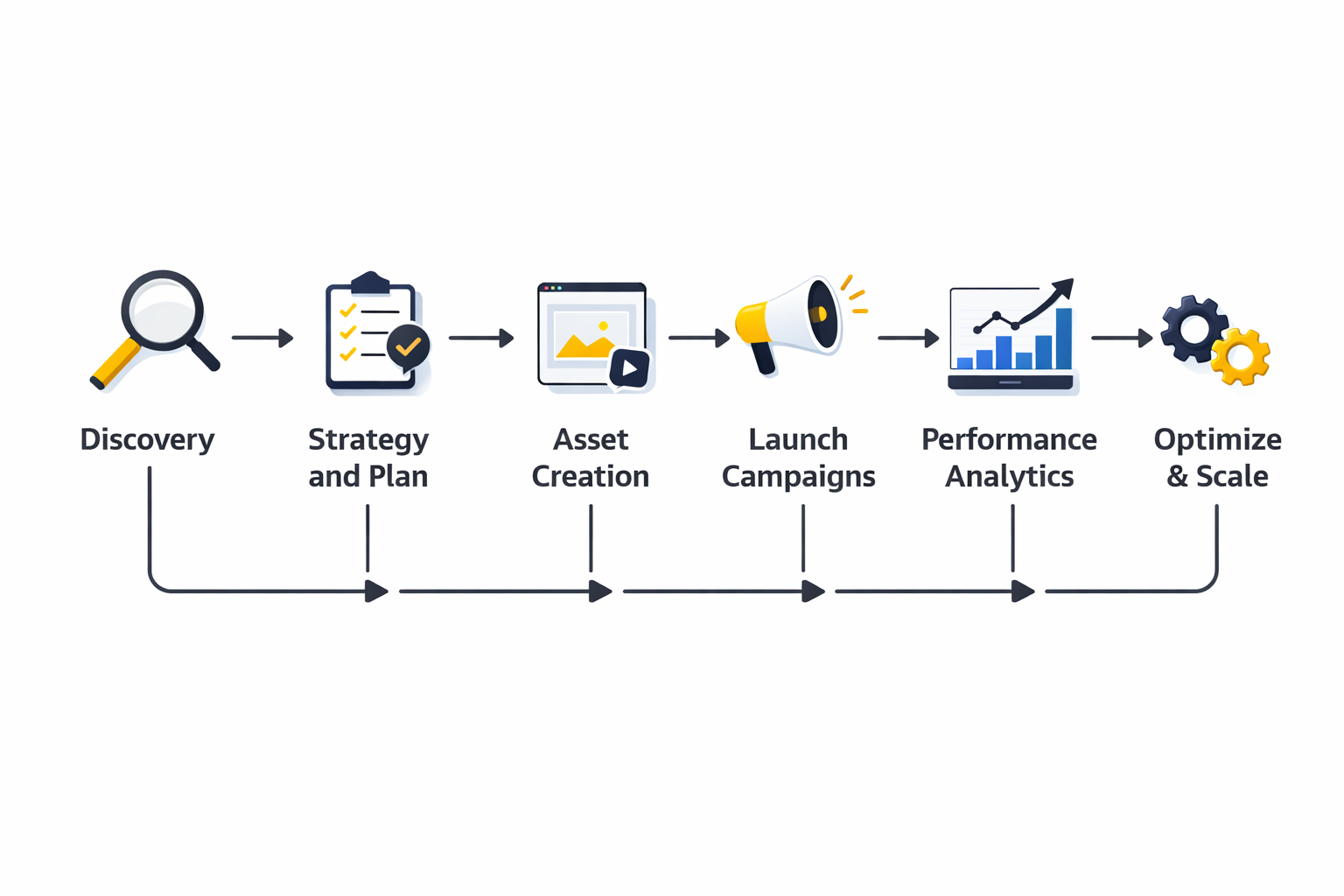
The simplest way to assess a digital marketing company is to look at five connected layers: strategy, execution, data, communication, and commercial fit. Strategy answers whether the firm understands your market, your offer, and your economics. Execution shows whether it can build campaigns, creative systems, landing pages, and follow-up sequences that move prospects from attention to action.
Data is where many agency relationships quietly fail. A company can look polished in meetings and still leave you blind when it comes to lead quality, source attribution, assisted conversions, and sales-cycle influence. That is why measurement matters so much in the framework. Salesforce’s 9th State of Marketing research emphasizes the importance of unified data and personalization, while Adobe’s 2025 digital trends report shows how strongly customers respond to consistent experiences across touchpoints.
Communication and commercial fit complete the picture. A strong agency should know how to translate marketing performance into business language, and its pricing model should match the complexity of the work rather than hide behind mystery retainers. If the team cannot tell you what success will look like, how the first 90 days will be structured, and what must be true for the partnership to scale, that is not sophistication. It is a warning.
Core Components
A capable digital marketing company usually combines four core components: audience insight, channel expertise, conversion architecture, and reporting discipline. Audience insight comes first because campaigns fail when messaging speaks to demographics instead of motivation. The best firms study what buyers are trying to solve, what language they use, what objections keep them from moving, and what evidence they need before they trust you.
Channel expertise comes next, but it should never be treated as the whole job. Search still matters enormously because Google continues to dominate global search share, yet paid social, email, short-form video, remarketing, and content distribution can all support the same buyer journey when they are coordinated properly. A digital marketing company that pushes one channel as the answer to every growth problem is usually selling its own comfort zone rather than solving your actual bottleneck.
Conversion architecture is what turns activity into outcomes. That includes landing pages, offer positioning, lead magnets, booking flows, sales pages, CRM automation, and email nurturing. If you need infrastructure as well as strategy, tools like ClickFunnels, Systeme.io, or Fillout can support the funnel layer, but the real value still comes from the thinking behind the build. Software does not replace strategic judgment. It only accelerates whatever system you have already designed.
Reporting discipline is the final component, and it often tells you whether an agency is operating professionally or performing for appearances. A trustworthy company tracks leading indicators and business outcomes together, not separately. It should be able to explain why traffic quality changed, why conversion rate moved, where assisted conversions are coming from, and what decision the latest data makes possible.
Professional Implementation
Professional implementation starts with sequencing, not speed. A strong digital marketing company does not begin by spraying content across platforms or launching broad campaigns on day one. It starts by clarifying goals, checking analytics, validating tracking, tightening offers, mapping audience segments, and deciding which channel should carry the first growth hypothesis.
That measured approach is more important than ever because the environment keeps shifting. Google’s guidance on durable measurement and first-party data makes it clear that businesses cannot depend on old assumptions about tracking, while Google’s work on changing search behavior shows that discovery patterns continue to evolve. The agency you hire should be building a system that can adapt, not just a campaign that looks good for one reporting cycle.
Implementation also means connecting execution tools to business follow-through. For example, email and lifecycle nurturing still matter after the click, which is why platforms such as Brevo can support structured follow-up, while publishing discipline can improve when workflows are centralized through tools like Buffer. The point is not to stack software for the sake of it. The point is to make sure the marketing company you choose can operationalize ideas without creating a bloated, fragile mess.
When implementation is handled well, the benefits compound. Strategy becomes easier to refine because data is cleaner. Creative gets sharper because the team learns what audiences respond to. And management gains confidence because the company they hired is no longer asking for blind faith; it is building a repeatable system for growth.
How to Evaluate Service Models
Hiring a digital marketing company gets a lot easier when you stop asking, “Which agency looks the most impressive?” and start asking, “Which operating model fits the way we actually grow?” That shift matters because marketing teams are being pushed harder than ever to justify spend. Gartner’s 2025 CMO spend data shows budgets sitting at 7.7% of company revenue, with 59% of CMOs saying they still do not have enough budget to execute their strategy, so the service model you choose has to create leverage, not just activity.
That is why this part of the article is not about chasing agency awards or being seduced by slick sales decks. It is about figuring out whether the digital marketing company you are considering is set up to solve your kind of problem, inside your kind of business, with your kind of timeline and internal team. If you get that right, everything else gets easier. If you get it wrong, even talented marketers can struggle to create consistent results.
Full-Service vs Specialist Firms
A full-service digital marketing company can make sense when your biggest problem is coordination. If paid media, SEO, email, creative, analytics, landing pages, and CRM follow-up all need to work together, one integrated team can reduce friction and speed up learning. That matters even more now that 78% of customers say they want consistent brand experiences, because disconnected execution across channels does not just feel messy internally; it weakens the customer experience on the outside too.
A specialist firm becomes more attractive when the bottleneck is narrow and expensive. Maybe your paid search account is wasting budget, maybe your technical SEO is broken, or maybe your lifecycle email system barely exists. In that case, a specialist can often move faster and go deeper than a broad agency that promises everything but is only truly elite at one or two things.
The mistake is assuming one model is always superior. A full-service digital marketing company is not automatically more strategic, and a specialist is not automatically more effective. The real question is whether your growth problem is mainly about orchestration or mainly about a single high-stakes capability that needs immediate expertise.

Strategy-First vs Task-First Engagements
One of the fastest ways to spot a weak digital marketing company is to watch how quickly it jumps into tactics. If the conversation rushes straight into ad formats, posting frequency, or keyword lists before anyone has clarified margins, sales capacity, audience segments, or offer strength, you are probably looking at a task-first vendor rather than a real strategic partner. That kind of engagement can feel productive in the beginning because things start moving fast, but speed without direction has a way of getting expensive.
A strategy-first company usually sounds a little slower at the start, and that is often a good sign. It wants to understand how buyers behave, where revenue actually comes from, how leads are qualified, and what happens after someone converts. That approach fits the current buying environment far better, especially when Forrester found that 86% of B2B purchases stall and 81% of buyers are dissatisfied with their chosen providers. In a market like that, the digital marketing company you hire cannot just generate attention; it has to reduce friction in the buying journey.
This is where many businesses need to be brutally honest with themselves. If you already know the strategy and simply need skilled execution, then a task-oriented engagement can work beautifully. But if your message is muddy, your funnel is fragmented, and your reporting does not connect to revenue, then hiring a task-first agency will usually magnify confusion instead of fixing it.
Internal Ownership and Hybrid Models
Many of the best arrangements are hybrid, not purely outsourced. That is because some capabilities should usually stay close to the business: offer development, pricing, brand voice, product insight, and the sales feedback loop. A digital marketing company can absolutely strengthen all of those areas, but it should not be inventing them from scratch while your internal team stays detached from the process.
This is where governance matters more than most companies realize. Deloitte’s 2024 Global Outsourcing Survey, which included more than 500 executives, found that organizations are moving toward more balanced sourcing models and more value-based relationships. The same research also points out that front-office and core capabilities such as sales and marketing are increasingly part of outsourcing decisions, which tells you something important: companies are no longer outsourcing only support work. They are outsourcing growth-critical work, which means the operating model has to be deliberate.
So when you evaluate a digital marketing company, ask yourself what it should own fully, what it should co-own, and what your team must keep internally. If nobody can answer that clearly, the relationship will turn into a blur of missed handoffs, duplicated work, and reporting arguments. The best agencies do not try to own everything. They help define the line between internal authority and external execution so the whole system becomes easier to manage.
Commercial Models and Contract Logic
Pricing tells you a lot about how a digital marketing company thinks. A flat retainer can work well when the scope is stable and the company is handling an ongoing mix of planning, execution, reporting, and optimization. A project fee can be smarter for one-off work such as a funnel build, analytics cleanup, CRM migration, or website relaunch. Performance-based compensation sounds attractive on paper, but it only works when attribution is clean, the sales process is controlled, and both sides agree on which outcomes the agency can genuinely influence.
This is why cheap retainers often become expensive, while clear scopes often save money. When the commercial model is vague, agencies protect themselves with loose deliverables and clients protect themselves with constant requests, which poisons the relationship on both sides. The better path is to define the business outcome, the decision rights, the reporting cadence, and the review process before work begins.
There is also a larger budget reality behind all of this. Gartner reports that 39% of CMOs plan to cut agency budgets, and the same release notes that many are streamlining rosters, renegotiating scope, and eliminating unproductive relationships. That does not mean agencies are losing relevance. It means weak commercial logic is getting punished faster than before.
How to Test Accountability Before Signing
The easiest way to test a digital marketing company is not by asking for a promise. It is by asking how it thinks. Ask what it would measure in the first 30 days, what it believes your likely bottleneck is, what assumptions it would want to validate, and what could cause the engagement to fail even if everyone is working hard. A serious team will not pretend certainty where certainty does not exist. It will show you how it makes decisions under incomplete information.
You should also listen for signs of relationship maturity, because performance is not driven by technical skill alone. Aprais’ 2024 analysis of more than 27,000 client-agency evaluations, matched with over 3,000 award-winning campaigns from the WARC Effective 100 database, found that stronger relationships are linked with more effective work. The most successful teams were marked by trust, strategic thinking, and a willingness to challenge one another rather than simply keep the peace.
That is a useful filter when you are choosing a digital marketing company. You do not want a team that says yes to everything, disappears into a dashboard, and resurfaces with excuses. You want one that can challenge bad assumptions, explain tradeoffs clearly, and still operate like a partner rather than a lecturer. Real accountability feels collaborative, but it never feels passive.
The Key Takeaway From Part 2
The right digital marketing company is not the one with the loudest pitch. It is the one whose service model matches the way your business actually needs to grow. Sometimes that means full-service integration, sometimes it means specialist firepower, and sometimes it means a hybrid arrangement where internal ownership and external expertise are carefully divided.
If you remember one thing from this section, let it be this: evaluate the model before you evaluate the personality. A charming team with the wrong structure will still frustrate you. A disciplined team with the right structure can become one of the best growth decisions you make.
Channel Strategy and Campaign Design
This is where a digital marketing company proves whether it actually understands growth or just knows how to stay busy. Strategy sounds exciting in a pitch, but channel selection and campaign design are where real money gets made or wasted. If the company cannot explain why a channel fits your buyer, your margins, your sales cycle, and your content strengths, then you are not looking at a strategy at all. You are looking at a collection of tactics dressed up as expertise.
The challenge is that buyers do not move in straight lines anymore. Salesforce’s current State of Marketing research highlights how marketers are prioritizing unified experiences across mobile, social, and web, while Nielsen’s 2024 marketing report makes the point even sharper by warning that channel-level performance alone does not guarantee the outcomes leaders actually care about. That is why a serious digital marketing company does not start with, “Let’s do more of everything.” It starts with which channels deserve focus, how they should work together, and what campaign architecture will move people from attention to action.
Start With Buyer Intent, Not Channel Hype
The first mistake businesses make is picking channels based on what feels hot instead of what fits buyer intent. A digital marketing company should look at how your audience discovers problems, compares options, and finally makes a decision. That matters because the channel that creates awareness is not always the channel that closes the sale, and the channel that captures demand is not always the one that creates it in the first place.
Search is still a central piece of the picture because Statcounter’s February 2026 data shows Google at 89.98% of worldwide search engine market share. That makes search crucial for categories where people actively look for answers, vendors, reviews, and local options. But search should not automatically dominate the entire plan, because intent often forms earlier through video, social content, referrals, email, and repeated exposure long before someone types a high-intent query.
That is why channel strategy has to begin with behavior. If people need education before they trust you, the digital marketing company should lean into content, video, email nurturing, and remarketing before expecting bottom-funnel conversion campaigns to carry the whole business. If demand already exists and buyers are actively comparing providers, then search, conversion-focused landing pages, and sales enablement can play a much larger role right away.
Build a Channel Mix That Matches the Funnel
A strong digital marketing company builds a channel mix the way a smart operator builds a team. Every part has a job, and no part should be there just because it is fashionable. Some channels are better at reach, some are better at trust, some are better at conversion, and some are better at reactivation. When those roles are clear, the plan becomes simpler and performance becomes easier to diagnose.
This is exactly why overconcentration can backfire. Nielsen’s 2024 findings warn that leaning too heavily into just a few digital channels can hurt long-term growth because ROI starts with reach, and not every channel delivers the same ability to reach new audiences. In plain English, a digital marketing company that pushes only one acquisition lever may generate short-term results for a while, but it can quietly starve the pipeline by failing to create future demand.
The better approach is to decide which channels will carry awareness, which ones will help evaluation, and which ones will handle conversion and follow-up. For many businesses, that means pairing search with video, social proof, retargeting, email, and a clean CRM process rather than expecting one platform to do the job of five. Once that structure is in place, campaigns stop competing with each other and start compounding.
Why Video, Social, and Search Now Work Together
A digital marketing company that still treats video as a side dish is already behind. Google’s August 2025 video research with Kantar found that 69% of viewers in the U.S. would rather watch a video than read text or listen to audio when learning a new skill. That matters because it changes how trust is built, how products are evaluated, and how buying confidence forms before someone ever lands on a sales page.
Video is especially powerful because it feeds multiple stages of the journey at once. It can create awareness, answer objections, demonstrate the product, and fuel remarketing audiences, while search captures the people who are ready to act and email keeps the relationship moving after the first click. A digital marketing company that understands this will not force every channel into the same KPI. It will let each one do the job it is naturally best at.
Social channels fit into that same system when used intelligently. HubSpot’s 2025 marketing findings point to YouTube, Instagram, and TikTok as priority investment platforms, while also noting that email continues to deliver the strongest ROI in France. The lesson is not that every business should rush onto every platform. The lesson is that a digital marketing company should design the mix around how your audience actually consumes information and how your team can consistently create useful, persuasive content.
Campaign Design Should Follow One Core Journey
One of the biggest reasons campaigns fail is that they are designed as isolated assets instead of one connected buyer journey. A digital marketing company might produce decent ads, decent landing pages, and decent follow-up emails, but if those pieces do not speak to the same audience, the same offer, and the same objection pattern, results will stay mediocre. People do not experience your marketing as separate departments. They experience it as one conversation.
That is why campaign design has to follow a single line of logic. The promise in the ad should feel consistent with the proof on the landing page. The landing page should make the next step obvious instead of dumping visitors into confusion. The follow-up sequence should continue the conversation instead of pretending the click never happened and starting from zero again.
When a digital marketing company gets this right, performance becomes much easier to improve. Weak click-through rates often point to messaging problems. Weak conversion rates often point to offer clarity, trust, or page design issues. Weak close rates after lead generation often point to qualification or follow-up problems. In other words, the campaign becomes diagnosable because it was built as one system rather than a pile of disconnected assets.
Creative and Offer Clarity Matter More Than Most Teams Admit
Many businesses assume channel choice is the main lever, but a digital marketing company knows that weak creative can ruin strong media buying and vague offers can ruin great creative. That is why campaign design cannot stop at targeting. It has to address what the audience sees, what the audience feels, and why the audience should move now rather than later.
This is also where real differentiation shows up. A professional digital marketing company will shape campaigns around the pain points, buying triggers, objections, and desired outcomes that matter to the customer. It will not settle for generic claims like “we help businesses grow” because generic messaging attracts generic attention, and generic attention rarely converts at a premium.
If the offer is strong and the creative is clear, channel performance usually improves across the board. Search clicks become more qualified because the message feels relevant. Video engagement improves because the content feels useful instead of promotional. Email performs better because the follow-up feels like help rather than pressure. The channels matter, but the promise moving through those channels matters just as much.
Privacy-Safe Design and Measurement-Ready Campaigns
A digital marketing company also has to design campaigns for the world that actually exists now, not the one marketers got comfortable with years ago. Tracking is more constrained, privacy expectations are higher, and clean measurement requires more intention than it used to. That is why campaign architecture should include consent-aware data collection, better first-party capture, and reporting that does not collapse the moment one signal gets weaker.
Google Marketing Platform’s privacy playbook stresses building direct relationships with users, being flexible in how performance is measured, and finding ways to keep campaigns effective even when personalization and tracking are limited. That is not a minor technical detail. It changes how landing pages are built, how lead capture is structured, and how remarketing and attribution are handled from the beginning.
The digital marketing company you hire should already be thinking this way. If it still talks as if old tracking assumptions are guaranteed forever, that is a problem. Modern campaign design has to balance relevance, trust, and measurement at the same time, because long-term growth depends on all three.
What Good Channel Strategy Looks Like in Practice
In practice, a strong digital marketing company usually narrows the plan before it expands it. It identifies the highest-intent channel, the strongest trust-building channel, and the most reliable follow-up mechanism, then it builds around those first. That kind of restraint is powerful because it keeps the team focused on one coherent system instead of scattering effort across too many fronts.
It also creates a better feedback loop. Search queries reveal what buyers care about right now. Video and social responses show what messages grab attention and build resonance. Email behavior shows who is genuinely interested and which objections still need to be answered. When those signals are connected, campaign design becomes smarter every month instead of starting over every quarter.
That is the real goal of channel strategy. A digital marketing company should not just launch campaigns. It should build a repeatable way to learn what works, strengthen the pieces that move revenue, and cut the ones that create noise. When that happens, marketing stops feeling random and starts feeling like an actual growth system.
Measurement, Attribution, and Optimization
This is the part where a digital marketing company either becomes incredibly valuable or incredibly dangerous. Anybody can generate activity. Far fewer teams can tell you which activity is producing qualified demand, which campaigns are helping revenue later in the funnel, and which numbers are only there to make a report look busy. If your measurement system is weak, the wrong channels get credit, the wrong campaigns get scaled, and the wrong decisions start feeling rational.
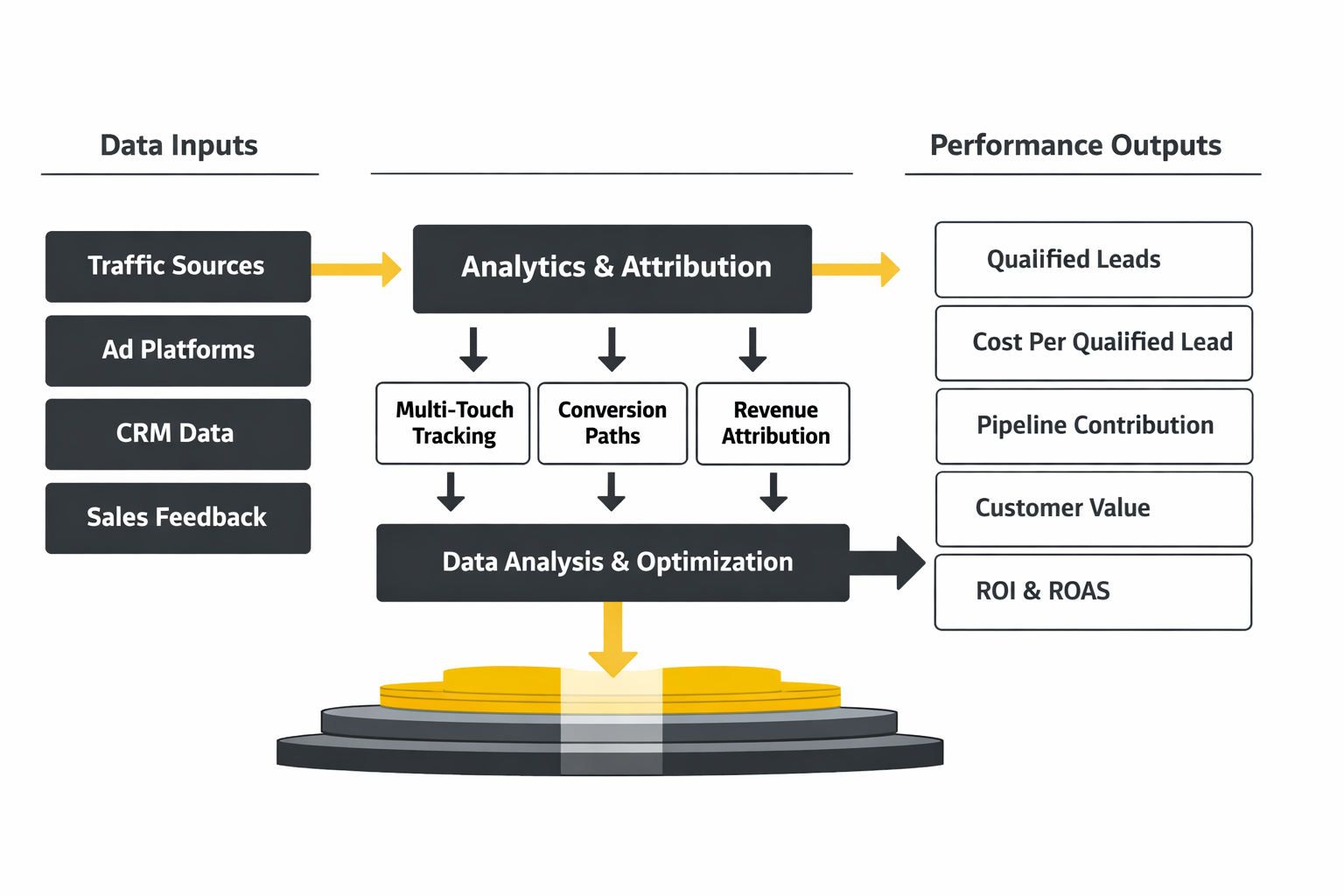
That is exactly why serious operators treat analytics as part of strategy, not a reporting chore at the end of the month. A digital marketing company should be able to connect media, creative, landing pages, CRM behavior, pipeline movement, and final revenue without pretending attribution is cleaner than it really is. When the team can do that, optimization becomes sharp. When it cannot, optimization turns into a guessing game with better charts.
Statistics and Data

The numbers around modern marketing make one thing obvious: a digital marketing company has to be disciplined with data because the stakes are high and the environment is messy. Gartner’s 2025 CMO spend survey shows marketing budgets sitting at 7.7% of company revenue, while Nielsen’s 2025 annual marketing report is based on responses from 1,400 global marketing professionals. That combination tells you a lot. Budgets are under pressure, accountability is increasing, and marketers are being forced to prove impact more clearly than before.
The opportunity is still massive, but scale alone does not create clarity. DataReportal’s 2025 global advertising trends analysis puts worldwide ad spend at roughly $1.1 trillion in 2024, and IAB’s 2025 Outlook Study shows buyers continuing to prioritize performance, cross-platform measurement, and channels such as retail media, CTV, and social. That means a digital marketing company is not working inside a small experimental budget anymore. It is operating inside a large, fragmented, highly scrutinized system where weak measurement can become a very expensive habit.
Customer expectations are pushing the same point from another direction. Adobe’s 2025 customer engagement research says 78% of customers want consistent brand experiences, while Adobe’s 2025 data and insights report draws on input from 3,200 CX professionals and 8,000 consumers. If the experience needs to feel connected across touchpoints, then reporting has to be connected too. A digital marketing company cannot evaluate search, paid social, email, video, and website behavior in separate silos and still expect to understand the real customer journey.
Even the channel landscape itself is telling marketers to update how they measure. Statcounter’s February 2026 data shows Google holding 89.98% of worldwide search market share, which is why search remains such a powerful demand-capture channel. At the same time, Google’s video research highlights that 69% of U.S. viewers would rather watch a video than read text or listen to audio to learn a new skill. A digital marketing company that reports only last-click search conversions will miss how video, content, and repeated exposure are shaping demand before that search even happens.
The same pressure shows up inside marketing teams. Salesforce’s Tenth Edition State of Marketing report is built on insights from nearly 4,500 marketers worldwide, and the research keeps circling back to AI, data activation, and personalization. That matters because more data does not automatically create better decisions. A digital marketing company still has to choose which metrics matter, which trends are noise, and which signals deserve action now instead of later.
What a Good Dashboard Should Actually Show
A dashboard is supposed to help you think, not overwhelm you. A professional digital marketing company should give you a reporting view that moves from business outcomes down into the drivers behind them. That usually means starting with revenue, qualified pipeline, cost per qualified lead, conversion rate, close rate, and customer value, then drilling into the campaign and channel patterns that are influencing those outcomes.
The important point here is sequence. If a report begins with impressions, clicks, and follower growth without first clarifying what happened to qualified demand and revenue, the priorities are upside down. A digital marketing company should absolutely track leading indicators, but it should present them in a way that explains the business story rather than distracting from it.
This is also where simplicity wins. Most companies do not need more charts. They need a cleaner view of what changed, why it changed, and what the next decision should be. The best dashboards make that obvious, which is why they end up being used by leadership instead of ignored after the first week.
The Metrics That Deserve the Most Attention
The right metrics depend on the business model, but a digital marketing company should almost always care deeply about traffic quality, conversion quality, cost efficiency, and downstream sales performance. Traffic quality tells you whether the right people are arriving. Conversion quality tells you whether those people are serious or just curious. Cost efficiency tells you whether acquisition is sustainable, and downstream sales performance tells you whether marketing is helping the business win, not just helping forms get filled out.
This is where a lot of companies get trapped by vanity. Click-through rate can matter, but only in context. Cost per lead can matter, but a cheaper lead is not better if sales cannot close it. Return on ad spend can matter, but it can also lie when the attribution window is narrow and the buying journey is longer than the platform report wants to admit.
A trustworthy digital marketing company knows how to handle those tradeoffs. It will not hide behind high-level averages or cherry-picked wins. It will explain which metrics are diagnostic, which are outcome metrics, and which ones are useful only when paired with the rest of the picture.
Why Attribution Is Harder Than Most Reports Admit
Attribution sounds clean in sales calls and messy in real life because real people do not behave like spreadsheets. They might discover a brand on social, watch a video a week later, search for the company later that month, click a retargeting ad, ignore three emails, come back directly, and finally convert after a sales conversation. A digital marketing company that insists one touchpoint deserves all the credit is usually simplifying reality so the report feels easier to sell.
That is why mature teams use attribution as a guide rather than a weapon. They combine platform data, analytics, CRM records, conversion paths, and actual sales feedback to build a more believable picture of what is working. Nielsen’s 2025 Marketing ROI Blueprint puts real emphasis on business outcomes over delivery metrics and pushes for cross-media integration to close measurement gaps, which is exactly the mindset a capable digital marketing company should bring into your account.
The goal is not perfect certainty. The goal is better judgment. When attribution is handled honestly, it helps the team decide where to lean in, where to keep testing, and where to stop wasting money on channels that are only good at claiming credit.
Optimization Should Follow Evidence, Not Mood
Once the data is in place, optimization becomes a lot more practical. A digital marketing company should be looking for friction points in the funnel, messages that consistently attract better-fit buyers, and campaign structures that create stronger conversion behavior over time. That is very different from making random weekly changes because somebody got nervous about one number moving in the wrong direction.
Good optimization usually starts with the most constrained part of the system. If click quality is weak, refine targeting and message-market fit. If landing-page conversion is weak, improve clarity, proof, and offer structure. If lead quality is weak, tighten qualification and align the campaign promise more closely with what sales can actually deliver. If close rate is weak, check the sales handoff, not just the ads.
A strong digital marketing company knows that not every problem belongs to media buying. Sometimes the channel is fine and the offer is soft. Sometimes the campaign is fine and the follow-up is poor. Sometimes the report is fine and the business is simply looking at the wrong success signal. Optimization works best when the team is willing to diagnose the real bottleneck instead of automatically blaming the easiest variable.
How to Judge a Digital Marketing Company by Its Reporting
If you want a simple test, look at the agency’s reporting and ask one question: does this help leadership make better decisions? A strong digital marketing company will show movement in the numbers, explain the likely reasons behind that movement, acknowledge uncertainty where it exists, and recommend what should happen next. That is what useful reporting feels like. It informs action.
Weak reporting usually does the opposite. It buries the important story inside platform screenshots, overuses jargon, and acts as if more data automatically means more intelligence. In reality, a digital marketing company earns trust when it simplifies complexity without distorting it. That is the difference between reporting that looks smart and reporting that actually helps a business grow.
By this point in the article, the bigger pattern should be clear. Measurement is not there to make the agency accountable after the fact. It is there to make the whole growth system smarter while it is happening. When a digital marketing company understands that, every campaign becomes easier to improve and every marketing decision becomes easier to defend.
Pricing, Red Flags, and the Selection Process
This is the moment where a digital marketing company stops being a nice idea and becomes a real business decision. You are not just buying ads, SEO, email, or creative support. You are choosing a partner that will influence how demand is created, how budget is allocated, and how leadership judges the success of marketing itself. That is why pricing, warning signs, and the actual selection process deserve far more attention than most companies give them.
A lot of businesses rush this stage because they want momentum. That is understandable, but it is also dangerous. Gartner’s 2025 CMO spend data shows 39% of CMOs planning to cut agency budgets, which tells you exactly what happens when partnerships do not produce enough clarity, confidence, or commercial value. In a market like that, the right digital marketing company can become a growth asset, while the wrong one becomes a cost that leadership starts questioning very quickly.
How Pricing Should Really Be Evaluated
The first thing to understand is that cheap and expensive are not the right categories. The real categories are clear and unclear. A digital marketing company can charge a premium and still be worth every cent if the scope, ownership, reporting, and expected outcomes are defined properly. It can also look affordable on paper and end up costing far more through delays, poor handoffs, underpowered strategy, and constant rework.
That is why pricing should always be read alongside operating logic. If the fee covers strategy, execution, analytics, creative, meetings, platform management, and optimization, the question is not just whether the number feels high. The question is whether the company has made the workload legible and whether the deliverables actually match the complexity of your growth model. A digital marketing company that hides behind broad phrases like “ongoing support” or “full growth management” without translating that into decisions, responsibilities, and review cycles is asking you to trust fog.
There is also a bigger outsourcing trend behind this. Deloitte’s 2024 Global Outsourcing Survey shows organizations moving toward more value-based relationships and increasing attention on front-office functions like sales and marketing. That matters because it reframes what smart buyers should expect. You are not paying for motion. You are paying for accountable contribution.
Retainers, Projects, and Performance Models
Most digital marketing company engagements fall into three broad structures: retainer, project, or performance-based compensation. A retainer usually works best when the work is ongoing, cross-functional, and needs continuous iteration. That can include paid media, lifecycle email, content guidance, analytics reviews, landing page testing, and monthly strategy refinement. In the right situation, a retainer gives both sides the stability needed to learn and improve.
Project pricing works better when the outcome is bounded. That might be a website relaunch, analytics cleanup, CRM setup, messaging framework, audit, or funnel build. A project scope can be incredibly effective because it forces clarity, but only if the business understands what happens after the build is complete. A digital marketing company that creates the engine but leaves nobody ready to run it can still leave you with a very expensive gap.
Performance pricing sounds exciting because it feels aligned, but it only works when the inputs and attribution are clean enough to support it. If the sales cycle is long, the product has multiple touchpoints, lead qualification is inconsistent, or internal follow-up is weak, performance-based compensation often creates more arguments than alignment. The better digital marketing company will tell you that honestly instead of using the model as a seductive shortcut in the sales process.
The Red Flags You Should Never Ignore
Some red flags are obvious, and some are surprisingly easy to rationalize away when a team is charismatic. One of the biggest warning signs is overconfidence without diagnosis. If a digital marketing company tells you exactly what channel mix you need before it has understood your economics, sales process, audience quality, or offer strength, it is not being decisive. It is skipping the thinking.
Another red flag is reporting language that sounds advanced but never becomes concrete. If the company cannot explain what success will look like in the first 30, 60, and 90 days, or if it hides behind vanity metrics when you ask about qualified demand, that is a problem. A trustworthy partner may not promise certainty, but it will show you how it plans to reduce uncertainty.
The last red flag worth taking seriously is a weak relationship posture. Aprais’ 2025 effectiveness analysis cross-matched more than 27,000 client-agency evaluations with over 3,000 effectiveness awards, and the pattern was clear: stronger working relationships were linked with stronger results. So if a digital marketing company seems defensive, evasive, allergic to challenge, or overly eager to say yes to everything, do not brush that off as a personality quirk. It can become a performance problem very fast.
Questions That Separate Professionals From Pretenders
The best selection questions are not the ones that invite rehearsed answers. They are the ones that force a digital marketing company to reveal how it thinks under pressure. Ask what assumptions it would want to test first. Ask what could cause the engagement to fail even if everybody is competent and working hard. Ask which business inputs it would need from your team to make the work successful.
You should also ask how the company handles disagreement. A weak agency relationship often stays polite right up until performance stalls, and then both sides discover they were never aligned on what mattered most. A strong digital marketing company will be able to describe how it challenges ideas, how it prioritizes tradeoffs, and how it makes calls when the data is incomplete but action is still required.
Another powerful question is whether the company can describe the customer journey in plain English. If it cannot explain how attention becomes trust, how trust becomes action, and how action becomes revenue, then all the platform fluency in the world will not save the partnership. Sophisticated marketers do not hide behind jargon. They make complex growth systems easier to understand.
How to Run a Selection Process Without Wasting Everyone’s Time
A clean selection process is not just kinder to agencies. It helps the buyer make a better decision. The 2025 WFA and VoxComm agency selection guidance argues for a more transparent, structured, and people-first selection approach, which is exactly the right direction. The old habit of running bloated, vague, overpitched processes may feel thorough, but it often rewards presentation theatre instead of real fit.
The smarter route is much simpler. Start with a clear business problem, define the needed capabilities, explain internal constraints, and be honest about budget shape and decision timing. Then narrow the field quickly and go deeper with a smaller group. A digital marketing company is far more likely to show you its real operating style when the process respects time, context, and commercial reality.
This matters even more because buyers are already frustrated in broader B2B decision-making. Forrester’s 2024 business buying research found that 86% of B2B purchases stall and 81% of buyers are dissatisfied with their chosen providers. That should be a wake-up call. A messy agency selection process does not just waste time at the beginning. It raises the odds of disappointment after the contract is signed.
What the Shortlist Should Actually Compare
When you are down to a shortlist, do not compare agencies only by credentials, channel coverage, or deck quality. Compare them on commercial fit, strategic sharpness, operational maturity, communication quality, and the level of truthfulness you felt in the conversation. A digital marketing company that admits complexity, explains tradeoffs clearly, and avoids fake certainty is usually far more valuable than one that sounds “more confident” because it oversimplifies everything.
It also helps to compare how each team frames your problem. One may talk mostly about campaign execution. Another may talk about message clarity, sales friction, and measurement gaps before discussing channels at all. That difference matters because it reveals whether the digital marketing company sees itself as a task engine or as a growth partner.
If you want a simple test, ask which of the shortlisted teams made you think more clearly about your own business. The right agency should not just impress you. It should sharpen your understanding of what needs to happen next.
The Final Check Before You Sign
Before you sign with any digital marketing company, do one final check that has nothing to do with the proposal design. Make sure both sides agree on the business objective, the first phase of work, the reporting cadence, the definition of success, the roles on each side, and what will happen if the early assumptions turn out to be wrong. That last part is important because real growth work always involves some uncertainty, and mature partners know how to navigate it without panicking.
The contract should support that clarity, not replace it. Legal language matters, of course, but it is not where trust is built. Trust is built when both sides understand what they are committing to, what they are not committing to, and how they will work through ambiguity together.
That is the real point of Part 5. Pricing matters. Red flags matter. Process matters. But underneath all of them is one bigger question: does this digital marketing company feel built for the way your business actually needs to grow? If the answer is yes, the partnership can become a force multiplier. If the answer is no, even a beautiful proposal will not save you.
Final Decision Framework and FAQ
By now, the big picture should be clear. Choosing a digital marketing company is not really about picking the team with the flashiest presentation, the biggest client list, or the most aggressive promises. It is about finding the partner that understands how your buyers move, how your economics work, and how marketing should connect to real business outcomes instead of surface-level activity.
If you want a practical way to make the final decision, keep it simple. Look for a digital marketing company that can explain your growth problem clearly, outline a realistic first phase, show how reporting will support decisions, and communicate like a partner instead of a performer. That matters even more in a market where marketing budgets remain under pressure, buyers are harder to win, and the cost of a bad agency relationship shows up fast.
The final test is not whether the agency sounds smart. It is whether it helps you think more clearly about your own business. If a digital marketing company can do that before the contract is signed, there is a good chance it will keep creating value after the work begins.

FAQ for This Complete Guide
What does a digital marketing company actually do?
A digital marketing company helps businesses attract attention, generate demand, convert prospects, and improve marketing performance across channels such as search, paid media, email, content, analytics, websites, and CRM follow-up. The good ones do far more than run campaigns. They connect message, media, measurement, and conversion so your marketing stops feeling scattered and starts behaving like a system.
That distinction matters because plenty of agencies can produce activity, but not all of them can produce clarity. A real partner should be able to explain how traffic becomes trust, how trust becomes action, and how action becomes revenue.
When should you hire a digital marketing company?
You should hire a digital marketing company when your internal team lacks a critical capability, your channels are underperforming, your reporting is too weak to support decisions, or your business has hit a growth wall that is too expensive to ignore. This is especially true when leadership expects faster progress but the current system cannot show what is working and what is failing.
It is usually the wrong time to hire one when the business still has no clear offer, no internal owner, and no willingness to share the information required for strategic work. Agencies can strengthen a growth engine, but they cannot replace basic business clarity.
Is it better to hire an agency or build an in-house team?
That depends on the bottleneck. A digital marketing company is often the smarter choice when you need speed, specialist depth, or cross-channel expertise without the cost and delay of building a full internal team. In-house talent becomes more attractive when the company needs constant collaboration, owns a large ongoing media budget, or wants certain capabilities deeply embedded in the business.
For many businesses, the strongest model is hybrid. Internal leaders keep ownership of brand, product, sales feedback, and commercial priorities, while the agency brings execution depth, external perspective, and faster learning cycles.
How do you know if an agency is any good?
You can usually tell by the quality of its thinking before you ever see the results. A strong digital marketing company asks sharp questions, resists rushing into tactics, explains tradeoffs honestly, and shows how it will diagnose the first phase of work. It does not hide behind jargon or offer fake certainty.
You should also pay close attention to how the team talks about success. If it cannot define meaningful outcomes, explain what the first 90 days should accomplish, or show how reporting will support decisions, that is a warning sign even if the sales process feels polished.
How much does a digital marketing company cost?
There is no single number that makes sense across every engagement because pricing depends on scope, channel mix, complexity, reporting depth, creative demands, and whether the work is strategic, technical, or execution-heavy. The more useful question is whether the pricing model matches the job being asked of the agency.
A cheap retainer can become very expensive if it leads to weak thinking, poor handoffs, and endless revisions. A premium fee can be worthwhile when the digital marketing company brings real leverage, accountability, and decision-making clarity that your team does not currently have.
What services should a good agency offer?
A good digital marketing company should offer the services that genuinely support your growth model, not an oversized menu designed to impress. Depending on the business, that can include paid search, paid social, SEO, analytics, landing pages, email automation, CRM integration, content strategy, creative testing, and conversion optimization.
The important point is not how many services are listed. It is whether those services work together around one buyer journey. Agencies that sell everything but cannot connect the pieces often create more noise than momentum.
Should you hire a full-service or specialist agency?
You should hire a full-service digital marketing company when the main problem is coordination across multiple channels and teams. You should hire a specialist when one costly bottleneck needs deeper expertise, such as technical SEO, lifecycle email, paid search efficiency, or attribution cleanup.
Neither model is automatically better. The smarter choice depends on whether your growth challenge is broad and interconnected or narrow and high stakes.
What results should you expect in the first 90 days?
In the first 90 days, the most realistic expectations are improved clarity, better tracking, stronger campaign structure, sharper messaging, cleaner reporting, and early performance signals that point toward scalable wins. Sometimes direct results come quickly, especially when there is already strong demand and the main issue is execution. Other times the first stage is more about fixing the system so later growth becomes repeatable.
A trustworthy digital marketing company will not promise miracles on a random timeline. It will explain what should improve first, what assumptions are being tested, and what evidence will determine the next moves.
What metrics actually matter when working with an agency?
The most important metrics are the ones that connect marketing activity to business outcomes. That usually means qualified leads, cost per qualified lead, conversion rate, pipeline contribution, close rate, customer value, and the patterns inside channel performance that help explain those outcomes.
Surface-level numbers still have a role, but only in context. A digital marketing company should never use clicks, impressions, or follower growth as a substitute for explaining whether the work is moving the business forward.
Can a digital marketing company help small businesses?
Yes, but only when the engagement is sized correctly and the business is clear about its priorities. A small business does not need a giant agency playbook copied from an enterprise account. It needs a digital marketing company that can identify the fastest path to traction, focus attention on the highest-leverage channels, and avoid unnecessary complexity.
In many cases, a smaller business benefits most from narrow focus, strong messaging, simple conversion paths, and disciplined follow-up. That is often more valuable than trying to look big across every platform at once.
How long should you stay with a digital marketing company?
You should stay with a digital marketing company as long as the relationship keeps creating clarity, progress, and confidence in the next decision. That does not mean results must always move in a straight line. Marketing rarely works like that. It means the team should keep learning, improving, communicating honestly, and making the system stronger over time.
If reporting becomes vague, accountability fades, or the same problems keep repeating without sharper diagnosis, the partnership is probably losing value. Good agency relationships evolve. Stagnant ones start explaining too much and improving too little.
What is the biggest mistake businesses make when hiring an agency?
The biggest mistake is choosing a digital marketing company based on presentation quality instead of operating fit. Businesses often get pulled in by confidence, case-study theatre, or the promise of fast wins without making sure the agency understands the buyer journey, the sales process, the economics, and the internal realities of the business.
The better move is to test how the agency thinks. If it can make your business feel clearer before the contract starts, it is much more likely to make your marketing perform better after the work begins.
Work With Professionals
If you have made it this far, then you already know the real opportunity is not simply hiring any digital marketing company. It is choosing the right one, setting the relationship up properly, and making sure the work connects to the outcomes your business actually cares about. That takes more thought up front, but it saves an enormous amount of money, time, and frustration later.
The companies that win with outside partners are usually not the ones chasing shortcuts. They are the ones willing to get clear about the customer journey, the numbers that matter, the responsibilities on each side, and the decisions that will shape the next phase of growth. When that foundation is strong, a digital marketing company can become one of the most valuable growth assets in the business.
If you are a marketer reading this from the other side, the lesson is just as important. Businesses are not looking for more noise. They are looking for people who can think clearly, execute well, and help them grow with confidence. That is where real opportunity lives.
Explore 10K+ Remote Marketing Contracts on MarkeWork.com
Most marketers spend too much time chasing clients, competing on crowded platforms, and losing a percentage of every project to middlemen.
MarkeWork gives you a better way. Browse thousands of remote marketing contracts and connect directly with companies desperate to hire skilled marketers like you without platform commissions and without unnecessary gatekeepers.
If you’re serious about finding better opportunities and keeping 100% of what you earn, you can explore available contracts and create your profile for free at MarkeWork.com.
 Filip Konecny Enterprises