
CPA marketing looks simple on the surface because the name suggests a clean bargain: a business pays when a defined action happens. In practice, though, that action can mean a sale, a qualified lead, a booked demo, an app install, or another conversion that has to be tracked, verified, and valued correctly. That is why smart operators treat CPA marketing as a discipline, not just a pricing model.
This article uses CPA marketing in the broad way professionals use it in the real world: affiliate and partner programs, paid media optimized to target CPA, lead-generation funnels, and the measurement systems that decide whether acquisition is genuinely profitable. The topic matters more now because U.S. internet advertising revenue reached $258.6 billion in 2024, while impact.com’s 2025 research shows partnership channels are no longer a side project for most brands that care about efficient growth.
If you want CPA marketing to work, you need more than traffic and a tracking link. You need clear economics, reliable attribution, compliant data collection, strong landing pages, disciplined partner management, and a realistic view of what an “action” is worth to the business after refunds, sales cycles, and operational costs are counted.
Article Outline
- Why CPA Marketing Matters
- CPA Marketing Framework Overview
- Core Components of CPA Marketing
- Professional CPA Marketing Implementation
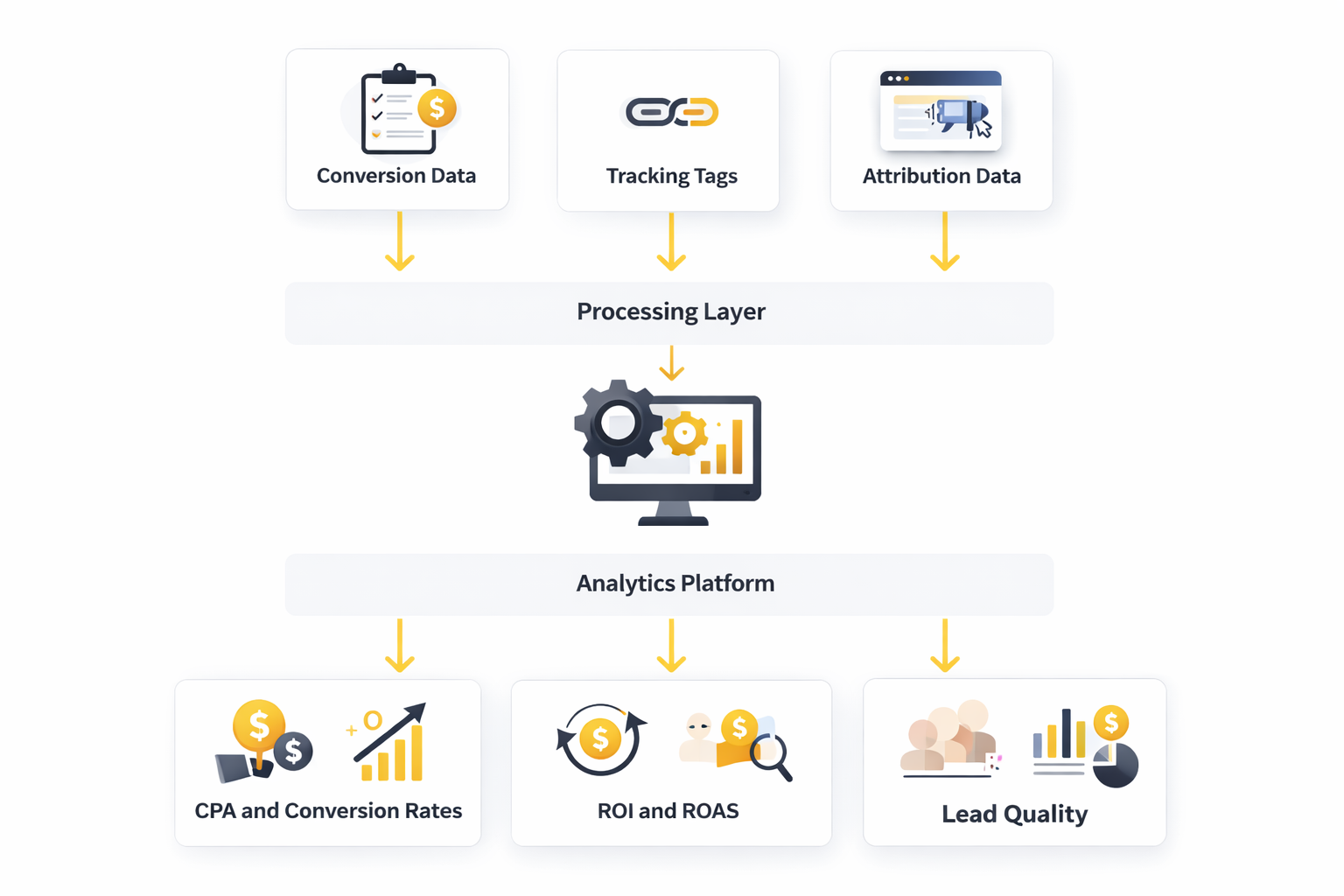
- Analytics and Optimization
- The CPA Marketing Ecosystem
Why CPA Marketing Matters
The reason businesses keep coming back to CPA marketing is straightforward: it pushes attention away from vanity metrics and toward outcomes that can be tied to revenue. Impressions, clicks, and reach still matter, but they stop being the finish line. The business starts asking a harder and much healthier question: what did it cost to generate an action that the company actually values?
That shift is happening across channels. Impact’s 2025 State of Affiliate Marketing report found that 74% of brands generate 11% to 30% of their total revenue from affiliate marketing, which tells you performance-based partnerships are now part of the main growth engine for many companies rather than an experimental add-on. At the same time, Google’s documentation on Target CPA bidding shows how deeply outcome-based optimization is built into modern ad buying itself.
CPA marketing also matters because budgets are under constant pressure. When leadership wants growth without waste, a model tied to defined actions gives teams a common language for deciding which campaigns deserve more budget, which partners are pulling their weight, and which offers only look good because the tracking setup is weak. It does not magically remove risk, but it makes performance easier to inspect, question, and improve.
There is also a compliance reason to take CPA marketing seriously. The FTC’s endorsement guidance keeps pushing marketers toward clear disclosure of material connections, and the agency’s broader Telemarketing Sales Rule guidance shows how quickly lead generation can become a legal problem when incentives outrun transparency. In other words, the better CPA marketing gets at producing conversions, the more important it becomes to make sure those conversions were earned in a way the business can defend.
CPA Marketing Framework Overview
A professional CPA marketing framework starts with one decision that many teams rush past: defining the action correctly. If the action is too shallow, such as a low-intent email submit, the campaign may look efficient while sales quality collapses downstream. If the action is too deep, such as a closed sale in a long enterprise cycle, learning becomes painfully slow and the channel may never gather enough signal to improve.
Once the action is defined, the framework moves through five connected layers: traffic source, offer, conversion environment, tracking, and feedback. Traffic can come from affiliates, search, social, creator partnerships, email, or comparison sites. The offer is the promise that explains why a visitor should act now. The conversion environment is the page, form, call flow, or checkout experience where that action takes place. Tracking confirms what happened, and feedback tells the team whether the result was actually profitable after lead quality, refunds, retention, and fulfillment are considered.
This is why mature CPA marketing programs look less like “buy traffic and hope” and more like operating systems. Google notes in its Target CPA guidance that performance should be judged against average target CPA over time rather than against one isolated number, which is a useful reminder that optimization is about patterns, not emotional reactions to a single day of results. Google Analytics reinforces the same idea in its attribution documentation, where cross-channel key-event settings determine how credit is assigned before users convert.
When you see the framework clearly, bad decisions become easier to spot. A traffic source may not be the real issue if the landing page is weak. A landing page may not be the issue if the action is poorly defined. And a campaign that appears expensive may be the best asset in the portfolio once attribution is widened beyond last click and downstream value is taken seriously.
Core Components of CPA Marketing
Every strong CPA marketing system rests on a few non-negotiable components. The first is conversion clarity: the business has to know exactly what counts as success, why that action matters, and what it is worth. Without that, even impressive reporting becomes noise because the team is optimizing toward activity instead of value.
The second component is partner and channel fit. Impact’s 2025 research found that leading brands build ecosystems with three to four diverse partner types rather than relying on a single source, and that matters because different partners influence different moments in the buying journey. A coupon site, a creator, a review publisher, and a paid search campaign may all contribute to the same conversion, but they do not create demand in the same way.
The third component is trustworthy measurement. Google explains in its Analytics attribution guidance that attribution settings determine how credit is assigned to ads, clicks, and other touchpoints before a key event happens. That sounds technical, but the business implication is simple: if your measurement model is careless, your payout decisions, bid decisions, and scaling decisions will be careless too.
The fourth component is compliance and disclosure discipline. The FTC’s endorsement guidance makes it clear that material connections need to be disclosed clearly and conspicuously, which is especially important when CPA marketing overlaps with creators, publishers, and affiliate recommendations. If a program depends on hidden incentives, vague opt-ins, or misleading landing pages, the short-term CPA may look attractive right up until the legal, reputational, and refund costs arrive.
The fifth component is operational speed. Offers change, partner quality shifts, tracking breaks, and audience intent moves faster than many teams expect. That is one reason 97% of brands and 96% of creators in Impact’s 2025 research reported using AI in their partnership programs: not because automation replaces judgment, but because scaling CPA marketing without faster creative testing, partner screening, and reporting loops is becoming harder every quarter.
Professional CPA Marketing Implementation
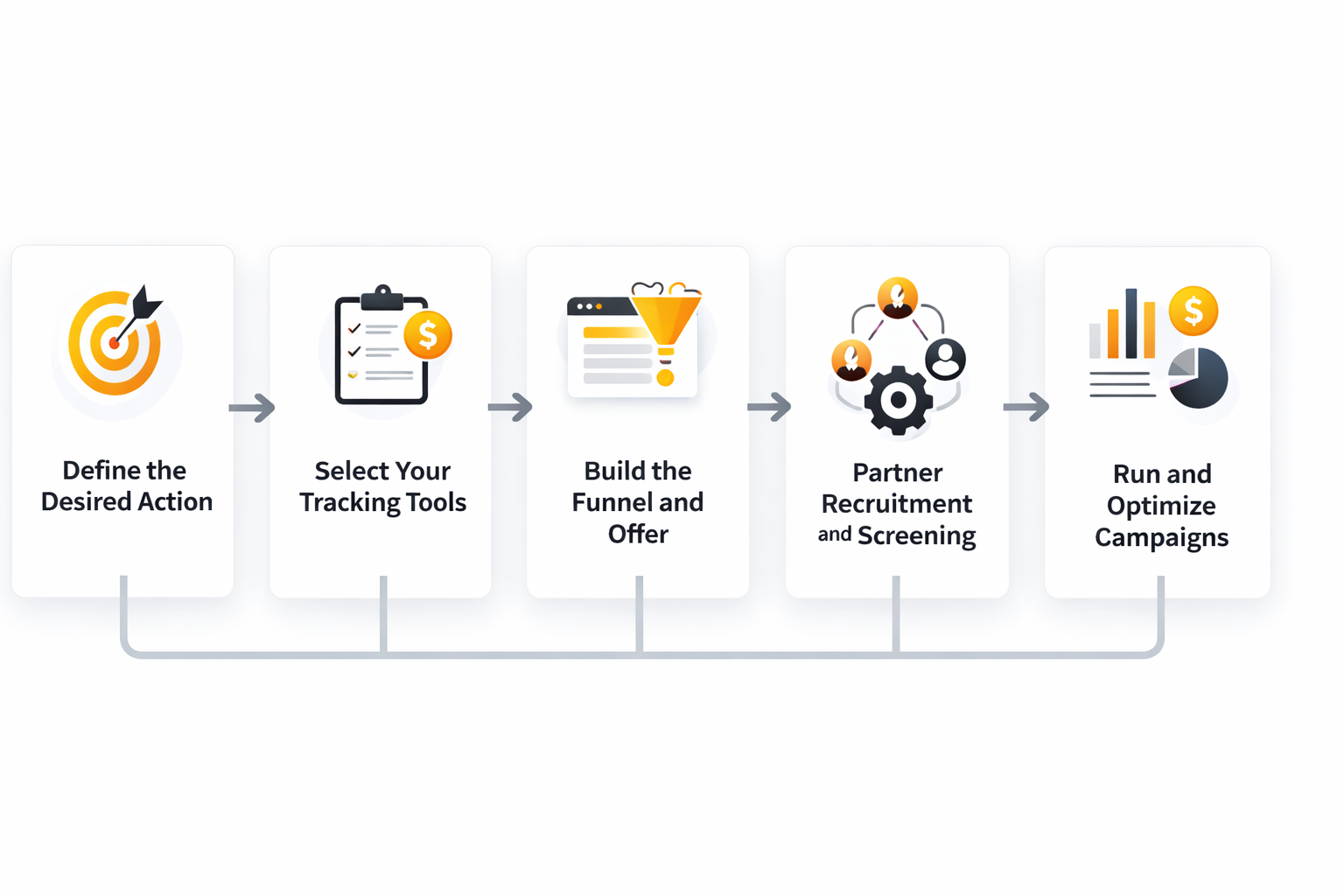
The professional way to implement CPA marketing is to begin with economics before you touch traffic. Work backward from gross margin, average order value, close rate, refund rate, and retention to decide what a qualified action can really cost. That single exercise protects you from one of the most common mistakes in the space: buying actions that look cheap in-platform but fail the business the moment finance reviews them.
Next, build the conversion path so it matches the action you want. If the goal is a lead, the form should qualify without crushing intent. If the goal is a sale, the page should reduce friction and answer the objections that stop people from completing checkout. This is where teams often use dedicated funnel tools such as ClickFunnels or Systeme.io, then pair them with cleaner data collection through Fillout when the business needs more control over qualification and routing.
After that, connect tracking before scaling spend. Google’s Target CPA documentation and Google Analytics attribution guidance both point to the same operational truth: optimization only works when the platform receives reliable conversion signals. In practical terms, that means naming conventions, event mapping, payout rules, and CRM reconciliation all need to be aligned before you start calling a campaign a winner.
Then create channel-specific rules. Affiliates need commission logic, approval standards, and brand guidelines. Paid media campaigns need learning budgets, bid strategy discipline, and realistic volume expectations. Content and creator partnerships need disclosure standards, tracking links, and a clear understanding of whether they are being rewarded for awareness, influence, or bottom-funnel conversion. When those rules are vague, CPA marketing turns into arguments about credit instead of a system for acquiring customers efficiently.
Finally, treat implementation as an operating rhythm, not a one-time setup. Teams that manage links, landing pages, and partner assets at scale often standardize workflows with tools like Dub for cleaner link management, Brevo or Moosend for email follow-up, and Buffer or Flick when social distribution is part of the conversion path. The tools are not the strategy, but the right stack can make a serious CPA marketing process far easier to run consistently.
Analytics and Optimization
This is where CPA marketing either turns into a serious growth machine or falls apart. A campaign can look profitable inside one ad platform and still lose money once duplicated conversions, weak lead quality, delayed revenue, refunds, and sales-team rejection rates are taken into account. That is why strong operators build their reporting around verified business outcomes instead of celebrating the first number a dashboard throws at them.
Google’s own Target CPA documentation makes an important point that too many advertisers ignore: the system optimizes toward an average target over time, not a perfect cost on every single conversion. That matters because CPA marketing works best when you judge trends with some patience and enough data, not when you panic after one expensive day. The same logic shows up in Google Ads data-driven attribution, which is built to show which keywords, ads, and campaigns actually contribute to conversion paths instead of rewarding only the last visible click.
Measuring the Right Action
The fastest way to ruin CPA marketing is to optimize toward the wrong conversion. If you tell the platform that every cheap form submit is a win, it will obediently find you more cheap form submits, even when those leads never answer the phone or never become customers. The platform is not being foolish in that moment; it is doing exactly what you asked it to do.
A better approach is to map the action to real commercial value. That may mean sending qualified lead stages back into your ad platform, separating raw leads from sales-accepted leads, or assigning higher importance to purchases that clear fraud checks and lower importance to actions that rarely produce revenue. Google explains in its Analytics attribution guidance that key-event settings decide how credit is assigned before conversion, which is a reminder that measurement is not neutral at all; it shapes what the system learns to chase.
Attribution Without Self-Deception
Attribution is where a lot of CPA marketing reporting becomes more emotional than factual. A last-click model can make bottom-funnel campaigns look heroic while quietly hiding the role played by content, creator partnerships, email nurturing, comparison pages, and earlier paid touchpoints that helped create the intent in the first place. When that happens, teams often cut the very channels that were making the closing channels work.
That is why it helps to compare multiple perspectives before making budget decisions. Google’s measurement stack now leans heavily on data-driven attribution and cross-platform journey analysis in Google Analytics, both of which are designed to give a fuller view of the customer path. In practical terms, that means CPA marketing gets stronger when you ask which source introduced demand, which source moved the buyer closer, and which source captured the final action, instead of pretending one touchpoint did all the work alone.
Privacy-First Tracking Reality
Modern CPA marketing also has to operate in a world where tracking is more limited than it used to be. Apple’s App Tracking Transparency framework requires authorization when apps track users across apps and websites, and Google has continued revising its measurement direction through its Privacy Sandbox technology updates. That means marketers cannot rely on lazy assumptions about perfect visibility anymore.
The response is not to give up on measurement. It is to build a cleaner first-party data system and connect browser-side and server-side signals wherever the platform officially supports it. Meta describes its Conversions API as a direct connection between marketing data and its systems for attribution and optimization, and that is exactly the kind of infrastructure serious CPA marketing teams now need if they want better signal quality in a privacy-conscious environment.
If you are tightening up your funnel stack and want a cleaner place to build pages that are actually meant to convert, this funnel builder is one of the easier ways to get landing pages, upsells, and conversion paths under control without wasting weeks on custom development.

Optimization That Actually Improves Profit
Once tracking is good enough to trust, optimization becomes far more strategic than simply lowering headline CPA. Sometimes the right move is to accept a slightly higher acquisition cost because the leads close faster, retain longer, or buy higher-margin products. Other times, the smartest move is to raise friction on the form, reject bad-fit traffic, or reduce payout on partner segments that generate activity without meaningful revenue.
This is why professional CPA marketing teams optimize the whole system rather than one surface metric. They test headlines, offers, forms, payout rules, traffic-source mix, sales follow-up speed, email sequences, and retargeting windows together because conversion efficiency is rarely created by one isolated tweak. Even your follow-up layer matters, which is why platforms like Brevo and Moosend can play a bigger role in CPA marketing than many people expect when abandoned leads and delayed buyers need structured nurturing before they convert.
The CPA Marketing Ecosystem
CPA marketing does not live inside one ad account or one affiliate dashboard. It is an ecosystem made up of advertisers, networks, publishers, creators, agencies, tracking platforms, CRM systems, analytics tools, legal requirements, and customer expectations. When people treat it like a narrow tactic, they usually miss the reason some programs keep compounding while others stay messy and fragile.
The ecosystem is also getting more diverse. Impact’s 2025 partnership research shows brands are increasingly working with a mix of creators, content publishers, loyalty partners, review sites, and other partner types rather than putting everything into one bucket. That is a healthy shift because CPA marketing gets stronger when you understand that different partners influence discovery, consideration, trust, and purchase at very different moments.
Advertisers, Networks, and Publishers
At the center of the ecosystem is the advertiser, because the advertiser defines the action, funds the payout, approves the economics, and carries the commercial risk if the numbers are wrong. But the advertiser rarely operates alone for long. Networks and platforms help recruit partners, manage tracking, process commissions, and create the operating layer that keeps a performance program from becoming a spreadsheet nightmare.
You can see that structure clearly in established platforms. Awin positions itself as an affiliate platform connecting advertisers and publishers globally, while Amazon Associates shows how even one of the world’s largest companies still relies on a formal partner model where publishers earn commissions on qualifying purchases and actions. The lesson here is simple: CPA marketing scales faster when the relationships, payout logic, and reporting standards are built into the ecosystem instead of improvised after problems appear.
Creators and Content Partners
One of the biggest changes in CPA marketing is that creators are no longer sitting on the edge of the performance world. They are now a core part of it. When a trusted creator explains a product well, handles objections honestly, and reaches an audience with clear buying intent, that partnership can influence far more than awareness.
This matters because buying decisions often begin long before someone is ready to click a retargeting ad or search for a branded term. A creator video, a comparison article, a tutorial, or a niche review can shape the decision path in ways last-click reports undercount. That is part of the reason recent partnership research from impact.com shows influencer and creator relationships taking a larger share of performance investment as brands look for channels that can both persuade and convert.
Compliance and Trust Inside the Ecosystem
No CPA marketing ecosystem stays healthy if trust disappears. The FTC’s endorsement guidance makes it clear that endorsements must be honest, not misleading, and transparent about material connections. That is not some side issue for legal teams to worry about later. It directly affects how landing pages are written, how creators disclose incentives, how affiliates position products, and how brands protect themselves from partners who chase payouts with deceptive tactics.
Trust also matters operationally. If publishers do not believe they will be credited correctly, they stop prioritizing the program. If advertisers believe traffic quality is weak or unclear, they cut payouts or close the partnership entirely. Strong CPA marketing ecosystems work because the people in them can see the rules, understand the incentives, and believe the reporting is fair enough to keep investing effort.
Where the Ecosystem Is Heading
The future of CPA marketing is heading toward cleaner first-party data, better partner diversification, stronger compliance standards, and more automation around the repetitive parts of execution. That does not mean human judgment becomes less important. It becomes more important because someone still has to define the action, interpret signal quality, choose which partners fit the brand, and decide what profitable growth really looks like.
You can already see the shape of that future in the tools people are stitching together. Teams use Dub to manage cleaner links, Fillout to qualify incoming leads more carefully, and Buffer or Flick to support content distribution when social content sits upstream of a conversion. The big takeaway is that CPA marketing is no longer just about paying for an action; it is about building a complete acquisition environment where every piece of the ecosystem helps produce better actions in the first place.
Building a CPA Marketing Program That Can Actually Scale
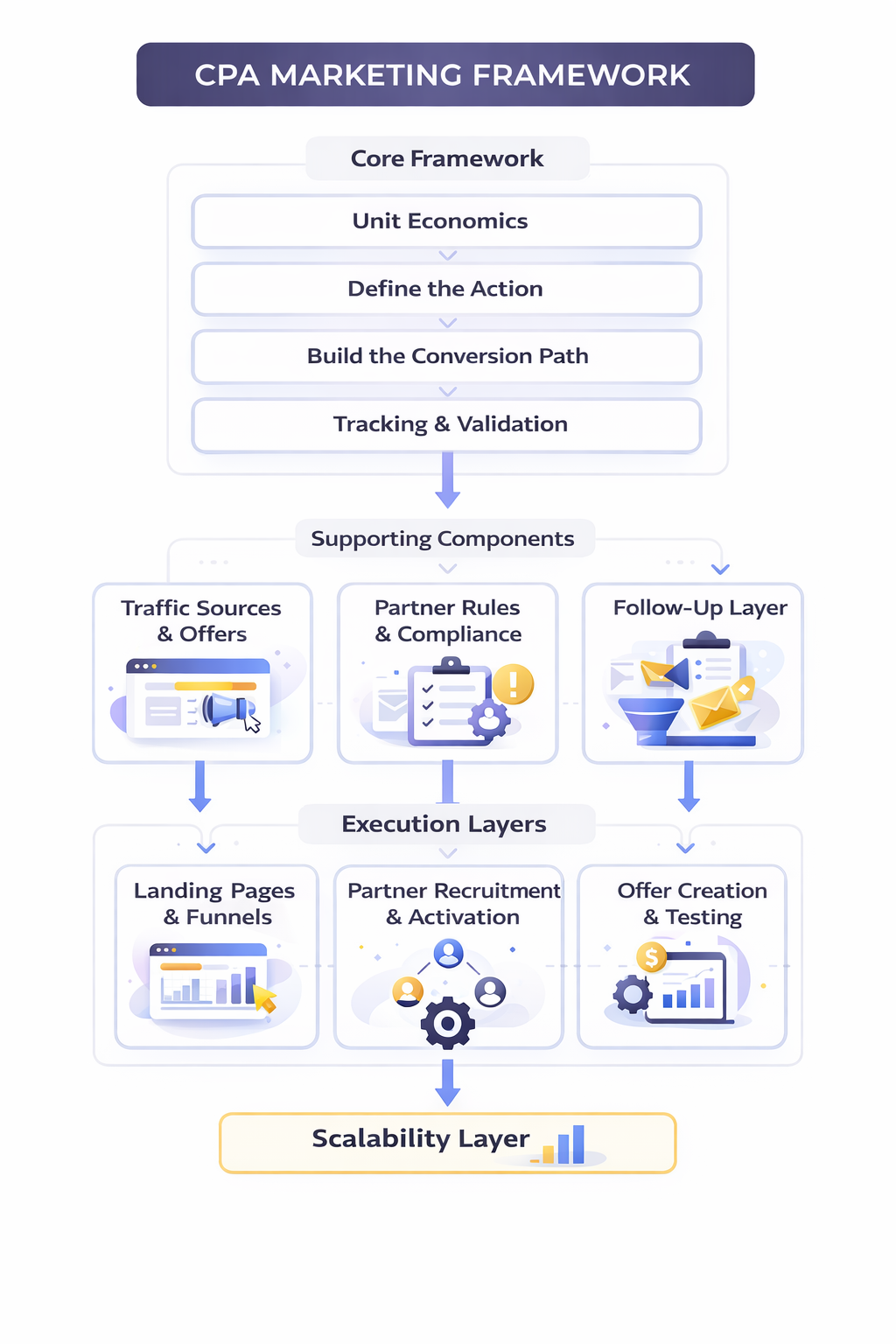
Most people get excited about CPA marketing when they see the upside. You only pay for a defined action, the numbers look clean, and it feels like you should be able to turn growth into a simple math problem. But that dream falls apart fast when the action is poorly defined, the tracking is unreliable, and the traffic source is pushing volume that looks good in a dashboard but never becomes meaningful revenue.
That is why building a serious CPA marketing program starts long before you recruit affiliates, launch ads, or publish landing pages. You need a framework that protects margin, keeps the program compliant, and gives every partner a clear picture of what counts as a successful action. Google’s official explanation of Target CPA bidding makes the same point in a different way: the system only works when conversion tracking is in place and the business knows what it wants the platform to optimize toward.
In other words, if your foundation is weak, CPA marketing becomes an expensive guessing game. If your foundation is strong, you give yourself a real shot at building a channel that can be scaled without losing control of profitability. That is the difference between chasing random conversions and building a repeatable acquisition system.
Start With Unit Economics, Not Traffic
The first move is brutally simple, and most people still skip it. Before you drive a single click, you need to know what a qualified action is worth to the business after gross margin, fulfillment cost, refund risk, sales-team effort, and retention are all considered. If you do not know that number, you are not really doing CPA marketing yet; you are just buying activity and hoping it turns into profit later.
This matters because a cheap conversion can still be wildly expensive once the back end is exposed. A lead that never answers the phone, a free trial that never activates, or a purchase that refunds three days later will make a campaign look far better than it really is. That is why smart teams treat headline CPA as the beginning of the conversation, not the final verdict.
Once you know the number, the rest of your decisions become sharper. You can set payout limits, qualify actions correctly, and decide whether you are building for immediate purchases, sales-qualified leads, booked appointments, or another milestone that actually matches how your company makes money. Without that step, CPA marketing turns into performance theater.
Define the Action With Precision
A strong CPA marketing program lives or dies based on the action it rewards. If the action is too shallow, you will attract a lot of low-quality volume because partners and ad platforms are simply responding to the incentives you created. If the action is too deep, learning becomes slow, reporting lags behind reality, and the campaign may never gather enough signal to improve.
The best middle ground depends on the business model. For some brands, a completed purchase is the obvious action. For others, it makes more sense to optimize for a booked consultation, a verified lead, or an activated user because that is where real commercial intent becomes visible. Google Analytics lets teams control how key events are valued and attributed through its attribution settings and key event reporting, which is a useful reminder that the action definition is not just a reporting choice; it shapes the entire optimization process.
If you get this right, everything downstream becomes easier. Your affiliates know what they are promoting, your ad platforms know what to optimize toward, and your internal team can judge performance without constantly arguing about whether the numbers mean anything. That kind of clarity is not glamorous, but it is one of the biggest competitive advantages in CPA marketing.
Build the Conversion Path Before You Buy Volume
Once the action is clear, you need a conversion path that makes completing that action feel natural. That means your offer, landing page, form, follow-up logic, and call to action all need to work together instead of fighting each other. A lot of CPA marketing campaigns fail because the traffic gets blamed for problems that were really caused by weak pages, unclear messaging, or a form that asks for too much too soon.
This is why the best operators build the funnel first and only then start sending meaningful traffic into it. If you need a page builder that can get a working funnel live fast, ClickFunnels is one practical option for offers that need landing pages, upsells, and conversion-focused flow. If you want more flexibility on how leads are collected and qualified before they hit your CRM, Fillout can help create a cleaner intake process without turning the user experience into a mess.
The goal here is not to make the funnel look fancy. The goal is to reduce confusion, improve trust, and make it obvious why the visitor should take the next step. CPA marketing gets dramatically better when the journey feels easy for the user and measurable for the business.
Set Up Tracking and Validation Early
This is the step that saves you from expensive false confidence later. Tracking needs to be connected before you scale, not after you notice the numbers feel strange. Google’s Target CPA guidance explicitly points back to conversion tracking as a requirement, and Google Analytics reporting attribution controls show how even the model you choose can change the story your reports tell.
Validation matters just as much as tracking. If leads are being passed to sales, you need to know which ones were accepted, contacted, and converted. If purchases are the action, you need to watch for cancellations, returns, fraud, and duplicate events. A CPA marketing program becomes far more trustworthy when the numbers are reconciled against real business outcomes instead of being taken at face value from the ad interface.
This is also where documentation helps more than people expect. Define event names, approval rules, payout logic, and reporting windows clearly from the start. It makes the program easier to scale, easier to audit, and much harder for weak traffic or internal confusion to poison the data.
Choosing Traffic Sources and Offers That Fit the Business
Once the system is ready, the next challenge is choosing where your CPA marketing program should actually get its conversions from. This is where people often become far too romantic about one channel. They want affiliate marketing to solve everything, or paid search to solve everything, or creators to solve everything. Real growth usually comes from matching the source to the buyer journey rather than forcing every channel to do the same job.
That matters because not all traffic behaves the same way. Search traffic often arrives with stronger intent, while creators and content partners may be much better at building trust before the conversion happens. Review sites, loyalty partners, comparison pages, email, retargeting, and direct affiliate relationships can all work in CPA marketing, but they influence different moments in the path to action.
The smartest move is to decide what role each source should play before you assign budget or payouts. If you skip that thinking, you end up rewarding the wrong behavior and then wondering why the program feels noisy, expensive, or impossible to scale cleanly.
Match the Source to Buyer Intent
Not every offer belongs in every traffic source. A complex B2B service with a long sales cycle may struggle in channels designed for quick, low-friction consumer actions. A straightforward ecommerce offer, on the other hand, may perform beautifully when the visitor already trusts the publisher, creator, or brand page sending the traffic.
This is why buyer intent should shape channel choice. High-intent search traffic can work well when users already know the problem they want solved. Content partners and creators can work better when the audience needs more context, more trust, and more persuasion before acting. Even within affiliate marketing, a comparison site, a coupon partner, and a niche content publisher are doing very different jobs, so expecting identical performance from them is usually a mistake.
CPA marketing becomes easier to optimize when you stop asking which channel is “best” in the abstract and start asking which channel best matches the moment the buyer is in. That shift sounds subtle, but it changes how you write offers, how you judge partner quality, and how you structure payouts.
Choose Offers That Are Easy to Understand and Easy to Act On
A great offer does not need to be complicated. In fact, CPA marketing usually works better when the promise is clear, the next step is obvious, and the value is easy to understand in a few seconds. Confusing offers create hesitation, and hesitation destroys conversion rate faster than most people realize.
That does not mean every offer has to be shallow. It means the path into the offer should feel straightforward. If the product is complex, the first action might be a demo request, a consultation, or a guided lead form rather than an immediate purchase. If the product is simple and low-risk, a direct conversion path may be the right move because adding extra friction only slows things down.
The best offers in CPA marketing also align with what the traffic source can credibly sell. A creator who can explain a product well may handle a more nuanced offer than a simple display placement can. A partner sending highly commercial traffic may convert better with a tighter, more direct landing page. The offer and the source need to make sense together.
Protect Quality With Clear Partner and Channel Rules
One of the fastest ways to damage a CPA marketing program is to leave too much undefined. If partners are not told what traffic methods are allowed, what disclosures are required, and what counts as an approved conversion, you create the perfect conditions for low-quality volume and ugly disputes later. Clear rules protect the advertiser, but they also protect good partners who want to know the standard they are being held to.
This is especially important when content, influencer, and review-based traffic enters the mix. The FTC’s guidance on endorsements and material connections makes it clear that incentives and relationships need to be disclosed in a way consumers can understand. That is not a detail to clean up later. In CPA marketing, compliance needs to be part of the offer and partner setup from day one.
When the rules are clear, better partners usually become easier to keep. They know how credit works, what kind of traffic is welcome, and what they can do to stay in good standing. That kind of stability is one of the reasons strong CPA marketing programs compound over time while weak ones constantly cycle through broken relationships and unreliable results.
Build a Follow-Up Layer That Saves Good Leads From Going Cold
A lot of CPA marketing value is lost after the action happens. The lead comes in, but the follow-up is slow. The buyer shows interest, but the email sequence never arrives. The person starts the process, gets distracted, and disappears before the sales team or funnel gets a second chance to bring them back.
That is why follow-up belongs inside the implementation conversation, not off to the side. Tools like Brevo and Moosend can help keep leads warm with structured sequences when the buying decision is not immediate. If content distribution is part of how your audience keeps encountering the offer before converting, Buffer and Flick can support the visibility side of that process as well.
The key idea is simple: CPA marketing should not end the moment someone fills out a form or clicks into a checkout flow. The businesses that win are usually the ones that build a system for turning interest into completed action, and then completed action into real revenue. That is where implementation stops being theoretical and starts becoming powerful.
Statistics and Data
If you want to understand where CPA marketing is going, the numbers tell a very clear story. This is no longer a small niche sitting off to the side of digital growth. The broader ad economy is getting bigger, partnership channels are contributing real revenue, and measurement is becoming more important because every serious team is under pressure to prove that conversions are not just cheap, but profitable.
The easiest mistake here is to read one stat in isolation and build a whole strategy around it. Strong CPA marketing decisions come from connecting market size, channel contribution, attribution quality, and partner mix. When you look at the data that way, you start to see why performance-led acquisition is becoming a much bigger part of how brands grow.
Market Size and Growth
The top-line number is hard to ignore. IAB and PwC’s full-year 2024 report shows U.S. digital advertising revenue hit a record $259 billion in 2024, up 15% year over year. That matters for CPA marketing because it confirms that brands are still pouring serious money into digital channels where performance can be measured, optimized, and defended.
That larger market creates more competition, but it also creates more room for specialists who know how to control costs and improve conversion quality. In a market of that size, businesses do not just want traffic. They want acquisition systems that can survive scrutiny from finance teams, sales teams, and leadership teams that are no longer impressed by vanity metrics.
How Much Revenue Affiliate and Partnership Channels Are Driving
One of the most useful data points in CPA marketing right now comes from impact.com’s 2025 State of Affiliate Marketing research. It found that 74% of brands generate 11% to 30% of their total revenue from affiliate marketing. That is a serious contribution, and it helps explain why more companies are treating performance partnerships like core infrastructure instead of a side experiment.
The same research also found that leading brands do not build around one partner type alone. Top-performing programs are built around three to four diverse partner types, which is a strong reminder that CPA marketing gets healthier when it is diversified. A channel mix that includes creators, publishers, affiliates, and advocates gives a business more ways to reach buyers across discovery, consideration, and conversion.
Creator and AI Shifts Inside CPA Marketing
The partnership mix is changing fast, and the data shows it. impact.com’s 2025 research reports that 59% of brands plan to allocate at least 25% of their affiliate budgets to creator partnerships. That is a major signal that creators are no longer being treated as awareness-only assets. They are increasingly expected to contribute directly to measurable acquisition.
The same report shows how quickly operations are changing behind the scenes. 97% of brands and 96% of creators say they are already using AI in their partnership programs. In practical terms, that means CPA marketing is becoming more automated in areas like partner discovery, content production, reporting, and workflow management, even though the real competitive edge still comes from human judgment around offer quality, payout structure, and conversion value.
Why Measurement Data Matters More Than Ever
Statistics about growth are exciting, but they only matter if the measurement is trustworthy. Google explains in its attribution settings documentation for Google Analytics that key event reports can assign credit to different ads, clicks, and channels before users convert. That sounds technical, but it has a direct impact on CPA marketing because the way credit is assigned shapes which campaigns get rewarded, which partners get paid, and which channels get scaled.
Google also makes it clear in its Target CPA bidding documentation that advertisers are working toward an average target over time, not a perfectly stable cost on every single conversion. That is an important mindset shift. Good CPA marketing is not about obsessing over one number from one day. It is about building enough signal, enough discipline, and enough attribution clarity to know whether the system is truly improving.
Privacy Rules Are Reshaping the Data
The other major force shaping CPA marketing data is privacy. Apple states in its user privacy and data use guidance that apps must request permission through the AppTrackingTransparency framework before tracking users across other companies’ apps and websites, and without permission the advertising identifier is unavailable for that purpose. That changes how much signal advertisers can rely on from browser- and device-level tracking alone.
This is one reason server-side measurement has become more important. Meta’s Conversions API documentation is built around passing event data for attribution and delivery optimization without depending entirely on the browser. For CPA marketing teams, that is not a minor technical upgrade. It is part of the new baseline for keeping analytics reliable enough to make smart acquisition decisions.
What the Data Really Means for CPA Marketing
Put all of these numbers together and the direction becomes obvious. The digital ad market is still growing, affiliate and partnership channels are contributing meaningful shares of revenue, creator-led performance is gaining budget, and better measurement is becoming non-negotiable. That combination creates a real opportunity for businesses that are willing to build disciplined CPA marketing systems instead of chasing shortcuts.
If you are putting the infrastructure together now, it helps to use tools that make execution cleaner rather than more chaotic. This funnel platform can help if you need faster landing-page deployment, while this link management tool can make tracking links and campaign routing easier to control as your CPA marketing operation grows. The tools are not the strategy, but better tools can make the data easier to trust, and that alone can save you a lot of wasted money.
Common CPA Marketing Mistakes
A lot of businesses get excited about CPA marketing for one reason: it feels safer than paying for impressions or clicks. You define an action, assign a value to it, and tell yourself you are only paying when something meaningful happens. But that feeling of safety can become dangerous fast when the action is weak, the funnel is sloppy, or the traffic source is rewarded for volume instead of quality.
One of the biggest mistakes is treating every conversion as equally valuable. A raw lead, a booked call, a trial signup, and a completed purchase may all sit inside the same reporting stack, but they do not carry the same economic weight. Google keeps pointing advertisers back to reliable conversion tracking for Target CPA bidding because the platform can only optimize around the signal it receives, and that is exactly where bad CPA marketing decisions usually begin.
Another common mistake is assuming cheap traffic is efficient traffic. It often is not. If the campaign generates actions that sales teams reject, customers refund, or support teams cannot profitably serve, then the business did not lower acquisition cost at all. It simply moved the damage further down the pipeline where it becomes harder to spot.
Keep Lead Quality High From Day One
The easiest way to improve CPA marketing is not always to lower the price of the action. Sometimes the better move is to raise the quality of the action so the business earns more from every approved conversion. That is a very different mindset, and it usually separates serious operators from people who are just staring at dashboards all day.
Lead quality improves when the promise is clear, the form asks for the right information, and the follow-up process is fast enough to catch intent while it is still alive. That is why the conversion path matters so much. If you need a cleaner way to qualify leads before they hit your CRM, this form and intake tool can help you collect better data without making the process feel heavy for the user.
The businesses that win with CPA marketing usually get serious about disqualification too. They reject bad-fit leads, tighten copy that attracts the wrong people, and stop pretending every conversion should be celebrated. That discipline protects margin, improves reporting, and makes it far easier to decide which channels deserve more budget.
Fraud, Compliance, and Partner Screening
This is the part many people would rather skip because it feels less exciting than launching offers or recruiting new partners. But if you ignore fraud, disclosure rules, and traffic screening, CPA marketing can turn ugly in a hurry. You can end up paying for fake actions, misleading promotions, low-intent traffic, or partner behavior that puts the brand in legal trouble.
The compliance side is not optional. The FTC’s guidance on endorsements and material connections makes it clear that financial relationships need to be disclosed in a clear and understandable way, especially when affiliates, creators, or publishers are influencing purchasing decisions. If a partner is rewarded for driving action, that relationship needs to be handled transparently, not buried in vague language or hidden at the bottom of the page.
Partner screening matters just as much as disclosure. Networks and publishers can send meaningful demand, but they can also send incentive-heavy traffic, unclear placements, or sources that create attribution confusion instead of real value. Awin’s own best-practices guidance for affiliate programs puts emphasis on reducing unnecessary steps in the transaction process and building stronger program hygiene, which is a good reminder that operational discipline is part of performance, not separate from it.
Watch for Bad Incentives Before They Spread
Bad incentives are one of the fastest ways to poison a CPA marketing program. If partners get paid the same whether the action is strong or weak, some of them will naturally drift toward whatever produces the most volume with the least resistance. That does not always mean fraud in the dramatic sense, but it often means weaker traffic, weaker trust, and a growing disconnect between reported performance and actual business value.
The fix is not complicated, but it does require courage. Define approved traffic methods clearly, document what counts as a payable action, and make sure the payout structure reflects actual downstream value instead of surface-level conversion counts. When expectations are clear, the best partners usually become easier to work with because they know what good performance actually looks like.
That also protects the internal team. Sales, finance, and marketing stop arguing about whether the numbers are real because the standards were set before scale created confusion. CPA marketing becomes a lot easier to defend when everyone knows the rules and the rules were designed around profit rather than vanity.
Making CPA Marketing Sustainable
The real goal is not to launch CPA marketing. The real goal is to build a version of it that still works six months from now, one year from now, and after the easiest wins are gone. That requires more than a few good campaigns. It requires a system that can handle creative fatigue, partner turnover, privacy changes, attribution debates, and the normal chaos that comes with scaling acquisition.
One useful way to think about this is to stop treating CPA marketing like a trick and start treating it like an operating discipline. Amazon’s Associates program overview is a simple example of how clearly defined linking, tracking, and qualifying actions create structure for a massive partner environment. The scale is different for smaller businesses, of course, but the principle is the same: sustainable CPA marketing needs clear mechanics and repeatable rules.
You also need a stack that does not slow you down every time you want to test a new offer, page, or follow-up sequence. If building and adjusting funnels is becoming a bottleneck, this funnel builder can make it easier to move faster without losing the conversion-first structure that CPA marketing depends on. Speed alone is not enough, but speed with discipline is powerful.
Play the Long Game
The best CPA marketing programs usually do not look magical from the outside. They look organized. They look patient. They look like teams that test consistently, cut weak traffic without drama, improve lead handling, and keep refining the economics until the channel becomes dependable.
That is worth remembering because this space attracts a lot of hype. People talk about secret offers, easy arbitrage, and overnight wins, but the businesses that keep winning are usually doing the boring things well. They care about signal quality, landing-page clarity, compliance, partner relationships, and the difference between a cheap action and a profitable one.
If you approach CPA marketing that way, you give yourself a much better chance of building something real. Not a short-term spike. Not a dashboard illusion. A channel that can keep producing customers while the rest of the market is still trying to figure out why its “low CPA” campaigns are not making any money.
FAQ for a Complete Guide to CPA Marketing
By this point, you have seen how CPA marketing works from the strategic side, the operational side, and the analytics side. What usually happens next is that practical questions start showing up fast. That is a good thing, because CPA marketing becomes far easier to execute once the vague ideas are replaced with clear decisions about traffic, tracking, payouts, and quality control.
The questions below are the ones that matter most if you want to turn theory into action. They are also the questions that help separate serious operators from people who are only chasing easy wins. If you get these right, you put yourself in a much stronger position to build a CPA marketing system that actually makes money.
What is CPA marketing in simple terms?
CPA marketing is a performance model where the advertiser pays when a specific action happens. That action might be a sale, a lead, a booked appointment, a trial signup, or another conversion the business has decided is valuable. What makes CPA marketing powerful is not the label itself, but the fact that it forces the business to think carefully about what kind of action is really worth paying for.
Is CPA marketing the same as affiliate marketing?
Not exactly, even though the two overlap all the time. Affiliate marketing is one of the most common environments where CPA marketing happens, because publishers, creators, and partners are often rewarded when they drive a qualifying action. But CPA marketing can also include paid ads, lead-generation funnels, and partner programs that are not traditionally labeled as affiliate marketing.
What counts as an action in CPA marketing?
The action depends on the business model. For some companies, it is a completed purchase. For others, it is a verified lead, a completed application, a demo booking, or a free trial that reaches activation. The key is that the action should be tied closely enough to business value that the company is not paying for empty activity.
How do you set a good target CPA?
You start with unit economics, not wishful thinking. A good target CPA comes from looking at margin, close rate, refund rate, retention, fulfillment cost, and sales effort, then working backward to find the maximum cost the business can absorb while staying profitable. Google’s Target CPA documentation is useful here because it reinforces the idea that bidding systems only work properly when the conversion being optimized has real value behind it.
Is a lower CPA always better?
No, and this is one of the biggest misunderstandings in the entire space. A lower CPA can look great while lead quality collapses, refund rates rise, or customers become less valuable over time. In many cases, slightly higher CPA marketing costs are completely acceptable when the conversions are stronger, more qualified, and more profitable after the full customer journey is considered.
Which traffic sources work best for CPA marketing?
There is no universal winner because the best source depends on buyer intent and offer type. Search can work very well when intent is already high, while creators, content publishers, and affiliates can perform better when trust and education need to happen before the conversion. The bigger point is that CPA marketing gets stronger when the source matches the stage of the buyer journey instead of being forced into the wrong role.
How important is tracking in CPA marketing?
It is absolutely central. Without reliable tracking, CPA marketing turns into a story people tell themselves rather than a system they can trust. Google’s Analytics attribution controls and Meta’s Conversions API documentation both point to the same reality: the better your signal quality is, the better your decisions about optimization, payout, and scale will be.
How do you improve lead quality in CPA marketing?
You improve it by tightening the offer, clarifying the promise, qualifying the form properly, and following up faster. A lot of low-quality CPA marketing results come from campaigns that attract the wrong person and then celebrate the conversion anyway. If you want a cleaner intake process, this lead-capture tool can help create forms and qualification paths that support stronger screening before leads move deeper into your funnel.
Do compliance and disclosures really matter that much?
They matter a great deal, especially when creators, publishers, and affiliates are involved. The FTC’s endorsement guidance makes it clear that material connections need to be disclosed clearly and honestly. In CPA marketing, that means the performance incentive cannot be treated like a hidden detail if it shapes how a product is promoted.
Can beginners succeed with CPA marketing?
Yes, but only if they stop looking for shortcuts. CPA marketing has a reputation for being simple because the payout model sounds straightforward, yet the real work sits in economics, funnel structure, partner selection, tracking, and optimization. Beginners can absolutely succeed, but the ones who win are usually the ones willing to learn how the whole system fits together instead of trying to jump straight to arbitrage.
What tools help most when building a CPA marketing system?
The best tools are the ones that remove operational friction without making the setup harder to control. If you need pages and funnels built around conversion flow, ClickFunnels is a practical option. If your challenge is follow-up and email nurturing, Brevo and Moosend can help keep interested leads from going cold. If your team needs cleaner link management for campaigns and partners, Dub can make that side easier to organize.
How long does it take for CPA marketing to work?
That depends on the offer, the channel, the data volume, and how clean the setup is at launch. Some campaigns gather useful learning quickly, while others need more time because the action is deeper in the funnel or the audience needs more trust before converting. The important thing is to measure progress properly and give the system enough time to learn without allowing weak traffic or weak economics to hide behind patience.
How do you know whether CPA marketing is truly profitable?
You know by reconciling platform numbers with business reality. That means looking beyond the initial conversion count and checking whether the leads were qualified, whether the purchases were retained, whether refunds stayed under control, and whether the revenue actually justified the payout or media spend. Profitable CPA marketing is not defined by a screenshot from an ad dashboard. It is defined by what the business keeps after the full process plays out.
Work With Professionals
There comes a point where trying to do every piece of CPA marketing alone starts slowing you down. You can keep patching together pages, partners, reporting, email follow-up, and analytics on your own, but growth gets easier when you can work with people who already understand how performance acquisition really works. That matters even more when the difference between a good campaign and a bad one is not traffic volume, but conversion quality and execution discipline.
If you are building your own stack, it helps to use tools that support the job instead of fighting it. This all-in-one platform can help if you want a simpler funnel and automation setup, and this scheduling tool or this social content platform can support the visibility side when content plays a role in conversion. But tools alone will only take you so far. At some stage, strong execution usually comes from strong people.
That is why it makes sense to look for marketers who already understand how offers, funnels, lead quality, and attribution fit together. Most marketers spend too much time chasing clients, competing on crowded platforms, and losing a percentage of every project to middlemen.
Explore 10K+ Remote Marketing Contracts on MarkeWork.com
MarkeWork gives you a better way. Browse thousands of remote marketing contracts and connect directly with companies desperate to hire skilled marketers like you without platform commissions and without unnecessary gatekeepers.
If you’re serious about finding better opportunities and keeping 100% of what you earn, you can explore available contracts and create your profile for free at MarkeWork.com.
 Filip Konecny Enterprises