

Content marketing works best when it stops acting like a publishing treadmill and starts acting like a business system. The goal is not to flood the internet with more pages, more posts, or more videos. The goal is to create useful, credible, well-structured content that helps people understand a problem, evaluate options, trust your expertise, and move closer to a decision.
That shift matters more now than it did even a few years ago. Gartner’s latest B2B buying research shows that 75% of buyers prefer a rep-free experience for at least part of the journey, while McKinsey’s 2024 B2B Pulse survey found that decision-makers now use an average of ten sales channels. In plain English, buyers are doing more of the journey on their own, across more touchpoints, and they expect content to do real work before a salesperson ever gets involved.
That is why strong content marketing is no longer a side tactic owned by one person with a calendar and a keyword list. Content Marketing Institute’s 2025 benchmark study found that 46% of B2B marketers expect their content marketing budget to increase, with 61% expecting higher investment in video and 52% expecting higher investment in thought leadership content. The businesses that win are not necessarily the loudest ones. They are the ones that make their content clearer, more useful, more consistent, and more connected to the actual buying journey.
Article Outline
- Part 1: Why Content Marketing Matters
- Part 2: Framework Overview
- Part 3: Core Components
- Part 4: Professional Implementation
- Part 5: Measurement and Optimization
- Part 6: Ecosystem, Long-Term Growth, and FAQs
This first part lays the foundation. We are going to look at why content marketing matters now, what a practical framework looks like, which core components make it work, and how professionals turn a scattered content effort into a disciplined growth engine. The later parts build on these anchors, so the structure below is designed to help readers jump directly to the section they need.
Why Content Marketing Matters

Content marketing matters because buyers have become much more independent, but not necessarily less uncertain. People can research products, compare vendors, read reviews, watch demos, and validate claims without filling out a form or booking a call. That freedom sounds great, but it also means brands have fewer chances to explain themselves live, so the content has to carry more of the relationship.
There is also a quality problem hiding inside the volume problem. Content Marketing Institute reports that 43% of B2B marketers struggle to differentiate their content from competitors, which helps explain why so much content gets published and quietly ignored. When everything looks generic, content stops being an advantage and starts becoming digital wallpaper.
The businesses getting better results are the ones that treat content as decision support rather than audience bait. Edelman and LinkedIn’s 2024 thought leadership research, based on nearly 3,500 management-level professionals, shows that strong thought leadership does more than create awareness. It can influence shortlists, justify premium pricing, and make a buyer more willing to give a new company a chance, which is exactly why authority-building content has become such a serious commercial asset.
Content marketing also matters because it compounds. A paid campaign can stop the moment the budget is paused, but a well-built library of useful articles, email sequences, comparison pages, guides, and videos can keep attracting search traffic, supporting sales conversations, and strengthening brand credibility for months or years. That is one reason Conductor’s 2024 SEO benchmarks remain so relevant to content strategy: organic visibility is still one of the clearest ways to turn expertise into repeatable discovery.
Framework Overview
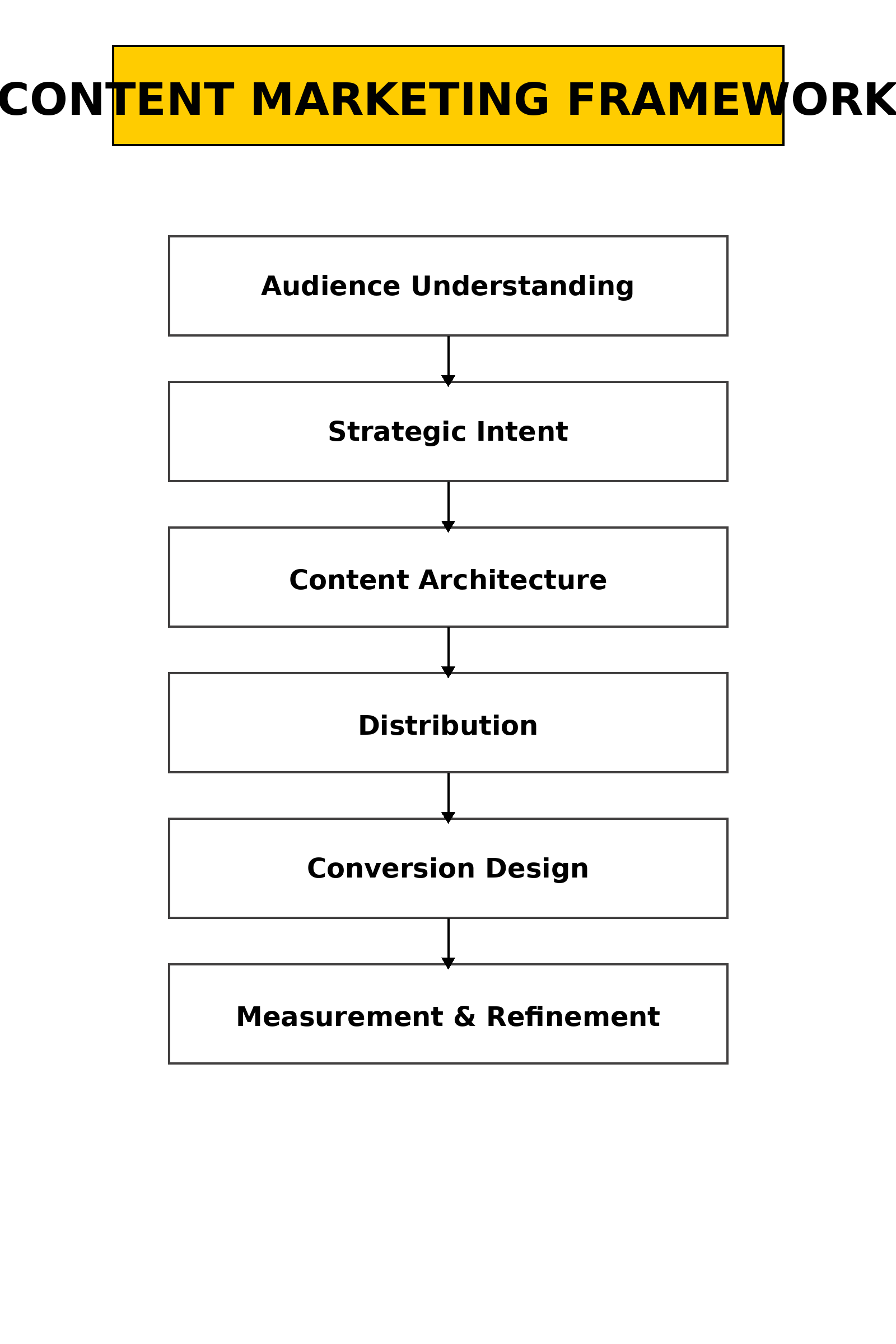
A practical content marketing framework starts with one question that sounds simple but changes everything: what job should this content do for the reader and for the business? If you cannot answer that clearly, you will usually end up with content that sounds polished but goes nowhere. Good frameworks reduce that confusion by connecting business goals, audience intent, content formats, distribution channels, and measurement into one operating system.
The easiest way to think about that system is in six layers. First comes audience understanding, because content without buyer context becomes guesswork. Second comes strategic intent, where each asset is tied to a real business outcome such as awareness, trust, lead generation, sales enablement, retention, or expansion.
Third comes content architecture, which means deciding what formats deserve to exist and how they support one another. Fourth comes distribution, because publishing is not the same thing as promotion. Fifth comes conversion design, which turns attention into the next logical action. Sixth comes measurement and refinement, which is where the framework becomes smarter over time instead of repeating the same mistakes with better graphics.
This kind of structure matters because buyer journeys are no longer neat or linear. Gartner describes modern buying as a looping process across problem identification, solution exploration, requirements building, and supplier selection, while McKinsey shows that decision-makers want omnichannel interaction and move between channels constantly. A real framework gives your content the flexibility to meet that behavior instead of pretending every prospect moves through a tidy funnel.
Core Components
The core components of content marketing are not just blog posts, social posts, and a newsletter. At a professional level, the core pieces usually include audience research, editorial planning, topic prioritization, format selection, production standards, search visibility, distribution, conversion paths, and performance analysis. When one of those pieces is missing, the whole system becomes less trustworthy and less effective.
Audience research comes first because relevance is the engine behind every other result. Without it, teams tend to create content around internal assumptions, pet topics, or whatever feels urgent that week. That is one reason modern marketers are putting so much emphasis on data foundations and personalization: Salesforce’s latest State of Marketing research, based on nearly 4,500 marketers worldwide, makes it clear that AI, data unification, and personalization are now central priorities rather than optional upgrades.
Editorial planning is the next component, and it has to be stronger than a spreadsheet full of ideas. A serious plan defines audience segments, funnel stages, themes, formats, publishing rhythm, owners, and quality standards. It also protects your brand from random acts of content, which is how many teams burn time without building momentum.
Format selection matters more than many people realize. Content Marketing Institute shows that marketers continue to increase investment in video, and Wistia’s 2024 video findings point to a simple truth: audiences still use video to learn, evaluate, and build confidence, especially when the content explains products clearly or teaches something genuinely useful. The real lesson is not that every brand should rush to make more video. It is that the format should match the buying moment, the audience’s question, and the level of trust required.
Distribution is another core component that often gets underbuilt. A piece of content rarely succeeds because it exists; it succeeds because it gets placed in front of the right people through search, email, social, communities, partnerships, sales outreach, and internal enablement. When teams treat distribution as an afterthought, they end up judging content too quickly or too harshly, even when the underlying asset was strong.
Professional Implementation
Professional implementation begins when content marketing stops being a collection of isolated deliverables and becomes an operating discipline. That means documented workflows, clear ownership, editorial standards, review processes, reusable templates, channel-specific distribution plans, and a measurement cadence that goes beyond vanity metrics. It is less glamorous than brainstorming headlines, but it is the part that separates consistent performers from teams that keep starting over.
In practice, professional teams build around priorities, not impulses. They identify the handful of themes most closely tied to revenue, buyer education, and brand authority, then create clusters of assets around those themes instead of scattering effort across dozens of disconnected topics. That approach is especially important now because buyers expect smooth movement between digital research and human interaction; Gartner found that buyers are 1.8 times more likely to complete a high-quality deal when supplier-provided digital tools work alongside sales support rather than in isolation.
Professional implementation also requires realistic use of AI. The opportunity is obvious, but blind trust is dangerous. CMI’s 2025 data shows widespread use of generative AI, yet only 4% of marketers report a high level of trust in AI outputs, which is a healthy reminder that speed and quality are not the same thing. The strongest teams use AI to accelerate research support, workflow efficiency, repurposing, and optimization, while still protecting brand voice, subject-matter depth, and factual accuracy through human judgment.
That human layer is becoming even more important as more brands publish more content with more automation. McKinsey reports that data-driven commercial teams blending personalized experiences with generative AI are 1.7 times more likely to increase market share. The keyword there is not AI. It is blending, because professional implementation is about using technology to sharpen the strategy, not to replace the thinking.
By this point, the pattern should be clear. Content marketing becomes powerful when it is aligned to the buyer journey, structured through a real framework, supported by the right core components, and executed with professional discipline. In the next part, we will go deeper into the framework itself so you can see how to turn those principles into a repeatable system.
1. Audience Reality Comes First
The first part of the framework is understanding how people actually think, search, compare, hesitate, and decide. Not how you wish they behaved. Not how your internal team talks about the product. How real buyers move when they are trying to reduce risk, gather evidence, and feel smart about the next step.
That distinction matters because discovery no longer happens in one place. Google’s latest research on search behavior shows that 70% of social media users use Google Search to inform and evaluate products they first discovered on social. That means content marketing has to anticipate cross-channel behavior from the start, because people do not experience your brand through one neat pipeline.
Audience reality also means recognizing how much friction exists before a click ever happens. SparkToro’s 2024 zero-click search study found that 59.7% of Google searches in the European Union ended without a click to the open web. So the framework has to respect a hard truth: visibility alone is not enough. Your messaging has to be clear enough, useful enough, and credible enough to earn the next action in a world where many searches end before a visit even begins.
2. Strategic Intent Gives Content a Job
Once you know how the audience behaves, the next step is deciding what each piece of content is supposed to accomplish. This is where many content marketing efforts become bloated. Teams create assets because they have a topic, a keyword, or a deadline, but they have not defined the commercial role of the content itself.
Strategic intent fixes that by forcing clarity. Some content should attract new demand. Some should deepen trust. Some should help buyers compare options, overcome objections, justify a purchase internally, or feel more confident choosing a higher-priced solution. The framework becomes much stronger the moment you stop asking, “What should we publish next?” and start asking, “What decision is this content helping the buyer make?”
That is also why high-level authority content matters more than many teams realize. Edelman and LinkedIn’s 2024 report, based on nearly 3,500 management-level professionals across seven countries, shows that effective thought leadership has a direct influence on sales and pricing and can make buyers more willing to seek a company out and even pay extra for its expertise. When content marketing is tied to strategic intent, thought leadership is no longer a vanity exercise. It becomes commercial leverage.

3. Content Architecture Creates Order Instead of Noise
The third part of the framework is content architecture, which is where you decide what types of content should exist and how they support one another. This is bigger than choosing between articles, videos, email newsletters, webinars, or case studies. It is about deciding how someone moves from first touch to deeper trust without feeling like every asset was created by a different company with a different agenda.
Good architecture usually includes pillar content, supporting pieces, proof-based content, conversion-focused assets, and retention content for customers who are already inside the ecosystem. That structure matters because people rarely need the same level of information at the same moment. A first-time visitor may need clarity and orientation, while a late-stage buyer may need comparison points, implementation detail, or stronger evidence that the investment will pay off.
Format selection should also be driven by usefulness, not trend anxiety. Wistia’s 2024 State of Video findings, based on millions of videos across thousands of companies, showed that simple instructional videos often outperform more polished formats and that viewers spend more total time with longer videos even when shorter ones earn higher engagement percentages. That is a useful reminder for content marketing teams: the format that wins is often the one that helps the audience understand something clearly, not the one that looks the most impressive in a planning deck.
4. Distribution Has to Be Designed, Not Assumed
A lot of content marketing underperforms for a very ordinary reason: distribution was never really planned. The content got published, maybe shared once, and then quietly left alone. When that happens, even strong work can look weak because it never had a fair chance to reach the people it was built for.
A smarter framework treats distribution as part of creation, not as something that happens afterward if there is still time. That means deciding in advance how an asset will travel through search, email, social, communities, partnerships, internal sales enablement, and repurposed formats. It also means accepting that different channels play different roles. Some channels generate discovery, some deepen familiarity, and some help buyers return when they are closer to making a decision.
That cross-channel design is no longer optional. McKinsey’s 2024 findings make it clear that buyers expect seamless movement across digital self-service, remote interaction, and human support. A content marketing framework that ignores distribution is like building a beautiful store in the middle of nowhere and acting surprised when nobody walks in.
5. Conversion Paths Should Feel Like the Natural Next Step
The fifth part of the framework is conversion design, and this is where many content programs become awkward. They work hard to earn attention, then immediately ask for too much. A visitor reads one useful piece of content and gets hit with a generic form, a mismatched call to action, or an offer that has nothing to do with the page they were just consuming.
Strong conversion paths feel like the logical continuation of the conversation. If the reader is early in the journey, the next step might be a deeper guide, a useful email series, or another closely related piece of content. If the reader is evaluating solutions, the next step may be a product walkthrough, a comparison page, a case study, or a consultation that helps them resolve uncertainty without pressure.
This is where content marketing becomes far more effective when it respects buying psychology instead of forcing premature lead capture. Buyers want to feel progress, not pressure. When the framework is built well, each next step feels earned, relevant, and proportionate to the level of trust the brand has built so far.
6. Measurement Turns the Framework Into a Living System
The final part of the framework is measurement, but not in the shallow sense of glancing at pageviews and calling it a day. Real measurement asks whether the content is attracting the right audience, whether it is holding attention, whether it supports movement to the next stage, and whether it contributes to pipeline, sales confidence, retention, or expansion over time. Without that feedback loop, content marketing becomes a production habit rather than a learning system.
This matters even more now because teams are trying to scale with AI while still protecting quality. Content Marketing Institute’s 2025 benchmark research found that 45% of B2B marketers still lack a scalable model for content creation, only 19% say AI is integrated into daily workflows, and just 4% report a high level of trust in AI outputs. Those numbers point to the same conclusion: speed alone will not fix a weak system. Measurement is what tells you whether your process is producing better content or simply more of it.
The strongest frameworks use measurement to improve judgment, not just reporting. They show which themes deserve more investment, which formats are actually helping buyers, where friction is hurting performance, and where the brand has a real chance to stand apart. That is what makes content marketing sustainable. It is not just a publishing machine. It is a system that keeps learning, tightening, and compounding as the market changes.
What This Framework Changes in Practice
Once you see content marketing through this six-part framework, a lot of bad habits become much easier to spot. You can tell when a team is publishing without audience insight, chasing channels without a distribution plan, or demanding conversions before trust exists. You can also see why some brands create less content than their competitors and still get better results from it.
The real advantage is not complexity. It is clarity. A solid framework helps you focus on content that deserves to exist, deserves to be promoted, and deserves to be improved over time.
In the next part, we will move from the framework itself into the core components that make content marketing work day to day, so you can see exactly what needs to be in place if you want the strategy to hold up under real business pressure.
Audience Insight Is the Foundation
The first core component is audience insight, and this is where content marketing becomes either deeply useful or painfully generic. It is not enough to know broad demographics or basic job titles. You need to understand what buyers are worried about, what they are trying to solve, what kind of language they trust, what objections slow them down, and what signals tell them they are moving in the right direction.
This matters more than ever because people bounce between channels while trying to reduce uncertainty. Google’s recent search behavior research shows that 70% of social media users turn to Google Search to learn more about products they first discovered on social platforms. That means your content marketing cannot assume discovery and evaluation happen in one place. It has to support curiosity at the first touch and confidence at the later touches.
There is another hard truth here. Getting seen is not the same as getting chosen. SparkToro’s 2024 study of Google searches in the European Union found that 59.7% ended without a click to the open web, which means weak messaging gets filtered out before your website even has a chance to make its case. Strong audience insight helps you write content that earns attention because it sounds like it actually understands the person reading it.
Editorial Strategy and Prioritization Keep the System Focused
The second core component is editorial strategy, which is what protects content marketing from turning into a random stream of opinions, announcements, and keyword-chasing. An editorial system decides what themes deserve attention, which audiences those themes matter to, what formats fit the moment, and how often the team can realistically publish without sacrificing quality.
This is one of the biggest differences between amateur and professional execution. Amateur execution starts with ideas. Professional execution starts with priorities. It knows which topics are tied to pipeline, which topics build authority, which topics support sales conversations, and which topics are just noise dressed up as activity.
The numbers around content volume make that discipline even more important. Content Marketing Institute’s 2025 B2B benchmarks show that 43% of marketers struggle to create content that differentiates itself from competitors. That is not a formatting problem. It is a prioritization problem. When editorial planning is weak, brands publish more and stand out less.
Authority, Proof, and Trust Assets Separate Serious Brands From Generic Ones
The third core component is authority, backed by proof. Content marketing cannot live on educational content alone. Teaching matters, but buyers also want evidence that your perspective holds up in the real world. That is where trust assets come in: case studies, comparison pages, implementation guides, expert commentary, original research, customer evidence, and thoughtful points of view that go deeper than recycled advice.
This is where content starts carrying commercial weight. Edelman and LinkedIn’s 2024 thought leadership study found that strong thought leadership can directly influence shortlists, increase willingness to pay a premium, and make buyers more open to working with a company they had not previously considered. That matters because trust is rarely built by saying you are credible. It is built by publishing material that feels grounded, specific, and useful enough to lower perceived risk.
Authority also protects content marketing from becoming too soft or too abstract. A business can publish helpful articles for months and still fail to convert if readers never see proof that the expertise translates into real outcomes. Trust assets make the argument complete. They show that the brand does not just understand the conversation. It can actually help someone move through it successfully.
Format Selection Shapes the Experience
The fourth core component is choosing the right format for the right job. Content marketing is not just about what you say. It is also about how the audience can absorb it with the least friction and the highest clarity. Some questions deserve a detailed article. Others are better answered through video, product demos, comparison pages, email sequences, webinars, or interactive resources.
That is why format selection should be driven by usefulness, not habit. Wistia’s 2025 video research, built from a survey of more than 1,300 professionals and analysis of over 100 million videos, makes it clear that video is now central to how businesses communicate. But the important lesson is not that every brand should publish video for the sake of it. The real lesson is that people choose formats based on the kind of certainty they need, and content marketing works best when the format matches that need.
Written content is still powerful because it supports search, deep explanation, and easy skimming. Video becomes powerful when the audience needs demonstration, tone, nuance, or human reassurance. A good content marketing system knows how those pieces fit together instead of forcing every question into the same format simply because that is what the team is used to producing.
Distribution and Amplification Decide Whether Great Content Gets a Chance
The fifth core component is distribution, and this is the part too many brands treat like an afterthought. They put everything into creation, hit publish, share the piece once, and then quietly move on to the next deadline. That is not a content marketing strategy. That is a content disposal strategy.
Real distribution means deciding in advance how an asset will travel. Search may drive ongoing discovery. Email may deepen the relationship. Social may create the first spark of awareness. Sales teams may use the asset during live conversations. Partners, communities, and internal advocates may extend its reach even further. The point is that strong content rarely wins because it exists. It wins because it gets placed in the right contexts often enough for the right people to see it.
This matters because buyers are interacting across more touchpoints than ever. McKinsey’s 2024 B2B Pulse research found that buyers use an average of ten channels along the buying journey. That reality changes everything. Content marketing has to be designed for movement across channels, not for one isolated encounter that magically does all the work.
Conversion Design Turns Attention Into Progress
The sixth core component is conversion design, which is really about making the next step feel natural. Content marketing often loses power when the reader gets value from the piece and then runs into a completely mismatched call to action. A thoughtful article ends with a hard sell. A useful guide points to a generic contact form. A comparison page leads nowhere relevant. That kind of friction wastes trust right when trust has finally started to build.
Good conversion design respects timing. Not every reader is ready for a sales conversation, and not every page should ask for one. Sometimes the right next step is another article, a deeper guide, a product walkthrough, a customer story, a webinar registration, or an email series that helps the person keep moving without feeling cornered.
This is where content marketing starts feeling smooth instead of forced. The reader does not feel pushed. The reader feels guided. That difference matters because progress is what keeps people engaged. Pressure is what makes them leave.
Operational Governance Keeps Quality From Slipping
The seventh core component is governance, which sounds less exciting than audience insight or authority content, but it is often the difference between a content marketing program that compounds and one that slowly degrades. Governance means style standards, brand voice rules, factual review, SME involvement, publishing workflows, refresh schedules, ownership, and approval systems that protect quality without strangling speed.
This has become even more important as teams try to move faster with automation and AI. Salesforce’s tenth State of Marketing report, based on insights from nearly 4,500 marketing leaders worldwide, shows just how central AI, data, and personalization have become. But moving faster creates a new risk: content can scale before judgment does. Governance is what keeps the system from flooding itself with work that sounds polished but says very little.
CMI’s 2025 research reinforces that tension. Many teams are experimenting with AI, yet very few report a high level of trust in AI outputs. That is exactly why content marketing still needs human standards, human review, and human accountability if it wants to protect credibility while scaling production.
Why These Components Have to Work Together
The biggest mistake is treating these core components like separate checkboxes. They are not. Audience insight influences editorial priorities. Editorial priorities shape the formats you choose. Formats affect distribution. Distribution changes how conversion paths should be designed. Governance protects the quality of the whole system while measurement reveals what deserves improvement.
That is why content marketing becomes powerful when the components are connected, not merely present. A team can have talented writers and still underperform if distribution is weak. It can publish often and still fail if the conversion path is clumsy. It can produce beautiful videos and still struggle if the editorial priorities are scattered and nobody knows which audience problem they are really trying to solve.
When these components click into place, the strategy starts to feel lighter even though the work is serious. Decisions become clearer. Content gets sharper. The results become easier to explain because the system finally makes sense from end to end.
The Next Step Is Execution
Once the core components are in place, content marketing stops being an abstract strategy and starts becoming operational. That is where the real game begins. It is one thing to know the parts. It is another thing entirely to build workflows, assign ownership, maintain standards, and keep execution strong when the calendar fills up and the pressure gets real.
That is exactly where we are headed next. In the next part, we will break down professional implementation so you can see how serious teams turn a good content marketing strategy into something that actually runs, scales, and produces results without falling apart.
Statistics and Data
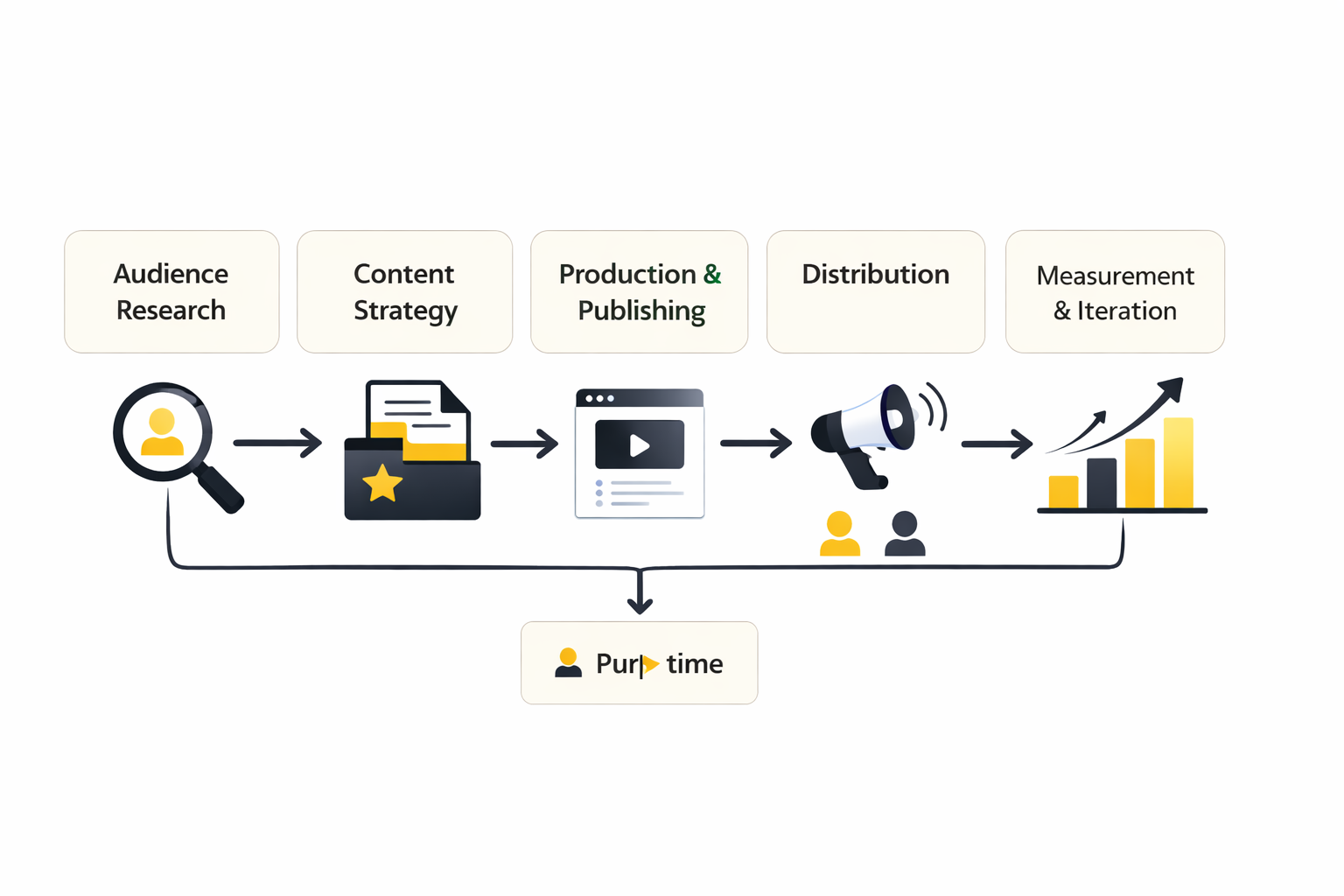
If you want content marketing to become a real growth system instead of a creative side project, you have to get comfortable with data. Not vanity data. Not screenshots of traffic spikes with no business context. Real operating data that tells you whether your content is reaching the right people, holding their attention, moving them closer to trust, and supporting revenue over time.
This is where many brands get discouraged too early. They publish for a few weeks, glance at surface-level numbers, and assume the strategy is not working. In reality, content marketing becomes much easier to manage once you know which metrics are signals of progress, which metrics are just noise, and how current market data should shape your expectations in the first place.
The broader market already shows why this matters. Content Marketing Institute’s 2025 B2B benchmark study shows that 46% of marketers who know their budgets expect content marketing spending to increase, which tells you something important right away: serious companies are not pulling back from content. They are trying to make it more accountable.
What the Market Is Telling Us Right Now
The first thing the data tells us is that content marketing now operates inside a far more complex buying environment than it did even a few years ago. McKinsey’s 2024 B2B Pulse research found that buyers use an average of ten interaction channels across the buying journey. That changes how you read performance. A blog post may not produce a last-click conversion on its own, but it can still be doing critical work inside a chain of touchpoints that eventually leads to a sale.
The second thing the data makes clear is that trust carries measurable commercial value. Edelman and LinkedIn’s 2024 study, based on nearly 3,500 management-level professionals across seven countries, shows that thought leadership is influencing real buying behavior, not just awareness. That matters because it gives content marketing a much stronger role than simple traffic generation. It can shape shortlist decisions, reduce perceived risk, and support premium positioning when the material is strong enough.
The third thing the market is telling us is that data, AI, and personalization are no longer side topics. Salesforce’s tenth State of Marketing report, built from insights from nearly 4,500 marketers worldwide, shows just how central those capabilities have become. That does not mean content marketing is turning into a machine-led process. It means the brands getting ahead are combining better systems, better data, and better judgment instead of treating content like disconnected acts of publishing.
Search Data and Discovery Metrics Matter More Than Most Teams Realize
Search remains one of the clearest ways to measure whether your content marketing is creating discoverability that compounds over time. Conductor’s 2025 State of SEO research found that 91% of respondents said SEO positively impacted website performance and marketing goals in 2024. That is a strong reminder that search visibility is not just a technical channel. It is one of the main ways content gets discovered by people who are already showing intent.
At the same time, the search environment has become harder. SparkToro’s 2024 zero-click study found that 59.7% of Google searches in the European Union ended without a click to the open web. That should immediately change how you interpret content marketing data. Ranking is still valuable, but rankings alone are no longer enough. Your topic selection, title structure, brand credibility, and message clarity all have to work harder if you want a search impression to become a visit.
The same pattern shows up when people move between social discovery and deeper research. Google’s recent research on search behavior shows that 70% of social media users use Google Search to evaluate products they first discovered on social. That means your content marketing analytics should never look at channels in isolation. Search may be closing the gap that social opened, and the real win is often hiding in the relationship between those touchpoints.
Production and Operational Data Reveal Whether the System Can Scale
One of the most useful content marketing statistics right now has nothing to do with traffic at all. CMI’s 2025 research found that 45% of B2B marketers lack a scalable model for content creation. That is a huge signal because it explains why so many teams feel stuck in reactive production even when they have smart people and decent budgets.
The same research adds another layer to that story. Only 19% say AI is integrated into their daily workflows, while 54% say their teams are taking an ad hoc approach. That means a lot of brands are experimenting with faster creation, but very few have turned that experimentation into an operating model strong enough to support consistent quality at scale.
There is an even more revealing number inside that same data set. Only 4% report a high level of trust in AI outputs. For content marketing leaders, that is incredibly useful because it tells you where the real bottleneck is. The challenge is not just producing more. The challenge is producing material that is accurate, differentiated, on-brand, and credible enough to deserve attention in the first place.
Format Performance and Engagement Data Help You Choose the Right Mix
Different content formats produce different kinds of engagement, and the numbers make that very clear. CMI’s 2025 benchmark data shows that 61% of B2B marketers expect their organizations to increase investment in video, making it the top planned investment area. That does not mean text is losing importance. It means content marketing is becoming more format-diverse because buyers need different kinds of confidence at different moments.
Wistia’s 2025 State of Video research gives even more context here. The study draws on a survey of more than 1,300 professionals and analysis of over 100 million videos, which makes it especially useful for deciding how video fits into the broader content mix. The takeaway is not that every team needs a studio. The takeaway is that video is now a serious performance format for explanation, demonstration, webinars, and trust-building, especially when viewers need more than a quick skim to feel confident.
This changes how you measure content marketing success across formats. Articles might drive discovery and long-tail search visibility. Video might deepen understanding and improve conversion readiness. Email may bring people back. A webinar may become the source material for an entire quarter of repurposed assets. The smartest analytics models do not ask which format is best in the abstract. They ask which format is doing the job it was supposed to do.
Budget, Investment, and Resource Signals Show Where the Industry Is Heading
Budget data helps you understand where the market believes content marketing is delivering value. CMI’s latest B2B data shows that 52% of marketers expect increased investment in thought leadership content, 40% expect increased investment in AI for content optimization and performance, and 39% expect increased investment in AI for content creation. Those numbers are useful because they reveal where content programs are being pushed to evolve: not just to publish more, but to become more authoritative, more measurable, and more efficient.
There is also a staffing signal hidden in the same report. Twenty-seven percent of marketers expect their content teams to grow in 2025, and among top performers that number rises to 38%. That matters because content marketing performance is still heavily tied to capability, not just tooling. Good systems help, but strong judgment, editorial discipline, and subject-matter depth still make a measurable difference.
When you combine those signals with Salesforce’s current marketing research, the direction becomes pretty clear. High-performing brands are putting more emphasis on AI, data unification, and personalization, but they are doing it to sharpen the content system, not to eliminate the need for strategy. The resource story is not “humans out, automation in.” It is “stronger systems, better prioritization, and more pressure to prove business value.”
Which Content Marketing Metrics Actually Matter
Once you step back from industry benchmarks, the most important question becomes much more practical: what should you actually measure inside your own content marketing program? The answer depends on the job each asset is meant to do, but the core groups usually include discovery metrics, engagement metrics, journey progression metrics, conversion metrics, and business outcome metrics.
Discovery metrics include impressions, keyword visibility, organic sessions, referral traffic, returning visitor growth, and audience-source quality. Engagement metrics include scroll depth, engaged time, completion rate for videos, return visits, newsletter signups, and multi-page session behavior. These numbers matter because they tell you whether the content is merely being seen or whether it is holding enough attention to begin building trust.
Journey progression metrics are where content marketing starts becoming commercially useful. These include assisted conversions, demo-path interactions, case study consumption, comparison-page visits, email reply rates, webinar attendance quality, and content touched before opportunity creation. Business outcome metrics go even further by tying content to influenced pipeline, sales velocity, retention support, expansion opportunities, and customer education outcomes. That is the layer where content stops looking like publishing and starts looking like infrastructure.
How to Read the Data With Better Judgment
The hardest part of content marketing analytics is not collecting numbers. It is interpreting them correctly. A post with modest traffic can be highly valuable if it attracts the right buyers and consistently influences high-intent journeys. A page with huge traffic can be almost worthless if it attracts curiosity without commercial relevance.
That is why context always matters more than isolated numbers. If search visibility is rising but engagement is weak, the topic may be attracting the wrong audience or the page may be underdelivering on the promise of the headline. If engagement is strong but conversions are low, the content itself may be useful while the next step is poorly matched. If conversions exist but sales quality is disappointing, then the content may be generating activity without enough qualification or depth.
The best content marketing teams use statistics and data to refine judgment, not replace it. They read patterns, compare channels, look for points of friction, and ask hard questions about what the numbers are really saying. That is how the strategy gets sharper over time.
What Comes After the Numbers
Once you understand the data, you can stop guessing about what to publish, what to improve, and what to cut. That is the real payoff. Statistics and dashboards are not there to make the strategy look sophisticated. They are there to help you make smarter decisions faster.
And that leads directly into the next part of the article. We are going to move from the numbers themselves into how content marketing fits inside a larger ecosystem, how the strongest programs keep compounding over time, and what that means for long-term growth instead of short bursts of performance.
The Content Marketing Ecosystem and Long-Term Growth
Content marketing gets a lot more powerful when you stop looking at it as a publishing function and start looking at it as an ecosystem. A single article can help, a single email can help, and a single video can help, but the real upside shows up when those pieces reinforce one another over time. That is when content marketing stops feeling like weekly output and starts feeling like an asset that keeps making the business stronger.
This shift matters because buyers are moving through more touchpoints than ever. McKinsey’s 2024 B2B Pulse research found that decision-makers now use an average of ten channels across the buying journey, which means your content marketing has to work across search, social, email, sales conversations, product education, and follow-up touchpoints without losing coherence. The brands that grow steadily are usually the ones that build that connected experience on purpose instead of hoping disconnected assets somehow add up.
There is also a long-game reason to think this way. Content Marketing Institute’s 2025 B2B benchmark study shows that more marketers expect budget increases than cuts, which tells you the market still believes content marketing is worth investing in. But that money only pays off consistently when the content system is built to compound, not just to fill a calendar.
Content Marketing Is Bigger Than Publishing
A lot of businesses still treat content marketing as a production problem. They ask how often they should post, which channels they should use, and how quickly they can create more assets. Those questions matter, but they are secondary. The deeper question is whether the content is connected to discovery, trust, conversion, customer success, and brand authority in a way that strengthens the whole business.
That is why strong content marketing systems rarely sit in one silo for long. Search teams need it for discoverability. Sales teams need it to support conversations and answer objections. Email teams need it to nurture attention. Customer success teams need it to improve adoption, retention, and expansion. Once you see that, the ecosystem becomes easier to understand because each piece of content can serve multiple functions at different points in the relationship.
The market is moving in that direction fast. Salesforce’s latest State of Marketing report, based on insights from nearly 4,500 marketers worldwide, shows that AI, personalization, and unified data are becoming central to modern marketing operations. That only makes content marketing more important, because personalization without strong content is just better-targeted mediocrity.
Why Compounding Matters More Than Traffic Spikes
One of the biggest mindset upgrades in content marketing is learning to value compounding more than short bursts of attention. A spike can feel exciting, but it often fades fast. A well-built content ecosystem keeps attracting, educating, and converting people long after the original publishing date, especially when the assets are refreshed, interlinked, repurposed, and distributed intelligently.
This is especially important in search and research-driven buying journeys. Google’s recent research on search behavior shows that 70% of social media users use Google Search to learn more about products they first discovered on social. That means content marketing value is often cumulative. A person may see your brand on one channel, research you on another, return through search later, and only then be ready to engage more seriously.
The compounding effect also protects your business from overdependence on paid reach. Paid media can absolutely accelerate things, but a content ecosystem gives you something more durable: a growing library of relevance and trust. Over time, that becomes one of the most defensible advantages a brand can have, because competitors can copy formats much faster than they can copy accumulated credibility.
How Content Marketing Supports the Whole Buyer Journey
The strongest content marketing programs do not overfocus on top-of-funnel visibility. They build material for the full journey. Early-stage content helps people understand a problem or opportunity. Mid-journey content helps them compare approaches, weigh tradeoffs, and make sense of the market. Late-stage content gives them the proof, detail, and reassurance they need to move forward without feeling reckless.
This is one reason authority content matters so much. Edelman and LinkedIn’s 2024 thought leadership study, based on nearly 3,500 management-level professionals, shows that strong thought leadership can influence buying decisions, improve willingness to pay a premium, and increase openness to considering a company that was not already a frontrunner. That is not just a branding outcome. It is a revenue outcome that travels through the ecosystem.
When content marketing is built this way, the buyer journey feels less fragmented. The reader does not encounter one smart article, then a weak follow-up, then a generic sales pitch. Instead, they keep running into clarity, proof, and useful next steps. That consistency is a huge part of why some brands feel trustworthy before the first conversation ever happens.
The Role of Search, Social, Email, and Sales
Inside a healthy content marketing ecosystem, channels stop competing with one another and start doing separate jobs. Search is often where high-intent discovery happens. Social can create the first spark of awareness and familiarity. Email helps build continuity and bring people back. Sales conversations can use content to shorten explanation time, answer objections, and give buyers something useful to revisit after the meeting.
This matters because modern buyers do not move in straight lines. McKinsey’s current research makes that clear, and the same pattern shows up in search behavior too. SparkToro’s 2024 zero-click study found that 59.7% of Google searches in the European Union ended without a click to the open web, which means your content marketing has to create recognition and trust even before a website visit occurs.
Once you accept that reality, channel strategy gets smarter. You stop asking which channel matters most in the abstract and start asking what job each channel should do inside the wider ecosystem. That is a much better question, because it forces every asset to support a real movement in the relationship instead of chasing isolated metrics.
Customer Retention, Expansion, and Post-Sale Content
One of the most underrated parts of content marketing is what happens after the sale. Many brands put almost all of their energy into acquisition and then wonder why retention feels harder than it should. But customers still need clarity after they buy. They need onboarding help, implementation guidance, practical ideas, product education, use cases, and confidence that they made the right decision.
This is where content marketing becomes a serious retention tool. Useful post-sale content reduces confusion, shortens time to value, and helps customers discover more of what the product or service can actually do. It also gives account managers, support teams, and customer success teams far better material to work with than repeating the same explanations in live conversations over and over again.
Long-term growth becomes much easier when the ecosystem extends beyond lead generation. The business does not just keep attracting new people. It becomes better at keeping the people it already won. That matters because a content system that supports both acquisition and retention is naturally stronger, more efficient, and more resilient over time.
How AI Changes the Ecosystem Without Replacing Strategy
AI is clearly changing content marketing, but not in the simplistic way people often describe it. It can make research support faster, help teams repurpose assets, speed up production workflows, and uncover optimization opportunities. What it cannot do on its own is create a strong ecosystem with real judgment, real differentiation, and real commercial relevance.
The current numbers make that tension obvious. CMI’s 2025 benchmark data shows that only a small minority of marketers report a high level of trust in AI outputs, even while more teams explore AI-assisted workflows. That should be encouraging, not discouraging, because it means good content marketing still depends on human standards, human taste, and human understanding of what the audience actually needs.
What AI does best inside the ecosystem is help strong teams move with more leverage. It can help you refresh older assets, turn one webinar into multiple formats, identify content gaps, and speed up routine work. But it still needs a real strategy wrapped around it, otherwise the ecosystem just fills up with faster versions of the same forgettable material buyers already ignore.
Building an Ecosystem That Gets Stronger Over Time
If you want content marketing to support long-term growth, the goal is not endless volume. The goal is strategic density. You want fewer gaps, stronger connections between assets, better support across the buyer journey, and a system that gets more useful as each new piece is added. That is what makes the ecosystem stronger instead of just larger.
In practical terms, that means refreshing strong evergreen assets, linking related content thoughtfully, turning customer questions into content opportunities, and building around themes that genuinely matter to the business. It also means measuring more than traffic. You want to know which content keeps bringing qualified people in, which pieces keep showing up in sales conversations, and which assets make the brand feel more credible in the moments that actually matter.
When that happens, content marketing starts doing what every business wants from its marketing: it creates momentum that does not disappear the second a campaign ends. That is the real beauty of the ecosystem approach. It makes the work harder to fake, but much more valuable to own.
The Final Piece Comes Next
At this point, the full picture is starting to come together. We have looked at why content marketing matters, how the framework works, which components make it effective, what the data is saying, and why the ecosystem model gives the strategy far more staying power. The only thing left is to bring it all together in a practical way and answer the questions people still tend to ask once they are ready to act.
That is what the final part will do. We will wrap the strategy up, clear up the biggest points of confusion, and finish with a focused FAQ so the article ends the same way great content marketing should end: with clarity, confidence, and a useful next step in mind.
Final Takeaways on Content Marketing

At this point, the big picture should be clear. Content marketing is not just a way to publish articles, post on social media, or keep your website fresh. It is a system for building attention, trust, buyer confidence, and long-term demand in a market where people research independently, compare across channels, and expect every interaction to make sense.
That is exactly why the strongest teams treat content marketing as business infrastructure. McKinsey’s 2024 B2B Pulse research shows that buyers now use an average of ten channels during the buying journey, while Gartner’s 2025 sales survey found that 61% of B2B buyers prefer an overall rep-free buying experience. When buyers want more control, your content has to do more of the heavy lifting.
The opportunity is still huge for businesses willing to do the work properly. Content Marketing Institute’s 2025 B2B benchmark study shows that 46% of marketers expect higher content marketing budgets, 61% expect higher investment in video, and 52% expect more investment in thought leadership. That tells you something simple but important: serious companies are not moving away from content marketing. They are trying to get better at it.
FAQ – Built for a Complete Guide
What is content marketing in simple terms?
Content marketing is the practice of creating useful, relevant content that helps people understand a problem, explore solutions, trust your expertise, and move closer to a decision. Done well, it does not feel like constant selling. It feels like steady, valuable guidance that makes the buyer more confident at every stage.
That matters even more now because people often discover a brand in one place and research it somewhere else. Google’s current research on search behavior shows that 70% of social media users use Google Search to evaluate products they first discovered on social, which is exactly why strong content marketing has to support the full journey instead of one isolated click.
Does content marketing still work in 2026?
Yes, but it works best for businesses that treat it like a system rather than a content treadmill. Publishing generic material just to stay active is getting weaker. Publishing clear, differentiated, trustworthy content tied to real buyer questions is still extremely effective.
The current market data supports that direction. CMI’s 2025 research shows more marketers expecting budget increases than cuts, which is a strong sign that businesses still see content marketing as commercially valuable when it is executed with discipline.
How long does content marketing take to produce meaningful results?
Content marketing usually takes longer than paid advertising to show obvious results, but its value also tends to compound more powerfully over time. The timeline depends on your competition, distribution strength, website authority, sales cycle, and how strong your content is from the beginning. In many cases, businesses start seeing promising signals such as stronger engagement, better search visibility, and better sales conversations before they see a major pipeline impact.
The biggest mistake is expecting mature results from immature systems. If the strategy is random, the message is weak, and the distribution is inconsistent, content marketing will feel slow because the foundation is slow. If the system is focused, the progress becomes much easier to spot and much easier to build on.
What types of content work best?
The best format depends on what the audience needs at that moment. Articles are great for search visibility, structured education, and deep explanation. Video is especially strong when people need demonstration, nuance, or reassurance from a human voice and face. Case studies, comparison pages, webinars, email sequences, and customer education content all play different roles inside a healthy content marketing ecosystem.
That is one reason video investment keeps climbing. Wistia’s 2025 State of Video research, based on a survey of more than 1,300 professionals and analysis of over 100 million videos, shows how central video has become to modern communication. The lesson is not that every business needs more video at all costs. The lesson is that the format should match the buyer’s need for clarity.
Is SEO the same as content marketing?
No. SEO and content marketing overlap, but they are not the same thing. SEO helps content become discoverable through search, while content marketing is the broader strategy of using content to attract attention, build trust, support decisions, and strengthen the customer journey.
You can have SEO without a strong content marketing strategy, and the result is often technically visible but commercially weak. You can also have content marketing without good SEO, and the result may be excellent material that too few people ever discover. The strongest businesses build both together.
How should you measure content marketing?
You should measure content marketing in layers. Start with discovery metrics such as impressions, organic traffic, referral traffic, and audience quality. Then look at engagement metrics such as time on page, scroll depth, video completion, returning visitors, and newsletter subscriptions. After that, track journey and business metrics such as assisted conversions, demo-path engagement, pipeline influence, retention support, and expansion opportunities.
This layered view matters because the buying journey is no longer linear. McKinsey’s 2024 findings on omnichannel buying behavior make it clear that content often contributes across multiple touchpoints, which means last-click measurement alone can dramatically understate the real value of content marketing.
Why is my content not ranking or getting enough traffic?
Usually the issue is not one single problem. The content may be targeting the wrong topics, failing to differentiate itself, matching the wrong search intent, or lacking enough credibility and distribution support to earn attention. In some cases, the topic is simply too competitive for the authority level of the site.
There is also a wider search reality to respect. SparkToro’s 2024 zero-click study found that 59.7% of Google searches in the European Union ended without a click to the open web. That means content marketing now has to earn more than rankings. It has to earn the click itself through better relevance, better titles, better credibility, and better alignment with what the user is actually trying to solve.
Can AI replace content marketing teams?
No, but it can absolutely make good teams faster and more effective. AI can help with ideation support, research assistance, workflow efficiency, repurposing, optimization, and first drafts. What it still struggles to replace is editorial judgment, subject-matter depth, genuine differentiation, and the human feel that makes a piece of content sound trustworthy instead of hollow.
The current industry data makes that pretty clear. CMI’s 2025 benchmark report shows that only 4% of B2B marketers report a high level of trust in AI outputs, even while many teams are experimenting heavily with AI-assisted workflows. So the opportunity is real, but the human layer still matters tremendously.
How much content should you publish?
You should publish as much as you can sustain at a high standard without turning the strategy into noise. Frequency matters, but clarity, relevance, and consistency matter more. A smaller volume of strong content tied to real audience needs will usually outperform a larger volume of weak content that exists only to satisfy an arbitrary schedule.
That is especially true now because differentiation is one of the biggest challenges in the field. CMI’s latest data shows that 43% of B2B marketers struggle to create content that stands apart from competitors. That is a strong argument for publishing with more intention, not just more frequency.
Is content marketing only for B2B companies?
Not at all. Content marketing works in B2B, B2C, ecommerce, services, SaaS, education, personal brands, and many other models. The exact formats and buying journeys change, but the core logic stays the same: useful content helps people discover options, build confidence, reduce risk, and move toward action.
B2B often gets more attention in strategy discussions because the journeys are longer and the decisions are more complex. But consumer brands also win through strong education, comparison content, storytelling, product use guidance, and post-purchase support. The principle is broader than the category.
What is the biggest mistake businesses make with content marketing?
The biggest mistake is treating content marketing like a series of disconnected deliverables instead of a connected system. Businesses publish a blog post here, a social update there, a video once in a while, and then wonder why nothing compounds. Without shared strategy, shared priorities, and shared conversion logic, the work stays scattered.
The stronger move is to build around themes, audience problems, and real business goals. That is what turns content into an ecosystem rather than a pile of assets. Once the pieces start supporting one another, the strategy becomes far more powerful and far easier to scale intelligently.
Does thought leadership actually help with sales?
Yes, when it is substantive enough to be useful. Weak thought leadership is just polished opinion. Strong thought leadership helps buyers understand their situation better, challenges lazy assumptions, and gives them a smarter way to think about the decision in front of them.
The commercial impact is real. Edelman and LinkedIn’s 2024 report, based on nearly 3,500 management-level professionals, shows that effective thought leadership can influence shortlists, increase willingness to pay a premium, and open buyers up to companies they may not have been considering before. That is why content marketing and authority-building work so well together when the ideas are strong.
Should a small business invest in content marketing?
Yes, especially if the business needs trust, education, and compounding visibility instead of short bursts of rented attention. A small business usually cannot outspend larger competitors forever, but it can build sharper positioning, clearer expertise, and stronger relationships through useful content that keeps working after it is published.
The key is focus. A small business does not need to be everywhere. It needs to be extremely helpful in the places and topics that matter most to its buyers. That is where content marketing becomes one of the most practical growth plays available.
Work With Professionals
There comes a point where doing everything yourself starts slowing the business down. Content marketing rewards consistency, strategic clarity, editorial discipline, strong distribution, and a sharp understanding of how buyers actually move. If one or two of those pieces are weak, the whole system can underperform even when the effort is real.
That is why many businesses eventually decide to work with professionals instead of trying to patch the strategy together on the fly. A strong team can help you clarify positioning, build a cleaner framework, tighten your content standards, choose better formats, and connect the work to outcomes that actually matter. When that happens, content marketing stops feeling like guesswork and starts feeling like leverage.
Explore 10K+ Remote Marketing Contracts on MarkeWork.com
Most marketers spend too much time chasing clients, competing on crowded platforms, and losing a percentage of every project to middlemen.
MarkeWork gives you a better way. Browse thousands of remote marketing contracts and connect directly with companies desperate to hire skilled marketers like you – without platform commissions and without unnecessary gatekeepers.
If you’re serious about finding better opportunities and keeping 100% of what you earn, you can explore available contracts and create your profile for free at MarkeWork.com.
 Filip Konecny Enterprises