
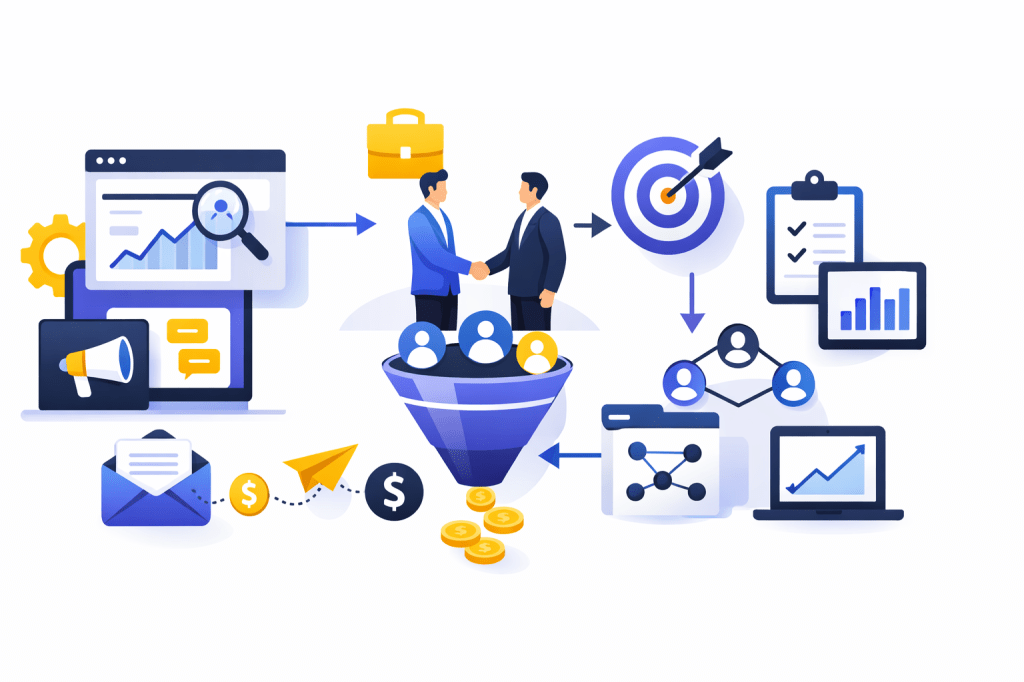
B2B marketing has changed fast. Buyers now research on their own, compare vendors long before they ever fill out a form, and expect every touchpoint to feel relevant instead of generic. That shift is why modern teams can no longer rely on a disconnected mix of campaigns, cold outreach, and vague brand messaging.
The companies that win treat b2b marketing as a system. They combine clear positioning, useful content, strong distribution, trustworthy data, and sales alignment so prospects can move forward with confidence. That matters even more now that 61% of B2B buyers prefer a rep-free buying experience, while 81% say they chose a winning vendor before speaking with sales.
This first part lays the groundwork. You will see why b2b marketing matters, how the framework fits together, which components do the heavy lifting, and what professional implementation actually looks like when the goal is not just more activity, but more qualified pipeline and more revenue confidence.
Article Outline
- Why B2B Marketing Matters
- B2B Marketing Framework Overview
- Core Components of B2B Marketing
- Professional B2B Marketing Implementation
- B2B Marketing Measurement and Optimization
- B2B Marketing FAQ and Next Steps
Why B2B Marketing Matters
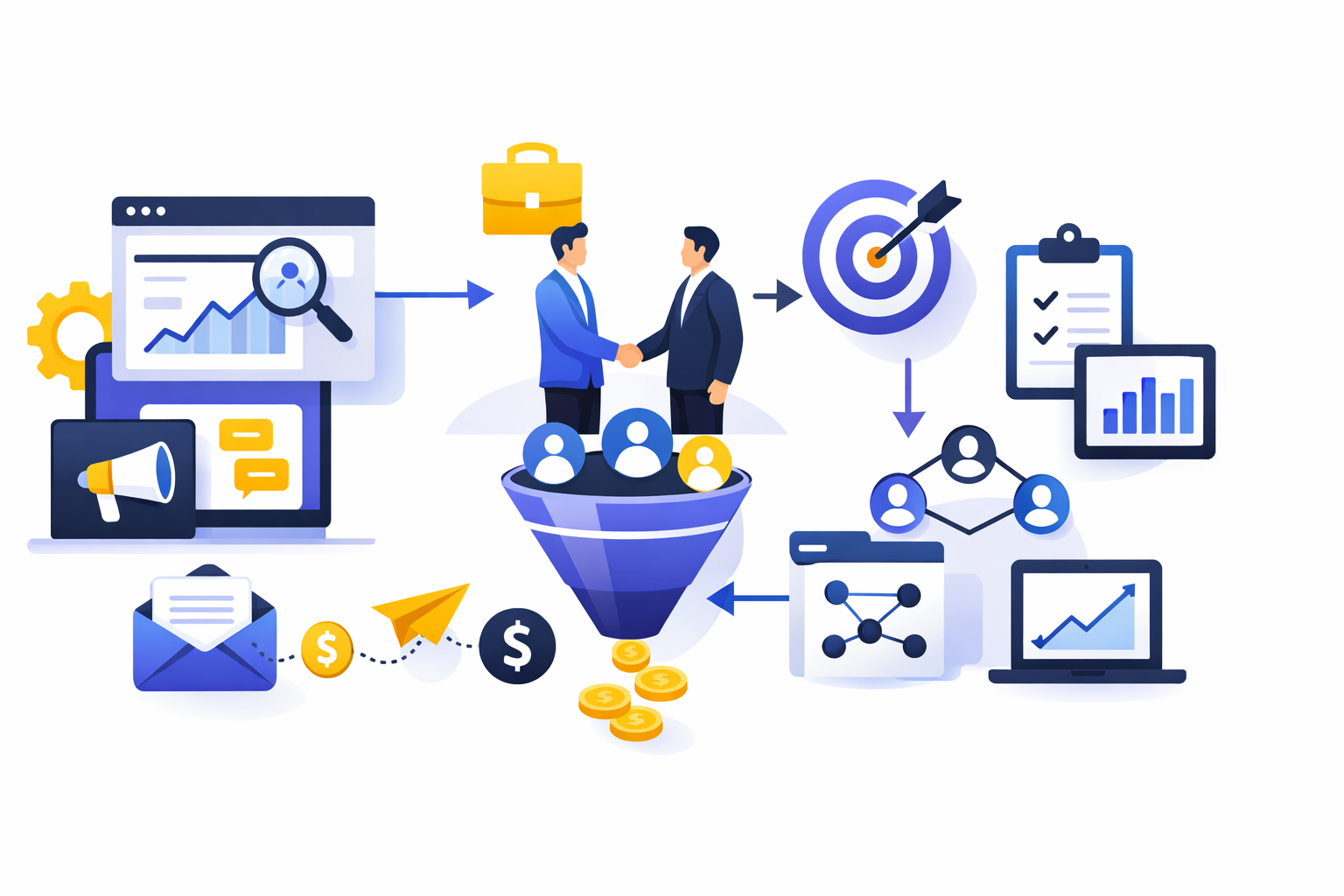
B2B marketing matters because it shapes the buying decision before a sales conversation ever starts. Research from 6sense, Gartner, and McKinsey points in the same direction: buyers want more self-service, they do more independent research, and they often narrow their options before a seller is invited into the process. If your brand is invisible during that research window, sales is forced to recover demand that marketing should have helped create earlier.
It also matters because B2B purchases are rarely made by one person. The 2025 Edelman-LinkedIn report explains that buying groups include visible and hidden decision-makers, and that more than 40% of B2B deals stall because of internal misalignment. In practice, that means effective b2b marketing does more than generate leads. It creates clarity, trust, and internal talking points that help multiple stakeholders agree on why your solution deserves serious consideration.
The channel mix is changing too, but the core requirement has stayed the same: your marketing has to help people understand the problem, believe your approach, and see proof that you can deliver. The latest B2B Content Marketing research from Content Marketing Institute shows that top-performing teams are more likely to understand their audience, measure content performance effectively, and run a scalable content operation. That is a useful reminder that b2b marketing is not about producing more noise. It is about building a repeatable engine that moves the right accounts from curiosity to conviction.
B2B Marketing Framework Overview
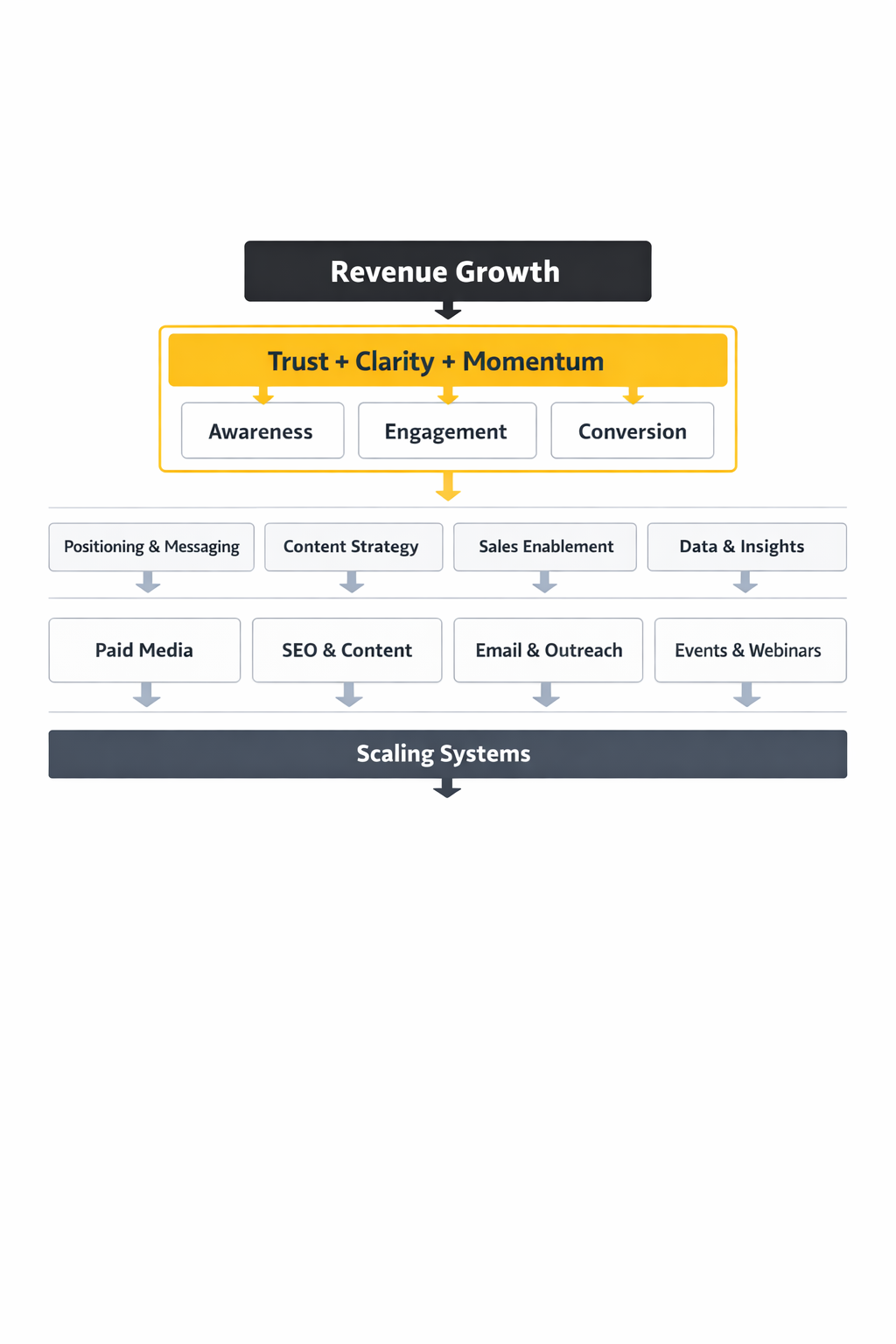
A practical b2b marketing framework starts with market clarity. You need a defined audience, a strong point of view, and positioning that explains why your offer matters now, not in abstract terms. When that foundation is weak, every downstream tactic gets harder because campaigns attract the wrong people, content feels interchangeable, and sales conversations turn into education from scratch.
From there, the framework moves into demand creation and demand capture. Demand creation builds familiarity and trust before people are ready to buy, which is why thought leadership still matters; the Edelman-LinkedIn research notes that effective thought leadership can influence sales outcomes and make buyers more willing to seek out a company’s expertise. Demand capture, on the other hand, turns active interest into measurable opportunities through search, retargeting, email, landing pages, demos, and sales follow-up.
The final layer is orchestration. That means connecting content, media, CRM data, website behavior, and sales feedback so the journey feels consistent instead of fragmented. This is exactly where many teams struggle: 45% of B2B marketers say they lack a scalable model for content creation, while the latest Salesforce State of Marketing report shows that 83% of marketers recognize the shift to personalized, two-way messaging, yet only one in four are satisfied with how they use data to power it. In other words, the framework is not complicated because the ideas are mysterious. It is complicated because execution breaks when systems, teams, and measurement do not line up.
Core Components of B2B Marketing
The first core component is positioning. A strong market position tells buyers who you serve, what problem you solve, why your approach is different, and why that difference is worth paying attention to. Without that clarity, even well-funded b2b marketing campaigns end up competing on volume instead of meaning, which usually creates more clicks than conviction.
The second component is content that earns trust. That does not just mean blog posts. It includes category education, case studies, buying guides, comparison pages, webinars, research, customer proof, and thoughtful email sequences that help people move from early research to shortlist decisions. The 2025 CMI research found that 82% of top-performing teams credit their success to understanding their audience, while Edelman and LinkedIn show that thought leadership helps influence hidden buyers who can quietly shape the deal.
The third component is distribution. Great content with weak distribution is just expensive storage. Strong b2b marketing uses the right mix of organic search, paid search, LinkedIn, newsletters, partner channels, webinars, retargeting, and direct outreach so useful ideas are actually seen by the people who matter. The same CMI report shows that 61% of marketers expect increased investment in video and 52% expect increased investment in thought leadership, which makes sense because buyers respond to formats that explain, demonstrate, and build credibility.
The fourth component is data and workflow discipline. AI can help, but only when the process is already sound. Only 4% of B2B marketers report a high level of trust in generative AI output, even as McKinsey reports that 19% of B2B decision-makers are already implementing gen AI use cases and another 23% are in the process. That is why the winning setup is not AI instead of strategy. It is AI supporting research, production, personalization, and analysis inside a system that still depends on strong judgment.
Professional B2B Marketing Implementation
Professional implementation starts with alignment, not tools. Marketing and sales need a shared definition of the ideal customer, the buying committee, the stage definitions, and the signals that indicate real intent. When teams skip that step, dashboards may look busy, but performance becomes hard to trust because nobody agrees on what counts as progress.
The next step is building the operating stack around the journey. That usually means a CRM for account visibility, automation for nurturing and routing, analytics for attribution, and a website built to convert interest into the next logical action. Teams that want to tighten their execution often start by cleaning up contact and pipeline management with a system like Copper, then improving email workflows and segmentation through a platform such as Brevo. If the offer requires a more structured conversion path, dedicated funnel software like ClickFunnels can help standardize pages, forms, and follow-up sequences.
Execution also means committing to distribution consistency. Thoughtful posts, campaign assets, and customer education need a publishing rhythm, not a burst-and-disappear approach. For teams managing recurring promotion across social channels, a scheduling layer such as Buffer can make that process more disciplined, but the larger point is strategic: tools only improve b2b marketing when they support a message that is already clear, a buyer journey that is already mapped, and a measurement model that tells you what deserves more budget.
That is why professional b2b marketing feels different from amateur execution. It does not chase every trend, and it does not confuse activity with momentum. It builds a system where positioning, content, channels, automation, and sales follow-up all reinforce the same promise, so prospects encounter one coherent story instead of five disconnected ones.
B2B Marketing Measurement and Optimization
This is the point where a lot of b2b marketing teams either become dangerous or stay noisy. If you measure the wrong things, you can look busy for months and still have no idea whether you are creating real commercial momentum. That is why serious teams move past vanity reporting and focus on signals that show whether the right accounts are moving closer to revenue.
The shift is already visible in current research. The latest 6sense attribution and contribution benchmark shows that leads and MQLs are increasingly treated as legacy measures, while pipeline influence, account engagement, and buying-group progress are becoming more important for leadership teams. That change makes sense, because in a world where 94% of buyers rank their shortlist before speaking with sellers, you do not win by stuffing the CRM with low-context contacts that were never likely to buy.
Pipeline Metrics That Actually Matter
The first job of measurement is to tell you whether your b2b marketing is attracting the right companies, not just whether it is attracting attention. A healthy dashboard should show how many target accounts are engaged, how quickly they move into qualified pipeline, how large the buying group becomes, and whether sales is acting on that activity in time. If those numbers are weak, more content or more spend usually will not solve the problem by itself.
That is exactly why the newest 6sense benchmark argues that legacy measures such as leads and MQLs do not line up with modern B2B buying, while board-level reporting is shifting toward bottom-line outcomes and early-stage opportunities tied to revenue. The same study notes that many organizations now report website account engagement at a higher rate than pipeline or MQLs, which is a useful sign that account-level behavior is finally being treated as a business signal instead of a side metric. That does not mean raw engagement is enough on its own, but it does mean b2b marketing is becoming more honest about what deserves executive attention.
There is also a practical reason to think this way. The 2025 B2B research from Content Marketing Institute shows that only a minority of marketers describe their content efforts as extremely or very successful, and one of the differences among top performers is that they do a better job measuring content performance effectively. Good measurement creates focus. It tells you which channels are creating qualified attention, which assets are helping deals move, and where the journey is breaking before revenue slips through your hands.
Why Attribution Needs a Broader View
Attribution gets messy in B2B because the buying journey is messy. Multiple people visit the site, content is consumed across weeks or months, sales conversations happen after research is already well underway, and some of the most important influence happens off-form and off-click. That is why simplistic last-click thinking usually makes b2b marketing look worse than it is, while also pushing teams toward channels that harvest demand instead of building it.
The better approach is to use attribution as a decision tool, not as a religion. A team should know which channels are helping create awareness, which ones bring accounts back, which touchpoints correlate with pipeline progression, and where handoff quality improves or collapses. That broader view fits the market reality described by Salesforce’s latest State of Marketing report, where 83% of marketers see the shift toward personalized, two-way messaging, yet only one in four are satisfied with how they use data to power it.
In plain English, most teams know the journey is more complex than their dashboards can comfortably explain. That is not an excuse to stop measuring. It is a reason to connect CRM stages, campaign data, account engagement, and sales feedback so attribution reflects how b2b marketing actually supports revenue instead of pretending one click created the deal all by itself.

How To Optimize Without Guessing
Optimization is where discipline separates professionals from amateurs. You are not optimizing because a platform gives you more settings to play with. You are optimizing because every campaign, landing page, webinar, nurture sequence, and sales follow-up either makes the buyer’s decision easier or adds friction that slows the deal down.
The smartest b2b marketing teams improve one layer at a time. They tighten the audience first, then the message, then the offer, then the journey after response, because better traffic means little if the handoff is weak. That method is supported by the same 2025 CMI study, where 61% said SEM or PPC produced the best results among paid channels, while videos were rated the most effective content type at 58% and in-person events and webinars led distribution effectiveness at 52% and 51%.
Those numbers do not tell you to copy another company’s media mix. They tell you to test with intention. For one business, search may capture existing demand while webinars move technical stakeholders forward; for another, customer proof and short video may do more to unlock trust than any landing-page tweak ever will. If you want the operations side of that process to stay organized instead of chaotic, a stack that includes Brevo for email workflows, Buffer for consistent publishing, and Copper for pipeline visibility can make optimization feel far less random.
A Real Story of B2B Marketing Optimization Under Pressure
FireMon did not have a small problem. Its marketing team was generating MQL volume, but sales engagement with those marketing-sourced leads sat around 10%, which is the kind of number that creates tension fast because it makes everyone question lead quality, targeting, and whether marketing is helping or just adding admin work. When that happens inside a revenue team, dashboards stop being neutral documents and start becoming evidence in an internal argument.
The backstory matters because this was not simply a bad campaign month. FireMon had been operating with a more traditional lead-generation setup, focused on individual contacts and single-touch activity, while the market increasingly demanded coordinated account-based engagement. The company needed a way to identify the accounts that actually mattered, connect marketing and sales around the same intelligence, and scale the process without adding headcount.
Then they hit the wall. Strong lead volume was not translating into strong adoption from sales, and that meant the system was producing motion without trust. FireMon could not break through by sending even more names to the same team, because the core problem was not quantity; it was the gap between who marketing was attracting and who sales believed was worth pursuing.
The epiphany was not magical, but it was decisive. FireMon realized the answer was to stop organizing around isolated leads and start organizing around accounts, buying signals, and coordinated journeys. In the company’s published customer story, that change meant using shared account intelligence, automated workflows, and better visibility into buying-stage signals so both teams could operate from the same picture.
The journey after that was the hard part. FireMon built a more integrated ABM framework, used workflows to coordinate campaigns across channels, and expanded from a small account set into a much broader target universe. At one point, when a major competitor exited the market, the team used its new infrastructure to launch a competitive displacement campaign in just 10 days, which is a much different story than waiting weeks for a fragmented campaign process to catch up.
Things still could have gone wrong. Scaling from a handful of accounts to more than one hundred can easily create new chaos if the message gets diluted, if data quality slips, or if automation becomes more impressive than useful. That is why the real lesson here is not that software fixed everything; it is that FireMon paired new tooling with a clearer model for how marketing and sales should work together when the target is pipeline quality rather than lead volume.
The outcome was meaningful because it changed both speed and business impact. FireMon’s published results show an 80% increase in accounts engaged, campaign launches that became 3x faster, and opportunity close times that improved by 54%. That is what good b2b marketing optimization looks like in the real world: not a prettier report, but a better operating system for creating revenue momentum.
What This Means Before The Next Part
If you want b2b marketing to perform at a high level, treat measurement as strategy, not as paperwork. Watch the health of target-account engagement, buying-group depth, pipeline progression, conversion quality, and sales response speed, because those metrics tell you whether your market story is landing where it should. Then optimize with patience, because the teams that win usually are not the teams that try everything; they are the teams that learn faster from what they measure.
That is also why systems matter. The latest CMI data shows that 45% of B2B marketers still lack a scalable content creation model, which means many teams are trying to improve performance while the engine underneath them is still unstable. When the operation becomes more structured, the analytics become more trustworthy, and once the analytics become more trustworthy, b2b marketing decisions stop feeling like guesses and start feeling like leverage.
Building A B2B Marketing Engine That Actually Runs
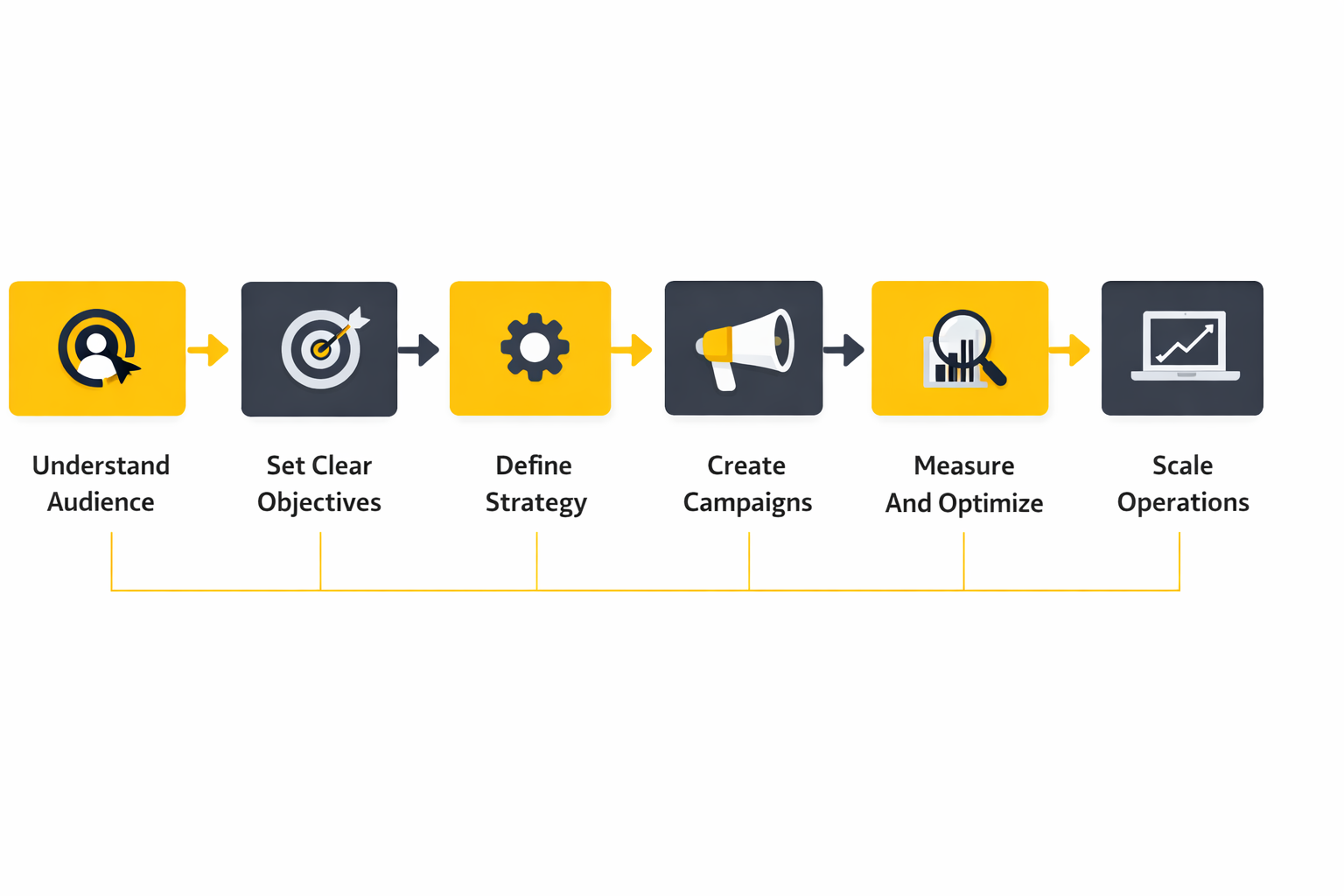
A lot of teams talk about b2b marketing like it is a collection of tactics. It is not. It is an operating system that has to move buyers from first signal to serious conversation without losing context, momentum, or trust along the way.
That matters even more now because the buying environment is compressed and crowded at the same time. 6sense found that 94% of B2B buyers ranked their shortlist before speaking with sellers, while Gartner reported that 61% prefer a rep-free buying experience. That means your implementation has to do real work before sales ever steps into the room.
The strongest teams do not build that engine by chasing every new channel. They build it by deciding exactly how accounts enter the system, what content and campaigns move them forward, when human follow-up should happen, and which handoffs deserve automation instead of guesswork. Once that structure is in place, b2b marketing stops feeling scattered and starts behaving like leverage.
Aligning Sales And Marketing From Day One
This is the part people love to skip because it feels slower than launching campaigns. But if marketing and sales do not agree on the same target accounts, the same stage definitions, and the same idea of what a real opportunity looks like, b2b marketing turns into a production line for friction. You get activity, but not confidence.
The pressure to fix that alignment problem is showing up in current research. On Salesforce’s analyst reports hub, a recent Forrester Consulting study highlights that 89% of businesses will be focused on RevOps in the next two years. That is not just a technology trend. It is a sign that companies are tired of running separate commercial systems that argue over credit while buyers move on.
The practical move is simple, even if it takes discipline. Define the account list, agree on the buying roles that matter, map the moments that count as forward motion, and make those definitions visible in the same workspace. A CRM like Copper can help keep that shared view clean, but the real win is not the software itself. The real win is that sales no longer sees marketing as noise, and marketing no longer measures success in names that were never likely to close.
Designing The Right Channel Mix For Each Stage
Good implementation starts by matching channels to buyer intent instead of forcing every prospect through the same funnel. Early-stage buyers often need category clarity, proof, and repeated exposure, which is why organic content, paid awareness, webinars, and thought leadership can matter so much. Mid-stage buyers need reassurance, comparison, and practical next steps, which is where remarketing, email nurture, product pages, and targeted outreach start doing heavier work.
The smartest teams make those choices based on how business buyers actually behave. 6sense’s demand generation research notes that B2B buying typically involves 10 to 11 stakeholders and often stretches to about 11.5 months, which tells you right away that a single ad click is not a strategy. At the same time, Content Marketing Institute’s 2025 research shows that videos were rated the most effective content type at 58%, while webinars and in-person events ranked among the most effective distribution channels.
That is why serious b2b marketing implementation feels deliberate. Search captures active intent. LinkedIn and niche media keep your message in front of the right people. Email nurture keeps the conversation alive between visits, and tools like Brevo can make that rhythm easier to manage without turning every sequence into robotic spam. The goal is not to be everywhere. The goal is to show up in the places that make the next decision easier.
Turning Traffic Into Qualified Conversations
One of the biggest mistakes in b2b marketing implementation is assuming traffic is close enough to progress. It is not. Buyers can spend weeks researching your brand, reading content, even clicking multiple campaigns, and still disappear if the next step feels clumsy, high-friction, or too early for where they are in the journey.
This is where forms, landing pages, scheduling, and follow-up logic stop being technical details and start becoming conversion strategy. If your form asks for too much too soon, or your thank-you page goes nowhere, or your sales handoff takes two days when the prospect was ready in twenty minutes, the system breaks at the exact moment it matters most. That is why many teams tighten the middle of the journey with purpose-built tools such as Fillout for cleaner forms, Cal.com for instant meeting routing, and ClickFunnels when they want tighter control over landing-page flow and offer sequence.
The point is not to stuff your stack with more tools. It is to remove drag. Strong b2b marketing feels easier for the buyer than weaker alternatives, and that advantage compounds because every lower-friction interaction gives your team more chances to build momentum before attention fades.
Making Automation Feel Human Instead Of Cheap
Automation only helps when it preserves relevance. Buyers can tell the difference between a useful sequence and a system that is simply pushing them forward because a workflow said it was time. If the message ignores the page they viewed, the topic they engaged with, or the role they probably play in the buying group, it does not feel like smart b2b marketing. It feels lazy.
That is why current implementation is shifting toward context-rich automation instead of volume-first blasting. Adobe’s 2025 AI and Digital Trends in B2B Journeys report centers on personalized, real-time engagement across accounts and buying groups, while McKinsey’s B2B Pulse 2024 shows that buyer comfort with remote and self-service spending has risen sharply, including for purchases above $500,000. Buyers are clearly willing to move without constant rep involvement, but they still expect the experience to feel intelligent.
So the better play is not to automate more for the sake of it. It is to automate the parts that protect speed and consistency while leaving room for judgment where nuance matters. A well-built workflow can score intent, route responses, trigger relevant follow-up, and keep sales informed, but it should still hand the conversation to a human at the moments where context is worth more than efficiency.
A Real Implementation Story: How DoorDash Tightened Its B2B Marketing Execution
The pressure was building before the improvement showed up in any dashboard. DoorDash’s B2B team was producing email campaigns inside a large, fast-moving business, and the process had started to drag in the exact way modern marketing teams hate most. Too many manual steps, too much production time, and too much friction between what the company wanted to deliver and what the system could realistically support.
The backstory matters because this was not a startup improvising its way through a few campaigns. DoorDash was already operating at scale, which makes slow execution even more dangerous because the cost of every delay multiplies across teams, audiences, and launches. The company needed a way to make personalization easier without making the process heavier, and it needed that change inside a real B2B environment, not in theory.
Then they hit the wall. When campaign production takes too long, the business starts paying twice: once in labor and once in lost responsiveness. Marketing cannot react as quickly to new opportunities, sales does not get the support it needs at the right moment, and buyers experience a slower, less tailored journey even when the brand clearly has the resources to do better.
The turning point came when DoorDash operationalized HubSpot as part of its CRM and marketing workflow. In HubSpot’s published case study, the company used automation to reduce manual campaign work and create a more personalized experience for its B2B customers. That mattered because the change was not cosmetic. It altered how the team executed the work, not just how the work looked from the outside.
The journey after that was methodical. DoorDash introduced automations across the email production process, built workflows that removed repetitive tasks, and used the platform to support more relevant communication at scale. HubSpot’s case study says the team ultimately automated 80% of marketing emails with workflows, which is the kind of shift that changes not only output, but also the amount of strategic focus a team can regain.
Of course, implementation stories always have a final conflict, and this one did too. When you automate a larger share of communication, the risk is that quality drops, brand voice gets flattened, or teams begin trusting workflows more than judgment. That is why the DoorDash example is useful: the company did not just automate to save time. It automated while still aiming for a more personalized experience, which is exactly the balance strong b2b marketing demands.
The outcome was clear and commercial. HubSpot reports that DoorDash shortened time to produce email campaigns by three days while improving the operational foundation for B2B communications. That is the dream outcome most teams are really after. Not more dashboards, not more jargon, but a system that helps them move faster, communicate better, and support revenue without burning the team out in the process.
What Good Implementation Really Looks Like
If you strip the jargon away, great b2b marketing implementation comes down to this: the right accounts enter the system, the right messages meet them at the right time, and the next action always feels obvious. That sounds simple, but it takes real work because every weak handoff, every muddy offer, and every slow response compounds across a long buying journey. The teams that win are usually the teams that make those handoffs feel almost invisible.
That is also why execution beats theory. You can study frameworks all day, but until your CRM is clean, your automation is relevant, your forms are easy, your scheduling is fast, and your content actually helps someone make a business decision, b2b marketing is still just potential. Once those pieces start working together, though, everything changes. You stop hoping the system will produce revenue, and you start trusting it to do what it was built to do.
Statistics And Data That Show Where B2B Marketing Is Headed

If you want to understand where b2b marketing is going, the data is brutally clear. Buyers are doing more on their own, they are making judgments earlier, and they are far less tolerant of lazy outreach than many teams still assume. That changes everything about how you create content, measure performance, and decide where to invest.
The goal here is not to throw random percentages at you. It is to show what the numbers actually mean when you are building campaigns, content, sales alignment, and reporting. Great b2b marketing gets stronger when the data is interpreted with context instead of treated like decoration.
Buyer Behavior Statistics
The strongest signal in the market is how far buyers want to get before talking to sales. Gartner found that 61% of B2B buyers prefer a rep-free buying experience, and the same survey showed that 73% actively avoid suppliers who send irrelevant outreach. That means b2b marketing has to be useful before it is persuasive. If your message feels generic, buyers do not merely ignore it. They often use it as a reason to screen you out.
The research from 6sense’s 2025 Buyer Experience Report pushes that point even further. It shows that 94% of buyers ordered their shortlist before engaging with sellers, that buyers purchase from one of their Day One shortlist vendors 95% of the time, and that the vendor contacted first still wins about 77% of the time. In plain English, b2b marketing is doing its most important work long before a demo request comes through.
There is another number in that same study that deserves attention. Typical B2B purchases involve 10 or more people and take close to a year, while buyers now reach out to sellers roughly 6 to 7 weeks earlier than they did in the prior pattern. That combination is why modern b2b marketing has to do two things at once: build familiarity over time and also make the next step easy when urgency finally appears.
Content And Channel Performance Data
The content data is just as revealing. In the latest B2B Content Marketing Benchmarks, Budgets, and Trends report, only 22% of marketers described their content marketing as extremely or very successful. That is not a comfortable number, but it is a useful one, because it shows how much room there still is for disciplined teams to separate themselves.
The same report explains what is actually working. Videos were rated the most effective content type at 58%, followed by case studies at 53%, while in-person events and webinars led distribution effectiveness at 52% and 51%. On the paid side, SEM and PPC produced the best results for 61% of respondents. That does not mean every company should copy the same mix, but it does tell you that b2b marketing works best when it combines strong educational assets with channels that catch intent and deepen trust.
The budget outlook also says a lot about where teams are placing their bets. Forty-six percent expect content marketing budgets to increase, while 61% expect increased investment in video and 52% expect increased investment in thought leadership. That is a signal that serious b2b marketing teams are not moving away from trust-building. They are investing more heavily in it.
AI, Personalization, And Data Quality Statistics
AI is now part of the picture, but the numbers show a more mature story than the hype cycle would suggest. Only 19% of B2B marketers say AI is integrated into their daily workflows, and only 4% report a high level of trust in generative AI output. That is a healthy reminder that good b2b marketing still depends on positioning, editorial judgment, and buyer understanding, even when AI is speeding up production.
At the same time, teams clearly expect AI to matter more. Adobe’s 2025 AI and Digital Trends in B2B Journeys report says 87% of senior executives believe integrating AI into customer journeys and marketing workflows will deliver measurable returns by the end of 2025. The key phrase there is measurable returns. The market is moving away from AI as novelty and toward AI as operational leverage.
But leverage depends on data quality, and that is still a weak point for many organizations. Salesforce’s State of Marketing report found that 83% of marketers recognize the shift toward personalized, two-way messaging, yet only one in four are satisfied with how they use data to power those moments. That gap matters because b2b marketing personalization is only as good as the account data, behavioral signals, and journey logic behind it.
Measurement And Attribution Data
One of the biggest statistical warnings in modern b2b marketing is not about buyer behavior at all. It is about how teams still measure success. In 6sense’s attribution and contribution benchmark, the headline is blunt: ABM adoption is increasing, but many marketers still rely on traditional metrics such as leads and MQLs. That disconnect matters because the buying process now happens across accounts, committees, and long cycles, not neat little one-contact conversions.
That is why smarter teams are shifting attention toward engagement at the account level, buying-group movement, qualified pipeline, and revenue contribution. The old reporting model made it easy to celebrate activity. The newer model makes b2b marketing prove that it is helping the business move the right accounts toward serious commercial outcomes.
The same logic shows up in buyer research too. 6sense found that buyers still interact with the winning vendor about 16 times per person, even though LLM use is widespread. So measurement cannot stop at clicks or first-touch traffic. Great b2b marketing needs to understand which combinations of content, proof, follow-up, and timing are building conviction across the full journey.
What The Numbers Mean In Practice
Put all of this together and the message is pretty clear. Buyers want control, buying groups are large, shortlists form early, irrelevant outreach damages trust, and performance now depends on better content, stronger data, and more honest measurement. That is why modern b2b marketing has become less about shouting louder and more about becoming easier to trust before the buying window fully opens.
The data also explains why thought leadership and credibility still matter so much. Edelman and LinkedIn report that more than 40% of B2B deals stall because of internal misalignment within buying groups. If several stakeholders are involved and some of them are barely visible, your content cannot just attract one contact. It has to help multiple people inside the account make sense of the decision.
And finally, the market is becoming more comfortable with larger digital transactions. McKinsey’s B2B Pulse 2024 shows that buyers’ comfort with remote and self-service spending has jumped sharply, especially for purchases above $500,000. That is a huge opportunity, but only for teams whose b2b marketing makes complex buying feel clearer, safer, and easier to move forward with.
B2B Marketing FAQ And Next Steps

By now, you can probably see the big picture. B2B marketing is not just about getting attention. It is about creating enough trust, clarity, and momentum that the right companies want to move closer to you before a sales call ever begins.
The latest research keeps pointing in the same direction. Shortlists form early, buyers want more control, and internal buying-group alignment matters more than most teams realize. So let’s close this guide with the questions people ask when they want to turn b2b marketing into something that actually produces revenue.
FAQ Built For A Complete Guide
What is b2b marketing?
B2B marketing is how one business attracts, educates, nurtures, and converts another business into a customer. That includes everything from positioning and content to email, paid media, search, webinars, CRM workflows, and sales enablement. The reason it feels more demanding than many B2C campaigns is simple: the purchase usually involves more stakeholders, more scrutiny, and more risk.
Why is b2b marketing so important right now?
It matters more than ever because buyers are making decisions earlier and with less patience for irrelevant outreach. 6sense found that 94% of buyers rank vendors before speaking with sales, while Gartner found that 61% prefer a rep-free buying experience. If your b2b marketing does not build trust before the hand-raise, you are already late.
How is b2b marketing different from b2c marketing?
The biggest difference is not that B2B buyers are somehow emotionless. It is that the decision usually has more people involved, more financial exposure, and more internal politics around it. In B2B, a strong message has to help a buying group justify a decision to one another, not just trigger one person to act fast. That is exactly why Edelman and LinkedIn’s 2025 research on hidden buyers is so useful: it shows that invisible stakeholders can quietly stall a deal even when the obvious champion seems interested.
What are the main channels in b2b marketing?
The core channels usually include organic search, paid search, LinkedIn, email, webinars, events, partner marketing, sales outreach, and educational content on your own site. The right mix depends on your audience and sales cycle, but the latest Content Marketing Institute research shows that video, case studies, webinars, and SEM or PPC are still among the most effective options. The mistake is not choosing the wrong channel once. The mistake is using channels without matching them to buyer intent.
What makes b2b marketing successful?
Successful b2b marketing is clear, consistent, and connected to revenue. It starts with strong positioning, carries that message into useful content, distributes it where the right accounts will actually see it, and measures whether qualified pipeline is improving. The reason so many teams underperform is not lack of effort. It is lack of alignment between message, channels, sales follow-up, and measurement.
How long does b2b marketing take to work?
Some channels can produce signals quickly, but real B2B momentum often takes longer than people want to admit. 6sense describes modern B2B buying as involving 10 to 11 stakeholders and sales cycles of about 11.5 months, which tells you right away that trust is rarely built in one click. That said, faster wins can happen when your offer is urgent, your traffic is qualified, and your follow-up system is strong.
What should you measure in b2b marketing?
You should measure what tells you whether the right accounts are moving toward revenue. That usually means account engagement, buying-group depth, qualified pipeline, opportunity progression, sales response speed, and conversion quality rather than just raw lead volume. The latest 6sense attribution benchmark is useful here because it shows how many teams are moving beyond old MQL-heavy thinking toward contribution models that better reflect how B2B buying actually works.
Is content marketing still worth it for b2b?
Absolutely, but only if the content earns trust instead of filling space. Buyers still need help understanding the problem, comparing options, building internal consensus, and defending the choice. That is why CMI’s 2025 benchmark report shows ongoing investment in video, thought leadership, and case studies. Content is still powerful in b2b marketing. Weak content is what stopped working.
Does AI help with b2b marketing?
Yes, but it helps the most when the strategy is already solid. AI can speed up research, drafting, workflow automation, personalization, and analysis, but it does not replace positioning or judgment. That balanced view is supported by both Adobe’s 2025 AI and digital trends work and CMI’s 2025 research, where adoption is growing but deep trust in raw generative output is still limited.
How do you align sales and marketing better?
You align them by agreeing on the same target accounts, the same stage definitions, the same handoff rules, and the same definition of progress. If sales thinks marketing is sending noise and marketing thinks sales is ignoring good opportunities, the system is already broken. A clean CRM process helps a lot, which is why many teams use platforms like Copper to keep account visibility and follow-up cleaner, but the bigger issue is shared accountability, not software alone.
What tools are useful for b2b marketing?
The most useful tools are the ones that remove friction in a system that already makes sense. Teams often need a CRM, email automation, analytics, scheduling, forms, landing pages, and social publishing support. Depending on the workflow, that can mean using Brevo for email and lifecycle messaging, Cal.com for faster meeting routing, Fillout for cleaner forms, or Buffer for more consistent distribution. The important thing is to fix a real bottleneck, not collect subscriptions.
Should smaller companies invest in b2b marketing too?
Yes, and in some ways they need it even more because they cannot afford waste. A smaller company usually wins by being sharper, more relevant, and more credible inside a narrower niche. Strong b2b marketing helps them look bigger than they are in the ways that matter, because it gives buyers a clearer story, a more professional journey, and better proof that the company can deliver.
What is the biggest mistake in b2b marketing?
The biggest mistake is chasing activity instead of building a system. Teams launch more campaigns, publish more content, buy more software, and still struggle because the positioning is unclear, the journey is clumsy, and the measurement is disconnected from revenue. When that happens, b2b marketing starts to feel random even though the real problem is structural.
Can b2b marketing work without a big budget?
Yes, but it has to be focused. A smaller budget forces discipline, which can actually become an advantage if you narrow the audience, sharpen the positioning, publish useful content, and stay consistent long enough to build trust. You may not dominate every channel, but you do not need to. In b2b marketing, relevance beats reach far more often than lazy teams expect.
What should you do first if you want better b2b marketing results?
Start with the foundation. Get clear on who you want to reach, what problem you solve, why your approach is different, and what journey you want buyers to take after first contact. Then clean up the handoffs, strengthen the proof, and make the next step obvious. Once that is done, every tactic becomes easier to evaluate and improve.
Work With Professionals
If all of this sounds like a lot, that is because it is. Great b2b marketing is not built by guessing, posting a few times, and hoping buyers magically connect the dots. It takes structure, testing, clear messaging, strong operations, and a team that understands how to turn attention into trust and trust into pipeline.
That is also why working with experienced professionals can shorten the learning curve fast. Whether you need better positioning, stronger funnel flow, cleaner lifecycle automation, or more disciplined campaign execution, the right support can help you avoid wasting months on tactics that never had a real chance. And when you want a faster path to execution, tools like ClickFunnels, Systeme.io, or ScaledMail can be useful if they fit a real strategy instead of acting as a substitute for one.
The bigger idea is simple: stop trying to make b2b marketing work through brute force. Build a serious system, get the right help, and make sure every piece of the journey gives buyers one more reason to keep moving toward you.
Explore 10K+ Remote Marketing Contracts on MarkeWork.com
Most marketers spend too much time chasing clients, competing on crowded platforms, and losing a percentage of every project to middlemen.
MarkeWork gives you a better way. Browse thousands of remote marketing contracts and connect directly with companies desperate to hire skilled marketers like you without platform commissions and without unnecessary gatekeepers.
If you’re serious about finding better opportunities and keeping 100% of what you earn, you can explore available contracts and create your profile for free at MarkeWork.com.
 Filip Konecny Enterprises