

Affiliate programs are no longer a side tactic that sits quietly in the corner of a marketing plan. They have become a serious growth channel because they let brands pay for outcomes, give publishers a clearer path to revenue, and create a structure where content, commerce, and trust can work together instead of fighting for budget. That matters even more now that customer acquisition costs are under pressure and marketing leaders are being pushed to prove not just activity, but real revenue.
The reason so many companies are revisiting affiliate programs is simple: the model is flexible enough to fit both lean online businesses and established brands with complex channel mixes. The Performance Marketing Association’s 2025 industry study found that U.S. affiliate marketing spending reached $13.62 billion in 2024 and helped drive $113 billion in e-commerce sales, while the APMA’s 2025 report showed UK brands investing £1.7 billion into affiliate and partner marketing in 2024. Those numbers explain why affiliate programs deserve a more strategic conversation than they usually get.
This first part lays the groundwork. We will look at why affiliate programs matter, how the model actually works, which parts make a program strong or fragile, and what professional implementation looks like when you want something that can scale instead of something that just sounds good on paper.
Article Outline
- Part 1: Why Affiliate Programs Matter
- Part 2: Framework Overview
- Part 3: Core Components
- Part 4: Professional Implementation
- Part 5: Measuring Performance and Improving Results
- Part 6: Ecosystem, Risk Management, and FAQ
Why Affiliate Programs Matter

What makes affiliate programs so compelling is that they sit at the intersection of media, sales, and partnerships. A brand gets distribution through publishers, creators, review sites, loyalty platforms, or niche experts, but it usually pays when a measurable action happens rather than simply paying for exposure and hoping the math works later. In a market where efficiency matters, that structure is hard to ignore.
The growth of the channel is not just a headline story about spending. The PMA study notes that affiliate investment in the United States rose 49.8% from 2021 to 2024, and that the channel now accounts for 9.4% of all U.S. e-commerce sales. On the UK side, the APMA highlights report shows affiliate and partner marketing contributing nearly 13% of UK e-commerce during the four-day Cyber Weekend period, which is a strong reminder that this is not a niche tactic used only by coupon sites.
Affiliate programs also matter because they have matured. The old stereotype was that affiliate meant last-click discounts and little else, but newer research shows the channel is broadening fast. impact.com’s 2025 research found that leading brands typically work with three to four different partner types, and that 74% of brands generate 11% to 30% of total revenue from affiliate marketing. That is a very different picture from a channel that exists only to mop up the final conversion.
There is another reason this matters: trust. Affiliate programs only work over time when the recommendation feels credible to the audience. That is why compliance is not some boring box to tick at the end. The FTC’s guidance on endorsements and material connections makes it clear that disclosure is part of honest marketing, and honest marketing is what keeps a partner channel from turning into a short-lived arbitrage game.
Affiliate Program Framework Overview
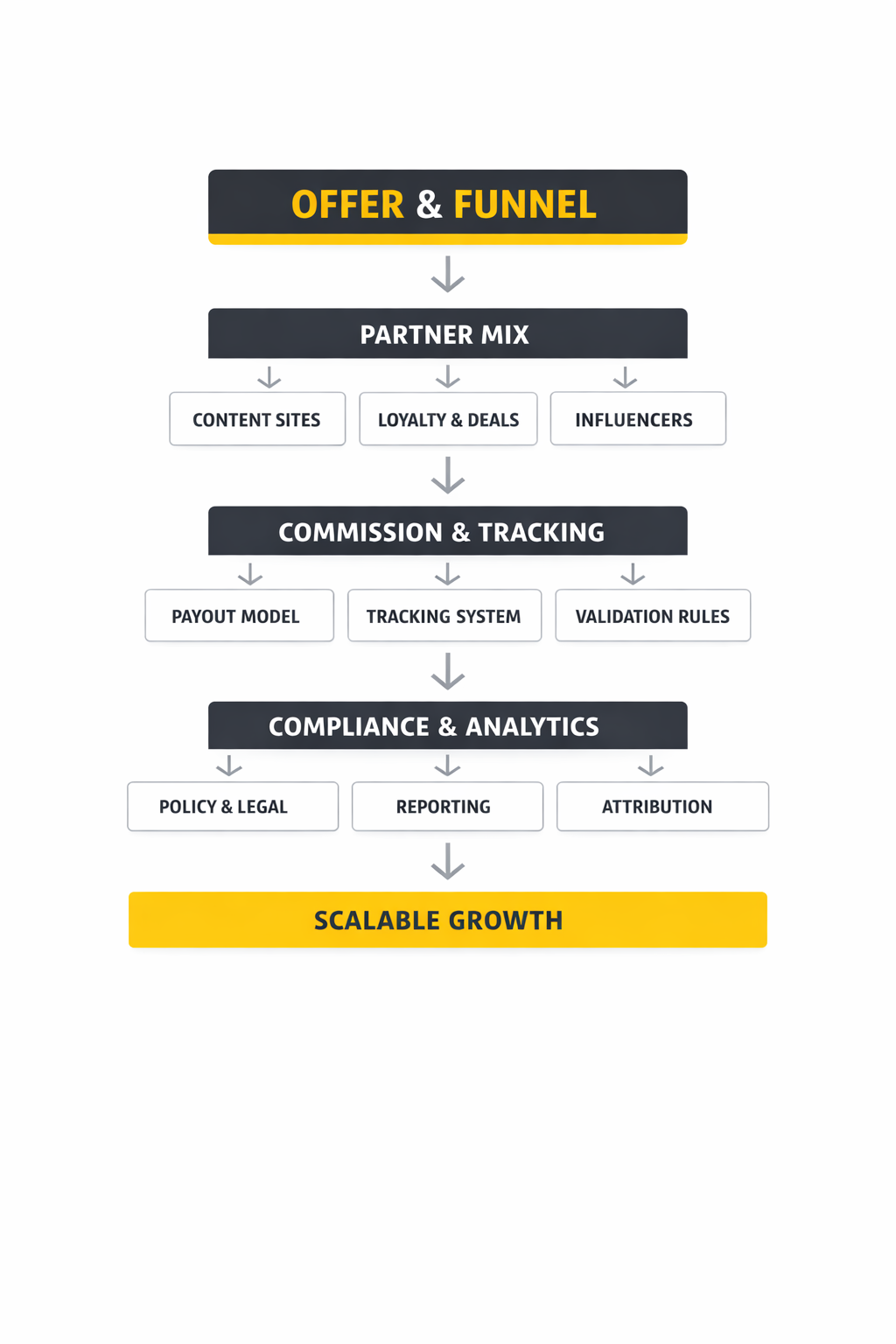
At the most basic level, affiliate programs work because three parties align around a measurable outcome. The brand wants revenue or leads, the affiliate wants a commission for influencing that outcome, and the platform or tracking layer records the action so everyone can see what happened. When those three pieces stay aligned, the program feels simple. When they drift apart, the whole thing starts to leak trust, money, or both.
A strong framework begins with a clear commercial goal. Some companies want new customer acquisition, some want higher average order value, some want app installs, and some want qualified leads that can be closed later by a sales team. The mistake is thinking all affiliate programs should be built the same way, when the truth is that the right structure depends on what the business actually values.
The next layer is partner mix. A broad program may include editorial publishers, comparison sites, creators, newsletter operators, B2B referral partners, cashback and loyalty platforms, and specialist communities. impact.com’s 2025 report points to diversification as one of the defining characteristics of stronger programs, and the PMA study also notes increasing publisher diversity, with content creators and bloggers taking a larger share of investment.
Then comes compensation. Commissions can be based on sales, leads, subscription events, app actions, or hybrid models. The framework only becomes healthy when payout logic matches business economics, because a commission that looks attractive to affiliates but destroys margin is not sustainable, while a commission that protects margin but gives partners no reason to care will never gain momentum.
Finally, the framework needs rules. Tracking windows, attribution logic, brand guidelines, prohibited traffic sources, disclosure requirements, and payout terms all shape how affiliates behave. Without that operational backbone, even a promising affiliate program can become noisy, hard to measure, and vulnerable to low-quality promotion.
Core Components
The first core component is the offer itself. If the underlying product is weak, overpriced, poorly positioned, or difficult to explain, affiliates will struggle no matter how generous the commission looks on a dashboard. Good partners want products they can recommend without damaging their own credibility, which means the health of an affiliate program starts with product-market fit, not with recruitment outreach.
The second component is tracking and attribution. A professional affiliate program needs dependable links, consistent conversion recording, clear validation rules, and a realistic view of how the customer journey unfolds. This is one reason brands increasingly want more than a basic network listing. They want partner-level visibility, cleaner attribution, and better control over how upper-funnel and lower-funnel partners are rewarded.
The third component is partner recruitment and enablement. Recruiting affiliates is not just a numbers game where more applications automatically mean more revenue. The best programs actively identify partners that fit the brand, then equip them with useful landing pages, fresh creative, product education, and a reason to keep promoting over time instead of publishing one link and disappearing.
The fourth component is commission design. Flat commissions can work, but tiered structures, bonuses for new customers, and incentives for specific product lines often create better behavior because they tell affiliates what the business actually wants more of. That is why mature affiliate programs treat payout design as strategy, not as a default setting.
The fifth component is governance. That includes fraud controls, disclosure standards, approval workflows, communication cadence, and policies around trademark bidding or promotional claims. It may sound less exciting than recruitment or sales, but governance is what protects the brand when the program grows and more moving pieces enter the system.
Professional Implementation
Professional implementation begins by resisting the temptation to launch too wide, too fast. A cleaner way to build affiliate programs is to start with the commercial model, define what a qualified conversion looks like, decide which partner types make sense first, and only then choose the platform or network infrastructure. That order matters because software should support strategy, not replace it.
For many businesses, the implementation stack also needs to connect affiliate activity with the rest of the funnel. If you are selling through webinars, application funnels, or high-converting sales pages, a platform like ClickFunnels can make it easier to route partner traffic into a controlled conversion path. If you want a leaner all-in-one setup with pages, email, and automation under one roof, Systeme.io is a practical option for getting an affiliate-ready funnel live without adding too many moving parts on day one.
Email follow-up is another place where many affiliate programs quietly lose money. Partners may drive the click, but the conversion often happens later, after reminder sequences, offer education, or onboarding emails do their job. Tools like Brevo or Moosend can help turn incoming affiliate traffic into a sequence-driven revenue stream instead of a one-visit gamble.
The professional standard also includes a partner experience that feels intentional. That means welcome materials, clear commission explanations, approved creative, regular communication, and an easy way for good affiliates to ask for custom support. If link management and attribution sharing are part of your process, a tool such as Dub can also help keep tracking links cleaner and easier to manage across campaigns.
Most importantly, implementation should be paced around proof. Launch with a smaller group of relevant partners, watch how traffic quality behaves, review assisted conversions alongside direct conversions, and expand only after the economics make sense. That is how affiliate programs become durable assets rather than chaotic side channels that create activity without real control.
If you want affiliate programs to perform like a real growth channel instead of a random side project, the framework has to come first. Too many brands start by recruiting affiliates before they have decided what kind of customer they want, how they will reward different partner types, or what counts as a valid conversion. That is usually where the trouble starts, because the program may look active on the surface while quietly creating low-quality sales, attribution fights, and margin problems underneath.
The stronger approach is to build the framework in the same order you would build any serious revenue engine. Start with the commercial outcome, map the partner roles that can influence that outcome, decide how attribution should work, and only then set the rules that keep the program healthy as it grows. That sequence is not glamorous, but it is what separates affiliate programs that scale from affiliate programs that become a mess the second more traffic starts coming in.

Framework Starts With the Right Goal
The first question is not which network to join or how many affiliates to recruit. The first question is what the business actually wants the program to do. Some affiliate programs are built to drive new-customer revenue, some are designed to increase subscription starts, and some make more sense as lead-generation systems where the real sale happens later in a call, demo, or application process.
That sounds obvious, but it changes everything downstream. A program built for first-time buyers needs very different incentives from a program built for repeat orders or one built for high-value enterprise leads. The Awin x Forrester survey from 2025 shows that brands are not investing in affiliate marketing for one single reason anymore, which is exactly why a vague goal leads to a vague framework and weak decision-making.
Once the goal is clear, affiliate programs become easier to judge honestly. You can tell whether the right partners are being recruited, whether commissions make sense, and whether the traffic is producing the kind of customer the business can actually profit from. Without that clarity, it is far too easy to celebrate gross sales while ignoring whether those sales are incremental, durable, or even worth paying for.
Partner Types Shape the Entire System
Not all affiliates play the same role, and treating them like they do is one of the fastest ways to build a program that feels confused. Editorial publishers, creators, deal sites, cashback platforms, B2B referral partners, and technology partners all influence buyers at different points in the journey. If the framework does not recognize those differences, the brand ends up rewarding behavior it does not fully understand.
That is one reason recent industry research keeps pointing toward partner diversification. impact.com’s 2025 report found that leading brands usually work with three to four partner types, while the APMA’s 2025 State of the Nation report showed cashback, loyalty, content creators, bloggers, and editorial partners all playing meaningful roles in the UK market. The important takeaway is not just that there are many partner categories, but that each category affects discovery, intent, and conversion in a different way.
That is why the framework should define partner roles before recruitment starts. A content creator who introduces the brand to a cold audience should not always be measured the same way as a voucher partner who appears right before checkout. When those roles are understood, affiliate programs stop looking like a pile of links and start looking more like a deliberate partnership portfolio.
Commission Logic Drives Affiliate Behavior
Affiliates respond to incentives just like sales teams, media buyers, and channel partners do. If you pay the same rate for every order, you may accidentally encourage behavior that looks busy but does not help the business grow in the right direction. If you reward new customers, higher-margin products, or qualified leads more aggressively, you start shaping the program around outcomes that matter instead of around volume for volume’s sake.
This is where many affiliate programs either become smart or stay shallow. A flat commission can be fine when the economics are simple, but once a business has different product lines, uneven margins, or a strong need for first-time buyers, the payout structure should reflect that reality. Partnerize’s 2025 outlook highlights the growing focus on customer value and publisher quality, which lines up with the broader shift away from treating every conversion as equally valuable.
A good commission structure also protects the relationship with strong partners. Serious affiliates do not just want the highest number on a landing page. They want a program that is predictable, fair, and built around a commercial model that can survive. When the math works for both sides, the partnership can deepen instead of collapsing after the first push.
Tracking and Attribution Have to Be Built on Purpose
Tracking sounds technical, but in practice it is a trust issue. If the affiliate believes conversions are not being recorded properly, the relationship weakens. If the brand cannot tell which partners influenced a sale and which ones simply appeared at the very end, the budget gets distorted and the program starts rewarding the wrong people.
This has become even more important as privacy changes and signal loss keep making digital measurement harder. The IAB Measurement Center notes that attribution, incrementality, and privacy-conscious measurement are now central challenges across digital media, and the IAB privacy framework reflects how quickly compliance expectations are evolving. In other words, affiliate programs cannot rely on lazy assumptions about tracking anymore. They need a measurement setup that fits the real customer journey and the real legal environment.
That usually means being deliberate about attribution windows, deduplication, assisted conversions, coupon usage, and post-purchase validation. It also means resisting the urge to judge the entire channel through one simplistic last-click lens. A better framework recognizes that some affiliates close demand while others create it, and both roles need to be understood before the brand decides what success actually looks like.
Rules and Compliance Keep the Program Credible
Affiliate programs can grow quickly, but speed without rules creates fragile growth. A professional framework needs written standards around disclosures, brand claims, traffic sources, paid search behavior, promotional language, and approval processes. Those rules are not there to make the program feel restrictive. They are there to protect trust before trust gets damaged.
That is especially true when affiliates publish reviews, recommendations, or creator-led endorsements. The FTC’s endorsement guidance makes it clear that material connections should be disclosed clearly, and the FTC’s business guidance hub keeps reinforcing that honesty in endorsements is not optional. If a brand wants affiliate programs that last, it cannot treat compliance as an afterthought handled only when something goes wrong.
Strong rules also make recruitment easier in the long run. Quality partners are more comfortable promoting a brand when expectations are clear, creative standards are consistent, and payout rules are transparent. That kind of structure may feel slower at the beginning, but it builds the kind of confidence that makes the program stronger month after month.
The Best Frameworks Are Built to Evolve
No affiliate framework should be treated like a fixed blueprint that never changes. Markets shift, partner mixes change, tracking environments evolve, and customer journeys become more fragmented over time. That is why the strongest affiliate programs are designed to learn rather than just to launch.
You can already see this in the way the industry is moving. The PMA’s 2025 industry study points to rising spend and wider publisher diversity in the United States, while the APMA’s 2025 release shows the UK channel expanding even in a difficult economic climate. Growth like that is a sign of opportunity, but it is also a warning that old assumptions will not stay good forever.
So the real goal of a framework is not to lock affiliate programs into one rigid model. The goal is to create a structure that can handle better partners, smarter attribution, cleaner incentives, and stronger governance as the channel matures. Get that right, and everything else in the program starts to make a lot more sense.
Core Components of Affiliate Programs
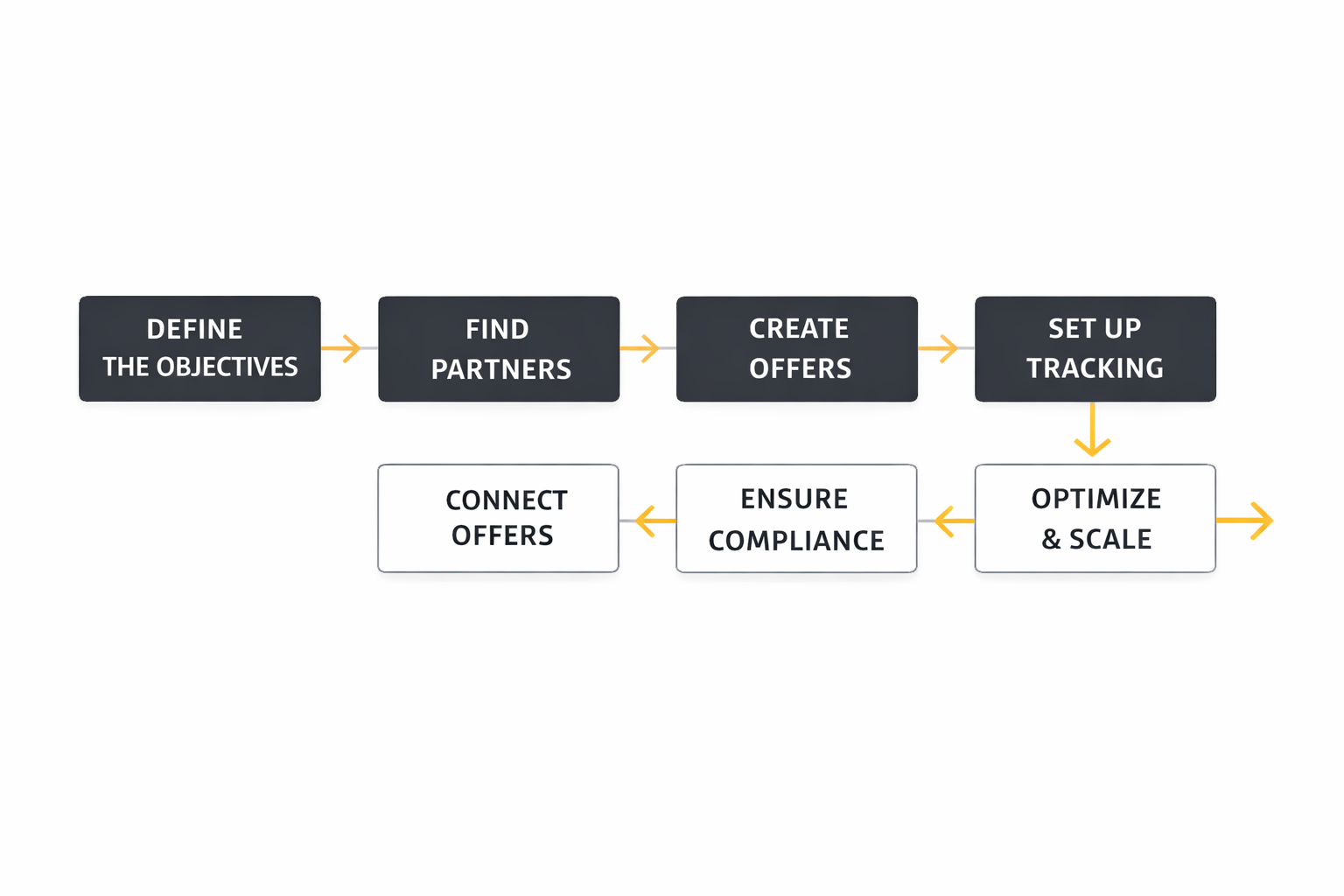
Once the framework is clear, the next step is getting serious about the components that make affiliate programs either profitable or painfully disappointing. This is where a lot of brands get exposed, because it is one thing to say you have an affiliate channel and another thing entirely to build one that partners actually want to promote. The moving pieces are not complicated in isolation, but they have to work together or the whole thing starts leaking revenue, trust, and momentum.
The good news is that strong affiliate programs tend to share the same fundamentals. They have an offer worth recommending, a tracking setup people can trust, partner support that feels real, commission logic that matches business goals, and compliance standards that protect the brand when the channel grows. Miss one of those pieces and the program can still launch, but it will struggle to scale cleanly.
The Offer Has to Be Worth Promoting
The first core component is the offer itself. If the product is weak, the checkout flow is clunky, the message is fuzzy, or the pricing feels off, affiliate programs run into resistance fast because partners do not want to risk their own reputation on something that feels shaky. Great affiliates are not just link distributors. They are putting their name, audience trust, and publishing time on the line every time they recommend something.
That is why a polished funnel matters more than many brands realize. If you are sending traffic into a webinar, sales page, application flow, or lead magnet, the path has to feel intentional from first click to final conversion. A platform like ClickFunnels can help you build that path in a way that gives affiliates a cleaner experience to promote, and Systeme.io can make sense when you want an all-in-one setup without piling on extra tools before the economics are proven.
There is a broader market reason this matters so much now. The PMA’s 2025 industry study shows affiliate investment generated $113 billion in U.S. e-commerce sales in 2024, and the 2025 impact.com report shows 74% of brands say affiliate marketing already drives 11% to 30% of their total revenue. Those numbers are not created by mediocre offers. They are created when partners see something they believe can genuinely convert.
Tracking Is the Trust Layer
If the offer gets the click, tracking decides whether the relationship survives. Affiliates can tolerate a lot of things, but they do not stay excited when conversions disappear, attribution feels random, or reporting is too vague to trust. This is why tracking is not just a technical detail buried in the back end. It is the trust layer underneath the entire program.
The conversation around measurement has moved well beyond simple last-click thinking. The same 2025 impact.com research found that 94% of brands are experimenting with or planning to adopt alternative attribution models within the next year, which tells you the market is actively looking for better ways to understand influence across the full buyer journey. The IAB and IAB Europe’s 2025 guidelines for incremental measurement in commerce media push in the same direction, stressing that marketers need methods that separate signal from noise and tie measurement to real business impact.
For affiliate programs, that means you should know how tracking windows work, how conversions are validated, how coupon use affects attribution, and how assisted influence is handled when a partner does not get the last click but clearly helped create demand. If you skip that work, you do not just lose data. You create doubt, and doubt is deadly in a channel built on performance relationships.
Partner Recruitment Needs Depth, Not Just Volume
It is tempting to think the answer is simply recruiting more affiliates, but numbers alone do not create a better channel. A crowded program with weak-fit partners can generate noise without producing meaningful revenue, while a smaller group of aligned affiliates can build momentum surprisingly fast. That is why smart affiliate programs focus less on how many people apply and more on who can actually influence the right buyers.
Recent market data makes this easier to understand. The APMA’s 2025 State of the Nation report shows UK brand budgets are spread across several partner categories, with cashback, loyalty, and rewards at 27%, content creators, blogs, and editorial at 25%, discounts and vouchers at 10%, and subnetworks at 9%. The impact.com study adds that leading brands usually work with three to four different partner types rather than leaning on one source of traffic. That combination tells a clear story: the best affiliate programs are not one-dimensional anymore.
Recruitment should follow that reality. If you sell software, a niche educator with a loyal audience may be far more valuable than a giant generic deal site. If you sell a product that needs explanation before the buyer feels comfortable, editorial coverage or creator-led demos may outperform blunt discount traffic. The component that matters here is not reach by itself. It is relevance.
Enablement Turns Signups Into Real Partners
Signing affiliates up is one thing. Giving them a real chance to succeed is something else entirely. Many programs quietly fail here because they recruit partners and then leave them staring at a dashboard with a few generic banners, no real messaging guidance, and no clear idea of which angle is most likely to convert.
That is why enablement is one of the most underrated components in affiliate programs. Partners need usable landing pages, refreshed creative, product education, promotional boundaries, and direct communication when offers change. If your business depends on follow-up sequences to close the sale, then email support is part of enablement too, because affiliates are not just promoting a page; they are promoting the entire experience behind it. Platforms such as Brevo and Moosend can help make sure that traffic from affiliate programs does not die after the first visit and instead moves through a sequence that keeps converting over time.
Good enablement also signals respect. It tells affiliates that the brand is not just trying to extract clicks, but is actually invested in making the partnership work. That changes the quality of the relationship in a big way, especially with serious partners who have plenty of other brands competing for their attention.
Commission Structure Shapes Everything
The commission model is where strategy becomes visible. It tells affiliates what the brand values most, and it influences which promotional behavior becomes common in the program. If you pay the same rate for every action, you may get plenty of activity, but not necessarily the kind that creates the healthiest business outcome.
This is why the best affiliate programs think beyond a single default percentage. New-customer bonuses, product-specific rates, performance tiers, lead-quality thresholds, and temporary incentives can all help direct the program toward more profitable behavior. The Awin x Forrester 2025 survey shows brands are investing in the channel for more than just raw transactions, including goals related to loyalty and broader strategic growth, and the same research base of more than 650 senior marketing leaders reflects how seriously larger organizations are treating channel design.
Put simply, commission design is not bookkeeping. It is behavior design. Get it right and you encourage the kinds of partners and promotions that strengthen the business. Get it wrong and you invite activity that looks impressive in a spreadsheet while quietly hurting margins or attracting the wrong customers.
Compliance Protects the Brand and the Channel
Compliance is not the flashy part of affiliate programs, but it is one of the components that decides whether growth is durable or dangerous. When affiliates publish reviews, recommendations, tutorials, comparison pages, or social posts, the brand is exposed to the quality of those claims and the clarity of those disclosures. If those standards are loose, the brand can end up paying for attention that creates legal risk and damages trust.
The FTC’s guidance on endorsement disclosures makes the reasoning very clear: when readers or viewers do not realize there is a relationship between the promoter and the company, that missing context affects how much weight they give the recommendation. The current federal endorsement guides exist for exactly this reason. They are about honest marketing, not just legal housekeeping.
For brands running affiliate programs, that means having written rules around claims, disclosures, trademark use, coupon language, review practices, and approval standards. It also means being willing to say no to partners or tactics that produce short-term results in ways that put the brand at risk. That discipline may feel slower in the beginning, but it is what keeps the channel credible as it gets bigger.
All the Components Have to Work Together
This is the part many people miss. You cannot fix a weak offer with a better commission forever. You cannot compensate for bad tracking by recruiting more affiliates. You cannot scale a partner channel responsibly if compliance is loose and communication is inconsistent. Each component matters on its own, but the real performance comes from how they support one another.
That is why the strongest affiliate programs feel coherent from the outside. The product is clear, the funnel makes sense, the tracking is believable, the partner mix is intentional, the commission model rewards the right behavior, and the rules protect trust rather than smothering growth. When those components line up, affiliates stop acting like random traffic sources and start behaving more like genuine growth partners.
And that is exactly where you want to be. Because once the core pieces are solid, the next phase is no longer about just having affiliate programs in place. It becomes about implementing them professionally, scaling them with more confidence, and building a channel that can keep producing results without turning into chaos.
Statistics and Data

If you want to understand where affiliate programs are headed, you have to stop looking at the channel like a side hustle tactic and start looking at the numbers like an operator. The latest market data shows a channel that is growing faster than a lot of people realize, getting more diverse in how value is created, and becoming harder to manage well if you are still relying on old last-click assumptions. That matters because once the data shifts, the brands that adapt first usually build the strongest advantage.
The big picture is already hard to ignore. The Performance Marketing Association’s 2025 U.S. industry study shows affiliate marketing spend reached $13.62 billion in 2024, up 49.8% from 2021, while the same study ties that investment to $113 billion in e-commerce sales and 9.4% of total U.S. e-commerce. Over in the UK, the APMA’s 2025 State of the Nation release reports that brands invested £1.7 billion in affiliate and partner marketing during 2024, generating £19 billion in revenue and more than 360 million sales. Those are not fringe-channel numbers. Those are numbers that force brands to take affiliate programs seriously.
How Big the Channel Has Become
The first thing the data tells us is that affiliate programs now operate at a scale that changes how they should be managed. When a channel is producing billions in spend and tens of billions in revenue, sloppy recruitment, weak tracking, and vague commission models stop being minor annoyances and start becoming expensive strategic mistakes. The market is simply too large now for brands to treat it casually.
What makes the growth even more interesting is the pace. The PMA study page and the PMA release summarizing the findings both show that U.S. affiliate investment grew at roughly twice the pace of the broader e-commerce market between 2021 and 2024. In the UK, the APMA’s State of the Nation 2025 summary places the channel at roughly 10% of UK e-commerce, which means affiliate programs are influencing a meaningful slice of online purchasing behavior rather than just catching leftovers at checkout.
That is the part people often underestimate. Once a channel reaches this level of economic weight, it becomes less about whether affiliate programs work at all and more about which brands know how to structure them well enough to keep the value instead of leaking it away.
What the Data Says About Partner Mix
Another shift shows up when you look at where the budgets are actually going. Older conversations about affiliate programs often revolve around coupon sites because those were easy to visualize and easy to criticize. The current data paints a much broader picture, and that broader picture matters because it changes how brands should recruit, evaluate, and support partners.
The APMA’s 2025 report shows cashback, loyalty, and rewards taking 27% of brand budgets in the UK, while content creators, bloggers, and editorial account for 25%. Subnetworks sit at 9%, and discounts and vouchers come in at 10%, which tells you the channel is not being dominated by one narrow partner type. The 2025 impact.com report reinforces the same story from another angle by showing that leading brands usually work with three to four different partner types rather than leaning on one source of distribution.
This matters because partner mix changes what affiliate programs are capable of doing. A creator or editorial partner may introduce the brand much earlier in the journey, while loyalty or deal partners may close demand later. When the data shows diversification growing, it is really showing that the channel is becoming more strategic and more full-funnel than many businesses have allowed for in their own reporting.
Revenue Contribution Is No Longer Small
One of the most useful things in recent affiliate research is not just channel size, but the way brands describe revenue contribution. It is one thing to know the industry is big in aggregate. It is another thing to see how much of a company’s own revenue can be influenced by affiliate programs when the channel is built properly.
The 2025 impact.com research reports that 74% of brands generate between 11% and 30% of total revenue from affiliate marketing. That should completely change how affiliate programs are discussed internally, because once a channel contributes that level of revenue, it deserves better forecasting, better analytics, better partner management, and tighter operational discipline. It cannot be treated like an afterthought delegated to whoever happens to have spare time.
This also explains why better funnel infrastructure matters so much. If affiliate traffic is already capable of becoming a meaningful portion of revenue, then the systems that capture and convert that traffic deserve real investment. That is where using a platform like ClickFunnels or a lean all-in-one build such as Systeme.io can become more than a convenience. It becomes a way to stop wasting the demand your affiliates worked to create.
The Data Is Pushing Brands Beyond Last Click
If there is one theme running through modern affiliate data, it is this: brands are getting less comfortable with simplistic attribution. That should not be surprising. The customer journey is messier, partner roles are more diverse, and privacy changes have made measurement more fragile than it used to be. As a result, the brands taking affiliate programs seriously are looking for ways to understand actual influence, not just the final recorded touchpoint.
The 2025 impact.com report says 94% of brands are either experimenting with or planning to adopt alternative attribution models within the next year. That lines up with the IAB and IAB Europe guidelines for incremental measurement in commerce media, which argue that marketers need methods capable of isolating the true business impact of campaigns rather than assuming every recorded conversion is equally incremental. The IAB Europe summary pushes the same message from a European market perspective.
That shift matters because it changes how affiliate programs should be evaluated. A partner who introduces high-quality new customers may be more valuable than a partner who appears at the end of every already-intended purchase. If your reporting cannot see that difference, the program may be paying the wrong people for the wrong reasons and calling it growth.
Coupon Behavior Is Changing
One of the more interesting signals in current research is that the structure of promotion is changing inside the affiliate channel itself. The old mental picture of affiliate programs being defined almost entirely by manual coupon-code entry is becoming less accurate as platforms, commerce tools, and consumer behavior evolve. That does not mean loyalty and incentives are disappearing. It means the way value is being delivered is shifting.
The PMA whitepaper on life beyond the affiliate coupon code explains that loyalty holds steady at 35% of spend while coupons have fallen from 16% to 10%, reflecting a move toward frictionless redemption and earlier-stage influence. The underlying whitepaper PDF frames this as a structural migration, not a cosmetic trend. That is important because it suggests affiliate programs are becoming less about waiting at checkout and more about influencing discovery, research, and conversion across multiple moments.
For brands, the implication is clear. If your recruitment, messaging, and analytics are still built around the idea that affiliates matter only at the bottom of the funnel, your strategy is already lagging behind what the market data is telling you.
What Brands Should Actually Measure
Raw sales matter, but they are not enough on their own. Once affiliate programs reach real scale, the smarter question becomes which numbers tell you whether the revenue is healthy, incremental, and likely to keep compounding over time. That is where many programs still struggle, because it is easier to pull a sales total than it is to understand the quality of that total.
The numbers worth paying closest attention to usually include new-customer share, conversion rate by partner type, average order value, validation rate, assisted-conversion patterns, refund or cancellation patterns, and payout as a percentage of contribution margin rather than just top-line revenue. The full IAB and IAB Europe measurement guidelines make the case for combining methods rather than pretending one metric can answer every question. That is exactly the mindset affiliate programs need if they want to grow without fooling themselves.
And once those metrics are in place, follow-up systems become easier to improve with purpose. If you can see where traffic drops, where conversion slows, and where customer intent cools off, you can plug the gap with better onboarding, smarter email sequences, or stronger remarketing. Tools like Brevo and Moosend are useful here not because they magically fix a weak program, but because they help you act on the data instead of just admiring it.
The Real Takeaway From the Numbers
The most important takeaway is not one isolated percentage. It is the direction of the whole market. Affiliate programs are bigger, more diverse, more revenue-relevant, and more measurement-intensive than they were just a few years ago. That means brands cannot afford to run them with outdated assumptions and hope the channel stays simple.
The data is telling a very clear story. This channel rewards businesses that know how to build partner ecosystems, track value honestly, and support affiliates with serious infrastructure instead of loose improvisation. If you read the numbers that way, they stop being trivia and start becoming a roadmap.
And that is exactly how you should use them. Not to collect random stats for a slide deck, but to make better decisions about how affiliate programs are built, measured, and scaled in the real world.
Once affiliate programs are live, the game changes. At that point, the question is no longer whether the channel can produce revenue, but whether the revenue is actually healthy, scalable, and worth paying for. That is where many brands get blindsided, because a dashboard can look busy while the underlying economics quietly drift in the wrong direction.
The best operators do not stare at one vanity number and call it strategy. They look at how affiliate programs influence new-customer growth, margin quality, partner contribution, and long-term buying behavior, then they improve the system one pressure point at a time. That is how you turn a partner channel from something that merely exists into something that can carry real weight for the business.
Measuring Affiliate Program Performance
If you want affiliate programs to improve, you need measurements that tell the truth. Gross sales on their own are not enough, because they do not tell you whether the traffic was incremental, whether the customers were profitable, or whether the same revenue would have happened anyway through another channel. That is why mature programs are measured through a wider lens.
The direction of the industry makes this impossible to ignore. The 2025 State of Affiliate Marketing report from impact.com found that 94% of brands are experimenting with or planning to adopt alternative attribution models, while the IAB and IAB Europe guidelines for incremental measurement in commerce media make the same point from a broader industry perspective: marketers need to measure true business impact rather than relying on simplistic reporting. That is exactly the mindset affiliate programs need now.
Start With New-Customer Value
One of the clearest ways to judge affiliate programs is to separate new-customer performance from returning-customer performance. That split matters because not every sale has the same value to the business. A new customer can generate future orders, referrals, and subscription revenue, while a repeat buyer may simply be completing a purchase they were already likely to make.
This is why many strong programs structure payouts around first-time buyers or higher-value actions instead of paying one flat rate forever. The Awin x Forrester 2025 survey shows marketing leaders increasingly viewing affiliate as a strategic growth channel rather than a narrow conversion tactic, and that only makes sense if brands are paying attention to customer quality rather than just order count. Measuring new-customer share gives you a much better sense of whether affiliate programs are expanding demand or merely catching it late.
When this number is weak, the next step is not panic. It is diagnosis. You look at partner mix, landing pages, offer design, and commission incentives to see whether the program is truly built to attract first-time buyers or whether it is unintentionally rewarding behavior closer to the checkout line.
Watch Conversion Rate With Context
Conversion rate matters, but it only becomes useful when you look at it in context. A loyalty partner closing highly motivated traffic near the end of the buying journey will often convert differently from a creator introducing the product to a colder audience. If you compare those two without accounting for their role in the journey, you can end up punishing the very partners who are creating new demand.
The 2025 affiliate benchmark analysis from impact.com shows how buyer journeys are shifting, with fewer purchases but higher order values across thousands of North American retail brands. That kind of movement is a reminder that raw conversion trends do not explain themselves. Affiliate programs need partner-level interpretation, not just surface-level percentages.
So yes, track conversion rate closely. But break it out by partner type, traffic source, device, landing page, and offer category. That is how the number becomes actionable instead of misleading.
Average Order Value Reveals More Than People Think
Average order value is one of the easiest numbers to underestimate. It often tells you whether affiliate programs are helping the business sell more intelligently or just sell more cheaply. If orders are getting larger without wrecking profitability, that is usually a sign that partner alignment, product positioning, and funnel experience are working together well.
This matters even more when you compare partner categories. Some affiliates drive urgency and volume, while others drive education and trust that can support larger purchases. The 2025 benchmark data pointing to higher order values across a large North American retail sample suggests that the modern buyer journey is not simply about more clicks. It is about how those clicks are qualified and converted.
When average order value is lagging, look for friction in the path. Sometimes the fix is better product bundling. Sometimes it is a stronger landing page. Sometimes it is a better email sequence after the click. That is where tools like ClickFunnels can help shape a cleaner upsell path, and where follow-up systems through Brevo or Moosend can capture value that would otherwise fade after the first visit.
Validation Rate Keeps the Dashboard Honest
Validation rate is one of those metrics that quietly protects the whole channel. If too many conversions are being rejected because of fraud, cancellations, returns, duplicate orders, or unqualified leads, the program may look stronger than it really is. That creates tension with affiliates and can trick the business into scaling the wrong traffic.
This is why clean operational definitions matter. A conversion should not be considered healthy merely because it fired in the system. It should be considered healthy when it meets the business rules, survives the validation process, and reflects real customer value. The full IAB and IAB Europe guidelines emphasize triangulating measurement methods rather than trusting one blunt signal, and validation rate belongs inside that broader discipline.
When validation rate starts slipping, do not brush it off as noise. Investigate the partners, the offer language, the traffic sources, and the post-click path. The earlier you catch weak-quality behavior, the easier it is to protect both margin and partner trust.
Incrementality Is the Real Test
At some point, every serious brand running affiliate programs has to ask the uncomfortable question: how much of this revenue is truly incremental? That is the question that separates channel activity from channel value. It is also the question many teams avoid, because answering it requires more discipline than glancing at last-click reports.
The market has started moving in this direction for good reason. The IAB’s 2025 work on demystifying incrementality in commerce media frames incrementality as one of the most critical measurements in modern digital commerce, and the research report on affiliate marketing incrementality published by impact.com argues that affiliate value regularly extends beyond simple last-touch attribution. That is not abstract theory. It directly affects how affiliate programs should be funded and scaled.
You do not always need a perfect lab-style experiment to improve here, but you do need intellectual honesty. Compare exposed and unexposed audiences where possible. Review branded-search dependency. Look at partner overlap with other paid channels. Track first-touch patterns alongside closing behavior. The more honestly you assess incrementality, the better your decisions get.
Improvement Comes From Partner-Level Decisions
Once the numbers are clear, improvement usually happens at the partner level rather than through one dramatic overhaul. Some affiliates deserve more support because they bring high-quality new customers. Some need different landing pages because their audience enters the funnel with different expectations. Some should be paid differently because they influence the journey in a different way from others.
This is one reason diversified partner programs tend to outperform overly narrow ones. The 2025 impact.com report shows top-performing brands typically working with three to four partner types, which gives them more room to balance upper-funnel influence with lower-funnel conversion. It also gives them more levers for improvement, because they are not dependent on one category doing all the work.
For brands, that means reviewing contribution partner by partner instead of making broad assumptions. You are not looking only for who drove the most sales. You are looking for who drove the most useful sales, who influenced customers early, who converts efficiently, and who deserves deeper investment because the economics make sense.
Small Funnel Fixes Can Change the Whole Program
One of the most exciting things about improving affiliate programs is that meaningful gains often come from small operational fixes. A stronger presell page, a clearer offer, a better onboarding email, a cleaner booking flow, or faster follow-up can lift results across multiple partners at once. That is leverage, and it is one of the best reasons to treat the channel seriously.
If your sales process depends on forms, qualification, or lead routing, a tool such as Fillout can help clean up the path between affiliate click and qualified lead. If the program depends on shorter branded links and easier tracking management across campaigns, Dub can help reduce friction there too. These are not magic fixes, but they become powerful when they are connected to the exact point in the funnel where performance is being lost.
The important thing is to improve with intention. Do not randomly change five variables and hope. Use the data to find the bottleneck, fix that bottleneck, and then watch how the program responds.
The Best Affiliate Programs Keep Learning
The final point is simple, but it matters. Affiliate programs that keep winning are usually the ones that keep learning. They review the numbers, question their assumptions, adjust payouts, refine tracking, strengthen partner support, and keep tightening the connection between channel performance and real business value.
That is especially important now because the channel is still evolving fast. The PMA’s 2025 study, the APMA’s 2025 market update, and the latest impact.com research all point in the same direction: this is a larger, more strategic, more diversified channel than many businesses still realize. That means passive management is not enough anymore.
If you keep measuring what matters and improving what the numbers actually reveal, affiliate programs become far easier to trust. And once you can trust the channel, you can scale it with a lot more confidence.
Affiliate Program Ecosystem and FAQ

By the time you get to this point, the big lesson should be clear: affiliate programs do not succeed because a brand flips on tracking and waits for commissions to roll in. They succeed when the entire ecosystem works together. That means the offer is strong, the funnel converts, the partner mix is intentional, the payouts are sustainable, the measurement is honest, and the rules protect trust instead of killing momentum.
The latest market signals point in exactly that direction. The PMA’s 2025 industry study shows a U.S. affiliate market that reached $13.62 billion in spend and $113 billion in e-commerce sales in 2024, while the APMA’s 2025 UK market release shows £1.7 billion in investment producing £19 billion in revenue. Once a channel reaches that level, affiliate programs stop being a side tactic. They become an operating system for partnerships, distribution, and measurable growth.
How the Ecosystem Actually Works
A healthy affiliate ecosystem is not just the relationship between a merchant and an affiliate. It includes publishers, creators, review sites, loyalty platforms, technology vendors, CRM tools, landing pages, analytics layers, legal standards, and operational processes that decide how traffic is captured and how value is assigned. When people oversimplify affiliate programs, this is the part they miss.
That is also why strong programs feel stable while weak ones always seem to be chasing problems. In the strong version, partners know what they are promoting, the brand knows what it is paying for, and the customer gets a buying journey that makes sense. In the weak version, everyone is guessing, numbers fight each other, and trust erodes faster than revenue grows.
If you want the ecosystem to support long-term growth, the infrastructure around the click matters just as much as the click itself. That is where a sales funnel platform such as ClickFunnels or an all-in-one build like Systeme.io can make a real difference, especially when your affiliate traffic needs a clearer path from interest to purchase.
Why Ecosystem Thinking Wins
The reason ecosystem thinking matters is simple: one weak point can ruin the economics of the entire channel. An amazing partner cannot rescue a broken checkout. Great tracking will not fix a weak offer. Strong demand generation still underperforms if follow-up is lazy. Affiliate programs become far more reliable when you stop asking which single tactic will save the day and start asking how the moving pieces support each other.
You can see the industry moving this way already. The 2025 State of Affiliate Marketing report from impact.com highlights that leading brands usually work with three to four partner types and that 94% are actively exploring better attribution models. That is not happening because the channel is getting simpler. It is happening because smarter brands know affiliate programs now require broader coordination and better decision-making.
That same logic applies to retention. If affiliate traffic depends on good post-click communication, you need an email system that helps you keep momentum alive after the first visit. That is where tools such as Brevo and Moosend can help turn a cold click into a warmer relationship instead of leaving conversion to chance.
FAQ for a Complete Guide to Affiliate Programs
What is an affiliate program?
An affiliate program is a structured partnership model where a business rewards outside partners for generating a defined result, usually a sale, lead, or qualified action. The partner promotes the offer through content, email, social media, comparison pages, referrals, or other approved methods, and the business pays a commission when the agreed action happens. The reason affiliate programs matter so much is that they let brands buy performance rather than paying only for exposure.
How do affiliate programs work?
At a practical level, affiliate programs work through tracked links, attribution rules, and conversion validation. A partner sends traffic through a unique link, the platform or software records the visit and any resulting action, and the merchant approves the conversion if it meets the program’s rules. When that process is transparent, both sides can trust the relationship and scale it with more confidence.
Are affiliate programs worth it for small businesses?
They can be, but only if the business has something worth promoting and a conversion path that does not waste traffic. Smaller companies often like affiliate programs because they can align cost more closely with results instead of spending heavily upfront on ads with no guarantee of return. What makes the difference is whether the business treats the channel seriously enough to manage partner quality, tracking, and follow-up properly.
What commission structure works best?
There is no single commission model that fits every situation. The best structure depends on product margins, customer lifetime value, refund risk, and whether the brand wants new customers, repeat buyers, or qualified leads. In many affiliate programs, tiered payouts or bonuses for first-time buyers work better than one flat rate because they guide partner behavior toward the results the business values most.
How many affiliates do you need to build momentum?
You usually need fewer than people think, but they need to be the right ones. A handful of relevant partners who speak to the right audience can outperform a giant list of weak-fit affiliates who never really engage. Strong affiliate programs are rarely built on volume alone. They are built on alignment, support, and a clear reason for partners to care.
What makes affiliate programs fail?
Most failures come down to weak offers, poor tracking, vague rules, or a bad partner mix. Sometimes the commission looks attractive, but the funnel leaks so badly that nobody converts. Other times the offer is solid, but the program recruits the wrong affiliates and then wonders why the traffic is low-quality or the results are inconsistent.
Do affiliate programs only work for e-commerce?
No, not at all. They are commonly used in e-commerce because the sale is easy to track, but affiliate programs can also work for software, subscriptions, education, lead generation, consulting, bookings, and even B2B services when qualification rules are defined clearly. The key is making sure the tracked action reflects real business value rather than just inflating dashboard numbers.
How do you keep affiliates compliant?
You do it with clear written rules, onboarding, ongoing monitoring, and fast communication when something needs to be fixed. Disclosure standards matter a lot here, especially for reviews, creator promotions, and comparison content. The FTC’s guidance on endorsement disclosures is essential reading because it explains why material connections need to be communicated clearly and why hidden incentives damage trust.
What should you measure first in affiliate programs?
Start with new-customer share, validated conversions, conversion rate by partner type, average order value, and payout efficiency relative to margin. Those numbers tell you much more than gross sales alone. The IAB and IAB Europe guidelines on incremental measurement in commerce media reinforce the same idea: the most useful measurement is the kind that helps you understand real business impact, not just surface activity.
Should you use a network or run it yourself?
That depends on your goals, technical needs, and internal resources. Networks can help with discovery, infrastructure, and payment workflows, while a more direct setup can provide tighter control and cleaner integration with your funnel and CRM. Many brands choose the route that gives them the best balance between access, visibility, and operational simplicity.
How long does it take to see results?
Affiliate programs rarely become serious revenue engines overnight. Early traction can happen quickly if the offer is strong and the first partners are a great fit, but durable results usually come from steady recruitment, strong support, and continuous optimization. The brands that win are the ones that stay patient long enough to improve the economics rather than quitting after a few weeks of imperfect data.
Can content creators be part of affiliate programs?
Absolutely, and they are becoming more important. The APMA’s 2025 report shows content creators, bloggers, and editorial partners making up a substantial share of UK affiliate budgets, which reflects how much buyers rely on trusted recommendations and real product context before purchasing. For many brands, creators are not an add-on anymore. They are a core part of the partner mix.
How do you make affiliate traffic convert better?
You improve the entire post-click experience instead of blaming affiliates for every weak result. That can mean stronger landing pages, better audience-message match, clearer offers, shorter forms, smarter follow-up emails, cleaner scheduling, or better lead qualification. If your program depends on applications or forms, something like Fillout can reduce friction, and if you need cleaner link control across campaigns, Dub can help organize tracking more effectively.
Work With Professionals
If there is one thing this guide should leave you with, it is that affiliate programs reward businesses that take the channel seriously. When the offer is strong, the tracking is trustworthy, and the partner experience feels professional, the channel can become a major source of revenue instead of just another experiment competing for attention. That is exactly why more brands are investing in it and why more skilled marketers are choosing to specialize in it.
There is also a career angle here that is easy to overlook. As affiliate programs grow more complex, companies need people who can build funnels, manage partnerships, improve attribution, sharpen conversion paths, and make the whole system actually work. In other words, businesses are not just looking for traffic. They are looking for marketers who know how to turn partner-driven demand into revenue.
If you want to sharpen the underlying systems behind affiliate programs, there are tools that can help you move faster. ClickFunnels can help you build stronger conversion paths, Systeme.io can simplify an all-in-one setup, and Brevo can strengthen the email side that so often decides whether affiliate traffic turns into real revenue.
Explore 10K+ Remote Marketing Contracts on MarkeWork.com
Most marketers spend too much time chasing clients, competing on crowded platforms, and losing a percentage of every project to middlemen.
MarkeWork gives you a better way. Browse thousands of remote marketing contracts and connect directly with companies desperate to hire skilled marketers like you without platform commissions and without unnecessary gatekeepers.
If you’re serious about finding better opportunities and keeping 100% of what you earn, you can explore available contracts and create your profile for free at MarkeWork.com.
 Filip Konecny Enterprises