

Most people talk about affiliate marketing like it begins and ends with a link. It does not. The real asset is the website behind that link, because that is where trust is built, where clicks turn into decisions, and where a recommendation either feels useful or feels like a cash grab.
That is why affiliate marketing websites still matter so much, even in a world dominated by video, creators, and social feeds. impact.com’s 2025 research shows that leading brands are building partner ecosystems across multiple touchpoints instead of relying on one traffic source, and Awin’s 2025 Forrester-backed survey shows that marketers increasingly see affiliate programs as a way to support personalization and stronger customer experiences. A good website lets you own that experience instead of renting it from an algorithm.
In this first part, we are going to get the foundation right. You will see why affiliate marketing websites matter, how the framework works, which components actually make the model profitable, and how to implement everything in a way that looks professional from day one.
Article Outline
- Part 1: Why Affiliate Marketing Websites Matter
- Part 2: Framework Overview
- Part 3: Core Components
- Part 4: Professional Implementation
- Part 5: Measurement and Optimization
- Part 6: Ecosystem, Scaling, and FAQ
Why Affiliate Marketing Websites Matter

Affiliate marketing websites matter because they do something social platforms cannot promise: they give you a stable place to publish, rank, compare, educate, and convert on your own terms. A social post can disappear in a feed within hours, but a well-structured buying guide, comparison page, tutorial, or resource hub can keep attracting search traffic and referral clicks for months or even years. That makes the website the center of gravity, not just a support channel.
The business case is stronger than many beginners realize. impact.com’s 2025 global study found that 74% of brands generate 11% to 30% of total revenue from affiliate marketing, which tells you this is not some tiny side tactic living in the margins. It is a revenue channel serious companies are measuring, funding, and expanding.
What makes a website especially powerful is that it can serve different stages of buyer intent without feeling disjointed. Someone can land on a broad educational article, move to a focused comparison, click into a product review, and then convert through a recommendation that feels earned rather than forced. That journey is hard to create if your whole strategy lives on a platform you do not control.
Trust Is the Real Conversion Engine
People do not click affiliate links just because a button exists. They click because the page makes them believe the recommendation is informed, honest, and useful. That is why the best affiliate marketing websites do not scream for the sale in the first paragraph. They slow down enough to explain who the product is for, who it is not for, and what tradeoffs matter before money enters the conversation.
This also has a compliance side that too many site owners ignore until it becomes a problem. The Federal Trade Commission’s guidance on endorsements, influencers, and reviews makes it very clear that material connections have to be disclosed and that reviews need to reflect genuine experiences rather than manipulated rankings. In plain English, if your website profits from the recommendation, your reader should know that without having to hunt for the truth.
That transparency does not weaken conversions. It usually strengthens them, because readers can feel the difference between a site that is trying to help and a site that is trying to hide. In affiliate marketing, credibility compounds in the same way traffic does.
Diverse Revenue Starts With a Strong Site Structure
One of the biggest mistakes people make is building a site around a single program, a single merchant, or a single page type. That can work for a while, but it leaves the business fragile. If one commission schedule changes, one keyword slips, or one platform policy shifts, the whole thing can wobble overnight.
The better approach is to build a site that supports multiple monetization paths. You might have product reviews linked to Amazon Associates, higher-ticket funnel recommendations linked to ClickFunnels, email automation recommendations linked to Brevo or Moosend, and scheduling or attribution tools connected to Cal.com or Dub. When the website is structured around audience needs instead of one payout source, it becomes much harder to break.
That idea lines up with what the strongest programs are already doing. impact.com’s research found that leading brands usually work with three to four partner types rather than putting everything on one model. Affiliate marketing websites that mirror that diversification on the publisher side tend to be more resilient, easier to optimize, and better positioned for long-term growth.
Framework Overview
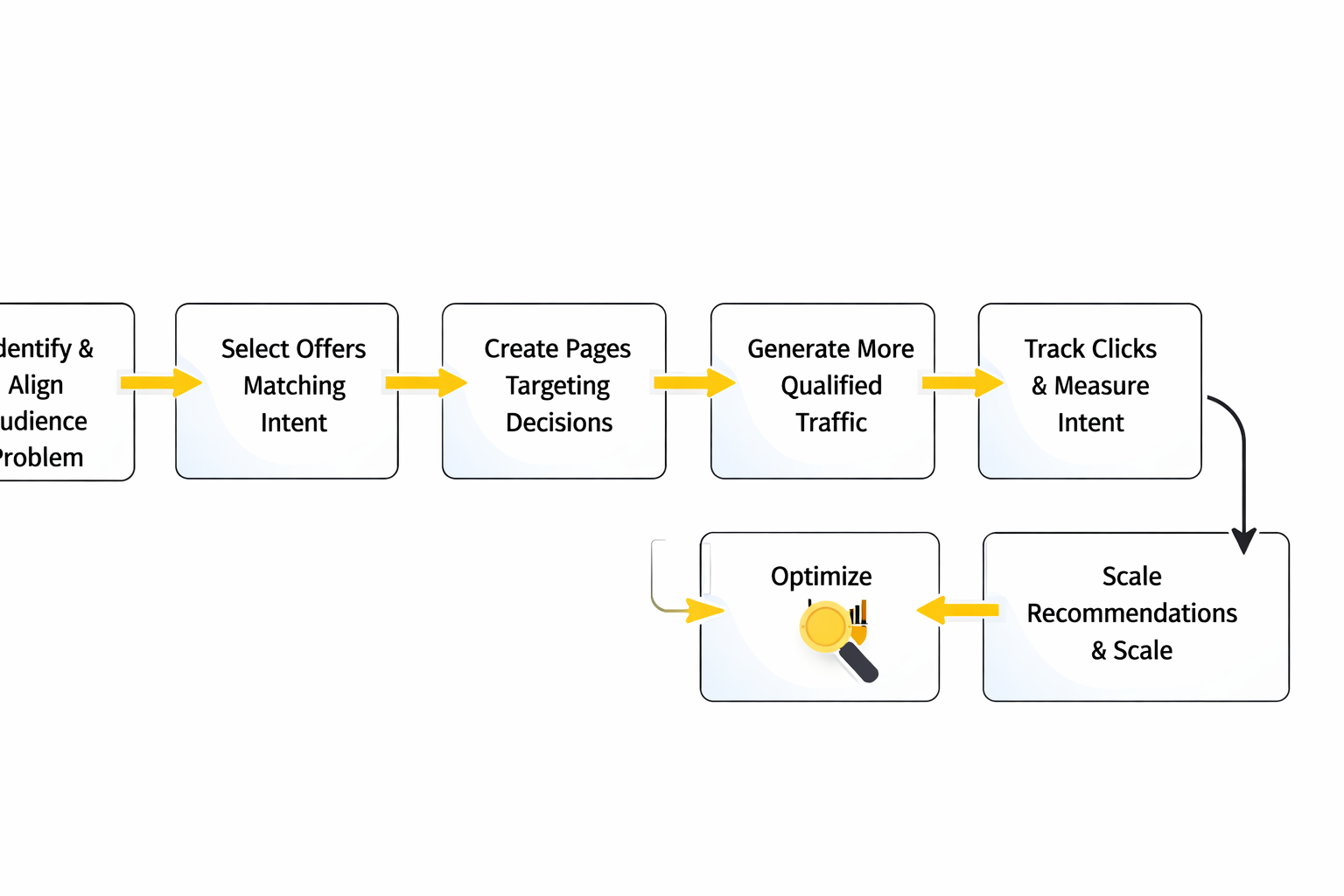
The cleanest way to think about affiliate marketing websites is this: traffic comes in, trust is built, intent is clarified, and the click happens only after the page has done enough work to deserve it. That sounds simple, but it forces you to stop obsessing over raw traffic and start focusing on what kind of page experience leads to a profitable action. A website that gets fewer visits but matches intent better will often outperform a noisy site that chases volume.
There are four moving parts inside that framework. First, you attract the right visitor through search, social, email, YouTube, or partnerships. Second, you match that visitor with the correct page type. Third, you guide them toward a recommendation that feels logically connected to the problem they want to solve. Fourth, you track what happened so you can improve the site instead of guessing.
When those parts are connected well, affiliate marketing stops feeling random. It becomes an actual system that can be measured, improved, and scaled.
Match the Page Type to the Visitor Intent
Not every visitor wants the same thing, so not every page should try to do the same job. A person searching for “best affiliate marketing websites” is usually earlier in the process than someone searching for “ClickFunnels vs Systeme.io for affiliate funnels.” The first page should help them understand the landscape, while the second page should help them make a decision.
That is why the most effective affiliate marketing websites use a mix of content formats. Educational articles capture broad interest, comparison pages help narrow choices, tutorials remove setup friction, and resource pages give readers a quick path to trusted tools. If you are recommending funnel builders, for example, a high-intent comparison between ClickFunnels and Systeme.io will usually convert very differently from a broad article about online business models.
The framework works best when every page knows its role. Trying to make one article educate beginners, rank for ten unrelated keywords, compare six tools, and force a conversion at the same time usually weakens all four goals. Clear intent beats clutter every time.
Design for the Full Journey, Not Just the Last Click
One of the biggest shifts in affiliate marketing right now is that the path to purchase is getting messier. impact.com’s 2025 benchmark across 2,368 North American retail brands found that affiliate journeys are getting longer at the front end and more compressed at checkout, which means shoppers are researching more and deciding later. If your website only tries to win the final click, you miss the pages that shape the decision earlier.
This is exactly why websites still outperform shallow content in many niches. A site can host top-of-funnel explainers, mid-funnel comparisons, and bottom-of-funnel offers in one connected structure. That gives you multiple opportunities to be useful before the visitor is ready to buy.
It also changes how you should look at content value. A tutorial that rarely gets direct last-click credit may still be one of the most important pages on the site if it moves people from confusion to confidence. The best affiliate marketing websites are built to influence the whole decision journey, not just the final transaction.
Core Components
The core components of affiliate marketing websites are not complicated, but they do need to work together. You need content that matches buyer intent, offers that make sense for the audience, pages that load fast, disclosures that are easy to understand, and analytics that tell you what is happening after the click. Miss one of those pieces and the whole model gets weaker.
Think of these components like a machine rather than a checklist. Strong content without clean tracking leaves you blind. Great tracking without persuasive page structure leaves you informed but underpaid. Speed without trust turns a technically polished site into a forgettable one.
When people say affiliate sites are saturated, what they often mean is that weak sites are saturated. Strong sites with clear positioning, real utility, and disciplined implementation still stand out.
Content Architecture That Guides Decisions
Content architecture is the hidden advantage most beginners never think about until their site becomes chaotic. If you want affiliate marketing websites to rank and convert, you need a structure that helps people move from topic to topic without getting lost. That usually means pillar pages, supporting articles, comparisons, tutorials, and a resource hub that ties everything together.
For a site about digital growth, one article might explain how affiliate models work, another might compare newsletter platforms like Brevo and Moosend, and another might show how to schedule content with Buffer or improve creator workflows with Flick. Each page has a job, and internal links move readers toward the next logical decision.
This matters because readers rarely arrive ready to buy the first thing they see. They need context. A thoughtful content structure gives them that context while quietly increasing the chances that the eventual click is both informed and profitable.
Technical Performance Is Not Optional
A slow affiliate website leaks money before persuasion even begins. Google’s current guidance on Core Web Vitals recommends an LCP within 2.5 seconds, an INP below 200 milliseconds, and a CLS below 0.1, because page experience is tied to both usability and search success. That is not a developer-side detail you can safely ignore. It is part of the business model.
The reason is simple. Many affiliate pages sit close to the moment of decision, and that means hesitation is expensive. If your review page jumps around as ads load, if your comparison table lags on mobile, or if your call-to-action button renders late, you are creating friction exactly where the user wants clarity.
This is also where professional tool choices start to matter. If you are building offer pages, lead magnets, or lightweight conversion paths, platforms like iMallin, ClickFunnels, and Systeme.io are often worth evaluating because speed, page flow, and conversion design are already part of the package instead of an afterthought.
Clear Disclosures and Honest Positioning
A surprising number of affiliate marketing websites still hide disclosures in footers or write them so vaguely that readers are left guessing. That is the wrong move strategically and legally. The FTC’s endorsement guidance and its plain-language advice on good disclosures both point in the same direction: if there is a material connection, people should be able to notice and understand it.
Good affiliate sites treat that clarity as part of the user experience. They disclose the relationship, explain how recommendations are chosen, and then let the quality of the content do the persuasion. That makes the recommendation feel stronger, not weaker, because the reader does not have to wonder what is being hidden.
Honest positioning also helps you write better pages. Once you stop pretending every tool is perfect, you can make sharper recommendations. A scheduling-heavy audience might be better served by Cal.com, an outreach-focused audience may care more about ScaledMail, and a tracking-focused audience might get more value from Dub. Precision is what makes affiliate content persuasive.
Professional Implementation
Professional implementation is where the gap opens up between hobby sites and real businesses. A hobby site publishes content and hopes commissions appear. A professional affiliate website builds a repeatable process for page creation, offer selection, measurement, compliance, and optimization so that growth is not based on luck.
This is also the stage where you should stop thinking only like a writer and start thinking like an operator. Your pages need clean templates, consistent calls to action, controlled link placement, and a clear system for updating outdated recommendations. If the site grows without a process, it becomes harder to trust your own data and harder to maintain quality.
The good news is that professional implementation does not require a huge team at the beginning. It requires discipline. That matters more than scale.
Build Clean Conversion Paths
The page should make the next step obvious. Not aggressive, not chaotic, just obvious. If the visitor finishes a comparison and still does not know where to click, what to test first, or why one option fits them better than another, the page has not finished its job.
This becomes especially important when the offer involves forms, trials, or purchases. Stripe’s checkout optimization guidance points out that global cart abandonment rates hover around 70%, and the company’s own recommendations keep coming back to the same themes: reduce friction, cut unnecessary steps, optimize mobile performance, and avoid making the purchase path harder than it needs to be. Those principles apply to affiliate landing pages too, even when the final checkout happens on the merchant’s side.
That is why many high-performing affiliate marketing websites use focused bridges instead of dumping readers onto a random homepage. A short pre-sell page, a clean tools page, or a guided next-step page can do a lot of heavy lifting before sending someone to PLR Funnels, Chatbase, Fillout, or Firecrawl when those tools genuinely fit the problem the reader is trying to solve.
Set Up Measurement Before You Need It
Too many affiliates wait until traffic arrives before they start measuring what matters. By then, they have already lost weeks or months of insight. Google’s current GA4 ecommerce documentation recommends tracking actions such as viewing items, beginning checkout, purchases, promotions, and related on-site behavior so you can understand how users actually move through revenue-driving pages.
Even if your site is not selling its own products, the lesson is the same: define the actions that matter before you publish at scale. That might include outbound affiliate clicks, email signups, resource page visits, comparison table interactions, or lead magnet downloads. Without that setup, you are making optimization decisions based on vibe instead of evidence.
The most professional affiliate marketing websites are calm about data because they do not need to guess. They know which pages attract commercial intent, which offer blocks get clicked, which devices underperform, and which content themes lead to the best downstream outcomes. That level of clarity is where consistent revenue starts.
Choose a Tool Stack That Makes the Site Easier to Run
A professional site should get easier to operate as it grows, not harder. That usually means choosing tools that reduce manual work in publishing, email follow-up, outreach, automation, and reporting. There is no prize for stitching together a fragile stack that breaks every time one plugin updates.
If your strategy includes lead capture, funnel routing, and segmented follow-up, it makes sense to test platforms like ClickFunnels or Systeme.io. If your growth depends more on content workflows, you may get more leverage from tools like Buffer, Flick, Wispr Flow, or BetterPic. If your site leans into automation and lead qualification, platforms such as Comp AI and Guideless may belong on your testing list.
The important thing is not to recommend tools because they exist or because they pay. Recommend them because they reduce friction for the audience you serve. That is how an affiliate marketing website starts feeling like a trusted operator instead of a crowded ad shelf.
Match the Right Page to the Right Intent
Not every visitor lands on your site ready to buy. Some people are just trying to understand the space, some are comparing two tools, and some are almost ready to pull the trigger but need a little more confidence before they click. That is why affiliate marketing websites work best when different page types serve different moments in the buying journey.
A broad educational article should calm confusion and build trust. A comparison page should make tradeoffs obvious and help the reader make a decision faster. A tutorial should remove friction, especially when the tool has a learning curve, and a focused resources page should give people a clean next step instead of forcing them to dig through your site.
This is also why you should stop trying to make every page do everything. If somebody is looking for a sales funnel platform, a tight comparison between ClickFunnels and Systeme.io will usually do a better job than a giant article stuffed with ten unrelated tools. The clearer the intent, the easier it becomes to guide the reader toward the offer that actually fits.
Design the Journey Before You Ask for the Click
A lot of affiliate sites rush the click too early. They throw buttons in the first screen, hit the reader with a hard recommendation, and never do the work required to earn trust. That may squeeze out a few impatient clicks, but it usually leaves a lot of money on the table because the page never helps the reader feel fully informed.
The best affiliate marketing websites think in sequences. They know the visitor may first need an explainer, then a comparison, then a short case for why one option is better for a specific kind of business, creator, or marketer. That matters even more now because Awin’s 2025 Forrester-backed research shows that 52% of marketers see affiliates as a way to support more personalized marketing communications, which tells you the channel is moving toward better matching, not louder promotion.
Once you understand that, your site structure gets sharper. Instead of screaming for the sale, you begin guiding the decision. And that shift is huge, because people do not usually need more hype. They need someone to make the path feel clearer.

Offer Fit Is What Separates a Useful Site From a Pushy One
Here is the part nobody should skip. Even the cleanest framework falls apart when the offer does not match the reader’s actual problem. You can build gorgeous affiliate marketing websites, write strong copy, and still underperform badly if you keep sending people to tools that are too expensive, too complex, or just wrong for what they need.
That is why professional affiliate sites think in terms of fit instead of payout alone. Someone trying to build simple forms and automate lightweight workflows may respond better to Fillout than to a bloated all-in-one stack. Someone who needs email marketing and CRM functionality may be a better match for Brevo, while someone focused on publishing and social scheduling could find more immediate value in Buffer or Flick.
When your framework is built around fit, your content gets better and your conversions usually do too. That is because the recommendation no longer feels forced. It feels like the obvious next step for the reader, and that is exactly how affiliate marketing websites start earning trust at scale.
Measure the Steps That Actually Move Revenue
Once the framework is live, you need to know where people are moving and where they are dropping off. Otherwise, you are just publishing pages and hoping the commissions show up. Hope is not a strategy, especially when different page types do very different jobs.
Google’s current GA4 ecommerce documentation recommends tracking the actions that reveal how users move through commercially important pages, including how product views, promotions, and placements affect revenue-driving behavior. Even if you are not running a classic ecommerce store, the lesson still applies to affiliate marketing websites. You should know which pages create outbound clicks, which comparisons get attention, which calls to action pull best, and which devices or traffic sources are quietly killing performance.
That is when your framework stops being theory. It becomes a system you can improve. And once you can improve it consistently, you are no longer just building pages. You are building an asset.
Your Editorial Engine Has to Pull the Whole Site Forward
The first core component is the editorial engine behind the site. That means the system you use to decide what gets published, what gets updated, what links to what, and how readers move from one topic to the next. Without that engine, most affiliate marketing websites become messy fast because pages get created one by one without any real plan holding them together.
A good editorial engine has range. It includes broad educational pages that pull in curious readers, comparison pages that help narrow decisions, tutorials that remove friction, and resource pages that offer a clean next step. When those pieces connect naturally, your content does not feel like isolated posts anymore. It starts feeling like a buyer journey that you intentionally designed.
This is also where discipline matters. If every new page targets a different angle with no relationship to the rest of the site, it becomes harder to build trust and harder to rank for topics that need depth. Affiliate marketing websites become much stronger when clusters of content reinforce each other instead of competing for attention.
Monetization Architecture Should Feel Natural, Not Forced
The second core component is monetization architecture, and this is where a lot of sites get weird. They throw buttons everywhere, interrupt the reading experience, and make it obvious they care more about the click than the person. That approach may create some short bursts of revenue, but it usually weakens trust over time.
Stronger affiliate marketing websites build monetization into the page in a way that feels useful. A comparison article might point readers toward ClickFunnels when the user clearly needs a sales-focused funnel stack, while a simpler audience may be better served by Systeme.io. Someone building email-driven campaigns may need Brevo or Moosend, and somebody focused on content publishing workflows may care more about Buffer or Flick.
The reason this matters is simple. Readers can tell when you are matching tools to their needs and when you are just dropping links because you want a commission. The more natural the fit, the more your recommendations feel like guidance instead of pressure. That is exactly how affiliate marketing websites earn more without sounding more aggressive.
Trust, Disclosure, and Review Quality Are Part of the Product
The third core component is trust, and trust is not just a nice extra. It is part of the product you are delivering. If someone is going to rely on your recommendation, they need to feel that your page is honest about how it makes money and serious about how it evaluates tools, services, or products.
That is why affiliate marketing websites need visible disclosures and review standards that make sense to a normal human being. The FTC’s current guidance on endorsements, influencers, and reviews makes clear that material connections should be disclosed and that review practices need to reflect genuine opinions rather than manufactured credibility. That should not scare you. It should actually sharpen your writing, because honest recommendations are easier to defend and easier for readers to trust.
Once you accept that, your pages usually improve. You stop pretending every tool is perfect. You explain tradeoffs more clearly. You recommend things like Cal.com, Chatbase, Fillout, or Dub only when the use case actually lines up, and that makes the whole site feel more credible.
Performance Is a Core Component Because Friction Kills Momentum
The fourth core component is performance. This is the part many people treat like a technical side quest, but it is really a conversion issue. When affiliate marketing websites load slowly, jump around on mobile, or feel clunky during comparison-heavy moments, the reader starts losing confidence before they ever reach the recommendation.
Google’s current documentation around Core Web Vitals still centers on LCP, INP, and CLS because fast, stable pages create a better experience for real users. That matters on affiliate sites because many visitors arrive with commercial intent. They are not casually browsing for entertainment. They are trying to get clarity and move forward, and every extra delay chips away at that momentum.
This is why clean layouts, fast pages, and simple decision paths are not optional extras. They are part of what makes affiliate marketing websites work. When the site feels quick and easy to use, the recommendation gets heard more clearly because the page itself is not getting in the way.
The Measurement Layer Tells You Which Components Are Actually Working
The fifth core component is measurement. Without it, you can have opinions, but you cannot have control. You may think one page is your best performer because it gets the most traffic, but the page sending the most useful clicks or creating the most assisted conversions could be something entirely different.
That is why serious affiliate marketing websites track the steps that reveal buying intent. Google’s GA4 ecommerce guidance focuses on measuring the actions that show how people move through commercial experiences, and that same logic applies here. Outbound clicks, comparison interactions, resource-page visits, email signups, and tool-specific call-to-action performance all tell you whether the site is guiding people well or just attracting attention.
Once that measurement layer is in place, the rest of the site gets easier to improve. You can see where trust is strong, where readers hesitate, and where certain offers clearly fit better than others. That is the point where affiliate marketing websites stop feeling like experiments and start behaving like businesses.
Statistics and Data

If you want affiliate marketing websites to grow beyond guesswork, this is the part you cannot skip. Data tells you whether your site is actually influencing buying decisions or just collecting pageviews that feel exciting but do not move revenue. And once you start looking at the numbers the right way, you quickly realize that a profitable affiliate website is usually less about chasing more traffic and more about improving the quality of the journey.
The recent numbers around the channel make that point very clear. PMA’s 2025 industry study shows that affiliate marketing spending in the United States rose from $9.1 billion in 2021 to $13.62 billion in 2024, while the same study ties that investment to $113 billion in ecommerce sales during 2024. At the same time, impact.com’s 2025 global research found that 74% of brands generate 11% to 30% of total revenue from affiliate marketing, which tells you this is not a side hustle channel for serious operators. It is a core commercial system, and affiliate marketing websites sit right in the middle of it.
The Revenue Opportunity Is Bigger Than Most Site Owners Realize
One of the most important things the current data shows is that affiliate marketing is still expanding even as the digital landscape gets more crowded. That matters because it tells you there is still room for well-built affiliate marketing websites that solve real problems instead of recycling generic product lists. Growth is not happening because the internet needs more noise. It is happening because brands still need trusted partners who can influence decisions in measurable ways.
The commercial value of that influence shows up in multiple places. impact.com’s 2025 research across 1,500 marketers, publishers, and creators shows that affiliate revenue is meaningful for most established programs, while Awin’s 2025 Forrester-backed survey of more than 650 marketing leaders found that marketers are prioritizing personalized communications, better customer experiences, and measurable ROI. That combination matters for publishers because it means affiliate marketing websites are being judged less like ad inventory and more like performance assets that can shape the full decision path.
That also changes how you should think about monetization. If your site only knows how to push one low-context offer, you are underbuilding the asset. A stronger setup gives readers different next steps based on what they actually need, whether that means a funnel platform like ClickFunnels, an all-in-one option like Systeme.io, or a leaner commerce setup through iMallin. When the site is designed around user fit instead of random link placement, the numbers become much easier to improve.
Buyer Behavior Data Shows Why the Middle of the Funnel Matters So Much
A lot of people assume affiliate success is just a traffic game, but recent benchmark data shows that the real battle is happening deeper in the journey. impact.com’s 2025 benchmark covering 2,368 North American retail brands found that clicks rose 2% year over year while transactions fell 5%. On the surface that sounds negative, but the same report shows that average order value climbed 4% to $123 and items per order increased from 2.3 to 2.5, which suggests shoppers are not disappearing. They are researching harder, taking longer, and buying with more intent once they decide.
That is exactly why affiliate marketing websites need strong comparison pages, resource hubs, tutorials, and bridge pages instead of just “best tools” posts. If the buyer is spending more time evaluating, your site needs to do more than introduce the offer. It needs to help narrow the choice, reduce uncertainty, and make the final click feel logical. A weak page may still earn attention, but a stronger page earns action because it supports the reader during the part of the journey where hesitation is highest.
The broader ecommerce picture points in the same direction. Adobe’s 2024 holiday ecommerce analysis released in January 2025 shows that consumers spent $241.4 billion online, with smartphones driving 54.5% of online purchases and affiliates and partners accounting for 17.6% of revenue share during the season. That matters for affiliate marketing websites because it confirms two things at once: mobile usability is no longer optional, and partner-driven buying influence is happening at serious scale.
Trust and Friction Numbers Explain Why So Many Affiliate Pages Underperform
When an affiliate page fails, the problem is not always the offer. Quite often the problem is the experience around the offer. The reader may feel uncertain, distracted, overloaded, or unconvinced that the site is trustworthy enough to take the next step.
Baymard’s cart abandonment research updated in 2025 puts some hard numbers behind that. The average documented cart abandonment rate sits at 70.22%, and among the more avoidable reasons for abandonment, 19% of shoppers said they did not trust the site with their credit card information, 19% said the site wanted them to create an account, and 18% said the checkout process was too long or too complicated. Even though affiliate marketing websites often send the visitor to another property to complete the transaction, those numbers still matter because trust problems usually begin before the merchant’s checkout page ever appears.
That means the affiliate page itself needs to reduce friction instead of adding more of it. Clean disclosures, obvious next steps, fast loading, and honest recommendations all help. If your site is sending people into lead capture or a pre-sell path first, the tools you use matter too, which is why many operators test options like Fillout for simple forms, Chatbase for guided qualification, and Brevo or Moosend for follow-up. The smoother that handoff feels, the better chance your affiliate marketing websites have of turning intent into revenue.
The Best Metrics Are the Ones That Explain the Journey
Most site owners track too little or they track the wrong things. They look at sessions, maybe bounce rate, maybe total affiliate clicks, and then wonder why it still feels impossible to know what is working. The problem is that those numbers are too blunt. They tell you something happened, but they do not explain why revenue rose or fell.
The better model is to track the steps that reveal intent and movement. Google’s current GA4 ecommerce guidance recommends measuring shopping behavior through specific events because that is how you understand product popularity, promotion impact, and revenue influence. Even if you are not processing the final purchase on your own domain, affiliate marketing websites can still use that logic by tracking outbound clicks, resource page visits, comparison interactions, email signups, and offer-specific engagement.
This is where your stack starts to matter in a practical way. If you want clean attribution on outbound links, a tool like Dub can make link-level reporting easier to manage. If your model includes booked demos, consultative sales, or partner calls, Cal.com can help you see whether content is driving actual meetings instead of just anonymous clicks. And if you are publishing at scale and want to automate research or enrichment around content workflows, platforms like Firecrawl can support the system behind the scenes. The point is not to collect more dashboards for the sake of it. The point is to make affiliate marketing websites measurable enough that you can improve them with confidence.
Performance Benchmarks Still Matter Because Slow Pages Quietly Destroy Revenue
It is easy to talk about analytics like it all lives inside reports, but some of the most important data points are technical. If the page is slow, unstable, or frustrating on mobile, your site starts losing momentum before the content has a real chance to persuade anyone. That is especially dangerous for affiliate marketing websites because many visits come from high-intent searches where the user already wants an answer quickly.
Google’s latest Core Web Vitals guidance still recommends keeping Largest Contentful Paint within 2.5 seconds, Interaction to Next Paint under 200 milliseconds, and Cumulative Layout Shift below 0.1. Those are not vanity numbers. They are practical benchmarks for whether the site feels fast, responsive, and stable enough to support decision-making. On mobile-heavy journeys, that matters even more, especially when Adobe’s recent ecommerce data shows that smartphones already drive the majority of online purchases.
So the takeaway here is simple. The numbers are not just there to decorate your article or make the channel sound impressive. They tell you exactly where affiliate marketing websites win or lose: in trust, in journey design, in mobile performance, and in how well the site turns attention into a confident next step. When you build around those numbers, the site stops feeling like content with links and starts behaving like a business.
Measurement and Optimization
This is where affiliate marketing websites either start printing more revenue from the same traffic or stay stuck in place for months. A lot of site owners work hard to publish, but they never build the habit of tightening the system after the content goes live. That is a huge mistake, because the site usually already contains hidden wins that only show up once you start measuring the right actions and improving the weak points one by one.
The good news is that optimization does not need to feel complicated. You are looking for a few simple truths: which pages attract commercial intent, which blocks get clicked, where users hesitate, and which offers fit the audience best. Once you know those things, affiliate marketing websites become easier to improve because you are no longer guessing about where the money is leaking out.
That mindset matters now more than ever because impact.com’s 2025 benchmark shows clicks rising while transactions softened, which is a strong signal that buyers are spending more time evaluating before they commit. In plain English, your site has to do more of the selling work in the middle of the journey, not just at the end.
Track Intent, Not Just Traffic
The first thing to understand is that traffic can make you feel smarter than you really are. A pageview does not tell you whether the article answered the question, whether the visitor trusted the recommendation, or whether they moved one step closer to buying. That is why affiliate marketing websites need to track intent signals instead of stopping at surface-level traffic numbers.
Google’s current GA4 ecommerce guidance is useful here because it focuses on the user actions that reveal movement through commercial experiences. For affiliate sites, that usually means tracking outbound clicks, button interactions, comparison-table engagement, resource-page visits, email opt-ins, and the paths users take before they reach those moments. When you look at those signals together, you start seeing which pages are doing real persuasive work and which ones are just collecting impressions.
Once you have that visibility, the next move becomes obvious. If a page gets strong traffic but weak outbound clicks, the offer fit or page structure is probably off. If a page has modest traffic but excellent click quality, it may deserve more internal links, more updates, and more promotional energy because it is already proving it can convert.
Fix Page Friction Before You Chase More Visitors
One of the fastest ways to improve affiliate marketing websites is to remove friction from pages that already have commercial intent. This is the work most people skip because it feels less exciting than publishing something new, but it often pays faster. If visitors are landing on a strong page and still failing to act, your biggest opportunity may be right there in front of you.
Friction usually hides in plain sight. The page may load too slowly on mobile, the call to action may be vague, the recommendation may appear too early, or the article may overwhelm readers with choices instead of helping them make one clear decision. Google’s latest Core Web Vitals documentation keeps pointing back to LCP, INP, and CLS because a page that feels slow, unstable, or awkward interrupts the decision process at exactly the wrong time.
The broader ecommerce data backs that up. Baymard’s 2025 cart abandonment research shows that friction, trust issues, and unnecessary complexity continue to push buyers away. Even when the final checkout happens on the merchant’s website, those same emotional triggers often start on the affiliate page first, which means your own content experience has to feel calm, fast, and easy to follow.
Refresh Money Pages on a Schedule
A lot of affiliate marketing websites lose momentum because their highest-value pages quietly go stale. Tools change, pricing changes, features change, competitors change, and user expectations change right along with them. If your best comparison or review page still sounds like it was written for last year’s market, people can feel that almost immediately.
This is why serious operators create a refresh cycle for money pages. They revisit comparisons, check whether screenshots or workflows still match the product, tighten the opening sections, simplify calls to action, and remove fluff that makes the page harder to trust. If a funnel-focused page starts converting better when you simplify the recommendation set to ClickFunnels and Systeme.io instead of listing ten loosely related tools, that is a signal to stay focused.
The same logic applies to supporting tools around the offer. A site that serves creators or marketers may improve performance by tightening recommendations around Buffer, Flick, Brevo, or Moosend depending on what the visitor actually needs next. Refreshing a page is not busywork when the page is already close to revenue. It is leverage.
Segment by Device and Traffic Source So You Can See the Real Story
If you only look at blended performance, affiliate marketing websites can fool you. A page may look average overall while performing brilliantly on desktop and terribly on mobile, or it may convert well for email traffic but poorly for search. If you never break the data apart, you end up optimizing for a blurry average instead of solving the real problem.
That matters because user behavior is increasingly device-driven. Adobe’s 2024 holiday ecommerce analysis released in 2025 showed smartphones driving 54.5% of online purchases, which means mobile is not the “secondary” experience anymore. It is often the main one. So if your comparison tables are awkward on small screens or your buttons and forms feel cramped, you are likely losing qualified clicks without realizing it.
Traffic source segmentation matters just as much. Search visitors often want fast clarity, email subscribers may tolerate a longer explanation because they already trust you, and social visitors may need more context before they are ready to click. Once you see those differences clearly, affiliate marketing websites become much easier to tune because you stop forcing one page experience on every kind of visitor.
Improve Offer Fit Instead of Just Adding More Offers
When revenue stalls, many affiliates react by adding more tools, more links, and more categories. That usually makes the site weaker, not stronger. More offers create more noise, more hesitation, and more opportunities for the visitor to lose the thread of the recommendation.
The better move is to improve offer fit. Ask which recommendation makes the most sense for the specific reader on that specific page. Somebody looking for a lean form and workflow setup may be better matched with Fillout. Somebody who needs appointment booking and route-to-call behavior may care more about Cal.com. Somebody trying to manage link performance across campaigns might get more value from Dub, while a team exploring conversational lead capture may be a stronger match for Chatbase.
This is where affiliate marketing websites become more persuasive without becoming more aggressive. You do not need louder buttons when the recommendation feels obviously aligned with the reader’s next problem. Fit is what makes the click feel natural, and natural clicks are usually the ones that compound.
Build Feedback Loops So the Site Keeps Getting Smarter
The final piece is building a feedback loop into the business. That means your analytics, page updates, offer testing, and internal linking all inform each other instead of living in separate little boxes. When you spot a page with strong click-through but weak downstream outcomes, you revisit the offer. When a tool recommendation starts resonating more strongly, you give it better placement on related pages. When a new traffic source behaves differently, you adjust the content flow to match it.
This is also where the right stack can save a lot of time. If you need cleaner outbound tracking, Dub can help you manage and analyze links more precisely. If you are building content systems, research workflows, or automated enrichment around your publishing process, tools like Firecrawl, Wispr Flow, Comp AI, Guideless, or BetterPic may fit depending on how your operation runs.
The important thing is not the tool itself. It is the habit. The best affiliate marketing websites keep learning from user behavior, tightening the weakest pages, and improving the match between intent and recommendation. That is how a site stops behaving like a content project and starts behaving like a system that gets stronger over time.
Ecosystem, Scaling, and FAQ

At this stage, affiliate marketing websites stop being just pages on a domain and start becoming an ecosystem. That means your articles, email list, comparison pages, tools pages, analytics, and offers all reinforce each other instead of operating like random pieces. When that happens, growth gets steadier because the site no longer depends on one page, one keyword, or one traffic spike to make money.
This is also where the strongest operators separate themselves from everyone else. impact.com’s 2025 research found that top-performing brands usually work across three to four partner types instead of relying on one source of influence, and Awin’s 2025 Forrester-backed survey found that 52% of marketers now see affiliates as a serious way to support more personalized marketing communications. The lesson for publishers is clear: affiliate marketing websites get stronger when they are built like connected systems, not like isolated content experiments.
Diversify Intelligently Without Turning the Site Into a Mess
Scaling does not mean adding more of everything. It means adding the right things in the right order so the site becomes more resilient without becoming more confusing. A strong ecosystem can include search traffic, an email list, retargeting, social proof, tools pages, comparison content, and a small number of carefully chosen offers that solve different problems for the same audience.
That is why good affiliate marketing websites diversify with discipline. If your audience needs funnels, email automation, and lead capture, it makes sense to connect recommendations like ClickFunnels, Systeme.io, Brevo, and Moosend into one coherent journey. If your audience is more focused on publishing, scheduling, and content workflows, you may build around Buffer, Flick, Wispr Flow, and BetterPic instead. The ecosystem gets stronger when every recommendation has a clear reason for being there.
Own the Audience Relationship Instead of Renting It
One of the smartest things you can do with affiliate marketing websites is build an audience relationship you control directly. Search traffic is valuable, social reach can be powerful, and referrals can scale fast, but none of them are fully yours. Your email list, your first-party data, your resource pages, and your best-converting internal journeys are the assets that protect you when platforms shift.
This matters because buyer journeys are getting more complex. impact.com’s 2025 benchmark showed clicks increasing while transactions declined, which points to more comparison behavior before purchase, not less. The publishers who win in that environment are the ones who can stay in front of the reader after the first visit, guide them toward the right next step, and re-enter the conversation when they are ready to decide.
That is why list building, light lead capture, and smart follow-up belong inside the ecosystem. If a visitor is not ready to click an affiliate offer on day one, that does not mean they are not valuable. It often means your affiliate marketing website needs a softer path that keeps the relationship alive until the timing is right.
Build Operations That Make Growth Easier, Not Heavier
Scaling becomes dangerous when every improvement adds more manual work. If every article update requires digging through spreadsheets, every outbound link is hard to trace, and every recommendation depends on memory instead of process, the business becomes fragile. The best affiliate marketing websites avoid that trap by building operations that simplify decisions as the site grows.
That can mean using Dub for cleaner link management, Cal.com when booked calls matter, Fillout for lean forms, Chatbase for guided qualification, or Firecrawl when research and automation become part of the publishing workflow. The exact stack will vary, but the goal stays the same: remove friction inside the business so more energy can go into better pages, better offers, and better decision support for readers.
FAQ for a Complete Guide
What are affiliate marketing websites?
Affiliate marketing websites are websites that publish content designed to help people make decisions and then earn a commission when a reader clicks through and completes a qualifying action with a partner brand. The site might publish reviews, tutorials, comparisons, resource pages, or educational content, but the core idea stays the same: help first, monetize second. The websites that last are the ones that make the recommendation feel genuinely useful instead of obviously forced.
Do affiliate marketing websites still work in 2026?
Yes, they absolutely still work, but the lazy version works far less often. The opportunity is still very real, which is one reason PMA’s 2025 industry study showed U.S. affiliate marketing spend climbing to $13.62 billion in 2024. What changed is the quality threshold. Thin content and shallow recommendations are easier to spot now, so affiliate marketing websites need sharper positioning, better trust signals, and stronger page experiences to compete.
How much traffic do affiliate marketing websites need to make money?
There is no single traffic number that guarantees success because intent matters more than raw volume. A small site with highly commercial traffic and strong offer fit can outperform a much larger site that attracts broad curiosity but weak buying intent. In practice, affiliate marketing websites tend to improve faster when they focus on pages that attract people close to a decision instead of chasing vanity traffic that looks impressive but converts poorly.
Which content types usually convert best?
Comparison pages, product alternatives pages, tutorials, and focused tools pages usually convert best because the visitor is already trying to solve something specific. Broad educational content still matters, but it often plays more of a trust-building and journey-shaping role. The highest-performing affiliate marketing websites use both, then connect them with internal links so curiosity can turn into action naturally.
Should you target high-ticket or low-ticket offers?
Both can work, but they behave differently. High-ticket offers can generate more revenue per conversion, though they usually require more trust and more explanation. Low-ticket offers may convert more easily, especially when the visitor already knows the category well. Most affiliate marketing websites become stronger when they balance the two instead of betting the entire business on one commission style.
How important are affiliate disclosures?
They are essential. Disclosures are not just a legal checkbox; they are part of how readers decide whether your recommendation feels honest. The FTC’s guidance on endorsements, influencers, and reviews makes clear that material connections should be disclosed, and in practice that transparency usually helps rather than hurts. Readers are far more comfortable clicking when the site feels open about how it makes money.
How many offers should one page promote?
Usually fewer than most people think. A page with too many offers creates hesitation because it asks the reader to do too much sorting on their own. The best affiliate marketing websites keep the choice set tight. A funnel page might focus on ClickFunnels and Systeme.io, while an email-focused page may narrow the field to Brevo and Moosend. Tight focus usually converts better than a giant shopping list.
What should you track on affiliate marketing websites?
You should track the actions that reveal intent and movement, not just pageviews. That includes outbound affiliate clicks, button clicks, email opt-ins, comparison-table interactions, tools-page visits, and device-level performance. Google’s current GA4 ecommerce documentation is useful because it is built around measuring commercial behavior step by step. That same logic helps affiliate marketing websites understand which pages are influencing revenue and which ones are just attracting attention.
How often should you update affiliate content?
Your highest-value pages should be reviewed regularly, especially if they cover software, pricing, features, or competitors that change often. Waiting a year to update a money page is usually too slow. The best habit is to refresh pages when the product changes, when user intent shifts, or when the page shows signs of slipping in clicks, rankings, or conversions. Freshness matters because readers can feel when a recommendation is no longer current.
Can you build affiliate marketing websites without relying only on SEO?
Yes. SEO is powerful, but the strongest businesses usually combine it with email, direct referrals, repeat visits, social distribution, partnerships, and branded traffic. In fact, impact.com’s 2025 research shows that diversified ecosystems perform better than one-dimensional partner setups. Affiliate marketing websites become more durable when they can attract and convert people from more than one channel.
What makes readers trust an affiliate site?
Trust usually comes from three things working together: honest disclosures, clear reasoning, and a page experience that feels calm instead of pushy. Readers trust a site more when it explains tradeoffs, makes specific recommendations for specific situations, and does not pretend every product is the perfect answer. Performance matters too, because Google’s Core Web Vitals guidance keeps reinforcing the value of fast, stable pages, and slow pages quietly undermine confidence during decision-heavy moments.
What is the biggest mistake beginners make?
The biggest mistake is building affiliate marketing websites around commissions instead of audience problems. When that happens, the content gets weaker, the offers feel random, and the site struggles to build any real authority. The better move is to obsess over the reader first, then choose the tools and offers that genuinely fit the next problem they need to solve.
Which tools can support the growth of affiliate marketing websites?
That depends on the business model, but a good stack usually supports publishing, tracking, lead capture, and conversion flow. Some site owners may need iMallin for commerce flows, others may lean on PLR Funnels for funnel assets, and others may get more value from ScaledMail, Comp AI, Guideless, or Copper depending on how their operation runs. The important thing is choosing tools that make the system easier to manage, not just bigger.
Work With Professionals
If you have made it this far, you already know the truth most people avoid. Affiliate marketing websites are not magic, and they are not passive just because somebody on the internet says they are. They work when the strategy is tight, the pages are useful, the offers fit, and the system keeps getting smarter over time.
That is exactly why working with professionals can shorten the path so much. A strong operator can help you tighten positioning, choose better tools, improve page structure, reduce friction, and build a cleaner ecosystem around the site instead of leaving you to guess your way through every decision. When the foundation is right, scaling gets a whole lot easier.
Explore 10K+ Remote Marketing Contracts on MarkeWork.com
Most marketers spend too much time chasing clients, competing on crowded platforms, and losing a percentage of every project to middlemen.
MarkeWork gives you a better way. Browse thousands of remote marketing contracts and connect directly with companies desperate to hire skilled marketers like you without platform commissions and without unnecessary gatekeepers.
If you’re serious about finding better opportunities and keeping 100% of what you earn, you can explore available contracts and create your profile for free at MarkeWork.com.
 Filip Konecny Enterprises