
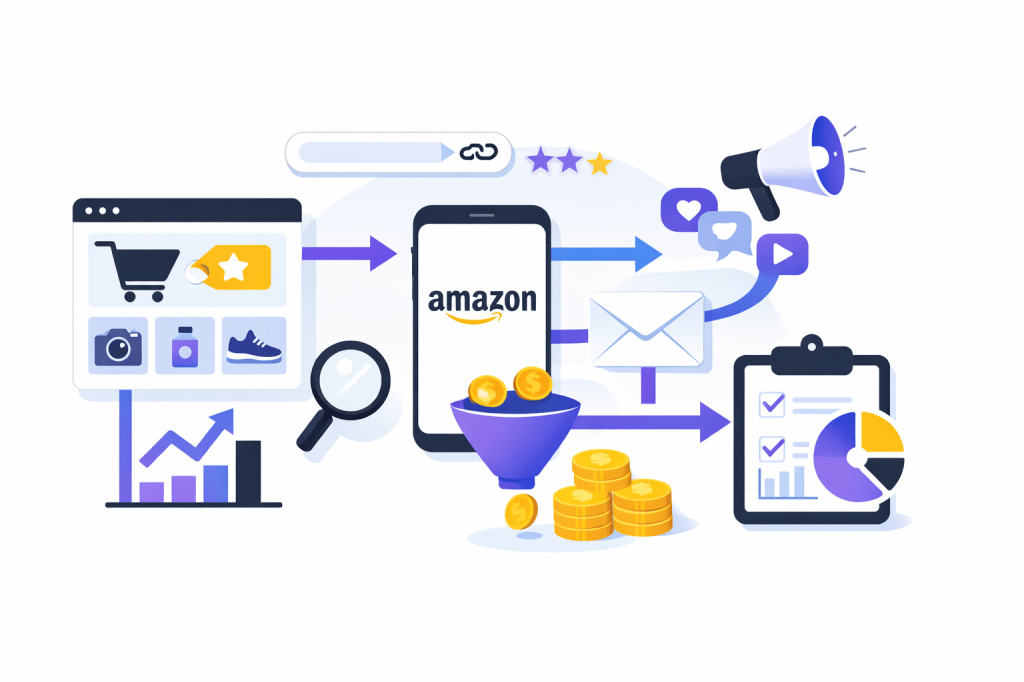
Amazon affiliate marketing still attracts beginners because the offer is simple to understand: recommend products people already know, send them to a store they already trust, and earn when those clicks turn into qualifying purchases. What makes it worth taking seriously in 2026 is not hype, but scale. Amazon reported $638 billion in 2024 revenue, and the company continues to sit at the center of how millions of people discover, compare, and buy products online.
That does not mean this is easy money. The economics are tighter than most new affiliates expect because Amazon’s standard commission rates vary by category, with the current official schedule showing examples like 4.5% for physical books, kitchen, and automotive, 3% for many home and sports categories, and 1% for grocery and health-related categories. On top of that, Amazon states that most commission credit depends on a 24-hour attribution window, so random traffic and weak content usually die fast.
The opportunity gets much better when you stop thinking like someone dropping links and start thinking like a publisher building buying intent. The broader performance marketing space has kept expanding, with the Performance Marketing Association reporting U.S. affiliate marketing spend reached $13.62 billion in 2024. That tells you something important: this channel is alive, but the winners are the people who create trust, context, and a path that makes clicking feel like the obvious next step.
Article Outline
- Part 1: Why Amazon Affiliate Marketing Matters
- Part 2: Amazon Affiliate Framework Overview
- Part 3: Core Components That Drive Clicks And Conversions
- Part 4: Professional Implementation For Content, Funnels, And Email
- Part 5: Measurement And Optimization That Protects Your Margins
- Part 6: Ecosystem Expansion, Long-Term Scaling, And FAQ
This first part lays the foundation so the rest of the article actually makes sense. We are going to cover why Amazon affiliate marketing still deserves attention, what the business model really looks like under the hood, which moving parts matter most, and how to implement it in a way that does not fall apart the moment traffic gets expensive or rankings shift.
Why Amazon Affiliate Marketing Matters
Amazon affiliate marketing matters because it sits at the intersection of trust, product breadth, and buyer readiness. Amazon’s own seller reporting says more than 60% of sales in its store come from independent sellers, which means affiliates are not limited to one brand story or one catalog. They can build content around thousands of real problems and match those problems with products that already have reviews, pricing context, and fast fulfillment attached to them.
It also matters because shopping behavior keeps moving toward smaller screens and faster purchase decisions. Adobe’s 2024 holiday recap showed consumers spent a record $241.4 billion online during the season, up 8.7% year over year, while mobile continued to play a major role in ecommerce transactions. When your content captures somebody at the exact moment they want a recommendation, Amazon gives you a destination that removes much of the friction that kills conversion on lesser-known stores.
There is another reason this model still works: people increasingly buy from trusted recommendations, not just from banner ads. Sprout Social’s 2024 consumer research found that nearly half of consumers make a purchase at least once a month because of influencer content. That is the real game here. Amazon affiliate marketing performs best when your content feels like guidance from someone who actually understands the buyer’s problem, not like a thin page written to force a keyword into a headline.
At the same time, this channel rewards discipline more than excitement. Amazon requires a clear disclosure, including the statement “As an Amazon Associate I earn from qualifying purchases”, and the FTC continues to stress that creators must make material relationships obvious to consumers in places they will actually notice them. In other words, the easy shortcut version is getting squeezed out, while the honest, useful, trust-building version is becoming even more valuable.
Amazon Affiliate Framework Overview
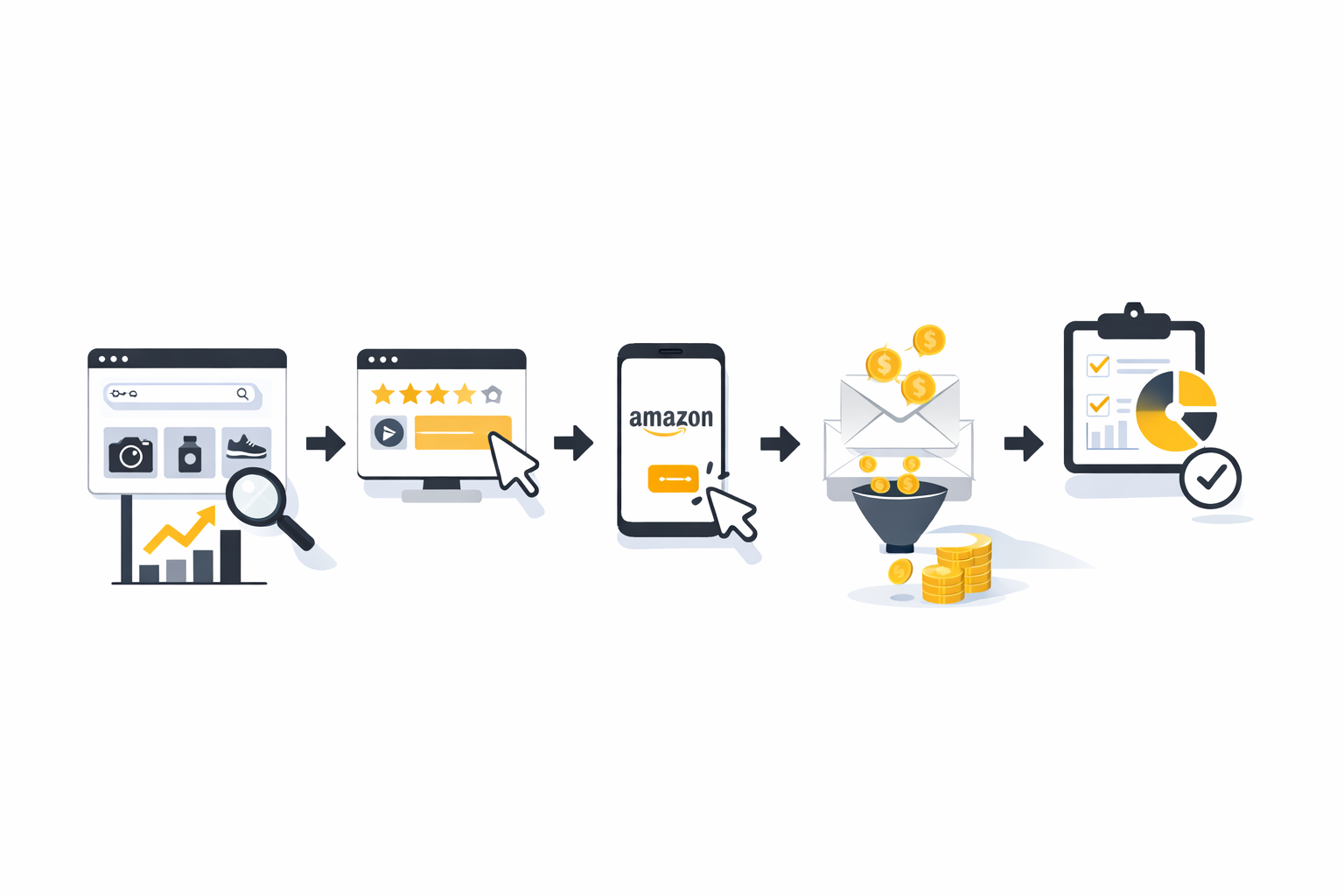
The framework is straightforward once you stop overcomplicating it. You attract the right person, help that person narrow a buying decision, move them to Amazon with a clear reason to click, and then repeat the process across clusters of related content. Every strong Amazon affiliate business is basically a system for capturing buying intent and organizing it at scale.
The first layer is audience intent. Somebody searching for “best espresso machine under $300” is already much closer to a transaction than somebody searching for “what is espresso.” That sounds obvious, but it changes everything about your content structure, because the pages that make money usually live at the bottom of the intent ladder while the pages that build reach and authority sit above them and funnel readers down.
The second layer is commercial fit. Amazon’s commission structure means you cannot treat every product category the same, and you also cannot assume a high-ticket item automatically means better economics. A sharper strategy is to build around product categories where the buyer has clear urgency, the decision needs comparison, and the commission rate or order basket makes the click worth chasing.
The third layer is asset ownership. You should never build this business in a way that depends on one traffic source alone. That is why serious operators pair content with email capture, basic funnel infrastructure, and simple distribution systems; for example, using Systeme.io or ClickFunnels to collect leads before sending readers out to offers. If Amazon changes terms, or a ranking drops, you still have an audience you can reach again.
Core Components
If you want Amazon affiliate marketing to work consistently, you need a few core components operating together. Miss one of them and the whole thing gets weaker than it looks from the outside. Get them aligned and even moderate traffic can become meaningful revenue.
Buyer-Intent Content
The first core component is content designed around commercial intent, not vanity traffic. That means comparison posts, problem-solution guides, alternatives pages, “best for” roundups, and review-style content that helps somebody move from confusion to decision. Amazon gives you the conversion environment, but your job is to create the moment where clicking feels logical and safe.
This is why generic product summaries rarely do much. Readers do not need another page repeating manufacturer specs they can see on Amazon itself. They need help choosing between options, understanding trade-offs, and avoiding bad buys that look good in a listing thumbnail.
Trust And Compliance
The second core component is trust, and trust is not just a soft concept here. Amazon requires visible Associate disclosure, and the FTC’s endorsement guidance makes it clear that material connections should be disclosed clearly and in ways people will notice. If your content feels evasive, overhyped, or weirdly secretive about compensation, you are weakening the exact thing that makes affiliate content persuasive in the first place.
Trust also comes from specificity. Instead of saying a product is “amazing,” show who it is for, who should skip it, where it beats alternatives, and where it does not. That kind of clarity increases clicks because readers feel they are being helped rather than handled.
Distribution And Retargeting Assets
The third component is distribution. Search traffic is powerful, but it should not be your only plan. Email, social clips, short-form posts, and repurposed content create more chances to get in front of buyers, and tools like Brevo, Moosend, Buffer, and Flick can help you keep that engine moving without turning your workflow into chaos.
This matters more than many affiliates realize because Amazon’s attribution window is short. When someone does not buy the first time, you need a reason and a method to get them back into your world later with new content, a better comparison, or a more specific recommendation. Even though the final purchase happens on Amazon, the durable advantage is usually built off Amazon.
Professional Implementation
Professional implementation starts with choosing a structure you can actually sustain. A focused niche site, a content-led personal brand, or a media property around one buying category all work better than a random collection of unrelated articles. The point is to make your recommendations feel connected, so each page strengthens the next one instead of starting from zero.
You also want a simple operating rhythm. Publish bottom-of-funnel content that answers buying questions, support it with informational content that pulls in a wider audience, and capture email subscribers with a useful resource before those readers disappear. If you want the setup to feel more like a business than a side project, a lightweight funnel built with ClickFunnels or iMallin can help you turn anonymous traffic into an audience you can guide repeatedly.
Finally, operate like someone who expects scrutiny. Use compliant links, keep disclosures obvious, avoid claims you cannot verify, and organize your content around real decision points instead of stuffing pages with products. That approach is less flashy, but it gives you the one thing that matters most in Amazon affiliate marketing: a business that can keep compounding when the initial excitement wears off.
- Pick one buying category so your content builds authority instead of looking scattered.
- Create content in clusters with guides, comparisons, and reviews that naturally feed one another.
- Capture traffic before it leaves with a simple lead magnet and email sequence.
- Disclose clearly so trust goes up instead of down when people realize you use affiliate links.
- Track what earns clicks because the pages that get traffic are not always the pages that make money.
That is the foundation for Part 1. In the next section of the article, we will go deeper into the framework itself and map exactly how to connect traffic sources, content types, and monetization paths so your Amazon affiliate marketing strategy is built to last.
Amazon Affiliate Framework Overview In Practice
Now that the foundation is clear, it is time to turn affiliate marketing with Amazon into something practical. A real framework is not just “write reviews and add links.” It is a sequence: attract the right visitor, match that visitor to the right buying stage, help them make a decision, send them to Amazon with confidence, and capture enough of that relationship that you are not rebuilding from zero every single day.
That matters because Amazon’s own rules shape the entire business model. The platform states that commissions are earned on qualifying items purchased after someone follows your link, and the program also makes clear that the standard shopping-cart window is typically 24 hours from the click. In plain English, you do not have much time to waste, which means your content has to meet people when they are already close to making a buying decision.
If you build this the right way, the business starts to feel a lot more stable. You stop guessing which pages should exist, you stop throwing links everywhere, and you start building a path that moves readers naturally from curiosity to action. That is the difference between random Amazon affiliate content and a system that can actually grow.

The Framework Starts With Intent
The first thing you need to understand is that not all clicks are equal. Somebody looking for “best standing desk for a small apartment” is very different from somebody searching “what is a standing desk.” The second person may become valuable later, but the first person is already leaning toward a purchase, and that makes affiliate marketing with Amazon much more effective because the visitor is already in decision mode.
This is why intent should control your publishing plan. Your highest-value pages usually sit closer to the sale: comparison articles, “best for” roundups, alternatives pages, and specific reviews built around real trade-offs. Informational content still matters, but its job is to warm people up, build trust, and guide them toward the pages where purchase intent is much stronger.
When you ignore intent, you end up with content that looks busy but does not convert. You may get traffic, but traffic by itself does not pay well when commission windows are short and category rates are uneven. The framework works best when every page has a clear role in moving the reader one step closer to a confident buying decision.
The Framework Uses Content Layers
A strong Amazon affiliate framework is layered, not flat. At the top, you have broader educational content that answers questions, explains categories, and helps readers understand what matters before they buy. In the middle, you have decision content that compares options, highlights differences, and narrows the field. At the bottom, you have conversion-focused pages that make the final click feel easy because the reader already trusts your judgment.
This layered model is important because people do not all arrive at the same point in the journey. Some are brand new and need orientation. Others are torn between two products and just need help breaking the tie. The better your content architecture reflects those stages, the more naturally readers move through your site instead of bouncing away after one page.
It also helps you write in a more human way. Instead of forcing the keyword into every paragraph, you can speak to what the reader is actually experiencing at that stage. That makes the article more persuasive, more useful, and much better suited to how real buyers behave online.
The Framework Must Match The Economics
One of the biggest mistakes in affiliate marketing with Amazon is choosing products based only on popularity. That sounds logical at first, but the official commission schedule shows that product categories are not rewarded equally, with current standard rates ranging from 4.5% in categories such as physical books, kitchen, and automotive to 1% in grocery and health-related categories, with some categories excluded entirely. So if you build content around products that are hard to rank, low-margin to promote, and bought casually rather than thoughtfully, the math can get ugly fast.
The smarter move is to target categories where buyers need help making sense of options. That usually means products with enough complexity to justify comparison, enough demand to make traffic worth chasing, and enough order value or basket potential to make the click commercially meaningful. You do not need the highest commission category on the platform. You need a category where trust actually changes the outcome.
This is also where a lot of beginners sabotage themselves. They chase anything they think might sell instead of committing to a segment they can understand deeply. But once you know the buyer’s questions, objections, language, and product concerns, your recommendations get sharper, your click-through rate improves, and your Amazon affiliate strategy starts feeling much more intentional.
The Framework Needs A Pre-Sell Bridge
Amazon closes the sale, but your content has to earn the click. That means your page should act like a bridge between confusion and confidence. It should not dump people onto Amazon too early, and it should not drown them in endless words either. The best pages explain what matters, reduce uncertainty, and then give the reader a clear reason to view the product.
This is where structure becomes a competitive advantage. Lead with the problem. Explain what separates good options from bad ones. Show who each recommendation fits best. Then place the affiliate link where the reader is most likely to think, “Yes, that is exactly what I needed.” When you do that, the click feels like a natural continuation of the reading experience rather than a sudden sales move.
If you want to make that process more systematic, it helps to build simple supporting assets around the content. A focused landing page in ClickFunnels or a lean setup in Systeme.io can help you collect leads, organize related recommendations, and turn one-time visitors into people you can reach again later.
The Framework Protects The Relationship
This is the part many people skip because they are too eager to drop a link and hope for the best. But if your only asset is an article that sends readers away, your business stays fragile. The moment rankings move, traffic slows, or Amazon updates something important, you are back at square one. A stronger framework protects the relationship before the click happens.
Email is usually the easiest place to start. If someone trusts you enough to read your product advice, many of them will also subscribe for buying guides, checklists, curated recommendations, or category updates. Tools like Brevo and Moosend make it easier to build that follow-up layer, while distribution tools like Buffer and Flick help you keep traffic flowing from outside search.
That does not mean you should force an opt-in everywhere. It means you should build enough owned attention that your content business is not completely dependent on Google, Pinterest, YouTube, or any single source. The affiliate link may create the commission, but the audience relationship is what creates long-term leverage.
The Framework Stays Compliant From The Start
A professional framework also takes compliance seriously before there is any meaningful scale. Amazon’s Operating Agreement requires a clear Associate disclosure, including the exact statement “As an Amazon Associate I earn from qualifying purchases”. The FTC also says that when a material connection could affect how people evaluate an endorsement, it should be disclosed clearly and conspicuously.
That is not just a legal box to check. It is part of how trust is built. When readers know how you make money and still feel that your guidance is honest, your recommendations become stronger, not weaker. People are not offended by affiliate links nearly as much as they are offended by feeling manipulated.
So build your disclosure into the system. Put it where people will actually see it. Keep the tone direct. And make sure the rest of the content lives up to it by being useful enough that the reader feels helped, not pushed.
A Simple Checklist For This Framework
- Choose a niche with real buying intent so your traffic has a reason to click and purchase.
- Publish layered content that supports readers from research stage to decision stage.
- Pick products with workable economics instead of assuming every Amazon category is equally worth promoting.
- Create a pre-sell bridge so the click to Amazon feels earned and natural.
- Capture part of the audience with email or funnel assets before visitors leave your platform.
- Use clear disclosures so trust and compliance are built into the business from day one.
How This Framework Sets Up The Rest Of The Article
This framework gives you the operating system behind affiliate marketing with Amazon. It explains why some sites get plenty of visitors and barely earn, while others with less traffic still generate meaningful commissions because every part of the journey is working together. Once you understand this structure, the next step is to break down the individual pieces that make it perform.
That is exactly where we are going next. In Part 3, we will get into the core components in much more detail, including the exact content types, trust signals, link strategies, and audience-building elements that make an Amazon affiliate business stronger over time instead of more complicated.
Core Components That Make Affiliate Marketing With Amazon Work
This is where affiliate marketing with Amazon stops being a vague business model and starts becoming a real system. If the framework in Part 2 showed you the path, these are the parts that actually make the engine run. And the truth is, most people do not fail because Amazon affiliate marketing is dead. They fail because one or two critical components are weak, and that weakness drags everything else down with it.
You need content that matches buyer intent. You need trust strong enough to make somebody act on your recommendation. You need click strategy, offer selection, audience capture, and compliance working together instead of fighting each other. When those pieces line up, even modest traffic can become profitable. When they do not, you can publish for months and wonder why the numbers still feel disappointing.
Content That Matches Real Buying Moments
The first component is content built around moments when people are already close to making a decision. That does not mean every article has to scream “buy now.” It means the article should meet the reader exactly where they are. If they are comparing options, help them compare. If they are worried about making a bad purchase, help them avoid a mistake. If they are looking for the best option in a narrow situation, guide them to the strongest fit.
This is why some of the best-performing Amazon affiliate content is incredibly specific. A person searching for a broad topic may be curious, but a person searching for the best laptop stand for back pain, the quietest blender for apartment living, or the best budget microphone for Zoom calls is usually trying to solve something right now. That kind of urgency changes how people read, how quickly they decide, and how willing they are to click through to Amazon.
The job of your article is not to dump specifications in their lap. Amazon already has specifications. Your job is to interpret the buying decision better than a product page can. Once you understand that, your content becomes more useful and a lot more persuasive at the same time.
Trust Signals That Lower Resistance
The second component is trust, and this is the one people love to underestimate. Readers do not click affiliate links just because a product appears on a page. They click when they feel the recommendation is grounded, honest, and relevant to their situation. That means your writing has to sound like it is helping a person make a smart decision, not like it is trying to corner them into one.
One reason this matters so much is that ecommerce trust is shaped heavily by how people interpret recommendations and reviews. Recent research published in Frontiers in Communication examined how authentic and fake reviews influence trust and purchase behavior on ecommerce platforms, which is a good reminder that credibility is not a side benefit in affiliate marketing with Amazon. It is the whole game. If people sense exaggeration, generic advice, or suspicious claims, resistance goes up fast.
So your trust signals should be obvious. Use plain language. Explain trade-offs. Say who a product is for and who should skip it. Be willing to point out flaws. Ironically, that kind of honesty often improves clicks because the reader feels like you are filtering options on their behalf rather than pushing the first thing with a commission attached to it.
Product Selection With Better Math
The third component is product selection, and this is where a lot of beginners make life harder than it needs to be. They pick products based on hype, popularity, or whatever seems easy to write about. But affiliate marketing with Amazon is shaped by category economics, buyer urgency, and basket behavior, so the numbers behind the click matter just as much as the content around it.
Amazon’s current standard commission schedule makes that crystal clear. The official rate table shows examples such as 4.5% for physical books, kitchen, and automotive, 3% for many home, sports, and pet categories, 2.5% for PCs and components, and 1% for grocery and health-related categories. That means a product can be popular and still be a weak target if the category is low-paying, the price point is small, or the buying decision is so casual that your content barely influences it.
The stronger play is to look for products where buyers need help. Complex products, comparison-heavy products, “best for” products, and products with meaningful price variation tend to create better affiliate conditions because your recommendation genuinely changes the outcome. When that happens, your click-through rate usually gets healthier because the reader sees a clear reason to view the product now.
Click Strategy That Feels Natural
The next component is click strategy. This sounds simple, but it is one of the easiest things to get wrong. Some publishers barely place links at all and make readers hunt for them. Others throw buttons and text links everywhere until the article starts feeling desperate. Neither approach works as well as a page that guides attention naturally and places the link at the exact moment the reader wants the next step.
Amazon states that commissions are earned when visitors follow eligible links and then purchase qualifying items, with the standard attribution window usually lasting 24 hours from the click. That short window is why your click placement matters so much. If somebody leaves the page half-convinced, gets distracted, and forgets about the product, the opportunity is usually gone.
So make your click strategy clean and intentional. Link after you have clarified the problem. Link after a recommendation summary. Link after comparing the best options. The goal is not to force more clicks. The goal is to make the right click feel obvious.
Audience Capture Before The Reader Leaves
This component separates fragile affiliate sites from durable businesses. If every visitor lands on your content and immediately leaves for Amazon, you may earn some commissions, but you are not building much leverage. The stronger version of affiliate marketing with Amazon captures at least a portion of the audience before they go, so you can bring them back with better recommendations, updated buying guides, and related content later.
That matters because not every visitor is ready on the first visit. Some are still comparing. Some need a reminder. Some buy later when the pain point becomes urgent. A simple lead magnet, category guide, or email sequence gives you another shot at the relationship, and that turns one article into something much more valuable over time.
This is where supporting tools can help. A simple setup in Systeme.io or a more sales-focused funnel in ClickFunnels can make it easier to collect subscribers and organize category-specific follow-up. Then tools like Brevo or Moosend help you stay in touch without making the workflow feel overwhelming.
Distribution That Keeps The Engine Moving
Another core component is distribution. Search traffic is powerful, but it should not be the only thing feeding your Amazon affiliate business. When all of your traffic comes from one source, the business becomes too easy to disrupt. Rankings shift, platforms change, and what felt stable suddenly looks shaky.
A healthier approach is to build multiple entry points into the same content ecosystem. Short-form posts can introduce a product category. Email can bring people back to a comparison page. Social scheduling tools like Buffer and content support tools like Flick can help keep your distribution consistent without eating every hour of your week. This is not about being everywhere. It is about making sure your best affiliate marketing with Amazon content gets more than one chance to perform.
That approach also gives you more data. You start seeing which traffic sources bring readers who actually click, which content formats create deeper engagement, and which themes deserve more investment. Over time, distribution stops feeling like extra work and starts feeling like the mechanism that multiplies the value of content you already created.
Compliance That Supports Conversion Instead Of Killing It
Some people treat compliance like a boring legal chore, but in practice it is part of conversion. Amazon requires Associates to clearly identify themselves using the statement “As an Amazon Associate I earn from qualifying purchases”, and Amazon’s own guidance also says link-level disclosure should be clear and conspicuous to satisfy program and FTC expectations. The FTC’s endorsement guidance makes the same basic point in plainer terms: if money or compensation could affect how people view the recommendation, the relationship needs to be easy for ordinary people to notice and understand.
That does not hurt performance when you do it right. In fact, it often helps. A clear disclosure tells the reader you are not hiding the business model. That lowers suspicion, and lower suspicion makes honest recommendations easier to believe.
So keep the disclosure plain, visible, and consistent. Then make sure the rest of the content is strong enough that the disclosure feels normal rather than awkward. When the advice is genuinely useful, transparency becomes an asset.
How These Components Work Together
None of these pieces are strong enough on their own. Great content without trust can still feel manipulative. Great product selection without distribution stays invisible. Great traffic without audience capture creates a business that constantly has to start over. And clear compliance without compelling recommendations is still just a disclaimer sitting on a weak page.
But when these components work together, affiliate marketing with Amazon becomes much more stable. You attract the right reader, help them think clearly, earn the click, preserve the relationship, and repeat that process across a growing library of content. That is how the business starts compounding rather than resetting every month.
You do not need to build all of it perfectly on day one. You just need to stop thinking in isolated tactics and start thinking in connected parts. That is how professionals approach it, and it is also how you avoid wasting a ton of effort on pages that were never positioned to convert in the first place.
A Practical Action List For Part 3
- Choose product angles with urgency so the reader has a real reason to decide now.
- Write recommendations with trade-offs because honesty increases trust faster than hype.
- Prioritize categories with workable commission math instead of assuming every Amazon niche is equally attractive.
- Place links where intent peaks rather than scattering them randomly through the page.
- Capture part of your audience before sending visitors away to Amazon.
- Build distribution around your best pages so performance is not trapped in one traffic source.
- Use clear disclosures and let transparency strengthen the recommendation.
What Comes After The Core Components
Now you know what the machine is made of. That is important, because most affiliate marketers try to improve results before they have even identified which pieces control those results in the first place. Once the core components are clear, implementation gets a lot easier because you are no longer guessing what deserves attention.
In Part 4, we are going to take these components and turn them into a professional implementation plan. That means content workflow, page structure, funnel support, email follow-up, and the practical decisions that help an Amazon affiliate operation feel like a real business instead of a scattered side hustle.
Professional Implementation For Content, Funnels, And Email
This is where affiliate marketing with Amazon gets real. It is one thing to understand the framework and the core components. It is another thing entirely to put those ideas into a workflow you can actually run every week without burning out, publishing random content, or sending traffic away before you have built any real relationship with the reader.
The best implementation is usually simpler than people expect. You choose a clear niche, build topic clusters around real buying questions, create pages that help people make decisions, and add a light system for capturing leads before those visitors disappear. That is how you turn an affiliate site from a collection of articles into a business asset.
Start With A Clear Content Map
If you want affiliate marketing with Amazon to compound, every piece of content should know why it exists. Some pages are there to rank for commercial terms. Some are there to educate readers who are not quite ready yet. Some are there to push returning visitors toward a short list of products that match their exact use case. When you map that out before you write, your site starts feeling focused instead of scattered.
A clean structure also makes internal linking much stronger. A broad article can lead into a category guide. That category guide can lead into comparison pages. Then those comparison pages can send highly qualified traffic to Amazon. The reader feels guided the entire way, and that improves both trust and conversion because the journey feels logical rather than forced.
This is why experienced affiliates do not just ask, “What keyword should I target next?” They ask, “What decision is the reader trying to make, and where should this page sit in the journey?” That one shift changes the quality of everything you publish.
Build A Publishing Rhythm You Can Sustain
One of the biggest mistakes in affiliate marketing with Amazon is building a plan based on excitement instead of consistency. You publish ten pieces in a rush, disappear for a month, then wonder why momentum never really builds. A smarter move is to create a repeatable rhythm: one strong buyer-intent article, one supporting educational article, one update to an existing money page, and one distribution push each week or each month depending on your capacity.
That rhythm matters because content is not static. Product lines change. Prices move. Reviews evolve. Amazon updates details on listings, and your readers notice when an article feels stale. A steady publishing cycle gives you enough structure to grow while also keeping older content useful enough to deserve its rankings and clicks.
It also keeps you honest. You stop confusing busyness with progress. Instead of chasing every shiny topic, you build a system that strengthens the same category again and again until you become genuinely hard to ignore.
Capture Leads Before Sending Visitors Away
Here is something most people learn too late: if all your traffic leaves for Amazon and never comes back, you are building on rented attention. You may earn commissions, but you are not building much stability. That is why professional affiliate marketing with Amazon usually includes some form of lead capture, even if it is very simple.
A buyer’s checklist, a niche-specific comparison guide, a short email course, or a curated product roundup can all work. The goal is not to trap readers. The goal is to give them something genuinely useful so they will happily stay connected. Once they are on your list, you can send new content, updated recommendations, seasonal buying guides, and product alternatives without begging a search engine to introduce you again.
This is where tools like Systeme.io or ClickFunnels can make your setup feel much cleaner. You do not need a giant funnel. You just need a reliable way to turn some percentage of your anonymous traffic into people you can reach again.
Use Email To Extend The Buying Window
Amazon’s standard attribution window is usually 24 hours from the click, which means you cannot afford to act like every reader will buy on the first visit. Many people need a second look, a clearer explanation, or a more specific recommendation. Email solves that problem beautifully because it lets you keep the conversation going after the first session ends.
This is not about blasting promotions every day. It is about sending the right follow-up at the right time. A welcome sequence can share your best guides. A product-category sequence can help subscribers compare options. A seasonal email can revive older content when demand spikes. When you do this right, affiliate marketing with Amazon stops depending only on first-click luck.
Email platforms like Brevo and Moosend make it much easier to automate that follow-up without turning your workflow into a full-time technical project. The point is to stay present in the reader’s world long enough to become the recommendation source they trust most.
Format Every Money Page For Decisions, Not Just Reading
A lot of affiliate pages are technically informative but still weak commercially because they are formatted like essays instead of decision tools. When someone lands on a buyer-intent page, they usually want clarity fast. They want to know the best pick, the budget pick, the quietest option, the easiest option, or the one most likely to solve their exact problem. If your structure hides that answer, clicks suffer.
This does not mean making the page shallow. It means making it usable. Put the recommendation summary early. Explain the logic behind the ranking. Add specific “best for” language. Address objections. Then link naturally when the reader is ready to go deeper. That kind of formatting respects both the user’s time and the business goal of the page.
The beauty of this approach is that it improves trust at the same time. Readers can feel when a page was built to help them decide rather than just fill space. And that feeling matters a lot in affiliate marketing with Amazon because trust is what makes the click happen.
Support Your Content With Consistent Distribution
Great content hidden in a corner of the internet does not become a business by itself. It needs distribution. Search is important, of course, but professional implementation means giving every strong article more than one chance to succeed. That may include email, social scheduling, short-form video, niche communities, or repurposed snippets that bring readers back into your ecosystem.
Distribution tools can help you keep that movement going without turning each post into an all-day job. Buffer helps with steady scheduling, while Flick can help with social content workflows if part of your traffic strategy leans into Instagram or similar channels. That kind of support matters because the first publish is just the start. The real leverage comes from continuing to put proven pages in front of the right people.
When you combine search, email, and social distribution, you reduce the odds that one traffic source controls your entire business. That is exactly the kind of stability an Amazon affiliate operation needs if it is supposed to last.
Statistics And Data That Shape Better Decisions

Data matters in affiliate marketing with Amazon because the margins are too tight for guesswork. You do not need a spreadsheet obsession, but you absolutely need enough numbers to tell you which pages deserve more attention, which products are worth promoting, and which traffic sources are quietly wasting your time. Once you see the market clearly, your implementation decisions get a lot sharper.
The broader context is strong. Amazon reported $638 billion in 2024 revenue, which gives you a sense of just how large the shopping environment is that you are plugging into. The performance marketing space around it is also growing fast, with the Performance Marketing Association showing U.S. affiliate marketing spend reached $13.62 billion in 2024, up 49.8% from 2021. That does not guarantee easy wins, but it does confirm that this channel is still attracting real budgets and real buyer attention.
Why Trust And Product Selection Matter In The Numbers
Amazon is powerful partly because shoppers already trust the store and know how to complete a purchase there. The marketplace is also massive, with more than 60% of sales in Amazon’s store coming from independent sellers. For affiliates, that matters because it means there is enormous catalog depth and endless room to build niche recommendation content around very specific problems and preferences.
But scale alone is not enough. Your product selection still has to fit the economics. Amazon’s official rate table currently shows examples like 4.5% for physical books, kitchen, and automotive, 3% for many home, sports, and pet categories, 2.5% for PCs and components, and 1% for grocery and health-related categories. That is why some niches feel far more rewarding than others even when traffic levels look similar on the surface.
The lesson is simple: choose categories where your advice actually changes the buyer’s decision and where the commission math gives that influence room to pay off. Popularity alone is not the metric that matters most. Commercial fit is.
How Buyer Behavior Is Changing
Buying behavior is also shifting in ways Amazon affiliates should take seriously. Adobe found that consumers spent a record $241.4 billion online during the 2024 holiday season, with 54.5% of online transactions happening on smartphones. That should immediately influence how you think about page design, link placement, comparison tables, paragraph length, and the overall reading experience on mobile.
The discovery layer is changing too. Adobe also reported that during the 2025 holiday season, AI-driven traffic to retail sites surged 693% year over year. That does not mean search is disappearing. It means content that answers questions clearly, structures information well, and helps readers make decisions has a growing chance to be surfaced in more than one environment.
On top of that, recommendation-driven shopping remains extremely powerful. Sprout Social’s 2024 consumer research found that nearly half of consumers make a purchase at least once a month because of influencer content. That is a huge clue for affiliates: your content performs best when it feels like trusted guidance, not like anonymous SEO filler.
The Numbers You Actually Need To Track
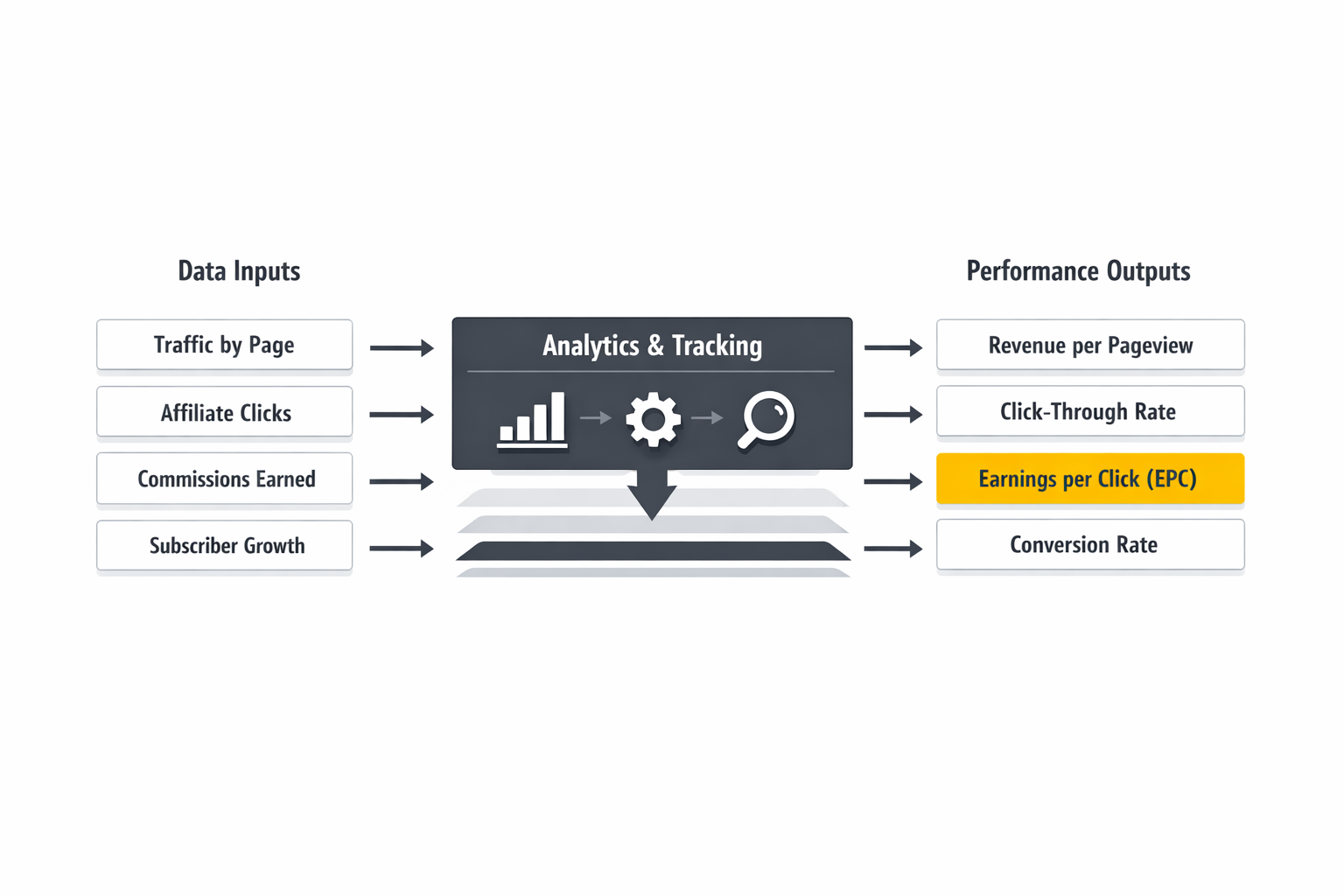
At the site level, a few numbers matter more than almost everything else. You need to know which pages attract buyer-intent traffic, which pages generate affiliate clicks, which pages produce commissions, and which pages help you collect email subscribers before readers leave. If you cannot see those patterns, you will end up optimizing the wrong articles simply because they look busy in analytics.
At the affiliate level, the most useful metrics are click-through rate, conversion rate after the click, earnings per click, and revenue per pageview. Other affiliate networks like Awin build their reporting around these same core performance measures, highlighting clicks, sales, commissions, EPC, conversion rates, and assisted conversions. That is worth paying attention to because it reinforces a larger point: the best affiliates do not just track traffic. They track the quality of traffic and the money each page actually produces.
When you look at those numbers together, implementation gets easier. A page with high traffic but weak click-through rate may need a better recommendation structure. A page with strong clicks but poor revenue may be targeting a weak category. A page with great subscriber capture but low affiliate earnings may be better used as a list-building asset than a direct monetization page. This is where data stops being abstract and starts telling you exactly what to do next.
Compliance Is Not Optional, And The Data Supports That Mindset
One more thing needs to be said clearly: data does not just point to opportunity. It also points to risk. Amazon’s Operating Agreement requires the exact disclosure “As an Amazon Associate I earn from qualifying purchases”, and the FTC makes it equally clear that material connections should be disclosed in a way ordinary people can notice and understand through its updated endorsement guidance.
That is not a technicality. When readers know how you make money and still feel that your recommendation is balanced, your content becomes stronger. Hidden incentives make people suspicious. Clear disclosure combined with honest guidance does the opposite and gives the recommendation more credibility.
So yes, track your numbers obsessively enough to learn. But do it inside a business model that can survive scrutiny. That is how you build something you can keep growing instead of something you are constantly trying to patch.
A Practical Metrics Checklist For Part 4
- Track traffic by page intent so you can separate educational content from money content.
- Measure affiliate click-through rate to see whether the recommendation structure is working.
- Watch conversion and earnings per click because traffic without monetization quality can fool you.
- Compare categories by commission economics before you invest months of content into them.
- Monitor mobile behavior carefully because smartphones now account for the majority of holiday online transactions.
- Track subscriber growth by page so you know which articles are best at building owned attention.
- Keep disclosure visible everywhere it matters so trust rises instead of dropping at the point of monetization.
Why This Data Matters Before You Scale
The big takeaway from this section is that affiliate marketing with Amazon rewards clarity. Clear content strategy, clear lead capture, clear distribution, clear tracking, and clear disclosure all work together. When those pieces are in place, the numbers stop feeling confusing and start showing you exactly where the next gains are hiding.
In Part 5, we are going to zoom out and look at the broader ecosystem around Amazon affiliate marketing. That includes the surrounding tools, partnerships, platform shifts, and long-term expansion decisions that help you move from a functioning affiliate site to a stronger digital business with more leverage.
Measurement And Optimization That Protect Your Margins
This is the part most people skip because it feels less exciting than publishing new content. But in affiliate marketing with Amazon, the money is often hiding in pages you already wrote, links you already placed, and buying journeys that are already getting traffic. If you do not measure what is happening after the visit, you can spend months creating more content when the faster win was sitting inside your existing pages the whole time.
That is especially important because Amazon’s model is efficient but not forgiving. The platform’s own help documentation shows that the standard referral window is usually 24 hours from the click, while the current commission table still varies sharply by category, from 4.5% in categories like physical books, kitchen, and automotive down to 1% in grocery and health-related categories. When the window is short and the rates are uneven, optimization is not optional. It is how you protect the business from leaking revenue at every stage.
Measure Pages By Money, Not Just Traffic
The first shift you need to make is simple: stop judging pages only by pageviews. A page with impressive traffic can still be weak if it attracts the wrong visitor, creates few affiliate clicks, or sends readers to products with poor economics. In affiliate marketing with Amazon, the page that looks “smaller” in analytics is often the one quietly carrying the business because it attracts stronger commercial intent.
This is why revenue per pageview matters so much. It forces you to ask better questions. Is the article bringing in buyers or browsers? Is the recommendation clear enough to earn the click? Is the product category worth the effort? Once you start looking through that lens, your content decisions become much sharper.
You also stop getting distracted by vanity wins. More traffic feels good, but more qualified traffic to better-converting pages is what actually changes the income statement. That is the number that deserves your attention.
Watch Where The Click Journey Breaks
Optimization gets easier when you know where the reader is dropping off. Sometimes the article is ranking and getting readers, but the page does not create enough trust to earn the affiliate click. Sometimes the click happens, but the category is too weak to produce satisfying commissions. Sometimes the content is strong, but the link placement comes too late and the reader leaves before the recommendation becomes obvious.
That means you should look at the journey in stages. Start with search impressions and visits. Then look at click-through rate on affiliate links. Then compare that to the commissions and earnings each page produces. This staged view tells you whether your problem is traffic, persuasion, product economics, or all three working against you at once.
Once you see the break point, you can make surgical improvements instead of random ones. That alone can save a ridiculous amount of time. It also helps you avoid the classic mistake of rewriting a page that did not need a rewrite when the real issue was simply weak link placement or poor product fit.
Optimize The Page Before You Publish More
There is a strong temptation to solve every revenue problem by creating more content. Sometimes that is the right move. Very often, though, the better move is to improve the pages that already have traction. If a page is ranking, being read, and already earning some clicks, it has proven that the market exists. That makes it one of the safest places to invest more effort.
In practice, that may mean rewriting the opening so the reader reaches the buying decision faster. It may mean changing the order of recommendations so the strongest fit appears earlier. It may mean making the “best for” language more specific, cutting filler, improving internal links, or replacing broad claims with sharper comparisons. Small changes can have an outsized effect when the page already has qualified traffic.
This approach is especially smart in affiliate marketing with Amazon because commission rates are not huge in many categories. You do not always need to double traffic to double earnings. Sometimes you just need the page to do a better job converting the traffic it already has.
Improve Earnings With A Better Product Mix
One of the easiest ways to miss revenue in affiliate marketing with Amazon is to treat all products inside a niche as equally valuable. They are not. A page can generate strong clicks and still disappoint financially if the products are low-priced, low-commission, or purchased casually without much basket expansion. That is why your product mix deserves review just as much as your content does.
Look closely at which recommendations are actually moving. Are readers clicking the premium option but buying the entry-level one? Are they responding better to bundles, accessories, or replacement products than to the hero item you assumed would win? Those patterns matter because they reveal how people truly shop inside the niche rather than how you imagined they would shop.
Over time, you want to build pages around product sets that make the economics healthier. That does not mean chasing the most expensive product every time. It means choosing products where your guidance changes the buying decision and the basket value gives that influence room to matter.
Use Email To Recover Lost Opportunity
Not every reader is ready to buy on the first session, and acting like they are will cost you money. Some need more comparison. Some get distracted. Some want to think about it overnight and come back later. In a program with a short attribution window, that behavior can quietly drain revenue unless you have a way to continue the conversation.
Email is one of the best ways to recover that lost opportunity. A short follow-up sequence can revisit the comparison, explain the differences between options, answer objections, and bring the reader back when the decision feels more urgent. That is why solid list-building infrastructure often matters more than people expect in affiliate marketing with Amazon.
Tools like Brevo and Moosend can make this process far easier to maintain, while Systeme.io or ClickFunnels can help you turn category-specific content into simple lead capture and follow-up funnels. The point is not to overbuild. The point is to stop letting interested readers disappear forever.
Refresh Winners And Cut Losers
Optimization is not only about improving what is working. It is also about being honest about what is not. Some pages will never become real earners, no matter how much you tweak them, because the intent is weak, the competition is too strong, or the underlying product opportunity is simply not attractive enough. Keeping those pages alive without a purpose can clutter the site and pull attention away from stronger assets.
That is why pruning and refreshing should both be part of your routine. Refresh pages that already show signs of life. Add better comparisons, update products, improve clarity, and strengthen the route into your money pages. But when a page has had a fair shot and still shows no meaningful commercial potential, it may be smarter to merge it, redirect it, or stop treating it like a priority.
This creates focus. And focus is one of the biggest advantages in affiliate marketing with Amazon because the channel rewards people who can identify what is working and push harder there rather than spreading effort thin across dozens of mediocre opportunities.
Build Systems So Optimization Actually Happens
Here is the truth nobody loves to hear: optimization rarely happens by accident. If you do not build a routine for it, publishing will always steal the spotlight because it feels more productive. The fix is to turn optimization into a normal operating rhythm instead of a vague promise you keep making to yourself.
That can be incredibly simple. Review top money pages every month. Refresh affiliate links and product picks on a schedule. Check which articles gained traffic but did not gain revenue. Track which updates improved clicks and which ones did nothing. When you create a system like that, optimization becomes part of the business rather than an afterthought.
It also gives you compounding benefits. A stronger page earns more, teaches you more, and often improves adjacent pages because you start seeing patterns that repeat across the niche. That is how a modest affiliate site slowly becomes a much more serious operation.
Why Optimization Matters Even More As The Channel Grows
The broader affiliate market is still expanding, which is great news and tough news at the same time. The Performance Marketing Association’s latest industry study says U.S. affiliate marketing spend reached $13.62 billion in 2024, up 49.8% from 2021. That tells you there is still plenty of opportunity here, but it also tells you more operators are competing for the same commercial attention.
In that kind of environment, sloppy execution gets punished faster. Thin pages, unclear recommendations, bad mobile experiences, weak follow-up, and lazy measurement all become more expensive because the market has better alternatives. The affiliates who keep winning are usually not the loudest. They are the ones running cleaner systems.
So think of optimization as your margin defense. It protects your content investment, makes your traffic more valuable, and helps you keep improving even when the market gets noisier. That is how you stay dangerous over the long haul.
A Practical Optimization Checklist For Part 5
- Track revenue per pageview so you can see which pages truly deserve more investment.
- Break the journey into stages and find out whether the leak is traffic, clicks, or commissions.
- Improve existing winners first before assuming the answer is always more content.
- Review your product mix because better economics can outperform higher raw traffic.
- Use email to recover hesitant buyers instead of relying only on first-session clicks.
- Refresh pages with traction and stop overfeeding pages that never showed commercial promise.
- Create a recurring optimization routine so the business keeps improving even when you are busy publishing.
What This Sets Up For The Final Part
At this point, you have the foundation, the framework, the core components, the implementation plan, and the optimization mindset that make affiliate marketing with Amazon far more resilient. That already puts you ahead of most people who treat this business like a few links dropped into generic content. But there is one more level to talk about if you want this to last.
In Part 6, we will look at the broader ecosystem around Amazon affiliate marketing, how to expand intelligently without losing focus, and the most important frequently asked questions that come up when people want to turn this from a side project into a durable digital business.
The Amazon Affiliate Ecosystem And How To Expand Without Losing Focus
By this point, you can probably see the bigger picture. Affiliate marketing with Amazon is not just about publishing a few review posts and hoping the commissions show up. It is an ecosystem business. Your content, your email list, your page structure, your traffic sources, your product selection, and your compliance habits all affect each other. When one part gets stronger, the whole machine gets more stable.
That matters even more now because the channel is growing, not shrinking. The latest Performance Marketing Association industry study shows U.S. affiliate marketing spend reached $13.62 billion in 2024, up 49.8% from 2021. At the same time, Amazon remains one of the largest shopping environments on earth, with the company reporting $638 billion in 2024 revenue. Those numbers do not guarantee easy wins, but they do make one thing very clear: this is still a serious channel for people willing to build it properly.
The mistake is thinking expansion means doing everything at once. It does not. Smart growth in affiliate marketing with Amazon usually means going deeper before going wider. Expand into adjacent product categories your audience already trusts you to cover. Build more entry points into proven buying journeys. Strengthen the email and funnel layer around your best content with tools like Systeme.io, ClickFunnels, Brevo, and Moosend. Then add distribution support with Buffer or Flick so your best pages keep reaching new buyers instead of fading after the first publish.
The other part of the ecosystem is trust. Amazon’s own program rules still require the disclosure “As an Amazon Associate I earn from qualifying purchases”, and the FTC’s endorsement guidance still expects material relationships to be disclosed clearly and conspicuously. That should not scare you. It should clarify the game. The winners in affiliate marketing with Amazon are not the people trying to hide the business model. They are the people whose recommendations are useful enough that transparency actually increases trust.
The Broader Ecosystem Around Affiliate Marketing With Amazon

If you zoom out, the ecosystem becomes easy to understand. Search and content bring in the right people. Email and funnels help you keep a relationship with them. Distribution keeps proven pages alive across multiple channels. Product selection and page structure improve earnings. Compliance protects trust. Measurement tells you where the leaks are. That is the full loop.
Once that loop is running, growth gets much easier. You can expand into adjacent categories. You can publish seasonal buying guides. You can build higher-converting lead magnets. You can create stronger recommendation sequences. And because the business is no longer depending on a single article or a single traffic source, each new piece you add has a better chance of compounding instead of just adding noise.
This is also the moment when affiliate marketing with Amazon starts feeling less fragile. Instead of hoping one article ranks and saves the month, you have a system that gives readers multiple ways to discover you, trust you, and act on your guidance. That is what makes the business durable.
FAQ For This Complete Guide
Is affiliate marketing with Amazon still worth it in 2026?
Yes, but not in the lazy way people often imagine. It is still worth it because Amazon remains a massive shopping platform and the affiliate industry itself keeps expanding, with the PMA’s latest study showing strong channel growth through 2024. What is no longer worth it is thin content, random product selection, and a strategy built on the hope that traffic alone will carry weak pages.
How much can beginners make with affiliate marketing on Amazon?
There is no honest universal number because outcomes depend on traffic quality, niche economics, product mix, and how well your content handles buying intent. Some beginners make almost nothing for months because their pages are too broad or their categories are weak. Others get traction faster because they choose better niches and build decision-focused content from day one. The real takeaway is that Amazon affiliate income is usually earned through a system, not a lucky article.
Do I need a website to do affiliate marketing with Amazon?
A website is still the strongest home base because it lets you control content structure, internal links, email capture, and long-term search visibility. Amazon does allow certain other approved traffic sources in some cases, but a site gives you far more leverage and stability. If you want this to become a durable business instead of a scattered side hustle, owning your publishing platform is the smarter move.
What type of content usually converts best?
The best-converting content usually sits close to a buying decision. That includes “best for” roundups, comparison pages, alternatives posts, problem-solution recommendations, and reviews that explain trade-offs clearly. Informational content still matters, but it works best when it feeds readers into those commercial pages instead of trying to do everything by itself.
How important is email in affiliate marketing with Amazon?
Email matters more than most beginners realize because Amazon’s standard attribution window is typically 24 hours from the click. Many readers are interested but not ready on the first visit. Email gives you a way to continue the conversation, bring them back to updated recommendations, and recover value that would otherwise disappear after that first session ends.
Which Amazon categories are usually more attractive for affiliates?
The answer is not just “the highest rate wins.” Amazon’s official commission table currently shows examples such as 4.5% for physical books, kitchen, and automotive, 3% for many home, sports, and pet categories, 2.5% for PCs and components, and 1% for grocery and health-related categories. The best category for you is usually the one where readers need guidance, the products have meaningful commercial value, and your recommendation can genuinely influence the buying decision.
How many articles do I need before I can expect results?
There is no magic number, because ten weak articles can do less than three strong ones. What matters more is whether your content covers a full decision journey inside a focused niche. If you have a handful of strong money pages, supporting educational pages, and clear internal links between them, you are already in a much better position than someone publishing dozens of random posts without a real structure.
Should I only promote Amazon, or should I diversify?
Amazon can be a great core monetization layer, but depending on one platform entirely always creates risk. Over time, many strong publishers diversify their business model with email offers, lead generation, digital products, sponsorships, or additional affiliate partners where those options make sense. The smart move is to build your Amazon affiliate strategy as a foundation while also creating enough owned audience and business flexibility that one platform never controls your future completely.
How do I stay compliant with Amazon and the FTC?
Start by being direct. Use Amazon’s required disclosure language, which the program rules specify as “As an Amazon Associate I earn from qualifying purchases”. Then make sure the disclosure is visible where real people will notice it, and follow the FTC’s guidance that material connections should be clear and conspicuous. Compliance works best when it is built into the content system from the start instead of being treated like an afterthought.
What metrics matter most in affiliate marketing with Amazon?
The most useful metrics are usually revenue per pageview, affiliate click-through rate, earnings per click, and email subscriber growth by page. Traffic matters, but traffic by itself can be misleading. The goal is to understand which pages attract real buyers, which recommendations earn clicks, and which categories actually produce worthwhile economics once the traffic arrives.
How long does it take to build meaningful income?
It usually takes longer than people want and less time than people fear if the strategy is strong. Affiliate marketing with Amazon is not instant because content has to rank, trust has to build, and the site needs enough structure for the business model to work properly. But when you focus on buyer-intent pages, consistent publishing, lead capture, and optimization, progress becomes far more predictable than it looks from the outside.
Can I do this without being a technical expert?
Yes. You do not need to be a hardcore technical operator to build a strong Amazon affiliate business. What you do need is clarity, discipline, and enough system thinking to connect content, product selection, email, and measurement in a sensible way. In many cases, the people who win are not the most technical. They are the ones who understand the buyer best and keep improving the system over time.
What is the biggest mistake beginners make?
The biggest mistake is treating affiliate marketing with Amazon like a link game instead of a trust game. They chase keywords without understanding intent, promote products without thinking about economics, and publish content that sounds generic because it never really helps the reader decide. Once you understand that the real asset is buyer trust, your content, links, email strategy, and optimization choices all start getting better.
Work With Professionals
If you made it all the way through this guide, you already know something most people never really learn: affiliate marketing with Amazon works best when you treat it like a business, not a trick. That means stronger content, better systems, clearer measurement, better offers, better relationships with your audience, and a willingness to keep improving even after the first wins show up.
And that lesson applies beyond affiliate marketing too. The same discipline that helps you build a profitable recommendation business is the discipline companies want when they hire marketers who can drive growth, manage funnels, build content systems, and turn attention into revenue. So if you want better opportunities in marketing more broadly, it makes sense to put yourself in rooms where serious companies are already looking.
Explore 10K+ Remote Marketing Contracts on MarkeWork.com
Most marketers spend too much time chasing clients, competing on crowded platforms, and losing a percentage of every project to middlemen.
MarkeWork gives you a better way. Browse thousands of remote marketing contracts and connect directly with companies desperate to hire skilled marketers like you — without platform commissions and without unnecessary gatekeepers.
If you’re serious about finding better opportunities and keeping 100% of what you earn, you can explore available contracts and create your profile for free at MarkeWork.com.
 Filip Konecny Enterprises